MHT CET 2025 April 9 Shift 2 PCB Question Paper is available for download here. Maharashtra State CET Cell conducted MHT CET 2025 PCB Exam on April 9 in Shift 2 from 2 PM to 5 PM in CBT mode.
The MHT CET 2025 PCB question paper includes the following:
The MHT CET 2025 PCB Question Paper consists of 200 multiple-choice questions (MCQs) totalling 200 marks divided into 3 sections: Physics (50 questions), Chemistry (50 questions), and Biology (100 questions).
All questions carry 1 mark each. There is no negative marking for incorrect answers.
MHT CET 2025 April 9 Shift 2 PCB Question Paper with Solution PDF
Also Check:
MHT CET 2025 April 9 Shift 2 PCB Questions with Solutions
Physics (Q1 - Q50)
Question 1:
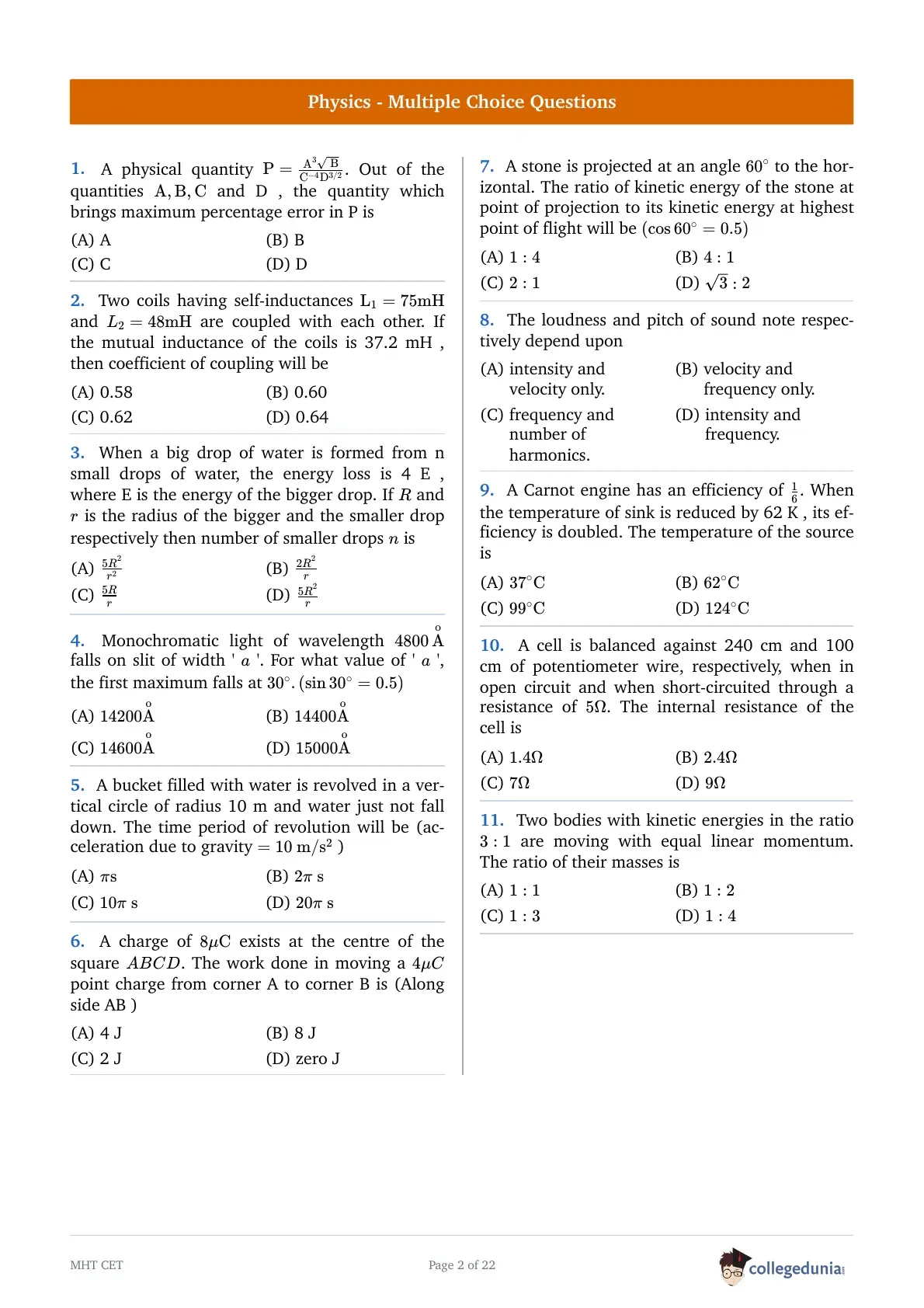
A physical quantity \(\mathrm{P}=\frac{\mathrm{A}^3 \sqrt{\mathrm{~B}}}{\mathrm{C}^{-4} \mathrm{D}^{3 / 2}}\). Out of the quantities \(\mathrm{A}, \mathrm{B}, \mathrm{C}\) and D , the quantity which brings maximum percentage error in P is
Question 2:
Two coils having self-inductances \(\mathrm{L}_1=75 \mathrm{mH}\) and \(L_2=48 \mathrm{mH}\) are coupled with each other. If the mutual inductance of the coils is 37.2 mH , then coefficient of coupling will be
(A) 0.58
(B) 0.60
(C) 0.62
(D) 0.64
Question 3:
When a big drop of water is formed from n small drops of water, the energy loss is 4 E , where E is the energy of the bigger drop. If \(R\) and \(r\) is the radius of the bigger and the smaller drop respectively then number of smaller drops \(n\) is
(A) \(\frac{5R^{2}}{r^{2}}\)
(B) \(\frac{2R^{2}}{r}\)
(C) \(\frac{5R}{r}\)
(D) \(\frac{5R^{2}}{r}\)
Question 4:
Monochromatic light of wavelength \(4800 \mathop {\rm{A}}\limits^{\rm{o}}\) falls on slit of width ' \(a\) '. For what value of ' \(a\) ', the first maximum falls at \(30^{\circ} .\left(\sin 30^{\circ}=0.5\right)\)
(A) \(14200\overset{\mathrm{o}}{\mathrm{A}}\)
(B) \(14400\overset{\mathrm{o}}{\mathrm{A}}\)
(C) \(14600\overset{\mathrm{o}}{\mathrm{A}}\)
(D) \(15000\overset{\mathrm{o}}{\mathrm{A}}\)
Question 5:
A bucket filled with water is revolved in a vertical circle of radius 10 m and water just not fall down. The time period of revolution will be (acceleration due to gravity \(=10 \mathrm{~m} / \mathrm{s}^2\) )
(A) \(\pi \mathrm{s}\)
(B) \(2\pi \text{ }\mathrm{s}\)
(C) \(10\pi \text{ }\mathrm{s}\)
(D) \(20\pi \text{ }\mathrm{s}\)
Question 6:
A charge of \(8 \mu \mathrm{C}\) exists at the centre of the square \(A B C D\). The work done in moving a \(4 \mu C\) point charge from corner A to corner B is (Along side AB )
(A) 4 J
(B) 8 J
(C) 2 J
(D) zero J
Question 7:
A stone is projected at an angle \(60^{\circ}\) to the horizontal. The ratio of kinetic energy of the stone at point of projection to its kinetic energy at highest point of flight will be \(\left(\cos 60^{\circ}=0.5\right)\)
(A) \(1:4\)
(B) \(4:1\)
(C) \(2:1\)
(D) \(\sqrt{3}:2\)
Question 8:
The loudness and pitch of sound note respectively depend upon
(A) intensity and velocity only.
(B) velocity and frequency only.
(C) frequency and number of harmonics.
(D) intensity and frequency.
Question 9:
A Carnot engine has an efficiency of \(\frac{1}{6}\). When the temperature of sink is reduced by 62 K , its efficiency is doubled. The temperature of the source is
Question 10:
A cell is balanced against 240 cm and 100 cm of potentiometer wire, respectively, when in open circuit and when short-circuited through a resistance of \(5 \Omega\). The internal resistance of the cell is
(A) \(1.4\Omega\)
(B) \(2.4\Omega\)
(C) \(7\Omega\)
(D) \(9\Omega\)
Question 11:
Two bodies with kinetic energies in the ratio \(3: 1\) are moving with equal linear momentum. The ratio of their masses is
(A) \(1:1\)
(B) \(1:2\)
(C) \(1:3\)
(D) \(1:4\)
Question 12:
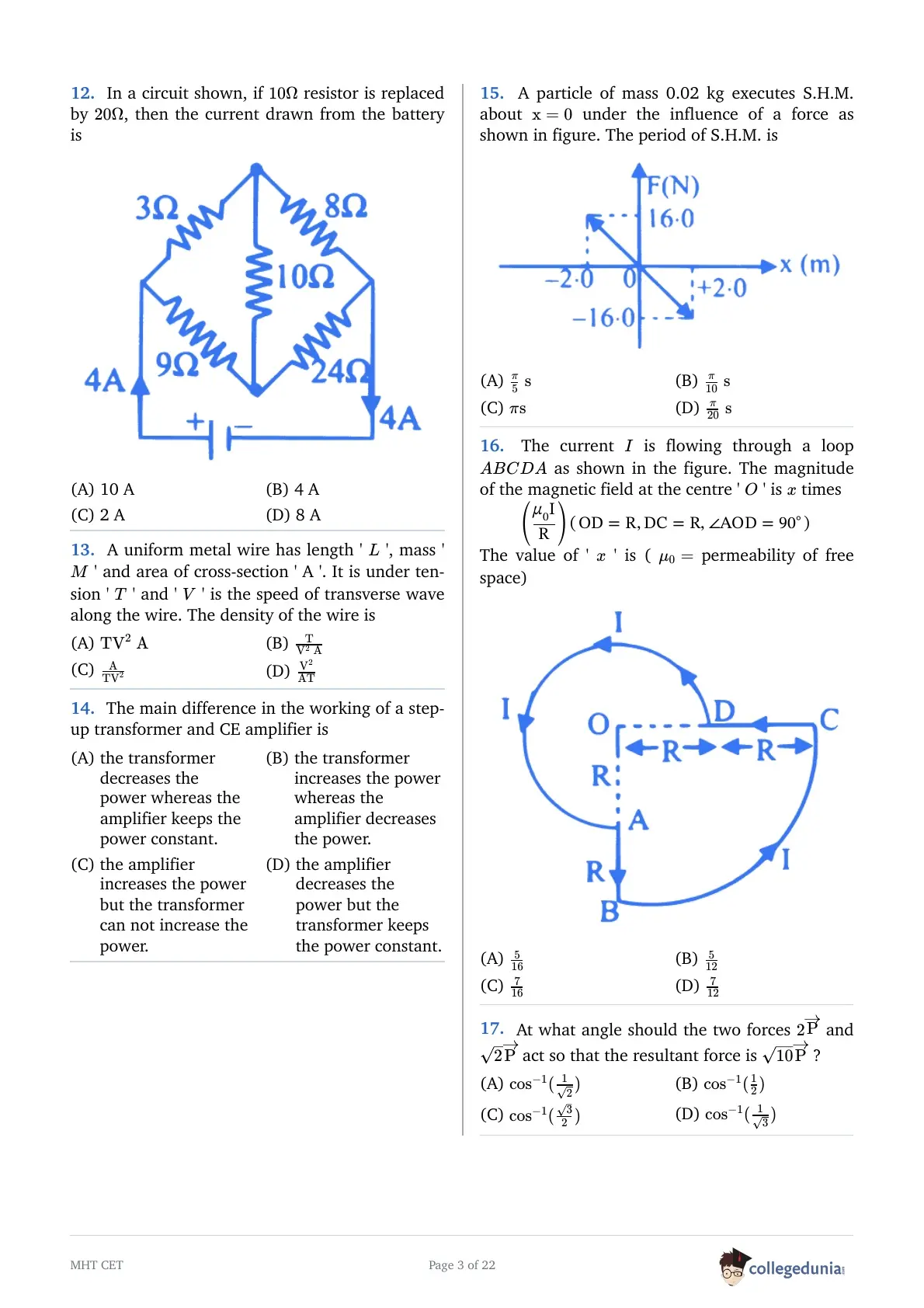
In a circuit shown, if \(10 \Omega\) resistor is replaced by \(20 \Omega\), then the current drawn from the battery is
(A) 10 A
(B) 4 A
(C) 2 A
(D) 8 A
Question 13:
A uniform metal wire has length ' \(L\) ', mass ' \(M\) ' and area of cross-section ' A '. It is under tension ' \(T\) ' and ' \(V\) ' is the speed of transverse wave along the wire. The density of the wire is
(A) \(\mathrm{TV}^{2}\text{ }\mathrm{A}\)
(B) \(\frac{\mathrm{T}}{\mathrm{V}^{2}\text{ }\mathrm{A}}\)
(C) \(\frac{\mathrm{A}}{\mathrm{TV}^{2}}\)
(D) \(\frac{\mathrm{V}^{2}}{\mathrm{AT}}\)
Question 14:
The main difference in the working of a step-up transformer and CE amplifier is
(A) the transformer decreases the power whereas the amplifier keeps the power constant.
(B) the transformer increases the power whereas the amplifier decreases the power.
(C) the amplifier increases the power but the transformer can not increase the power.
(D) the amplifier decreases the power but the transformer keeps the power constant.
Question 15:
A particle of mass 0.02 kg executes S.H.M. about \(\mathrm{x}=0\) under the influence of a force as shown in figure. The period of S.H.M. is
(A) \(\frac{\pi}{5}\text{ }\mathrm{s}\)
(B) \(\frac{\pi}{10}\text{ }\mathrm{s}\)
(C) \(\pi \mathrm{s}\)
(D) \(\frac{\pi}{20}\text{ }\mathrm{s}\)
Question 16:
The current \(I\) is flowing through a loop \(A B C D A\) as shown in the figure. The magnitude of the magnetic field at the centre ' \(O\) ' is \(x\) times
\[ \left(\frac{\mu_0 \mathrm{I}}{\mathrm{R}}\right)\left(\mathrm{OD}=\mathrm{R}, \mathrm{DC}=\mathrm{R}, \angle \mathrm{AOD}=90^{\circ}\right) \]
The value of ' \(x\) ' is ( \(\mu_0=\) permeability of free space)
(A) \(\frac{5}{16}\)
(B) \(\frac{5}{12}\)
(C) \(\frac{7}{16}\)
(D) \(\frac{7}{12}\)
Question 17:
At what angle should the two forces \(2 \overrightarrow{\mathrm{P}}\) and \(\sqrt{2} \overrightarrow{\mathrm{P}}\) act so that the resultant force is \(\sqrt{10} \overrightarrow{\mathrm{P}}\) ?
(A) \(\mathrm{cos}^{-1}(\frac{1}{\sqrt{2}})\)
(B) \(\mathrm{cos}^{-1}(\frac{1}{2})\)
(C) \(\mathrm{cos}^{-1}(\frac{\sqrt{3}}{2})\)
(D) \(\mathrm{cos}^{-1}(\frac{1}{\sqrt{3}})\)
Question 18:
If the r.m.s. velocity of gas is V at temperature T , then
(A) \(\mathrm{VT}^{2}=\) constant
(B) \(\mathrm{V}^{2}\text{ }\mathrm{T}=\) constant
(C) \(\mathrm{V}^{2}/\mathrm{T}=\) constant
(D) \(\mathrm{VT}=\) constant
Question 19:
Light propagates 2 cm distance in glass of refractive index 1.5 in certain time. In the same time same light propogates a distance of 2.25 cm in a medium. The refractive index of the medium is
(A) \(\frac{4}{3}\)
(B) \(\frac{3}{2}\)
(C) \(\frac{8}{3}\)
(D) \(\frac{3}{4}\)
Question 20:
In photoelectric effect experiment, the stopping potential for a given metal is \(\mathrm{V}_0\) (in volt) when radiation of wavelength \(\lambda_0\) is used. If radiation of wavelength \(5 \lambda_0\) is used with the same metal, then the stopping potential is (in volt) ( \(\mathrm{h}=\) Planck's constant, \(\mathrm{c}=\) velocity of light, \(\mathrm{e}=\) electronic charge)
(A) \(\mathrm{V}_{0}-\frac{4\mathrm{hc}}{5\mathrm{e}\lambda _{0}}\)
(B) \(\mathrm{V}_{0}+\frac{4\mathrm{hc}}{5\mathrm{e}\lambda _{0}}\)
(C) \(\mathrm{V}_{0}+\frac{2\mathrm{hc}}{3\mathrm{e}\lambda _{0}}\)
(D) \(\mathrm{V}_{0}-\frac{2\mathrm{hc}}{3\mathrm{e}\lambda _{0}}\)
Question 21:
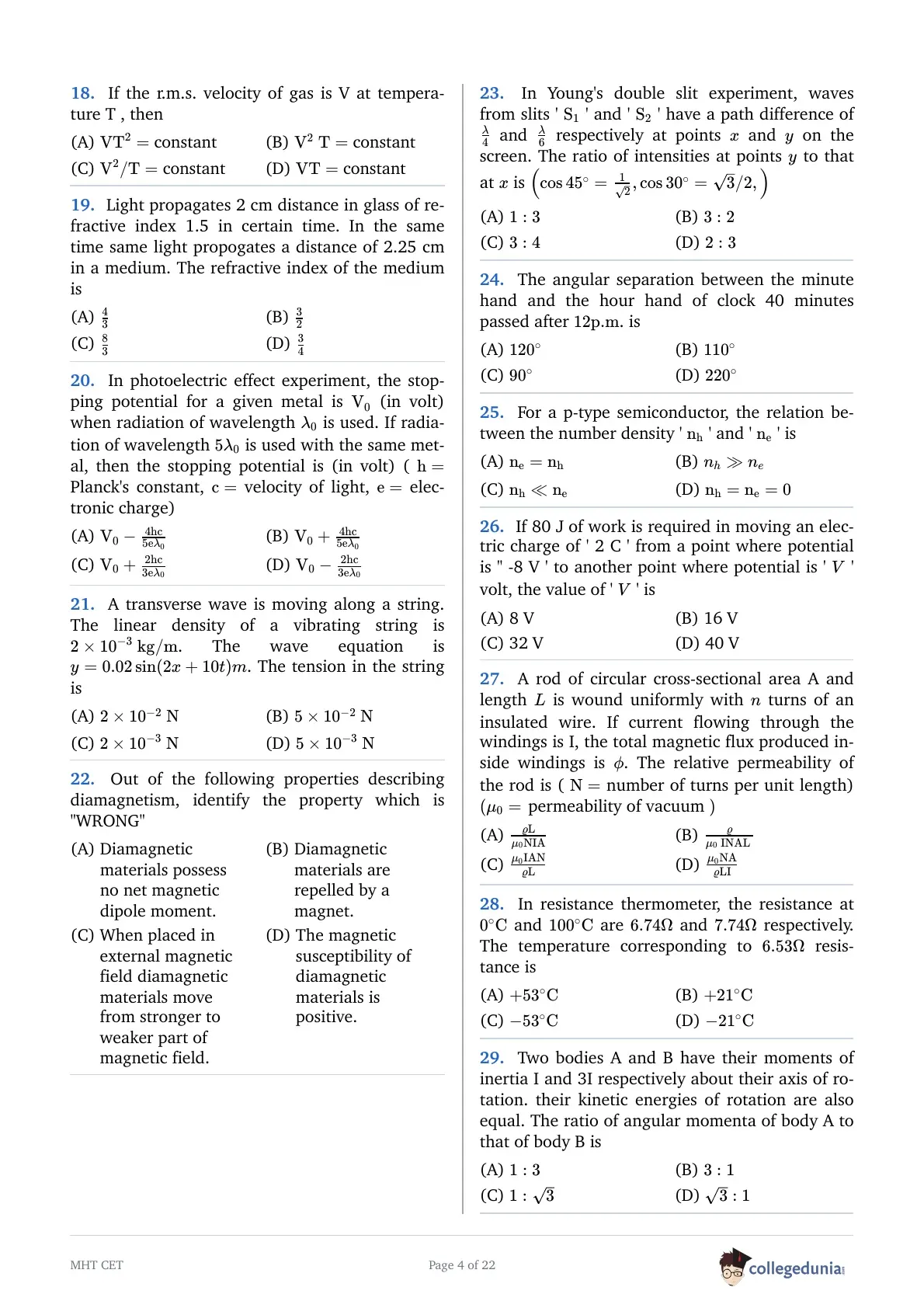
A transverse wave is moving along a string. The linear density of a vibrating string is \(2 \times 10^{-3} \mathrm{~kg} / \mathrm{m}\). The wave equation is \(y=0.02 \sin (2 x+10 t) m\). The tension in the string is
(A) \(2\times 10^{-2}\text{ }\mathrm{N}\)
(B) \(5\times 10^{-2}\text{ }\mathrm{N}\)
(C) \(2\times 10^{-3}\text{ }\mathrm{N}\)
(D) \(5\times 10^{-3}\text{ }\mathrm{N}\)
Question 22:
Out of the following properties describing diamagnetism, identify the property which is "WRONG"
(A) Diamagnetic materials possess no net magnetic dipole moment.
(B) Diamagnetic materials are repelled by a magnet.
(C) When placed in external magnetic field diamagnetic materials move from stronger to weaker part of magnetic field.
(D) The magnetic susceptibility of diamagnetic materials is positive.
Question 23:
In Young's double slit experiment, waves from slits ' \(\mathrm{S}_1\) ' and ' \(\mathrm{S}_2\) ' have a path difference of \(\frac{\lambda}{4}\) and \(\frac{\lambda}{6}\) respectively at points \(x\) and \(y\) on the screen. The ratio of intensities at points \(y\) to that at \(x\) is \(\left(\cos 45^{\circ}=\frac{1}{\sqrt{2}}, \cos 30^{\circ}=\sqrt{3} / 2,\right)\)
(A) \(1:3\)
(B) \(3:2\)
(C) \(3:4\)
(D) \(2:3\)
Question 24:
The angular separation between the minute hand and the hour hand of clock 40 minutes passed after \(12 \mathrm{p} . \mathrm{m}\). is
(A) \(120^{\circ}\)
(B) \(110^{\circ}\)
(C) \(90^{\circ}\)
(D) \(220^{\circ}\)
Question 25:
For a p-type semiconductor, the relation between the number density ' \(\mathrm{n}_{\mathrm{h}}\) ' and ' \(\mathrm{n}_{\mathrm{e}}\) ' is
(A) \(\mathrm{n}_{\mathrm{e}}=\mathrm{n}_{\mathrm{h}}\)
(B) \(n_{h}\gg n_{e}\)
(C) \(\mathrm{n}_{\mathrm{h}}\ll \mathrm{n}_{\mathrm{e}}\)
(D) \(\mathrm{n}_{\mathrm{h}}=\mathrm{n}_{\mathrm{e}}=0\)
Question 26:
If 80 J of work is required in moving an electric charge of ' 2 C ' from a point where potential is " -8 V ' to another point where potential is ' \(V\) ' volt, the value of ' \(V\) ' is
(A) 8 V
(B) 16 V
(C) 32 V
(D) 40 V
Question 28:
In resistance thermometer, the resistance at \(0^{\circ} \mathrm{C}\) and \(100^{\circ} \mathrm{C}\) are \(6.74 \Omega\) and \(7.74 \Omega\) respectively. The temperature corresponding to \(6.53 \Omega\) resistance is
(A) \(+53^{\circ}\mathrm{C}\)
(B) \(+21^{\circ}\mathrm{C}\)
(C) \(-53^{\circ}\mathrm{C}\)
(D) \(-21^{\circ}\mathrm{C}\)
Question 29:
Two bodies A and B have their moments of inertia I and 3I respectively about their axis of rotation. their kinetic energies of rotation are also equal. The ratio of angular momenta of body A to that of body B is
(A) \(1:3\)
(B) \(3:1\)
(C) \(1:\sqrt{3}\)
(D) \(\sqrt{3}:1\)
Question 30:
Glass has refractive index ' \(n\) ' with respect to air and ' \(\theta\) ' is the critical angle for a ray of light going from glass to air. If a ray of light is incident from air on the glass with angle of incidence ' \(\theta\) ', corresponding angle of refraction is
(A) \(\mathrm{sin}^{-1}(\frac{1}{n})\)
(B) \(\mathrm{sin}^{-1}(\mathrm{n})\)
(C) \(\mathrm{sin}^{-1}(\frac{1}{\mathrm{n}^{2}})\)
(D) \(\mathrm{sin}^{-1}(\frac{1}{\sqrt{n}})\)
Question 31:
An elastic conducting material is stretched into a circular loop. It is placed with its plane perpendicular to uniform magnetic field \(\mathrm{B}=0.6 \mathrm{~T}\). When loop is released, the radius starts shrinking at constant rate \(3 \mathrm{~cm} / \mathrm{s}\). The induced e.m.f. in the loop at an instant when the radius of the loop is 10 cm will be (in mV )
(A) \(2.6\pi\)
(B) \(3.6\pi\)
(C) \(3.2\pi\)
(D) \(1.8\pi\)
Question 32:
Two solid spheres of same material but of mass ' M ' and ' 8 M ' fall simultaneously through a viscous liquid. Their terminal velocities are respectively ' V ' and ' nV '. The value ' n ' is
Question 33:
Magnetic field at the centre of a circular loop of area ' \(A\) ' is ' \(B\) '. The magnetic moment of the loop is ' \(x B\) '. The value of ' \(x\) ' is ( \(\mu_0=\) permeability of vacuum or free space)
(A) \(\frac{\sqrt{A^{3}}}{\mu _{0}\pi}\)
(B) \(\frac{2\sqrt{A}}{\mu _{0}\pi}\)
(C) \(\frac{2}{\mu _{0}}\sqrt{\frac{\text{ }\mathrm{A}^{3}}{\pi}}\)
(D) \(\frac{2}{\mu _{0}}\sqrt{\frac{\text{ }\mathrm{A}}{\pi}}\)
Question 34:
An ideal gas in a container of volume 500 cc is at a pressure of \(2 \times 10^5 \mathrm{~N} / \mathrm{m}^2\). The average kinetic energy of each molecule is \(6 \times 10^{-21} \mathrm{~J}\). The number of gas molecules in the container is
(A) \(5\times 10^{25}\)
(B) \(5\times 10^{23}\)
(C) \(25\times 10^{23}\)
(D) \(2.5\times 10^{22}\)
Question 35:
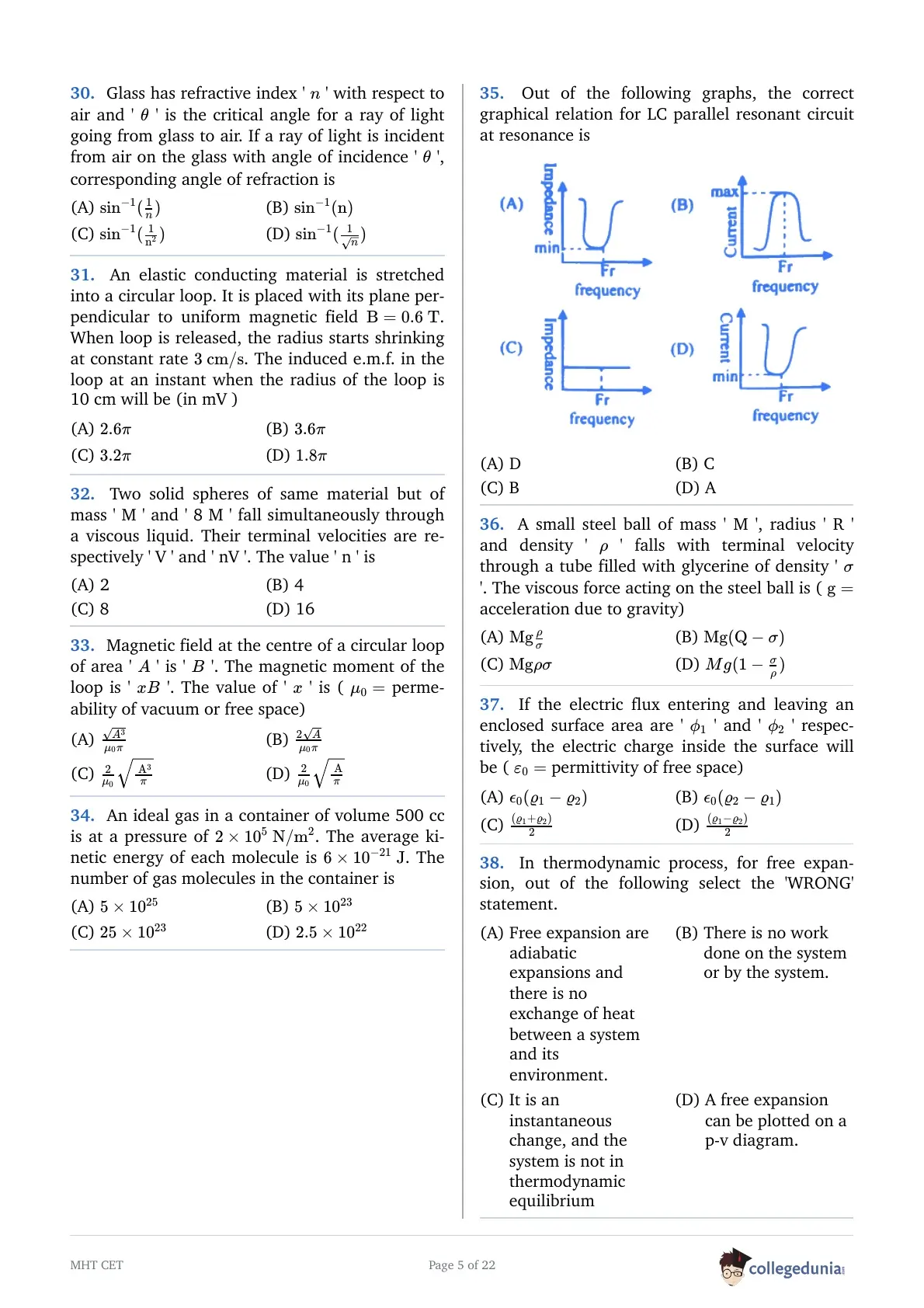
Out of the following graphs, the correct graphical relation for LC parallel resonant circuit at resonance is
Question 36:
A small steel ball of mass ' M ', radius ' R ' and density ' \(\rho\) ' falls with terminal velocity through a tube filled with glycerine of density ' \(\sigma\) '. The viscous force acting on the steel ball is ( \(\mathrm{g}=\) acceleration due to gravity)
(A) \(\mathrm{Mg}\frac{\rho}{\sigma}\)
(B) \(\mathrm{Mg}(\mathrm{Q}-\sigma )\)
(C) \(\mathrm{Mg}\rho \sigma\)
(D) \(Mg(1-\frac{\sigma}{\rho})\)
Question 37:
If the electric flux entering and leaving an enclosed surface area are ' \(\phi_1\) ' and ' \(\phi_2\) ' respectively, the electric charge inside the surface will be ( \(\varepsilon_0=\) permittivity of free space)
(A) \(\epsilon _{0}(\varrho _{1}-\varrho _{2})\)
(B) \(\epsilon _{0}(\varrho _{2}-\varrho _{1})\)
(C) \(\frac{(\varrho _{1}+\varrho _{2})}{2}\)
(D) \(\frac{(\varrho _{1}-\varrho _{2})}{2}\)
Question 38:
In thermodynamic process, for free expansion, out of the following select the 'WRONG' statement.
(A) Free expansion are adiabatic expansions and there is no exchange of heat between a system and its environment.
(B) There is no work done on the system or by the system.
(C) It is an instantaneous change, and the system is not in thermodynamic equilibrium
(D) A free expansion can be plotted on a p-v diagram.
Question 39:
The frequency of oscillation of LCR series circuit is ' \(F\) '. The value of capacitance is tripled, then new frequency becomes ' xF '. The value of ' \(x\) ' is
(A) \(\sqrt{3}\)
(B) \(\frac{1}{\sqrt{3}}\)
(C) \(\frac{1}{6}\)
(D) \(\frac{1}{\sqrt{6}}\)
Question 40:
The heat required to increase the temperature from 373 K to 573 K at constant volume for ideal monoatomic gas of 2 moles is ( \(R=\) universal gas constant)
(A) 900 R
(B) \(300\mathrm{R}\)
(C) 1200 R
(D) 600 R
Question 41:
Two (A and B) pendulums begin to swing simultaneously. The first pendulum (A) makes five oscillations when the other (B) makes three oscillations. The ratio of the lengths of pendulum \(A\) to that of \(B\) is
(A) \(3:5\)
(B) \(9:25\)
(C) \(5:3\)
(D) \(2:3\)
Question 42:
Two identical photocathodes receive light of frequencies ' \(f 1\) ' and ' \(f_2\) '. The velocity of the photoelectrons of mass ' \(m\) ' emitted are respectively ' \(\mathrm{v}_1\) ' and ' \(\mathrm{v}_2\) '. Then the correct relation is ( \(\mathrm{h}=\) Planck's constant)
(A) \(v_{1}-v_{2}=[\frac{2h}{m}(f_{1}-f_{2})]^{\frac{1}{2}}\)
(B) \(v_{1}+v_{2}=[\frac{2h}{m}(f_{1}+f_{2})]^{\frac{1}{2}}\)
(C) \(v_{1}^{2}-v_{2}^{2}=\frac{2h}{m}(f_{1}-f_{2})\)
(D) \(v_{1}^{2}+v_{2}^{2}=\frac{2h}{m}(f_{1}+f_{2})\)
Question 43:
The capacitive reactance of a capacitor connected to 50 V d.c. is
(A) zero.
(B) \(10\Omega\).
(C) \(50\Omega\).
(D) infinity.
Question 44:
A particle performs S.H.M. with amplitude 'A'. The speed of the particle is \(\left(\frac{1}{3}\right)^{\text {rd }}\) of the maximum speed when its displacement from the mean position is
(A) \(\frac{\mathrm{A}}{3}\)
(B) \(\frac{\sqrt{2}\text{ }\mathrm{A}}{3}\)
(C) \(\frac{2\sqrt{2}\text{ }\mathrm{A}}{3}\)
(D) \(\frac{2\text{ }\mathrm{A}}{3}\)
Question 45:
In the Bohr model of hydrogen atom, out of the following quantities, the principal quantum number is proportional to ( \(\mathrm{R}, \mathrm{V}\) and E represent radius of the orbit, speed of electron and total energy of the electron respectively)
Question 46:
An open organ pipe and a closed organ pipe have the frequency of their second overtone identical. The ratio of length of closed pipe to that of open pipe is (Neglect end correction)
(A) \(2:3\)
(B) \(5:6\)
(C) \(3:4\)
(D) \(6:7\)
Question 47:
An object is released from a distance ' \(r\) ' from the centre of the earth. The velocity of the object at the time of striking the earth will be ( \(R=\) radius of earth, \(r>R, g=\) acceleration due to gravity)
(A) \([2\mathrm{gR}(\mathrm{r}-\mathrm{R})/\mathrm{r}]^{\frac{1}{2}}\)
(B) \([gR(r-R)/r^{2}]^{\frac{1}{2}}\)
(C) \([2\mathrm{gR}(\mathrm{r}-\mathrm{R})/\mathrm{r}^{2}]^{\frac{1}{2}}\)
(D) \([gR^{2}(r-R)/r^{2}]^{\frac{1}{2}}\)
Question 48:
According to Bohr's first postulate the kinetic energy \(\frac{1}{2} m v^2\) of the electron in C.G.S. system is ( \(\mathrm{m}=\) mass of electron, v is its velocity, r is the radius of the stationary orbit around the nucleus with charge Ze )
(A) \(\frac{\mathrm{Ze}}{\mathrm{r}^{2}}\)
(B) \(\frac{\mathrm{Ze}^{2}}{\mathrm{r}}\)
(C) \(\frac{\mathrm{Ze}^{2}}{2\mathrm{r}}\)
(D) \(\frac{\mathrm{Ze}^{2}}{2\mathrm{r}^{2}}\)
Question 49:
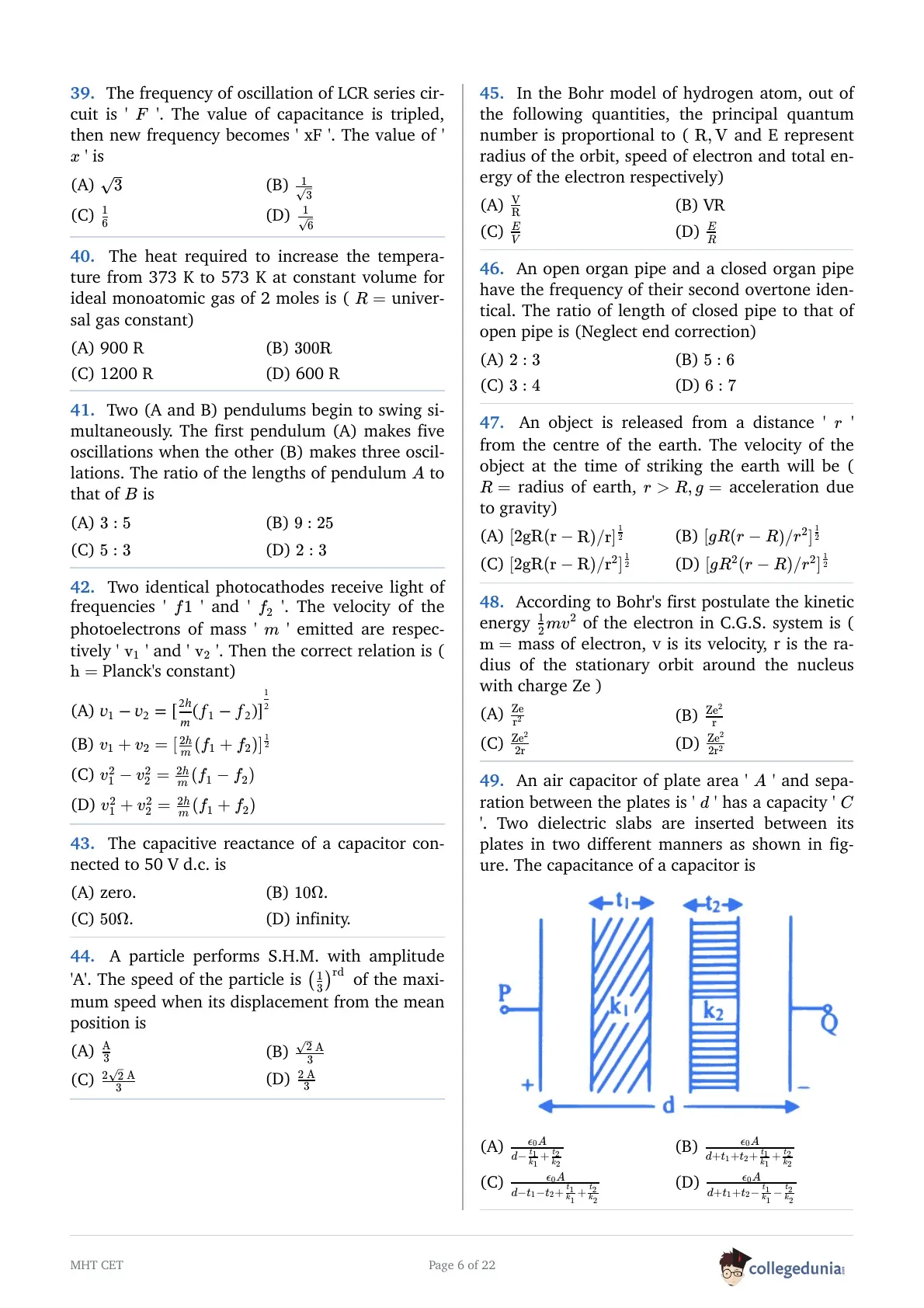
An air capacitor of plate area ' \(A\) ' and separation between the plates is ' \(d\) ' has a capacity ' \(C\) '. Two dielectric slabs are inserted between its plates in two different manners as shown in figure. The capacitance of a capacitor is
(A) \(\frac{\epsilon _{0}A}{d-\frac{t_{1}}{k_{1}}+\frac{t_{2}}{k_{2}}}\)
(B) \(\frac{\epsilon _{0}A}{d+t_{1}+t_{2}+\frac{t_{1}}{k_{1}}+\frac{t_{2}}{k_{2}}}\)
(C) \(\frac{\epsilon _{0}A}{d-t_{1}-t_{2}+\frac{t_{1}}{k_{1}}+\frac{t_{2}}{k_{2}}}\)
(D) \(\frac{\epsilon _{0}A}{d+t_{1}+t_{2}-\frac{t_{1}}{k_{1}}-\frac{t_{2}}{k_{2}}}\)
Question 50:
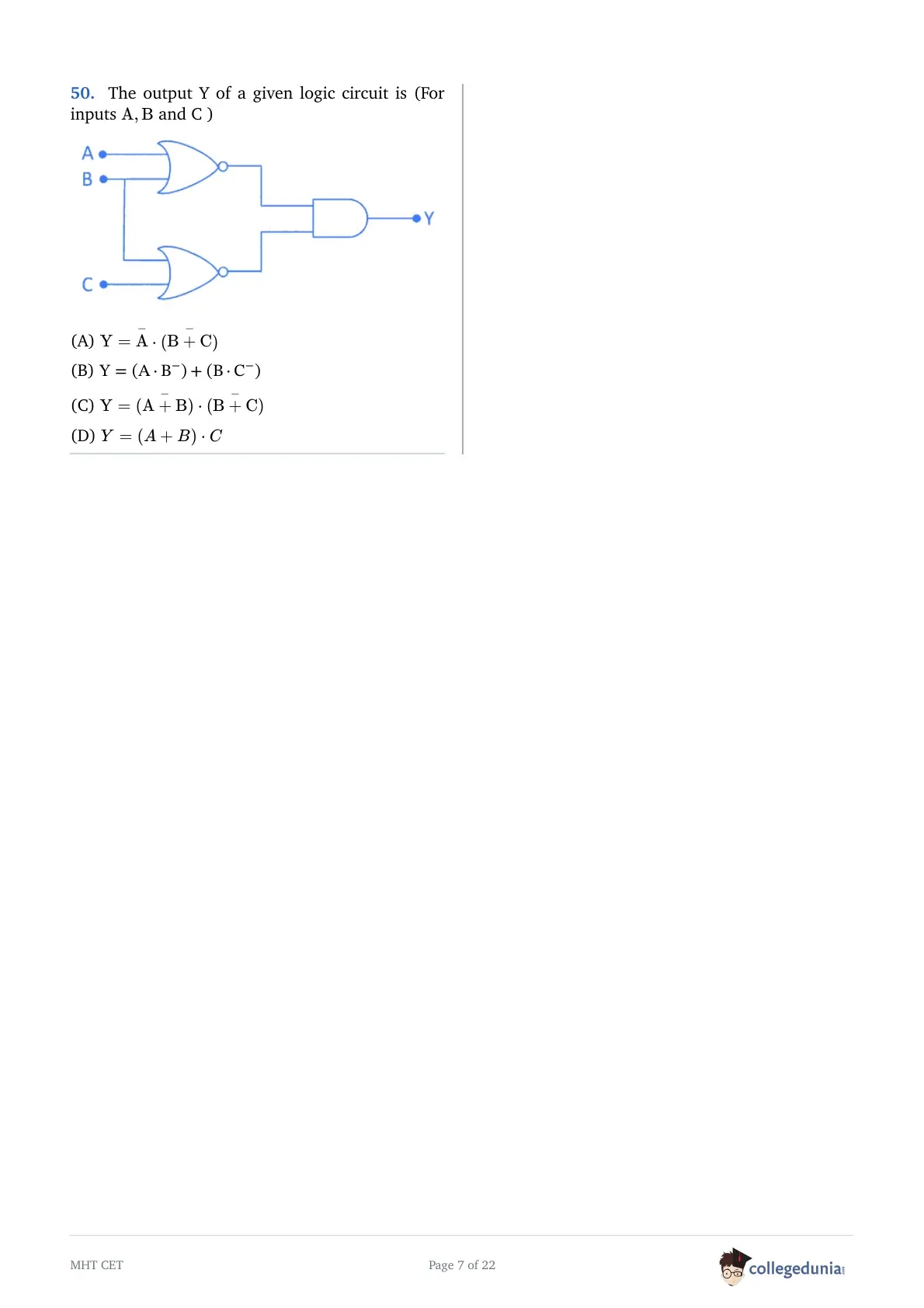
The output Y of a given logic circuit is (For inputs \(\mathrm{A}, \mathrm{B}\) and C )
(A) \(\mathrm{Y}=\overset{-}{\mathrm{A}}\cdot (\overset{-}{\mathrm{B}+\mathrm{C}})\)
(B) \(\mathrm{Y}=(\overset{-}{\mathrm{A}\cdot \mathrm{B}})+(\overset{-}{\mathrm{B}\cdot \mathrm{C}})\)
(C) \(\mathrm{Y}=(\overset{-}{\mathrm{A}+\mathrm{B}})\cdot (\overset{-}{\mathrm{B}+\mathrm{C}})\)
(D) \(Y=(A+B)\cdot C\)
Chemistry (Q51 - Q100)
Question 51:
Identify thermoplastic polymer from following.
(A) Urea formaldehyde resin
(B) Polystyrene
(C) Nylon 6,6
(D) Vulcunized rubber
Question 52:
Which from following compounds is called Gammexane?
(A) Chlorobenzene
(B) DDT
(C) Benzene hexachloride
(D) Benzoyl chloride
Question 53:
Which of the following cations is involved in formation of chlorophyll molecule in plants?
(A) \(\mathrm{Na}^{+}\)
(B) \(\mathrm{Sr}^{2+}\)
(C) \(\mathrm{Mg}^{2+}\)
(D) \(\mathrm{Ca}^{2+}\)
Question 55:
What type of hybridisation is found in \(\mathrm{H}_2 \mathrm{Se}\) ?
Question 56:
Which from following compounds is used as analgesics?
(A) BHT
(B) Methyl Salicylate
(C) Gallic acid
(D) Curcumin
Question 57:
Calculate the osmotic pressure of 0.01 M aqueous solution of non electrolyte at 300 K .
\[ \left[\mathrm{R}=0.0821 \mathrm{~atm} \mathrm{dm}^3 \mathrm{~K}^{-1} \mathrm{~mol}^{-1}\right] \]
(A) 0.121 atm
(B) 0.246 atm
(C) 0.356 atm
(D) 0.412 atm
Question 58:
What is the percent void volume in hcp lattice?
(A) \(68.00\%\)
(B) \(47.6\%\)
(C) \(26.00\%\)
(D) \(32.00\%\)
Question 59:
Identify the product ' X ' in following reaction.
Ethanoyl chloride \(\xrightarrow{\mathrm{H}_2 \mathrm{O}} X\)
(A) Ethanol
(B) Ethanoic acid
(C) Ethanal
(D) Ethyl ethanoate
Question 60:
Identify the major product obtained in the reaction of chlorobenzene with chlorine in presence of anhydrous \(\mathrm{FeCl}_3\).
(A) 1,2-Dichlorobenzene
(B) 1,3-Dichlorobenzene
(C) 1,4-Dichlorobenzene
(D) 1,3,5-Trichlorobenzene
Question 61:
Which from following reagents is NOT involved in Sandmeyer reaction?
(A) \(\mathrm{CuCl}/\mathrm{HCl}\)
(B) \(\mathrm{CuBr}/\mathrm{HBr}\)
(C) \(\mathrm{CuCN}/\mathrm{KCN}\)
(D) Cu (Powder) \(/\mathrm{HCl}\)
Question 62:
Identify positively charged sol from following.
(A) Starch
(B) Gum
(C) Methylene Blue
(D) Gelatin
Question 63:
The solubility of sparingly soluble, salt \(\mathrm{AX}_2\) is \(1.5 \times 10^{-3} \mathrm{~mol} \mathrm{dm}^{-3}\). What is its solubility product?
(A) \(1.65\times 10^{-7}\)
(B) \(1.35\times 10^{-8}\)
(C) \(2.25\times 10^{-8}\)
(D) \(1.15\times 10^{-7}\)
Question 64:
Which of the following species acts as an oxidising agent during working of hydrogenoxygen fuel cell?
(A) \(\mathrm{H}_{2}\)
(B) \(\mathrm{H}^{+}\)
(C) \(\mathrm{O}_{2}\)
(D) NaOH
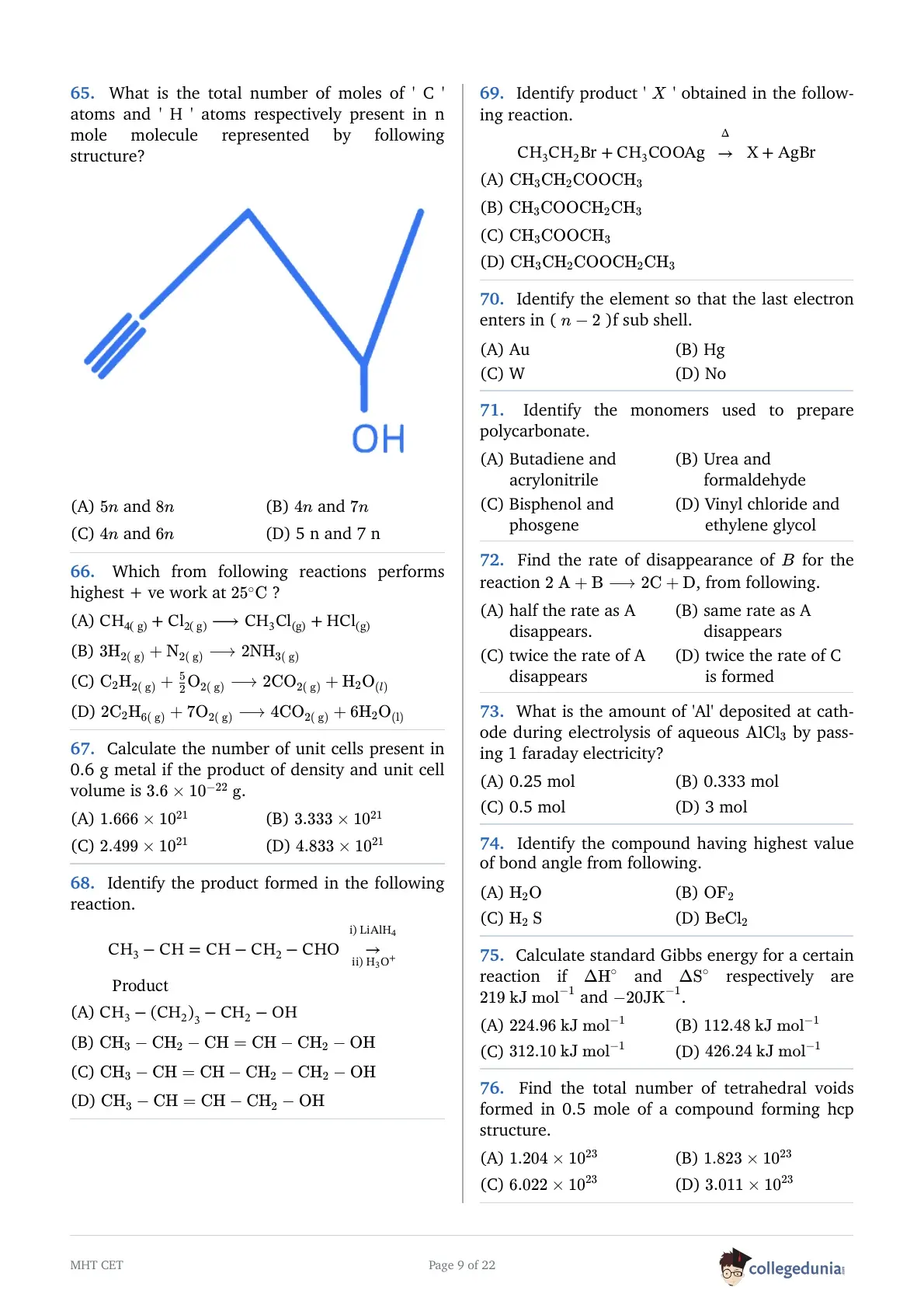
Question 65:
What is the total number of moles of ' C ' atoms and ' H ' atoms respectively present in n mole molecule represented by following structure?
(A) \(5n\) and \(8n\)
(B) \(4n\) and \(7n\)
(C) \(4n\) and \(6n\)
(D) 5 n and 7 n
Question 66:
Which from following reactions performs highest + ve work at \(25^{\circ} \mathrm{C}\) ?
(A) \(\mathrm{CH}_{4(\text{ }\mathrm{g})}+\mathrm{Cl}_{2(\text{ }\mathrm{g})}\longrightarrow \mathrm{CH}_{3}\mathrm{Cl}_{(\mathrm{g})}+\mathrm{HCl}_{(\mathrm{g})}\)
(B) \(3\mathrm{H}_{2(\text{ }\mathrm{g})}+\mathrm{N}_{2(\text{ }\mathrm{g})}\longrightarrow 2\mathrm{NH}_{3(\text{ }\mathrm{g})}\)
(C) \(\mathrm{C}_{2}\mathrm{H}_{2(\text{ }\mathrm{g})}+\frac{5}{2}\mathrm{O}_{2(\text{ }\mathrm{g})}\longrightarrow 2\mathrm{CO}_{2(\text{ }\mathrm{g})}+\mathrm{H}_{2}\mathrm{O}_{(l)}\)
(D) \(2\mathrm{C}_{2}\mathrm{H}_{6(\text{ }\mathrm{g})}+7\mathrm{O}_{2(\text{ }\mathrm{g})}\longrightarrow 4\mathrm{CO}_{2(\text{ }\mathrm{g})}+6\mathrm{H}_{2}\mathrm{O}_{(\mathrm{l})}\)
Question 67:
Calculate the number of unit cells present in 0.6 g metal if the product of density and unit cell volume is \(3.6 \times 10^{-22} \mathrm{~g}\).
(A) \(1.666\times 10^{21}\)
(B) \(3.333\times 10^{21}\)
(C) \(2.499\times 10^{21}\)
(D) \(4.833\times 10^{21}\)
Question 68:
Identify the product formed in the following reaction.
\[
\mathrm{CH}_3-\mathrm{CH}=\mathrm{CH}-\mathrm{CH}_2-\mathrm{CHO} \xrightarrow[\text { ii) } \mathrm{H}_3 \mathrm{O}^{+}]{\text {i) } \mathrm{LiAlH}_4} \text { Product }
\]
(A) \(\mathrm{CH}_{3}-(\mathrm{CH}_{2})_{3}-\mathrm{CH}_{2}-\mathrm{OH}\)
(B) \(\mathrm{CH}_{3}-\mathrm{CH}_{2}-\mathrm{CH}=\mathrm{CH}-\mathrm{CH}_{2}-\mathrm{OH}\)
(C) \(\mathrm{CH}_{3}-\mathrm{CH}=\mathrm{CH}-\mathrm{CH}_{2}-\mathrm{CH}_{2}-\mathrm{OH}\)
(D) \(\mathrm{CH}_{3}-\mathrm{CH}=\mathrm{CH}-\mathrm{CH}_{2}-\mathrm{OH}\)
Question 69:
Identify product ' \(X\) ' obtained in the following reaction.
\[ \mathrm{CH}_3 \mathrm{CH}_2 \mathrm{Br}+\mathrm{CH}_3 \mathrm{COOAg} \xrightarrow{\Delta} \mathrm{X}+\mathrm{AgBr} \]
(A) \(\mathrm{CH}_{3}\mathrm{CH}_{2}\mathrm{COOCH}_{3}\)
(B) \(\mathrm{CH}_{3}\mathrm{COOCH}_{2}\mathrm{CH}_{3}\)
(C) \(\mathrm{CH}_{3}\mathrm{COOCH}_{3}\)
(D) \(\mathrm{CH}_{3}\mathrm{CH}_{2}\mathrm{COOCH}_{2}\mathrm{CH}_{3}\)
Question 70:
Identify the element so that the last electron enters in ( \(n-2\) )f sub shell.
(A) Au
(B) Hg
(C) W
(D) No
Question 71:
Identify the monomers used to prepare polycarbonate.
Question 72:
Find the rate of disappearance of \(B\) for the reaction \(2 \mathrm{~A}+\mathrm{B} \longrightarrow 2 \mathrm{C}+\mathrm{D}\), from following.
(A) half the rate as A disappears.
(B) same rate as A disappears
(C) twice the rate of A disappears
(D) twice the rate of C is formed
Question 73:
What is the amount of 'Al' deposited at cathode during electrolysis of aqueous \(\mathrm{AlCl}_3\) by passing 1 faraday electricity?
(A) 0.25 mol
(B) 0.333 mol
(C) 0.5 mol
(D) 3 mol
Question 74:
Identify the compound having highest value of bond angle from following.
Question 75:
Calculate standard Gibbs energy for a certain reaction if \(\Delta \mathrm{H}^{\circ}\) and \(\Delta \mathrm{S}^{\circ}\) respectively are \(219 \mathrm{~kJ} \mathrm{~mol}^{-1}\) and \(-20 \mathrm{JK}^{-1}\).
(A) \(224.96\text{ }\mathrm{kJ}\text{ }\mathrm{mol}^{-1}\)
(B) \(112.48\text{ }\mathrm{kJ}\text{ }\mathrm{mol}^{-1}\)
(C) \(312.10\text{ }\mathrm{kJ}\text{ }\mathrm{mol}^{-1}\)
(D) \(426.24\text{ }\mathrm{kJ}\text{ }\mathrm{mol}^{-1}\)
Question 76:
Find the total number of tetrahedral voids formed in 0.5 mole of a compound forming hcp structure.
(A) \(1.204\times 10^{23}\)
(B) \(1.823\times 10^{23}\)
(C) \(6.022\times 10^{23}\)
(D) \(3.011\times 10^{23}\)
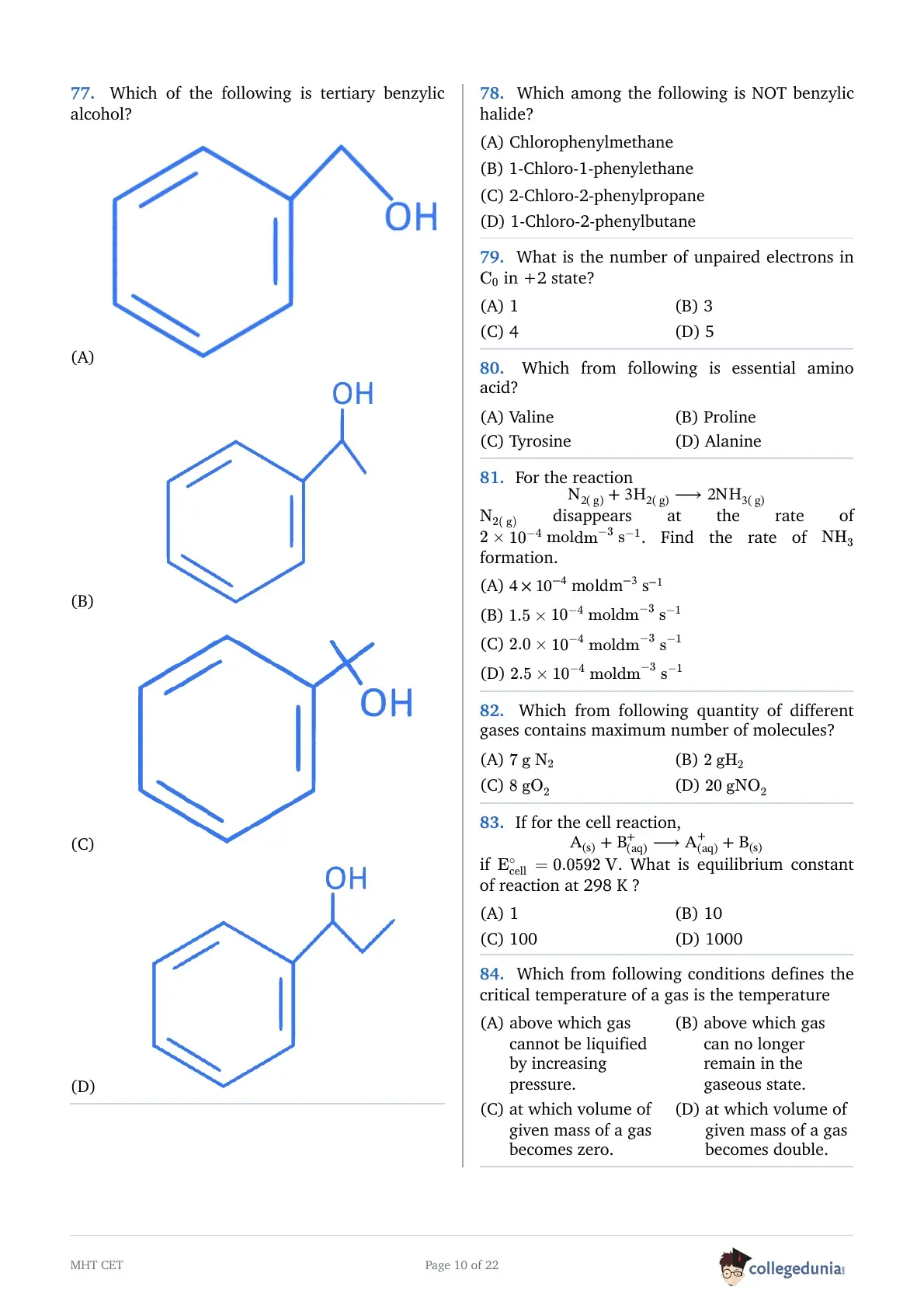
Question 77:
Which of the following is tertiary benzylic alcohol?
Question 78:
Which among the following is NOT benzylic halide?
(A) Chlorophenylmethane
(B) 1-Chloro-1-phenylethane
(C) 2-Chloro-2-phenylpropane
(D) 1-Chloro-2-phenylbutane
Question 79:
What is the number of unpaired electrons in \(\mathrm{C}_0\) in +2 state?
Question 80:
Which from following is essential amino acid?
(A) Valine
(B) Proline
(C) Tyrosine
(D) Alanine
Question 81:
For the reaction
\[ \mathrm{N}_{2(\mathrm{~g})}+3 \mathrm{H}_{2(\mathrm{~g})} \longrightarrow 2 \mathrm{NH}_{3(\mathrm{~g})} \]
\(\mathrm{N}_{2(\mathrm{~g})}\) disappears at the rate of \(2 \times 10^{-4} \mathrm{~mol} \mathrm{dm}^{-3} \mathrm{~s}^{-1}\). Find the rate of \(\mathrm{NH}_3\) formation.
(A) \(4\times 10^{-4}\text{ }\mathrm{moldm}^{-3}\text{ }\mathrm{s}^{-1}\)
(B) \(1.5\times 10^{-4}\text{ }\mathrm{moldm}^{-3}\text{ }\mathrm{s}^{-1}\)
(C) \(2.0\times 10^{-4}\text{ }\mathrm{moldm}^{-3}\text{ }\mathrm{s}^{-1}\)
(D) \(2.5\times 10^{-4}\text{ }\mathrm{moldm}^{-3}\text{ }\mathrm{s}^{-1}\)
Question 82:
Which from following quantity of different gases contains maximum number of molecules?
(A) \(7\text{ }\mathrm{g}\text{ }\mathrm{N}_{2}\)
(B) \(2\text{ }\mathrm{gH}_{2}\)
(C) \(8\text{ }\mathrm{gO}_{2}\)
(D) \(20\text{ }\mathrm{gNO}_{2}\)
Question 83:
If for the cell reaction,
\[ \mathrm{A}_{(\mathrm{s})}+\mathrm{B}_{(\mathrm{aq})}^{+} \longrightarrow \mathrm{A}_{(\mathrm{aq})}^{+}+\mathrm{B}_{(\mathrm{s})} \]
if \(\mathrm{E}_{\text {cell }}^{\circ}=0.0592 \mathrm{~V}\). What is equilibrium constant of reaction at 298 K ?
(A) 1
(B) 10
(C) 100
(D) 1000
Question 84:
Which from following conditions defines the critical temperature of a gas is the temperature
(A) above which gas cannot be liquified by increasing pressure.
(B) above which gas can no longer remain in the gaseous state.
(C) at which volume of given mass of a gas becomes zero.
(D) at which volume of given mass of a gas becomes double.
Question 86:
Which from following units of concentrations of solutions is temperature independent?
(A) Molarity
(B) Mole fraction
(C) Percent by volume
(D) Mass by volume
Question 87:
Which of the following is a pair of dihydric phenols?
(A) Resorcinol and pyrogallol
(B) Quinol and phloroglucinol
(C) Phloroglucinol and pyrogallol
(D) Catechol and quinol
Question 88:
Identify the products of following reaction.
\[ \mathrm{C}_6 \mathrm{H}_5 \mathrm{COOC}_2 \mathrm{H}_5 \xrightarrow[\text { dil H}_2 \mathrm{SO}_4]{\Delta} \text { Products } \]
(A) \(\mathrm{C}_{6}\mathrm{H}_{5}\mathrm{OH}+\mathrm{C}_{2}\mathrm{H}_{5}\mathrm{OH}\)
(B) \(\mathrm{C}_{6}\mathrm{H}_{5}\mathrm{OH}+\mathrm{C}_{2}\mathrm{H}_{5}\mathrm{COOH}\)
(C) \(\mathrm{C}_{6}\mathrm{H}_{5}\mathrm{COOH}+\mathrm{C}_{2}\mathrm{H}_{5}\mathrm{OH}\)
(D) \(\mathrm{C}_{6}\mathrm{H}_{5}\mathrm{COOH}+\mathrm{C}_{2}\mathrm{H}_{5}\mathrm{COOH}\)
Question 89:
Identify the correct decreasing order of stability of complexes formed by divalent metal ions with same ligand.
(A) \(\mathrm{Co}^{2+}>\mathrm{Fe}^{2+}>\mathrm{Ni}^{2+}\)
(B) \(\mathrm{Fe}^{2+}>\mathrm{Co}^{2+}>\mathrm{Ni}^{2+}\)
(C) \(\mathrm{Ni}^{2+}>\mathrm{Co}^{2+}>\mathrm{Fe}^{2+}\)
(D) \(\mathrm{Ni}^{2+}>\mathrm{Fe}^{2+}>\mathrm{Co}^{2+}\)
Question 90:
Which from following tests for glucose confirms presence of carbonyl group?
(A) Action of \(\mathrm{NH}_{2}\mathrm{OH}\) to form oxime
(B) Heating with HI forming \(n\)-hexane
(C) Formation of pentaacetate derivative when reacted with acetic anhydride
(D) Glucose and gluconic acid both form saccharic acid when treated with dilute \(\mathrm{HNO}_{3}\)
Question 91:
Half life of a first order reaction is 3 hours. Calculate the value of \(\frac{[\mathrm{A}]_0}{[\mathrm{~A}]_{\mathrm{t}}}\) after 8 hours.
(A) 2.17
(B) 4.34
(C) 6.34
(D) 8.12
Question 92:
What is the average oxidation number of carbon in carbon suboxide \(\mathrm{C}_3 \mathrm{O}_2\) ?
(A) 0
(B) \(+\frac{1}{3}\)
(C) \(+\frac{4}{3}\)
(D) +2
Question 93:
Solubility of \(\mathrm{Mg}(\mathrm{OH})_2\) is ' S ' \(\mathrm{mol} / \mathrm{dm}^3\) its solubility product is equal to
(A) \(\mathrm{S}^{2}\)
(B) \(27\text{ }\mathrm{S}^{4}\)
(C) \(4\text{ }\mathrm{S}^{3}\)
(D) \(4\text{ }\mathrm{S}^{2}\)
Question 94:
What is change in oxidation number of ' Mn ' during the decolourisation of acidified potassium permanganate by moist sulfur dioxide?
(A) increases by 2
(B) increase by 5
(C) decrease by 2
(D) decreases by 5
Question 95:
Calculate the energy associated with second orbit of \(\mathrm{He}^{+}\).
(A) \(-2.18\times 10^{-18}\text{ }\mathrm{J}\)
(B) \(-4.36\times 10^{-18}\text{ }\mathrm{J}\)
(C) \(-6.54\times 10^{-18}\text{ }\mathrm{J}\)
(D) \(-8.72\times 10^{-18}\text{ }\mathrm{J}\)
Question 96:
Calculate cryoscopic constant of solvent if 2 g solute having molar mass \(80 \mathrm{~g} \mathrm{~mol}^{-1}\) dissolved in 75 g solvent decreases its freezing point by 0.4 K .
(A) \(1.2\text{ }\mathrm{K}\text{ }\mathrm{kg}\text{ }\mathrm{mol}^{-1}\)
(B) \(1.6\text{ }\mathrm{K}\text{ }\mathrm{kg}\text{ }\mathrm{mol}^{-1}\)
(C) \(2.1\text{ }\mathrm{K}\text{ }\mathrm{kg}\text{ }\mathrm{mol}^{-1}\)
(D) \(2.5\text{ }\mathrm{K}\text{ }\mathrm{kg}\text{ }\mathrm{mol}^{-1}\)
Question 97:
Identify the order of reactivity of halogens towards alkanes.
(A) \(\mathrm{I}_{2}>\mathrm{Br}_{2}>\mathrm{Cl}_{2}>\mathrm{F}_{2}\)
(B) \(\mathrm{Br}_{2}>\mathrm{Cl}_{2}>\mathrm{F}_{2}>\mathrm{I}_{2}\)
(C) \(\mathrm{F}_{2}>\mathrm{Cl}_{2}>\mathrm{Br}_{2}>\mathrm{I}_{2}\)
(D) \(\mathrm{Cl}_{2}>\mathrm{F}_{2}>\mathrm{I}_{2}>\mathrm{Br}_{2}\)
Question 98:
Identify product ' B ' in the following reaction.
\[ \text { Cumene } \xrightarrow[\Delta]{\mathrm{KMnO}_4, \mathrm{KOH}} \mathrm{~A} \xrightarrow{\mathrm{H}_3 \mathrm{O}^{+}} \mathrm{B} \]
(A) Phenol
(B) Benzaldehyde
(C) Benzophenone
(D) Benzoic acid
Question 99:
What is the total number of donor atoms present in Bis(ethylenediamine)dithiocyanatoplatinum (IV)?
Question 100:
Which among the following compounds has highest boiling point?
(A) \(n-\mathrm{C}_{4}\mathrm{H}_{9}\mathrm{NH}_{2}\)
(B) \((\mathrm{C}_{2}\mathrm{H}_{5})_{2}\mathrm{NH}\)
(C) \(\mathrm{C}_{2}\mathrm{H}_{5}\text{ }\mathrm{N}(\mathrm{CH}_{3})_{2}\)
(D) \((\mathrm{CH}_{3})_{3}-\mathrm{C}-\mathrm{NH}_{2}\)
Biology (Q101 - Q200)
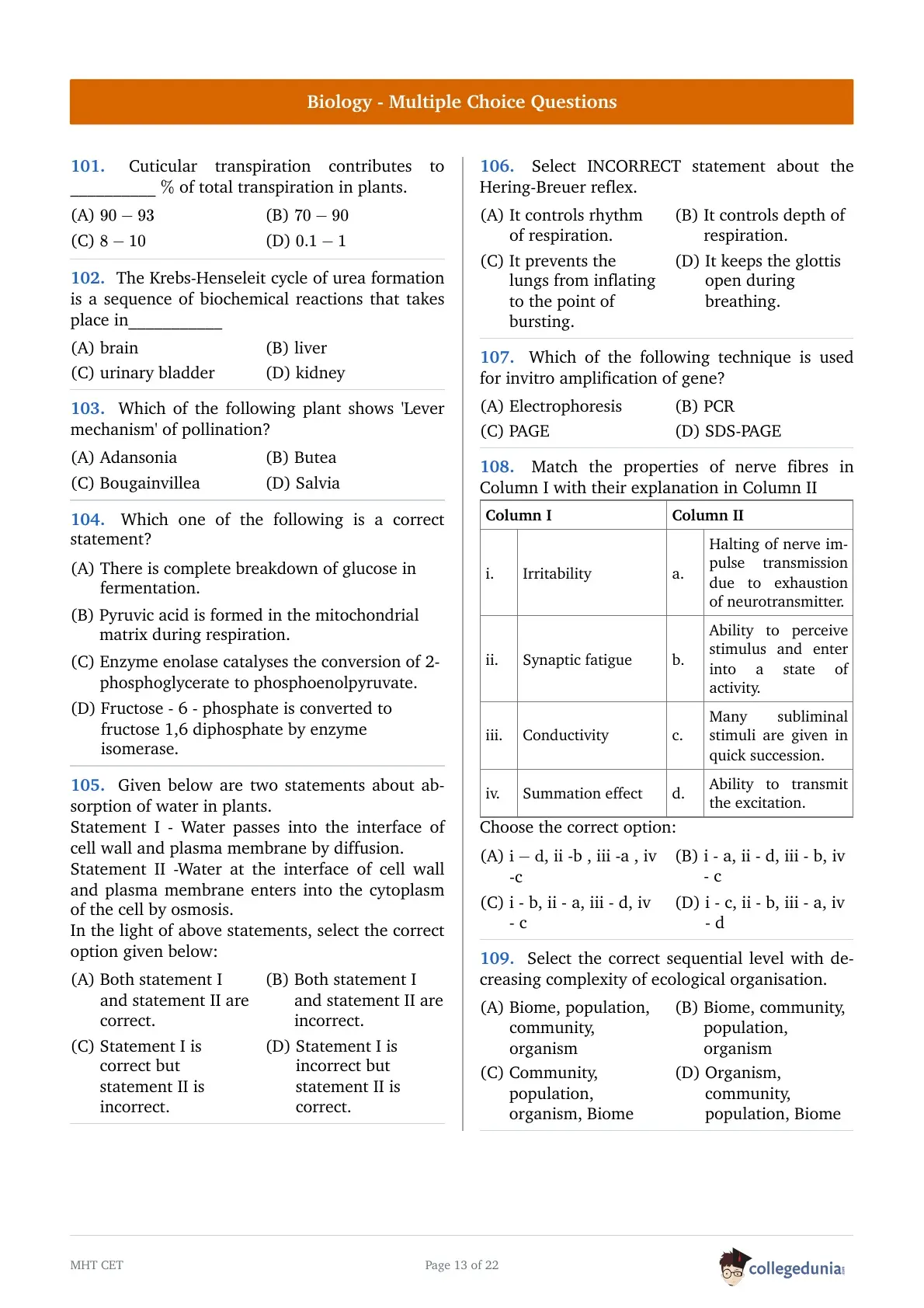
Question 101:
Cuticular transpiration contributes to __________ \(\%\) of total transpiration in plants.
(A) \(90-93\)
(B) \(70-90\)
(C) \(8-10\)
(D) \(0.1-1\)
Question 102:
The Krebs-Henseleit cycle of urea formation is a sequence of biochemical reactions that takes place in___________
(A) brain
(B) liver
(C) urinary bladder
(D) kidney
Question 103:
Which of the following plant shows 'Lever mechanism' of pollination?
(A) Adansonia
(B) Butea
(C) Bougainvillea
(D) Salvia
Question 104:
Which one of the following is a correct statement?
(A) There is complete breakdown of glucose in fermentation.
(B) Pyruvic acid is formed in the mitochondrial matrix during respiration.
(C) Enzyme enolase catalyses the conversion of 2-phosphoglycerate to phosphoenolpyruvate.
(D) Fructose - 6 - phosphate is converted to fructose 1,6 diphosphate by enzyme isomerase.
Question 105:
Given below are two statements about absorption of water in plants.
Statement I - Water passes into the interface of cell wall and plasma membrane by diffusion.
Statement II -Water at the interface of cell wall and plasma membrane enters into the cytoplasm of the cell by osmosis.
In the light of above statements, select the correct option given below:
(A) Both statement I and statement II are correct.
(B) Both statement I and statement II are incorrect.
(C) Statement I is correct but statement II is incorrect.
(D) Statement I is incorrect but statement II is correct.
Question 106:
Select INCORRECT statement about the Hering-Breuer reflex.
(A) It controls rhythm of respiration.
(B) It controls depth of respiration.
(C) It prevents the lungs from inflating to the point of bursting.
(D) It keeps the glottis open during breathing.
Question 107:
Which of the following technique is used for invitro amplification of gene?
(A) Electrophoresis
(B) PCR
(C) PAGE
(D) SDS-PAGE
Question 108:
Match the properties of nerve fibres in Column I with their explanation in Column II
Column I Column II i. Irritability a. Halting of nerve impulse transmission due to exhaustion of neurotransmitter. ii. Synaptic fatigue b. Ability to perceive stimulus and enter into a state of activity. iii. Conductivity c. Many subliminal stimuli are given in quick succession. iv. Summation effect d. Ability to transmit the excitation.
(A) \(\mathrm{i}-\mathrm{d}\), ii -b , iii -a , iv -c
(B) i - a, ii - d, iii - b, iv - c
(C) i - b, ii - a, iii - d, iv - c
(D) i - c, ii - b, iii - a, iv - d
Question 109:
Select the correct sequential level with decreasing complexity of ecological organisation.
(A) Biome, population, community, organism
(B) Biome, community, population, organism
(C) Community, population, organism, Biome
(D) Organism, community, population, Biome
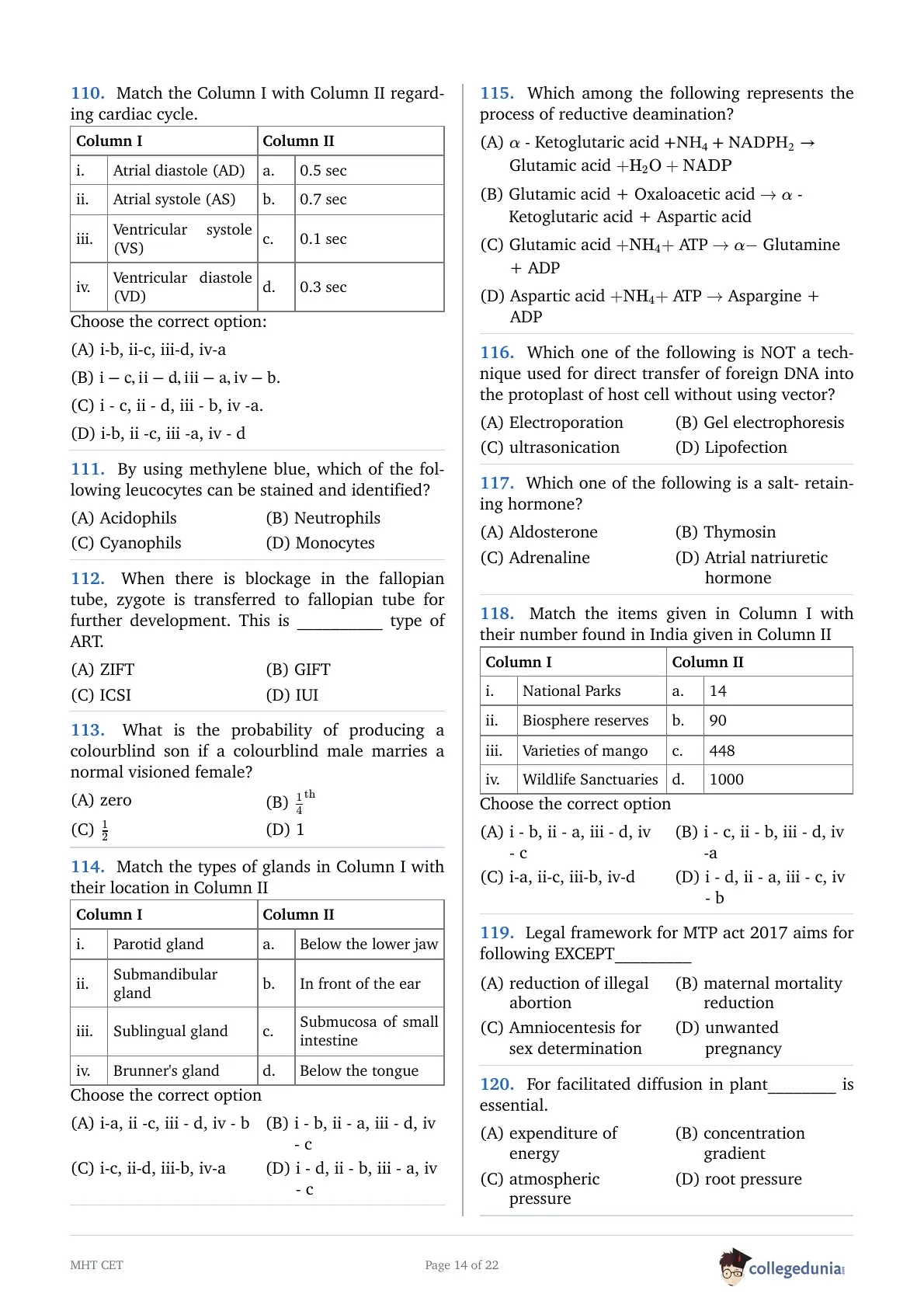
Question 110:
Match the Column I with Column II regarding cardiac cycle.
Column I Column II i. Atrial diastole (AD) a. 0.5 sec ii. Atrial systole (AS) b. 0.7 sec iii. Ventricular systole (VS) c. 0.1 sec iv. Ventricular diastole (VD) d. 0.3 sec
(A) i-b, ii-c, iii-d, iv-a
(B) \(\mathrm{i}-\mathrm{c},\mathrm{ii}-\mathrm{d},\mathrm{iii}-\mathrm{a},\mathrm{iv}-\mathrm{b}\).
(C) i - c, ii - d, iii - b, iv -a.
(D) i-b, ii -c, iii -a, iv - d
Question 112:
When there is blockage in the fallopian tube, zygote is transferred to fallopian tube for further development. This is __________ type of ART.
(A) ZIFT
(B) GIFT
(C) ICSI
(D) IUI
Question 113:
What is the probability of producing a colourblind son if a colourblind male marries a normal visioned female?
Question 114:
Match the types of glands in Column I with their location in Column II
Column I Column II i. Parotid gland a. Below the lower jaw ii. Submandibular gland b. In front of the ear iii. Sublingual gland c. Submucosa of small intestine iv. Brunner's gland d. Below the tongue
(A) i-a, ii -c, iii - d, iv - b
(B) i - b, ii - a, iii - d, iv - c
(C) i-c, ii-d, iii-b, iv-a
(D) i - d, ii - b, iii - a, iv - c
Question 115:
Which among the following represents the process of reductive deamination?
(A) \(\alpha\) - Ketoglutaric acid \(+\mathrm{NH}_{4}+\mathrm{NADPH}_{2}\rightarrow\) Glutamic acid \(+\mathrm{H}_{2}\mathrm{O}+\mathrm{NADP}\)
(B) Glutamic acid + Oxaloacetic acid \(\rightarrow \alpha\) - Ketoglutaric acid + Aspartic acid
(C) Glutamic acid \(+\mathrm{NH}_{4}+\) ATP \(\rightarrow \alpha -\) Glutamine + ADP
(D) Aspartic acid \(+\mathrm{NH}_{4}+\) ATP \(\rightarrow\) Aspargine + ADP
Question 116:
Which one of the following is NOT a technique used for direct transfer of foreign DNA into the protoplast of host cell without using vector?
(A) Electroporation
(B) Gel electrophoresis
(C) ultrasonication
(D) Lipofection
Question 117:
Which one of the following is a salt- retaining hormone?
Question 118:
Match the items given in Column I with their number found in India given in Column II
Column I Column II i. National Parks a. 14 ii. Biosphere reserves b. 90 iii. Varieties of mango c. 448 iv. Wildlife Sanctuaries d. 1000
(A) i - b, ii - a, iii - d, iv - c
(B) i - c, ii - b, iii - d, iv -a
(C) i-a, ii-c, iii-b, iv-d
(D) i - d, ii - a, iii - c, iv - b
Question 119:
Legal framework for MTP act 2017 aims for following EXCEPT_________
(A) reduction of illegal abortion
(B) maternal mortality reduction
(C) Amniocentesis for sex determination
(D) unwanted pregnancy
Question 120:
For facilitated diffusion in plant________ is essential.
(A) expenditure of energy
(B) concentration gradient
(C) atmospheric pressure
(D) root pressure
Question 121:
Select the correct pair regarding origin of life
Question 122:
Given below are two statements.
Statement I -The right lung is larger and divided into two lobes.
Statement II -The left lung is smaller and divided into three lobes.
In the light of above statements, select the correct option given below:
(A) Both statement I and statement II are correct.
(B) Both statement I and statement II are incorrect.
(C) Statement I is correct but statement II is incorrect.
(D) Statement I is incorrect but statement II is correct.
Question 123:
People who don't drink enough water and consume high protein diet, may suffer from
__________ kidney stones.
(A) calcium
(B) uric acid
(C) struvite
(D) cystine
Question 124:
Which one of the following is the activator for enzyme enolase in glycolysis?
(A) \(\mathrm{Mn}^{++}\)
(B) \(\mathrm{Mg}^{++}\)
(C) \(\mathrm{Ca}^{++}\)
(D) \(\mathrm{Zn}^{++}\)
Question 125:
Match parts of human ear in Column I with their structure / characteristic in Column II.
Column I Column II i. Organ of Corti a. Dynamic balance is maintained ii. Semi-circular Canal b. Sensory epithelium over basilar membrane of cochlea iii. Tympanic membrane c. Connects middle ear to the pharynx iv. Eustachian tube d. Transmits sound waves to middle ear
(A) i - b, ii - a, iii - d, iv - c
(B) i - c, ii - d, iii - a, iv - b
(C) i-d, ii -c, iii -a, iv - b
(D) i - a, ii - d, iii - c, iv - b
Question 126:
Following components of the ecosystem are all linked to function as an 'ecosystem unit' EXCEPT ________
(A) productivity
(B) decomposition
(C) stratification
(D) energy flow
Question 127:
Elimination of defective gene and insertion of healthy gene in a genome is achieved by ________
Question 128:
In which one of the following, treatment includes use of protective mask and gear to minimize inflammation?
(A) Sinusitis
(B) Laryngitis
(C) Silicosis
(D) Emphysema
Question 129:
The very first step of initiation of translation is
(A) binding of tRNA to AUG codons on mRNA.
(B) binding of mRNA to larger subunit of ribosome.
(C) binding of mRNA to smaller subunit of ribosome.
(D) binding of two ribosomal subunits.
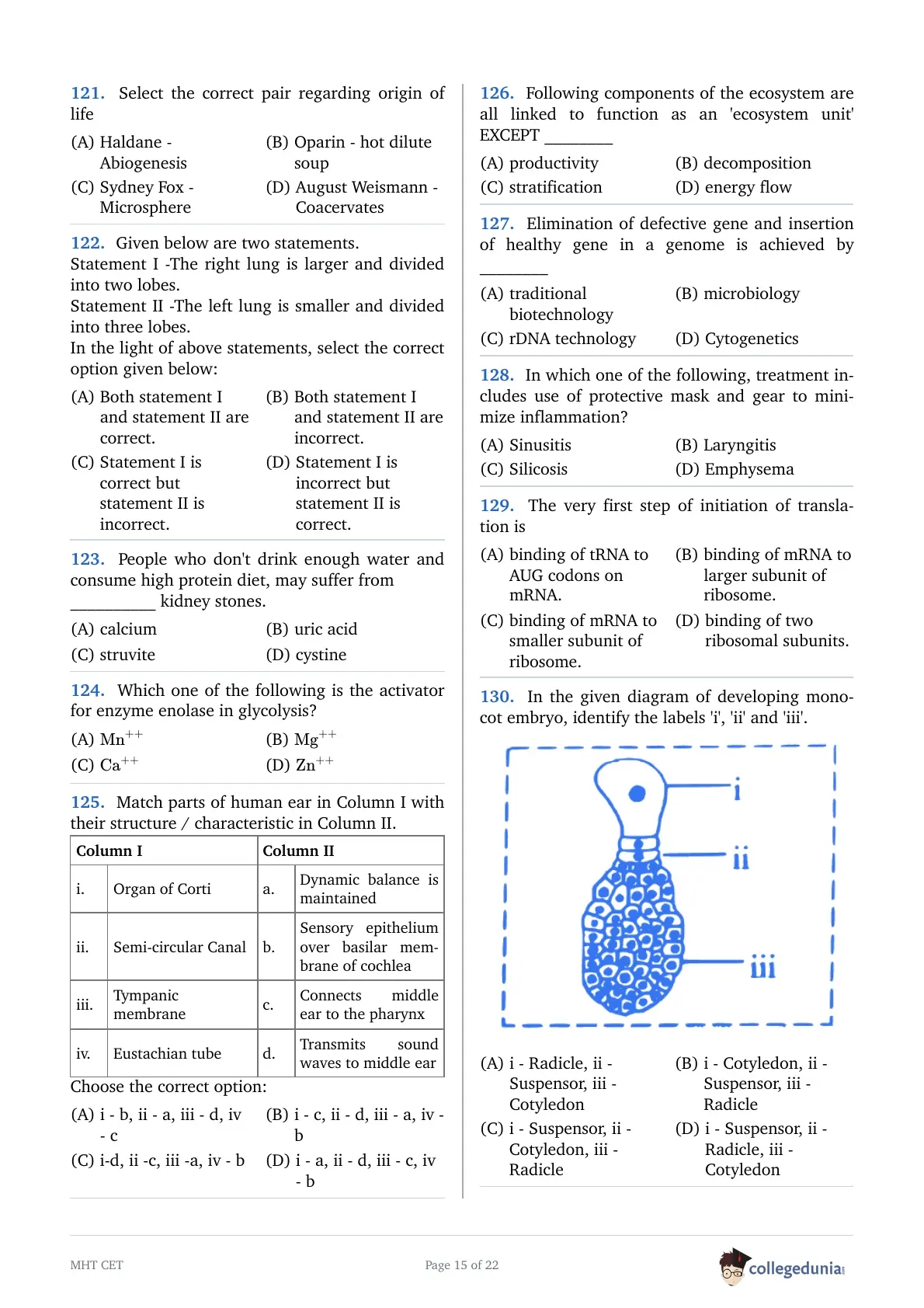
Question 130:
In the given diagram of developing monocot embryo, identify the labels 'i', 'ii' and 'iii'.
(A) i - Radicle, ii - Suspensor, iii - Cotyledon
(B) i - Cotyledon, ii - Suspensor, iii - Radicle
(C) i - Suspensor, ii - Cotyledon, iii - Radicle
(D) i - Suspensor, ii - Radicle, iii - Cotyledon
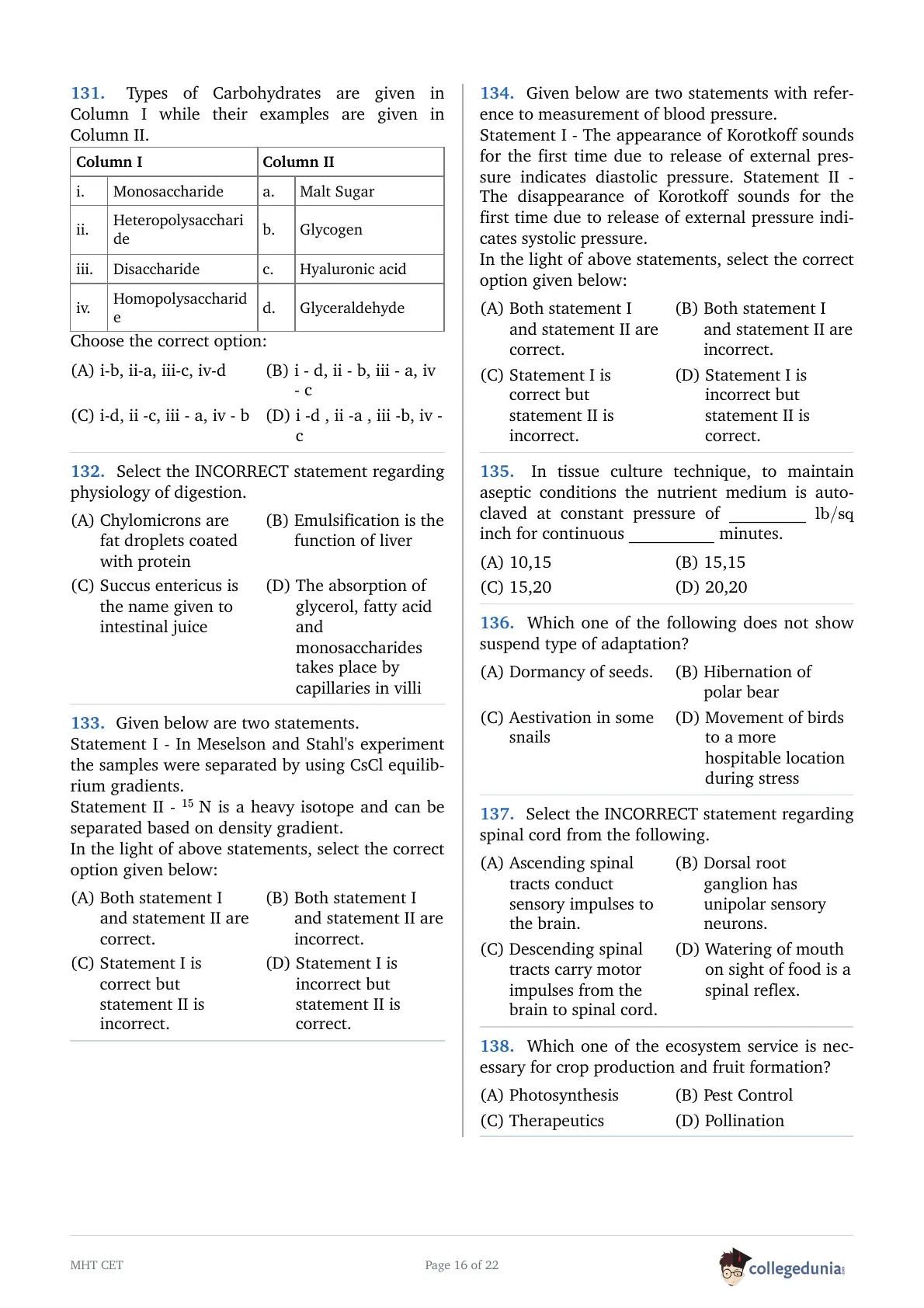
Question 131:
Types of Carbohydrates are given in Column I while their examples are given in Column II.
Column I Column II i. Monosaccharide a. Malt Sugar ii. Heteropolysaccharide b. Glycogen iii. Disaccharide c. Hyaluronic acid iv. Homopolysaccharide d. Glyceraldehyde
(A) i-b, ii-a, iii-c, iv-d
(B) i - d, ii - b, iii - a, iv - c
(C) i-d, ii -c, iii - a, iv - b
(D) i -d , ii -a , iii -b, iv -c
Question 132:
Select the INCORRECT statement regarding physiology of digestion.
(A) Chylomicrons are fat droplets coated with protein
(B) Emulsification is the function of liver
(C) Succus entericus is the name given to intestinal juice
(D) The absorption of glycerol, fatty acid and monosaccharides takes place by capillaries in villi
Question 133:
Given below are two statements.
Statement I - In Meselson and Stahl's experiment the samples were separated by using CsCl equilibrium gradients.
Statement II - \({ }^{15} \mathrm{~N}\) is a heavy isotope and can be separated based on density gradient.
In the light of above statements, select the correct option given below:
(A) Both statement I and statement II are correct.
(B) Both statement I and statement II are incorrect.
(C) Statement I is correct but statement II is incorrect.
(D) Statement I is incorrect but statement II is correct.
Question 134:
Given below are two statements with reference to measurement of blood pressure.
Statement I - The appearance of Korotkoff sounds for the first time due to release of external pressure indicates diastolic pressure. Statement II - The disappearance of Korotkoff sounds for the first time due to release of external pressure indicates systolic pressure.
In the light of above statements, select the correct option given below:
(A) Both statement I and statement II are correct.
(B) Both statement I and statement II are incorrect.
(C) Statement I is correct but statement II is incorrect.
(D) Statement I is incorrect but statement II is correct.
Question 135:
In tissue culture technique, to maintain aseptic conditions the nutrient medium is autoclaved at constant pressure of _________ \(\mathrm{lb} / \mathrm{sq}\) inch for continuous __________ minutes.
(A) 10,15
(B) 15,15
(C) 15,20
(D) 20,20
Question 136:
Which one of the following does not show suspend type of adaptation?
(A) Dormancy of seeds.
(B) Hibernation of polar bear
(C) Aestivation in some snails
(D) Movement of birds to a more hospitable location during stress
Question 137:
Select the INCORRECT statement regarding spinal cord from the following.
(A) Ascending spinal tracts conduct sensory impulses to the brain.
(B) Dorsal root ganglion has unipolar sensory neurons.
(C) Descending spinal tracts carry motor impulses from the brain to spinal cord.
(D) Watering of mouth on sight of food is a spinal reflex.
Question 138:
Which one of the ecosystem service is necessary for crop production and fruit formation?
(A) Photosynthesis
(B) Pest Control
(C) Therapeutics
(D) Pollination
Question 139:
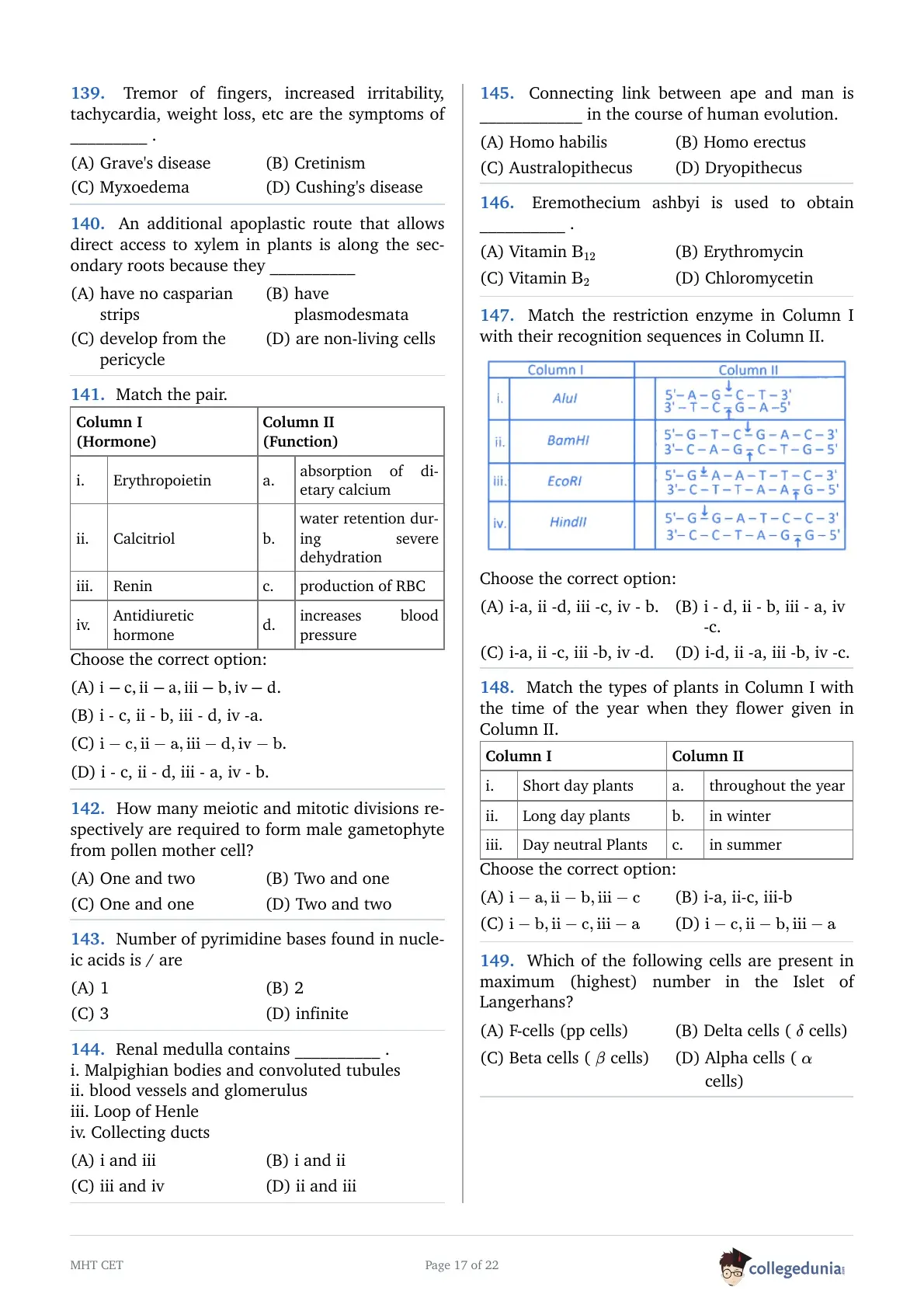
Tremor of fingers, increased irritability, tachycardia, weight loss, etc are the symptoms of _________ .
(A) Grave's disease
(B) Cretinism
(C) Myxoedema
(D) Cushing's disease
Question 140:
An additional apoplastic route that allows direct access to xylem in plants is along the secondary roots because they __________
Question 141:
Match the pair.
Column I Column II i. Erythropoietin a. absorption of dietary calcium ii. Calcitriol b. water retention during severe dehydration iii. Renin c. production of RBC iv. Antidiuretic hormone d. increases blood pressure
(A) \(\mathrm{i}-\mathrm{c},\mathrm{ii}-\mathrm{a},\mathrm{iii}-\mathrm{b},\mathrm{iv}-\mathrm{d}\).
(B) i - c, ii - b, iii - d, iv -a.
(C) \(\mathrm{i}-\mathrm{c},\mathrm{ii}-\mathrm{a},\mathrm{iii}-\mathrm{d},\mathrm{iv}-\mathrm{b}\).
(D) i - c, ii - d, iii - a, iv - b.
Question 143:
Number of pyrimidine bases found in nucleic acids is / are
(A) 1
(B) 2
(C) 3
(D) infinite
Question 144:
Renal medulla contains __________ .
i. Malpighian bodies and convoluted tubules
ii. blood vessels and glomerulus
iii. Loop of Henle
iv. Collecting ducts
(A) i and iii
(B) i and ii
(C) iii and iv
(D) ii and iii
Question 145:
Connecting link between ape and man is ____________ in the course of human evolution.
(A) Homo habilis
(B) Homo erectus
(C) Australopithecus
(D) Dryopithecus
Question 146:
Eremothecium ashbyi is used to obtain __________ .
Question 147:
\[ \text { Match the restriction enzyme in Column I with their recognition sequences in Column II. } \]
(A) i-a, ii -d, iii -c, iv - b.
(B) i - d, ii - b, iii - a, iv -c.
(C) i-a, ii -c, iii -b, iv -d.
(D) i-d, ii -a, iii -b, iv -c.
Question 148:
Match the types of plants in Column I with the time of the year when they flower given in Column II.
Column I Column II i. Short day plants a. throughout the year ii. Long day plants b. in winter iii. Day neutral Plants c. in summer
(A) \(\mathrm{i}-\mathrm{a},\mathrm{ii}-\mathrm{b},\mathrm{iii}-\mathrm{c}\)
(B) i-a, ii-c, iii-b
(C) \(\mathrm{i}-\mathrm{b},\mathrm{ii}-\mathrm{c},\mathrm{iii}-\mathrm{a}\)
(D) \(\mathrm{i}-\mathrm{c},\mathrm{ii}-\mathrm{b},\mathrm{iii}-\mathrm{a}\)
Question 149:
Which of the following cells are present in maximum (highest) number in the Islet of Langerhans?
(A) F-cells (pp cells)
(B) Delta cells ( \(\delta\) cells)
(C) Beta cells ( \(\beta\) cells)
(D) Alpha cells ( \(\alpha\) cells)
Question 150:
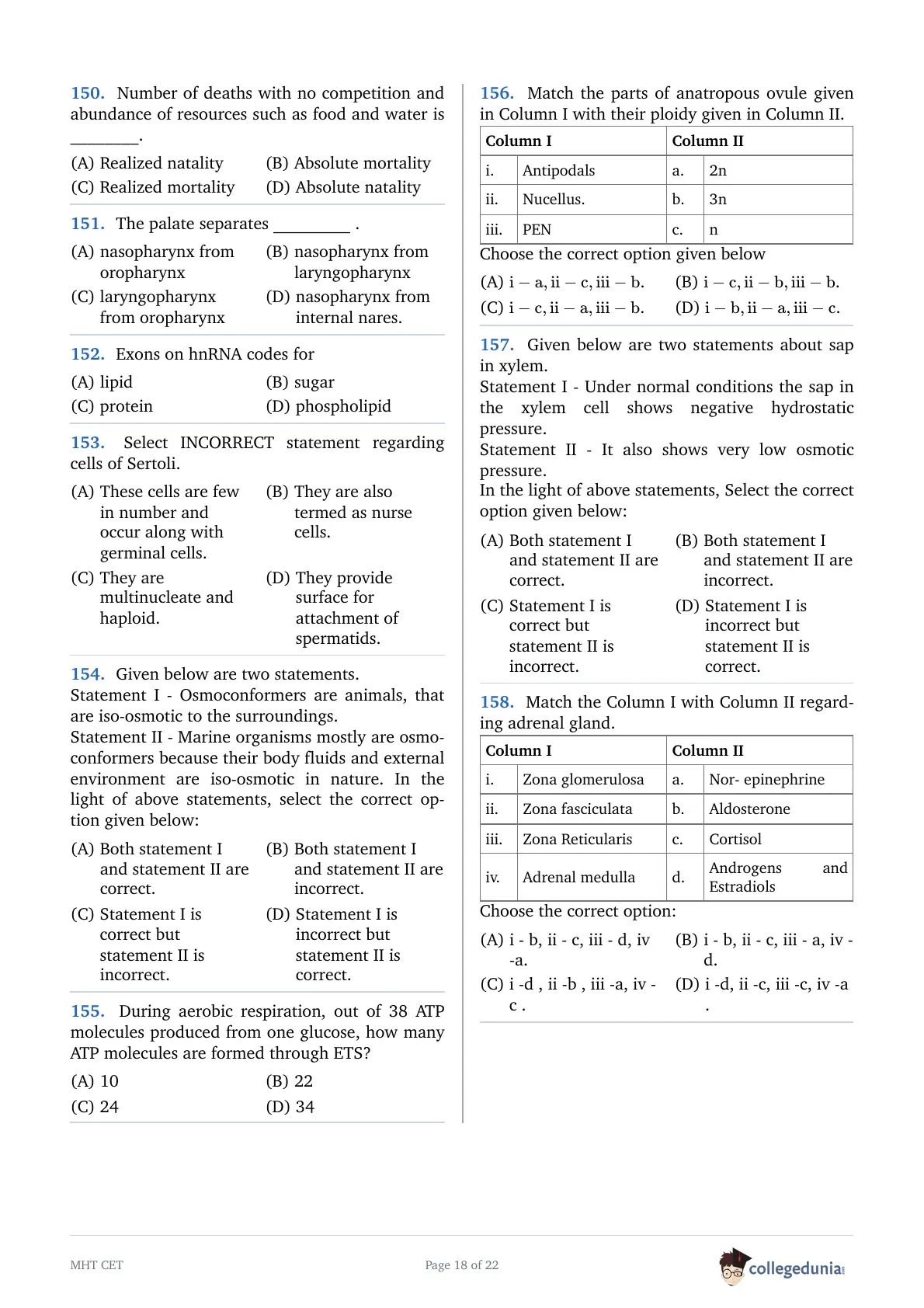
Number of deaths with no competition and abundance of resources such as food and water is ________.
(A) Realized natality
(B) Absolute mortality
(C) Realized mortality
(D) Absolute natality
Question 151:
The palate separates _________ .
(A) nasopharynx from oropharynx
(B) nasopharynx from laryngopharynx
(C) laryngopharynx from oropharynx
(D) nasopharynx from internal nares.
Question 152:
Exons on hnRNA codes for \(\qquad\)
(A) lipid
(B) sugar
(C) protein
(D) phospholipid
Question 153:
Select INCORRECT statement regarding cells of Sertoli.
(A) These cells are few in number and occur along with germinal cells.
(B) They are also termed as nurse cells.
(C) They are multinucleate and haploid.
(D) They provide surface for attachment of spermatids.
Question 154:
Given below are two statements.
Statement I - Osmoconformers are animals, that are iso-osmotic to the surroundings.
Statement II - Marine organisms mostly are osmoconformers because their body fluids and external environment are iso-osmotic in nature. In the light of above statements, select the correct option given below:
(A) Both statement I and statement II are correct.
(B) Both statement I and statement II are incorrect.
(C) Statement I is correct but statement II is incorrect.
(D) Statement I is incorrect but statement II is correct.
Question 155:
During aerobic respiration, out of 38 ATP molecules produced from one glucose, how many ATP molecules are formed through ETS?
(A) 10
(B) 22
(C) 24
(D) 34
Question 156:
Match the parts of anatropous ovule given in Column I with their ploidy given in Column II.
Column I Column II i. Antipodals a. 2n ii. Nucellus. b. 3n iii. PEN c. n
(A) \(\mathrm{i}-\mathrm{a},\mathrm{ii}-\mathrm{c},\mathrm{iii}-\mathrm{b}\).
(B) \(\mathrm{i}-\mathrm{c},\mathrm{ii}-\mathrm{b},\mathrm{iii}-\mathrm{b}\).
(C) \(\mathrm{i}-\mathrm{c},\mathrm{ii}-\mathrm{a},\mathrm{iii}-\mathrm{b}\).
(D) \(\mathrm{i}-\mathrm{b},\mathrm{ii}-\mathrm{a},\mathrm{iii}-\mathrm{c}\).
Question 158:
Match the Column I with Column II regarding adrenal gland.
Column I Column II i. Zona glomerulosa a. Nor- epinephrine ii. Zona fasciculata b. Aldosterone iii. Zona Reticularis c. Cortisol iv. Adrenal medulla d. Androgens and Estradiols
(A) i - b, ii - c, iii - d, iv -a.
(B) i - b, ii - c, iii - a, iv - d.
(C) i -d , ii -b , iii -a, iv -c .
(D) i -d, ii -c, iii -c, iv -a .
Question 159:
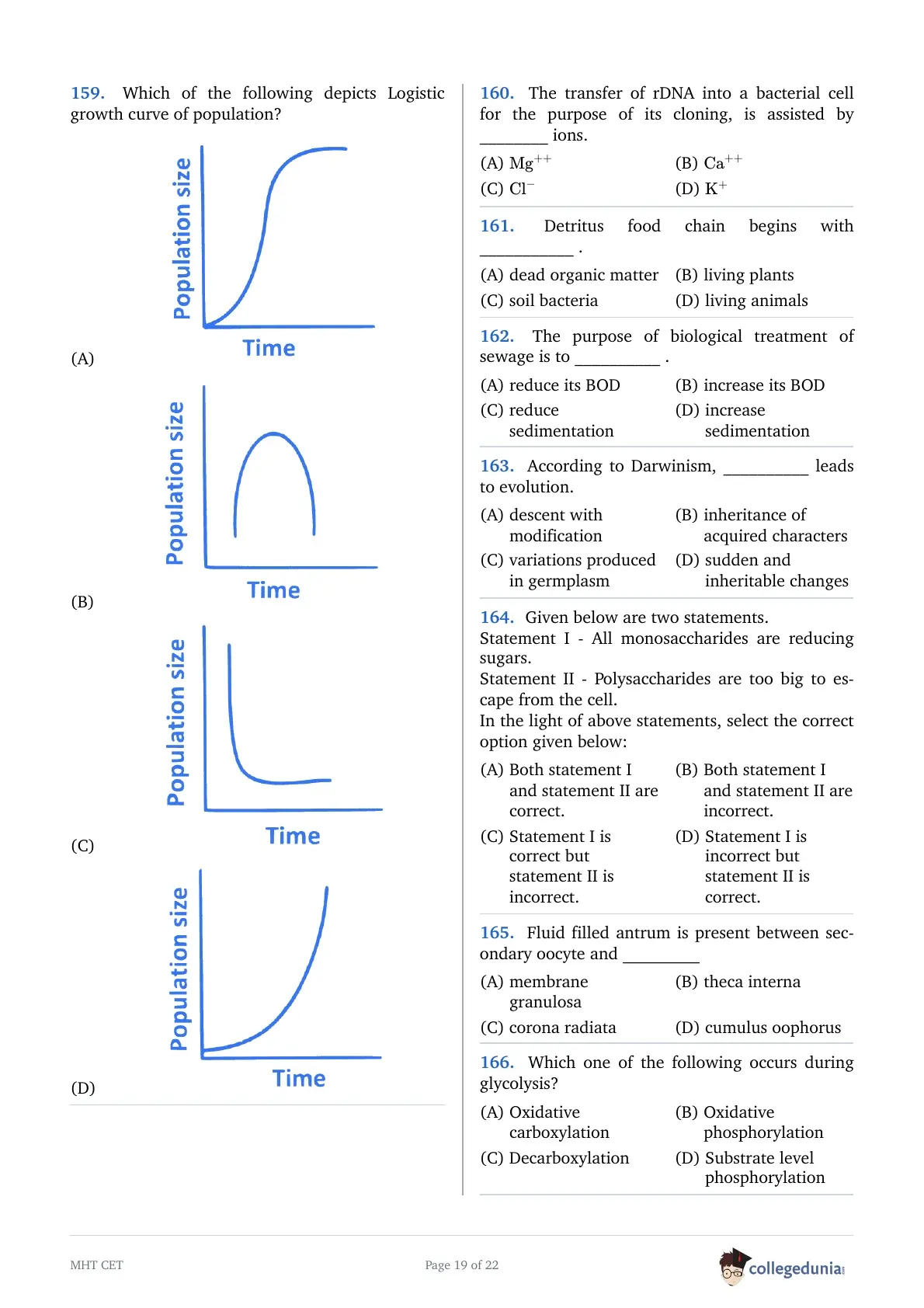
Which of the following depicts Logistic growth curve of population?
Question 160:
The transfer of rDNA into a bacterial cell for the purpose of its cloning, is assisted by ________ ions.
(A) \(\mathrm{Mg}^{++}\)
(B) \(\mathrm{Ca}^{++}\)
(C) \(\mathrm{Cl}^{-}\)
(D) \(\mathrm{K}^{+}\)
Question 161:
Detritus food chain begins with ___________ .
(A) dead organic matter
(B) living plants
(C) soil bacteria
(D) living animals
Question 162:
The purpose of biological treatment of sewage is to __________ .
(A) reduce its BOD
(B) increase its BOD
(C) reduce sedimentation
(D) increase sedimentation
Question 163:
According to Darwinism, __________ leads to evolution.
(A) descent with modification
(B) inheritance of acquired characters
(C) variations produced in germplasm
(D) sudden and inheritable changes
Question 164:
Given below are two statements.
Statement I - All monosaccharides are reducing sugars.
Statement II - Polysaccharides are too big to escape from the cell.
In the light of above statements, select the correct option given below:
(A) Both statement I and statement II are correct.
(B) Both statement I and statement II are incorrect.
(C) Statement I is correct but statement II is incorrect.
(D) Statement I is incorrect but statement II is correct.
Question 165:
Fluid filled antrum is present between secondary oocyte and _________
(A) membrane granulosa
(B) theca interna
(C) corona radiata
(D) cumulus oophorus
Question 166:
Which one of the following occurs during glycolysis?
Question 167:
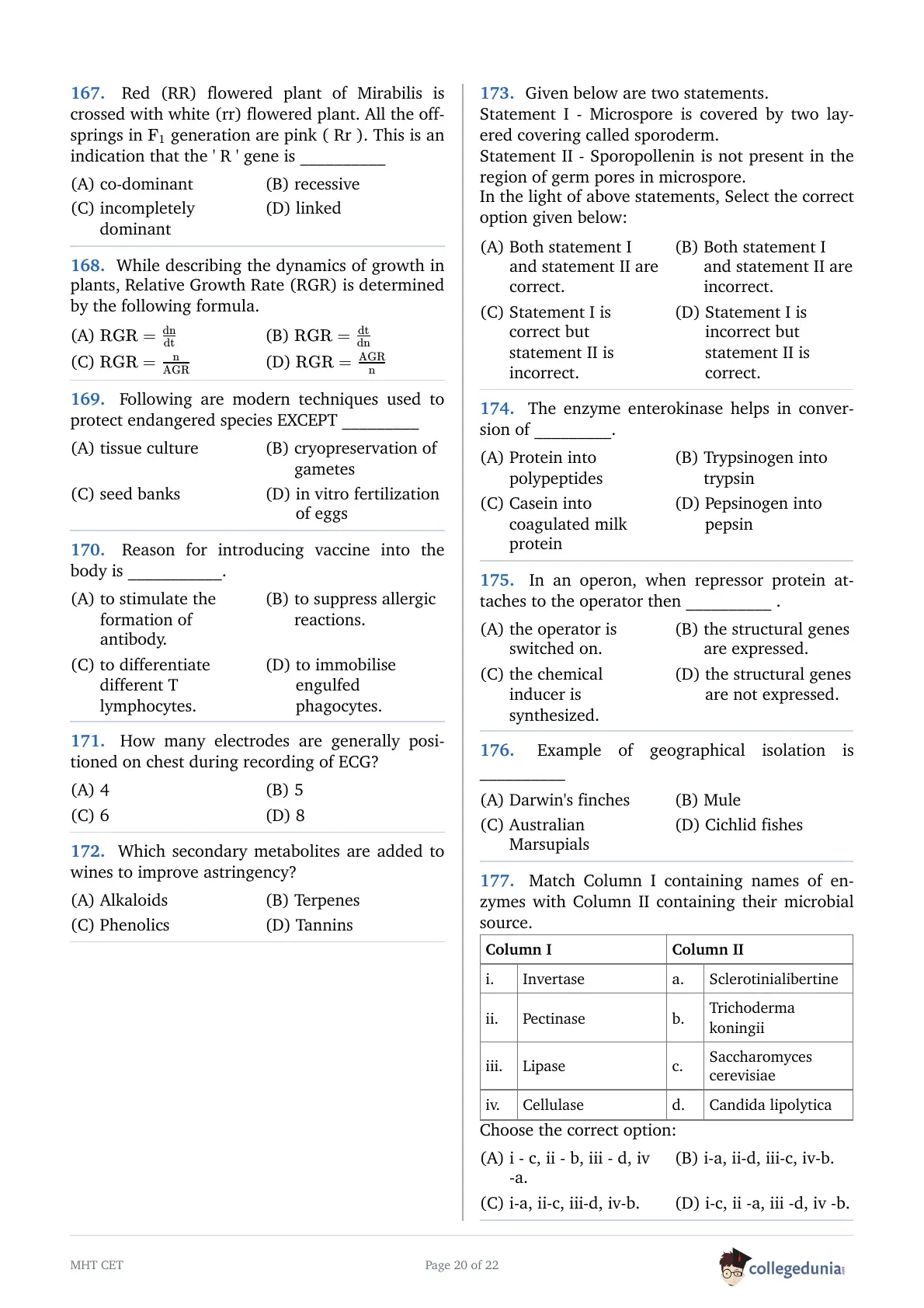
Red (RR) flowered plant of Mirabilis is crossed with white (rr) flowered plant. All the offsprings in \(\mathrm{F}_1\) generation are pink ( Rr ). This is an indication that the ' R ' gene is __________
(A) co-dominant
(B) recessive
(C) incompletely dominant
(D) linked
Question 168:
While describing the dynamics of growth in plants, Relative Growth Rate (RGR) is determined by the following formula.
(A) \(\mathrm{RGR}=\frac{\mathrm{dn}}{\mathrm{dt}}\)
(B) \(\mathrm{RGR}=\frac{\mathrm{dt}}{\mathrm{dn}}\)
(C) \(\mathrm{RGR}=\frac{\mathrm{n}}{\mathrm{AGR}}\)
(D) \(\mathrm{RGR}=\frac{\mathrm{AGR}}{\mathrm{n}}\)
Question 169:
Following are modern techniques used to protect endangered species EXCEPT _________
Question 170:
Reason for introducing vaccine into the body is ___________.
(A) to stimulate the formation of antibody.
(B) to suppress allergic reactions.
(C) to differentiate different T lymphocytes.
(D) to immobilise engulfed phagocytes.
Question 171:
How many electrodes are generally positioned on chest during recording of ECG?
Question 172:
Which secondary metabolites are added to wines to improve astringency?
(A) Alkaloids
(B) Terpenes
(C) Phenolics
(D) Tannins
Question 173:
Given below are two statements.
Statement I - Microspore is covered by two layered covering called sporoderm.
Statement II - Sporopollenin is not present in the region of germ pores in microspore.
In the light of above statements, Select the correct option given below:
(A) Both statement I and statement II are correct.
(B) Both statement I and statement II are incorrect.
(C) Statement I is correct but statement II is incorrect.
(D) Statement I is incorrect but statement II is correct.
Question 174:
The enzyme enterokinase helps in conversion of _________.
Question 175:
In an operon, when repressor protein attaches to the operator then __________ .
(A) the operator is switched on.
(B) the structural genes are expressed.
(C) the chemical inducer is synthesized.
(D) the structural genes are not expressed.
Question 176:
Example of geographical isolation is __________
(A) Darwin's finches
(B) Mule
(C) Australian Marsupials
(D) Cichlid fishes
Question 177:
Match Column I containing names of enzymes with Column II containing their microbial source.
Column I Column II i. Invertase a. Sclerotinialibertine ii. Pectinase b. Trichoderma koningii iii. Lipase c. Saccharomyces cerevisiae iv. Cellulase d. Candida lipolytica
(A) i - c, ii - b, iii - d, iv -a.
(B) i-a, ii-d, iii-c, iv-b.
(C) i-a, ii-c, iii-d, iv-b.
(D) i-c, ii -a, iii -d, iv -b.
Question 178:
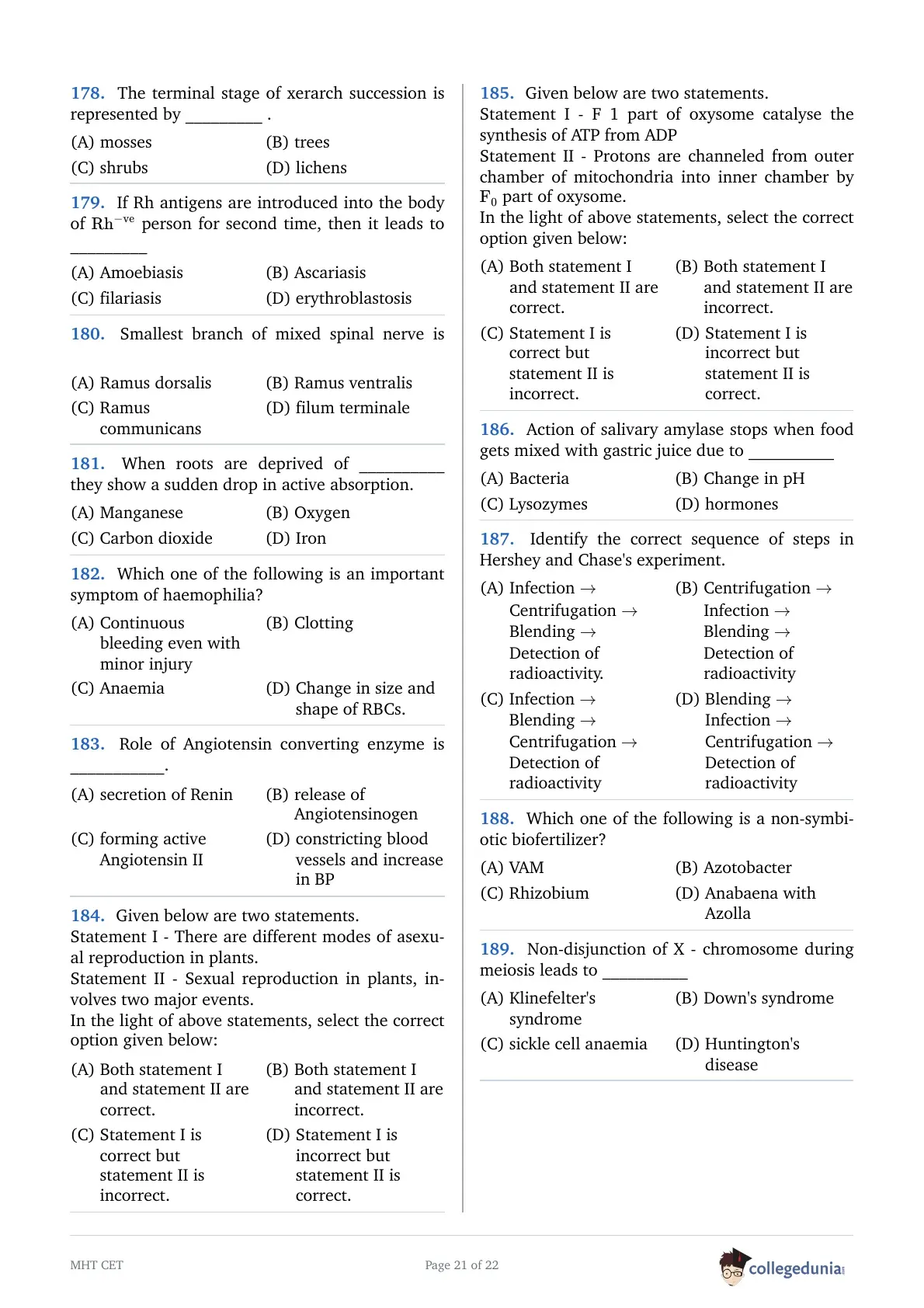
The terminal stage of xerarch succession is represented by _________ .
(A) mosses
(B) trees
(C) shrubs
(D) lichens
Question 179:
If Rh antigens are introduced into the body of \(\mathrm{Rh}^{-\mathrm{ve}}\) person for second time, then it leads to _________
(A) Amoebiasis
(B) Ascariasis
(C) filariasis
(D) erythroblastosis
Question 180:
Smallest branch of mixed spinal nerve is \(\qquad\)
(A) Ramus dorsalis
(B) Ramus ventralis
(C) Ramus communicans
(D) filum terminale
Question 181:
When roots are deprived of __________ they show a sudden drop in active absorption.
(A) Manganese
(B) Oxygen
(C) Carbon dioxide
(D) Iron
Question 182:
Which one of the following is an important symptom of haemophilia?
Question 183:
Role of Angiotensin converting enzyme is ___________.
(A) secretion of Renin
(B) release of Angiotensinogen
(C) forming active Angiotensin II
(D) constricting blood vessels and increase in BP
Question 184:
Given below are two statements.
Statement I - There are different modes of asexual reproduction in plants.
Statement II - Sexual reproduction in plants, involves two major events.
In the light of above statements, select the correct option given below:
(A) Both statement I and statement II are correct.
(B) Both statement I and statement II are incorrect.
(C) Statement I is correct but statement II is incorrect.
(D) Statement I is incorrect but statement II is correct.
Question 185:
Given below are two statements.
Statement I - F 1 part of oxysome catalyse the synthesis of ATP from ADP
Statement II - Protons are channeled from outer chamber of mitochondria into inner chamber by \(\mathrm{F}_0\) part of oxysome.
In the light of above statements, select the correct option given below:
(A) Both statement I and statement II are correct.
(B) Both statement I and statement II are incorrect.
(C) Statement I is correct but statement II is incorrect.
(D) Statement I is incorrect but statement II is correct.
Question 186:
Action of salivary amylase stops when food gets mixed with gastric juice due to __________
(A) Bacteria
(B) Change in pH
(C) Lysozymes
(D) hormones
Question 187:
Identify the correct sequence of steps in Hershey and Chase's experiment.
(A) Infection \(\rightarrow\) Centrifugation \(\rightarrow\) Blending \(\rightarrow\) Detection of radioactivity.
(B) Centrifugation \(\rightarrow\) Infection \(\rightarrow\) Blending \(\rightarrow\) Detection of radioactivity
(C) Infection \(\rightarrow\) Blending \(\rightarrow\) Centrifugation \(\rightarrow\) Detection of radioactivity
(D) Blending \(\rightarrow\) Infection \(\rightarrow\) Centrifugation \(\rightarrow\) Detection of radioactivity
Question 188:
Which one of the following is a non-symbiotic biofertilizer?
(A) VAM
(B) Azotobacter
(C) Rhizobium
(D) Anabaena with Azolla
Question 189:
Non-disjunction of X - chromosome during meiosis leads to __________
(A) Klinefelter's syndrome
(B) Down's syndrome
(C) sickle cell anaemia
(D) Huntington's disease
Question 190:
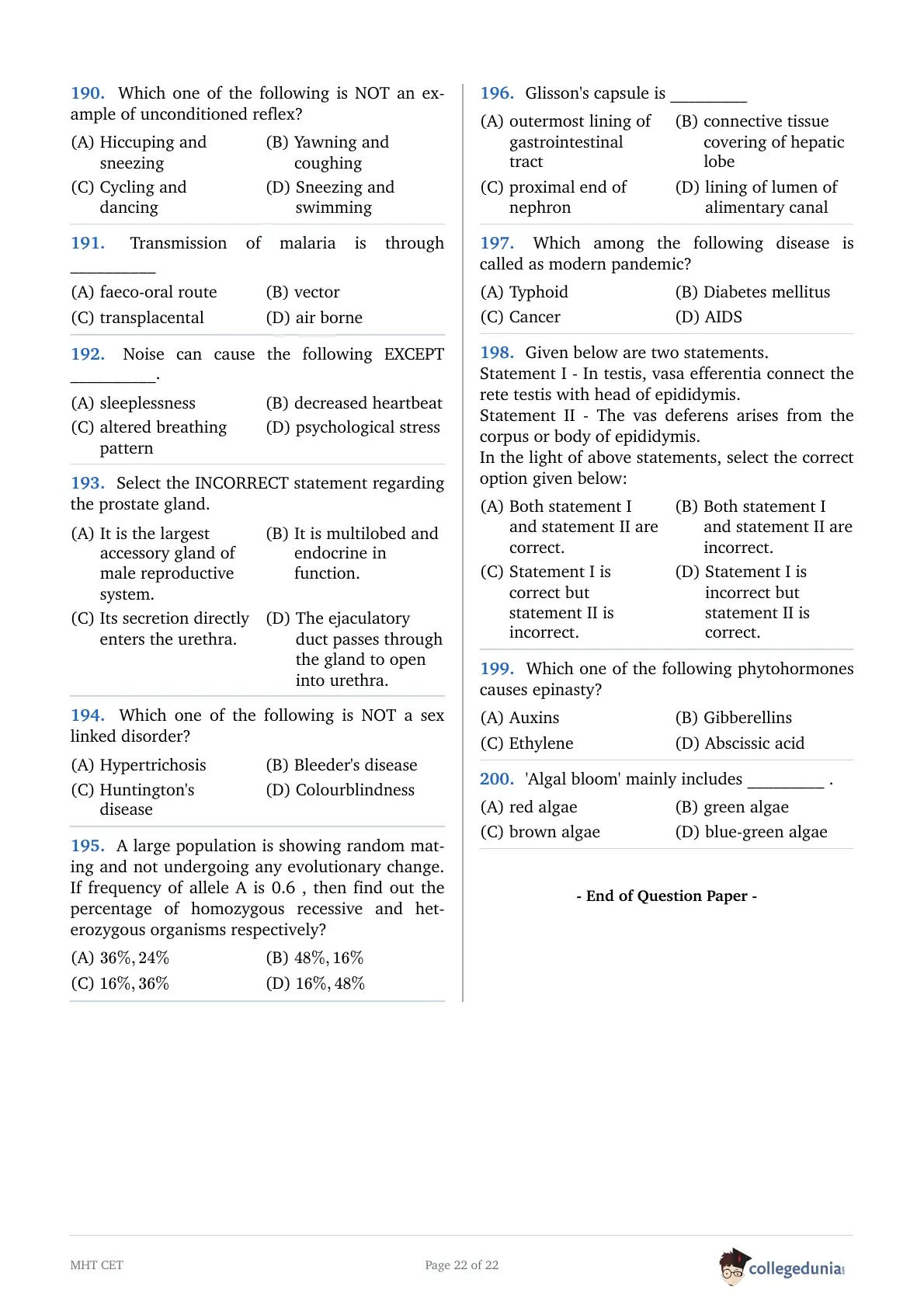
Which one of the following is NOT an example of unconditioned reflex?
(A) Hiccuping and sneezing
(B) Yawning and coughing
(C) Cycling and dancing
(D) Sneezing and swimming
Question 191:
Transmission of malaria is through __________
(A) faeco-oral route
(B) vector
(C) transplacental
(D) air borne
Question 192:
Noise can cause the following EXCEPT __________.
Question 193:
Select the INCORRECT statement regarding the prostate gland.
(A) It is the largest accessory gland of male reproductive system.
(B) It is multilobed and endocrine in function.
(C) Its secretion directly enters the urethra.
(D) The ejaculatory duct passes through the gland to open into urethra.
Question 194:
Which one of the following is NOT a sex linked disorder?
(A) Hypertrichosis
(B) Bleeder's disease
(C) Huntington's disease
(D) Colourblindness
Question 195:
A large population is showing random mating and not undergoing any evolutionary change. If frequency of allele A is 0.6 , then find out the percentage of homozygous recessive and heterozygous organisms respectively?
(A) \(36\%,24\%\)
(B) \(48\%,16\%\)
(C) \(16\%,36\%\)
(D) \(16\%,48\%\)
Question 196:
Glisson's capsule is _________
(A) outermost lining of gastrointestinal tract
(B) connective tissue covering of hepatic lobe
(C) proximal end of nephron
(D) lining of lumen of alimentary canal
Question 197:
Which among the following disease is called as modern pandemic?
(A) Typhoid
(B) Diabetes mellitus
(C) Cancer
(D) AIDS
Question 198:
Given below are two statements.
Statement I - In testis, vasa efferentia connect the rete testis with head of epididymis.
Statement II - The vas deferens arises from the corpus or body of epididymis.
In the light of above statements, select the correct option given below:
(A) Both statement I and statement II are correct.
(B) Both statement I and statement II are incorrect.
(C) Statement I is correct but statement II is incorrect.
(D) Statement I is incorrect but statement II is correct.
Question 199:
Which one of the following phytohormones causes epinasty?
(A) Auxins
(B) Gibberellins
(C) Ethylene
(D) Abscissic acid
Question 200:
'Algal bloom' mainly includes _________ .
(A) red algae
(B) green algae
(C) brown algae
(D) blue-green algae
MHT CET 2025 PCB Exam Pattern and Marking Scheme
Parameter
Details
Conducting Body
Maharashtra Common Entrance Test Cell (Maharashtra CET Cell)
Exam Mode
Online (Computer-Based Test)
Duration
180 minutes (3 hours)
Groups / Subjects
PCB (Physics, Chemistry, Biology) for Pharmacy and Agriculture
Total Questions
200
Total Marks
200
Question Type
Multiple Choice Questions (MCQs)
Marking Scheme
1 mark for each correct answer
Negative Marking
No
Syllabus Weightage
Class 12 – 80%
Class 11 – 20%








Comments