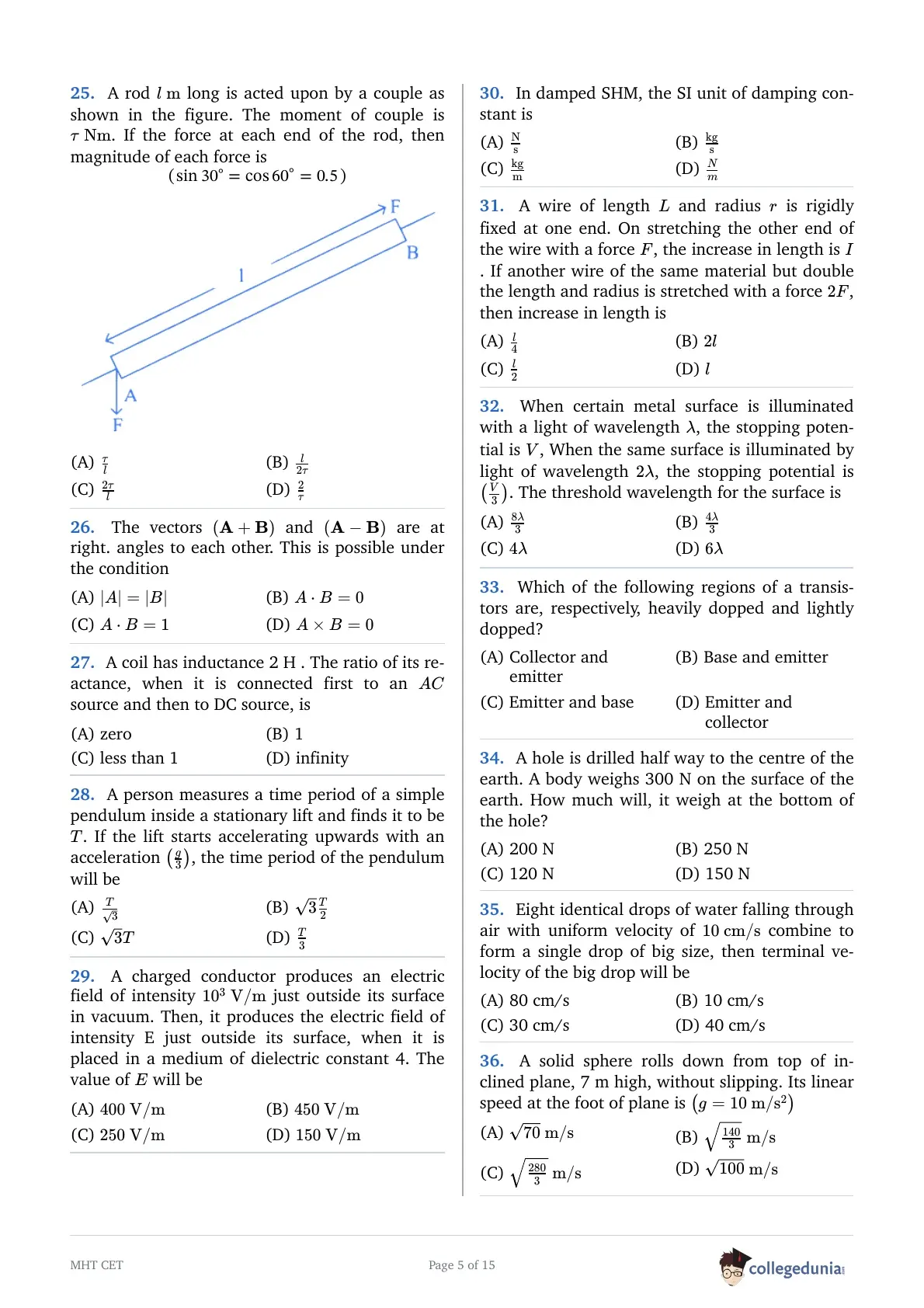
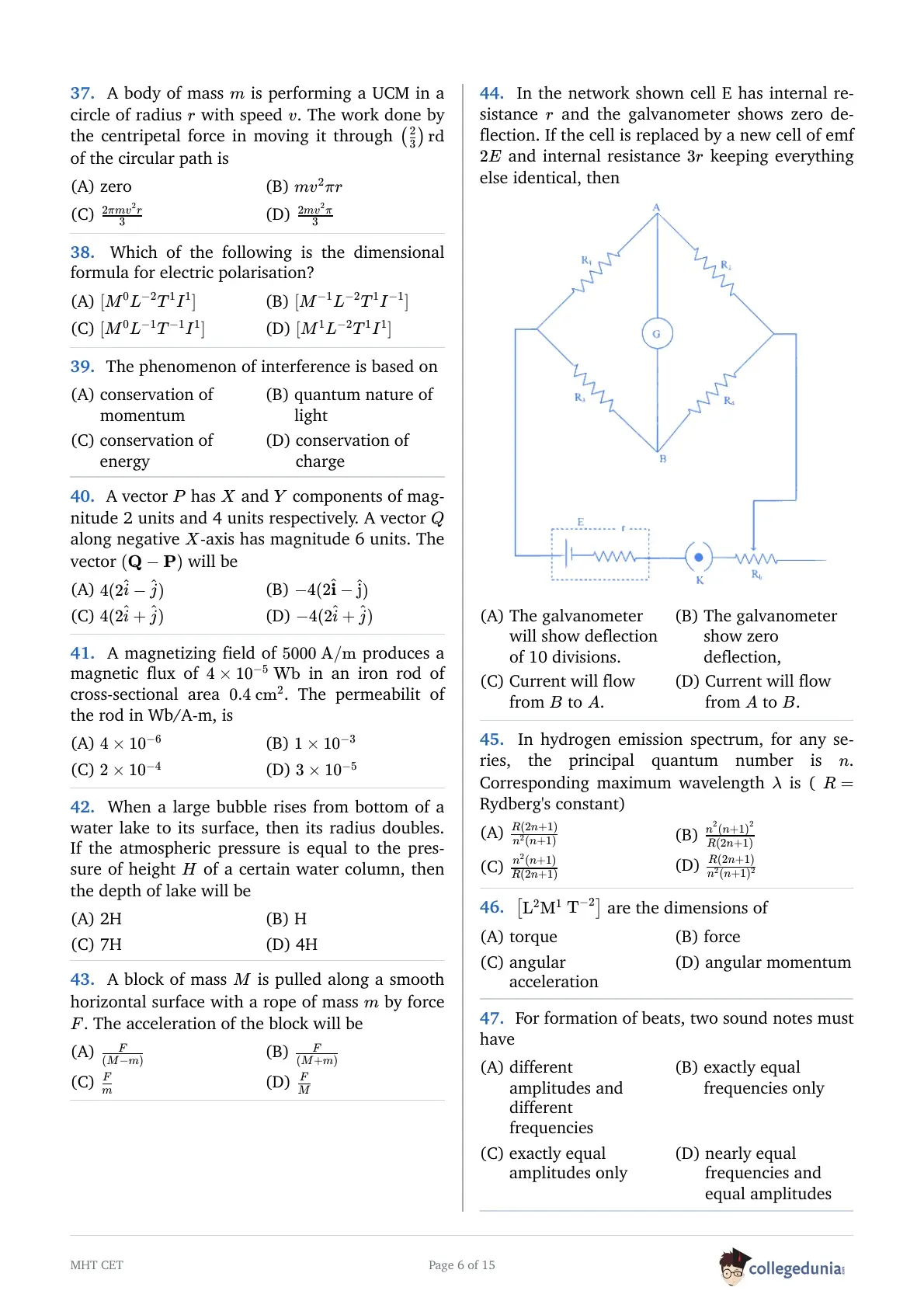
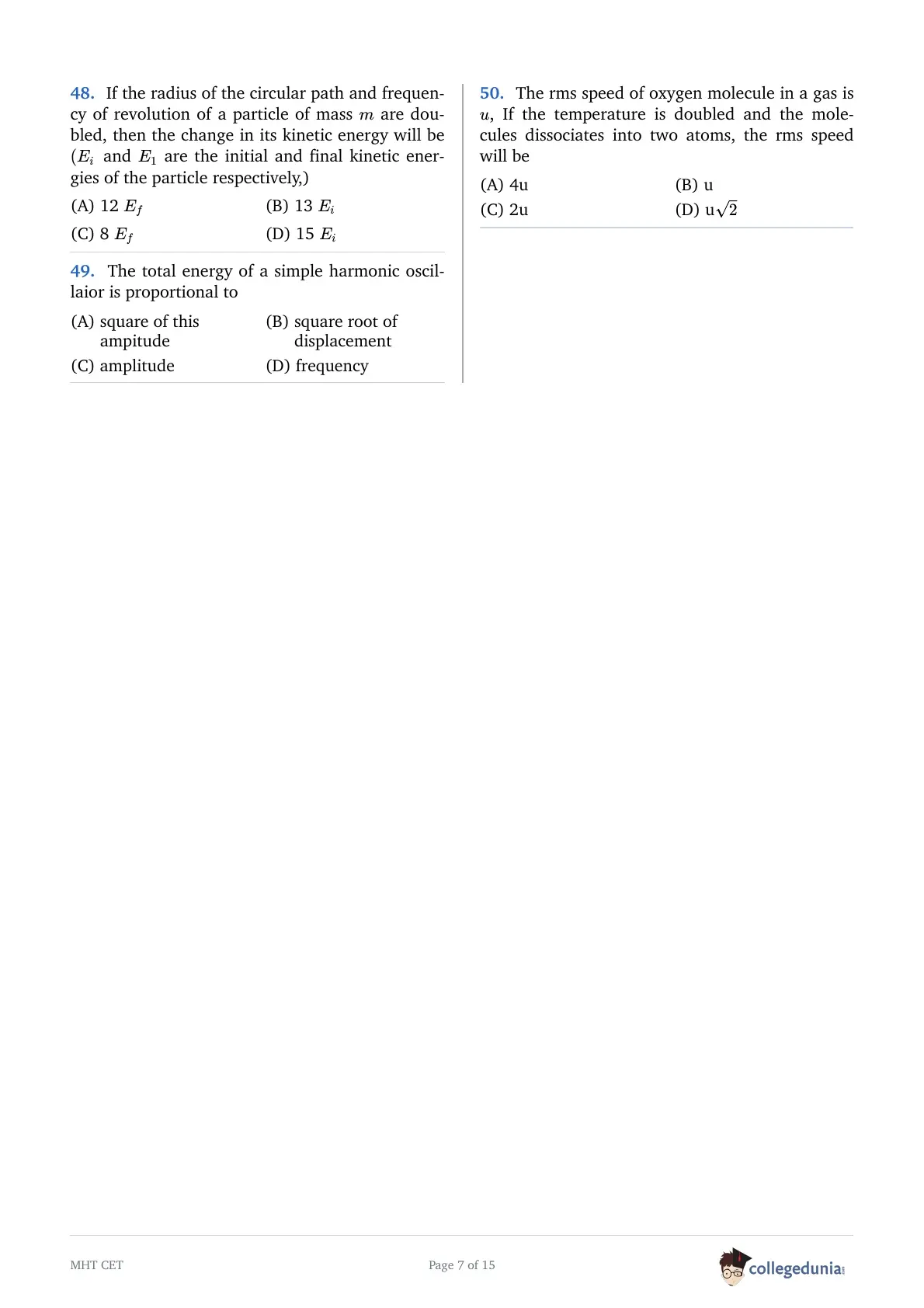
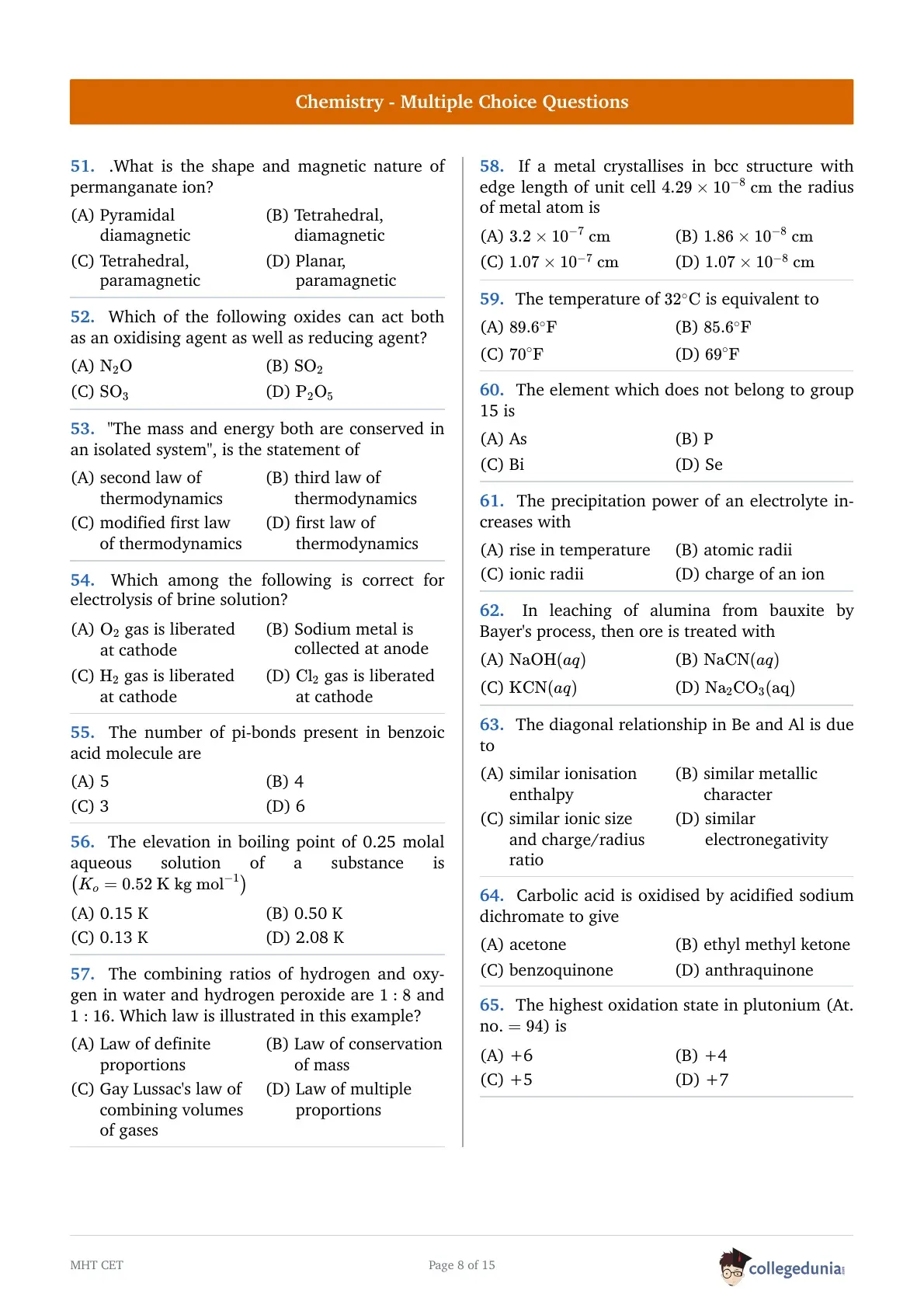
MHT CET 2019 May 3 Shift 1 PCM Question Paper is available for download here. Maharashtra State CET Cell conducted MHT CET 2019 PCM Exam on May 3 in Shift 1 from 9 AM to 12 PM in CBT mode.

The MHT CET 2019 PCM question paper includes the following:

  • The MHT CET 2019 PCM Question Paper consists of 150 multiple-choice questions (MCQs) totalling 200 marks divided into 3 sections: Physics, Chemistry, and Mathematics, with 50 questions in each subject.
  • Physics and Chemistry questions carry 1 mark each while Mathematics questions carry 2 marks each.
  • There is no negative marking for incorrect answers.

MHT CET 2019 May 3 Shift 1 PCM Question Paper with Solution PDF

CD PDF CD PDF with Solutions
Download Collegedunia PDF 0.78 MB -

Also Check:

MHT CET 2019 May 3 Shift 1 PCM Questions with Solutions


Physics (Q1 - Q50)

Question 1:

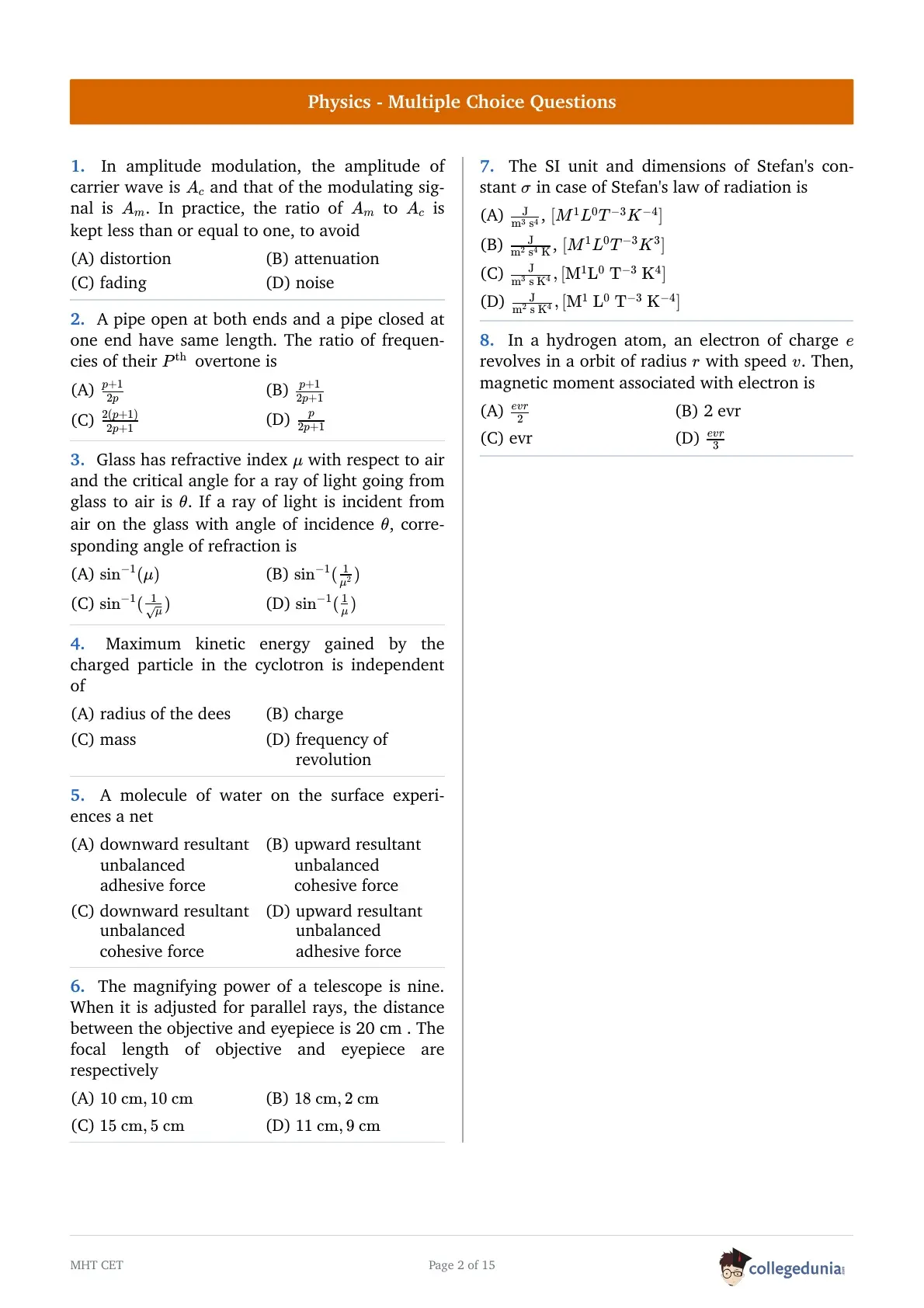
In amplitude modulation, the amplitude of carrier wave is \(A_c\) and that of the modulating signal is \(A_m\). In practice, the ratio of \(A_m\) to \(A_c\) is kept less than or equal to one, to avoid

  • (A) distortion
  • (B) attenuation
  • (C) fading
  • (D) noise

Question 2:

A pipe open at both ends and a pipe closed at one end have same length. The ratio of frequencies of their \(P^{th}\) overtone is

  • (A) \(\frac{p+1}{2p}\)
  • (B) \(\frac{p+1}{2p+1}\)
  • (C) \(\frac{2\left(p+1\right)}{2p+1}\)
  • (D) \(\frac{p}{2p+1}\)

Question 3:

Glass has refractive index \(\mu\) with respect to air and the critical angle for a ray of light going from glass to air is \(\theta\). If a ray of light is incident from air on the glass with angle of incidence \(\theta\), corresponding angle of refraction is

  • (A) \(sin^{-1}\left(\mu\right)\)
  • (B) \(sin^{-1}\left(\frac{1}{\mu^{2}}\right)\)
  • (C) \(sin^{-1}\left(\frac{1}{\sqrt{\mu}}\right)\)
  • (D) \(sin^{-1}\left(\frac{1}{\mu}\right)\)

Question 4:

Maximum kinetic energy gained by the charged particle in the cyclotron is independent of

  • (A) radius of the dees
  • (B) charge
  • (C) mass
  • (D) frequency of revolution

Question 5:

A molecule of water on the surface experiences a net

  • (A) downward resultant unbalanced adhesive force
  • (B) upward resultant unbalanced cohesive force
  • (C) downward resultant unbalanced cohesive force
  • (D) upward resultant unbalanced adhesive force

Question 6:

The magnifying power of a telescope is nine. When it is adjusted for parallel rays, the distance between the objective and eyepiece is \(20 \,cm\). The focal length of objective and eyepiece are respectively

  • (A) \(10\, cm\), \(10 \,cm\)
  • (B) \(18\, cm\), \(2 \,cm\)
  • (C) \(15\, cm\), \(5 \,cm\)
  • (D) \(11\, cm\), \(9 \,cm\)

Question 7:

The \(SI\) unit and dimensions of Stefan?s constant \(\sigma\) in case of Stefan?s law of radiation is

  • (A) \(\frac{J}{m^{3}\,s^{4}}, \left[M^{1}L^{0}T^{-3}K^{-4}\right]\)
  • (B) \(\frac{J}{m^{2}\,s^{4}\,K}, \left[M^{1}L^{0}T^{-3}K^{3}\right]\)
  • (C) \(\frac{J}{m^{3}s\,K^{4}}, \left[M^{1}L^{0}T^{-3}K^{4}\right]\)
  • (D) \(\frac{J}{m^{2}s\,K^{4}}, \left[M^{1}L^{0}T^{-3}K^{-4}\right]\)

Question 8:

In a hydrogen atom, an electron of charge e revolves in a orbit of radius \(r\) with speed \(v\). Then, magnetic moment associated with electron is

  • (A) \(\frac{evr}{2}\)
  • (B) \(2\,evr\)
  • (C) \(evr\)
  • (D) \(\frac{evr}{3}\)

Question 9:

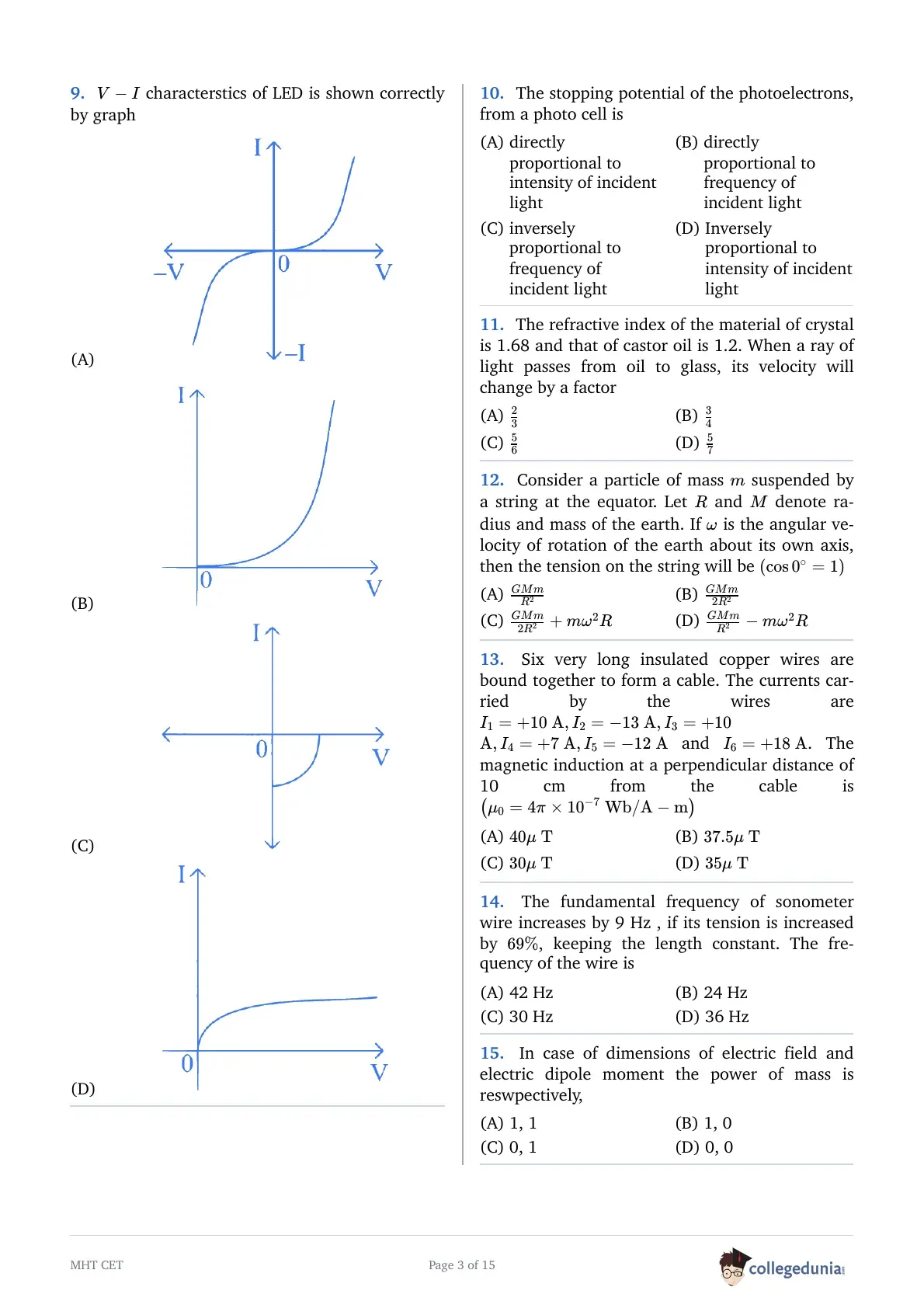
\(V-I\) characterstics of LED is shown correctly by graph

  • (A)
  • (B)
  • (C)
  • (D)

Question 10:

The stopping potential of the photoelectrons, from a photo cell is

  • (A) directly proportional to intensity of incident light
  • (B) directly proportional to frequency of incident light
  • (C) inversely proportional to frequency of incident light
  • (D) Inversely proportional to intensity of incident light

Question 11:

The refractive index of the material of crystal is 1.68 and that of castor oil is 1.2. When a ray of light passes from oil to glass, its velocity will change by a factor

  • (A) \(\frac{2}{3}\)
  • (B) \(\frac{3}{4}\)
  • (C) \(\frac{5}{6}\)
  • (D) \(\frac{5}{7}\)

Question 12:

Consider a particle of mass \(m\) suspended by a string at the equator. Let \(R\) and \(M\) denote radius and mass of the earth. If \(\omega\) is the angular velocity of rotation of the earth about its own axis, then the tension on the string will be \(\left(\cos 0^{\circ}=1\right)\)

  • (A) \(\frac{GMm}{R^{2}}\)
  • (B) \(\frac{GMm}{2R^{2}}\)
  • (C) \(\frac{GMm}{2R^{2}}+m\omega ^{2}R\)
  • (D) \(\frac{GMm}{R^{2}}-m\omega ^{2}R\)

Question 13:

Six very long insulated copper wires are bound together to form a cable. The currents carried by the wires are \(I_1=+10 \mathrm{~A}, I_2=-13 \mathrm{~A}, I_3=+10\) \(\mathrm{A}, I_4=+7 \mathrm{~A}, I_5=-12 \mathrm{~A}\) and \(I_6=+18 \mathrm{~A}\). The magnetic induction at a perpendicular distance of 10 cm from the cable is \(\left(\mu_0=4 \pi \times 10^{-7} \mathrm{~Wb} / \mathrm{A}-\mathrm{m}\right)\)

  • (A) \(40\mu \text{ }\mathrm{T}\)
  • (B) \(37.5\mu \text{ }\mathrm{T}\)
  • (C) \(30\mu \text{ }\mathrm{T}\)
  • (D) \(35\mu \text{ }\mathrm{T}\)

Question 14:

The fundamental frequency of sonometer wire increases by 9 Hz , if its tension is increased by \(69 \%\), keeping the length constant. The frequency of the wire is

  • (A) 42 Hz
  • (B) 24 Hz
  • (C) 30 Hz
  • (D) 36 Hz

Question 15:

In case of dimensions of electric field and electric dipole moment the power of mass is reswpectively,

  • (A) 1, 1
  • (B) 1, 0
  • (C) 0, 1
  • (D) 0, 0

Question 16:

A potentiometer wire has length \(L\) For given cell of emf \(E\), the balancing length is \(\frac{L}{3}\) from the positive end of the wire. If the length of potentiometer wire is increased by \(50 \%\), then for the same cell, the balance point is obtained at length

  • (A) \(\frac{L}{2}\) from positive end
  • (B) \(\frac{L}{5}\) from positive end
  • (C) \(\frac{L}{3}\) from positive end
  • (D) \(\frac{L}{4}\) from positive end

Question 17:

For homogeneous isotropic material, which one of the following cannot be the value of Poisson's ratio?

  • (A) 0.1
  • (B) \(-\)1
  • (C) 0.5
  • (D) 0.8

Question 18:

A mass is whirled in a circular path with constant angular velocity and its linear velocity is \(v\). If the string is now halved keeping the angular momentum same, the linear velocity is

  • (A) \(2v\)
  • (B) \(\frac{v}{2}\)
  • (C) \(v\)
  • (D) \(v\sqrt{2}\)

Question 19:

A circular coil and a square coil is prepared from two identical metal wires and a current is passed through it. Ratio of magnetic dipole moment associated with circular coil to that of square coil is

  • (A) \(\frac{2}{\pi}\)
  • (B) \(\frac{\pi}{2}\)
  • (C) \(\pi\)
  • (D) \(\frac{4}{\pi}\)

Question 20:

In Young's double slit experiment fifth dark fringe is formed opposite to one of the slit. IID is the distance between the slits and the screen and \(d\) is the separation between the slits, then the wavelength of light used is

  • (A) \(\frac{d^{2}}{5D}\)
  • (B) \(\frac{d^{2}}{9D}\)
  • (C) \(\frac{d^{2}}{6D}\)
  • (D) \(\frac{d^{2}}{15D}\)

Question 22:

A 220 V input is supplied to a transformer. The output circuit draws a current of 2.0 A at 440 V . If the ratio of output to input power is 0.8 , then the current drawn by primary winding is

  • (A) 3.6 A
  • (B) 5.0 A
  • (C) 2.5 A
  • (D) 2.8 A

Question 23:

A sonometer wire is in unison with a tuning fork, when it is stretched by weight \(w\) and the corresponding resonating length is \(L_4\). If the weight is reduced to \(\left(\frac{w}{4}\right)\), the corresponding resonating length becomes \(L_2\). The ratio \(\left(\frac{L_1}{L_2}\right)\) is

  • (A) \(4:1\)
  • (B) \(1:4\)
  • (C) \(1:2\)
  • (D) \(2:1\)

Question 24:

If the speed of an electron of hydrogen atom in the ground state is \(2.2 \times 10^6 \mathrm{~m} / \mathrm{s}\), then its speed in the third excited state will be

  • (A) \(5.5\times 10^{6}\text{ }\mathrm{m}/\mathrm{s}\)
  • (B) \(5.5\times 10^{5}\text{ }\mathrm{m}/\mathrm{s}\)
  • (C) \(8.8\times 10^{5}\text{ }\mathrm{m}/\mathrm{s}\)
  • (D) \(6.8\times 10^{6}\text{ }\mathrm{m}/\mathrm{s}\)

Question 26:

The vectors \((\mathbf{A}+\mathbf{B})\) and \((\mathbf{A}-\mathbf{B})\) are at right. angles to each other. This is possible under the condition

  • (A) \(|A|=|B|\)
  • (B) \(A\cdot B=0\)
  • (C) \(A\cdot B=1\)
  • (D) \(A\times B=0\)

Question 27:

A coil has inductance 2 H . The ratio of its reactance, when it is connected first to an \(A C\) source and then to DC source, is

  • (A) zero
  • (B) 1
  • (C) less than 1
  • (D) infinity

Question 28:

A person measures a time period of a simple pendulum inside a stationary lift and finds it to be \(T\). If the lift starts accelerating upwards with an acceleration \(\left(\frac{g}{3}\right)\), the time period of the pendulum will be

  • (A) \(\frac{T}{\sqrt{3}}\)
  • (B) \(\sqrt{3}\frac{T}{2}\)
  • (C) \(\sqrt{3}T\)
  • (D) \(\frac{T}{3}\)

Question 29:

A charged conductor produces an electric field of intensity \(10^3 \mathrm{~V} / \mathrm{m}\) just outside its surface in vacuum. Then, it produces the electric field of intensity E just outside its surface, when it is placed in a medium of dielectric constant 4. The value of \(E\) will be

  • (A) \(400\text{ }\mathrm{V}/\mathrm{m}\)
  • (B) \(450\text{ }\mathrm{V}/\mathrm{m}\)
  • (C) \(250\text{ }\mathrm{V}/\mathrm{m}\)
  • (D) \(150\text{ }\mathrm{V}/\mathrm{m}\)

Question 30:

In damped SHM, the SI unit of damping constant is

  • (A) \(\frac{\mathrm{N}}{\mathrm{s}}\)
  • (B) \(\frac{\mathrm{kg}}{\mathrm{s}}\)
  • (C) \(\frac{\mathrm{kg}}{\mathrm{m}}\)
  • (D) \(\frac{N}{m}\)

Question 31:

A wire of length \(L\) and radius \(r\) is rigidly fixed at one end. On stretching the other end of the wire with a force \(F\), the increase in length is \(I\). If another wire of the same material but double the length and radius is stretched with a force \(2 F\), then increase in length is

  • (A) \(\frac{l}{4}\)
  • (B) \(2l\)
  • (C) \(\frac{l}{2}\)
  • (D) \(l\)

Question 32:

When certain metal surface is illuminated with a light of wavelength \(\lambda\), the stopping potential is \(V\), When the same surface is illuminated by light of wavelength \(2 \lambda\), the stopping potential is \(\left(\frac{V}{3}\right)\). The threshold wavelength for the surface is

  • (A) \(\frac{8\lambda}{3}\)
  • (B) \(\frac{4\lambda}{3}\)
  • (C) \(4\lambda\)
  • (D) \(6\lambda\)

Question 33:

Which of the following regions of a transistors are, respectively, heavily dopped and lightly dopped?

  • (A) Collector and emitter
  • (B) Base and emitter
  • (C) Emitter and base
  • (D) Emitter and collector

Question 34:

A hole is drilled half way to the centre of the earth. A body weighs 300 N on the surface of the earth. How much will, it weigh at the bottom of the hole?

  • (A) 200 N
  • (B) 250 N
  • (C) 120 N
  • (D) 150 N

Question 35:

Eight identical drops of water falling through air with uniform velocity of \(10 \mathrm{~cm} / \mathrm{s}\) combine to form a single drop of big size, then terminal velocity of the big drop will be

  • (A) 80 cm/s
  • (B) 10 cm/s
  • (C) 30 cm/s
  • (D) 40 cm/s

Question 36:

A solid sphere rolls down from top of inclined plane, 7 m high, without slipping. Its linear speed at the foot of plane is \(\left(g=10 \mathrm{~m} / \mathrm{s}^2\right)\)

  • (A) \(\sqrt{70}\text{ }\mathrm{m}/\mathrm{s}\)
  • (B) \(\sqrt{\frac{140}{3}}\text{ }\mathrm{m}/\mathrm{s}\)
  • (C) \(\sqrt{\frac{280}{3}}\text{ }\mathrm{m}/\mathrm{s}\)
  • (D) \(\sqrt{100}\text{ }\mathrm{m}/\mathrm{s}\)

Question 37:

A body of mass \(m\) is performing a UCM in a circle of radius \(r\) with speed \(v\). The work done by the centripetal force in moving it through \(\left(\frac{2}{3}\right) \mathrm{rd}\) of the circular path is

  • (A) zero
  • (B) \(mv^{2}\pi r\)
  • (C) \(\frac{2\pi mv^{2}r}{3}\)
  • (D) \(\frac{2mv^{2}\pi}{3}\)

Question 38:

Which of the following is the dimensional formula for electric polarisation?

  • (A) \([M^{0}L^{-2}T^{1}I^{1}]\)
  • (B) \([M^{-1}L^{-2}T^{1}I^{-1}]\)
  • (C) \([M^{0}L^{-1}T^{-1}I^{1}]\)
  • (D) \([M^{1}L^{-2}T^{1}I^{1}]\)

Question 39:

The phenomenon of interference is based on

  • (A) conservation of momentum
  • (B) quantum nature of light
  • (C) conservation of energy
  • (D) conservation of charge

Question 40:

A vector \(P\) has \(X\) and \(Y\) components of magnitude 2 units and 4 units respectively. A vector \(Q\) along negative \(X\)-axis has magnitude 6 units. The vector \((\mathbf{Q}-\mathbf{P})\) will be

  • (A) \(4(2\hat{i}-\hat{j})\)
  • (B) \(-4(2\hat{\mathbf{i}}-\hat{\mathrm{j}})\)
  • (C) \(4(2\hat{i}+\hat{j})\)
  • (D) \(-4(2\hat{i}+\hat{j})\)

Question 41:

A magnetizing field of \(5000 \mathrm{~A} / \mathrm{m}\) produces a magnetic flux of \(4 \times 10^{-5} \mathrm{~Wb}\) in an iron rod of cross-sectional area \(0.4 \mathrm{~cm}^2\). The permeabilit of the rod in Wb/A-m, is

  • (A) \(4\times 10^{-6}\)
  • (B) \(1\times 10^{-3}\)
  • (C) \(2\times 10^{-4}\)
  • (D) \(3\times 10^{-5}\)

Question 42:

When a large bubble rises from bottom of a water lake to its surface, then its radius doubles. If the atmospheric pressure is equal to the pressure of height \(H\) of a certain water column, then the depth of lake will be

  • (A) 2H
  • (B) H
  • (C) 7H
  • (D) 4H

Question 43:

A block of mass \(M\) is pulled along a smooth horizontal surface with a rope of mass \(m\) by force \(F\). The acceleration of the block will be

  • (A) \(\frac{F}{(M-m)}\)
  • (B) \(\frac{F}{(M+m)}\)
  • (C) \(\frac{F}{m}\)
  • (D) \(\frac{F}{M}\)

Question 44:

In the network shown cell E has internal resistance \(r\) and the galvanometer shows zero deflection. If the cell is replaced by a new cell of emf \(2 E\) and internal resistance \(3 r\) keeping everything else identical, then

  • (A) The galvanometer will show deflection of 10 divisions.
  • (B) The galvanometer show zero deflection,
  • (C) Current will flow from \(B\) to \(A\).
  • (D) Current will flow from \(A\) to \(B\).

Question 45:

In hydrogen emission spectrum, for any series, the principal quantum number is \(n\). Corresponding maximum wavelength \(\lambda\) is ( \(R=\) Rydberg's constant)

  • (A) \(\frac{R(2n+1)}{n^{2}(n+1)}\)
  • (B) \(\frac{n^{2}(n+1)^{2}}{R(2n+1)}\)
  • (C) \(\frac{n^{2}(n+1)}{R(2n+1)}\)
  • (D) \(\frac{R(2n+1)}{n^{2}(n+1)^{2}}\)

Question 46:

\(\left[\mathrm{L}^2 \mathrm{M}^1 \mathrm{~T}^{-2}\right]\) are the dimensions of

  • (A) torque
  • (B) force
  • (C) angular acceleration
  • (D) angular momentum

Question 47:

For formation of beats, two sound notes must have

  • (A) different amplitudes and different frequencies
  • (B) exactly equal frequencies only
  • (C) exactly equal amplitudes only
  • (D) nearly equal frequencies and equal amplitudes

Question 48:

If the radius of the circular path and frequency of revolution of a particle of mass \(m\) are doubled, then the change in its kinetic energy will be \(\left(E_i\right.\) and \(E_1\) are the initial and final kinetic energies of the particle respectively,)

  • (A) 12 \(E_{f}\)
  • (B) 13 \(E_{i}\)
  • (C) 8 \(E_{f}\)
  • (D) 15 \(E_{i}\)

Question 49:

The total energy of a simple harmonic oscillaior is proportional to

  • (A) square of this ampitude
  • (B) square root of displacement
  • (C) amplitude
  • (D) frequency

Question 50:

The rms speed of oxygen molecule in a gas is \(u\), If the temperature is doubled and the molecules dissociates into two atoms, the rms speed will be

  • (A) 4u
  • (B) u
  • (C) 2u
  • (D) u\(\sqrt{2}\)

Chemistry (Q51 - Q100)

Question 51:

.What is the shape and magnetic nature of permanganate ion?

  • (A) Pyramidal diamagnetic
  • (B) Tetrahedral, diamagnetic
  • (C) Tetrahedral, paramagnetic
  • (D) Planar, paramagnetic

Question 52:

Which of the following oxides can act both as an oxidising agent as well as reducing agent ?

  • (A) \(N_2O\)
  • (B) \(SO_2\)
  • (C) \(SO_3\)
  • (D) \(P_2O_5\)

Question 53:

"The mass and energy both are conserved in an isolated system", is the statement of

  • (A) second law of thermodynamics
  • (B) third law of thermodynamics
  • (C) modified first law of thermodynamics
  • (D) first law of thermodynamics

Question 54:

Which among the following is correct for electrolysis of brine solution ?

  • (A) \(O_2\) gas is liberated at cathode
  • (B) Sodium metal is collected at anode
  • (C) \(H_2\) gas is liberated at cathode
  • (D) \(Cl_2\) gas is liberated at cathode

Question 55:

The number of pi-bonds present in benzoic acid molecule are

  • (A) \(5\)
  • (B) \(4\)
  • (C) \(3\)
  • (D) \(6\)

Question 56:

The elevation in boiling point of \(0.25\) molal aqueous solution of a substance is \((K_b = 0.52\, K\, kg\, mol^{-1})\)

  • (A) \(0.15 \,K\)
  • (B) \(0.50 \,K\)
  • (C) \(0.13 \,K\)
  • (D) \(2.08 \,K\)

Question 57:

The combining ratios of hydrogen and oxygen in water and hydrogen peroxide are \(1 : 8\) and \(1 : 16\) . Which law is illustrated in this example ?

  • (A) Law of definite proportions
  • (B) Law of conservation of mass
  • (C) Gay Lussac?s law of combining volumes of gases
  • (D) Law of multiple proportions

Question 58:

If a metal crystallises in bcc structure with edge length of unit cell \(4.29 \times 10^{-8}\, cm\) the radius of metal atom is

  • (A) \(3.2 \times 10^{-7}\,cm\)
  • (B) \(1.86 \times 10^{-8}\,cm\)
  • (C) \(1.07 \times 10^{-7}\,cm\)
  • (D) \(1.07 \times 10^{-8}\,cm\)

Question 59:

The temperature of \(32^{\circ}C\) is equivalent to

  • (A) \(89.6^{\circ}F\)
  • (B) \(85.6^{\circ}F\)
  • (C) \(70^{\circ}F\)
  • (D) \(69^{\circ}F\)

Question 60:

The element which does not belong to group 15 is

  • (A) As
  • (B) P
  • (C) Bi
  • (D) Se

Question 61:

The precipitation power of an electrolyte increases with

  • (A) rise in temperature
  • (B) atomic radii
  • (C) ionic radii
  • (D) charge of an ion

Question 62:

In leaching of alumina from bauxite by Bayer's process, then ore is treated with

  • (A) \(\mathrm{NaOH}(aq)\)
  • (B) \(\mathrm{NaCN}(aq)\)
  • (C) \(\mathrm{KCN}(aq)\)
  • (D) \(\mathrm{Na}_{2}\mathrm{CO}_{3}(\mathrm{aq})\)

Question 63:

The diagonal relationship in Be and Al is due to

  • (A) similar ionisation enthalpy
  • (B) similar metallic character
  • (C) similar ionic size and charge/radius ratio
  • (D) similar electronegativity

Question 64:

Carbolic acid is oxidised by acidified sodium dichromate to give

  • (A) acetone
  • (B) ethyl methyl ketone
  • (C) benzoquinone
  • (D) anthraquinone

Question 65:

The highest oxidation state in plutonium (At. no. \(=94\)) is

  • (A) +6
  • (B) +4
  • (C) +5
  • (D) +7

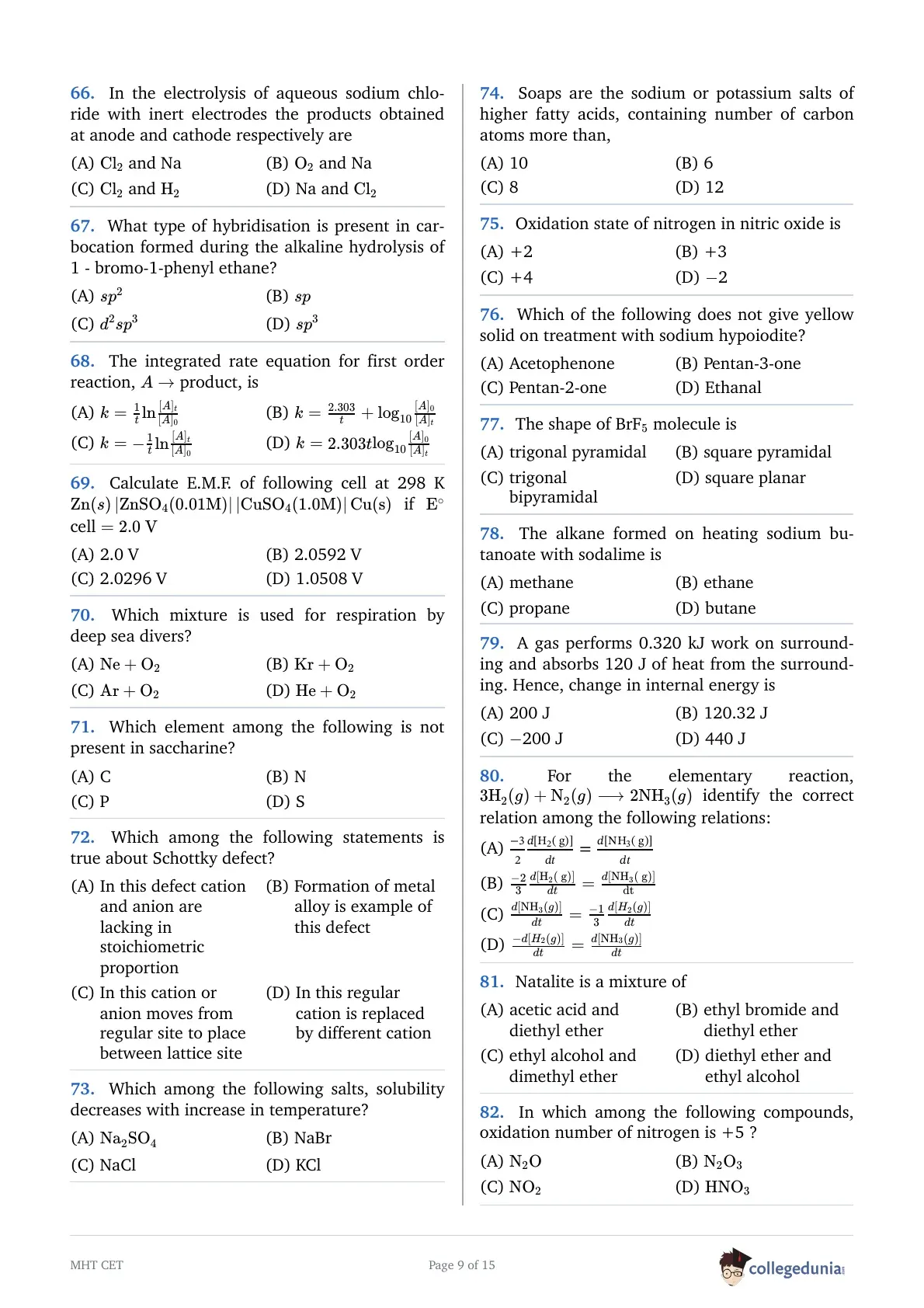
Question 66:

In the electrolysis of aqueous sodium chloride with inert electrodes the products obtained at anode and cathode respectively are

  • (A) \(\mathrm{Cl}_{2}\) and Na
  • (B) \(\mathrm{O}_{2}\) and Na
  • (C) \(\mathrm{Cl}_{2}\) and \(\mathrm{H}_{2}\)
  • (D) Na and \(\mathrm{Cl}_{2}\)

Question 67:

What type of hybridisation is present in carbocation formed during the alkaline hydrolysis of 1 - bromo-1-phenyl ethane?

  • (A) \(sp^{2}\)
  • (B) \(sp\)
  • (C) \(d^{2}sp^{3}\)
  • (D) \(sp^{3}\)

Question 68:

The integrated rate equation for first order reaction, \(A \rightarrow\) product, is

  • (A) \(k=\frac{1}{t}\mathrm{ln}\frac{[A]_{t}}{[A]_{0}}\)
  • (B) \(k=\frac{2.303}{t}+\mathrm{log}_{10}\frac{[A]_{0}}{[A]_{t}}\)
  • (C) \(k=-\frac{1}{t}\mathrm{ln}\frac{[A]_{t}}{[A]_{0}}\)
  • (D) \(k=2.303t\mathrm{log}_{10}\frac{[A]_{0}}{[A]_{t}}\)

Question 69:

Calculate E.M.F. of following cell at 298 K \(\mathrm{Zn}(s)\left|\mathrm{ZnSO}_4(0.01 \mathrm{M})\right|\left|\mathrm{CuSO}_4(1.0 \mathrm{M})\right| \mathrm{Cu}(\mathrm{s})\) if \(\mathrm{E}^{\circ}\) cell \(=2.0 \mathrm{~V}\)

  • (A) 2.0 V
  • (B) 2.0592 V
  • (C) 2.0296 V
  • (D) 1.0508 V

Question 70:

Which mixture is used for respiration by deep sea divers?

  • (A) \(\mathrm{Ne}+\mathrm{O}_{2}\)
  • (B) \(\mathrm{Kr}+\mathrm{O}_{2}\)
  • (C) \(\mathrm{Ar}+\mathrm{O}_{2}\)
  • (D) \(\mathrm{He}+\mathrm{O}_{2}\)

Question 71:

Which element among the following is not present in saccharine?

  • (A) C
  • (B) N
  • (C) P
  • (D) S

Question 72:

Which among the following statements is true about Schottky defect?

  • (A) In this defect cation and anion are lacking in stoichiometric proportion
  • (B) Formation of metal alloy is example of this defect
  • (C) In this cation or anion moves from regular site to place between lattice site
  • (D) In this regular cation is replaced by different cation

Question 73:

Which among the following salts, solubility decreases with increase in temperature?

  • (A) \(\mathrm{Na}_{2}\mathrm{SO}_{4}\)
  • (B) NaBr
  • (C) NaCl
  • (D) KCl

Question 74:

Soaps are the sodium or potassium salts of higher fatty acids, containing number of carbon atoms more than,

  • (A) 10
  • (B) 6
  • (C) 8
  • (D) 12

Question 75:

Oxidation state of nitrogen in nitric oxide is

  • (A) +2
  • (B) +3
  • (C) +4
  • (D) \(-\)2

Question 76:

Which of the following does not give yellow solid on treatment with sodium hypoiodite?

  • (A) Acetophenone
  • (B) Pentan-3-one
  • (C) Pentan-2-one
  • (D) Ethanal

Question 77:

The shape of BrF\(_5\) molecule is

  • (A) trigonal pyramidal
  • (B) square pyramidal
  • (C) trigonal bipyramidal
  • (D) square planar

Question 78:

The alkane formed on heating sodium butanoate with sodalime is

  • (A) methane
  • (B) ethane
  • (C) propane
  • (D) butane

Question 79:

A gas performs 0.320 kJ work on surrounding and absorbs 120 J of heat from the surrounding. Hence, change in internal energy is

  • (A) 200 J
  • (B) 120.32 J
  • (C) \(-\)200 J
  • (D) 440 J

Question 80:

For the elementary reaction, \(3 \mathrm{H}_2(g)+\mathrm{N}_2(g) \longrightarrow 2 \mathrm{NH}_3(g)\) identify the correct relation among the following relations:

  • (A) \(\frac{-3}{2}\frac{d[\mathrm{H}_{2}(\text{ }\mathrm{g})]}{dt}=\frac{d[\mathrm{NH}_{3}(\text{ }\mathrm{g})]}{dt}\)
  • (B) \(\frac{-2}{3}\frac{d[\mathrm{H}_{2}(\text{ }\mathrm{g})]}{dt}=\frac{d[\mathrm{NH}_{3}(\text{ }\mathrm{g})]}{\mathrm{dt}}\)
  • (C) \(\frac{d[\mathrm{NH}_{3}(g)]}{dt}=\frac{-1}{3}\frac{d[H_{2}(g)]}{dt}\)
  • (D) \(\frac{-d[H_{2}(g)]}{dt}=\frac{d[\mathrm{NH}_{3}(g)]}{dt}\)

Question 81:

Natalite is a mixture of

  • (A) acetic acid and diethyl ether
  • (B) ethyl bromide and diethyl ether
  • (C) ethyl alcohol and dimethyl ether
  • (D) diethyl ether and ethyl alcohol

Question 82:

In which among the following compounds, oxidation number of nitrogen is +5 ?

  • (A) \(\mathrm{N}_{2}\mathrm{O}\)
  • (B) \(\mathrm{N}_{2}\mathrm{O}_{3}\)
  • (C) \(\mathrm{NO}_{2}\)
  • (D) \(\mathrm{HNO}_{3}\)

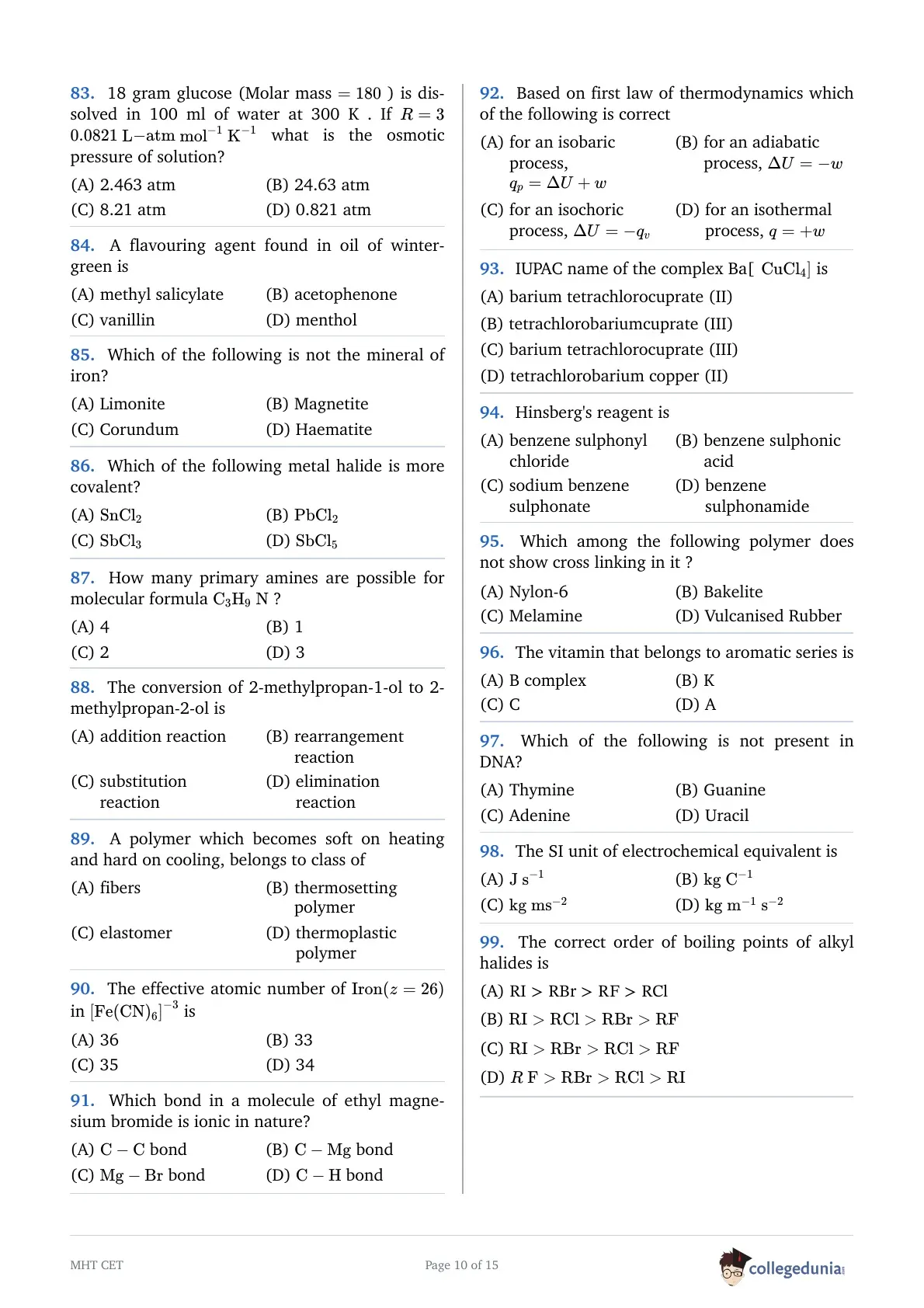
Question 83:

18 gram glucose (Molar mass \(=180\) ) is dissolved in 100 ml of water at 300 K . If \(R=3\) \(0.0821 \mathrm{~L}{-\mathrm{a t m}} \mathrm{~mol}^{-1} \mathrm{~K}^{-1}\) what is the osmotic pressure of solution?

  • (A) 2.463 atm
  • (B) 24.63 atm
  • (C) 8.21 atm
  • (D) 0.821 atm

Question 84:

A flavouring agent found in oil of wintergreen is

  • (A) methyl salicylate
  • (B) acetophenone
  • (C) vanillin
  • (D) menthol

Question 85:

Which of the following is not the mineral of iron?

  • (A) Limonite
  • (B) Magnetite
  • (C) Corundum
  • (D) Haematite

Question 86:

Which of the following metal halide is more covalent?

  • (A) \(\mathrm{SnCl}_{2}\)
  • (B) \(\mathrm{PbCl}_{2}\)
  • (C) \(\mathrm{SbCl}_{3}\)
  • (D) \(\mathrm{SbCl}_{5}\)

Question 87:

How many primary amines are possible for molecular formula \(\mathrm{C}_3 \mathrm{H}_9 \mathrm{~N}\) ?

  • (A) 4
  • (B) 1
  • (C) 2
  • (D) 3

Question 88:

The conversion of 2-methylpropan-1-ol to 2-methylpropan-2-ol is

  • (A) addition reaction
  • (B) rearrangement reaction
  • (C) substitution reaction
  • (D) elimination reaction

Question 89:

A polymer which becomes soft on heating and hard on cooling, belongs to class of

  • (A) fibers
  • (B) thermosetting polymer
  • (C) elastomer
  • (D) thermoplastic polymer

Question 90:

The effective atomic number of \(\operatorname{Iron}(z=26)\) in \(\left[\mathrm{Fe}(\mathrm{CN})_6\right]^{-3}\) is

  • (A) 36
  • (B) 33
  • (C) 35
  • (D) 34

Question 91:

Which bond in a molecule of ethyl magnesium bromide is ionic in nature?

  • (A) \(\mathrm{C}-\mathrm{C}\) bond
  • (B) \(\mathrm{C}-\mathrm{Mg}\) bond
  • (C) \(\mathrm{Mg}-\mathrm{Br}\) bond
  • (D) \(\mathrm{C}-\mathrm{H}\) bond

Question 93:

IUPAC name of the complex Ba[ \(\left.\mathrm{CuCl}_4\right]\) is

  • (A) barium tetrachlorocuprate (II)
  • (B) tetrachlorobariumcuprate (III)
  • (C) barium tetrachlorocuprate (III)
  • (D) tetrachlorobarium copper (II)

Question 94:

Hinsberg's reagent is

  • (A) benzene sulphonyl chloride
  • (B) benzene sulphonic acid
  • (C) sodium benzene sulphonate
  • (D) benzene sulphonamide

Question 95:

Which among the following polymer does not show cross linking in it ?

  • (A) Nylon-6
  • (B) Bakelite
  • (C) Melamine
  • (D) Vulcanised Rubber

Question 96:

The vitamin that belongs to aromatic series is

  • (A) B complex
  • (B) K
  • (C) C
  • (D) A

Question 97:

Which of the following is not present in DNA?

  • (A) Thymine
  • (B) Guanine
  • (C) Adenine
  • (D) Uracil

Question 98:

The SI unit of electrochemical equivalent is

  • (A) \(\mathrm{J}\text{ }\mathrm{s}^{-1}\)
  • (B) \(\mathrm{kg}\text{ }\mathrm{C}^{-1}\)
  • (C) \(\mathrm{kg}\text{ }\mathrm{ms}^{-2}\)
  • (D) \(\mathrm{kg}\text{ }\mathrm{m}^{-1}\text{ }\mathrm{s}^{-2}\)

Question 99:

The correct order of boiling points of alkyl halides is

  • (A) \(\mathrm{RI}>\mathrm{RBr}>\mathrm{RF}>\mathrm{RCl}\)
  • (B) \(\mathrm{RI}>\mathrm{RCl}>\mathrm{RBr}>\mathrm{RF}\)
  • (C) \(\mathrm{RI}>\mathrm{RBr}>\mathrm{RCl}>\mathrm{RF}\)
  • (D) \(R\text{ }\mathrm{F}>\mathrm{RBr}>\mathrm{RCl}>\mathrm{RI}\)

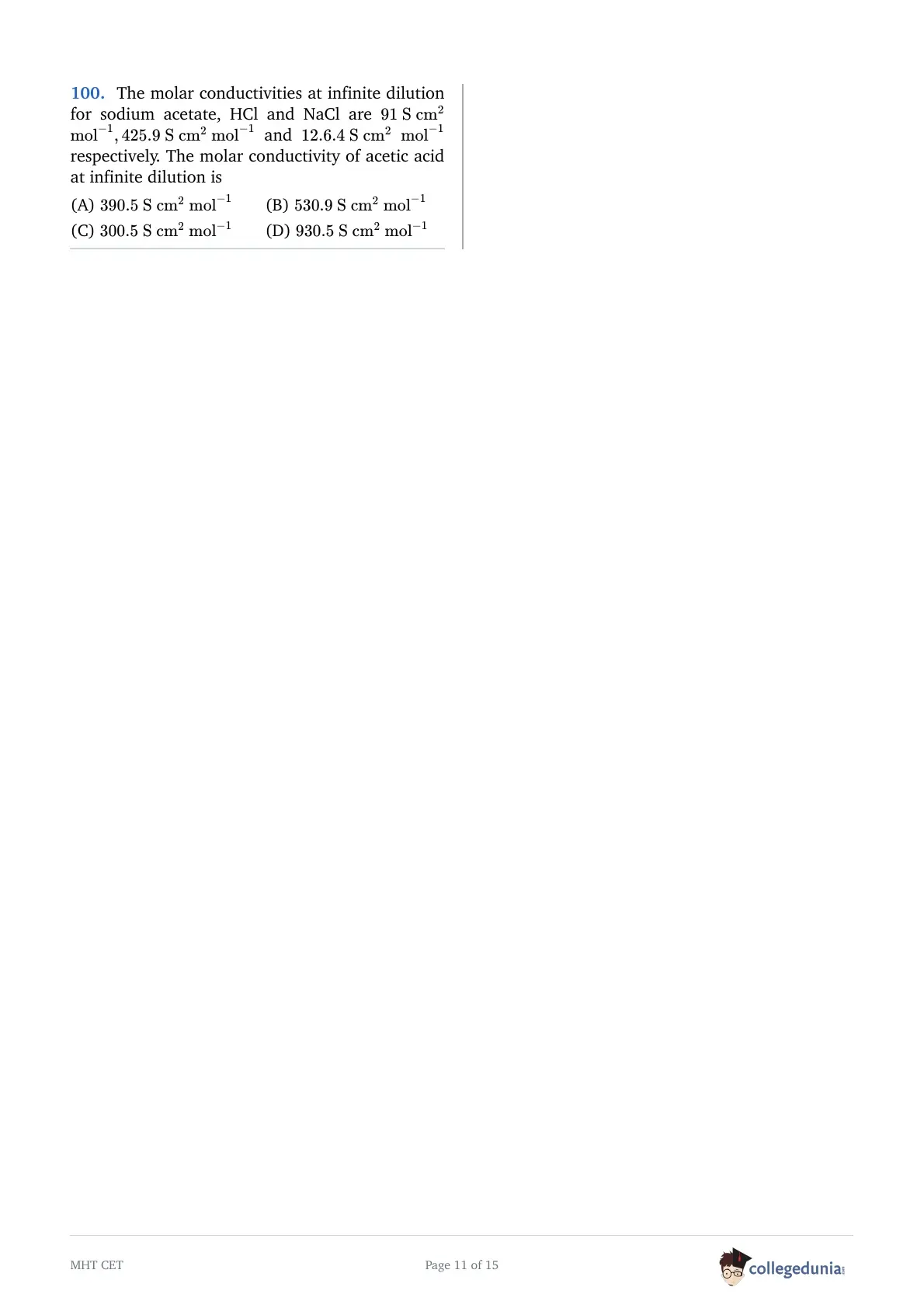
Question 100:

The molar conductivities at infinite dilution for sodium acetate, HCl and NaCl are \(91 \mathrm{~S} \mathrm{~cm}{ }^2\) \(\mathrm{mol}^{-1}, 425.9 \mathrm{~S} \mathrm{~cm}^2 \mathrm{~mol}^{-1}\) and \(12.6 .4 \mathrm{~S} \mathrm{~cm}^2\) \(\mathrm{mol}^{-1}\) respectively. The molar conductivity of acetic acid at infinite dilution is

  • (A) \(390.5\text{ }\mathrm{S}\text{ }\mathrm{cm}^{2}\text{ }\mathrm{mol}^{-1}\)
  • (B) \(530.9\text{ }\mathrm{S}\text{ }\mathrm{cm}^{2}\text{ }\mathrm{mol}^{-1}\)
  • (C) \(300.5\text{ }\mathrm{S}\text{ }\mathrm{cm}^{2}\text{ }\mathrm{mol}^{-1}\)
  • (D) \(930.5\text{ }\mathrm{S}\text{ }\mathrm{cm}^{2}\text{ }\mathrm{mol}^{-1}\)

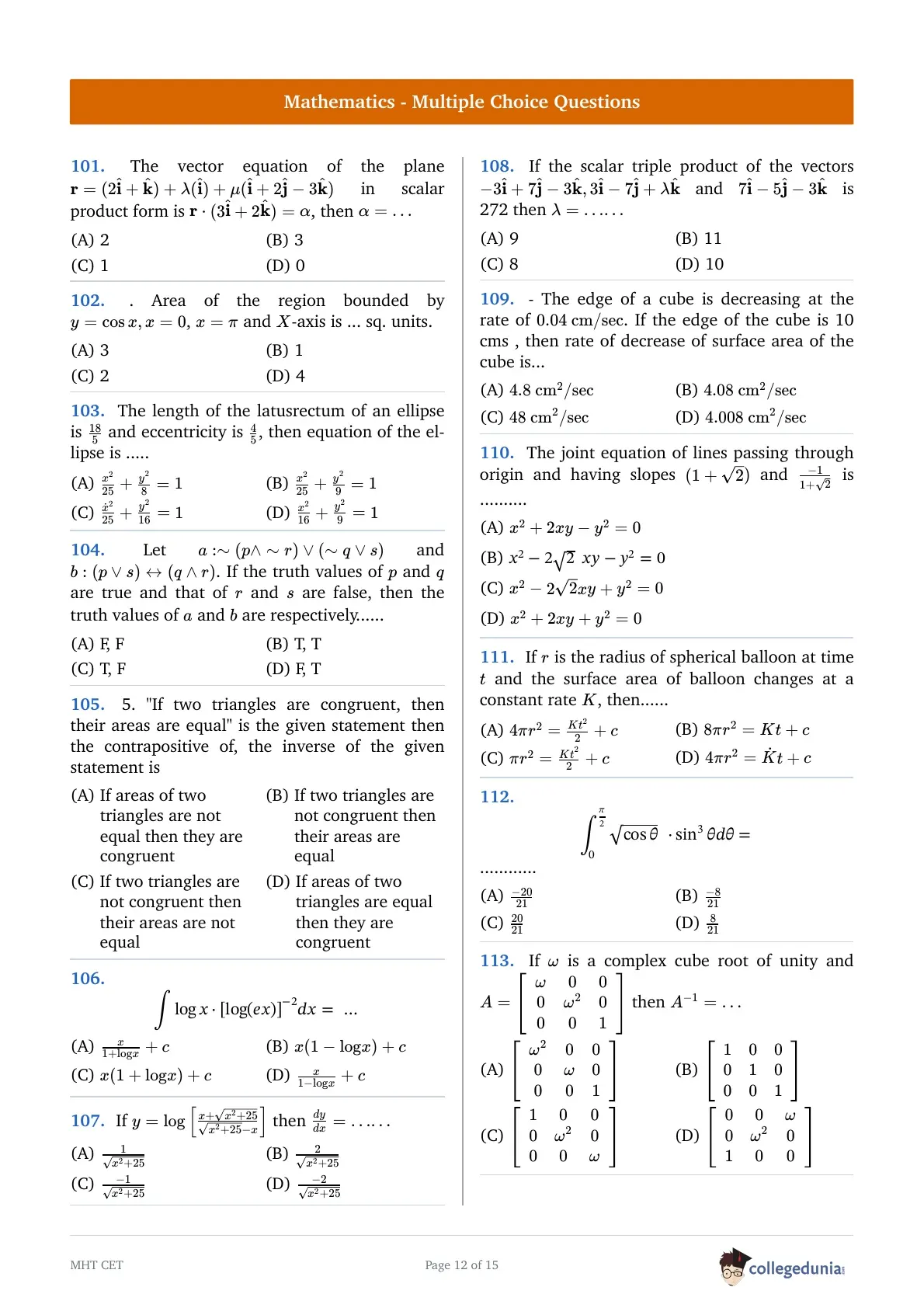
Question 102:

. Area of the region bounded by \(y=\cos x, x=0\), \(x=\pi\) and \(X\)-axis is ... sq. units.

  • (A) 3
  • (B) 1
  • (C) 2
  • (D) 4

Question 103:

The length of the latusrectum of an ellipse is \(\frac{18}{5}\) and eccentricity is \(\frac{4}{5}\), then equation of the ellipse is .....

  • (A) \(\frac{x^{2}}{25}+\frac{y^{2}}{8}=1\)
  • (B) \(\frac{x^{2}}{25}+\frac{y^{2}}{9}=1\)
  • (C) \(\frac{\dot{x}^{2}}{25}+\frac{y^{2}}{16}=1\)
  • (D) \(\frac{x^{2}}{16}+\frac{y^{2}}{9}=1\)

Question 104:

Let \(a: \sim(p \wedge \sim r) \vee(\sim q \vee s)\) and \(b:(p \vee s) \leftrightarrow(q \wedge r)\). If the truth values of \(p\) and \(q\) are true and that of \(r\) and \(s\) are false, then the truth values of \(a\) and \(b\) are respectively......

  • (A) F, F
  • (B) T, T
  • (C) T, F
  • (D) F, T

Question 105:

5. "If two triangles are congruent, then their areas are equal" is the given statement then the contrapositive of, the inverse of the given statement is

  • (A) If areas of two triangles are not equal then they are congruent
  • (B) If two triangles are not congruent then their areas are equal
  • (C) If two triangles are not congruent then their areas are not equal
  • (D) If areas of two triangles are equal then they are congruent

Question 106:

\[\int \log x \cdot[\log (e x)]^{-2} d x=\ldots\]

  • (A) \(\frac{x}{1+\mathrm{log}x}+c\)
  • (B) \(x(1-\mathrm{log}x)+c\)
  • (C) \(x(1+\mathrm{log}x)+c\)
  • (D) \(\frac{x}{1-\mathrm{log}x}+c\)

Question 107:

If \(y=\log \left[\frac{x+\sqrt{x^2+25}}{\sqrt{x^2+25}-x}\right]\) then \(\frac{d y}{d x}=\ldots \ldots\)

  • (A) \(\frac{1}{\sqrt{x^{2}+25}}\)
  • (B) \(\frac{2}{\sqrt{x^{2}+25}}\)
  • (C) \(\frac{-1}{\sqrt{x^{2}+25}}\)
  • (D) \(\frac{-2}{\sqrt{x^{2}+25}}\)

Question 108:

If the scalar triple product of the vectors \(-3 \hat{\mathbf{i}}+7 \hat{\mathbf{j}}-3 \hat{\mathbf{k}}, 3 \hat{\mathbf{i}}-7 \hat{\mathbf{j}}+\lambda \hat{\mathbf{k}}\) and \(7 \hat{\mathbf{i}}-5 \hat{\mathbf{j}}-3 \hat{\mathbf{k}}\) is 272 then \(\lambda=\ldots \ldots\)

  • (A) 9
  • (B) 11
  • (C) 8
  • (D) 10

Question 109:

- The edge of a cube is decreasing at the rate of \(0.04 \mathrm{~cm} / \mathrm{sec}\). If the edge of the cube is 10 cms , then rate of decrease of surface area of the cube is...

  • (A) \(4.8\text{ }\mathrm{cm}^{2}/\mathrm{sec}\)
  • (B) \(4.08\text{ }\mathrm{cm}^{2}/\mathrm{sec}\)
  • (C) \(48\text{ }\mathrm{cm}^{2}/\mathrm{sec}\)
  • (D) \(4.008\text{ }\mathrm{cm}^{2}/\mathrm{sec}\)

Question 110:

The joint equation of lines passing through origin and having slopes \((1+\sqrt{2})\) and \(\frac{-1}{1+\sqrt{2}}\) is ..........

  • (A) \(x^{2}+2xy-y^{2}=0\)
  • (B) \(x^{2}-2\sqrt{2}xy-y^{2}=0\)
  • (C) \(x^{2}-2\sqrt{2}xy+y^{2}=0\)
  • (D) \(x^{2}+2xy+y^{2}=0\)

Question 111:

If \(r\) is the radius of spherical balloon at time \(t\) and the surface area of balloon changes at a constant rate \(K\), then......

  • (A) \(4\pi r^{2}=\frac{Kt^{2}}{2}+c\)
  • (B) \(8\pi r^{2}=Kt+c\)
  • (C) \(\pi r^{2}=\frac{Kt^{2}}{2}+c\)
  • (D) \(4\pi r^{2}=\dot{K}t+c\)

Question 112:

\[\int_0^{\frac{\pi}{2}} \sqrt{\cos \theta} \cdot \sin ^3 \theta d \theta=\] ............

  • (A) \(\frac{-20}{21}\)
  • (B) \(\frac{-8}{21}\)
  • (C) \(\frac{20}{21}\)
  • (D) \(\frac{8}{21}\)

Question 113:

If \(\omega\) is a complex cube root of unity and \(A=\left[\begin{array}{ccc}\omega & 0 & 0 \\ 0 & \omega^2 & 0 \\ 0 & 0 & 1\end{array}\right]\) then \(A^{-1}=\ldots\)

  • (A) \(\left[\begin{array}{ccc} \omega ^{2} & 0 & 0 \\ 0 & \omega & 0 \\ 0 & 0 & 1 \end{array}\right]\)
  • (B) \(\left[\begin{array}{ccc} 1 & 0 & 0 \\ 0 & 1 & 0 \\ 0 & 0 & 1 \end{array}\right]\)
  • (C) \(\left[\begin{array}{ccc} 1 & 0 & 0 \\ 0 & \omega ^{2} & 0 \\ 0 & 0 & \omega \end{array}\right]\)
  • (D) \(\left[\begin{array}{ccc} 0 & 0 & \omega \\ 0 & \omega ^{2} & 0 \\ 1 & 0 & 0 \end{array}\right]\)

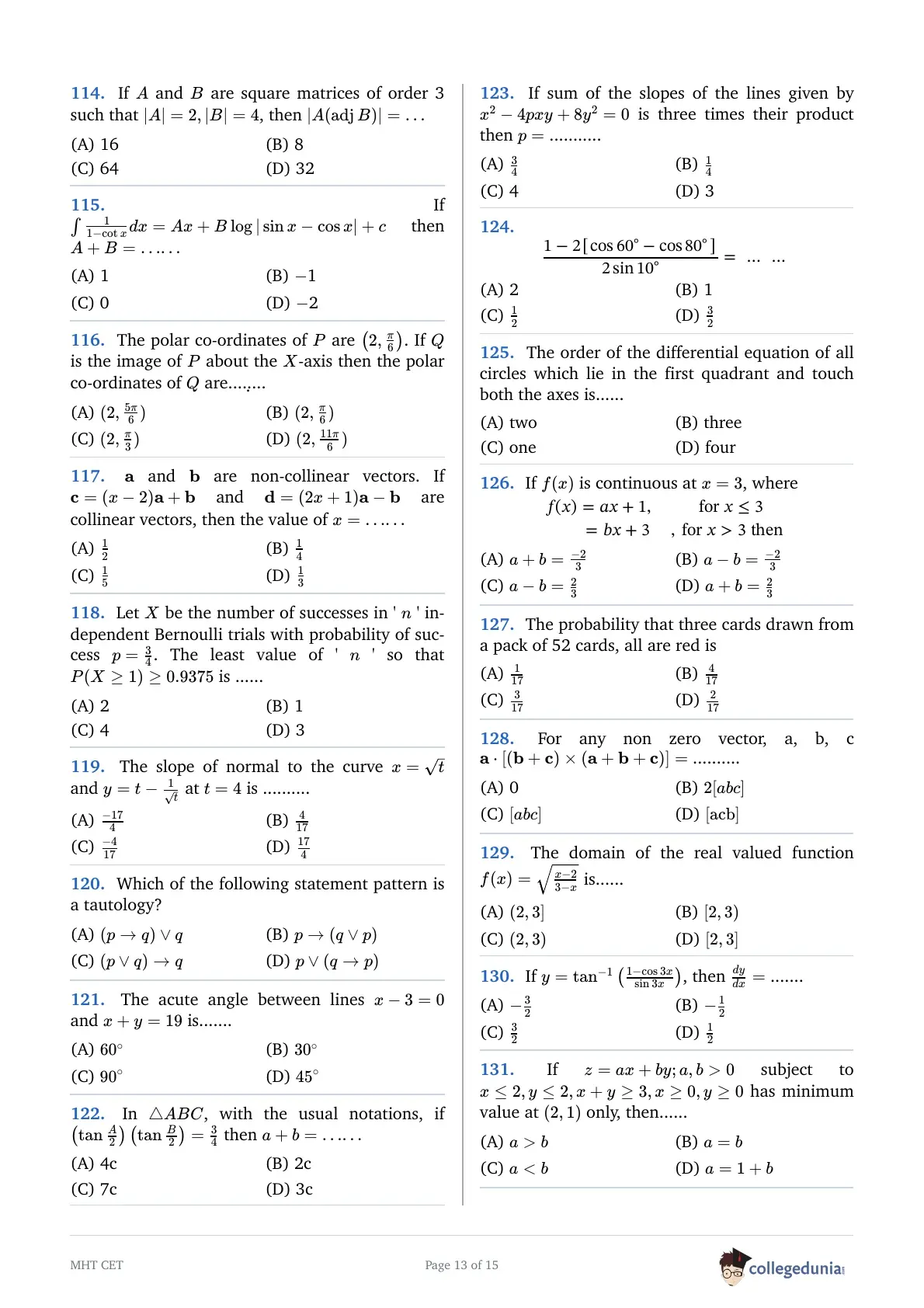
Question 114:

If \(A\) and \(B\) are square matrices of order 3 such that \(|A|=2,|B|=4\), then \(|A(\operatorname{adj} B)|=\ldots\)

  • (A) 16
  • (B) 8
  • (C) 64
  • (D) 32

Question 115:

If \(\int \frac{1}{1-\cot x} d x=A x+B \log |\sin x-\cos x|+c\) then \(A+B=\ldots \ldots\)

  • (A) 1
  • (B) \(-\)1
  • (C) 0
  • (D) \(-\)2

Question 116:

The polar co-ordinates of \(P\) are \(\left(2, \frac{\pi}{6}\right)\). If \(Q\) is the image of \(P\) about the \(X\)-axis then the polar co-ordinates of \(Q\) are.....̣...

  • (A) \((2,\frac{5\pi}{6})\)
  • (B) \((2,\frac{\pi}{6})\)
  • (C) \((2,\frac{\pi}{3})\)
  • (D) \((2,\frac{11\pi}{6})\)

Question 117:

\(\mathbf{a}\) and \(\mathbf{b}\) are non-collinear vectors. If \(\mathbf{c}=(x-2) \mathbf{a}+\mathbf{b}\) and \(\mathbf{d}=(2 x+1) \mathbf{a}-\mathbf{b}\) are collinear vectors, then the value of \(x=\ldots \ldots\)

  • (A) \(\frac{1}{2}\)
  • (B) \(\frac{1}{4}\)
  • (C) \(\frac{1}{5}\)
  • (D) \(\frac{1}{3}\)

Question 118:

Let \(X\) be the number of successes in ' \(n\) ' independent Bernoulli trials with probability of success \(p=\frac{3}{4}\). The least value of ' \(n\) ' so that \(P(X \geq 1) \geq 0.9375\) is ......

  • (A) 2
  • (B) 1
  • (C) 4
  • (D) 3

Question 119:

The slope of normal to the curve \(x=\sqrt{t}\) and \(y=t-\frac{1}{\sqrt{t}}\) at \(t=4\) is ..........

  • (A) \(\frac{-17}{4}\)
  • (B) \(\frac{4}{17}\)
  • (C) \(\frac{-4}{17}\)
  • (D) \(\frac{17}{4}\)

Question 120:

Which of the following statement pattern is a tautology?

  • (A) \((p\rightarrow q)\vee q\)
  • (B) \(p\rightarrow (q\vee p)\)
  • (C) \((p\vee q)\rightarrow q\)
  • (D) \(p\vee (q\rightarrow p)\)

Question 121:

The acute angle between lines \(x-3=0\) and \(x+y=19\) is.......

  • (A) \(60^{\circ}\)
  • (B) \(30^{\circ}\)
  • (C) \(90^{\circ}\)
  • (D) \(45^{\circ}\)

Question 122:

In \(\triangle A B C\), with the usual notations, if \(\left(\tan \frac{A}{2}\right)\left(\tan \frac{B}{2}\right)=\frac{3}{4}\) then \(a+b=\ldots \ldots\)

  • (A) 4c
  • (B) 2c
  • (C) 7c
  • (D) 3c

Question 123:

If sum of the slopes of the lines given by \(x^2-4 p x y+8 y^2=0\) is three times their product then \(p=\) ...........

  • (A) \(\frac{3}{4}\)
  • (B) \(\frac{1}{4}\)
  • (C) 4
  • (D) 3

Question 124:

\[\frac{1-2\left[\cos 60^{\circ}-\cos 80^{\circ}\right]}{2 \sin 10^{\circ}}=\ldots \ldots\]

  • (A) 2
  • (B) 1
  • (C) \(\frac{1}{2}\)
  • (D) \(\frac{3}{2}\)

Question 125:

The order of the differential equation of all circles which lie in the first quadrant and touch both the axes is......

  • (A) two
  • (B) three
  • (C) one
  • (D) four

Question 126:

If \(f(x)\) is continuous at \(x=3\), where

\[\begin{aligned} f(x) & =a x+1, & \text { for } x \leq 3 \\ & =b x+3 & , \text { for } x>3 \text { then } \end{aligned}\]

  • (A) \(a+b=\frac{-2}{3}\)
  • (B) \(a-b=\frac{-2}{3}\)
  • (C) \(a-b=\frac{2}{3}\)
  • (D) \(a+b=\frac{2}{3}\)

Question 127:

The probability that three cards drawn from a pack of 52 cards, all are red is

  • (A) \(\frac{1}{17}\)
  • (B) \(\frac{4}{17}\)
  • (C) \(\frac{3}{17}\)
  • (D) \(\frac{2}{17}\)

Question 128:

For any non zero vector, a, b, c \(\mathbf{a} \cdot[(\mathbf{b}+\mathbf{c}) \times(\mathbf{a}+\mathbf{b}+\mathbf{c})]=\) ..........

  • (A) 0
  • (B) \(2[abc]\)
  • (C) \([abc]\)
  • (D) \([\mathrm{acb}]\)

Question 129:

The domain of the real valued function \(f(x)=\sqrt{\frac{x-2}{3-x}}\) is......

  • (A) \((2,3]\)
  • (B) \([2,3)\)
  • (C) \((2,3)\)
  • (D) \([2,3]\)

Question 130:

If \(y=\tan ^{-1}\left(\frac{1-\cos 3 x}{\sin 3 x}\right)\), then \(\frac{d y}{d x}=\) .......

  • (A) \(-\frac{3}{2}\)
  • (B) \(-\frac{1}{2}\)
  • (C) \(\frac{3}{2}\)
  • (D) \(\frac{1}{2}\)

Question 131:

If \(z=a x+b y ; a, b>0\) subject to \(x \leq 2, y \leq 2, x+y \geq 3, x \geq 0, y \geq 0\) has minimum value at \((2,1)\) only, then......

  • (A) \(a>b\)
  • (B) \(a=b\)
  • (C) \(a<b\)
  • (D) \(a=1+b\)

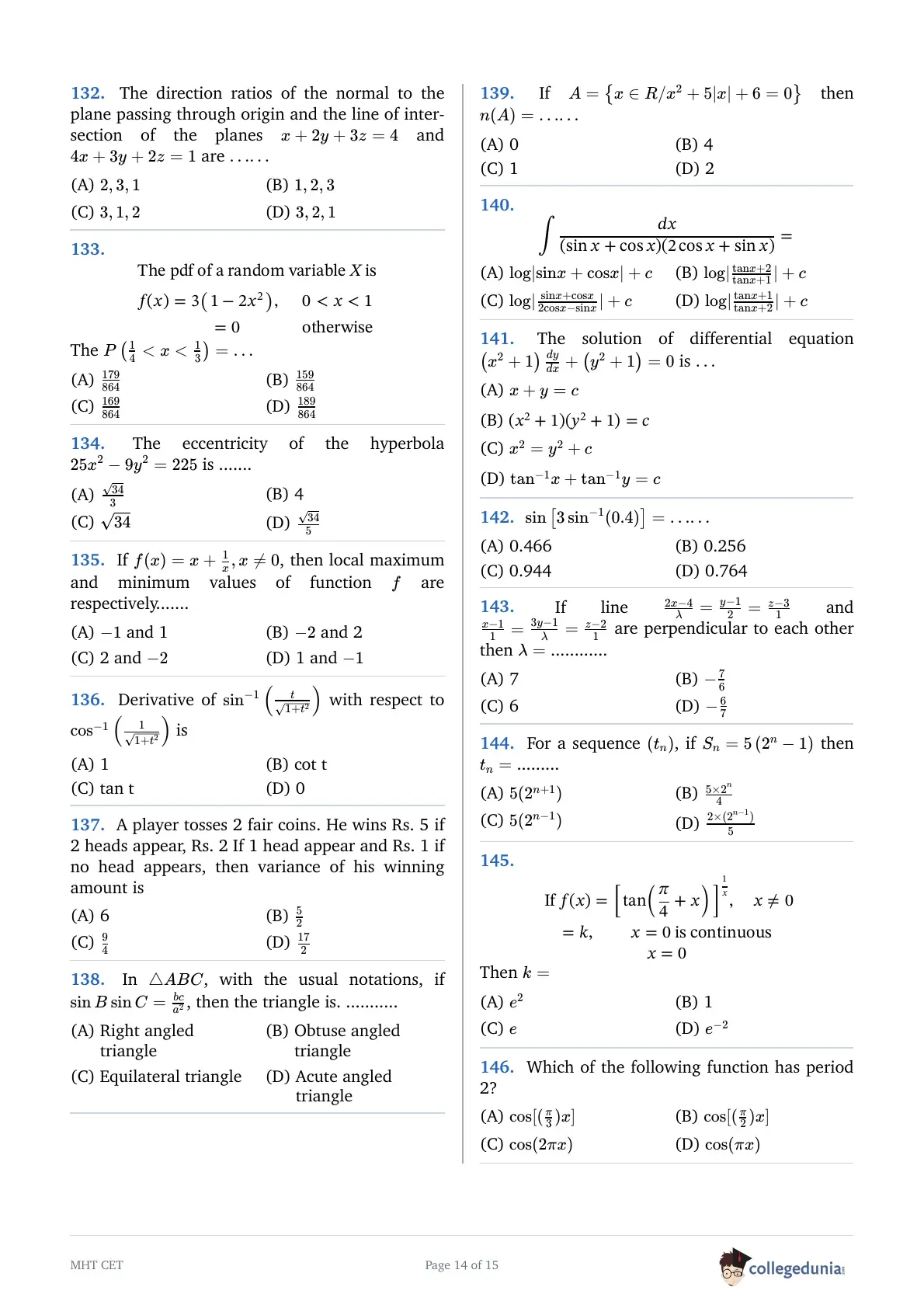
Question 132:

The direction ratios of the normal to the plane passing through origin and the line of intersection of the planes \(x+2 y+3 z=4\) and \(4 x+3 y+2 z=1\) are \(\ldots \ldots\)

  • (A) \(2,3,1\)
  • (B) \(1,2,3\)
  • (C) \(3,1,2\)
  • (D) \(3,2,1\)

Question 134:

The eccentricity of the hyperbola \(25 x^2-9 y^2=225\) is .......

  • (A) \(\frac{\sqrt{34}}{3}\)
  • (B) 4
  • (C) \(\sqrt{34}\)
  • (D) \(\frac{\sqrt{34}}{5}\)

Question 135:

If \(f(x)=x+\frac{1}{x}, x \neq 0\), then local maximum and minimum values of function \(f\) are respectively.......

  • (A) \(-1\) and 1
  • (B) \(-2\) and 2
  • (C) 2 and \(-2\)
  • (D) 1 and \(-1\)

Question 136:

Derivative of \(\sin ^{-1}\left(\frac{t}{\sqrt{1+t^2}}\right)\) with respect to \(\cos ^{-1}\left(\frac{1}{\sqrt{1+t^2}}\right)\) is

  • (A) 1
  • (B) cot t
  • (C) tan t
  • (D) 0

Question 137:

A player tosses 2 fair coins. He wins Rs. 5 if 2 heads appear, Rs. 2 If 1 head appear and Rs. 1 if no head appears, then variance of his winning amount is

  • (A) 6
  • (B) \(\frac{5}{2}\)
  • (C) \(\frac{9}{4}\)
  • (D) \(\frac{17}{2}\)

Question 138:

In \(\triangle A B C\), with the usual notations, if \(\sin B \sin C=\frac{b c}{a^2}\), then the triangle is. ...........

  • (A) Right angled triangle
  • (B) Obtuse angled triangle
  • (C) Equilateral triangle
  • (D) Acute angled triangle

Question 139:

If \(A=\left\{x \in R / x^2+5|x|+6=0\right\}\) then \(n(A)=\ldots \ldots\)

  • (A) 0
  • (B) 4
  • (C) 1
  • (D) 2

Question 140:

\[\int \frac{d x}{(\sin x+\cos x)(2 \cos x+\sin x)}=\]

  • (A) \(\mathrm{log}|\mathrm{sin}x+\mathrm{cos}x|+c\)
  • (B) \(\mathrm{log}|\frac{\mathrm{tan}x+2}{\mathrm{tan}x+1}|+c\)
  • (C) \(\mathrm{log}|\frac{\mathrm{sin}x+\mathrm{cos}x}{2\mathrm{cos}x-\mathrm{sin}x}|+c\)
  • (D) \(\mathrm{log}|\frac{\mathrm{tan}x+1}{\mathrm{tan}x+2}|+c\)

Question 141:

The solution of differential equation \(\left(x^2+1\right) \frac{d y}{d x}+\left(y^2+1\right)=0\) is \(\ldots\)

  • (A) \(x+y=c\)
  • (B) \((x^{2}+1)(y^{2}+1)=c\)
  • (C) \(x^{2}=y^{2}+c\)
  • (D) \(\mathrm{tan}^{-1}x+\mathrm{tan}^{-1}y=c\)

Question 142:

\(\sin \left[3 \sin ^{-1}(0.4)\right]=\ldots \ldots\)

  • (A) 0.466
  • (B) 0.256
  • (C) 0.944
  • (D) 0.764

Question 143:

If line \(\frac{2 x-4}{\lambda}=\frac{y-1}{2}=\frac{z-3}{1}\) and \(\frac{x-1}{1}=\frac{3 y-1}{\lambda}=\frac{z-2}{1}\) are perpendicular to each other then \(\lambda=\) ............

  • (A) 7
  • (B) \(-\frac{7}{6}\)
  • (C) 6
  • (D) \(-\frac{6}{7}\)

Question 144:

For a sequence \(\left(t_n\right)\), if \(S_n=5\left(2^n-1\right)\) then \(t_n=\) .........

  • (A) \(5(2^{n+1})\)
  • (B) \(\frac{5\times 2^{n}}{4}\)
  • (C) \(5(2^{n-1})\)
  • (D) \(\frac{2\times (2^{n-1})}{5}\)

Question 145:

\[\begin{aligned} & \text { If } f(x)=\left[\tan \left(\frac{\pi}{4}+x\right)\right]^{\frac{1}{x}}, \quad x \neq 0 \\ & =k \text {, } \qquad x=0 \text { is continuous }\\ & x=0 \end{aligned}\] Then \(k=\)

  • (A) \(e^{2}\)
  • (B) 1
  • (C) \(e\)
  • (D) \(e^{-2}\)

Question 146:

Which of the following function has period 2?

  • (A) \(\mathrm{cos}[(\frac{\pi}{3})x]\)
  • (B) \(\mathrm{cos}[(\frac{\pi}{2})x]\)
  • (C) \(\mathrm{cos}(2\pi x)\)
  • (D) \(\mathrm{cos}(\pi x)\)

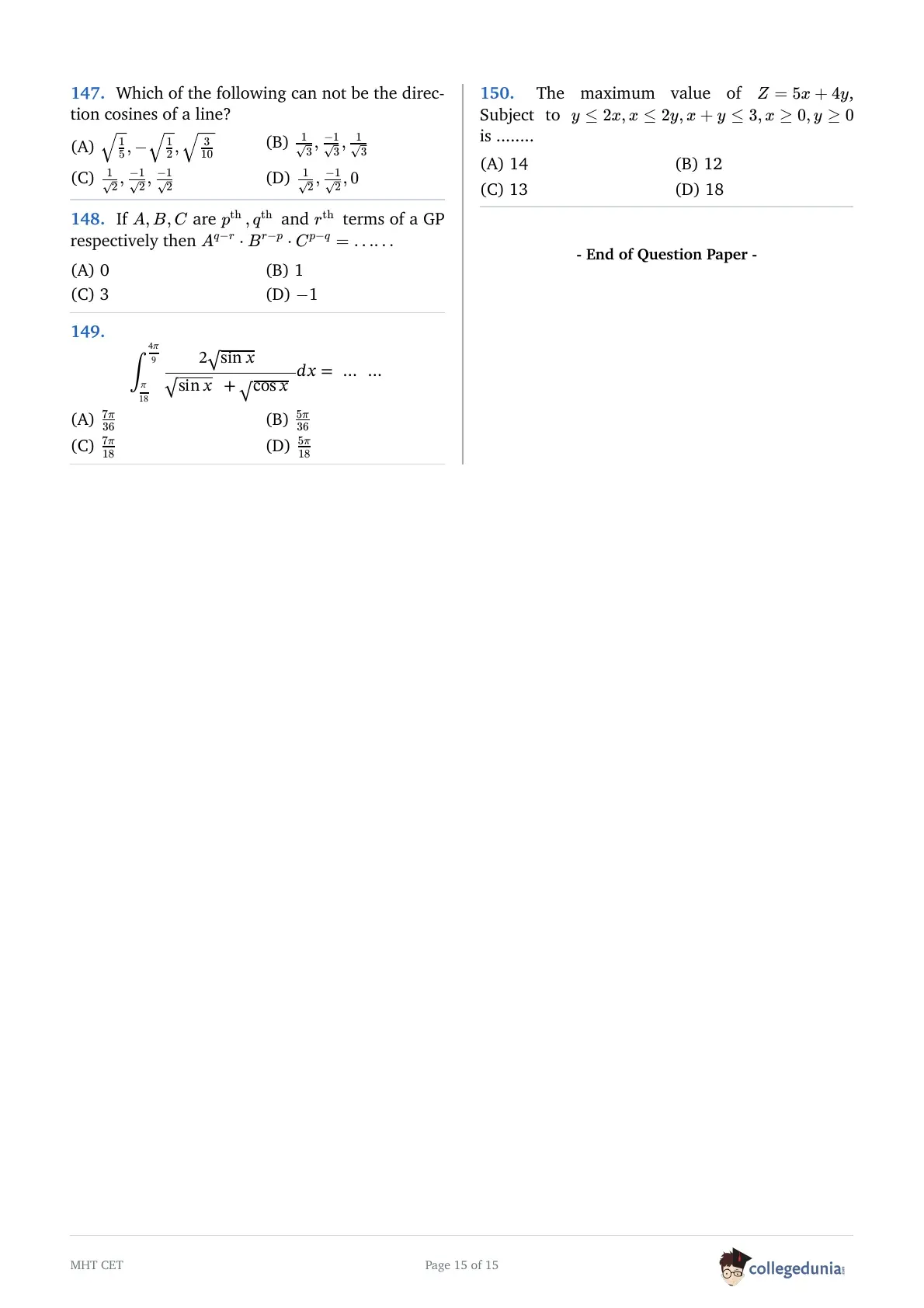
Question 147:

Which of the following can not be the direction cosines of a line?

  • (A) \(\sqrt{\frac{1}{5}},-\sqrt{\frac{1}{2}},\sqrt{\frac{3}{10}}\)
  • (B) \(\frac{1}{\sqrt{3}},\frac{-1}{\sqrt{3}},\frac{1}{\sqrt{3}}\)
  • (C) \(\frac{1}{\sqrt{2}},\frac{-1}{\sqrt{2}},\frac{-1}{\sqrt{2}}\)
  • (D) \(\frac{1}{\sqrt{2}},\frac{-1}{\sqrt{2}},0\)

Question 148:

If \(A, B, C\) are \(p^{\text {th }}, q^{\text {th }}\) and \(r^{\text {th }}\) terms of a GP respectively then \(A^{q-r} \cdot B^{r-p} \cdot C^{p-q}=\ldots \ldots\)


  • (A) 0
  • (B) 1
  • (C) 3
  • (D) \(-\)1

Question 149:

\[\int_{\frac{\pi}{18}}^{\frac{4 \pi}{9}} \frac{2 \sqrt{\sin x}}{\sqrt{\sin x}+\sqrt{\cos x}} d x=\ldots \ldots\]

  • (A) \(\frac{7\pi}{36}\)
  • (B) \(\frac{5\pi}{36}\)
  • (C) \(\frac{7\pi}{18}\)
  • (D) \(\frac{5\pi}{18}\)

Question 150:

The maximum value of \(Z=5 x+4 y\), Subject to \(y \leq 2 x, x \leq 2 y, x+y \leq 3, x \geq 0, y \geq 0\) is ........

  • (A) 14
  • (B) 12
  • (C) 13
  • (D) 18

MHT CET 2019 PCM Exam Pattern and Marking Scheme

Parameter Details
Conducting Body Maharashtra Common Entrance Test Cell (Maharashtra CET Cell)
Exam Mode Online (Computer-Based Test)
Duration 180 minutes (3 hours)
Groups / Subjects PCM (Physics, Chemistry, Mathematics) for Engineering
Total Questions

150

Total Marks 200
Question Type Multiple Choice Questions (MCQs)
Marks Distribution
  • Mathematics – 2 marks/question
  • Physics and Chemistry – 1 mark/question
Negative Marking No
Syllabus Weightage
  • Class 12 – 80%
  • Class 11 – 20%