




MHT CET 2021 Sep 20 Shift 1 PCM Question Paper is available for download here. Maharashtra State CET Cell conducted MHT CET 2021 PCM Exam on Sep 20 in Shift 1 from 9 AM to 12 PM in CBT mode.
The MHT CET 2021 PCM question paper includes the following:
- The MHT CET 2021 PCM Question Paper consists of 150 multiple-choice questions (MCQs) totalling 200 marks divided into 3 sections: Physics, Chemistry, and Mathematics, with 50 questions in each subject.
- Physics and Chemistry questions carry 1 mark each while Mathematics questions carry 2 marks each.
- There is no negative marking for incorrect answers.
MHT CET 2021 Sep 20 Shift 1 PCM Question Paper with Solution PDF
| CD PDF | CD PDF with Solutions |
|---|---|
| Download Collegedunia PDF 1.01 MB | - |
Also Check:
MHT CET 2021 Sep 20 Shift 1 PCM Questions with Solutions
Physics (Q1 - Q50)
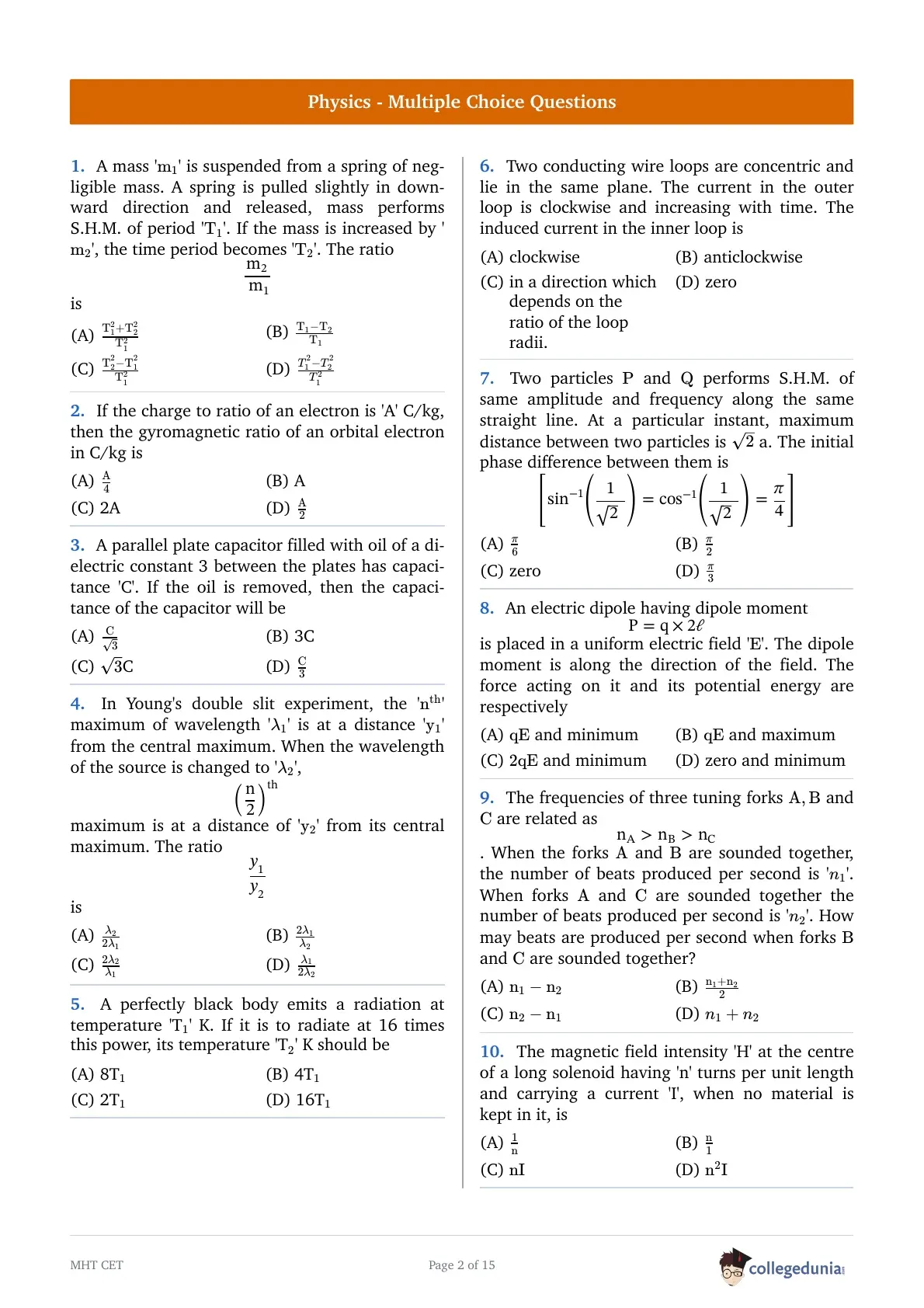
A mass '\(m_1\)' is suspended from a spring of negligible mass. A spring is pulled slightly in downward direction and released, mass performs S.H.M. of period '\(T_1\)'. If the mass is increased by '\(m_2\)', the time period becomes '\(T_2\)'. The ratio \(\frac{m_2}{m_1}\) is
If the charge to mass ratio of an electron is 'A' C/kg, then the gyromagnetic ratio of an orbital electron in C/kg is
A parallel plate capacitor filled with oil of a dielectric constant 3 between the plates has capacitance 'C'. If the oil is removed, then the capacitance of the capacitor will be
A perfectly black body emits a radiation at temperature '\(T_1\)' K. If it is to radiate at 16 times this power, its temperature '\(T_2\)' K should be
Two conducting wire loops are concentric and lie in the same plane. The current in the outer loop is clockwise and increasing with time. The induced current in the inner loop is
Two particles P and Q performs S.H.M. of same amplitude and frequency along the same straight line. At a particular instant, maximum distance between two particles is 2 a. The initial phase difference between them is \(\left[ \sin^{-1}\left(\frac{1}{2}\right) = \cos^{-1}\left(\frac{1}{2}\right) = \frac{\pi}{4} \right]\)
An electric dipole having dipole moment \(P = q \times 2\ell\) is placed in a uniform electric field 'E'. The dipole moment is along the direction of the field. The force acting on it and its potential energy are respectively
The frequencies of three tuning forks A, B and C are related as \(n_A > n_B > n_C\). When the forks A and B are sounded together, the number of beats produced per second is '\(n_1\)'. When forks A and C are sounded together the number of beats produced per second is '\(n_2\)'. How many beats are produced per second when forks B and C are sounded together?
The magnetic field intensity 'H' at the centre of a long solenoid having 'n' turns per unit length and carrying a current 'I', when no material is kept in it, is
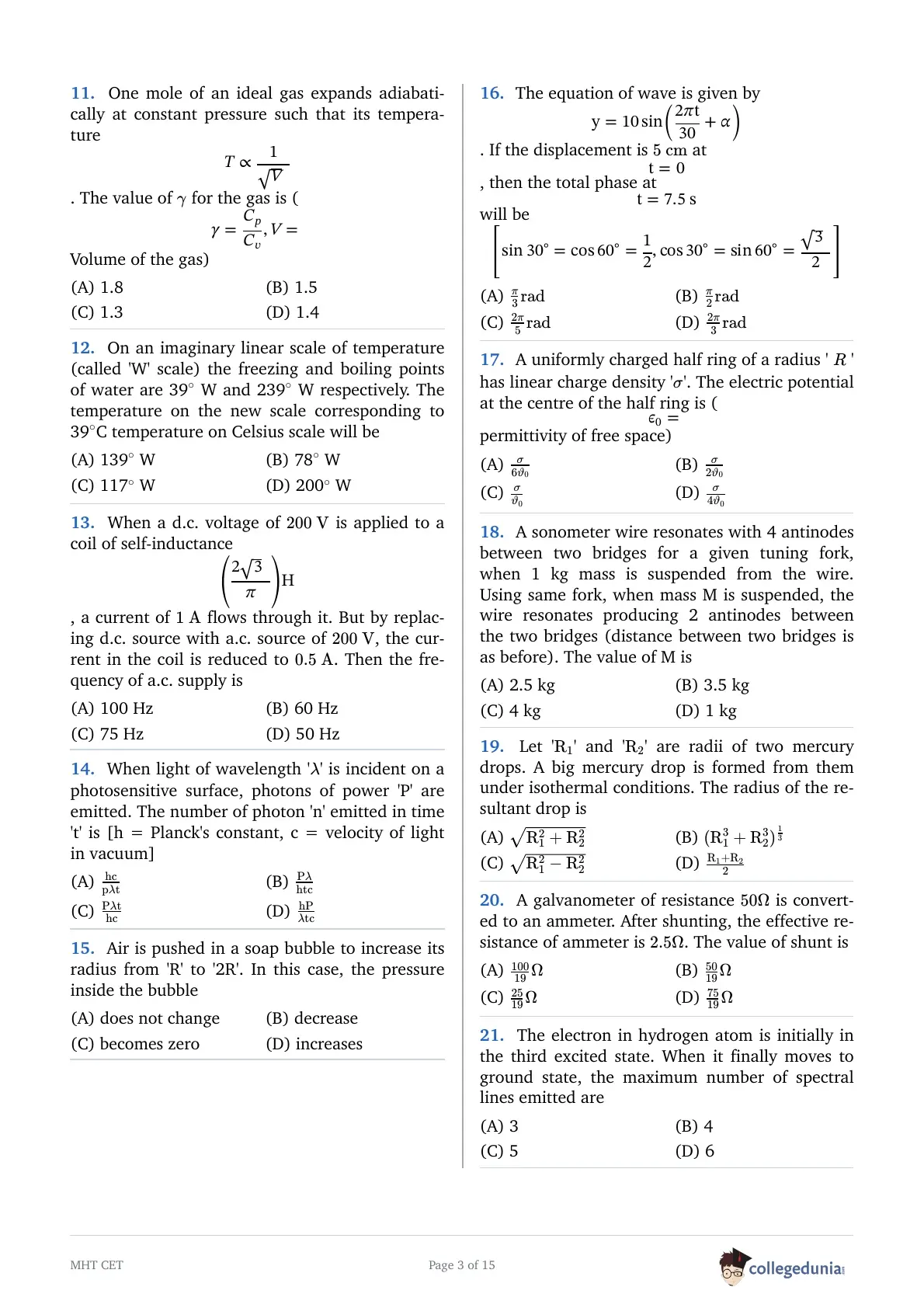
One mole of an ideal gas expands adiabatically at constant pressure such that its temperature \(T \propto \frac{1}{\sqrt{V}}\). The value of \(\gamma\) for the gas is \(\left( \gamma = \frac{C_p}{C_v}, V = \text{Volume of the gas} \right)\)
On an imaginary linear scale of temperature (called 'W' scale) the freezing and boiling points of water are \(39^\circ\text{W}\) and \(239^\circ\text{W}\) respectively. The temperature on the new scale corresponding to \(39^\circ\text{C}\) temperature on Celsius scale will be
When a d.c. voltage of 200 V is applied to a coil of self-inductance \(\left(\frac{2\sqrt{3}}{\pi}\right)\) H, a current of 1 A flows through it. But by replacing d.c. source with a.c. source of 200 V, the current in the coil is reduced to 0.5 A. Then the frequency of a.c. supply is
When light of wavelength '\(\lambda\)' is incident on a photosensitive surface, photons of power 'P' are emitted. The number of photon 'n' emitted in time 't' is [h = Planck's constant, c = velocity of light in vacuum]
Air is pushed in a soap bubble to increase its radius from 'R' to '2R'. In this case, the pressure inside the bubble
The equation of wave is given by \(y = 10 \sin \left(\frac{2\pi t}{30} + \alpha\right)\). If the displacement is 5 cm at t = 0, then the total phase at t = 7.5 s will be \(\left[ \sin 30^\circ = \cos 60^\circ = \frac{1}{2}, \cos 30^\circ = \sin 60^\circ = \frac{\sqrt{3}}{2} \right]\)
A uniformly charged half ring of a radius 'R' has linear charge density '\(\sigma\)'. The electric potential at the centre of the half ring is (\(\epsilon_0\) = permittivity of free space)
A sonometer wire resonates with 4 antinodes between two bridges for a given tuning fork, when 1 kg mass is suspended from the wire. Using same fork, when mass M is suspended, the wire resonates producing 2 antinodes between the two bridges (distance between two bridges is as before). The value of M is
Let '\(R_1\)' and '\(R_2\)' are radii of two mercury drops. A big mercury drop is formed from them under isothermal conditions. The radius of the resultant drop is
A galvanometer of resistance 50 \(\Omega\) is converted to an ammeter. After shunting, the effective resistance of ammeter is 2.5 \(\Omega\). The value of shunt is
The electron in hydrogen atom is initially in the third excited state. When it finally moves to ground state, the maximum number of spectral lines emitted are
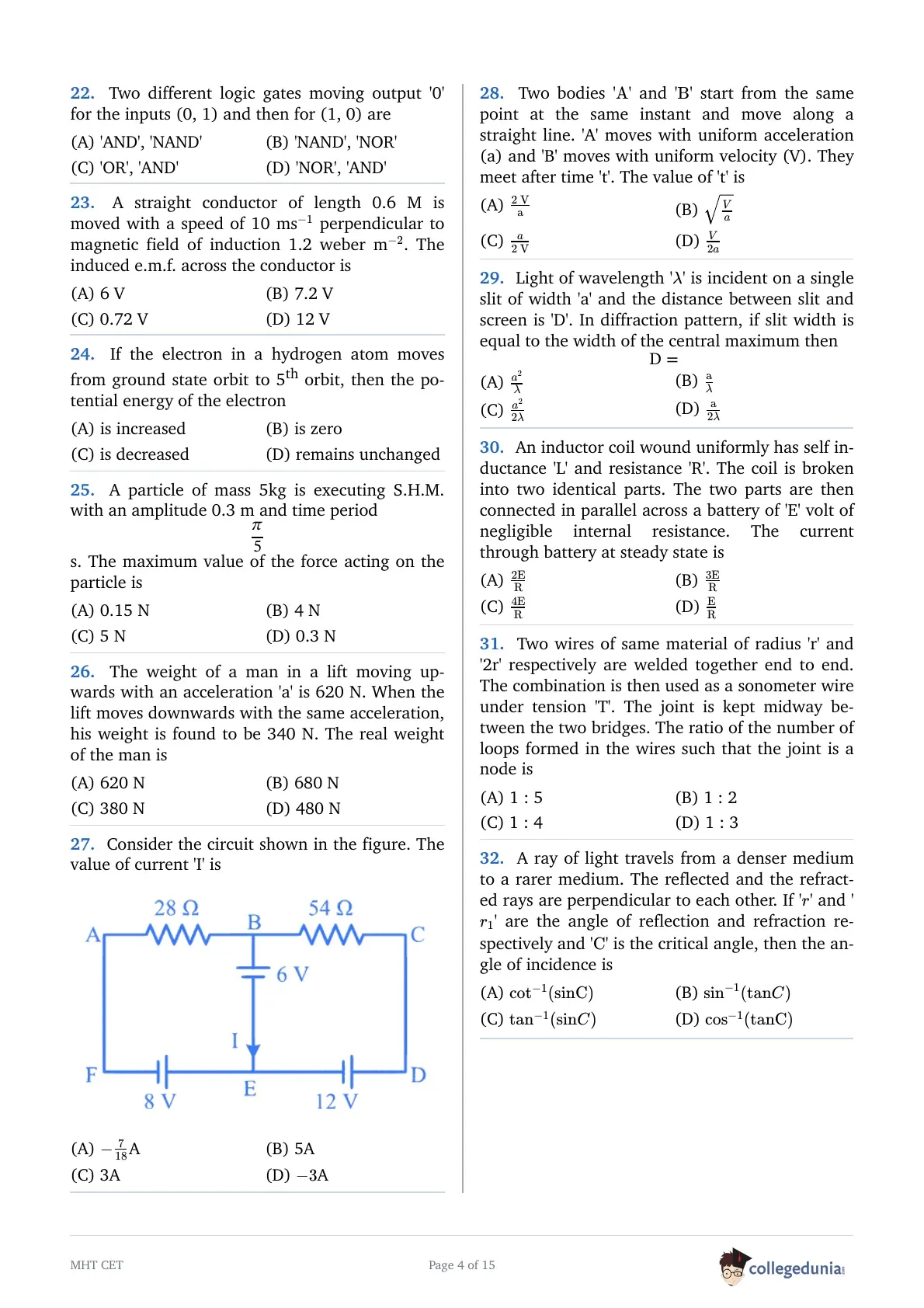
Two different logic gates giving output '0' for the inputs (0, 1) and then for (1, 0) are
A straight conductor of length 0.6 m is moved with a speed of 10 \(\text{ms}^{-1}\) perpendicular to a magnetic field of induction 1.2 \(\text{Wb/m}^2\). The induced e.m.f. across the conductor is
If the electron in a hydrogen atom moves from the ground state orbit to the \(5^{\text{th}}\) orbit, then the potential energy of the electron
A particle of mass 5 kg is executing S.H.M. with an amplitude 0.3 m and time period \(\frac{\pi}{5}\) s. The maximum value of the force acting on the particle is
The weight of a man in a lift moving upwards with an acceleration 'a' is 620 N. When the lift moves downwards with the same acceleration, his weight is found to be 340 N. The real weight of the man is
Consider the circuit shown in the figure. The value of current 'I' is

Two bodies 'A' and 'B' start from the same point at the same instant and move along a straight line. 'A' moves with uniform acceleration (\(a\)) and 'B' moves with uniform velocity (\(V\)). They meet after time '\(t\)'. The value of '\(t\)' is
Light of wavelength '\(\lambda\)' is incident on a single slit of width 'a' and the distance between slit and screen is 'D'. In diffraction pattern, if slit width is equal to the width of the central maximum then D =
An inductor coil wound uniformly has self inductance 'L' and resistance 'R'. The coil is broken into two identical parts. The two parts are then connected in parallel across a battery of 'E' volt of negligible internal resistance. The current through battery at steady state is
Two wires of same material of radius 'r' and '2r' respectively are welded together end to end. The combination is then used as a sonometer wire under tension 'T'. The joint is kept midway between the two bridges. The ratio of the number of loops formed in the wires such that the joint is a node is
A ray of light travels from a denser medium to a rarer medium. The reflected and the refracted rays are perpendicular to each other. If 'r' and '\(r_1\)' are the angle of reflection and refraction respectively and 'C' is the critical angle, then the angle of incidence is
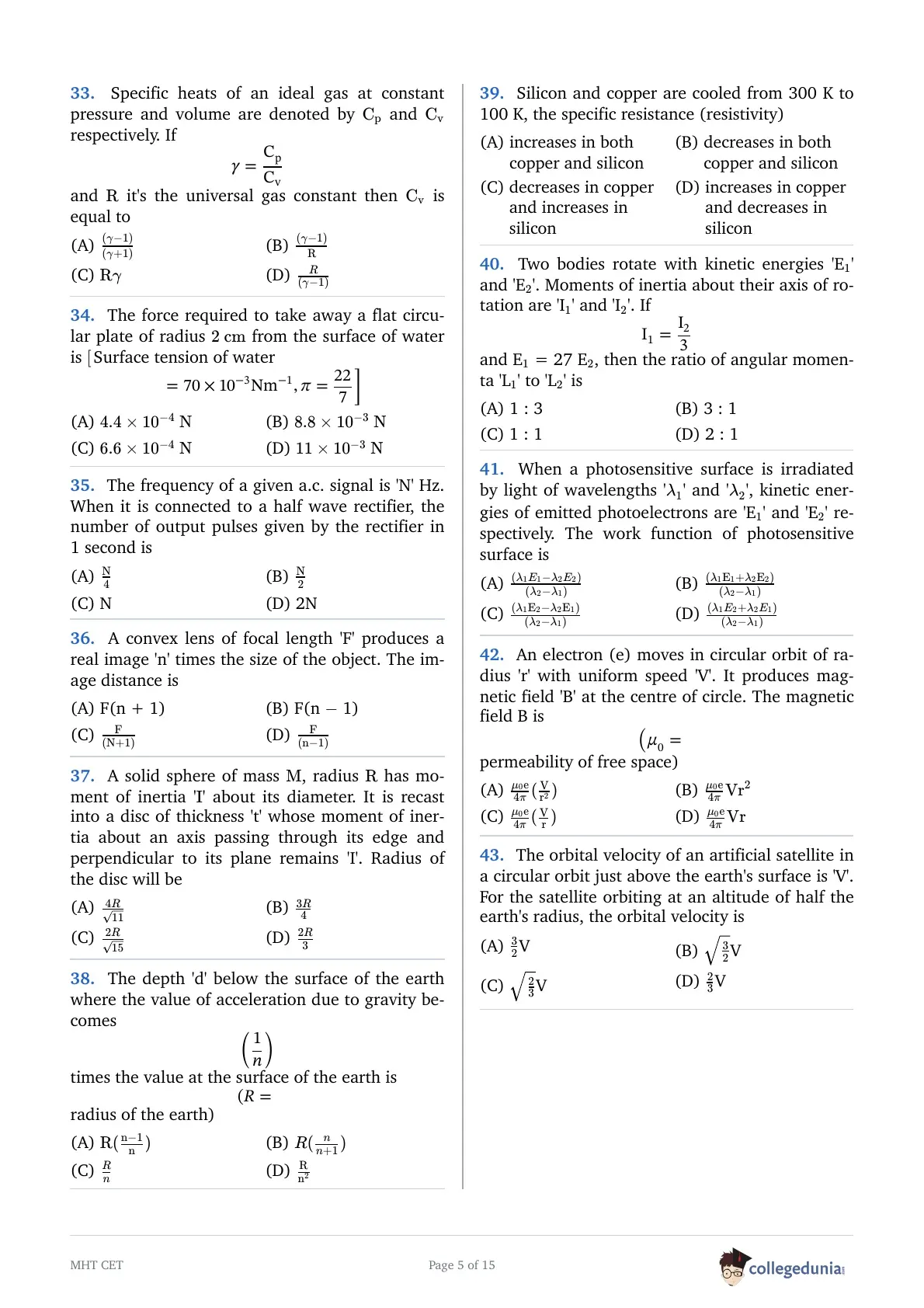
Specific heats of an ideal gas at constant pressure and volume are denoted by \(C_p\) and \(C_v\) respectively. If \(\gamma = \frac{C_p}{C_v}\) and \(R\) is the universal gas constant, then \(C_v\) is equal to
The force required to take away a flat circular plate of radius 2 cm from the surface of water is [Surface tension of water = \(70 \times 10^{-3}\ \text{Nm}^{-1}\), \(\pi = \frac{22}{7}\)]
The frequency of a given a.c. signal is 'N' Hz. When it is connected to a half wave rectifier, the number of output pulses given by the rectifier in 1 second is
A convex lens of focal length 'F' produces a real image 'n' times the size of the object. The image distance is
A solid sphere of mass M, radius R has moment of inertia 'I' about its diameter. It is recast into a disc of thickness 't' whose moment of inertia about an axis passing through its edge and perpendicular to its plane remains 'I'. Radius of the disc will be
The depth 'd' below the surface of the earth where the value of acceleration due to gravity becomes \(\left(\frac{1}{n}\right)\) times the value at the surface of the earth is (\(R\) = radius of the earth)
Silicon and copper are cooled from 300 K to 100 K, the specific resistance (resistivity)
Two bodies rotate with kinetic energies 'E\(_1\)' and 'E\(_2\)'. Moments of inertia about their axis of rotation are 'I\(_1\)' and 'I\(_2\)'. If \(I_1 = \frac{I_2}{3}\) and \(E_1 = 27E_2\), then the ratio of angular momenta 'L\(_1\)' to 'L\(_2\)' is
When a photosensitive surface is irradiated by light of wavelengths '\(\lambda_1\)' and '\(\lambda_2\)', kinetic energies of emitted photoelectrons are '\(E_1\)' and '\(E_2\)' respectively. The work function of the photosensitive surface is
An electron (e) moves in a circular orbit of radius 'r' with uniform speed 'V'. It produces a magnetic field 'B' at the centre of the circle. The magnetic field B is (\(\mu_0\) = permeability of free space)
The orbital velocity of an artificial satellite in a circular orbit just above the earth's surface is 'V'. For the satellite orbiting at an altitude of half the earth's radius, the orbital velocity is
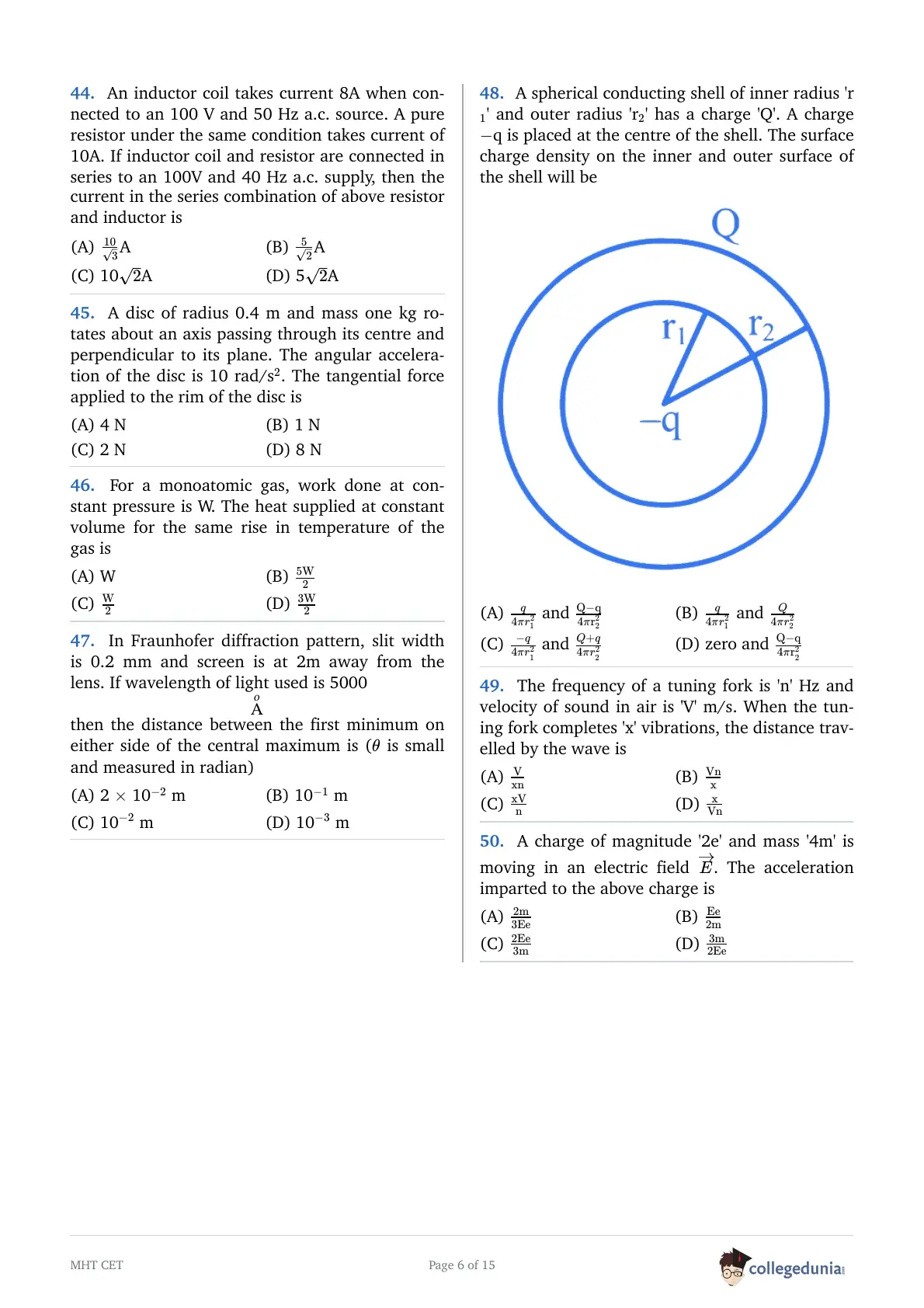
An inductor coil takes a current of 8 A when connected to a 100 V, 50 Hz a.c. source. A pure resistor under the same condition takes a current of 10 A. If the inductor coil and resistor are connected in series to a 100 V, 40 Hz a.c. supply, then the current in the series combination is
A disc of radius 0.4 m and mass one kg rotates about an axis passing through its centre and perpendicular to its plane. The angular acceleration of the disc is \(10\ \text{rad/s}^2\). The tangential force applied to the rim of the disc is
For a monoatomic gas, the work done at constant pressure is \(W\). The heat supplied at constant volume for the same rise in temperature of the gas is
In Fraunhofer diffraction pattern, slit width is 0.2 mm and screen is at 2m away from the lens. If wavelength of light used is 5000 \(\text{A}^\circ\) then the distance between the first minimum on either side of the central maximum is (\(\theta\) is small and measured in radian)
A spherical conducting shell of inner radius '\(r_1\)' and outer radius '\(r_2\)' has a charge 'Q'. A charge \(-q\) is placed at the centre of the shell. The surface charge density on the inner and outer surface of the shell will be

The frequency of a tuning fork is 'n' Hz and velocity of sound in air is 'V' m/s. When the tuning fork completes 'x' vibrations, the distance travelled by the wave is
A charge of magnitude '2e' and mass '4m' is moving in an electric field \(\vec{E}\). The acceleration imparted to the above charge is
Chemistry (Q51 - Q100)
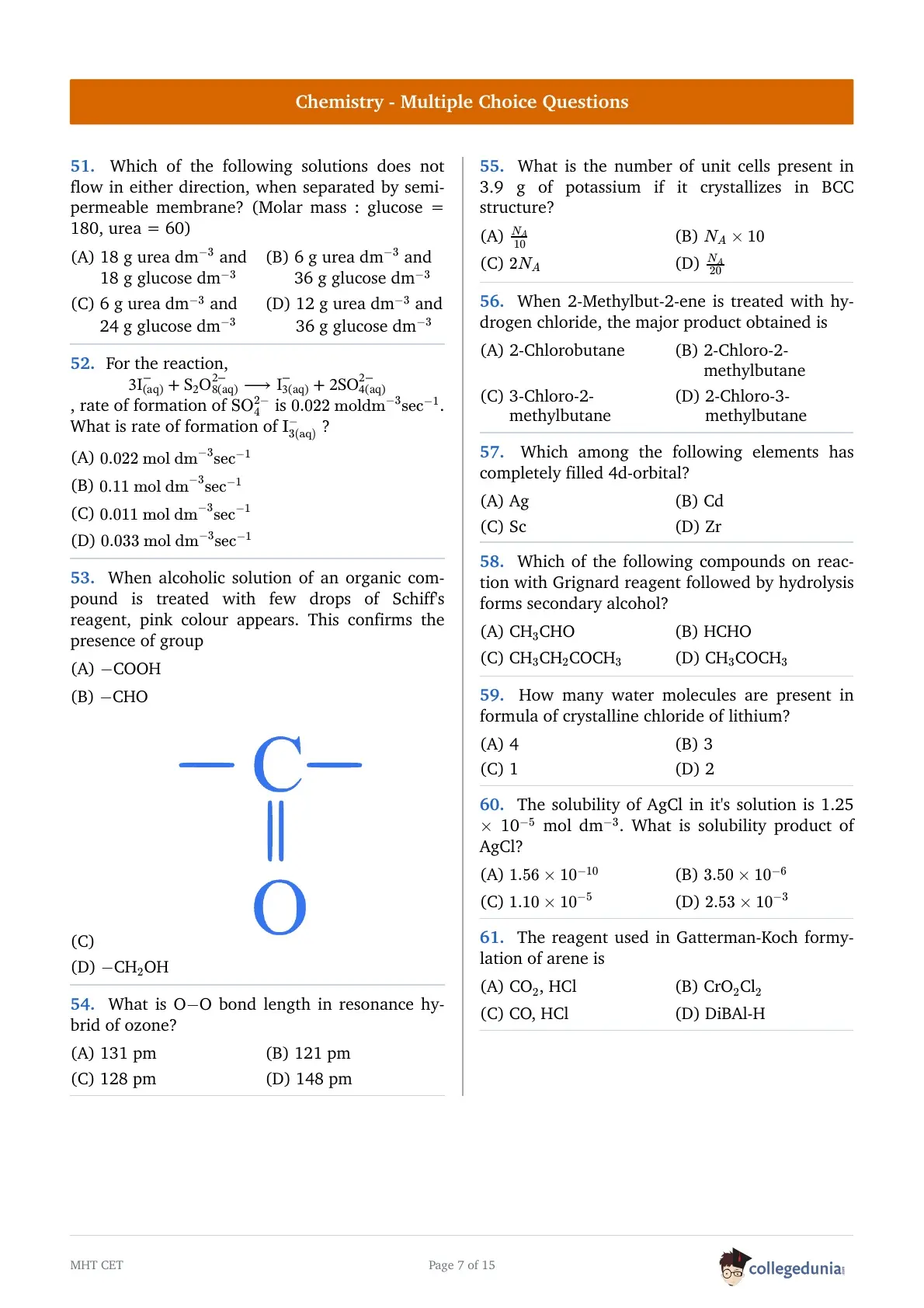
Which of the following solutions does not flow in either direction, when separated by semipermeable membrane? (Molar mass : glucose = 180, urea = 60)
For the reaction, \(3\text{I}^-_{\text{(aq)}} + \text{S}_2\text{O}^{2-}_{8\text{(aq)}} \longrightarrow \text{I}^-_{3\text{(aq)}} + 2\text{SO}^{2-}_{4\text{(aq)}}\), rate of formation of \(\text{SO}^{2-}_4\) is \(0.022\ \text{mol dm}^{-3}\ \text{sec}^{-1}\). What is rate of formation of \(\text{I}^-_{3\text{(aq)}}\)?
When alcoholic solution of an organic compound is treated with few drops of Schiff's reagent, pink colour appears. This confirms the presence of group
What is \(\text{O}-\text{O}\) bond length in resonance hybrid of ozone?
What is the number of unit cells present in 3.9 g of potassium if it crystallizes in BCC structure?
When 2-Methylbut-2-ene is treated with hydrogen chloride, the major product obtained is
Which among the following elements has completely filled 4d-orbital?
Which of the following compounds on reaction with Grignard reagent followed by hydrolysis forms secondary alcohol?
How many water molecules are present in formula of crystalline chloride of lithium?
The solubility of AgCl in it's solution is \(1.25 \times 10^{-5}\ \text{mol dm}^{-3}\). What is solubility product of AgCl?
The reagent used in Gatterman-Koch formylation of arene is
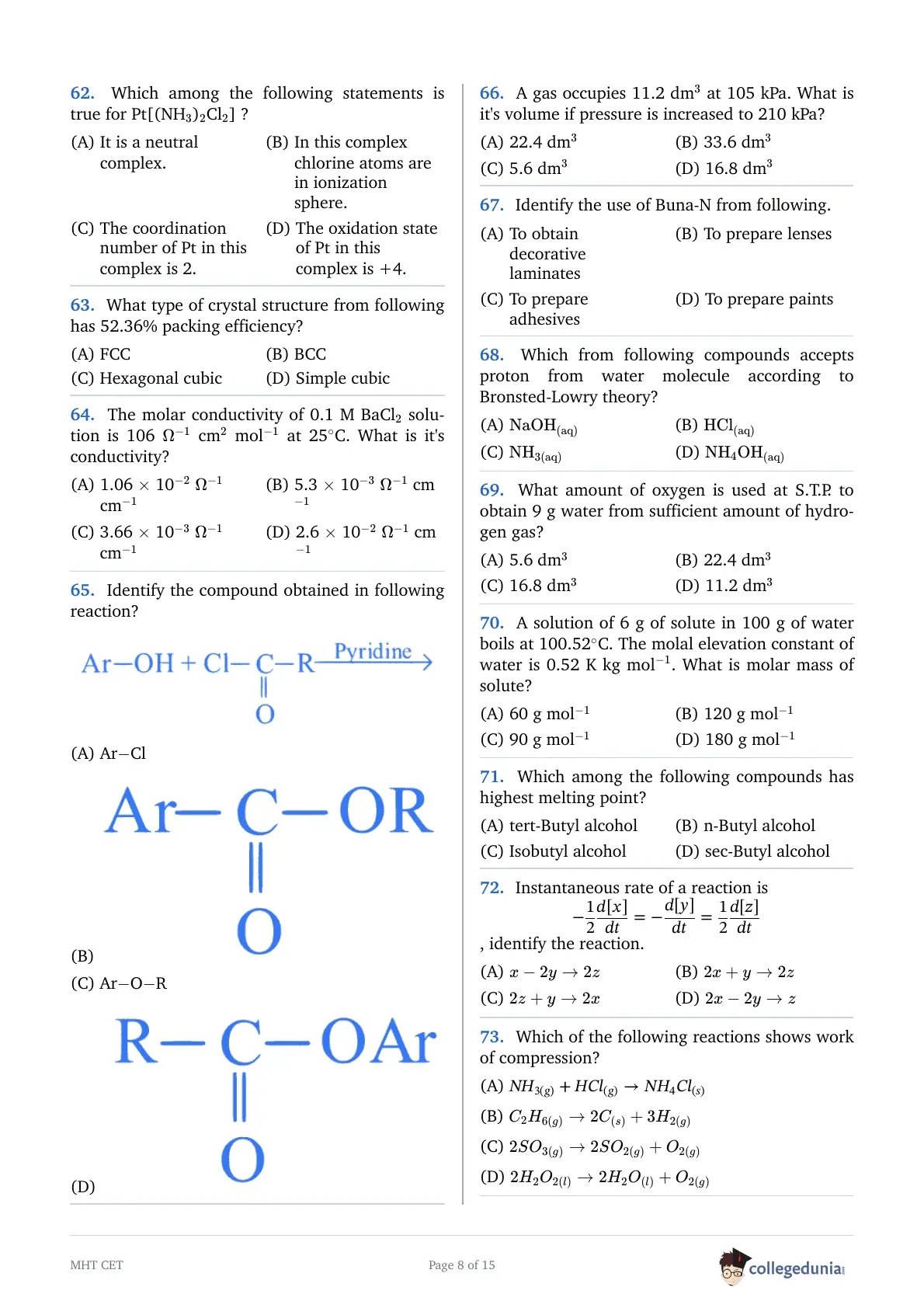
Which among the following statements is true for \(\text{Pt[(NH}_3)_2\text{Cl}_2]\)?
What type of crystal structure from following has 52.36% packing efficiency?
The molar conductivity of 0.1 M \(\text{BaCl}_2\) solution is \(106\ \Omega^{-1}\ \text{cm}^2\ \text{mol}^{-1}\) at \(25^\circ\text{C}\). What is its conductivity?
Identify the compound obtained in following reaction?

- (A) Ar\(-\)Cl
- (B)
![]()
- (C) Ar\(-\)O\(-\)R
- (D)
![]()


A gas occupies \(11.2\ \text{dm}^3\) at \(105\ \text{kPa}\). What is its volume if pressure is increased to \(210\ \text{kPa}\)?
Identify the use of Buna-N from following.
Which from following compounds accepts proton from water molecule according to Brønsted-Lowry theory?
What amount of oxygen is used at S.T.P. to obtain 9 g water from sufficient amount of hydrogen gas?
A solution of 6 g of solute in 100 g of water boils at \(100.52^\circ\text{C}\). The molal elevation constant of water is \(0.52\ \text{K kg mol}^{-1}\). What is molar mass of solute?
Which among the following compounds has highest melting point?
Instantaneous rate of a reaction is \(-\frac{1}{2}\frac{d[x]}{dt} = -\frac{d[y]}{dt} = \frac{1}{2}\frac{d[z]}{dt}\), identify the reaction.
Which of the following reactions shows work of compression?
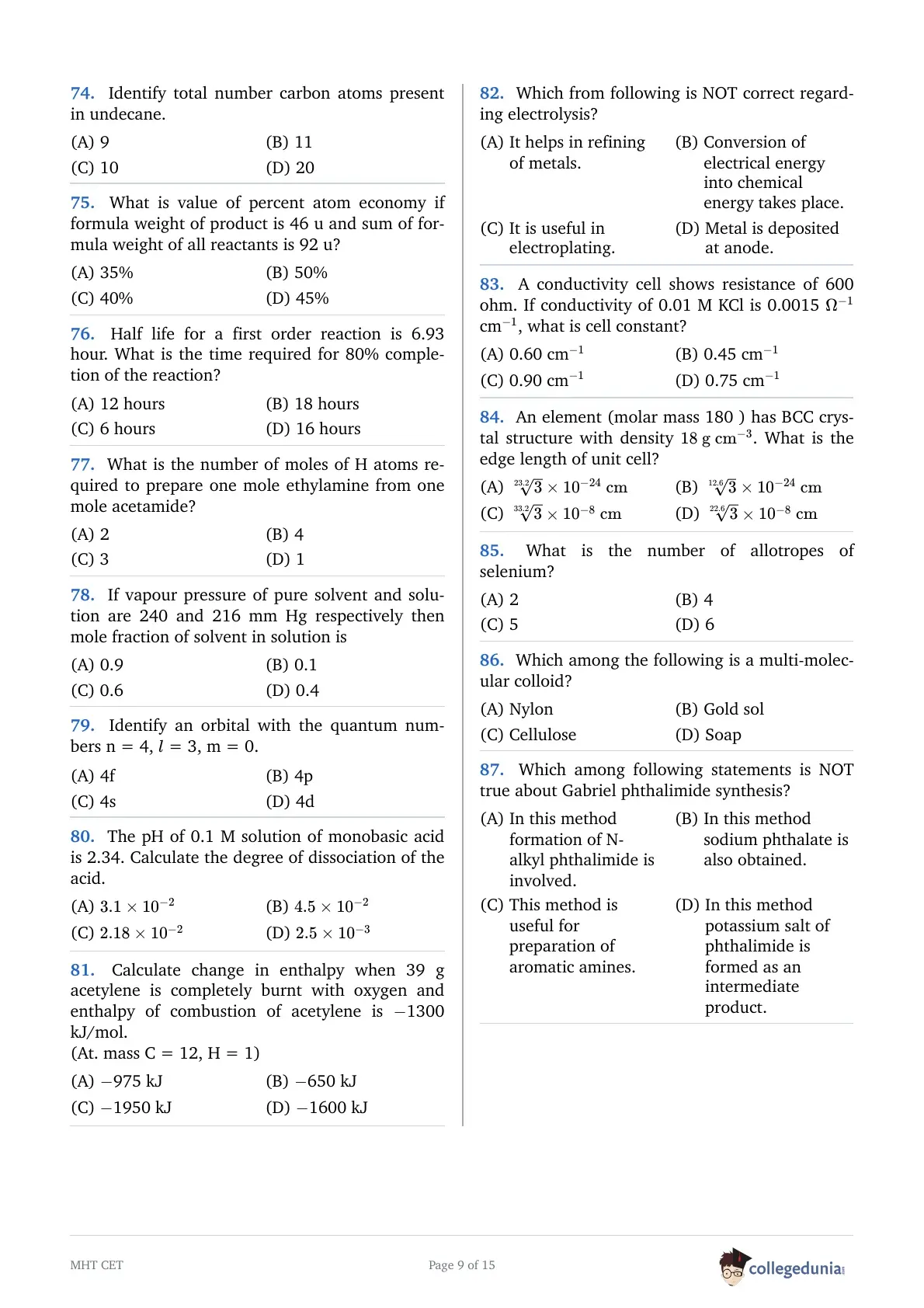
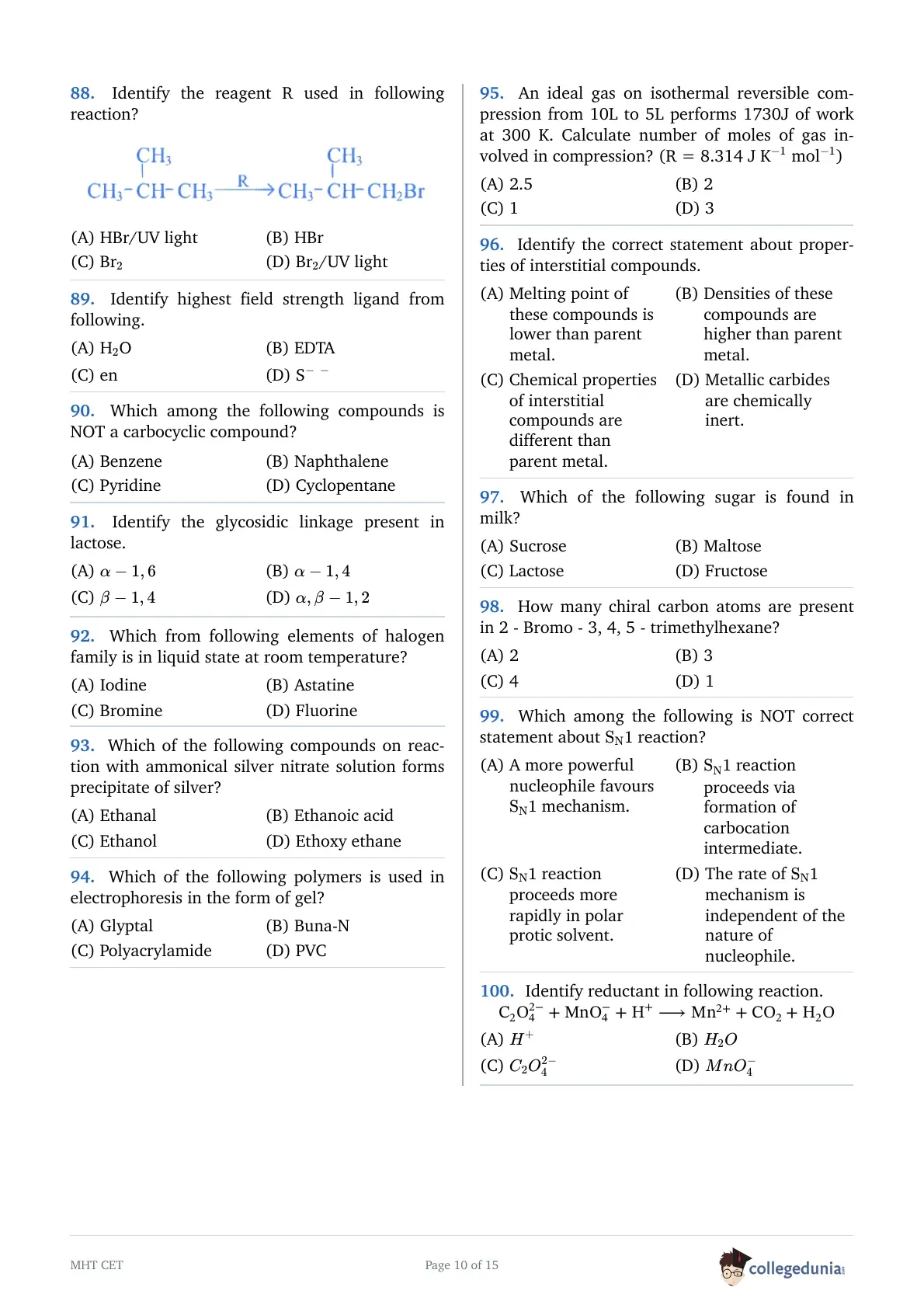
Identify total number carbon atoms present in undecane.
What is value of percent atom economy if formula weight of product is 46 u and sum of formula weight of all reactants is 92 u?
Half life for a first order reaction is 6.93 hour. What is the time required for 80% completion of the reaction?
What is the number of moles of H atoms required to prepare one mole ethylamine from one mole acetamide?
If vapour pressure of pure solvent and solution are 240 and 216 mm Hg respectively then mole fraction of solvent in solution is
Identify an orbital with the quantum numbers \(n = 4\), \(l = 3\), \(m = 0\).
The pH of 0.1 M solution of monobasic acid is 2.34. Calculate the degree of dissociation of the acid.
Calculate change in enthalpy when 39 g acetylene is completely burnt with oxygen and enthalpy of combustion of acetylene is \(-1300\ \text{kJ/mol}\). (At. mass C = 12, H = 1)
Which from following is NOT correct regarding electrolysis?
A conductivity cell shows resistance of 600 ohm. If conductivity of 0.01 M KCl is \(0.0015\ \Omega^{-1}\ \text{cm}^{-1}\), what is cell constant?
An element (molar mass 180) has BCC crystal structure with density \(18\ \text{g cm}^{-3}\). What is the edge length of unit cell?
What is the number of allotropes of selenium?
Which among the following is a multi-molecular colloid?
Which among following statements is NOT true about Gabriel phthalimide synthesis?

Identify highest field strength ligand from following.
Which among the following compounds is NOT a carbocyclic compound?
Identify the glycosidic linkage present in lactose.
Which from following elements of halogen family is in liquid state at room temperature?
Which of the following compounds on reaction with ammonical silver nitrate solution forms precipitate of silver?
Which of the following polymers is used in electrophoresis in the form of gel?
An ideal gas on isothermal reversible compression from 10 L to 5 L performs 1730 J of work at 300 K. Calculate number of moles of gas involved in compression? (\(R = 8.314\ \text{J K}^{-1}\ \text{mol}^{-1}\))
Identify the correct statement about properties of interstitial compounds.
Which of the following sugar is found in milk?
How many chiral carbon atoms are present in 2-Bromo-3,4,5-trimethylhexane?
Which among the following is NOT correct statement about \(\text{S}_\text{N}1\) reaction?
Identify reductant in following reaction: \(\text{C}_2\text{O}_4^{2-} + \text{MnO}_4^- + \text{H}^+ \longrightarrow \text{Mn}^{2+} + \text{CO}_2 + \text{H}_2\text{O}\)
Mathematics (Q101 - Q150)
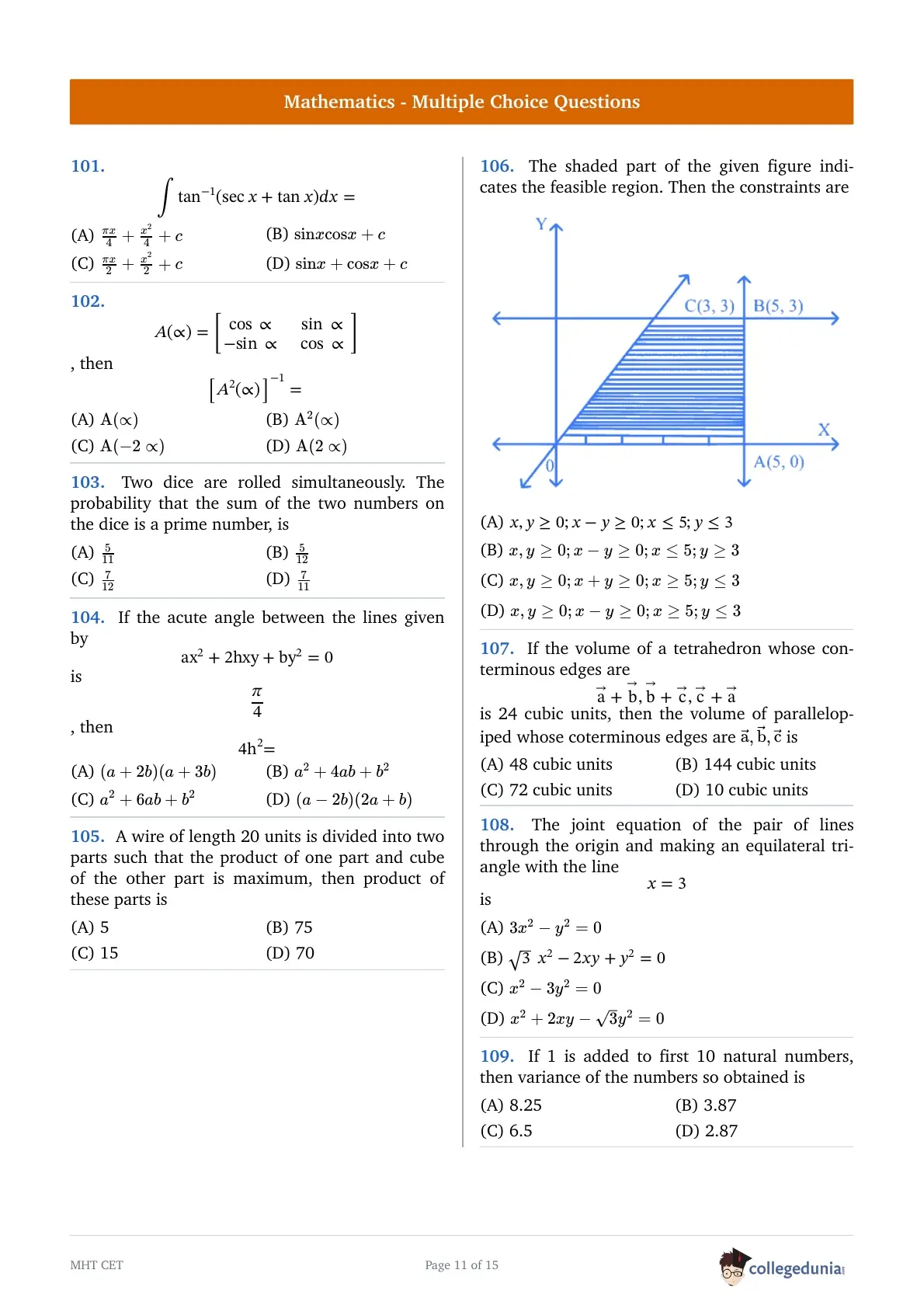
\(\int \tan^{-1}(\sec x + \tan x) dx =\)
\[A(\propto)=\left[\begin{array}{cc}\cos \propto & \sin \propto \\ -\sin \propto & \cos \propto\end{array}\right]\], then \[\left[A^2(\propto)\right]^{-1}=\]
Two dice are rolled simultaneously. The probability that the sum of the two numbers on the dice is a prime number, is
If the acute angle between the lines given by \(ax^2 + 2hxy + by^2 = 0\) is \(\frac{\pi}{4}\), then \(4h^2 =\)
A wire of length 20 units is divided into two parts such that the product of one part and cube of the other part is maximum, then product of these parts is
The shaded part of the given figure indicates the feasible region. Then the constraints are

If the volume of a tetrahedron whose conterminous edges are \(\vec{\mathrm{a}}+\vec{\mathrm{b}}\), \(\vec{\mathrm{b}}+\vec{\mathrm{c}}\), \(\vec{\mathrm{c}}+\vec{\mathrm{a}}\) is 24 cubic units, then the volume of parallelopiped whose coterminous edges are \(\vec{\mathrm{a}}\), \(\vec{\mathrm{b}}\), \(\vec{\mathrm{c}}\) is
The joint equation of the pair of lines through the origin and making an equilateral triangle with the line \(x = 3\) is
If 1 is added to first 10 natural numbers, then variance of the numbers so obtained is
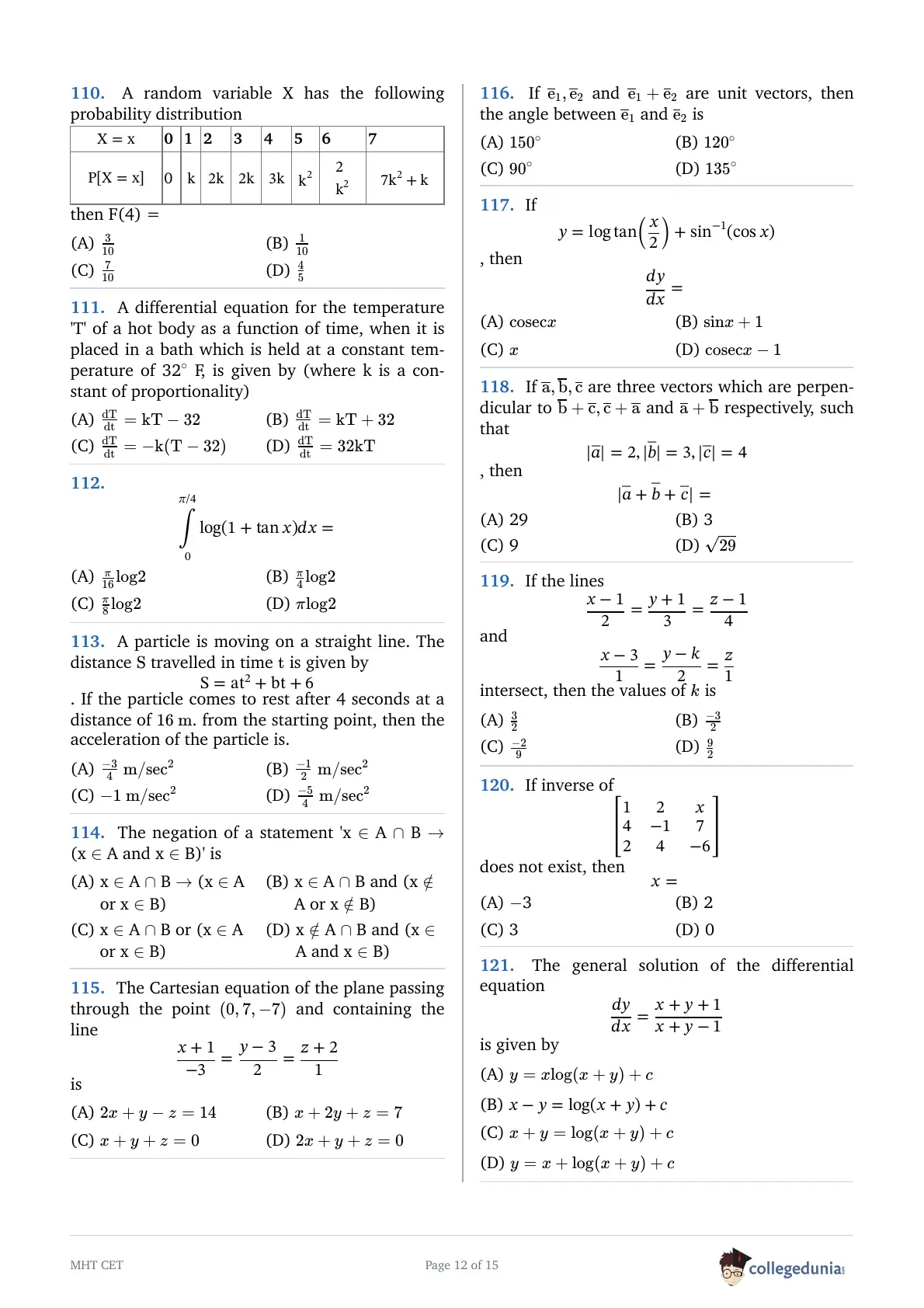
A differential equation for the temperature 'T' of a hot body as a function of time, when it is placed in a bath which is held at a constant temperature of \(32^\circ\text{F}\), is given by (where k is a constant of proportionality)
\(\int_0^{\pi / 4} \log (1+\tan x) \text{d}x=\)
A particle is moving on a straight line. The distance S travelled in time t is given by \(S = a t^2 + b t + 6\). If the particle comes to rest after 4 seconds at a distance of 16 m from the starting point, then the acceleration of the particle is
The negation of a statement '\(x \in A \cap B \rightarrow (x \in A \text{ and } x \in B)\)' is
The Cartesian equation of the plane passing through the point \((0,7,-7)\) and containing the line \(\frac{x+1}{-3}=\frac{y-3}{2}=\frac{z+2}{1}\) is
If \(\bar{\mathrm{e}}_1\), \(\bar{\mathrm{e}}_2\) and \(\bar{\mathrm{e}}_1+\bar{\mathrm{e}}_2\) are unit vectors, then the angle between \(\bar{\mathrm{e}}_1\) and \(\bar{\mathrm{e}}_2\) is
If \(y=\log \tan \left(\frac{x}{2}\right)+\sin ^{-1}(\cos x)\), then \(\frac{d y}{d x}=\)
If \(\bar{\mathrm{a}}\), \(\bar{\mathrm{b}}\), \(\bar{\mathrm{c}}\) are three vectors which are perpendicular to \(\bar{\mathrm{b}} + \bar{\mathrm{c}}\), \(\bar{\mathrm{c}} + \bar{\mathrm{a}}\) and \(\bar{\mathrm{a}} + \bar{\mathrm{b}}\) respectively, such that \(|\bar{a}| = 2\), \(|\bar{b}| = 3\), \(|\bar{c}| = 4\), then \(|\bar{a} + \bar{b} + \bar{c}| =\)
If the lines \(\frac{x-1}{2}=\frac{y+1}{3}=\frac{z-1}{4}\) and \(\frac{x-3}{1}=\frac{y-k}{2}=\frac{z}{1}\) intersect, then the value of \(k\) is
If inverse of \(\begin{bmatrix} 1 & 2 & x \\ 4 & -1 & 7 \\ 2 & 4 & -6 \end{bmatrix}\) does not exist, then \(x =\)
The general solution of the differential equation \(\frac{d y}{d x}=\frac{x+y+1}{x+y-1}\) is given by
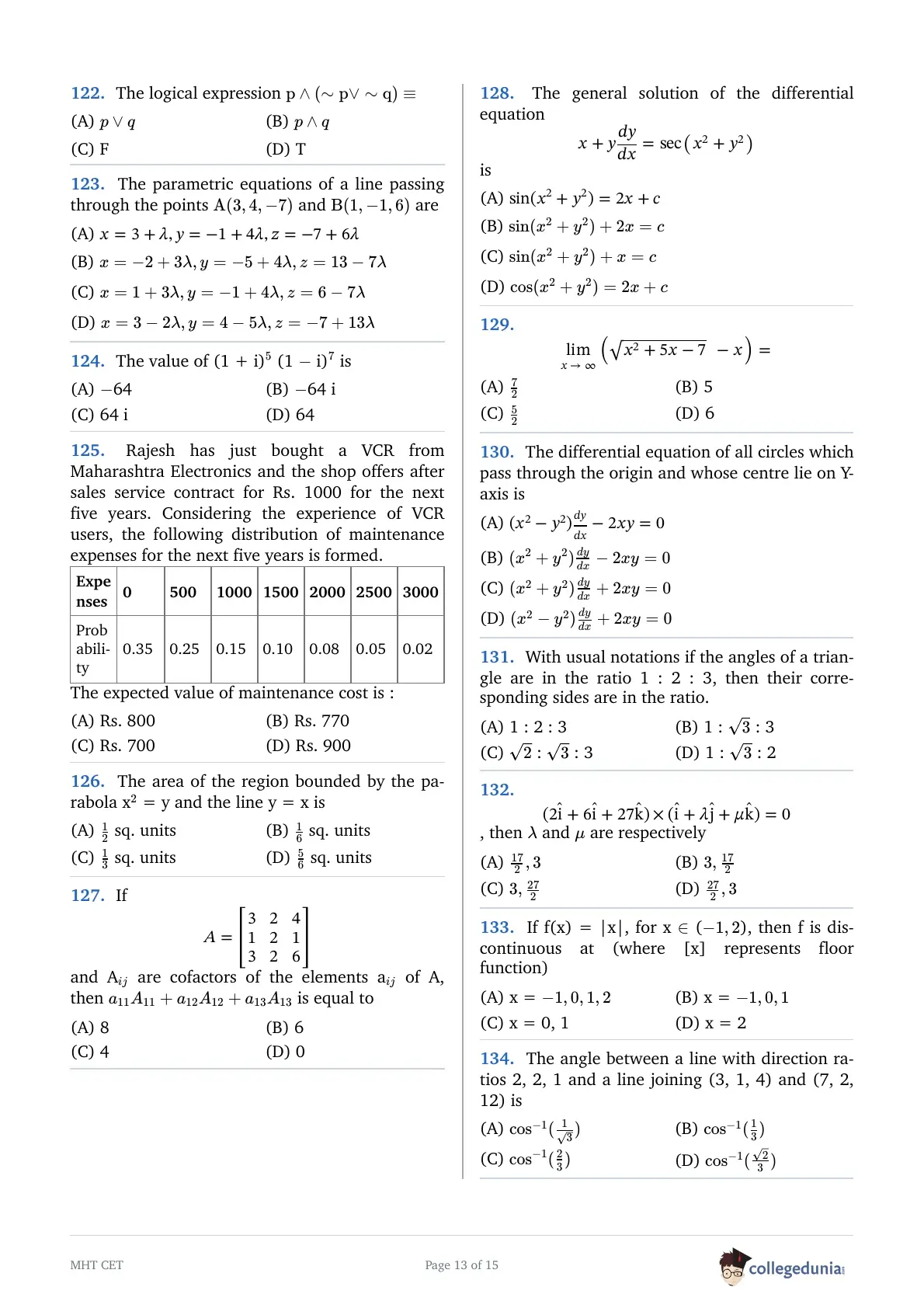
The logical expression \(p \wedge(\sim p \vee \sim q) \equiv\)
The parametric equations of a line passing through the points \(A(3,4,-7)\) and \(B(1,-1,6)\) are
The value of \((1 + i)^5 (1 - i)^7\) is
Rajesh has just bought a VCR from Maharashtra Electronics and the shop offers after sales service contract for Rs. 1000 for the next five years. Considering the experience of VCR users, the following distribution of maintenance expenses for the next five years is formed.

The area of the region bounded by the parabola \(x^2 = y\) and the line \(y = x\) is
If \(A = \begin{bmatrix} 3 & 2 & 4 \\ 1 & 2 & 1 \\ 3 & 2 & 6 \end{bmatrix}\) and \(A_{ij}\) are cofactors of the elements \(a_{ij}\) of \(A\), then \(a_{11}A_{11} + a_{12}A_{12} + a_{13}A_{13}\) is equal to
The general solution of the differential equation \(x + y \frac{d y}{d x} = \sec(x^2 + y^2)\) is
\(\lim_{x \to \infty} \left( \sqrt{x^2 + 5x - 7} - x \right) =\)
The differential equation of all circles which pass through the origin and whose centre lie on Y-axis is
With usual notations if the angles of a triangle are in the ratio 1 : 2 : 3, then their corresponding sides are in the ratio
\((2\hat{\mathrm{i}} + 6\hat{\mathrm{j}} + 27\hat{\mathrm{k}}) \times (\hat{\mathrm{i}} + \lambda\hat{\mathrm{j}} + \mu\hat{\mathrm{k}}) = \vec{0}\), then \(\lambda\) and \(\mu\) are respectively
If \(f(x) = [x]\), for \(x \in (-1, 2)\), then \(f\) is discontinuous at (where \([x]\) represents floor function)
The angle between a line with direction ratios 2, 2, 1 and a line joining \((3, 1, 4)\) and \((7, 2, 12)\) is
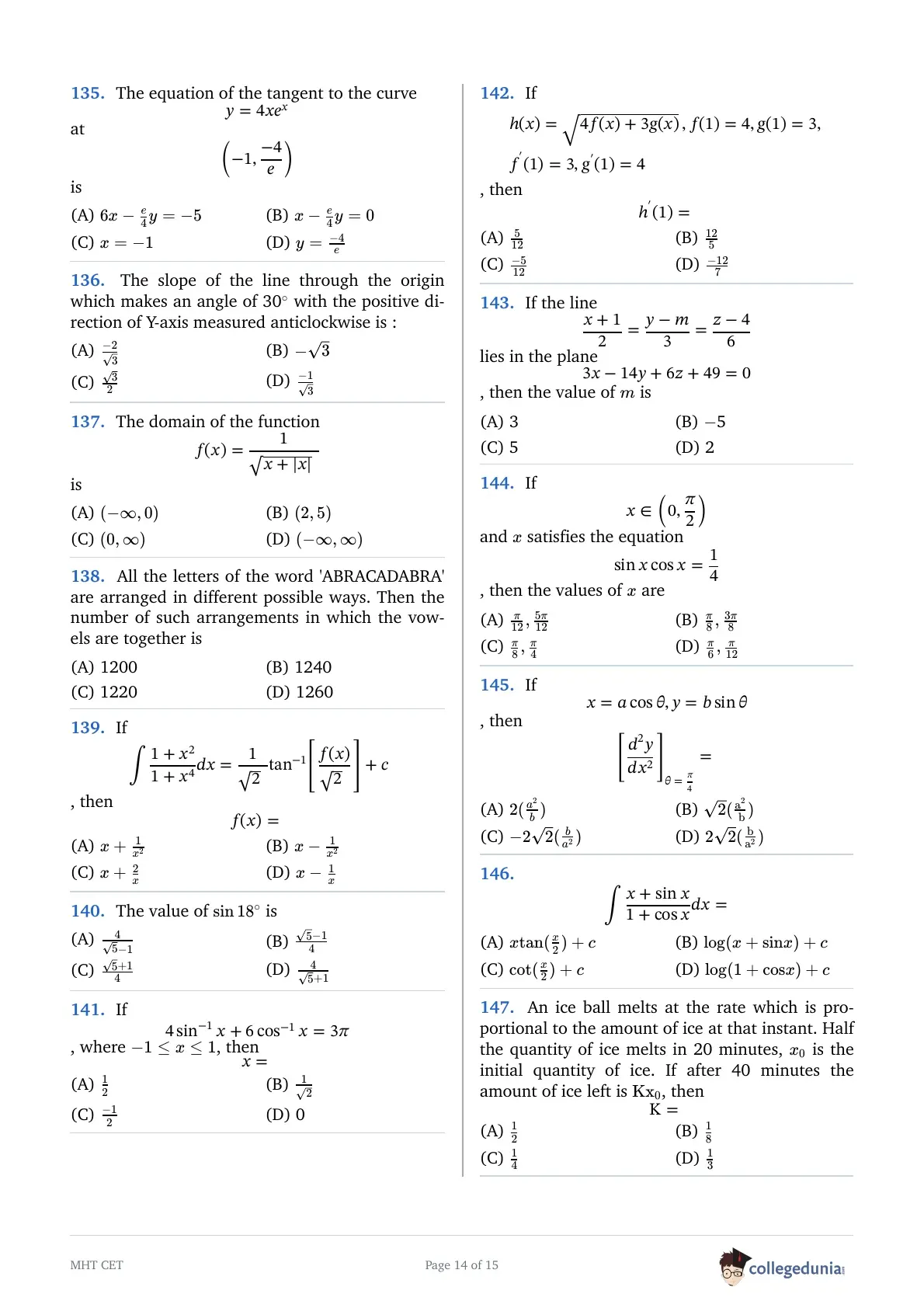
The equation of the tangent to the curve \(y = 4x e^x\) at \(\left(-1, -\frac{4}{e}\right)\) is
The slope of the line through the origin which makes an angle of \(30^\circ\) with the positive direction of Y-axis measured anticlockwise is :
The domain of the function \(f(x) = \frac{1}{\sqrt{x + |x|}}\) is
All the letters of the word 'ABRACADABRA' are arranged in different possible ways. Then the number of such arrangements in which the vowels are together is
If \(\int \frac{1+x^2}{1+x^4} d x=\frac{1}{\sqrt{2}} \tan ^{-1}\left[\frac{f(x)}{\sqrt{2}}\right]+c\), then \(f(x)=\)
If \(4 \sin ^{-1} x+6 \cos ^{-1} x=3 \pi\), where \(-1 \leq x \leq 1\), then \(x =\)
If \(h(x)=\sqrt{4 f(x)+3 g(x)}\), \(f(1)=4\), \(g(1)=3\), \(f^{\prime}(1)=3\), \(g^{\prime}(1)=4\), then \(h^{\prime}(1)=\)
If the line \(\frac{x+1}{2}=\frac{y-m}{3}=\frac{z-4}{6}\) lies in the plane \(3x-14y+6z+49=0\), then the value of \(m\) is
If \(x \in \left(0, \frac{\pi}{2}\right)\) and \(x\) satisfies the equation \(\sin x \cos x = \frac{1}{4}\), then the values of \(x\) are
If \(x = a \cos \theta\), \(y = b \sin \theta\), then \(\left[\frac{d^2 y}{d x^2}\right] = \)
\(\int \frac{x+\sin x}{1+\cos x} d x=\)
An ice ball melts at the rate which is proportional to the amount of ice at that instant. Half the quantity of ice melts in 20 minutes, \(x_0\) is the initial quantity of ice. If after 40 minutes the amount of ice left is \(Kx_0\), then K =
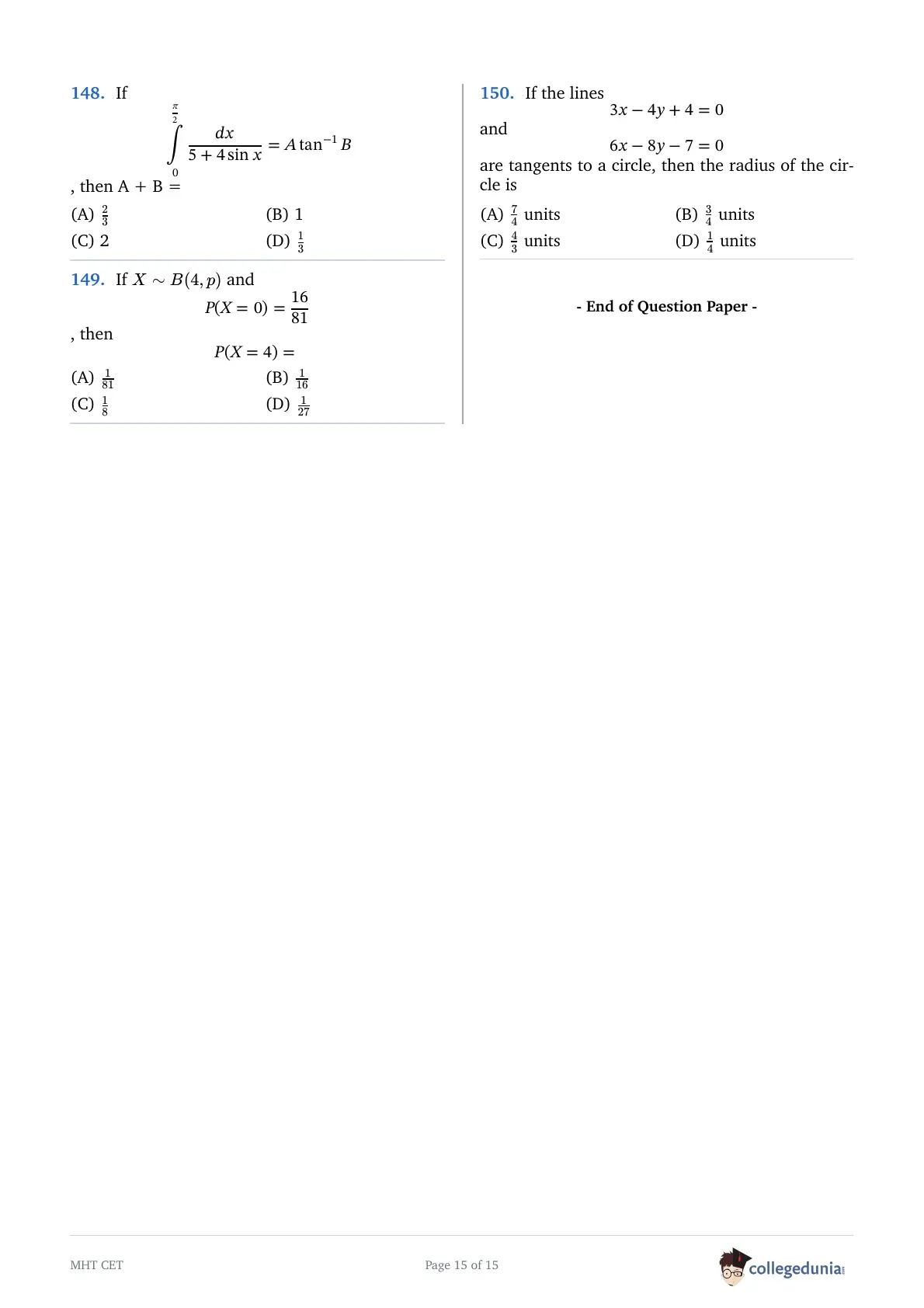
If \(\int_0^{\frac{\pi}{2}} \frac{dx}{5+4\sin x} = A \tan^{-1} B\), then A + B =
If \(X \sim B(4, p)\) and \(P(X = 0) = \frac{16}{81}\), then \(P(X = 4) =\)
If the lines \(3x - 4y + 4 = 0\) and \(6x - 8y - 7 = 0\) are tangents to a circle, then the radius of the circle is
MHT CET 2021 PCM Exam Pattern and Marking Scheme
| Parameter | Details |
|---|---|
| Conducting Body | Maharashtra Common Entrance Test Cell (Maharashtra CET Cell) |
| Exam Mode | Online (Computer-Based Test) |
| Duration | 180 minutes (3 hours) |
| Groups / Subjects | PCM (Physics, Chemistry, Mathematics) for Engineering |
| Total Questions |
150 |
| Total Marks | 200 |
| Question Type | Multiple Choice Questions (MCQs) |
| Marks Distribution |
|
| Negative Marking | No |
| Syllabus Weightage |
|



Comments