




MHT CET 2021 Sep 20 Shift 2 PCM Question Paper is available for download here. Maharashtra State CET Cell conducted MHT CET 2021 PCM Exam on Sep 20 in Shift 2 from 2 PM to 5 PM in CBT mode.
The MHT CET 2021 PCM question paper includes the following:
- The MHT CET 2021 PCM Question Paper consists of 150 multiple-choice questions (MCQs) totalling 200 marks divided into 3 sections: Physics, Chemistry, and Mathematics, with 50 questions in each subject.
- Physics and Chemistry questions carry 1 mark each while Mathematics questions carry 2 marks each.
- There is no negative marking for incorrect answers.
MHT CET 2021 Sep 20 Shift 2 PCM Question Paper with Solution PDF
| CD PDF | CD PDF with Solutions |
|---|---|
| Download Collegedunia PDF 1.13 MB | - |
Also Check:
MHT CET 2021 Sep 20 Shift 2 PCM Questions with Solutions
Physics (Q1 - Q50)
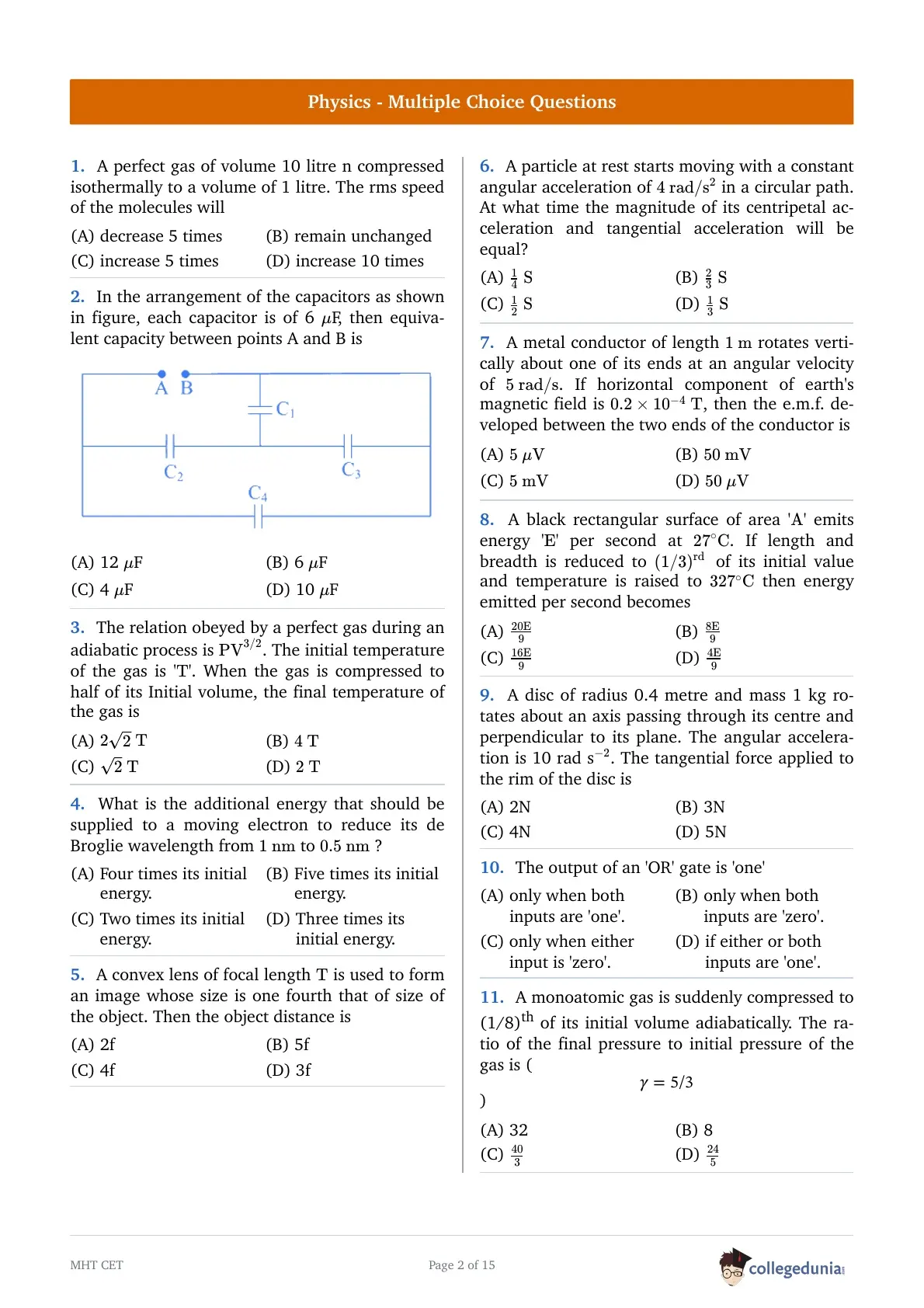
A perfect gas of volume 10 litre is compressed isothermally to a volume of 1 litre. The rms speed of the molecules will
In the arrangement of the capacitors as shown in figure, each capacitor is of \(6\ \mu\text{F}\), then equivalent capacity between points A and B is

The relation obeyed by a perfect gas during an adiabatic process is \(PV^{3/2} = \text{constant}\). The initial temperature of the gas is \(T\). When the gas is compressed to half of its initial volume, the final temperature of the gas is
What is the additional energy that should be supplied to a moving electron to reduce its de Broglie wavelength from \(1\ \text{nm}\) to \(0.5\ \text{nm}\)?
A convex lens of focal length \(f\) is used to form an image whose size is one fourth that of size of the object. Then the object distance is
A particle at rest starts moving with a constant angular acceleration of \(4\ \text{rad}/\text{s}^2\) in a circular path. At what time the magnitudes of its tangential acceleration and centripetal acceleration will be equal?
A metal conductor of length \(1\ \text{m}\) rotates vertically about one of its ends at an angular velocity of \(5\ \text{rad/s}\). If the horizontal component of earth's magnetic field is \(0.2 \times 10^{-4}\ \text{T}\), then the emf developed between the two ends of the conductor is
A disc of radius 0.4 metre and mass 1 kg rotates about an axis passing through its centre and perpendicular to its plane. The angular acceleration is \(10\ \text{rad}/\text{s}^2\). The tangential force applied to the rim of the disc is
The output of an 'OR' gate is 'one'
A monoatomic gas is suddenly compressed to (1/8)th of its initial volume adiabatically. The ratio of the final pressure to the initial pressure is
In the case of insulators, a band gap and conduction band is respectively
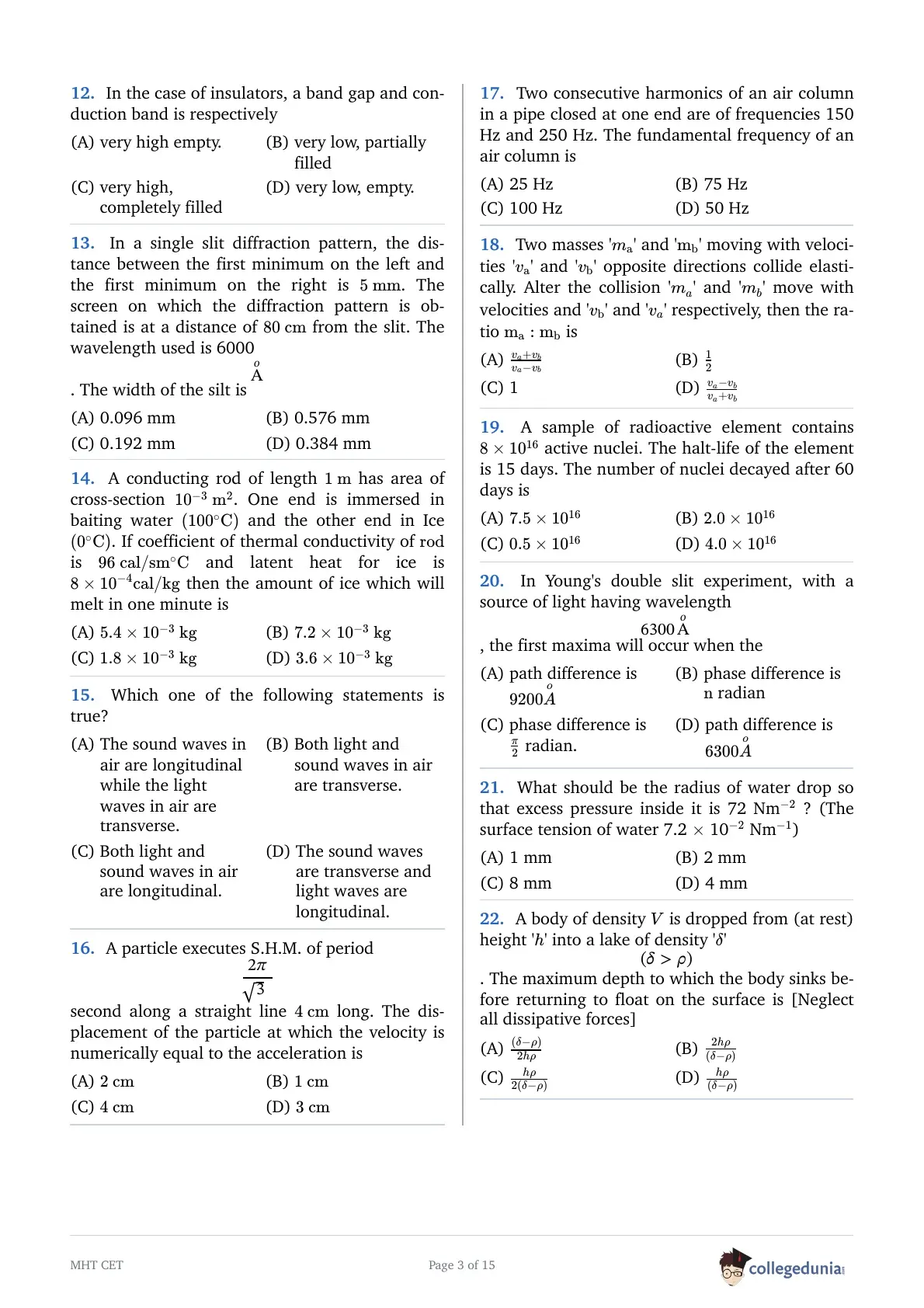
In a single slit diffraction pattern, the distance between the first minimum on the left and the first minimum on the right is \(5\ \text{mm}\). The screen on which the diffraction pattern is displayed is at a distance of \(80\ \text{cm}\) from the slit. The wavelength is \(6000\ \text{\AA}\). The slit width is about
A conducting rod of length \(1\ \text{m}\) has area of cross-section \(10^{-3}\ \text{m}^2\). One end is immersed in boiling water (\(100^\circ\text{C}\)) and the other end in ice (\(0^\circ\text{C}\)). If coefficient of thermal conductivity of copper is \(92\ \text{cal}/\text{m-s-}^\circ\text{C}\) and latent heat of ice is \(8 \times 10^4\ \text{cal}/\text{kg}\), then the amount of ice which will melt in one minute is
Which one of the following statements is true?
A particle executes S.H.M. of period \(\frac{2\pi}{\sqrt{3}}\) second along a straight line \(4\ \text{cm}\) long. The maximum velocity of the particle is
Two consecutive harmonics of an air column in a pipe closed at one end are of frequencies 150 Hz and 250 Hz. The fundamental frequency of an air column is
Two masses \(m_a\) and \(m_b\) moving with velocities \(v_a\) and \(v_b\) in opposite directions collide elastically. After the collision \(m_a\) and \(m_b\) move with velocities \(v_b\) and \(v_a\) respectively, then the ratio \(m_a : m_b\) is
A sample of radioactive element contains \(8 \times 10^{16}\) active nuclei. The half-life of the element is 15 days. The number of nuclei decayed after 60 days is
In Young's double slit experiment, with a source of light having wavelength \(6300\ \text{\AA}\), the first maxima will occur when the
What should be the radius of water drop so that excess pressure inside it is \(72\ \text{Nm}^{-2}\)? (The surface tension of water \(7.2 \times 10^{-2}\ \text{Nm}^{-1}\))
A body of density \(\rho\) is dropped from (at rest) height \(h\) into a lake of density \(\delta\) (\(\delta > \rho\)). The maximum depth to which the body sinks before returning to float on the surface is [Neglect all dissipative forces]
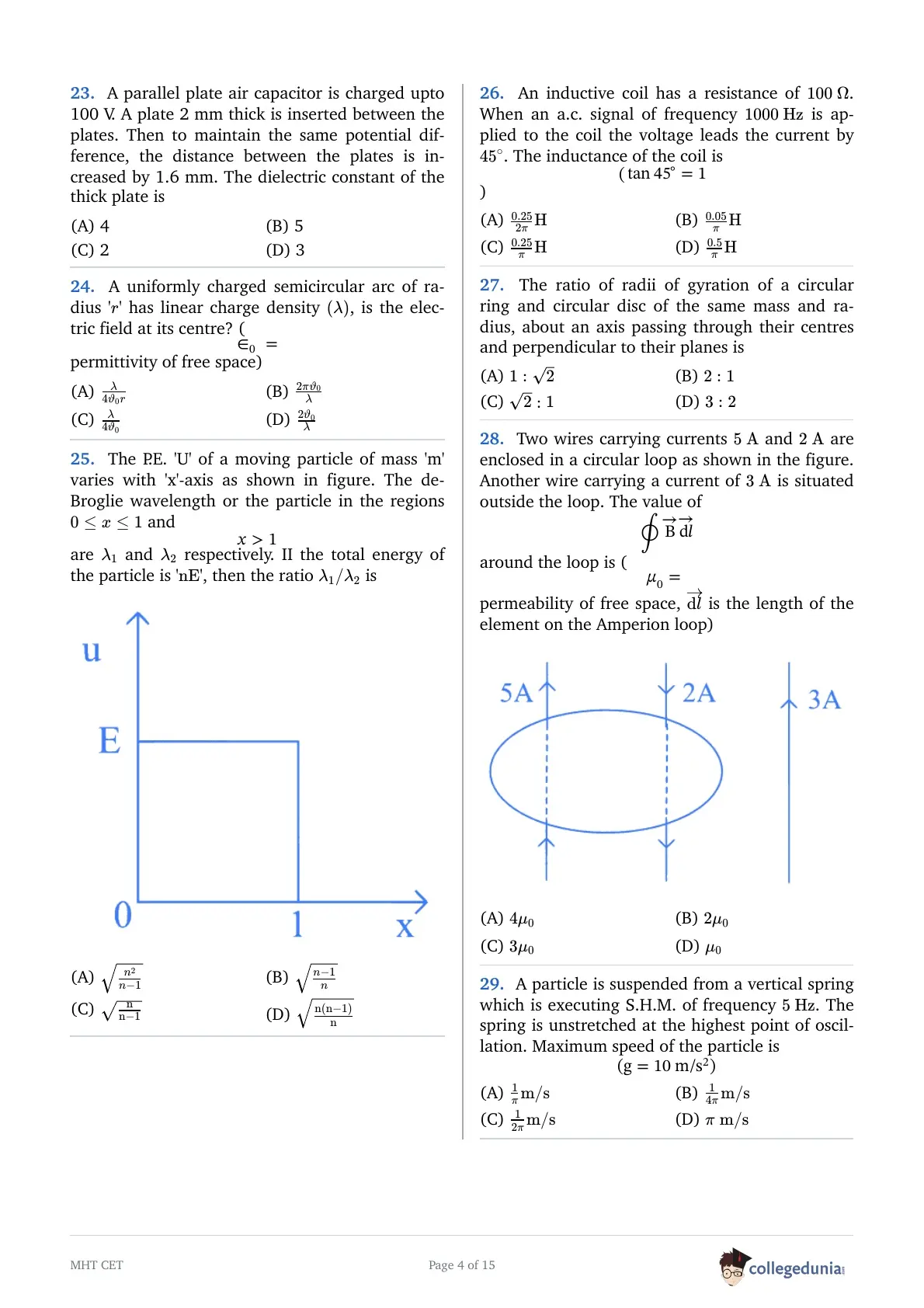
A parallel plate air capacitor is charged upto \(100\ \text{V}\). A plate \(2\ \text{mm}\) thick is inserted between the plates. Then to maintain the same potential difference, the distance between the plates is increased by \(1.6\ \text{mm}\). The dielectric constant of the thick plate is
A uniformly charged semicircular arc of radius \(r\) has linear charge density \(\lambda\). What is the electric field at its centre? (\(\epsilon_0 =\) permittivity of free space)
The P.E. 'U' of a moving particle of mass 'm' varies with 'x'-axis as shown in figure. The deBroglie wavelength of the particle in the regions \(0 \le x \le 1\) and \(x > 1\) are \(\lambda_1\) and \(\lambda_2\) respectively. If the total energy of the particle is 'nE', then the ratio \(\lambda_1 / \lambda_2\) is

An inductive coil has a resistance of \(100\ \Omega\). When an a.c. signal of frequency \(1000\ \text{Hz}\) is applied to the coil the voltage leads the current by \(45^\circ\). The inductance of the coil is (\(\tan 45^\circ = 1\))
The ratio of radii of gyration of a circular ring and circular disc of the same mass and radius, about an axis passing through their centres and perpendicular to their planes is
Two wires carrying currents \(5\ \text{A}\) and \(2\ \text{A}\) are enclosed in a circular loop as shown in the figure. Another wire carrying a current of \(3\ \text{A}\) is situated outside the loop. The value of \(\oint \vec{B} \cdot d\vec{l}\) around the loop is (\(\mu_0 = \) permeability of free space, \(d\vec{l}\) is the length of the element on the Amperion loop)

A particle is suspended from a vertical spring which is executing S.H.M. of frequency \(5\ \text{Hz}\). The spring is unstretched at the highest point of oscillation. Maximum speed of the particle is (\(g = 10\ \text{m/s}^2\))
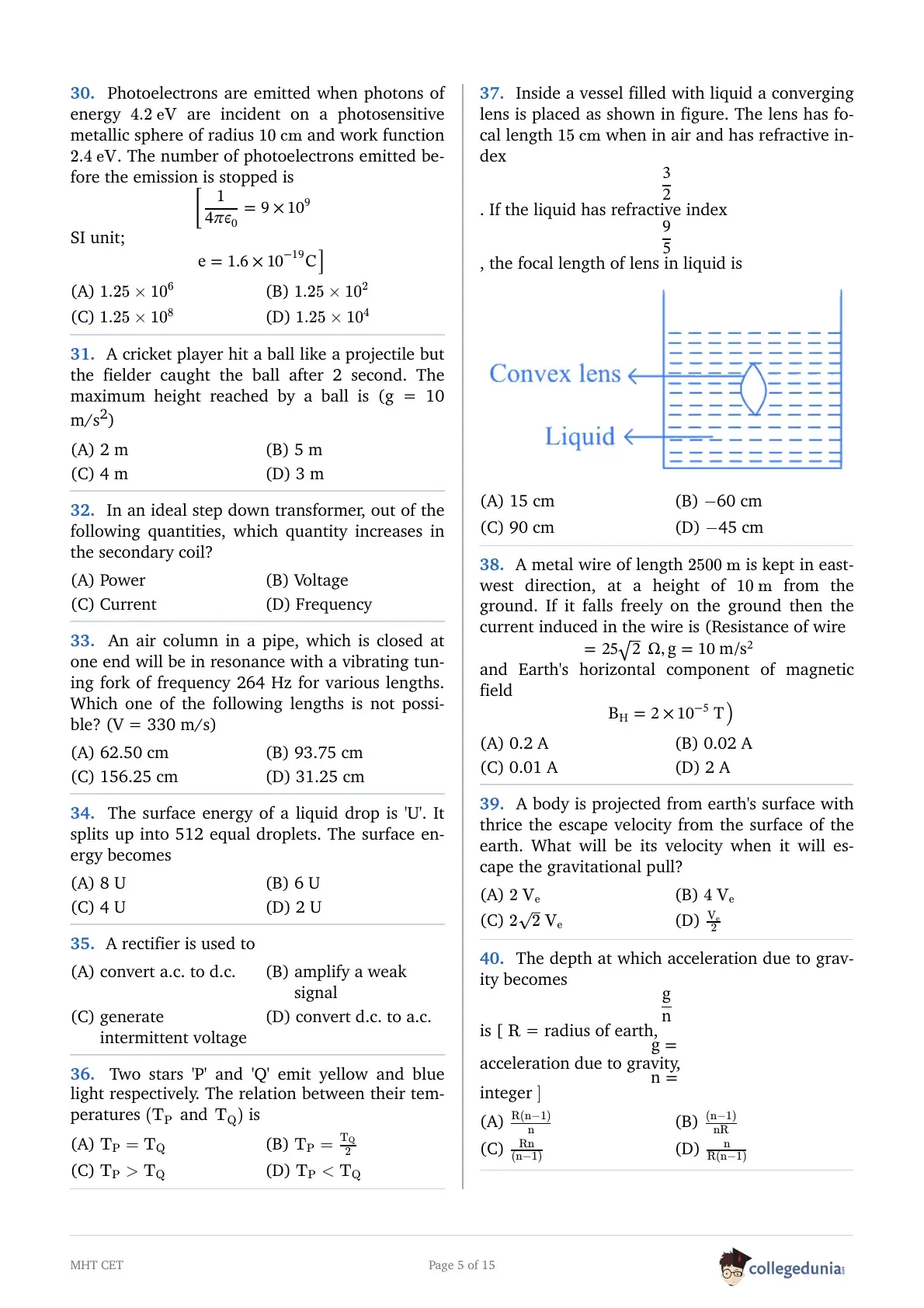
Photoelectrons are emitted when photons of energy \(4.2\ \text{eV}\) are incident on a photosensitive metallic sphere of radius \(10\ \text{cm}\) and work function \(2.4\ \text{eV}\). The number of photoelectrons emitted before the emission is stopped is
[\(\frac{1}{4\pi\epsilon_0} = 9 \times 10^9\ \text{SI unit};\ e = 1.6 \times 10^{-19}\ \text{C}\)]
A cricket player hit a ball like a projectile but the fielder caught the ball after 2 second. The maximum height reached by a ball is (\(g = 10\ \text{m/s}^2\))
In an ideal step down transformer, out of the following quantities, which quantity increases in the secondary coil?
An air column in a pipe, which is closed at one end will be in resonance with a vibrating tuning fork of frequency 264 Hz for various lengths. Which one of the following lengths is not possible? (V = 330 m/s)
The surface energy of a liquid drop is 'U'. It splits up into 512 equal droplets. The surface energy becomes
A rectifier is used to
Two stars 'P' and 'Q' emit yellow and blue light respectively. The relation between their temperatures (\(T_P\) and \(T_Q\)) is
Inside a vessel filled with liquid a converging lens is placed as shown in figure. The lens has focal length \(15\ \text{cm}\) when in air and has refractive index \(\frac{3}{2}\). If the liquid has refractive index \(\frac{9}{5}\), the focal length of lens in liquid is

A metal wire of length \(2500\ \text{m}\) is kept in east-west direction, at a height of \(10\ \text{m}\) from the ground. If it falls freely on the ground then the current induced in the wire is (Resistance of wire \(= 25\sqrt{2}\ \Omega, g = 10\ \text{m/s}^2\) and Earth's horizontal component of magnetic field \(B_H = 2 \times 10^{-5}\ \text{T}\))
A body is projected from earth's surface with thrice the escape velocity from the surface of the earth. What will be its velocity when it will escape the gravitational pull?
The depth at which acceleration due to gravity becomes \(\frac{g}{n}\) is [\(R = \text{radius of earth}\), \(g = \text{acceleration due to gravity}\), \(n = \text{integer}\)]
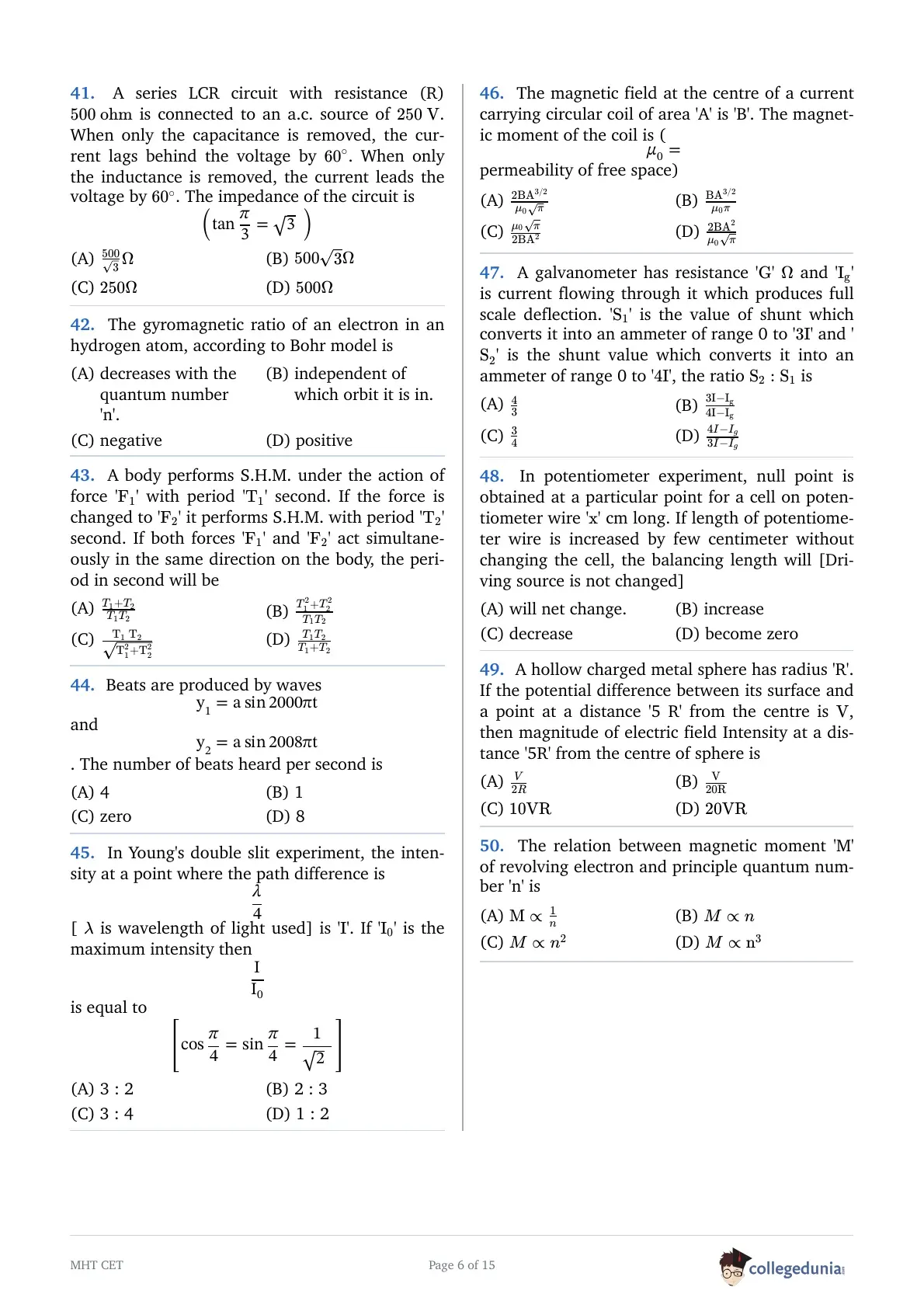
A series LCR circuit with resistance (\(R\)) \(500\ \Omega\) is connected to an a.c. source of \(250\ \text{V}\). When only the capacitance is removed, the current lags behind the voltage by \(60^\circ\). When only the inductance is removed, the current leads the voltage by \(60^\circ\). The impedance of the circuit is (\(\tan \frac{\pi}{3} = \sqrt{3}\))
The gyromagnetic ratio of an electron in an hydrogen atom, according to Bohr model is
A body performs S.H.M. under the action of force '\(F_1\)' with period '\(T_1\)' second. If the force is changed to '\(F_2\)' it performs S.H.M. with period '\(T_2\)' second. If both forces '\(F_1\)' and '\(F_2\)' act simultaneously in the same direction on the body, the period in second will be
Beats are produced by waves \(y_1 = a \sin 2000\pi t\) and \(y_2 = a \sin 2008\pi t\). The number of beats heard per second is
In Young's double slit experiment, the intensity at a point where the path difference is \(\frac{\lambda}{4}\) (\(\lambda\) is wavelength of light used) is '\(I\)'. If '\(I_0\)' is the maximum intensity then \(I/I_0\) is equal to
The magnetic field at the centre of a current carrying circular coil of area '\(A\)' is '\(B\)'. The magnetic moment of the coil is (\(\mu_0 = \) permeability of free space)
A galvanometer has resistance '\(G\)' \(\Omega\) and '\(I_g\)' is current flowing through it which produces full scale deflection. '\(S_1\)' is the value of shunt which converts it into an ammeter of range 0 to '\(3I\)' and '\(S_2\)' is the shunt value which converts it into an ammeter of range 0 to '\(4I\)', the ratio \(S_2 : S_1\) is
In potentiometer experiment, null point is obtained at a particular point for a cell on potentiometer wire '\(x\)' cm long. If length of potentiometer wire is increased by few centimeter without changing the cell, the balancing length will [Driving source is not changed]
A hollow charged metal sphere has radius 'R'. If the potential difference between its surface and a point at a distance '5R' from the centre is V, then magnitude of electric field Intensity at a distance '5R' from the centre of sphere is
The relation between magnetic moment 'M' of revolving electron and principle quantum number 'n' is
Chemistry (Q51 - Q100)
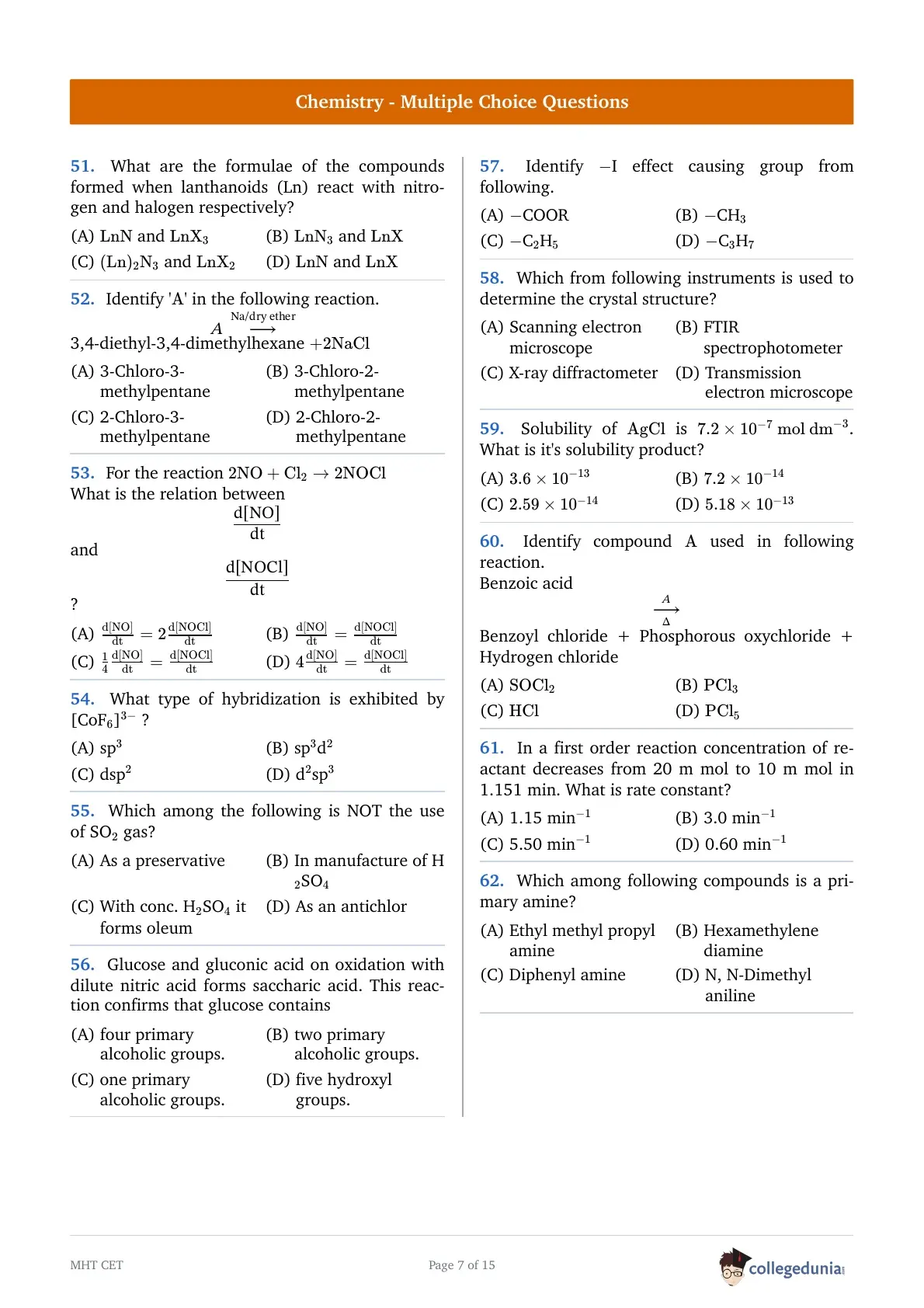
What are the formulae of the compounds formed when lanthanoids (Ln) react with nitrogen and halogen respectively?
Identify '\[\mathrm{A}\]' in the following reaction.
\[A \stackrel{\text { Na/dry ether }}{\longrightarrow}\] 3,4-diethyl-3,4-dimethylhexane \[+2 \mathrm{NaCl}\]
For the reaction \(2\text{NO} + \text{Cl}_2 \rightarrow 2\text{NOCl}\), what is the relation between \(\frac{d[\text{NO}]}{dt}\) and \(\frac{d[\text{NOCl}]}{dt}\)?
What type of hybridization is exhibited by \([\text{CoF}_6]^{3-}\)?
Which among the following is NOT the use of \(\text{SO}_2\) gas?
Glucose and gluconic acid on oxidation with dilute nitric acid forms saccharic acid. This reaction confirms that glucose contains
Identify \(-\text{I}\) effect causing group from following.
Which from following instruments is used to determine the crystal structure?
Solubility of AgCl is \(7.2 \times 10^{-7}\ \text{mol}\ \text{dm}^{-3}\). What is its solubility product?
Identify compound 'A' used in the following reaction:
Benzoic acid \(\xrightarrow[\Delta]{\text{A}}\) Benzoyl chloride + Phosphorus oxychloride + Hydrogen chloride
In a first order reaction, the concentration of a reactant decreases from \(20\ \text{mmol}\) to \(10\ \text{mmol}\) in \(1.151\ \text{min}\). What is the rate constant?
Which among the following compounds is a primary amine?
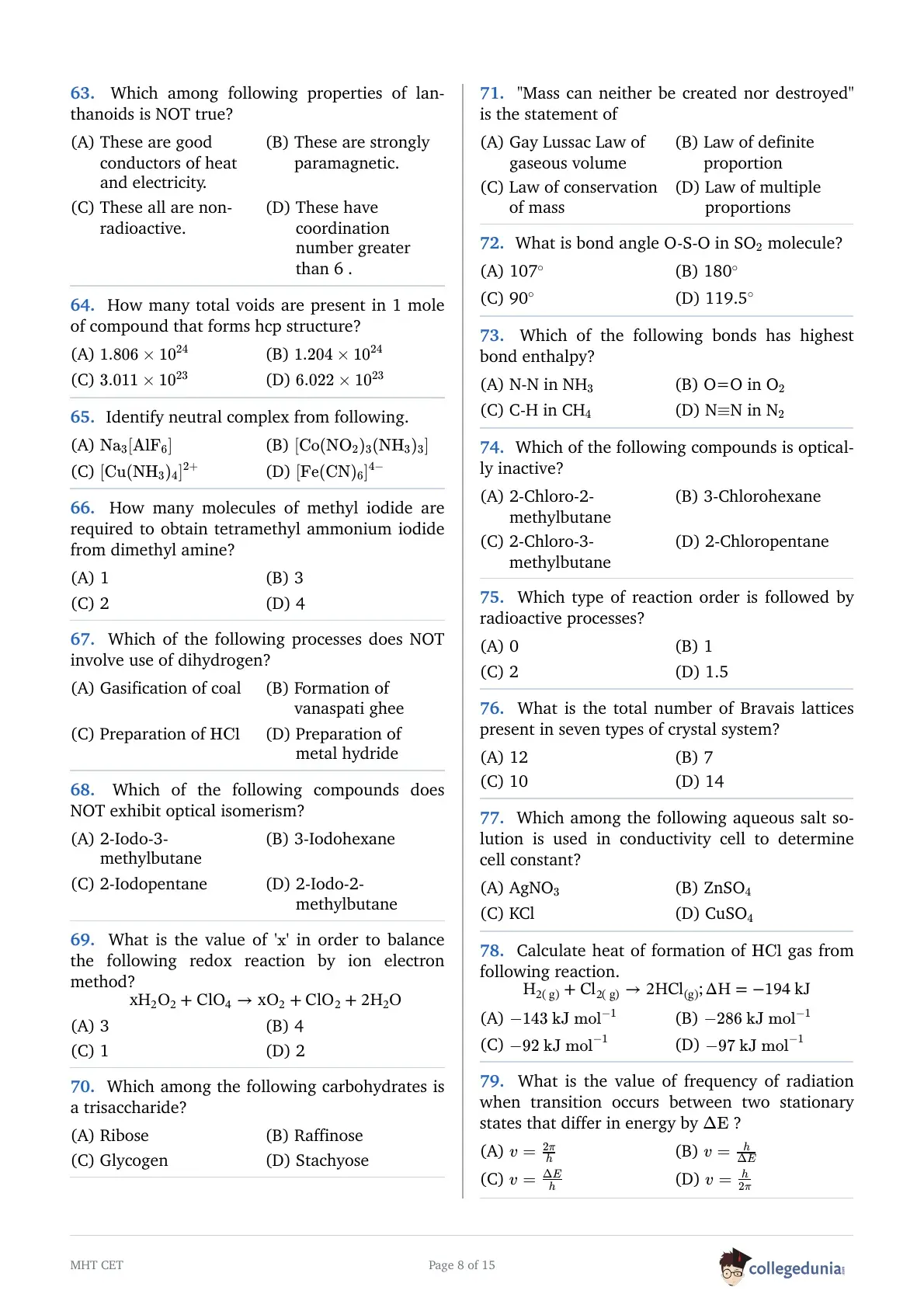
Which among the following properties of lanthanoids is NOT true?
How many total voids are present in 1 mole of a compound that forms an hcp structure?
Identify the neutral complex from the following.
How many molecules of methyl iodide are required to obtain tetramethyl ammonium iodide from dimethyl amine?
Which of the following processes does NOT involve use of dihydrogen?
Which of the following compounds does NOT exhibit optical isomerism?
What is the value of '\(\mathrm{x}\)' in order to balance the following redox reaction by ion electron method? \(\quad \mathrm{x} \mathrm{H}_2 \mathrm{O}_2+\mathrm{ClO}_4 \rightarrow \mathrm{xO}_2+\mathrm{ClO}_2+2 \mathrm{H}_2 \mathrm{O}\)
Which among the following carbohydrates is a trisaccharide?
"Mass can neither be created nor destroyed" is the statement of
What is bond angle O-S-O in \(\text{SO}_2\) molecule?
Which of the following bonds has highest bond enthalpy?
Which of the following compounds is optically inactive?
Which type of reaction order is followed by radioactive processes?
What is the total number of Bravais lattices present in seven types of crystal system?
Which among the following aqueous salt solution is used in conductivity cell to determine cell constant?
Calculate heat of formation of HCl gas from following reaction.
\(\text{H}_{2(g)} + \text{Cl}_{2(g)} \rightarrow 2\text{HCl}_{(g)}\) ; \(\Delta\text{H} = -194\ \text{kJ}\)
What is the value of frequency of radiation when transition occurs between two stationary states that differ in energy by \(\Delta E\)?
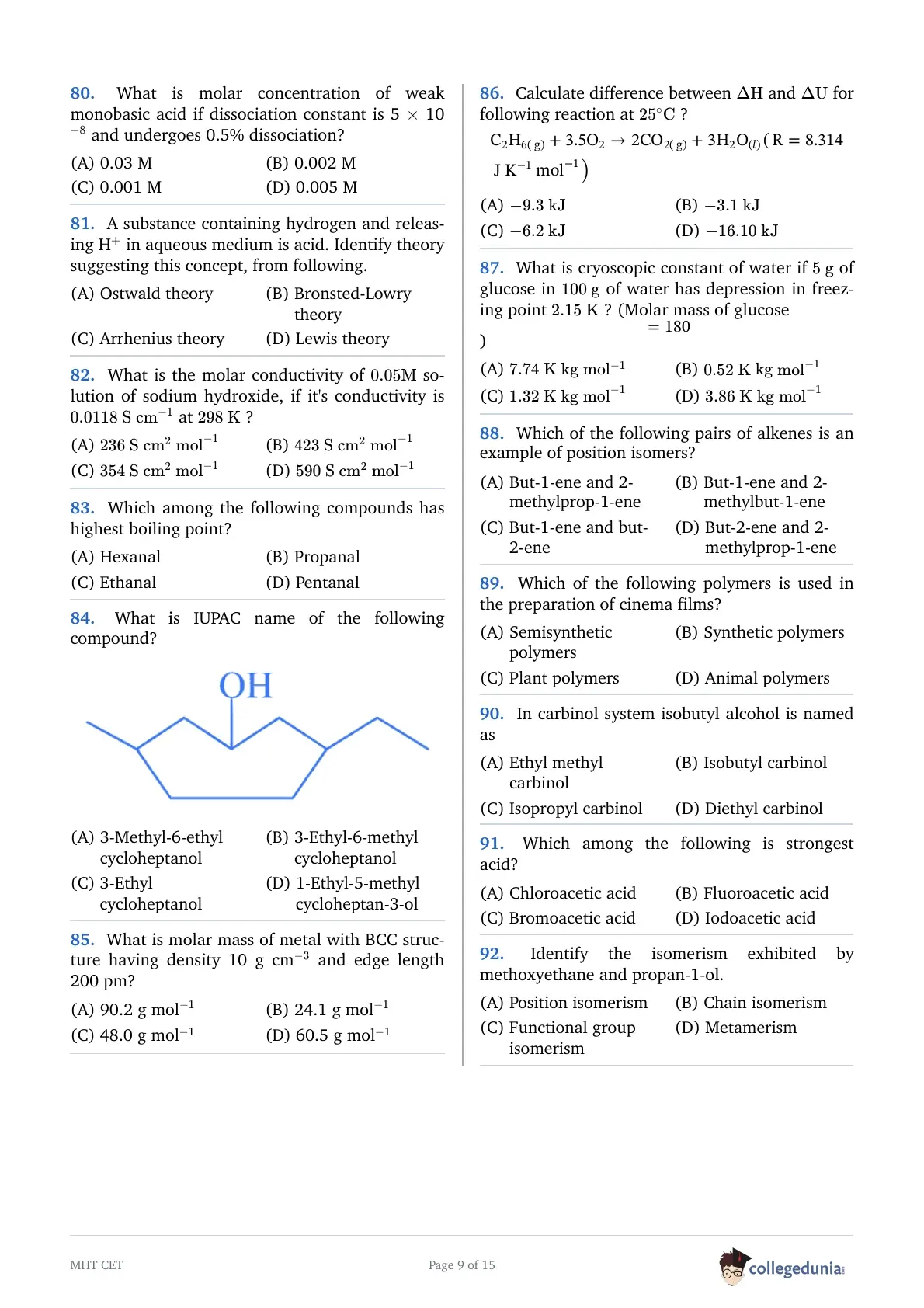
What is molar concentration of weak monobasic acid if dissociation constant is \(5 \times 10^{-8}\) and undergoes \(0.5\%\) dissociation?
A substance containing hydrogen and releasing \(\text{H}^+\) in aqueous medium is acid. Identify theory suggesting this concept, from following.
What is the molar conductivity of \(0.05\ \text{M}\) solution of sodium hydroxide, if its conductivity is \(0.0118\ \text{S}\ \text{cm}^{-1}\) at \(298\ \text{K}\)?
Which among the following compounds has highest boiling point?

What is molar mass of metal with BCC structure having density \(10\ \text{g}\ \text{cm}^{-3}\) and edge length 200 pm?
Calculate difference between \(\Delta H\) and \(\Delta U\) for following reaction at \(25^\circ \text{C}\)?
\(\text{C}_2\text{H}_{6(g)} + 3.5\text{O}_{2(g)} \rightarrow 2\text{CO}_{2(g)} + 3\text{H}_2\text{O}_{(l)}\)
What is cryoscopic constant of water if 5 g of glucose in 100 g of water has depression in freezing point 2.15 K? (Molar mass of glucose = 180)
Which of the following pairs of alkenes is an example of position isomers?
Which of the following polymers is used in the preparation of cinema films?
In carbinol system isobutyl alcohol is named as
Which among the following is strongest acid?
Identify the isomerism exhibited by methoxyethane and propan-1-ol.
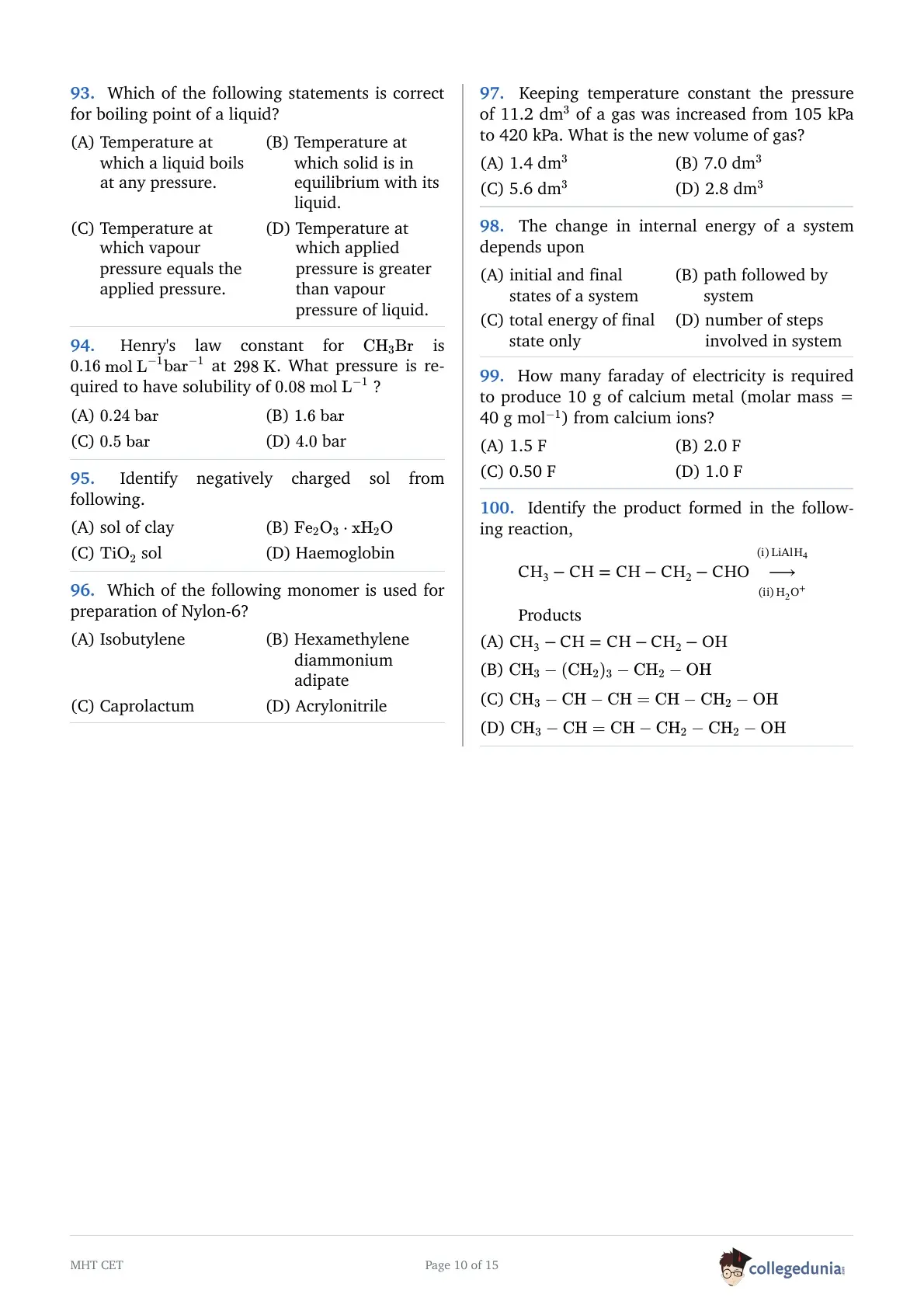
Which of the following statements is correct for boiling point of a liquid?
Henry's law constant for \(CH_3Br\) is \(0.16\ \text{mol}\ \text{L}^{-1}\text{bar}^{-1}\) at \(298\ \text{K}\). What pressure is required to have solubility of \(0.08\ \text{mol}\ \text{L}^{-1}\)?
Identify negatively charged sol from following.
Which of the following monomer is used for preparation of Nylon-6?
Keeping temperature constant the pressure of \(11.2\ \text{dm}^3\) of a gas was increased from \(105\ \text{kPa}\) to \(420\ \text{kPa}\). What is the new volume of gas?
The change in internal energy of a system depends upon
How many faraday of electricity is required to produce 10 g of calcium metal (molar mass = 40 \(\text{g}\ \text{mol}^{-1}\)) from calcium ions?
Identify the product formed in the following reaction,
\(\text{CH}_3-\text{CH}=\text{CH}-\text{CH}_2-\text{CHO} \xrightarrow{\text{(i) LiAlH}_4 \text{ (ii) H}_2\text{O}} \text{Products}\)
Mathematics (Q101 - Q150)
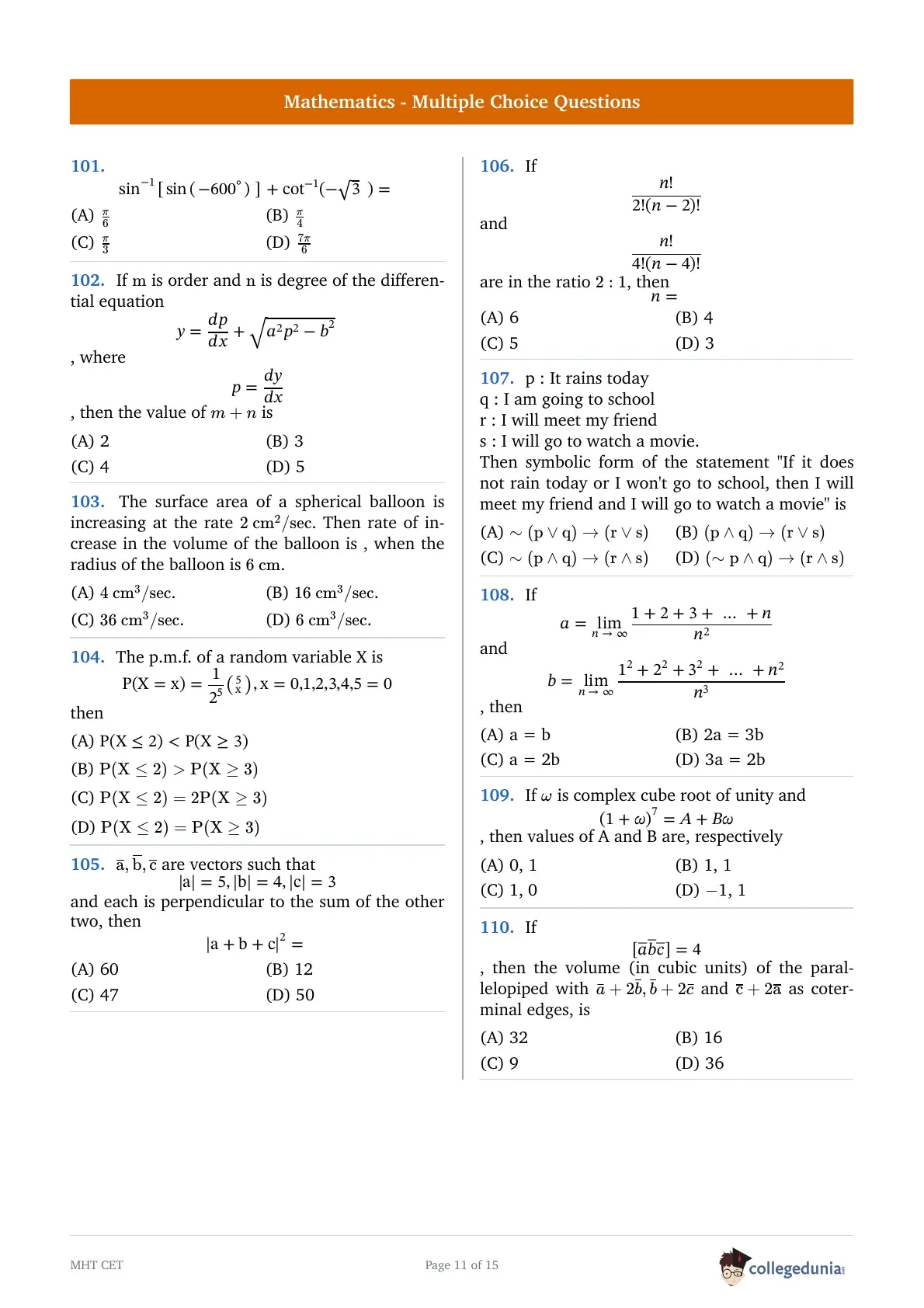
Evaluate: \(\sin^{-1}[\sin(-600^\circ)] + \cot^{-1}(-\sqrt{3})\)
If \(m\) is order and \(n\) is degree of the differential equation \(y = x\frac{dy}{dx} + \sqrt{a^2 \left(\frac{dy}{dx}\right)^2 - b^2}\), then the value of \(m + n\) is
The surface area of a spherical balloon is increasing at the rate \(2\ \text{cm}^2/\text{sec}\). Then rate of increase in the volume of the balloon is, when the radius of the balloon is \(6\ \text{cm}\).
The p.m.f. of a random variable \(X\) is \(P(X = x) = \frac{1}{2^5} \binom{5}{x}, x = 0, 1, 2, 3, 4, 5\), then
\(\vec{a}, \vec{b}, \vec{c}\) are vectors such that \(|\vec{a}| = 5, |\vec{b}| = 4, |\vec{c}| = 3\) and each is perpendicular to the sum of the other two, then \(|\vec{a} + \vec{b} + \vec{c}|^2 = \)
If \(\frac{n!}{2!(n-2)!}\) and \(\frac{n!}{4!(n-4)!}\) are in the ratio \(2:1\), then \(n =\)
p : It rains today
q : I am going to school
r : I will meet my friend
s : I will go to watch a movie.
Then symbolic form of the statement "If it does not rain today or I won't go to school, then I will meet my friend and I will go to watch a movie" is
If \(a = \lim_{n \rightarrow \infty} \frac{1+2+3+\ldots+n}{n^2}\) and \(b = \lim_{n \rightarrow \infty} \frac{1^2+2^2+3^2+\ldots+n^2}{n^3}\), then
If \(\omega\) is complex cube root of unity and \((1+\omega)^7=A+B\omega\), then values of \(A\) and \(B\) are, respectively
If \([\vec{a} \vec{b} \vec{c}]=4\), then the volume (in cubic units) of the parallelopiped with \(\vec{a}+2\vec{b}, \vec{b}+2\vec{c}\) and \(\vec{c}+2\vec{a}\) as coterminal edges, is

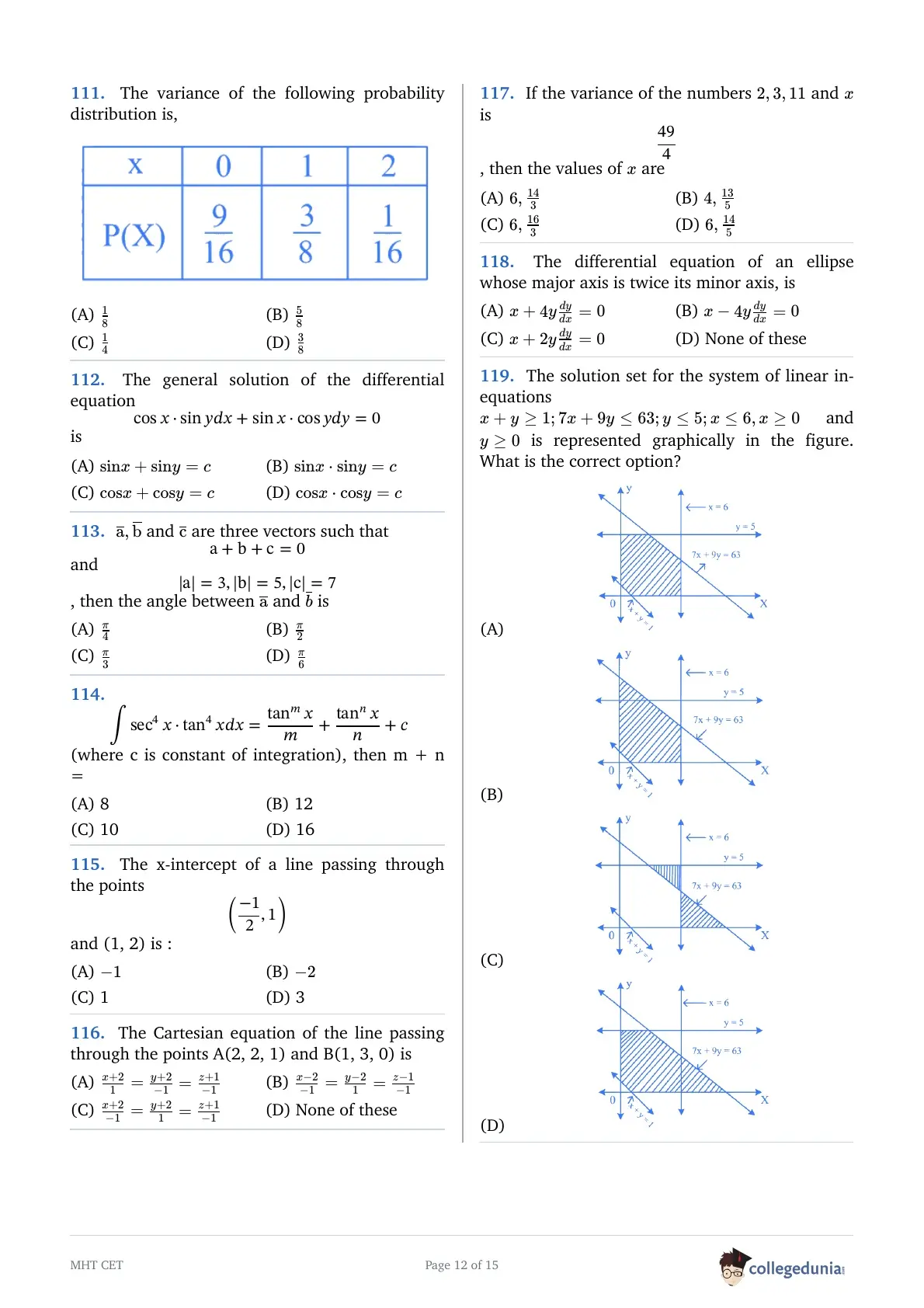
The general solution of the differential equation \(\cos x \cdot \sin y dx + \sin x \cdot \cos y dy = 0\) is
\(\vec{a}, \vec{b}\) and \(\vec{c}\) are three vectors such that \(\vec{a} + \vec{b} + \vec{c} = \vec{0}\) and \(|\vec{a}| = 3, |\vec{b}| = 5, |\vec{c}| = 7\), then the angle between \(\vec{a}\) and \(\vec{b}\) is
\(\int \sec^4 x \cdot \tan^4 x dx = \frac{\tan^m x}{m} + \frac{\tan^n x}{n} + c\) (where \(c\) is constant of integration), then \(m + n =\)
The x-intercept of a line passing through the points \(\left(-\frac{1}{2}, 1\right)\) and \((1, 2)\) is :
The Cartesian equation of the line passing through the points A(2, 2, 1) and B(1, 3, 0) is
If the variance of the numbers \(2, 3, 11\) and \(x\) is \(\frac{49}{4}\), then the values of \(x\) are
The differential equation of an ellipse whose major axis is twice its minor axis, is
The solution set for the system of linear inequations \(x+y \geq 1 ; 7 x+9 y \leq 63 ; y \leq 5 ; x \leq 6, x \geq 0\) and \(y \geq 0\) is represented graphically in the figure. What is the correct option?
- (A)
![]()
- (B)
![]()
- (C)
![]()
- (D)
![]()


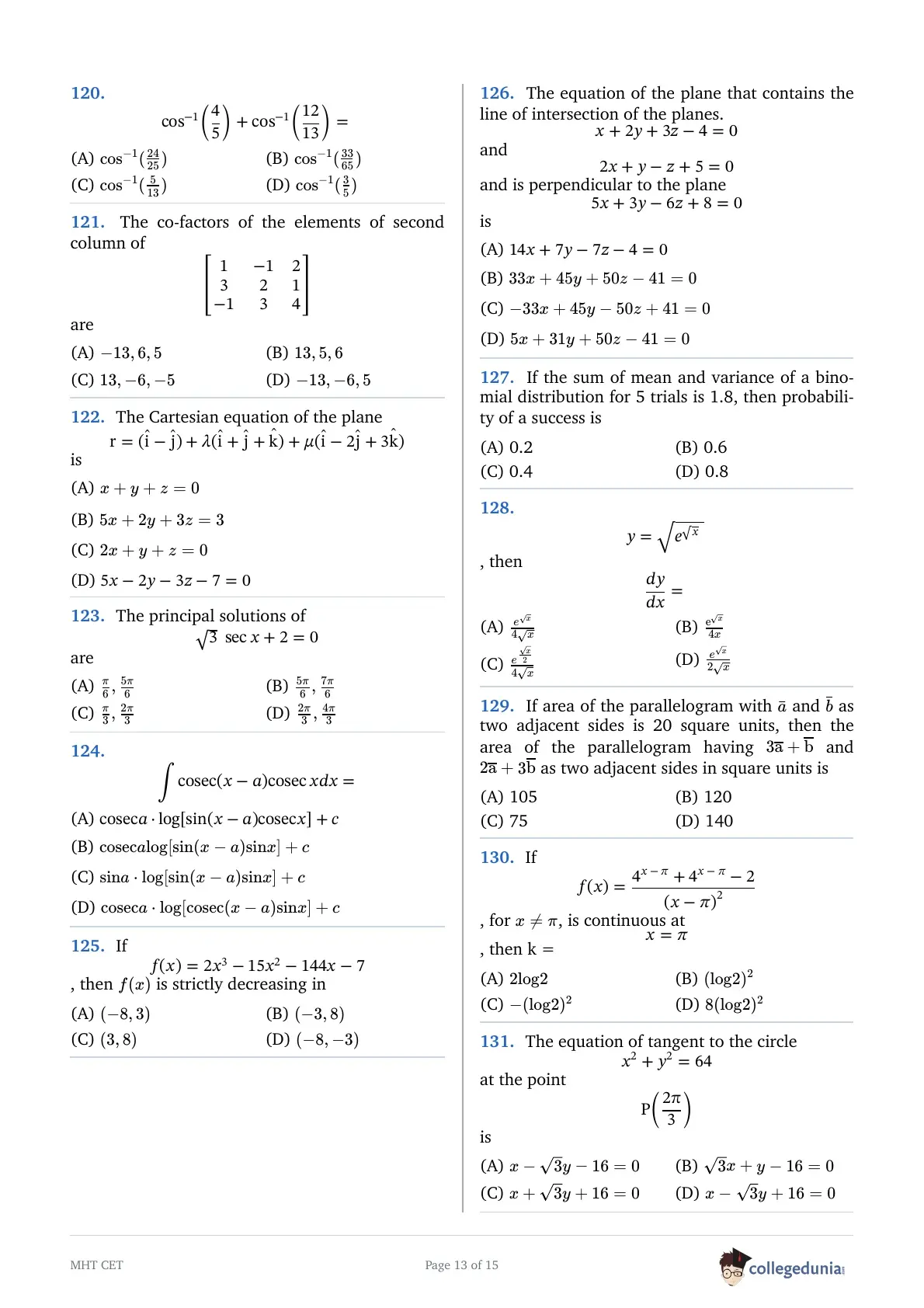
\(\cos^{-1}\left(\frac{4}{5}\right)+\cos^{-1}\left(\frac{12}{13}\right)=\)
The co-factors of the elements of second column of \(\left[\begin{array}{ccc}1 & -1 & 2 \\ 3 & 2 & 1 \\ -1 & 3 & 4\end{array}\right]\) are
The Cartesian equation of the plane \(\overline{\mathrm{r}}=(\hat{\mathrm{i}}-\hat{\mathrm{j}})+\lambda(\hat{\mathrm{i}}+\hat{\mathrm{j}}+\hat{\mathrm{k}})+\mu(\hat{\mathrm{i}}-2 \hat{\mathrm{j}}+3 \hat{\mathrm{k}})\) is
The principal solutions of \(\sqrt{3} \sec x + 2 = 0\) are
\(\int \operatorname{cosec}(x-a) \operatorname{cosec} x dx = \)
If \(f(x) = 2x^3 - 15x^2 - 144x - 7\), then \(f(x)\) is strictly decreasing in
The equation of the plane that contains the line of intersection of the planes \(x+2y+3z-4=0\) and \(2x+y-z+5=0\) and is perpendicular to the plane \(5x+3y-6z+8=0\) is
If the sum of mean and variance of a binomial distribution for 5 trials is 1.8, then probability of a success is
If \(y = \sqrt{e^{\sqrt{x}}}\), then \(\frac{dy}{dx} =\)
If area of the parallelogram with \(\vec{a}\) and \(\vec{b}\) as two adjacent sides is 20 square units, then the area of the parallelogram having \(3\vec{a}+\vec{b}\) and \(2\vec{a}+3\vec{b}\) as two adjacent sides in square units is
If \(f(x) = \frac{4^{x - \pi} + 4^{\pi - x} - 2}{(x - \pi)^2}\), for \(x \ne \pi\), is continuous at \(x = \pi\), then \(f(\pi)\) is
The equation of tangent to the circle \(x^2+y^2=64\) at the point \(P\left(\frac{2\pi}{3}\right)\) is
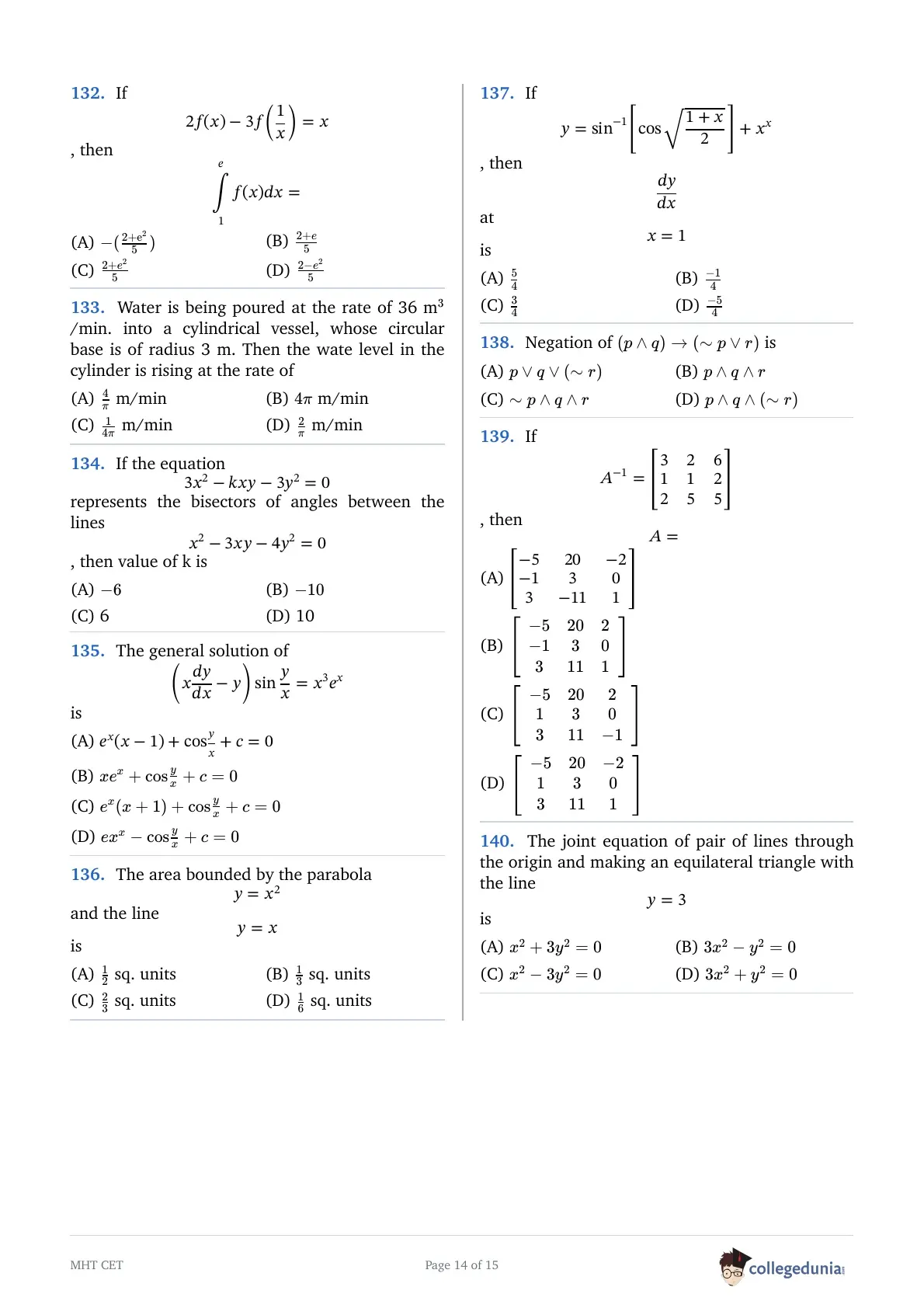
If \(2 f(x) - 3 f\left(\frac{1}{x}\right) = x\), then \(\int_1^e f(x) dx =\)
Water is being poured at the rate of \(36\ \text{m}^3/\text{min}\) into a cylindrical vessel, whose circular base is of radius \(3\ \text{m}\). Then the water level in the cylinder is rising at the rate of
If the equation \(3x^2 - kxy - 3y^2 = 0\) represents the bisectors of angles between the lines \(x^2 - 3xy - 4y^2 = 0\), then value of \(k\) is
The general solution of \(\left(x \frac{dy}{dx} - y\right) \sin \frac{y}{x} = x^3 e^x\) is
The area bounded by the parabola \(y = x^2\) and the line \(y = x\) is
If \(y = \sin^{-1}\left[\cos \sqrt{\frac{1+x}{2}}\right] + x^x\), then \(\frac{dy}{dx}\) at \(x=1\) is
If \(A^{-1}=\left[\begin{array}{ccc}3 & 2 & 6 \\ 1 & 1 & 2 \\ 2 & 5 & 5\end{array}\right]\), then \(A=\)
The joint equation of pair of lines through the origin and making an equilateral triangle with the line \(y=3\) is
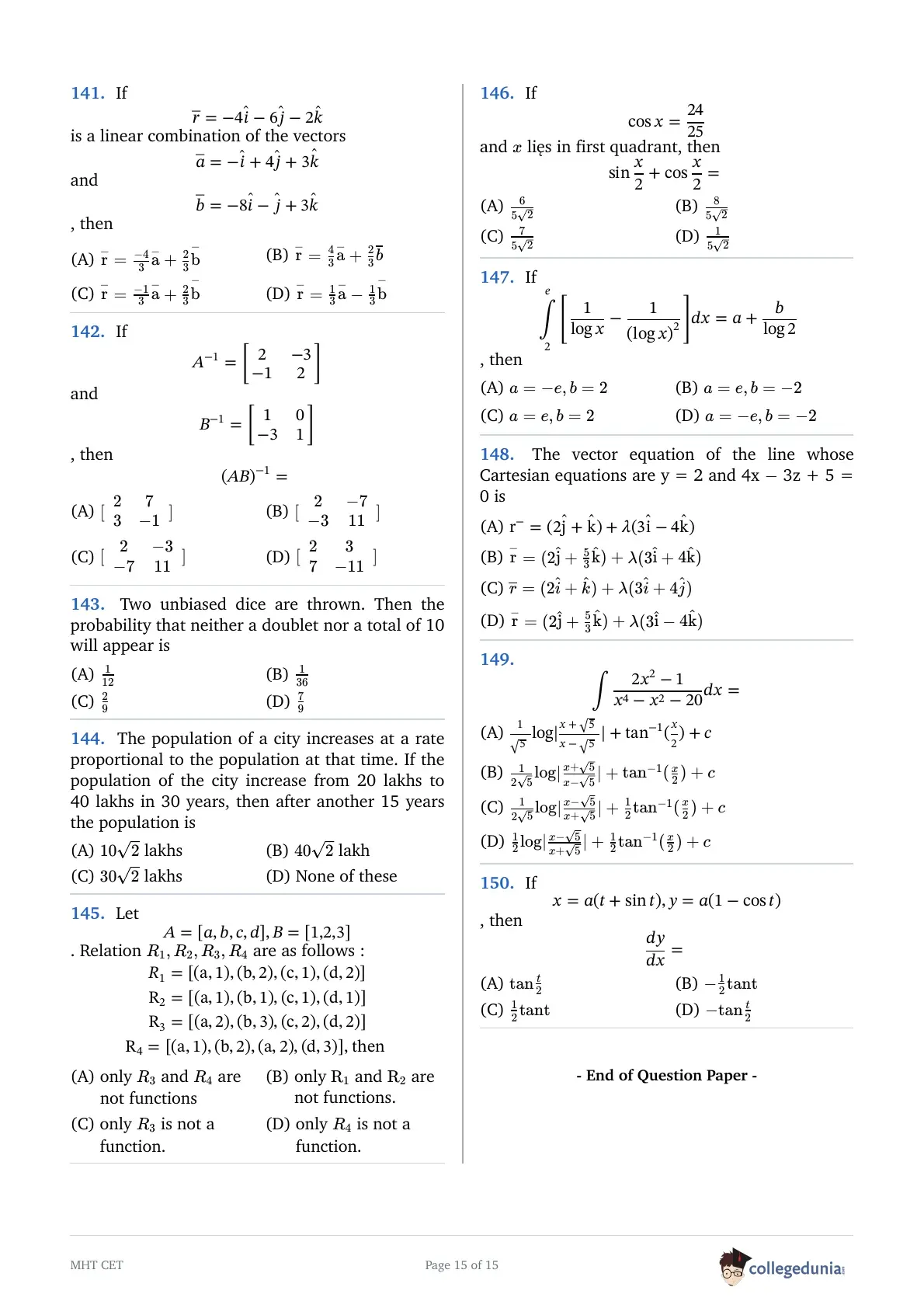
If \(\vec{r} = -4\hat{i} - 6\hat{j} - 2\hat{k}\) is a linear combination of the vectors \(\vec{a} = -\hat{i} + 4\hat{j} + 3\hat{k}\) and \(\vec{b} = -8\hat{i} - \hat{j} + 3\hat{k}\), then
If \(A^{-1} = \left[\begin{array}{cc}2 & -3 \\ -1 & 2\end{array}\right]\) and \(B^{-1} = \left[\begin{array}{cc}1 & 0 \\ -3 & 1\end{array}\right]\), then \((AB)^{-1} =\)
Two unbiased dice are thrown. Then the probability that neither a doublet nor a total of 10 will appear is
The population of a city increases at a rate proportional to the population at that time. If the population of the city increase from 20 lakhs to 40 lakhs in 30 years, then after another 15 years the population is
Let \(A=[a, b, c, d], B=[1,2,3]\). Relation \(R_1, R_2, R_3, R_4\) are as follows :
\(R_1=[(a, 1), (b, 2), (c, 1), (d, 2)]\)
\(R_2=[(a, 1), (b, 1), (c, 1), (d, 1)]\)
\(R_3=[(a, 2), (b, 3), (c, 2), (d, 2)]\)
\(R_4=[(a, 1), (b, 2), (a, 2), (d, 3)]\), then
If \(\cos x = \frac{24}{25}\) and \(x\) lies in first quadrant, then \(\sin \frac{x}{2} + \cos \frac{x}{2} =\)
If \(\int_2^e \left[ \frac{1}{\log x} - \frac{1}{(\log x)^2} \right] dx = a + \frac{b}{\log 2}\), then
The vector equation of the line whose Cartesian equations are \(y = 2\) and \(4x - 3z + 5 = 0\) is
\(\int \frac{2 x^2-1}{x^4-x^2-20} d x=\)
If \(x = a(t + \sin t), y = a(1 - \cos t)\), then \(\frac{dy}{dx} =\)
MHT CET 2021 PCM Exam Pattern and Marking Scheme
| Parameter | Details |
|---|---|
| Conducting Body | Maharashtra Common Entrance Test Cell (Maharashtra CET Cell) |
| Exam Mode | Online (Computer-Based Test) |
| Duration | 180 minutes (3 hours) |
| Groups / Subjects | PCM (Physics, Chemistry, Mathematics) for Engineering |
| Total Questions |
150 |
| Total Marks | 200 |
| Question Type | Multiple Choice Questions (MCQs) |
| Marks Distribution |
|
| Negative Marking | No |
| Syllabus Weightage |
|



Comments