




MHT CET 2021 Sep 21 Shift 1 PCM Question Paper is available for download here. Maharashtra State CET Cell conducted MHT CET 2021 PCM Exam on Sep 21 in Shift 1 from 9 AM to 12 PM in CBT mode.
The MHT CET 2021 PCM question paper includes the following:
- The MHT CET 2021 PCM Question Paper consists of 150 multiple-choice questions (MCQs) totalling 200 marks divided into 3 sections: Physics, Chemistry, and Mathematics, with 50 questions in each subject.
- Physics and Chemistry questions carry 1 mark each while Mathematics questions carry 2 marks each.
- There is no negative marking for incorrect answers.
MHT CET 2021 Sep 21 Shift 1 PCM Question Paper with Solution PDF
| CD PDF | CD PDF with Solutions |
|---|---|
| Download Collegedunia PDF 0.93 MB | - |
Also Check:
MHT CET 2021 Sep 21 Shift 1 PCM Questions with Solutions
Physics (Q1 - Q50)
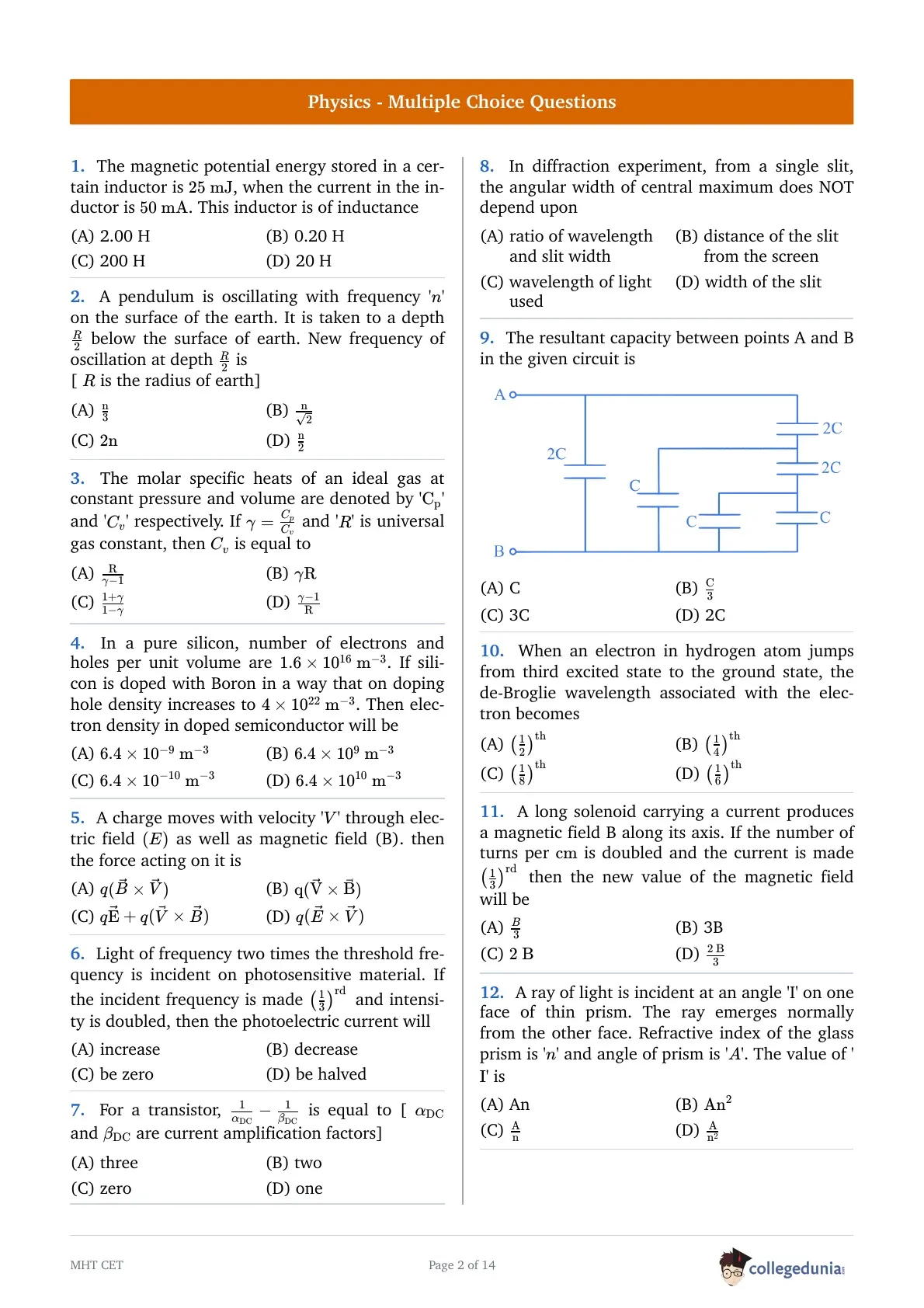
The magnetic potential energy stored in a certain inductor is \(25\ \text{mJ}\), when the current in the inductor is \(50\ \text{mA}\). This inductor is of inductance
A pendulum is oscillating with frequency 'n' on the surface of the earth. It is taken to a depth \(\frac{R}{2}\) below the surface of earth. New frequency of oscillation at depth \(\frac{R}{2}\) is [R is the radius of earth]
The molar specific heats of an ideal gas at constant pressure and volume are denoted by ' \(C_p\) ' and ' \(C_v\) ' respectively. If \(\gamma = \frac{C_p}{C_v}\) and ' R ' is universal gas constant, then \(C_v\) is equal to
In a pure silicon, number of electrons and holes per unit volume are \(1.6 \times 10^{16}\ \text{m}^{-3}\). If silicon is doped with Boron in a way that on doping hole density increases to \(4 \times 10^{22}\ \text{m}^{-3}\). Then electron density in doped semiconductor will be
A charge moves with velocity 'V' through electric field (E) as well as magnetic field (B). then the force acting on it is
Light of frequency two times the threshold frequency is incident on photosensitive material. If the incident frequency is made 1/3 rd and intensity is doubled, then the photoelectric current will
For a transistor, \(\frac{1}{\alpha_{DC}} - \frac{1}{\beta_{DC}}\) is equal to [\(\alpha_{DC}\) and \(\beta_{DC}\) are current amplification factors]
In diffraction experiment, from a single slit, the angular width of central maximum does NOT depend upon

When an electron in hydrogen atom jumps from third excited state to the ground state, the de-Broglie wavelength associated with the electron becomes
A long solenoid carrying a current produces a magnetic field B along its axis. If the number of turns per cm is doubled and the current is made 1/3 rd, then the new value of the magnetic field will be
A ray of light is incident at an angle 'i' on one face of thin prism. The ray emerges normally from the other face. Refractive index of the glass prism is 'n' and angle of prism is 'A'. The value of 'i' is
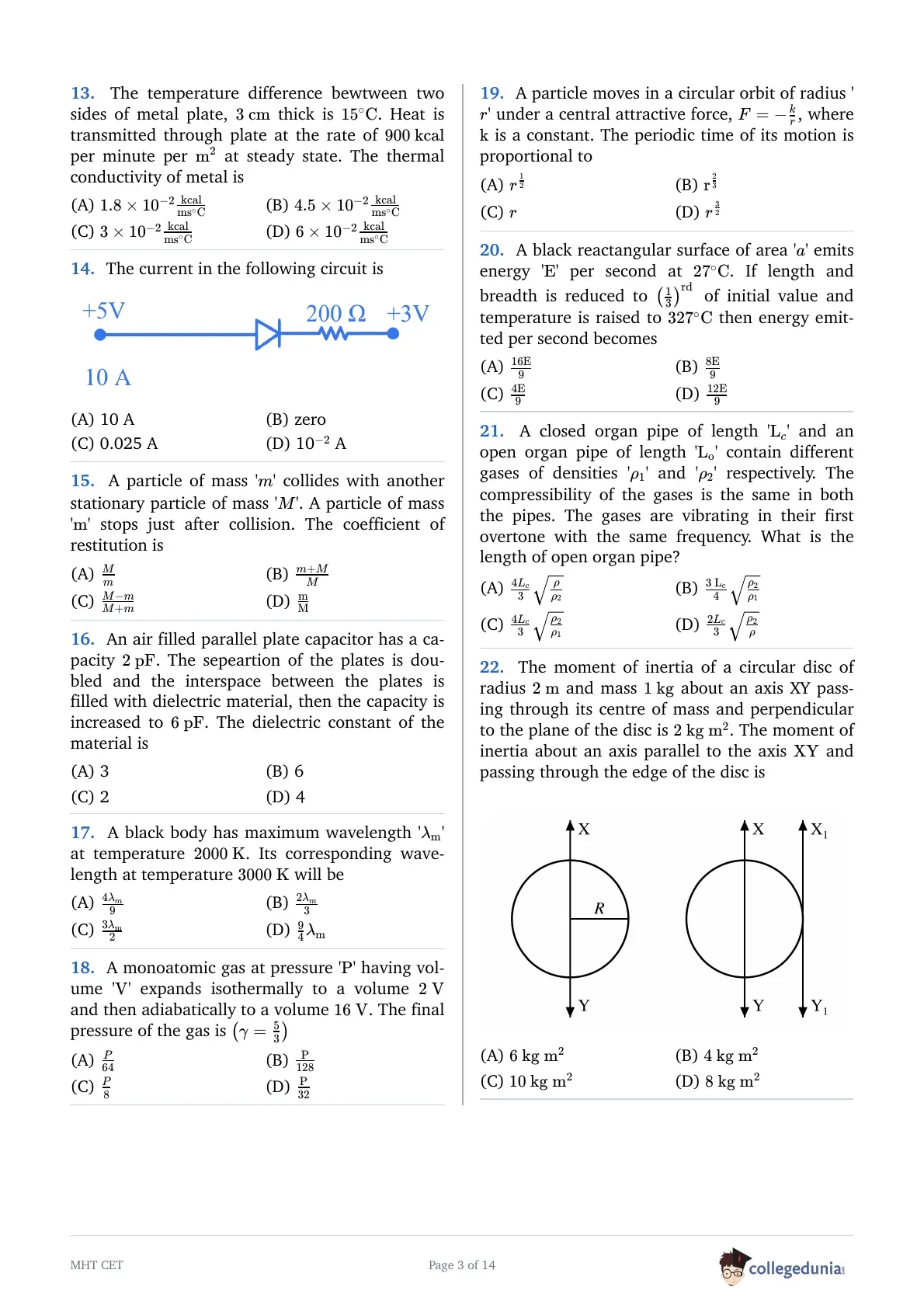
The temperature difference between two sides of metal plate, 3 cm thick is 15°C. Heat is transmitted through plate at the rate of 900 kcal per minute per m² at steady state. The thermal conductivity of metal is

A particle of mass 'm' collides with another stationary particle of mass 'M'. A particle of mass 'm' stops just after collision. The coefficient of restitution is
An air filled parallel plate capacitor has a capacity \(2\ \text{pF}\). The separation of the plates is doubled and the interspace between the plates is filled with dielectric material, then the capacity is increased to \(6\ \text{pF}\). The dielectric constant of the material is
A black body has maximum wavelength \( \lambda_m \) at temperature 2000 K. Its corresponding wavelength at temperature 3000 K will be
A monoatomic gas at pressure ‘P’ having volume ‘V’ expands isothermally to a volume 2 V and then adiabatically to a volume 16 V. The final pressure of the gas is \(\gamma = \frac{5}{3}\)
A particle moves in a circular orbit of radius 'r' under a central attractive force, \( F = -\frac{k}{r} \), where k is a constant. The periodic time of its motion is proportional to
A black rectangular surface of area 'a' emits energy 'E' per second at 27°C. If length and breadth is reduced to \(\left(\frac{1}{3}\right)^{\text{rd}}\) of initial value and temperature is raised to 327°C then energy emitted per second becomes
A closed organ pipe of length \( L_c \) and an open organ pipe of length \( L_o \) contain different gases of densities \( \rho_1 \) and \( \rho_2 \) respectively. The compressibility of the gases is the same in both the pipes. The gases are vibrating in their first overtone with the same frequency. What is the length of open organ pipe?
The moment of inertia of a circular disc of radius 2 m and mass 1 kg about an axis XY passing through its centre of mass and perpendicular to the plane of the disc is 2 kg m\(^2\). The moment of inertia about an axis parallel to the axis XY and passing through the edge of the disc is
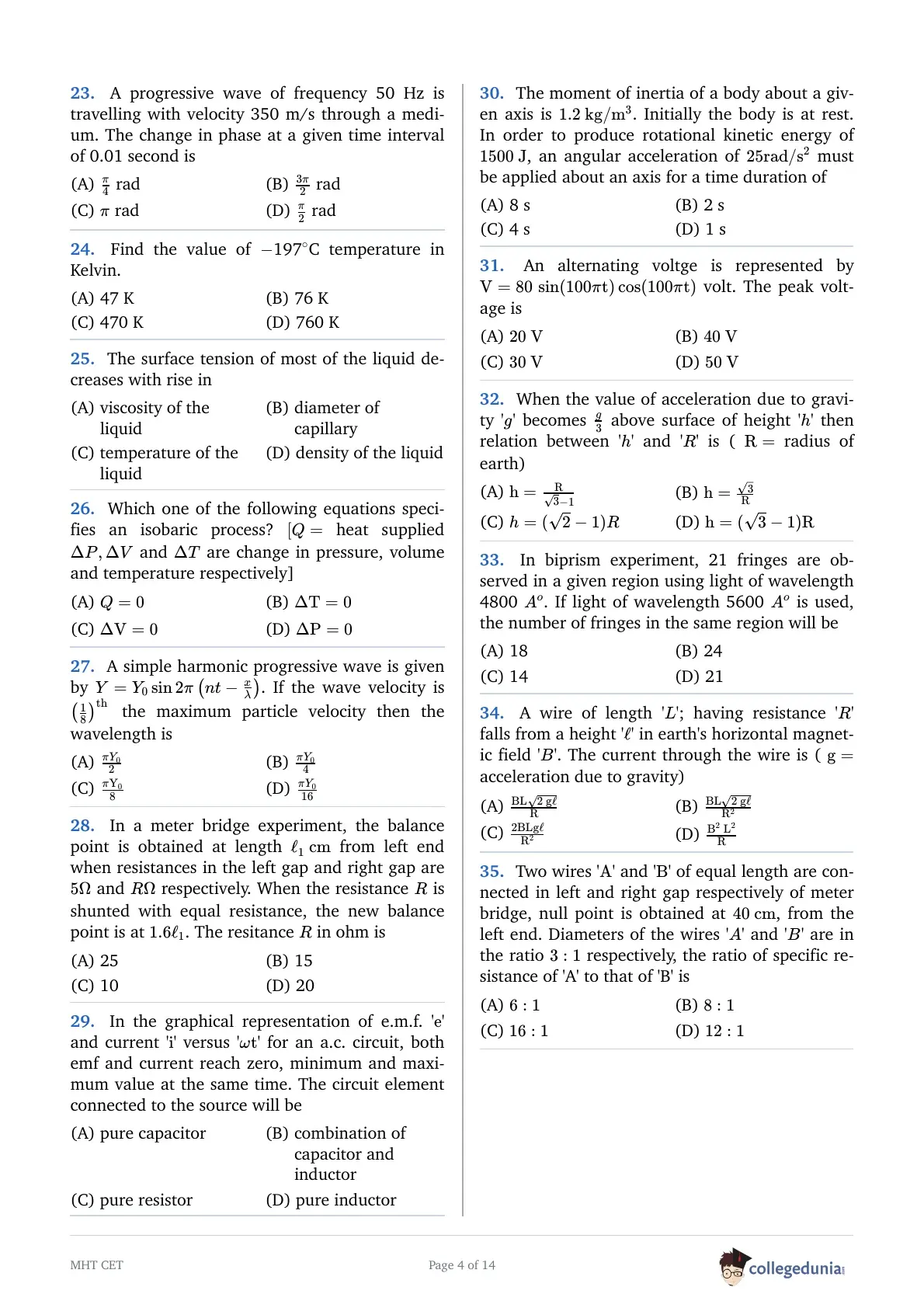
A progressive wave of frequency 50 Hz is travelling with velocity 350 m/s through a medium. The change in phase at a given time interval of 0.01 second is
Find the value of \(-197^\circ C\) temperature in Kelvin.
The surface tension of most of the liquid decreases with rise in
Which one of the following equations specifies an isobaric process? \([Q = \text{heat supplied}, \Delta P, \Delta V \text{ and } \Delta T \text{ are change in pressure, volume and temperature respectively}]\)
A simple harmonic progressive wave is given by \( Y = Y_0 \sin 2\pi \left( nt - \frac{x}{\lambda} \right) \). If the wave velocity is \(\left( \frac{1}{8} \right)^{\text{th}}\) the maximum particle velocity then the wavelength is
In a meter bridge experiment, the balance point is obtained at length \(\ell_1\) cm from left end when resistances in the left gap and right gap are \(5\Omega\) and \(R\Omega\) respectively. When the resistance \(R\) is shunted with equal resistance, the new balance point is at \(1.6\ell_1\). The resistance \(R\) in ohm is
In the graphical representation of e.m.f. 'e' and current 'i' versus 'ωt' for an a.c. circuit, both emf and current reach zero, minimum and maximum value at the same time. The circuit element connected to the source will be
The moment of inertia of a body about a given axis is \( 1.2 \, \text{kg m}^2 \). Initially the body is at rest. In order to produce rotational kinetic energy of \( 1500 \, \text{J} \), an angular acceleration of \( 25 \, \text{rad/s}^2 \) must be applied about an axis for a time duration of
An alternating voltage is represented by \( V = 80 \sin(100\pi t) \cos(100\pi t) \) volt. The peak voltage is
When the value of acceleration due to gravity \( g' \) becomes \( \frac{g}{3} \) above surface of height \( h \) then relation between \( h \) and \( R \) is \( (R = \text{radius of earth}) \)
In biprism experiment, 21 fringes are observed in a given region using light of wavelength 4800 Å. If light of wavelength 5600 Å is used, the number of fringes in the same region will be
A wire of length \(L\); having resistance \(R\) falls from a height \(l\) in earth's horizontal magnetic field \(B\). The current through the wire is ( \(g = \) acceleration due to gravity)
Two wires 'A' and 'B' of equal length are connected in left and right gap respectively of meter bridge, null point is obtained at 40 cm from the left end. Diameters of the wires 'A' and 'B' are in the ratio 3 : 1 respectively, the ratio of specific resistance of 'A' to that of 'B' is
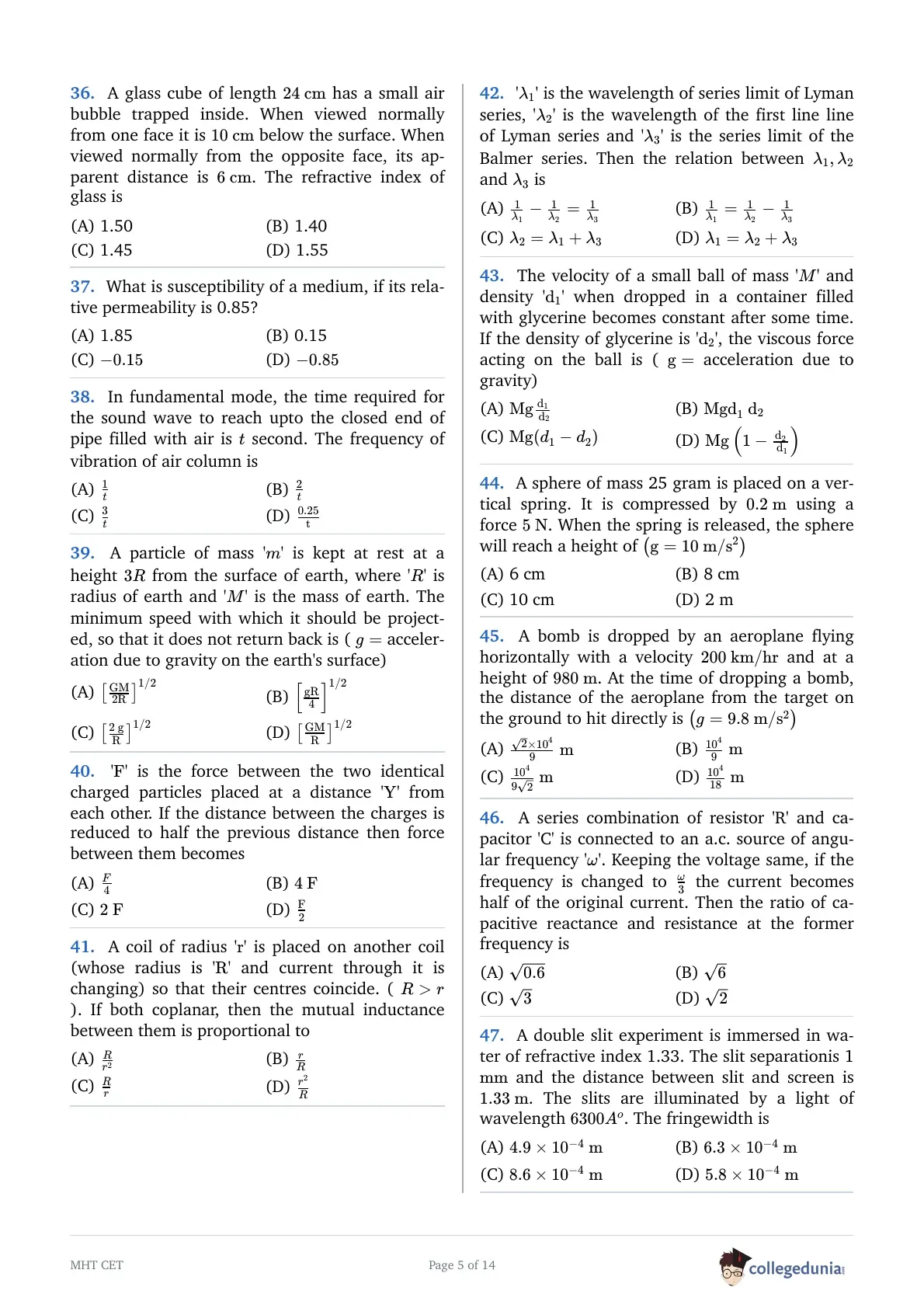
A glass cube of length 24 cm has a small air bubble trapped inside. When viewed normally from one face it is 10 cm below the surface. When viewed normally from the opposite face, its apparent distance is 6 cm. The refractive index of glass is
What is susceptibility of a medium, if its relative permeability is 0.85?
In fundamental mode, the time required for the sound wave to reach upto the closed end of pipe filled with air is \( t \) second. The frequency of vibration of air column is
A particle of mass 'm' is kept at rest at a height \( 3R \) from the surface of earth, where 'R' is radius of earth and 'M' is the mass of earth. The minimum speed with which it should be projected, so that it does not return back is ( \( g = \) acceleration due to gravity on the earth's surface)
'F' is the force between the two identical charged particles placed at a distance 'Y' from each other. If the distance between the charges is reduced to half the previous distance then force between them becomes
A coil of radius 'r' is placed on another coil (whose radius is 'R' and current through it is changing) so that their centres coincide. (\( R > r \)). If both coplanar, then the mutual inductance between them is proportional to
\(\lambda_1\) is the wavelength of series limit of Lyman series, \(\lambda_2\) is the wavelength of the first line of Lyman series and \(\lambda_3\) is the series limit of the Balmer series. Then the relation between \(\lambda_1\), \(\lambda_2\) and \(\lambda_3\) is
The velocity of a small ball of mass '\( M \)' and density '\( d_1 \)' when dropped in a container filled with glycerine becomes constant after some time. If the density of glycerine is '\( d_2 \)', the viscous force acting on the ball is ( \( g = \) acceleration due to gravity )
A sphere of mass 25 gram is placed on a vertical spring. It is compressed by 0.2 m using a force 5 N. When the spring is released, the sphere will reach a height of \( g = 10 \, \text{m/s}^2 \)
A bomb is dropped by an aeroplane flying horizontally with a velocity 200 km/hr and at a height of 980 m. At the time of dropping a bomb, the distance of the aeroplane from the target on the ground to hit directly is \( (g = 9.8 \, \text{m/s}^2) \)
A series combination of resistor 'R' and capacitor 'C' is connected to an a.c. source of angular frequency 'ω'. Keeping the voltage same, if the frequency is changed to \(\frac{ω}{3}\) the current becomes half of the original current. Then the ratio of capacitive reactance and resistance at the former frequency is
A double slit experiment is immersed in water of refractive index 1.33. The slit separation is 1 mm and the distance between slit and screen is 1.33 m. The slits are illuminated by a light of wavelength \(6300 \, \text{Å}\). The fringe width is
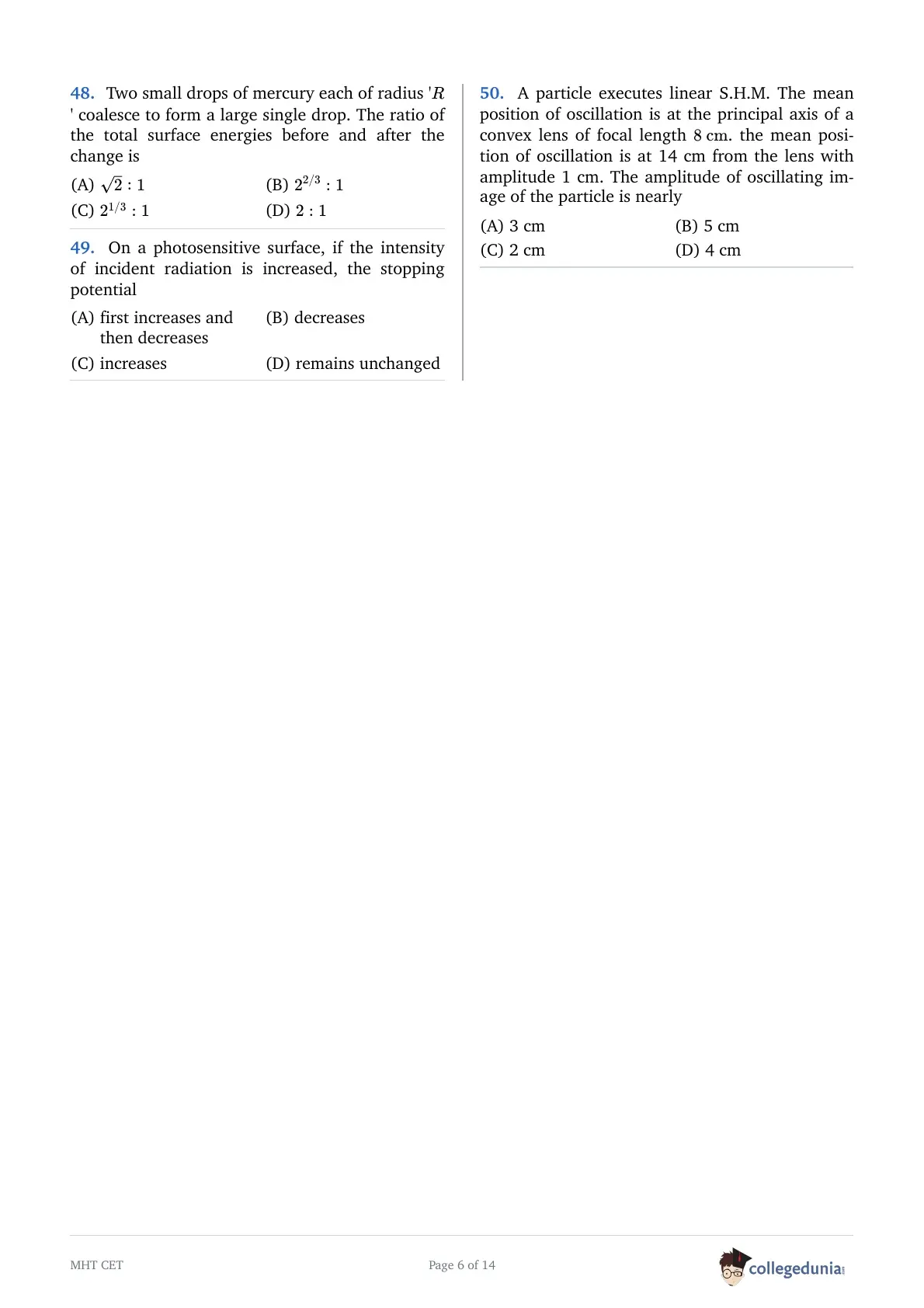
Two small drops of mercury each of radius '\( R \)' coalesce to form a large single drop. The ratio of the total surface energies before and after the change is
On a photosensitive surface, if the intensity of incident radiation is increased, the stopping potential
A particle executes linear S.H.M. The mean position of oscillation is at the principal axis of a convex lens of focal length 8 cm. The mean position of oscillation is at 14 cm from the lens with amplitude 1 cm. The amplitude of oscillating image of the particle is nearly
Chemistry (Q51 - Q100)
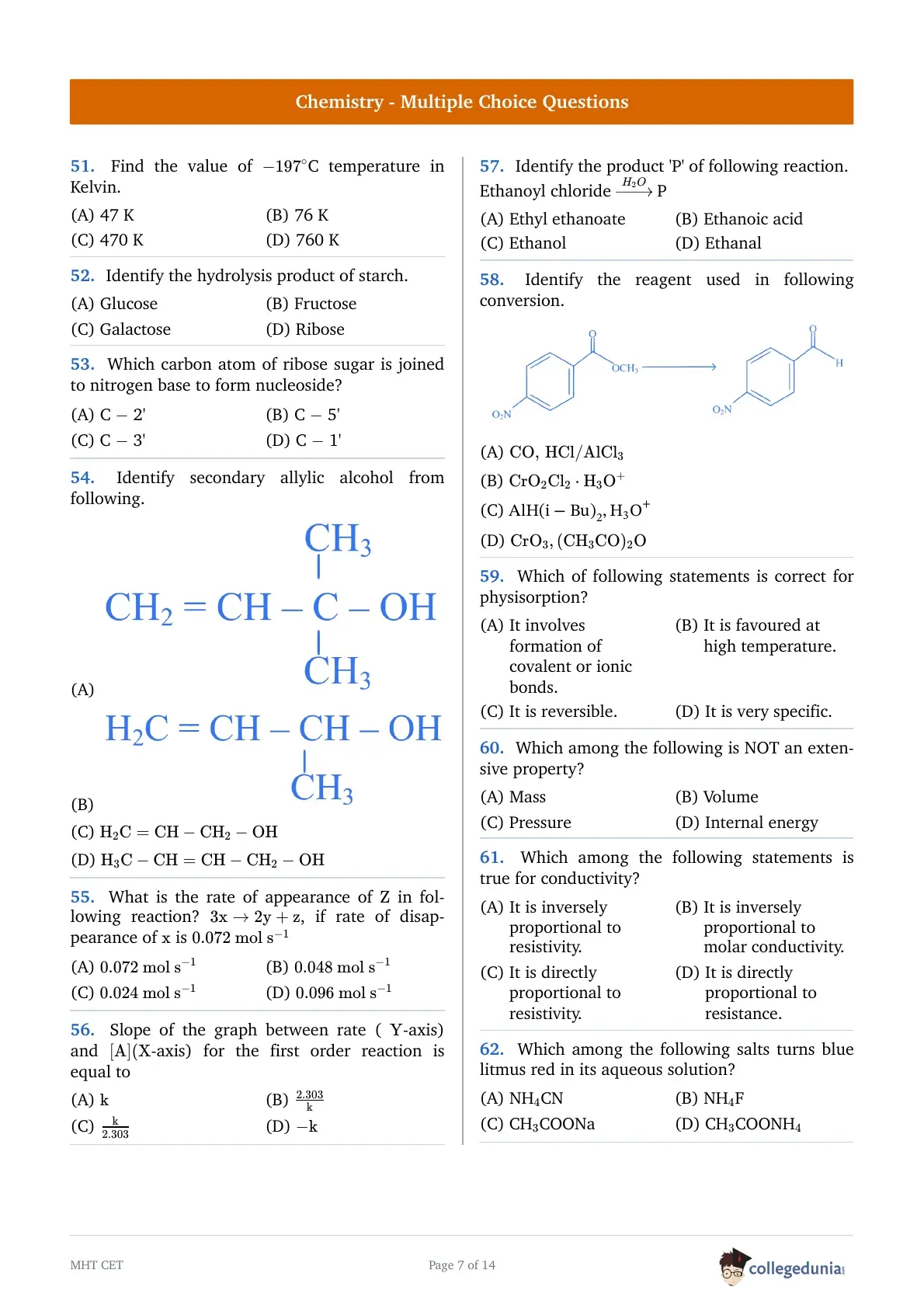
Find the value of \(-197^\circ\text{C}\) temperature in Kelvin.
Identify the hydrolysis product of starch.
Which carbon atom of ribose sugar is joined to nitrogen base to form nucleoside?
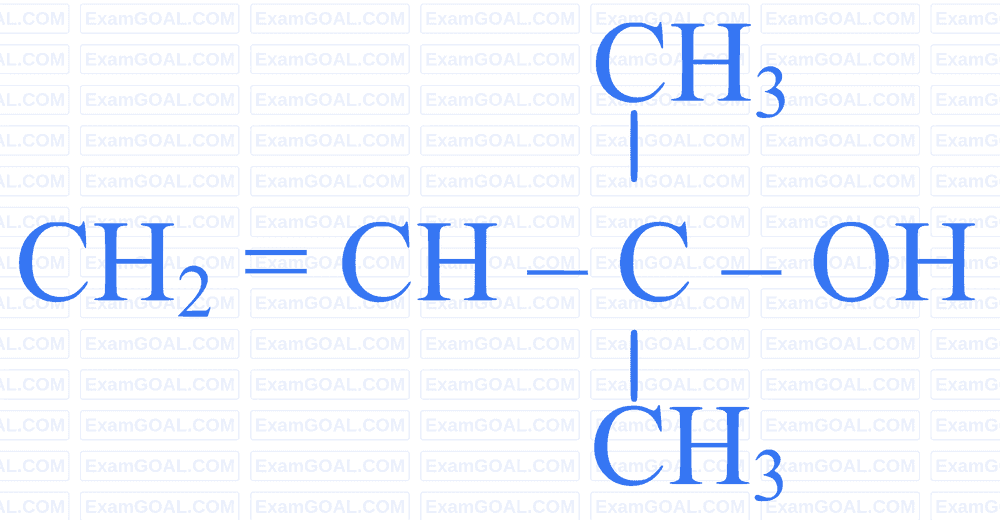
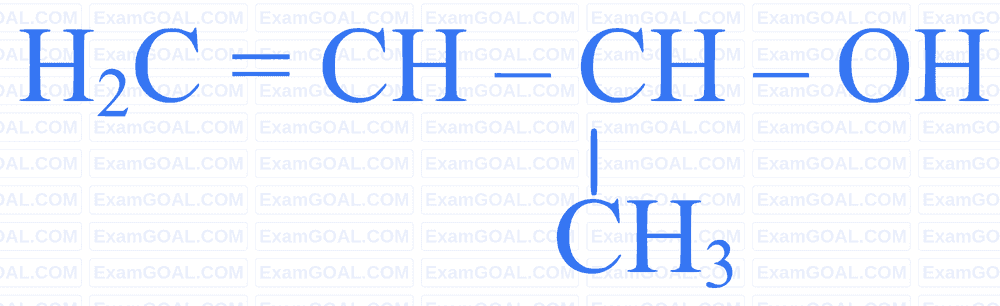
Identify secondary allylic alcohol from following.
- (A)
![MHT CET 2021 21th September Morning Shift Chemistry - Alcohol, Phenols and Ethers Question 262 English Option 1]()
- (B)
![MHT CET 2021 21th September Morning Shift Chemistry - Alcohol, Phenols and Ethers Question 262 English Option 2]()
- (C) \(\mathrm{H}_{2}\mathrm{C}=\mathrm{CH}-\mathrm{CH}_{2}-\mathrm{OH}\)
- (D) \(\mathrm{H}_{3}\mathrm{C}-\mathrm{CH}=\mathrm{CH}-\mathrm{CH}_{2}-\mathrm{OH}\)
What is the rate of appearance of Z in following reaction? \(3\text{x} \rightarrow 2\text{y} + \text{z}\), if rate of disappearance of x is \(0.072\text{ mol s}^{-1}\)?
Slope of the graph between rate (Y-axis) and [A] (X-axis) for the first order reaction is equal to
Identify the product 'P' of following reaction.
Ethanoyl chloride \(\xrightarrow{H_2O}\) P

Which of following statements is correct for physisorption?
Which among the following is NOT an extensive property?
Which among the following statements is true for conductivity?
Which among the following salts turns blue litmus red in it's aqueous solution?
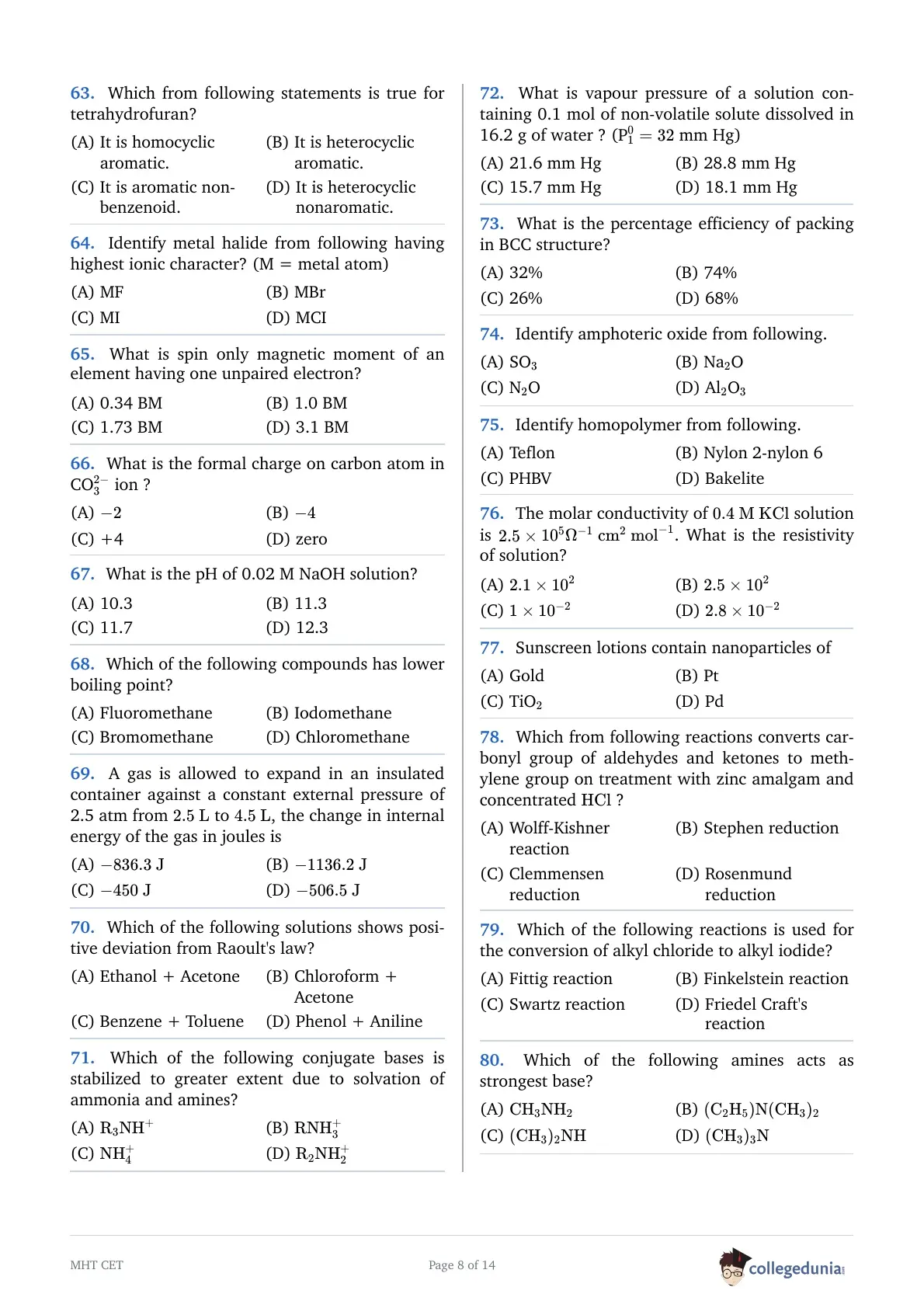
Which from following statements is true for tetrahydrofuran?
Identify metal halide from following having highest ionic character? (M = metal atom)
What is spin only magnetic moment of an element having one unpaired electron?
What is the formal charge on carbon atom in \(\text{CO}_3^{2-}\) ion ?
What is the pH of 0.02 M NaOH solution?
Which of the following compounds has lower boiling point?
A gas is allowed to expand in an insulated container against a constant external pressure of 2.5 atm from 2.5 L to 4.5 L, the change in internal energy of the gas in joules is
Which of the following solutions shows positive deviation from Raoult's law?
Which of the following conjugate bases is stabilized to greater extent due to solvation of ammonia and amines?
What is vapour pressure of a solution containing 0.1 mol of non-volatile solute dissolved in 16.2 g of water ? (\(P_1^0= 32\text{ mm Hg}\))
What is the percentage efficiency of packing in BCC structure?
Identify amphoteric oxide from following.
Identify homopolymer from following.
The molar conductivity of \(0.4\text{ M KCl}\) solution is \(2.5 \times 10^5\ \Omega^{-1}\text{ cm}^2\text{ mol}^{-1}\). What is the resistivity of solution?
Sunscreen lotions contains nanoparticles of
Which from following reactions converts carbonyl group of aldehydes and ketones to methylene group on treatment with zinc amalgam and concentrated HCl ?
Which of the following reactions is used for the conversion of alkyl chloride to alkyl iodide?
Which of the following amines acts as strongest base?
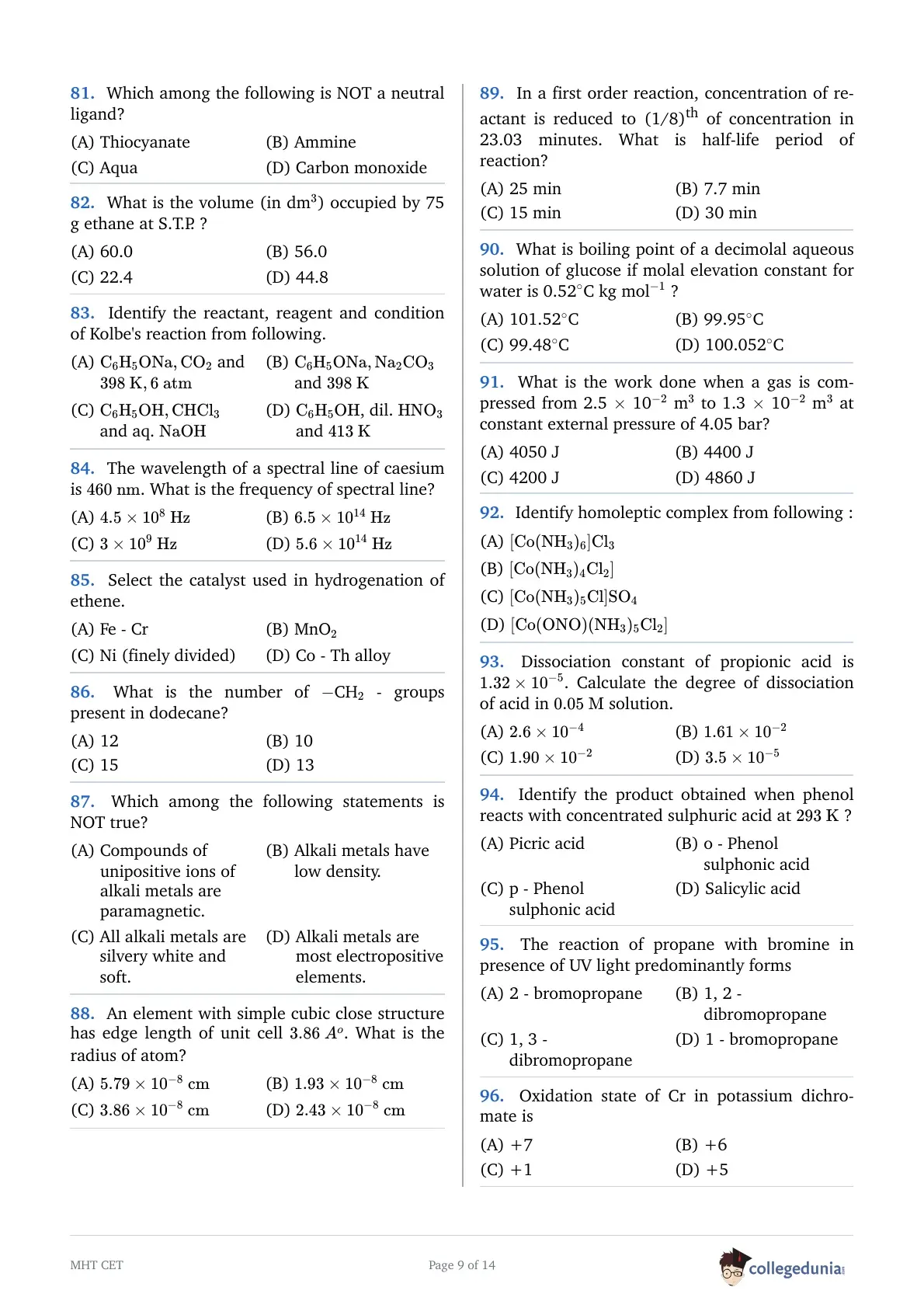
Which among the following is NOT a neutral ligand?
What is the volume (in \(\text{dm}^3\)) occupied by 75 g ethane at S.T.P. ?
Identify the reactant, reagent and condition of Kolbe's reaction from following.
The wavelength of a spectral line of caesium is \(460\text{ nm}\). What is the frequency of spectral line?
Select the catalyst used in hydrogenation of ethene.
What is the number of \(\text{-CH}_2\text{-}\) groups present in dodecane?
Which among the following statements is NOT true?
An element with simple cubic close structure has edge length of unit cell \(3.86\ \text{\AA}\). What is the radius of atom?
In a first order reaction, concentration of reactant is reduced to (1/8)th of concentration in 23.03 minutes. What is half-life period of reaction?
What is boiling point of a decimolal aqueous solution of glucose if molal elevation constant for water is \(0.52^\circ\text{C kg mol}^{-1}\)?
What is the work done when a gas is compressed from \(2.5 \times 10^{-2}\text{ m}^3\) to \(1.3 \times 10^{-2}\text{ m}^3\) at constant external pressure of \(4.05\text{ bar}\)?
Identify homoleptic complex from following :
Dissociation constant of propionic acid is \(1.32 \times 10^{-5}\). Calculate the degree of dissociation of acid in \(0.05\text{ M}\) solution.
Identify the product obtained when phenol reacts with concentrated sulphuric acid at \(293\text{ K}\) ?
The reaction of propane with bromine in presence of UV light predominantly forms
Oxidation state of Cr in potassium dichromate is
What is the volume of unit cell of a metal (at. mass \(25\text{ g mol}^{-1}\)) having BCC structure and density \(3\text{ g cm}^{-3}\) ?
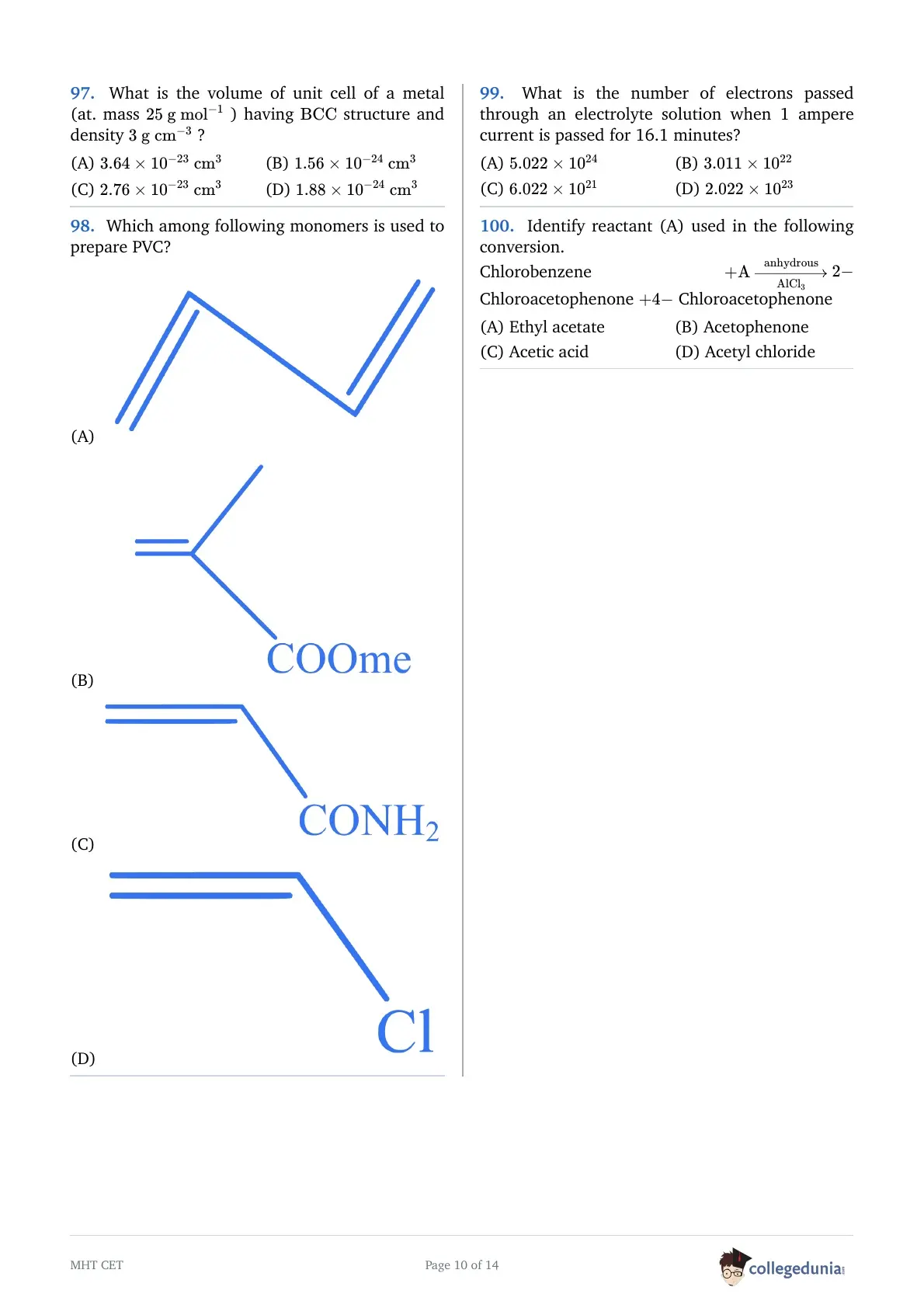
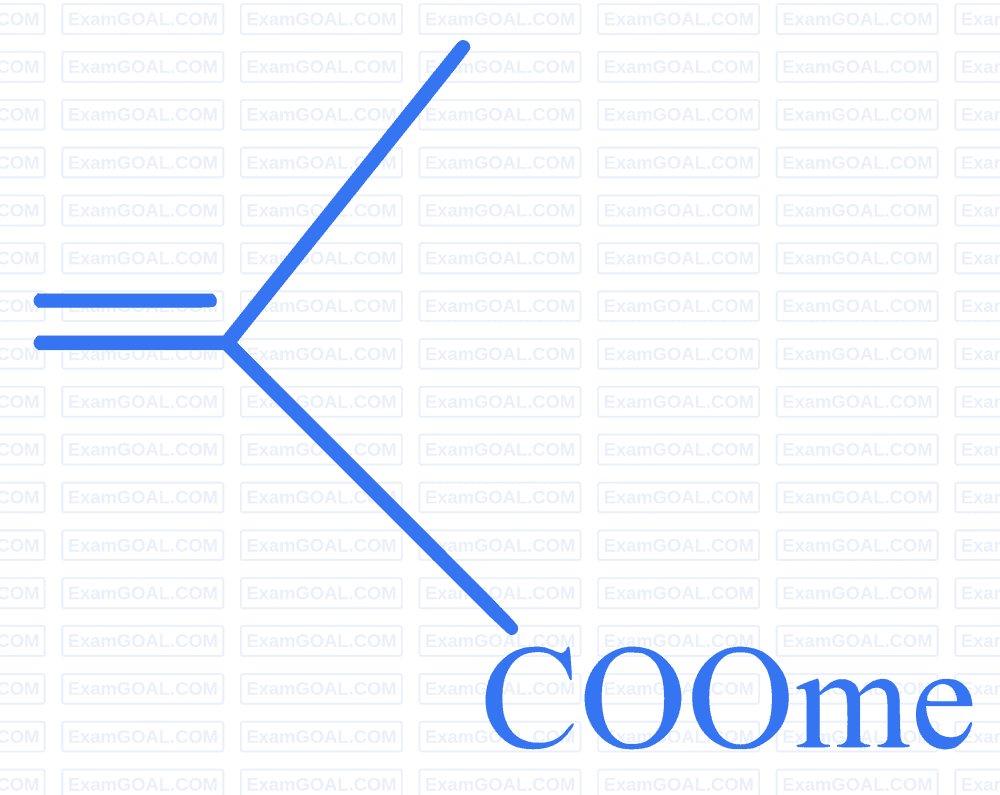
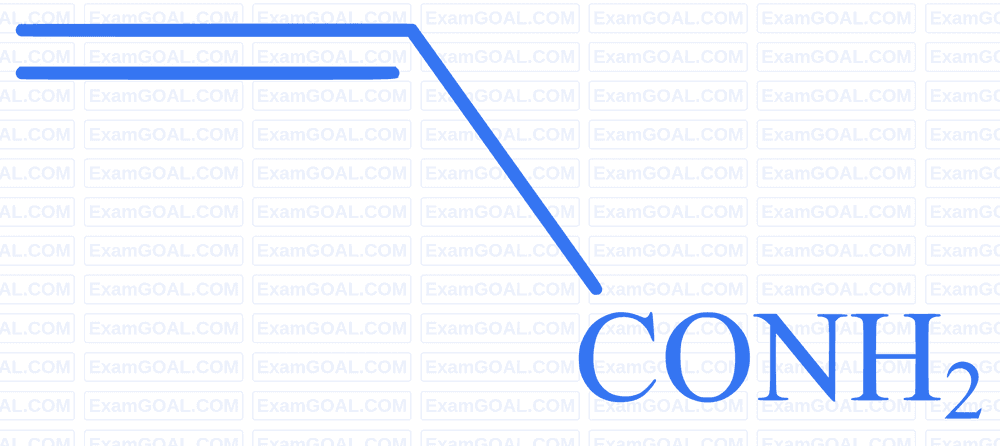
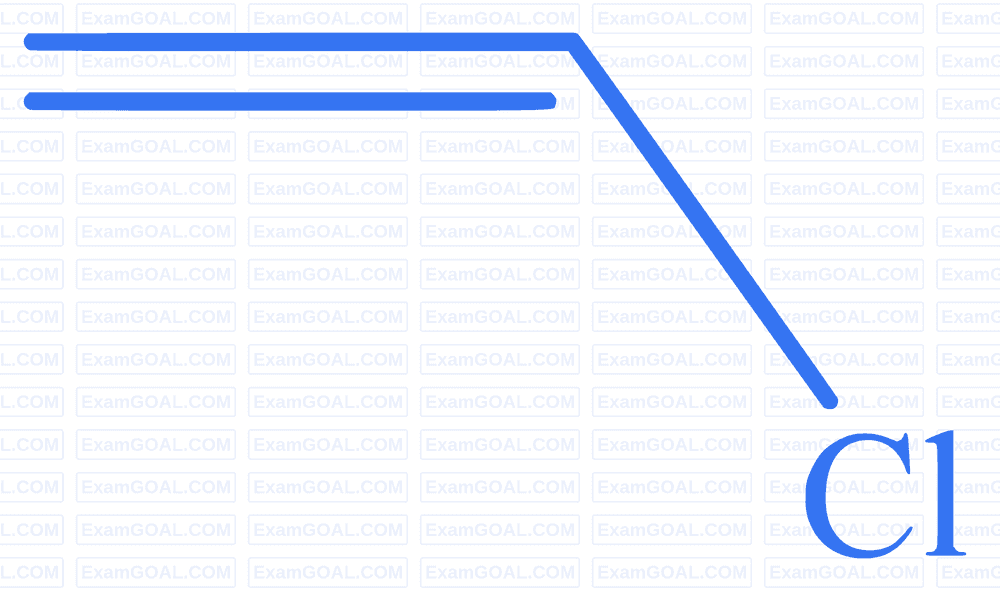
Which among following monomers is used to prepare PVC?
- (A)
![MHT CET 2021 21th September Morning Shift Chemistry - Polymers Question 225 English Option 1]()
- (B)
![MHT CET 2021 21th September Morning Shift Chemistry - Polymers Question 225 English Option 2]()
- (C)
![MHT CET 2021 21th September Morning Shift Chemistry - Polymers Question 225 English Option 3]()
- (D)
![MHT CET 2021 21th September Morning Shift Chemistry - Polymers Question 225 English Option 4]()

What is the number of electrons passed through an electrolyte solution when 1 ampere current is passed for 16.1 minutes?
Identify reactant (A) used in the following conversion.
Chlorobenzene + A \(\xrightarrow{\text{anhydrous AlCl}_3}\) 1-Chloroacetophenone + 4-Chloroacetophenone
Mathematics (Q101 - Q150)
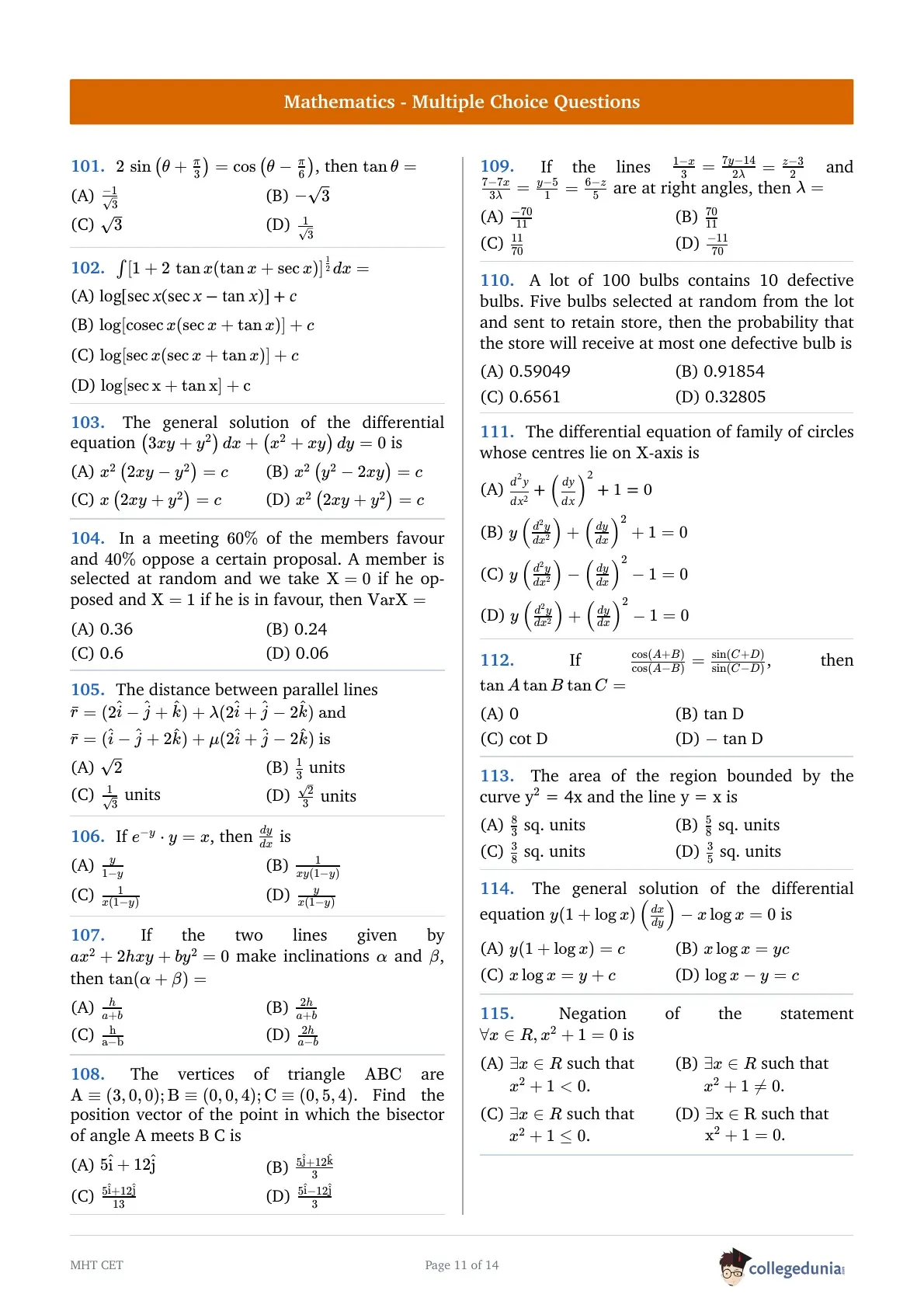
\(2 \sin \left(\theta+\frac{\pi}{3}\right)=\cos \left(\theta-\frac{\pi}{6}\right)\), then \(\tan \theta=\)
\(\int[1+2 \tan x(\tan x+\sec x)]^{\frac{1}{2}} d x=\)
The general solution of the differential equation \((3xy + y^2)dx + (x^2 + xy)dy = 0\) is
In a meeting 60% of the members favour and 40% oppose a certain proposal. A member is selected at random and we take \(X = 0\) if he opposed and \(X = 1\) if he is in favour, then \(\text{Var}(X) =\)
The distance between parallel lines \(\bar{r} = (2\hat{i} - \hat{j} + \hat{k}) + \lambda(2\hat{i} + \hat{j} - 2\hat{k})\) and \(\bar{r} = (\hat{i} - \hat{j} + 2\hat{k}) + \mu(2\hat{i} + \hat{j} - 2\hat{k})\) is
If \(e^{-y} \cdot y = x\), then \(\frac{dy}{dx}\) is
If the two lines given by \(ax^2 + 2hxy + by^2 = 0\) make inclinations \(\alpha\) and \(\beta\), then \(\tan(\alpha + \beta) =\)
The vertices of triangle ABC are \(A \equiv (3,0,0) ; B \equiv (0,0,4) ; C \equiv (0,5,4)\). Find the position vector of the point in which the bisector of angle A meets BC is
If the lines \(\frac{1-x}{3}=\frac{7y-14}{2\lambda}=\frac{z-3}{2}\) and \(\frac{7-7x}{3\lambda}=\frac{y-5}{1}=\frac{6-z}{5}\) are at right angles, then \(\lambda =\)
A lot of 100 bulbs contains 10 defective bulbs. Five bulbs selected at random from the lot and sent to retain store, then the probability that the store will receive at most one defective bulb is
The differential equation of family of circles whose centres lie on X-axis is
If \(\frac{\cos(A+B)}{\cos(A-B)} = \frac{\sin(C+D)}{\sin(C-D)}\), then \(\tan A \tan B \tan C =\)
The area of the region bounded by the curve \(y^2 = 4x\) and the line \(y = x\) is
The general solution of the differential equation \(y(1+\log x)\left(\frac{dx}{dy}\right) - x\log x = 0\) is
Negation of the statement \(\forall x \in R, x^2+1=0\) is
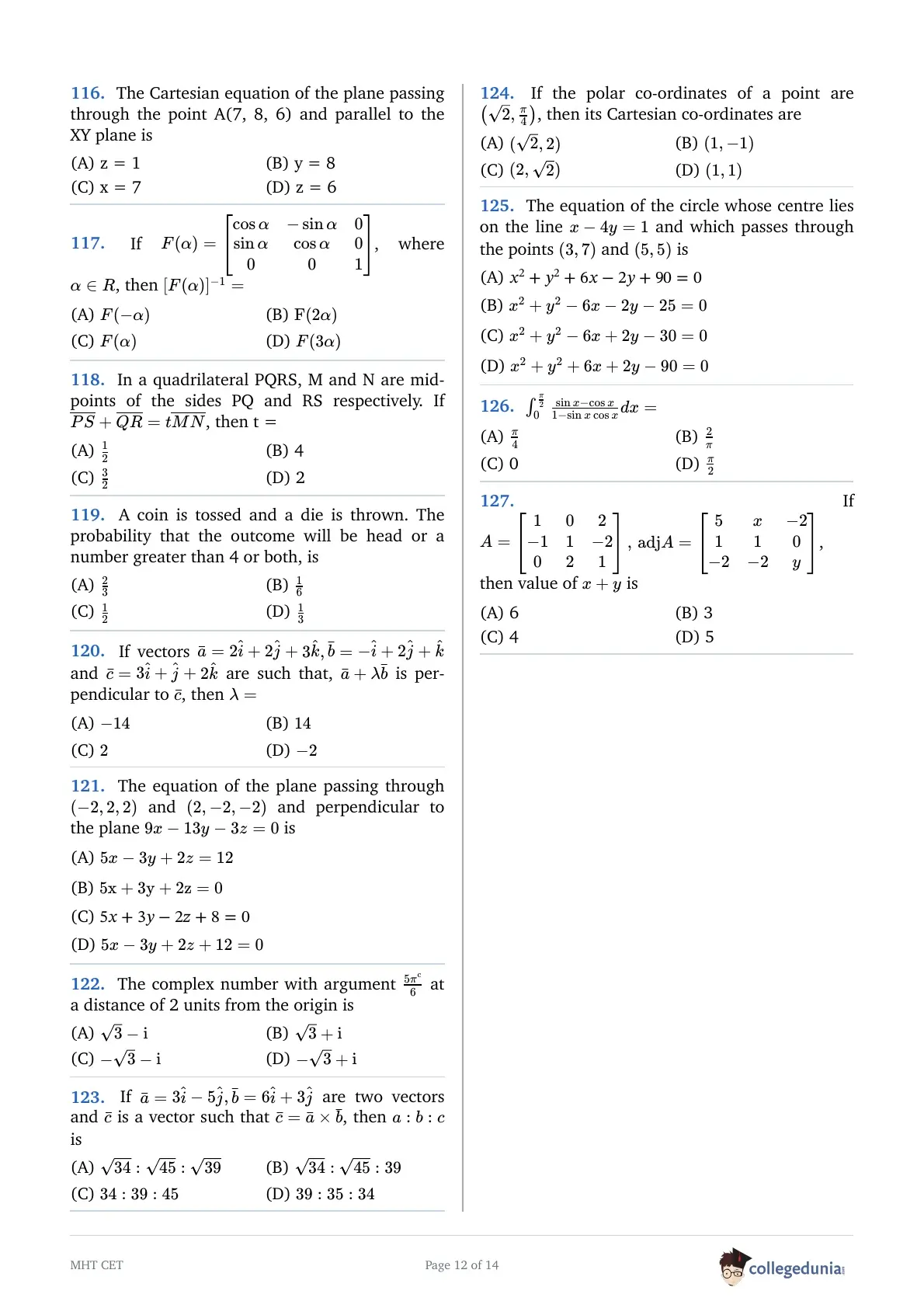
The Cartesian equation of the plane passing through the point \(A(7, 8, 6)\) and parallel to the XY plane is
If \(F(\alpha)=\begin{bmatrix}\cos \alpha & -\sin \alpha & 0 \\ \sin \alpha & \cos \alpha & 0 \\ 0 & 0 & 1\end{bmatrix}\), where \(\alpha \in R\), then \([F(\alpha)]^{-1} =\)
In a quadrilateral PQRS, M and N are mid-points of the sides PQ and RS respectively. If \(\overline{PS} + \overline{QR} = t\overline{MN}\), then \(t =\)
A coin is tossed and a die is thrown. The probability that the outcome will be head or a number greater than 4 or both, is
If vectors \(\bar{a}=2\hat{i}+2\hat{j}+3\hat{k}\), \(\bar{b}=-\hat{i}+2\hat{j}+\hat{k}\) and \(\bar{c}=3\hat{i}+\hat{j}+2\hat{k}\) are such that \(\bar{a}+\lambda\bar{b}\) is perpendicular to \(\bar{c}\), then \(\lambda =\)
The equation of the plane passing through \((-2,2,2)\) and \((2,-2,-2)\) and perpendicular to the plane \(9x-13y-3z=0\) is
The complex number with argument \(\frac{5\pi}{6}\) at a distance of 2 units from the origin is
If \(\bar{a}=3\hat{i}-5\hat{j}, \bar{b}=6\hat{i}+3\hat{j}\) are two vectors and \(\bar{c}\) is a vector such that \(\bar{c}=\bar{a}\times\bar{b}\), then \(|\bar{a}|:|\bar{b}|:|\bar{c}|\) is
If the polar co-ordinates of a point are \(\left(\sqrt{2}, \frac{\pi}{4}\right)\), then its Cartesian co-ordinates are
The equation of the circle whose centre lies on the line \(x-4y=1\) and which passes through the points \((3,7)\) and \((5,5)\) is
\(\int_0^{\frac{\pi}{2}} \frac{\sin x-\cos x}{1-\sin x \cos x} d x=\)
If \(A = \begin{bmatrix} 1 & 0 & 2 \\ -1 & 1 & -2 \\ 0 & 2 & 1 \end{bmatrix}\) and \(\text{adj } A = \begin{bmatrix} 5 & x & -2 \\ 1 & 1 & 0 \\ -2 & -2 & y \end{bmatrix}\), then the value of \(x + y\) is
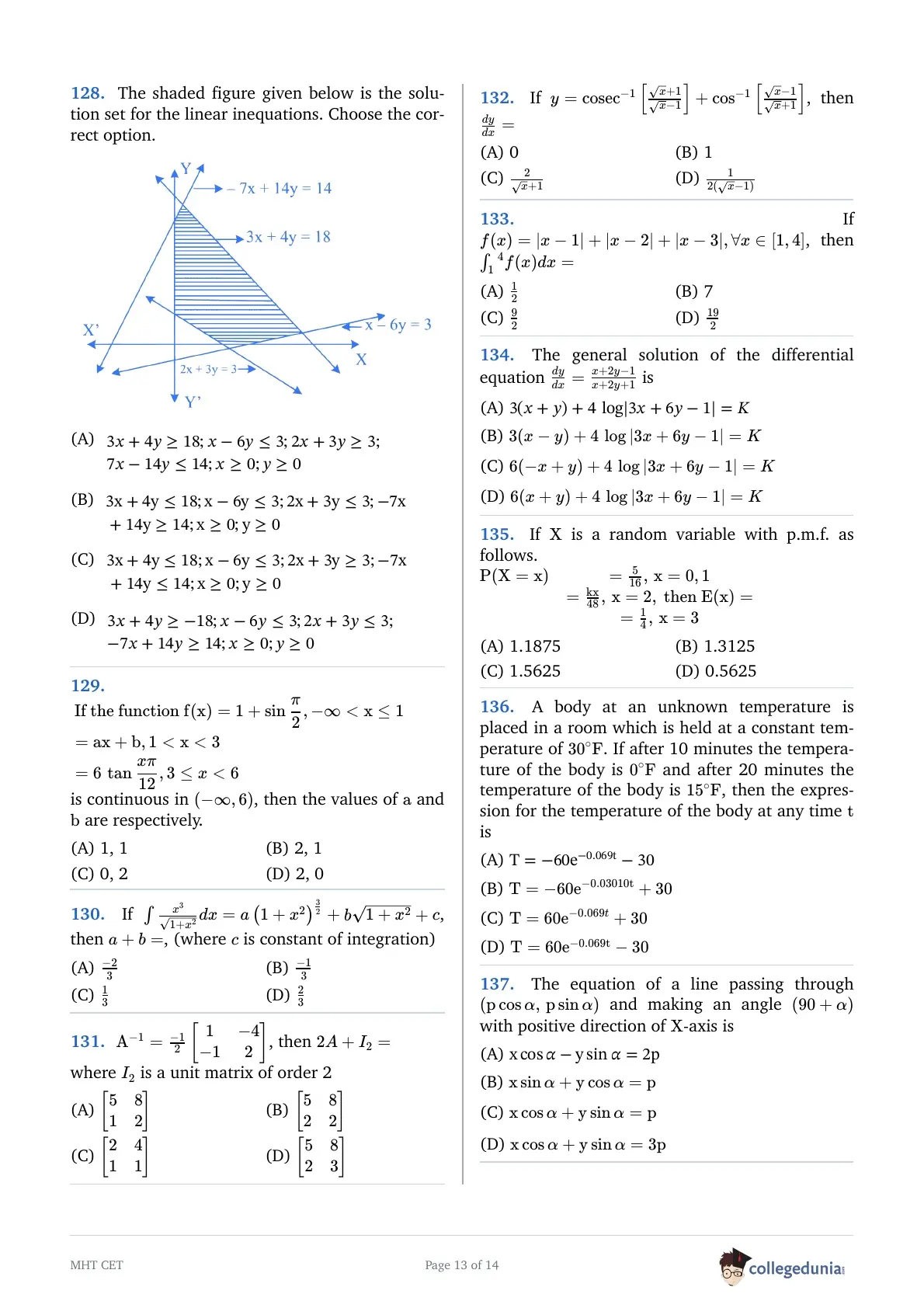
The shaded figure given below is the solution set for the linear inequations. Choose the correct option.

\(\begin{aligned} & \text{ If the function }\mathrm{f}(\mathrm{x})=1+\sin \frac{\pi }{2},-\infty \lt \mathrm{x}\leq 1 \\ & =\mathrm{ax}+\mathrm{b},1\lt \mathrm{x}\lt 3 \\ & =6\,\tan \frac{x\pi }{12},3\leq x\lt 6 \end{aligned}\)
is continuous in \((-\infty ,6)\), then the values of \(\mathrm{a}\) and \(\mathrm{b}\) are respectively.
If \(\int \frac{x^3}{\sqrt{1+x^2}} dx = a(1+x^2)^{\frac{3}{2}} + b\sqrt{1+x^2} + c\), then \(a+b =\), (where \(c\) is constant of integration)
If \(A^{-1} = \frac{-1}{2} \begin{bmatrix} 1 & -4 \\ -1 & 2 \end{bmatrix}\), then \(2A + I_2 = \dots\) where \(I_2\) is a unit matrix of order 2.
If \(y = \operatorname{cosec}^{-1} \left[ \frac{\sqrt{x}+1}{\sqrt{x}-1} \right] + \cos^{-1} \left[ \frac{\sqrt{x}-1}{\sqrt{x}+1} \right]\), then \(\frac{dy}{dx} =\)
If \(f(x) = |x-1| + |x-2| + |x-3|, \forall x \in [1,4]\), then \(\int_1^4 f(x) dx =\)
The general solution of the differential equation \(\frac{dy}{dx} = \frac{x+2y-1}{x+2y+1}\) is
If \(\mathrm{X}\) is a random variable with p.m.f. as follows.
\(\begin{matrix} \mathrm{P}(\mathrm{X}=\mathrm{x}) & =\frac{5}{16},\,\mathrm{x}=0,1 \\ & =\frac{\mathrm{kx}}{48},\,\mathrm{x}=2,\text{ then }\mathrm{E}(\mathrm{x})= \\ & =\frac{1}{4},\,\mathrm{x}=3 \end{matrix}\)
A body at an unknown temperature is placed in a room which is held at a constant temperature of \(30^{\circ}F\). If after 10 minutes the temperature of the body is \(0^{\circ}F\) and after 20 minutes the temperature of the body is \(15^{\circ}F\), then the expression for the temperature of the body at any time \(t\) is
The equation of a line passing through \((p \cos \alpha, p \sin \alpha)\) and making an angle \((90 + \alpha)\) with positive direction of X-axis is
If \(|\bar{a}| = 3, |\bar{b}| = 4, |\bar{a} - \bar{b}| = 5\), then \(|\bar{a} + \bar{b}| =\)
\(\tan ^{-1}\left(\frac{x-1}{x-2}\right)+\tan ^{-1}\left(\frac{x+1}{x+2}\right)=\frac{\pi}{4}\), then the values of \(x\) are
If \(f(x) = 3[x] + 5\{x + 1\}\), where \([x]\) is greatest integer function of \(x\) and \(\{x\}\) is fractional part function of \(x\), then \(f(-1.32) =\)
A stone is thrown into a quiet lake and the waves formed move in circles. If the radius of a circular wave increases at the rate of \(4\ \text{cm/sec}\), then the rate of increase in its area, at the instant when its radius is \(10\ \text{cm}\), is _________ \(\text{cm}^2/\text{sec}\).
The function \(f(x) = \cot^{-1} x + x\) is increasing in the interval.
\(\lim _{x \rightarrow 1} \frac{(2 x-3)(\sqrt{x}-1)}{2 x^2+x-3}=\)
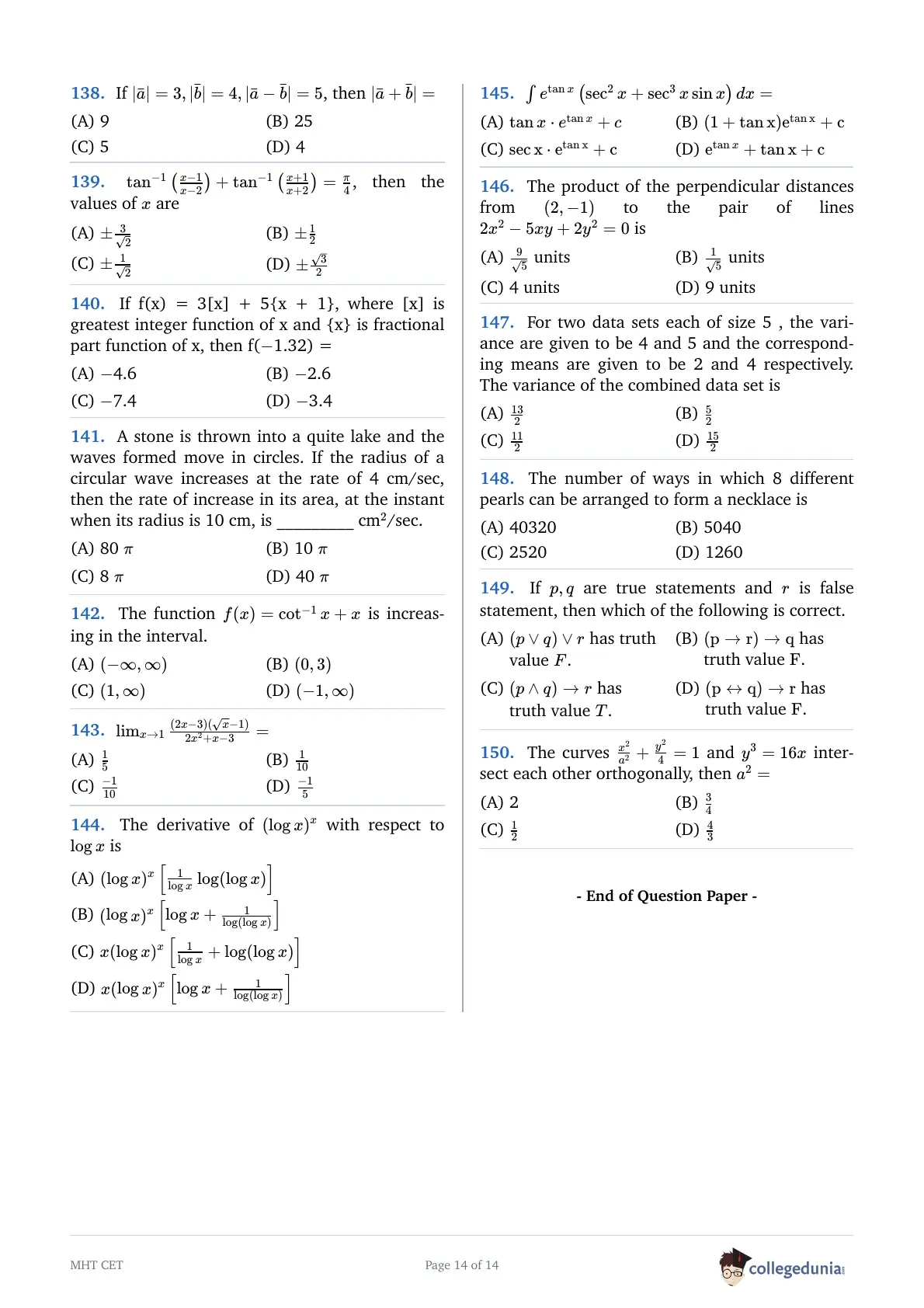
The derivative of \((\log x)^x\) with respect to \(\log x\) is
\(\int e^{\tan x}(\sec ^2 x+\sec ^3 x \sin x) d x=\)
The product of the perpendicular distances from \((2,-1)\) to the pair of lines \(2 x^2-5 x y+2 y^2=0\) is
For two data sets each of size 5, the variance are given to be 4 and 5 and the corresponding means are given to be 2 and 4 respectively. The variance of the combined data set is
The number of ways in which 8 different pearls can be arranged to form a necklace is
If \(p, q\) are true statements and \(r\) is false statement, then which of the following is correct.
The curves \(\frac{x^2}{a^2} + \frac{y^2}{4} = 1\) and \(y^3 = 16x\) intersect each other orthogonally, then \(a^2 =\)
MHT CET 2021 PCM Exam Pattern and Marking Scheme
| Parameter | Details |
|---|---|
| Conducting Body | Maharashtra Common Entrance Test Cell (Maharashtra CET Cell) |
| Exam Mode | Online (Computer-Based Test) |
| Duration | 180 minutes (3 hours) |
| Groups / Subjects | PCM (Physics, Chemistry, Mathematics) for Engineering |
| Total Questions |
150 |
| Total Marks | 200 |
| Question Type | Multiple Choice Questions (MCQs) |
| Marks Distribution |
|
| Negative Marking | No |
| Syllabus Weightage |
|



Comments