




MHT CET 2021 Sep 21 Shift 2 PCM Question Paper is available for download here. Maharashtra State CET Cell conducted MHT CET 2021 PCM Exam on Sep 21 in Shift 2 from 2 PM to 5 PM in CBT mode.
The MHT CET 2021 PCM question paper includes the following:
- The MHT CET 2021 PCM Question Paper consists of 150 multiple-choice questions (MCQs) totalling 200 marks divided into 3 sections: Physics, Chemistry, and Mathematics, with 50 questions in each subject.
- Physics and Chemistry questions carry 1 mark each while Mathematics questions carry 2 marks each.
- There is no negative marking for incorrect answers.
MHT CET 2021 Sep 21 Shift 2 PCM Question Paper with Solution PDF
| CD PDF | CD PDF with Solutions |
|---|---|
| Download Collegedunia PDF 1.08 MB | - |
Also Check:
MHT CET 2021 Sep 21 Shift 2 PCM Questions with Solutions
Physics (Q1 - Q50)
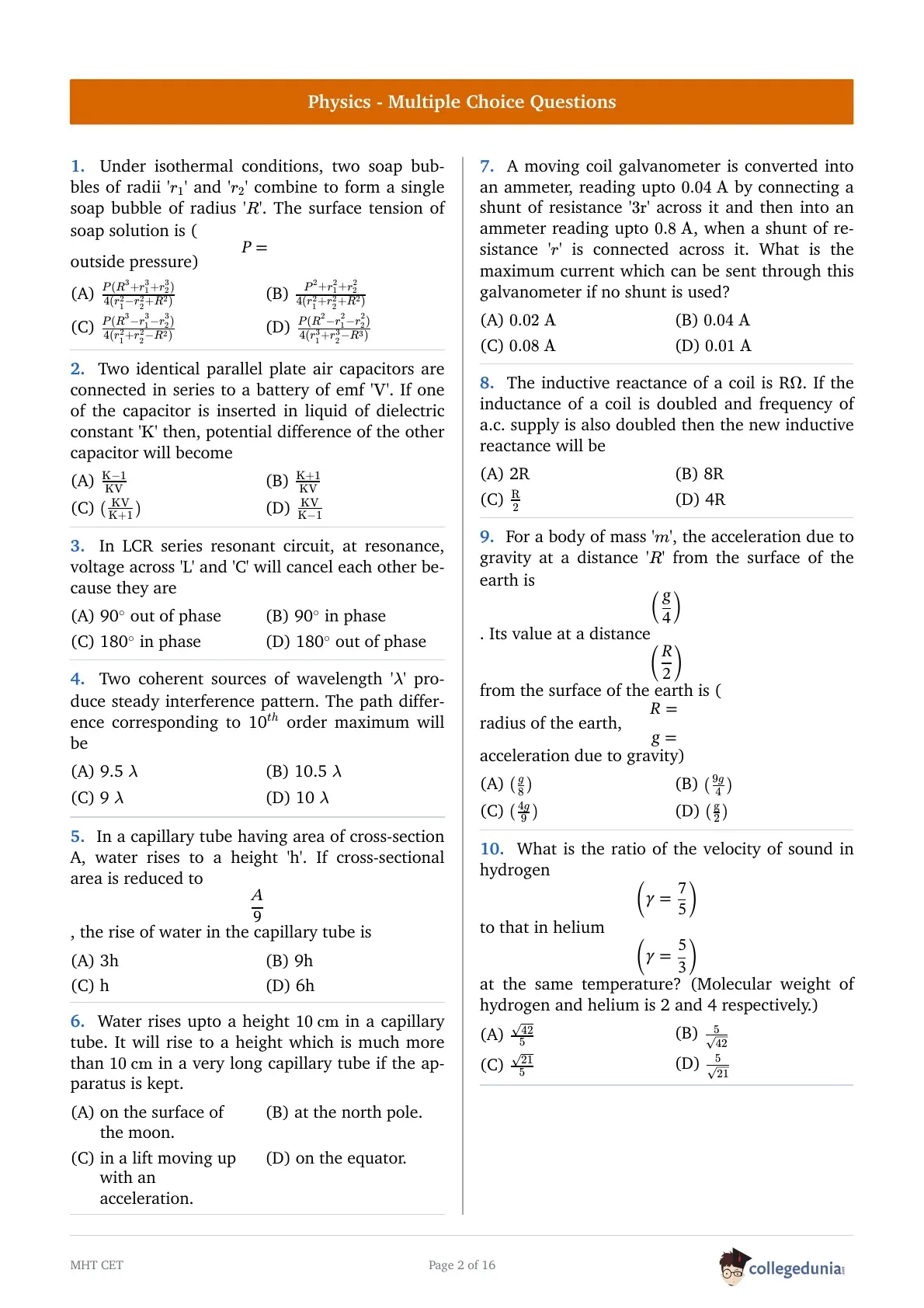
Under isothermal conditions, two soap bubbles of radii \(r_1\) and \(r_2\) combine to form a single soap bubble of radius \(R\). The surface tension of soap solution is (\(P = \text{outside pressure}\))
Two identical parallel plate air capacitors are connected in series to a battery of emf \(V\). If one of the capacitors is inserted in liquid of dielectric constant \(K\), then potential difference of the other capacitor will become
In LCR series resonant circuit, at resonance, voltage across \(L\) and \(C\) will cancel each other because they are
Two coherent sources of wavelength \(\lambda\) produce steady interference pattern. The path difference corresponding to \(10^{\text{th}}\) order maximum will be
In a capillary tube having area of cross-section \(A\), water rises to a height \(h\). If cross-sectional area is reduced to \(\frac{A}{9}\), the rise of water in the capillary tube is
Water rises upto a height 10 cm in a capillary tube. It will rise to a height which is much more than 10 cm in a very long capillary tube if the apparatus is kept.
A moving coil galvanometer is converted into an ammeter, reading upto 0.04 A by connecting a shunt of resistance \(3r\) across it and then into an ammeter reading upto 0.8 A, when a shunt of resistance \(r\) is connected across it. What is the maximum current which can be sent through this galvanometer if no shunt is used?
The inductive reactance of a coil is \(R\ \Omega\). If the inductance of a coil is doubled and frequency of a.c. supply is also doubled then the new inductive reactance will be
For a body of mass \(m\), the acceleration due to gravity at a distance \(R\) from the surface of the earth is \(\frac{g}{4}\). Its value at a distance \(\frac{R}{2}\) from the surface of the earth is (\(R =\) radius of the earth, \(g =\) acceleration due to gravity)
What is the ratio of the velocity of sound in hydrogen (\(\gamma = \frac{7}{5}\)) to that in helium (\(\gamma = \frac{5}{3}\)) at the same temperature? (Molecular weight of hydrogen and helium is 2 and 4 respectively.)
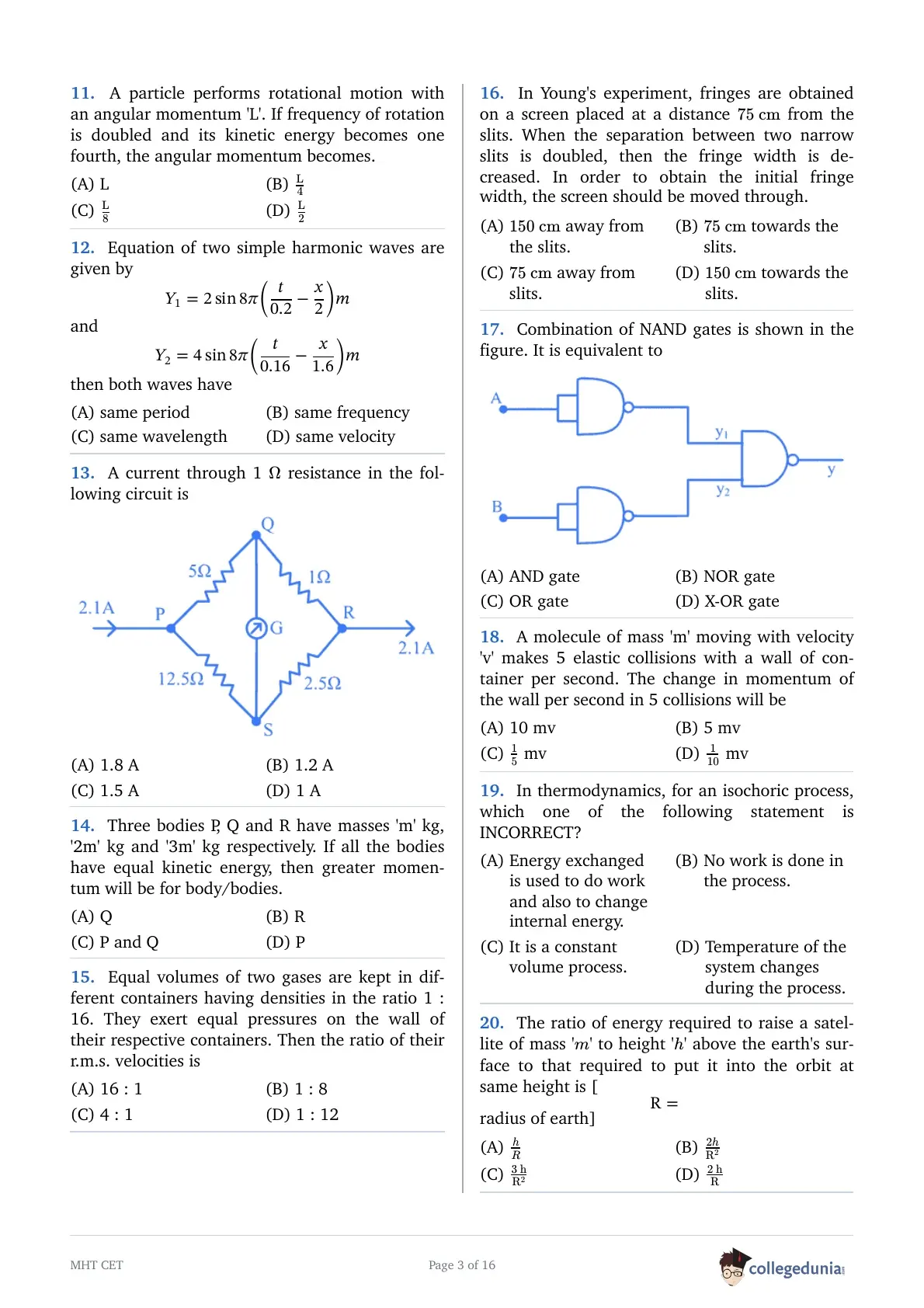
A particle performs rotational motion with an angular momentum \(L\). If frequency of rotation is doubled and its kinetic energy becomes one fourth, the angular momentum becomes.
Equation of two simple harmonic waves are given by \(Y_1 = 2 \sin 8\pi \left( \frac{t}{0.2} - \frac{x}{2} \right) m\) and \(Y_2 = 4 \sin 8\pi \left( \frac{t}{0.16} - \frac{x}{1.6} \right) m\) then both waves have

Three bodies \(P\), \(Q\), and \(R\) have masses \(m\text{ kg}\), \(2m\text{ kg}\), and \(3m\text{ kg}\) respectively. If all the bodies have equal kinetic energy, then the greater momentum will be for body/bodies
Equal volumes of two gases are kept in different containers having densities in the ratio \(1 : 16\). They exert equal pressures on the wall of their respective containers. Then the ratio of their r.m.s. velocities is
In Young's double-slit experiment, interference fringes are obtained on a screen placed at a distance of \(75\text{ cm}\) from the slits. When the separation between the two narrow slits is doubled, the fringe width decreases. In order to maintain the initial fringe width, the screen should be moved through a distance of
Combination of NAND gates is shown in the figure. It is equivalent to

A molecule of mass \(m\) moving with velocity \(v\) makes 5 elastic collisions with a wall of container per second. The change in momentum of the wall per second in 5 collisions will be
In thermodynamics, for an isochoric process, which one of the following statement is INCORRECT?
The ratio of energy required to raise a satellite of mass \(m\) to height \(h\) above the earth's surface to that required to put it into the orbit at same height is (\(R\) = radius of earth)
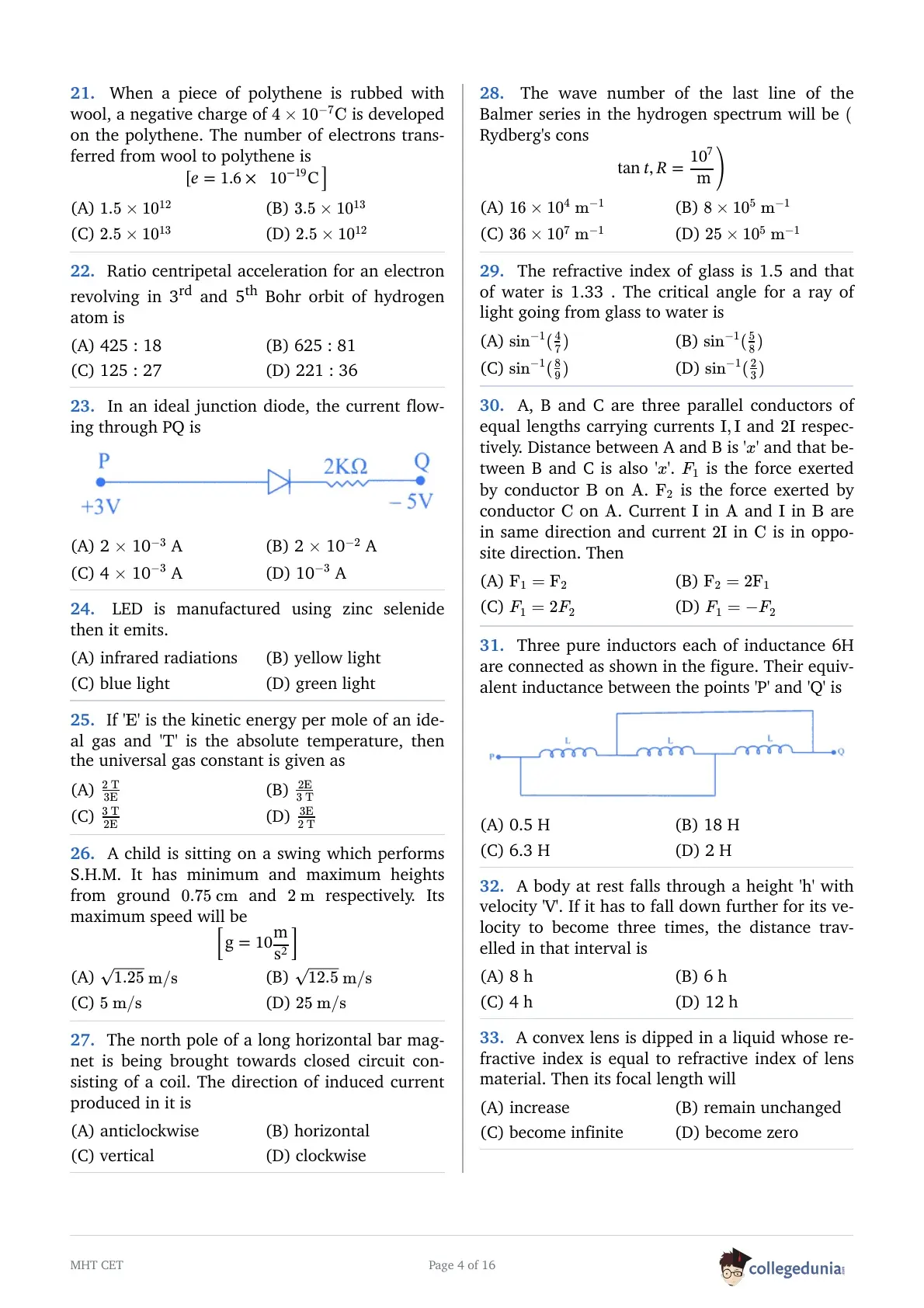
When a piece of polythene is rubbed with wool, a negative charge of \(4 \times 10^{-7}\text{ C}\) is developed on the polythene. The number of electrons transferred from wool to polythene is [\(e = 1.6 \times 10^{-19}\text{ C}\)]
Ratio of centripetal acceleration for an electron revolving in 3rd and 5th Bohr orbit of hydrogen atom is

LED is manufactured using zinc selenide then it emits
If \(E\) is the kinetic energy per mole of an ideal gas and \(T\) is the absolute temperature, then the universal gas constant (\(R\)) is given as
A child is sitting on a swing which performs S.H.M. It has minimum and maximum heights from the ground as \(0.75\text{ m}\) and \(2\text{ m}\) respectively. Its maximum speed will be [\(g = 10\text{ m/s}^2\)]
The north pole of a long horizontal bar magnet is being brought towards a closed circuit consisting of a coil. The direction of induced current produced in it is
The wave number of the last line of the Balmer series in the hydrogen spectrum will be (\(R = 10^7\text{ m}^{-1}\))
The refractive index of glass is 1.5 and that of water is 1.33. The critical angle for a ray of light going from glass to water is
A, B and C are three parallel conductors of equal lengths carrying currents \(I\), \(I\) and \(2I\) respectively. Distance between A and B is \(x\) and that between B and C is also \(x\). \(F_1\) is the force exerted by conductor B on A. \(F_2\) is the force exerted by conductor C on A. Current \(I\) in A and \(I\) in B are in the same direction and current \(2I\) in C is in the opposite direction. Then
Three pure inductors each of inductance \(6\text{ H}\) are connected as shown in the figure. Their equivalent inductance between the points 'P' and 'Q' is

A body at rest falls through a height 'h' with velocity 'V'. If it has to fall down further for its velocity to become three times, the distance travelled in that interval is
A convex lens is dipped in a liquid whose refractive index is equal to the refractive index of the lens material. Then its focal length will
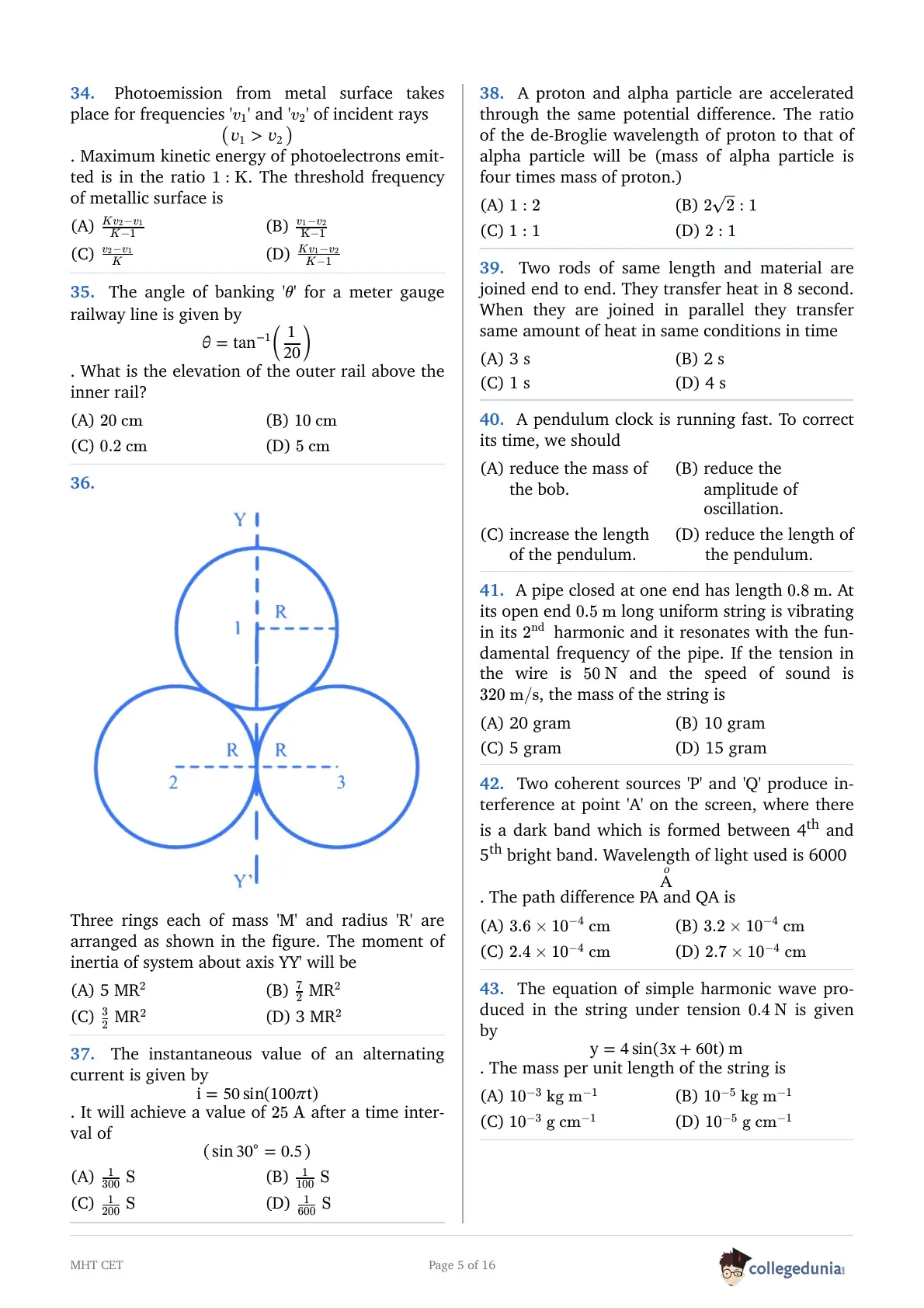
Photoemission from a metal surface takes place for frequencies \(\nu_1\) and \(\nu_2\) of incident rays (\(\nu_1 > \nu_2\)). The maximum kinetic energy of the photoelectrons emitted is in the ratio \(1 : K\). The threshold frequency (\(\nu_0\)) of the metallic surface is
The angle of banking \(\theta\) for a meter gauge railway line is given by \(\theta = \tan^{-1}\left(\frac{1}{20}\right)\). What is the elevation of the outer rail above the inner rail?
Three rings each of mass \(M\) and radius \(R\) are arranged as shown in the figure. The moment of inertia of the system about the axis \(YY'\) will be

The instantaneous value of an alternating current is given by \(i = 50 \sin (100 \pi t)\). It will achieve a value of \(25\text{ A}\) after a time interval of (\(\sin 30^\circ = 0.5\))
A proton and alpha particle are accelerated through the same potential difference. The ratio of the de-Broglie wavelength of proton to that of alpha particle will be (mass of alpha particle is four times mass of proton.)
Two rods of same length and material are joined end to end. They transfer heat in 8 second. When they are joined in parallel they transfer same amount of heat in same conditions in time
A pendulum clock is running fast. To correct its time, we should
A pipe closed at one end has length \(0.8\text{ m}\). At its open end, a \(0.5\text{ m}\) long uniform string is vibrating in its 2nd harmonic and it resonates with the fundamental frequency of the pipe. If the tension in the wire is \(50\text{ N}\) and the speed of sound is \(320\text{ m/s}\), the mass of the string is
Two coherent sources 'P' and 'Q' produce interference at point 'A' on the screen, where there is a dark band which is formed between 4th and 5th bright band. Wavelength of light used is \(6000\text{ \r{A}}\). The path difference PA and QA is
The equation of a simple harmonic wave produced in a string under tension \(0.4\text{ N}\) is given by \(y = 4 \sin (3x + 60t)\text{ m}\). The mass per unit length of the string is
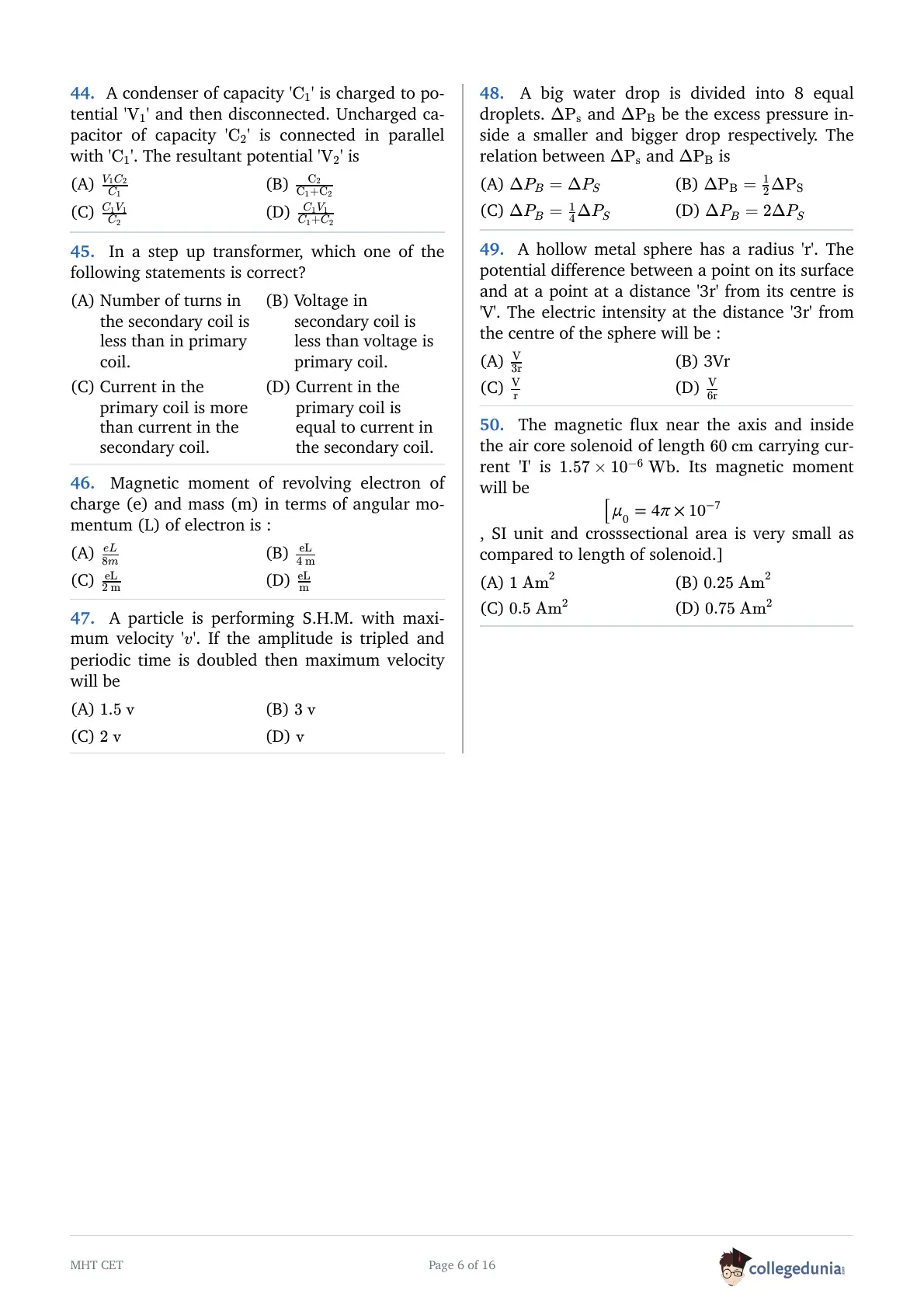
A condenser of capacity \(C_1\) is charged to a potential \(V_1\) and then disconnected. An uncharged capacitor of capacity \(C_2\) is then connected in parallel with \(C_1\). The resultant common potential \(V_2\) is
In a step up transformer, which one of the following statements is correct?
Magnetic moment of a revolving electron of charge \(e\) and mass \(m\) in terms of angular momentum \(L\) of the electron is:
A particle is performing S.H.M. with maximum velocity \(v\). If the amplitude is tripled and the periodic time is doubled, then the new maximum velocity will be
A big water drop is divided into 8 equal droplets. \(\Delta P_S\) and \(\Delta P_B\) be the excess pressure inside a smaller and bigger drop respectively. The relation between \(\Delta P_S\) and \(\Delta P_B\) is
A hollow metal sphere has a radius \(r\). The potential difference between a point on its surface and at a point at a distance \(3r\) from its centre is \(V\). The electric intensity at the distance \(3r\) from the centre of the sphere will be
The magnetic flux near the axis and inside an air core solenoid of length \(60\text{ cm}\) carrying current \(I\) is \(1.57 \times 10^{-6}\text{ Wb}\). Its magnetic moment will be [\(\mu_0 = 4\pi \times 10^{-7}\) SI units, and cross-sectional area is very small as compared to length of solenoid]
Chemistry (Q51 - Q100)
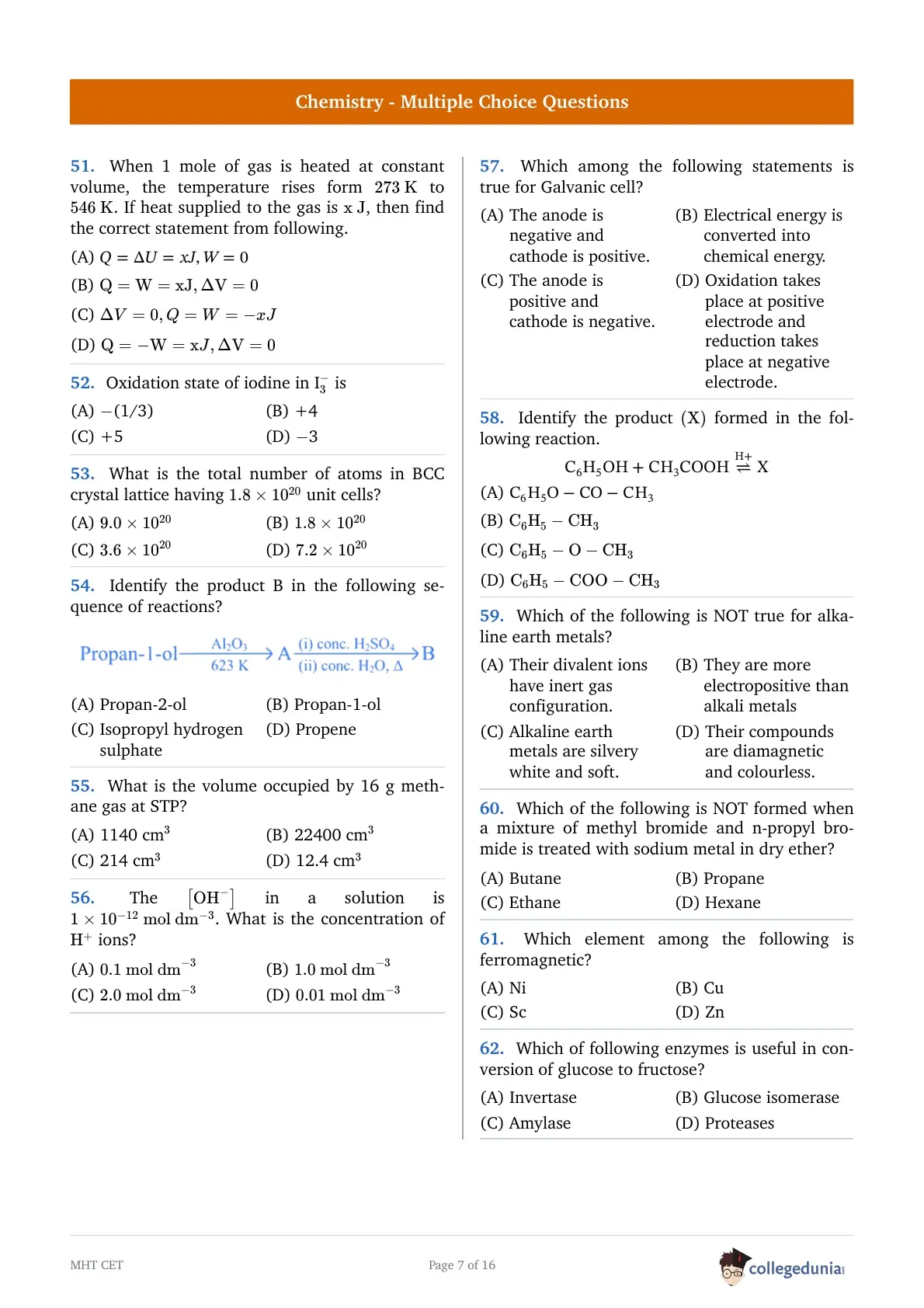
When 1 mole of gas is heated at constant volume, the temperature rises from 273 K to 546 K. If heat supplied to the gas is \( x \, \text{J} \), then find the correct statement from following.
Oxidation state of iodine in \( I_3^- \) is
What is the total number of atoms in BCC crystal lattice having \( 1.8 \times 10^{20} \) unit cells?

What is the volume occupied by 16 g methane gas at STP?
The \([OH^-]\) in a solution is \(1 \times 10^{-12}\) mol dm\(^{-3}\). What is the concentration of \(H^+\) ions?
Which among the following statements is true for Galvanic cell?
Identify the product \[(\mathrm{X})\] formed in the following reaction.
\[\mathrm{C}_6 \mathrm{H}_5 \mathrm{OH}+\mathrm{CH}_3 \mathrm{COOH} \stackrel{\mathrm{H}+}{\rightleftharpoons} \mathrm{X} \]
Which of the following is NOT true for alkaline earth metals?
Which of the following is NOT formed when a mixture of methyl bromide and n-propyl bromide is treated with sodium metal in dry ether?
Which of following enzymes is useful in conversion of glucose to fructose?
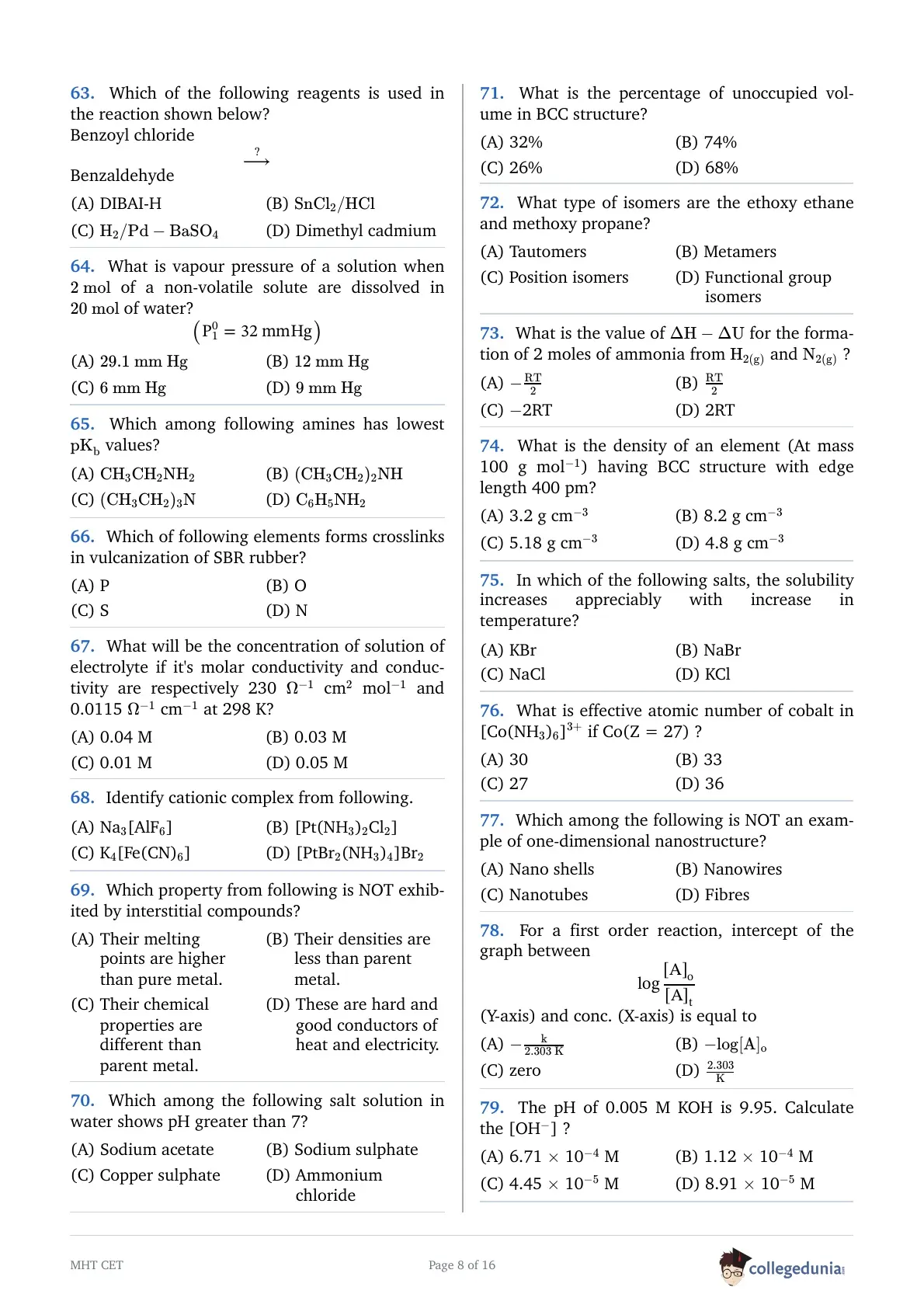
Which of the following reagents is used in the reaction shown below?
Benzoyl chloride → Benzaldehyde
What is vapour pressure of a solution when 2 mol of a non-volatile solute are dissolved in 20 mol of water? \( P_1^0 = 32 \, \text{mmHg} \)
Which among following amines has lowest \( pK_b \) values?
Which of the following elements forms crosslinks in vulcanization of SBR rubber?
What will be the concentration of solution of electrolyte if its molar conductivity and conductivity are respectively 230 \(\Omega^{-1} \, \text{cm}^2 \, \text{mol}^{-1}\) and 0.0115 \(\Omega^{-1} \, \text{cm}^{-1}\) at 298 K?
Identify cationic complex from following.
Which property from following is NOT exhibited by interstitial compounds?
Which among the following salt solution in water shows pH greater than 7?
What is the percentage of unoccupied volume in BCC structure?
What type of isomers are the ethoxy ethane and methoxy propane?
What is the value of \(\Delta H - \Delta U\) for the formation of 2 moles of ammonia from \(H_{2(g)}\) and \(N_{2(g)}\)?
What is the density of an element (Atomic mass 100 g mol\(^{-1}\)) having BCC structure with edge length 400 pm?
In which of the following salts, the solubility increases appreciably with increase in temperature?
What is effective atomic number of cobalt in \([Co(NH_3)_6]^{3+}\) if \(Co(Z = 27)\)?
Which among the following is NOT an example of one-dimensional nanostructure?
For a first order reaction, intercept of the graph between \(\log \frac{[A]_0}{[A]_t}\) (Y-axis) and conc. (X-axis) is equal to
The pH of 0.005 M KOH is 9.95. Calculate the \([OH^-]\)?
Which among the following noble gases reacts with fluorine to give crystalline fluorides?
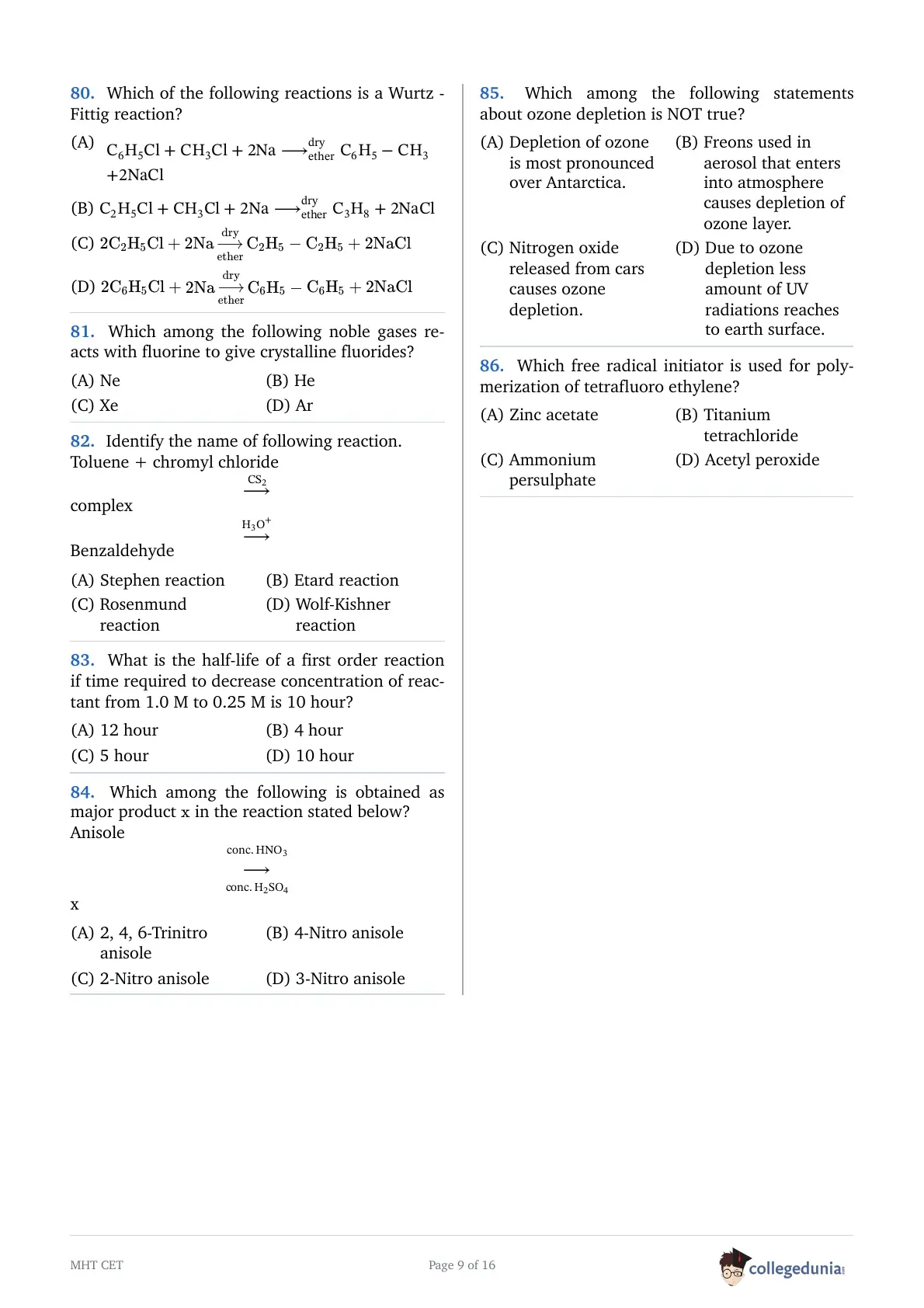
Identify the name of following reaction.
Toluene + chromyl chloride \[\stackrel{\mathrm{CS}_2}{\longrightarrow}\] complex \[\stackrel{\mathrm{H}_3 \mathrm{O}^{+}}{\longrightarrow}\] Benzaldehyde
What is the half-life of a first order reaction if time required to decrease concentration of reactant from 1.0 M to 0.25 M is 10 hour?
Which among the following is obtained as major product \[\mathrm{x}\] in the reaction stated below?
Anisole \[\mathrm{\mathrel{\mathop{\kern0pt\longrightarrow} \limits_{conc.\,{H_2}S{O_4}}^{conc.\,HN{O_3}}}}\] x
Which among the following statements about ozone depletion is NOT true?
Which free radical initiator is used for polymerization of tetrafluoro ethylene?
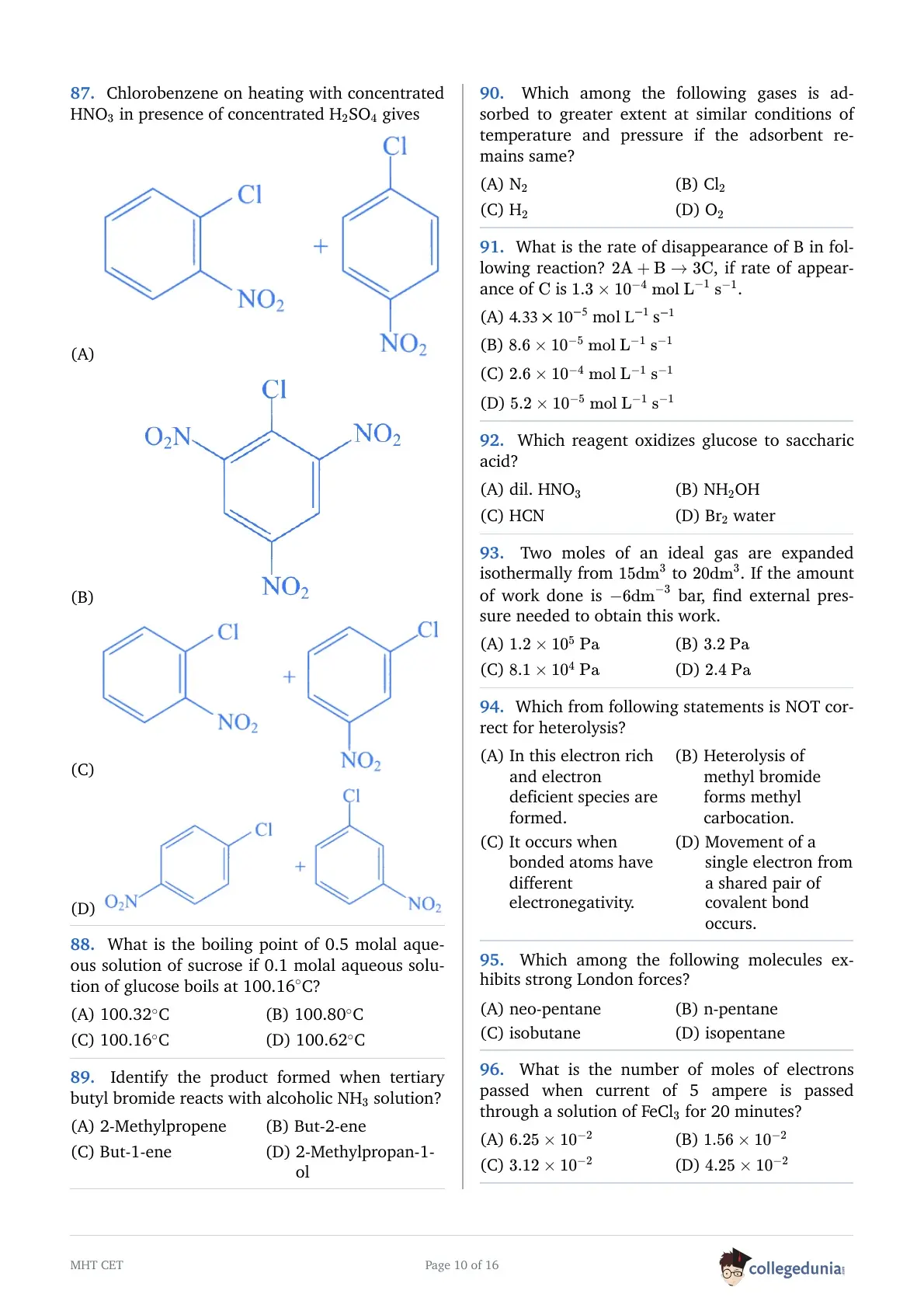
Chlorobenzene on heating with concentrated HNO\(_3\) in presence of concentrated H\(_2\)SO\(_4\) gives
- (A)
![]()
- (B)
![]()
- (C)
![]()
- (D)
![]()


What is the boiling point of 0.5 molal aqueous solution of sucrose if 0.1 molal aqueous solution of glucose boils at 100.16 \(^\circ\)C?
Identify the product formed when tertiary butyl bromide reacts with alcoholic NH\(_3\) solution?
Which among the following gases is adsorbed to greater extent at similar conditions of temperature and pressure if the adsorbent remains same?
What is the rate of disappearance of B in following reaction? \(2 \text{A} + \text{B} \rightarrow 3 \text{C}\), if rate of appearance of C is \(1.3 \times 10^{-4}\ \text{mol}\ \text{L}^{-1}\ \text{s}^{-1}\).
Which reagent oxidizes glucose to saccharic acid?
Two moles of an ideal gas are expanded isothermally from \(15\ \text{dm}^3\) to \(20\ \text{dm}^3\). If the amount of work done is \(-6\ \text{dm}^3\ \text{bar}\), find external pressure needed to obtain this work.
Which from following statements is NOT correct for heterolysis?
Which among the following molecules exhibits strong London forces?
What is the number of moles of electrons passed when current of 5 ampere is passed through a solution of \(\text{FeCl}_3\) for 20 minutes?
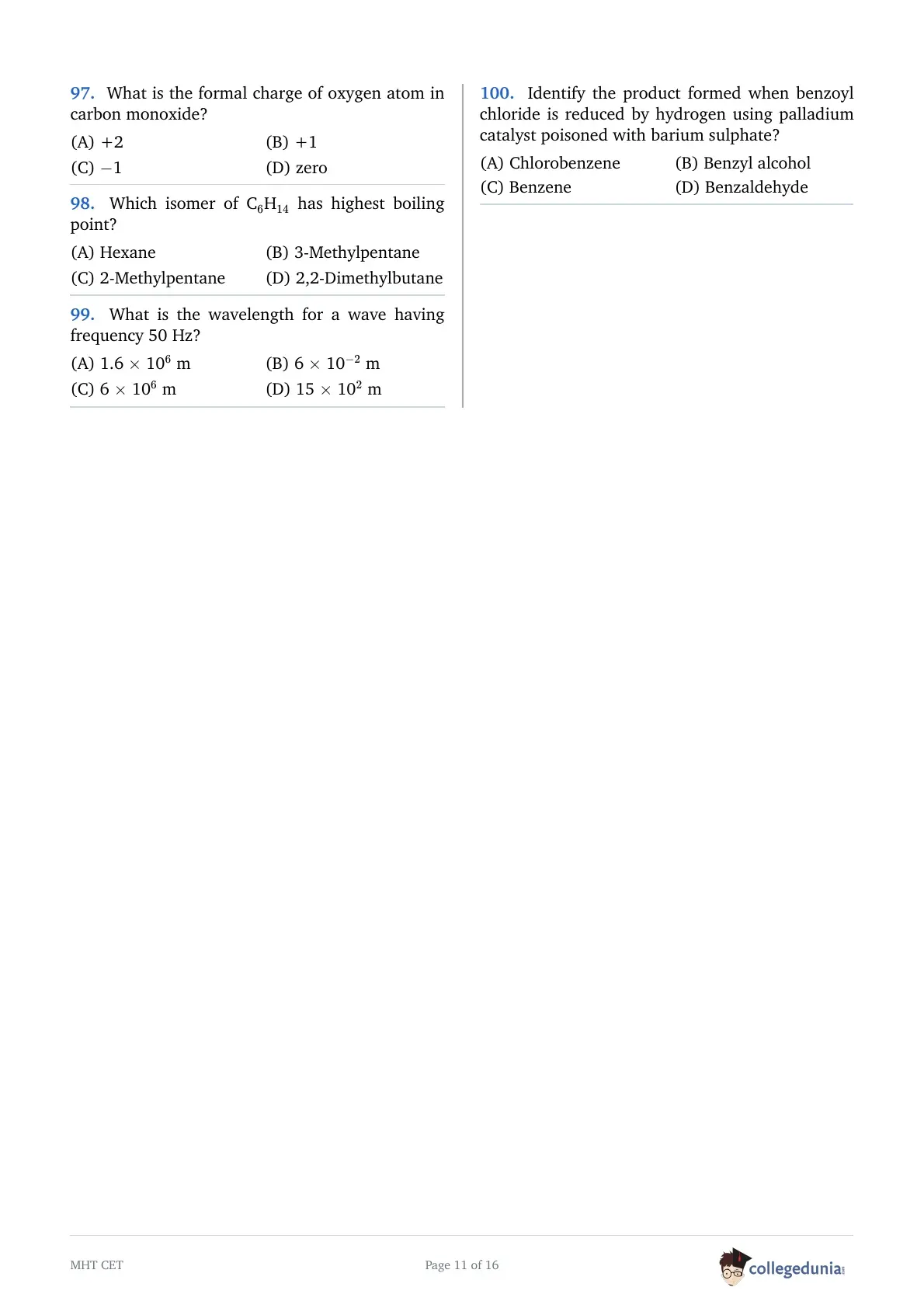
What is the formal charge of oxygen atom in carbon monoxide?
Which isomer of \(\text{C}_6\text{H}_{14}\) has highest boiling point?
What is the wavelength for a wave having frequency 50 Hz?
Identify the product formed when benzoyl chloride is reduced by hydrogen using palladium catalyst poisoned with barium sulphate?
Mathematics (Q101 - Q150)
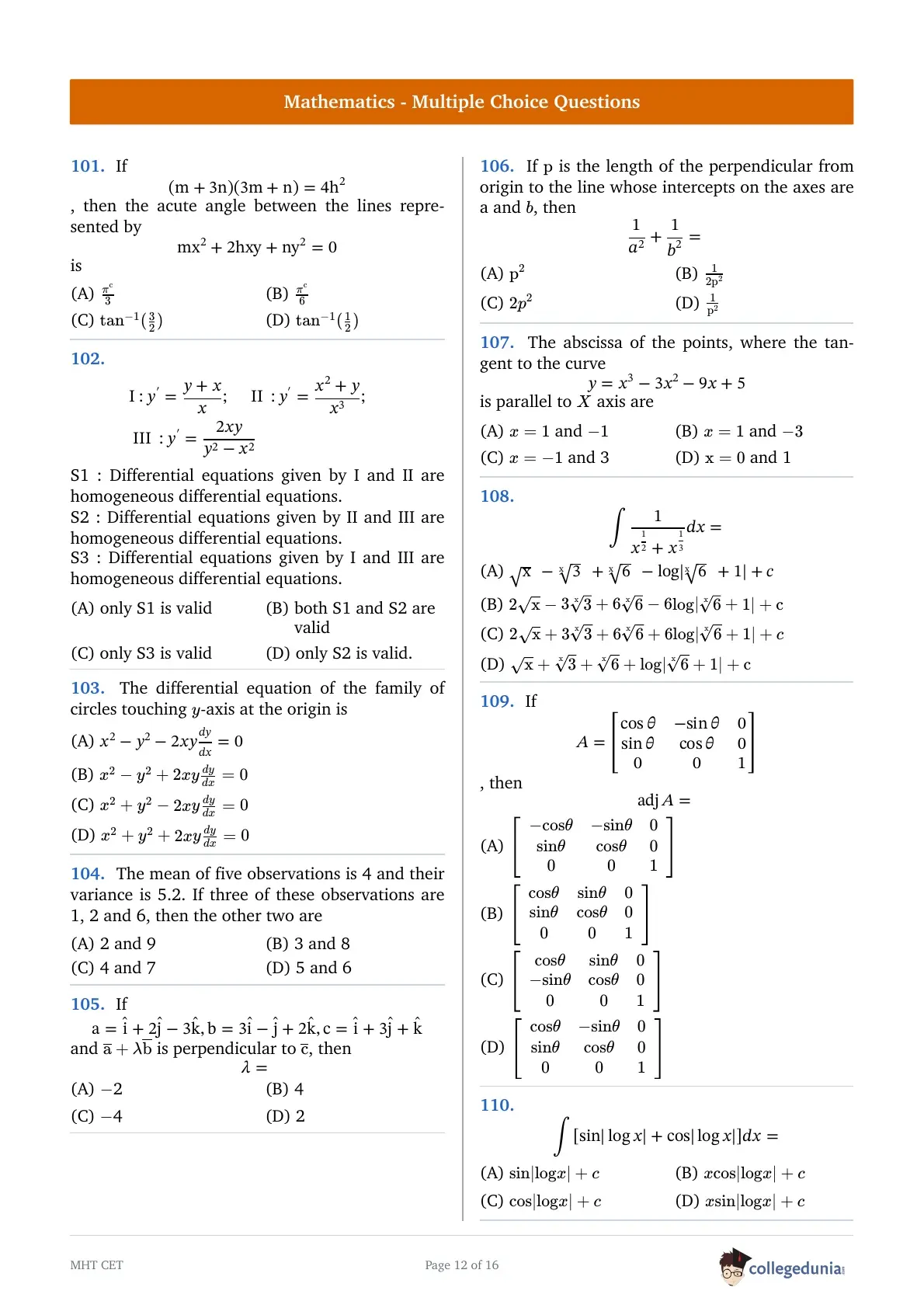
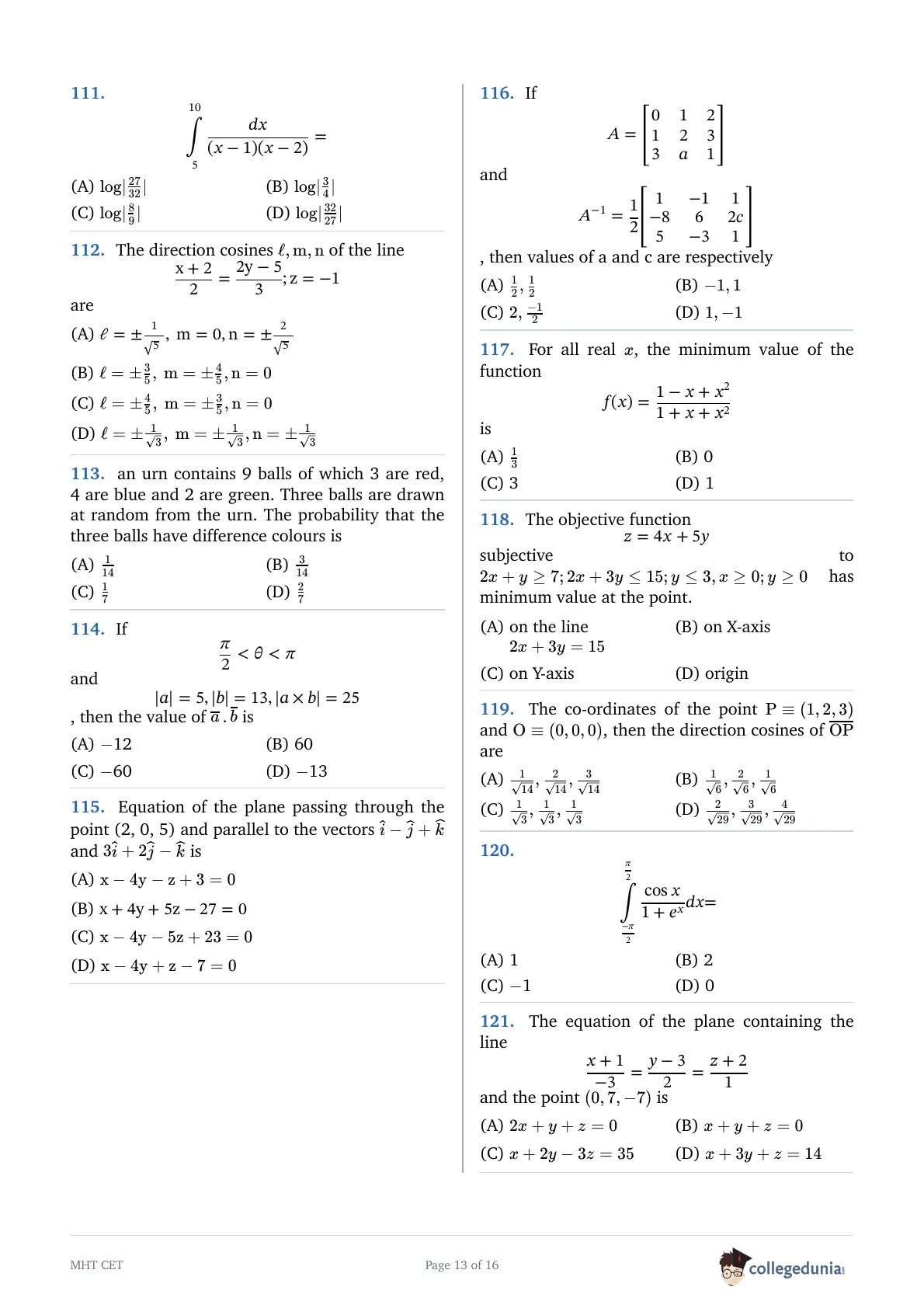
If \((\text{m}+3\text{n})(3\text{m}+\text{n})=4\text{h}^2\), then the acute angle between the lines represented by \(\text{m} \text{x}^2+2\text{h}\text{xy}+\text{n}\text{y}^2=0\) is
Consider the following differential equations:
I: \(y' = \frac{y+x}{x}\)
II: \(y' = \frac{x^2+y}{x^3}\)
III: \(y' = \frac{2xy}{y^2-x^2}\)
Which of the statements below is true regarding these equations?
S1: Differential equations given by I and II are homogeneous differential equations.
S2: Differential equations given by II and III are homogeneous differential equations.
S3: Differential equations given by I and III are homogeneous differential equations.
The differential equation of the family of circles touching \(y\)-axis at the origin is
The mean of five observations is 4 and their variance is 5.2. If three of these observations are 1, 2 and 6, then the other two are
If \(\bar{a} = \hat{i} + 2\hat{j} - 3\hat{k}\), \(\bar{b} = 3\hat{i} - \hat{j} + 2\hat{k}\), \(\bar{c} = \hat{i} + 3\hat{j} + \hat{k}\) and \(\bar{a} + \lambda\bar{b}\) is perpendicular to \(\bar{c}\), then \(\lambda =\)
If \(p\) is the length of the perpendicular from origin to the line whose intercepts on the axes are \(a\) and \(b\), then \(\frac{1}{a^2} + \frac{1}{b^2} =\)
The abscissa of the points, where the tangent to the curve \(y = x^3 - 3x^2 - 9x + 5\) is parallel to \(X\) axis are
If \[A=\left[\begin{array}{ccc}\cos \theta & -\sin \theta & 0 \\ \sin \theta & \cos \theta & 0 \\ 0 & 0 & 1\end{array}\right]\], then \[\operatorname{adj} A=\]
The direction cosines \(\ell, m, n\) of the line \(\frac{x+2}{2}=\frac{2y-5}{3} ; z=-1\) are
An urn contains 9 balls of which 3 are red, 4 are blue and 2 are green. Three balls are drawn at random from the urn. The probability that the three balls have different colors is
If \(\frac{\pi}{2} < \theta < \pi\) and \(|\overline{a}| = 5,\ |\overline{b}| = 13,\ |\overline{a} \times \overline{b}| = 25\), then the value of \(\overline{a} \cdot \overline{b}\) is
Equation of the plane passing through the point \((2, 0, 5)\) and parallel to the vectors \(\hat{i} - \hat{j} + \hat{k}\) and \(3\hat{i} + 2\hat{j} - \hat{k}\) is
If \(A = \begin{bmatrix} 0 & 1 & 2 \\ 1 & 2 & 3 \\ 3 & a & 1 \end{bmatrix}\) and \(A^{-1} = \frac{1}{2}\begin{bmatrix} 1 & -1 & 1 \\ -8 & 6 & 2c \\ 5 & -3 & 1 \end{bmatrix}\), then values of \(a\) and \(c\) are respectively
For all real \(x\), the minimum value of the function \(f(x) = \frac{1 - x + x^2}{1 + x + x^2}\) is
The objective function \(z = 4x + 5y\) subject to \(2x + y \geq 7;\ 2x + 3y \leq 15;\ y \leq 3,\ x \geq 0;\ y \geq 0\) has its minimum value at a point located
The coordinates of the point \(P \equiv (1,2,3)\) and \(O \equiv (0,0,0)\) are given. The direction cosines of \(\overline{OP}\) are
\(\int\limits_{{{ - \pi } \over 2}}^{{\pi \over 2}} {{{\cos x} \over {1 + {e^x}}}dx = }\)
The equation of the plane containing the line \(\frac{x+1}{-3} = \frac{y-3}{2} = \frac{z+2}{1}\) and the point \((0,7,-7)\) is
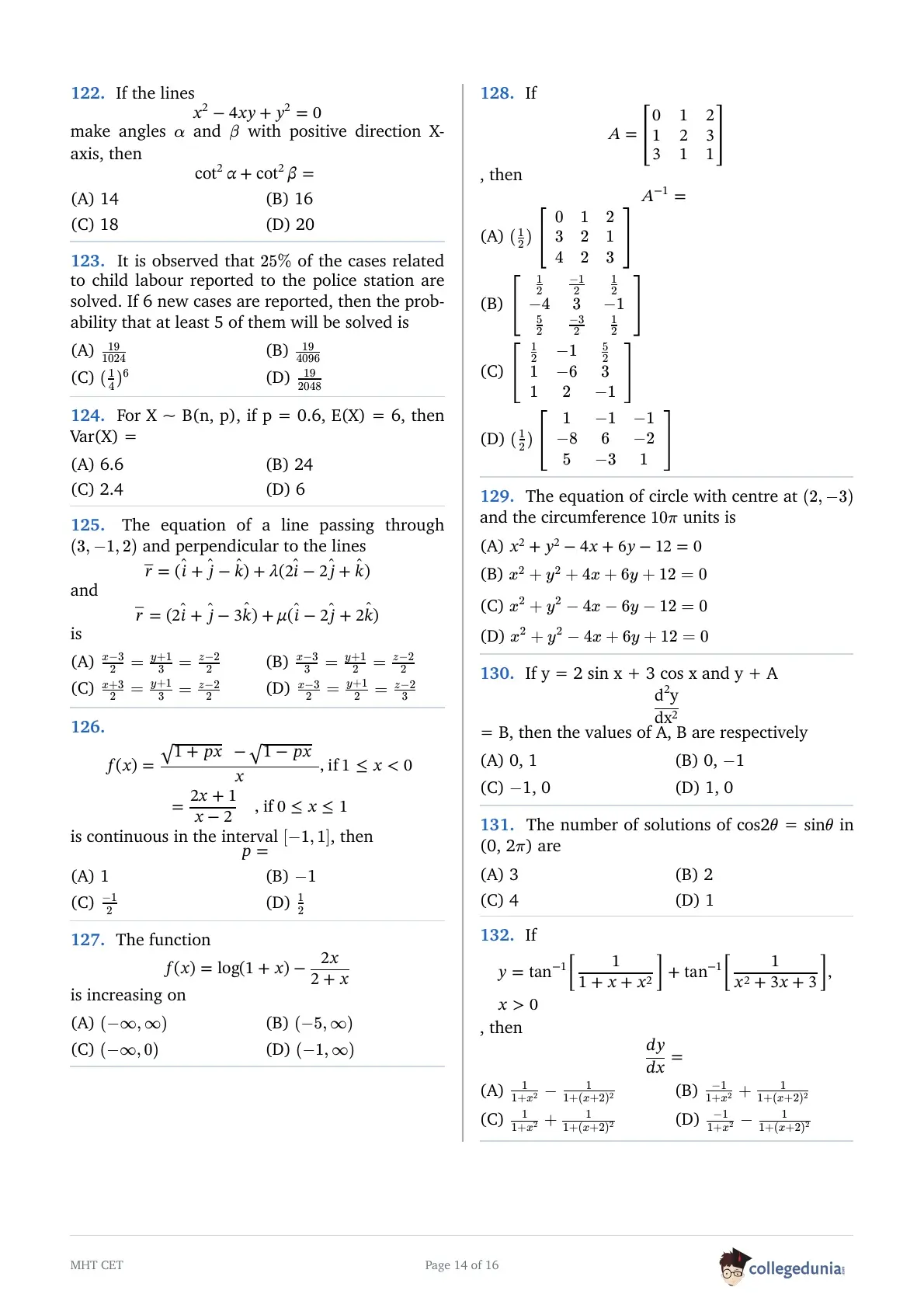
If the lines \(x^2 - 4xy + y^2 = 0\) make angles \(\alpha\) and \(\beta\) with the positive direction of the \(X\)-axis, then \(\cot^2\alpha + \cot^2\beta =\)
It is observed that 25% of the cases related to child labour reported to the police station are solved. If 6 new cases are reported, then the probability that at least 5 of them will be solved is
For \(X \sim B(n, p)\), if \(p = 0.6\) and \(E(X) = 6\), then \(\text{Var}(X) =\)
The equation of a line passing through \((3, -1, 2)\) and perpendicular to the lines \(\bar{r} = (\hat{i} + \hat{j} - \hat{k}) + \lambda (2\hat{i} - 2\hat{j} + \hat{k})\) and \(\bar{r} = (2\hat{i} + \hat{j} - 3\hat{k}) + \mu (\hat{i} - 2\hat{j} + 2\hat{k})\) is
\(\begin{aligned} f(x) &= \frac{\sqrt{1+px}-\sqrt{1-px}}{x}, & & \text{if } -1 \leq x < 0 \\ &= \frac{2x+1}{x-2}, & & \text{if } 0 \leq x \leq 1 \end{aligned}\)
is continuous in the interval \([-1,1]\), then \(p=\)
The function \( f(x) = \log(1 + x) - \frac{2x}{2+x} \) is increasing on
The equation of circle with centre at \( (2, -3) \) and the circumference \( 10\pi \) units is
If \( y = 2 \sin x + 3 \cos x \) and \( y + A \frac{d^2 y}{dx^2} = B \), then the values of \( A, B \) are respectively
The number of solutions of \( \cos 2\theta = \sin \theta \) in \( (0, 2\pi) \) are
If \( y = \tan^{-1} \left[ \frac{1}{1+x+x^2} \right] + \tan^{-1} \left[ \frac{1}{x^2+3x+3} \right] \), \( x > 0 \), then \(\frac{dy}{dx} =\)
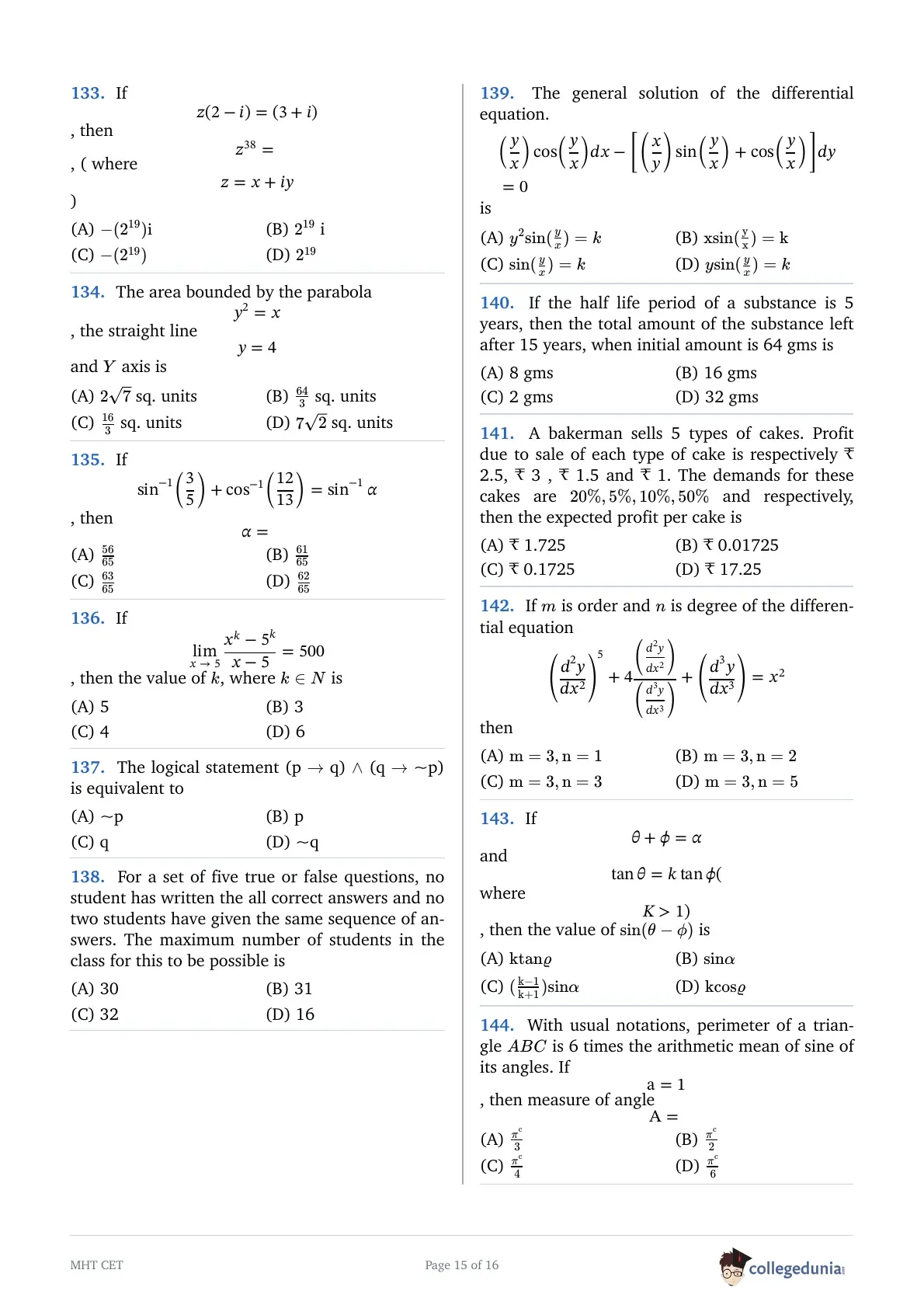
If \( z(2 - i) = (3 + i) \), then \( z^{38} = \), (where \( z = x + iy \))
The area bounded by the parabola \( y^2 = x \), the straight line \( y = 4 \) and \( Y \) axis is
If \( \sin^{-1}\left(\frac{3}{5}\right) + \cos^{-1}\left(\frac{12}{13}\right) = \sin^{-1}\alpha \), then \( \alpha = \)
If \(\lim _\limits{x \rightarrow 5} \frac{x^k-5^k}{x-5}=500\), then the value of \(k\), where \(k \in N\) is
The logical statement \((p \to q) \land (q \to \sim p)\) is equivalent to
For a set of five true or false questions, no student has written the all correct answers and no two students have given the same sequence of answers. The maximum number of students in the class for this to be possible is
The general solution of the differential equation. \(\left(\frac{y}{x}\right) \cos \left(\frac{y}{x}\right) d x-\left[\left(\frac{x}{y}\right) \sin \left(\frac{y}{x}\right)+\cos \left(\frac{y}{x}\right)\right] d y=0\) is
If the half life period of a substance is 5 years, then the total amount of the substance left after 15 years, when initial amount is 64 gms is
A bakerman sells 5 types of cakes. Profit due to sale of each type of cake is respectively ₹ 2.5, ₹ 3, ₹ 1.5, ₹ 1 and ₹ 2. The demands for these cakes are 20%, 5%, 10%, 50% and 15% respectively, then the expected profit per cake is
If \(m\) is order and \(n\) is degree of the differential equation \(\left(\frac{d^2 y}{d x^2}\right)^5+4 \frac{\left(\frac{d^2 y}{d x^2}\right)}{\left(\frac{d^3 y}{d x^3}\right)}+\left(\frac{d^3 y}{d x^3}\right)=x^2\) then
If \( \theta + \phi = \alpha \) and \( \tan \theta = k \tan \phi \) (where \( k > 1 \)), then the value of \( \sin(\theta - \phi) \) is
With usual notations, perimeter of a triangle \( ABC \) is 6 times the arithmetic mean of sine of its angles. If \( a = 1 \), then measure of angle \( A = \)
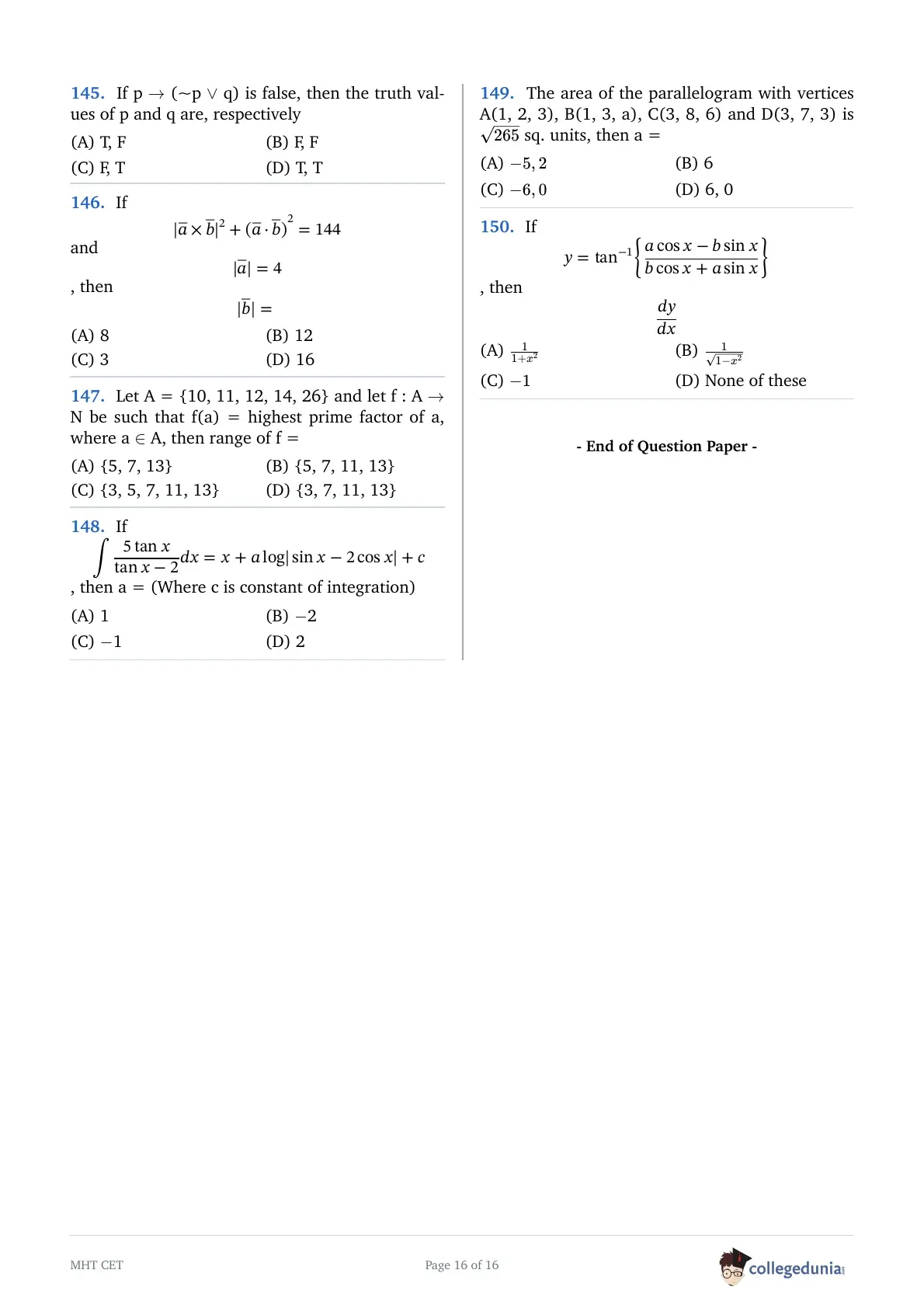
If \( p \to (\sim p \lor q) \) is false, then the truth values of \( p \) and \( q \) are, respectively
If \[|\bar{a} \times \bar{b}|^2+(\bar{a} \cdot \bar{b})^2=144\] and \[|\bar{a}|=4\], then \[|\bar{b}|=\]
Let \( A = \{10, 11, 12, 14, 26\} \) and let \( f : A \to \mathbb{N} \) be such that \( f(a) = \) highest prime factor of \( a \), where \( a \in A \), then range of \( f = \)
If \(\int {{{5\tan x} \over {\tan x - 2}}dx = x + a\log |\sin x - 2\cos x| + c}\), then a = (Where c is constant of integration)
The area of the parallelogram with vertices \( A(1, 2, 3) \), \( B(1, 3, a) \), \( C(3, 8, 6) \) and \( D(3, 7, 3) \) is \( \sqrt{265} \) sq. units, then \( a = \)
If \( y = \tan^{-1} \left( \frac{a \cos x - b \sin x}{b \cos x + a \sin x} \right) \), then \( \frac{dy}{dx} = \)
MHT CET 2021 PCM Exam Pattern and Marking Scheme
| Parameter | Details |
|---|---|
| Conducting Body | Maharashtra Common Entrance Test Cell (Maharashtra CET Cell) |
| Exam Mode | Online (Computer-Based Test) |
| Duration | 180 minutes (3 hours) |
| Groups / Subjects | PCM (Physics, Chemistry, Mathematics) for Engineering |
| Total Questions |
150 |
| Total Marks | 200 |
| Question Type | Multiple Choice Questions (MCQs) |
| Marks Distribution |
|
| Negative Marking | No |
| Syllabus Weightage |
|



Comments