




MHT CET 2021 Sep 22 Shift 1 PCM Question Paper is available for download here. Maharashtra State CET Cell conducted MHT CET 2021 PCM Exam on Sep 22 in Shift 1 from 9 AM to 12 PM in CBT mode.
The MHT CET 2021 PCM question paper includes the following:
- The MHT CET 2021 PCM Question Paper consists of 150 multiple-choice questions (MCQs) totalling 200 marks divided into 3 sections: Physics, Chemistry, and Mathematics, with 50 questions in each subject.
- Physics and Chemistry questions carry 1 mark each while Mathematics questions carry 2 marks each.
- There is no negative marking for incorrect answers.
MHT CET 2021 Sep 22 Shift 1 PCM Question Paper with Solution PDF
| CD PDF | CD PDF with Solutions |
|---|---|
| Download Collegedunia PDF 0.98 MB | - |
Also Check:
MHT CET 2021 Sep 22 Shift 1 PCM Questions with Solutions
Physics (Q1 - Q50)
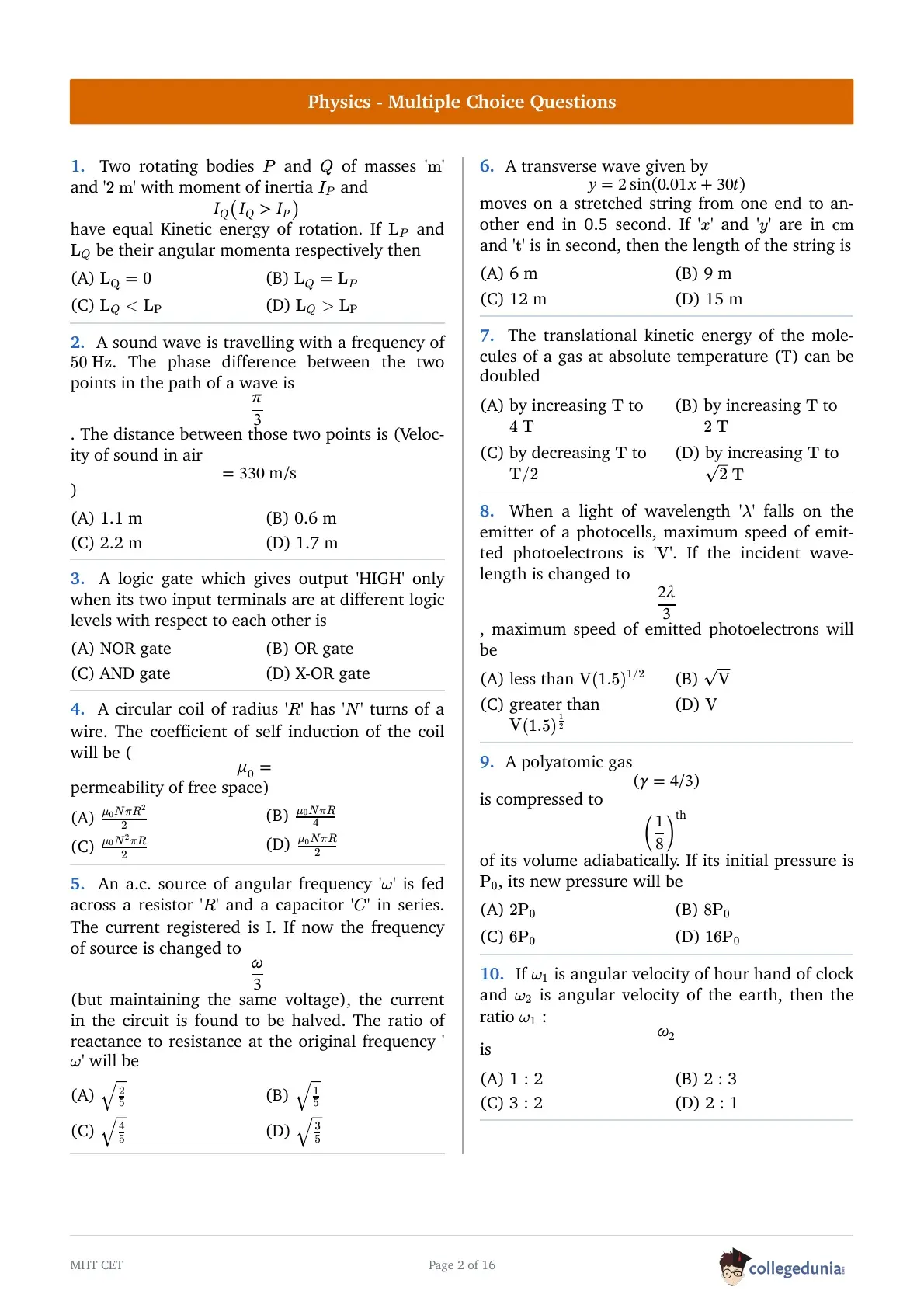
Two rotating bodies \(P\) and \(Q\) of masses \(m\) and \(2m\) with moment of inertia \(I_P\) and \(I_Q\) (\(I_Q > I_P\)) have equal Kinetic energy of rotation. If \(L_P\) and \(L_Q\) be their angular momenta respectively, then
A sound wave is travelling with a frequency of \(50\ \text{Hz}\). The phase difference between the two points in the path of a wave is \(\frac{\pi}{3}\). The distance between those two points is (Velocity of sound in air \(= 330\ \text{m/s}\))
A logic gate which gives output 'HIGH' only when its two input terminals are at different logic levels with respect to each other is
A circular coil of radius \(R\) has \(N\) turns of a wire. The coefficient of self-induction of the coil will be (\(\mu_0 = \) permeability of free space)
An a.c. source of angular frequency \(\omega\) is fed across a resistor \(R\) and a capacitor \(C\) in series. The current registered is \(I\). If now the frequency of source is changed to \(\frac{\omega}{3}\) (but maintaining the same voltage), the current in the circuit is found to be halved. The ratio of reactance to resistance at the original frequency \(\omega\) will be
A transverse wave given by \(y = 2 \sin(0.01x + 30t)\) moves on a stretched string from one end to another end in \(0.5\ \text{second}\). If '\(x\)' and '\(y\)' are in \(\text{cm}\) and '\(t\)' is in \(\text{second}\), then the length of the string is
The translational kinetic energy of the molecules of a gas at absolute temperature (\(T\)) can be doubled
When a light of wavelength '\[\lambda\]' falls on the emitter of a photocells, maximum speed of emitted photoelectrons is '\[\mathrm{V}\]'. If the incident wavelength is changed to \[\frac{2 \lambda}{3}\], maximum speed of emitted photoelectrons will be
A polyatomic gas (\(\gamma = 4/3\)) is compressed to \(\left(\frac{1}{8}\right)^{\text{th}}\) of its volume adiabatically. If its initial pressure is \(P_0\), its new pressure will be
If \(\omega_1\) is the angular velocity of the hour hand of a clock and \(\omega_2\) is the angular velocity of the earth's rotation about its axis, then the ratio \(\omega_1 : \omega_2\) is
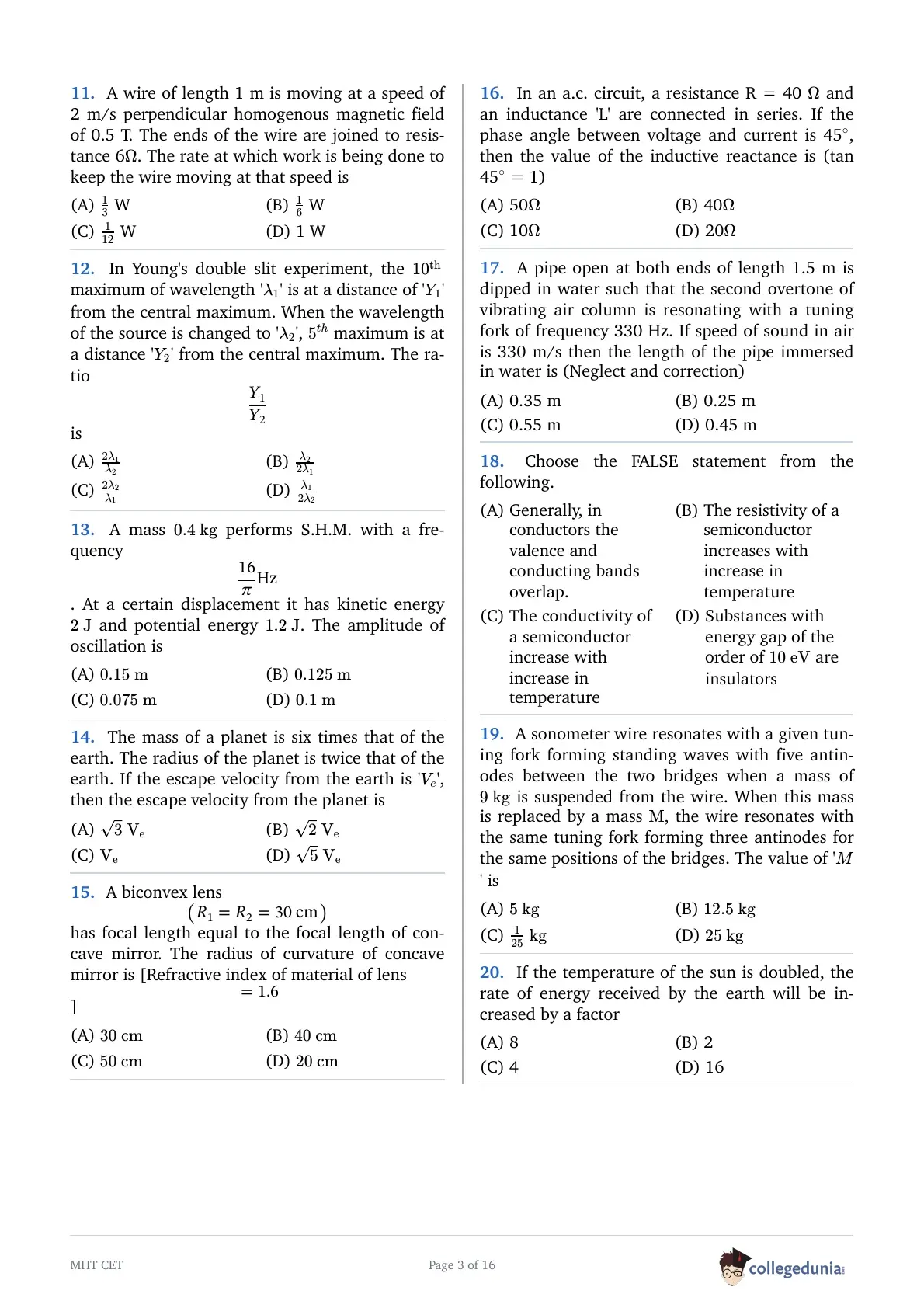
A wire of length \(1\ \text{m}\) is moving at a speed of \(2\ \text{m/s}\) perpendicular to a homogeneous magnetic field of \(0.5\ \text{T}\). If the ends of the wire are joined to a resistance of \(6\ \Omega\), the rate at which work is being done to keep the wire moving at that speed is
In Young's double slit experiment, the \(10^{\text{th}}\) maximum of wavelength '\(\lambda_1\)' is at a distance of '\(Y_1\)' from the central maximum. When the wavelength of the source is changed to '\(\lambda_2\)', the \(5^{\text{th}}\) maximum is at a distance '\(Y_2\)' from the central maximum. The ratio \(\frac{Y_1}{Y_2}\) is
A mass \(0.4\ \text{kg}\) performs S.H.M. with a frequency \(\frac{16}{\pi}\ \text{Hz}\). At a certain displacement it has kinetic energy \(2\ \text{J}\) and potential energy \(1.2\ \text{J}\). The amplitude of oscillation is
The mass of a planet is six times that of the earth. The radius of the planet is twice that of the earth. If the escape velocity from the earth is '\(V_e\)', then the escape velocity from the planet is
A biconvex lens (\(R_1 = R_2 = 30\ \text{cm}\)) has focal length equal to the focal length of a concave mirror. The radius of curvature of the concave mirror is [Refractive index of material of lens \(= 1.6\)]
In an a.c. circuit, a resistance \(R = 40\ \Omega\) and an inductance '\(L\)' are connected in series. If the phase angle between voltage and current is \(45^\circ\), then the value of the inductive reactance is (\(\tan 45^\circ = 1\))
A pipe open at both ends of length \(1.5\ \text{m}\) is dipped in water such that the second overtone of vibrating air column is resonating with a tuning fork of frequency \(330\ \text{Hz}\). If speed of sound in air is \(330\ \text{m/s}\), then the length of the pipe immersed in water is (Neglect end correction)
Choose the FALSE statement from the following.
A sonometer wire resonates with a given tuning fork forming standing waves with five antinodes between the two bridges when a mass of \(9\ \text{kg}\) is suspended from the wire. When this mass is replaced by a mass \(M\), the wire resonates with the same tuning fork forming three antinodes for the same positions of the bridges. The value of '\(M\)' is
If the temperature of the sun is doubled, the rate of energy received by the earth will be increased by a factor
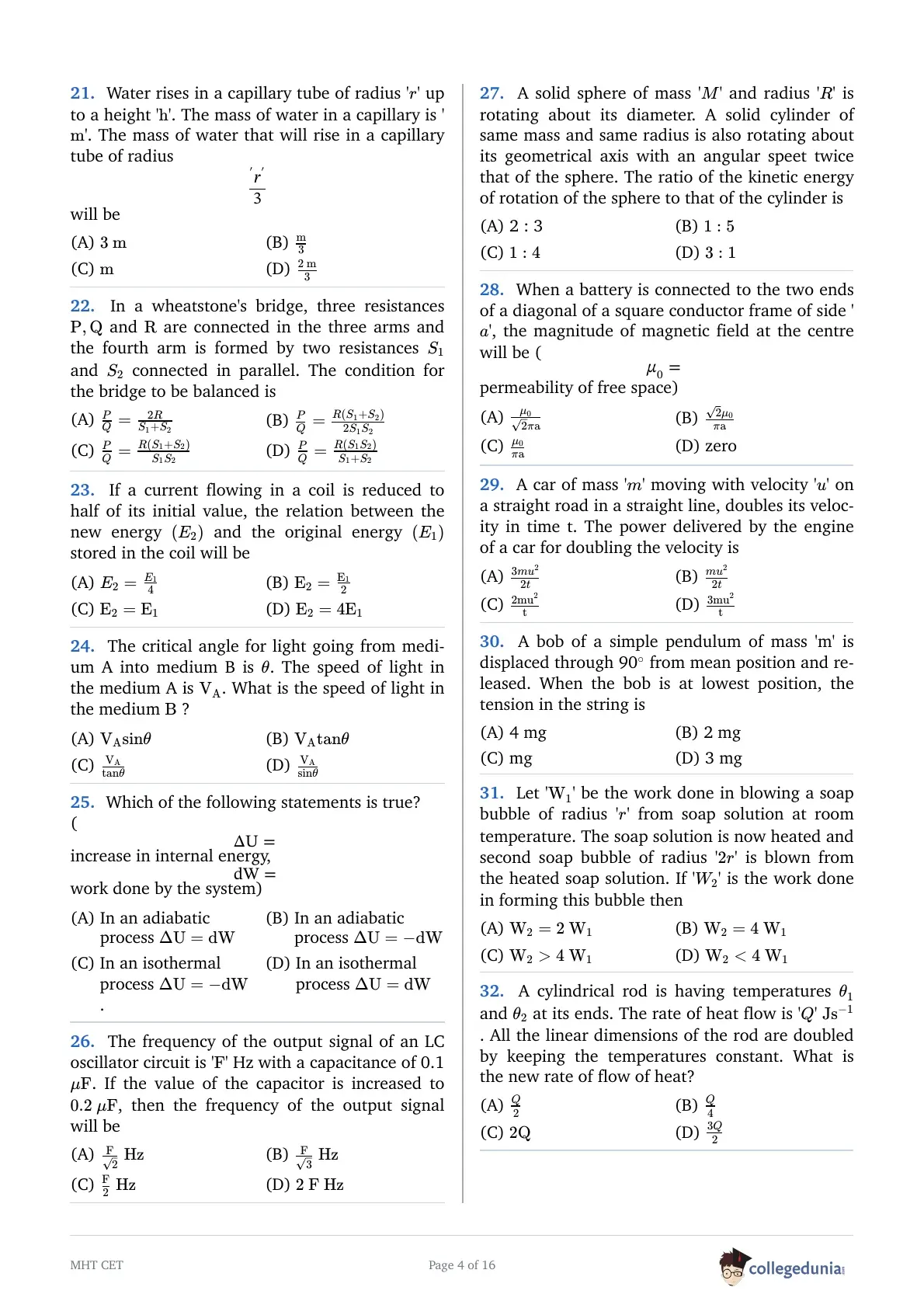
Water rises in a capillary tube of radius \(r\) up to a height \(h\). The mass of water in the capillary is \(m\). The mass of water that will rise in a capillary tube of radius \(\frac{r}{3}\) will be
In a Wheatstone's bridge, three resistances \(P\), \(Q\) and \(R\) are connected in the three arms and the fourth arm is formed by two resistances \(S_1\) and \(S_2\) connected in parallel. The condition for the bridge to be balanced is
If a current flowing in a coil is reduced to half of its initial value, the relation between the new energy (\(E_2\)) and the original energy (\(E_1\)) stored in the coil will be
The critical angle for light going from medium A into medium B is \(\theta\). The speed of light in medium A is \(V_A\). What is the speed of light in medium B?
Which of the following statements is true? (\(\Delta U = \) increase in internal energy, \(dW = \) work done by the system)
\
The frequency of the output signal of an LC oscillator circuit is \(F\ \text{Hz}\) with a capacitance of \(0.1\ \mu\text{F}\). If the value of the capacitor is increased to \(0.2\ \mu\text{F}\), then the frequency of the output signal will be
A solid sphere of mass \(M\) and radius \(R\) is rotating about its diameter. A solid cylinder of same mass and same radius is also rotating about its geometrical axis with an angular speed twice that of the sphere. The ratio of the kinetic energy of rotation of the sphere to that of the cylinder is
When a battery is connected to the two ends of a diagonal of a square conductor frame of side \(a\), the magnitude of magnetic field at the centre will be (\(\mu_0 = \) permeability of free space)
A car of mass \(m\) moving with velocity \(u\) on a straight road in a straight line, doubles its velocity in time \(t\). The power delivered by the engine of a car for doubling the velocity is
A bob of a simple pendulum of mass \(m\) is displaced through \(90^\circ\) from its mean position and released. When the bob is at its lowest position, the tension in the string is
Let \(W_1\) be the work done in blowing a soap bubble of radius \(r\) from a soap solution at room temperature. The soap solution is now heated and a second soap bubble of radius \(2r\) is blown from the heated soap solution. If \(W_2\) is the work done in forming this second bubble, then
A cylindrical rod has temperatures \(\theta_1\) and \(\theta_2\) at its ends. The rate of heat flow is \(Q\ \text{J}\ \text{s}^{-1}\). All the linear dimensions of the rod are doubled while keeping the temperatures constant. What is the new rate of flow of heat?
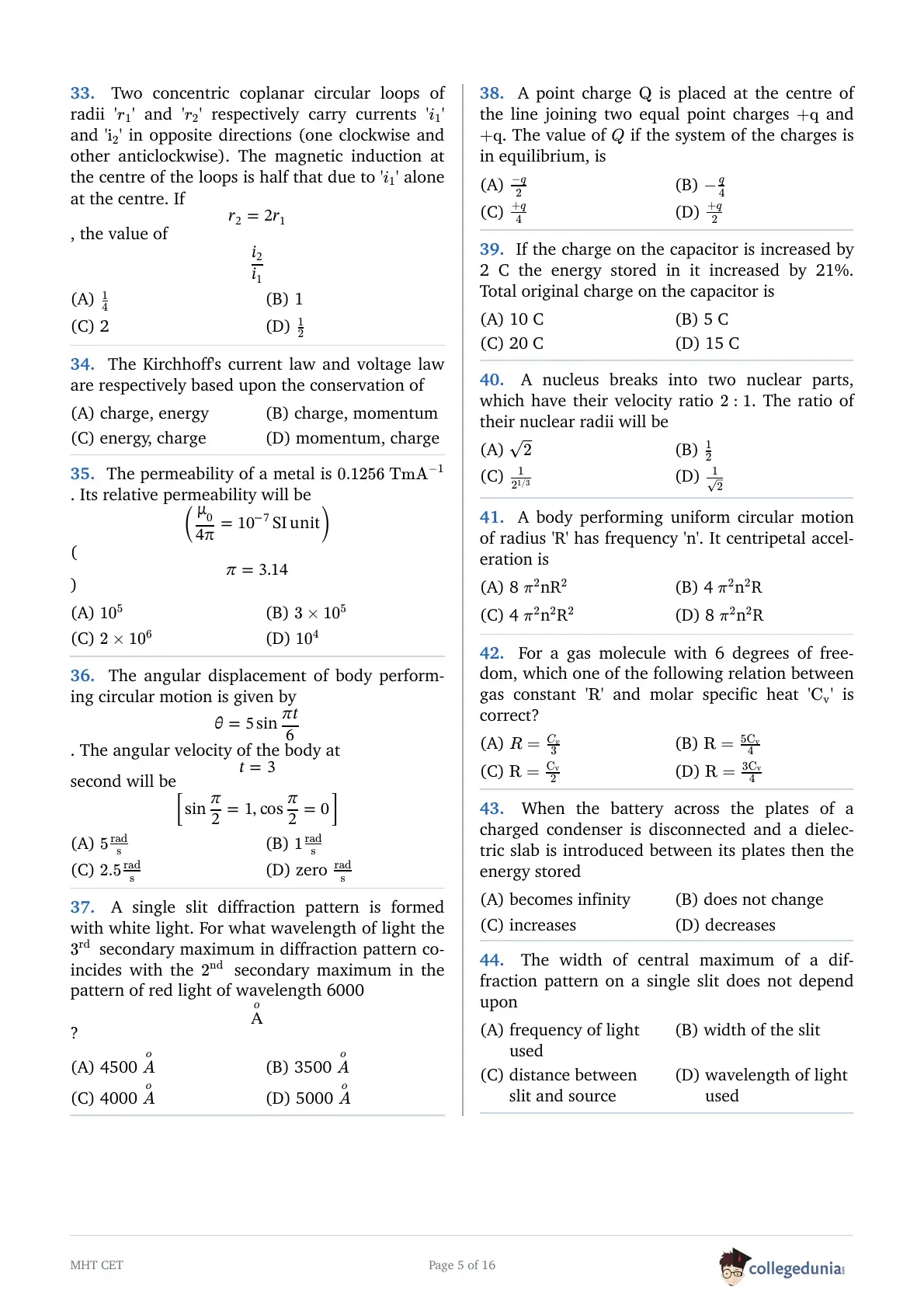
Two concentric coplanar circular loops of radii \(r_1\) and \(r_2\) respectively carry currents \(i_1\) and \(i_2\) in opposite directions (one clockwise and other anticlockwise). The magnetic induction at the centre of the loops is half that due to \(i_1\) alone at the centre. If \(r_2 = 2r_1\), the value of \(\frac{i_2}{i_1}\) is
The Kirchhoff's current law and voltage law are respectively based upon the conservation of
The permeability of a metal is \(0.1256\ \text{T}\cdot\text{m}\cdot\text{A}^{-1}\). Its relative permeability will be (\(\frac{\mu_0}{4\pi} = 10^{-7}\ \text{SI unit}\), \(\pi = 3.14\))
The angular displacement of a body performing circular motion is given by \(\theta = 5 \sin\left(\frac{\pi t}{6}\right)\). The angular velocity of the body at \(t = 3\ \text{second}\) will be [\(\sin\left(\frac{\pi}{2}\right) = 1\), \(\cos\left(\frac{\pi}{2}\right) = 0\)]
A single slit diffraction pattern is formed with white light. For what wavelength of light does the \(3^{\text{rd}}\) secondary maximum in the diffraction pattern coincide with the \(2^{\text{nd}}\) secondary maximum in the pattern of red light of wavelength \(6000\ \text{\AA}\)?
A point charge \(Q\) is placed at the centre of the line joining two equal point charges \(+q\) and \(+q\). The value of \(Q\) if the system of the charges is in equilibrium, is
If the charge on a capacitor is increased by \(2\ \text{C}\), the energy stored in it increases by \(21\%\). The total original charge on the capacitor is
A nucleus breaks into two nuclear parts, which have their velocity ratio \(2 : 1\). The ratio of their nuclear radii will be
A body performing uniform circular motion of radius \(R\) has frequency \(n\). Its centripetal acceleration is
For a gas molecule with 6 degrees of freedom, which one of the following relations between gas constant '\(R\)' and molar specific heat '\(C_v\)' is correct?
When the battery across the plates of a charged condenser is disconnected and a dielectric slab is introduced between its plates, then the energy stored
The width of the central maximum of a diffraction pattern on a single slit does not depend upon
If the amplitude of linear S.H.M. is decreased then
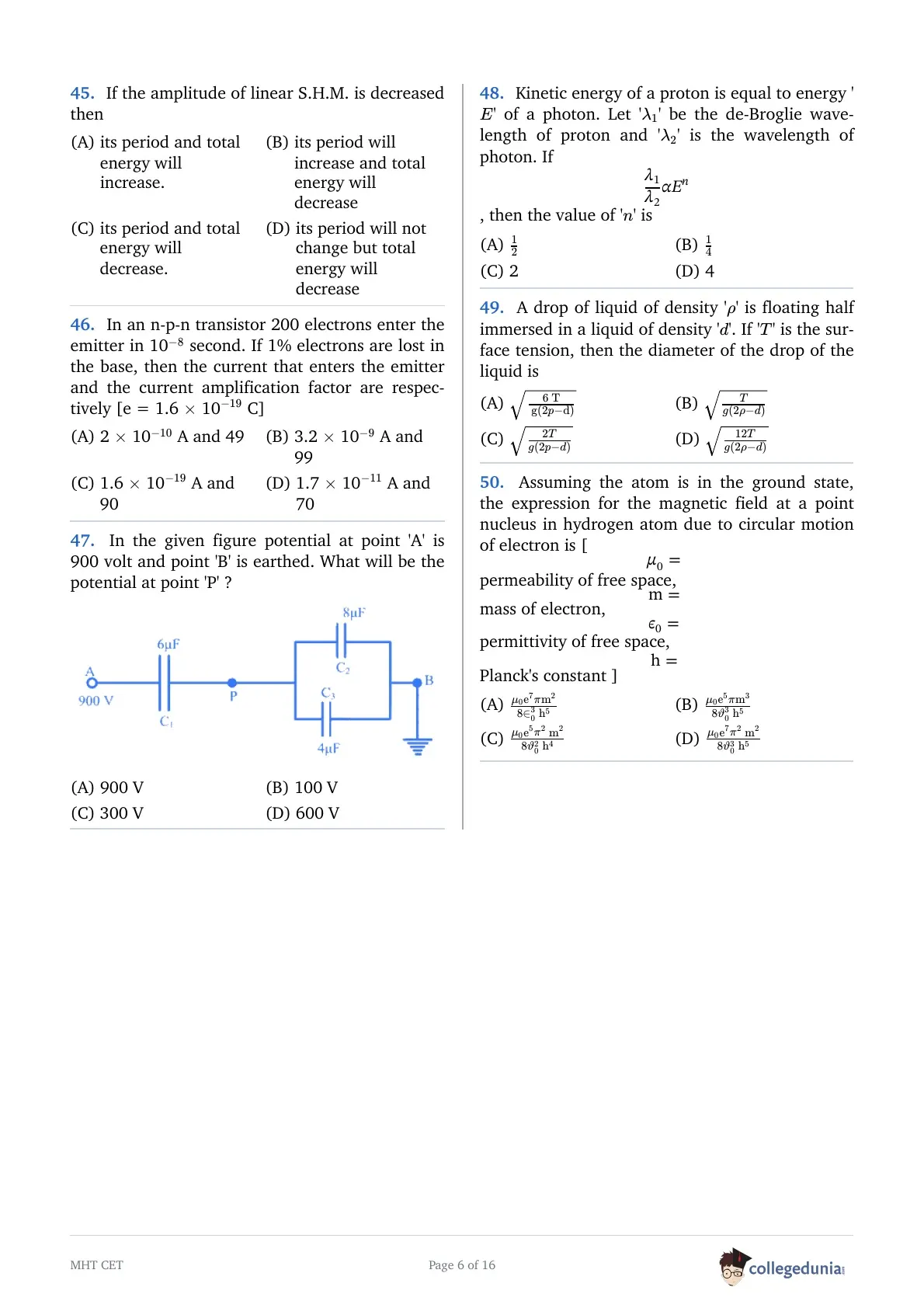
In an n-p-n transistor 200 electrons enter the emitter in \(10^{-8}\ \text{second}\). If \(1\%\) electrons are lost in the base, then the current that enters the emitter and the current amplification factor are respectively [\(e = 1.6 \times 10^{-19}\ \text{C}\)]
In the given figure potential at point 'A' is \(900\ \text{volt}\) and point 'B' is earthed. What will be the potential at point 'P'?

Kinetic energy of a proton is equal to energy '\[E\]' of a photon. Let '\[\lambda_1\]' be the de-Broglie wavelength of proton and '\[\lambda_2\]' is the wavelength of photon. If \[\frac{\lambda_1}{\lambda_2} \alpha E^n\], then the value of '\[n\]' is
A drop of liquid of density '\[\rho\]' is floating half immersed in a liquid of density '\[d\]'. If '\[T\]' is the surface tension, then the diameter of the drop of the liquid is
Assuming the atom is in the ground state, the expression for the magnetic field at a point nucleus in hydrogen atom due to circular motion of electron is [\[\mu_0=\] permeability of free space, \[\mathrm{m}=\] mass of electron, \[\epsilon_0=\] permittivity of free space, \[\mathrm{h}=\] Planck's constant ]
Chemistry (Q51 - Q100)
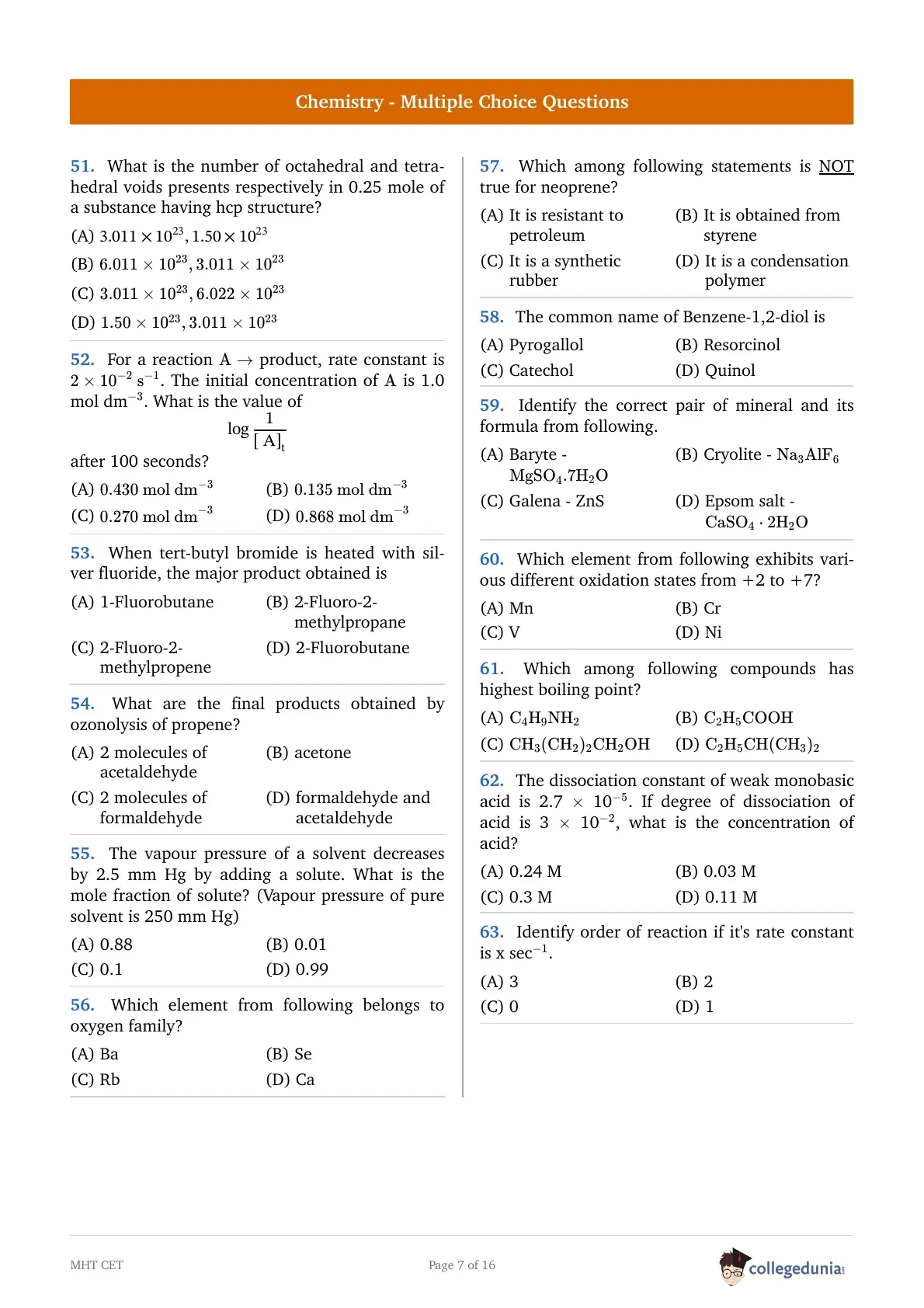
What is the number of octahedral and tetrahedral voids presents respectively in 0.25 mole of a substance having hcp structure?
For a reaction \(\mathrm{A} \rightarrow \text{product}\), rate constant is \(2 \times 10^{-2}\ \mathrm{s}^{-1}\). The initial concentration of A is \(1.0\ \mathrm{mol\ dm}^{-3}\). What is the value of \(\log_{10}\!\left(\frac{1}{[\mathrm{A}]_t}\right)\) after 100 seconds?
When tert-butyl bromide is heated with silver fluoride, the major product obtained is
What are the final products obtained by ozonolysis of propene?
The vapour pressure of a solvent decreases by 2.5 mm Hg by adding a solute. What is the mole fraction of solute? (Vapour pressure of pure solvent is 250 mm Hg)
Which element from following belongs to oxygen family?
Which among following statements is NOT true for neoprene?
The common name of Benzene-1,2-diol is
Which element from following exhibits various different oxidation states from +2 to +7?
The dissociation constant of weak monobasic acid is \(2.7 \times 10^{-5}\). If degree of dissociation of acid is \(3 \times 10^{-2}\), what is the concentration of acid?
Identify the order of reaction if its rate constant is \(x\ \mathrm{sec}^{-1}\).

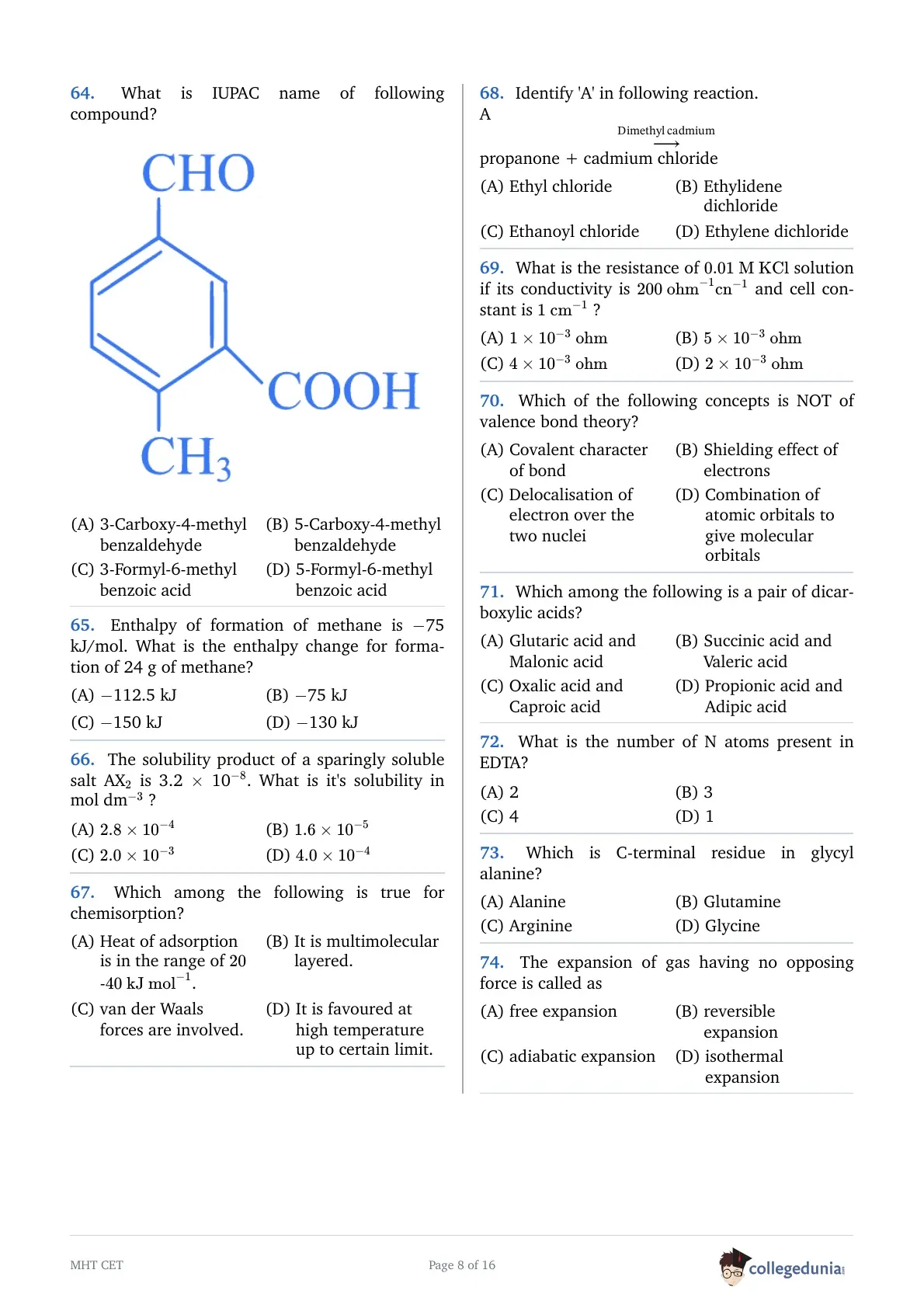
Enthalpy of formation of methane is \(-75\ \mathrm{kJ/mol}\). What is the enthalpy change for formation of 24 g of methane?
The solubility product of a sparingly soluble salt \(\mathrm{AX}_2\) is \(3.2 \times 10^{-8}\). What is its solubility in \(\mathrm{mol\ dm}^{-3}\)?
Which among the following is true for chemisorption?
Identify 'A' in following reaction.
A \(\mathrm{\buildrel {Dimethyl\,cadmium} \over \longrightarrow}\) propanone + cadmium chloride
What is the resistance of 0.01 M KCl solution if its conductivity is \(200\ \mathrm{ohm}^{-1}\ \mathrm{cm}^{-1}\) and cell constant is \(1\ \mathrm{cm}^{-1}\)?
Which of the following concepts is NOT of valence bond theory?
Which among the following is a pair of dicarboxylic acids?
What is the number of N atoms present in EDTA?
The expansion of gas having no opposing force is called as
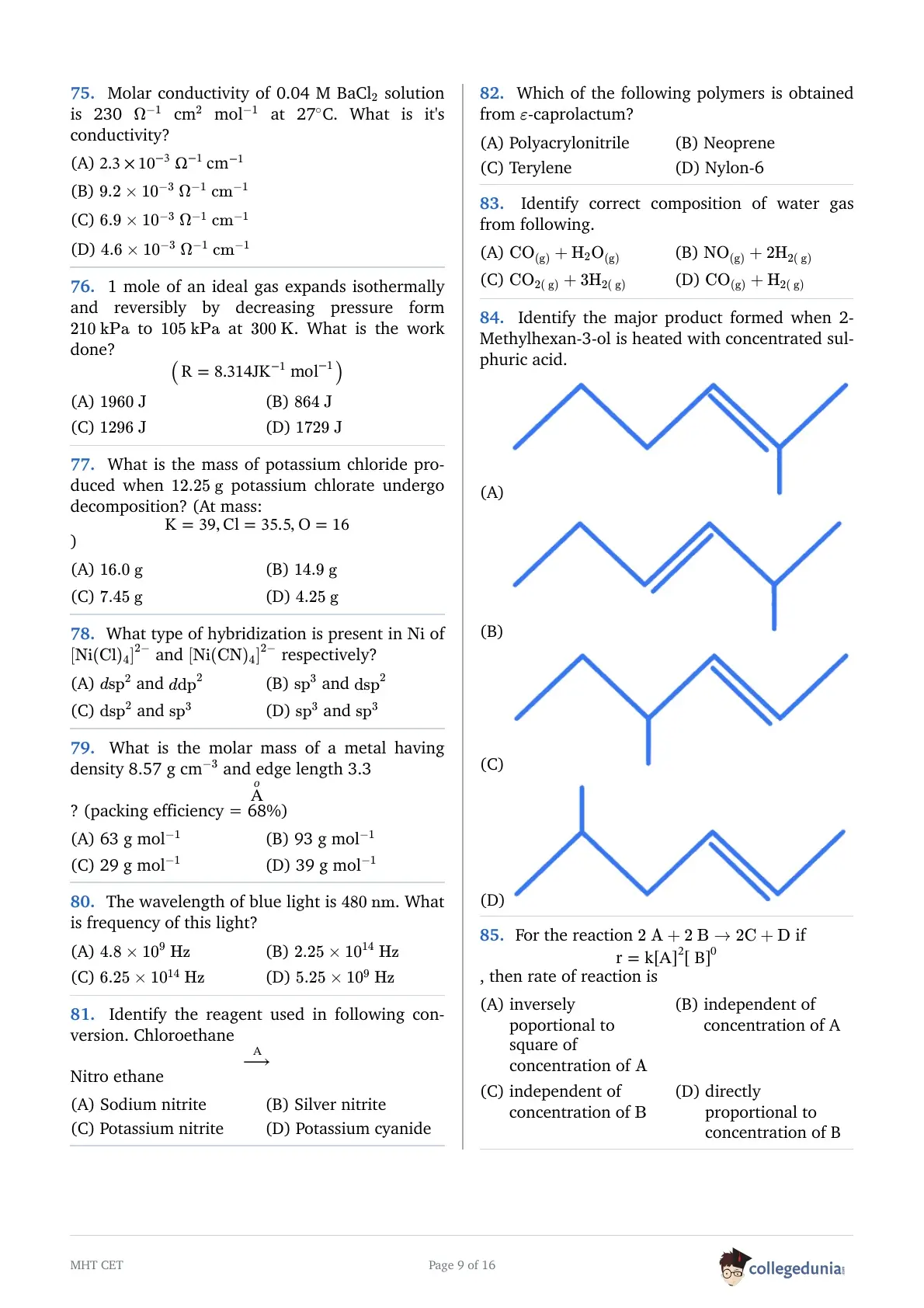
Molar conductivity of \(0.04\ \mathrm{M}\) \(\mathrm{BaCl}_2\) solution is \(230\ \Omega^{-1}\ \mathrm{cm}^2\ \mathrm{mol}^{-1}\) at \(27^{\circ}\mathrm{C}\). What is its conductivity?
1 mole of an ideal gas expands isothermally and reversibly by decreasing pressure from \(210\ \mathrm{kPa}\) to \(105\ \mathrm{kPa}\) at \(300\ \mathrm{K}\). What is the work done? (\(R = 8.314\ \mathrm{J\ K}^{-1}\ \mathrm{mol}^{-1}\))
What is the mass of potassium chloride produced when \(12.25\ \mathrm{g}\) potassium chlorate undergoes decomposition? (Atomic masses: \(\mathrm{K} = 39\), \(\mathrm{Cl} = 35.5\), \(\mathrm{O} = 16\))
What type of hybridization is present in \(\mathrm{Ni}\) of \([\mathrm{Ni}(\mathrm{Cl})_4]^{2-}\) and \([\mathrm{Ni}(\mathrm{CN})_4]^{2-}\) respectively?
What is the molar mass of a metal having density \(8.57\ \mathrm{g\ cm}^{-3}\) and edge length \(3.3\ \mathrm{\AA}\)? (packing efficiency = 68%)
The wavelength of blue light is 480 nm. What is frequency of this light?
Identify the reagent used in following conversion.
\(\text{Chloroethane} \xrightarrow{\text{A}} \text{Nitro ethane}\)
Which of the following polymers is obtained from \(\varepsilon\)-caprolactum?
Identify correct composition of water gas from following.
Identify the major product formed when 2-Methylhexan-3-ol is heated with concentrated sulphuric acid.
- (A)
![]()
- (B)
![]()
- (C)
![]()
- (D)
![]()


For the reaction \(2\mathrm{A} + 2\mathrm{B} \rightarrow 2\mathrm{C} + \mathrm{D}\), if the differential rate law is expressed as \(r = k[\mathrm{A}]^2[\mathrm{B}]^0\), then the rate of the reaction is
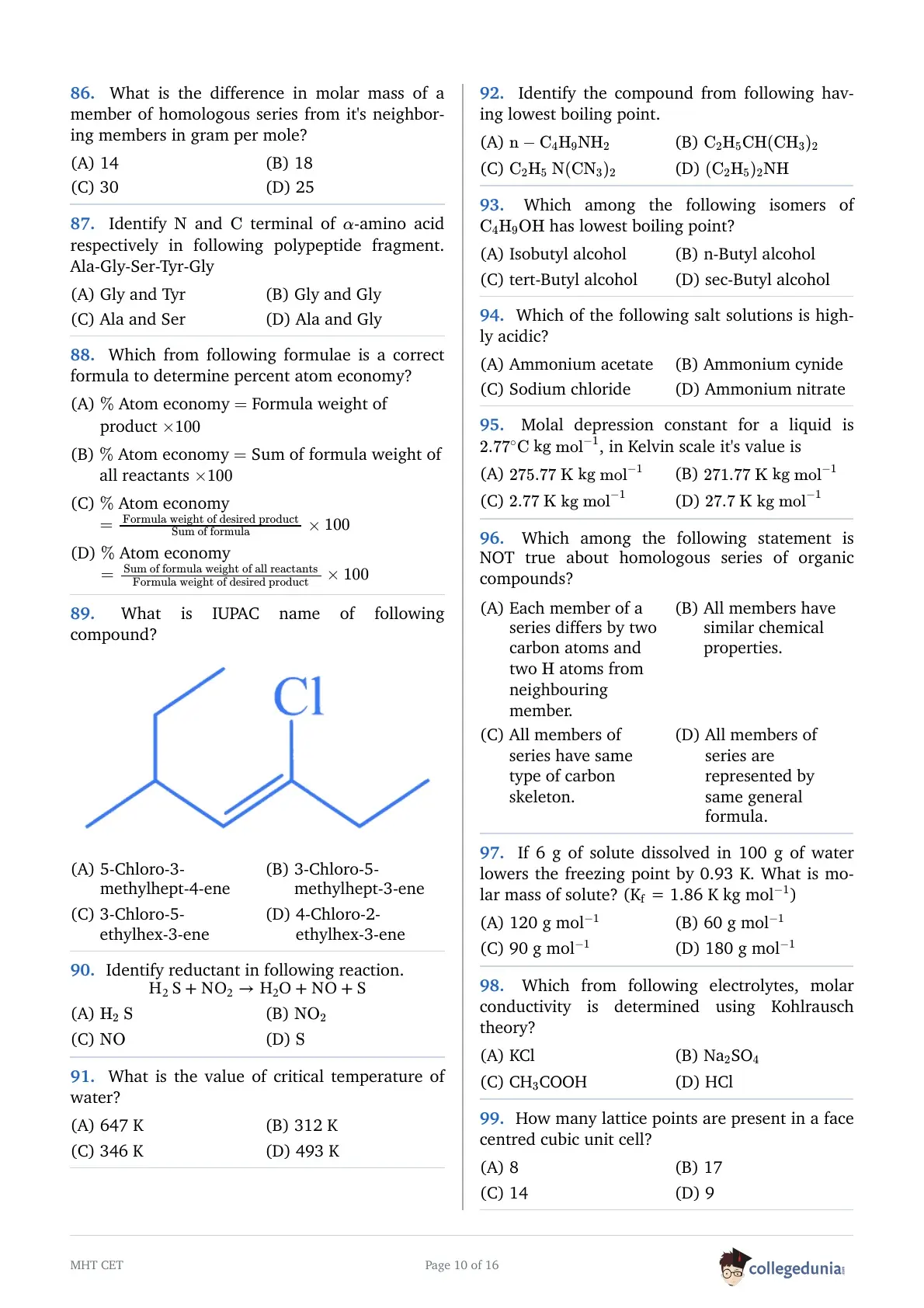
What is the difference in molar mass of a member of a homologous series from its neighboring members in grams per mole?
Identify \[\mathrm{N}\] and \[\mathrm{C}\] terminal of \[\alpha \]-amino acid respectively in following polypeptide fragment. Ala-Gly-Ser-Tyr-Gly
Which from following formulae is a correct formula to determine percent atom economy?

Identify reductant in following reaction.
\(\mathrm{H_2S} + \mathrm{NO_2} \rightarrow \mathrm{H_2O} + \mathrm{NO} + \mathrm{S}\)
What is the value of critical temperature of water?
Which among the following isomers of \(\mathrm{C_4H_9OH}\) has lowest boiling point?
Which of the following salt solutions is highly acidic?
Molal depression constant for a liquid is \(2.77^{\circ}\mathrm{C}\ \mathrm{kg}\ \mathrm{mol}^{-1}\), in Kelvin scale its value is
Which among the following statement is NOT true about homologous series of organic compounds?
If 6 g of solute dissolved in 100 g of water lowers the freezing point by 0.93 K. What is molar mass of solute? (\(\mathrm{K}_f = 1.86\ \mathrm{K}\ \mathrm{kg}\ \mathrm{mol}^{-1}\))
Which from following electrolytes, molar conductivity is determined using Kohlrausch theory?
How many lattice points are present in a face centred cubic unit cell?
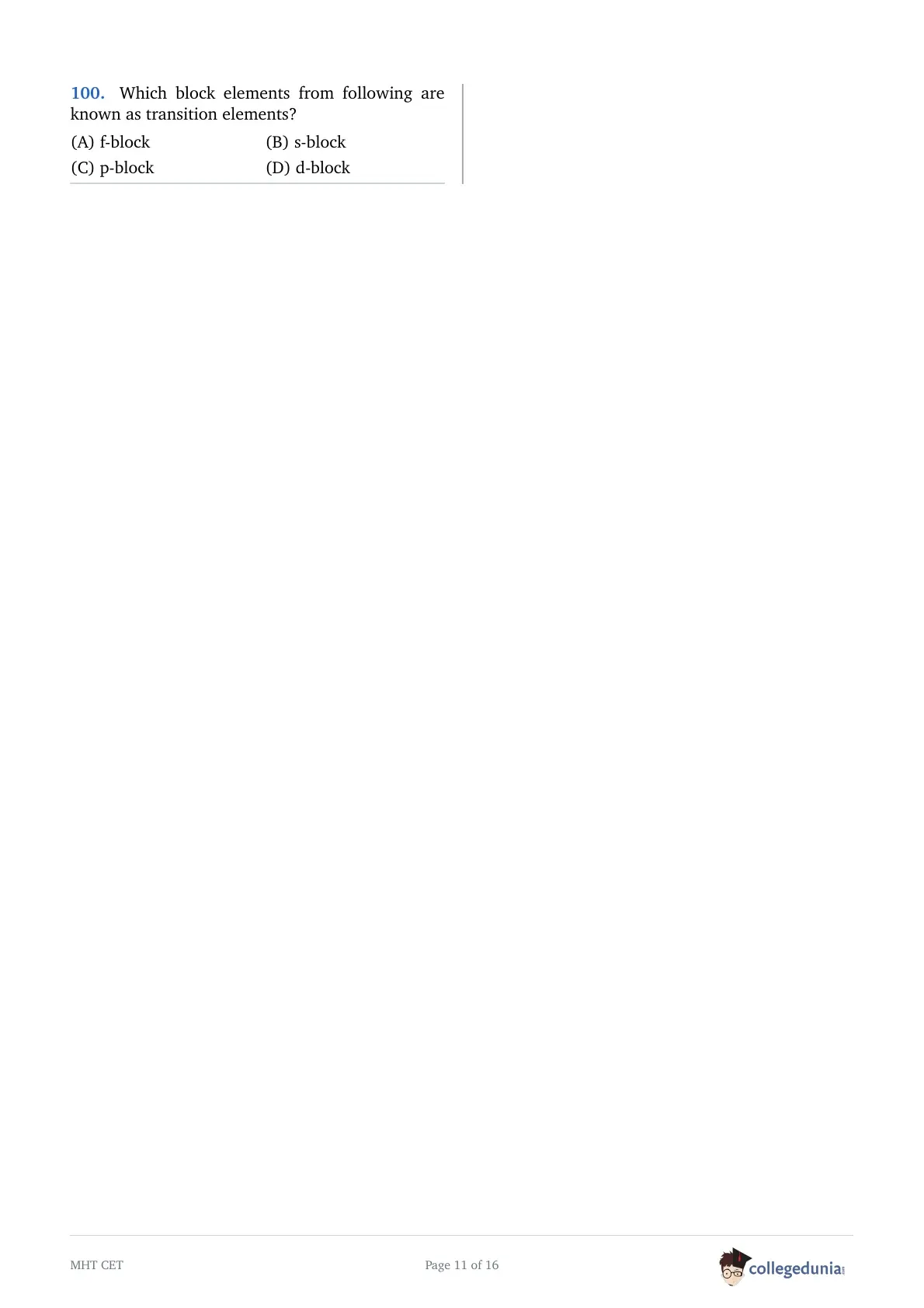
Which block elements from following are known as transition elements?
Mathematics (Q101 - Q150)
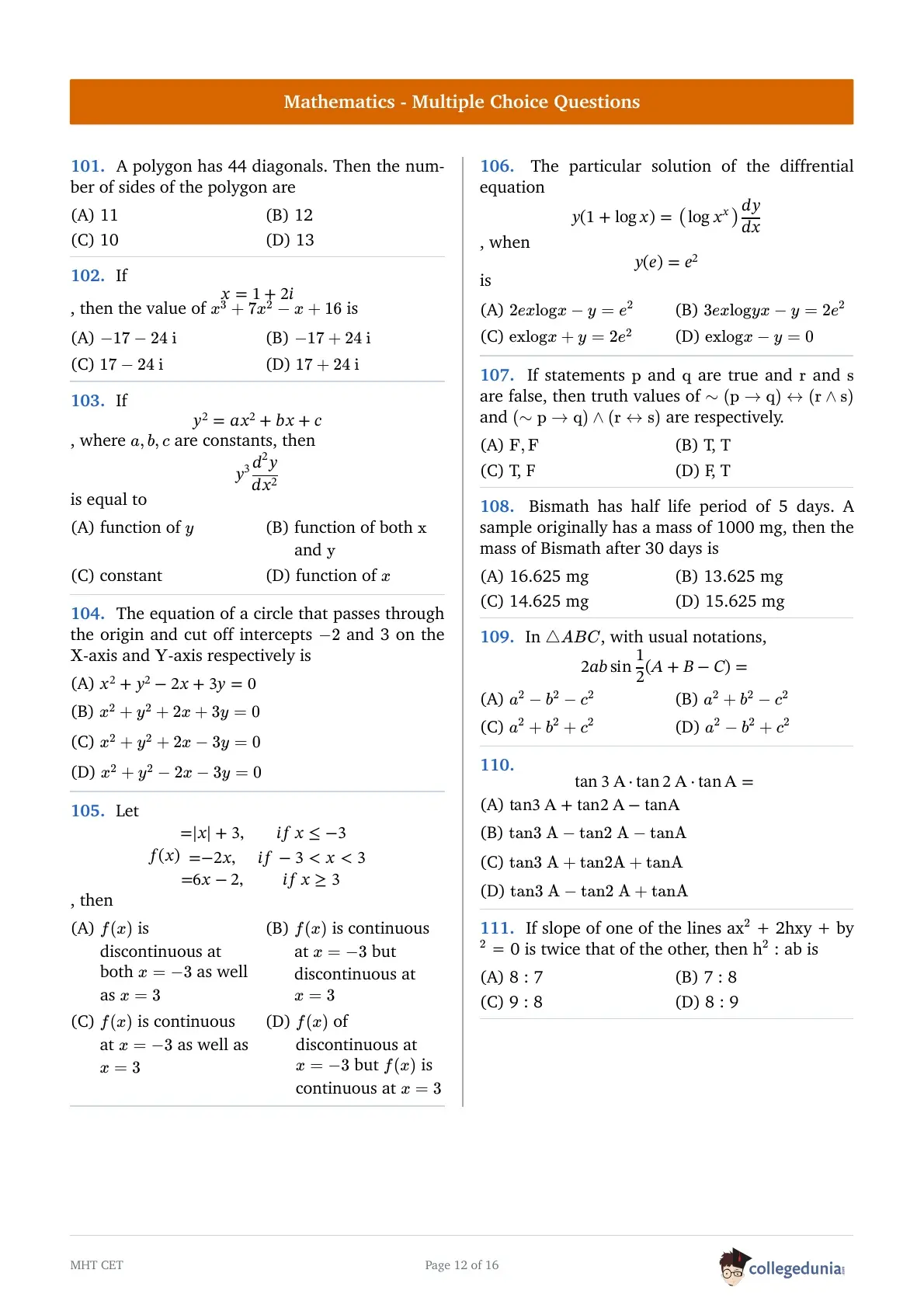
A polygon has 44 diagonals. Then the number of sides of the polygon are
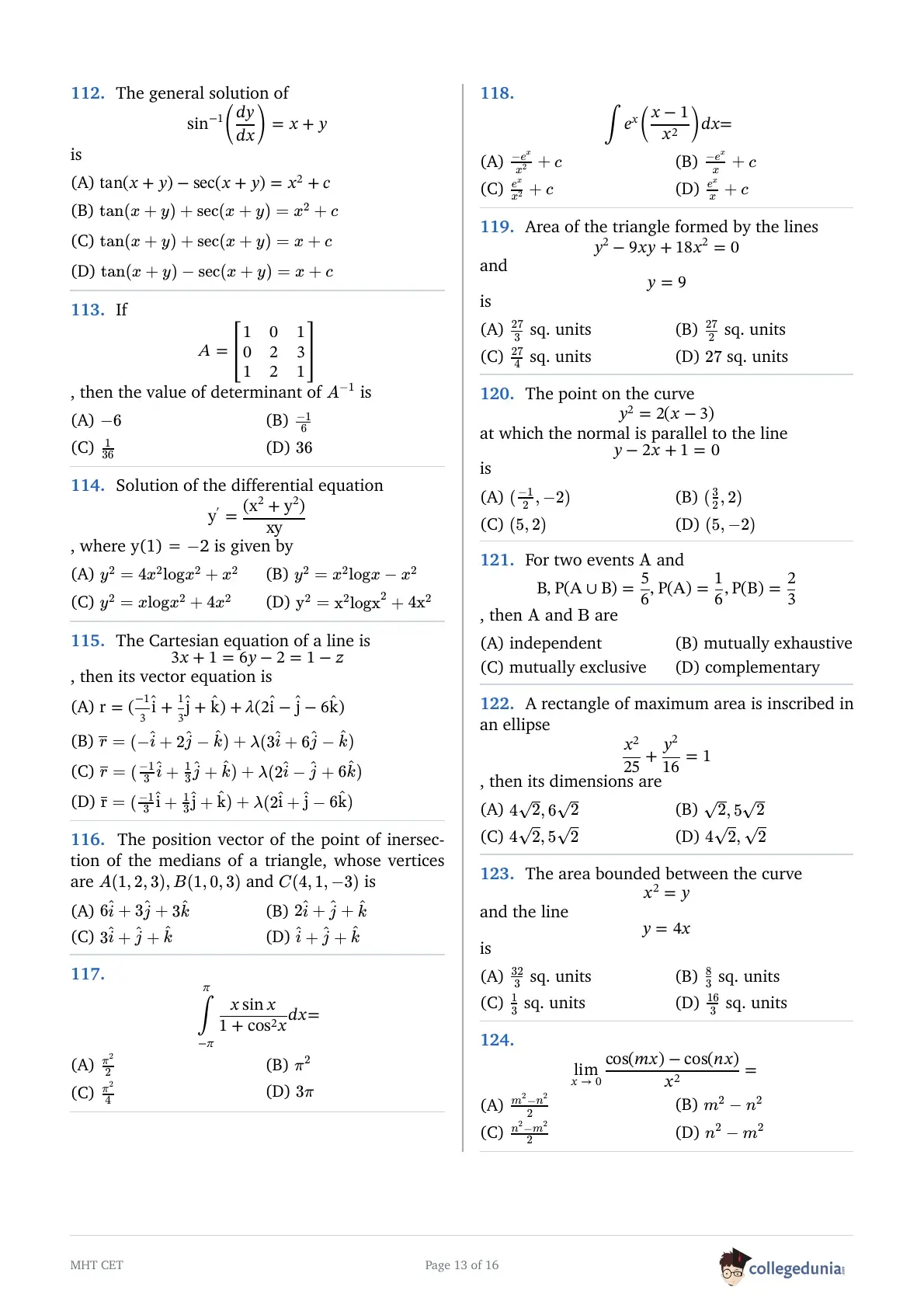
If \(y^2 = ax^2 + bx + c\), where \(a, b, c\) are constants, then \(y^3 \frac{d^2y}{dx^2}\) is equal to
The equation of a circle that passes through the origin and cut off intercepts \(-2\) and \(3\) on the X-axis and Y-axis respectively is
Let
\(f(x)\matrix{ { = |x| + 3,} & {if\,x \le - 3} \cr { = - 2x,} & {if\, - 3 < x < 3} \cr { = 6x - 2,} & {if\,x \ge 3} \cr }\), then
The particular solution of the differential equation \(y(1+\log x) = \left(\log x^x\right)\frac{dy}{dx}\), when \(y(e) = e^2\) is
If statements \(p\) and \(q\) are true and \(r\) and \(s\) are false, then truth values of \(\sim ( p \rightarrow q ) \leftrightarrow ( r \wedge s )\) and \(( \sim p \rightarrow q ) \wedge ( r \leftrightarrow s )\) are respectively
Bismath has half life period of 5 days. A sample originally has a mass of 1000 mg, then the mass of Bismath after 30 days is
In \(\triangle ABC\), with usual notations, \(2ab \sin \frac{1}{2}(A+B-C) =\)
\[\tan 3 \mathrm{~A} \cdot \tan 2 \mathrm{~A} \cdot \tan \mathrm{A}=\]
If the slope of one of the lines \(ax^2 + 2hxy + by^2 = 0\) is twice that of the other, then \(h^2 : ab\) is
The general solution of \(\sin^{-1}\left(\frac{dy}{dx}\right) = x + y\) is
If \(A = \begin{bmatrix} 1 & 0 & 1 \\ 0 & 2 & 3 \\ 1 & 2 & 1 \end{bmatrix}\), then the value of the determinant of \(A^{-1}\) is
Solution of the differential equation \(y' = \frac{x^2+y^2}{xy}\), where \(y(1) = -2\) is given by
The Cartesian equation of a line is \(3x + 1 = 6y - 2 = 1 - z\), then its vector equation is
The position vector of the point of intersection of the medians of a triangle, whose vertices are \(A(1, 2, 3)\), \(B(1, 0, 3)\) and \(C(4, 1, -3)\) is
The value of \(\int_{-\pi}^{\pi} \frac{x\sin x}{1+\cos^2 x}\,dx =\)
The value of \(\int e^x \left(\frac{x - 1}{x^2}\right) dx =\)
Area of the triangle formed by the lines \(y^2 - 9xy + 18x^2 = 0\) and \(y = 9\) is
The point on the curve \(y^2 = 2(x - 3)\) at which the normal is parallel to the line \(y - 2x + 1 = 0\) is
For two events \(A\) and \(B\), \(P(A \cup B) = \frac{5}{6}\), \(P(A) = \frac{1}{6}\), \(P(B) = \frac{2}{3}\), then \(A\) and \(B\) are
A rectangle of maximum area is inscribed in an ellipse \(\frac{x^2}{25} + \frac{y^2}{16} = 1\), then its dimensions are
The area bounded between the curve \(x^2 = y\) and the line \(y = 4x\) is
\[\lim _\limits{x \rightarrow 0} \frac{\cos (m x)-\cos (n x)}{x^2}=\]
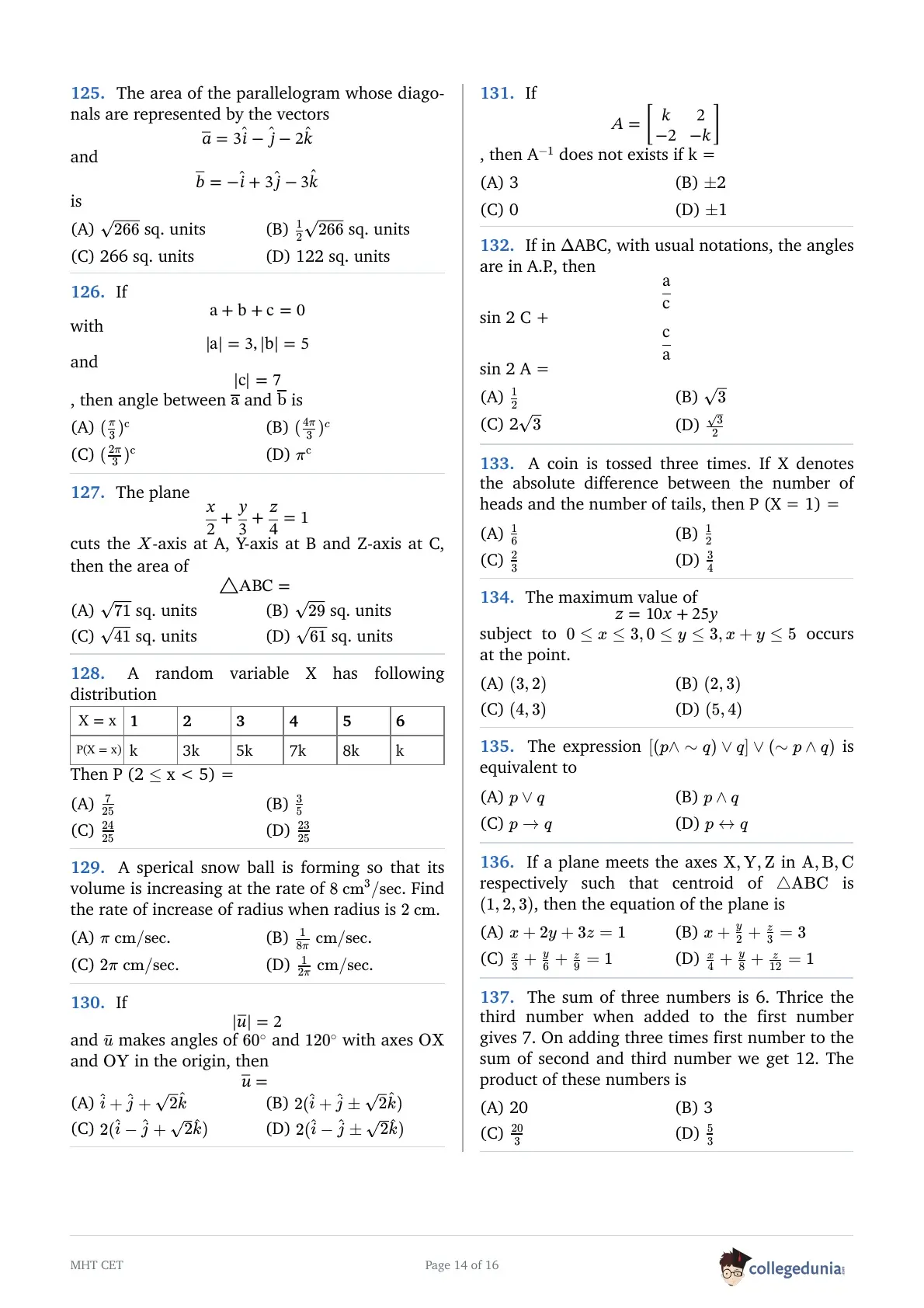
The area of the parallelogram whose diagonals are represented by the vectors \(\vec{a} = 3\hat{i} - \hat{j} - 2\hat{k}\) and \(\vec{b} = -\hat{i} + 3\hat{j} - 3\hat{k}\) is
If \(\vec{a} + \vec{b} + \vec{c} = \vec{0}\) with \(|\vec{a}| = 3\), \(|\vec{b}| = 5\) and \(|\vec{c}| = 7\), then the angle between \(\vec{a}\) and \(\vec{b}\) is
The plane \(\frac{x}{2} + \frac{y}{3} + \frac{z}{4} = 1\) cuts the \(X\)-axis at \(A\), \(Y\)-axis at \(B\) and \(Z\)-axis at \(C\), then the area of \(\Delta ABC\) is
A random variable \(X\) has the following probability distribution:
{|c|c|c|c|c|c|c|}
\(X = x\) & 1 & 2 & 3 & 4 & 5 & 6 \(P(X = x)\) & \(k\) & \(3k\) & \(5k\) & \(7k\) & \(8k\) & \(k\) Then \(P(2 \le X < 5) =\)
A spherical snow ball is forming so that its volume is increasing at the rate of \(8\ \text{cm}^3/\text{sec}\). Find the rate of increase of its radius when the radius is \(2\ \text{cm}\).
If \(|\vec{u}| = 2\) and \(\vec{u}\) makes angles of \(60^\circ\) and \(120^\circ\) with the axes \(OX\) and \(OY\) at the origin, then \(\vec{u} =\)
If \[A = \left[ {\matrix{ k & 2 \cr { - 2} & { - k} \cr } } \right]\], then A\[^{-1}\] does not exists if k =
If in \(\Delta ABC\), with usual notations, the angles are in A.P., then \(\frac{a}{c}\sin(2C) + \frac{c}{a}\sin(2A) =\)
A coin is tossed three times. If \(X\) denotes the absolute difference between the number of heads and the number of tails, then \(P(X = 1) =\)
The maximum value of \(z = 10x + 25y\) subject to \(0 \le x \le 3\), \(0 \le y \le 3\), \(x + y \le 5\) occurs at the point
The expression \([(p \wedge \sim q) \vee q] \vee (\sim p \wedge q)\) is equivalent to
If a plane meets the axes \(X\), \(Y\), \(Z\) in \(A\), \(B\), \(C\) respectively such that centroid of \(\Delta ABC\) is \((1, 2, 3)\), then the equation of the plane is
The sum of three numbers is 6. Thrice the third number when added to the first number gives 7. On adding three times first number to the sum of second and third number we get 12. The product of these numbers is
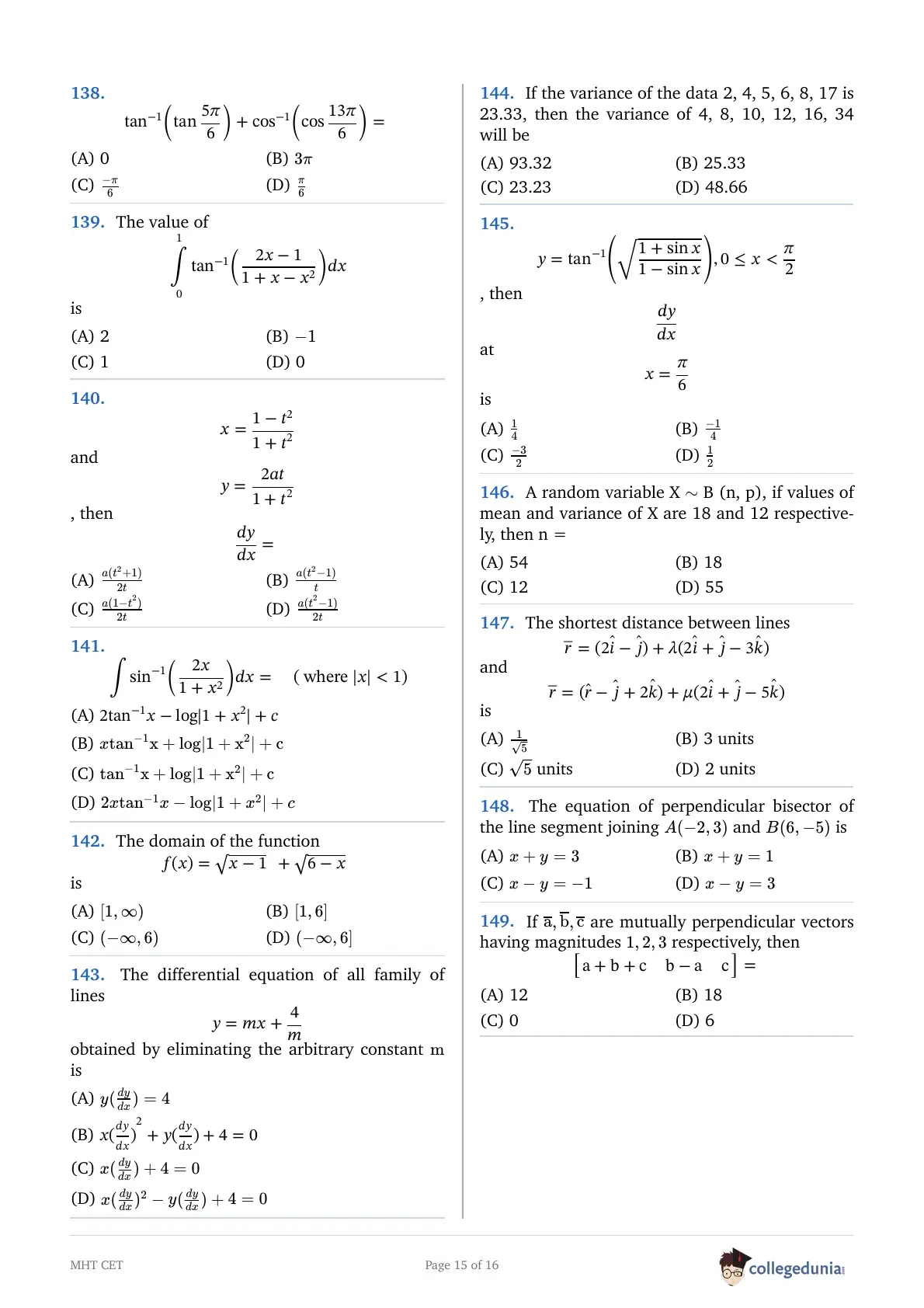
\(\tan^{-1}\left(\tan \frac{5\pi}{6}\right) + \cos^{-1}\left(\cos \frac{13\pi}{6}\right) =\)
The value of \(\int_0^1 \tan^{-1}\left(\frac{2x - 1}{1 + x - x^2}\right)\,dx\) is
If \(x = \frac{1 - t^2}{1 + t^2}\) and \(y = \frac{2at}{1 + t^2}\), then \(\frac{dy}{dx} =\)
\(\int \sin^{-1}\left(\frac{2x}{1+x^2}\right) dx = \quad (\text{where } |x| < 1)\)
The domain of the function \(f(x) = \sqrt{x - 1 + \sqrt{6 - x}}\) is
The differential equation of all family of lines \(y = mx + \frac{4}{m}\) obtained by eliminating the arbitrary constant \(m\) is
If the variance of the data \(2, 4, 5, 6, 8, 17\) is \(23.33\), then the variance of \(4, 8, 10, 12, 16, 34\) will be
If \(y=\tan^{-1}\left(\sqrt{\frac{1+\sin x}{1-\sin x}}\right),\ 0 \leq x < \frac{\pi}{2}\), then \(\frac{dy}{dx}\) at \(x=\frac{\pi}{6}\) is
A random variable \(X \sim B(n, p)\). If the values of the mean and variance of \(X\) are \(18\) and \(12\) respectively, then \(n =\)
The shortest distance between lines \(\vec{r} = (2\hat{i} - \hat{j}) + \lambda(2\hat{i} + \hat{j} - 3\hat{k})\) and \(\vec{r} = (\hat{i} - \hat{j} + 2\hat{k}) + \mu(2\hat{i} + \hat{j} - 5\hat{k})\) is
The equation of the perpendicular bisector of the line segment joining \(A(-2, 3)\) and \(B(6, -5)\) is
If \(\vec{a}\), \(\vec{b}\), \(\vec{c}\) are mutually perpendicular vectors having magnitudes \(1\), \(2\), \(3\) respectively, then \([\vec{a} + \vec{b} + \vec{c} \quad \vec{b} - \vec{a} \quad \vec{c}] =\)
MHT CET 2021 PCM Exam Pattern and Marking Scheme
| Parameter | Details |
|---|---|
| Conducting Body | Maharashtra Common Entrance Test Cell (Maharashtra CET Cell) |
| Exam Mode | Online (Computer-Based Test) |
| Duration | 180 minutes (3 hours) |
| Groups / Subjects | PCM (Physics, Chemistry, Mathematics) for Engineering |
| Total Questions |
150 |
| Total Marks | 200 |
| Question Type | Multiple Choice Questions (MCQs) |
| Marks Distribution |
|
| Negative Marking | No |
| Syllabus Weightage |
|



Comments