




MHT CET 2021 Sep 22 Shift 2 PCM Question Paper is available for download here. Maharashtra State CET Cell conducted MHT CET 2021 PCM Exam on Sep 22 in Shift 2 from 2 PM to 5 PM in CBT mode.
The MHT CET 2021 PCM question paper includes the following:
- The MHT CET 2021 PCM Question Paper consists of 150 multiple-choice questions (MCQs) totalling 200 marks divided into 3 sections: Physics, Chemistry, and Mathematics, with 50 questions in each subject.
- Physics and Chemistry questions carry 1 mark each while Mathematics questions carry 2 marks each.
- There is no negative marking for incorrect answers.
MHT CET 2021 Sep 22 Shift 2 PCM Question Paper with Solution PDF
| CD PDF | CD PDF with Solutions |
|---|---|
| Download Collegedunia PDF 1.03 MB | - |
Also Check:
MHT CET 2021 Sep 22 Shift 2 PCM Questions with Solutions
Physics (Q1 - Q50)
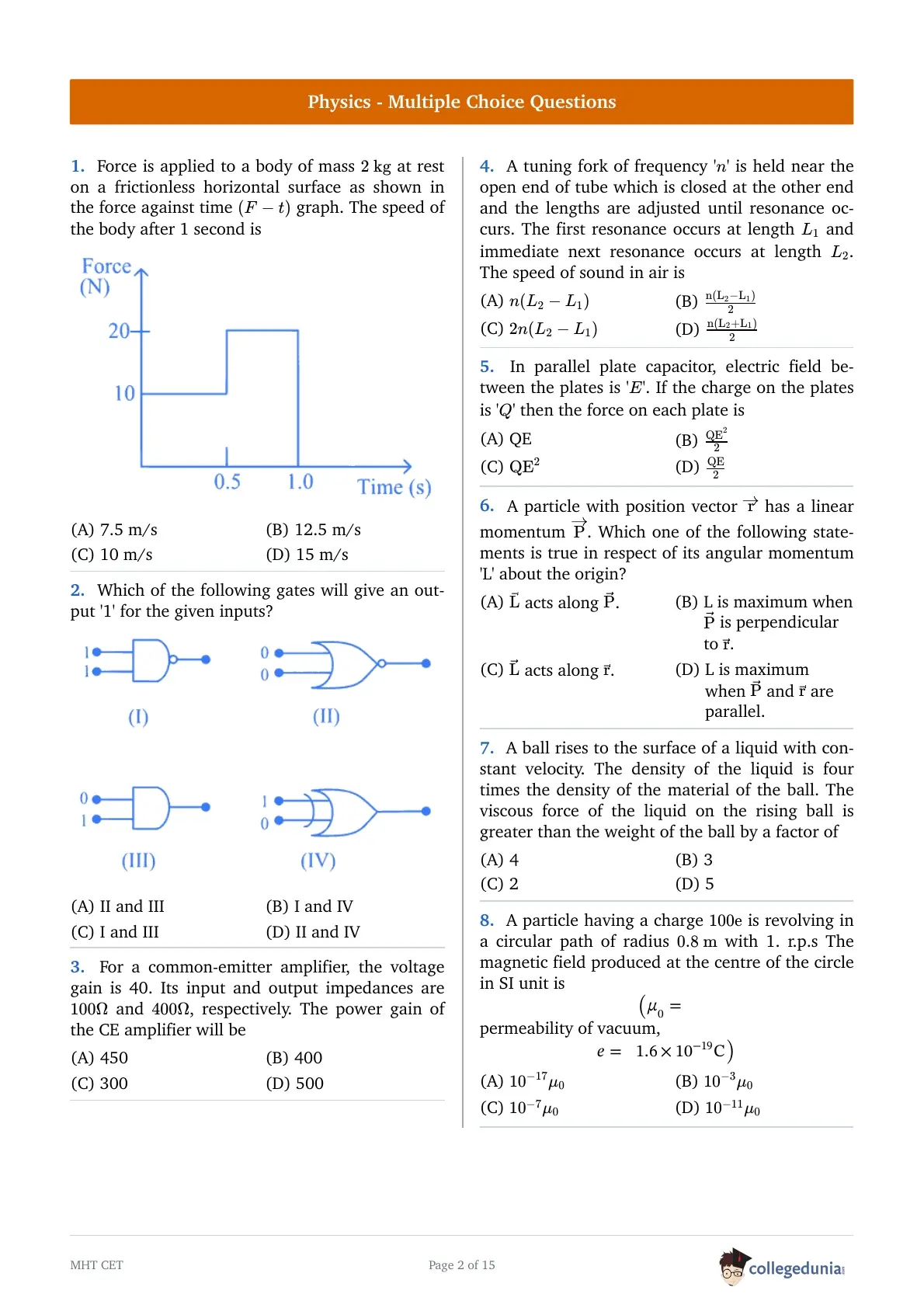
Force is applied to a body of mass \(2\text{ kg}\) at rest on a frictionless horizontal surface as shown in the force against time (\(F-t\)) graph. The speed of the body after 1 second is

Which of the following gates will give an output '1' for the given inputs?

For a common-emitter amplifier, the voltage gain is \(40\). Its input and output impedances are \(100\ \Omega\) and \(400\ \Omega\), respectively. The power gain of the CE amplifier will be
A tuning fork of frequency '\(n\)' is held near the open end of a tube which is closed at the other end and the lengths are adjusted until resonance occurs. The first resonance occurs at length \(L_1\) and the immediate next resonance occurs at length \(L_2\). The speed of sound in air is
In a parallel plate capacitor, the electric field between the plates is '\(E\)'. If the charge on the plates is '\(Q\)', then the force on each plate is
A particle with position vector \(\vec{r}\) has a linear momentum \(\vec{P}\). Which one of the following statements is true in respect of its angular momentum 'L' about the origin?
A ball rises to the surface of a liquid with constant velocity. The density of the liquid is four times the density of the material of the ball. The viscous force of the liquid on the rising ball is greater than the weight of the ball by a factor of
A particle having a charge \(100e\) is revolving in a circular path of radius \(0.8\text{ m}\) with \(1\text{ r.p.s.}\). The magnetic field produced at the centre of the circle in SI unit is (\(\mu_0 = \text{permeability of vacuum}\), \(e = 1.6 \times 10^{-19}\text{ C}\))
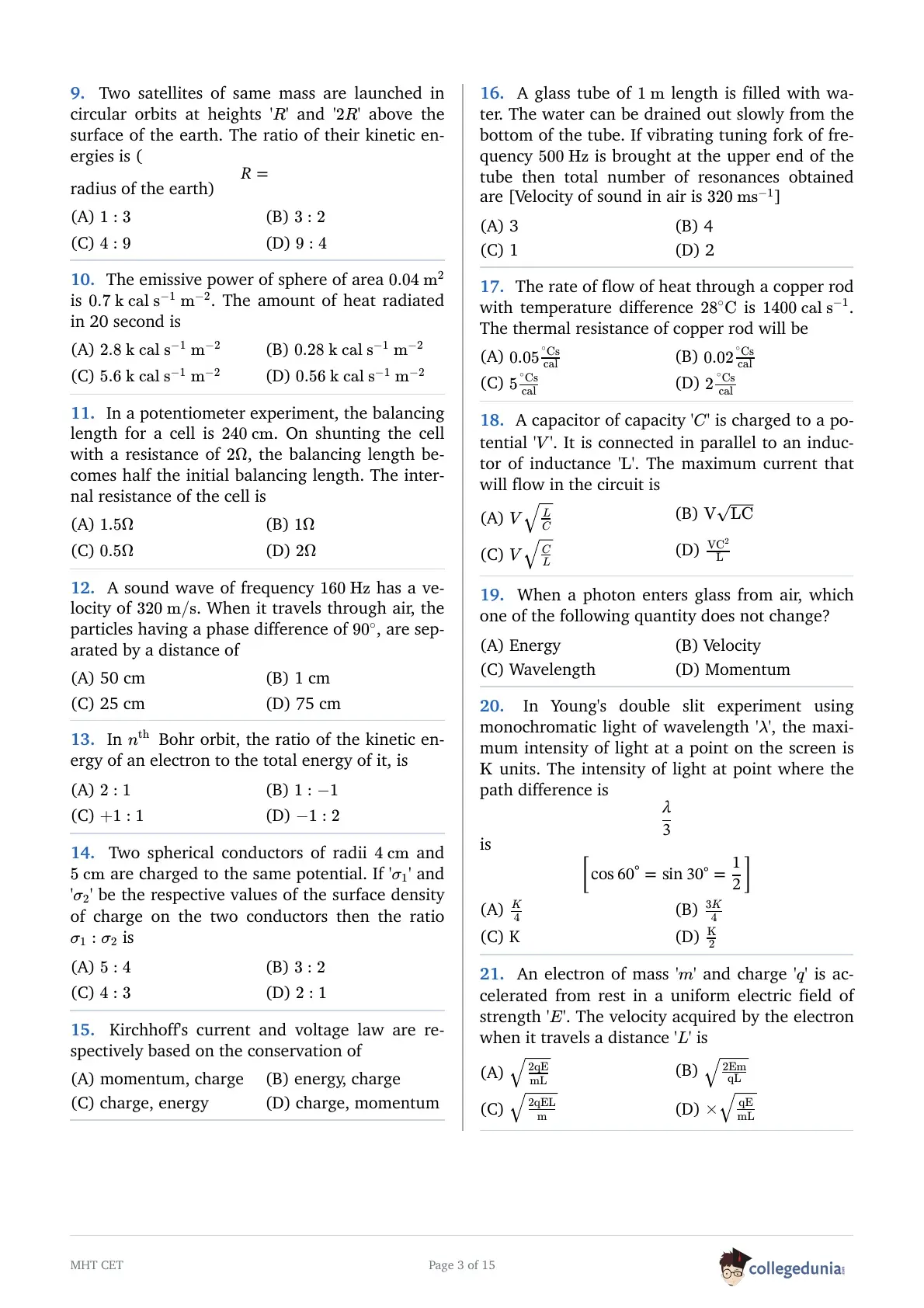
Two satellites of same mass are launched in circular orbits at heights '\(R\)' and '\(2R\)' above the surface of the earth. The ratio of their kinetic energies is (\(R = \text{radius of the earth}\))
The emissive power of a sphere of area \(0.04\text{ m}^2\) is \(0.7\text{ kcal}\cdot\text{s}^{-1}\cdot\text{m}^{-2}\). The amount of heat radiated in 20 seconds is
In a potentiometer experiment, the balancing length for a cell is \(240\text{ cm}\). On shunting the cell with a resistance of \(2\ \Omega\), the balancing length becomes half the initial balancing length. The internal resistance of the cell is
A sound wave of frequency \(160\text{ Hz}\) has a velocity of \(320\text{ m/s}\). When it travels through air, the particles having a phase difference of \(90^\circ\) are separated by a distance of
In \(n^{\text{th}}\) Bohr orbit, the ratio of the kinetic energy of an electron to the total energy of it, is
Two spherical conductors of radii \(4\text{ cm}\) and \(5\text{ cm}\) are charged to the same potential. If '\(\sigma_1\)' and '\(\sigma_2\)' be the respective values of the surface density of charge on the two conductors then the ratio \(\sigma_1 : \sigma_2\) is
Kirchhoff's current and voltage law are respectively based on the conservation of
A glass tube of \(1\text{ m}\) length is filled with water. The water can be drained out slowly from the bottom of the tube. If a vibrating tuning fork of frequency \(500\text{ Hz}\) is brought at the upper end of the tube, then the total number of resonances obtained are [Velocity of sound in air is \(320\text{ m/s}\)]
The rate of flow of heat through a copper rod with a temperature difference of \(28^\circ\text{C}\) is \(1400\text{ cal}\cdot\text{s}^{-1}\). The thermal resistance of the copper rod will be
A capacitor of capacity '\(C\)' is charged to a potential '\(V\)'. It is connected in parallel to an inductor of inductance '\(L\)'. The maximum current that will flow in the circuit is
When a photon enters glass from air, which one of the following quantities does not change?
In Young's double slit experiment using monochromatic light of wavelength '\(\lambda\)', the maximum intensity of light at a point on the screen is \(K\) units. The intensity of light at a point where the path difference is \(\frac{\lambda}{3}\) is
An electron of mass '\(m\)' and charge '\(q\)' is accelerated from rest in a uniform electric field of strength '\(E\)'. The velocity acquired by the electron when it travels a distance '\(L\)' is
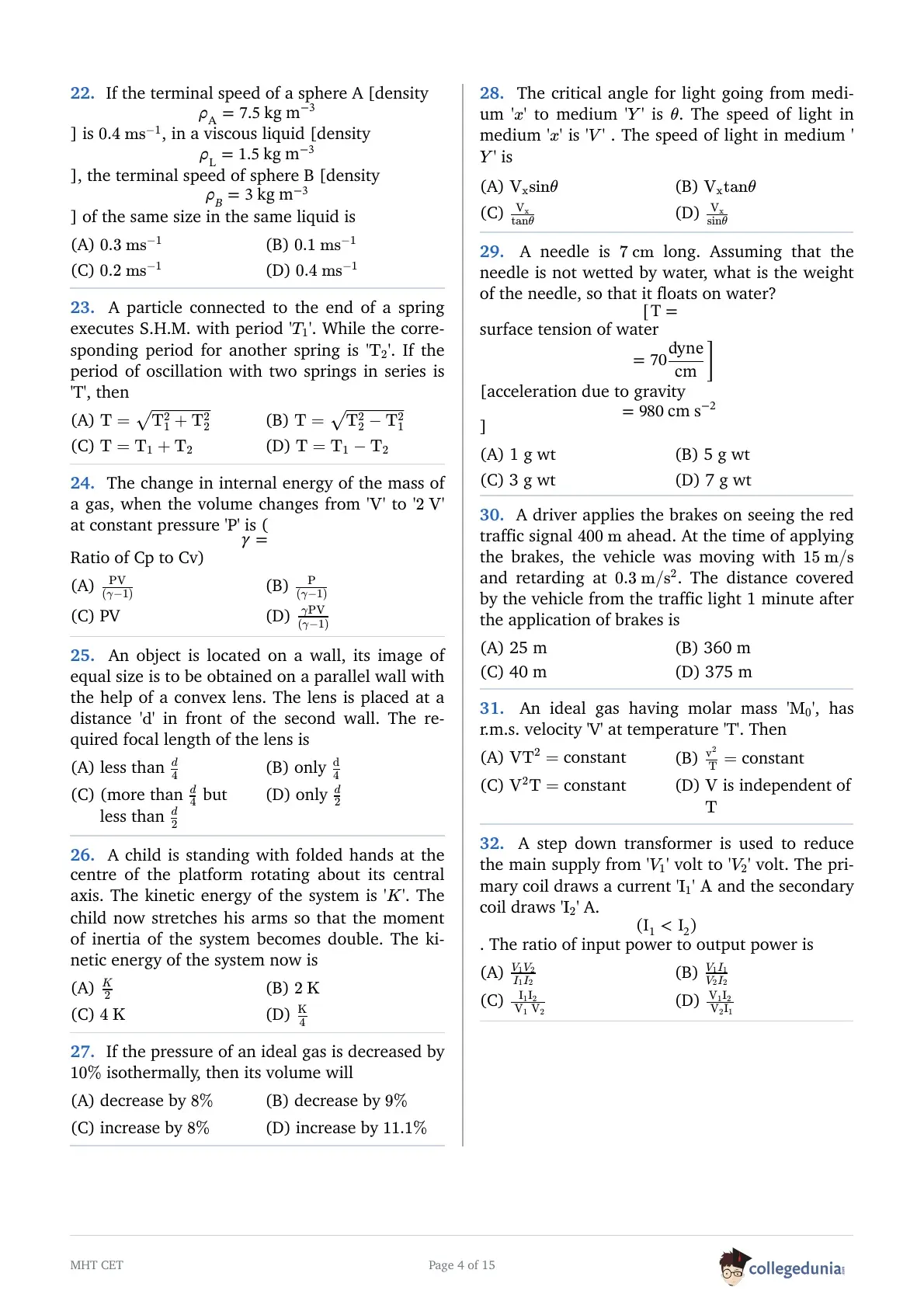
If the terminal speed of a sphere A [density \(\rho_A = 7.5\text{ kg}\cdot\text{m}^{-3}\)] is \(0.4\text{ m/s}\) in a viscous liquid [density \(\rho_L = 1.5\text{ kg}\cdot\text{m}^{-3}\)], then the terminal speed of a sphere B [density \(\rho_B = 3\text{ kg}\cdot\text{m}^{-3}\)] of the same size in the same liquid is
A particle connected to the end of a spring executes S.H.M. with period \(T_1\). While the corresponding period for another spring is \(T_2\). If the period of oscillation with two springs in series is \(T\), then
The change in internal energy of the mass of a gas, when the volume changes from \(V\) to \(2V\) at constant pressure \(P\) is (\(\gamma = \text{Ratio of } C_p \text{ to } C_v\))
An object is located on a wall, its image of equal size is to be obtained on a parallel wall with the help of a convex lens. The lens is placed at a distance '\(d\)' in front of the second wall. The required focal length of the lens is
A child is standing with folded hands at the centre of the platform rotating about its central axis. The kinetic energy of the system is '\(K\)'. The child now stretches his arms so that the moment of inertia of the system becomes double. The kinetic energy of the system now is
If the pressure of an ideal gas is decreased by 10% isothermally, then its volume will
The critical angle for light going from medium '\(x\)' to medium '\(Y\)' is \(\theta\). The speed of light in medium '\(x\)' is \(v\). The speed of light in medium '\(Y\)' is
A needle is \[7 \mathrm{~cm}\] long. Assuming that the needle is not wetted by water, what is the weight of the needle, so that it floats on water?
\[\left[\mathrm{T}=\right.\] surface tension of water \[\left.=70 \frac{\mathrm{dyne}}{\mathrm{cm}}\right]\]
[acceleration due to gravity \[=980 \mathrm{~cm} \mathrm{~s}^{-2}\]]
An ideal gas having molar mass \(M_0\), has r.m.s. velocity \(V\) at temperature \(T\). Then
A step-down transformer is used to reduce the main supply from \(V_1\) volt to \(V_2\) volt. The primary coil draws a current \(I_1\) A and the secondary coil draws \(I_2\) A (\(I_1 \lt I_2\)). The ratio of input power to output power is
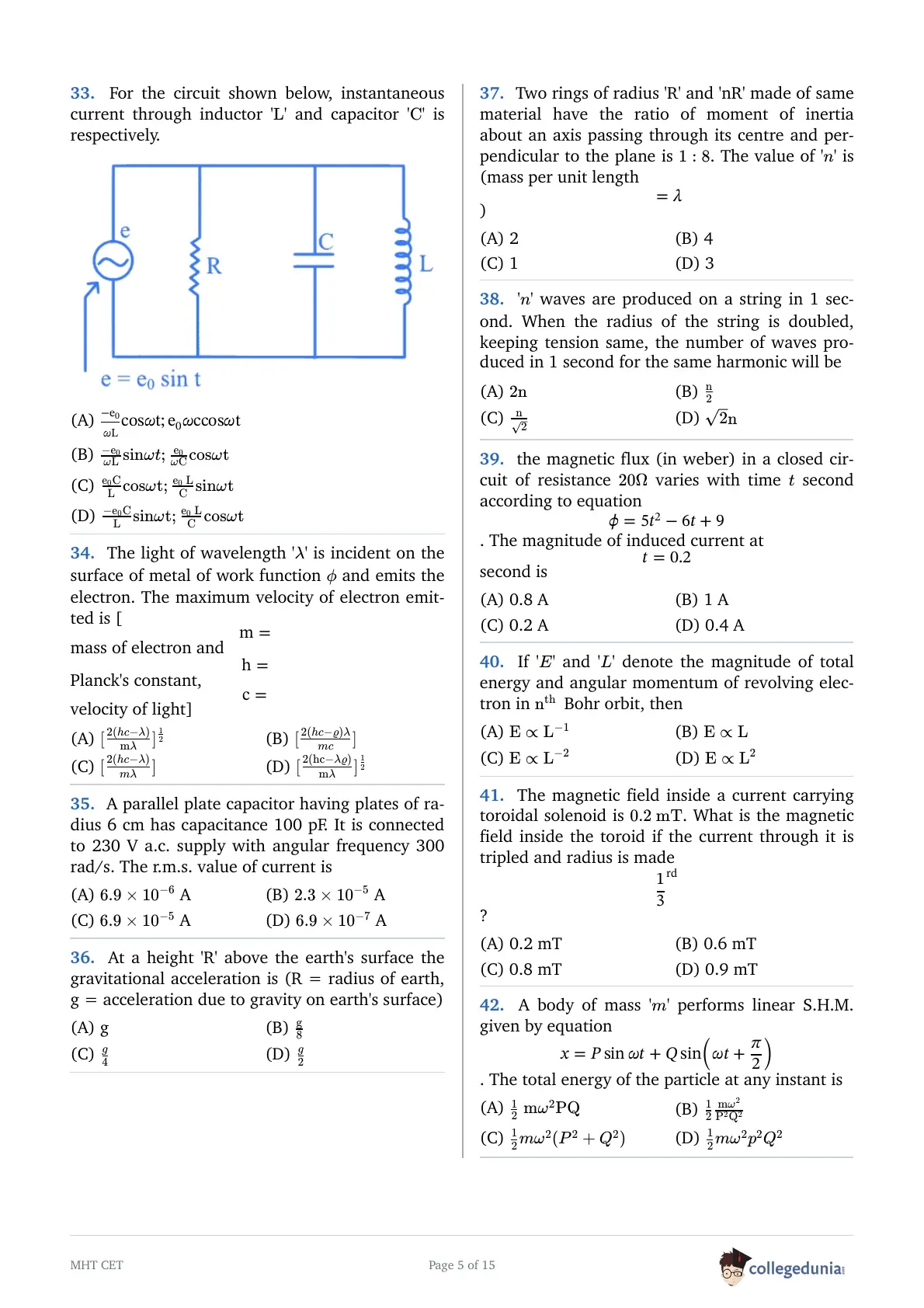
For the circuit shown below, instantaneous current through inductor '\(L\)' and capacitor '\(C\)' is respectively

The light of wavelength '\[\lambda\]' is incident on the surface of metal of work function \[\phi\] and emits the electron. The maximum velocity of electron emitted is [\[\mathrm{m}=\] mass of electron and \[\mathrm{h}=\] Planck's constant, \[\mathrm{c}=\] velocity of light]
A parallel plate capacitor having plates of radius \(6\text{ cm}\) has capacitance \(100\text{ pF}\). It is connected to \(230\text{ V}\) a.c. supply with angular frequency \(300\text{ rad/s}\). The r.m.s. value of current is
At a height 'R' above the earth's surface the gravitational acceleration is (R = radius of earth, g = acceleration due to gravity on earth's surface)
Two rings of radius 'R' and 'nR' made of same material have the ratio of moment of inertia about an axis passing through its centre and perpendicular to the plane is \(1 : 8\). The value of 'n' is (mass per unit length = \(\lambda\))
'n' waves are produced on a string in 1 second. When the radius of the string is doubled, keeping tension same, the number of waves produced in 1 second for the same harmonic will be
The magnetic flux (in weber) in a closed circuit of resistance \(20\ \Omega\) varies with time \(t\) second according to equation \(\phi = 5t^2 - 6t + 9\). The magnitude of induced current at \(t = 0.2\) second is
If '\(E\)' and '\(L\)' denote the magnitude of total energy and angular momentum of a revolving electron in the \(n^{\text{th}}\) Bohr orbit, then
The magnetic field inside a current carrying toroidal solenoid is \(0.2\text{ mT}\). What is the magnetic field inside the toroid if the current through it is tripled and the cross-sectional radius is made \(\frac{1}{3}^{\text{rd}}\)?
A body of mass '\(m\)' performs linear S.H.M. given by the equation \(x = P \sin \omega t + Q \sin \left(\omega t + \frac{\pi}{2}\right)\). The total energy of the particle at any instant is
Two particles \(A\) and \(B\) having same mass have charge \(+q\) and \(+4q\) respectively. When they are allowed to fall from rest through same electric potential difference, the ratio of their speeds \(V_A\) to \(V_B\) will become
The relative permeability of iron is 2000. Its absolute permeability in SI unit will be [\(\frac{\mu_0}{4\pi} = 10^{-7}\text{ T}\cdot\text{m}\cdot\text{A}^{-1}\)]
Choose the correct statement. In semiconductors, the valence band and conduction band are
A step-down transformer has a turns ratio of \(20 : 1\). If \(8\text{ V}\) is applied across a \(0.4\ \Omega\) secondary load, then the primary current will be
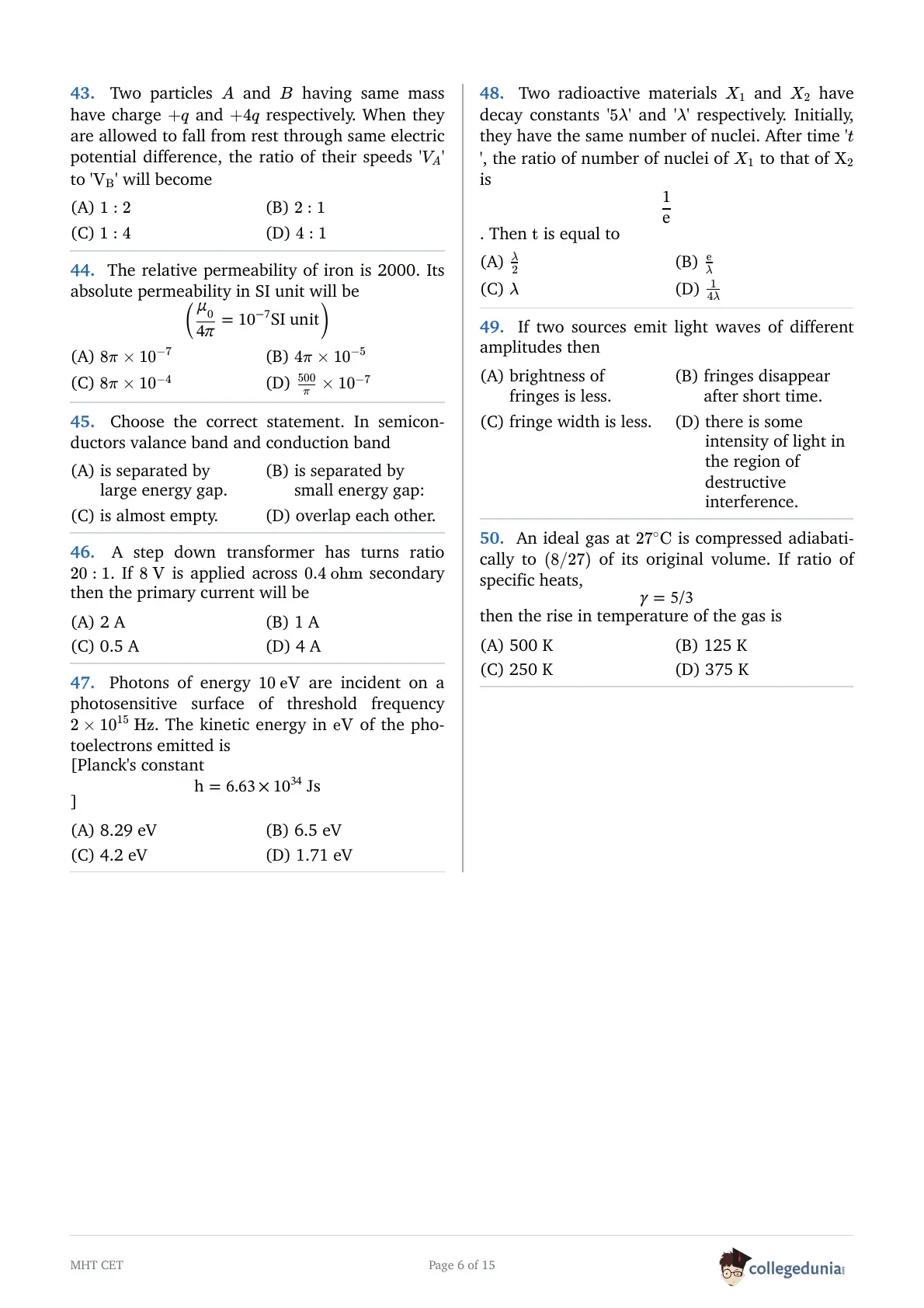
Photons of energy \[10 \mathrm{~eV}\] are incident on a photosensitive surface of threshold frequency \[2 \times 10^{15} \mathrm{~Hz}\]. The kinetic energy in \[\mathrm{eV}\] of the photoelectrons emitted is
[Planck's constant \[\mathrm{h}=6.63 \times 10^{34} \mathrm{~Js}\] ]
Two radioactive materials \(X_1\) and \(X_2\) have decay constants '\(5\lambda\)' and '\(\lambda\)' respectively. Initially, they have the same number of nuclei. After time '\(t\)', the ratio of number of nuclei of \(X_1\) to that of \(X_2\) is \(\frac{1}{e}\). Then \(t\) is equal to
If two sources emit light waves of different amplitudes then
An ideal gas at \(27^\circ\text{C}\) is compressed adiabatically to \(\left(\frac{8}{27}\right)\) of its original volume. If the ratio of specific heats, \(\gamma = \frac{5}{3}\) then the rise in temperature of the gas is
Chemistry (Q51 - Q100)
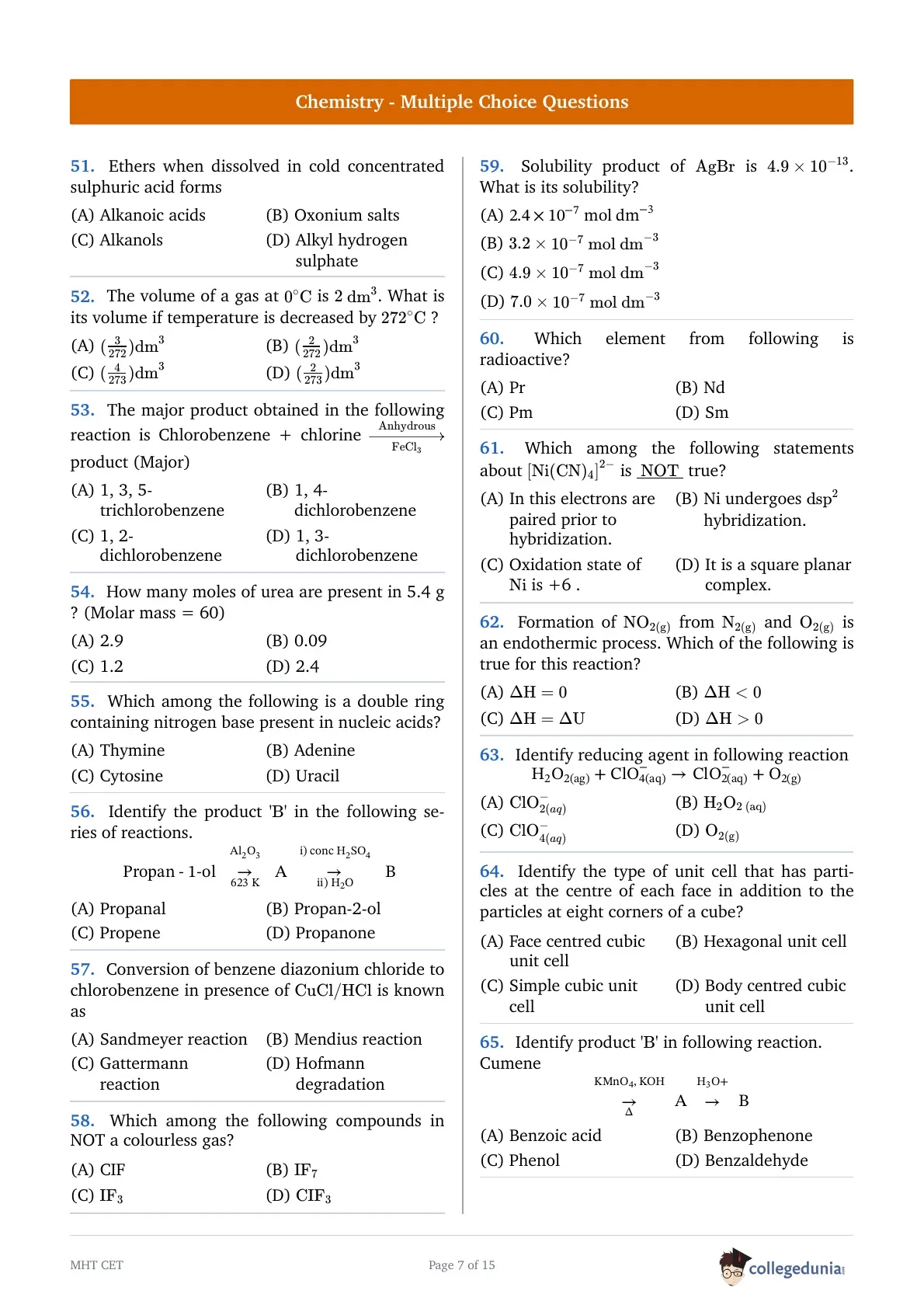
Ethers when dissolved in cold concentrated sulphuric acid forms
The volume of a gas at \(0^\circ \text{C}\) is \(2\ \text{dm}^3\). What is its volume if temperature is decreased by \(272^\circ \text{C}\)?
The major product obtained in the following reaction is Chlorobenzene + chlorine \(\xrightarrow{\text{Anhydrous }\text{FeCl}_3}\) product (Major)
How many moles of urea are present in 5.4 g ? (Molar mass = 60)
Which among the following is a double ring containing nitrogen base present in nucleic acids?
Identify the product 'B' in the following series of reactions:
\(\text{Propan-1-ol} \xrightarrow{623\ \text{K},\ \text{Al}_2\text{O}_3} \text{A} \xrightarrow[\text{ii) }\text{H}_2\text{O}]{\text{i) conc. }\text{H}_2\text{SO}_4} \text{B}\)
Conversion of benzene diazonium chloride to chlorobenzene in presence of CuCl / HCl is known as
Which among the following compounds is NOT a colourless gas?
Solubility product of AgBr is \(4.9 \times 10^{-13}\). What is its solubility?
Which element from following is radioactive?
Which among the following statements about \([\text{Ni}(\text{CN})_4]^{2-}\) is NOT true?
Formation of \(\text{NO}_{2(g)}\) from \(\text{N}_{2(g)}\) and \(\text{O}_{2(g)}\) is an endothermic process. Which of the following is true for this reaction?
Identify reducing agent in following reaction:
\(\text{H}_2\text{O}_{2(aq)} + \text{ClO}_{4(aq)}^- \rightarrow \text{ClO}_{2(aq)}^- + \text{O}_{2(g)}\)
Identify the type of unit cell that has particles at the centre of each face in addition to the particles at eight corners of a cube?
Identify product 'B' in following reaction:
\(\text{Cumene} \xrightarrow{\text{KMnO}_4,\ \text{KOH},\ \Delta} \text{A} \xrightarrow{\text{H}_3\text{O}^+} \text{B}\)
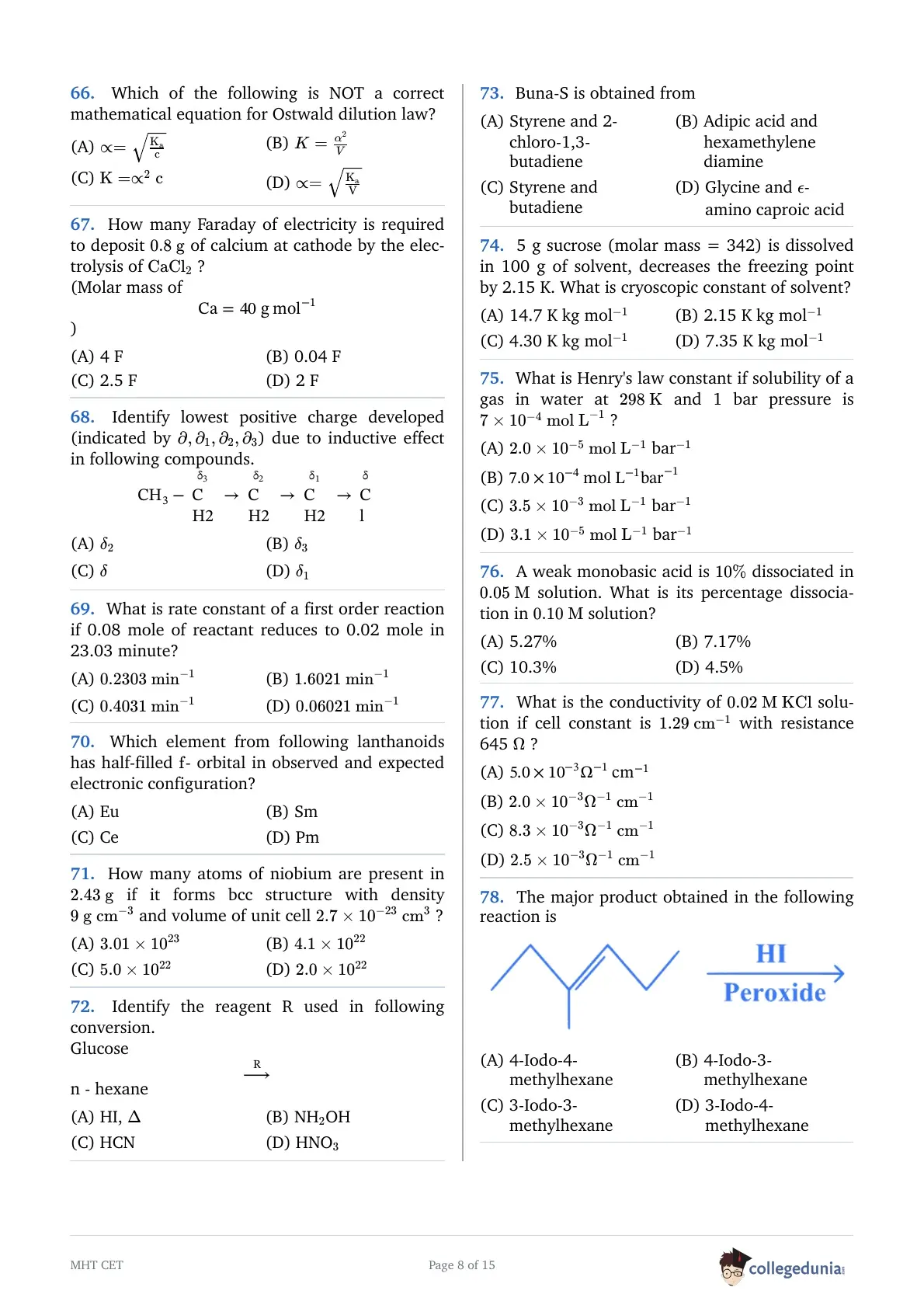
Which of the following is NOT a correct mathematical equation for Ostwald dilution law?
How many Faraday of electricity is required to deposit 0.8 g of calcium at cathode by the electrolysis of \(\text{CaCl}_2\)? (Molar mass of Ca = \(40\ \text{g}\ \text{mol}^{-1}\))
Identify lowest positive charge developed (indicated by \(\partial, \partial_1, \partial_2, \partial_3\)) due to inductive effect in following compounds: \(\text{CH}_3-\text{CH}_2^{\delta_3} \rightarrow \text{CH}_2^{\delta_2} \rightarrow \text{CH}_2^{\delta_1} \rightarrow \text{Cl}^\delta\)
What is rate constant of a first order reaction if 0.08 mole of reactant reduces to 0.02 mole in 23.03 minute?
Which element from following lanthanoids has half-filled f-orbital in observed and expected electronic configuration?
How many atoms of niobium are present in \(2.43\ \text{g}\) if it forms bcc structure with density \(9\ \text{g}\ \text{cm}^{-3}\) and volume of unit cell \(2.7 \times 10^{-23}\ \text{cm}^3\)?
Identify the reagent R used in following conversion.
Glucose \[\mathrm{\buildrel R \over \longrightarrow}\] n - hexane
Buna-S is obtained from
5 g sucrose (molar mass = 342) is dissolved in 100 g of solvent, decreases the freezing point by 2.15 K. What is cryoscopic constant of solvent?
What is Henry's law constant if solubility of a gas in water at 298 K and 1 bar pressure is \(7 \times 10^{-4}\ \text{mol}\ \text{L}^{-1}\)?
A weak monobasic acid is 10% dissociated in 0.05 M solution. What is its percentage dissociation in 0.10 M solution?
What is the conductivity of 0.02 M KCl solution if cell constant is \(1.29\ \text{cm}^{-1}\) with resistance 645 \(\Omega\)?

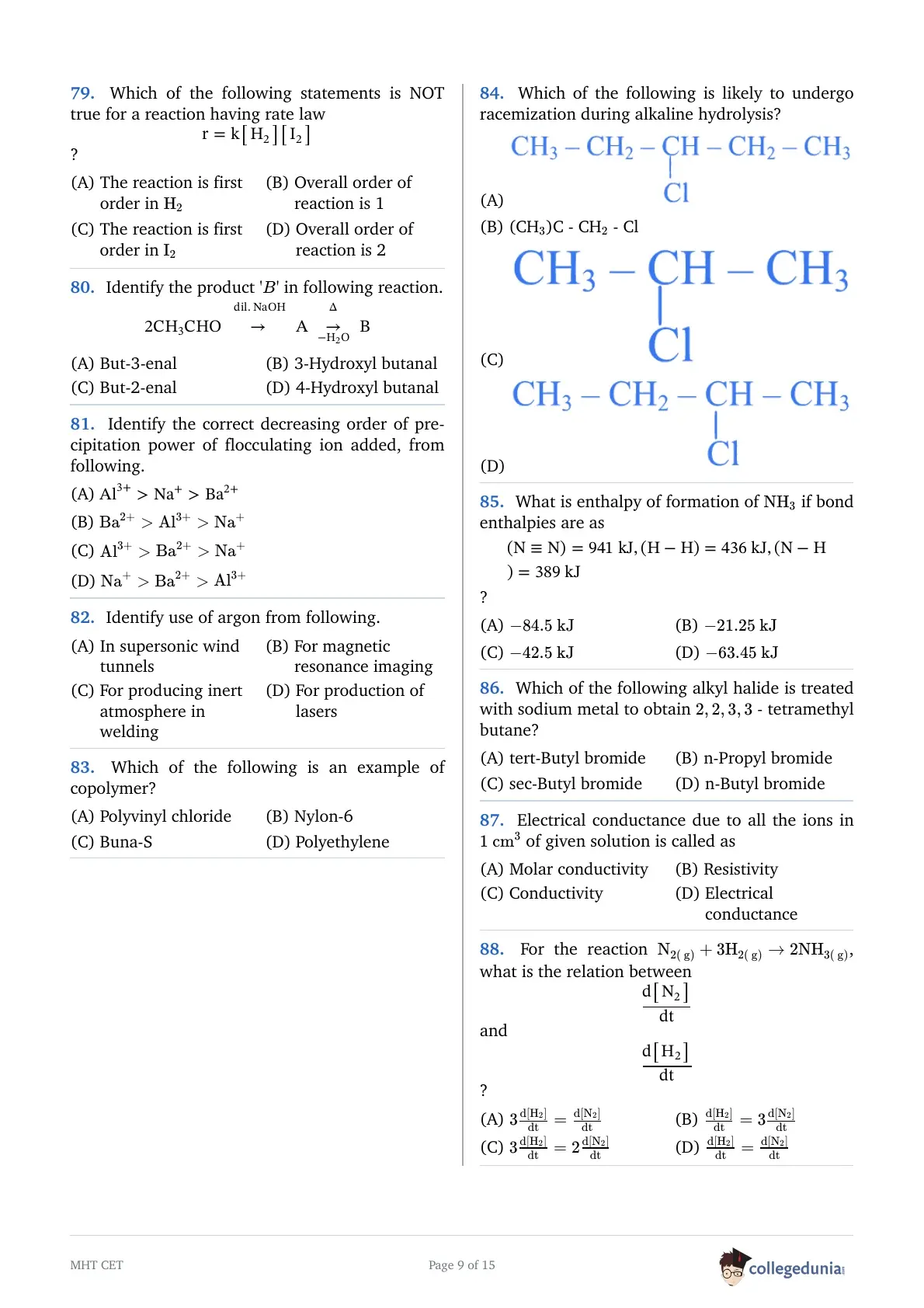
Which of the following statements is NOT true for a reaction having rate law \(r = k [\text{H}_2][\text{I}_2]\)?
Identify the product 'B' in following reaction:
\(2\text{CH}_3\text{CHO} \xrightarrow{\text{dil. NaOH}} \text{A} \xrightarrow[-\text{H}_2\text{O}]{\Delta} \text{B}\)
Identify the correct decreasing order of precipitation power of flocculating ion added, from following.
Identify use of argon from following.
Which of the following is an example of copolymer?
Which of the following is likely to undergo racemization during alkaline hydrolysis?
- (A)
![]()
- (B) (CH\({}_{3}\))C - CH\({}_{2}\) - Cl
- (C)
![]()
- (D)
![]()


What is enthalpy of formation of \(\text{NH}_3\) if bond enthalpies are as \((\text{N}\equiv\text{N}) = 941\ \text{kJ}\), \((\text{H}-\text{H}) = 436\ \text{kJ}\), \((\text{N}-\text{H}) = 389\ \text{kJ}\)?
Which of the following alkyl halide is treated with sodium metal to obtain 2,2,3,3-tetramethyl butane?
Electrical conductance due to all the ions in \(1\ \text{cm}^3\) of given solution is called as
For the reaction \(\text{N}_{2(g)} + 3\text{H}_{2(g)} \rightarrow 2\text{NH}_{3(g)}\), what is the relation between \(\frac{d[\text{N}_2]}{dt}\) and \(\frac{d[\text{H}_2]}{dt}\)?
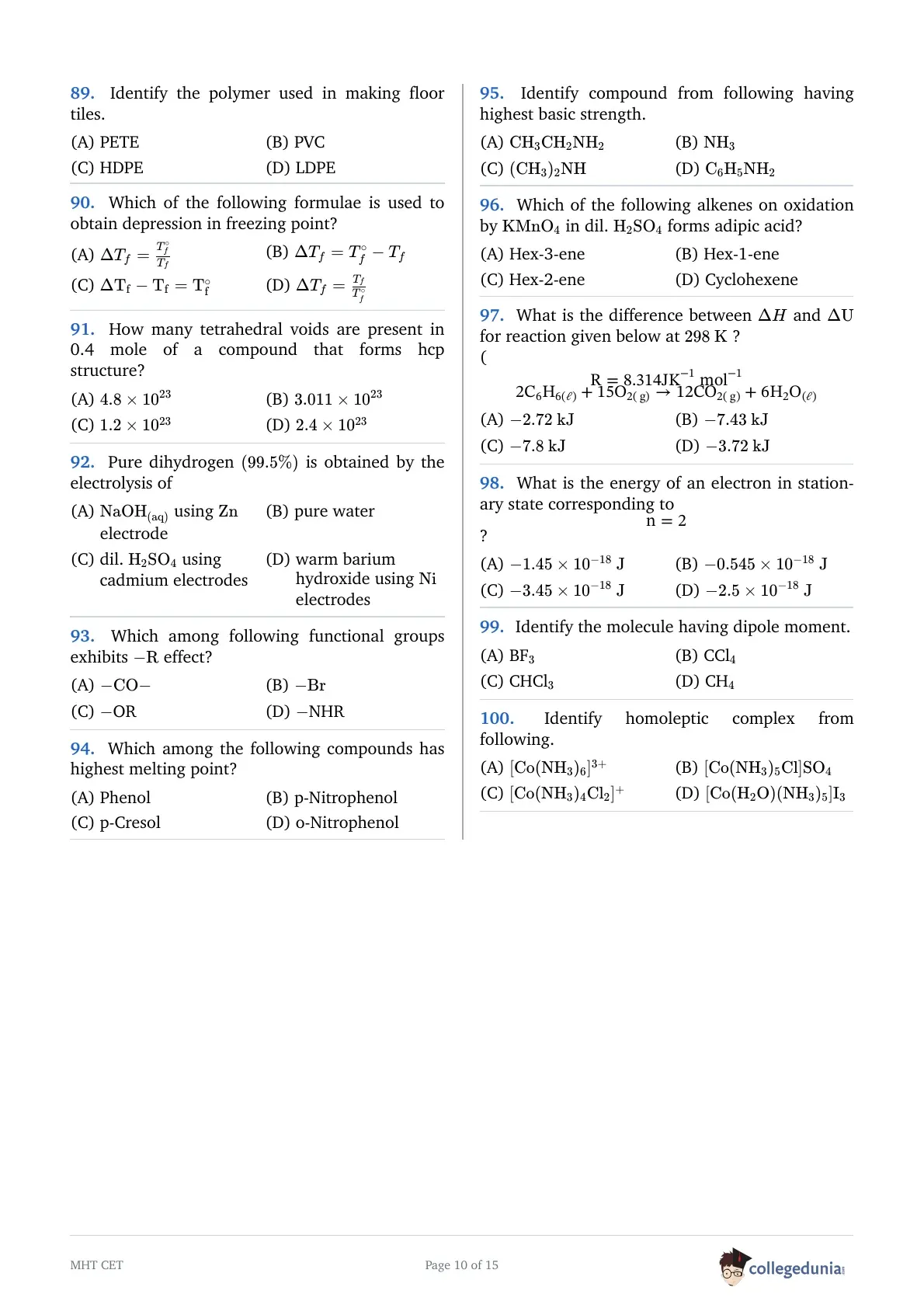
Identify the polymer used in making floor tiles.
Which of the following formulae is used to obtain depression in freezing point?
How many tetrahedral voids are present in 0.4 mole of a compound that forms hcp structure?
Pure dihydrogen (99.5%) is obtained by the electrolysis of
Which among following functional groups exhibits \(-\text{R}\) effect?
Which among the following compounds has highest melting point?
Identify compound from following having highest basic strength.
Which of the following alkenes on oxidation by \(\text{KMnO}_4\) in dil. \(\text{H}_2\text{SO}_4\) forms adipic acid?
What is the difference between \(\Delta H\) and \(\Delta U\) for reaction given below at 298 K?
(R = 8.314 \(\text{J}\ \text{K}^{-1}\ \text{mol}^{-1}\))
\(2\text{C}_6\text{H}_{6(\ell)} + 15\text{O}_{2(g)} \rightarrow 12\text{CO}_{2(g)} + 6\text{H}_2\text{O}_{(\ell)}\)
What is the energy of an electron in stationary state corresponding to n = 2?
Identify the molecule having a non-zero dipole moment.
Identify the homoleptic complex from the following.
Mathematics (Q101 - Q150)
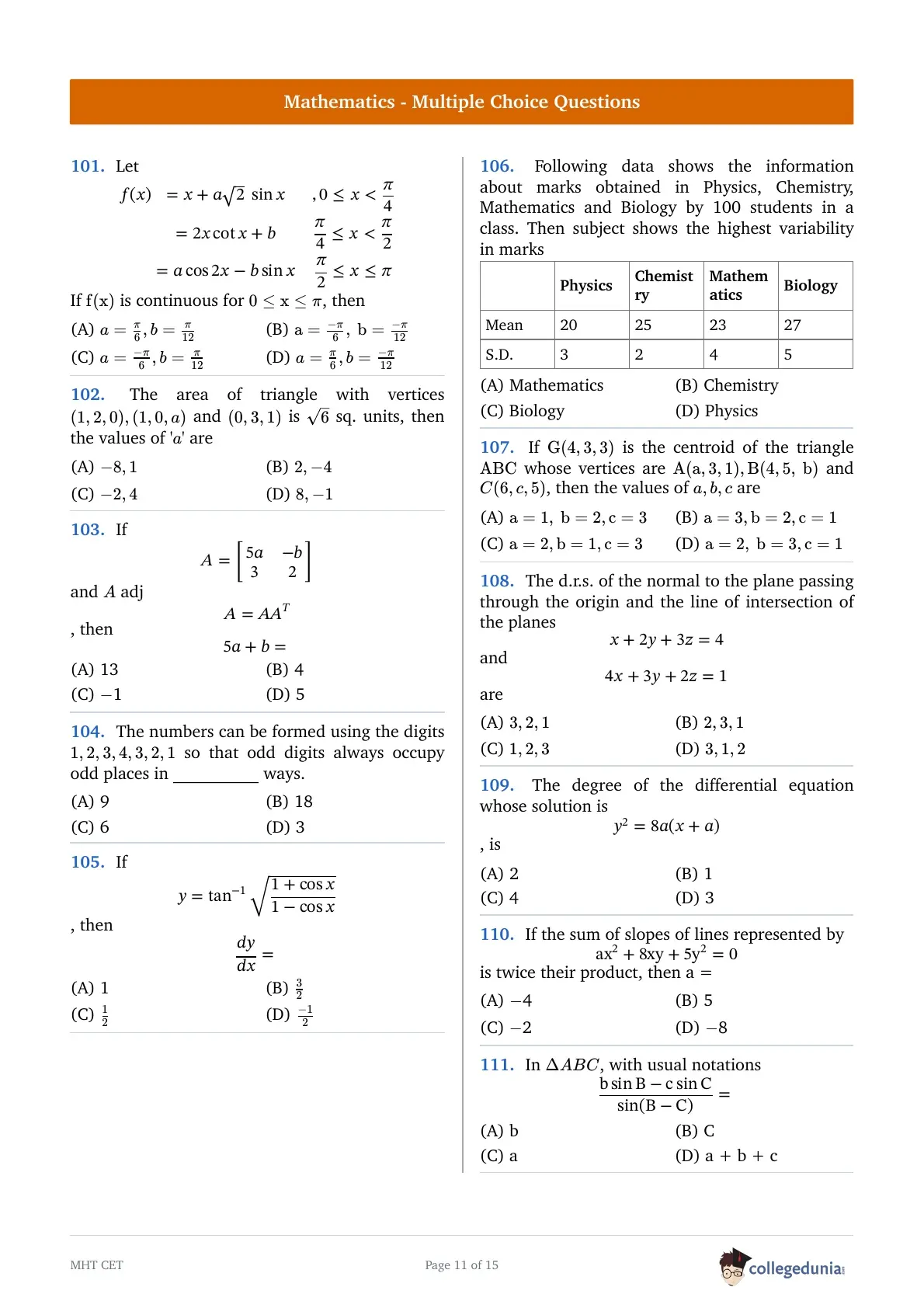
Let
\(\begin{aligned} f(x) &= x+a\sqrt{2}\sin x, & & 0 \leq x < \frac{\pi}{4} \\ &= 2x\cot x+b, & & \frac{\pi}{4} \leq x < \frac{\pi}{2} \\ &= a\cos 2x-b\sin x, & & \frac{\pi}{2} \leq x \leq \pi \end{aligned}\)
If \(f(x)\) is continuous for \(0 \leq x \leq \pi\), then
The area of triangle with vertices \((1,2,0)\), \((1,0,a)\) and \((0,3,1)\) is \(\sqrt{6}\) sq. units, then the values of '\(a\)' are
If \(A = \begin{bmatrix} 5a & -b \\ 3 & 2 \end{bmatrix}\) and \(A \cdot \text{adj } A = A \cdot A^T\), then \(5a + b =\)
The numbers can be formed using the digits \(1, 2, 3, 4, 3, 2, 1\) so that odd digits always occupy odd places in ways.
If \(y = \tan^{-1}\left(\sqrt{\frac{1+\cos x}{1-\cos x}}\right)\), then \(\frac{dy}{dx} =\)
Following data shows the information about marks obtained in Physics, Chemistry, Mathematics and Biology by 100 students in a class. Then subject shows the highest variability in marks. Choose the correct subject from the options below:

If \(G(4,3,3)\) is the centroid of the triangle \(ABC\) whose vertices are \(A(a,3,1)\), \(B(4,5,b)\) and \(C(6,c,5)\), then the values of \(a\), \(b\), \(c\) are
The d.r.s. of the normal to the plane passing through the origin and the line of intersection of the planes \(x+2y+3z=4\) and \(4x+3y+2z=1\) are
The degree of the differential equation whose solution is \(y^2 = 8a(x+a)\), is
If the sum of slopes of lines represented by \(ax^2+8xy+5y^2=0\) is twice their product, then \(a =\)
In \(\Delta ABC\), with usual notations \(\frac{b\sin B - c\sin C}{\sin(B-C)} =\)
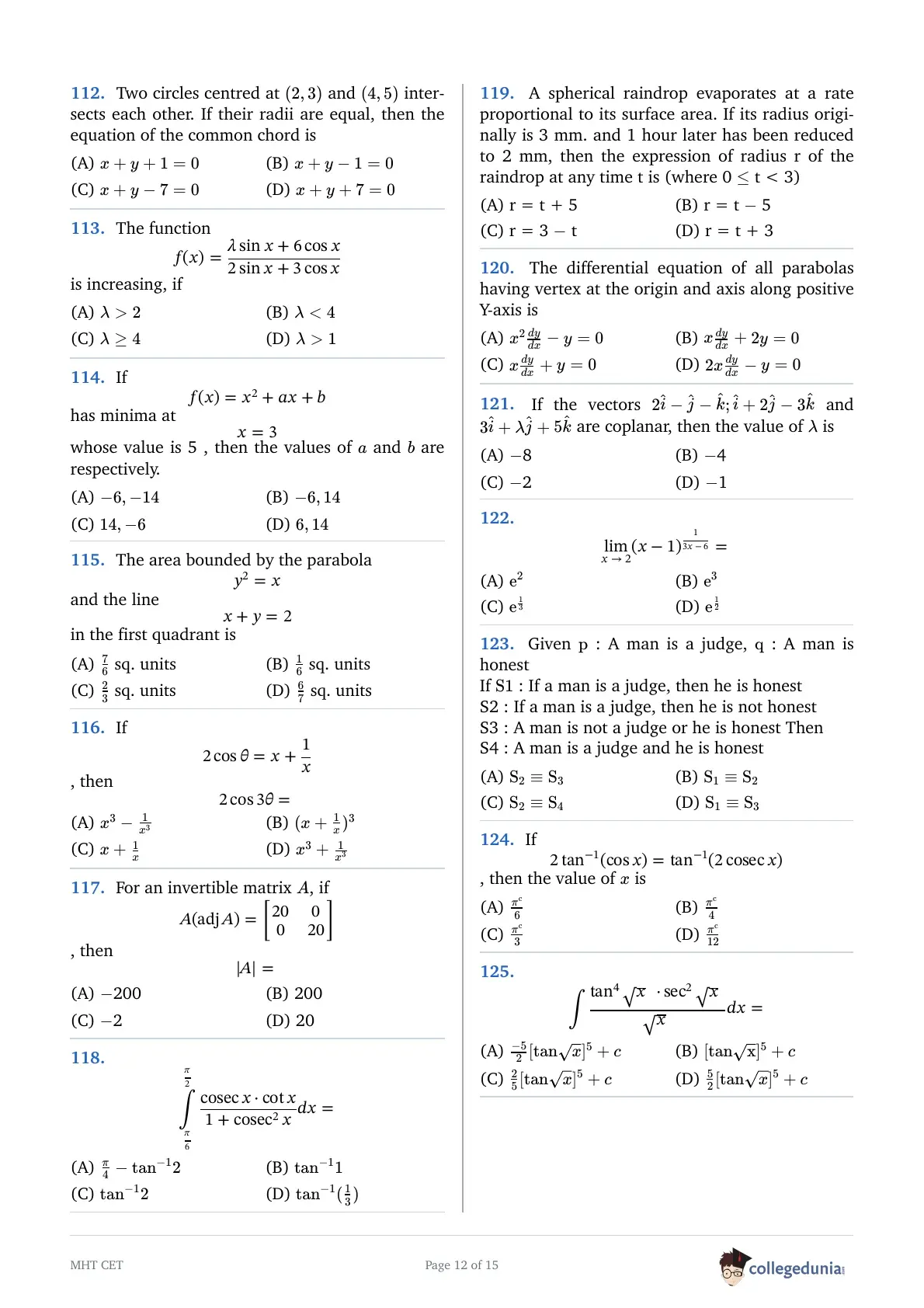
Two circles centred at \((2,3)\) and \((4,5)\) intersect each other. If their radii are equal, then the equation of the common chord is
The function \(f(x) = \frac{\lambda \sin x + 6 \cos x}{2 \sin x + 3 \cos x}\) is increasing, if
If \(f(x) = x^2 + ax + b\) has minima at \(x = 3\) whose value is \(5\), then the values of \(a\) and \(b\) are respectively
The area bounded by the parabola \(y^2 = x\) and the line \(x + y = 2\) in the first quadrant is
If \(2 \cos \theta = x + \frac{1}{x}\), then \(2 \cos 3\theta =\)
For an invertible matrix \(A\), if \(A(\text{adj } A) = \begin{bmatrix} 20 & 0 \\ 0 & 20 \end{bmatrix}\), then \(|A| =\)
\(\int_\limits{\frac{\pi}{6}}^{\frac{\pi}{2}} \frac{\operatorname{cosec} x \cdot \cot x}{1+\operatorname{cosec}^2 x} d x=\)
A spherical raindrop evaporates at a rate proportional to its surface area. If its radius originally is \(3\text{ mm}\) and \(1\text{ hour}\) later has been reduced to \(2\text{ mm}\), then the expression of radius \(r\) of the raindrop at any time \(t\) is (where \(0 \le t \lt 3\))
The differential equation of all parabolas having vertex at the origin and axis along positive Y-axis is
If the vectors \(2\hat{i} - \hat{j} - \hat{k}\), \(\hat{i} + 2\hat{j} - 3\hat{k}\) and \(3\hat{i} + \lambda\hat{j} + 5\hat{k}\) are coplanar, then the value of \(\lambda\) is
Given \(p\) : A man is a judge, \(q\) : A man is honest.
If \(S_1\) : If a man is a judge, then he is honest
\(S_2\) : If a man is a judge, then he is not honest
\(S_3\) : A man is not a judge or he is honest
\(S_4\) : A man is a judge and he is honest
Then
If \(2 \tan^{-1}(\cos x) = \tan^{-1}(2 \csc x)\), then the value of \(x\) is
\(\int \frac{\tan ^4 \sqrt{x} \cdot \sec ^2 \sqrt{x}}{\sqrt{x}} d x=\)
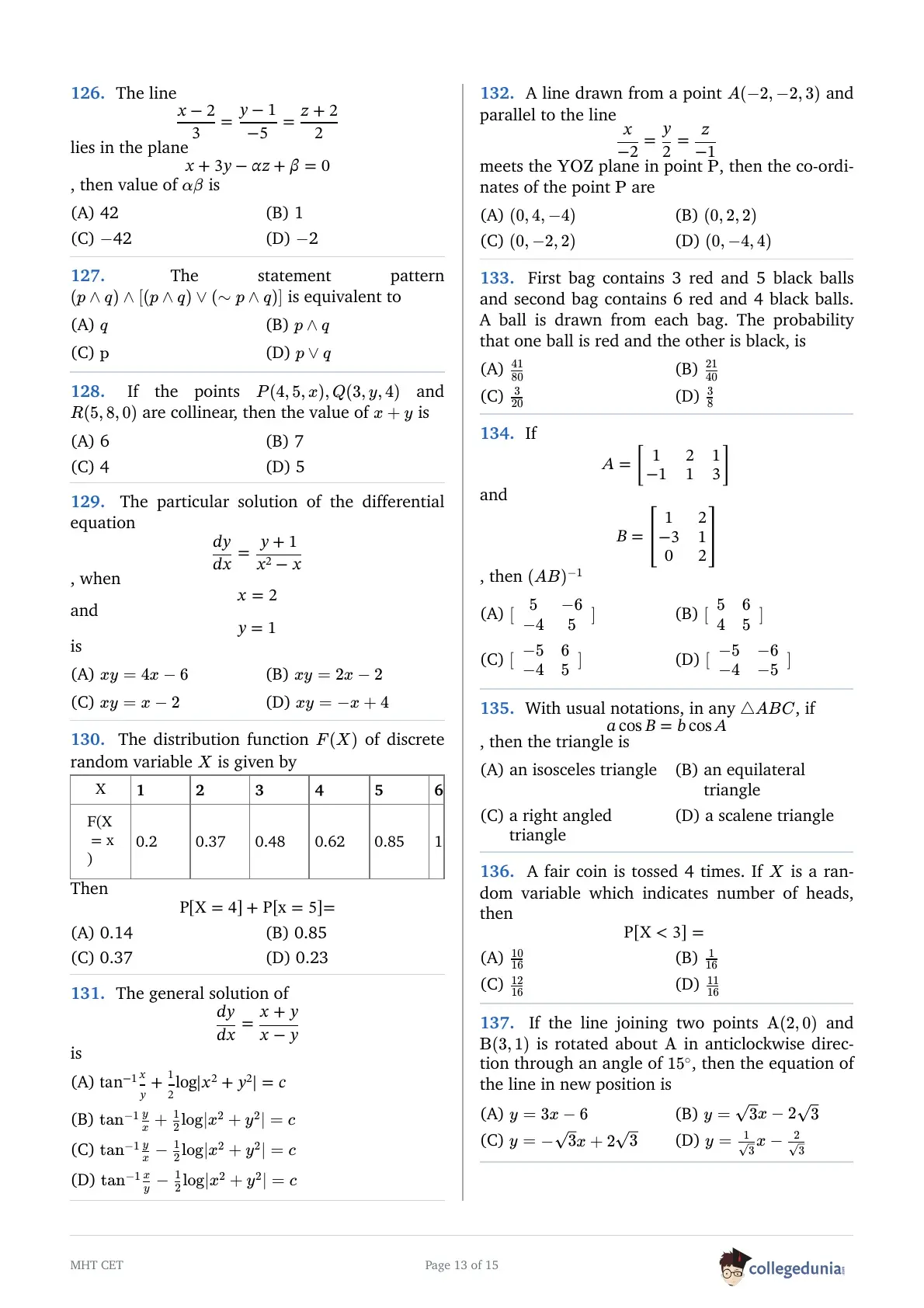
The line \(\frac{x-2}{3} = \frac{y-1}{-5} = \frac{z+2}{2}\) lies in the plane \(x + 3y - \alpha z + \beta = 0\), then value of \(\alpha \beta\) is
The statement pattern \((p \wedge q) \wedge [(p \wedge q) \vee (\sim p \wedge q)]\) is equivalent to
If the points \(P(4,5,x)\), \(Q(3,y,4)\) and \(R(5,8,0)\) are collinear, then the value of \(x+y\) is
The particular solution of the differential equation \(\frac{dy}{dx} = \frac{y+1}{x^2-x}\), when \(x=2\) and \(y=1\) is
The distribution function \[F(X)\] of discrete random variable \[X\] is given by
| \[\mathrm{X}\] | 1 | 2 | 3 | 4 | 5 | 6 |
|---|---|---|---|---|---|---|
| \[\mathrm{F (X=x)}\] | 0.2 | 0.37 | 0.48 | 0.62 | 0.85 | 1 |
The general solution of \(\frac{dy}{dx} = \frac{x+y}{x-y}\) is
A line drawn from a point \(A(-2,-2,3)\) and parallel to the line \(\frac{x}{-2} = \frac{y}{2} = \frac{z}{-1}\) meets the \(YOZ\) plane in point \(P\), then the coordinates of the point \(P\) are
First bag contains 3 red and 5 black balls and second bag contains 6 red and 4 black balls. A ball is drawn from each bag. The probability that one ball is red and the other is black, is
If \(A = \begin{bmatrix} 1 & 2 & 1 \\ -1 & 1 & 3 \end{bmatrix}\) and \(B = \begin{bmatrix} 1 & 2 \\ -3 & 1 \\ 0 & 2 \end{bmatrix}\), then \((AB)^{-1} =\)
With usual notations, in any \(\Delta ABC\), if \(a\cos B = b\cos A\), then the triangle is
A fair coin is tossed 4 times. If \(X\) is a random variable which indicates number of heads, then \(P[X \lt 3] =\)
If the line joining two points \(A(2,0)\) and \(B(3,1)\) is rotated about \(A\) in anticlockwise direction through an angle of \(15^\circ\), then the equation of the line in its new position is
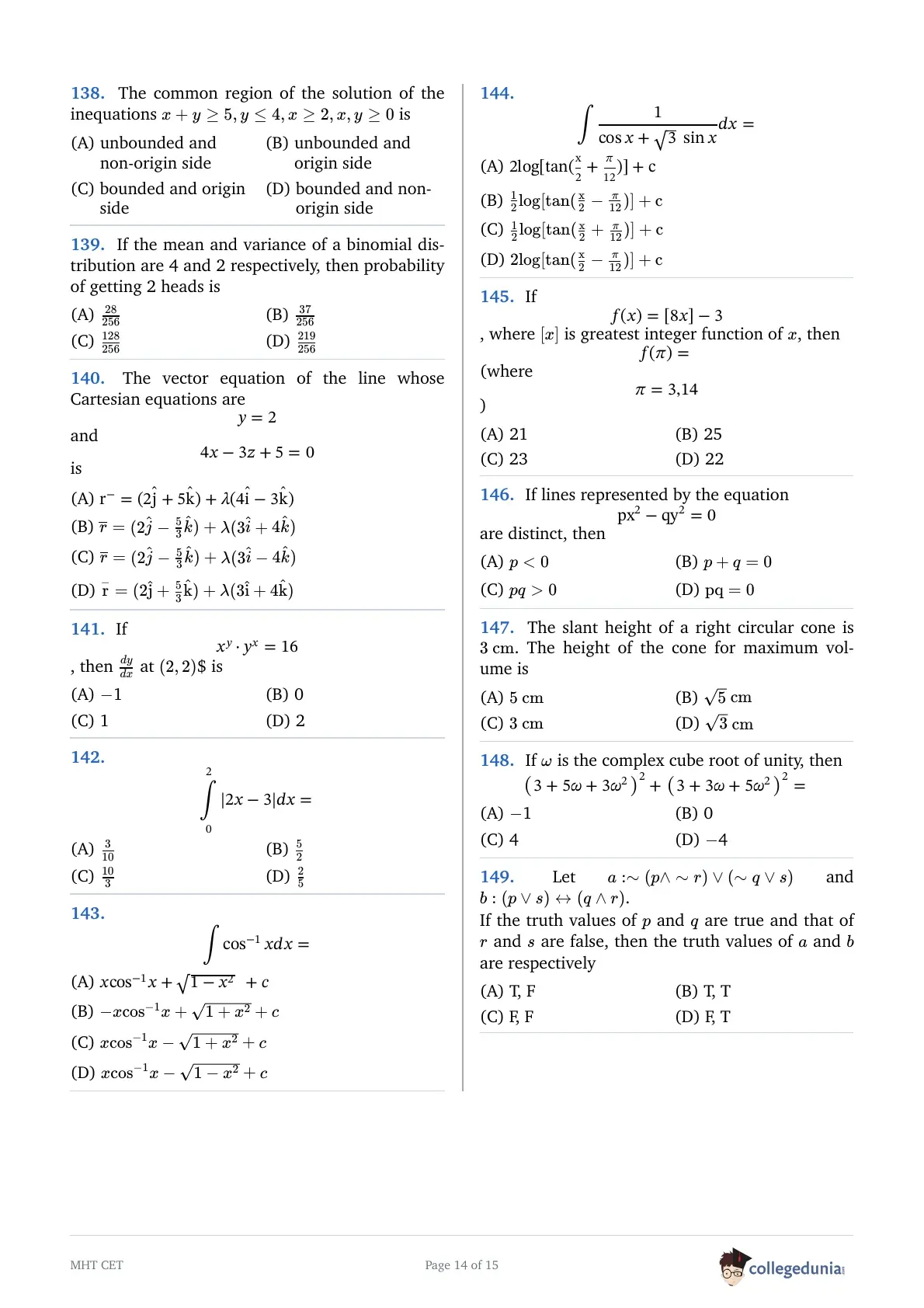
The common region of the solution of the inequations \(x+y \ge 5\), \(y \le 4\), \(x \ge 2\), \(x, y \ge 0\) is
If the mean and variance of a binomial distribution are 4 and 2 respectively, then probability of getting 2 successes is
If \(x^y \cdot y^x = 16\), then \(\frac{dy}{dx}\) at \((2,2)\) is
If \(f(x) = [8x] - 3\), where \([x]\) is the greatest integer function of \(x\), then \(f(\pi) =\) (where \(\pi = 3.14\))
If lines represented by the equation \(px^2 - qy^2 = 0\) are distinct, then
The slant height of a right circular cone is \(\sqrt{3}\text{ cm}\). The height of the cone for maximum volume is
If \(\omega\) is the complex cube root of unity, then \((3 + 5\omega + 3\omega^2)^2 + (3 + 3\omega + 5\omega^2)^2 =\)
Let \(a : \sim(p \wedge \sim r) \vee (\sim q \vee s)\) and \(b : (p \vee s) \leftrightarrow (q \wedge r)\). If the truth values of \(p\) and \(q\) are true and that of \(r\) and \(s\) are false, then the truth values of \(a\) and \(b\) are respectively
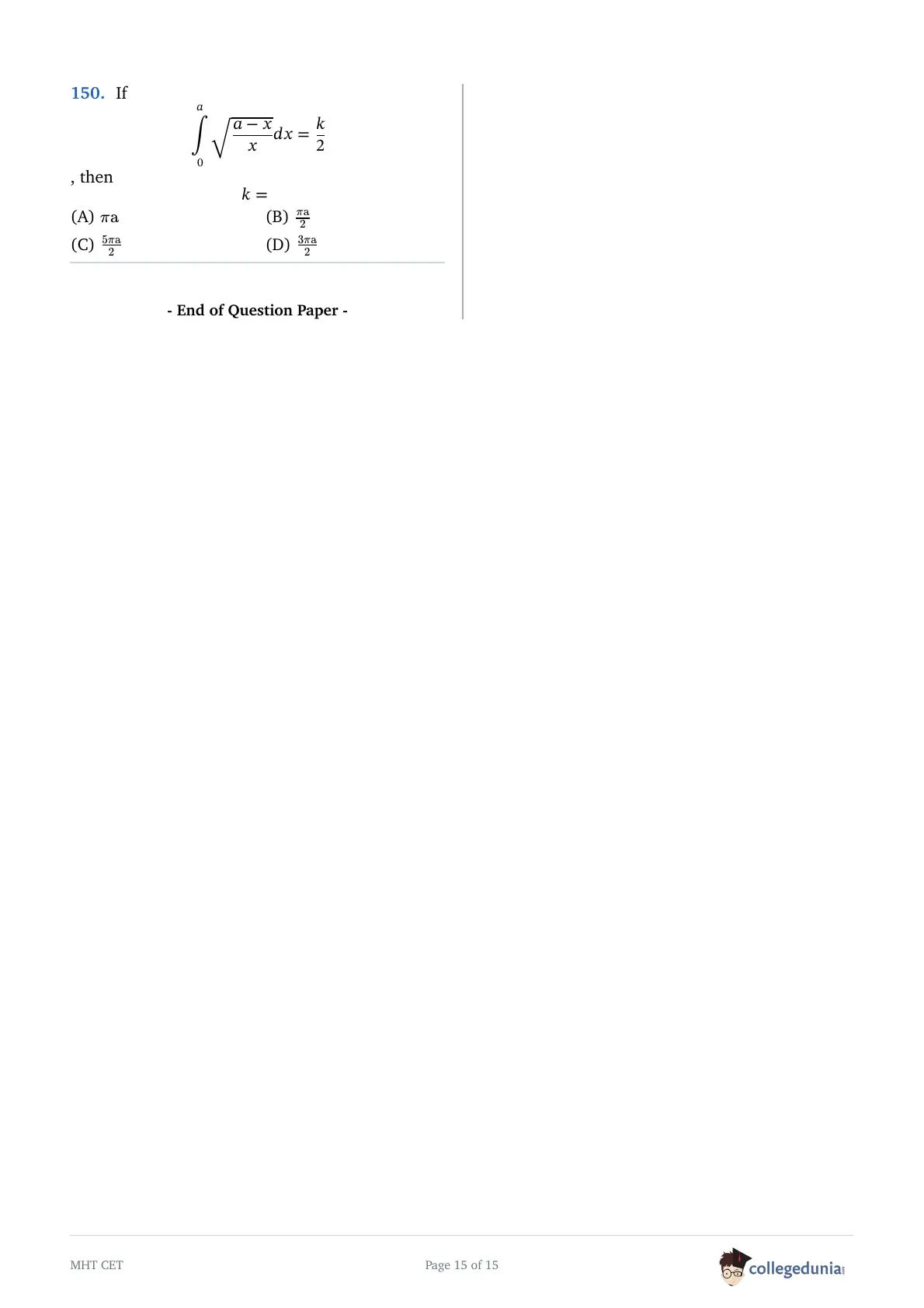
If \(\int_\limits0^a \sqrt{\frac{a-x}{x}} d x=\frac{k}{2}\), then \(k=\)
MHT CET 2021 PCM Exam Pattern and Marking Scheme
| Parameter | Details |
|---|---|
| Conducting Body | Maharashtra Common Entrance Test Cell (Maharashtra CET Cell) |
| Exam Mode | Online (Computer-Based Test) |
| Duration | 180 minutes (3 hours) |
| Groups / Subjects | PCM (Physics, Chemistry, Mathematics) for Engineering |
| Total Questions |
150 |
| Total Marks | 200 |
| Question Type | Multiple Choice Questions (MCQs) |
| Marks Distribution |
|
| Negative Marking | No |
| Syllabus Weightage |
|



Comments