




MHT CET 2021 Sep 23 Shift 1 PCM Question Paper is available for download here. Maharashtra State CET Cell conducted MHT CET 2021 PCM Exam on Sep 23 in Shift 1 from 9 AM to 12 PM in CBT mode.
The MHT CET 2021 PCM question paper includes the following:
- The MHT CET 2021 PCM Question Paper consists of 150 multiple-choice questions (MCQs) totalling 200 marks divided into 3 sections: Physics, Chemistry, and Mathematics, with 50 questions in each subject.
- Physics and Chemistry questions carry 1 mark each while Mathematics questions carry 2 marks each.
- There is no negative marking for incorrect answers.
MHT CET 2021 Sep 23 Shift 1 PCM Question Paper with Solution PDF
| CD PDF | CD PDF with Solutions |
|---|---|
| Download Collegedunia PDF 1.03 MB | - |
Also Check:
MHT CET 2021 Sep 23 Shift 1 PCM Questions with Solutions
Physics (Q1 - Q50)
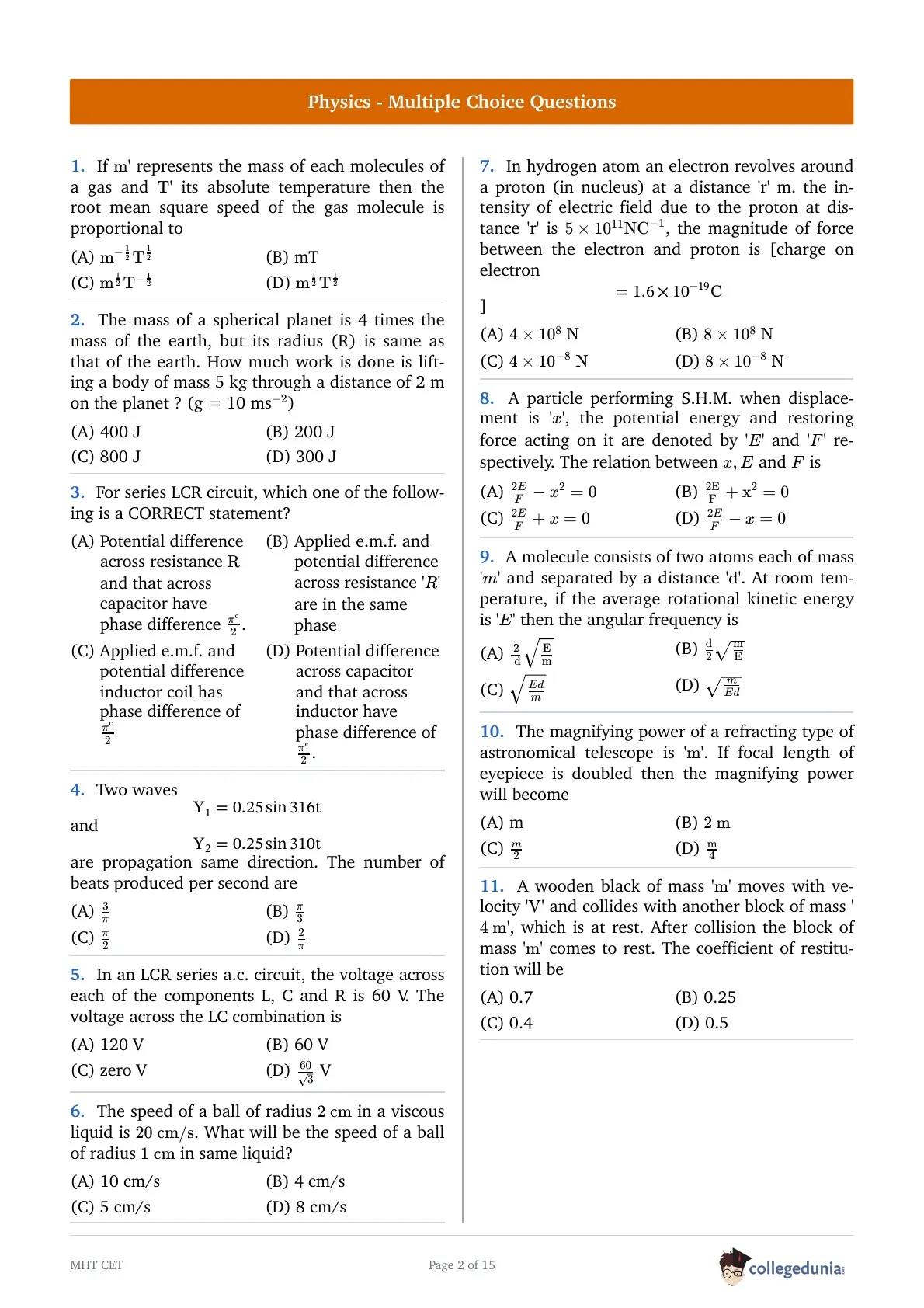
If \(m\) represents the mass of each molecule of a gas and \(T\) its absolute temperature, then the root mean square speed of the gas molecule is proportional to
The mass of a spherical planet is 4 times the mass of the earth, but its radius (\(R\)) is same as that of the earth. How much work is done in lifting a body of mass 5 kg through a distance of 2 m on the planet? (\(g = 10\ \text{ms}^{-2}\))
For series LCR circuit, which one of the following is a CORRECT statement?
Two waves \(Y_1 = 0.25 \sin(316t)\) and \(Y_2 = 0.25 \sin(310t)\) are propagating in the same direction. The number of beats produced per second are
In an LCR series a.c. circuit, the voltage across each of the components L, C and R is 60 V. The voltage across the LC combination is
The speed of a ball of radius 2 cm in a viscous liquid is 20 cm/s. What will be the speed of a ball of radius 1 cm in same liquid?
In hydrogen atom an electron revolves around a proton (in nucleus) at a distance 'r' m. The intensity of electric field due to the proton at distance 'r' is \(5 \times 10^{11}\ \text{NC}^{-1}\), the magnitude of force between the electron and proton is [charge on electron = \(1.6 \times 10^{-19}\ \text{C}\)]
A particle performing S.H.M. when displacement is 'x', the potential energy and restoring force acting on it are denoted by 'E' and 'F' respectively. The relation between x, E and F is
A molecule consists of two atoms each of mass \(m\) and separated by a distance \(d\). At room temperature, if the average rotational kinetic energy is \(E\) then the angular frequency is
The magnifying power of a refracting type of astronomical telescope is \(m\). If focal length of eyepiece is doubled then the magnifying power will become
A wooden block of mass \(m\) moves with velocity \(V\) and collides with another block of mass \(4m\), which is at rest. After collision the block of mass \(m\) comes to rest. The coefficient of restitution will be
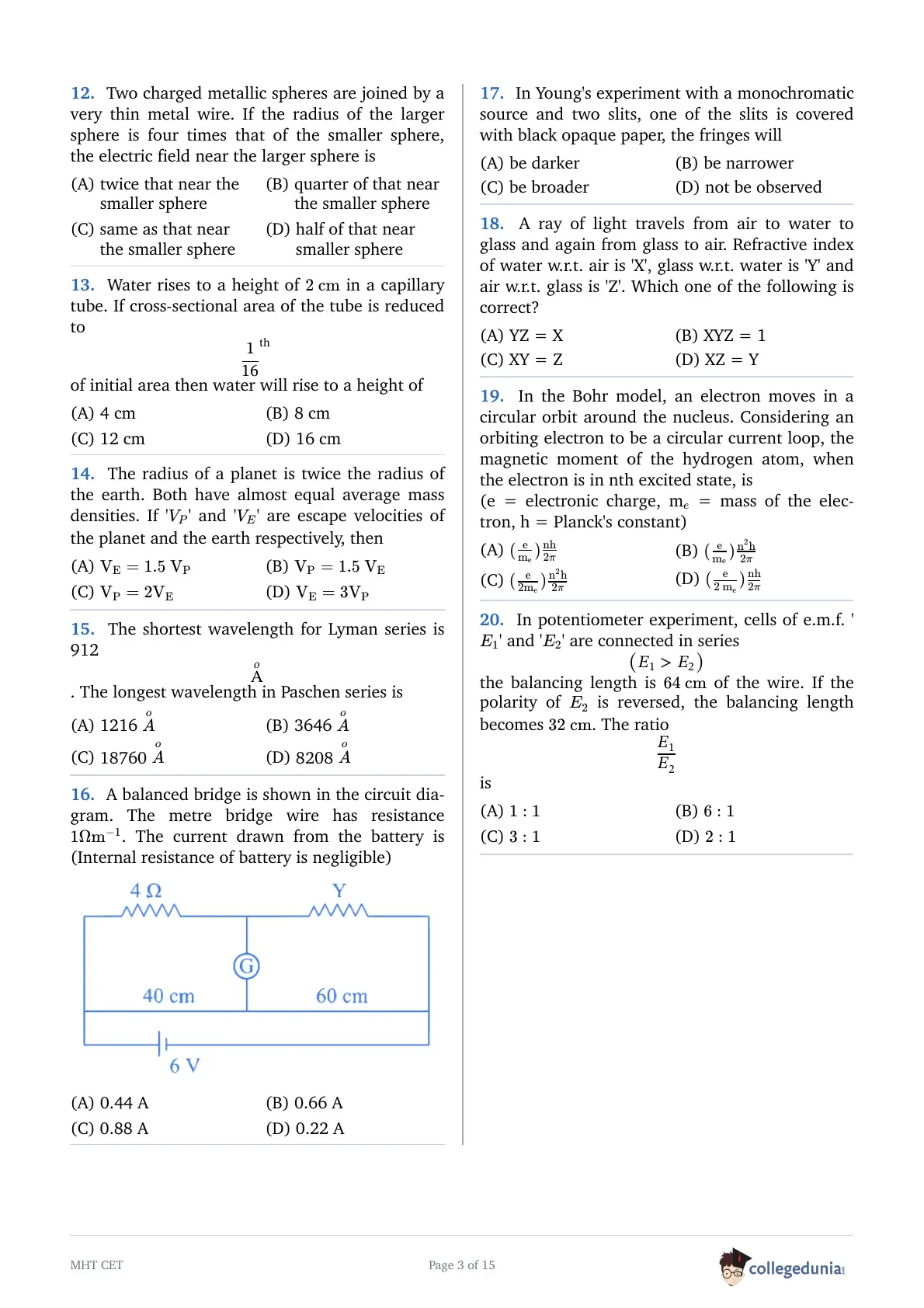
Two charged metallic spheres are joined by a very thin metal wire. If the radius of the larger sphere is four times that of the smaller sphere, the electric field near the larger sphere is
Water rises to a height of 2 cm in a capillary tube. If cross-sectional area of the tube is reduced to \(\frac{1}{16}\) of initial area, then water will rise to a height of
The radius of a planet is twice the radius of the earth. Both have almost equal average mass densities. If \(V_P\) and \(V_E\) are escape velocities of the planet and the earth respectively, then
The shortest wavelength for Lyman series is 912 \[\mathop A\limits^o \]. The longest wavelength in Paschen series is
A balanced bridge is shown in the circuit diagram. The metre bridge wire has resistance \(1\ \Omega\text{m}^{-1}\). The current drawn from the battery is (Internal resistance of battery is negligible)

In Young's experiment with a monochromatic source and two slits, one of the slits is covered with black opaque paper, the fringes will
A ray of light travels from air to water to glass and again from glass to air. Refractive index of water w.r.t. air is 'X', glass w.r.t. water is 'Y' and air w.r.t. glass is 'Z'. Which one of the following is correct?
In the Bohr model, an electron moves in a circular orbit around the nucleus. Considering an orbiting electron to be a circular current loop, the magnetic moment of the hydrogen atom, when the electron is in \(n^{\text{th}}\) excited state, is (\(e\) = electronic charge, \(m_e\) = mass of the electron, \(h\) = Planck's constant)
In potentiometer experiment, cells of e.m.f. \(E_1\) and \(E_2\) are connected in series (\(E_1 > E_2\)) the balancing length is 64 cm of the wire. If the polarity of \(E_2\) is reversed, the balancing length becomes 32 cm. The ratio \(\frac{E_1}{E_2}\) is
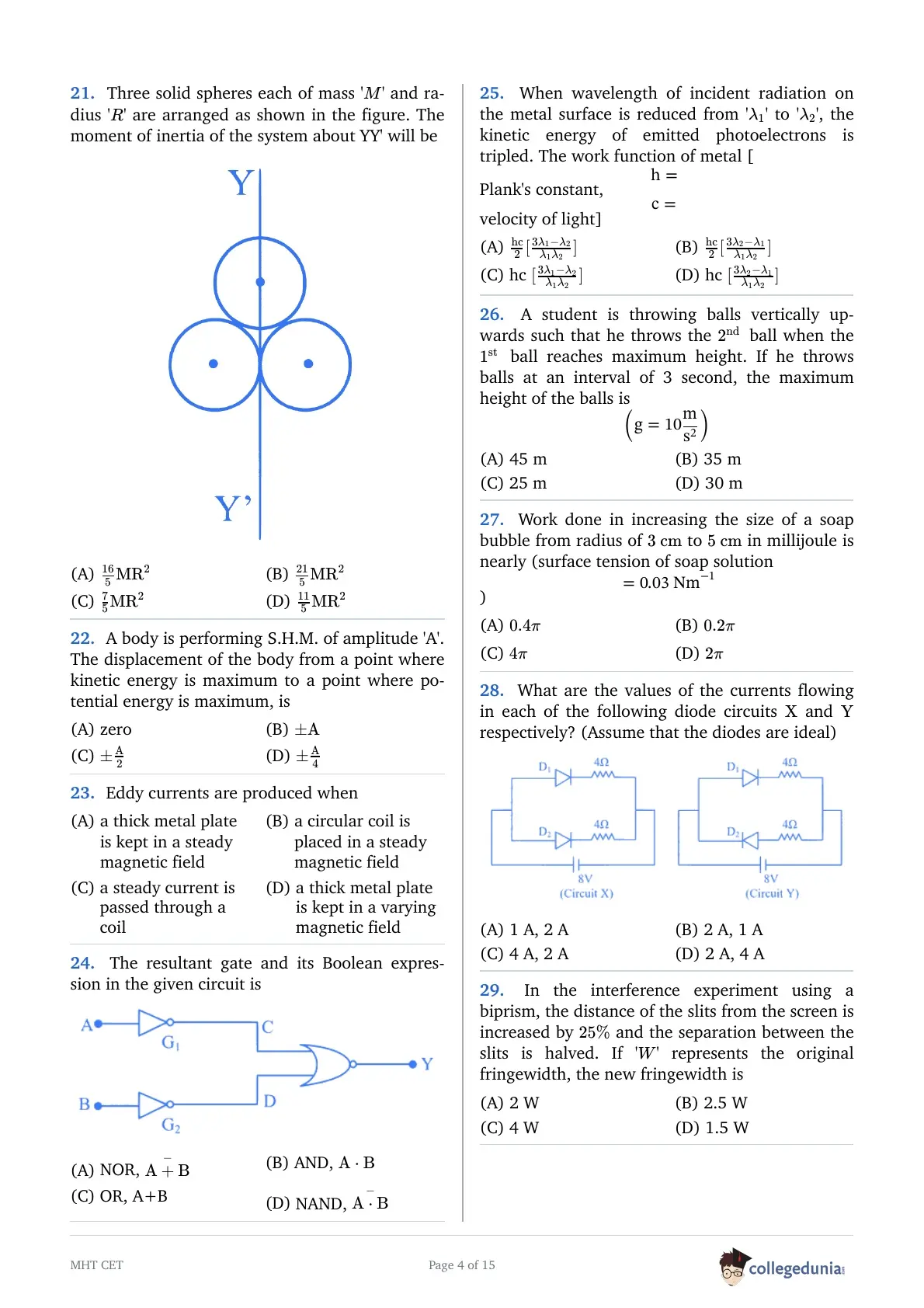
Three solid spheres each of mass \(M\) and radius \(R\) are arranged as shown in the figure. The moment of inertia of the system about YY' will be

A body is performing S.H.M. of amplitude 'A'. The displacement of the body from a point where kinetic energy is maximum to a point where potential energy is maximum, is
Eddy currents are produced when
The resultant gate and its Boolean expression in the given circuit is

When wavelength of incident radiation on the metal surface is reduced from \(\lambda_1\) to \(\lambda_2\), the kinetic energy of emitted photoelectrons is tripled. The work function of metal [\(h\) = Planck's constant, \(c\) = velocity of light] is
A student is throwing balls vertically upwards such that he throws the \(2^{\text{nd}}\) ball when the \(1^{\text{st}}\) ball reaches maximum height. If he throws balls at an interval of 3 second, the maximum height of the balls is (\(g = 10\ \text{ms}^{-2}\))
Work done in increasing the size of a soap bubble from radius of 3 cm to 5 cm in millijoule is nearly (surface tension of soap solution = \(0.03\ \text{Nm}^{-1}\))
What are the values of the currents flowing in each of the following diode circuits X and Y respectively? (Assume that the diodes are ideal)

In the interference experiment using a biprism, the distance of the slits from the screen is increased by 25% and the separation between the slits is halved. If 'W' represents the original fringewidth, the new fringewidth is
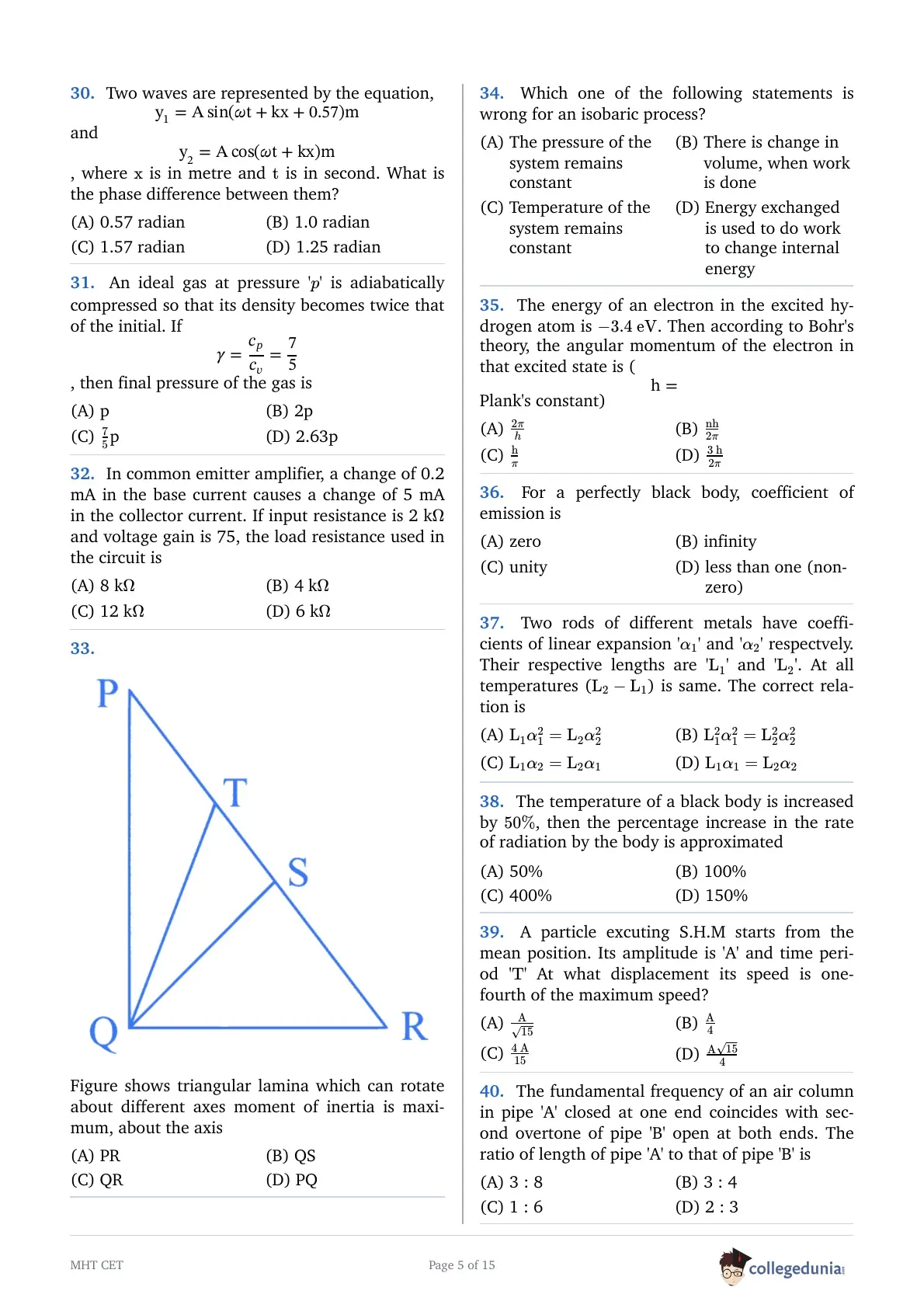
Two waves are represented by the equation, \(y_1 = A \sin(\omega t + kx + 0.57)\ \text{m}\) and \(y_2 = A \cos(\omega t + kx)\ \text{m}\), where \(x\) is in metre and \(t\) is in second. What is the phase difference between them?
An ideal gas at pressure 'p' is adiabatically compressed so that its density becomes twice that of the initial. If \(\gamma = \frac{c_p}{c_v} = \frac{7}{5}\), then final pressure of the gas is
In common emitter amplifier, a change of 0.2 mA in the base current causes a change of 5 mA in the collector current. If input resistance is 2 k\(\Omega\) and voltage gain is 75, the load resistance used in the circuit is
Figure shows triangular lamina which can rotate about different axes. The moment of inertia is maximum about the axis

Which one of the following statements is wrong for an isobaric process?
The energy of an electron in the excited hydrogen atom is \(-3.4\ \text{eV}\). Then according to Bohr's theory, the angular momentum of the electron in that excited state is (\(h\) = Planck's constant)
For a perfectly black body, coefficient of emission is
Two rods of different metals have coefficients of linear expansion \(\alpha_1\) and \(\alpha_2\) respectively. Their respective lengths are \(L_1\) and \(L_2\). If at all temperatures \((L_2 - L_1)\) remains the same, the correct relation is
The temperature of a black body is increased by 50%, then the percentage increase in the rate of radiation by the body is approximated as
A particle executing S.H.M. starts from the mean position. Its amplitude is \(A\) and time period is \(T\). At what displacement is its speed one-fourth of the maximum speed?
The fundamental frequency of an air column in pipe 'A' closed at one end coincides with the second overtone of pipe 'B' open at both ends. The ratio of the length of pipe 'A' to that of pipe 'B' is
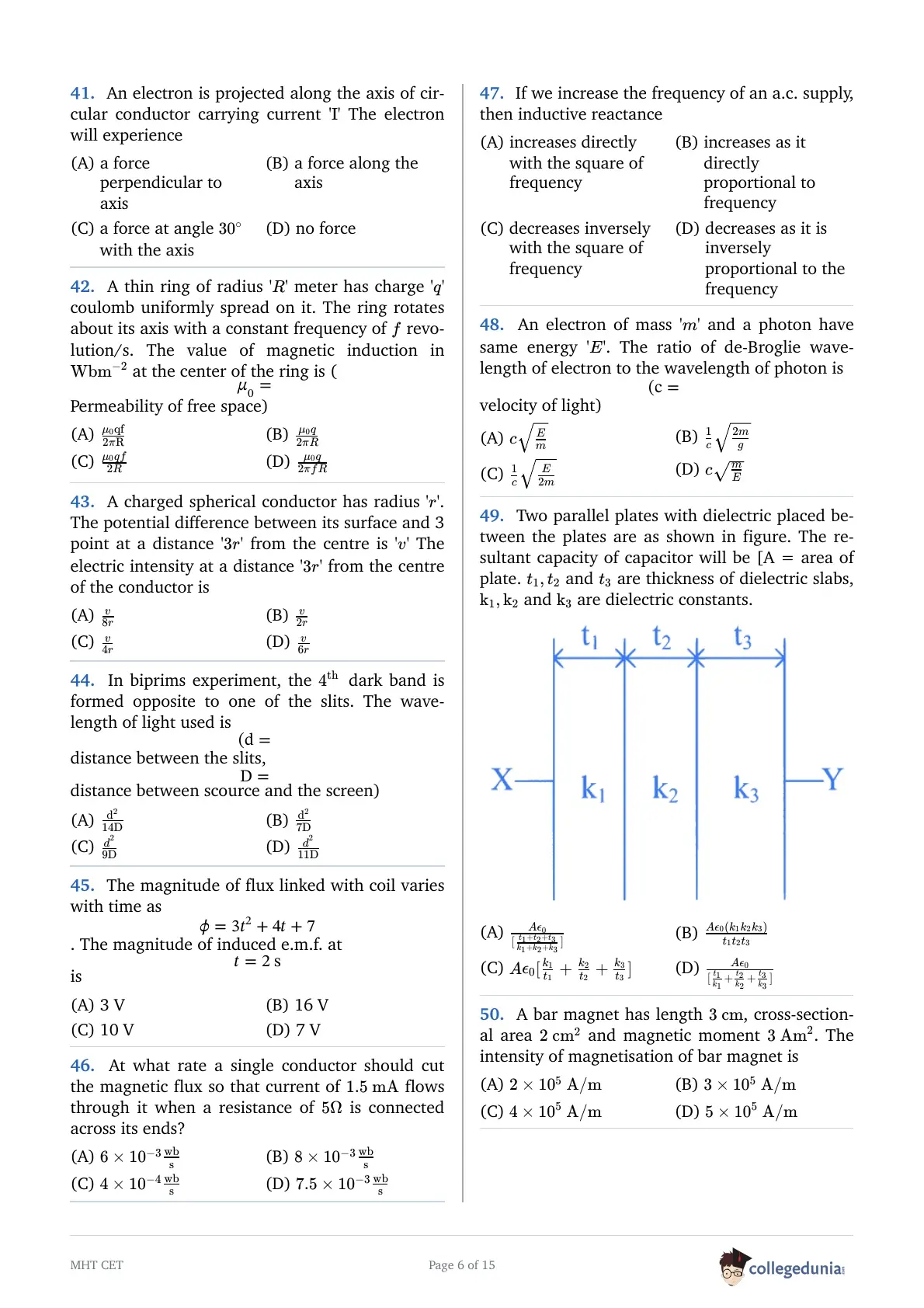
An electron is projected along the axis of a circular conductor carrying current \(I\). The electron will experience
A thin ring of radius \(R\) meter has charge \(q\) coulomb uniformly spread on it. The ring rotates about its axis with a constant frequency of \(f\ \text{rev s}^{-1}\). The magnetic induction at the center of the ring is
A charged spherical conductor has radius \(r\). The potential difference between its surface and a point at a distance of \(3r\) from its centre is \(V\). The electric field intensity at a distance of \(3r\) from its centre is
In biprism experiment, the \(4^{\text{th}}\) dark band is formed opposite to one of the slits. The wavelength of light used is [d = separation between slits, D = distance between slits and screen]
The magnitude of flux linked with coil varies with time as \(\phi = 3t^2 + 4t + 7\). The magnitude of induced e.m.f. at \(t = 2\ \text{s}\) is
At what rate a single conductor should cut the magnetic flux so that current of \(1.5\ \text{mA}\) flows through it when a resistance of \(5\ \Omega\) is connected across its ends?
If we increase the frequency of an a.c. supply, then inductive reactance
An electron of mass 'm' and a photon have same energy 'E'. The ratio of de-Broglie wavelength of electron to the wavelength of photon is (c = velocity of light)
Two parallel plates with dielectric placed between the plates are as shown in figure. The resultant capacity of capacitor will be [\(A = \text{area of plate}\), \(t_1, t_2\) and \(t_3\) are thickness of dielectric slabs, \(k_1, k_2\) and \(k_3\) are dielectric constants.]

A bar magnet has length 3 cm, cross-sectional area \(2\ \text{cm}^2\) and magnetic moment \(3\ \text{A m}^2\). The intensity of magnetisation of the bar magnet is
Chemistry (Q51 - Q100)
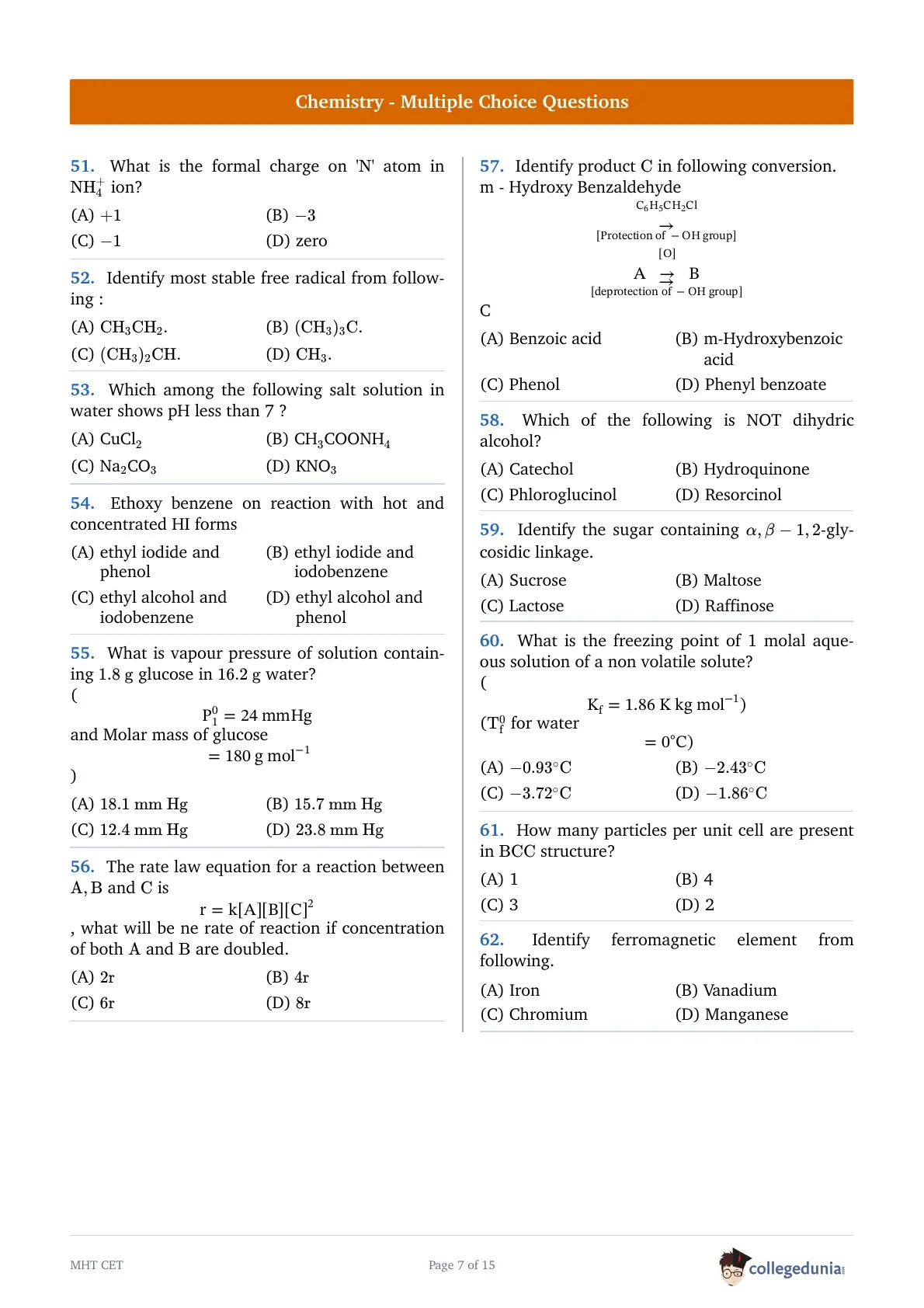
What is the formal charge on 'N' atom in \(\text{NH}_4^+\) ion?
Identify most stable free radical from following :
Which among the following salt solution in water shows pH less than 7 ?
Ethoxy benzene on reaction with hot and concentrated HI forms
What is vapour pressure of solution containing 1.8 g glucose in 16.2 g water? (\(P_1^0 = 24\) mm Hg and Molar mass of glucose = 180 g mol\(^{-1}\))
The rate law equation for a reaction between A, B and C is \(r = k [A] [B] [C]^2\), what will be the rate of reaction if concentration of both A and B are doubled?
Identify product C in following conversion:
m-Hydroxy Benzaldehyde \(\xrightarrow{\text{[Protection of -OH group]} \, \text{C}_6\text{H}_5\text{CH}_2\text{Cl}} \text{A} \xrightarrow{\text{[O]}} \text{B} \xrightarrow{\text{[deprotection of -OH group]}} \text{C}\)
Which of the following is NOT dihydric alcohol?
Identify the sugar containing \(\alpha, \beta\)-1,2-glycosidic linkage.
What is the freezing point of 1 molal aqueous solution of a non volatile solute? (\(K_f = 1.86\) K kg mol\(^{-1}\)) (\(T_f^0\) for water = 0\(^\circ\)C)
How many particles per unit cell are present in BCC structure?
Identify ferromagnetic element from following.
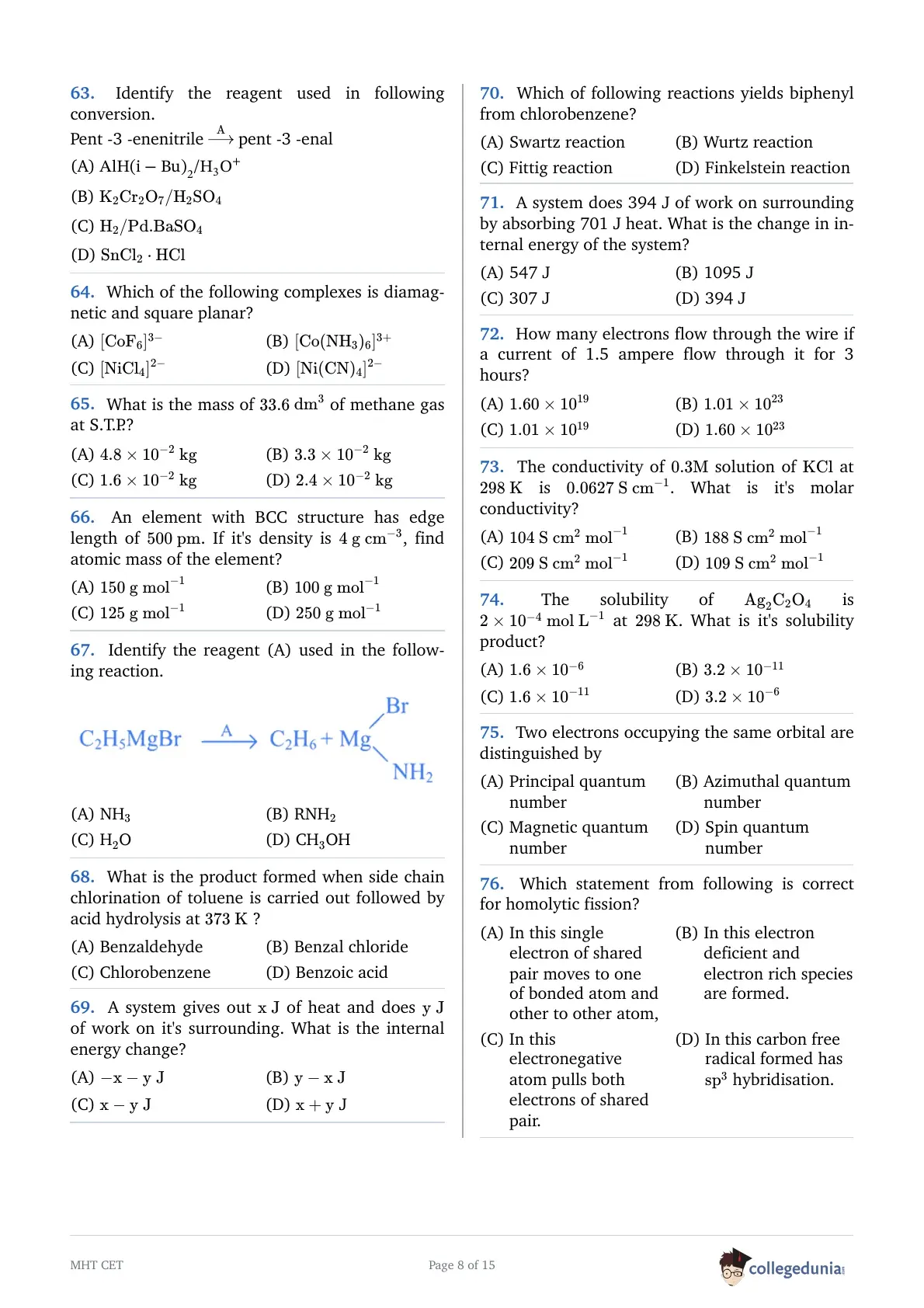
Identify the reagent used in following conversion:
Pent-3-enenitrile \(\xrightarrow{\text{A}}\) pent-3-enal
Which of the following complexes is diamagnetic and square planar?
What is the mass of 33.6 dm\(^3\) of methane gas at S.T.P.?
An element with BCC structure has edge length of 500 pm. If it's density is 4 g cm\(^{-3}\), find atomic mass of the element?

What is the product formed when side chain chlorination of toluene is carried out followed by acid hydrolysis at 373 K ?
A system gives out x J of heat and does y J of work on it's surrounding. What is the internal energy change?
Which of following reactions yields biphenyl from chlorobenzene?
A system does 394 J of work on surrounding by absorbing 701 J heat. What is the change in internal energy of the system?
How many electrons flow through the wire if a current of 1.5 ampere flow through it for 3 hours?
The conductivity of 0.3 M solution of KCl at 298 K is 0.0627 S cm\(^{-1}\). What is it's molar conductivity?
The solubility of \(\text{Ag}_2\text{C}_2\text{O}_4\) is \(2 \times 10^{-4}\) mol L\(^{-1}\) at 298 K. What is it's solubility product?
Two electrons occupying the same orbital are distinguished by
Which statement from following is correct for homolytic fission?
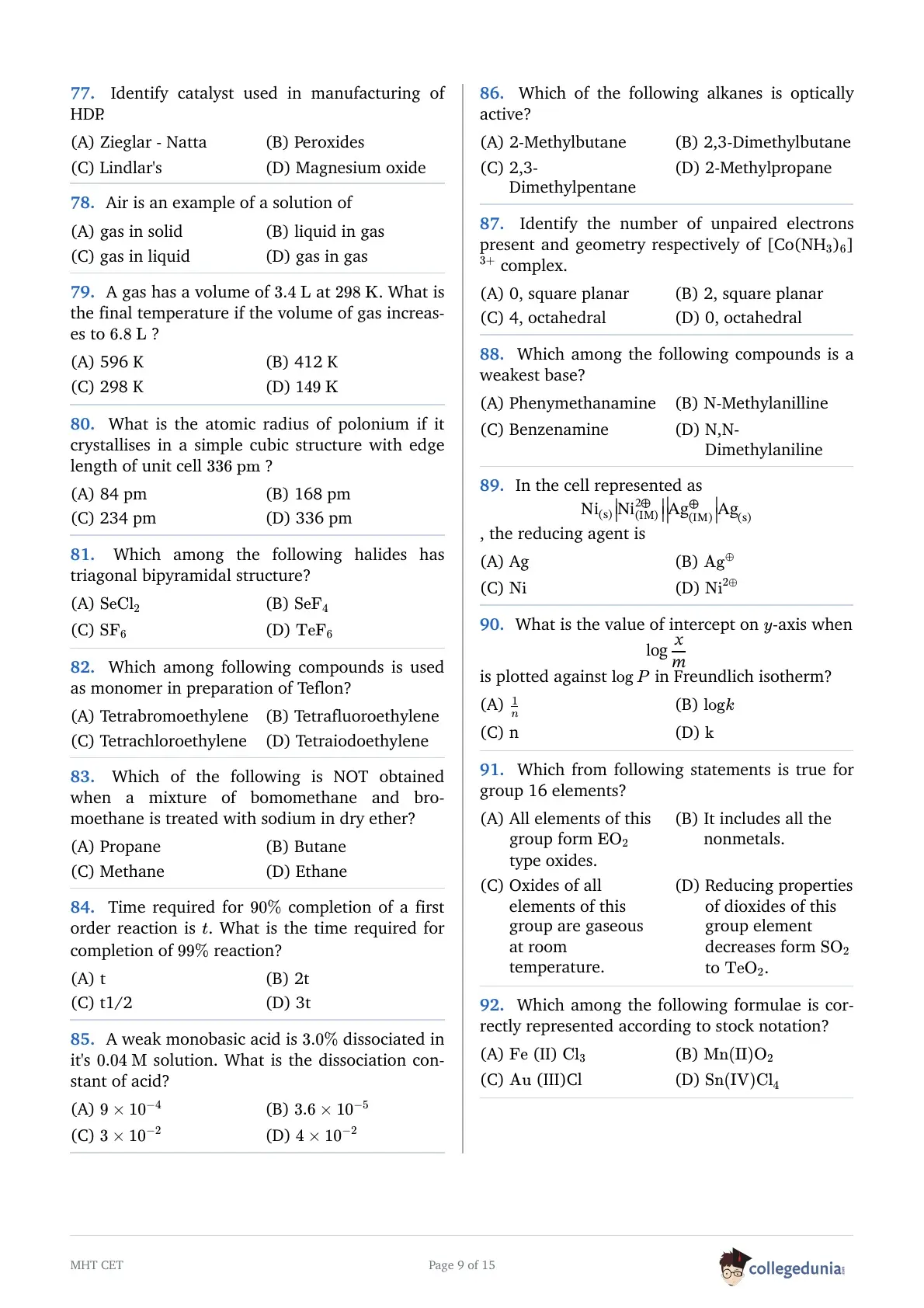
Identify catalyst used in manufacturing of HDP.
Air is an example of a solution of
A gas has a volume of 3.4 L at 298 K. What is the final temperature if the volume of gas increases to 6.8 L?
What is the atomic radius of polonium if it crystallises in a simple cubic structure with edge length of unit cell 336 pm?
Which among the following halides has trigonal bipyramidal structure?
Which among following compounds is used as monomer in preparation of Teflon?
Which of the following is NOT obtained when a mixture of bromomethane and bromoethane is treated with sodium in dry ether?
Time required for 90% completion of a first order reaction is \(t\). What is the time required for completion of 99% reaction?
A weak monobasic acid is 3.0% dissociated in it's 0.04 M solution. What is the dissociation constant of acid?
Which of the following alkanes is optically active?
Identify the number of unpaired electrons present and geometry respectively of \([\text{Co}(\text{NH}_3)_6]^{3+}\) complex.
Which among the following compounds is a weakest base?
In the cell represented as \[\mathrm{Ni}_{(\mathrm{s})}\left|\mathrm{Ni}_{(\mathrm{IM})}^{2 \oplus}\right|\left|\mathrm{Ag}_{(\mathrm{IM})}^{\oplus}\right| \mathrm{Ag}_{(\mathrm{s})}\], the reducing agent is
What is the value of intercept on y-axis when \(\log_{10} \frac{x}{m}\) is plotted against \(\log_{10} P\) in Freundlich isotherm?
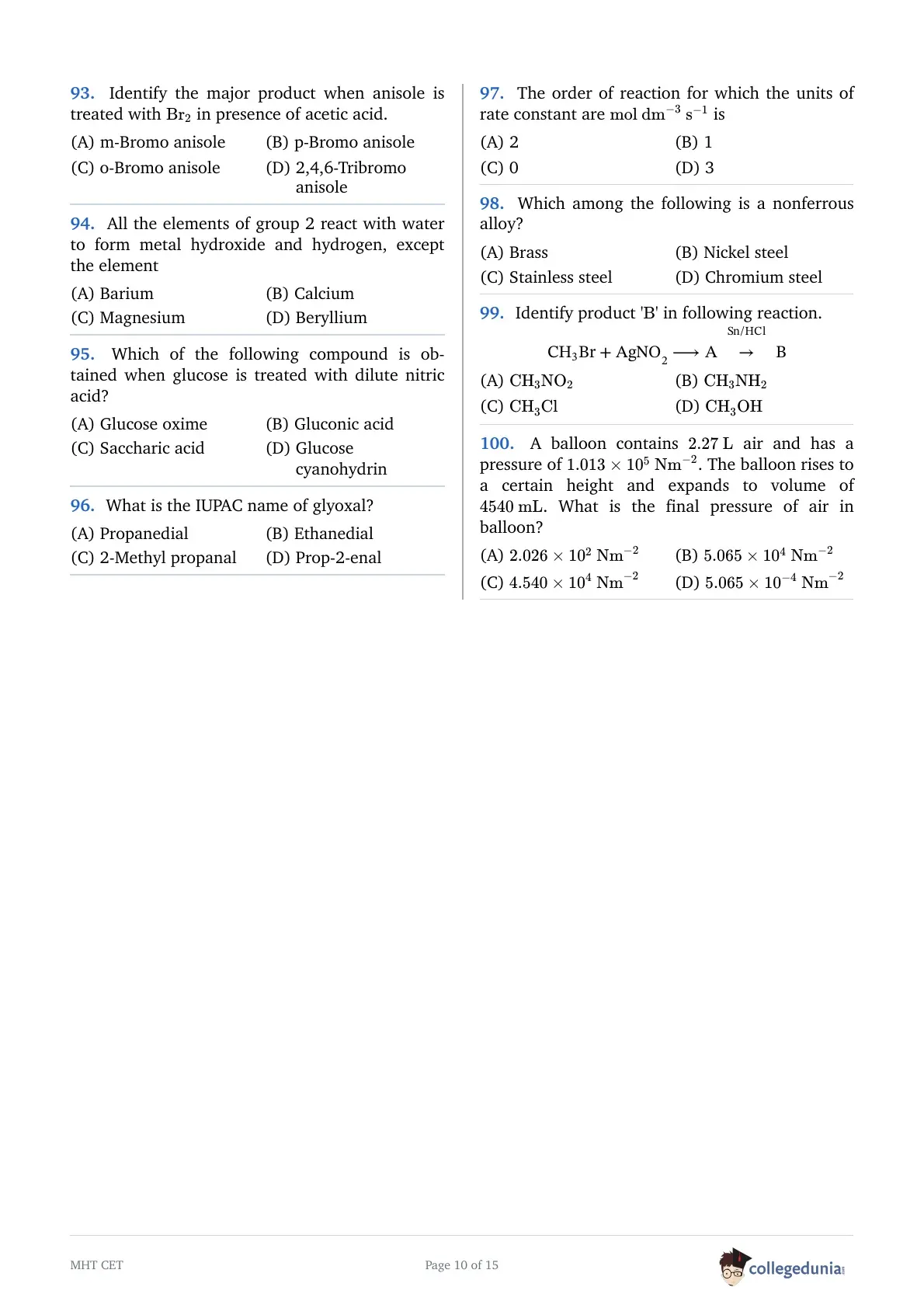
Which from following statements is true for group 16 elements?
Which among the following formulae is correctly represented according to stock notation?
Identify the major product when anisole is treated with \(\text{Br}_2\) in presence of acetic acid.
All the elements of group 2 react with water to form metal hydroxide and hydrogen, except the element
Which of the following compound is obtained when glucose is treated with dilute nitric acid?
What is the IUPAC name of glyoxal?
The order of reaction for which the units of rate constant are mol dm\(^{-3}\) s\(^{-1}\) is
Which among the following is a nonferrous alloy?
Identify product '\[\mathrm{B}\]' in following reaction.
\[\mathrm{CH}_3 \mathrm{Br}+\mathrm{AgNO}_2 \longrightarrow \mathrm{A} \xrightarrow{\mathrm{Sn} / \mathrm{HCl}} \mathrm{B}\]
A balloon contains \[2.27 \mathrm{~L}\] air and has a pressure of \[1.013 \times 10^5 \mathrm{~Nm}^{-2}\]. The balloon rises to a certain height and expands to volume of \[4540 \mathrm{~mL}\]. What is the final pressure of air in balloon?
Mathematics (Q101 - Q150)
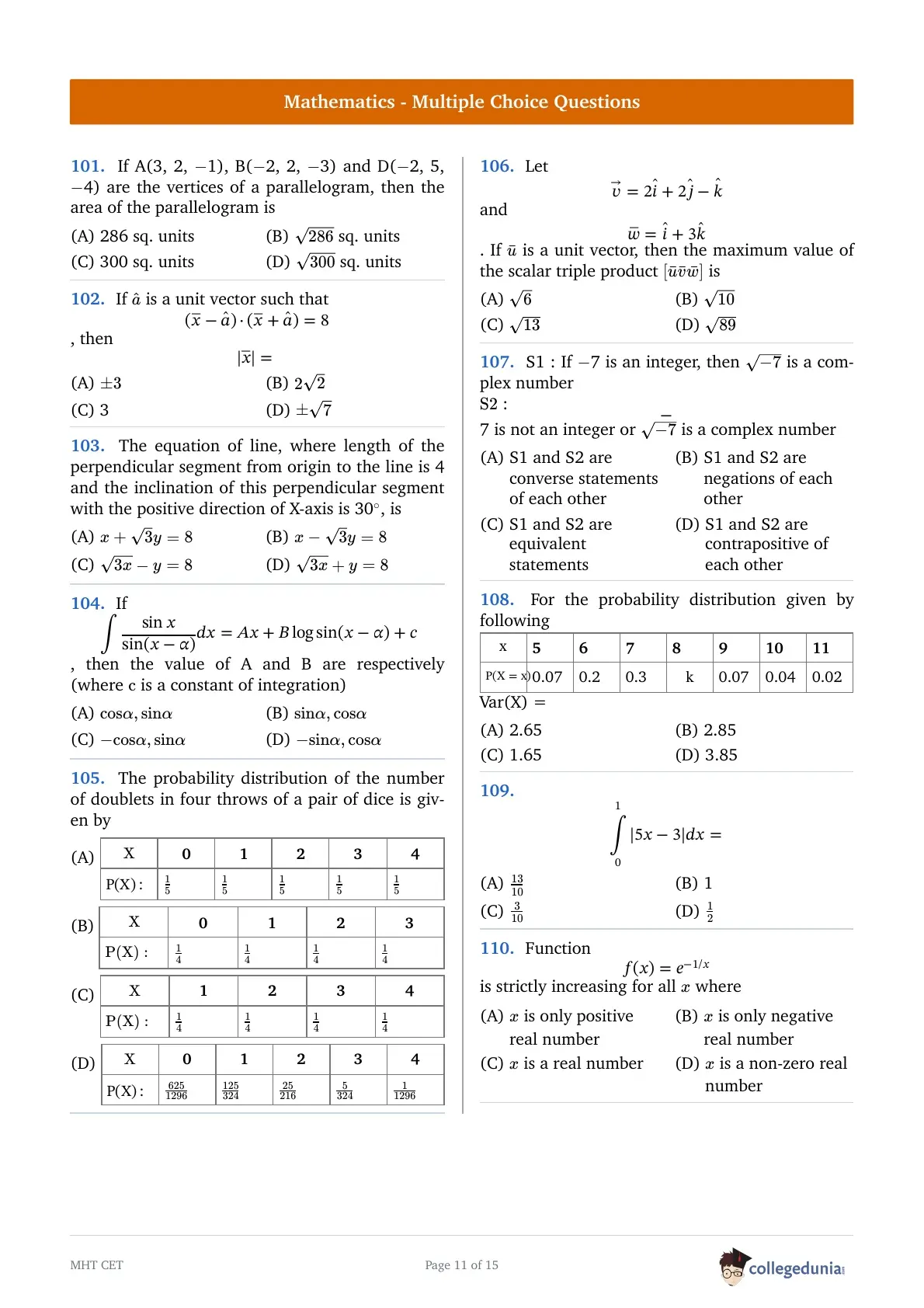
If A(3, 2, \(-1\)), B(\(-2\), 2, \(-3\)) and D(\(-2\), 5, \(-4\)) are the vertices of a parallelogram, then the area of the parallelogram is
If \(\hat{a}\) is a unit vector such that \((\vec{x} - \hat{a}) \cdot (\vec{x} + \hat{a}) = 8\), then \(|\vec{x}| =\)
The equation of line, where length of the perpendicular segment from origin to the line is 4 and the inclination of this perpendicular segment with the positive direction of X-axis is \(30^\circ\), is
If \(\int \frac{\sin x}{\sin (x-\alpha)} dx = Ax + B \log |\sin (x-\alpha)| + c\), then the value of A and B are respectively (where c is a constant of integration)
The probability distribution of the number of doublets in four throws of a pair of dice is given by
Let \(\vec{v} = 2\hat{i} + 2\hat{j} - \hat{k}\) and \(\vec{w} = \hat{i} + 3\hat{k}\). If \(\vec{u}\) is a unit vector, then the maximum value of the scalar triple product \([\vec{u} \,\, \vec{v} \,\, \vec{w}]\) is
S1 : If \(-7\) is an integer, then \(\sqrt{-7}\) is a complex number
S2 : \(-7\) is not an integer or \(\sqrt{-7}\) is a complex number
Choose the correct statement from the options given below
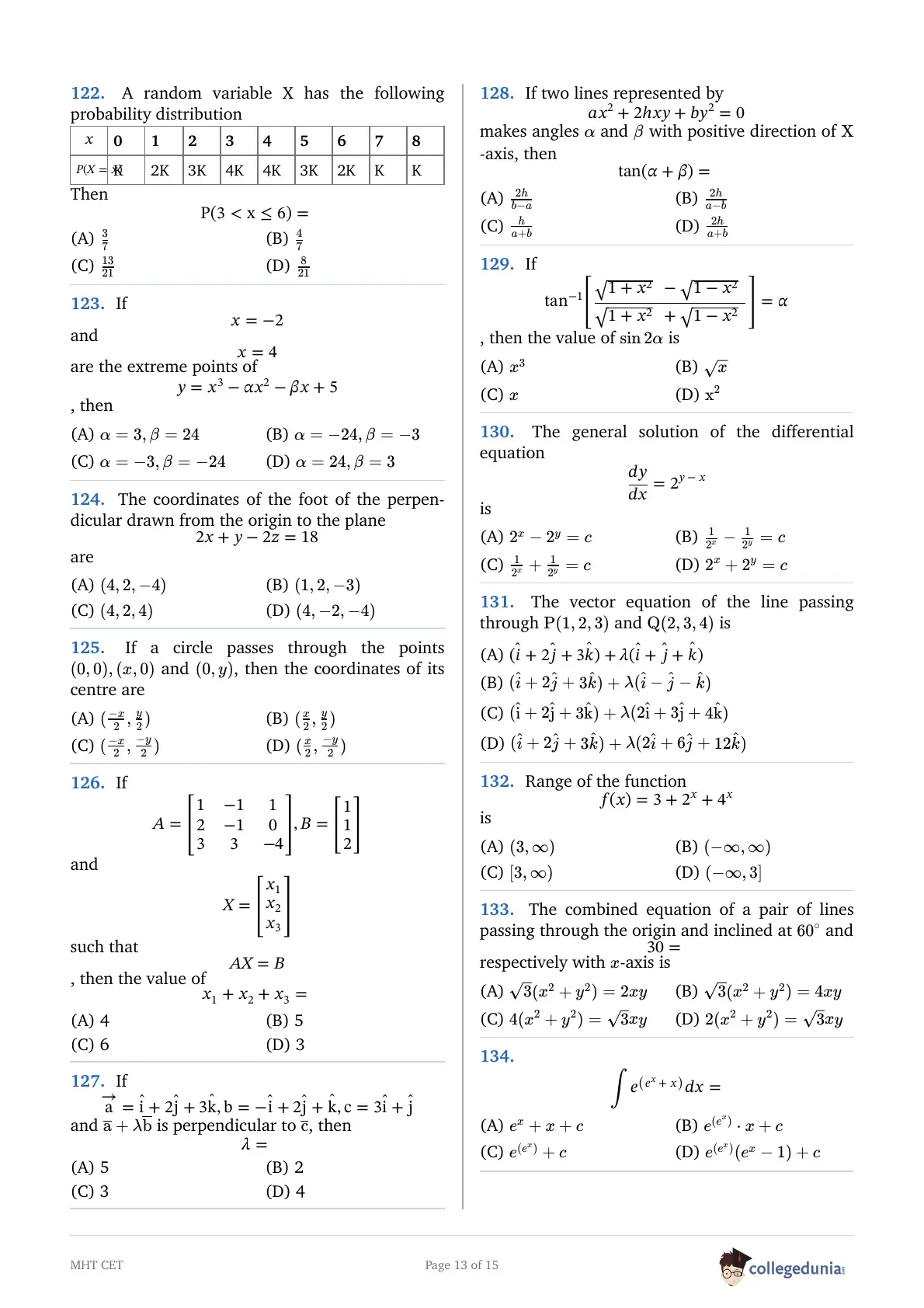
For the probability distribution given by following
| \[\mathrm{x}\] | 5 | 6 | 7 | 8 | 9 | 10 | 11 |
|---|---|---|---|---|---|---|---|
| \[\mathrm{P(X=x)}\] | 0.07 | 0.2 | 0.3 | \[\mathrm{k}\] | 0.07 | 0.04 | 0.02 |
Function \(f(x) = e^{-1/x}\) is strictly increasing for all \(x\) where
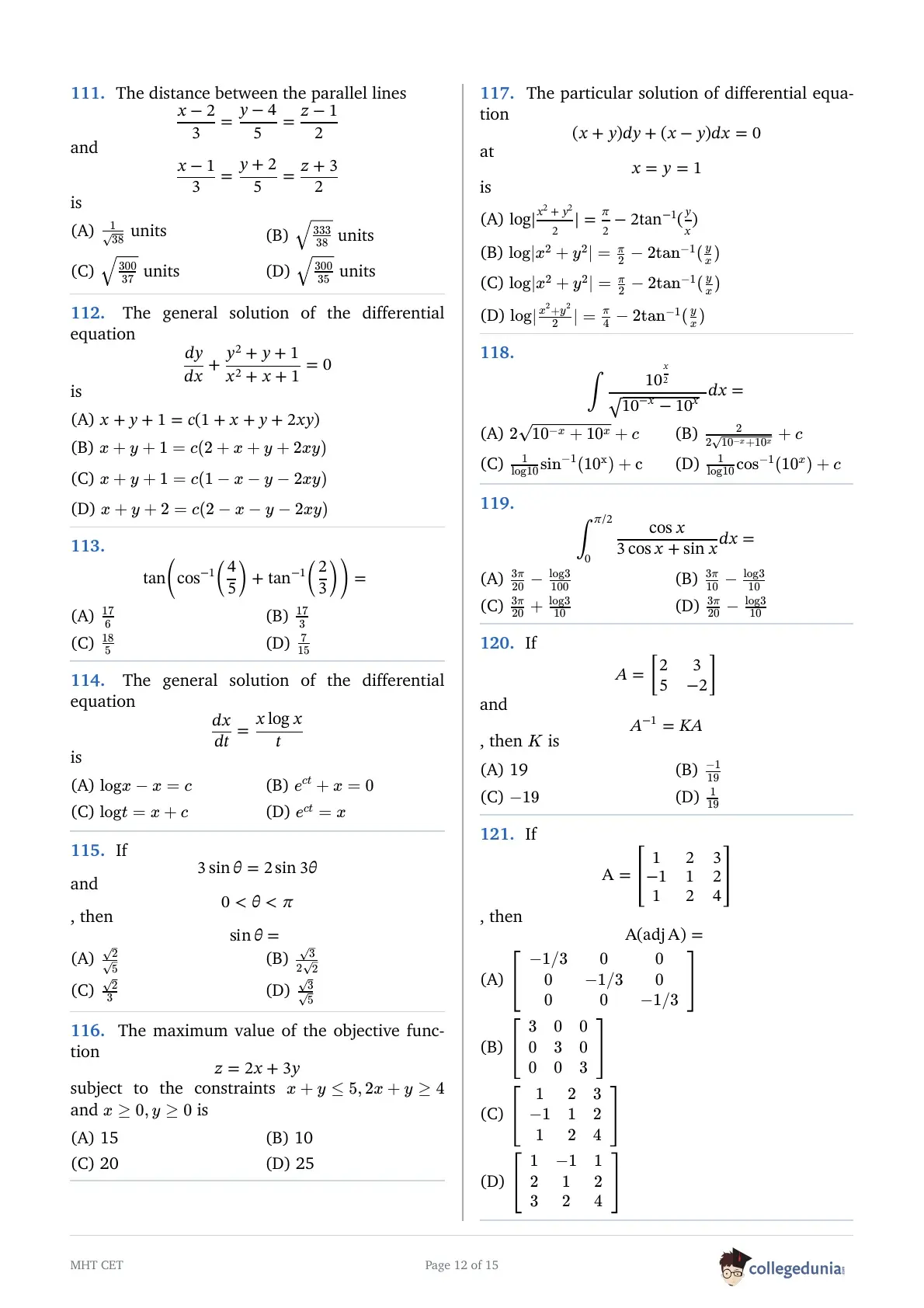
The distance between the parallel lines \(\frac{x-2}{3}=\frac{y-4}{5}=\frac{z-1}{2}\) and \(\frac{x-1}{3}=\frac{y+2}{5}=\frac{z+3}{2}\) is
The general solution of the differential equation \(\frac{dy}{dx} + \frac{y^2+y+1}{x^2+x+1} = 0\) is
Evaluate the trigonometric expression: \(\tan \left(\cos^{-1}\left(\frac{4}{5}\right) + \tan^{-1}\left(\frac{2}{3}\right)\right) =\)
The general solution of the differential equation \(\frac{dx}{dt} = \frac{x \log x}{t}\) is
If \(3 \sin \theta = 2 \sin 3 \theta\) and \(0 < \theta < \pi\), then \(\sin \theta =\)
The maximum value of the objective function \(z = 2x + 3y\) subject to the constraints \(x + y \le 5\), \(2x + y \ge 4\) and \(x \ge 0, y \ge 0\) is
The particular solution of differential equation \((x + y) dy + (x - y) dx = 0\) at \(x = y = 1\) is
Evaluate the integral: \(\int \frac{10^{x/2}}{\sqrt{10^{-x} - 10^x}} dx\)
Evaluate the integral: \(\int_0^{\pi / 2} \frac{\cos x}{3 \cos x + \sin x} dx\)
If \(A=\left[\begin{array}{rr}2 & 3 \\ 5 & -2\end{array}\right]\) and \(A^{-1}=K A\), then \(K\) is
If \(\mathrm{A}=\left[\begin{array}{ccc}1 & 2 & 3 \\ -1 & 1 & 2 \\ 1 & 2 & 4\end{array}\right]\), then \(\mathrm{A}(\text{adj }\mathrm{A}) =\)

If \(x = -2\) and \(x = 4\) are the extreme points of the function \(y = x^3 - \alpha x^2 - \beta x + 5\), then the values of \(\alpha\) and \(\beta\) are respectively
The coordinates of the foot of the perpendicular drawn from the origin to the plane \(2x + y - 2z = 18\) are
If a circle passes through the points \((0,0)\), \((x, 0)\) and \((0, y)\), then the coordinates of its centre are
If \(A=\left[\begin{array}{ccc}1 & -1 & 1 \\ 2 & -1 & 0 \\ 3 & 3 & -4\end{array}\right]\), \(B=\left[\begin{array}{l}1 \\ 1 \\ 2\end{array}\right]\) and \(X=\left[\begin{array}{l}x_1 \\ x_2 \\ x_3\end{array}\right]\) such that \(AX = B\), then the value of \(x_1 + x_2 + x_3 =\)
If two lines represented by \(ax^2 + 2hxy + by^2 = 0\) make angles \(\alpha\) and \(\beta\) with the positive direction of X-axis, then \(\tan(\alpha + \beta) =\)
If \(\tan^{-1} \left[ \frac{\sqrt{1+x^2} - \sqrt{1-x^2}}{\sqrt{1+x^2} + \sqrt{1-x^2}} \right] = \alpha\), then the value of \(\sin 2\alpha\) is
The general solution of the differential equation \(\frac{dy}{dx} = 2^{y - x}\) is
The vector equation of the line passing through \(\text{P}(1,2,3)\) and \(\text{Q}(2,3,4)\) is
Range of the function \(f(x) = 3 + 2^x + 4^x\) is
The combined equation of a pair of lines passing through the origin and inclined at \(60^\circ\) and \(30^\circ\) respectively with X-axis is
If \(z = x + iy\) satisfies the condition \(|z + 1| = 1\), then \(z\) lies on the
If \(3\hat{j}\), \(4\hat{k}\) and \(3\hat{j} + 4\hat{k}\) are the position vectors of the vertices \(A, B, C\) respectively of \(\Delta ABC\), then the position vector of the point in which the bisector of \(\angle A\) meets \(BC\) is
10 is divided into two parts such that the sum of double of the first and square of the other is minimum, then the numbers are respectively
In a triangle ABC, with usual notations \(a = 2\), \(b = 3\), \(c = 5\), then \(\frac{\cos A}{a} + \frac{\cos B}{b} + \frac{\cos C}{c} =\)
If \(f(x) = \frac{1 - \sin x + \cos x}{1 + \sin x + \cos x}\), for \(x \neq \pi\) is continuous at \(x = \pi\), then the value of \(f(\pi)\) is
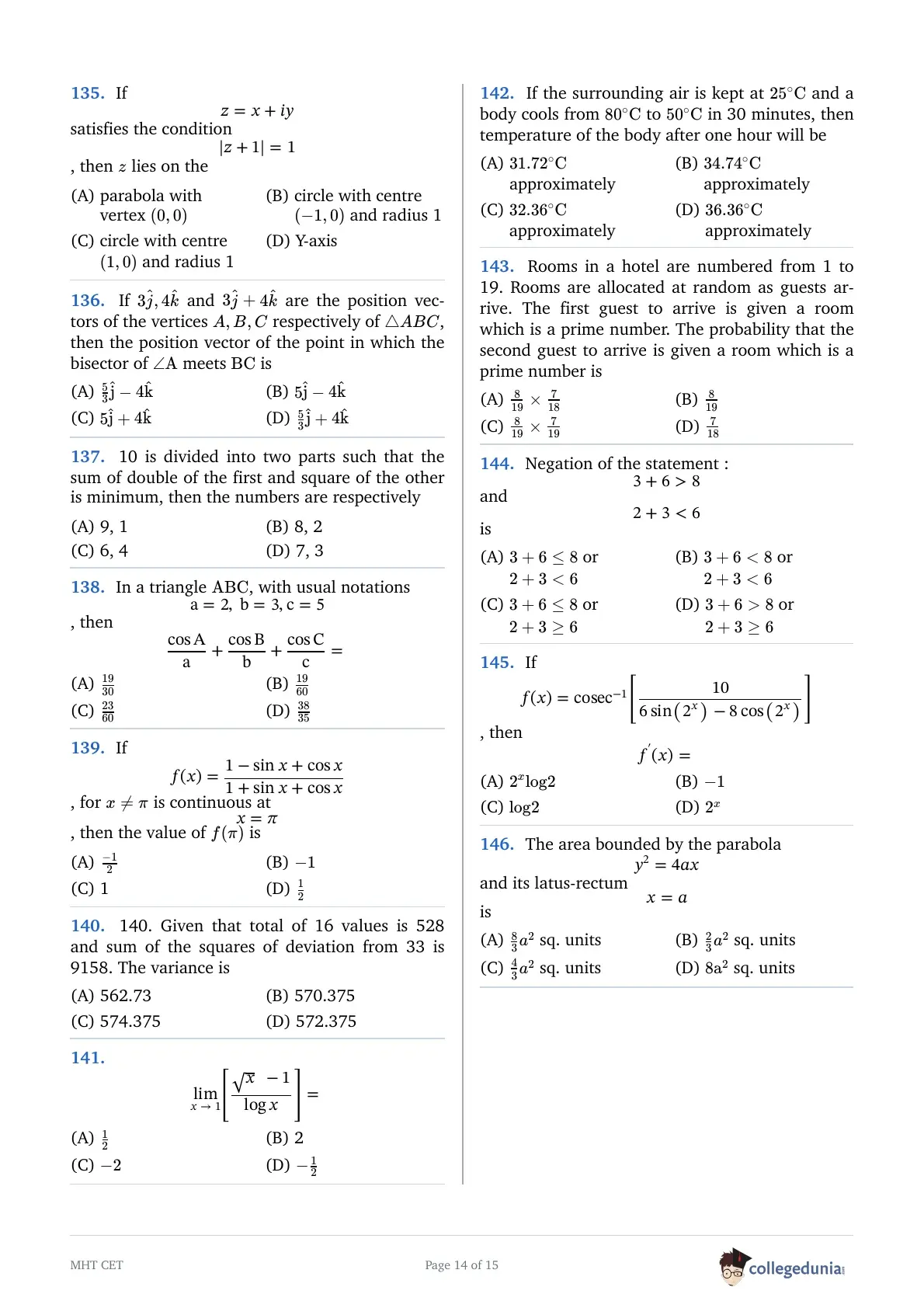
Given that the total of 16 values is 528 and the sum of the squares of deviation from 33 is 9158. The variance is
Evaluate the limit: \(\lim_{x \to 1} \left[ \frac{\sqrt{x} - 1}{\log x} \right] =\)
If the surrounding air is kept at 25\(^\circ\)C and a body cools from 80\(^\circ\)C to 50\(^\circ\)C in 30 minutes, then temperature of the body after one hour will be
Rooms in a hotel are numbered from 1 to 19. Rooms are allocated at random as guests arrive. The first guest to arrive is given a room which is a prime number. The probability that the second guest to arrive is given a room which is a prime number is
Negation of the statement : \(3 + 6 > 8\) and \(2 + 3 < 6\) is
If \(f(x) = \csc^{-1} \left[ \frac{10}{6 \sin(2^x) - 8 \cos(2^x)} \right]\), then \(f'(x) =\)
The area bounded by the parabola \(y^2 = 4ax\) and its latus-rectum \(x = a\) is
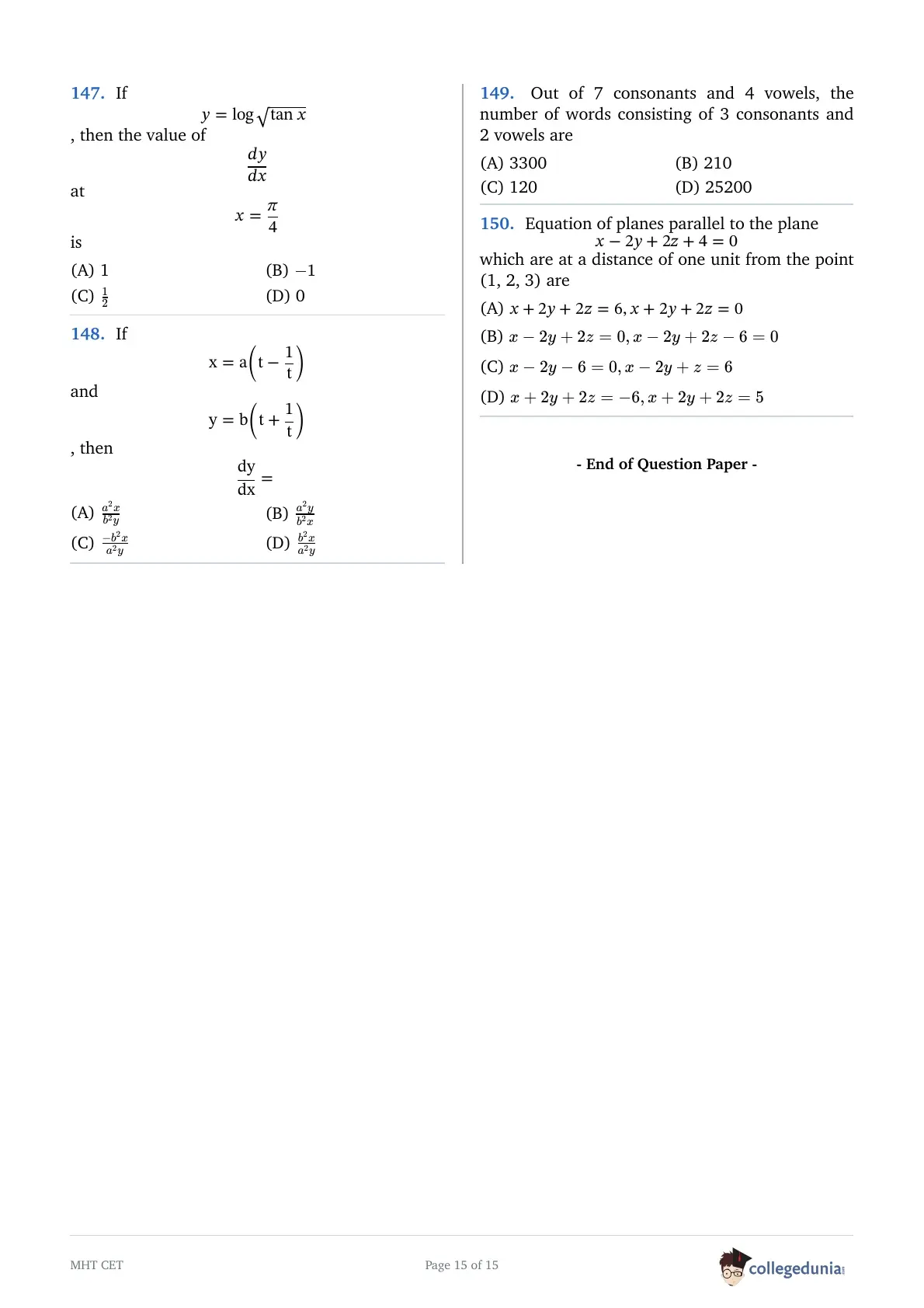
If \(y = \log \sqrt{\tan x}\), then the value of \(\frac{dy}{dx}\) at \(x = \frac{\pi}{4}\) is
If \(x = a\left(t - \frac{1}{t}\right)\) and \(y = b\left(t + \frac{1}{t}\right)\), then \(\frac{dy}{dx} =\)
Out of 7 consonants and 4 vowels, the number of words consisting of 3 consonants and 2 vowels are
Equation of planes parallel to the plane \(x - 2y + 2z + 4 = 0\) which are at a distance of one unit from the point \((1, 2, 3)\) are
MHT CET 2021 PCM Exam Pattern and Marking Scheme
| Parameter | Details |
|---|---|
| Conducting Body | Maharashtra Common Entrance Test Cell (Maharashtra CET Cell) |
| Exam Mode | Online (Computer-Based Test) |
| Duration | 180 minutes (3 hours) |
| Groups / Subjects | PCM (Physics, Chemistry, Mathematics) for Engineering |
| Total Questions |
150 |
| Total Marks | 200 |
| Question Type | Multiple Choice Questions (MCQs) |
| Marks Distribution |
|
| Negative Marking | No |
| Syllabus Weightage |
|



Comments