




MHT CET 2021 Sep 23 Shift 2 PCM Question Paper is available for download here. Maharashtra State CET Cell conducted MHT CET 2021 PCM Exam on Sep 23 in Shift 2 from 2 PM to 5 PM in CBT mode.
The MHT CET 2021 PCM question paper includes the following:
- The MHT CET 2021 PCM Question Paper consists of 150 multiple-choice questions (MCQs) totalling 200 marks divided into 3 sections: Physics, Chemistry, and Mathematics, with 50 questions in each subject.
- Physics and Chemistry questions carry 1 mark each while Mathematics questions carry 2 marks each.
- There is no negative marking for incorrect answers.
MHT CET 2021 Sep 23 Shift 2 PCM Question Paper with Solution PDF
| CD PDF | CD PDF with Solutions |
|---|---|
| Download Collegedunia PDF 1.04 MB | - |
Also Check:
MHT CET 2021 Sep 23 Shift 2 PCM Questions with Solutions
Physics (Q1 - Q50)
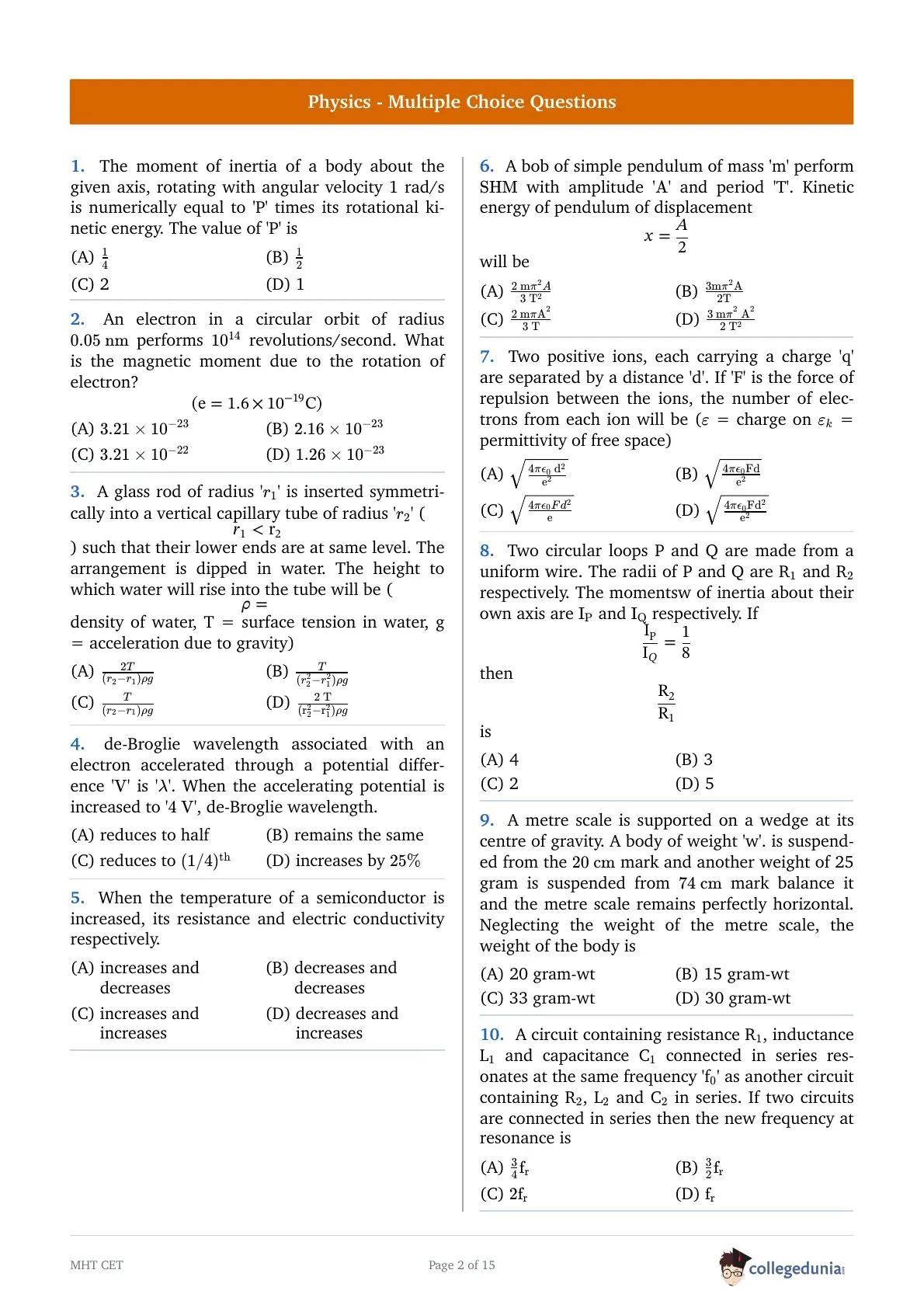
The moment of inertia of a body about the given axis, rotating with angular velocity \(1 \text{ rad/s}\) is numerically equal to 'P' times its rotational kinetic energy. The value of 'P' is
An electron in a circular orbit of radius \(0.05 \text{ nm}\) performs \(10^{14}\) revolutions/second. What is the magnetic moment due to the rotation of electron? (\(e = 1.6 \times 10^{-19} \text{ C}\))
A glass rod of radius '\(r_1\)' is inserted symmetrically into a vertical capillary tube of radius '\(r_2\)' (\(r_1 < r_2\)) such that their lower ends are at same level. The arrangement is dipped in water. The height to which water will rise into the tube will be (\(\rho\) = density of water, T = surface tension in water, g = acceleration due to gravity)
de-Broglie wavelength associated with an electron accelerated through a potential difference \(V\) is \(\lambda\). When the accelerating potential is increased to \(4V\), the de-Broglie wavelength
When the temperature of a semiconductor is increased, its resistance and electric conductivity respectively
A bob of simple pendulum of mass \(m\) performs SHM with amplitude \(A\) and period \(T\). Kinetic energy of pendulum at displacement \(x = \frac{A}{2}\) will be
Two positive ions, each carrying a charge \(q\) are separated by a distance \(d\). If \(F\) is the force of repulsion between the ions, the number of electrons missing from each ion will be (\(\varepsilon_0\) = permittivity of free space, \(e\) = charge on an electron)
Two circular loops P and Q are made from a uniform wire. The radii of P and Q are \(R_1\) and \(R_2\) respectively. The moments of inertia about their own central axis are \(I_P\) and \(I_Q\) respectively. If \(\frac{I_P}{I_Q} = \frac{1}{8}\) then the ratio \(\frac{R_2}{R_1}\) is
A metre scale is supported on a wedge at its centre of gravity. A body of weight \(w\) is suspended from the \(20 \text{ cm}\) mark and another weight of \(25 \text{ gram}\) is suspended from the \(74 \text{ cm}\) mark to balance it and the metre scale remains perfectly horizontal. Neglecting the weight of the metre scale, the weight of the body is
A circuit containing resistance \(R_1\), inductance \(L_1\) and capacitance \(C_1\) connected in series resonates at the same frequency \(f_0\) as another circuit containing \(R_2\), \(L_2\) and \(C_2\) in series. If two circuits are connected in series then the new frequency at resonance is
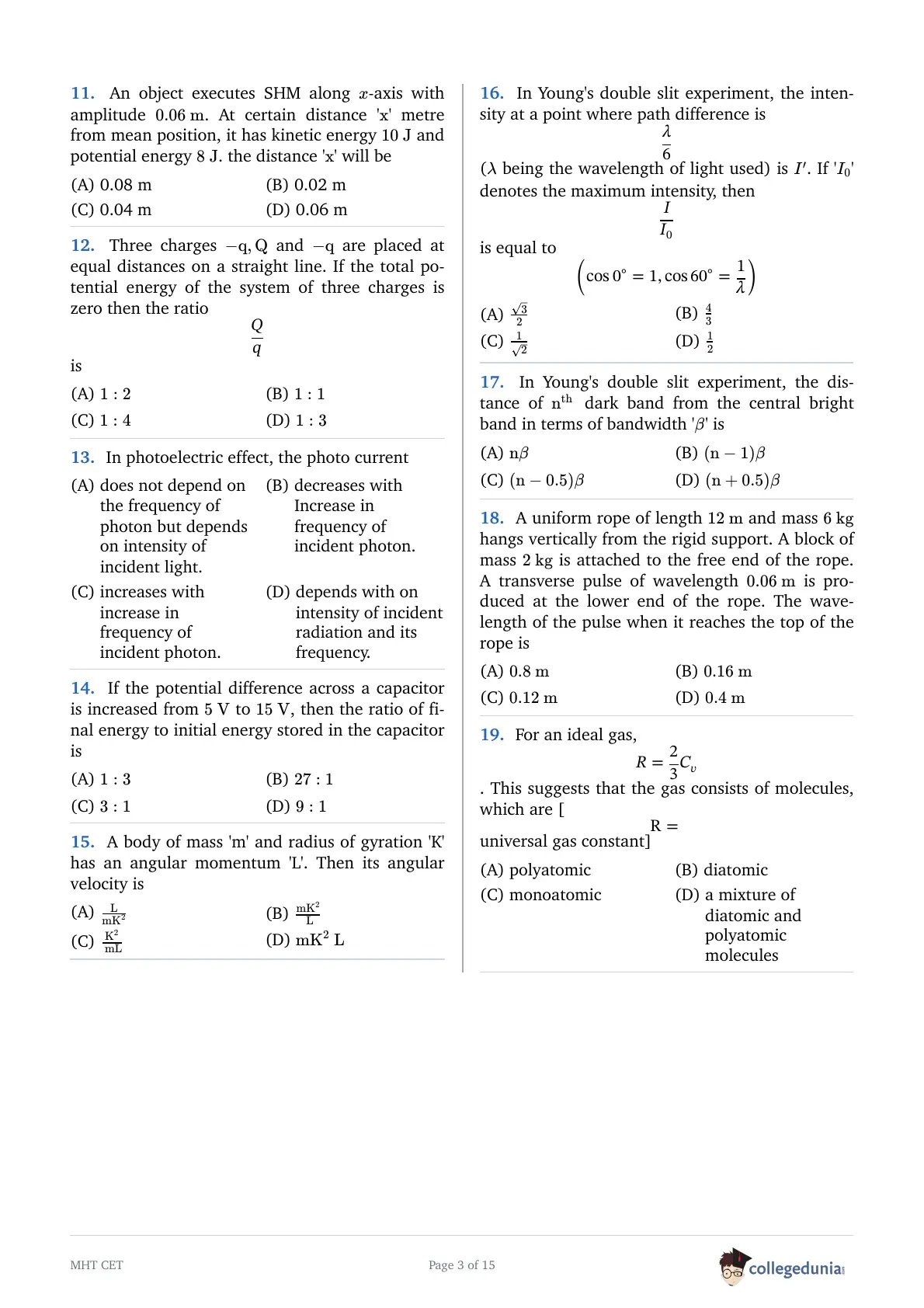
An object executes SHM along \(x\)-axis with amplitude \(0.06 \text{ m}\). At certain distance \(x\) metre from mean position, it has kinetic energy \(10 \text{ J}\) and potential energy \(8 \text{ J}\). The distance \(x\) will be
Three charges \(-q\), \(Q\) and \(-q\) are placed at equal distances on a straight line. If the total potential energy of the system of three charges is zero then the ratio \(\frac{Q}{q}\) is
In photoelectric effect, the photo current
If the potential difference across a capacitor is increased from \(5 \text{ V}\) to \(15 \text{ V}\), then the ratio of final energy to initial energy stored in the capacitor is
A body of mass 'm' and radius of gyration 'K' has an angular momentum 'L'. Then its angular velocity is
In Young's double slit experiment, the intensity at a point where path difference is \(\frac{\lambda}{6}\) (\(\lambda\) being the wavelength of light used) is \(I'\). If '\(I_0\)' denotes the maximum intensity, then \(\frac{I'}{I_0}\) is equal to (\(\cos 0^\circ = 1, \cos 60^\circ = \frac{1}{2}\))
In Young's double slit experiment, the distance of \(n^{\text{th}}\) dark band from the central bright band in terms of bandwidth \(\beta\) is
A uniform rope of length \(12\text{ m}\) and mass \(6\text{ kg}\) hangs vertically from a rigid support. A block of mass \(2\text{ kg}\) is attached to the free end of the rope. A transverse pulse of wavelength \(0.06\text{ m}\) is produced at the lower end of the rope. The wavelength of the pulse when it reaches the top of the rope is
For an ideal gas, \(R = \frac{2}{3} C_v\). This suggests that the gas consists of molecules, which are (\(R = \) universal gas constant)
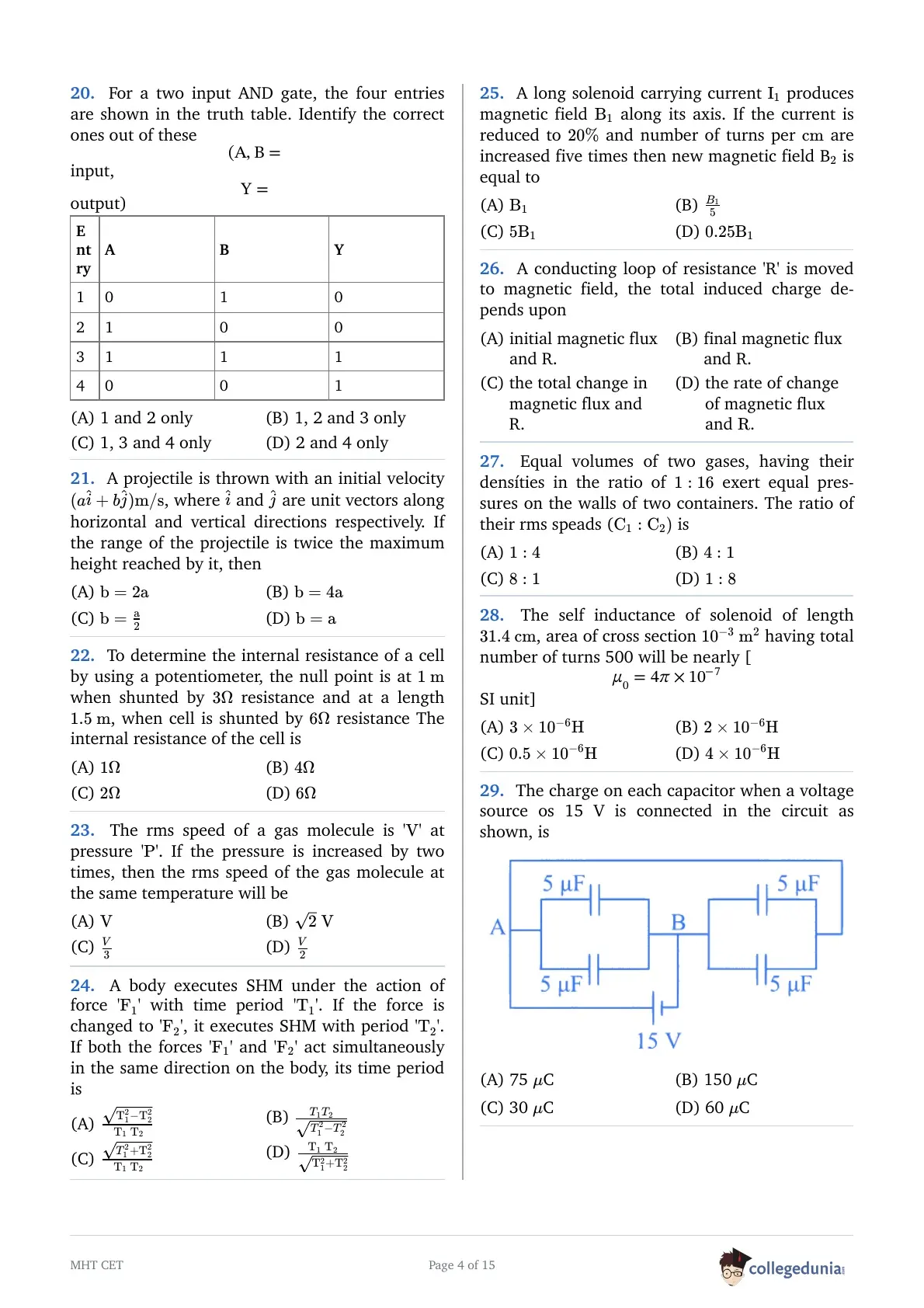
For a two input AND gate, the four entries are shown in the truth table. Identify the correct ones out of these (\(A\), \(B = \) input, \(Y = \) output)

A projectile is thrown with an initial velocity \((a \hat{i}+b \hat{j}) \text{ m/s}\), where \(\hat{i}\) and \(\hat{j}\) are unit vectors along horizontal and vertical directions respectively. If the range of the projectile is twice the maximum height reached by it, then
To determine the internal resistance of a cell by using a potentiometer, the null point is at \(1 \text{ m}\) when shunted by \(3 \; \Omega\) resistance and at a length \(1.5 \text{ m}\), when cell is shunted by \(6 \; \Omega\) resistance. The internal resistance of the cell is
The rms speed of a gas molecule is 'V' at pressure 'P'. If the pressure is increased by two times, then the rms speed of the gas molecule at the same temperature will be
A body executes SHM under the action of force '\(F_1\)' with time period '\(T_1\)'. If the force is changed to '\(F_2\)', it executes SHM with period '\(T_2\)'. If both the forces '\(F_1\)' and '\(F_2\)' act simultaneously in the same direction on the body, its time period is
A long solenoid carrying current \(I_1\) produces magnetic field \(B_1\) along its axis. If the current is reduced to \(20\%\) and number of turns per cm are increased five times then new magnetic field \(B_2\) is equal to
A conducting loop of resistance 'R' is moved in a magnetic field, the total induced charge depends upon
Equal volumes of two gases, having their densities in the ratio of \(1 : 16\) exert equal pressures on the walls of two containers. The ratio of their rms speeds (\(C_1 : C_2\)) is
The self inductance of a solenoid of length \(31.4 \text{ cm}\), area of cross section \(10^{-3} \text{ m}^2\) having total number of turns \(500\) will be nearly [\(\mu_0 = 4\pi \times 10^{-7}\) SI unit]
The charge on each capacitor when a voltage source of \(15 \text{ V}\) is connected in the circuit as shown, is

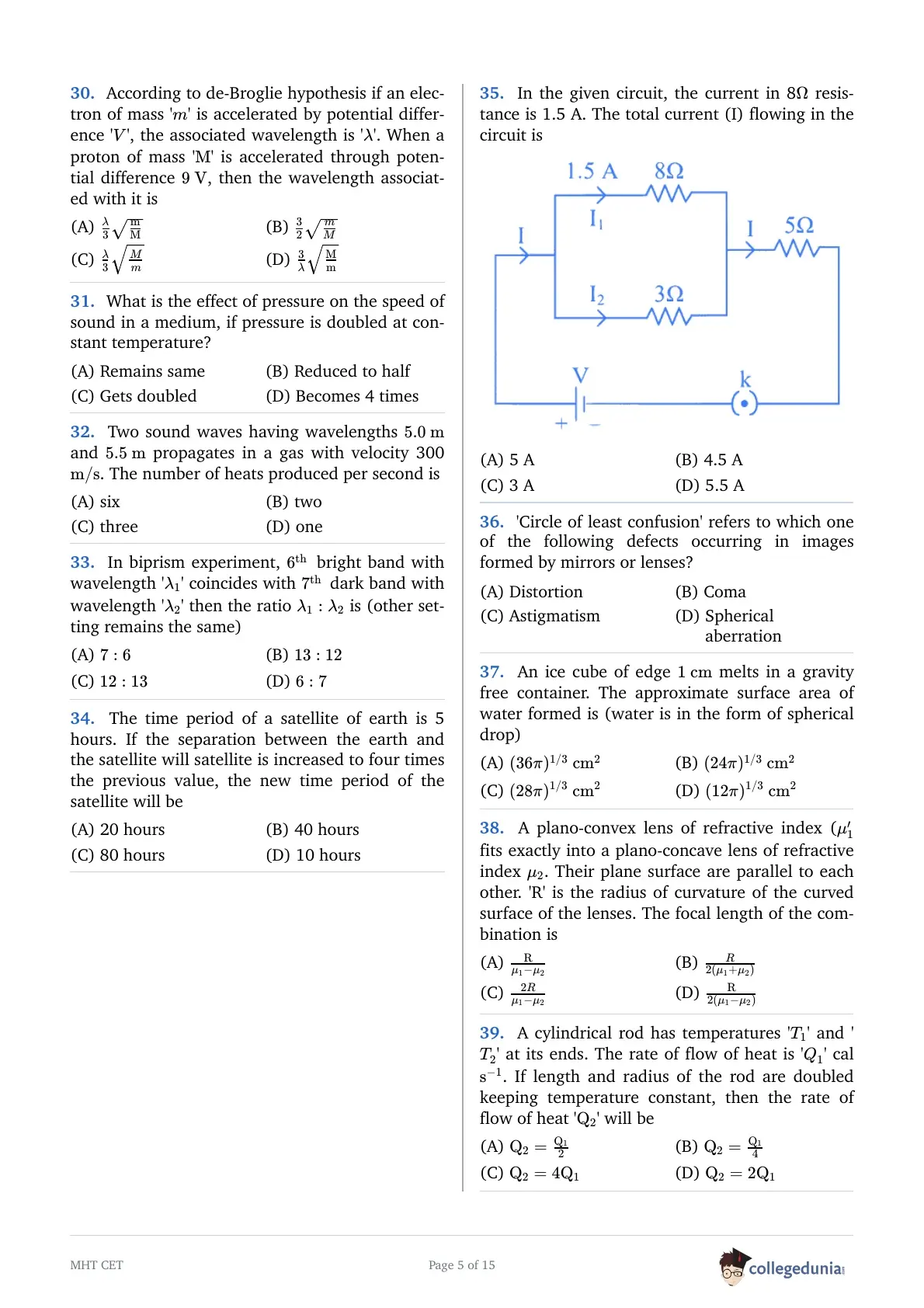
According to de-Broglie hypothesis if an electron of mass '\(m\)' is accelerated by potential difference '\(V\)', the associated wavelength is '\(\lambda\)'. When a proton of mass '\(M\)' is accelerated through potential difference \(9V\), then the wavelength associated with it is
What is the effect of pressure on the speed of sound in a medium, if pressure is doubled at constant temperature?
Two sound waves having wavelengths \(5.0 \text{ m}\) and \(5.5 \text{ m}\) propagate in a gas with velocity \(300 \text{ m/s}\). The number of beats produced per second is
In biprism experiment, \(6^{\text{th}}\) bright band with wavelength '\(\lambda_1\)' coincides with \(7^{\text{th}}\) dark band with wavelength '\(\lambda_2\)', then the ratio \(\lambda_1 : \lambda_2\) is (other setting remains the same)
The time period of a satellite of earth is \(5\text{ hours}\). If the separation between the earth and the satellite is increased to four times the previous value, the new time period of the satellite will be
In the given circuit, the current in \(8 \; \Omega\) resistance is \(1.5\text{ A}\). The total current (\(I\)) flowing in the circuit is

'Circle of least confusion' refers to which one of the following defects occurring in images formed by mirrors or lenses?
An ice cube of edge \(1 \text{ cm}\) melts in a gravity free container. The approximate surface area of water formed is (water is in the form of a spherical drop)
A plano-convex lens of refractive index \(\mu_1\) fits exactly into a plano-concave lens of refractive index \(\mu_2\). Their plane surfaces are parallel to each other. 'R' is the radius of curvature of the curved surface of the lenses. The focal length of the combination is
A cylindrical rod has temperatures '\(T_1\)' and '\(T_2\)' at its ends. The rate of flow of heat is '\(Q_1\)' \(\text{cal s}^{-1}\). If length and radius of the rod are doubled keeping temperature constant, then the rate of flow of heat '\(Q_2\)' will be
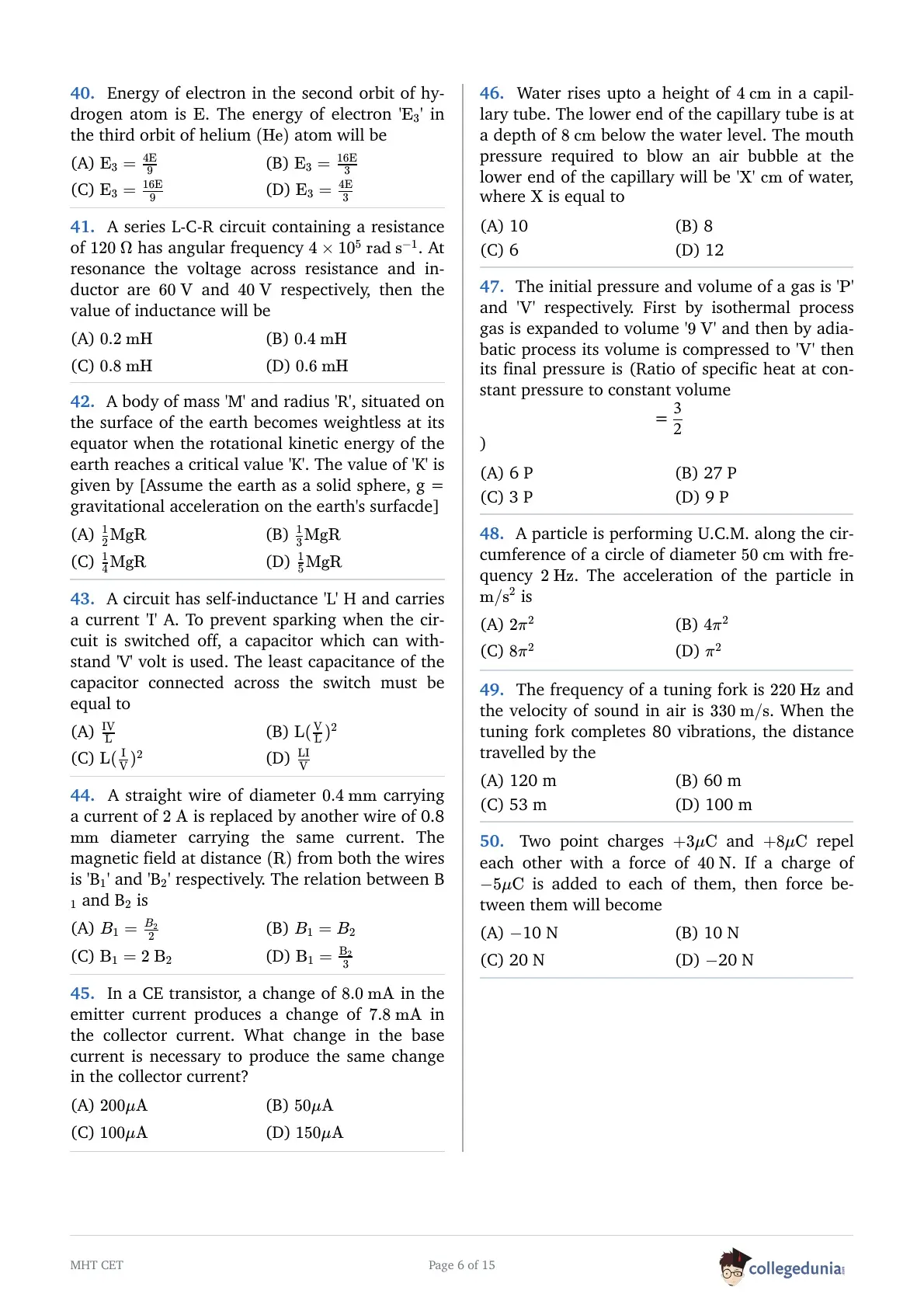
Energy of electron in the second orbit of hydrogen atom is \(E\). The energy of electron '\(E_3\)' in the third orbit of helium (\(\text{He}^+\)) atom will be
A series L-C-R circuit containing a resistance of \(120 \; \Omega\) has angular frequency \(4 \times 10^5 \text{ rad s}^{-1}\). At resonance, the voltage across the resistance and inductor are \(60 \text{ V}\) and \(40 \text{ V}\) respectively, then the value of inductance will be
A body of mass 'M' and radius 'R', situated on the surface of the earth becomes weightless at its equator when the rotational kinetic energy of the earth reaches a critical value 'K'. The value of 'K' is given by [Assume the earth as a solid sphere, g = gravitational acceleration on the earth's surface]
A circuit has self-inductance 'L' H and carries a current 'I' A. To prevent sparking when the circuit is switched off, a capacitor which can withstand 'V' volt is used. The least capacitance of the capacitor connected across the switch must be equal to
A straight wire of diameter \(0.4 \text{ mm}\) carrying a current of \(2 \text{ A}\) is replaced by another wire of \(0.8 \text{ mm}\) diameter carrying the same current. The magnetic field at distance (R) from both the wires is '\(B_1\)' and '\(B_2\)' respectively. The relation between \(B_1\) and \(B_2\) is
In a CE transistor, a change of \(8.0 \text{ mA}\) in the emitter current produces a change of \(7.8 \text{ mA}\) in the collector current. What change in the base current is necessary to produce the same change in the collector current?
Water rises upto a height of \(4 \text{ cm}\) in a capillary tube. The lower end of the capillary tube is at a depth of \(8 \text{ cm}\) below the water level. The mouth pressure required to blow an air bubble at the lower end of the capillary will be 'X' cm of water, where X is equal to
The initial pressure and volume of a gas is 'P' and 'V' respectively. First by isothermal process gas is expanded to volume '9V' and then by adiabatic process its volume is compressed to 'V' then its final pressure is (Ratio of specific heat at constant pressure to constant volume = \(\frac{3}{2}\))
A particle is performing U.C.M. along the circumference of a circle of diameter \(50 \text{ cm}\) with frequency \(2 \text{ Hz}\). The acceleration of the particle in \(\text{m/s}^2\) is
The frequency of a tuning fork is \(220 \text{ Hz}\) and the velocity of sound in air is \(330 \text{ m/s}\). When the tuning fork completes \(80\) vibrations, the distance travelled by the sound wave is
Two point charges \(+3 \; \mu\text{C}\) and \(+8 \; \mu\text{C}\) repel each other with a force of \(40 \text{ N}\). If a charge of \(-5 \; \mu\text{C}\) is added to each of them, then the force between them will become
Chemistry (Q51 - Q100)
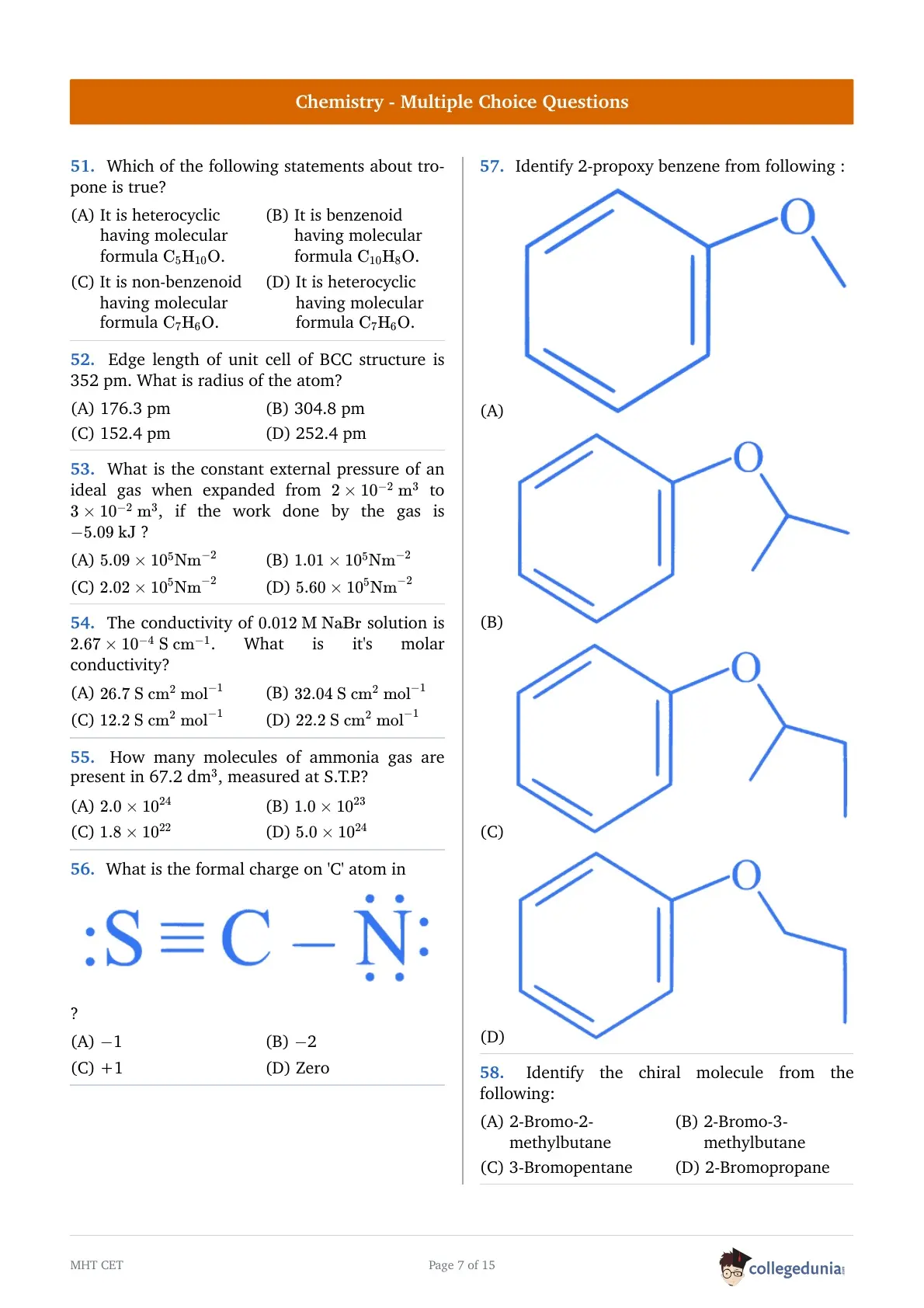
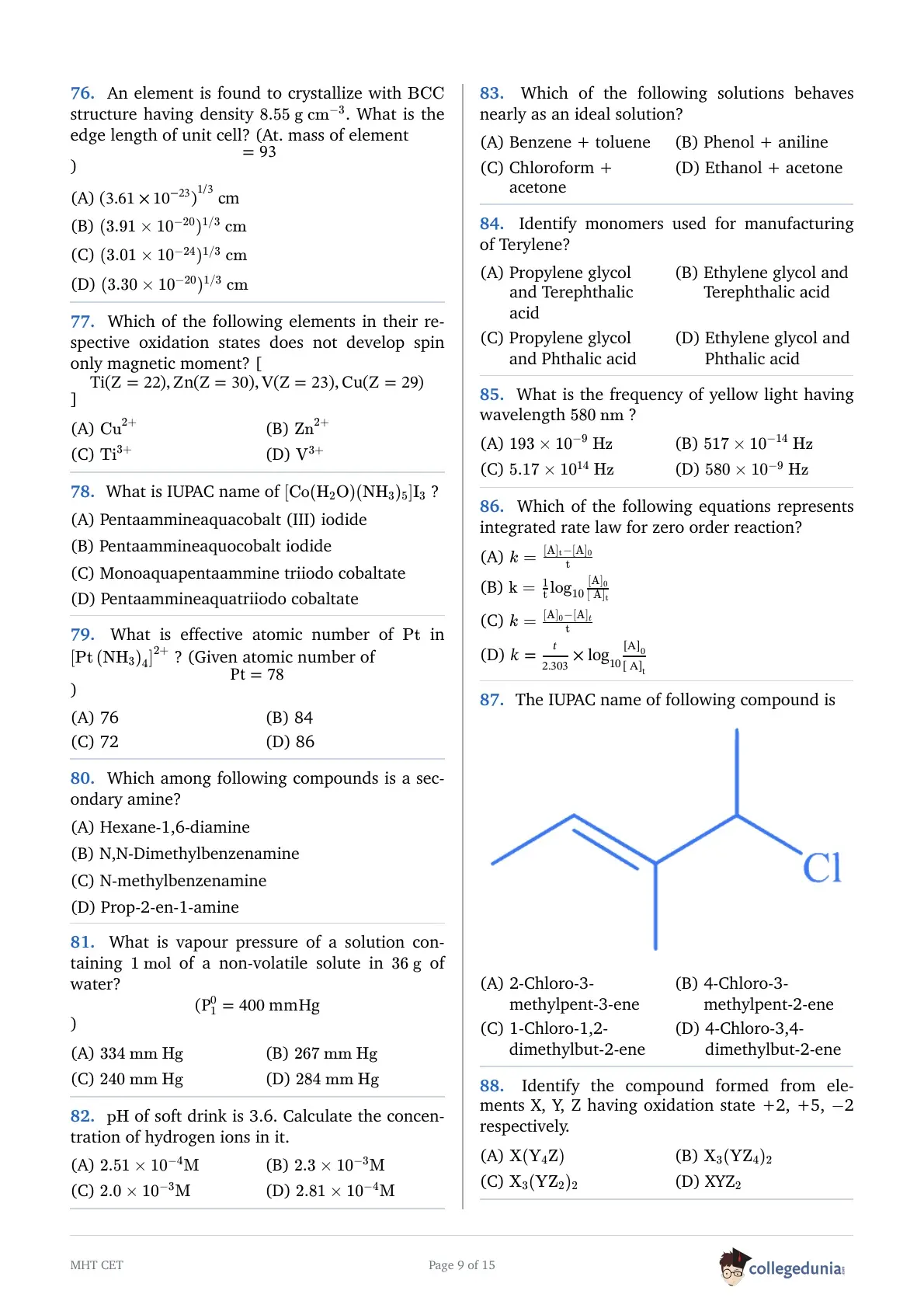
Which of the following statements about tropone is true?
Edge length of unit cell of BCC structure is 352 pm. What is radius of the atom?
What is the constant external pressure of an ideal gas when expanded from \(2 \times 10^{-2}\ \text{m}^3\) to \(3 \times 10^{-2}\ \text{m}^3\), if the work done by the gas is \(-5.09\ \text{kJ}\)?
The conductivity of \(0.012\ \text{M}\) NaBr solution is \(2.67 \times 10^{-4}\ \text{S\ cm}^{-1}\). What is it's molar conductivity?
How many molecules of ammonia gas are present in 67.2 \(\text{dm}^3\), measured at S.T.P.?
What is the formal charge on 'C' atom in the phosgene (\(\text{COCl}_2\)) molecule?


Identify the chiral molecule from the following:
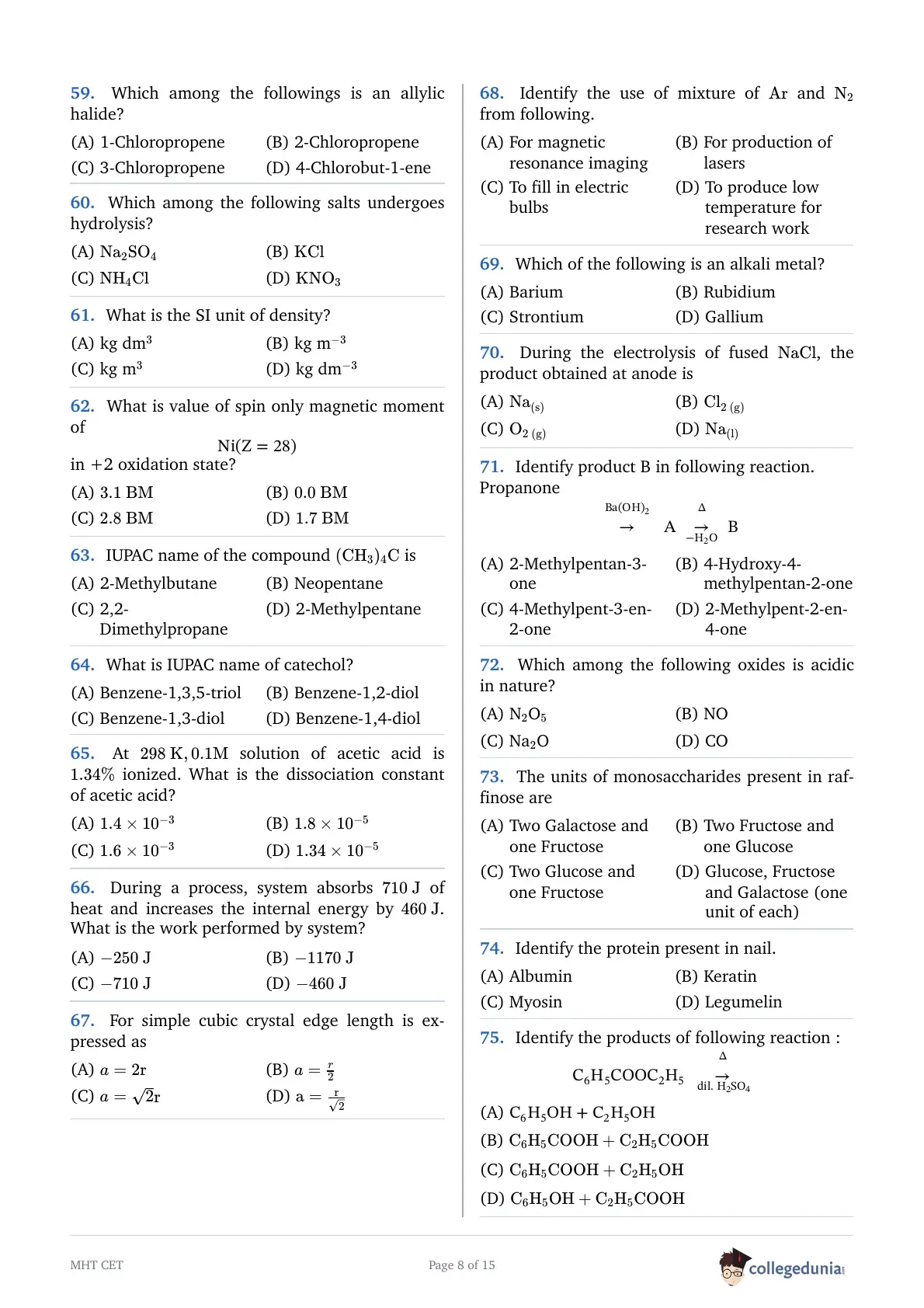
Which among the followings is an allylic halide?
Which among the following salts undergoes hydrolysis?
What is the SI unit of density?
What is value of spin only magnetic moment of \(\text{Ni}\ (Z = 28)\) in +2 oxidation state?
IUPAC name of the compound \((\text{CH}_3)_4\text{C}\) is
What is IUPAC name of catechol?
At 298 K, 0.1 M solution of acetic acid is 1.34 % ionized. What is the dissociation constant of acetic acid?
During a process, system absorbs 710 J of heat and increases the internal energy by 460 J. What is the work performed by system?
For simple cubic crystal edge length is expressed as
Identify the use of mixture of Ar and \(\text{N}_2\) from following.
Which of the following is an alkali metal?
During the electrolysis of fused NaCl, the product obtained at anode is
Identify product B in following reaction.
Propanone \(\xrightarrow{\mathrm{Ba}(\mathrm{OH})_2} \mathrm{~A} \xrightarrow[-\mathrm{H}_2 \mathrm{O}]{\Delta} \mathrm{B}\)
Which among the following oxides is acidic in nature?
The units of monosaccharides present in raffinose are
Identify the protein present in nail.
Identify the products of following reaction :
\(\mathrm{C}_6 \mathrm{H}_5 \mathrm{COOC}_2 \mathrm{H}_5 \xrightarrow[\text { dil. } \mathrm{H}_2 \mathrm{SO}_4]{\Delta}\)
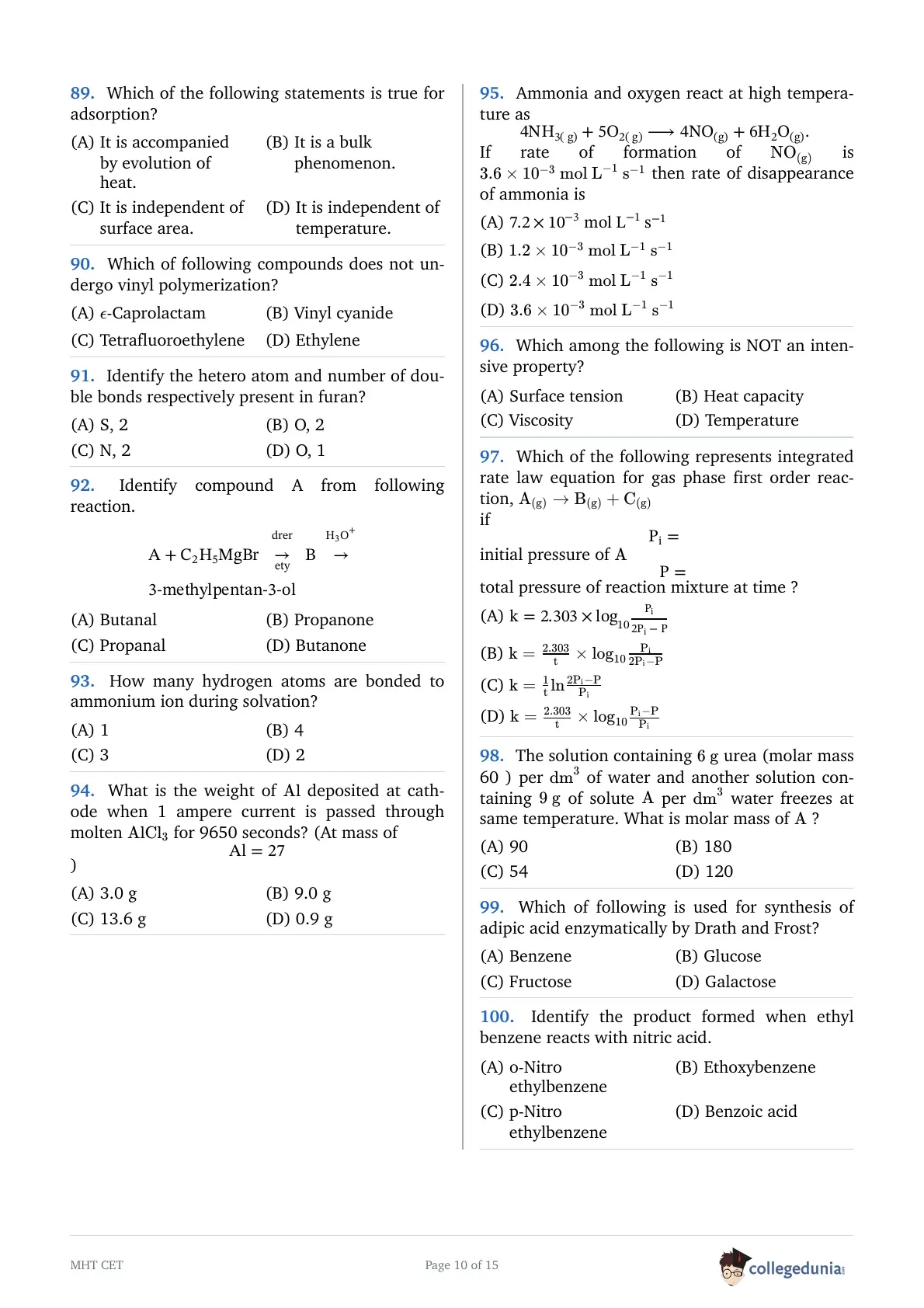
An element is found to crystallize with BCC structure having density \(8.55\ \text{g\ cm}^{-3}\). What is the edge length of unit cell? (At. mass of element = 93)
Which of the following elements in their respective oxidation states does not develop spin only magnetic moment? [\(\text{Ti}\ (Z = 22)\), \(\text{Zn}\ (Z = 30)\), \(\text{V}\ (Z = 23)\), \(\text{Cu}\ (Z = 29)\)]
What is IUPAC name of \([\text{Co}(\text{H}_2\text{O})(\text{NH}_3)_5]\text{I}_3\) ?
What is effective atomic number of Pt in \([\text{Pt}(\text{NH}_3)_4]^{2+}\) ? (Given atomic number of Pt = 78)
Which among following compounds is a secondary amine?
What is vapour pressure of a solution containing 1 mol of a non-volatile solute in 36 g of water? (\(P_1^0 = 400\ \text{mm Hg}\))
pH of soft drink is 3.6. Calculate the concentration of hydrogen ions in it.
Which of the following solutions behaves nearly as an ideal solution?
Identify monomers used for manufacturing of Terylene?
What is the frequency of yellow light having wavelength 580 nm?
Which of the following equations represents integrated rate law for zero order reaction?

Identify the compound formed from elements X, Y, Z having oxidation states \(+2\), \(+5\), \(-2\) respectively.
Which of the following statements is true for adsorption?
Which of the following compounds does not undergo vinyl polymerization?
Identify the hetero atom and number of double bonds respectively present in furan?
Identify compound A from following reaction.
\(\mathrm{A}+\mathrm{C}_2 \mathrm{H}_5 \mathrm{MgBr} \xrightarrow[\text { ety }]{\text { drer }} \mathrm{B} \xrightarrow{\mathrm{H}_3 \mathrm{O}^{+}} \text {3-methylpentan-3-ol }\)
How many hydrogen atoms are bonded to ammonium ion during solvation?
What is the weight of Al deposited at cathode when 1 ampere current is passed through molten \(\text{AlCl}_3\) for 9650 seconds? (At mass of Al = 27)
Ammonia and oxygen react at high temperature as:
\(4\text{NH}_{3(\text{g})} + 5\text{O}_{2(\text{g})} \longrightarrow 4\text{NO}_{(\text{g})} + 6\text{H}_2\text{O}_{(\text{g})}\)
If rate of formation of \(\text{NO}_{(\text{g})}\) is \(3.6 \times 10^{-3}\ \text{mol\ L}^{-1}\text{s}^{-1}\) then rate of disappearance of ammonia is
Which among the following is NOT an intensive property?
Which of the following represents integrated rate law equation for gas phase first order reaction, \(\text{A}_{(\text{g})} \rightarrow \text{B}_{(\text{g})} + \text{C}_{(\text{g})}\) if \(P_i =\) initial pressure of A and \(P =\) total pressure of reaction mixture at time \(t\)?
The solution containing 6 g urea (molar mass 60) per \(\text{dm}^3\) of water and another solution containing 9 g of solute A per \(\text{dm}^3\) water freezes at same temperature. What is molar mass of A?
Which of following is used for synthesis of adipic acid enzymatically by Drath and Frost?
Identify the product formed when ethyl benzene reacts with nitric acid.
Mathematics (Q101 - Q150)
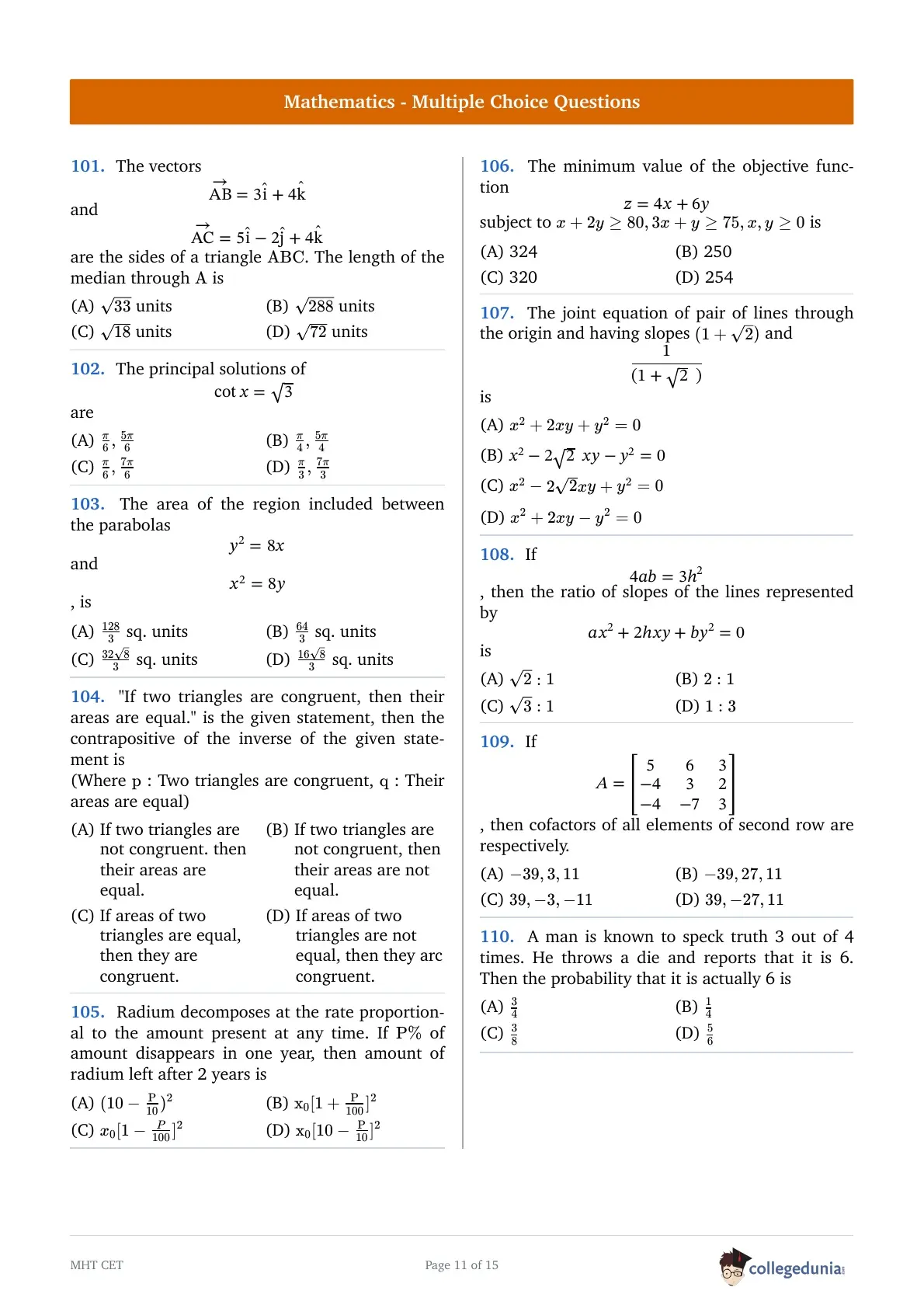
The vectors \(\overrightarrow{\text{AB}} = 3\hat{\text{i}} + 4\hat{\text{k}}\) and \(\overrightarrow{\text{AC}} = 5\hat{\text{i}} - 2\hat{\text{j}} + 4\hat{\text{k}}\) are the sides of a triangle ABC. The length of the median through A is
The principal solutions of \(\cot x = \sqrt{3}\) are
The area of the region included between the parabolas \(y^2 = 8x\) and \(x^2 = 8y\) is
"If two triangles are congruent, then their areas are equal." is the given statement, then the contrapositive of the inverse of the given statement is
Radium decomposes at the rate proportional to the amount present at any time. If \(P\%\) of amount disappears in one year, then amount of radium left after 2 years is
The minimum value of the objective function \(z = 4x + 6y\) subject to \(x + 2y \ge 80\), \(3x + y \ge 75\), \(x, y \ge 0\) is
The joint equation of pair of lines through the origin and having slopes \((1+\sqrt{2})\) and \(\frac{1}{(1+\sqrt{2})}\) is
If \[4 a b=3 h^2\], then the ratio of slopes of the lines represented by \[a x^2+2 h x y+b y^2=0\] is
If \(A = \left[\begin{array}{ccc}5 & 6 & 3 \\ -4 & 3 & 2 \\ -4 & -7 & 3\end{array}\right]\), then cofactors of all elements of second row are respectively
A man is known to speak truth 3 out of 4 times. He throws a die and reports that it is 6. Then the probability that it is actually 6 is
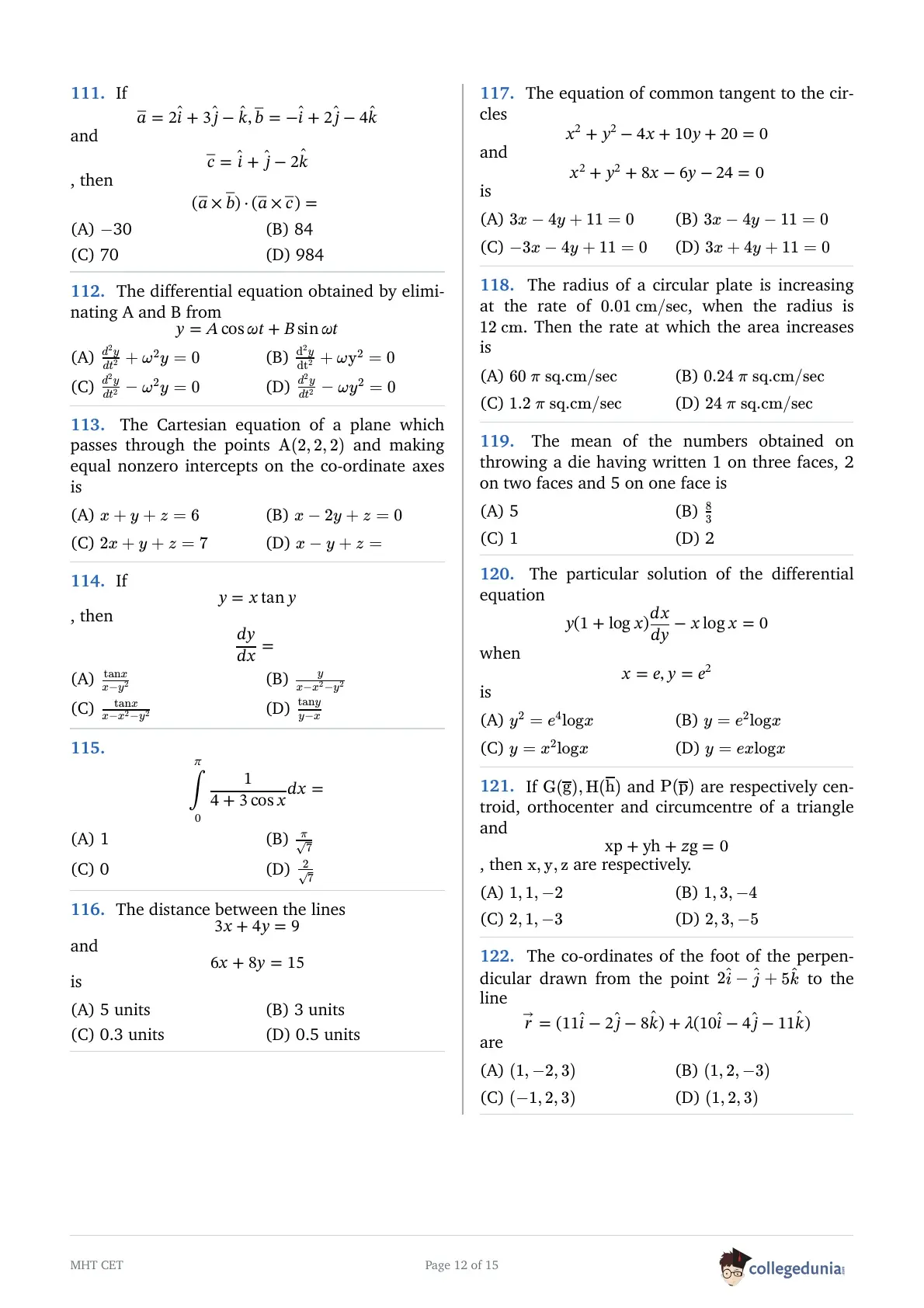
If \(\vec{a} = 2\hat{\text{i}} + 3\hat{\text{j}} - \hat{\text{k}}\), \(\vec{b} = -\hat{\text{i}} + 2\hat{\text{j}} - 4\hat{\text{k}}\) and \(\vec{c} = \hat{\text{i}} + \hat{\text{j}} - 2\hat{\text{k}}\), then \((\vec{a} \times \vec{b}) \cdot (\vec{a} \times \vec{c}) =\)
The differential equation obtained by eliminating A and B from \(y = A \cos \omega t + B \sin \omega t\) is
The Cartesian equation of a plane which passes through the points \(\text{A}(2, 2, 2)\) and making equal nonzero intercepts on the co-ordinate axes is
If \(y = x \tan y\), then \(\frac{dy}{dx} =\)
The value of the definite integral \(\int_{0}^{\pi} \frac{1}{4 + 3 \cos x} \, dx\) is
The equation of the common tangent to the circles \(x^2 + y^2 - 4x + 10y + 20 = 0\) and \(x^2 + y^2 + 8x - 6y - 24 = 0\) is
The radius of a circular plate is increasing at the rate of \(0.01\ \text{cm/sec}\). When the radius is \(12\ \text{cm}\), the rate at which its area increases is
The mean of the numbers obtained on throwing a die having written 1 on three faces, 2 on two faces and 5 on one face is
The particular solution of the differential equation \(y(1 + \log x) \frac{dx}{dy} - x \log x = 0\) when \(x = e, y = e^2\) is
If \(\text{G}(\vec{\text{g}})\), \(\text{H}(\vec{\text{h}})\) and \(\text{P}(\vec{\text{p}})\) are respectively centroid, orthocenter and circumcentre of a triangle and \(x\vec{\text{p}} + y\vec{\text{h}} + z\vec{\text{g}} = \vec{\text{0}}\), then \(x, y, z\) are respectively
The co-ordinates of the foot of the perpendicular drawn from the point \(2\hat{\text{i}} - \hat{\text{j}} + 5\hat{\text{k}}\) to the line \(\vec{\text{r}} = (11\hat{\text{i}} - 2\hat{\text{j}} - 8\hat{\text{k}}) + \lambda(10\hat{\text{i}} - 4\hat{\text{j}} - 11\hat{\text{k}})\) are
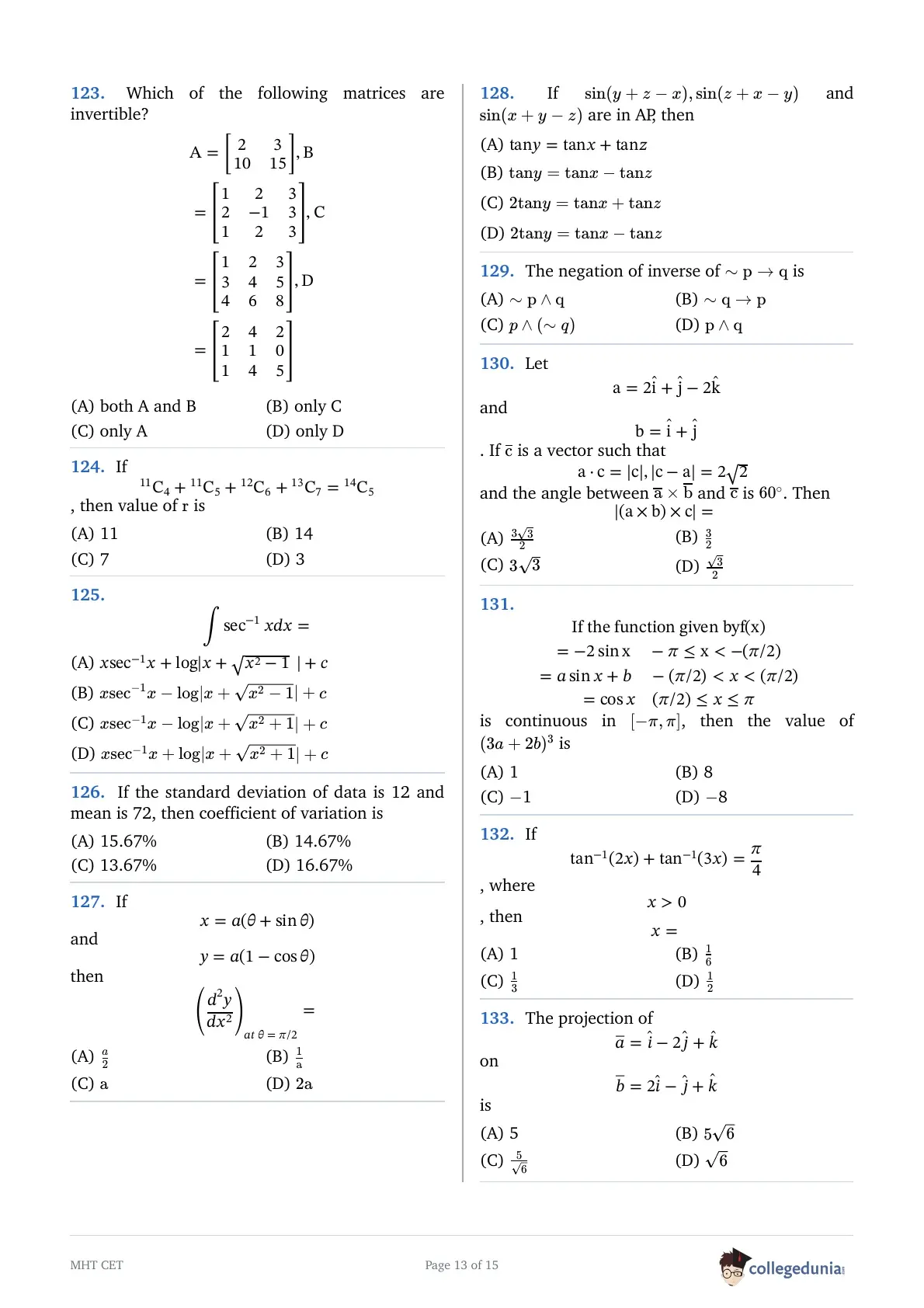
Which of the following matrices are invertible?
\(\begin{aligned} & \mathrm{A}=\left[\begin{array}{cc} 2 & 3 \\ 10 & 15 \end{array}\right], \mathrm{B}=\left[\begin{array}{ccc} 1 & 2 & 3 \\ 2 & -1 & 3 \\ 1 & 2 & 3 \end{array}\right], \mathrm{C}=\left[\begin{array}{lll} 1 & 2 & 3 \\ 3 & 4 & 5 \\ 4 & 6 & 8 \end{array}\right], \mathrm{D}=\left[\begin{array}{lll} 2 & 4 & 2 \\ 1 & 1 & 0 \\ 1 & 4 & 5 \end{array}\right] \end{aligned}\)
If \(^{11}\text{C}_4 + {^{11}\text{C}_5} + {^{12}\text{C}_6} + {^{13}\text{C}_7} = {^{14}\text{C}_r}\), then the value of \(r\) is
Evaluate the indefinite integral \(\int \sec^{-1}x \, dx\)
If the standard deviation of data is 12 and mean is 72, then coefficient of variation is
If \(x = a(\theta + \sin \theta)\) and \(y = a(1 - \cos \theta)\), then \(\left(\frac{d^2y}{dx^2}\right)_{\text{at } \theta = \pi / 2} =\)
If \(\sin(y + z - x)\), \(\sin(z + x - y)\) and \(\sin(x + y - z)\) are in AP, then
The negation of the inverse of \(\sim p \rightarrow q\) is
Let \(\vec{a} = 2\hat{\text{i}} + \hat{\text{j}} - 2\hat{\text{k}}\) and \(\vec{b} = \hat{\text{i}} + \hat{\text{j}}\). If \(\vec{c}\) is a vector such that \(\vec{a} \cdot \vec{c} = |\vec{c}|\), \(|\vec{c} - \vec{a}| = 2\sqrt{2}\) and the angle between \(\vec{a} \times \vec{b}\) and \(\vec{c}\) is \(60^\circ\), then \(|(\vec{a} \times \vec{b}) \times \vec{c}| =\)
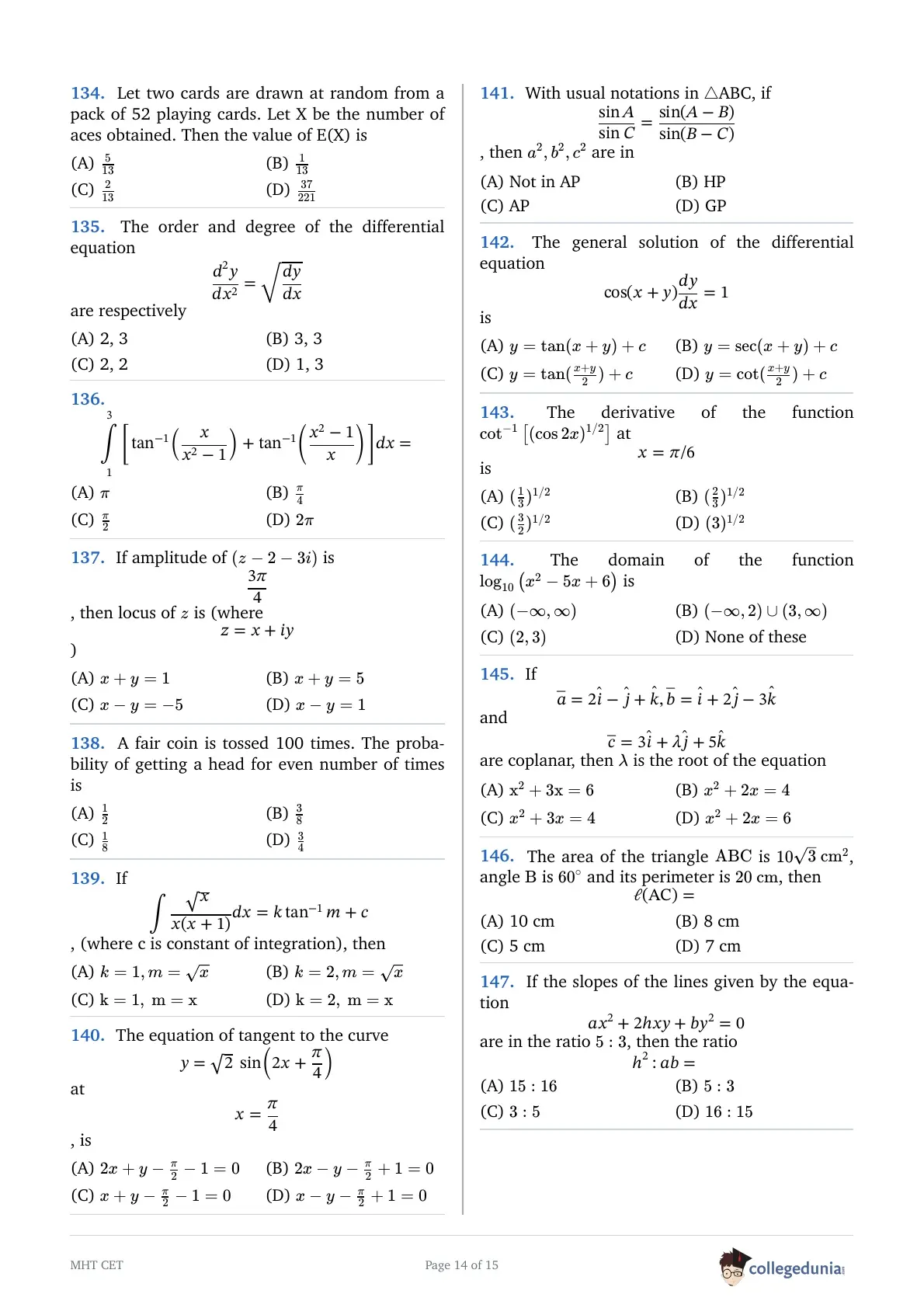
If the function given by
\(f(x) = -2 \sin x\) for \(-\pi \le x < -\frac{\pi}{2}\)
\(f(x) = a \sin x + b\) for \(-\frac{\pi}{2} < x < \frac{\pi}{2}\)
\(f(x) = \cos x\) for \(\frac{\pi}{2} \le x \le \pi\)
is continuous in \([-\pi, \pi]\), then the value of \((3a + 2b)^3\) is
If \(\tan^{-1}(2x) + \tan^{-1}(3x) = \frac{\pi}{4}\), where \(x > 0\), then \(x =\)
The projection of \(\vec{a} = \hat{\text{i}} - 2\hat{\text{j}} + \hat{\text{k}}\) on \(\vec{b} = 2\hat{\text{i}} - \hat{\text{j}} + \hat{\text{k}}\) is
Let two cards be drawn at random from a pack of 52 playing cards. Let X be the number of aces obtained. Then the value of E(X) is
The order and degree of the differential equation \(\frac{d^2 y}{d x^2}=\sqrt{\frac{d y}{d x}}\) are respectively
\(\int_\limits1^3\left[\tan ^{-1}\left(\frac{x}{x^2-1}\right)+\tan ^{-1}\left(\frac{x^2-1}{x}\right)\right] d x=\)
If the amplitude of \((z - 2 - 3i)\) is \(\frac{3\pi}{4}\), then the locus of \(z\) is (where \(z = x + iy\))
A fair coin is tossed 100 times. The probability of getting a head for an even number of times is
If \(\int \frac{\sqrt{x}}{x(x+1)} \, dx = k \tan^{-1} m + c\) (where \(c\) is a constant of integration), then
The equation of the tangent to the curve \(y = \sqrt{2} \sin\left(2x + \frac{\pi}{4}\right)\) at \(x = \frac{\pi}{4}\) is
With usual notations in \(\triangle \text{ABC}\), if \(\frac{\sin \text{A}}{\sin \text{C}} = \frac{\sin(\text{A} - \text{B})}{\sin(\text{B} - \text{C})}\), then \(a^2, b^2, c^2\) are in
The general solution of the differential equation \(\cos(x + y) \frac{dy}{dx} = 1\) is
The derivative of the function \(\cot^{-1}\left[(\cos 2x)^{1/3}\right]\) at \(x = \frac{\pi}{6}\) is
The domain of the function \(\log_{10}(x^2 - 5x + 6)\) is
If \(\vec{a} = 2\hat{\text{i}} - \hat{\text{j}} + \hat{\text{k}}\), \(\vec{b} = \hat{\text{i}} + 2\hat{\text{j}} - 3\hat{\text{k}}\) and \(\vec{c} = 3\hat{\text{i}} + \lambda\hat{\text{j}} + 5\hat{\text{k}}\) are coplanar, then \(\lambda\) is the root of the equation
The area of the triangle ABC is \(10\sqrt{3}\ \text{cm}^2\), angle B is \(60^\circ\) and its perimeter is \(20\ \text{cm}\), then \(\ell(\text{AC}) =\)
If the slopes of the lines given by the equation \(ax^2 + 2hxy + by^2 = 0\) are in the ratio \(5 : 3\), then the ratio \(h^2 : ab =\)
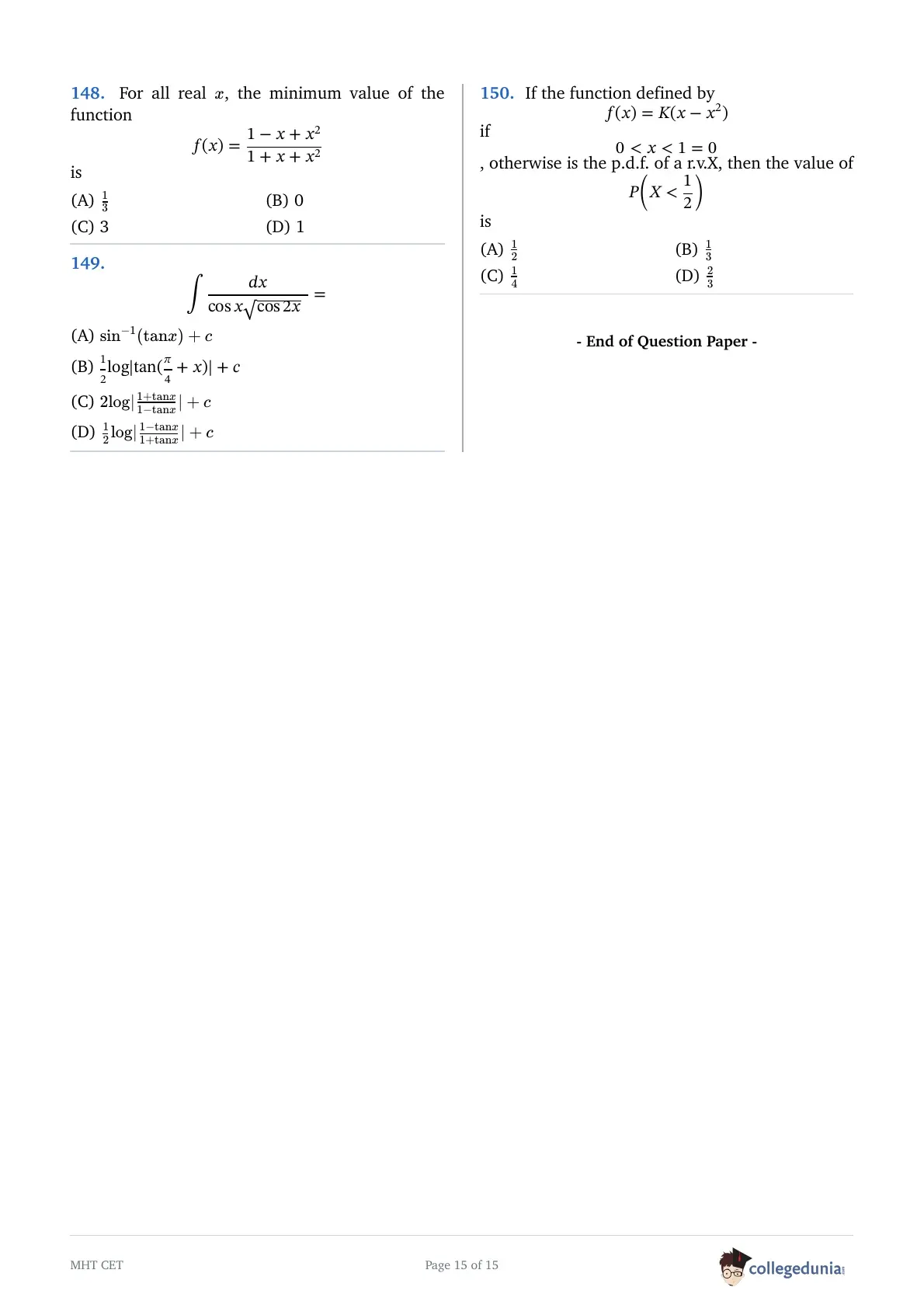
For all real \(x\), the minimum value of the function \(f(x) = \frac{1 - x + x^2}{1 + x + x^2}\) is
If the function defined by \(f(x)=K(x-x^2)\) if \(0 < x < 1\), \(=0\) otherwise, is the p.d.f. of a r.v. X, then the value of \(P\left(X<\frac{1}{2}\right)\) is
MHT CET 2021 PCM Exam Pattern and Marking Scheme
| Parameter | Details |
|---|---|
| Conducting Body | Maharashtra Common Entrance Test Cell (Maharashtra CET Cell) |
| Exam Mode | Online (Computer-Based Test) |
| Duration | 180 minutes (3 hours) |
| Groups / Subjects | PCM (Physics, Chemistry, Mathematics) for Engineering |
| Total Questions |
150 |
| Total Marks | 200 |
| Question Type | Multiple Choice Questions (MCQs) |
| Marks Distribution |
|
| Negative Marking | No |
| Syllabus Weightage |
|



Comments