




MHT CET 2021 Sep 24 Shift 1 PCM Question Paper is available for download here. Maharashtra State CET Cell conducted MHT CET 2021 PCM Exam on Sep 24 in Shift 1 from 9 AM to 12 PM in CBT mode.
The MHT CET 2021 PCM question paper includes the following:
- The MHT CET 2021 PCM Question Paper consists of 150 multiple-choice questions (MCQs) totalling 200 marks divided into 3 sections: Physics, Chemistry, and Mathematics, with 50 questions in each subject.
- Physics and Chemistry questions carry 1 mark each while Mathematics questions carry 2 marks each.
- There is no negative marking for incorrect answers.
MHT CET 2021 Sep 24 Shift 1 PCM Question Paper with Solution PDF
| CD PDF | CD PDF with Solutions |
|---|---|
| Download Collegedunia PDF 1.14 MB | - |
Also Check:
MHT CET 2021 Sep 24 Shift 1 PCM Questions with Solutions
Physics (Q1 - Q50)
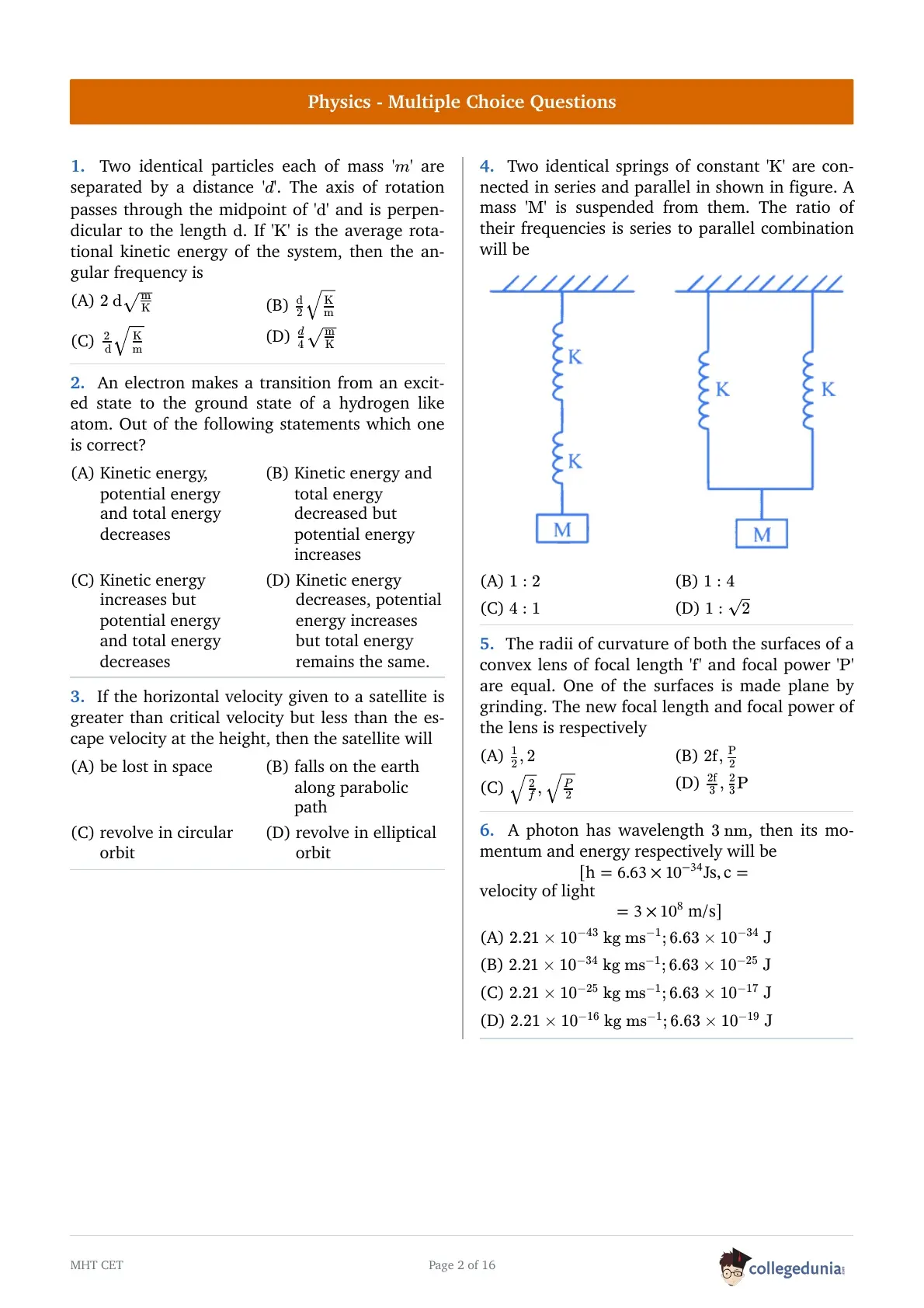
Two identical particles each of mass \(m\) are separated by a distance \(d\). The axis of rotation passes through the midpoint of \(d\) and is perpendicular to the length \(d\). If \(K\) is the average rotational kinetic energy of the system, then the angular frequency is
An electron makes a transition from an excited state to the ground state of a hydrogen like atom. Out of the following statements which one is correct?
If the horizontal velocity given to a satellite is greater than critical velocity but less than the escape velocity at the height, then the satellite will
Two identical springs of constant \(K\) are connected in series and parallel in shown in figure. A mass \(M\) is suspended from them. The ratio of their frequencies is series to parallel combination will be

The radii of curvature of both the surfaces of a convex lens of focal length \(f\) and focal power \(P\) are equal. One of the surfaces is made plane by grinding. The new focal length and focal power of the lens is respectively
A photon has wavelength \(3\text{ nm}\), then its momentum and energy respectively will be \([h = 6.63 \times 10^{-34}\text{ Js}, c = 3 \times 10^8\text{ m/s}]\)
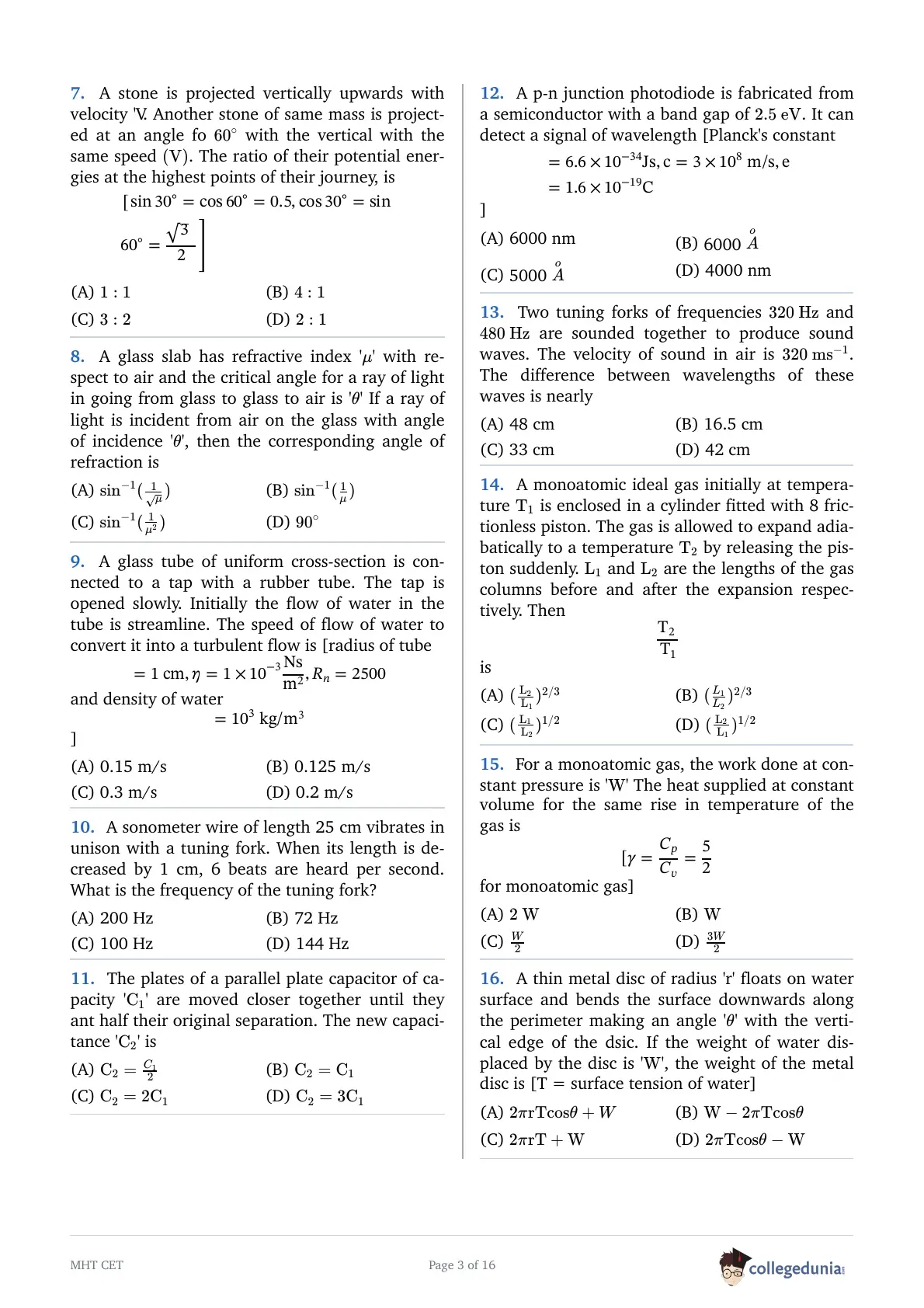
A stone is projected vertically upwards with velocity \(V\). Another stone of same mass is projected at an angle of \(60^\circ\) with the vertical with the same speed (\(V\)). The ratio of their potential energies at the highest points of their journey, is
A glass slab has refractive index \(\mu\) with respect to air and the critical angle for a ray of light in going from glass to air is \(\theta\). If a ray of light is incident from air on the glass with angle of incidence \(\theta\), then the corresponding angle of refraction is
A glass tube of uniform cross-section is connected to a tap with a rubber tube. The tap is opened slowly. Initially the flow of water in the tube is streamline. The speed of flow of water to convert it into a turbulent flow is [radius of tube = \(1\text{ cm}\), \(\eta = 1 \times 10^{-3}\text{ Ns/m}^2\), \(R_n = 2500\) and density of water = \(10^3\text{ kg/m}^3\)]
A sonometer wire of length \(25\text{ cm}\) vibrates in unison with a tuning fork. When its length is decreased by \(1\text{ cm}\), \(6\) beats are heard per second. What is the frequency of the tuning fork?
The plates of a parallel plate capacitor of capacity \(C_1\) are moved closer together until they are at half their original separation. The new capacitance \(C_2\) is
A p-n junction photodiode is fabricated from a semiconductor with a band gap of \(2.5\text{ eV}\). It can detect a signal of wavelength [Planck's constant = \(6.6 \times 10^{-34}\text{ Js}\), \(c = 3 \times 10^8\text{ m/s}\), \(e = 1.6 \times 10^{-19}\text{ C}\)]
Two tuning forks of frequencies \(320\text{ Hz}\) and \(480\text{ Hz}\) are sounded together to produce sound waves. The velocity of sound in air is \(320\text{ ms}^{-1}\). The difference between wavelengths of these waves is nearly
A monoatomic ideal gas initially at temperature \(T_1\) is enclosed in a cylinder fitted with a frictionless piston. The gas is allowed to expand adiabatically to a temperature \(T_2\) by releasing the piston suddenly. \(L_1\) and \(L_2\) are the lengths of the gas columns before and after the expansion respectively. Then \(\frac{T_2}{T_1}\) is
A thin metal disc of radius \(r\) floats on a water surface and bends the surface downwards along the perimeter making an angle \(\theta\) with the vertical edge of the disc. If the weight of water displaced by the disc is \(W\), the weight of the metal disc is [\(T\) = surface tension of water]
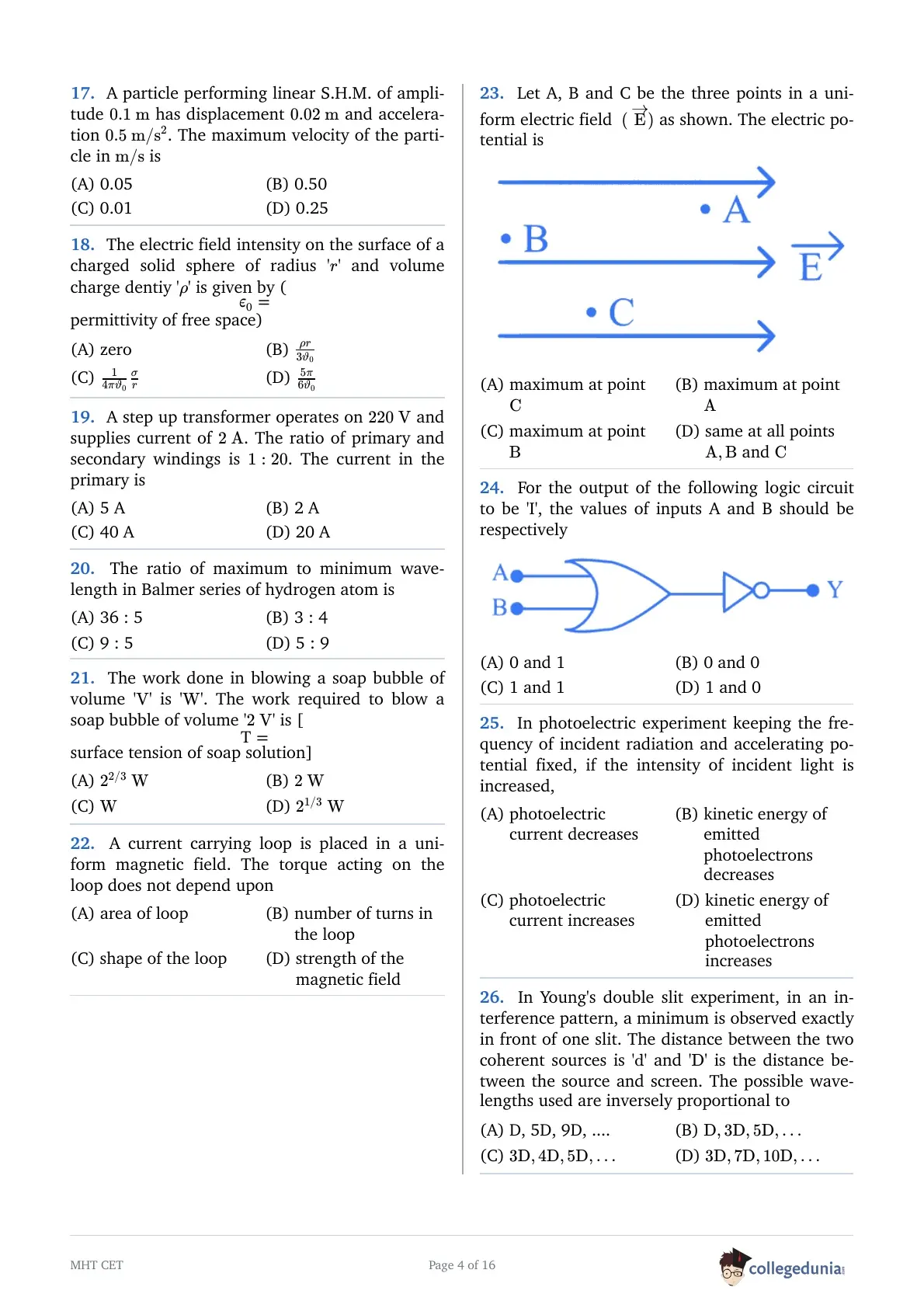
A particle performing linear S.H.M. of amplitude \(0.1\text{ m}\) has displacement \(0.02\text{ m}\) and acceleration \(0.5\text{ m/s}^2\). The maximum velocity of the particle in m/s is
The electric field intensity on the surface of a charged solid sphere of radius \(r\) and volume charge density \(\rho\) is given by (\(\varepsilon_0\) = permittivity of free space)
A step up transformer operates on \(220\text{ V}\) and supplies current of \(2\text{ A}\). The ratio of primary and secondary windings is \(1 : 20\). The current in the primary is
The ratio of maximum to minimum wavelength in Balmer series of hydrogen atom is
The work done in blowing a soap bubble of volume \(V\) is \(W\). The work required to blow a soap bubble of volume \(2V\) is [\(T\) = surface tension of soap solution]
A current carrying loop is placed in a uniform magnetic field. The torque acting on the loop does not depend upon
Let A, B and C be the three points in a uniform electric field \(\vec{E}\) as shown. The electric potential is

For the output of the following logic circuit to be '1', the values of inputs A and B should be respectively

In a photoelectric experiment, keeping the frequency of incident radiation and accelerating potential fixed, if the intensity of incident light is increased, then the
In Young's double slit experiment, in an interference pattern, a minimum is observed exactly in front of one slit. The distance between the two coherent sources is \(d\) and \(D\) is the distance between the source and screen. The possible wavelengths used are inversely proportional to
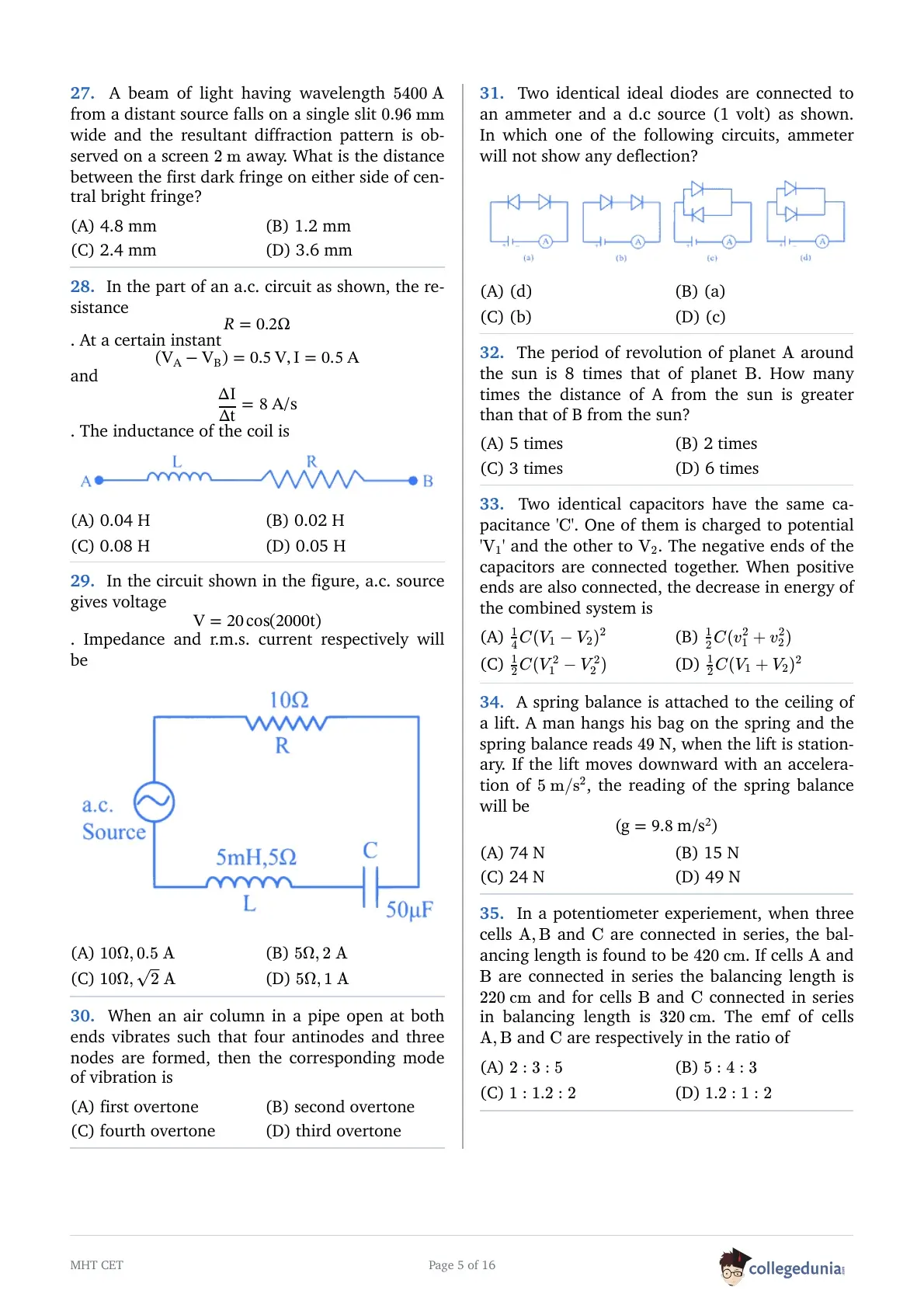
A beam of light having wavelength \(5400\text{ \AA}\) from a distant source falls on a single slit \(0.96\text{ mm}\) wide and the resultant diffraction pattern is observed on a screen \(2\text{ m}\) away. What is the distance between the first dark fringe on either side of the central bright fringe?
In the part of an a.c. circuit as shown, the resistance \(R = 0.2\ \Omega\). At a certain instant \((V_A - V_B) = 0.5\text{ V}\), \(I = 0.5\text{ A}\) and \(\frac{\Delta I}{\Delta t} = 8\text{ A/s}\). The inductance of the coil is

In the circuit shown in the figure, a.c. source gives voltage \(V = 20 \cos(2000t)\). Impedance and r.m.s. current respectively will be

When an air column in a pipe open at both ends vibrates such that four antinodes and three nodes are formed, then the corresponding mode of vibration is
Two identical ideal diodes are connected to an ammeter and a d.c source (1 volt) as shown. In which one of the following circuits, ammeter will not show any deflection?

The period of revolution of planet A around the sun is 8 times that of planet B. How many times the distance of A from the sun is greater than that of B from the sun?
Two identical capacitors have the same capacitance \(C\). One of them is charged to potential \(V_1\) and the other to \(V_2\). The negative ends of the capacitors are connected together. When positive ends are also connected, the decrease in energy of the combined system is
A spring balance is attached to the ceiling of a lift. A man hangs his bag on the spring and the spring balance reads \(49\text{ N}\), when the lift is stationary. If the lift moves downward with an acceleration of \(5\text{ m/s}^2\), the reading of the spring balance will be (\(g = 9.8\text{ m/s}^2\))
In a potentiometer experiment, when three cells A, B and C are connected in series, the balancing length is found to be \(420\text{ cm}\). If cells A and B are connected in series the balancing length is \(220\text{ cm}\) and for cells B and C connected in series the balancing length is \(320\text{ cm}\). The emf of cells A, B and C are respectively in the ratio of
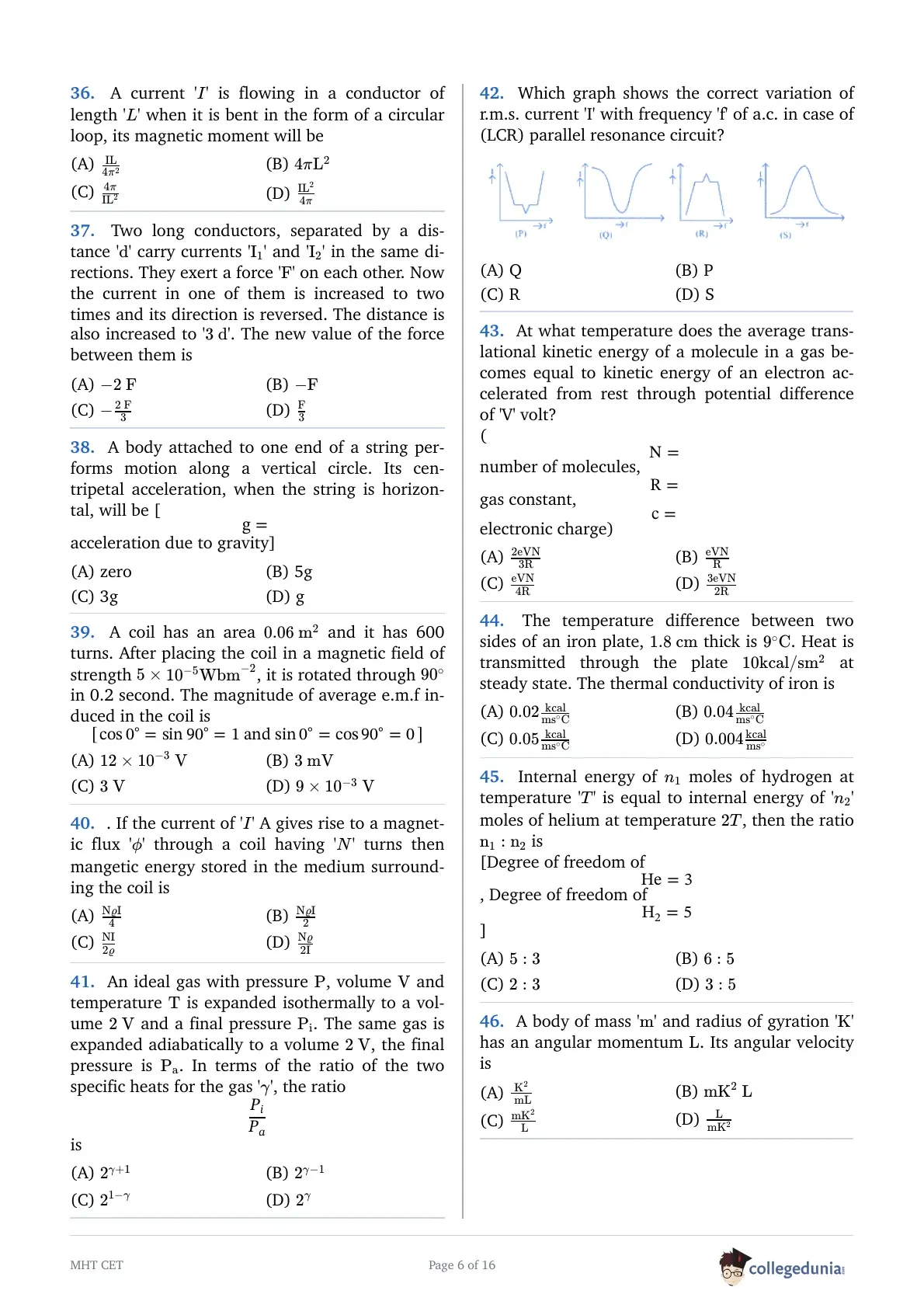
A current \(I\) is flowing in a conductor of length \(L\). When it is bent in the form of a circular loop, its magnetic moment will be
Two long conductors, separated by a distance \(d\) carry currents \(I_1\) and \(I_2\) in the same directions. They exert a force \(F\) on each other. Now the current in one of them is increased to two times and its direction is reversed. The distance is also increased to \(3d\). The new value of the force between them is
A body attached to one end of a string performs motion along a vertical circle. Its centripetal acceleration, when the string is horizontal, will be [\(g\) = acceleration due to gravity]
A coil has an area \(0.06\text{ m}^2\) and it has \(600\) turns. After placing the coil in a magnetic field of strength \(5 \times 10^{-5}\text{ Wb/m}^2\), it is rotated through \(90^\circ\) in \(0.2\) second. The magnitude of average e.m.f induced in the coil is [\(\cos 0^\circ = \sin 90^\circ = 1\) and \(\sin 0^\circ = \cos 90^\circ = 0\)]
If the current of \(I\text{ A}\) gives rise to a magnetic flux \(\phi\) through a coil having \(N\) turns, then magnetic energy stored in the medium surrounding the coil is
An ideal gas with pressure \(P\), volume \(V\) and temperature \(T\) is expanded isothermally to a volume \(2V\) and a final pressure \(P_i\). The same gas is expanded adiabatically to a volume \(2V\), the final pressure is \(P_a\). In terms of the ratio of the two specific heats for the gas \(\gamma\), the ratio \(\frac{P_i}{P_a}\) is
Which graph shows the correct variation of r.m.s. current \(I\) with frequency \(f\) of a.c. in case of (LCR) parallel resonance circuit?

At what temperature does the average translational kinetic energy of a molecule in a gas becomes equal to kinetic energy of an electron accelerated from rest through potential difference of \(V\) volt? [\(N\) = number of molecules, \(R\) = gas constant, \(e\) = electronic charge]
The temperature difference between two sides of an iron plate, \(1.8\text{ cm}\) thick is \(9^\circ\text{C}\). Heat is transmitted through the plate \(10\text{ kcal/s}\cdot\text{m}^2\) at steady state. The thermal conductivity of iron is
Internal energy of \(n_1\) moles of hydrogen at temperature \(T\) is equal to internal energy of \(n_2\) moles of helium at temperature \(2T\), then the ratio \(n_1 : n_2\) is [Degree of freedom of \(\text{He} = 3\), Degree of freedom of \(\text{H}_2 = 5\)]
A body of mass \(m\) and radius of gyration \(K\) has an angular momentum \(L\). Its angular velocity is
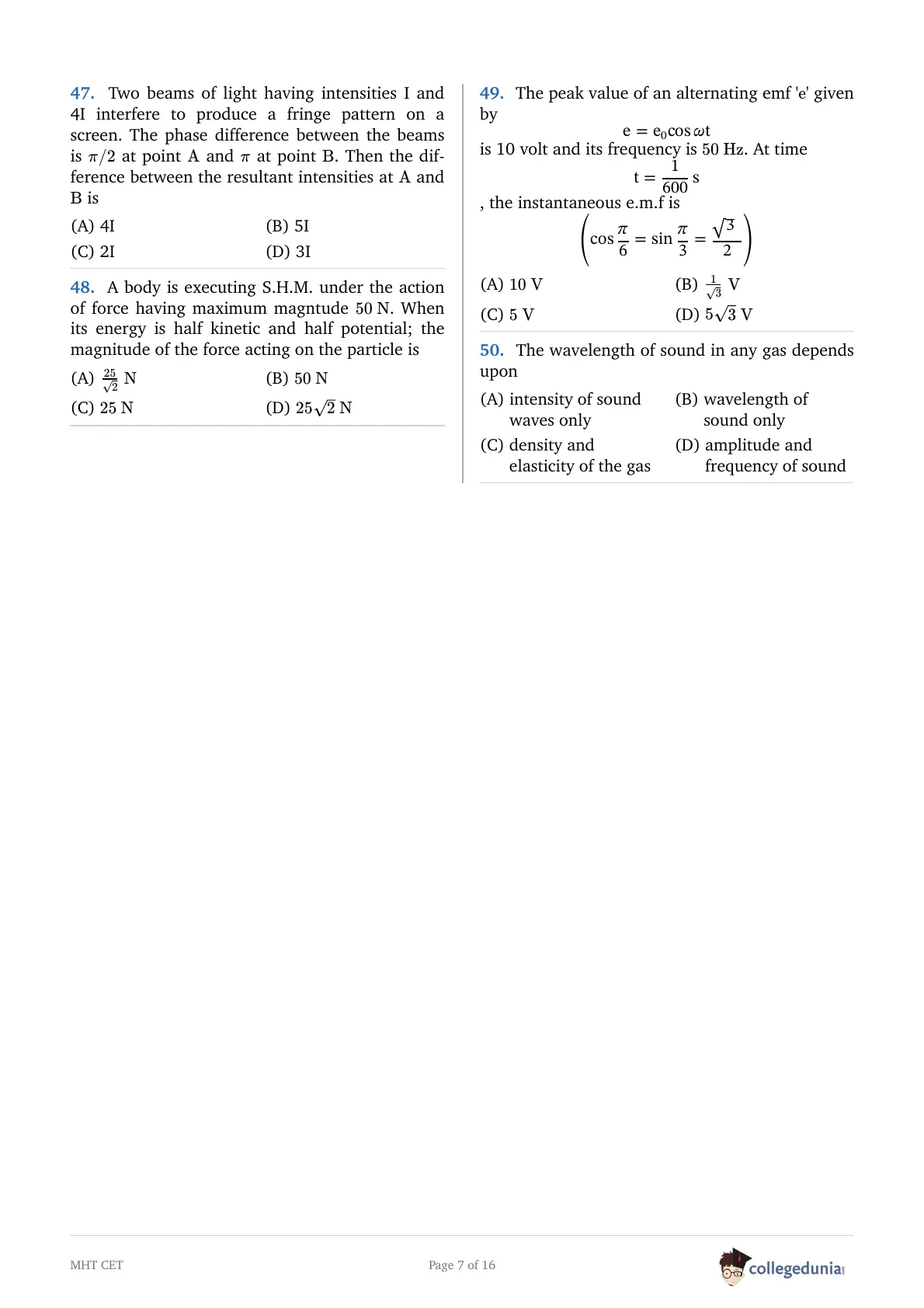
Two beams of light having intensities \(I\) and \(4I\) interfere to produce a fringe pattern on a screen. The phase difference between the beams is \(\pi / 2\) at point A and \(\pi\) at point B. Then the difference between the resultant intensities at A and B is
A body is executing S.H.M. under the action of force having maximum magnitude \(50\text{ N}\). When its energy is half kinetic and half potential, the magnitude of the force acting on the particle is
The peak value of an alternating emf \(e\) given by \(e = e_0 \cos \omega t\) is \(10\text{ V}\) and its frequency is \(50\text{ Hz}\). At time \(t = \frac{1}{600}\text{ s}\), the instantaneous e.m.f is \(\left[\cos \frac{\pi}{6} = \sin \frac{\pi}{3} = \frac{\sqrt{3}}{2}\right]\)
The wavelength of sound in any gas depends upon
Chemistry (Q51 - Q100)
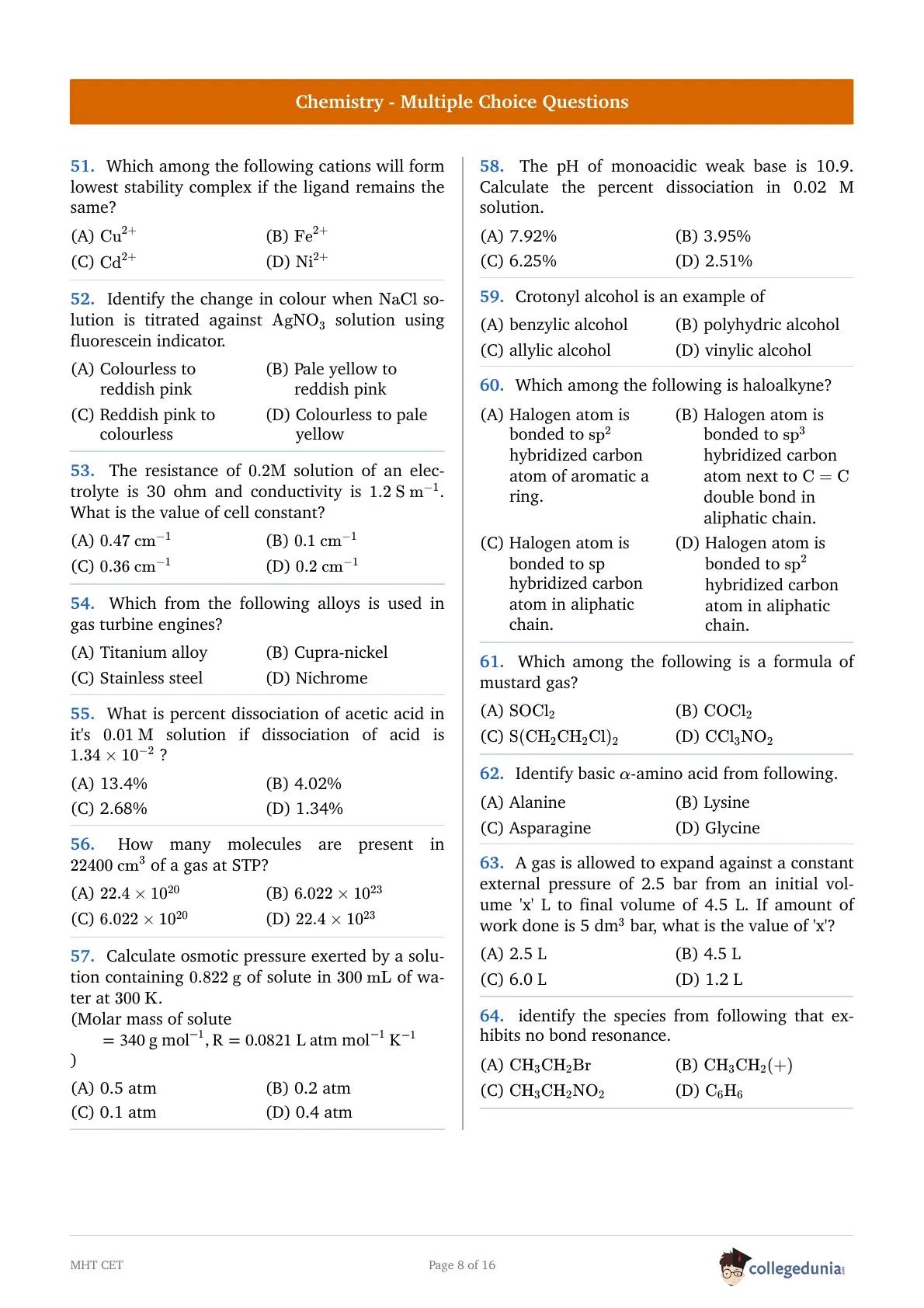
Which among the following cations will form lowest stability complex if the ligand remains the same?
Identify the change in colour when \(\mathrm{NaCl}\) solution is titrated against \(\mathrm{AgNO}_3\) solution using fluorescein indicator.
The resistance of \(0.2\ \mathrm{M}\) solution of an electrolyte is \(30\ \Omega\) and conductivity is \(1.2\ \mathrm{S\ m^{-1}}\). What is the value of cell constant?
Which from the following alloys is used in gas turbine engines?
What is percent dissociation of acetic acid in it's \(0.01\ \mathrm{M}\) solution if dissociation constant of acid is \(1.34 \times 10^{-5}\)?
How many molecules are present in \(22400\ \mathrm{cm^3}\) of a gas at STP?
Calculate osmotic pressure exerted by a solution containing \(0.822\ \mathrm{g}\) of solute in \(300\ \mathrm{mL}\) of water at \(300\ \mathrm{K}\). (Molar mass of solute = \(340\ \mathrm{g\ mol^{-1}}\), \(R = 0.0821\ \mathrm{L\ atm\ mol^{-1}\ K^{-1}}\))
The \(\mathrm{pH}\) of monoacidic weak base is \(10.9\). Calculate the percent dissociation in \(0.02\ \mathrm{M}\) solution.
Crotonyl alcohol is an example of
Which among the following is haloalkyne?
Which among the following is a formula of mustard gas?
Identify basic \(\alpha\)-amino acid from following.
A gas is allowed to expand against a constant external pressure of \(2.5\ \mathrm{bar}\) from an initial volume 'x' \(\mathrm{L}\) to final volume of \(4.5\ \mathrm{L}\). If amount of work done is \(5\ \mathrm{dm^3\ bar}\), what is the value of 'x'?
Identify the species from following that exhibits no bond resonance.
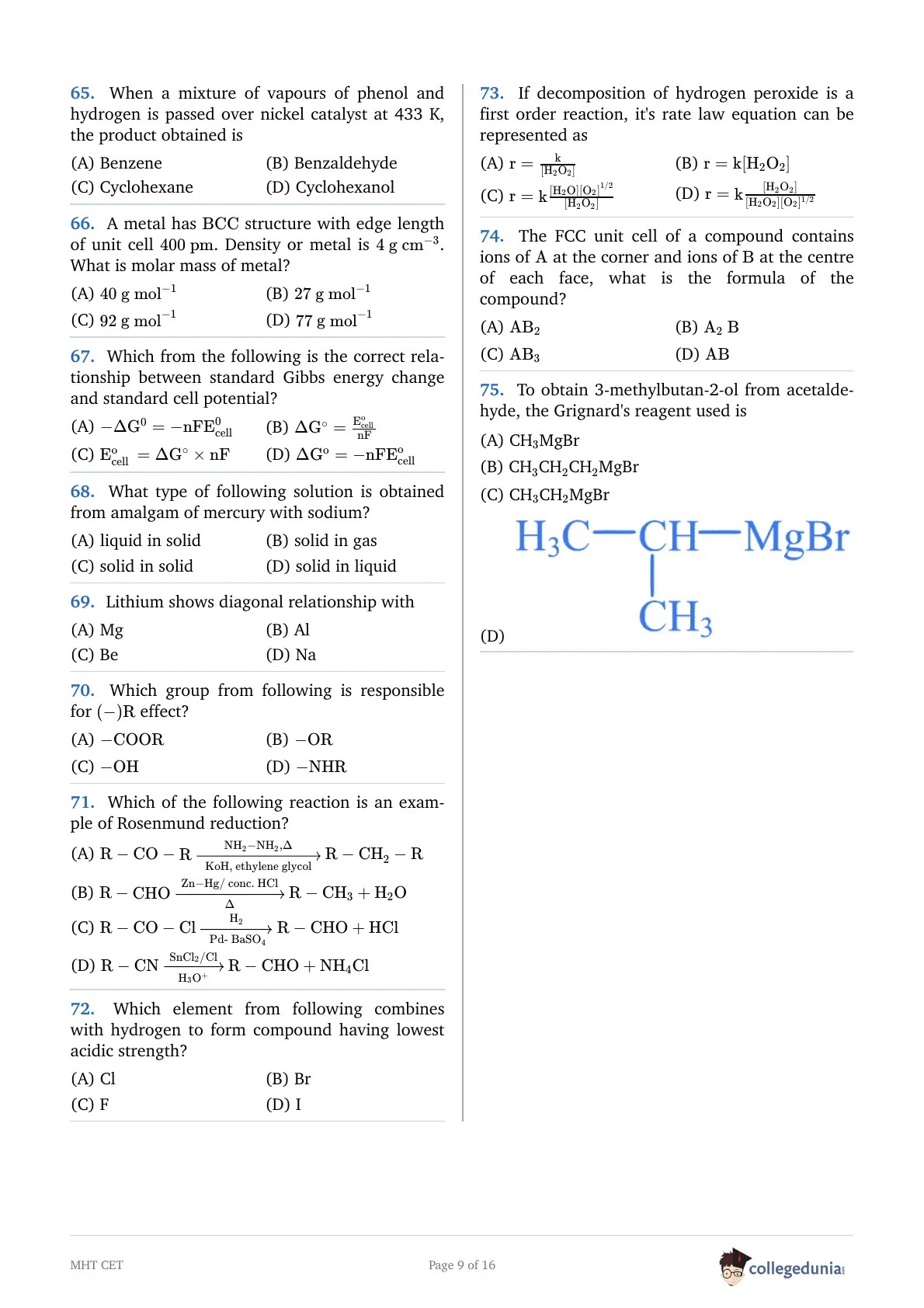
When a mixture of vapours of phenol and hydrogen is passed over nickel catalyst at \(433\ \mathrm{K}\), the product obtained is
A metal has \(\mathrm{BCC}\) structure with edge length of unit cell \(400\ \mathrm{pm}\). Density of metal is \(4\ \mathrm{g\ cm^{-3}}\). What is molar mass of metal?
Which from the following is the correct relationship between standard Gibbs energy change and standard cell potential?
What type of following solution is obtained from amalgam of mercury with sodium?
Lithium shows diagonal relationship with
Which group from following is responsible for \((-)\mathrm{R}\) effect?
Which of the following reaction is an example of Rosenmund reduction?
Which element from following combines with hydrogen to form compound having lowest acidic strength?
If decomposition of hydrogen peroxide is a first order reaction, it's rate law equation can be represented as
The FCC unit cell of a compound contains ions of \(\mathrm{A}\) at the corner and ions of \(\mathrm{B}\) at the centre of each face, what is the formula of the compound?
To obtain 3-methylbutan-2-ol from acetaldehyde, the Grignard's reagent used is
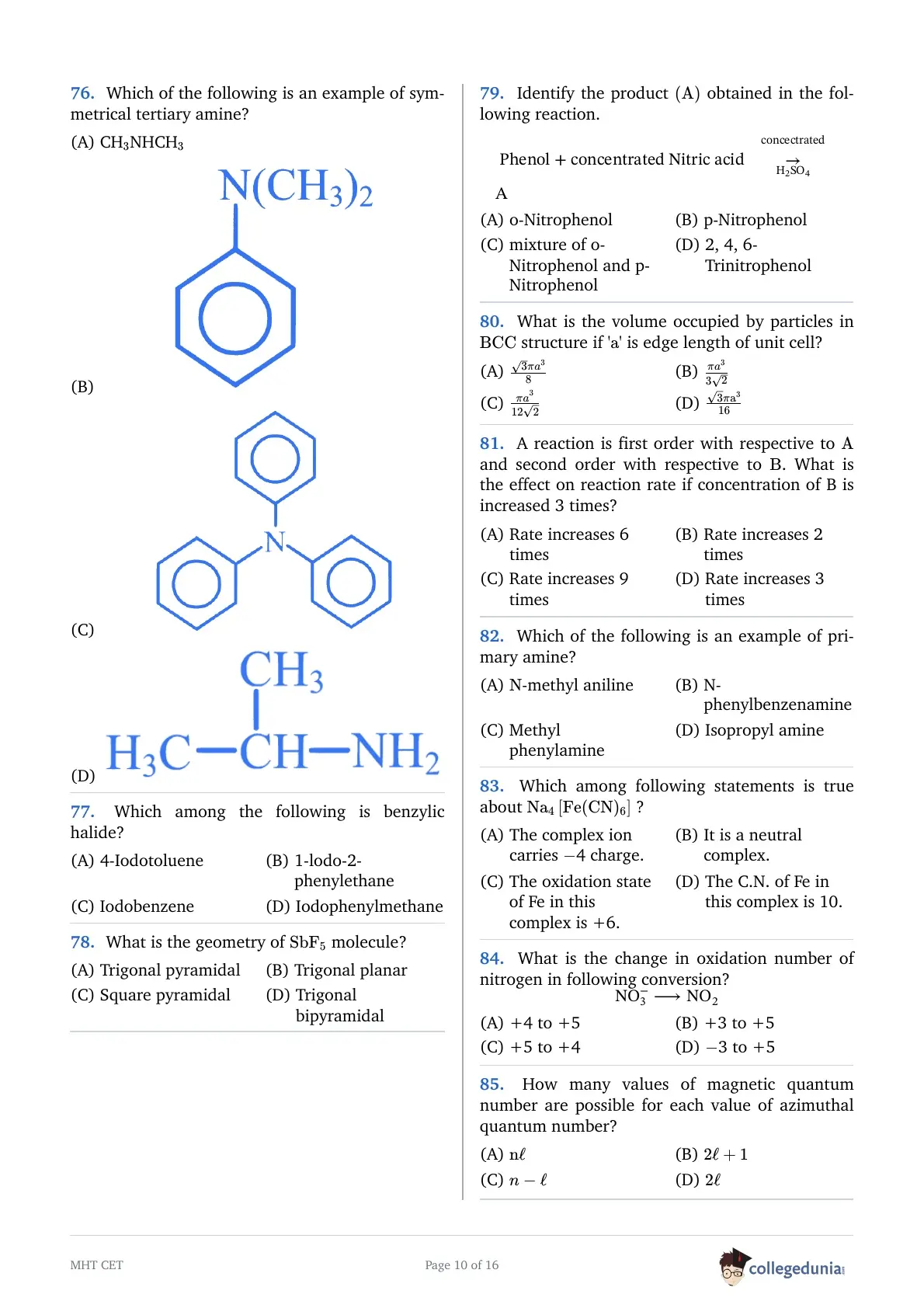
Which of the following is an example of symmetrical tertiary amine?
- (A) CH\({}_{3}\)NHCH\({}_{3}\)
- (B)
![]()
- (C)
![]()
- (D)
![]()


Which among the following is benzylic halide?
What is the geometry of \(\mathrm{SbF}_5\) molecule?
Identify the product (A) obtained in the following reaction.
\(\text{Phenol} + \text{concentrated Nitric acid} \xrightarrow{\text{concentrated } \mathrm{H_2SO_4}} \text{A}\)
What is the volume occupied by particles in \(\mathrm{BCC}\) structure if 'a' is edge length of unit cell?
A reaction is first order with respective to \(\mathrm{A}\) and second order with respective to \(\mathrm{B}\). What is the effect on reaction rate if concentration of \(\mathrm{B}\) is increased 3 times?
Which of the following is an example of primary amine?
Which among following statements is true about \(\mathrm{Na_4[Fe(CN)_6]}\)?
What is the change in oxidation number of nitrogen in following conversion?
\(\mathrm{NO}_3^{-} \longrightarrow \mathrm{NO}_2\)
How many values of magnetic quantum number are possible for each value of azimuthal quantum number?
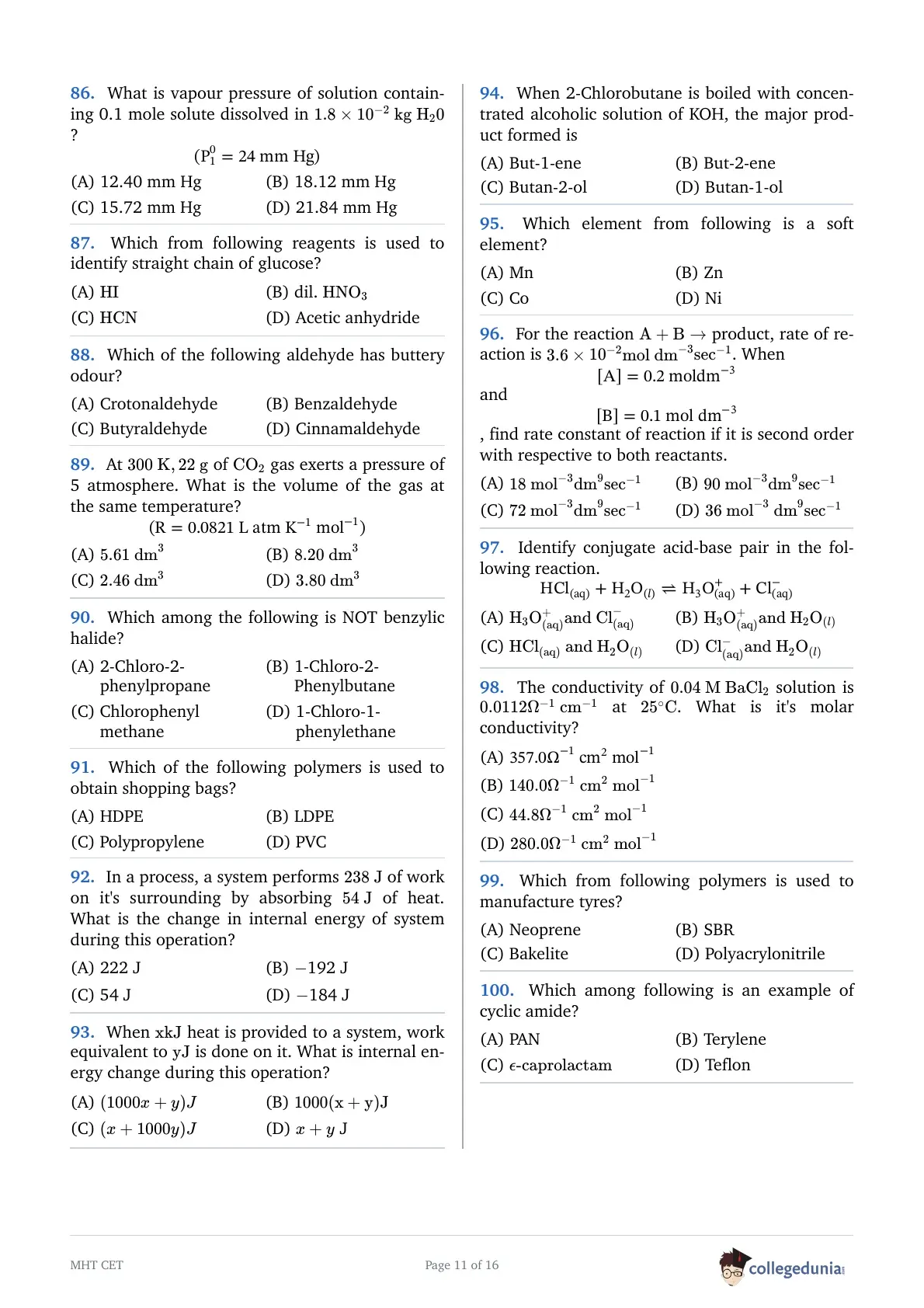
What is vapour pressure of solution containing \(0.1\ \mathrm{mole}\) solute dissolved in \(1.8 \times 10^{-2}\ \mathrm{kg}\ \mathrm{H_2O}\)? (\(P_1^\circ = 24\ \mathrm{mm\ Hg}\))
Which from following reagents is used to identify straight chain of glucose?
Which of the following aldehyde has buttery odour?
At \(300\ \mathrm{K}\), \(22\ \mathrm{g}\) of \(\mathrm{CO_2}\) gas exerts a pressure of \(5\ \mathrm{atmosphere}\). What is the volume of the gas at the same temperature? (\(R = 0.0821\ \mathrm{L\ atm\ K^{-1}\ mol^{-1}}\))
Which among the following is NOT benzylic halide?
Which of the following polymers is used to obtain shopping bags?
In a process, a system performs \(238\ \mathrm{J}\) of work on it's surrounding by absorbing \(54\ \mathrm{J}\) of heat. What is the change in internal energy of system during this operation?
When \(\mathrm{x}\ \mathrm{kJ}\) heat is provided to a system, work equivalent to \(\mathrm{y}\ \mathrm{J}\) is done on it. What is internal energy change during this operation?
When 2-Chlorobutane is boiled with concentrated alcoholic solution of \(\mathrm{KOH}\), the major product formed is
Which element from following is a soft element?
For the reaction \(\mathrm{A + B \rightarrow \text{product}}\), the rate of reaction is \(3.6 \times 10^{-2}\ \mathrm{mol\ dm^{-3}\ sec^{-1}}\). When \([\mathrm{A}] = 0.2\ \mathrm{mol\ dm^{-3}}\) and \([\mathrm{B}] = 0.1\ \mathrm{mol\ dm^{-3}}\), find the rate constant of the reaction if it is second order with respective to both reactants.
Identify conjugate acid-base pair in the following reaction.
\(\mathrm{HCl}_{(\mathrm{aq})}+\mathrm{H}_2 \mathrm{O}_{(l)} \rightleftharpoons \mathrm{H}_3 \mathrm{O}_{(\mathrm{aq})}^{+}+\mathrm{Cl}_{(\mathrm{aq})}^{-}\)
The conductivity of \(0.04\ \mathrm{M}\ \mathrm{BaCl_2}\) solution is \(0.0112\ \Omega^{-1}\ \mathrm{cm^{-1}}\) at \(25^\circ\text{C}\). What is its molar conductivity?
Which from following polymers is used to manufacture tyres?
Which among following is an example of cyclic amide?
Mathematics (Q101 - Q150)
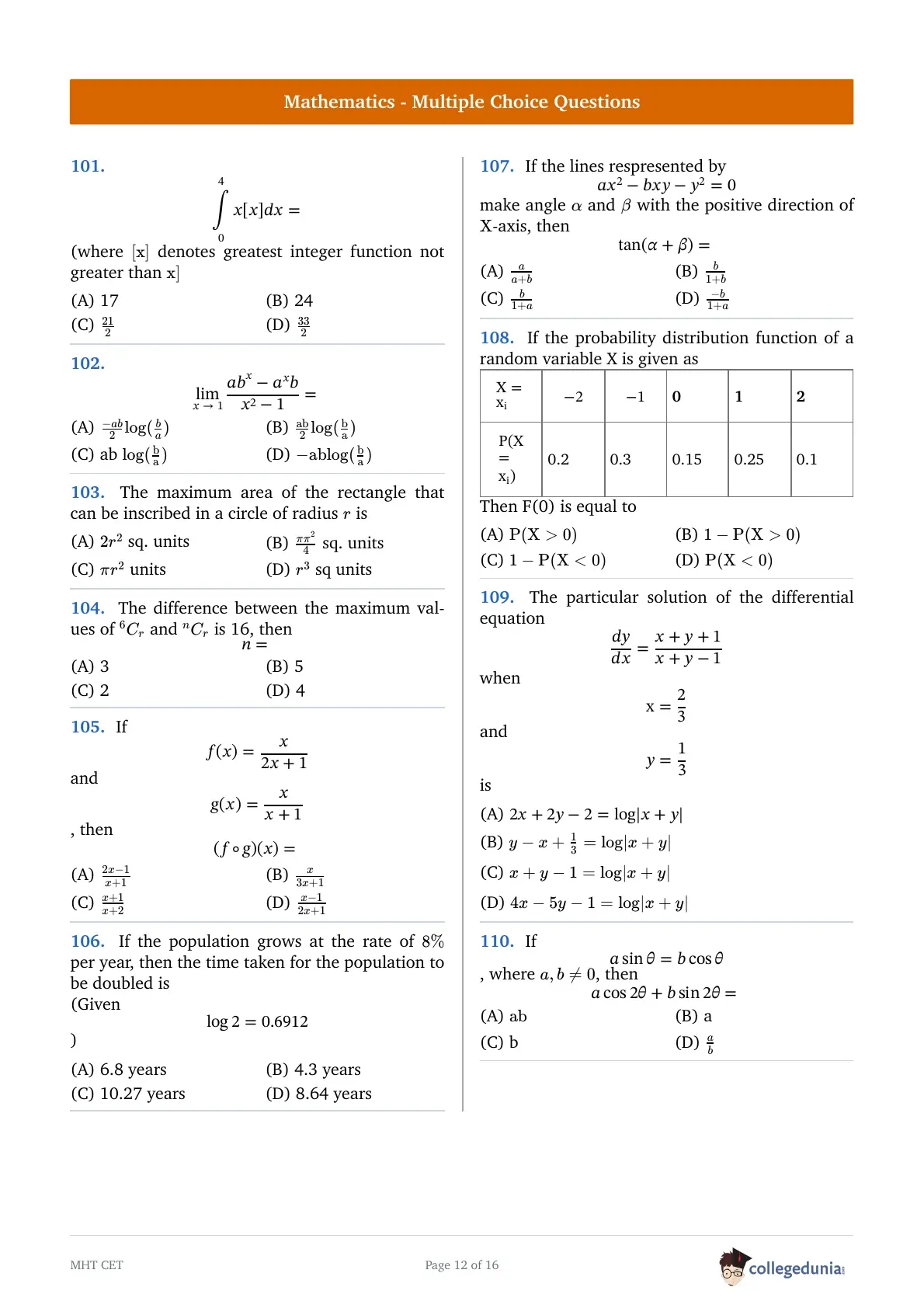
\(\int_{0}^{4} x[x] , dx = \)
(where \([x]\) denotes the greatest integer function not greater than \(x\))
\(\lim_{x \rightarrow 1} \frac{ab^x - a^x b}{x^2 - 1} = \)
The maximum area of the rectangle that can be inscribed in a circle of radius \(r\) is
The difference between the maximum values of \(^{6}\mathrm{C}_r\) and \(^{n}\mathrm{C}_r\) is 16, then \(n = \)
If \(f(x) = \frac{x}{2x+1}\) and \(g(x) = \frac{x}{x+1}\), then \((f \circ g)(x) = \)
If the population grows at the rate of \(8\%\) per year, then the time taken for the population to be doubled is (Given \(\log 2 = 0.6912\))
If the lines represented by \(ax^2 - bxy - y^2 = 0\) make angles \(\alpha\) and \(\beta\) with the positive direction of the \(X\)-axis, then \(\tan(\alpha + \beta) = \)
If the probability distribution function of a random variable \(X\) is given as

The particular solution of the differential equation \(\frac{dy}{dx} = \frac{x+y+1}{x+y-1}\) when \(x = \frac{2}{3}\) and \(y = \frac{1}{3}\) is
If \(a\sin\theta = b\cos\theta\), where \(a, b \neq 0\), then \(a\cos 2\theta + b\sin 2\theta = \)
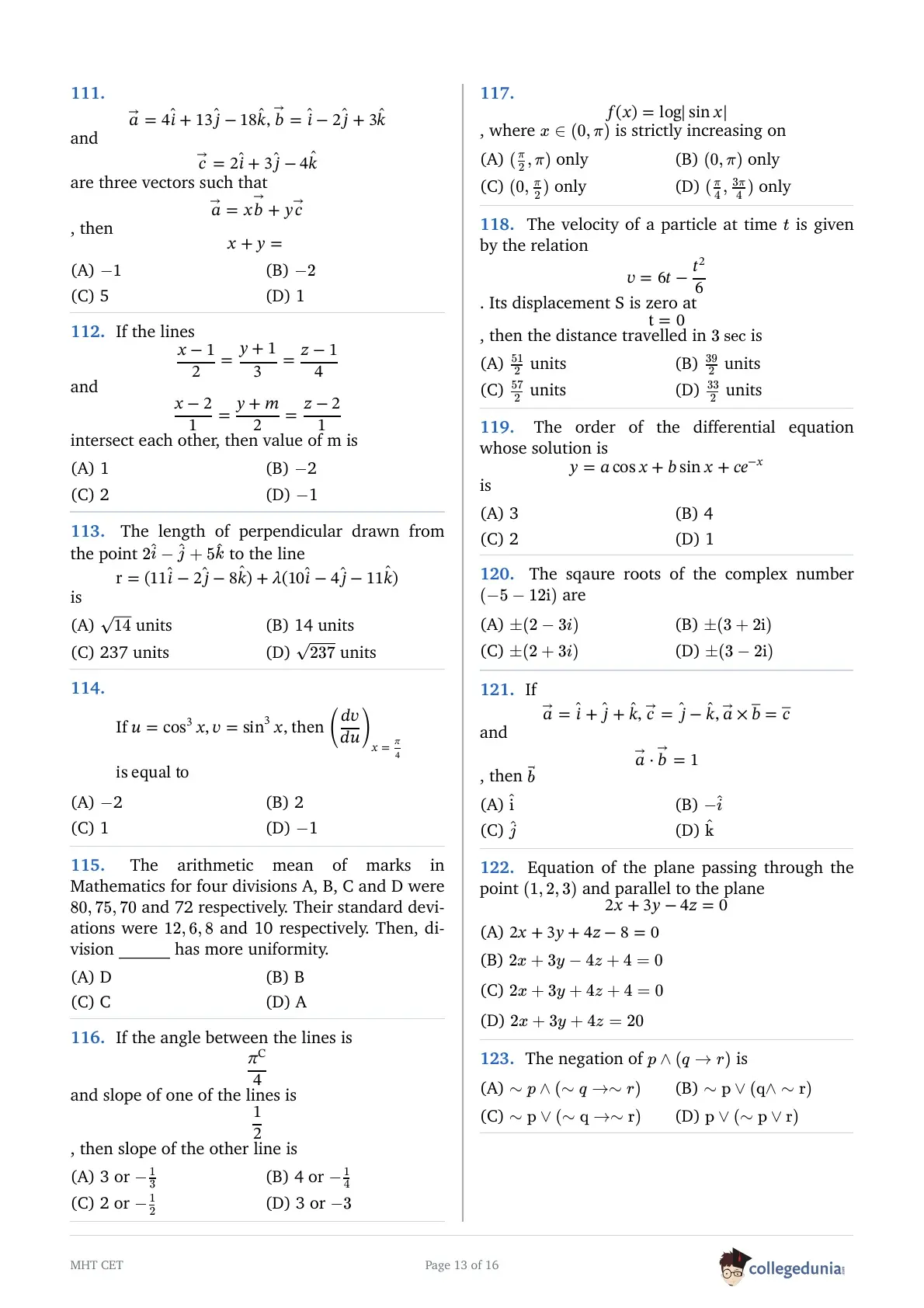
If \(\vec{a} = 4\hat{i} + 13\hat{j} - 18\hat{k}\), \(\vec{b} = \hat{i} - 2\hat{j} + 3\hat{k}\), and \(\vec{c} = 2\hat{i} + 3\hat{j} - 4\hat{k}\) are three vectors such that \(\vec{a} = x\vec{b} + y\vec{c}\), then \(x + y = \)
If the lines \(\frac{x-1}{2} = \frac{y+1}{3} = \frac{z-1}{4}\) and \(\frac{x-2}{1} = \frac{y+m}{2} = \frac{z-2}{1}\) intersect each other, then the value of \(m\) is
The length of perpendicular drawn from the point \(2\hat{i} - \hat{j} + 5\hat{k}\) to the line \(\vec{r} = (11\hat{i} - 2\hat{j} - 8\hat{k}) + \lambda(10\hat{i} - 4\hat{j} - 11\hat{k})\) is
If \(u = \cos^3 x\) and \(v = \sin^3 x\), then \(\left(\frac{dv}{du}\right)_{x = \frac{\pi}{4}}\) is equal to
The arithmetic mean of marks in Mathematics for four divisions A, B, C and D were 80, 75, 70 and 72 respectively. Their standard deviations were 12, 6, 8 and 10 respectively. Then, which division has more uniformity.
If the angle between two lines is \(\frac{\pi}{4}\) and the slope of one of the lines is \(\frac{1}{2}\), then the slope of the other line is
\(f(x) = \log|\sin x|\), where \(x \in (0, \pi)\) is strictly increasing on
The velocity of a particle at time \(t\) is given by the relation \(v = 6t - \frac{t^2}{6}\). If its displacement \(S\) is zero at \(t = 0\), then the distance travelled in \(3\ \text{sec}\) is
The order of the differential equation whose solution is \(y = a \cos x + b \sin x + c e^{-x}\) is
If \(\vec{a} = \hat{i} + \hat{j} + \hat{k}\), \(\vec{c} = \hat{j} - \hat{k}\), \(\vec{a} \times \vec{b} = \vec{c}\) and \(\vec{a} \cdot \vec{b} = 1\), then \(\vec{b} = \)
Equation of the plane passing through the point \((1, 2, 3)\) and parallel to the plane \(2x + 3y - 4z = 0\) is
The negation of \(p \wedge (q \rightarrow r)\) is
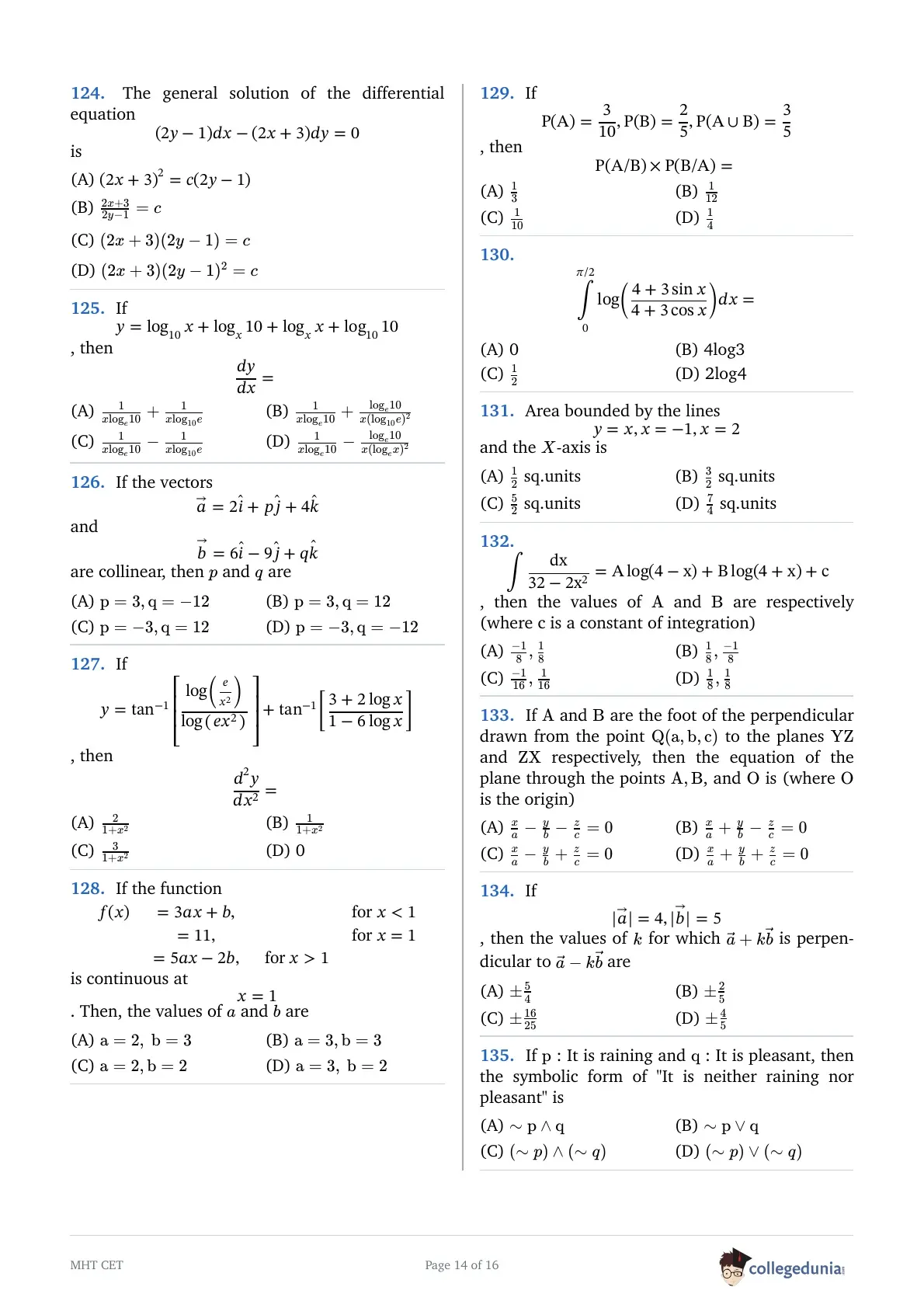
The general solution of the differential equation \((2y - 1) \, dx - (2x + 3) \, dy = 0\) is
If \(y = \log_{10} x + \log_x 10 + \log_x x + \log_{10} 10\), then \(\frac{dy}{dx} = \)
If the vectors \(\vec{a} = 2\hat{i} + p\hat{j} + 4\hat{k}\) and \(\vec{b} = 6\hat{i} - 9\hat{j} + q\hat{k}\) are collinear, then \(p\) and \(q\) are
If \(y = \tan^{-1}\left[\frac{\log\left(\frac{e}{x^2}\right)}{\log(ex^2)}\right] + \tan^{-1}\left[\frac{3 + 2\log x}{1 - 6\log x}\right]\), then \(\frac{d^2y}{dx^2} = \)
If the function
\(\begin{array}{rlrl} f(x) & =3 a x+b, & & \text { for } x<1 \\ & =11, & & \text { for } x=1 \\ & =5 a x-2 b, & \text { for } x>1 \end{array}\)
is continuous at \(x=1\). Then, the values of \(a\) and \(b\) are
If \(\mathrm{P(A)} = \frac{3}{10}\), \(\mathrm{P(B)} = \frac{2}{5}\), and \(\mathrm{P(A \cup B)} = \frac{3}{5}\), then \(\mathrm{P(A / B) \times P(B / A)} = \)
\(\int_{0}^{\pi / 2} \log\left(\frac{4+3\sin x}{4+3\cos x}\right) dx = \)
The area bounded by the lines \(y = x\), \(x = -1\), \(x = 2\) and the \(X\)-axis is
If \(\int \frac{dx}{32 - 2x^2} = A \log|4 - x| + B \log|4 + x| + c\), then the values of \(A\) and \(B\) are respectively
If \(A\) and \(B\) are the foot of the perpendicular drawn from the point \(Q(a, b, c)\) to the planes \(YZ\) and \(ZX\) respectively, then the equation of the plane through the points \(A\), \(B\), and the origin \(O\) is
If \(|\vec{a}| = 4\), \(|\vec{b}| = 5\), then the values of \(k\) for which \(\vec{a} + k\vec{b}\) is perpendicular to \(\vec{a} - k\vec{b}\) are
If \(p\) : It is raining and \(q\) : It is pleasant, then the symbolic form of "It is neither raining nor pleasant" is
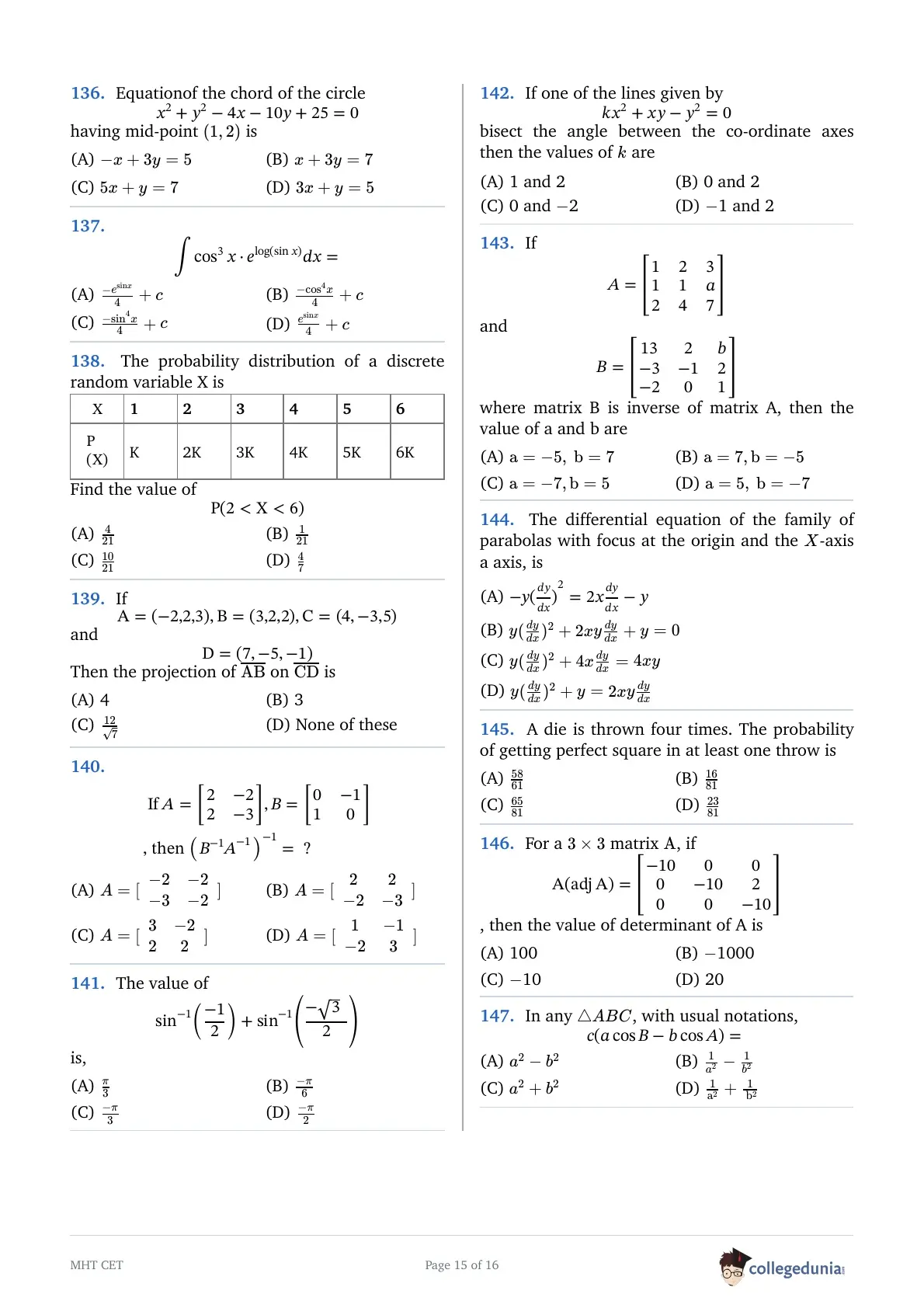
Equation of the chord of the circle \(x^2 + y^2 - 4x - 10y + 25 = 0\) having mid-point \((1, 2)\) is
\(\int \cos^3 x \cdot e^{\log(\sin x)} , dx = \)
The probability distribution of a discrete random variable \(X\) is given as

If \(A = (-2, 2, 3)\), \(B = (3, 2, 2)\), \(C = (4, -3, 5)\), and \(D = (7, -5, -1)\), then the projection of \(\vec{AB}\) on \(\vec{CD}\) is
The value of \(\sin^{-1}\left(-\frac{1}{2}\right) + \sin^{-1}\left(-\frac{\sqrt{3}}{2}\right)\) is
If one of the lines given by \(kx^2 + xy - y^2 = 0\) bisects the angle between the co-ordinate axes, then the values of \(k\) are
If \(A = \begin{bmatrix} 1 & 2 & 3 \\ 1 & 1 & a \\ 2 & 4 & 7 \end{bmatrix}\) and \(B = \begin{bmatrix} 13 & 2 & b \\ -3 & -1 & 2 \\ -2 & 0 & 1 \end{bmatrix}\) where matrix \(B\) is the inverse of matrix \(A\), then the values of \(a\) and \(b\) are
The differential equation of the family of parabolas with focus at the origin and the \(X\)-axis as its axis, is
A die is thrown four times. The probability of getting a perfect square in at least one throw is
For a \(3 \times 3\) matrix \(A\), if \(A(\operatorname{adj}A) = \begin{bmatrix} -10 & 0 & 0 \\ 0 & -10 & 0 \\ 0 & 0 & -10 \end{bmatrix}\), then the value of the determinant of \(A\) is
In any \(\triangle ABC\), with usual notations, \(c(a \cos B - b \cos A) = \)
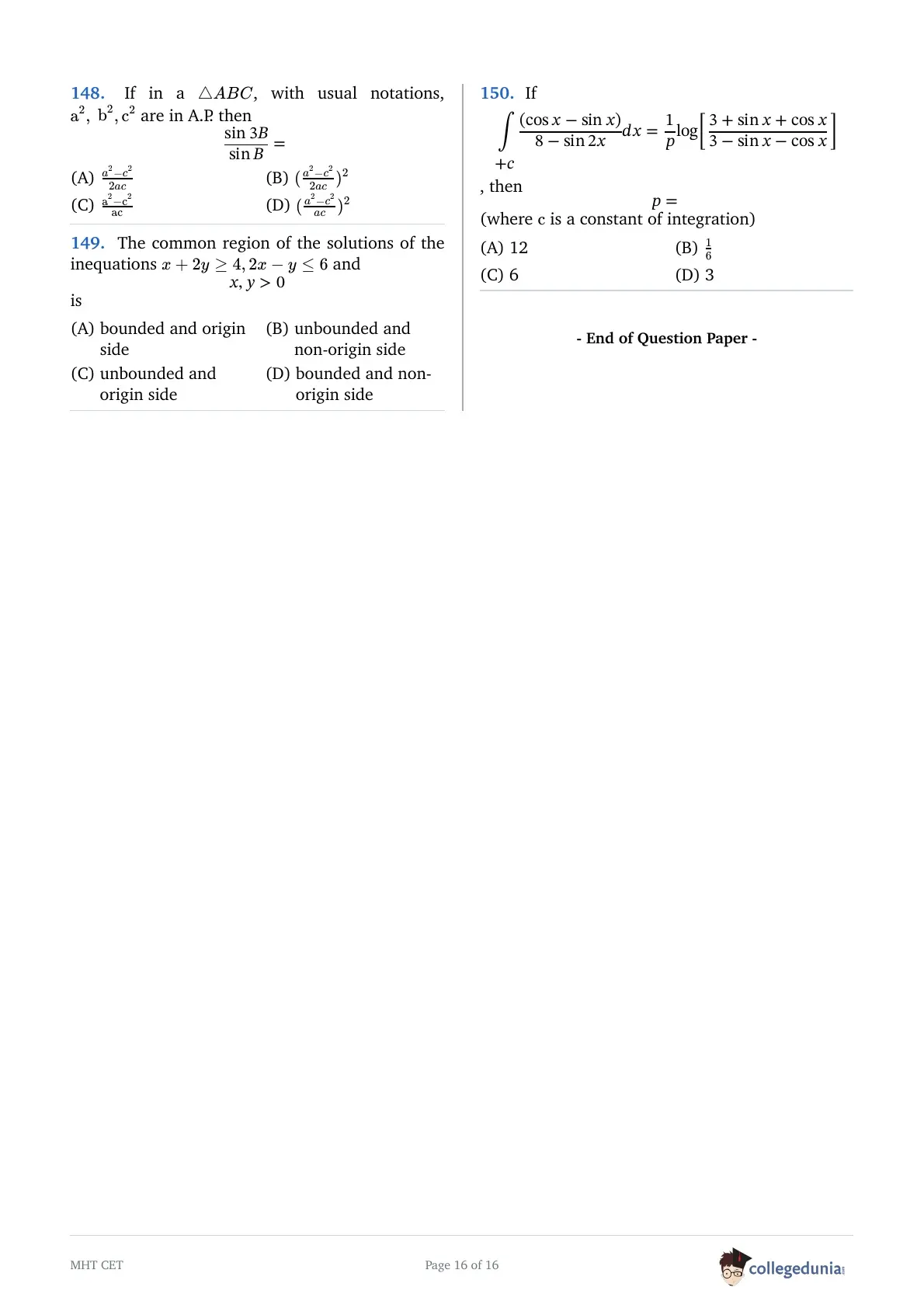
If in a \(\triangle ABC\), with usual notations, \(a^2\), \(b^2\), \(c^2\) are in A.P., then \(\frac{\sin 3B}{\sin B} = \)
The common region of the solutions of the inequations \(x + 2y \ge 4\), \(2x - y \le 6\) and \(x, y > 0\) is
If \[\int \frac{(\cos x-\sin x)}{8-\sin 2 x} d x=\frac{1}{p} \log \left[\frac{3+\sin x+\cos x}{3-\sin x-\cos x}\right]+c\], then \[p=\] (where \[\mathrm{c}\] is a constant of integration)
MHT CET 2021 PCM Exam Pattern and Marking Scheme
| Parameter | Details |
|---|---|
| Conducting Body | Maharashtra Common Entrance Test Cell (Maharashtra CET Cell) |
| Exam Mode | Online (Computer-Based Test) |
| Duration | 180 minutes (3 hours) |
| Groups / Subjects | PCM (Physics, Chemistry, Mathematics) for Engineering |
| Total Questions |
150 |
| Total Marks | 200 |
| Question Type | Multiple Choice Questions (MCQs) |
| Marks Distribution |
|
| Negative Marking | No |
| Syllabus Weightage |
|



Comments