MHT CET 2021 Sep 24 Shift 2 PCM Question Paper is available for download here. Maharashtra State CET Cell conducted MHT CET 2021 PCM Exam on Sep 24 in Shift 2 from 2 PM to 5 PM in CBT mode.

The MHT CET 2021 PCM question paper includes the following:

  • The MHT CET 2021 PCM Question Paper consists of 150 multiple-choice questions (MCQs) totalling 200 marks divided into 3 sections: Physics, Chemistry, and Mathematics, with 50 questions in each subject.
  • Physics and Chemistry questions carry 1 mark each while Mathematics questions carry 2 marks each.
  • There is no negative marking for incorrect answers.

MHT CET 2021 Sep 24 Shift 2 PCM Question Paper with Solution PDF

CD PDF CD PDF with Solutions
Download Collegedunia PDF 0.98 MB -

Also Check:

MHT CET 2021 Sep 24 Shift 2 PCM Questions with Solutions


Physics (Q1 - Q50)

Question 1:

A current 'I' produces a magnetic flux '\[\phi\]' per turn in a coil of '\[n\]' turns. Self inductance of the coil is '\[L\]'. The relation between them is

  • (A) \(\mathrm{nLI}=\varrho\)
  • (B) \(\frac{\mathrm{nL}}{\mathrm{I}}=\varrho\)
  • (C) \(\frac{\mathrm{LI}}{\mathrm{n}^{2}}=\varrho\)
  • (D) \(\frac{\mathrm{LI}}{\mathrm{n}}=\varrho\)

Question 2:

A rejector circuit is the resonant circuit in which

  • (A) \(\mathrm{L}-\mathrm{C}-\mathrm{R}\) are connected in parallel.
  • (B) \(\mathrm{L}-\mathrm{C}-\mathrm{R}\) are connected in series.
  • (C) \(\mathrm{C}-\mathrm{R}\) are connected in series.
  • (D) L-R are connected in series.

Question 3:

A light of wavelength '\[\lambda\]' and intensity '\[\mathrm{I}\]' falls on photosensitive material. If '\[\mathrm{N}\]' photo electrons are emitted, each with kinetic energy 'E', then

  • (A) \(\mathrm{E}\propto \mathrm{I},\mathrm{N}\propto \lambda\)
  • (B) \(\mathrm{E}\propto \mathrm{I},\mathrm{N}\propto \mathrm{I}\)
  • (C) \(\mathrm{E}\propto \mathrm{I},\mathrm{N}\propto \frac{1}{\lambda}\)
  • (D) \(\mathrm{E}\propto \frac{1}{\lambda},\mathrm{N}\propto \mathrm{I}\)

Question 4:

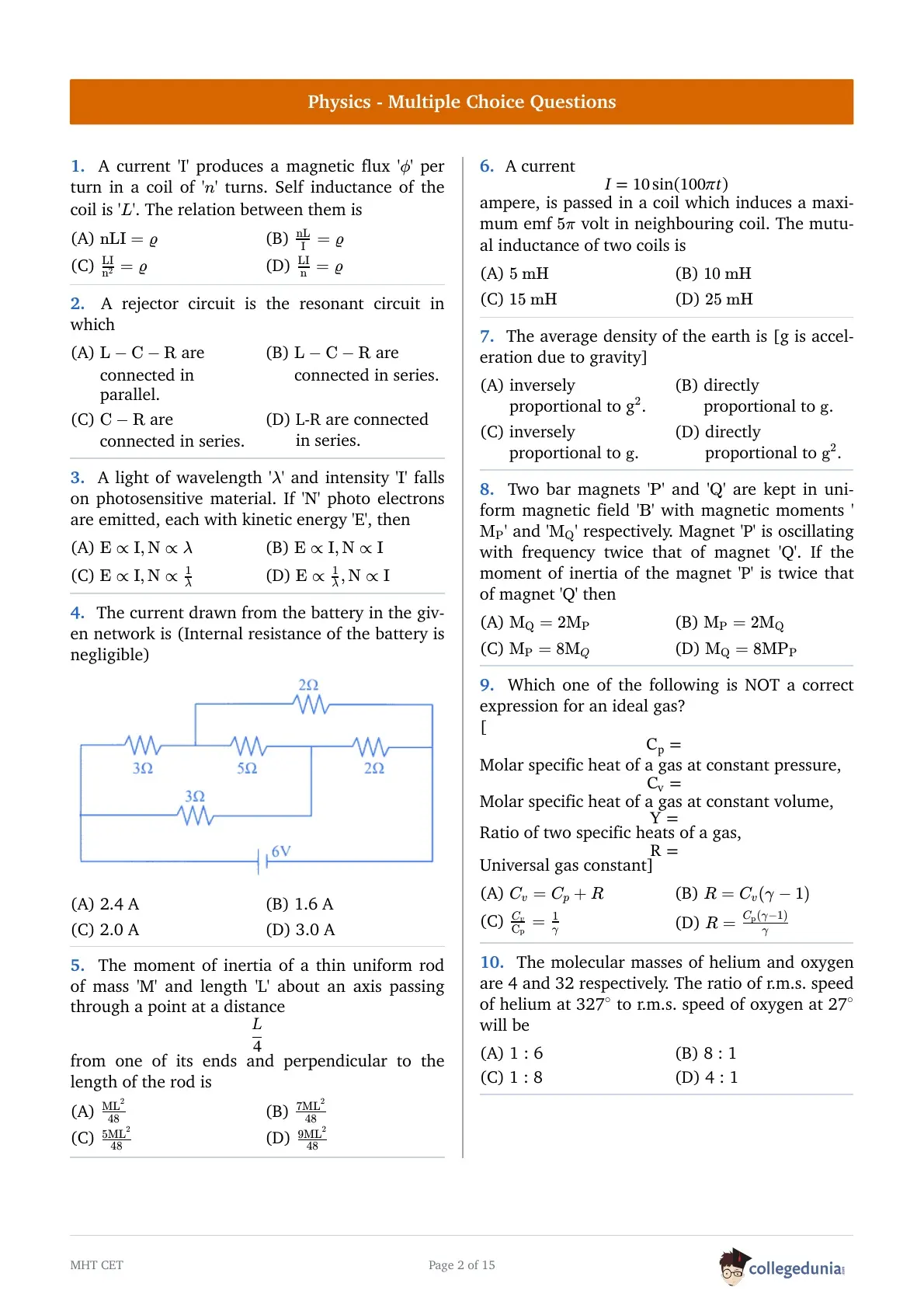
The current drawn from the battery in the given network is (Internal resistance of the battery is negligible)

  • (A) 2.4 A
  • (B) 1.6 A
  • (C) 2.0 A
  • (D) 3.0 A

Question 5:

The moment of inertia of a thin uniform rod of mass 'M' and length 'L' about an axis passing through a point at a distance \[\frac{L}{4}\] from one of its ends and perpendicular to the length of the rod is

  • (A) \(\frac{\mathrm{ML}^{2}}{48}\)
  • (B) \(\frac{7\mathrm{ML}^{2}}{48}\)
  • (C) \(\frac{5\mathrm{ML}^{2}}{48}\)
  • (D) \(\frac{9\mathrm{ML}^{2}}{48}\)

Question 6:

A current \[I=10 \sin (100 \pi t)\] ampere, is passed in a coil which induces a maximum emf \[5 \pi\] volt in neighbouring coil. The mutual inductance of two coils is

  • (A) \(5\text{ }\mathrm{mH}\)
  • (B) \(10\text{ }\mathrm{mH}\)
  • (C) \(15\text{ }\mathrm{mH}\)
  • (D) \(25\text{ }\mathrm{mH}\)

Question 7:

The average density of the earth is [g is acceleration due to gravity]

  • (A) inversely proportional to g\({}^{2}\).
  • (B) directly proportional to \(\mathrm{g}\).
  • (C) inversely proportional to \(\mathrm{g}\).
  • (D) directly proportional to \(\mathrm{g}^{2}\).

Question 8:

Two bar magnets '\[\mathrm{P}\]' and '\[\mathrm{Q}\]' are kept in uniform magnetic field '\[\mathrm{B}\]' with magnetic moments '\[\mathrm{M_P}\]' and '\[\mathrm{M_Q}\]' respectively. Magnet 'P' is oscillating with frequency twice that of magnet 'Q'. If the moment of inertia of the magnet 'P' is twice that of magnet 'Q' then

  • (A) \(\mathrm{M}_{\mathrm{Q}}=2\mathrm{M}_{\mathrm{P}}\)
  • (B) \(\mathrm{M}_{\mathrm{P}}=2\mathrm{M}_{\mathrm{Q}}\)
  • (C) \(\mathrm{M}_{\mathrm{P}}=8\mathrm{M}_{Q}\)
  • (D) \(\mathrm{M}_{\mathrm{Q}}=8\mathrm{MP}_{\mathrm{P}}\)

Question 9:

Which one of the following is NOT a correct expression for an ideal gas?

[\[\mathrm{C_p}=\] Molar specific heat of a gas at constant pressure,

\[\mathrm{C_v}=\] Molar specific heat of a gas at constant volume,

\[\mathrm{Y}=\] Ratio of two specific heats of a gas,

\[\mathrm{R}=\] Universal gas constant]

  • (A) \(C_{v}=C_{p}+R\)
  • (B) \(R=C_{v}(\gamma -1)\)
  • (C) \(\frac{C_{v}}{\mathrm{C}_{\mathrm{p}}}=\frac{1}{\gamma}\)
  • (D) \(R=\frac{C_{\mathrm{p}}(\gamma -1)}{\gamma}\)

Question 10:

The molecular masses of helium and oxygen are 4 and 32 respectively. The ratio of r.m.s. speed of helium at 327\[^\circ\] to r.m.s. speed of oxygen at 27\[^\circ\] will be

  • (A) 1 : 6
  • (B) 8 : 1
  • (C) 1 : 8
  • (D) 4 : 1

Question 11:

Which one of the following p-V diagram is correct for an isochoric process:

  • (A) IV
  • (B) II
  • (C) III
  • (D) I

Question 12:

A magnetic dipole of magnetic moment \[\mathrm{M}\], is freely suspended in a magnetic field of induction B. The minimum and maximum values of potential energy of the dipole, respectively are

  • (A) \(-\mathrm{MB},+\mathrm{MB}\)
  • (B) \(0,\mathrm{MB}\)
  • (C) \(0,2\mathrm{MB}\)
  • (D) MB, 0

Question 13:

In series LCR circuit, at resonance the peak value of current will be [\[\mathrm{E_0}\] is peak emf, R is resistance, \[\omega \mathrm{L}\] is inductive reactance and \[\omega \mathrm{C}\] is capacitive]

  • (A) \(\frac{E_{0}}{R}\)
  • (B) \(\frac{E_{0}}{\sqrt{2}R}\)
  • (C) \(\frac{E_{0}}{\sqrt{R^{2}+(\omega L-\frac{1}{\omega C})^{2}}}\)
  • (D) \(\frac{E_{0}}{\sqrt{2}\sqrt{R^{2}+(\omega L-\frac{1}{\omega C})^{2}}}\)

Question 14:

A particle is moving along the circular path with constant speed and centripetal acceleration 'a'. If the speed is doubled, the ratio of its acceleration after and before the change is

  • (A) \(3:1\)
  • (B) \(1:4\)
  • (C) \(2:1\)
  • (D) \(4:1\)

Question 15:

The displacement of a particle performing S.H.M. is given by \[x=5 \sin (3 t+3)\], where \[x\] is in \[\mathrm{cm}\] and \[t\] is in second. The maximum acceleration of the particle will be

  • (A) \(15\text{ }\mathrm{cm}\text{ }\mathrm{s}^{-2}\)
  • (B) \(30\text{ }\mathrm{cm}\text{ }\mathrm{s}^{-2}\)
  • (C) \(45\text{ }\mathrm{cm}\text{ }\mathrm{s}^{-2}\)
  • (D) \(90\text{ }\mathrm{cm}\text{ }\mathrm{s}^{-2}\)

Question 16:

A cylindrical tube open at both ends has fundamental frequency 'n' in air. The tube is dipped vertically in water so that one-fourth of it is in water. The fundamental frequency of the air column becomes

  • (A) \(\frac{3n}{4}\)
  • (B) \(\frac{n}{2}\)
  • (C) \(n\)
  • (D) \(\frac{2n}{3}\)

Question 17:

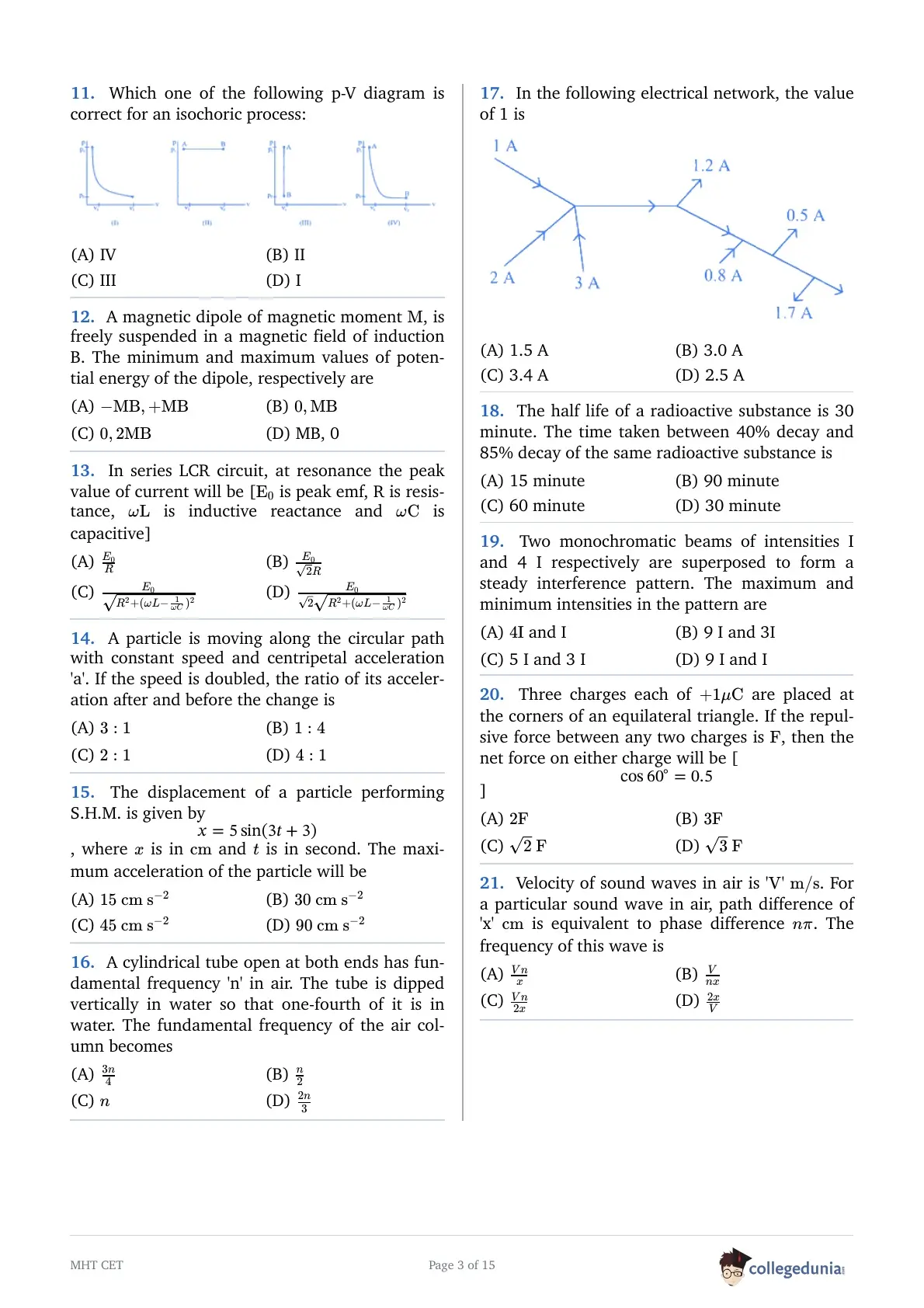
In the following electrical network, the value of 1 is

  • (A) 1.5 A
  • (B) 3.0 A
  • (C) 3.4 A
  • (D) 2.5 A

Question 18:

The half life of a radioactive substance is 30 minute. The time taken between 40% decay and 85% decay of the same radioactive substance is

  • (A) 15 minute
  • (B) 90 minute
  • (C) 60 minute
  • (D) 30 minute

Question 19:

Two monochromatic beams of intensities I and 4 I respectively are superposed to form a steady interference pattern. The maximum and minimum intensities in the pattern are

  • (A) \(4\mathrm{I}\) and I
  • (B) 9 I and 3I
  • (C) 5 I and 3 I
  • (D) 9 I and I

Question 20:

Three charges each of \[+1 \mu \mathrm{C}\] are placed at the corners of an equilateral triangle. If the repulsive force between any two charges is \[\mathrm{F}\], then the net force on either charge will be [\[\cos 60^{\circ}=0.5\]]

  • (A) \(2\mathrm{F}\)
  • (B) \(3\mathrm{F}\)
  • (C) \(\sqrt{2}\text{ }\mathrm{F}\)
  • (D) \(\sqrt{3}\text{ }\mathrm{F}\)

Question 22:

Choose the correct statement. In conductors

  • (A) valance band and conduction band overlap each other.
  • (B) valance band and conduction band are separated by large energy gap.
  • (C) valancè band and conduction band are separated by a small energy gap.
  • (D) a very small number of electrons are available for electrical conduction.

Question 23:

For a transistor, the current ratio \[\alpha_{\mathrm{dc}}=\frac{69}{70}\], the current gain \[\beta_{\mathrm{dc}}\] is

  • (A) 67
  • (B) 69
  • (C) 71
  • (D) 66

Question 24:

'n' small drops of same size fall through air with constant velocity \[5 \mathrm{~cm} / \mathrm{s}\]. They coalesce to form a big drop. The terminal velocity of the big drop is

  • (A) \(7\mathrm{n}^{2/3}\text{ }\mathrm{cm}/\mathrm{s}\)
  • (B) \(5\mathrm{n}^{2/3}\text{ }\mathrm{cm}/\mathrm{s}\)
  • (C) \(3\mathrm{n}^{2/3}\text{ }\mathrm{cm}/\mathrm{s}\)
  • (D) \(9\mathrm{n}^{2/3}\text{ }\mathrm{cm}/\mathrm{s}\)

Question 25:

The depth from the surface of the earth of radius \[\mathrm{R}\], at which acceleration due to gravity will be \[60 \%\] of the value on the earth surface is

  • (A) \(\frac{2R}{3}\)
  • (B) \(\frac{2R}{5}\)
  • (C) \(\frac{3R}{5}\)
  • (D) \(\frac{5R}{3}\)

Question 26:

A body of mass 'm' is moving with speed 'V' along a circular path of radius 'r'. Now the speed is reduced to \[\frac{V}{2}\] and radius is increased to '3r'. For this change, initial centripetal force needs to be

  • (A) increased by \(\frac{7}{12}\) times
  • (B) increased by \(\frac{10}{12}\) times
  • (C) decreased by \(\frac{11}{12}\) times
  • (D) decreased by \(\frac{1}{12}\) times

Question 27:

The path difference between two interfering light waves meeting at a point on the screen is \[\left(\frac{57}{2}\right) \lambda\]. The bond obtained at that point is

  • (A) 29th bright band
  • (B) 57th dark band
  • (C) 57th bright band
  • (D) 29th dark band

Question 28:

Pressure inside two soap bubbles are 1.01 atm and 1.03 atm. The ratio between their volumes is (Pressure outside the soap bubble is 1 atmosphere)

  • (A) 9 : 1
  • (B) 27 : 1
  • (C) 81 : 1
  • (D) 3 : 1

Question 29:

The length and diameter of a metal wire used in sonometer is doubled. The fundamental frequency will change from 'n' to

  • (A) \(\frac{n}{4}\)
  • (B) 2n
  • (C) 4n
  • (D) \(\frac{n}{2}\)

Question 30:

An alternating e.m.f. is \[\mathrm{e}=\mathrm{e}_0 \sin \omega \mathrm{t}\]. In what time the e.m.f. will have half its maximum value, if '\[\mathrm{e}\]' starts from zero? (\[\mathrm{T}=\] time period, \[\sin 30^{\circ}=0.5\])

  • (A) \(\frac{\mathrm{T}}{12}\)
  • (B) \(\frac{\mathrm{T}}{16}\)
  • (C) \(\frac{\mathrm{T}}{4}\)
  • (D) \(\frac{\mathrm{T}}{8}\)

Question 31:

A ray of light is incident on one face of an equilateral glass prism having refractive index \[\sqrt{2}\]. It produces the emergent ray which just. grazes along the adjacent face. The value of angle of incidence is \[\left(\sin 45^{\circ}=\cos 45^{\circ}=\frac{1}{\sqrt{2}}\right)\]

  • (A) \(\mathrm{sin}^{-1}(\frac{1}{\sqrt{2}}\mathrm{sin}15^{\circ})\)
  • (B) \(\mathrm{sin}^{-1}(\sqrt{2}\mathrm{sin}30^{\circ})\)
  • (C) \(\mathrm{sin}^{-1}(\frac{1}{\sqrt{2}}\mathrm{sin}45^{\circ})\)
  • (D) \(\mathrm{sin}^{-1}(\sqrt{2}\mathrm{sin}15^{\circ})\)

Question 32:

The input a.c. voltage of frequency \[60 \mathrm{~Hz}\] is applied to half-wave rectifier and also to full-wave rectifier. The output frequency in case of half-wave rectifier and that in case of full wave rectifier is respectively.

  • (A) 120 Hz, 60 Hz
  • (B) 60 Hz, 120 Hz
  • (C) 60 Hz, 60 Hz
  • (D) 120 Hz, 120 Hz

Question 33:

Three point masses, each of mass 'm' are kept at the corners of an equilateral triangle of side 'L'. The system rotates about the centre of the triangle without any change in the separation of masses during rotation. The period of rotation is directly proportional to \[\left(\cos 30^{\circ}=\frac{\sqrt{3}}{2}\right)\]

  • (A) L
  • (B) \(\mathrm{L}^{1/2}\)
  • (C) \(\mathrm{L}^{3/2}\)
  • (D) \(\mathrm{L}^{-2}\)

Question 34:

A closed organ pipe and an open organ pipe of same length produce 2 beats per second when they are set into vibrations together in fundamental mode. The length of open pipe is now halved and that of closed pipe is doubled. The number of beats produced per second will be

  • (A) 4
  • (B) 3
  • (C) 8
  • (D) 7

Question 35:

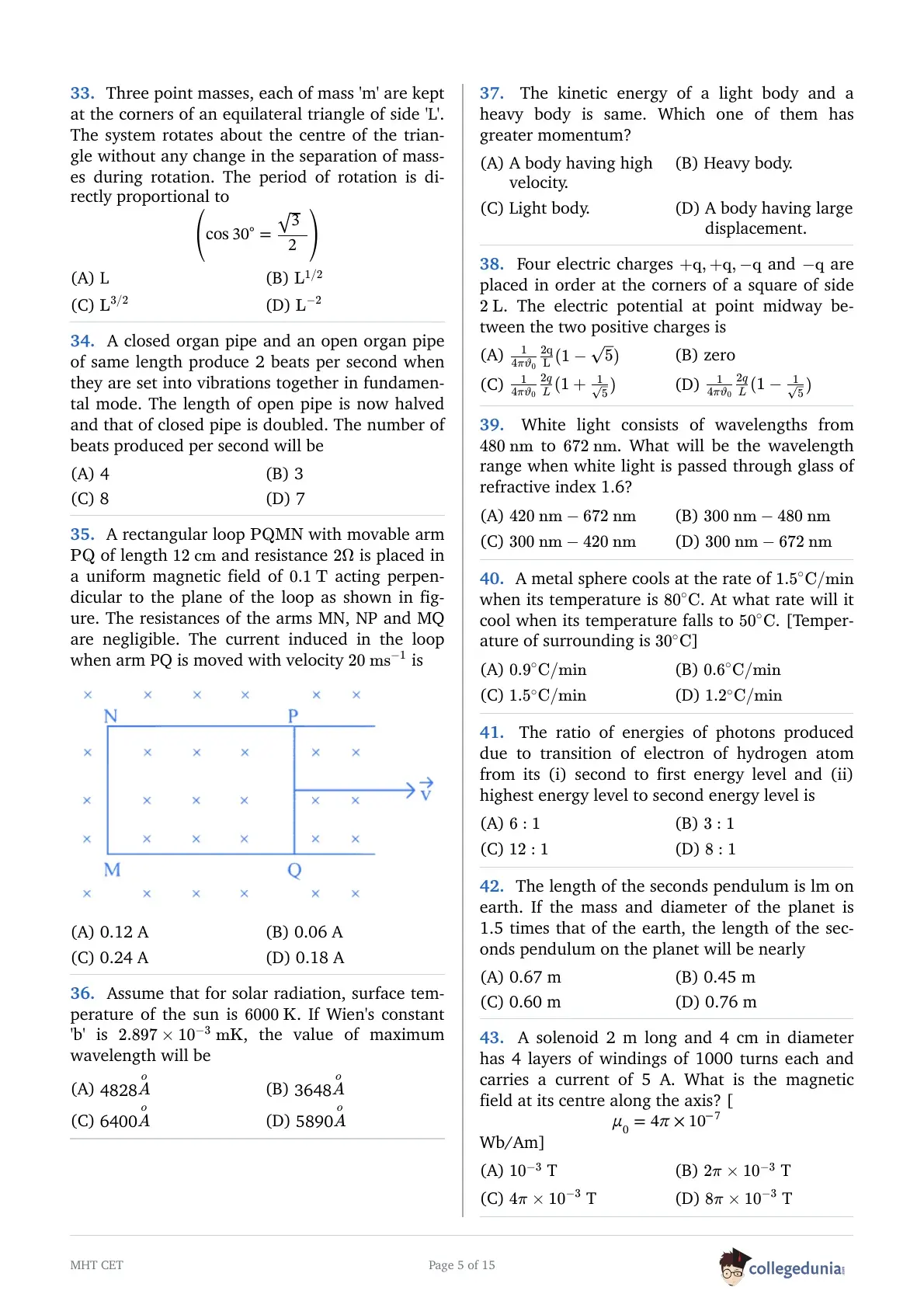
A rectangular loop \[\mathrm{PQMN}\] with movable arm \[\mathrm{PQ}\] of length \[12 \mathrm{~cm}\] and resistance \[2 \Omega\] is placed in a uniform magnetic field of \[0.1 \mathrm{~T}\] acting perpendicular to the plane of the loop as shown in figure. The resistances of the arms MN, NP and MQ are negligible. The current induced in the loop when arm PQ is moved with velocity \[20 \mathrm{~ms}^{-1}\] is

  • (A) 0.12 A
  • (B) 0.06 A
  • (C) 0.24 A
  • (D) 0.18 A

Question 36:

Assume that for solar radiation, surface temperature of the sun is \[6000 \mathrm{~K}\]. If Wien's constant 'b' is \[2.897 \times 10^{-3} \mathrm{~mK}\], the value of maximum wavelength will be

  • (A) 4828\(\overset{o}{A}\)
  • (B) 3648\(\overset{o}{A}\)
  • (C) 6400\(\overset{o}{A}\)
  • (D) 5890\(\overset{o}{A}\)

Question 37:

The kinetic energy of a light body and a heavy body is same. Which one of them has greater momentum?

  • (A) A body having high velocity.
  • (B) Heavy body.
  • (C) Light body.
  • (D) A body having large displacement.

Question 38:

Four electric charges \[+\mathrm{q},+\mathrm{q},-\mathrm{q}\] and \[-\mathrm{q}\] are placed in order at the corners of a square of side \[2 \mathrm{~L}\]. The electric potential at point midway between the two positive charges is

  • (A) \(\frac{1}{4\pi \vartheta _{0}}\frac{2\mathrm{q}}{\mathrm{L}}(1-\sqrt{5})\)
  • (B) zero
  • (C) \(\frac{1}{4\pi \vartheta _{0}}\frac{2q}{L}(1+\frac{1}{\sqrt{5}})\)
  • (D) \(\frac{1}{4\pi \vartheta _{0}}\frac{2q}{L}(1-\frac{1}{\sqrt{5}})\)

Question 39:

White light consists of wavelengths from \[480 \mathrm{~nm}\] to \[672 \mathrm{~nm}\]. What will be the wavelength range when white light is passed through glass of refractive index 1.6?

  • (A) \(420\text{ }\mathrm{nm}-672\text{ }\mathrm{nm}\)
  • (B) \(300\text{ }\mathrm{nm}-480\text{ }\mathrm{nm}\)
  • (C) \(300\text{ }\mathrm{nm}-420\text{ }\mathrm{nm}\)
  • (D) \(300\text{ }\mathrm{nm}-672\text{ }\mathrm{nm}\)

Question 40:

A metal sphere cools at the rate of \[1.5^{\circ} \mathrm{C} / \mathrm{min}\] when its temperature is \[80^{\circ} \mathrm{C}\]. At what rate will it cool when its temperature falls to \[50^{\circ} \mathrm{C}\]. [Temperature of surrounding is \[30^{\circ} \mathrm{C}\]]

  • (A) \(0.9^{\circ}\mathrm{C}/\mathrm{min}\)
  • (B) \(0.6^{\circ}\mathrm{C}/\mathrm{min}\)
  • (C) \(1.5^{\circ}\mathrm{C}/\mathrm{min}\)
  • (D) \(1.2^{\circ}\mathrm{C}/\mathrm{min}\)

Question 41:

The ratio of energies of photons produced due to transition of electron of hydrogen atom from its (i) second to first energy level and (ii) highest energy level to second energy level is

  • (A) \(6:1\)
  • (B) \(3:1\)
  • (C) \(12:1\)
  • (D) \(8:1\)

Question 42:

The length of the seconds pendulum is lm on earth. If the mass and diameter of the planet is 1.5 times that of the earth, the length of the seconds pendulum on the planet will be nearly

  • (A) 0.67 m
  • (B) 0.45 m
  • (C) 0.60 m
  • (D) 0.76 m

Question 43:

A solenoid 2 m long and 4 cm in diameter has 4 layers of windings of 1000 turns each and carries a current of 5 A. What is the magnetic field at its centre along the axis? [\[\mu_0=4\pi\times10^{-7}\] Wb/Am]

  • (A) \(10^{-3}\) T
  • (B) \(2\pi \times 10^{-3}\) T
  • (C) \(4\pi \times 10^{-3}\) T
  • (D) \(8\pi \times 10^{-3}\) T

Question 44:

A particle of charge 'q' and mass 'm' moves in a circular orbit of radius 'r' with angular speed '\[\omega\]'. The ratio of the magnitude of its magnetic moment to that of its angular momentum depends on

  • (A) \(\omega\) and q
  • (B) \(\omega\) and m
  • (C) q and m
  • (D) \(\omega\), q and m

Question 45:

A battery is used to charge a parallel plate capacitor till the potential difference between the plates becomes equal to the e.m.f. of the battery. The ratio of the energy stored int he capacitor to the work done by the battery will be

  • (A) 2
  • (B) \(\frac{1}{2}\)
  • (C) 1
  • (D) \(\frac{1}{4}\)

Question 47:

If the work done in blowing a soap bubble of volume '\[\mathrm{V}\]' is '\[\mathrm{W}\]', then the work done in blowing a soap bubble of volume '\[2 \mathrm{~V}\]' will be

  • (A) \(2\text{ }\mathrm{W}\)
  • (B) \((4)^{1/3}\text{ }\mathrm{W}\)
  • (C) \(\mathrm{W}\)
  • (D) \(\sqrt{2}\text{ }\mathrm{W}\)

Question 48:

A monochromatic ray of light travels through glass slab and water column. The number of waves in glass slab of thickness \[4 \mathrm{~cm}\] is the same as in water column of height \[5 \mathrm{~cm}\]. If refractive index of glass is \[\frac{5}{3}\] then refractive index of water is

  • (A) 1.33
  • (B) 1.30
  • (C) 1.25
  • (D) 1.10

Question 49:

Capacitors of capacities \[\mathrm{C}_1, \mathrm{C}_2\] and \[\mathrm{C}_3\] are connected in series. If the combination is connected to a supply of '\[\mathrm{V}\]' volt, then potential difference across capacitor '\[\mathrm{C}_1\]' is

  • (A) \(\frac{\mathrm{C}_{2}\mathrm{C}_{3}+\mathrm{C}_{1}\mathrm{C}_{3}+\mathrm{C}_{1}\mathrm{C}_{2}}{\mathrm{C}_{1}\mathrm{C}_{2}V}\)
  • (B) \(\frac{\mathrm{C}_{2}\mathrm{C}_{3}+\mathrm{C}_{1}\mathrm{C}_{3}+\mathrm{C}_{1}\mathrm{C}_{2}}{\mathrm{C}_{1}\mathrm{C}_{2}\mathrm{C}_{3}\mathrm{V}}\)
  • (C) \(\frac{\mathrm{C}_{2}\mathrm{C}_{3}\mathrm{V}}{\mathrm{C}_{2}\mathrm{C}_{3}+\mathrm{C}_{1}\mathrm{C}_{3}+\mathrm{C}_{1}\mathrm{C}_{2}}\)
  • (D) \(\frac{\mathrm{C}_{1}\mathrm{C}_{2}\mathrm{C}_{3}\mathrm{V}}{\mathrm{C}_{2}\mathrm{C}_{3}+\mathrm{C}_{1}\mathrm{C}_{3}+\mathrm{C}_{1}\mathrm{C}_{2}}\)

Question 50:

A monoatomic gas is suddenly compressed to \[(1 / 8)^{\text {th }}\] of its initial volume adiabatically. The ratio of the final pressure to initial pressure of the gas is \[(\gamma=5 / 3)\]

  • (A) 32
  • (B) 8
  • (C) \(\frac{40}{3}\)
  • (D) \(\frac{24}{5}\)

Chemistry (Q51 - Q100)

Question 51:

Which of the following is an alkali metal?

  • (A) Ba
  • (B) Cs
  • (C) Ca
  • (D) Sr

Question 52:

The electrical conductance of unit volume (1 cm\[^3\]) of solution is called as

  • (A) electrical resistance
  • (B) resistivity
  • (C) molar conductivity
  • (D) conductivity

Question 53:

What is oxidation state of cobalt in a coordination complex if it's EAN is 36 and the value of C.N. is 6 (Given: Atomic number of cobalt = 27).

  • (A) +4
  • (B) +2
  • (C) +1
  • (D) +3

Question 54:

Which among the following cations will not form coloured compounds? (Atomic number \[\mathrm{Cu}=29, \mathrm{Ti}=22, \mathrm{~V}=23, \mathrm{Mn}=25\])

  • (A) \(\mathrm{V}^{3+}\)
  • (B) \(\mathrm{Ti}^{3+}\)
  • (C) \(\mathrm{Cu}^{+}\)
  • (D) \(\mathrm{Mn}^{2+}\)

Question 55:

Which of the following aldehydes is less reactive towards nucleophilic addition reaction?

  • (A) Benzaldehyde
  • (B) Formaldehyde
  • (C) Acetaldehyde
  • (D) Butyraldehyde

Question 56:

Which of the following is an aldohexose?

  • (A) Ribose
  • (B) Glucose
  • (C) Fructose
  • (D) Threose

Question 57:

Cannizzaro reaction is an example of

  • (A) Elimination reaction
  • (B) Disproportionation reaction
  • (C) Decomposition reaction
  • (D) Nucleophilic addition reaction

Question 58:

The solution containing \[3 \mathrm{~g}\] urea (molar mass 60 ) per \[\mathrm{dm}^3\] of water and another solution containing \[4.5 \mathrm{~g}\] of solute \[\mathrm{A}\] per \[\mathrm{dm}^3\] boils at same temperature, then what is molar mass of \[\mathrm{A}\] ?

  • (A) \(54\text{ }\mathrm{g}\text{ }\mathrm{mol}^{-1}\)
  • (B) \(180\text{ }\mathrm{g}\text{ }\mathrm{mol}^{-1}\)
  • (C) \(120\text{ }\mathrm{g}\text{ }\mathrm{mol}^{-1}\)
  • (D) \(90\text{ }\mathrm{g}\text{ }\mathrm{mol}^{-1}\)

Question 60:

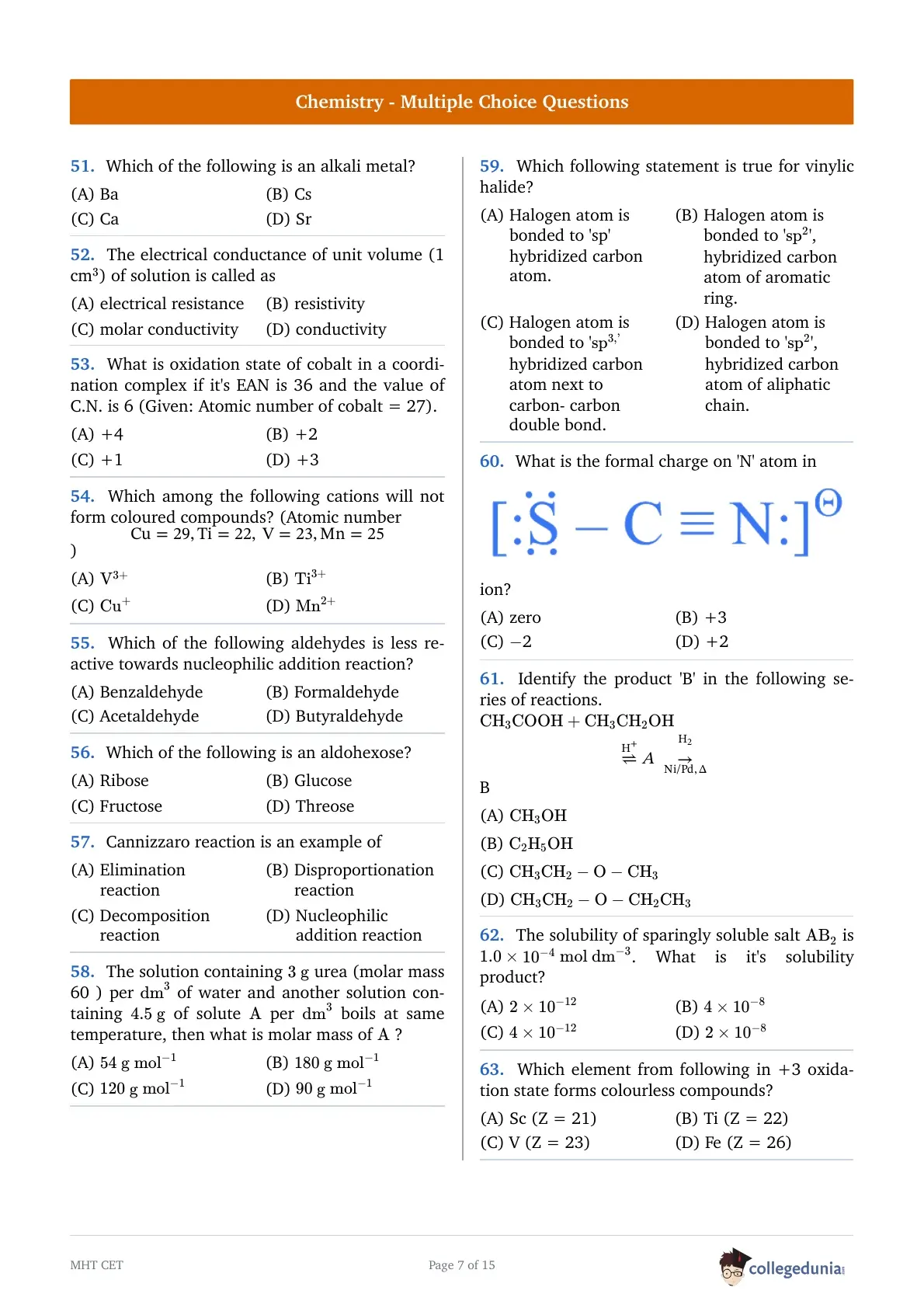
What is the formal charge on 'N' atom in

  • (A) zero
  • (B) +3
  • (C) \(-\)2
  • (D) +2

Question 61:

Identify the product 'B' in the following series of reactions.

\[\mathrm{CH_3COOH+CH_3CH_2OH}\] \[\stackrel{\mathrm{H}^{+}}{\rightleftharpoons} A \xrightarrow[\mathrm{Ni} / \mathrm{Pd}, \Delta]{\mathrm{H}_2}\] B

  • (A) \(\mathrm{CH}_{3}\mathrm{OH}\)
  • (B) \(\mathrm{C}_{2}\mathrm{H}_{5}\mathrm{OH}\)
  • (C) \(\mathrm{CH}_{3}\mathrm{CH}_{2}-\mathrm{O}-\mathrm{CH}_{3}\)
  • (D) \(\mathrm{CH}_{3}\mathrm{CH}_{2}-\mathrm{O}-\mathrm{CH}_{2}\mathrm{CH}_{3}\)

Question 62:

The solubility of sparingly soluble salt \[\mathrm{AB}_2\] is \[1.0 \times 10^{-4} \mathrm{~mol} \mathrm{~dm}^{-3}\]. What is it's solubility product?

  • (A) \(2\times 10^{-12}\)
  • (B) \(4\times 10^{-8}\)
  • (C) \(4\times 10^{-12}\)
  • (D) \(2\times 10^{-8}\)

Question 63:

Which element from following in +3 oxidation state forms colourless compounds?

  • (A) Sc (Z = 21)
  • (B) Ti (Z = 22)
  • (C) V (Z = 23)
  • (D) Fe (Z = 26)

Question 64:

Which among the following compounds contains amino group?

  • (A) N-Phenylbenzenamine
  • (B) 4-Bromoaniline
  • (C) N,N-Dimethylbenzenamine
  • (D) N-Methylmethanamine

Question 65:

What is IUPAC name of phloroglucinol?

  • (A) Benzene-1, 3-diol
  • (B) Benzene-1,4-diol
  • (C) Benzene-1,3,5-triol
  • (D) Benzene-1,2,3-triol

Question 66:

In a first reaction 60% of reactant decomposes in 4.606 min. What is half life of reaction? (k = 0.1989 min\[^{-1}\])

  • (A) 3.48 min
  • (B) 2.4 min
  • (C) 3.0 min
  • (D) 1.74 min

Question 67:

The density of chromium metal is 7 g cm\[^{-3}\]. If edge length of unit cell is 300 pm, identify the type of unit cell. (At mass Cr = 52)

  • (A) Body centred cubic
  • (B) Simple cubic
  • (C) Hexagonal close pack
  • (D) Face centred cubic

Question 68:

How many gram of H\[_2\]O are present in 0.25 mol of it?

  • (A) 0.25 g
  • (B) 5.4 g
  • (C) 4.5 g
  • (D) 6.1 g

Question 69:

Identify molecular formula of pyridine from following

  • (A) C\({}_{5}\)H\({}_{11}\)N
  • (B) C\({}_{4}\)H\({}_{4}\)S
  • (C) C\({}_{4}\)H\({}_{4}\)O
  • (D) C\({}_{5}\)H\({}_{5}\)N

Question 70:

Which of the following is a first step in mechanism of heterogenous catalysis?

  • (A) Desorption of reaction product from catalyst surface
  • (B) Adsorption of reactant molecules on catalyst
  • (C) Occurrence of chemical reaction on catalyst surface to form an intermediate
  • (D) Diffusion of reactants towards catalyst surface

Question 71:

Which of the following carboxylic acids has lowest boiling point?

  • (A) Butyric acid
  • (B) Propionic acid
  • (C) Acetic acid
  • (D) Valeric acid

Question 72:

For the reaction, \[2 \mathrm{~A}+\mathrm{B} \rightarrow 2 \mathrm{C}\], rate of disappearance of \[\mathrm{A}\] is \[0.076 \mathrm{~mol} \mathrm{~s}^{-1}\]. What is the rate of disappearance of \[\mathrm{B}\] ?

  • (A) \(0.076\text{ }\mathrm{mol}\text{ }\mathrm{s}^{-1}\)
  • (B) \(0.038\text{ }\mathrm{mol}\text{ }\mathrm{s}^{-1}\)
  • (C) \(0.019\text{ }\mathrm{mol}\text{ }\mathrm{s}^{-1}\)
  • (D) \(0.095\text{ }\mathrm{mol}\text{ }\mathrm{s}^{-1}\)

Question 73:

Which of following is an example of cross-linked polymers?

  • (A) PVC
  • (B) Acetate rayon
  • (C) High density polyethylene
  • (D) Melamine

Question 74:

For isochoric process, the first law of thermodynamics can be expressed as

  • (A) \(\Delta \mathrm{U}=\mathrm{Q}_{\mathrm{V}}\)
  • (B) \(-\Delta \mathrm{U}=\mathrm{Q}-\mathrm{P}\Delta \mathrm{V}\)
  • (C) \(-\Delta \mathrm{U}=-\mathrm{W}\)
  • (D) \(\mathrm{W}=-\mathrm{Q}\)

Question 75:

Which of the following alcohols has lowest boiling point?

  • (A) sec-Butyl alcohol
  • (B) tert-Butyl alcohol
  • (C) iso-Butyl alcohol
  • (D) n-Butyl alcohol

Question 76:

What is the \[\mathrm{pH}\] of \[0.005 \mathrm{~M} \mathrm{~H}_2 \mathrm{SO}_4\] solution?

  • (A) 5.0
  • (B) 2.3
  • (C) 3.3
  • (D) 2.0

Question 77:

The solubility product expression for \[\mathrm{Ca}_3\left(\mathrm{PO}_4\right)_2\] is represented as

  • (A) \(\mathrm{K}_{\mathrm{sp}}=[\mathrm{Ca}^{2+}]^{2}[\mathrm{PO}_{4}{}^{3-}]^{2}\)
  • (B) \(\mathrm{K}_{\mathrm{sp}}=[\mathrm{Ca}^{2+}]^{3}[\mathrm{PO}_{4}{}^{3-}]^{2}\)
  • (C) \(\mathrm{K}_{\mathrm{sp}}=[\mathrm{Ca}^{2+}][\mathrm{PO}_{4}{}^{2}]^{3}\)
  • (D) \(\mathrm{K}_{\mathrm{sp}}=[\mathrm{Ca}^{2+}][\mathrm{PO}_{4}{}^{2}]\)

Question 78:

Which among the following is NOT a feature of \[\mathrm{S}_{\mathrm{N}} 1\] mechanism?

  • (A) Involve only backside attack of nucleophile.
  • (B) In an optically active substrate the product formed is racemic.
  • (C) Two step mechanism.
  • (D) Heterolysis of \(\mathrm{C}-\mathrm{X}\) bond forms carbocation intermediate.

Question 79:

An element has \[\mathrm{BCC}\] structure with edge length of unit cell \[600 \mathrm{~pm}\]. What is the atomic radius of element?

  • (A) \(\sqrt{3}\times 150\text{ }\mathrm{pm}\)
  • (B) \(150\text{ }\mathrm{pm}\)
  • (C) \(300\text{ }\mathrm{pm}\)
  • (D) \(\frac{300}{\sqrt{2}}\text{ }\mathrm{pm}\)

Question 80:

When certain volume of gas expands against a constant external pressure of \[2.40 \times 10^5 \mathrm{~Pa}\] at 300 \[\mathrm{K}\] to \[2.2 \times 10^{-3} \mathrm{~m}^3\]. If the work obtained is \[-0.048 \mathrm{~kJ}\]. What is the initial volume of the gas?

  • (A) \(2\times 10^{-3}\text{ }\mathrm{m}^{3}\)
  • (B) \(4.5\times 10^{-2}\text{ }\mathrm{m}^{3}\)
  • (C) \(1.5\times 10^{-3}\text{ }\mathrm{m}^{3}\)
  • (D) \(2.8\times 10^{-2}\text{ }\mathrm{m}^{3}\)

Question 81:

Which among the following pairs of electronic effect and it's example is NOT correct?

  • (A) Hyper conjugation : Propene
  • (B) Resonance : Nitromethane
  • (C) \((-)\mathrm{R}\) effect: \(\mathrm{C}_{6}\mathrm{H}_{5}\mathrm{NH}_{2}\)
  • (D) Electromeric effect: Acetone

Question 82:

A certain mass of a gas occupies volume of 250 mL at 2 atm. Calculate the volume of gas if pressure is increased to 2.5 atm at constant temperature.

  • (A) 352.0 mL
  • (B) 300.0 mL
  • (C) 200 mL
  • (D) 443.0 mL

Question 83:

Vapour pressure of solution and of pure solvent are \[\mathrm{P}_1\] and \[\mathrm{P}_1{ }^0\] respectively. If \[\frac{P_1}{P_1^0}\] is 0.15, find the mole fraction of solute.

  • (A) 0.66
  • (B) 0.85
  • (C) 0.15
  • (D) 0.33

Question 85:

What is internal energy change when \[62 \mathrm{~J}\] of work is done on the system and \[128 \mathrm{~J}\] of heat is transferred to surrounding?

  • (A) \(-62\text{ }\mathrm{J}\)
  • (B) \(-190\text{ }\mathrm{J}\)
  • (C) \(-128\text{ }\mathrm{J}\)
  • (D) \(-66\text{ }\mathrm{J}\)

Question 86:

Which of the following catalyst/reagent is used to convert \[\mathrm{C} \equiv \mathrm{C}\] triple bond to \[\mathrm{C}=\mathrm{C}\] double bond to form cis isomer of alkene?

  • (A) \(\mathrm{Na}\)/liquid \(\mathrm{NH}_{3}\)
  • (B) \(\mathrm{Pd}-\mathrm{C}\), quinolone
  • (C) \(\mathrm{ZnCl}_{2}/\mathrm{HCl}\)
  • (D) \(\mathrm{Na}/\mathrm{Hg}\) in \(\mathrm{H}_{2}\mathrm{O}\)

Question 87:

Which among the following reactions exhibits the reducing property of ozone?

  • (A) \(\mathrm{PbS}_{(\mathrm{s})}+4\mathrm{O}_{3(\text{ }\mathrm{g})}\rightarrow \mathrm{PbSO}_{4(\text{ }\mathrm{s})}+4\mathrm{O}_{2(\text{ }\mathrm{g})}\)
  • (B) \(\mathrm{BaO}_{2\text{ (g) }}+\mathrm{O}_{3(\text{ }\mathrm{g})}\rightarrow \mathrm{BaO}_{(\mathrm{s})}+2\mathrm{O}_{2\text{ (g) }}\)
  • (C) \(\mathrm{NO}_{(\mathrm{g})}+\mathrm{O}_{3(\text{ }\mathrm{g})}\rightarrow \mathrm{NO}_{2(\text{ }\mathrm{g})}+\mathrm{O}_{2(\text{ }\mathrm{g})}\)
  • (D) \(2\mathrm{KI}_{(\mathrm{qq})}+\mathrm{H}_{2}\mathrm{O}_{(\mathrm{l})}+\mathrm{O}_{3(\text{ }\mathrm{g})}\rightarrow 2\mathrm{KOH}_{(\mathrm{aq})}+\mathrm{I}_{2(\text{ }\mathrm{g})}+\mathrm{O}_{2}(\text{ }\mathrm{g})\)

Question 88:

Which of the following is a correct bridged name of deoxyriboseadenosine monophosphate?

  • (A) AMP
  • (B) dAMP
  • (C) dTMP
  • (D) UMP

Question 89:

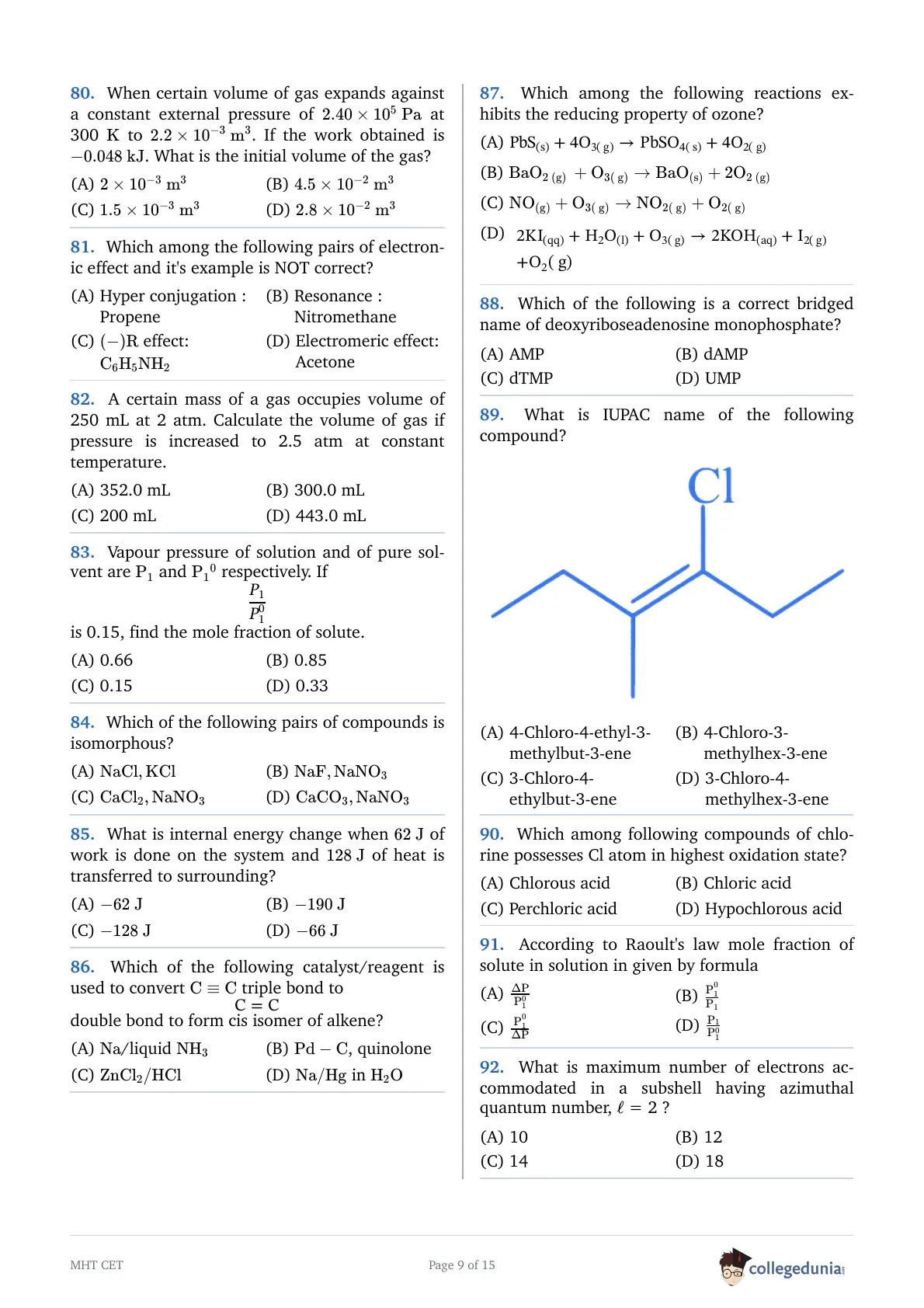
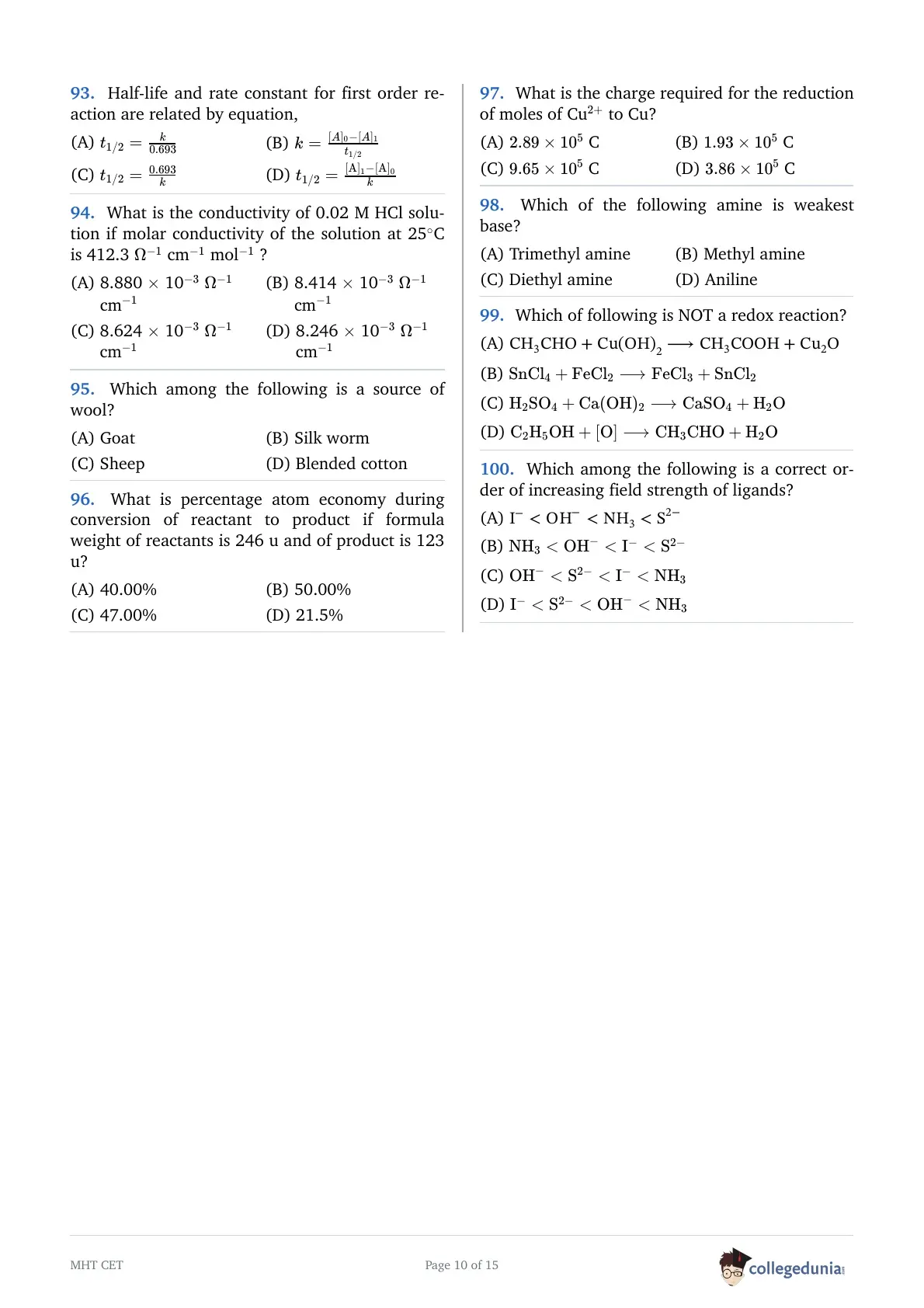
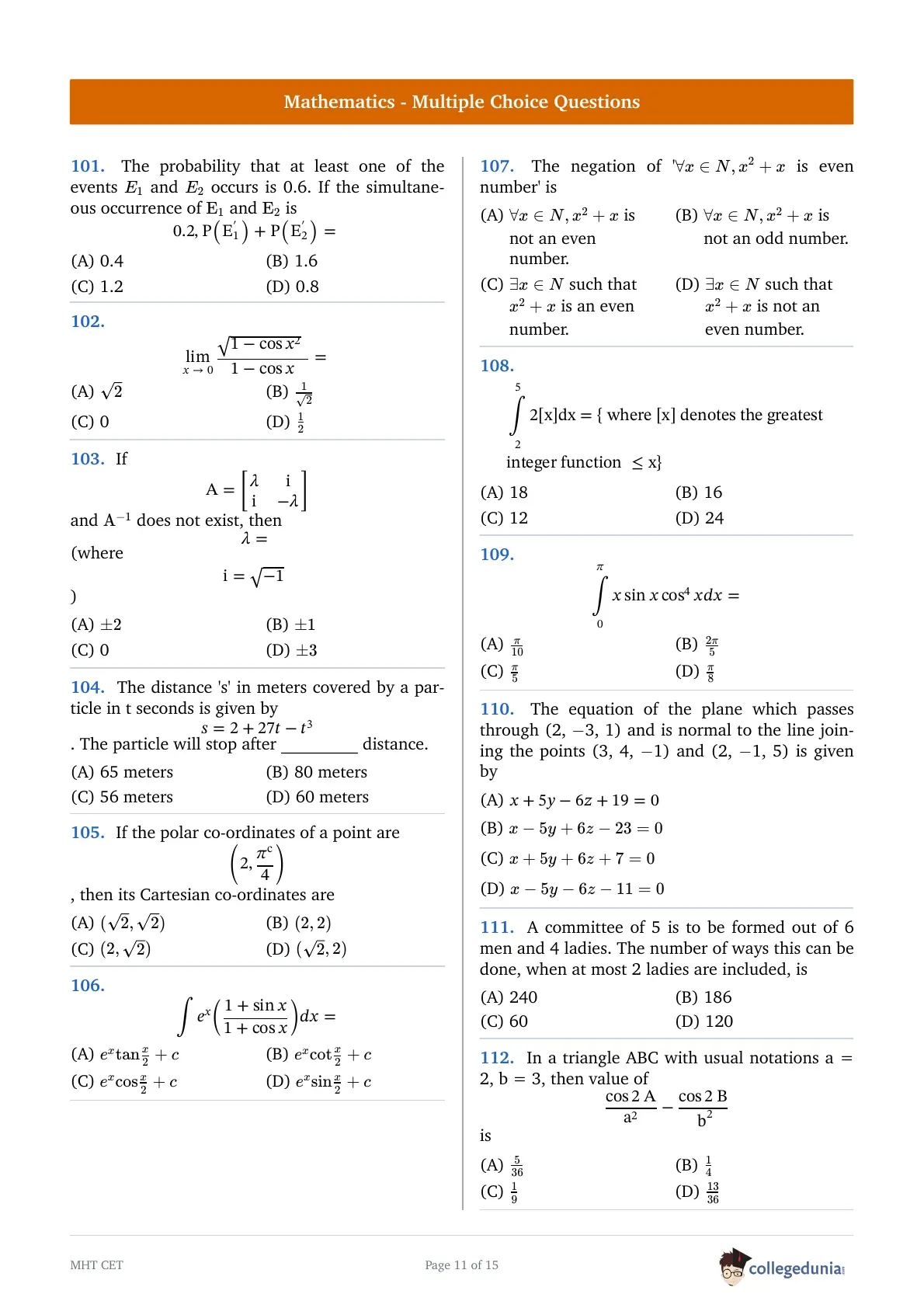
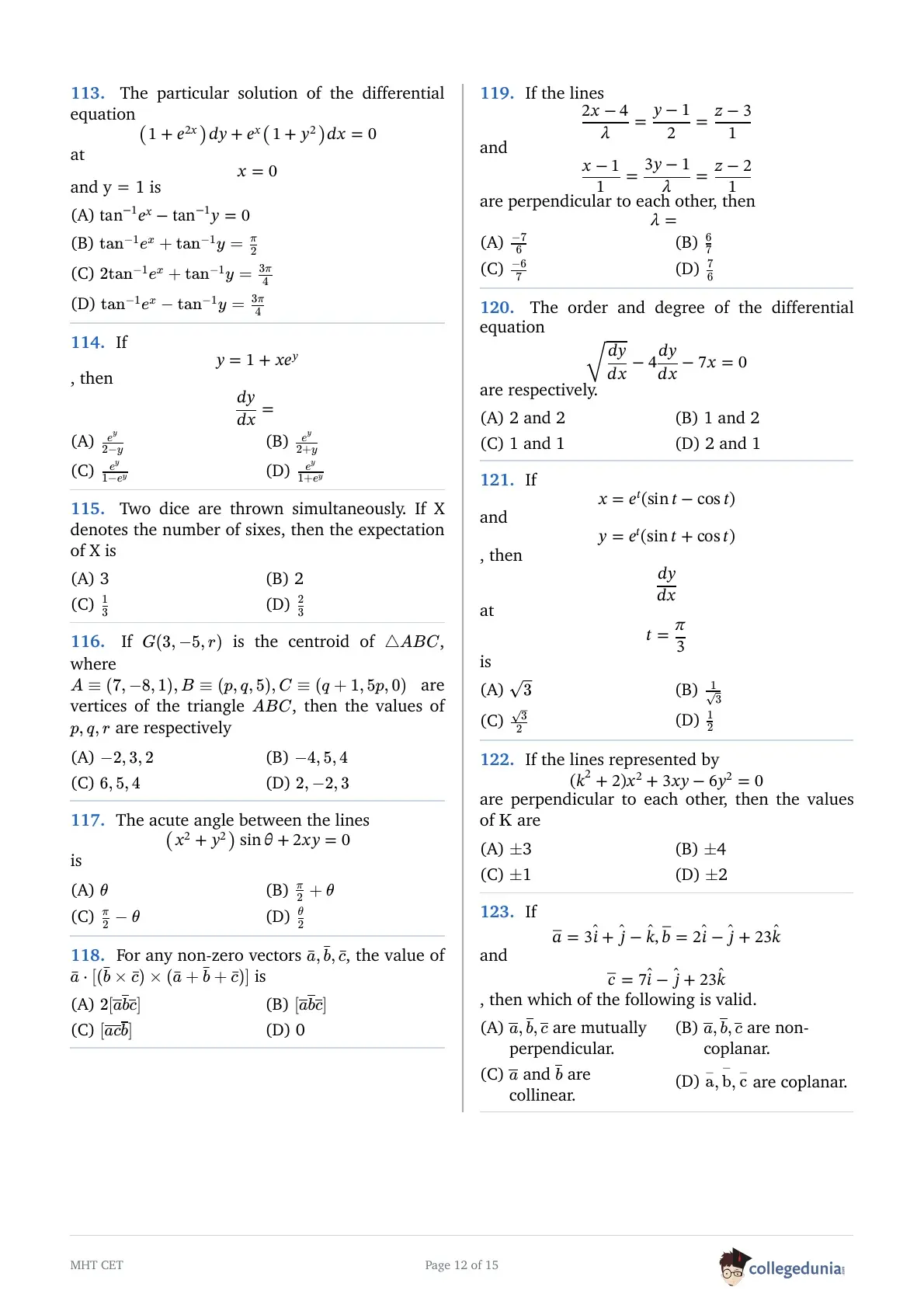
What is IUPAC name of the following compound?

  • (A) 4-Chloro-4-ethyl-3-methylbut-3-ene
  • (B) 4-Chloro-3-methylhex-3-ene
  • (C) 3-Chloro-4-ethylbut-3-ene
  • (D) 3-Chloro-4-methylhex-3-ene

Question 90:

Which among following compounds of chlorine possesses Cl atom in highest oxidation state?

  • (A) Chlorous acid
  • (B) Chloric acid
  • (C) Perchloric acid
  • (D) Hypochlorous acid

Question 91:

According to Raoult's law mole fraction of solute in solution in given by formula

  • (A) \(\frac{\Delta \mathrm{P}}{\mathrm{P}_{1}^{0}}\)
  • (B) \(\frac{\mathrm{P}_{1}^{0}}{\mathrm{P}_{1}}\)
  • (C) \(\frac{\mathrm{P}_{1}^{0}}{\Delta \mathrm{P}}\)
  • (D) \(\frac{\mathrm{P}_{1}}{\mathrm{P}_{1}^{0}}\)

Question 92:

What is maximum number of electrons accommodated in a subshell having azimuthal quantum number, \[\ell\] = 2 ?

  • (A) 10
  • (B) 12
  • (C) 14
  • (D) 18

Question 93:

Half-life and rate constant for first order reaction are related by equation,

  • (A) \(t_{1/2}=\frac{k}{0.693}\)
  • (B) \(k=\frac{[A]_{0}-[A]_{1}}{t_{1/2}}\)
  • (C) \(t_{1/2}=\frac{0.693}{k}\)
  • (D) \(t_{1/2}=\frac{[\mathrm{A}]_{1}-[\mathrm{A}]_{0}}{k}\)

Question 94:

What is the conductivity of 0.02 M HCl solution if molar conductivity of the solution at 25\[^\circ\]C is 412.3 \[\Omega^{-1}\] cm\[^{-1}\] mol\[^{-1}\] ?

  • (A) 8.880 \(\times\) 10\({}^{-3}\) \(\Omega ^{-1}\) cm\({}^{-1}\)
  • (B) 8.414 \(\times\) 10\({}^{-3}\) \(\Omega ^{-1}\) cm\({}^{-1}\)
  • (C) 8.624 \(\times\) 10\({}^{-3}\) \(\Omega ^{-1}\) cm\({}^{-1}\)
  • (D) 8.246 \(\times\) 10\({}^{-3}\) \(\Omega ^{-1}\) cm\({}^{-1}\)

Question 95:

Which among the following is a source of wool?

  • (A) Goat
  • (B) Silk worm
  • (C) Sheep
  • (D) Blended cotton

Question 96:

What is percentage atom economy during conversion of reactant to product if formula weight of reactants is 246 u and of product is 123 u?

  • (A) 40.00%
  • (B) 50.00%
  • (C) 47.00%
  • (D) 21.5%

Question 98:

Which of the following amine is weakest base?

  • (A) Trimethyl amine
  • (B) Methyl amine
  • (C) Diethyl amine
  • (D) Aniline

Question 99:

Which of following is NOT a redox reaction?

  • (A) \(\mathrm{CH}_{3}\mathrm{CHO}+\mathrm{Cu}(\mathrm{OH})_{2}\longrightarrow \mathrm{CH}_{3}\mathrm{COOH}+\mathrm{Cu}_{2}\mathrm{O}\)
  • (B) \(\mathrm{SnCl}_{4}+\mathrm{FeCl}_{2}\longrightarrow \mathrm{FeCl}_{3}+\mathrm{SnCl}_{2}\)
  • (C) \(\mathrm{H}_{2}\mathrm{SO}_{4}+\mathrm{Ca}(\mathrm{OH})_{2}\longrightarrow \mathrm{CaSO}_{4}+\mathrm{H}_{2}\mathrm{O}\)
  • (D) \(\mathrm{C}_{2}\mathrm{H}_{5}\mathrm{OH}+[\mathrm{O}]\longrightarrow \mathrm{CH}_{3}\mathrm{CHO}+\mathrm{H}_{2}\mathrm{O}\)

Question 100:

Which among the following is a correct order of increasing field strength of ligands?

  • (A) \(\mathrm{I}^{-}<\mathrm{OH}^{-}<\mathrm{NH}_{3}<\mathrm{S}^{2-}\)
  • (B) \(\mathrm{NH}_{3}<\mathrm{OH}^{-}<\mathrm{I}^{-}<\mathrm{S}^{2-}\)
  • (C) \(\mathrm{OH}^{-}<\mathrm{S}^{2-}<\mathrm{I}^{-}<\mathrm{NH}_{3}\)
  • (D) \(\mathrm{I}^{-}<\mathrm{S}^{2-}<\mathrm{OH}^{-}<\mathrm{NH}_{3}\)

Mathematics (Q101 - Q150)

Question 101:

The probability that at least one of the events \[E_1\] and \[E_2\] occurs is 0.6. If the simultaneous occurrence of \[\mathrm{E}_1\] and \[\mathrm{E}_2\] is \[0.2, \mathrm{P}\left(\mathrm{E}_1^{\prime}\right)+\mathrm{P}\left(\mathrm{E}_2^{\prime}\right)=\]

  • (A) 0.4
  • (B) 1.6
  • (C) 1.2
  • (D) 0.8

Question 102:

\[\lim _\limits{x \rightarrow 0} \frac{\sqrt{1-\cos x^2}}{1-\cos x}=\]

  • (A) \(\sqrt{2}\)
  • (B) \(\frac{1}{\sqrt{2}}\)
  • (C) 0
  • (D) \(\frac{1}{2}\)

Question 103:

If \[\mathrm{A}=\left[\begin{array}{cc}\lambda & \mathrm{i} \\ \mathrm{i} & -\lambda\end{array}\right]\] and \[\mathrm{A}^{-1}\] does not exist, then \[\lambda=\] (where \[\mathrm{i}=\sqrt{-1}\])

  • (A) \(\pm 2\)
  • (B) \(\pm 1\)
  • (C) 0
  • (D) \(\pm 3\)

Question 105:

If the polar co-ordinates of a point are \[\left(2, \frac{\pi^{\mathrm{c}}}{4}\right)\], then its Cartesian co-ordinates are

  • (A) \((\sqrt{2},\sqrt{2})\)
  • (B) \((2,2)\)
  • (C) \((2,\sqrt{2})\)
  • (D) \((\sqrt{2},2)\)

Question 106:

\[\int e^x\left(\frac{1+\sin x}{1+\cos x}\right) d x=\]

  • (A) \(e^{x}\mathrm{tan}\frac{x}{2}+c\)
  • (B) \(e^{x}\mathrm{cot}\frac{x}{2}+c\)
  • (C) \(e^{x}\mathrm{cos}\frac{x}{2}+c\)
  • (D) \(e^{x}\mathrm{sin}\frac{x}{2}+c\)

Question 107:

The negation of '\[\forall x \in N, x^2+x\] is even number' is

  • (A) \(\forall x\in N,x^{2}+x\) is not an even number.
  • (B) \(\forall x\in N,x^{2}+x\) is not an odd number.
  • (C) \(\exists x\in N\) such that \(x^{2}+x\) is an even number.
  • (D) \(\exists x\in N\) such that \(x^{2}+x\) is not an even number.

Question 108:

\[\int_\limits2^5 2[\mathrm{x}] \mathrm{dx}=\{\text { where }[\mathrm{x}] \text { denotes the greatest integer function } \leq \mathrm{x}\}\]

  • (A) 18
  • (B) 16
  • (C) 12
  • (D) 24

Question 109:

\[\int_\limits0^\pi x \sin x \cos ^4 x d x=\]

  • (A) \(\frac{\pi}{10}\)
  • (B) \(\frac{2\pi}{5}\)
  • (C) \(\frac{\pi}{5}\)
  • (D) \(\frac{\pi}{8}\)

Question 110:

The equation of the plane which passes through (2, \[-\]3, 1) and is normal to the line joining the points (3, 4, \[-\]1) and (2, \[-\]1, 5) is given by

  • (A) \(x+5y-6z+19=0\)
  • (B) \(x-5y+6z-23=0\)
  • (C) \(x+5y+6z+7=0\)
  • (D) \(x-5y-6z-11=0\)

Question 111:

A committee of 5 is to be formed out of 6 men and 4 ladies. The number of ways this can be done, when at most 2 ladies are included, is

  • (A) 240
  • (B) 186
  • (C) 60
  • (D) 120

Question 112:

In a triangle ABC with usual notations a = 2, b = 3, then value of \[\frac{\cos 2 \mathrm{~A}}{\mathrm{a}^2}-\frac{\cos 2 \mathrm{~B}}{\mathrm{~b}^2}\] is

  • (A) \(\frac{5}{36}\)
  • (B) \(\frac{1}{4}\)
  • (C) \(\frac{1}{9}\)
  • (D) \(\frac{13}{36}\)

Question 113:

The particular solution of the differential equation \[\left(1+e^{2 x}\right) d y+e^x\left(1+y^2\right) d x=0\] at \[x=0\] and y = 1 is

  • (A) \(\mathrm{tan}^{-1}e^{x}-\mathrm{tan}^{-1}y=0\)
  • (B) \(\mathrm{tan}^{-1}e^{x}+\mathrm{tan}^{-1}y=\frac{\pi}{2}\)
  • (C) \(2\mathrm{tan}^{-1}e^{x}+\mathrm{tan}^{-1}y=\frac{3\pi}{4}\)
  • (D) \(\mathrm{tan}^{-1}e^{x}-\mathrm{tan}^{-1}y=\frac{3\pi}{4}\)

Question 114:

If \[y=1+x e^y\], then \[\frac{d y}{d x}=\]

  • (A) \(\frac{e^{y}}{2-y}\)
  • (B) \(\frac{e^{y}}{2+y}\)
  • (C) \(\frac{e^{y}}{1-e^{y}}\)
  • (D) \(\frac{e^{y}}{1+e^{y}}\)

Question 115:

Two dice are thrown simultaneously. If X denotes the number of sixes, then the expectation of X is

  • (A) 3
  • (B) 2
  • (C) \(\frac{1}{3}\)
  • (D) \(\frac{2}{3}\)

Question 116:

If \[G(3,-5, r)\] is the centroid of \[\triangle A B C\], where \[A \equiv(7,-8,1), B \equiv(p, q, 5), C \equiv(q+1,5 p, 0)\] are vertices of the triangle \[A B C\], then the values of \[p, q, r\] are respectively

  • (A) \(-2,3,2\)
  • (B) \(-4,5,4\)
  • (C) \(6,5,4\)
  • (D) \(2,-2,3\)

Question 117:

The acute angle between the lines \[\left(x^2+y^2\right) \sin \theta+2 x y=0\] is

  • (A) \(\theta\)
  • (B) \(\frac{\pi}{2}+\theta\)
  • (C) \(\frac{\pi}{2}-\theta\)
  • (D) \(\frac{\theta}{2}\)

Question 119:

If the lines \[\frac{2 x-4}{\lambda}=\frac{y-1}{2}=\frac{z-3}{1}\] and \[\frac{x-1}{1}=\frac{3 y-1}{\lambda}=\frac{z-2}{1}\] are perpendicular to each other, then \[\lambda=\]

  • (A) \(\frac{-7}{6}\)
  • (B) \(\frac{6}{7}\)
  • (C) \(\frac{-6}{7}\)
  • (D) \(\frac{7}{6}\)

Question 120:

The order and degree of the differential equation \[\sqrt{\frac{d y}{d x}}-4 \frac{d y}{d x}-7 x=0\] are respectively.

  • (A) 2 and 2
  • (B) 1 and 2
  • (C) 1 and 1
  • (D) 2 and 1

Question 121:

If \[x=e^t(\sin t-\cos t)\] and \[y=e^t(\sin t+\cos t)\], then \[\frac{d y}{d x}\] at \[t=\frac{\pi}{3}\] is

  • (A) \(\sqrt{3}\)
  • (B) \(\frac{1}{\sqrt{3}}\)
  • (C) \(\frac{\sqrt{3}}{2}\)
  • (D) \(\frac{1}{2}\)

Question 122:

If the lines represented by \[(k^2+2) x^2+3 x y-6 y^2=0\] are perpendicular to each other, then the values of \[\mathrm{K}\] are

  • (A) \(\pm\)3
  • (B) \(\pm\)4
  • (C) \(\pm\)1
  • (D) \(\pm\)2

Question 123:

If \[\bar{a}=3 \hat{i}+\hat{j}-\hat{k}, \bar{b}=2 \hat{i}-\hat{j}+23 \hat{k}\] and \[\bar{c}=7 \hat{i}-\hat{j}+23 \hat{k}\], then which of the following is valid.

  • (A) \(\overline{a},\overline{b},\overline{c}\) are mutually perpendicular.
  • (B) \(\overline{a},\overline{b},\overline{c}\) are non-coplanar.
  • (C) \(\overline{a}\) and \(\overline{b}\) are collinear.
  • (D) \(\overset{-}{\mathrm{a}},\overset{-}{\mathrm{b}},\overset{-}{\mathrm{c}}\) are coplanar.

Question 124:

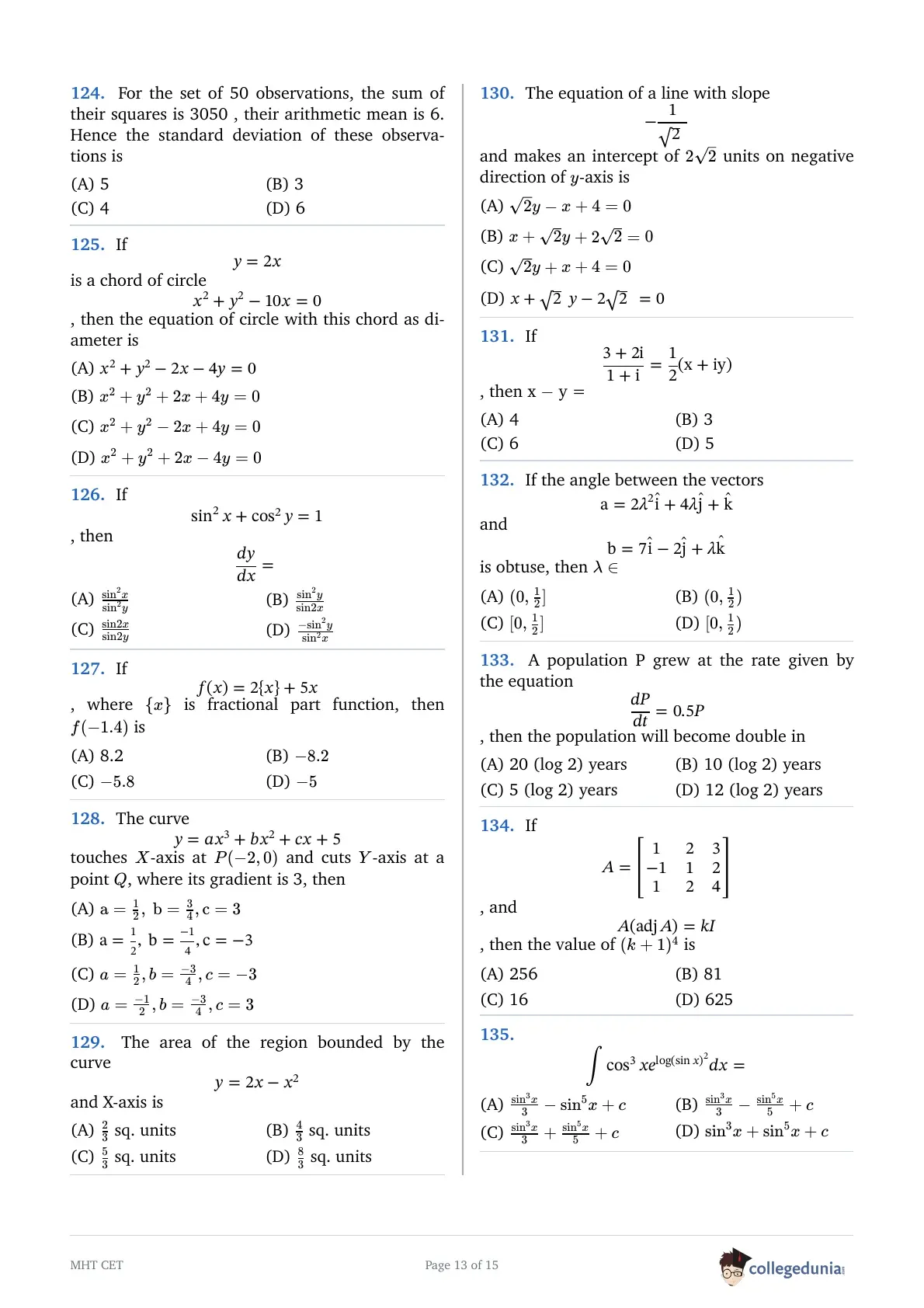
For the set of 50 observations, the sum of their squares is 3050 , their arithmetic mean is 6. Hence the standard deviation of these observations is

  • (A) 5
  • (B) 3
  • (C) 4
  • (D) 6

Question 125:

If \[y=2 x\] is a chord of circle \[x^2+y^2-10 x=0\], then the equation of circle with this chord as diameter is

  • (A) \(x^{2}+y^{2}-2x-4y=0\)
  • (B) \(x^{2}+y^{2}+2x+4y=0\)
  • (C) \(x^{2}+y^{2}-2x+4y=0\)
  • (D) \(x^{2}+y^{2}+2x-4y=0\)

Question 126:

If \[\sin ^2 x+\cos ^2 y=1\], then \[\frac{d y}{d x}=\]

  • (A) \(\frac{\mathrm{sin}^{2}x}{\mathrm{sin}^{2}y}\)
  • (B) \(\frac{\mathrm{sin}^{2}y}{\mathrm{sin}2x}\)
  • (C) \(\frac{\mathrm{sin}2x}{\mathrm{sin}2y}\)
  • (D) \(\frac{-\mathrm{sin}^{2}y}{\mathrm{sin}^{2}x}\)

Question 127:

If \[f(x)=2\{x\}+5 x\], where \[\{x\}\] is fractional part function, then \[f(-1.4)\] is

  • (A) 8.2
  • (B) \(-8.2\)
  • (C) \(-5.8\)
  • (D) \(-5\)

Question 128:

The curve \[y=a x^3+b x^2+c x+5\] touches \[X\]-axis at \[P(-2,0)\] and cuts \[Y\]-axis at a point \[Q\], where its gradient is 3, then

  • (A) \(\mathrm{a}=\frac{1}{2},\text{ }\mathrm{b}=\frac{3}{4},\mathrm{c}=3\)
  • (B) \(\mathrm{a}=\frac{1}{2},\text{ }\mathrm{b}=\frac{-1}{4},\mathrm{c}=-3\)
  • (C) \(a=\frac{1}{2},b=\frac{-3}{4},c=-3\)
  • (D) \(a=\frac{-1}{2},b=\frac{-3}{4},c=3\)

Question 129:

The area of the region bounded by the curve \[y=2 x-x^2\] and X-axis is

  • (A) \(\frac{2}{3}\) sq. units
  • (B) \(\frac{4}{3}\) sq. units
  • (C) \(\frac{5}{3}\) sq. units
  • (D) \(\frac{8}{3}\) sq. units

Question 130:

The equation of a line with slope \[-\frac{1}{\sqrt{2}}\] and makes an intercept of \[2 \sqrt{2}\] units on negative direction of \[y\]-axis is

  • (A) \(\sqrt{2}y-x+4=0\)
  • (B) \(x+\sqrt{2}y+2\sqrt{2}=0\)
  • (C) \(\sqrt{2}y+x+4=0\)
  • (D) \(x+\sqrt{2}y-2\sqrt{2}=0\)

Question 131:

If \[\mathrm{\frac{3+2i}{1+i}=\frac{1}{2}(x+iy)}\], then x \[-\] y =

  • (A) 4
  • (B) 3
  • (C) 6
  • (D) 5

Question 132:

If the angle between the vectors \[\overline{\mathrm{a}}=2 \lambda^2 \hat{\mathrm{i}}+4 \lambda \hat{\mathrm{j}}+\hat{\mathrm{k}}\] and \[\overline{\mathrm{b}}=7 \hat{\mathrm{i}}-2 \hat{\mathrm{j}}+\lambda \hat{\mathrm{k}}\] is obtuse, then \[\lambda \in\]

  • (A) \((0,\frac{1}{2}]\)
  • (B) \((0,\frac{1}{2})\)
  • (C) \([0,\frac{1}{2}]\)
  • (D) \([0,\frac{1}{2})\)

Question 134:

If \[A=\left[\begin{array}{ccc}1 & 2 & 3 \\ -1 & 1 & 2 \\ 1 & 2 & 4\end{array}\right]\], and \[A(\operatorname{adj} A)=k I\], then the value of \[(k+1)^4\] is

  • (A) 256
  • (B) 81
  • (C) 16
  • (D) 625

Question 135:

\[\int \cos ^3 x e^{\log (\sin x)^2} d x=\]

  • (A) \(\frac{\mathrm{sin}^{3}x}{3}-\mathrm{sin}^{5}x+c\)
  • (B) \(\frac{\mathrm{sin}^{3}x}{3}-\frac{\mathrm{sin}^{5}x}{5}+c\)
  • (C) \(\frac{\mathrm{sin}^{3}x}{3}+\frac{\mathrm{sin}^{5}x}{5}+c\)
  • (D) \(\mathrm{sin}^{3}x+\mathrm{sin}^{5}x+c\)

Question 136:

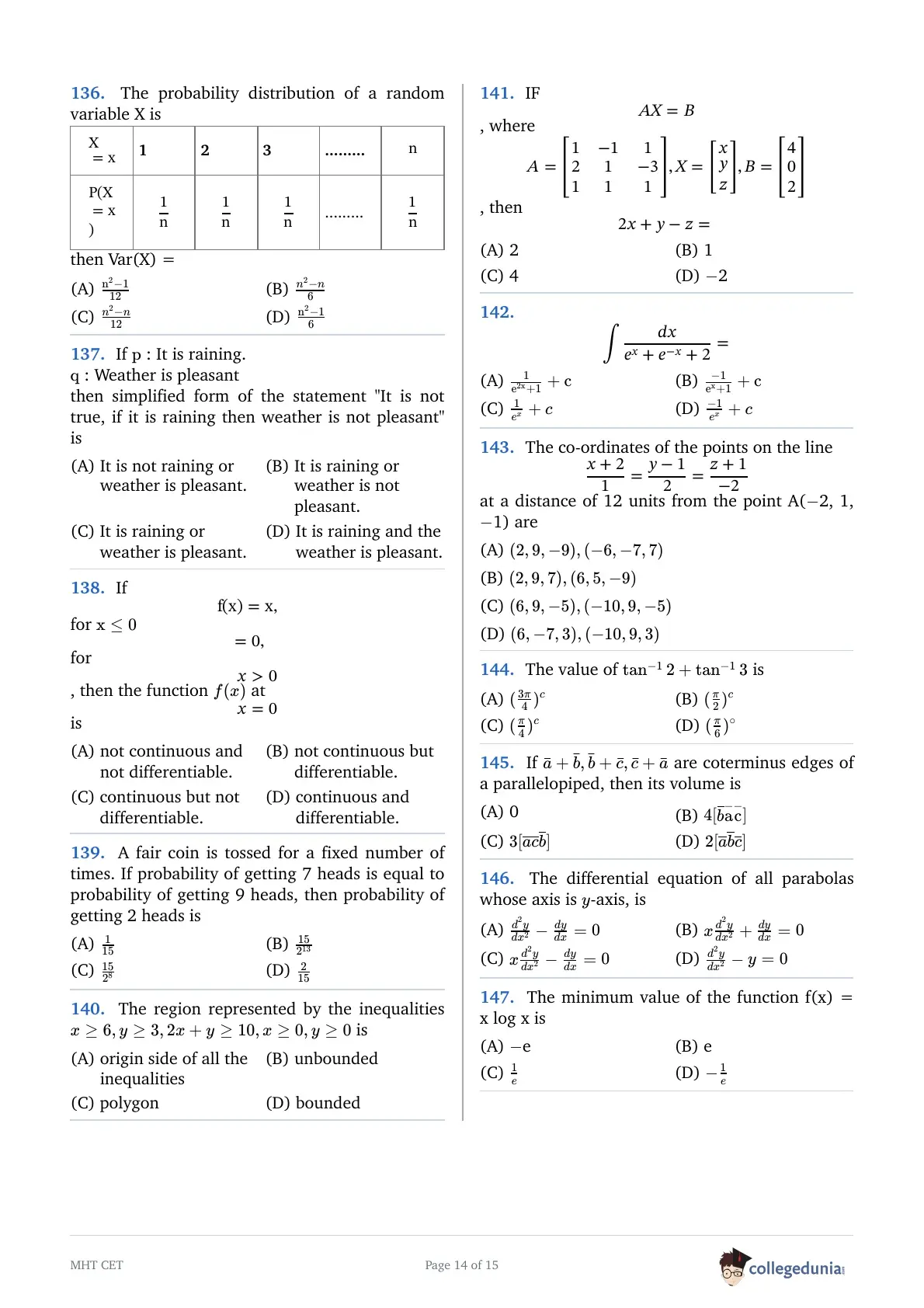
The probability distribution of a random variable X is

\[\mathrm{X=x}\]123.........\[\mathrm{n}\]
\[\mathrm{P(X=x)}\]\[\mathrm{\frac{1}{n}}\]\[\mathrm{\frac{1}{n}}\]\[\mathrm{\frac{1}{n}}\].........\[\mathrm{\frac{1}{n}}\]
  • (A) \(\frac{\mathrm{n}^{2}-1}{12}\)
  • (B) \(\frac{n^{2}-n}{6}\)
  • (C) \(\frac{n^{2}-n}{12}\)
  • (D) \(\frac{\mathrm{n}^{2}-1}{6}\)

Question 137:

If \[\mathrm{p}\] : It is raining.

\[\mathrm{q}\] : Weather is pleasant

then simplified form of the statement "It is not true, if it is raining then weather is not pleasant" is

  • (A) It is not raining or weather is pleasant.
  • (B) It is raining or weather is not pleasant.
  • (C) It is raining or weather is pleasant.
  • (D) It is raining and the weather is pleasant.

Question 138:

If \[\mathrm{f}(\mathrm{x})=\mathrm{x}, \quad\] for \[\mathrm{x} \leq 0\]

\[=0,\quad\] for \[x>0\], then the function \[f(x)\] at \[x=0\] is

  • (A) not continuous and not differentiable.
  • (B) not continuous but differentiable.
  • (C) continuous but not differentiable.
  • (D) continuous and differentiable.

Question 139:

A fair coin is tossed for a fixed number of times. If probability of getting 7 heads is equal to probability of getting 9 heads, then probability of getting 2 heads is

  • (A) \(\frac{1}{15}\)
  • (B) \(\frac{15}{2^{13}}\)
  • (C) \(\frac{15}{2^{8}}\)
  • (D) \(\frac{2}{15}\)

Question 140:

The region represented by the inequalities \[x \geq 6, y \geq 3,2 x+y \geq 10, x \geq 0, y \geq 0\] is

  • (A) origin side of all the inequalities
  • (B) unbounded
  • (C) polygon
  • (D) bounded

Question 141:

IF \[A X=B\], where \[A=\left[\begin{array}{ccc}1 & -1 & 1 \\ 2 & 1 & -3 \\ 1 & 1 & 1\end{array}\right], X=\left[\begin{array}{l}x \\ y \\ z\end{array}\right], B=\left[\begin{array}{l}4 \\ 0 \\ 2\end{array}\right]\], then \[2 x+y-z=\]

  • (A) 2
  • (B) 1
  • (C) 4
  • (D) \(-\)2

Question 142:

\[\int \frac{d x}{e^x+e^{-x}+2}=\]

  • (A) \(\frac{1}{\mathrm{e}^{2\mathrm{x}}+1}+\mathrm{c}\)
  • (B) \(\frac{-1}{\mathrm{e}^{\mathrm{x}}+1}+\mathrm{c}\)
  • (C) \(\frac{1}{e^{x}}+c\)
  • (D) \(\frac{-1}{e^{x}}+c\)

Question 143:

The co-ordinates of the points on the line \[\frac{x+2}{1}=\frac{y-1}{2}=\frac{z+1}{-2}\] at a distance of 12 units from the point A(\[-\]2, 1, \[-\]1) are

  • (A) \((2,9,-9),(-6,-7,7)\)
  • (B) \((2,9,7),(6,5,-9)\)
  • (C) \((6,9,-5),(-10,9,-5)\)
  • (D) \((6,-7,3),(-10,9,3)\)

Question 144:

The value of \[\tan ^{-1} 2+\tan ^{-1} 3\] is

  • (A) \((\frac{3\pi}{4})^{c}\)
  • (B) \((\frac{\pi}{2})^{c}\)
  • (C) \((\frac{\pi}{4})^{c}\)
  • (D) \((\frac{\pi}{6})^{\circ}\)

Question 145:

If \[\bar{a}+\bar{b}, \bar{b}+\bar{c}, \bar{c}+\bar{a}\] are coterminus edges of a parallelopiped, then its volume is

  • (A) 0
  • (B) \(4[\overline{b}\overset{-}{\mathrm{a}}\overset{-}{\mathrm{c}}]\)
  • (C) \(3[\overline{a}\overline{c}\overline{b}]\)
  • (D) \(2[\overline{a}\overline{b}\overline{c}]\)

Question 146:

The differential equation of all parabolas whose axis is \[y\]-axis, is

  • (A) \(\frac{d^{2}y}{dx^{2}}-\frac{dy}{dx}=0\)
  • (B) \(x\frac{d^{2}y}{dx^{2}}+\frac{dy}{dx}=0\)
  • (C) \(x\frac{d^{2}y}{dx^{2}}-\frac{dy}{dx}=0\)
  • (D) \(\frac{d^{2}y}{dx^{2}}-y=0\)

Question 147:

The minimum value of the function f(x) = x log x is

  • (A) \(-\)e
  • (B) e
  • (C) \(\frac{1}{e}\)
  • (D) \(-\frac{1}{e}\)

Question 148:

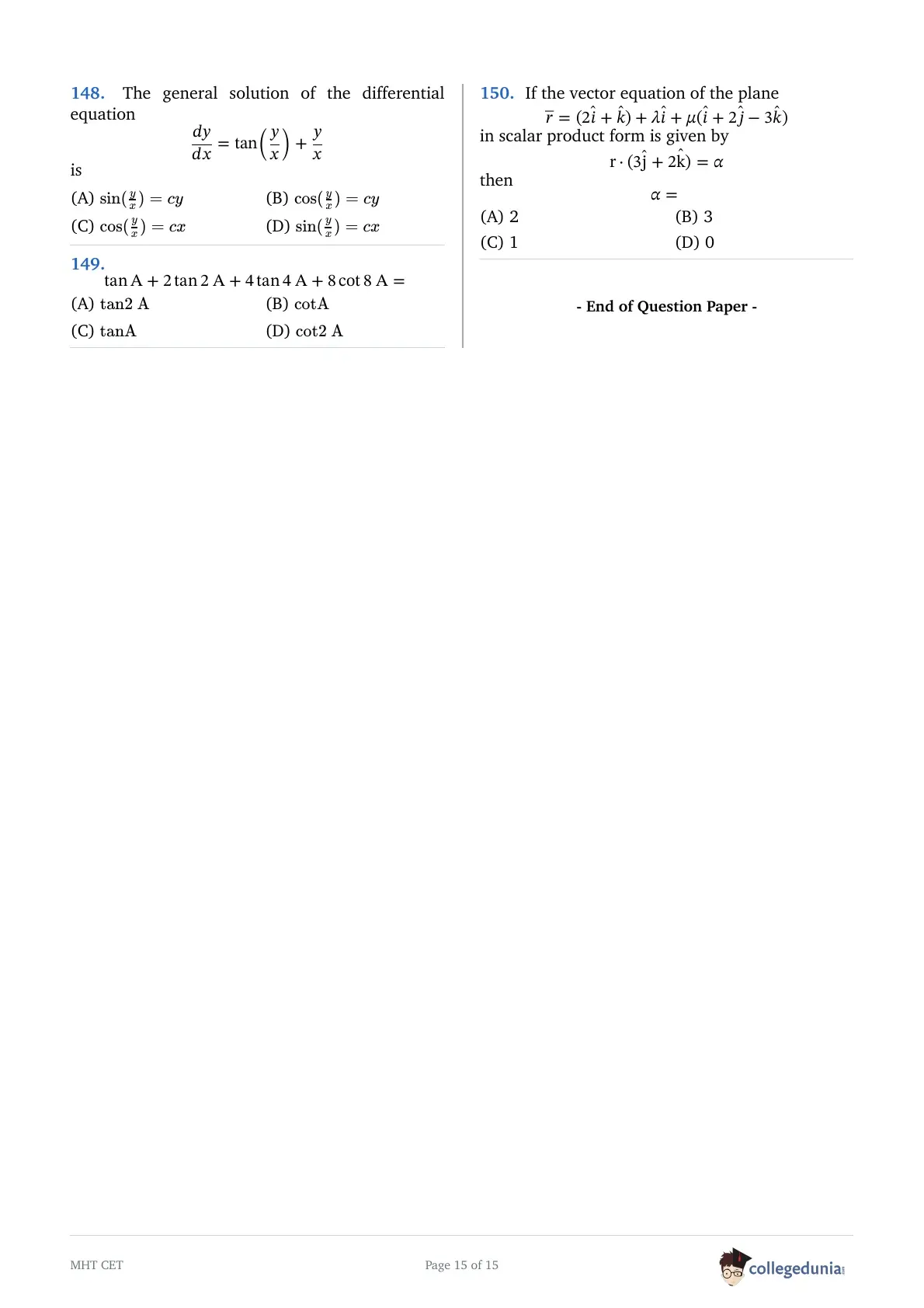
The general solution of the differential equation \[\frac{d y}{d x}=\tan \left(\frac{y}{x}\right)+\frac{y}{x}\] is

  • (A) \(\mathrm{sin}(\frac{y}{x})=cy\)
  • (B) \(\mathrm{cos}(\frac{y}{x})=cy\)
  • (C) \(\mathrm{cos}(\frac{y}{x})=cx\)
  • (D) \(\mathrm{sin}(\frac{y}{x})=cx\)

Question 149:

\[\tan \mathrm{A}+2 \tan 2 \mathrm{~A}+4 \tan 4 \mathrm{~A}+8 \cot 8 \mathrm{~A}=\]

  • (A) \(\mathrm{tan}2\text{ }\mathrm{A}\)
  • (B) \(\mathrm{cotA}\)
  • (C) \(\mathrm{tanA}\)
  • (D) \(\mathrm{cot}2\text{ }\mathrm{A}\)

Question 150:

If the vector equation of the plane \[\bar{r}=(2 \hat{i}+\hat{k})+\lambda \hat{i}+\mu(\hat{i}+2 \hat{j}-3 \hat{k})\] in scalar product form is given by \[\overline{\mathrm{r}} \cdot(3 \hat{\mathrm{j}}+2 \hat{\mathrm{k}})=\alpha\] then \[\alpha=\]


  • (A) 2
  • (B) 3
  • (C) 1
  • (D) 0

MHT CET 2021 PCM Exam Pattern and Marking Scheme

Parameter Details
Conducting Body Maharashtra Common Entrance Test Cell (Maharashtra CET Cell)
Exam Mode Online (Computer-Based Test)
Duration 180 minutes (3 hours)
Groups / Subjects PCM (Physics, Chemistry, Mathematics) for Engineering
Total Questions

150

Total Marks 200
Question Type Multiple Choice Questions (MCQs)
Marks Distribution
  • Mathematics – 2 marks/question
  • Physics and Chemistry – 1 mark/question
Negative Marking No
Syllabus Weightage
  • Class 12 – 80%
  • Class 11 – 20%