




MHT CET 2025 April 17 Shift 2 PCB Question Paper is available for download here. Maharashtra State CET Cell conducted MHT CET 2025 PCB Exam on April 17 in Shift 2 from 2 PM to 5 PM in CBT mode. This paper is memory-based: it is compiled from the questions candidates recalled after the exam, so it does not contain every question of the shift.
The MHT CET 2025 PCB question paper includes the following:
- The MHT CET 2025 PCB Question Paper consists of 200 multiple-choice questions (MCQs) totalling 200 marks divided into 3 sections: Physics (50 questions), Chemistry (50 questions), and Biology (100 questions).
- All questions carry 1 mark each. There is no negative marking for incorrect answers.
MHT CET 2025 April 17 Shift 2 PCB Question Paper with Solution PDF
| CD PDF | CD PDF with Solutions |
|---|---|
| Download Collegedunia PDF 0.83 MB | - |
Also Check:
MHT CET 2025 April 17 Shift 2 PCB Questions with Solutions
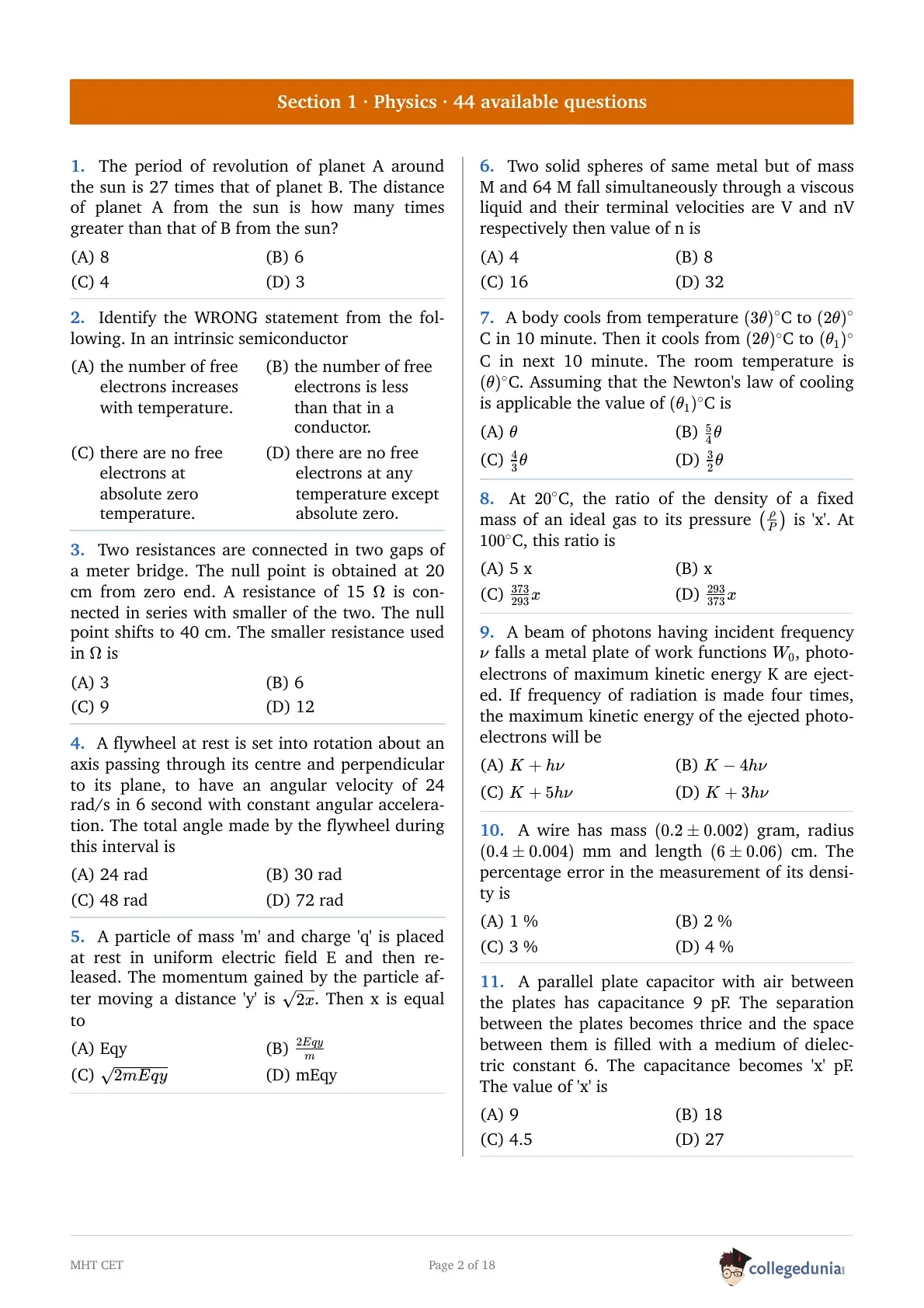
Identify the WRONG statement from the following. In an intrinsic semiconductor
Two resistances are connected in two gaps of a meter bridge. The null point is obtained at 20 cm from zero end. A resistance of 15 \(\Omega\) is connected in series with smaller of the two. The null point shifts to 40 cm. The smaller resistance used in \(\Omega\) is
A flywheel at rest is set into rotation about an axis passing through its centre and perpendicular to its plane, to have an angular velocity of 24 rad/s in 6 second with constant angular acceleration. The total angle made by the flywheel during this interval is
A particle of mass 'm' and charge 'q' is placed at rest in uniform electric field E and then released. The momentum gained by the particle after moving a distance 'y' is \(\sqrt{2x}\). Then x is equal to
Two solid spheres of same metal but of mass M and 64 M fall simultaneously through a viscous liquid and their terminal velocities are V and nV respectively then value of n is
A body cools from temperature \((3\theta)^\circ\)C to \((2\theta)^\circ\)C in 10 minute. Then it cools from \((2\theta)^\circ\)C to \((\theta_1)^\circ\)C in next 10 minute. The room temperature is \((\theta)^\circ\)C. Assuming that the Newton's law of cooling is applicable the value of \((\theta_1)^\circ\)C is
At \(20^\circ\)C, the ratio of the density of a fixed mass of an ideal gas to its pressure \(\left(\frac{\rho}{P}\right)\) is 'x'. At \(100^\circ\)C, this ratio is
A beam of photons having incident frequency \(\nu\) falls a metal plate of work functions \(W_0\), photo-electrons of maximum kinetic energy K are ejected. If frequency of radiation is made four times, the maximum kinetic energy of the ejected photoelectrons will be
A wire has mass \((0.2\pm0.002)\) gram, radius \((0.4\pm0.004)\) mm and length \((6\pm0.06)\) cm. The percentage error in the measurement of its density is
A parallel plate capacitor with air between the plates has capacitance 9 pF. The separation between the plates becomes thrice and the space between them is filled with a medium of dielectric constant 6. The capacitance becomes 'x' pF. The value of 'x' is
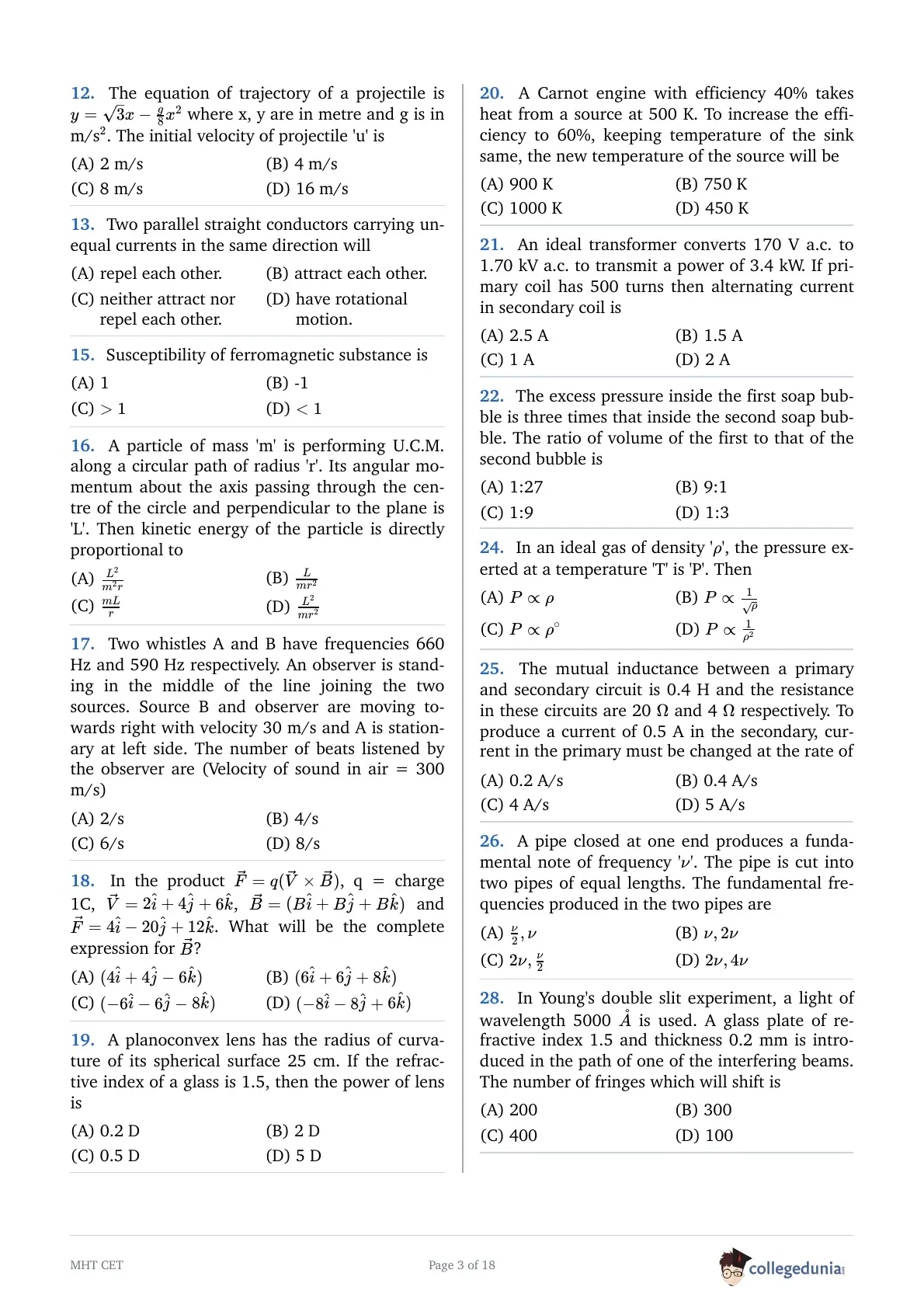
The equation of trajectory of a projectile is \(y=\sqrt{3}x-\frac{g}{8}x^{2}\) where x, y are in metre and g is in m/s\(^2\). The initial velocity of projectile 'u' is
Two parallel straight conductors carrying unequal currents in the same direction will
Susceptibility of ferromagnetic substance is
A particle of mass 'm' is performing U.C.M. along a circular path of radius 'r'. Its angular momentum about the axis passing through the centre of the circle and perpendicular to the plane is 'L'. Then kinetic energy of the particle is directly proportional to
Two whistles A and B have frequencies 660 Hz and 590 Hz respectively. An observer is standing in the middle of the line joining the two sources. Source B and observer are moving towards right with velocity 30 m/s and A is stationary at left side. The number of beats listened by the observer are (Velocity of sound in air = 300 m/s)
In the product \(\vec{F}=q(\vec{V}\times\vec{B})\), q = charge 1C, \(\vec{V}=2\hat{i}+4\hat{j}+6\hat{k}\), \(\vec{B}=(B\hat{i}+B\hat{j}+B\hat{k})\) and \(\vec{F}=4\hat{i}-20\hat{j}+12\hat{k}\). What will be the complete expression for \(\vec{B}\)?
A planoconvex lens has the radius of curvature of its spherical surface 25 cm. If the refractive index of a glass is 1.5, then the power of lens is
A Carnot engine with efficiency 40% takes heat from a source at 500 K. To increase the efficiency to 60%, keeping temperature of the sink same, the new temperature of the source will be
An ideal transformer converts 170 V a.c. to 1.70 kV a.c. to transmit a power of 3.4 kW. If primary coil has 500 turns then alternating current in secondary coil is
The excess pressure inside the first soap bubble is three times that inside the second soap bubble. The ratio of volume of the first to that of the second bubble is
In Young's double slit experiment, two slits \(A_1\) and \(A_2\) are illuminated with light of wavelength 600 nm. The line joining \(A_1O\) is perpendicular to \(A_1A_2\). If the first minimum is detected at 'O', the value of slit separation 'a' will be (D = 60 cm). [Figure: YDSE experimental setup with slits and screen]
In an ideal gas of density '\(\rho\)', the pressure exerted at a temperature 'T' is 'P'. Then
The mutual inductance between a primary and secondary circuit is 0.4 H and the resistance in these circuits are 20 \(\Omega\) and 4 \(\Omega\) respectively. To produce a current of 0.5 A in the secondary, current in the primary must be changed at the rate of
A pipe closed at one end produces a fundamental note of frequency '\(\nu\)'. The pipe is cut into two pipes of equal lengths. The fundamental frequencies produced in the two pipes are
A thin rod of length 'L' and mass 'M' is bent at the middle point O at an angle of \(60^\circ\). The moment of inertia of the rod about an axis passing through point 'O' and perpendicular to the plane of the rod will be [Figure: Rod bent at 60\(^\circ\) at point O]
In Young's double slit experiment, a light of wavelength 5000 \(\mathring{A}\) is used. A glass plate of refractive index 1.5 and thickness 0.2 mm is introduced in the path of one of the interfering beams. The number of fringes which will shift is
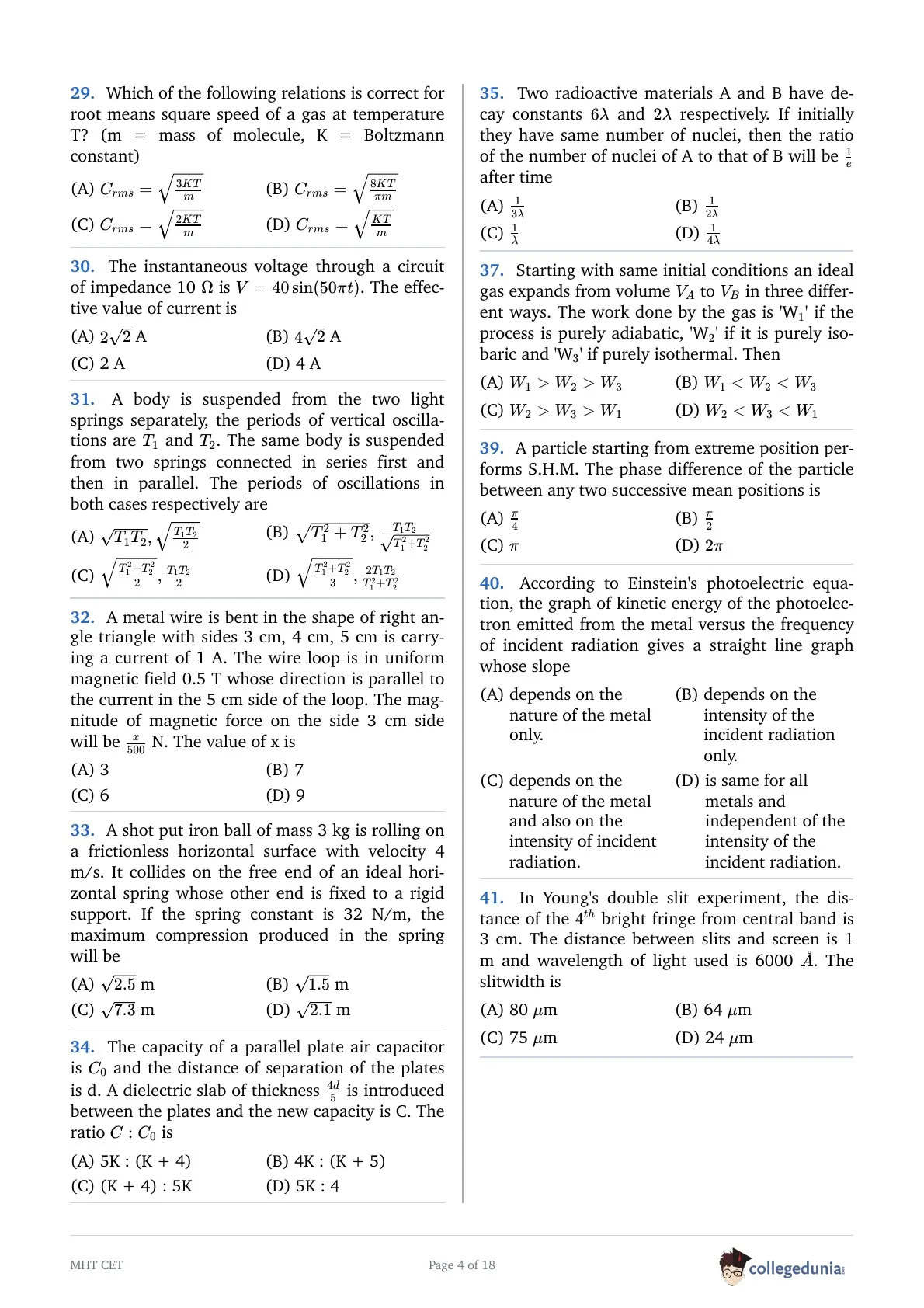
Which of the following relations is correct for root means square speed of a gas at temperature T? (m = mass of molecule, K = Boltzmann constant)
The instantaneous voltage through a circuit of impedance 10 \(\Omega\) is \(V=40\sin(50\pi t)\). The effective value of current is
A body is suspended from the two light springs separately, the periods of vertical oscillations are \(T_1\) and \(T_2\). The same body is suspended from two springs connected in series first and then in parallel. The periods of oscillations in both cases respectively are
A metal wire is bent in the shape of right angle triangle with sides 3 cm, 4 cm, 5 cm is carrying a current of 1 A. The wire loop is in uniform magnetic field 0.5 T whose direction is parallel to the current in the 5 cm side of the loop. The magnitude of magnetic force on the side 3 cm side will be \(\frac{x}{500}\) N. The value of x is
A shot put iron ball of mass 3 kg is rolling on a frictionless horizontal surface with velocity 4 m/s. It collides on the free end of an ideal horizontal spring whose other end is fixed to a rigid support. If the spring constant is 32 N/m, the maximum compression produced in the spring will be
The capacity of a parallel plate air capacitor is \(C_0\) and the distance of separation of the plates is d. A dielectric slab of thickness \(\frac{4d}{5}\) is introduced between the plates and the new capacity is C. The ratio \(C:C_0\) is
Two radioactive materials A and B have decay constants \(6\lambda\) and \(2\lambda\) respectively. If initially they have same number of nuclei, then the ratio of the number of nuclei of A to that of B will be \(\frac{1}{e}\) after time
Starting with same initial conditions an ideal gas expands from volume \(V_A\) to \(V_B\) in three different ways. The work done by the gas is 'W\(_1\)' if the process is purely adiabatic, 'W\(_2\)' if it is purely isobaric and 'W\(_3\)' if purely isothermal. Then
A particle starting from extreme position performs S.H.M. The phase difference of the particle between any two successive mean positions is
According to Einstein's photoelectric equation, the graph of kinetic energy of the photoelectron emitted from the metal versus the frequency of incident radiation gives a straight line graph whose slope
In Young's double slit experiment, the distance of the \(4^{th}\) bright fringe from central band is 3 cm. The distance between slits and screen is 1 m and wavelength of light used is 6000 \(\mathring{A}\). The slitwidth is
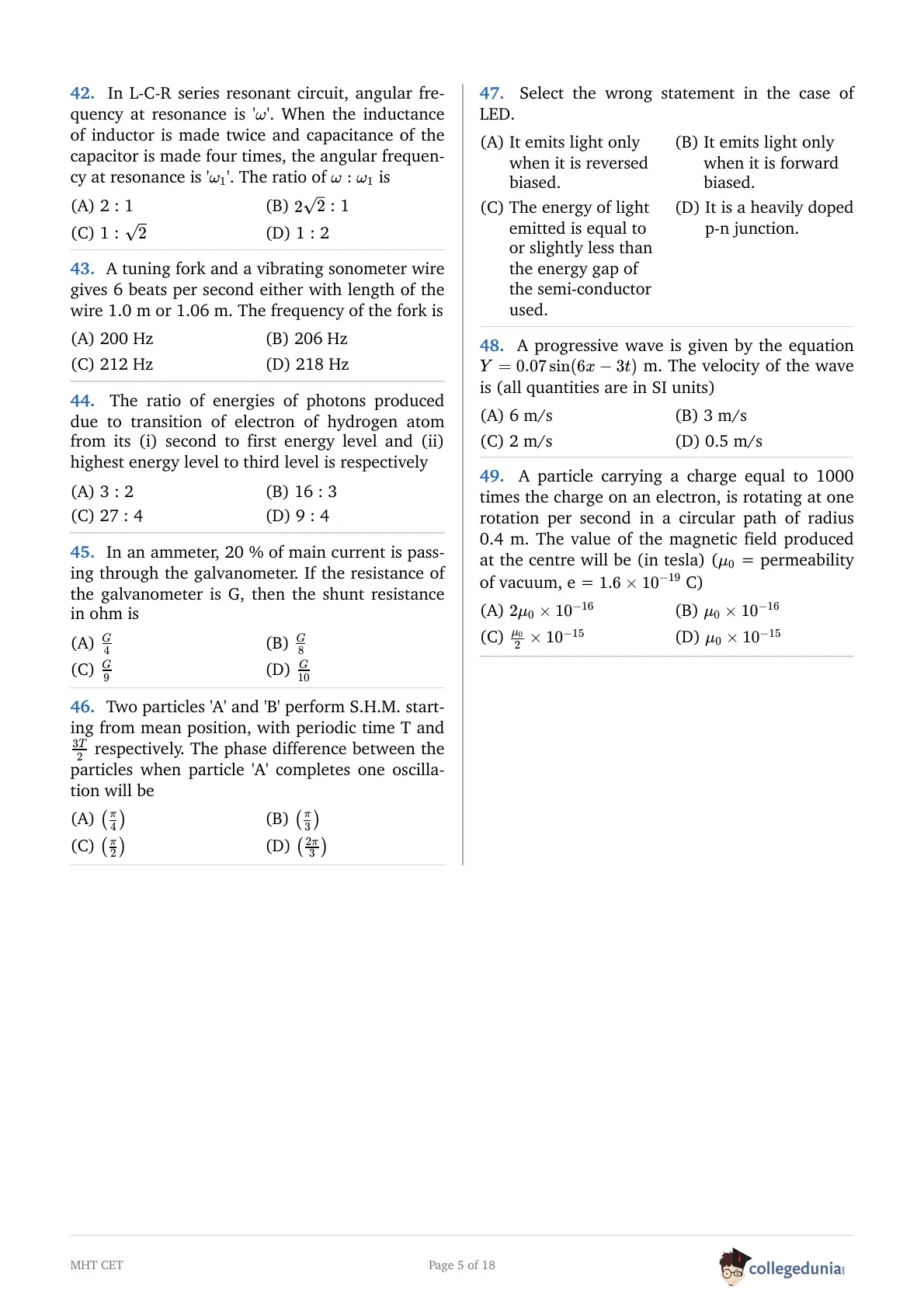
In L-C-R series resonant circuit, angular frequency at resonance is '\(\omega\)'. When the inductance of inductor is made twice and capacitance of the capacitor is made four times, the angular frequency at resonance is '\(\omega_1\)'. The ratio of \(\omega:\omega_1\) is
A tuning fork and a vibrating sonometer wire gives 6 beats per second either with length of the wire 1.0 m or 1.06 m. The frequency of the fork is
The ratio of energies of photons produced due to transition of electron of hydrogen atom from its (i) second to first energy level and (ii) highest energy level to third level is respectively
In an ammeter, 20 % of main current is passing through the galvanometer. If the resistance of the galvanometer is G, then the shunt resistance in ohm is
Two particles 'A' and 'B' perform S.H.M. starting from mean position, with periodic time T and \(\frac{3T}{2}\) respectively. The phase difference between the particles when particle 'A' completes one oscillation will be
Select the wrong statement in the case of LED.
A progressive wave is given by the equation \(Y=0.07\sin(6x-3t)\) m. The velocity of the wave is (all quantities are in SI units)
A particle carrying a charge equal to 1000 times the charge on an electron, is rotating at one rotation per second in a circular path of radius 0.4 m. The value of the magnetic field produced at the centre will be (in tesla) (\(\mu_0\) = permeability of vacuum, e = \(1.6\times10^{-19}\) C)
Chemistry (Q51 - Q99)
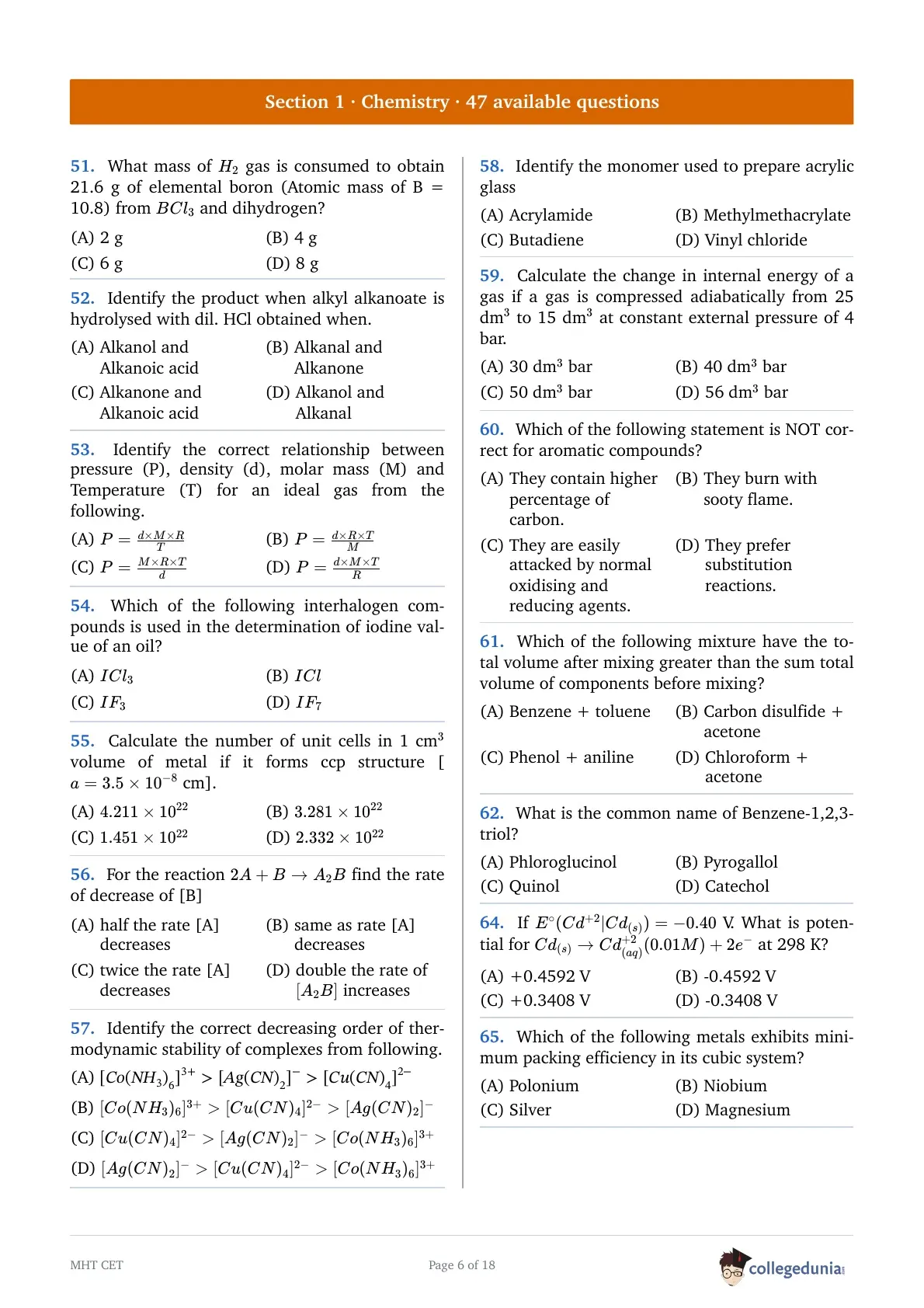
What mass of \(H_2\) gas is consumed to obtain 21.6 g of elemental boron (Atomic mass of B = 10.8) from \(BCl_3\) and dihydrogen?
Identify the correct relationship between pressure (P), density (d), molar mass (M) and Temperature (T) for an ideal gas from the following.
Which of the following interhalogen compounds is used in the determination of iodine value of an oil?
Calculate the number of unit cells in 1 cm\(^3\) volume of metal if it forms ccp structure [\(a = 3.5\times 10^{-8}\) cm].
For the reaction \(2A + B \rightarrow A_2B\) find the rate of decrease of [B]
Identify the correct decreasing order of thermodynamic stability of complexes from following.
Identify the monomer used to prepare acrylic glass
Calculate the change in internal energy of a gas if a gas is compressed adiabatically from 25 dm\(^3\) to 15 dm\(^3\) at constant external pressure of 4 bar.
Which of the following statement is NOT correct for aromatic compounds?
Which of the following mixture have the total volume after mixing greater than the sum total volume of components before mixing?
What is the common name of Benzene-1,2,3-triol?
If \(E^\circ (Cd^{+2}|Cd_{(s)}) = -0.40\) V. What is potential for \(Cd_{(s)} \rightarrow Cd^{+2}_{(aq)}(0.01M) + 2e^{-}\) at 298 K?
Which of the following metals exhibits minimum packing efficiency in its cubic system?
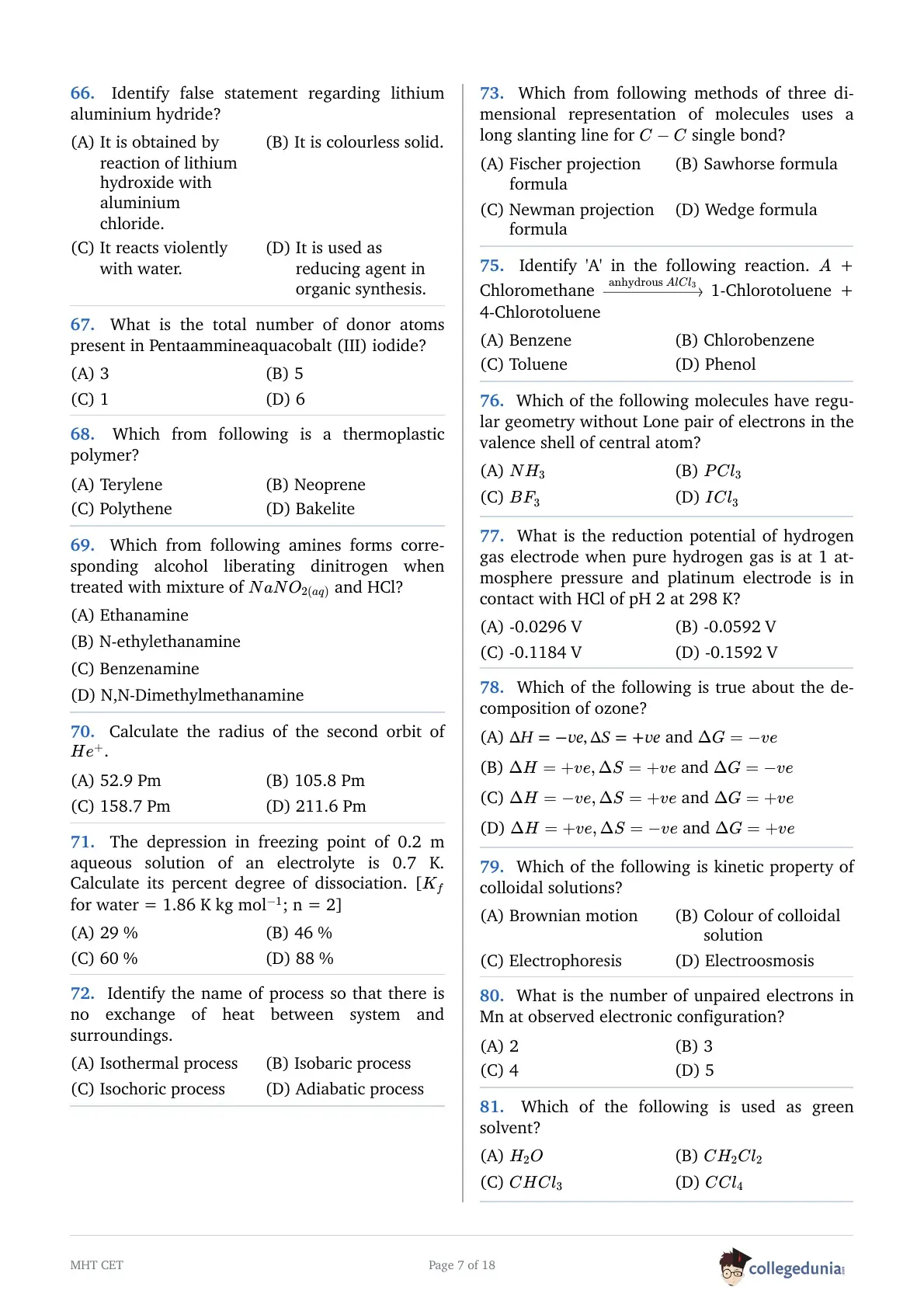
Identify false statement regarding lithium aluminium hydride?
What is the total number of donor atoms present in Pentaammineaquacobalt (III) iodide?
Which from following is a thermoplastic polymer?
Which from following amines forms corresponding alcohol liberating dinitrogen when treated with mixture of \(NaNO_{2(aq)}\) and HCl?
Calculate the radius of the second orbit of \(He^{+}\).
The depression in freezing point of 0.2 m aqueous solution of an electrolyte is 0.7 K. Calculate its percent degree of dissociation. [\(K_f\) for water = 1.86 K kg mol\(^{-1}\); n = 2]
Identify the name of process so that there is no exchange of heat between system and surroundings.
Which from following methods of three dimensional representation of molecules uses a long slanting line for \(C-C\) single bond?
Which of the following molecules have regular geometry without Lone pair of electrons in the valence shell of central atom?
What is the reduction potential of hydrogen gas electrode when pure hydrogen gas is at 1 atmosphere pressure and platinum electrode is in contact with HCl of pH 2 at 298 K?
Which of the following is true about the decomposition of ozone?
Which of the following is kinetic property of colloidal solutions?
What is the number of unpaired electrons in Mn at observed electronic configuration?
Which of the following is used as green solvent?
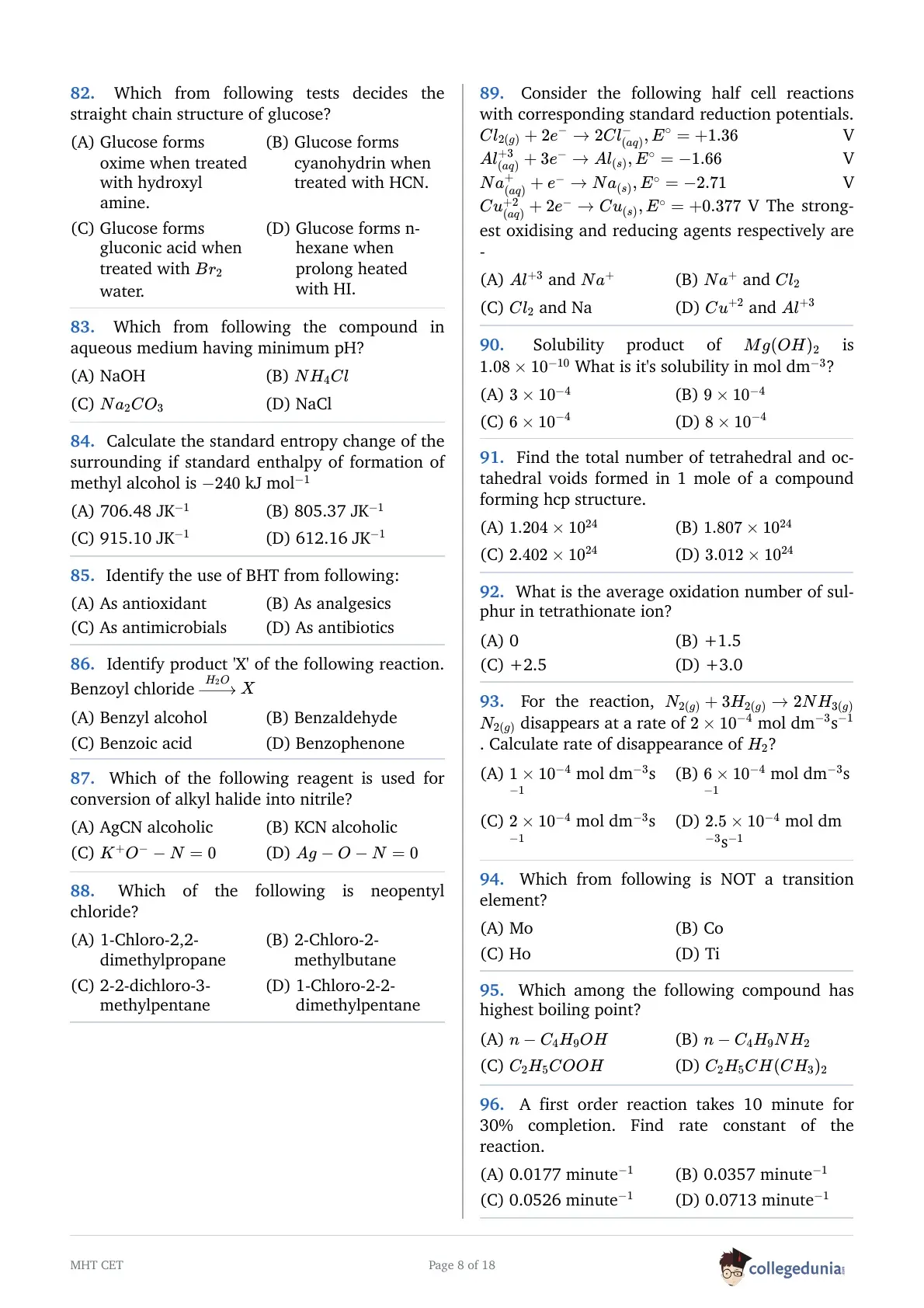
Which from following tests decides the straight chain structure of glucose?
Which from following the compound in aqueous medium having minimum pH?
Calculate the standard entropy change of the surrounding if standard enthalpy of formation of methyl alcohol is \(-240\) kJ mol\(^{-1}\)
Identify the use of BHT from following:
Identify product 'X' of the following reaction. Benzoyl chloride \(\xrightarrow{H_2O}\) \(X\)
Which of the following reagent is used for conversion of alkyl halide into nitrile?
Which of the following is neopentyl chloride?
Consider the following half cell reactions with corresponding standard reduction potentials. \(Cl_{2(g)} + 2e^{-} \rightarrow 2Cl^{-}_{(aq)}, E^{\circ} = +1.36\) V \(Al^{+3}_{(aq)} + 3e^{-} \rightarrow Al_{(s)}, E^{\circ} = -1.66\) V \(Na^{+}_{(aq)} + e^{-} \rightarrow Na_{(s)}, E^{\circ} = -2.71\) V \(Cu^{+2}_{(aq)} + 2e^{-} \rightarrow Cu_{(s)}, E^{\circ} = +0.377\) V The strongest oxidising and reducing agents respectively are -
Solubility product of \(Mg(OH)_2\) is \(1.08\times 10^{-10}\) What is it's solubility in mol dm\(^{-3}\)?
Find the total number of tetrahedral and octahedral voids formed in 1 mole of a compound forming hcp structure.
What is the average oxidation number of sulphur in tetrathionate ion?
For the reaction, \(N_{2(g)} + 3H_{2(g)} \rightarrow 2NH_{3(g)}\) \(N_{2(g)}\) disappears at a rate of \(2\times 10^{-4}\) mol dm\(^{-3}\)s\(^{-1}\). Calculate rate of disappearance of \(H_2\)?
Which from following is NOT a transition element?
Which among the following compound has highest boiling point?
A first order reaction takes 10 minute for 30% completion. Find rate constant of the reaction.
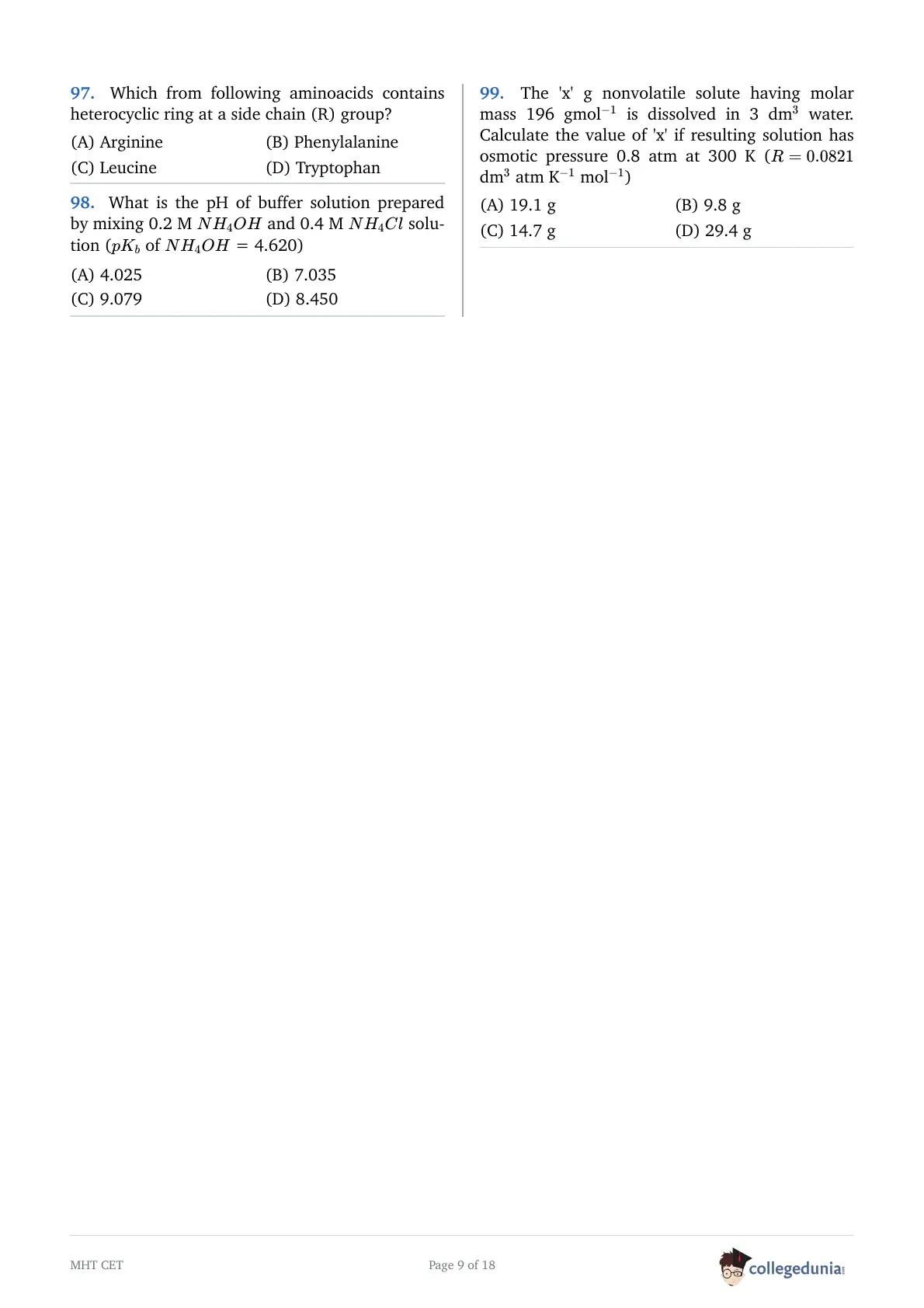
Which from following aminoacids contains heterocyclic ring at a side chain (R) group?
What is the pH of buffer solution prepared by mixing 0.2 M \(NH_4OH\) and 0.4 M \(NH_4Cl\) solution (\(pK_b\) of \(NH_4OH\) = 4.620)
The 'x' g nonvolatile solute having molar mass 196 gmol\(^{-1}\) is dissolved in 3 dm\(^3\) water. Calculate the value of 'x' if resulting solution has osmotic pressure 0.8 atm at 300 K (\(R = 0.0821\) dm\(^3\) atm K\(^{-1}\) mol\(^{-1}\))
Biology (Q101 - Q200)
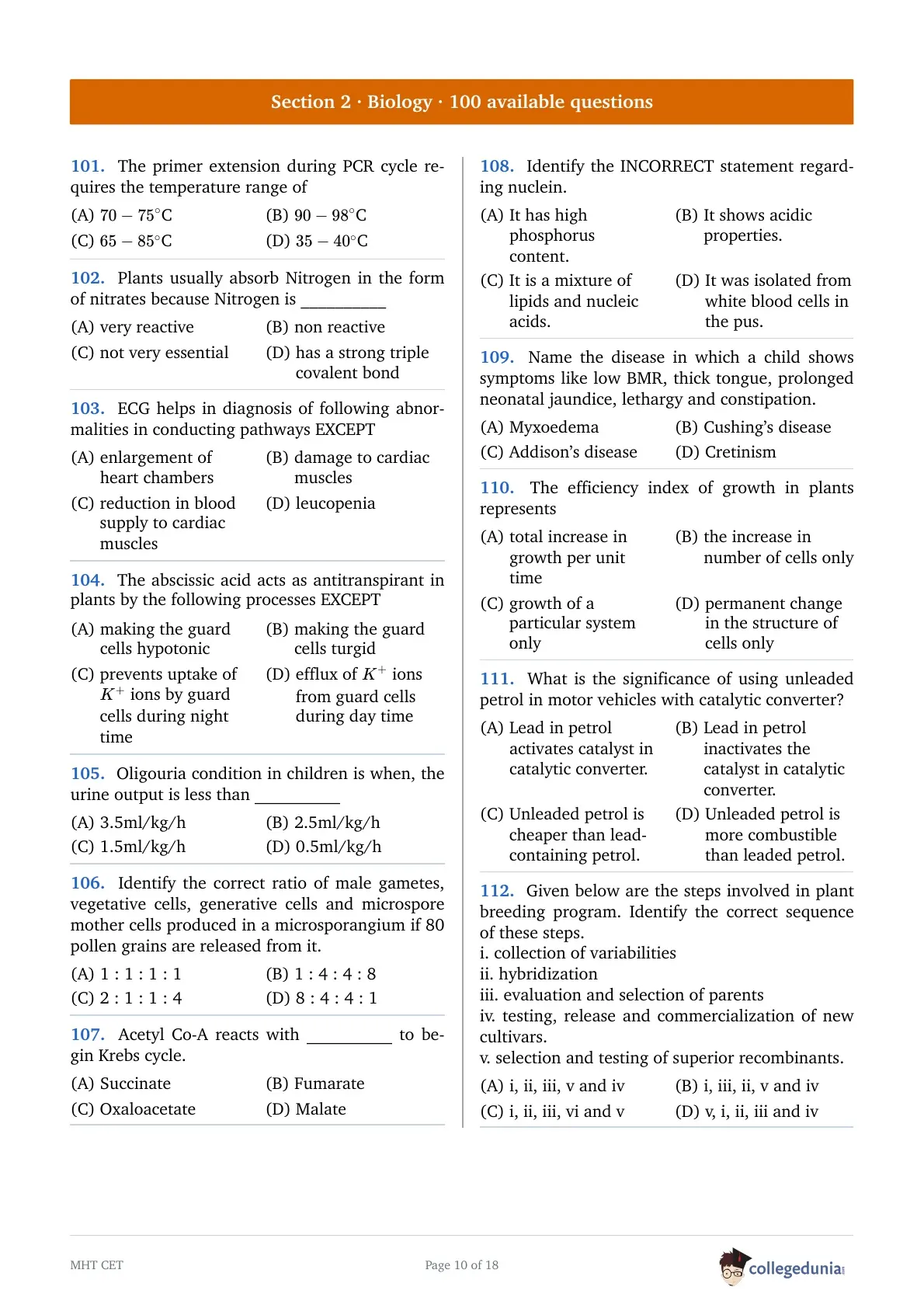
The primer extension during PCR cycle requires the temperature range of
Plants usually absorb Nitrogen in the form of nitrates because Nitrogen is __________
ECG helps in diagnosis of following abnormalities in conducting pathways EXCEPT
The abscissic acid acts as antitranspirant in plants by the following processes EXCEPT
Oligouria condition in children is when, the urine output is less than __________
Identify the correct ratio of male gametes, vegetative cells, generative cells and microspore mother cells produced in a microsporangium if 80 pollen grains are released from it.
Acetyl Co-A reacts with __________ to begin Krebs cycle.
Identify the INCORRECT statement regarding nuclein.
Name the disease in which a child shows symptoms like low BMR, thick tongue, prolonged neonatal jaundice, lethargy and constipation.
The efficiency index of growth in plants represents
What is the significance of using unleaded petrol in motor vehicles with catalytic converter?
Given below are the steps involved in plant breeding program. Identify the correct sequence of these steps.
i. collection of variabilities
ii. hybridization
iii. evaluation and selection of parents
iv. testing, release and commercialization of new cultivars.
v. selection and testing of superior recombinants.
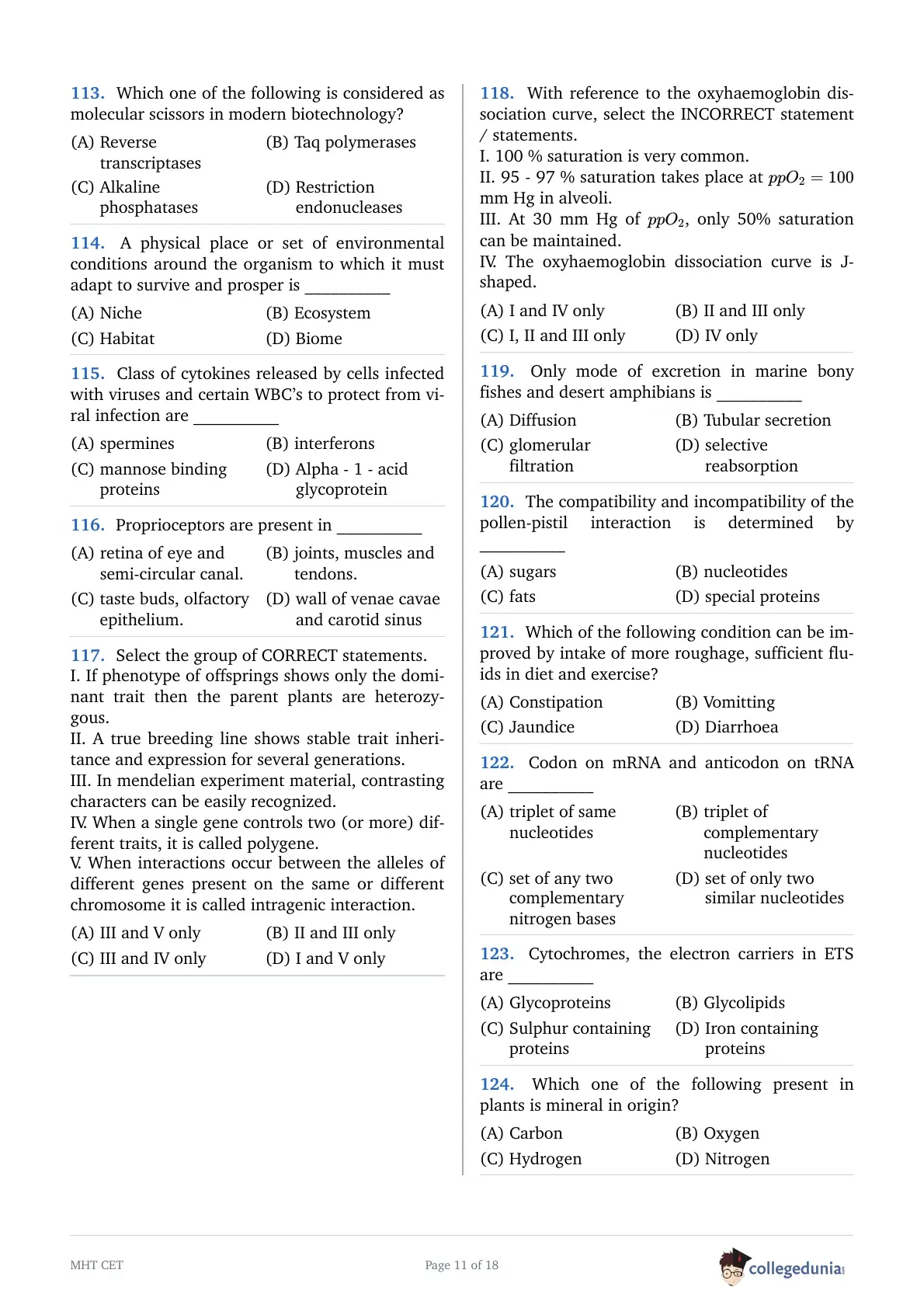
Which one of the following is considered as molecular scissors in modern biotechnology?
A physical place or set of environmental conditions around the organism to which it must adapt to survive and prosper is __________
Class of cytokines released by cells infected with viruses and certain WBC’s to protect from viral infection are __________
Proprioceptors are present in __________
Select the group of CORRECT statements.
I. If phenotype of offsprings shows only the dominant trait then the parent plants are heterozygous.
II. A true breeding line shows stable trait inheritance and expression for several generations.
III. In mendelian experiment material, contrasting characters can be easily recognized.
IV. When a single gene controls two (or more) different traits, it is called polygene.
V. When interactions occur between the alleles of different genes present on the same or different chromosome it is called intragenic interaction.
With reference to the oxyhaemoglobin dissociation curve, select the INCORRECT statement / statements.
I. 100 % saturation is very common.
II. 95 - 97 % saturation takes place at \(ppO_2 = 100\) mm Hg in alveoli.
III. At 30 mm Hg of \(ppO_2\), only 50% saturation can be maintained.
IV. The oxyhaemoglobin dissociation curve is J-shaped.
Only mode of excretion in marine bony fishes and desert amphibians is __________
The compatibility and incompatibility of the pollen-pistil interaction is determined by __________
Which of the following condition can be improved by intake of more roughage, sufficient fluids in diet and exercise?
Codon on mRNA and anticodon on tRNA are __________
Cytochromes, the electron carriers in ETS are __________
Which one of the following present in plants is mineral in origin?
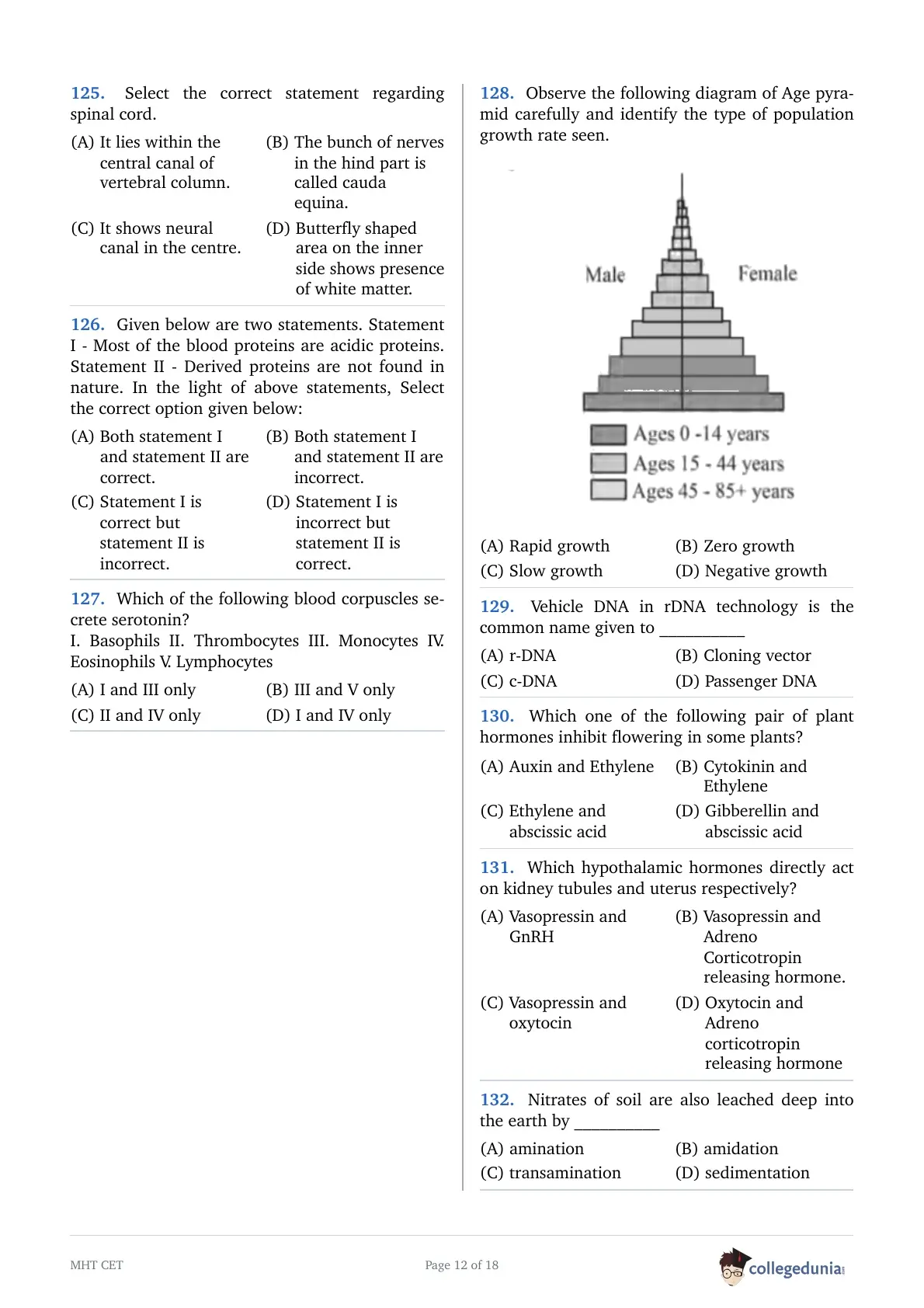
Select the correct statement regarding spinal cord.
Given below are two statements. Statement I - Most of the blood proteins are acidic proteins. Statement II - Derived proteins are not found in nature. In the light of above statements, Select the correct option given below:
Vehicle DNA in rDNA technology is the common name given to __________
Which one of the following pair of plant hormones inhibit flowering in some plants?
Which hypothalamic hormones directly act on kidney tubules and uterus respectively?
Nitrates of soil are also leached deep into the earth by __________
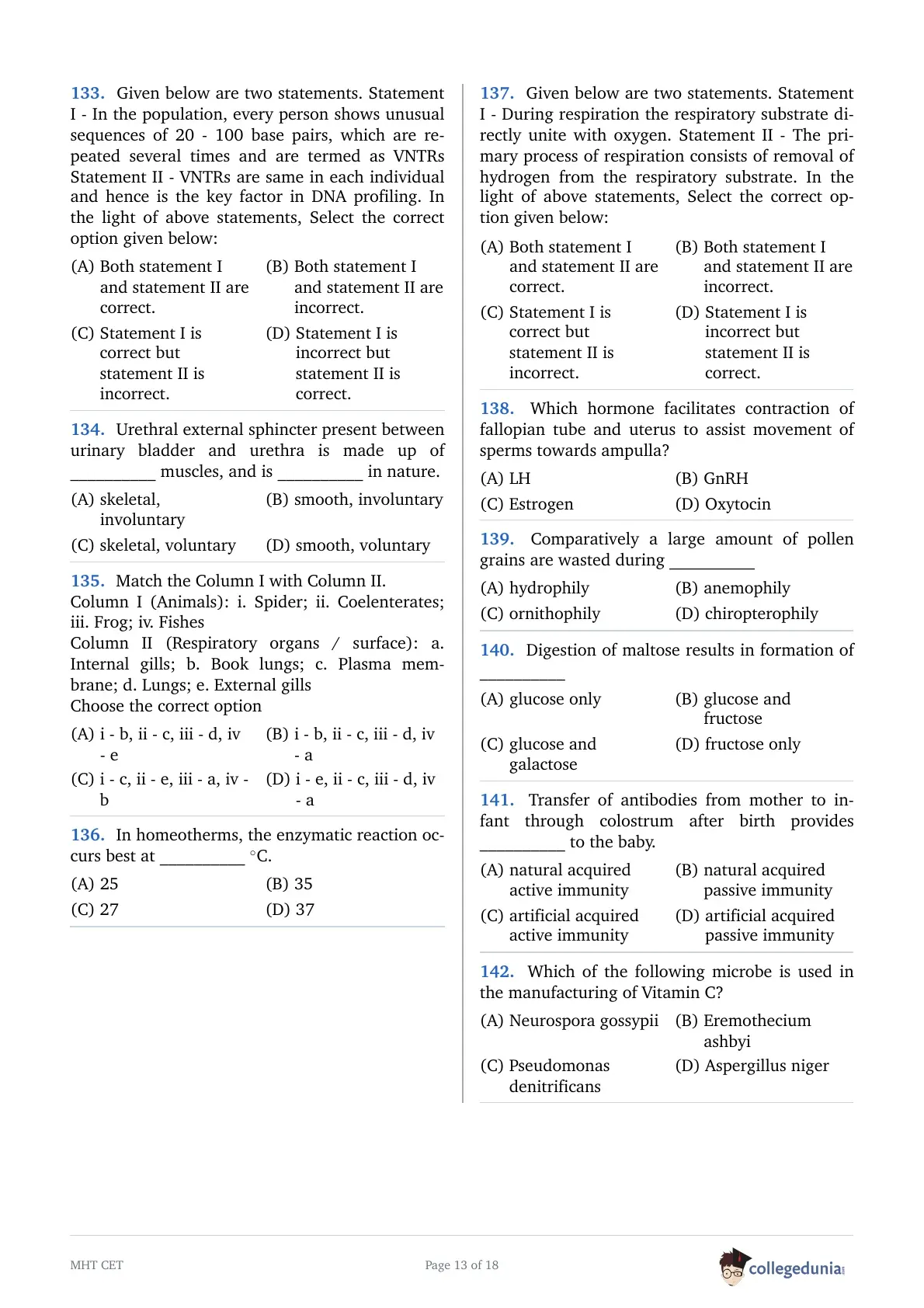
Given below are two statements. Statement I - In the population, every person shows unusual sequences of 20 - 100 base pairs, which are repeated several times and are termed as VNTRs Statement II - VNTRs are same in each individual and hence is the key factor in DNA profiling. In the light of above statements, Select the correct option given below:
Urethral external sphincter present between urinary bladder and urethra is made up of __________ muscles, and is __________ in nature.
Match the Column I with Column II.
Column I (Animals): i. Spider; ii. Coelenterates; iii. Frog; iv. Fishes
Column II (Respiratory organs / surface): a. Internal gills; b. Book lungs; c. Plasma membrane; d. Lungs; e. External gills
Choose the correct option
In homeotherms, the enzymatic reaction occurs best at __________ \(^{\circ}\)C.
Given below are two statements. Statement I - During respiration the respiratory substrate directly unite with oxygen. Statement II - The primary process of respiration consists of removal of hydrogen from the respiratory substrate. In the light of above statements, Select the correct option given below:
Which hormone facilitates contraction of fallopian tube and uterus to assist movement of sperms towards ampulla?
Comparatively a large amount of pollen grains are wasted during __________
Digestion of maltose results in formation of __________
Transfer of antibodies from mother to infant through colostrum after birth provides __________ to the baby.
Which of the following microbe is used in the manufacturing of Vitamin C?
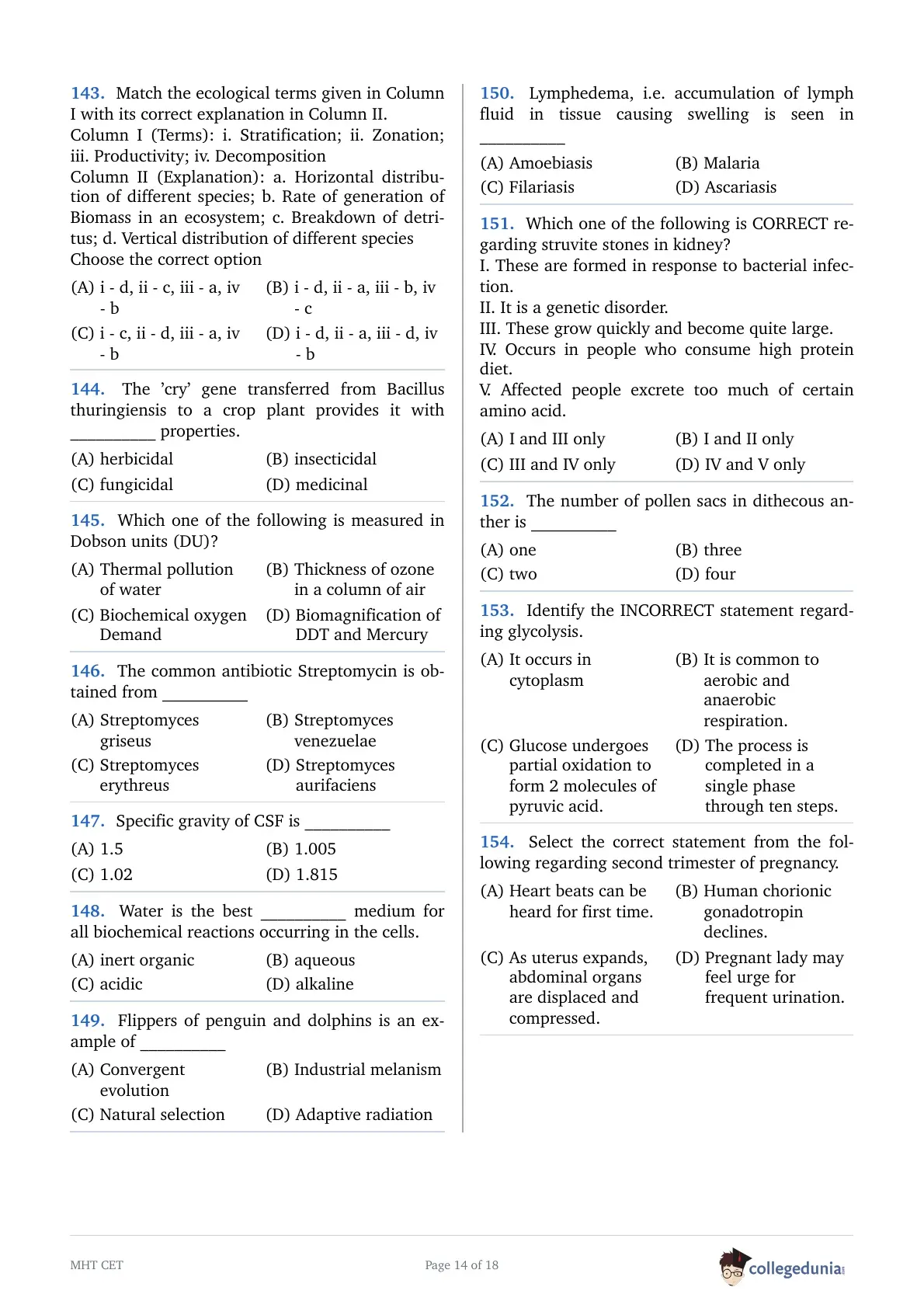
Match the ecological terms given in Column I with its correct explanation in Column II.
Column I (Terms): i. Stratification; ii. Zonation; iii. Productivity; iv. Decomposition
Column II (Explanation): a. Horizontal distribution of different species; b. Rate of generation of Biomass in an ecosystem; c. Breakdown of detritus; d. Vertical distribution of different species
Choose the correct option
The ’cry’ gene transferred from Bacillus thuringiensis to a crop plant provides it with __________ properties.
Which one of the following is measured in Dobson units (DU)?
The common antibiotic Streptomycin is obtained from __________
Specific gravity of CSF is __________
Water is the best __________ medium for all biochemical reactions occurring in the cells.
Flippers of penguin and dolphins is an example of __________
Lymphedema, i.e. accumulation of lymph fluid in tissue causing swelling is seen in __________
Which one of the following is CORRECT regarding struvite stones in kidney?
I. These are formed in response to bacterial infection.
II. It is a genetic disorder.
III. These grow quickly and become quite large.
IV. Occurs in people who consume high protein diet.
V. Affected people excrete too much of certain amino acid.
The number of pollen sacs in dithecous anther is __________
Identify the INCORRECT statement regarding glycolysis.
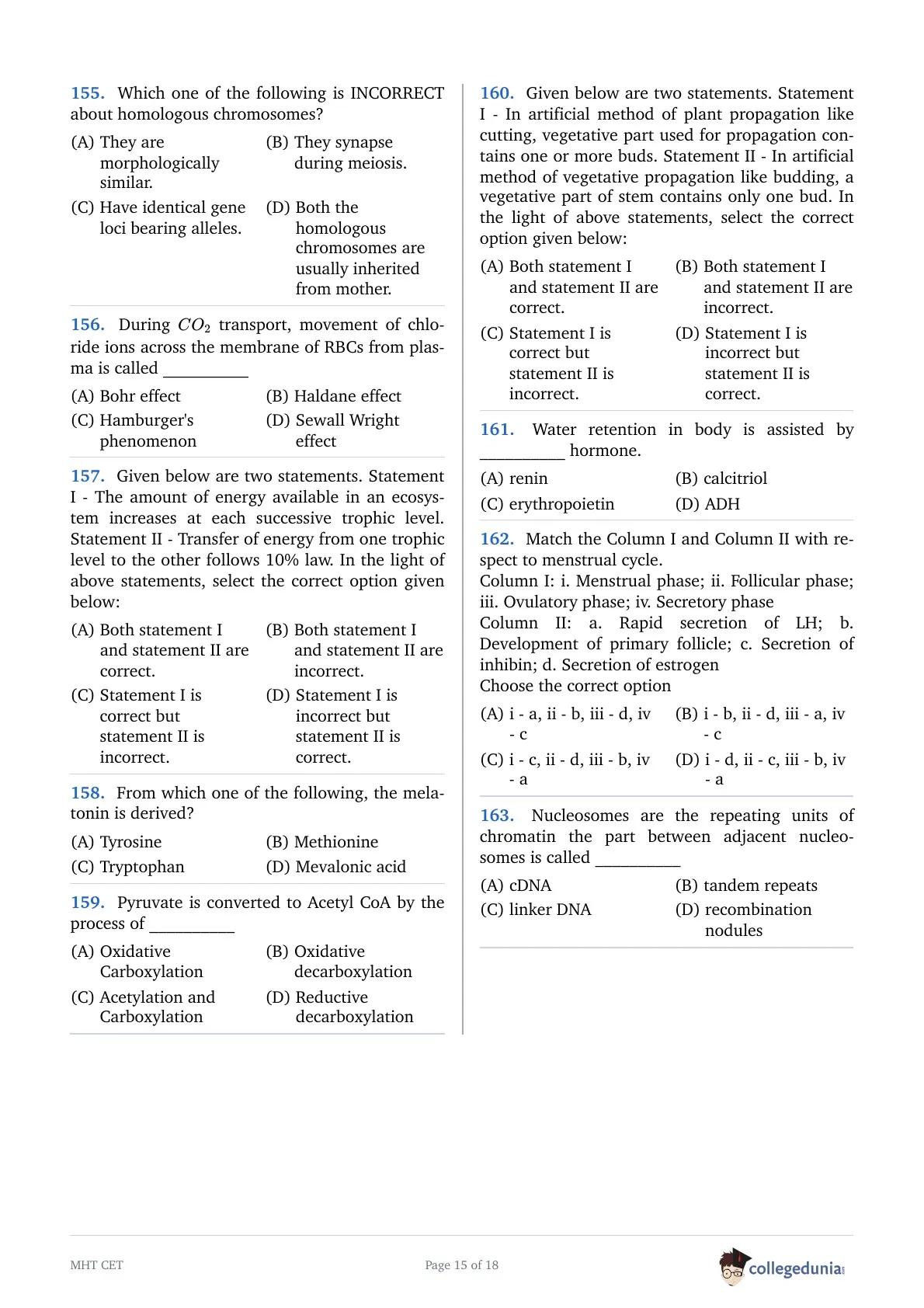
Which one of the following is INCORRECT about homologous chromosomes?
During \(CO_2\) transport, movement of chloride ions across the membrane of RBCs from plasma is called __________
Given below are two statements. Statement I - The amount of energy available in an ecosystem increases at each successive trophic level. Statement II - Transfer of energy from one trophic level to the other follows 10% law. In the light of above statements, select the correct option given below:
From which one of the following, the melatonin is derived?
Pyruvate is converted to Acetyl CoA by the process of __________
Given below are two statements. Statement I - In artificial method of plant propagation like cutting, vegetative part used for propagation contains one or more buds. Statement II - In artificial method of vegetative propagation like budding, a vegetative part of stem contains only one bud. In the light of above statements, select the correct option given below:
Water retention in body is assisted by __________ hormone.
Match the Column I and Column II with respect to menstrual cycle.
Column I: i. Menstrual phase; ii. Follicular phase; iii. Ovulatory phase; iv. Secretory phase
Column II: a. Rapid secretion of LH; b. Development of primary follicle; c. Secretion of inhibin; d. Secretion of estrogen
Choose the correct option
Nucleosomes are the repeating units of chromatin the part between adjacent nucleosomes is called __________
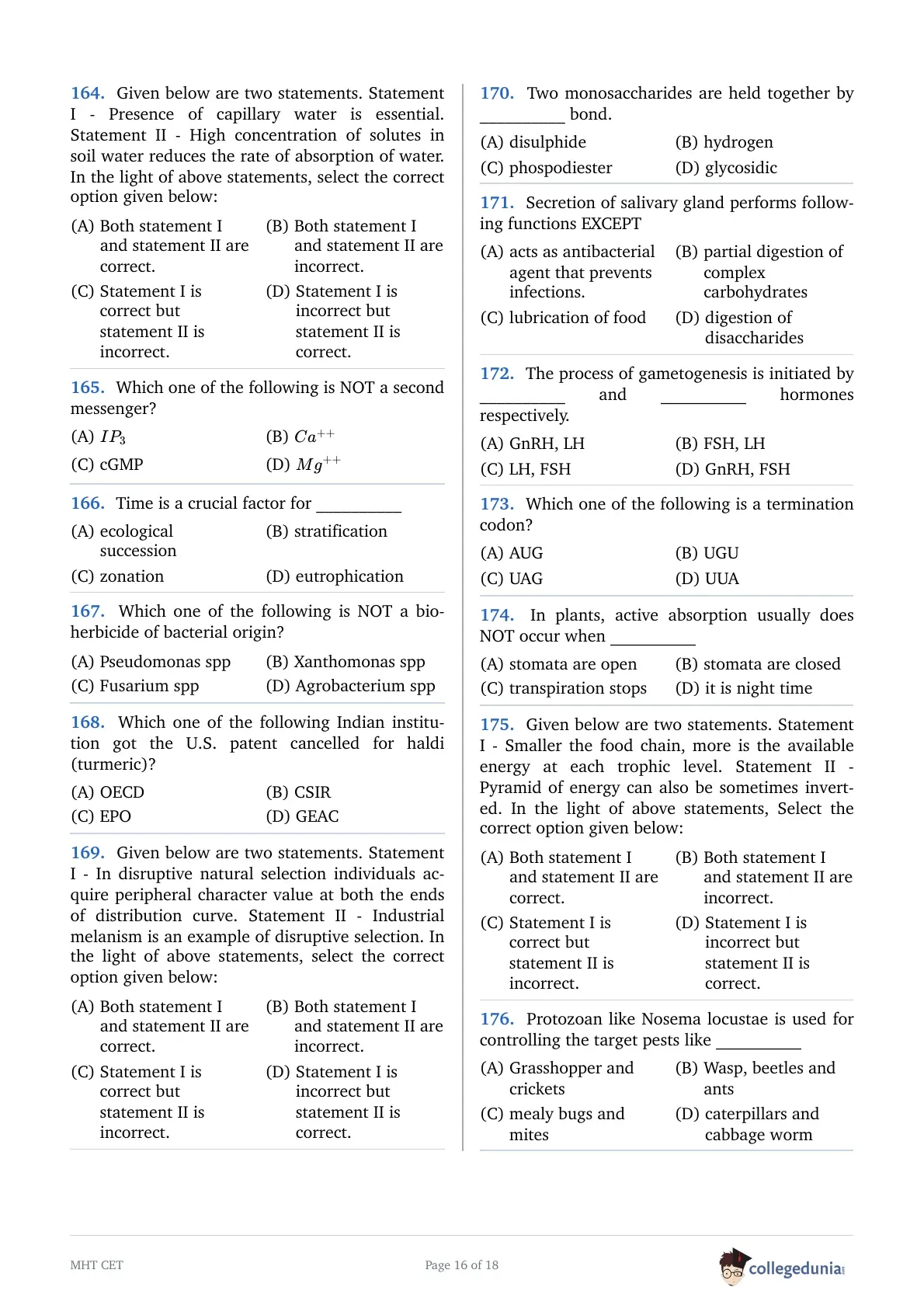
Given below are two statements. Statement I - Presence of capillary water is essential. Statement II - High concentration of solutes in soil water reduces the rate of absorption of water. In the light of above statements, select the correct option given below:
Which one of the following is NOT a second messenger?
Time is a crucial factor for __________
Which one of the following is NOT a bioherbicide of bacterial origin?
Which one of the following Indian institution got the U.S. patent cancelled for haldi (turmeric)?
Given below are two statements. Statement I - In disruptive natural selection individuals acquire peripheral character value at both the ends of distribution curve. Statement II - Industrial melanism is an example of disruptive selection. In the light of above statements, select the correct option given below:
Two monosaccharides are held together by __________ bond.
Secretion of salivary gland performs following functions EXCEPT
The process of gametogenesis is initiated by __________ and __________ hormones respectively.
Which one of the following is a termination codon?
In plants, active absorption usually does NOT occur when __________
Given below are two statements. Statement I - Smaller the food chain, more is the available energy at each trophic level. Statement II - Pyramid of energy can also be sometimes inverted. In the light of above statements, Select the correct option given below:
Protozoan like Nosema locustae is used for controlling the target pests like __________
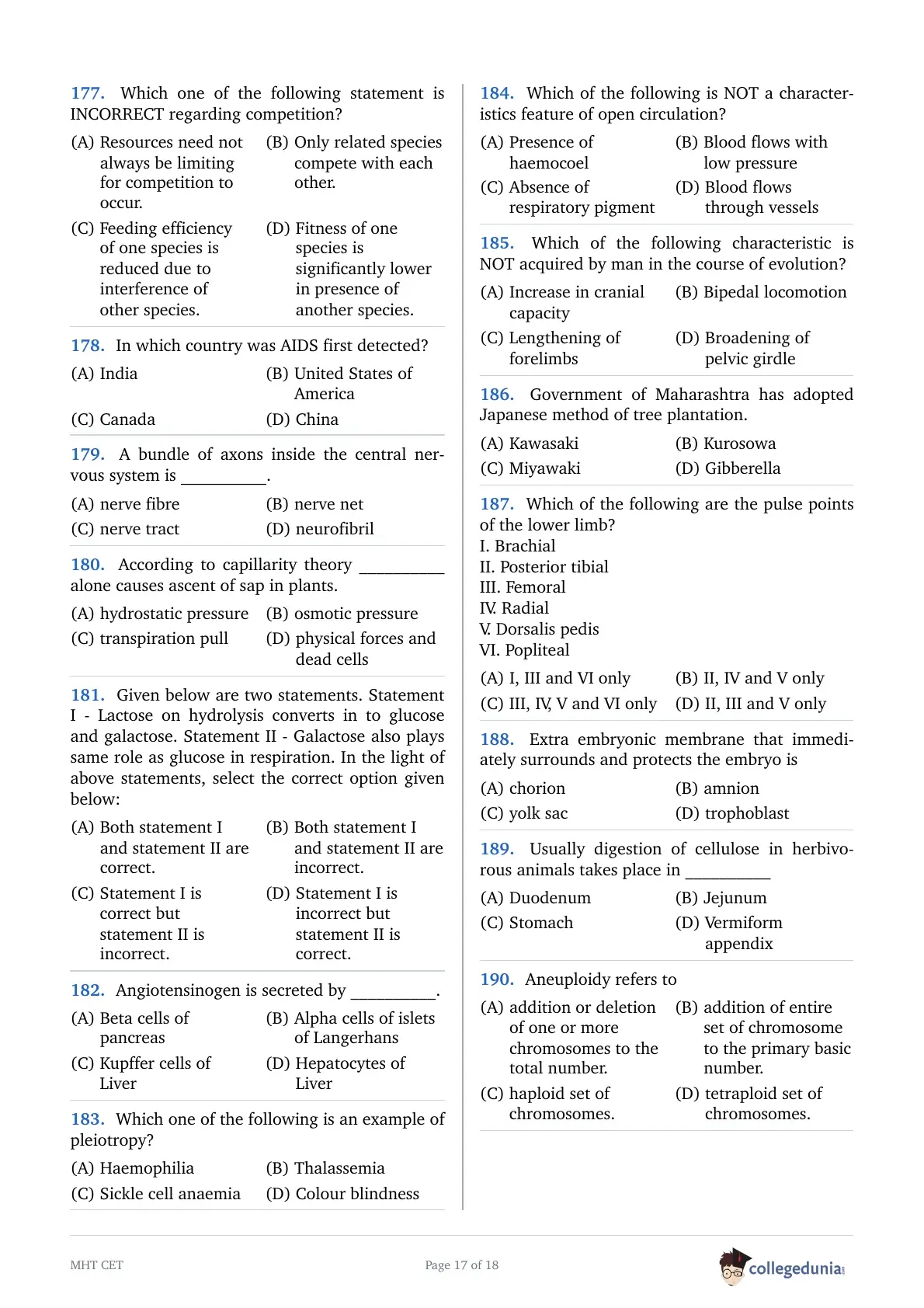
Which one of the following statement is INCORRECT regarding competition?
In which country was AIDS first detected?
A bundle of axons inside the central nervous system is __________.
According to capillarity theory __________ alone causes ascent of sap in plants.
Given below are two statements. Statement I - Lactose on hydrolysis converts in to glucose and galactose. Statement II - Galactose also plays same role as glucose in respiration. In the light of above statements, select the correct option given below:
Angiotensinogen is secreted by __________.
Which one of the following is an example of pleiotropy?
Which of the following is NOT a characteristics feature of open circulation?
Which of the following characteristic is NOT acquired by man in the course of evolution?
Government of Maharashtra has adopted Japanese method of tree plantation.
Extra embryonic membrane that immediately surrounds and protects the embryo is
Usually digestion of cellulose in herbivorous animals takes place in __________
Aneuploidy refers to
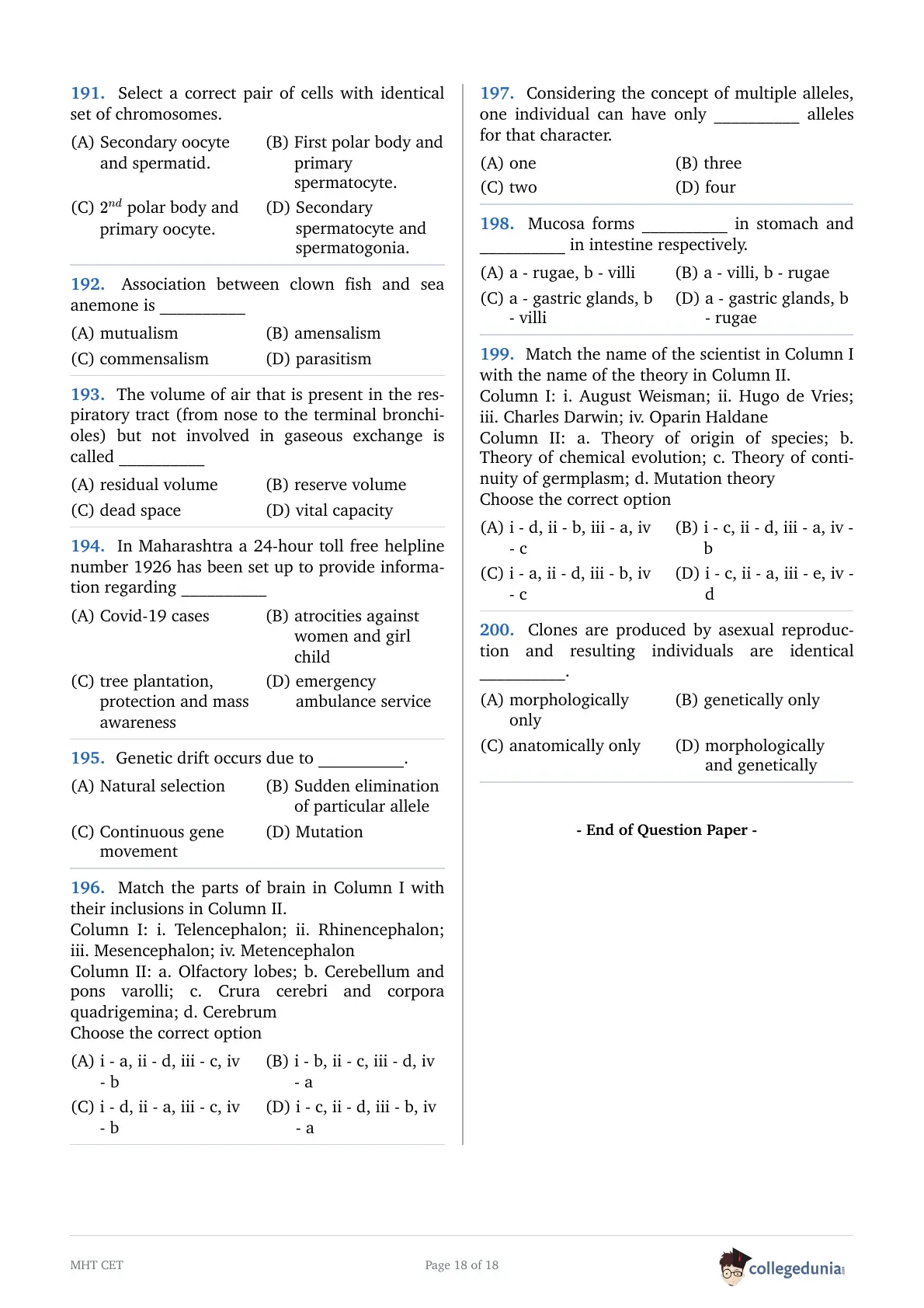
Select a correct pair of cells with identical set of chromosomes.
Association between clown fish and sea anemone is __________
The volume of air that is present in the respiratory tract (from nose to the terminal bronchioles) but not involved in gaseous exchange is called __________
In Maharashtra a 24-hour toll free helpline number 1926 has been set up to provide information regarding __________
Genetic drift occurs due to __________.
Match the parts of brain in Column I with their inclusions in Column II.
Column I: i. Telencephalon; ii. Rhinencephalon; iii. Mesencephalon; iv. Metencephalon
Column II: a. Olfactory lobes; b. Cerebellum and pons varolli; c. Crura cerebri and corpora quadrigemina; d. Cerebrum
Choose the correct option
Considering the concept of multiple alleles, one individual can have only __________ alleles for that character.
Mucosa forms __________ in stomach and __________ in intestine respectively.
Clones are produced by asexual reproduction and resulting individuals are identical __________.
MHT CET 2025 PCB Exam Pattern and Marking Scheme
| Parameter | Details |
|---|---|
| Conducting Body | Maharashtra Common Entrance Test Cell (Maharashtra CET Cell) |
| Exam Mode | Online (Computer-Based Test) |
| Duration | 180 minutes (3 hours) |
| Groups / Subjects | PCB (Physics, Chemistry, Biology) for Pharmacy and Agriculture |
| Total Questions |
200 |
| Total Marks | 200 |
| Question Type | Multiple Choice Questions (MCQs) |
| Marking Scheme | 1 mark for each correct answer |
| Negative Marking | No |
| Syllabus Weightage |
|



Comments