




MHT CET 2025 April 25 Shift 1 PCM Question Paper is available for download here. Maharashtra State CET Cell conducted MHT CET 2025 PCM Exam on April 25 in Shift 1 from 9 AM to 12 PM in CBT mode.
The MHT CET 2025 PCM question paper includes the following:
- The MHT CET 2025 PCM Question Paper consists of 150 multiple-choice questions (MCQs) totalling 200 marks divided into 3 sections: Physics, Chemistry, and Mathematics, with 50 questions in each subject.
- Physics and Chemistry questions carry 1 mark each while Mathematics questions carry 2 marks each.
- There is no negative marking for incorrect answers.
MHT CET 2025 April 25 Shift 1 PCM Question Paper with Solution PDF
| CD PDF | CD PDF with Solutions |
|---|---|
| Download Collegedunia PDF 0.85 MB | - |
Also Check:
MHT CET 2025 April 25 Shift 1 PCM Questions with Solutions
Physics (Q1 - Q50)
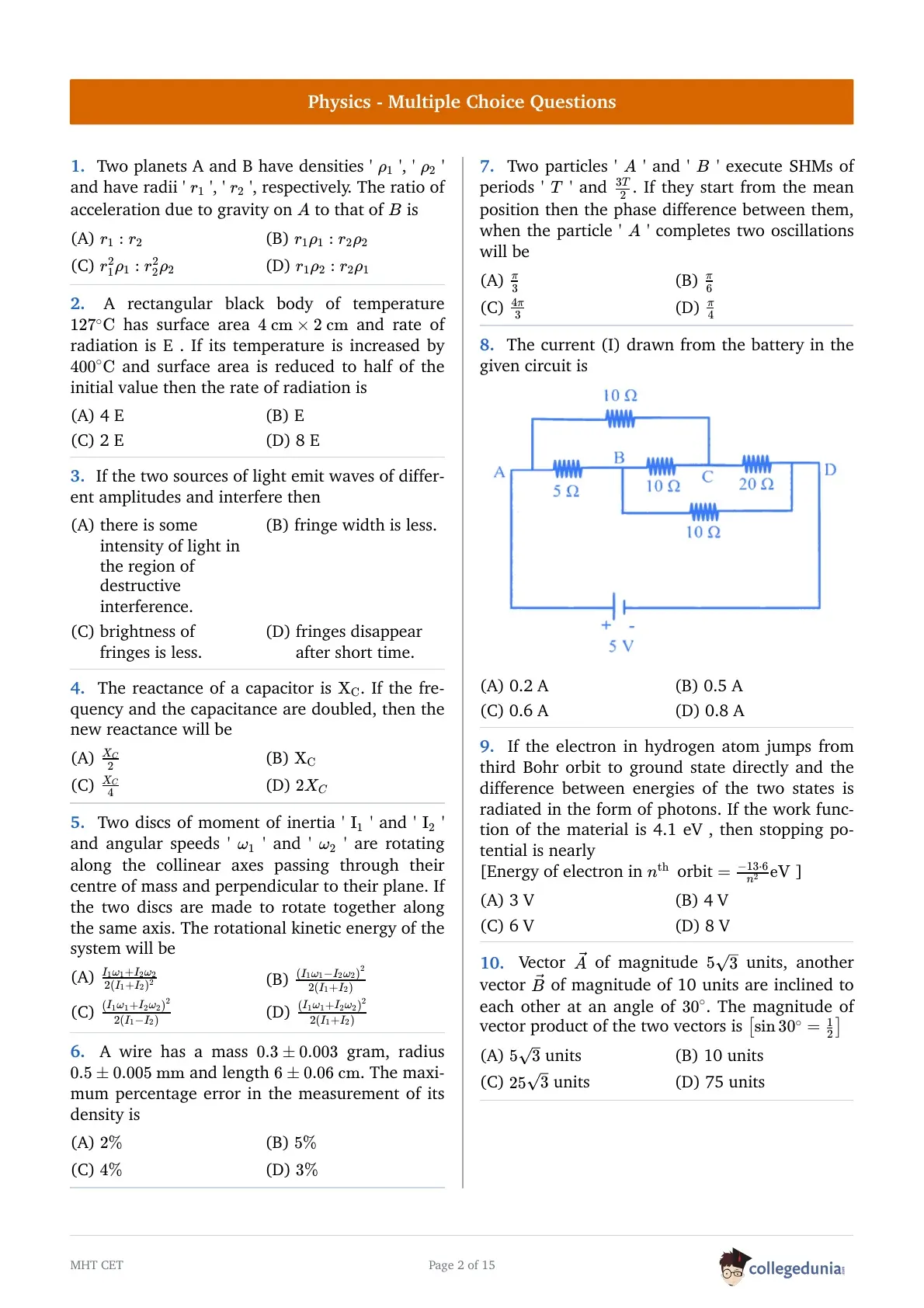
Two planets A and B have densities ' \(\rho_1\) ', ' \(\rho_2\) ' and have radii ' \(r_1\) ', ' \(r_2\) ', respectively. The ratio of acceleration due to gravity on \(A\) to that of \(B\) is
A rectangular black body of temperature \(127^{\circ} \mathrm{C}\) has surface area \(4 \mathrm{~cm} \times 2 \mathrm{~cm}\) and rate of radiation is E . If its temperature is increased by \(400^{\circ} \mathrm{C}\) and surface area is reduced to half of the initial value then the rate of radiation is
If the two sources of light emit waves of different amplitudes and interfere then
The reactance of a capacitor is \(\mathrm{X}_{\mathrm{C}}\). If the frequency and the capacitance are doubled, then the new reactance will be
Two discs of moment of inertia ' \(\mathrm{I}_1\) ' and ' \(\mathrm{I}_2\) ' and angular speeds ' \(\omega_1\) ' and ' \(\omega_2\) ' are rotating along the collinear axes passing through their centre of mass and perpendicular to their plane. If the two discs are made to rotate together along the same axis. The rotational kinetic energy of the system will be
A wire has a mass \(0.3 \pm 0.003\) gram, radius \(0.5 \pm 0.005 \mathrm{~mm}\) and length \(6 \pm 0.06 \mathrm{~cm}\). The maximum percentage error in the measurement of its density is
Two particles ' \(A\) ' and ' \(B\) ' execute SHMs of periods ' \(T\) ' and \(\frac{3 T}{2}\). If they start from the mean position then the phase difference between them, when the particle ' \(A\) ' completes two oscillations will be

If the electron in hydrogen atom jumps from third Bohr orbit to ground state directly and the difference between energies of the two states is radiated in the form of photons. If the work function of the material is 4.1 eV , then stopping potential is nearly
[Energy of electron in \(n^{\text {th }}\) orbit \(=\frac{-13 \cdot 6}{n^2} \mathrm{eV}\) ]
Vector \(\vec{A}\) of magnitude \(5 \sqrt{3}\) units, another vector \(\vec{B}\) of magnitude of 10 units are inclined to each other at an angle of \(30^{\circ}\). The magnitude of vector product of the two vectors is \(\left[\sin 30^{\circ}=\frac{1}{2}\right]\)
The magnetic field intensity H at the centre of a long solenoid having \(n\) turns per unit length and carrying a current I, when no material is kept in it is ( \(\mu_0=\) permeability of free space)
Four particles each of mass M are placed at the corners of a square of side L . The radius of gyration of the system about an axis perpendicular to the square and passing through its centre is
In Fraunhofer diffraction pattern, slit width is 0.3 mm and screen is at 1.5 m away from the lens. If wavelength of light used is \(4500 \mathop {\rm{A}}\limits^{\rm{o}}\), then the distance between the first minimum on either side of the central maximum is [ \(\theta\) is small and measured in radian.]
Two boys are standing at points A and B on ground, where distance \(\mathrm{AB}=\mathrm{x}\). The boy at B stars running perpendicular to \(A B\) with velocity \(\mathrm{v}_1\). The boy at A starts running simultaneously with velocity v and meets the other boy in time \(t\). The value of \(t\) is
The temperature of an ideal gas is increased from 100 K to 400 K . If ' \(x\) ' is the root mean square velocity of its molecules at 100 K , r.m.s. velocity becomes
Current \(I\) is carried in a wire of length ' \(L\) '. If wire is bent into a circular coil of single turn, the maximum torque in a given magnetic field \(B\) is

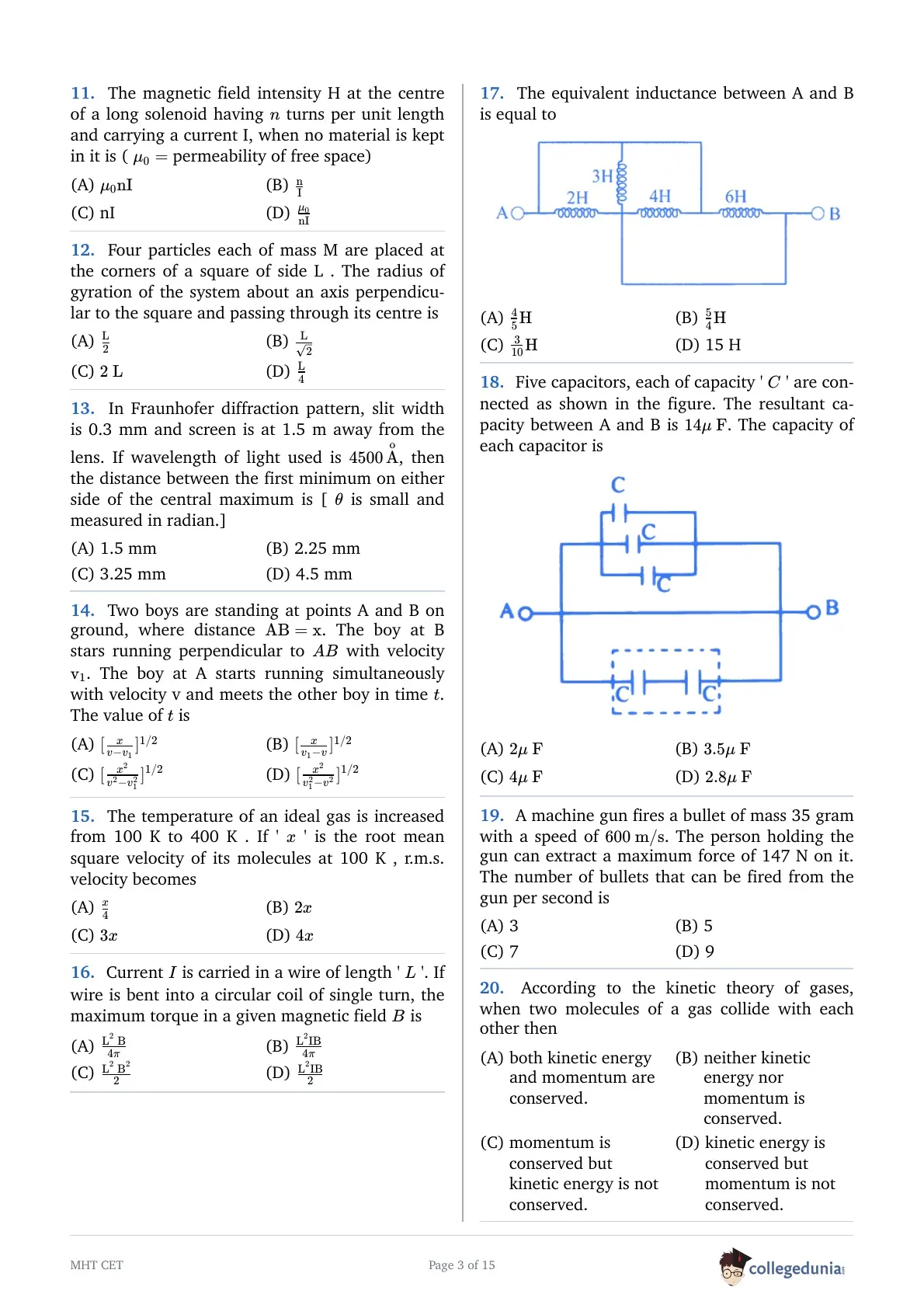
Five capacitors, each of capacity ' \(C\) ' are connected as shown in the figure. The resultant capacity between A and B is \(14 \mu \mathrm{~F}\). The capacity of each capacitor is

A machine gun fires a bullet of mass 35 gram with a speed of \(600 \mathrm{~m} / \mathrm{s}\). The person holding the gun can extract a maximum force of 147 N on it. The number of bullets that can be fired from the gun per second is
According to the kinetic theory of gases, when two molecules of a gas collide with each other then
An a. c. voltage is applied to pure inductor. The current in the inductor
During the isothermal expansion, a confined ideal gas does \((-150) \mathrm{J}\) of work against its surroundings. This means that
A single slit diffraction pattern is formed with light of wavelength \(6384 \mathop {\rm{A}}\limits^{\rm{o}}\). The second secondary maximum for this wavelength coincides with the third secondary maximum in the pattern for light of wavelength ' \(\lambda_0\) '. The value of ' \(\lambda_0\) ' is
When a metal surface is illuminated by light of wavelength \(\lambda_1\) and \(\lambda_2\), the maximum velocities of photoelectrons ejected are V and 2 V respectively. The work function of the metal is ( \(\mathrm{h}=\) Planck's constant, \(\mathrm{c}=\) velocity of light, \(\lambda_1>\lambda_2\) )
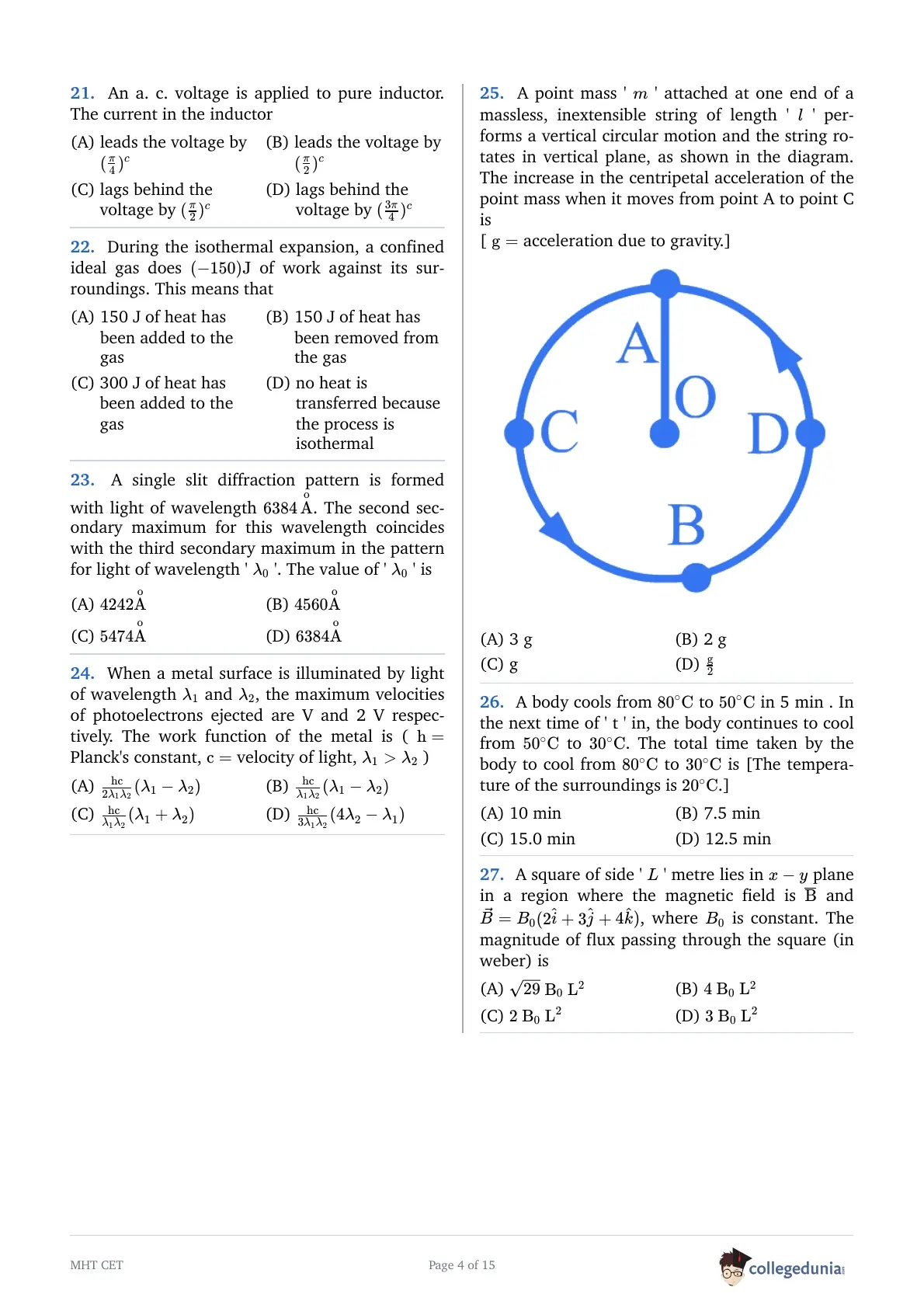
A point mass ' \(m\) ' attached at one end of a massless, inextensible string of length ' \(l\) ' performs a vertical circular motion and the string rotates in vertical plane, as shown in the diagram. The increase in the centripetal acceleration of the point mass when it moves from point A to point C is
[ \(\mathrm{g}=\) acceleration due to gravity.]

A body cools from \(80^{\circ} \mathrm{C}\) to \(50^{\circ} \mathrm{C}\) in 5 min . In the next time of ' t ' in, the body continues to cool from \(50^{\circ} \mathrm{C}\) to \(30^{\circ} \mathrm{C}\). The total time taken by the body to cool from \(80^{\circ} \mathrm{C}\) to \(30^{\circ} \mathrm{C}\) is [The temperature of the surroundings is \(20^{\circ} \mathrm{C}\).]
A square of side ' \(L\) ' metre lies in \(x-y\) plane in a region where the magnetic field is \(\overline{\mathrm{B}}\) and \(\vec{B}=B_0(2 \hat{i}+3 \hat{j}+4 \hat{k})\), where \(B_0\) is constant. The magnitude of flux passing through the square (in weber) is
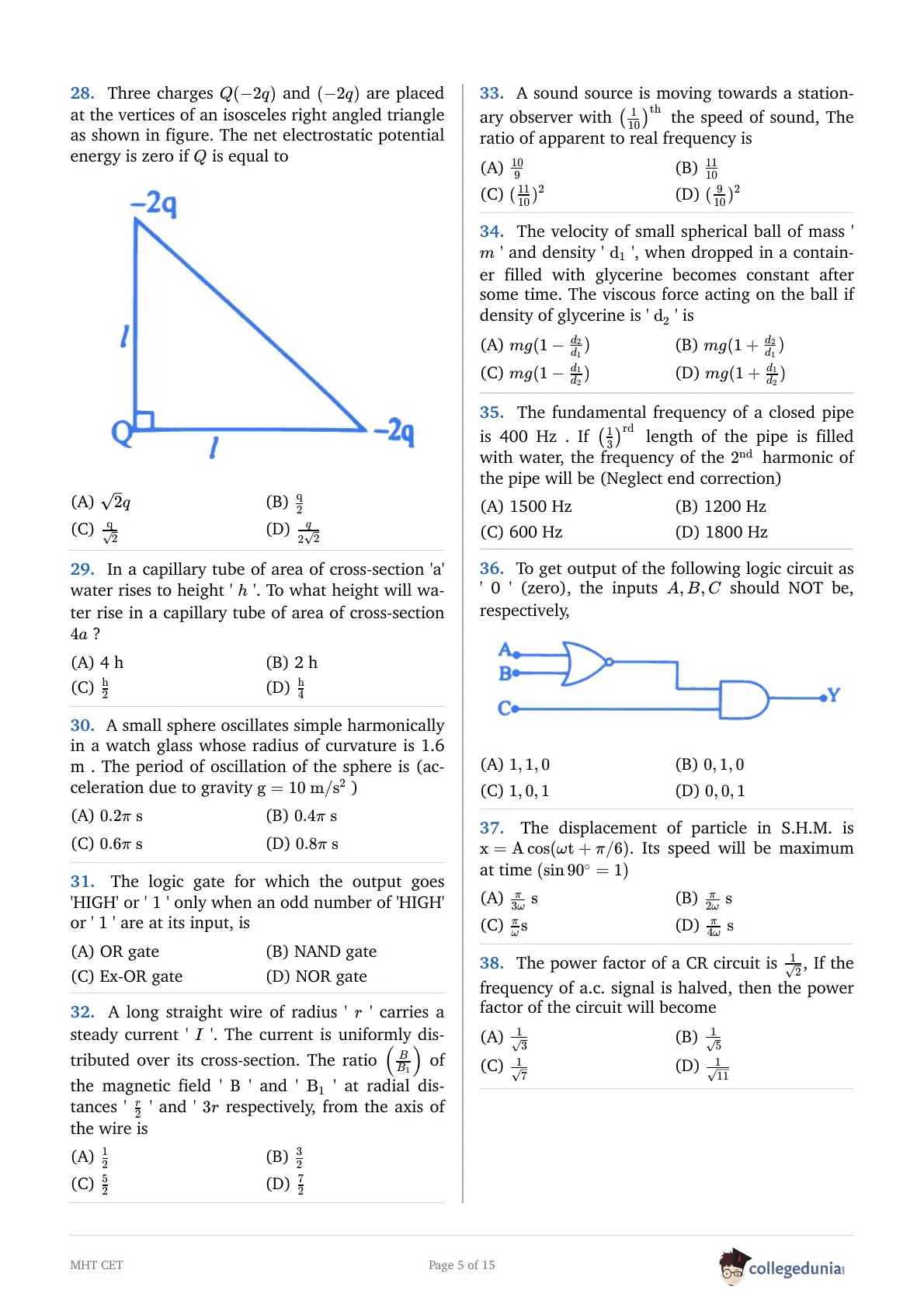
Three charges \(Q(-2 q)\) and \((-2 q)\) are placed at the vertices of an isosceles right angled triangle as shown in figure. The net electrostatic potential energy is zero if \(Q\) is equal to

In a capillary tube of area of cross-section 'a' water rises to height ' \(h\) '. To what height will water rise in a capillary tube of area of cross-section \(4 a\) ?
A small sphere oscillates simple harmonically in a watch glass whose radius of curvature is 1.6 m . The period of oscillation of the sphere is (acceleration due to gravity \(\mathrm{g}=10 \mathrm{~m} / \mathrm{s}^2\) )
The logic gate for which the output goes 'HIGH' or ' 1 ' only when an odd number of 'HIGH' or ' 1 ' are at its input, is
A long straight wire of radius ' \(r\) ' carries a steady current ' \(I\) '. The current is uniformly distributed over its cross-section. The ratio \(\left(\frac{B}{B_1}\right)\) of the magnetic field ' B ' and ' \(\mathrm{B}_1\) ' at radial distances ' \(\frac{r}{2}\) ' and ' \(3 r\) respectively, from the axis of the wire is
A sound source is moving towards a stationary observer with \(\left(\frac{1}{10}\right)^{\text {th }}\) the speed of sound, The ratio of apparent to real frequency is
The velocity of small spherical ball of mass ' \(m\) ' and density ' \(\mathrm{d}_1\) ', when dropped in a container filled with glycerine becomes constant after some time. The viscous force acting on the ball if density of glycerine is ' \(\mathrm{d}_2\) ' is
The fundamental frequency of a closed pipe is 400 Hz . If \(\left(\frac{1}{3}\right)^{\text {rd }}\) length of the pipe is filled with water, the frequency of the \(2^{\text {nd }}\) harmonic of the pipe will be (Neglect end correction)
To get output of the following logic circuit as ' 0 ' (zero), the inputs \(A, B, C\) should NOT be, respectively,

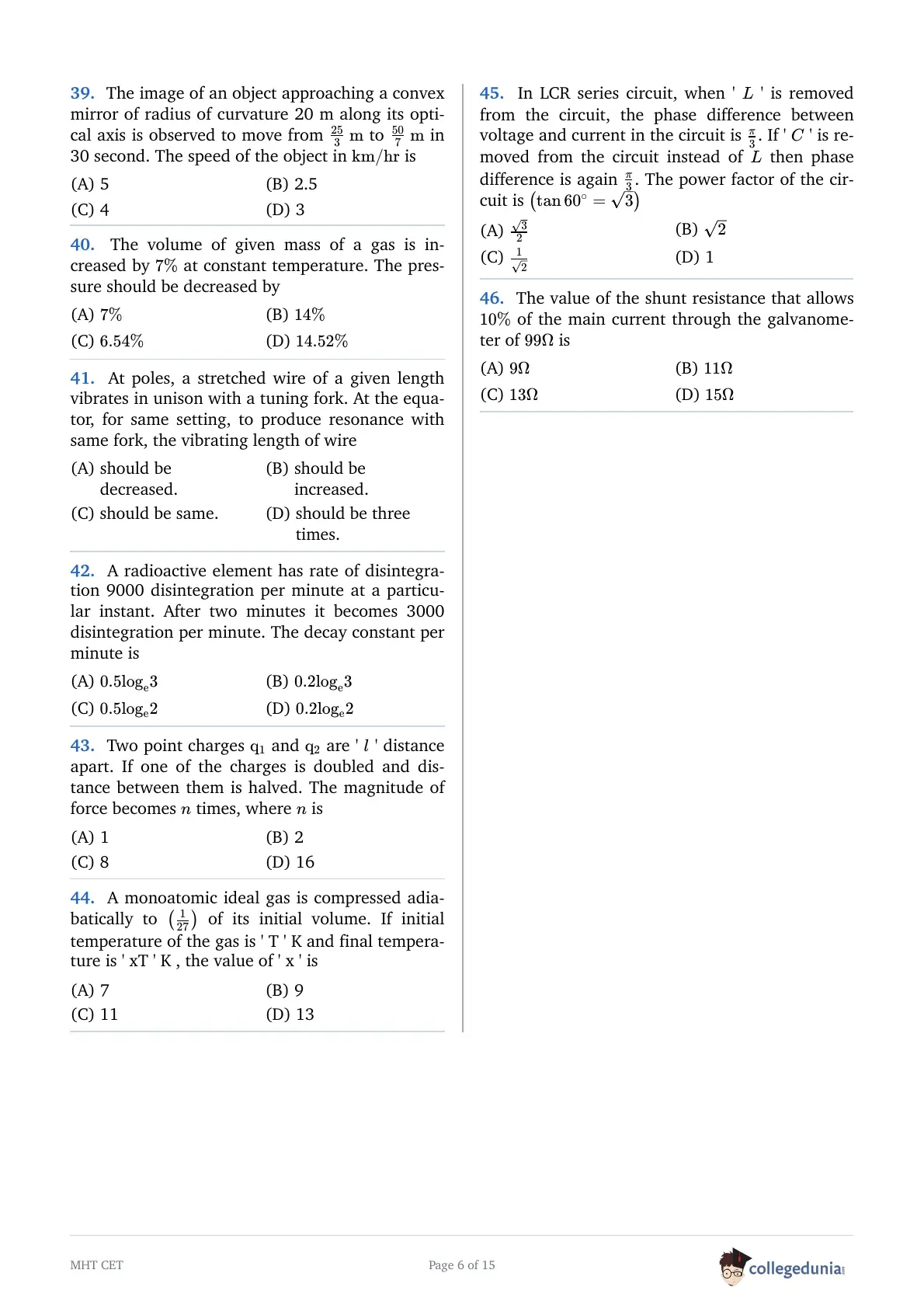
The displacement of particle in S.H.M. is \(\mathrm{x}=\mathrm{A} \cos (\omega \mathrm{t}+\pi / 6)\). Its speed will be maximum at time \(\left(\sin 90^{\circ}=1\right)\)
The power factor of a CR circuit is \(\frac{1}{\sqrt{2}}\), If the frequency of a.c. signal is halved, then the power factor of the circuit will become
The image of an object approaching a convex mirror of radius of curvature 20 m along its optical axis is observed to move from \(\frac{25}{3} \mathrm{~m}\) to \(\frac{50}{7} \mathrm{~m}\) in 30 second. The speed of the object in \(\mathrm{km} / \mathrm{hr}\) is
The volume of given mass of a gas is increased by \(7 \%\) at constant temperature. The pressure should be decreased by
At poles, a stretched wire of a given length vibrates in unison with a tuning fork. At the equator, for same setting, to produce resonance with same fork, the vibrating length of wire
A radioactive element has rate of disintegration 9000 disintegration per minute at a particular instant. After two minutes it becomes 3000 disintegration per minute. The decay constant per minute is
Two point charges \(\mathrm{q}_1\) and \(\mathrm{q}_2\) are ' \(l\) ' distance apart. If one of the charges is doubled and distance between them is halved. The magnitude of force becomes \(n\) times, where \(n\) is
A monoatomic ideal gas is compressed adiabatically to \(\left(\frac{1}{27}\right)\) of its initial volume. If initial temperature of the gas is ' T ' K and final temperature is ' xT ' K , the value of ' x ' is
In LCR series circuit, when ' \(L\) ' is removed from the circuit, the phase difference between voltage and current in the circuit is \(\frac{\pi}{3}\). If ' \(C\) ' is removed from the circuit instead of \(L\) then phase difference is again \(\frac{\pi}{3}\). The power factor of the circuit is \(\left(\tan 60^{\circ}=\sqrt{3}\right)\)
The value of the shunt resistance that allows \(10 \%\) of the main current through the galvanometer of \(99 \Omega\) is
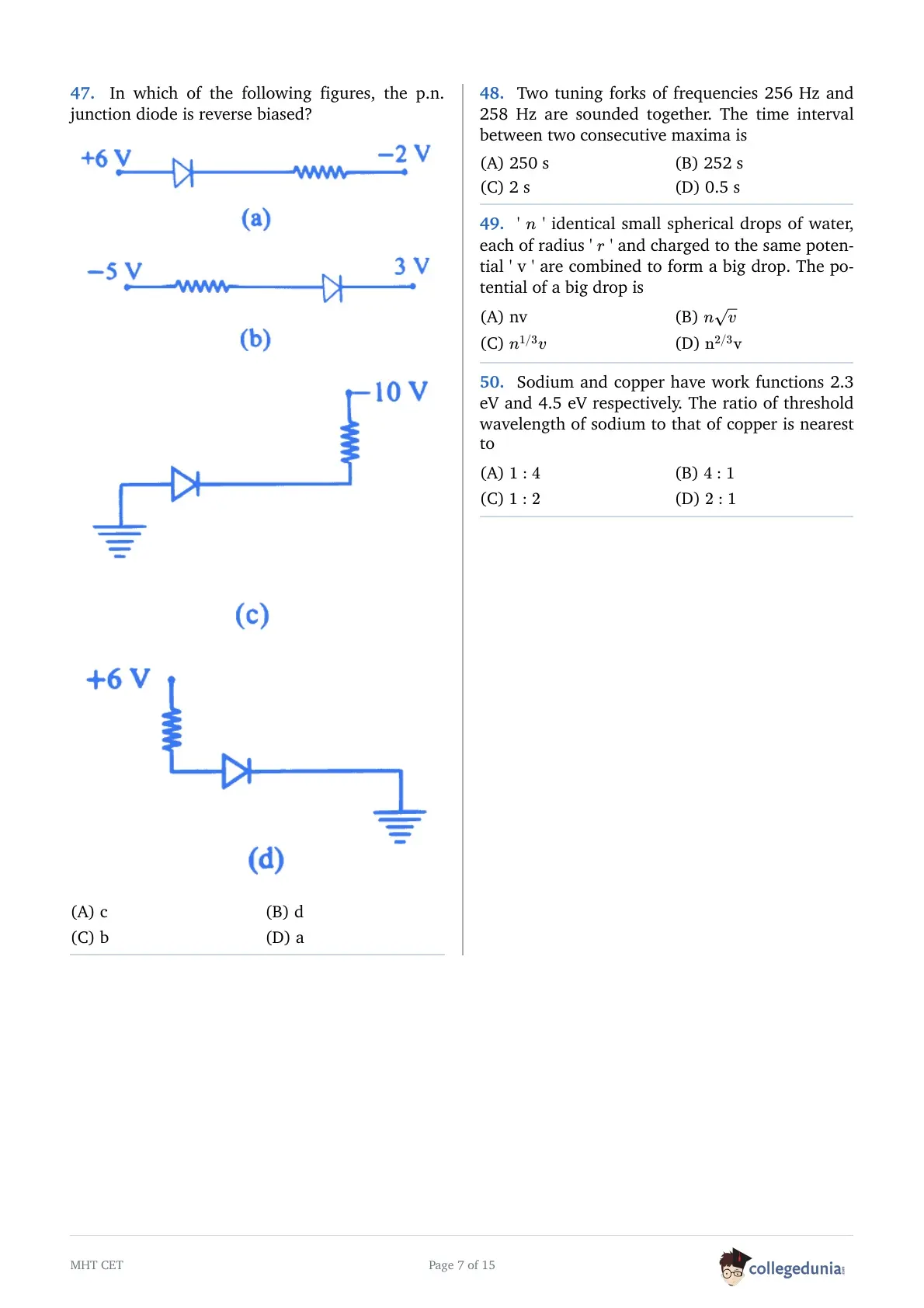
Two tuning forks of frequencies 256 Hz and 258 Hz are sounded together. The time interval between two consecutive maxima is
' \(n\) ' identical small spherical drops of water, each of radius ' \(r\) ' and charged to the same potential ' v ' are combined to form a big drop. The potential of a big drop is
Sodium and copper have work functions 2.3 eV and 4.5 eV respectively. The ratio of threshold wavelength of sodium to that of copper is nearest to
Chemistry (Q51 - Q100)
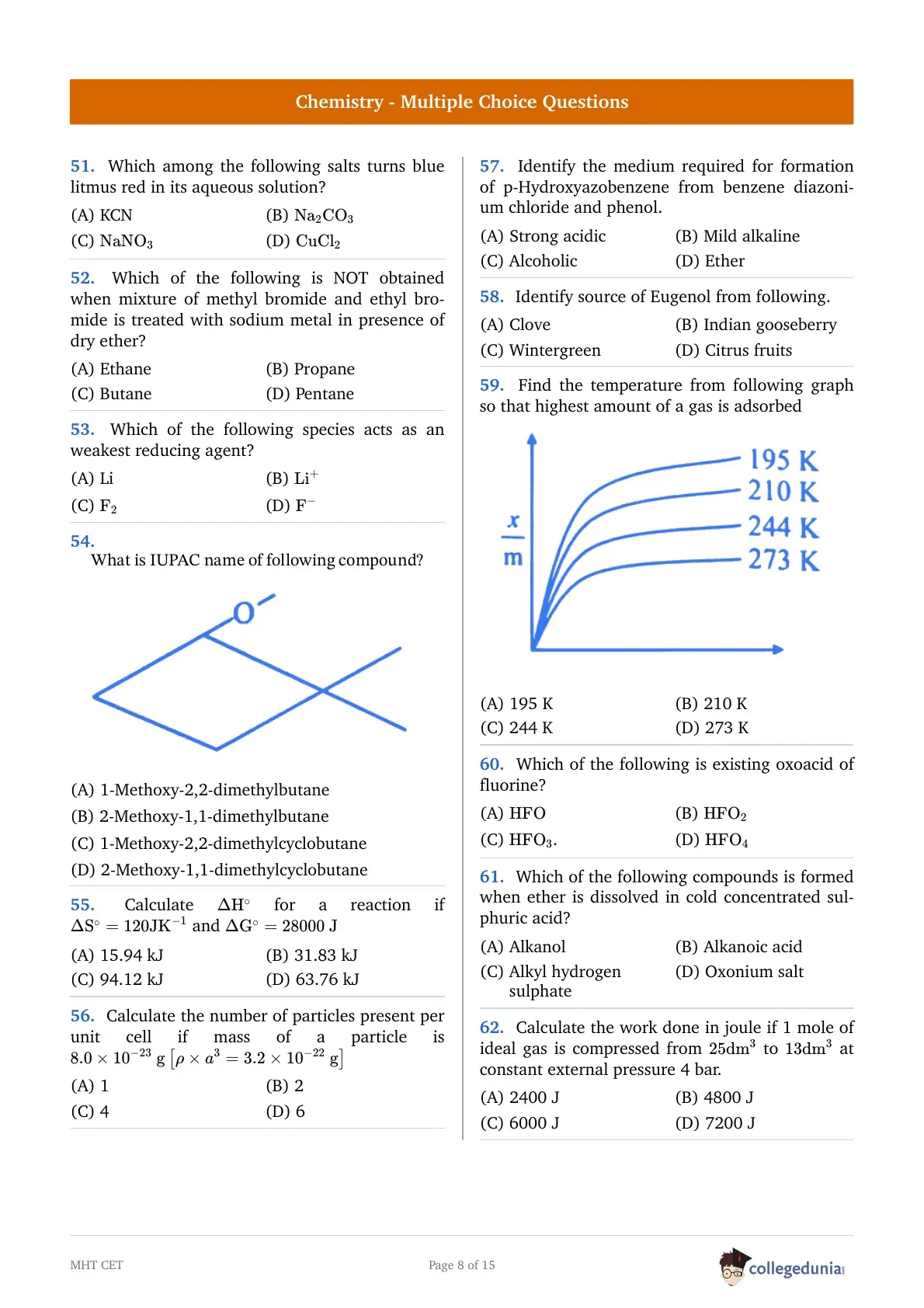
Which among the following salts turns blue litmus red in its aqueous solution?
Which of the following is NOT obtained when mixture of methyl bromide and ethyl bromide is treated with sodium metal in presence of dry ether?

Calculate \(\Delta \mathrm{H}^{\circ}\) for a reaction if \(\Delta \mathrm{S}^{\circ}=120 \mathrm{JK}^{-1}\) and \(\Delta \mathrm{G}^{\circ}=28000 \mathrm{~J}\)
Calculate the number of particles present per unit cell if mass of a particle is \(8.0 \times 10^{-23} \mathrm{~g} \left[\rho \times a^3=3.2 \times 10^{-22} \mathrm{~g}\right]\)
Identify the medium required for formation of p-Hydroxyazobenzene from benzene diazonium chloride and phenol.
Find the temperature from following graph so that highest amount of a gas is adsorbed

Which of the following compounds is formed when ether is dissolved in cold concentrated sulphuric acid?
Calculate the work done in joule if 1 mole of ideal gas is compressed from \(25 \mathrm{dm}^3\) to \(13 \mathrm{dm}^3\) at constant external pressure 4 bar.
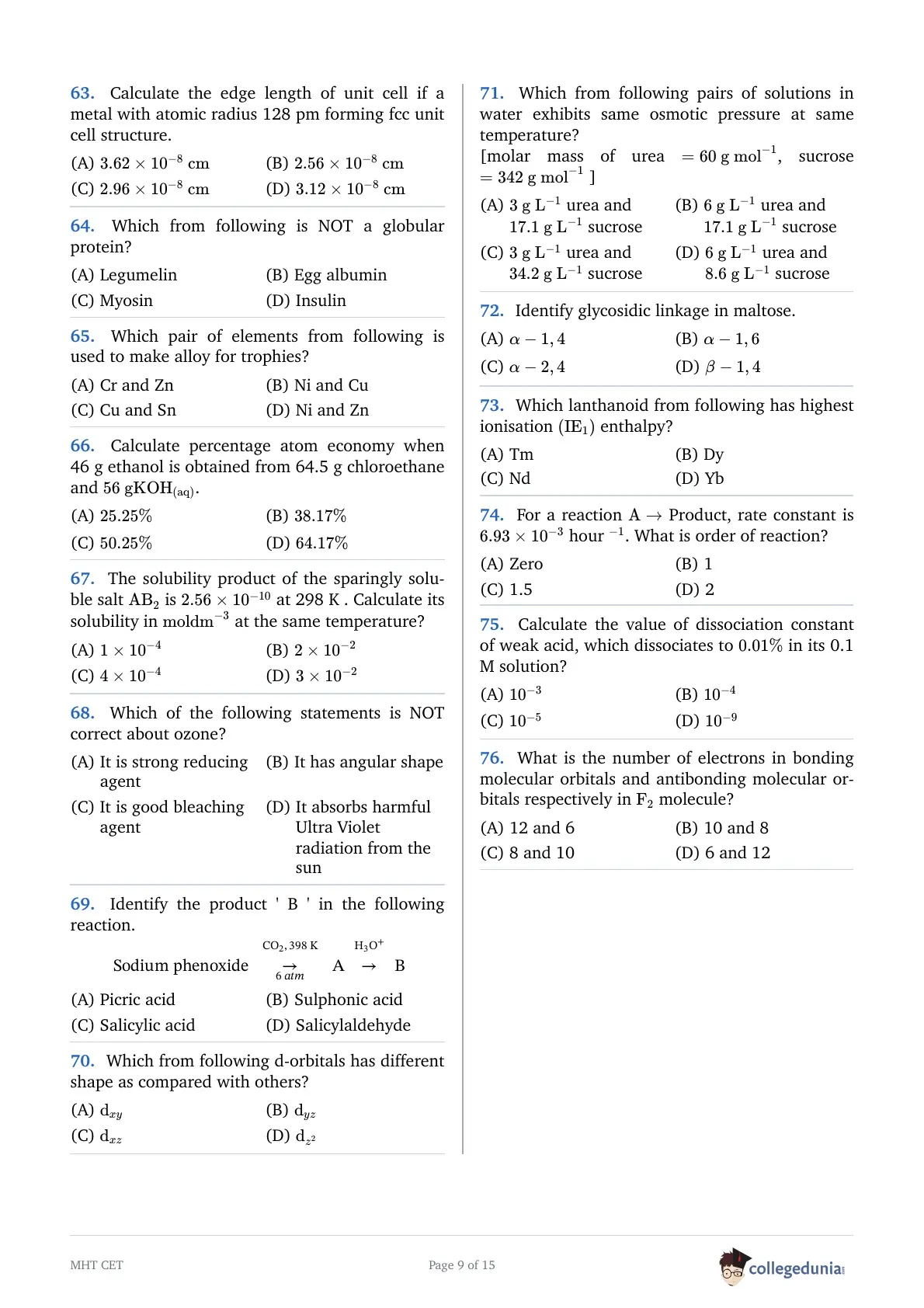
Calculate the edge length of unit cell if a metal with atomic radius 128 pm forming fcc unit cell structure.
Which pair of elements from following is used to make alloy for trophies?
Calculate percentage atom economy when 46 g ethanol is obtained from 64.5 g chloroethane and \(56 \mathrm{~g} \mathrm{KOH}_{(\mathrm{aq})}\).
The solubility product of the sparingly soluble salt \(\mathrm{AB}_2\) is \(2.56 \times 10^{-10}\) at 298 K . Calculate its solubility in \(\mathrm{mol} \mathrm{dm}^{-3}\) at the same temperature?
Identify the product ' B ' in the following reaction.
\[ \text { Sodium phenoxide } \xrightarrow[6 \,atm]{\mathrm{CO}_2, 398 \mathrm{~K}} \mathrm{~A} \xrightarrow{\mathrm{H}_3 \mathrm{O}^{+}} \mathrm{B} \]
Which from following d-orbitals has different shape as compared with others?
Which from following pairs of solutions in water exhibits same osmotic pressure at same temperature?
[molar mass of urea \(=60 \mathrm{~g} \mathrm{~mol}^{-1}\), sucrose \(=342 \mathrm{~g} \mathrm{~mol}^{-1}\) ]
Which lanthanoid from following has highest ionisation \(\left(\mathrm{IE}_1\right)\) enthalpy?
For a reaction \(\mathrm{A} \rightarrow\) Product, rate constant is \(6.93 \times 10^{-3}\) hour \({ }^{-1}\). What is order of reaction?
Calculate the value of dissociation constant of weak acid, which dissociates to \(0.01 \%\) in its 0.1 M solution?
What is the number of electrons in bonding molecular orbitals and antibonding molecular orbitals respectively in \(\mathrm{F}_2\) molecule?
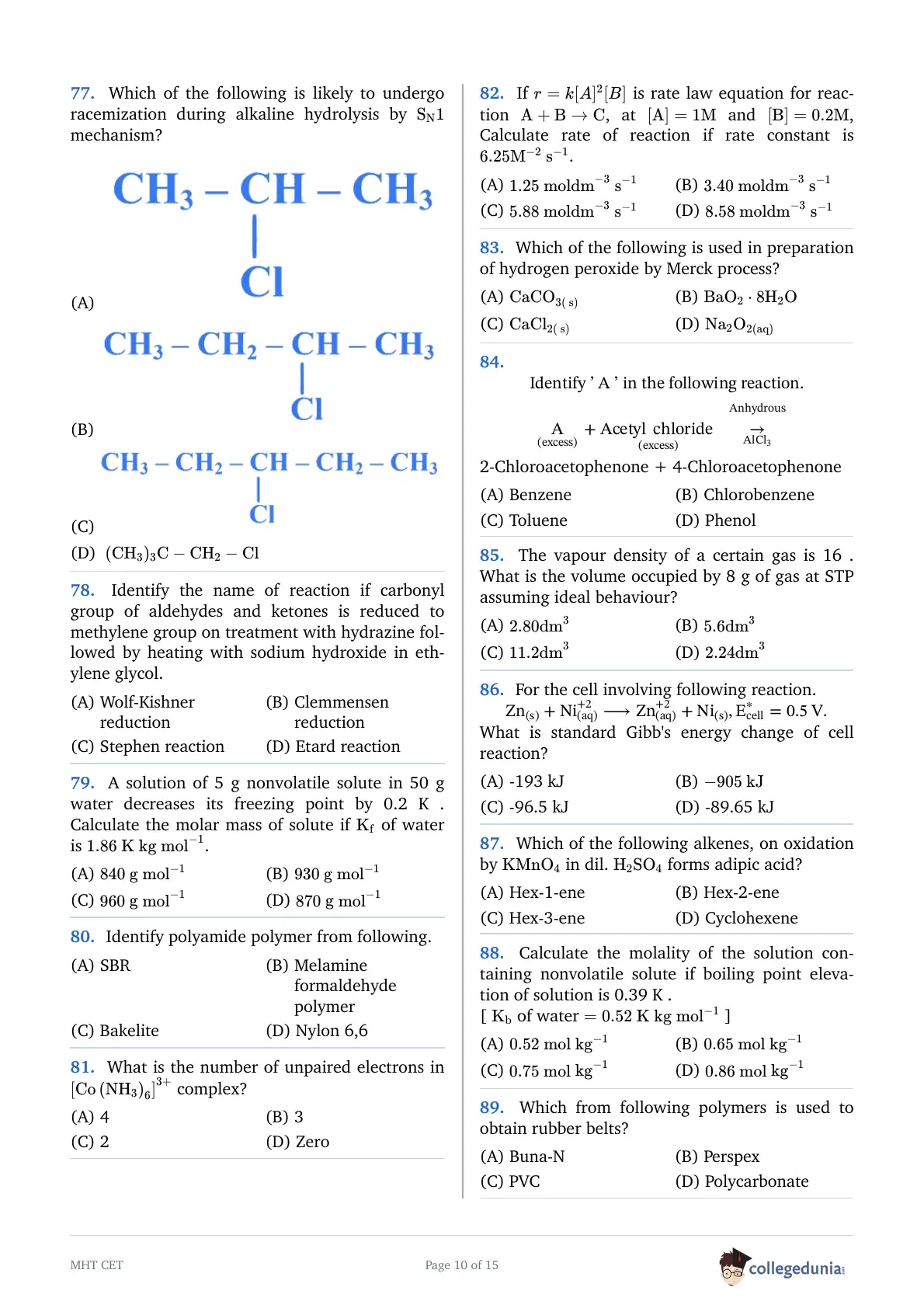
Which of the following is likely to undergo racemization during alkaline hydrolysis by \(\mathrm{S}_{\mathrm{N}} 1\) mechanism?
- (A)
![]()
- (B)
![]()
- (C)
![]()
- (D)
\(\text{ }(\mathrm{CH}_{3})_{3}\mathrm{C}-\mathrm{CH}_{2}-\mathrm{Cl}\)


Identify the name of reaction if carbonyl group of aldehydes and ketones is reduced to methylene group on treatment with hydrazine followed by heating with sodium hydroxide in ethylene glycol.
A solution of 5 g nonvolatile solute in 50 g water decreases its freezing point by 0.2 K . Calculate the molar mass of solute if \(\mathrm{K}_{\mathrm{f}}\) of water is \(1.86 \mathrm{~K} \mathrm{~kg} \mathrm{~mol}^{-1}\).
What is the number of unpaired electrons in \(\left[\mathrm{Co}\left(\mathrm{NH}_3\right)_6\right]^{3+}\) complex?
If \(r=k[A]^2[B]\) is rate law equation for reaction \(\mathrm{A}+\mathrm{B} \rightarrow \mathrm{C}\), at \([\mathrm{A}]=1 \mathrm{M}\) and \([\mathrm{B}]=0.2 \mathrm{M}\), Calculate rate of reaction if rate constant is \(6.25 \mathrm{M}^{-2} \mathrm{~s}^{-1}\).
Which of the following is used in preparation of hydrogen peroxide by Merck process?
\[ \begin{aligned} &\text { Identify ' } \mathrm{A} \text { ' in the following reaction. }\\ &\underset{\text { (excess) }}{\mathrm{A}}+\underset{\text { (excess) }}{\operatorname{Acetyl} \text { chloride }} \xrightarrow[\mathrm{AlCl}_3]{\text { Anhydrous }} \end{aligned} \]
2-Chloroacetophenone + 4-Chloroacetophenone
The vapour density of a certain gas is 16 . What is the volume occupied by 8 g of gas at STP assuming ideal behaviour?
For the cell involving following reaction.
\[ \mathrm{Zn}_{(\mathrm{s})}+\mathrm{Ni}_{(\mathrm{aq})}^{+2} \longrightarrow \mathrm{Zn}_{(\mathrm{aq})}^{+2}+\mathrm{Ni}_{(\mathrm{s})}, \mathrm{E}_{\mathrm{cell}}^*=0.5 \mathrm{~V} . \]
What is standard Gibb's energy change of cell reaction?
Which of the following alkenes, on oxidation by \(\mathrm{KMnO}_4\) in dil. \(\mathrm{H}_2 \mathrm{SO}_4\) forms adipic acid?
Calculate the molality of the solution containing nonvolatile solute if boiling point elevation of solution is 0.39 K .
[ \(\mathrm{K}_{\mathrm{b}}\) of water \(=0.52 \mathrm{~K} \mathrm{~kg} \mathrm{~mol}^{-1}\) ]
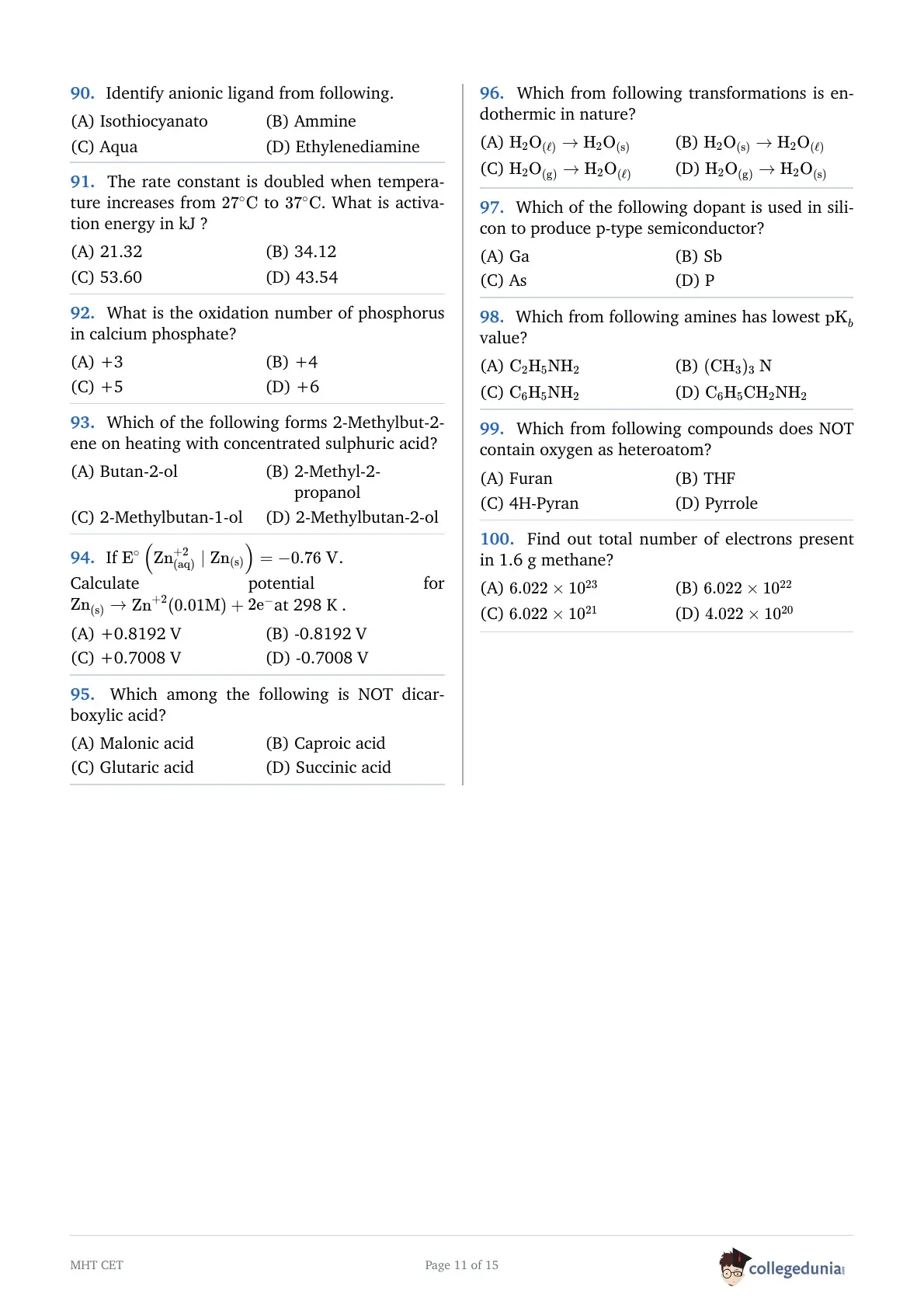
The rate constant is doubled when temperature increases from \(27^{\circ} \mathrm{C}\) to \(37^{\circ} \mathrm{C}\). What is activation energy in kJ ?
Which of the following forms 2-Methylbut-2-ene on heating with concentrated sulphuric acid?
If \(\mathrm{E}^{\circ}\left(\mathrm{Zn}_{(\mathrm{aq})}^{+2} \mid \mathrm{Zn}_{(\mathrm{s})}\right)=-0.76 \mathrm{~V}\).
Calculate potential for \(\mathrm{Zn}_{(\mathrm{s})} \rightarrow \mathrm{Zn}^{+2}(0.01 \mathrm{M})+2 \mathrm{e}^{-}\)at 298 K .
Which of the following dopant is used in silicon to produce p-type semiconductor?
Which from following compounds does NOT contain oxygen as heteroatom?
Mathematics (Q101 - Q150)
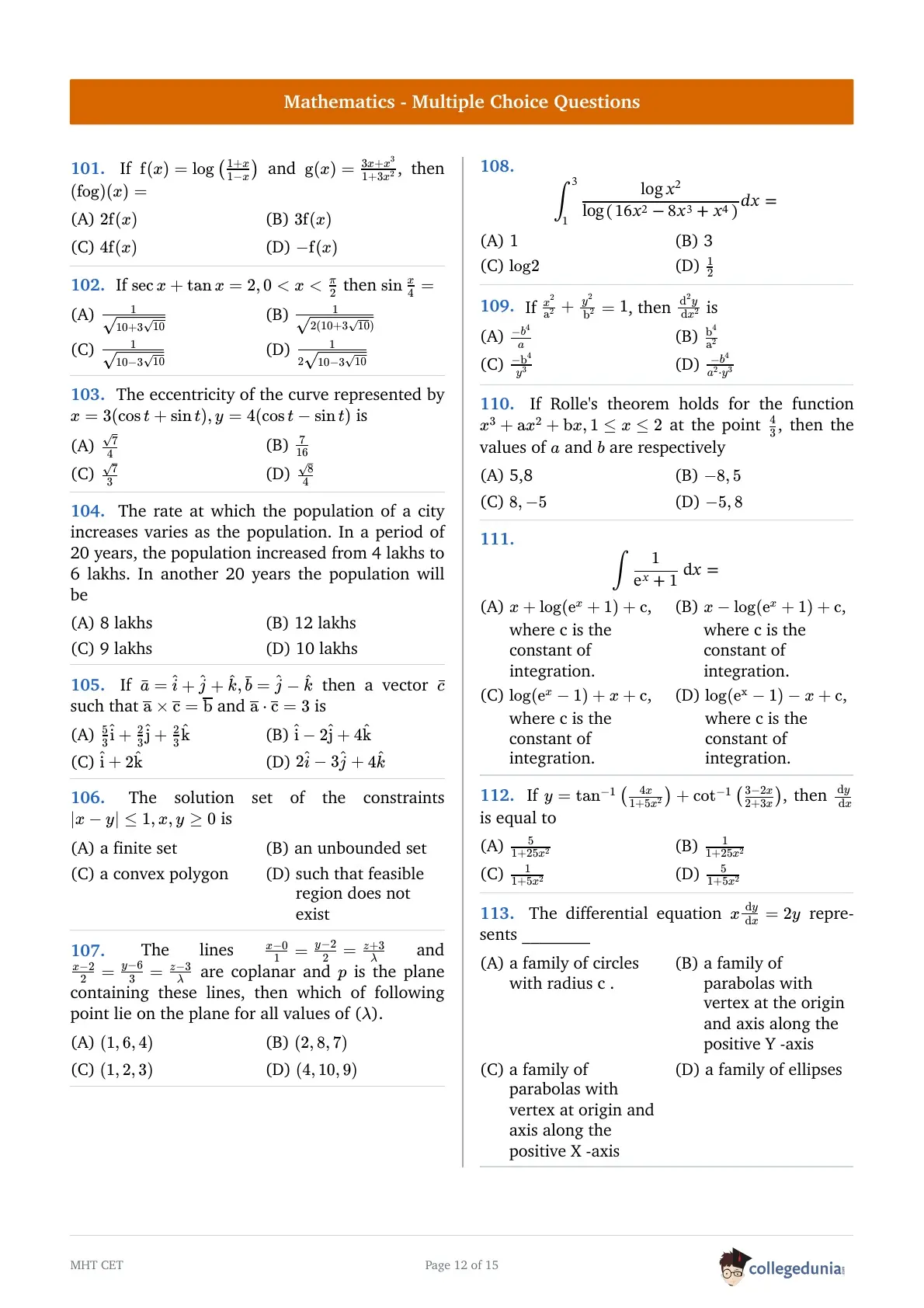
If \(\mathrm{f}(x)=\log \left(\frac{1+x}{1-x}\right)\) and \(\mathrm{g}(x)=\frac{3 x+x^3}{1+3 x^2}\), then \((\mathrm{fog})(x)=\)
The eccentricity of the curve represented by \(x=3(\cos t+\sin t), y=4(\cos t-\sin t)\) is
The rate at which the population of a city increases varies as the population. In a period of 20 years, the population increased from 4 lakhs to 6 lakhs. In another 20 years the population will be
If \(\bar{a}=\hat{i}+\hat{j}+\hat{k}, \bar{b}=\hat{j}-\hat{k}\) then a vector \(\bar{c}\) such that \(\overline{\mathrm{a}} \times \overline{\mathrm{c}}=\overline{\mathrm{b}}\) and \(\overline{\mathrm{a}} \cdot \overline{\mathrm{c}}=3\) is
The solution set of the constraints \(|x-y| \leq 1, x, y \geq 0\) is
The lines \(\frac{x-0}{1}=\frac{y-2}{2}=\frac{z+3}{\lambda}\) and \(\frac{x-2}{2}=\frac{y-6}{3}=\frac{z-3}{\lambda}\) are coplanar and \(p\) is the plane containing these lines, then which of following point lie on the plane for all values of (\(\lambda\)).
\[ \int_1^3 \frac{\log x^2}{\log \left(16 x^2-8 x^3+x^4\right)} d x= \]
If \(\frac{x^2}{\mathrm{a}^2}+\frac{y^2}{\mathrm{~b}^2}=1\), then \(\frac{\mathrm{d}^2 y}{\mathrm{~d} x^2}\) is
If Rolle's theorem holds for the function \(x^3+\mathrm{a} x^2+\mathrm{b} x, 1 \leq x \leq 2\) at the point \(\frac{4}{3}\), then the values of \(a\) and \(b\) are respectively
If \(y=\tan ^{-1}\left(\frac{4 x}{1+5 x^2}\right)+\cot ^{-1}\left(\frac{3-2 x}{2+3 x}\right)\), then \(\frac{\mathrm{d} y}{\mathrm{~d} x}\) is equal to
The differential equation \(x \frac{\mathrm{~d} y}{\mathrm{~d} x}=2 y\) represents ________
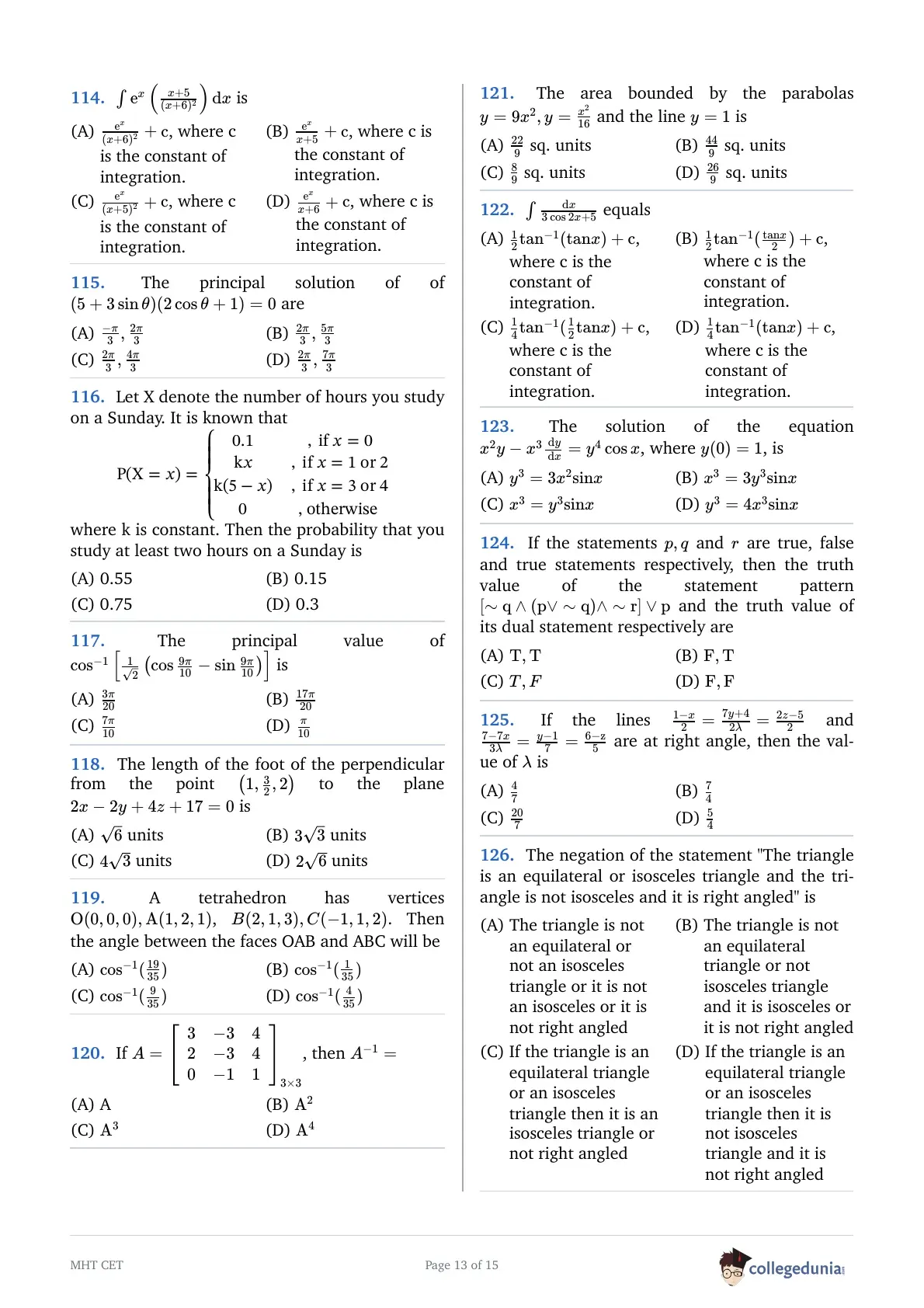
\(\int \mathrm{e}^x\left(\frac{x+5}{(x+6)^2}\right) \mathrm{d} x\) is
The principal solution of of \((5+3 \sin \theta)(2 \cos \theta+1)=0\) are
Let X denote the number of hours you study on a Sunday. It is known that
\[ \mathrm{P}(\mathrm{X}=x)=\left\{\begin{array}{cc} 0.1 & , \text { if } x=0 \\ \mathrm{k} x & , \text { if } x=1 \text { or } 2 \\ \mathrm{k}(5-x) & , \text { if } x=3 \text { or } 4 \\ 0 & , \text { otherwise } \end{array}\right. \]
where k is constant. Then the probability that you study at least two hours on a Sunday is
The principal value of \(\cos ^{-1}\left[\frac{1}{\sqrt{2}}\left(\cos \frac{9 \pi}{10}-\sin \frac{9 \pi}{10}\right)\right]\) is
The length of the foot of the perpendicular from the point \(\left(1, \frac{3}{2}, 2\right)\) to the plane \(2 x-2 y+4 z+17=0\) is
A tetrahedron has vertices \(\mathrm{O}(0,0,0), \mathrm{A}(1,2,1)\), \(B(2,1,3), C(-1,1,2)\). Then the angle between the faces OAB and ABC will be
If \(A=\left[\begin{array}{lll}3 & -3 & 4 \\ 2 & -3 & 4 \\ 0 & -1 & 1\end{array}\right]_{3 \times 3}\), then \(A^{-1}=\)
The area bounded by the parabolas \(y=9 x^2, y=\frac{x^2}{16}\) and the line \(y=1\) is
The solution of the equation \(x^2 y-x^3 \frac{\mathrm{~d} y}{\mathrm{~d} x}=y^4 \cos x\), where \(y(0)=1\), is
If the statements \(p, q\) and \(r\) are true, false and true statements respectively, then the truth value of the statement pattern \([\sim \mathrm{q} \wedge(\mathrm{p} \vee \sim \mathrm{q}) \wedge \sim \mathrm{r}] \vee \mathrm{p}\) and the truth value of its dual statement respectively are
If the lines \(\frac{1-x}{2}=\frac{7 y+4}{2 \lambda}=\frac{2 z-5}{2}\) and \(\frac{7-7 x}{3 \lambda}=\frac{y-1}{7}=\frac{6-\mathrm{z}}{5}\) are at right angle, then the value of \(\lambda\) is
The negation of the statement "The triangle is an equilateral or isosceles triangle and the triangle is not isosceles and it is right angled" is
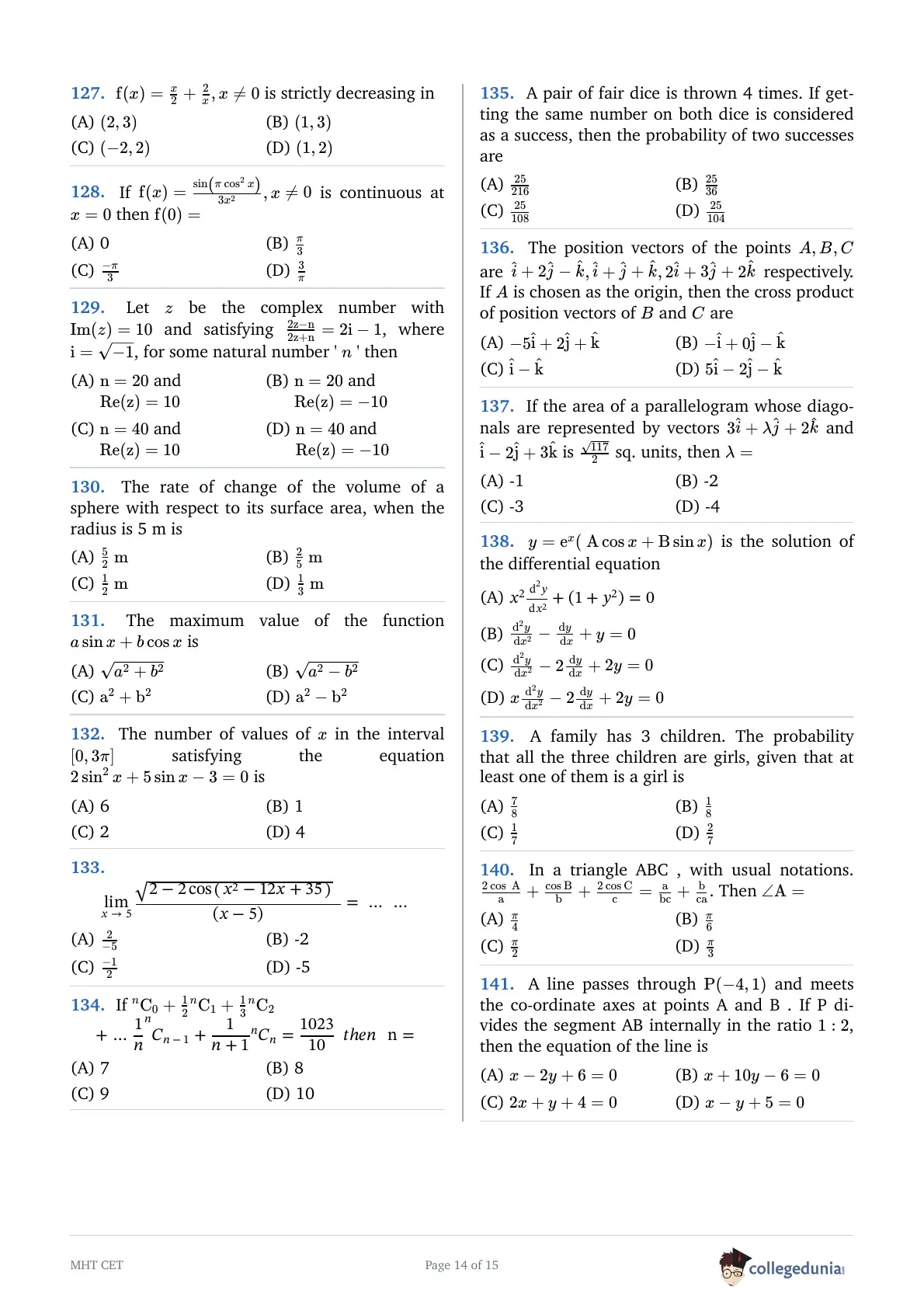
\(\mathrm{f}(x)=\frac{x}{2}+\frac{2}{x}, x \neq 0\) is strictly decreasing in
If \(\mathrm{f}(x)=\frac{\sin \left(\pi \cos ^2 x\right)}{3 x^2}, x \neq 0\) is continuous at \(x=0\) then \(\mathrm{f}(0)=\)
Let \(z\) be the complex number with \(\operatorname{Im}(z)=10\) and satisfying \(\frac{2 \mathrm{z}-\mathrm{n}}{2 \mathrm{z}+\mathrm{n}}=2 \mathrm{i}-1\), where \(\mathrm{i}=\sqrt{-1}\), for some natural number ' \(n\) ' then
The rate of change of the volume of a sphere with respect to its surface area, when the radius is 5 m is
The number of values of \(x\) in the interval \([0,3 \pi]\) satisfying the equation \(2 \sin ^2 x+5 \sin x-3=0\) is
If \({ }^n \mathrm{C}_0+\frac{1}{2}{ }^n \mathrm{C}_1+\frac{1}{3}{ }^n \mathrm{C}_2+\ldots+\frac{1}{n}{ }^n \mathrm{C}_{n-1}+\frac{1}{n+1}{ }^n \mathrm{C}_n=\frac{1023}{10}\), then \(\mathrm{n}=\)
A pair of fair dice is thrown 4 times. If getting the same number on both dice is considered as a success, then the probability of two successes are
The position vectors of the points \(A, B, C\) are \(\hat{i}+2 \hat{j}-\hat{k}, \hat{i}+\hat{j}+\hat{k}, 2 \hat{i}+3 \hat{j}+2 \hat{k}\) respectively. If \(A\) is chosen as the origin, then the cross product of position vectors of \(B\) and \(C\) are
If the area of a parallelogram whose diagonals are represented by vectors \(3 \hat{i}+\lambda \hat{j}+2 \hat{k}\) and \(\hat{\mathrm{i}}-2 \hat{\mathrm{j}}+3 \hat{\mathrm{k}}\) is \(\frac{\sqrt{117}}{2}\) sq. units, then \(\lambda=\)
\(y=\mathrm{e}^x(\mathrm{~A} \cos x+\mathrm{B} \sin x)\) is the solution of the differential equation
A family has 3 children. The probability that all the three children are girls, given that at least one of them is a girl is
In a triangle ABC , with usual notations. \(\frac{2 \cos \mathrm{~A}}{\mathrm{a}}+\frac{\cos \mathrm{B}}{\mathrm{b}}+\frac{2 \cos \mathrm{C}}{\mathrm{c}}=\frac{\mathrm{a}}{\mathrm{bc}}+\frac{\mathrm{b}}{\mathrm{ca}}\). Then \(\angle \mathrm{A}=\)
A line passes through \(\mathrm{P}(-4,1)\) and meets the co-ordinate axes at points A and B . If P divides the segment AB internally in the ratio \(1: 2\), then the equation of the line is
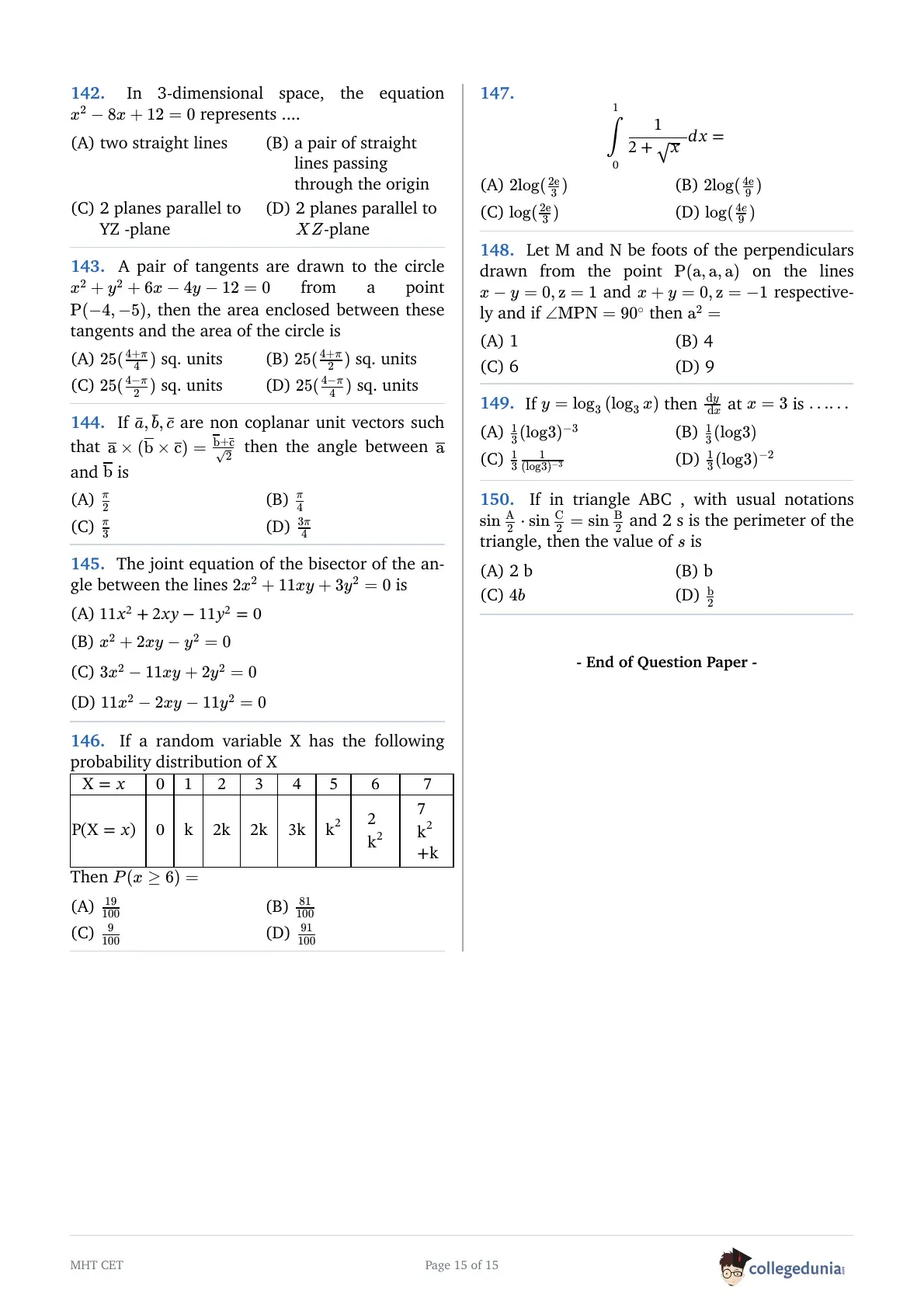
In 3-dimensional space, the equation \(x^2-8 x+12=0\) represents ....
A pair of tangents are drawn to the circle \(x^2+y^2+6 x-4 y-12=0\) from a point \(\mathrm{P}(-4,-5)\), then the area enclosed between these tangents and the area of the circle is
If \(\bar{a}, \bar{b}, \bar{c}\) are non coplanar unit vectors such that \(\overline{\mathrm{a}} \times(\overline{\mathrm{b}} \times \overline{\mathrm{c}})=\frac{\overline{\mathrm{b}}+\overline{\mathrm{c}}}{\sqrt{2}}\) then the angle between \(\overline{\mathrm{a}}\) and \(\overline{\mathrm{b}}\) is
The joint equation of the bisector of the angle between the lines \(2 x^2+11 x y+3 y^2=0\) is
If a random variable X has the following probability distribution of X
\[ \begin{array}{|l|c|c|c|c|c|c|c|c|} \hline \mathrm{X}=x & 0 & 1 & 2 & 3 & 4 & 5 & 6 & 7 \\ \hline \mathrm{P}(\mathrm{X}=x) & 0 & \mathrm{k} & 2 \mathrm{k} & 2 \mathrm{k} & 3 \mathrm{k} & \mathrm{k}^2 & 2 \mathrm{k}^2 & 7 \mathrm{k}^2+\mathrm{k} \\ \hline \end{array} \]
Then \(P(x \geq 6)=\)
Let M and N be foots of the perpendiculars drawn from the point \(\mathrm{P}(\mathrm{a}, \mathrm{a}, \mathrm{a})\) on the lines \(x-y=0, \mathrm{z}=1\) and \(x+y=0, \mathrm{z}=-1\) respectively and if \(\angle \mathrm{MPN}=90^{\circ}\) then \(\mathrm{a}^2=\)
If \(y=\log _3\left(\log _3 x\right)\) then \(\frac{\mathrm{d} y}{\mathrm{~d} x}\) at \(x=3\) is \(\ldots \ldots\)
If in triangle ABC , with usual notations \(\sin \frac{\mathrm{A}}{2} \cdot \sin \frac{\mathrm{C}}{2}=\sin \frac{\mathrm{B}}{2}\) and 2 s is the perimeter of the triangle, then the value of \(s\) is
MHT CET 2025 PCM Exam Pattern and Marking Scheme
| Parameter | Details |
|---|---|
| Conducting Body | Maharashtra Common Entrance Test Cell (Maharashtra CET Cell) |
| Exam Mode | Online (Computer-Based Test) |
| Duration | 180 minutes (3 hours) |
| Groups / Subjects | PCM (Physics, Chemistry, Mathematics) for Engineering |
| Total Questions |
150 |
| Total Marks | 200 |
| Question Type | Multiple Choice Questions (MCQs) |
| Marks Distribution |
|
| Negative Marking | No |
| Syllabus Weightage |
|



Comments