MHT CET 2026 April 21 Shift 1 PCB Question Paper is available for download here. Maharashtra State CET Cell conducted MHT CET 2026 PCB Exam on April 21 in Shift 1 from 9 AM to 12 PM in CBT mode.

The MHT CET 2026 PCB question paper includes the following:

  • The MHT CET 2026 PCB Question Paper consists of 200 multiple-choice questions (MCQs) totalling 200 marks divided into 3 sections: Physics (50 questions), Chemistry (50 questions), and Biology (100 questions).
  • All questions carry 1 mark each. There is no negative marking for incorrect answers.

MHT CET 2026 April 21 Shift 1 PCB Question Paper with Solution PDF

CD PDF CD PDF with Solutions
Download Collegedunia PDF 1.01 MB -

Also Check:

MHT CET 2026 April 21 Shift 1 PCB Questions with Solutions


Physics (Q1 - Q50)

Question 1:

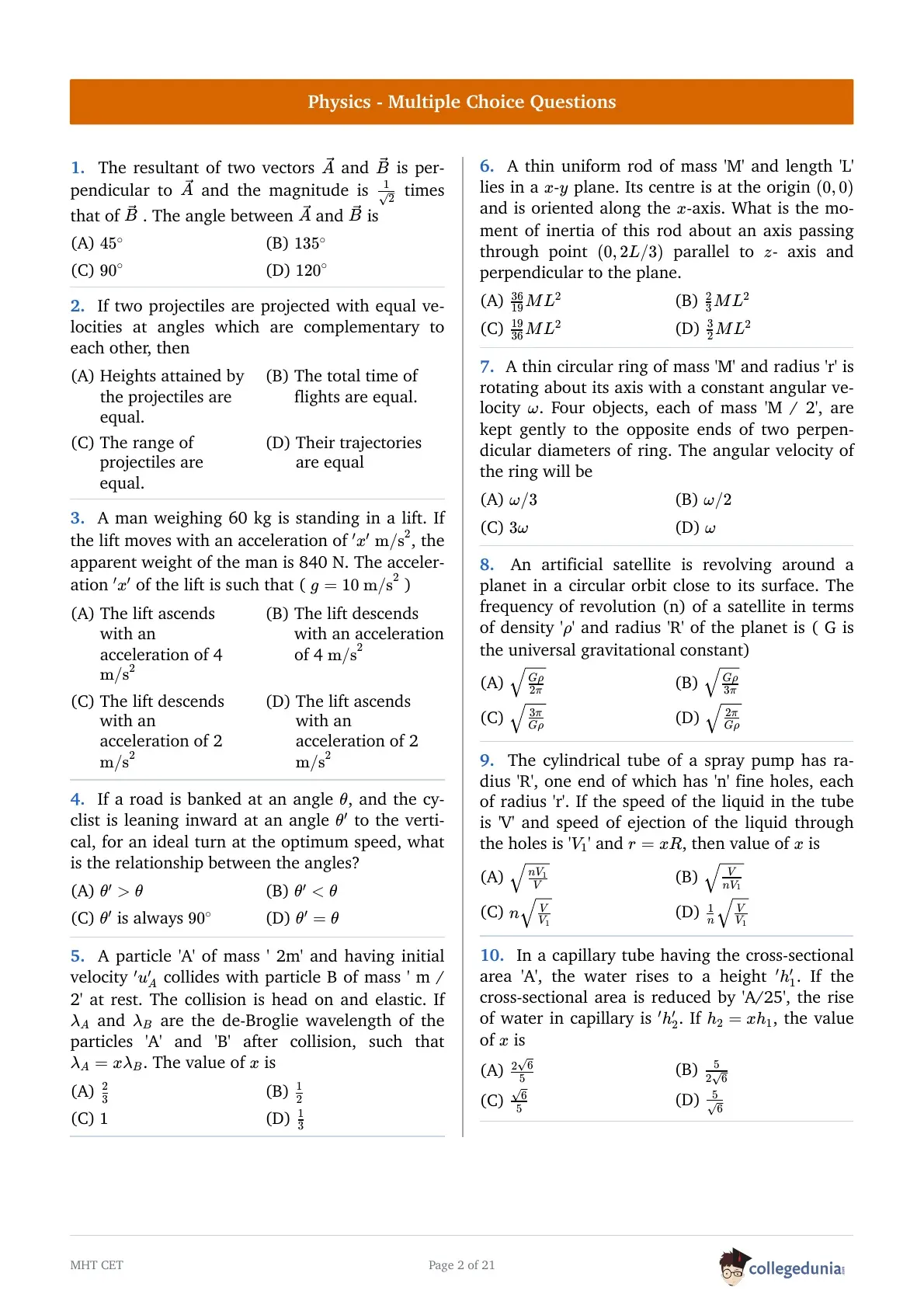
The resultant of two vectors \(\vec{A}\) and \(\vec{B}\) is perpendicular to \(\vec{A}\) and the magnitude is \(\frac{1}{\sqrt{2}}\) times that of \(\vec{B}\) . The angle between \(\vec{A}\) and \(\vec{B}\) is

  • (A) \(45^{\circ }\)
  • (B) \(135^{\circ }\)
  • (C) \(90^{\circ }\)
  • (D) \(120^{\circ }\)

Question 2:

If two projectiles are projected with equal velocities at angles which are complementary to each other, then

  • (A) Heights attained by the projectiles are equal.
  • (B) The total time of flights are equal.
  • (C) The range of projectiles are equal.
  • (D) Their trajectories are equal

Question 3:

A man weighing 60 kg is standing in a lift. If the lift moves with an acceleration of \({}'x'\) \(\text{m/s}^{2}\), the apparent weight of the man is 840 N. The acceleration \({}'x'\) of the lift is such that ( \(g=10\ \text{m/s}^{2}\) )

  • (A) The lift ascends with an acceleration of 4 \(\text{m/s}^{2}\)
  • (B) The lift descends with an acceleration of 4 \(\text{m/s}^{2}\)
  • (C) The lift descends with an acceleration of 2 \(\text{m/s}^{2}\)
  • (D) The lift ascends with an acceleration of 2 \(\text{m/s}^{2}\)

Question 4:

If a road is banked at an angle \(\theta\), and the cyclist is leaning inward at an angle \(\theta '\) to the vertical, for an ideal turn at the optimum speed, what is the relationship between the angles?

  • (A) \(\theta '>\theta\)
  • (B) \(\theta '\lt \theta\)
  • (C) \(\theta '\) is always \(90^{\circ }\)
  • (D) \(\theta '=\theta\)

Question 5:

A particle 'A' of mass ' 2m' and having initial velocity \({}'u_{A}'\) collides with particle B of mass ' m / 2' at rest. The collision is head on and elastic. If \(\lambda _{A}\) and \(\lambda _{B}\) are the de-Broglie wavelength of the particles 'A' and 'B' after collision, such that \(\lambda _{A}=x\lambda _{B}\). The value of \(x\) is

  • (A) \(\frac{2}{3}\)
  • (B) \(\frac{1}{2}\)
  • (C) \(1\)
  • (D) \(\frac{1}{3}\)

Question 6:

A thin uniform rod of mass 'M' and length 'L' lies in a \(x\)-\(y\) plane. Its centre is at the origin \((0,0)\) and is oriented along the \(x\)-axis. What is the moment of inertia of this rod about an axis passing through point \((0,2L/3)\) parallel to \(z\)- axis and perpendicular to the plane.

  • (A) \(\frac{36}{19}ML^{2}\)
  • (B) \(\frac{2}{3}ML^{2}\)
  • (C) \(\frac{19}{36}ML^{2}\)
  • (D) \(\frac{3}{2}ML^{2}\)

Question 7:

A thin circular ring of mass 'M' and radius 'r' is rotating about its axis with a constant angular velocity \(\omega\). Four objects, each of mass 'M / 2', are kept gently to the opposite ends of two perpendicular diameters of ring. The angular velocity of the ring will be

  • (A) \(\omega /3\)
  • (B) \(\omega /2\)
  • (C) \(3\omega\)
  • (D) \(\omega\)

Question 8:

An artificial satellite is revolving around a planet in a circular orbit close to its surface. The frequency of revolution (n) of a satellite in terms of density '\(\rho\)' and radius 'R' of the planet is ( G is the universal gravitational constant)

  • (A) \(\sqrt{\frac{G\rho }{2\pi }}\)
  • (B) \(\sqrt{\frac{G\rho }{3\pi }}\)
  • (C) \(\sqrt{\frac{3\pi }{G\rho }}\)
  • (D) \(\sqrt{\frac{2\pi }{G\rho }}\)

Question 9:

The cylindrical tube of a spray pump has radius 'R', one end of which has 'n' fine holes, each of radius 'r'. If the speed of the liquid in the tube is 'V' and speed of ejection of the liquid through the holes is '\(V_{1}\)' and \(r=xR\), then value of \(x\) is

  • (A) \(\sqrt{\frac{nV_{1}}{V}}\)
  • (B) \(\sqrt{\frac{V}{nV_{1}}}\)
  • (C) \(n\sqrt{\frac{V}{V_{1}}}\)
  • (D) \(\frac{1}{n}\sqrt{\frac{V}{V_{1}}}\)

Question 10:

In a capillary tube having the cross-sectional area 'A', the water rises to a height \({}'h_{1}'\). If the cross-sectional area is reduced by 'A/25', the rise of water in capillary is \({}'h_{2}'\). If \(h_{2}=xh_{1}\), the value of \(x\) is

  • (A) \(\frac{2\sqrt{6}}{5}\)
  • (B) \(\frac{5}{2\sqrt{6}}\)
  • (C) \(\frac{\sqrt{6}}{5}\)
  • (D) \(\frac{5}{\sqrt{6}}\)

Question 11:

The atmospheric pressure on the surface of the fluid is \(P_{0}\) . The depth \(h\) at which pressure is \(n\) times the atmospheric pressure is

  • (A) \(\frac{nP_{0}}{\rho g}\)
  • (B) \(\frac{(n+1)P_{0}}{\rho g}\)
  • (C) \(\frac{(n-1)P_{0}}{\rho g}\)
  • (D) \(\frac{n^{2}P_{0}}{\rho g}\)

Question 12:

The thermal conduction rate '\(P_{cond}\)' of a slab is given by \(P_{cond}=\frac{kA(T_{1}-T_{2})}{x}\), where ' \(x\) ' is the thickness of the slab and 'A' is the area . The term that represents thermal resistance ' \(R_{T}\)'

  • (A) \(\frac{kA}{x}\)
  • (B) \(\frac{x}{kA}\)
  • (C) \(\frac{k(T_{1}-T_{2})}{x}\)
  • (D) \(\frac{x}{k(T_{1}-T_{2})}\)

Question 13:

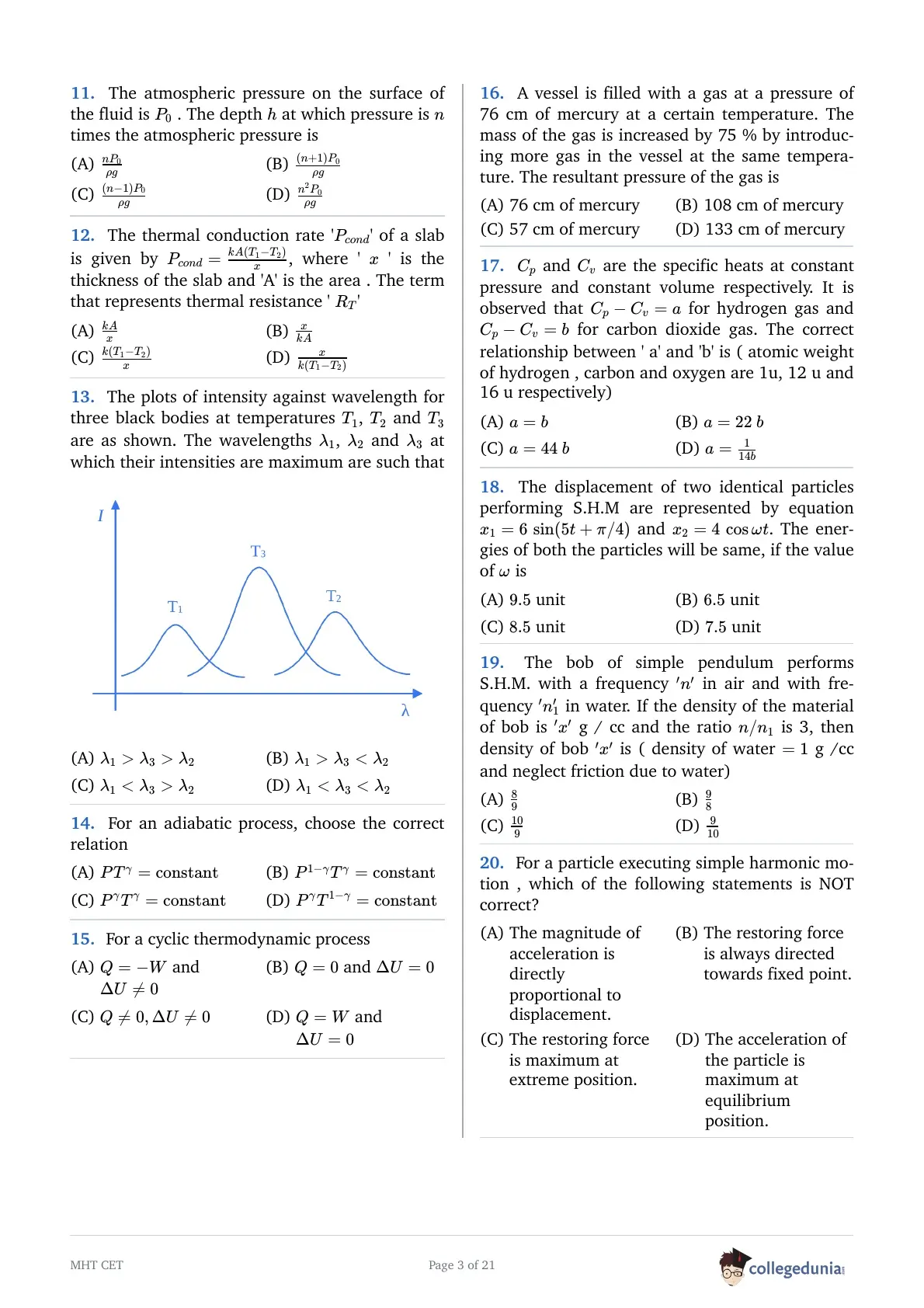
The plots of intensity against wavelength for three black bodies at temperatures \(T_{1}\), \(T_{2}\) and \(T_{3}\) are as shown. The wavelengths \(\lambda _{1}\), \(\lambda _{2}\) and \(\lambda _{3}\) at which their intensities are maximum are such that

  • (A) \(\lambda _{1}>\lambda _{3}>\lambda _{2}\)
  • (B) \(\lambda _{1}>\lambda _{3}\lt \lambda _{2}\)
  • (C) \(\lambda _{1}\lt \lambda _{3}>\lambda _{2}\)
  • (D) \(\lambda _{1}\lt \lambda _{3}\lt \lambda _{2}\)

Question 14:

For an adiabatic process, choose the correct relation

  • (A) \(PT^{\gamma }=\text{constant}\)
  • (B) \(P^{1-\gamma }T^{\gamma }=\text{constant}\)
  • (C) \(P^{\gamma }T^{\gamma }=\text{constant}\)
  • (D) \(P^{\gamma }T^{1-\gamma }=\text{constant}\)

Question 15:

For a cyclic thermodynamic process

  • (A) \(Q=-W\) and \(\Delta U\neq 0\)
  • (B) \(Q=0\) and \(\Delta U=0\)
  • (C) \(Q\neq 0,\Delta U\neq 0\)
  • (D) \(Q=W\) and \(\Delta U=0\)

Question 16:

A vessel is filled with a gas at a pressure of 76 cm of mercury at a certain temperature. The mass of the gas is increased by 75 % by introducing more gas in the vessel at the same temperature. The resultant pressure of the gas is

  • (A) 76 cm of mercury
  • (B) 108 cm of mercury
  • (C) 57 cm of mercury
  • (D) 133 cm of mercury

Question 17:

\(C_{p}\) and \(C_{v}\) are the specific heats at constant pressure and constant volume respectively. It is observed that \(C_{p}-C_{v}=a\) for hydrogen gas and \(C_{p}-C_{v}=b\) for carbon dioxide gas. The correct relationship between ' a' and 'b' is ( atomic weight of hydrogen , carbon and oxygen are 1u, 12 u and 16 u respectively)

  • (A) \(a=b\)
  • (B) \(a=22\ b\)
  • (C) \(a=44\ b\)
  • (D) \(a=\frac{1}{14b}\)

Question 18:

The displacement of two identical particles performing S.H.M are represented by equation \(x_{1}=6\,\sin (5t+\pi /4)\) and \(x_{2}=4\,\cos \omega t\). The energies of both the particles will be same, if the value of \(\omega\) is

  • (A) \(9.5\) unit
  • (B) \(6.5\) unit
  • (C) \(8.5\) unit
  • (D) \(7.5\) unit

Question 19:

The bob of simple pendulum performs S.H.M. with a frequency \({}'n'\) in air and with frequency \({}'n_{1}'\) in water. If the density of the material of bob is \({}'x'\) g / cc and the ratio \(n/n_{1}\) is 3, then density of bob \({}'x'\) is ( density of water \(=1\) g /cc and neglect friction due to water)

  • (A) \(\frac{8}{9}\)
  • (B) \(\frac{9}{8}\)
  • (C) \(\frac{10}{9}\)
  • (D) \(\frac{9}{10}\)

Question 20:

For a particle executing simple harmonic motion , which of the following statements is NOT correct?

  • (A) The magnitude of acceleration is directly proportional to displacement.
  • (B) The restoring force is always directed towards fixed point.
  • (C) The restoring force is maximum at extreme position.
  • (D) The acceleration of the particle is maximum at equilibrium position.

Question 21:

A sound wave travels from a region of air at \(20^{\circ }\text{C}\) into a region at \(40^{\circ }\text{C}\). What is the ratio of the wavelengths (\(\lambda _{40}/\lambda _{20}\)), if the frequency remains constant?

  • (A) \(\sqrt{\frac{313}{293}}\)
  • (B) \(\frac{313}{293}\)
  • (C) \(\sqrt{\frac{40}{20}}\)
  • (D) \(\frac{40}{20}\)

Question 22:

An object of specific gravity \(\rho\) is hung from a thin steel wire. The fundamental frequency for the transverse stationary waves is 300 Hz. The object is immersed in water, so that one half of its volume is submerged. The second harmonic frequency will be ( density of water \(=1\) g / cc)

  • (A) \(600\left(\frac{2\rho -1}{2\rho }\right)^{1/2}\)
  • (B) \(600\left(\frac{2\rho }{2\rho -1}\right)^{1/2}\)
  • (C) \(600\left(\frac{\rho -1}{2\rho }\right)^{1/2}\)
  • (D) \(600\left(\frac{\rho }{2\rho -1}\right)^{1/2}\)

Question 23:

A hollow pipe of length 0.8 m is closed at one end. At its open end a 0.5 m long uniform string is vibrating in fourth harmonic, and it resonates with the fundamental frequency of the pipe. If the tension in the wire is 50 N and the speed of sound is 320 m/s, the mass of string is

  • (A) \(5\) g
  • (B) \(40\) g
  • (C) \(20\) g
  • (D) \(10\) g

Question 24:

A transverse wave is described by the equation \(y=A\sin 2\pi \left(nt-\frac{x}{10}\right)\). The ratio of maximum particle velocity to wave velocity is

  • (A) \(\frac{\pi A}{5}\)
  • (B) \(\frac{2\pi A}{5}\)
  • (C) \(\frac{3\pi A}{5}\)
  • (D) \(\frac{4\pi A}{5}\)

Question 25:

Three point charges \(+4e\) , \(+2e\) and \(+e\) are kept at each vertex of an equilateral triangle ABC , each of side \(a\) . The net electric intensity acting on charge \(+e\) is
( \(\cos 60^{\circ }=1/2\) and \(k\) is constant )

  • (A) \(\frac{2\sqrt{7}ke}{a^{2}}\)
  • (B) \(\frac{4\sqrt{7}ke}{a^{2}}\)
  • (C) \(\frac{7\sqrt{2}ke}{a^{2}}\)
  • (D) \(\frac{\sqrt{7}ke}{a^{2}}\)

Question 26:

The electric potential due to a dipole at point P making an angle \(120^{\circ }\) with the axis of a dipole is
(\(\varepsilon _{0}\) = permittivity of free space, \(p\) = electric dipole moment , \(r\) = distance of point P from the center of dipole)
(\(\cos 60^{\circ }=1/2\))

  • (A) \(\frac{1}{8\pi \varepsilon _{0}}\frac{p}{r^{2}}\)
  • (B) \(\frac{-1}{8\pi \varepsilon _{0}}\frac{p}{r^{2}}\)
  • (C) \(\frac{-1}{8\pi \varepsilon _{0}}\frac{3p}{r^{2}}\)
  • (D) \(\frac{1}{8\pi \varepsilon _{0}}\frac{3p}{r^{2}}\)

Question 27:

The electric potential ' \(V\) ' at a radial distance \(x\) just outside a non-conducting sphere is \(\frac{\rho R^{2}}{2\varepsilon _{0}x}\). The electric intensity ' E ' at a radial distance \(x\) is ( \(\rho\) is uniform volume charge density, \(R\) is the radius of the sphere and \(\varepsilon _{0}\) is the permittivity of free space)

  • (A) \(\frac{\rho R^{2}}{2\varepsilon _{0}x}\)
  • (B) \(\frac{\rho R^{2}}{3\varepsilon _{0}x^{2}}\)
  • (C) \(\frac{\rho R^{2}}{2\varepsilon _{0}x^{2}}\)
  • (D) \(\frac{\rho R^{2}}{\varepsilon _{0}x^{2}}\)

Question 28:

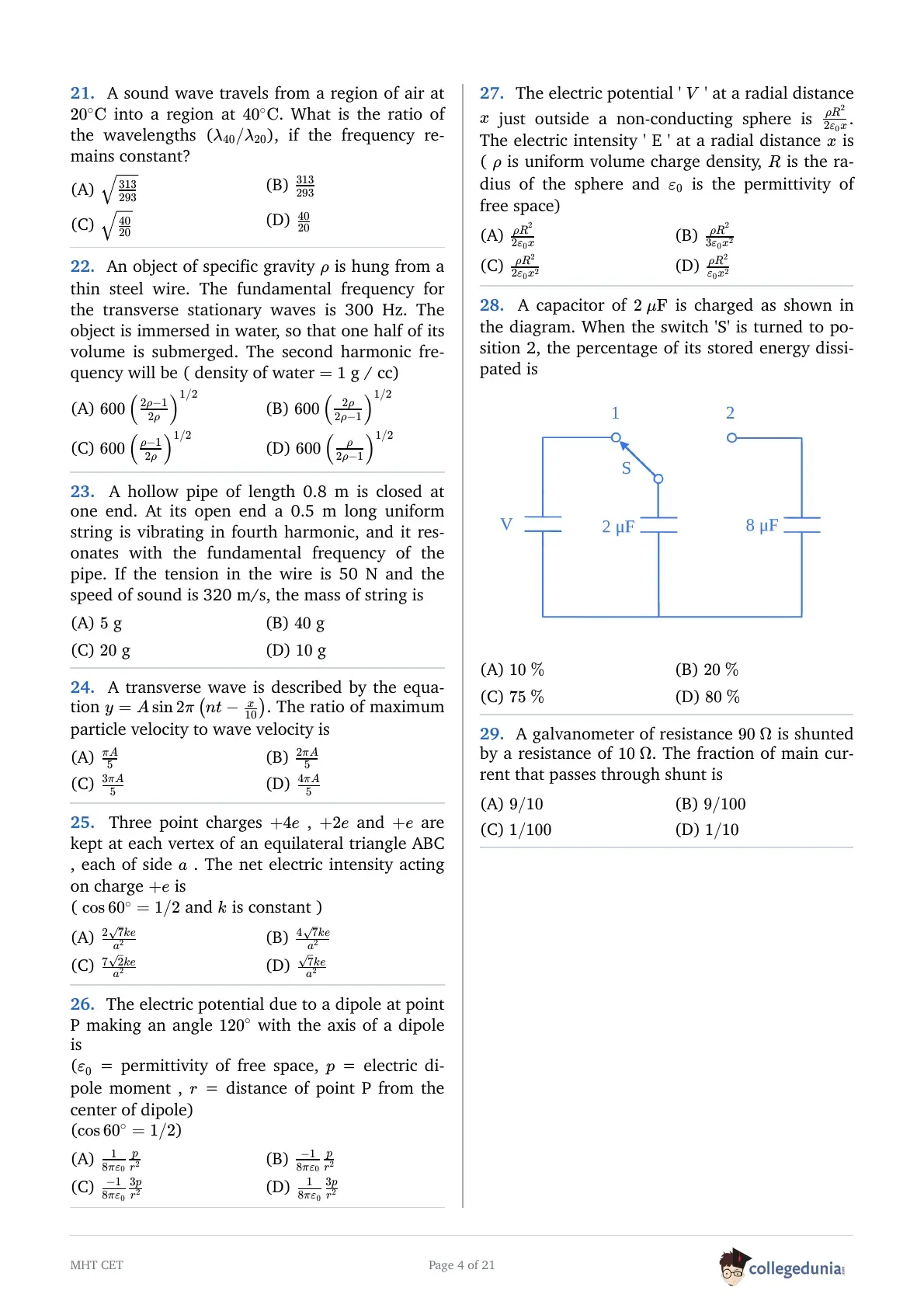
A capacitor of \(2\ \mu \text{F}\) is charged as shown in the diagram. When the switch 'S' is turned to position 2, the percentage of its stored energy dissipated is

  • (A) \(10\ \%\)
  • (B) \(20\ \%\)
  • (C) \(75\ \%\)
  • (D) \(80\ \%\)

Question 29:

A galvanometer of resistance \(90\ \Omega\) is shunted by a resistance of \(10\ \Omega\). The fraction of main current that passes through shunt is

  • (A) \(9/10\)
  • (B) \(9/100\)
  • (C) \(1/100\)
  • (D) \(1/10\)

Question 30:

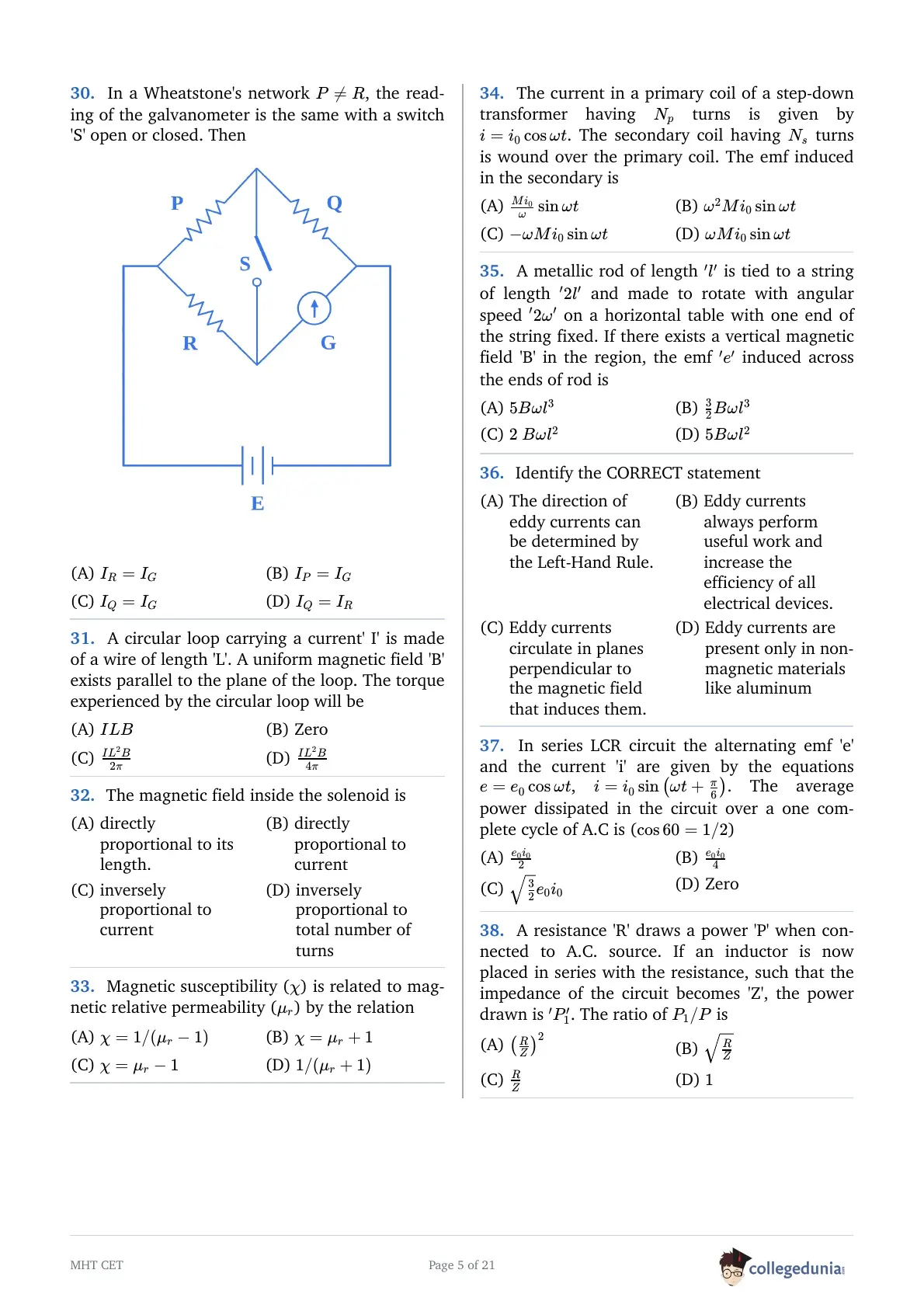
In a Wheatstone's network \(P\neq R\), the reading of the galvanometer is the same with a switch 'S' open or closed. Then

  • (A) \(I_{R}=I_{G}\)
  • (B) \(I_{P}=I_{G}\)
  • (C) \(I_{Q}=I_{G}\)
  • (D) \(I_{Q}=I_{R}\)

Question 31:

A circular loop carrying a current' I' is made of a wire of length 'L'. A uniform magnetic field 'B' exists parallel to the plane of the loop. The torque experienced by the circular loop will be

  • (A) \(ILB\)
  • (B) Zero
  • (C) \(\frac{IL^{2}B}{2\pi }\)
  • (D) \(\frac{IL^{2}B}{4\pi }\)

Question 32:

The magnetic field inside the solenoid is

  • (A) directly proportional to its length.
  • (B) directly proportional to current
  • (C) inversely proportional to current
  • (D) inversely proportional to total number of turns

Question 33:

Magnetic susceptibility (\(\chi\)) is related to magnetic relative permeability (\(\mu _{r}\)) by the relation

  • (A) \(\chi =1/(\mu _{r}-1)\)
  • (B) \(\chi =\mu _{r}+1\)
  • (C) \(\chi =\mu _{r}-1\)
  • (D) \(1/(\mu _{r}+1)\)

Question 34:

The current in a primary coil of a step-down transformer having \(N_{p}\) turns is given by \(i=i_{0}\cos \omega t\). The secondary coil having \(N_{s}\) turns is wound over the primary coil. The emf induced in the secondary is

  • (A) \(\frac{Mi_{0}}{\omega }\sin \omega t\)
  • (B) \(\omega ^{2}Mi_{0}\sin \omega t\)
  • (C) \(-\omega Mi_{0}\sin \omega t\)
  • (D) \(\omega Mi_{0}\sin \omega t\)

Question 35:

A metallic rod of length \({}'l'\) is tied to a string of length \({}'2l'\) and made to rotate with angular speed \({}'2\omega '\) on a horizontal table with one end of the string fixed. If there exists a vertical magnetic field 'B' in the region, the emf \({}'e'\) induced across the ends of rod is

  • (A) \(5B\omega l^{3}\)
  • (B) \(\frac{3}{2}B\omega l^{3}\)
  • (C) \(2\ B\omega l^{2}\)
  • (D) \(5B\omega l^{2}\)

Question 36:

Identify the CORRECT statement

  • (A) The direction of eddy currents can be determined by the Left-Hand Rule.
  • (B) Eddy currents always perform useful work and increase the efficiency of all electrical devices.
  • (C) Eddy currents circulate in planes perpendicular to the magnetic field that induces them.
  • (D) Eddy currents are present only in non-magnetic materials like aluminum

Question 37:

In series LCR circuit the alternating emf 'e' and the current 'i' are given by the equations \(e=e_{0}\cos \omega t\), \(i=i_{0}\sin \left(\omega t+\frac{\pi }{6}\right)\). The average power dissipated in the circuit over a one complete cycle of A.C is (\(\cos 60=1/2\))

  • (A) \(\frac{e_{0}i_{0}}{2}\)
  • (B) \(\frac{e_{0}i_{0}}{4}\)
  • (C) \(\sqrt{\frac{3}{2}}e_{0}i_{0}\)
  • (D) Zero

Question 38:

A resistance 'R' draws a power 'P' when connected to A.C. source. If an inductor is now placed in series with the resistance, such that the impedance of the circuit becomes 'Z', the power drawn is \({}'P_{1}'\). The ratio of \(P_{1}/P\) is

  • (A) \(\left(\frac{R}{Z}\right)^{2}\)
  • (B) \(\sqrt{\frac{R}{Z}}\)
  • (C) \(\frac{R}{Z}\)
  • (D) \(1\)

Question 39:

The r.m.s value of current in a 50 Hz A.C. circuit is 10 A. The average value of A.C. current over a cycle is

  • (A) Zero
  • (B) 10 A
  • (C) 7.072 A
  • (D) 14.14 A

Question 40:

Three beams of blue, green and orange colour are made to pass separately through a prism . In the position of minimum deviation, the angle of refraction will be (the angle of prism is \(60^{\circ }\))

  • (A) \(30^{\circ }\) for blue , green and orange colour
  • (B) \(30^{\circ }\) only for blue colour
  • (C) \(30^{\circ }\) only for green colour
  • (D) \(30^{\circ }\) only for orange colour

Question 41:

In an experiment to measure the power of a convex lens, the least count of measuring scale for the position of object \(u\) and the position of image \(v\) are \(\Delta u\) and \(\Delta v\) respectively. The error \(\Delta P\) in measurement of power of a convex lens will be

  • (A) \(\frac{\Delta v}{v^{2}}+\frac{\Delta u}{u^{2}}\)
  • (B) \(\frac{\Delta v}{v}+\frac{\Delta u}{u}\)
  • (C) \(\frac{1}{\frac{\Delta v}{v}+\frac{\Delta u}{u}}\)
  • (D) \(\frac{1}{\frac{\Delta v}{v^{2}}+\frac{\Delta u}{u^{2}}}\)

Question 42:

An unpolarized beam of light having flux \(10^{-2}\) W falls normally on a rotating polarizer of cross-sectional area \(3\times 10^{-4}\) \(\text{m}^{2}\). If the energy of light passing through the polarizer per revolution is \(10^{-2}\) J, then the polarizer is rotating with the angular frequency of

  • (A) \(\pi\) rad/s
  • (B) \(2\pi\) rad/s
  • (C) \(3\pi\) rad/s
  • (D) \(\frac{\pi }{2}\) rad/s

Question 43:

The equation of two interfering light waves are
\(y_{1}=b\cos \omega t\) and \(y_{2}=b\sin (\omega t+\Phi )\).
If the light waves interfere destructively, then the possible value of \(\Phi\) are

  • (A) \(\frac{3\pi }{2},\frac{5\pi }{2},\frac{13\pi }{2},\ldots \ldots\)
  • (B) \(\frac{3\pi }{2},\frac{7\pi }{2},\frac{13\pi }{2},\ldots\)
  • (C) \(\frac{3\pi }{2},\frac{7\pi }{2},\frac{11\pi }{2},\ldots \ldots\)
  • (D) \(\frac{3\pi }{2},\frac{9\pi }{2},\frac{11\pi }{2},\ldots \ldots\)

Question 44:

The condition for observing Fraunhofer diffraction from a single slit is that the wavefront incident on a single slit must be

  • (A) spherical.
  • (B) plane.
  • (C) cylindrical.
  • (D) elliptical.

Question 45:

At the stopping potential, the photoelectrons have

  • (A) kinetic energy \(=0\)
  • (B) potential energy \(=0\)
  • (C) kinetic energy greater than potential energy
  • (D) Kinetic energy is maximum

Question 46:

The ratio of angular frequency (\(\omega\)) of an electron to the total energy ( E) of an electron in the first orbit of hydrogen atom is ( \(h\) is the Planck's constant)

  • (A) \(-h/4\pi\)
  • (B) \(-4\pi /h\)
  • (C) \(-2\pi /h\)
  • (D) \(-h/2\pi\)

Question 47:

The equation ;
\(4\ {}_{1}^{1}\text{H}\rightarrow {}_{2}^{4}\text{He}^{2+}+2\ e^{-}+26\ \text{MeV}\)
represents

  • (A) \(\beta\) - decay
  • (B) \(\gamma\) -decay
  • (C) fusion
  • (D) fission

Question 48:

Which of the following statements is NOT true?

  • (A) The resistance of the intrinsic semiconductors decreases with increase in temperature
  • (B) Doping pure silicon with trivalent impurities gives \(p\) - type semiconductor
  • (C) The majority carriers in \(n\) -type semiconductors are holes
  • (D) \(p\)-\(n\) junction diode has a negligible resistance in forward bias

Question 49:

The components which are used in regulated power supply as rectifier, filter and voltage regulator are

  • (A) transformer, inductor and capacitor
  • (B) transformer, capacitor and Zener diode
  • (C) p-n junction diodes, Zener diode and inductor
  • (D) p-n junction diode, capacitor and Zener diode

Question 50:

Identify the INCORRECT statement

  • (A) Dark current in photo diode flows only when the photodiode is reverse biased.
  • (B) Dark current in photo diode is caused by minority carriers flowing across the junction.
  • (C) Dark current in a photo diode is a small current, typically in the range of picoampere or nanoampere.
  • (D) Dark current in photo diode is only caused by external background radiation.

Chemistry (Q51 - Q100)

Question 51:

Which of the following gases has high vapour density at same temperature and pressure?

  • (A) \(\text{H}_{2}\)
  • (B) \(\text{O}_{2}\)
  • (C) \(\text{Cl}_{2}\)
  • (D) \(\text{CH}_{4}\)

Question 52:

Which of the following compounds has maximum number of molecules ?

  • (A) 2 g of \(\text{H}_{2}\)
  • (B) 7 g of \(\text{N}_{2}\)
  • (C) 8 g of \(\text{O}_{2}\)
  • (D) 20 g of \(\text{NO}_{2}\)

Question 53:

Identify a correct set of quantum numbers that represents the highest energy of an electron in an orbital from following.

  • (A) \(n=3,l=0,m_{l}=0,s=+1/2\)
  • (B) \(n=3,l=1,m_{l}=+1,s=+1/2\)
  • (C) \(n=3,l=2,m_{l}=+1,s=+1/2\)
  • (D) \(n=4,l=0,m_{l}=0,s=+1/2\)

Question 54:

The hydride with lowest acid strength among the following is

  • (A) \(\text{H}_{2}\text{Se}\)
  • (B) \(\text{H}_{2}\text{Te}\)
  • (C) \(\text{H}_{2}\text{O}\)
  • (D) \(\text{H}_{2}\text{S}\)

Question 55:

Which orbital overlap produces a \(\sigma\) bond in HCl?

  • (A) s\(-\)s
  • (B) s\(-\)p
  • (C) p\(-\)p
  • (D) p\(-\)d

Question 56:

Calculate the work done when an ideal gas expands from \(1\times 10^{-3}\) to \(1\times 10^{-2}\ \text{m}^{3}\) at 300 K against constant pressure of \(1\times 10^{5}\ \text{Nm}^{-2}\).

  • (A) 900kJ
  • (B) \(-900\)kJ
  • (C) 270kJ
  • (D) \(-900\)J

Question 57:

Standard enthalpy of vaporization \(\Delta _{vap}H^{0}\) for water at \(100^{\circ }\text{C}\) is 40.66 kJ \(\text{mol}^{-1}\). What is the internal energy of vaporization of water at \(100^{\circ }\text{C}\) (in kJ \(\text{mol}^{-1}\))?

  • (A) \(+37.56\)
  • (B) \(-43.76\)
  • (C) \(+43.76\)
  • (D) \(+40.66\)

Question 58:

Which of the following processes exhibits that \(\Delta U=Q_{v}\) ?

  • (A) Isothermal
  • (B) Isobaric
  • (C) Isochoric
  • (D) Adiabatic

Question 59:

The degree of dissociation of a monobasic acid in its 0.1M solution at 300 K is \(1.342\times 10^{-2}\). Calculate the degree of dissociation of the same acid in its 0.02M solution.

  • (A) \(1.0\times 10^{-2}\)
  • (B) \(2.0\times 10^{-2}\)
  • (C) \(3.0\times 10^{-2}\)
  • (D) \(4.0\times 10^{-2}\)

Question 60:

In the washing of precipitates, the wash liquid should contain a common ion with the precipitate for

  • (A) increasing the ionisation and increasing the solubility
  • (B) increasing the ionisation and decreasing the solubility
  • (C) suppressing the ionisation and decreasing the solubility
  • (D) suppressing the ionisation and increasing the solubility

Question 61:

Identify from following an example of Lewis acid.

  • (A) \(\text{H}_{2}\text{SO}_{4}\)
  • (B) \(\text{HClO}_{4}\)
  • (C) \(\text{CH}_{3}\text{COOH}\)
  • (D) \(\text{BF}_{3}\)

Question 62:

The oxidation process involves

  • (A) Increase in oxidation number
  • (B) Addition of hydrogen
  • (C) Removal of electronegative element
  • (D) Gain of electrons

Question 63:

Which of the following substance does NOT contain \(\text{CaCO}_{3}\)?

  • (A) Marble
  • (B) Chalk
  • (C) Limestone
  • (D) Slaked lime

Question 64:

Which of the following instruments is used to find out absorption of functional groups?

  • (A) Xray diffractometer
  • (B) UV-visible spectrophotometer
  • (C) Scanning electron microscope
  • (D) Fourier transform Infrared spectrophotometer

Question 65:

Which of the following is a gas at room temperature ?

  • (A) Propanal
  • (B) Acetaldehyde
  • (C) Formaldehyde
  • (D) Acetone

Question 66:

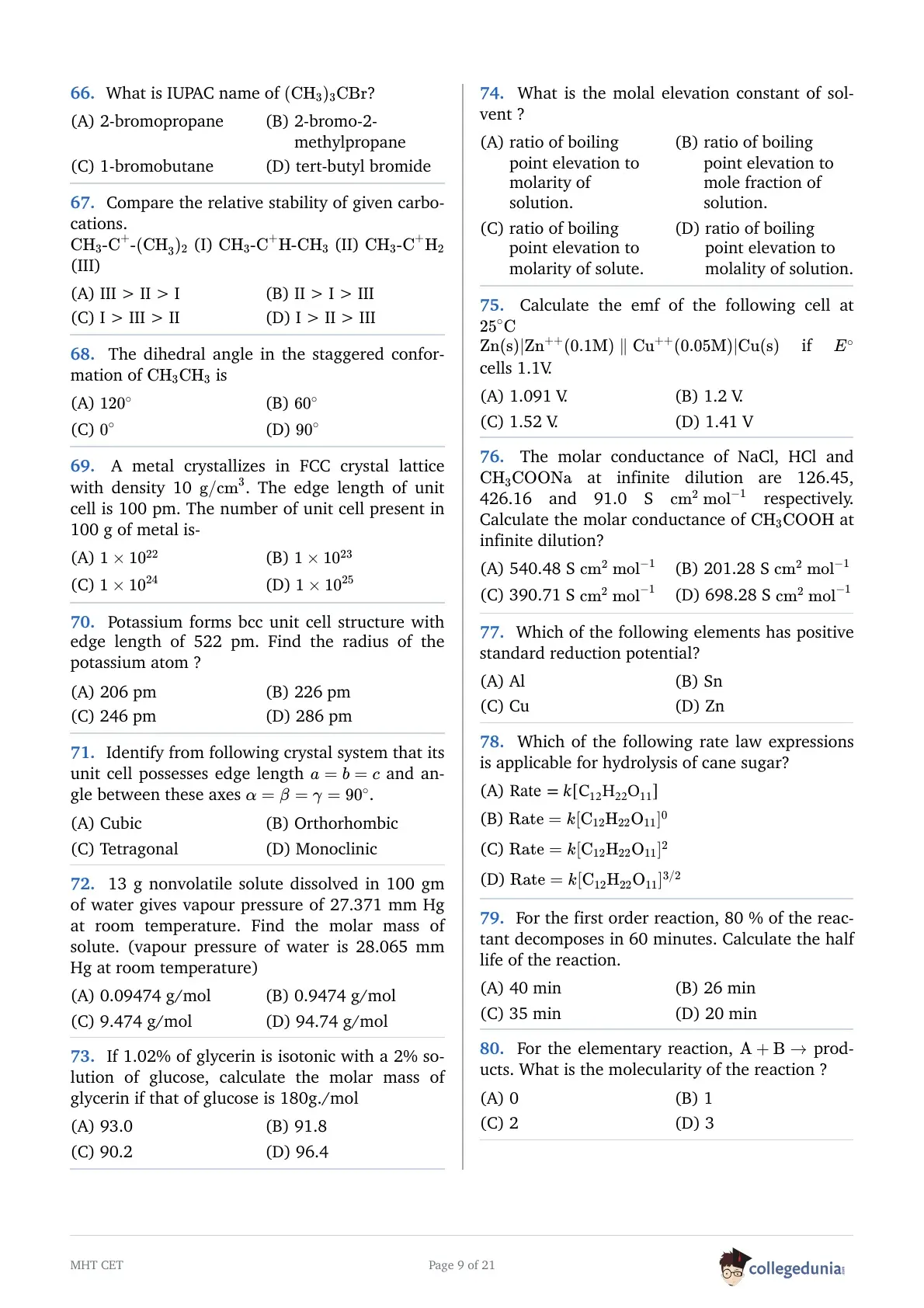
What is IUPAC name of \((\text{CH}_{3})_{3}\text{CBr}\)?

  • (A) 2-bromopropane
  • (B) 2-bromo-2-methylpropane
  • (C) 1-bromobutane
  • (D) tert-butyl bromide

Question 67:

Compare the relative stability of given carbocations.
\(\text{CH}_{3}\text{-}\text{C}^{+}\text{-(CH}_{3})_{2}\) (I) \(\text{CH}_{3}\text{-}\text{C}^{+}\text{H-CH}_{3}\) (II) \(\text{CH}_{3}\text{-}\text{C}^{+}\text{H}_{2}\) (III)

  • (A) III > II > I
  • (B) II > I > III
  • (C) I > III > II
  • (D) I > II > III

Question 68:

The dihedral angle in the staggered conformation of \(\text{CH}_{3}\text{CH}_{3}\) is

  • (A) \(120^{\circ }\)
  • (B) \(60^{\circ }\)
  • (C) \(0^{\circ }\)
  • (D) \(90^{\circ }\)

Question 69:

A metal crystallizes in FCC crystal lattice with density 10 \(\text{g/cm}^{3}\). The edge length of unit cell is 100 pm. The number of unit cell present in 100 g of metal is-

  • (A) \(1\times 10^{22}\)
  • (B) \(1\times 10^{23}\)
  • (C) \(1\times 10^{24}\)
  • (D) \(1\times 10^{25}\)

Question 70:

Potassium forms bcc unit cell structure with edge length of 522 pm. Find the radius of the potassium atom ?

  • (A) 206 pm
  • (B) 226 pm
  • (C) 246 pm
  • (D) 286 pm

Question 71:

Identify from following crystal system that its unit cell possesses edge length \(a=b=c\) and angle between these axes \(\alpha =\beta =\gamma =90^{\circ }\).

  • (A) Cubic
  • (B) Orthorhombic
  • (C) Tetragonal
  • (D) Monoclinic

Question 72:

13 g nonvolatile solute dissolved in 100 gm of water gives vapour pressure of 27.371 mm Hg at room temperature. Find the molar mass of solute. (vapour pressure of water is 28.065 mm Hg at room temperature)

  • (A) 0.09474 g/mol
  • (B) 0.9474 g/mol
  • (C) 9.474 g/mol
  • (D) 94.74 g/mol

Question 73:

If 1.02% of glycerin is isotonic with a 2% solution of glucose, calculate the molar mass of glycerin if that of glucose is 180g./mol

  • (A) 93.0
  • (B) 91.8
  • (C) 90.2
  • (D) 96.4

Question 74:

What is the molal elevation constant of solvent ?

  • (A) ratio of boiling point elevation to molarity of solution.
  • (B) ratio of boiling point elevation to mole fraction of solution.
  • (C) ratio of boiling point elevation to molarity of solute.
  • (D) ratio of boiling point elevation to molality of solution.

Question 75:

Calculate the emf of the following cell at \(25^{\circ }\text{C}\)
\(\text{Zn(s)}|\text{Zn}^{++}(0.1\text{M})\parallel \text{Cu}^{++}(0.05\text{M})|\text{Cu(s)}\) if \(E^{\circ }\) cells 1.1V.

  • (A) 1.091 V.
  • (B) 1.2 V.
  • (C) 1.52 V.
  • (D) 1.41 V

Question 76:

The molar conductance of NaCl, HCl and \(\text{CH}_{3}\text{COONa}\) at infinite dilution are 126.45, 426.16 and 91.0 S \(\text{cm}^{2}\ \text{mol}^{-1}\) respectively. Calculate the molar conductance of \(\text{CH}_{3}\text{COOH}\) at infinite dilution?

  • (A) 540.48 S \(\text{cm}^{2}\ \text{mol}^{-1}\)
  • (B) 201.28 S \(\text{cm}^{2}\ \text{mol}^{-1}\)
  • (C) 390.71 S \(\text{cm}^{2}\ \text{mol}^{-1}\)
  • (D) 698.28 S \(\text{cm}^{2}\ \text{mol}^{-1}\)

Question 77:

Which of the following elements has positive standard reduction potential?

  • (A) Al
  • (B) Sn
  • (C) Cu
  • (D) Zn

Question 78:

Which of the following rate law expressions is applicable for hydrolysis of cane sugar?

  • (A) \(\text{Rate}=k[\text{C}_{12}\text{H}_{22}\text{O}_{11}]\)
  • (B) \(\text{Rate}=k[\text{C}_{12}\text{H}_{22}\text{O}_{11}]^{0}\)
  • (C) \(\text{Rate}=k[\text{C}_{12}\text{H}_{22}\text{O}_{11}]^{2}\)
  • (D) \(\text{Rate}=k[\text{C}_{12}\text{H}_{22}\text{O}_{11}]^{3/2}\)

Question 79:

For the first order reaction, 80 % of the reactant decomposes in 60 minutes. Calculate the half life of the reaction.

  • (A) 40 min
  • (B) 26 min
  • (C) 35 min
  • (D) 20 min

Question 80:

For the elementary reaction, \(\text{A}+\text{B}\rightarrow\) products. What is the molecularity of the reaction ?

  • (A) 0
  • (B) 1
  • (C) 2
  • (D) 3

Question 81:

Which of the following statements is not true about absorption?

  • (A) Concentration of the absorbate is uniform through the bulk of the absorbent.
  • (B) It is independent of temperature and pressure.
  • (C) It is not accompanied by any evolution or absorption of heat.
  • (D) It depends on the surface area.

Question 82:

Identify the correct order of acidity of the following compounds.

  • (A) \(\text{HClO}_{2}\lt \text{HClO}\lt \text{HClO}_{3}\lt \text{HClO}_{4}\)
  • (B) \(\text{HClO}_{4}\lt \text{HClO}_{2}\lt \text{HClO}\lt \text{HClO}_{3}\)
  • (C) \(\text{HClO}_{3}\lt \text{HClO}_{4}\lt \text{HClO}_{2}\lt \text{HClO}\)
  • (D) \(\text{HClO}\lt \text{HClO}_{2}\lt \text{HClO}_{3}\lt \text{HClO}_{4}\)

Question 83:

Calculate the value of magnetic moment in \(\text{Cr}^{3+}\)

  • (A) 1.75 BM
  • (B) 2.84 BM
  • (C) 3.87 BM
  • (D) 4.9 BM

Question 84:

Identify the element of first transition series that has the highest melting point.

  • (A) Vanadium
  • (B) Chromium
  • (C) Manganese
  • (D) Iron

Question 85:

What quantity of AgCl is precipitated when one mole of Pentaamminecarbonatocobalt(III) chloride is treated with excess \(\text{AgNO}_{3}\) (molar mass \(=143.3\) g \(\text{mol}^{-1}\)) solution?

  • (A) 143.3 g
  • (B) 72.0 g
  • (C) 286.6 g
  • (D) 215.0 g

Question 86:

Identify the anionic sphere complex from following.

  • (A) Triamminetrinitrocobalt(III)
  • (B) Tetramminecopper(II) ion
  • (C) Sodium hexanitrocobaltate(III)
  • (D) Pentacarbonyliron(0)

Question 87:

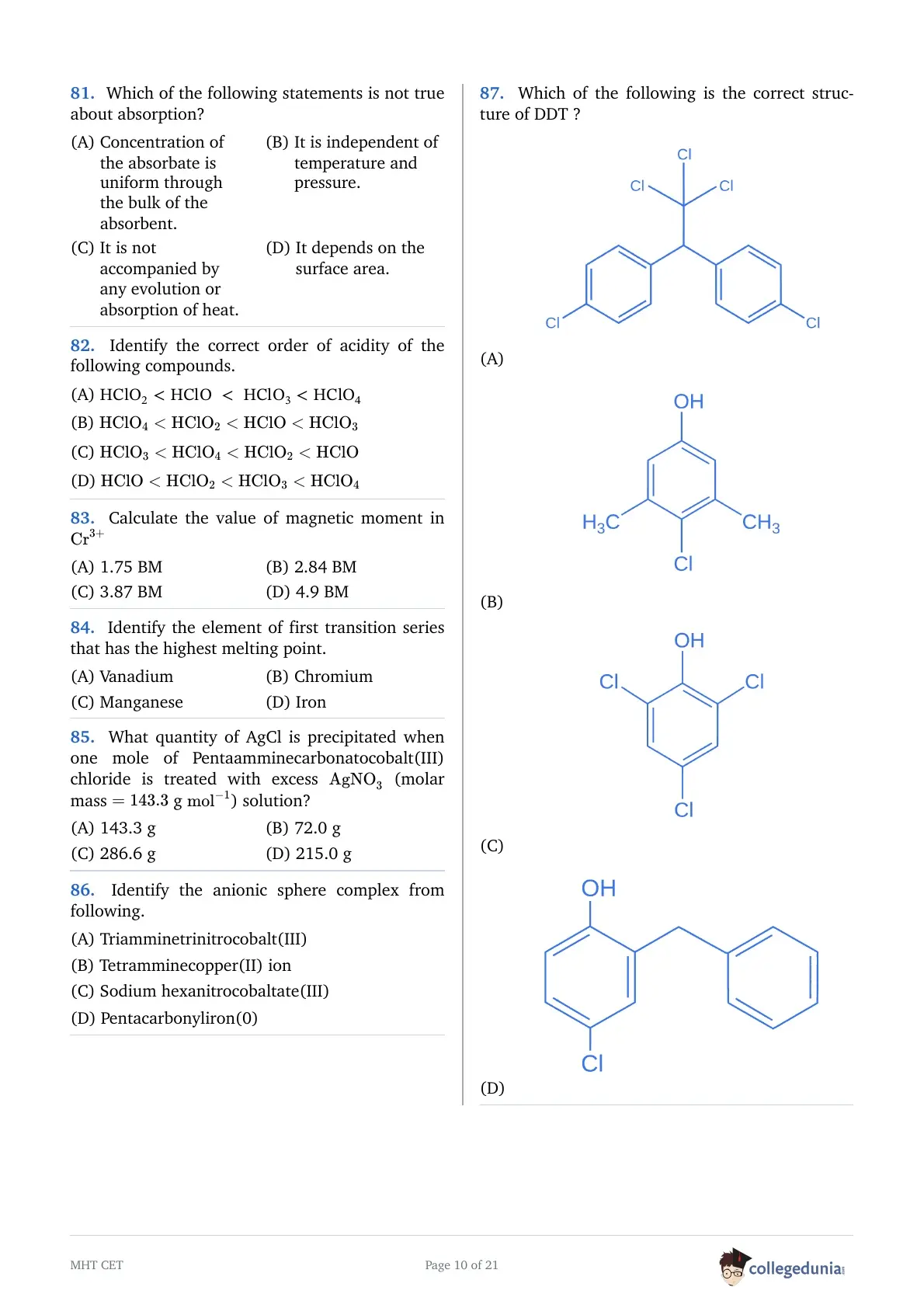
Which of the following is the correct structure of DDT ?

  • (A)
  • (B)
  • (C)
  • (D)

Question 88:

Which of the following reactions is used to prepare salicylaldehyde from phenol ?

  • (A) Kolbe's reaction
  • (B) Reimer-Tiemann reaction
  • (C) Williamson synthesis
  • (D) Esterification

Question 89:

Identify the name of \(\text{CH}_{3}\text{CH}_{2}\text{OH}\) according to carbinol system .

  • (A) Methyl carbinol
  • (B) Ethyl carbinol
  • (C) Carbinol
  • (D) Ethanol

Question 90:

In the given reaction, the product "Z" is -
\(\text{CH}_{3}\text{-CH(OH)-CH}_{3}\xrightarrow{\text{Cu / 573 K . oxidation}}\text{Z}\)

  • (A) \(\text{CH}_{3}\text{-CHO}\)
  • (B) \(\text{CH}_{3}\text{-CO-CH}_{3}\)
  • (C) \(\text{CH}_{3}\text{-CH=CH}_{2}\)
  • (D) \(\text{CH}_{3}\text{-CH}_{2}\text{-COOH}\)

Question 91:

Which of the following reagents is used for converting alcohol to alkyl chloride?

  • (A) \(\text{SOCl}_{2}\)
  • (B) \(\text{H}_{2}\text{SO}_{4}\)
  • (C) HCl only
  • (D) PCC

Question 92:

Identify a catalyst used in Stephen reaction from the following.

  • (A) \(\text{ZnCl}_{2}\) and HCl
  • (B) \(\text{HgCl}_{2}\) and HCl
  • (C) \(\text{SnCl}_{2}\) and HCl
  • (D) AgCl and HCl

Question 93:

Which of the following reactions converts \(>\text{C=O}\) to \(>\text{CH}_{2}\) ?
(A) Rosenmund's reaction
(B) Aldol condensation
(C) Clemmensen's reduction
(D) Wolff–Kishner reduction
Choose the correct answer from the options given below:

  • (A) (A) and (D) only.
  • (B) (C) and (D) only.
  • (C) (A), (B), (C) and (D).
  • (D) (B), (C) and (D) only.

Question 94:

Identify the product when ethyl amine reacts with nitrous acid in cold.

  • (A) \(\text{CH}_{3}\text{CH}_{2}\text{NO}_{2}\)
  • (B) \(\text{CH}_{3}\text{CHO}\)
  • (C) \(\text{CH}_{3}\text{CH}_{2}\text{OH}\)
  • (D) \(\text{CH}_{3}\text{CH}_{2}\text{NC}\)

Question 95:

Identify the reaction that converts \(\text{CH}_{3}\text{CN}\) to \(\text{CH}_{3}\text{-CH}_{2}\text{-NH}_{2}\) .

  • (A) Mendius reduction
  • (B) Hofmann reduction
  • (C) Clemmensen reduction
  • (D) Rosenmund reduction

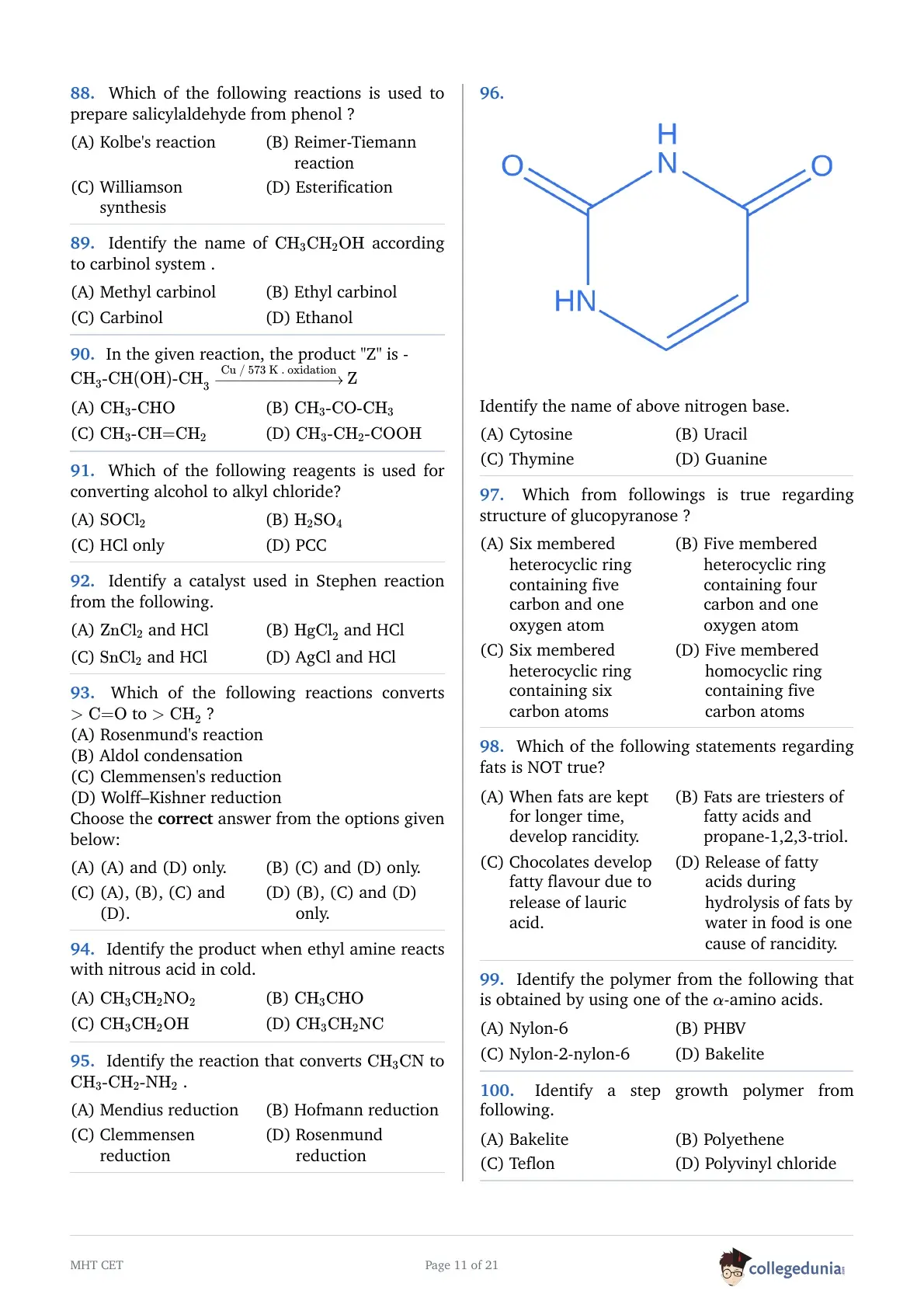
Question 96:

  • (A) Cytosine
  • (B) Uracil
  • (C) Thymine
  • (D) Guanine

Question 97:

Which from followings is true regarding structure of glucopyranose ?

  • (A) Six membered heterocyclic ring containing five carbon and one oxygen atom
  • (B) Five membered heterocyclic ring containing four carbon and one oxygen atom
  • (C) Six membered heterocyclic ring containing six carbon atoms
  • (D) Five membered homocyclic ring containing five carbon atoms

Question 98:

Which of the following statements regarding fats is NOT true?

  • (A) When fats are kept for longer time, develop rancidity.
  • (B) Fats are triesters of fatty acids and propane-1,2,3-triol.
  • (C) Chocolates develop fatty flavour due to release of lauric acid.
  • (D) Release of fatty acids during hydrolysis of fats by water in food is one cause of rancidity.

Question 99:

Identify the polymer from the following that is obtained by using one of the \(\alpha\)-amino acids.

  • (A) Nylon-6
  • (B) PHBV
  • (C) Nylon-2-nylon-6
  • (D) Bakelite

Question 100:

Identify a step growth polymer from following.

  • (A) Bakelite
  • (B) Polyethene
  • (C) Teflon
  • (D) Polyvinyl chloride

Biology (Q101 - Q200)

Question 101:

The most primitive animal with a central nervous system (CNS) located on the ventral side of body is-------.

  • (A) Hydra
  • (B) Planaria
  • (C) Sycon
  • (D) Scoliodon

Question 102:

Sponges and Coelenterates respire through-------------------.

  • (A) Book gills
  • (B) Plasma membrane
  • (C) Book lungs
  • (D) Cloaca

Question 103:

Which one of the following listed organs are mesodermal in origin ?

  • (A) Muscles, blood, liver, vagina
  • (B) Bones, heart, lens, tongue
  • (C) Blood, heart, retina, pancreas
  • (D) Muscles, blood, kidneys, gonads

Question 104:

The special tissue present in the epiphytic roots for absorption of water vapours from air --------.

  • (A) hydathodes
  • (B) lenticels
  • (C) velamen
  • (D) phloem

Question 105:

Which of the following statement is INCORRECT about enzyme substrate complex ?

  • (A) The substrate induces the enzyme to alter its shape.
  • (B) The substrate is completely bound to the enzyme.
  • (C) It breaks the chemical bonds of the substrate.
  • (D) The shape of an enzyme changes permanently after the formation of the enzyme-substrate complex.

Question 106:

Identify the enzyme that is NOT an isomerase type.

  • (A) Epimerases
  • (B) Sucrases
  • (C) Racemases
  • (D) Mutases

Question 107:

Identify the INCORRECT statement with respect to enzymatic activity.

  • (A) Increase in the substrate concentration increases the velocity of enzyme activity.
  • (B) Km value is a constant and a characteristic feature of a given enzyme.
  • (C) The activity of enzymes is increased at low temperature.
  • (D) The rate of reaction is increased with the increasing concentration of the enzyme.

Question 108:

The example of unsaturated fatty acid which is found in many seed oils is

  • (A) Lecithin
  • (B) Palmitic acid
  • (C) Stearic acid
  • (D) Linolenic acid

Question 109:

Cleavage differs from normal mitotic divisions as

  • (A) There is no nuclear division during cleavage.
  • (B) There is no division of cytoplasm during cleavage.
  • (C) There is no growth phase between the cleavages.
  • (D) The division of cytoplasm follows nuclear division.

Question 110:

Rate of cuticular transpiration is ------------------ to the thickness of cuticle.

  • (A) Not related
  • (B) Equal
  • (C) Inversely proportional
  • (D) Directly proportional

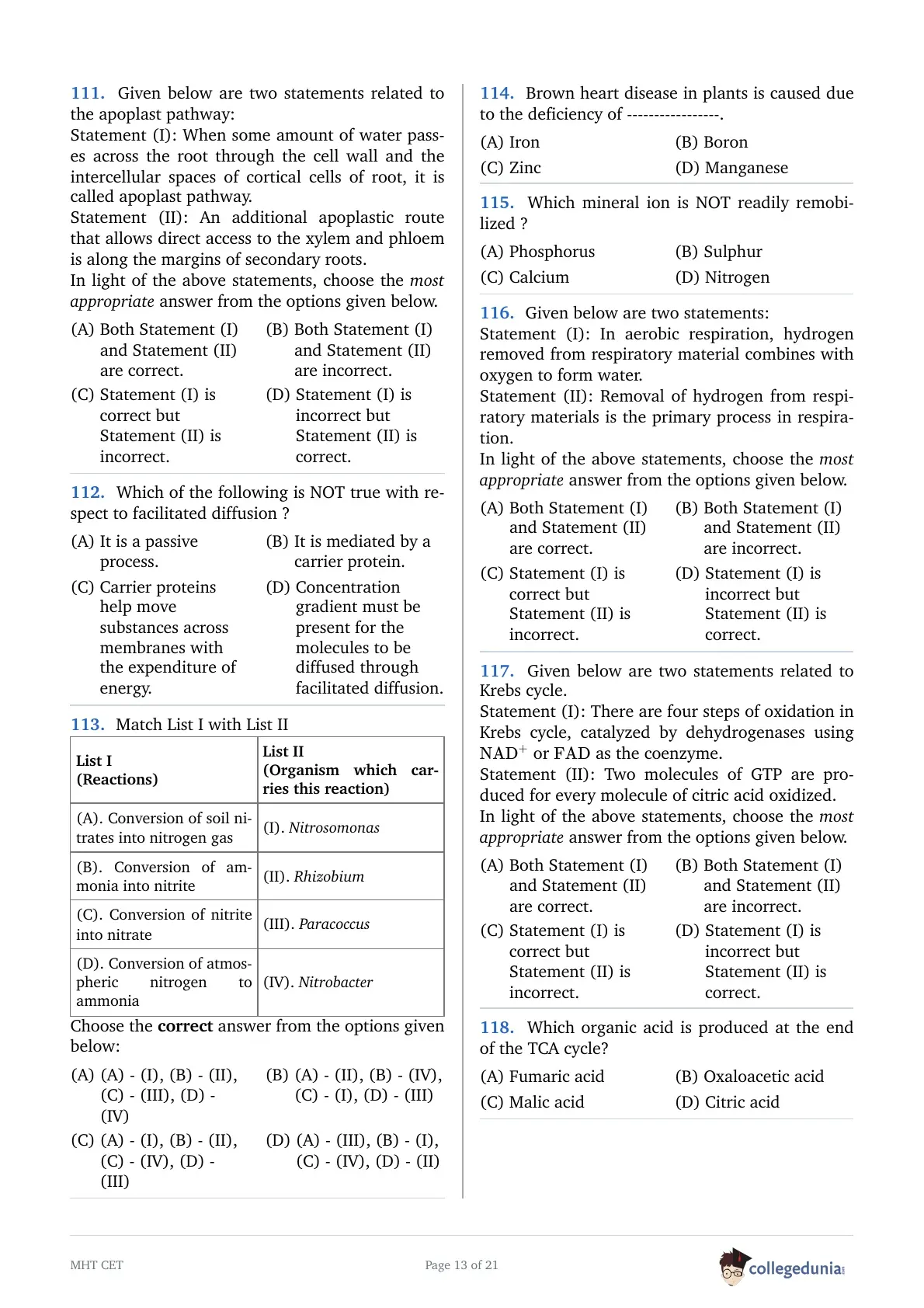
Question 111:

Given below are two statements related to the apoplast pathway:
Statement (I): When some amount of water passes across the root through the cell wall and the intercellular spaces of cortical cells of root, it is called apoplast pathway.
Statement (II): An additional apoplastic route that allows direct access to the xylem and phloem is along the margins of secondary roots.
In light of the above statements, choose the most appropriate answer from the options given below.

  • (A) Both Statement (I) and Statement (II) are correct.
  • (B) Both Statement (I) and Statement (II) are incorrect.
  • (C) Statement (I) is correct but Statement (II) is incorrect.
  • (D) Statement (I) is incorrect but Statement (II) is correct.

Question 112:

Which of the following is NOT true with respect to facilitated diffusion ?

  • (A) It is a passive process.
  • (B) It is mediated by a carrier protein.
  • (C) Carrier proteins help move substances across membranes with the expenditure of energy.
  • (D) Concentration gradient must be present for the molecules to be diffused through facilitated diffusion.

Question 113:

Match List I with List II

List I
(Reactions)
List II
(Organism which carries this reaction)
(A). Conversion of soil nitrates into nitrogen gas(I). Nitrosomonas
(B). Conversion of ammonia into nitrite(II). Rhizobium
(C). Conversion of nitrite into nitrate(III). Paracoccus
(D). Conversion of atmospheric nitrogen to ammonia(IV). Nitrobacter
  • (A) (A) - (I), (B) - (II), (C) - (III), (D) - (IV)
  • (B) (A) - (II), (B) - (IV), (C) - (I), (D) - (III)
  • (C) (A) - (I), (B) - (II), (C) - (IV), (D) - (III)
  • (D) (A) - (III), (B) - (I), (C) - (IV), (D) - (II)

Question 114:

Brown heart disease in plants is caused due to the deficiency of -----------------.

  • (A) Iron
  • (B) Boron
  • (C) Zinc
  • (D) Manganese

Question 115:

Which mineral ion is NOT readily remobilized ?

  • (A) Phosphorus
  • (B) Sulphur
  • (C) Calcium
  • (D) Nitrogen

Question 116:

Given below are two statements:
Statement (I): In aerobic respiration, hydrogen removed from respiratory material combines with oxygen to form water.
Statement (II): Removal of hydrogen from respiratory materials is the primary process in respiration.
In light of the above statements, choose the most appropriate answer from the options given below.

  • (A) Both Statement (I) and Statement (II) are correct.
  • (B) Both Statement (I) and Statement (II) are incorrect.
  • (C) Statement (I) is correct but Statement (II) is incorrect.
  • (D) Statement (I) is incorrect but Statement (II) is correct.

Question 117:

Given below are two statements related to Krebs cycle.
Statement (I): There are four steps of oxidation in Krebs cycle, catalyzed by dehydrogenases using \(\text{NAD}^{+}\) or \(\text{FAD}\) as the coenzyme.
Statement (II): Two molecules of GTP are produced for every molecule of citric acid oxidized.
In light of the above statements, choose the most appropriate answer from the options given below.

  • (A) Both Statement (I) and Statement (II) are correct.
  • (B) Both Statement (I) and Statement (II) are incorrect.
  • (C) Statement (I) is correct but Statement (II) is incorrect.
  • (D) Statement (I) is incorrect but Statement (II) is correct.

Question 118:

Which organic acid is produced at the end of the TCA cycle?

  • (A) Fumaric acid
  • (B) Oxaloacetic acid
  • (C) Malic acid
  • (D) Citric acid

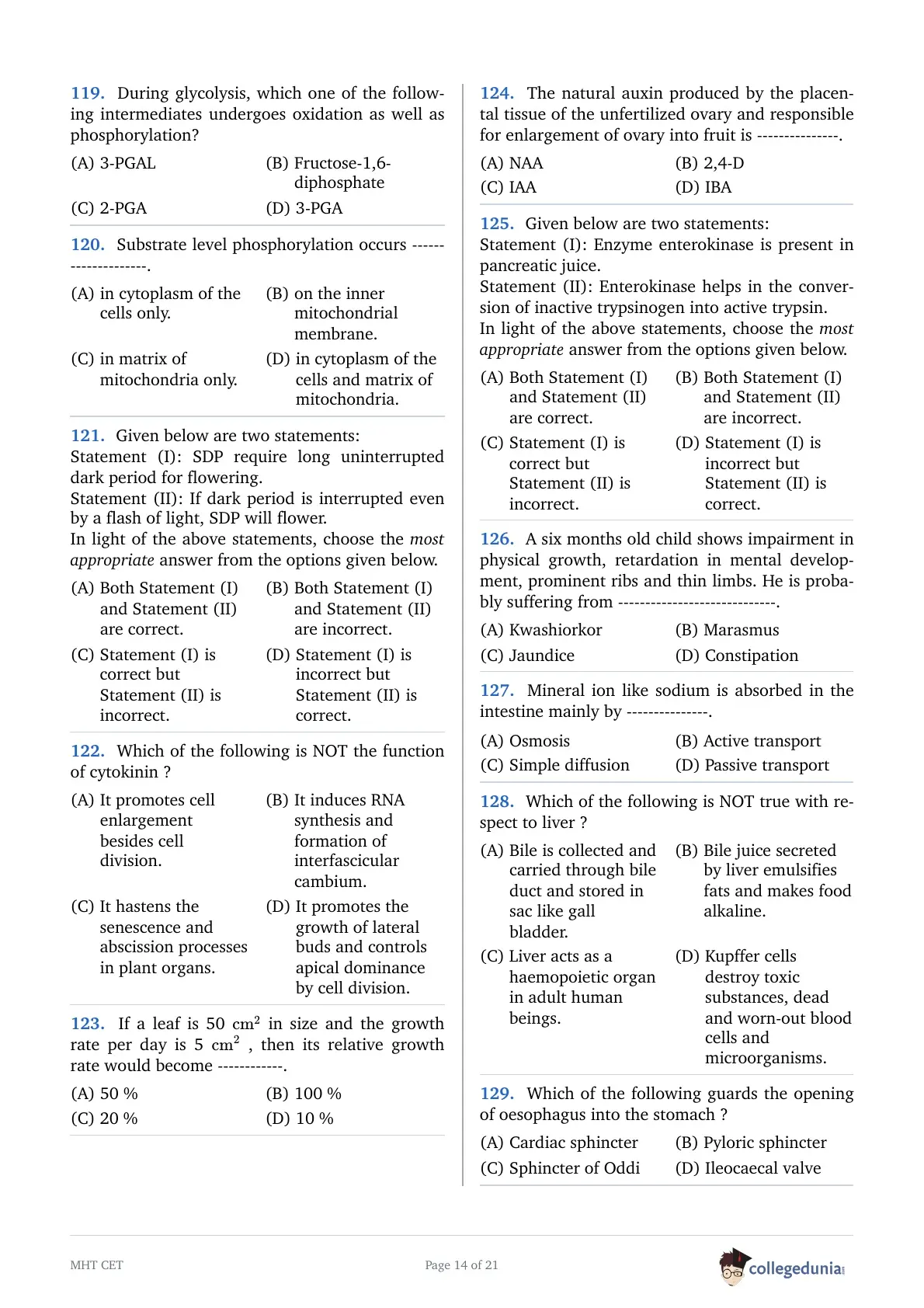
Question 119:

During glycolysis, which one of the following intermediates undergoes oxidation as well as phosphorylation?

  • (A) 3-PGAL
  • (B) Fructose-1,6-diphosphate
  • (C) 2-PGA
  • (D) 3-PGA

Question 120:

Substrate level phosphorylation occurs --------------------.

  • (A) in cytoplasm of the cells only.
  • (B) on the inner mitochondrial membrane.
  • (C) in matrix of mitochondria only.
  • (D) in cytoplasm of the cells and matrix of mitochondria.

Question 121:

Given below are two statements:
Statement (I): SDP require long uninterrupted dark period for flowering.
Statement (II): If dark period is interrupted even by a flash of light, SDP will flower.
In light of the above statements, choose the most appropriate answer from the options given below.

  • (A) Both Statement (I) and Statement (II) are correct.
  • (B) Both Statement (I) and Statement (II) are incorrect.
  • (C) Statement (I) is correct but Statement (II) is incorrect.
  • (D) Statement (I) is incorrect but Statement (II) is correct.

Question 122:

Which of the following is NOT the function of cytokinin ?

  • (A) It promotes cell enlargement besides cell division.
  • (B) It induces RNA synthesis and formation of interfascicular cambium.
  • (C) It hastens the senescence and abscission processes in plant organs.
  • (D) It promotes the growth of lateral buds and controls apical dominance by cell division.

Question 123:

If a leaf is 50 \(\text{cm}^{2}\) in size and the growth rate per day is 5 \(\text{cm}^{2}\) , then its relative growth rate would become ------------.

  • (A) 50 %
  • (B) 100 %
  • (C) 20 %
  • (D) 10 %

Question 124:

The natural auxin produced by the placental tissue of the unfertilized ovary and responsible for enlargement of ovary into fruit is ---------------.

  • (A) NAA
  • (B) 2,4-D
  • (C) IAA
  • (D) IBA

Question 125:

Given below are two statements:
Statement (I): Enzyme enterokinase is present in pancreatic juice.
Statement (II): Enterokinase helps in the conversion of inactive trypsinogen into active trypsin.
In light of the above statements, choose the most appropriate answer from the options given below.

  • (A) Both Statement (I) and Statement (II) are correct.
  • (B) Both Statement (I) and Statement (II) are incorrect.
  • (C) Statement (I) is correct but Statement (II) is incorrect.
  • (D) Statement (I) is incorrect but Statement (II) is correct.

Question 126:

A six months old child shows impairment in physical growth, retardation in mental development, prominent ribs and thin limbs. He is probably suffering from -----------------------------.

  • (A) Kwashiorkor
  • (B) Marasmus
  • (C) Jaundice
  • (D) Constipation

Question 127:

Mineral ion like sodium is absorbed in the intestine mainly by ---------------.

  • (A) Osmosis
  • (B) Active transport
  • (C) Simple diffusion
  • (D) Passive transport

Question 128:

Which of the following is NOT true with respect to liver ?

  • (A) Bile is collected and carried through bile duct and stored in sac like gall bladder.
  • (B) Bile juice secreted by liver emulsifies fats and makes food alkaline.
  • (C) Liver acts as a haemopoietic organ in adult human beings.
  • (D) Kupffer cells destroy toxic substances, dead and worn-out blood cells and microorganisms.

Question 129:

Which of the following guards the opening of oesophagus into the stomach ?

  • (A) Cardiac sphincter
  • (B) Pyloric sphincter
  • (C) Sphincter of Oddi
  • (D) Ileocaecal valve

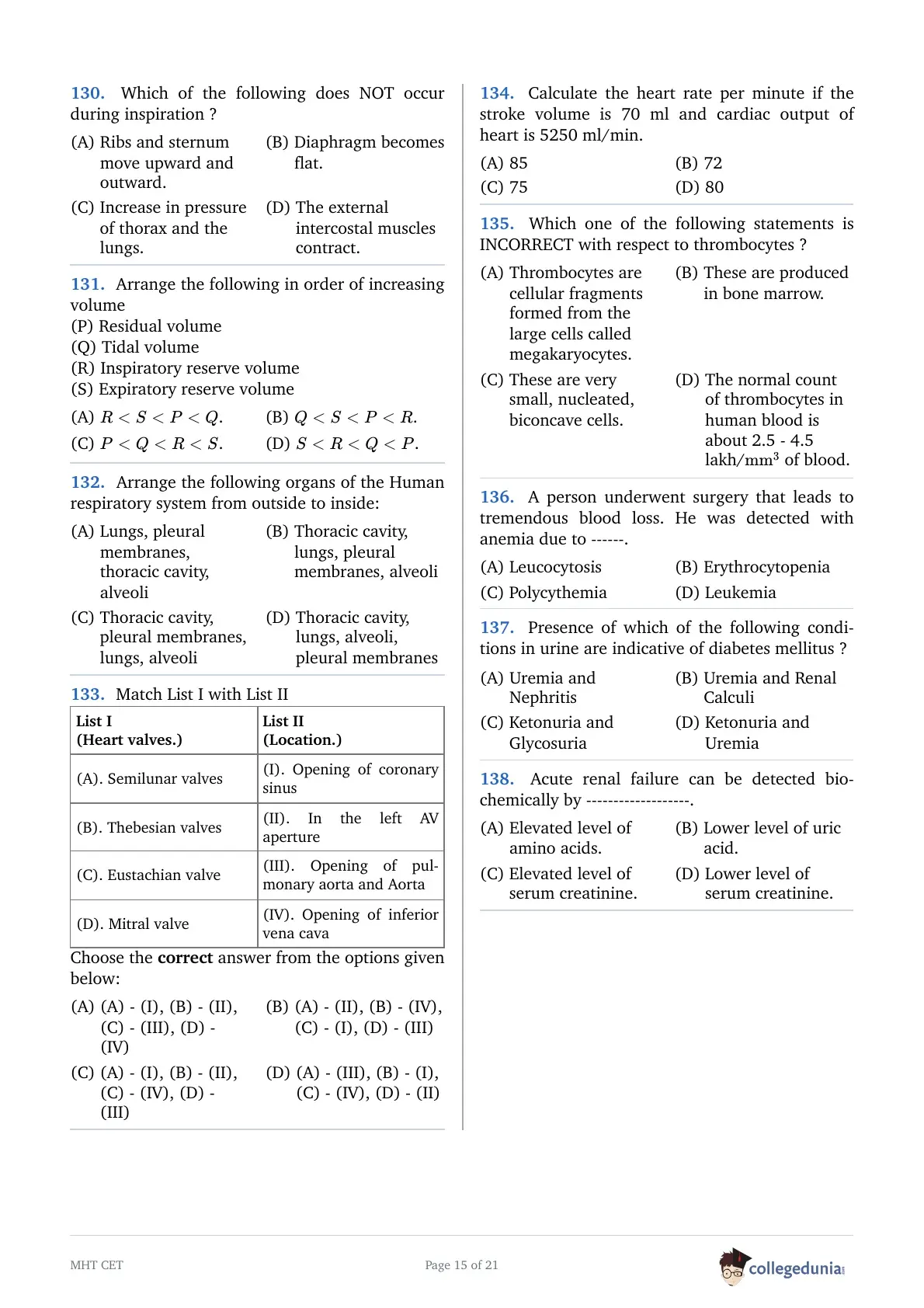
Question 130:

Which of the following does NOT occur during inspiration ?

  • (A) Ribs and sternum move upward and outward.
  • (B) Diaphragm becomes flat.
  • (C) Increase in pressure of thorax and the lungs.
  • (D) The external intercostal muscles contract.

Question 131:

Arrange the following in order of increasing volume
(P) Residual volume
(Q) Tidal volume
(R) Inspiratory reserve volume
(S) Expiratory reserve volume

  • (A) \(R\lt S\lt P\lt Q\).
  • (B) \(Q\lt S\lt P\lt R\).
  • (C) \(P\lt Q\lt R\lt S\).
  • (D) \(S\lt R\lt Q\lt P\).

Question 132:

Arrange the following organs of the Human respiratory system from outside to inside:

  • (A) Lungs, pleural membranes, thoracic cavity, alveoli
  • (B) Thoracic cavity, lungs, pleural membranes, alveoli
  • (C) Thoracic cavity, pleural membranes, lungs, alveoli
  • (D) Thoracic cavity, lungs, alveoli, pleural membranes

Question 133:

Match List I with List II

List I
(Heart valves.)
List II
(Location.)
(A). Semilunar valves(I). Opening of coronary sinus
(B). Thebesian valves(II). In the left AV aperture
(C). Eustachian valve(III). Opening of pulmonary aorta and Aorta
(D). Mitral valve(IV). Opening of inferior vena cava
  • (A) (A) - (I), (B) - (II), (C) - (III), (D) - (IV)
  • (B) (A) - (II), (B) - (IV), (C) - (I), (D) - (III)
  • (C) (A) - (I), (B) - (II), (C) - (IV), (D) - (III)
  • (D) (A) - (III), (B) - (I), (C) - (IV), (D) - (II)

Question 134:

Calculate the heart rate per minute if the stroke volume is 70 ml and cardiac output of heart is 5250 ml/min.

  • (A) 85
  • (B) 72
  • (C) 75
  • (D) 80

Question 135:

Which one of the following statements is INCORRECT with respect to thrombocytes ?

  • (A) Thrombocytes are cellular fragments formed from the large cells called megakaryocytes.
  • (B) These are produced in bone marrow.
  • (C) These are very small, nucleated, biconcave cells.
  • (D) The normal count of thrombocytes in human blood is about 2.5 - 4.5 lakh/\(\text{mm}^{3}\) of blood.

Question 136:

A person underwent surgery that leads to tremendous blood loss. He was detected with anemia due to ------.

  • (A) Leucocytosis
  • (B) Erythrocytopenia
  • (C) Polycythemia
  • (D) Leukemia

Question 137:

Presence of which of the following conditions in urine are indicative of diabetes mellitus ?

  • (A) Uremia and Nephritis
  • (B) Uremia and Renal Calculi
  • (C) Ketonuria and Glycosuria
  • (D) Ketonuria and Uremia

Question 138:

Acute renal failure can be detected biochemically by -------------------.

  • (A) Elevated level of amino acids.
  • (B) Lower level of uric acid.
  • (C) Elevated level of serum creatinine.
  • (D) Lower level of serum creatinine.

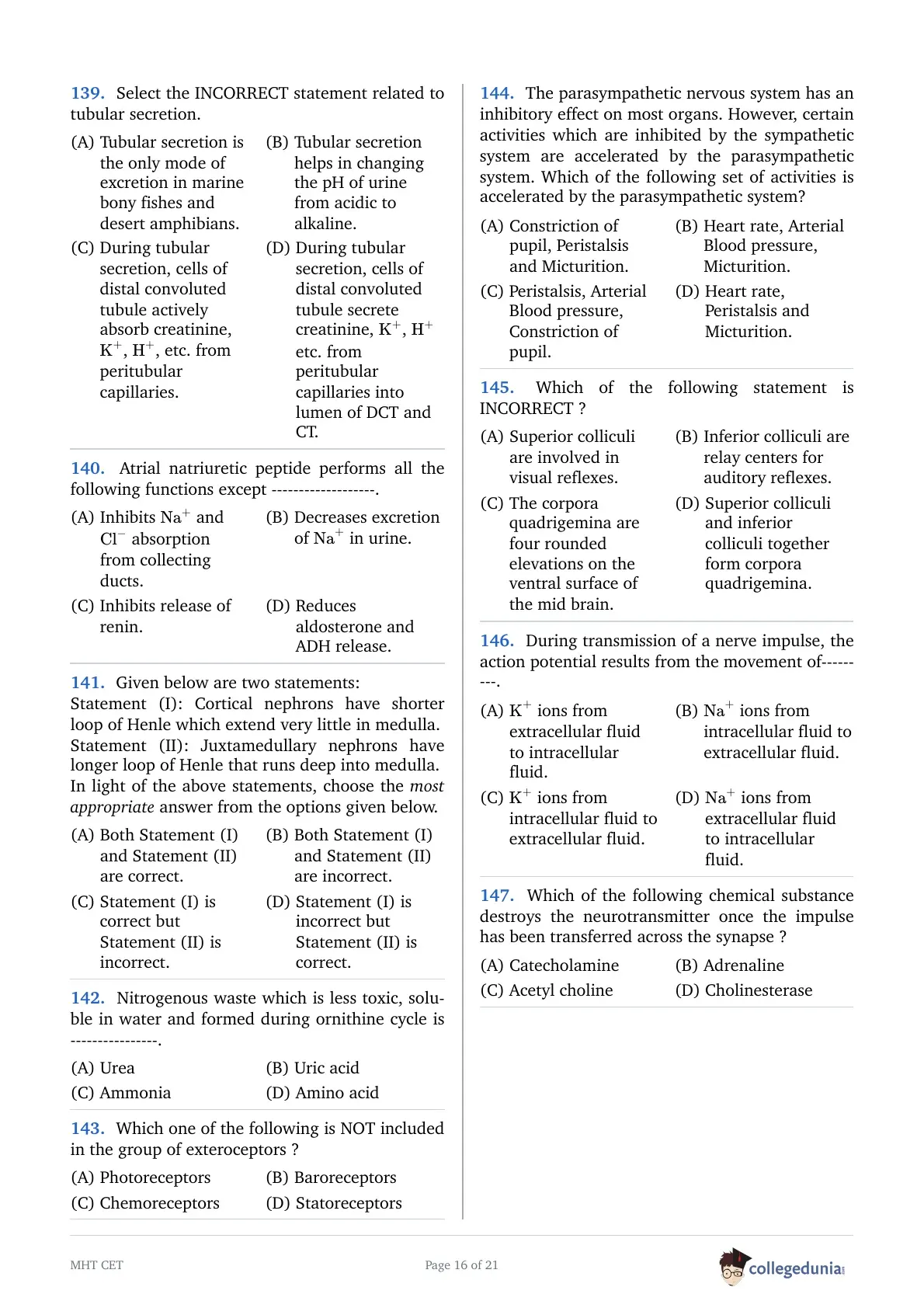
Question 139:

Select the INCORRECT statement related to tubular secretion.

  • (A) Tubular secretion is the only mode of excretion in marine bony fishes and desert amphibians.
  • (B) Tubular secretion helps in changing the pH of urine from acidic to alkaline.
  • (C) During tubular secretion, cells of distal convoluted tubule actively absorb creatinine, \(\text{K}^{+}\), \(\text{H}^{+}\), etc. from peritubular capillaries.
  • (D) During tubular secretion, cells of distal convoluted tubule secrete creatinine, \(\text{K}^{+}\), \(\text{H}^{+}\) etc. from peritubular capillaries into lumen of DCT and CT.

Question 140:

Atrial natriuretic peptide performs all the following functions except -------------------.

  • (A) Inhibits \(\text{Na}^{+}\) and \(\text{Cl}^{-}\) absorption from collecting ducts.
  • (B) Decreases excretion of \(\text{Na}^{+}\) in urine.
  • (C) Inhibits release of renin.
  • (D) Reduces aldosterone and ADH release.

Question 141:

Given below are two statements:
Statement (I): Cortical nephrons have shorter loop of Henle which extend very little in medulla.
Statement (II): Juxtamedullary nephrons have longer loop of Henle that runs deep into medulla.
In light of the above statements, choose the most appropriate answer from the options given below.

  • (A) Both Statement (I) and Statement (II) are correct.
  • (B) Both Statement (I) and Statement (II) are incorrect.
  • (C) Statement (I) is correct but Statement (II) is incorrect.
  • (D) Statement (I) is incorrect but Statement (II) is correct.

Question 142:

Nitrogenous waste which is less toxic, soluble in water and formed during ornithine cycle is ----------------.

  • (A) Urea
  • (B) Uric acid
  • (C) Ammonia
  • (D) Amino acid

Question 143:

Which one of the following is NOT included in the group of exteroceptors ?

  • (A) Photoreceptors
  • (B) Baroreceptors
  • (C) Chemoreceptors
  • (D) Statoreceptors

Question 144:

The parasympathetic nervous system has an inhibitory effect on most organs. However, certain activities which are inhibited by the sympathetic system are accelerated by the parasympathetic system. Which of the following set of activities is accelerated by the parasympathetic system?

  • (A) Constriction of pupil, Peristalsis and Micturition.
  • (B) Heart rate, Arterial Blood pressure, Micturition.
  • (C) Peristalsis, Arterial Blood pressure, Constriction of pupil.
  • (D) Heart rate, Peristalsis and Micturition.

Question 145:

Which of the following statement is INCORRECT ?

  • (A) Superior colliculi are involved in visual reflexes.
  • (B) Inferior colliculi are relay centers for auditory reflexes.
  • (C) The corpora quadrigemina are four rounded elevations on the ventral surface of the mid brain.
  • (D) Superior colliculi and inferior colliculi together form corpora quadrigemina.

Question 146:

During transmission of a nerve impulse, the action potential results from the movement of---------.

  • (A) \(\text{K}^{+}\) ions from extracellular fluid to intracellular fluid.
  • (B) \(\text{Na}^{+}\) ions from intracellular fluid to extracellular fluid.
  • (C) \(\text{K}^{+}\) ions from intracellular fluid to extracellular fluid.
  • (D) \(\text{Na}^{+}\) ions from extracellular fluid to intracellular fluid.

Question 147:

Which of the following chemical substance destroys the neurotransmitter once the impulse has been transferred across the synapse ?

  • (A) Catecholamine
  • (B) Adrenaline
  • (C) Acetyl choline
  • (D) Cholinesterase

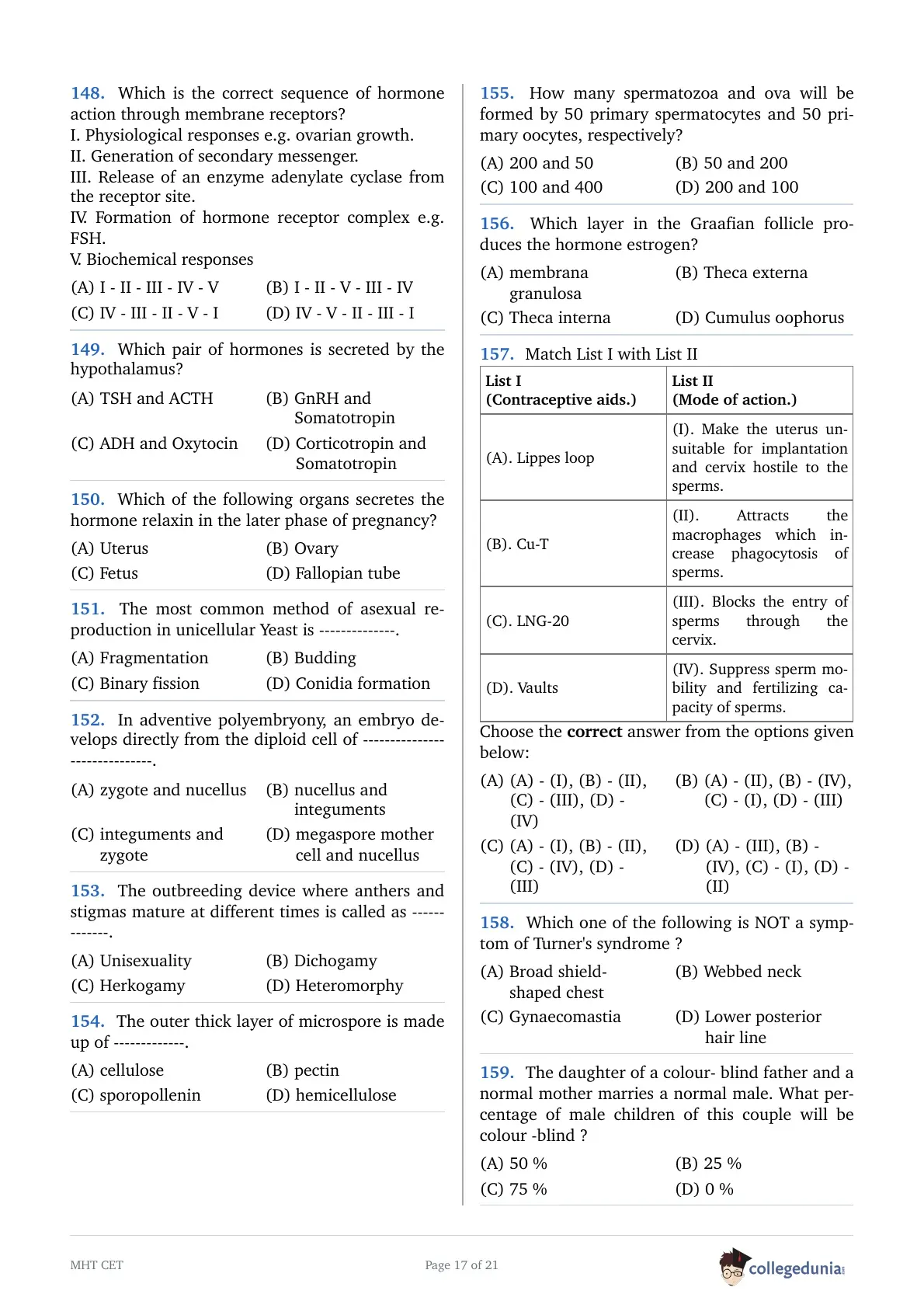
Question 148:

Which is the correct sequence of hormone action through membrane receptors?
I. Physiological responses e.g. ovarian growth.
II. Generation of secondary messenger.
III. Release of an enzyme adenylate cyclase from the receptor site.
IV. Formation of hormone receptor complex e.g. FSH.
V. Biochemical responses

  • (A) I - II - III - IV - V
  • (B) I - II - V - III - IV
  • (C) IV - III - II - V - I
  • (D) IV - V - II - III - I

Question 149:

Which pair of hormones is secreted by the hypothalamus?

  • (A) TSH and ACTH
  • (B) GnRH and Somatotropin
  • (C) ADH and Oxytocin
  • (D) Corticotropin and Somatotropin

Question 150:

Which of the following organs secretes the hormone relaxin in the later phase of pregnancy?

  • (A) Uterus
  • (B) Ovary
  • (C) Fetus
  • (D) Fallopian tube

Question 151:

The most common method of asexual reproduction in unicellular Yeast is --------------.

  • (A) Fragmentation
  • (B) Budding
  • (C) Binary fission
  • (D) Conidia formation

Question 152:

In adventive polyembryony, an embryo develops directly from the diploid cell of ------------------------------.

  • (A) zygote and nucellus
  • (B) nucellus and integuments
  • (C) integuments and zygote
  • (D) megaspore mother cell and nucellus

Question 153:

The outbreeding device where anthers and stigmas mature at different times is called as -------------.

  • (A) Unisexuality
  • (B) Dichogamy
  • (C) Herkogamy
  • (D) Heteromorphy

Question 154:

The outer thick layer of microspore is made up of -------------.

  • (A) cellulose
  • (B) pectin
  • (C) sporopollenin
  • (D) hemicellulose

Question 155:

How many spermatozoa and ova will be formed by 50 primary spermatocytes and 50 primary oocytes, respectively?

  • (A) 200 and 50
  • (B) 50 and 200
  • (C) 100 and 400
  • (D) 200 and 100

Question 156:

Which layer in the Graafian follicle produces the hormone estrogen?

  • (A) membrana granulosa
  • (B) Theca externa
  • (C) Theca interna
  • (D) Cumulus oophorus

Question 157:

Match List I with List II

List I
(Contraceptive aids.)
List II
(Mode of action.)
(A). Lippes loop(I). Make the uterus unsuitable for implantation and cervix hostile to the sperms.
(B). Cu-T(II). Attracts the macrophages which increase phagocytosis of sperms.
(C). LNG-20(III). Blocks the entry of sperms through the cervix.
(D). Vaults(IV). Suppress sperm mobility and fertilizing capacity of sperms.
  • (A) (A) - (I), (B) - (II), (C) - (III), (D) - (IV)
  • (B) (A) - (II), (B) - (IV), (C) - (I), (D) - (III)
  • (C) (A) - (I), (B) - (II), (C) - (IV), (D) - (III)
  • (D) (A) - (III), (B) - (IV), (C) - (I), (D) - (II)

Question 158:

Which one of the following is NOT a symptom of Turner's syndrome ?

  • (A) Broad shield-shaped chest
  • (B) Webbed neck
  • (C) Gynaecomastia
  • (D) Lower posterior hair line

Question 159:

The daughter of a colour- blind father and a normal mother marries a normal male. What percentage of male children of this couple will be colour -blind ?

  • (A) 50 %
  • (B) 25 %
  • (C) 75 %
  • (D) 0 %

Question 160:

In a monohybrid cross between pure tall pea plant with pure dwarf pea plant, how many types of genotypes are found in the \(F_{2}\) generation ?

  • (A) 4
  • (B) 3
  • (C) 8
  • (D) 9

Question 161:

Linkage of genes in plants was discovered by -----------------.

  • (A) T. H. Morgan
  • (B) Bateson and Punnett
  • (C) Sutton and Boveri
  • (D) W. Waldeyer

Question 162:

Which one of the following is NOT an example of complete sex linkage ?

  • (A) Red-green color blindness
  • (B) Myopia
  • (C) Nephritis
  • (D) Haemophilia

Question 163:

Which one of the following is NOT the main aim of Human Genome Project ?

  • (A) Mapping the entire human genome at the level of nucleotide sequences.
  • (B) To store the information collected from the project in databases.
  • (C) To prevent the transfer of related technologies to the private sectors, such as industries.
  • (D) To develop tools and techniques for analysis of data.

Question 164:

Given below are two statements:
Statement (I): DNA fingerprinting technique involves identifying similarities in VNTRs.
Statement (II): The length of the regions having VNTRs is different in each individual.
In light of the above statements, choose the most appropriate answer from the options given below.

  • (A) Both Statement (I) and Statement (II) are correct.
  • (B) Both Statement (I) and Statement (II) are incorrect.
  • (C) Statement (I) is correct but Statement (II) is incorrect.
  • (D) Statement (I) is incorrect but Statement (II) is correct.

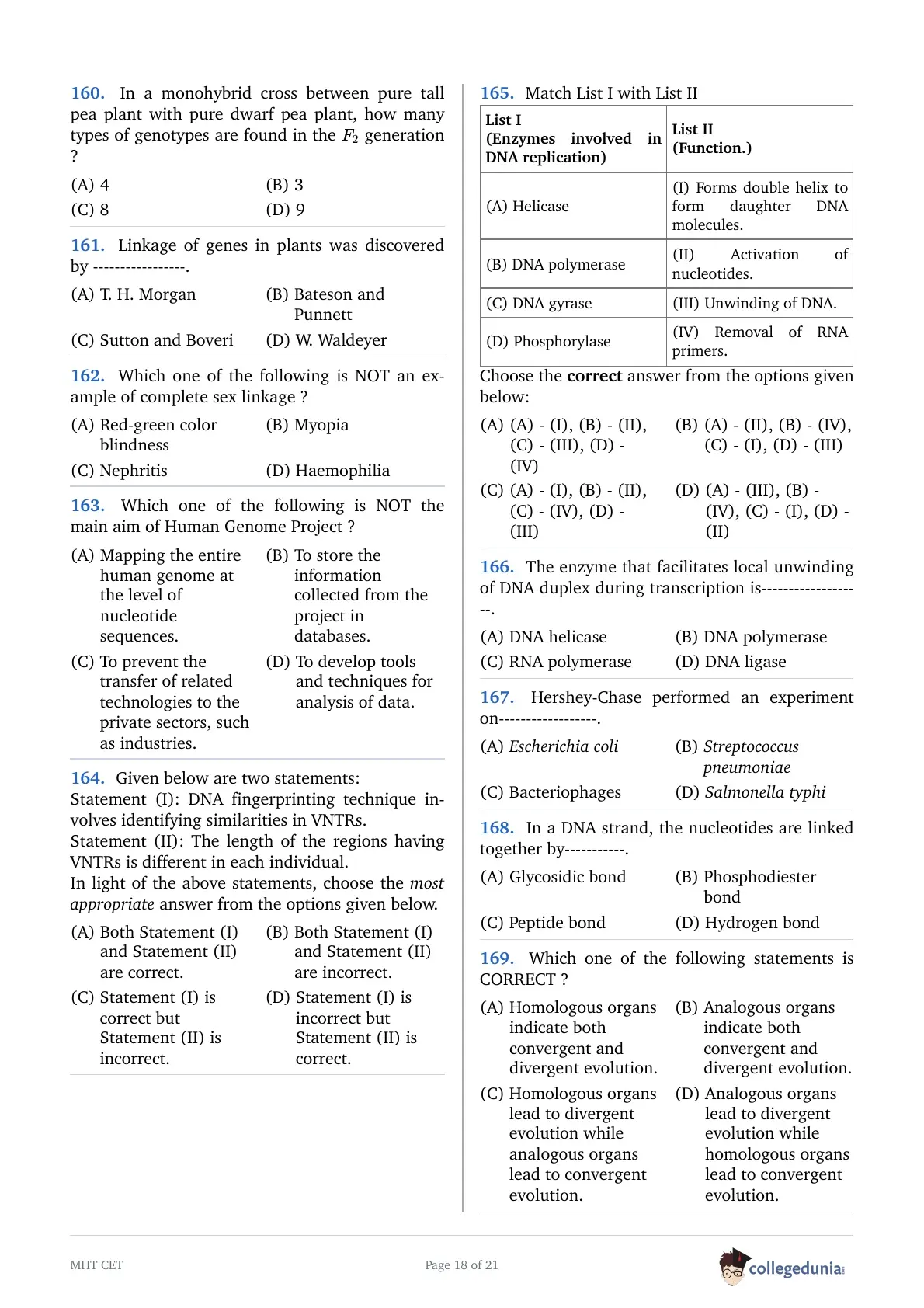
Question 165:

Match List I with List II

List I
(Enzymes involved in DNA replication)
List II
(Function.)
(A) Helicase(I) Forms double helix to form daughter DNA molecules.
(B) DNA polymerase(II) Activation of nucleotides.
(C) DNA gyrase(III) Unwinding of DNA.
(D) Phosphorylase(IV) Removal of RNA primers.
  • (A) (A) - (I), (B) - (II), (C) - (III), (D) - (IV)
  • (B) (A) - (II), (B) - (IV), (C) - (I), (D) - (III)
  • (C) (A) - (I), (B) - (II), (C) - (IV), (D) - (III)
  • (D) (A) - (III), (B) - (IV), (C) - (I), (D) - (II)

Question 166:

The enzyme that facilitates local unwinding of DNA duplex during transcription is-------------------.

  • (A) DNA helicase
  • (B) DNA polymerase
  • (C) RNA polymerase
  • (D) DNA ligase

Question 167:

Hershey-Chase performed an experiment on------------------.

  • (A) Escherichia coli
  • (B) Streptococcus pneumoniae
  • (C) Bacteriophages
  • (D) Salmonella typhi

Question 168:

In a DNA strand, the nucleotides are linked together by-----------.

  • (A) Glycosidic bond
  • (B) Phosphodiester bond
  • (C) Peptide bond
  • (D) Hydrogen bond

Question 169:

Which one of the following statements is CORRECT ?

  • (A) Homologous organs indicate both convergent and divergent evolution.
  • (B) Analogous organs indicate both convergent and divergent evolution.
  • (C) Homologous organs lead to divergent evolution while analogous organs lead to convergent evolution.
  • (D) Analogous organs lead to divergent evolution while homologous organs lead to convergent evolution.

Question 170:

The highest cranial capacity among the following is found in --------------------.

  • (A) Neanderthal man
  • (B) Homo erectus
  • (C) Homo habilis
  • (D) Australopithecus

Question 171:

Given below are two statements:
Statement (I): Lamarck's theory of inheritance of acquired characters was disproved by Weismann.
Statement (II): According to Weismann, variations produced in somatic cells are inherited while variations produced in germ cells are not inherited to the next generation.
In light of the above statements, choose the most appropriate answer from the options given below.

  • (A) Both Statement (I) and Statement (II) are correct.
  • (B) Both Statement (I) and Statement (II) are incorrect.
  • (C) Statement (I) is correct but Statement (II) is incorrect.
  • (D) Statement (I) is incorrect but Statement (II) is correct.

Question 172:

Darwin's finches is the classic example of --------------------.

  • (A) Habitat isolation
  • (B) Seasonal isolation
  • (C) Geographical isolation
  • (D) Ethological isolation

Question 173:

Which of the following was the most active element in the primitive atmosphere on earth ?

  • (A) Nitrogen
  • (B) Carbon
  • (C) Sulphur
  • (D) Hydrogen

Question 174:

Identify the groups of cannabinoids.

  • (A) Heroin, Di-acetyl morphine, Ganja
  • (B) Cocain, Heroin, LSD
  • (C) Marijuana, Hashish, Charas
  • (D) Morphine, Heroin, Hashish

Question 175:

Which of the following is a pair of viral diseases ?

  • (A) Malaria and AIDS
  • (B) Filariasis and AIDS
  • (C) Common Cold and Dengue.
  • (D) Typhoid and Common Cold

Question 176:

Wuchereria bancrofti is transmitted to human body by ----------------------.

  • (A) female Anopheles mosquito
  • (B) female Aedes mosquito
  • (C) female Culex mosquito
  • (D) Plasmodium ovale

Question 177:

A person who has recovered from attack of measles develops ------------------ immunity to measles, for the life time.

  • (A) natural acquired active
  • (B) artificial acquired active
  • (C) natural acquired passive
  • (D) artificial acquired passive

Question 178:

All the following are the major categories of psychological disorders except \(\_\_\_\_\).

  • (A) Autism spectrum disorder.
  • (B) Attention Deficit Hyperactivity Disorder.
  • (C) Alzheimer's disease.
  • (D) Intellectual disability.

Question 179:

Which of the following is considered as the best layer (for eggs) variety ?

  • (A) Plymouth Rock
  • (B) Rhode Island Red
  • (C) Leghorn
  • (D) Aseel

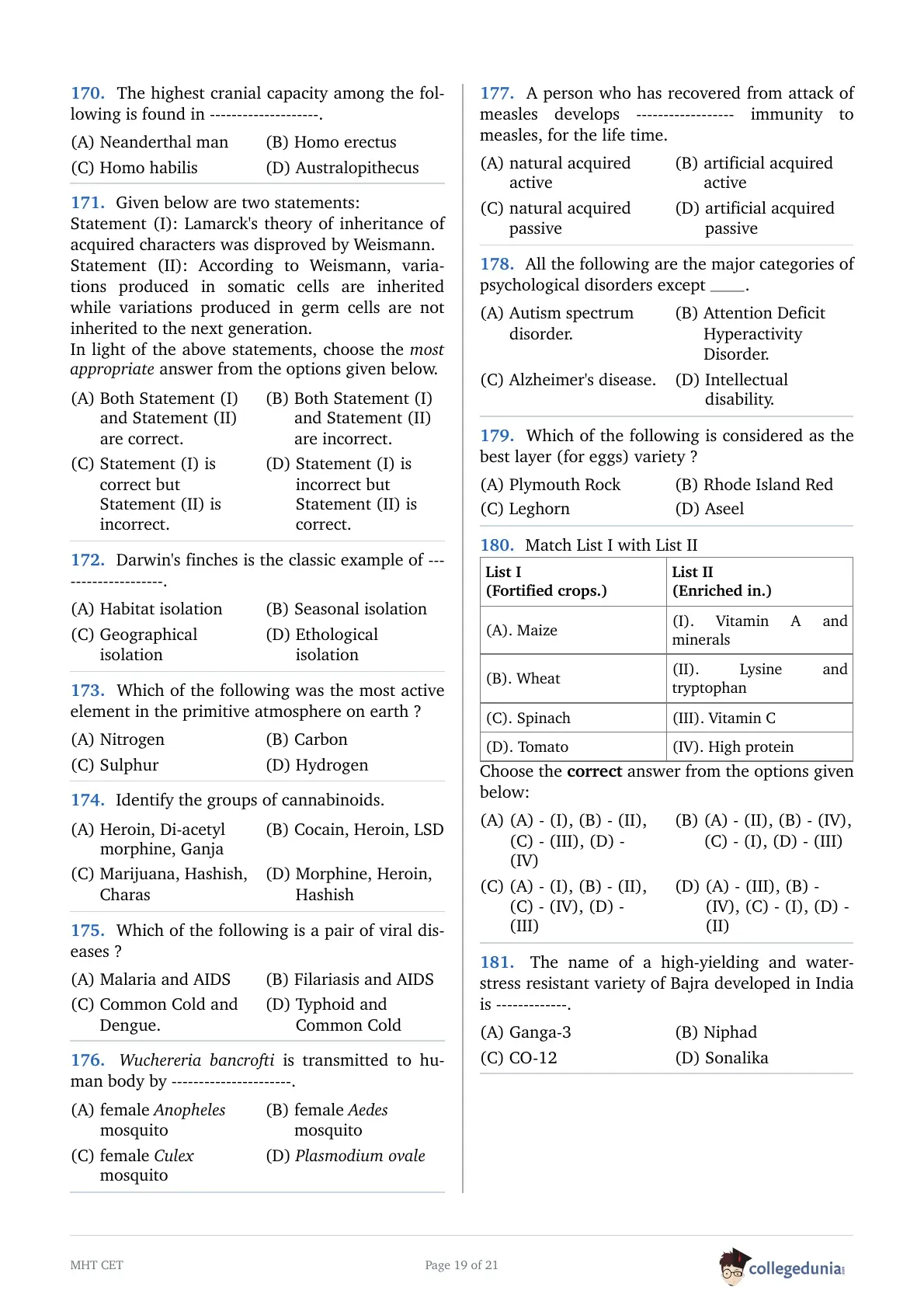
Question 180:

Match List I with List II

List I
(Fortified crops.)
List II
(Enriched in.)
(A). Maize(I). Vitamin A and minerals
(B). Wheat(II). Lysine and tryptophan
(C). Spinach(III). Vitamin C
(D). Tomato(IV). High protein
  • (A) (A) - (I), (B) - (II), (C) - (III), (D) - (IV)
  • (B) (A) - (II), (B) - (IV), (C) - (I), (D) - (III)
  • (C) (A) - (I), (B) - (II), (C) - (IV), (D) - (III)
  • (D) (A) - (III), (B) - (IV), (C) - (I), (D) - (II)

Question 181:

The name of a high-yielding and water-stress resistant variety of Bajra developed in India is -------------.

  • (A) Ganga-3
  • (B) Niphad
  • (C) CO-12
  • (D) Sonalika

Question 182:

At which stage, the embryos are implanted in the uterus of surrogate mothers in MOET technology?

  • (A) Just fertilized eggs
  • (B) Gastrula
  • (C) 8 to 32 celled embryos
  • (D) Blastula

Question 183:

Which of the following bioherbicide can be used if a lake is abundantly covered by water hyacinth plants ?

  • (A) Phytophthora palmivora
  • (B) Alternaria crassa
  • (C) Fusarium spp.
  • (D) Agrobacterium spp.

Question 184:

Given below are two statements:
Statement (I): In rDNA technology, the transformation process generates a mixed population of transformed and non-transformed host cells.
Statement (II): In the screening process, both transformed and non-transformed host cells divide and redivide along with the replication of recombinant DNA.
In light of the above statements, choose the most appropriate answer from the options given below.

  • (A) Both Statement (I) and Statement (II) are correct.
  • (B) Both Statement (I) and Statement (II) are incorrect.
  • (C) Statement (I) is correct but Statement (II) is incorrect.
  • (D) Statement (I) is incorrect but Statement (II) is correct.

Question 185:

Which GMO crop plant is having an adverse effect on Monarch butterfly populations?

  • (A) Bt brinjal
  • (B) Bt cotton
  • (C) Bt corn
  • (D) Bt tobacco

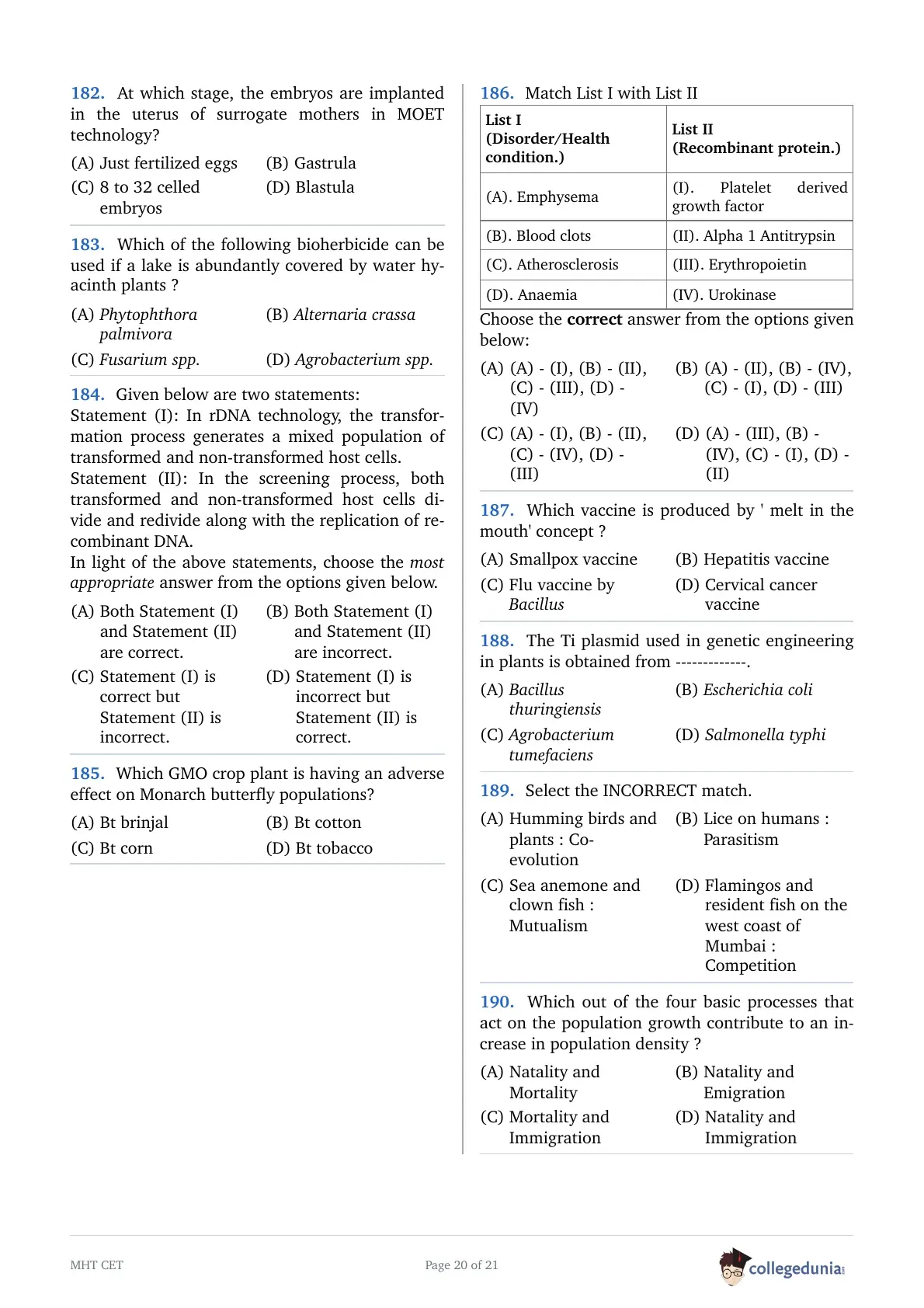
Question 186:

Match List I with List II

List I
(Disorder/Health condition.)
List II
(Recombinant protein.)
(A). Emphysema(I). Platelet derived growth factor
(B). Blood clots(II). Alpha 1 Antitrypsin
(C). Atherosclerosis(III). Erythropoietin
(D). Anaemia(IV). Urokinase
  • (A) (A) - (I), (B) - (II), (C) - (III), (D) - (IV)
  • (B) (A) - (II), (B) - (IV), (C) - (I), (D) - (III)
  • (C) (A) - (I), (B) - (II), (C) - (IV), (D) - (III)
  • (D) (A) - (III), (B) - (IV), (C) - (I), (D) - (II)

Question 187:

Which vaccine is produced by ' melt in the mouth' concept ?

  • (A) Smallpox vaccine
  • (B) Hepatitis vaccine
  • (C) Flu vaccine by Bacillus
  • (D) Cervical cancer vaccine

Question 188:

The Ti plasmid used in genetic engineering in plants is obtained from -------------.

  • (A) Bacillus thuringiensis
  • (B) Escherichia coli
  • (C) Agrobacterium tumefaciens
  • (D) Salmonella typhi

Question 189:

Select the INCORRECT match.

  • (A) Humming birds and plants : Co-evolution
  • (B) Lice on humans : Parasitism
  • (C) Sea anemone and clown fish : Mutualism
  • (D) Flamingos and resident fish on the west coast of Mumbai : Competition

Question 190:

Which out of the four basic processes that act on the population growth contribute to an increase in population density ?

  • (A) Natality and Mortality
  • (B) Natality and Emigration
  • (C) Mortality and Immigration
  • (D) Natality and Immigration

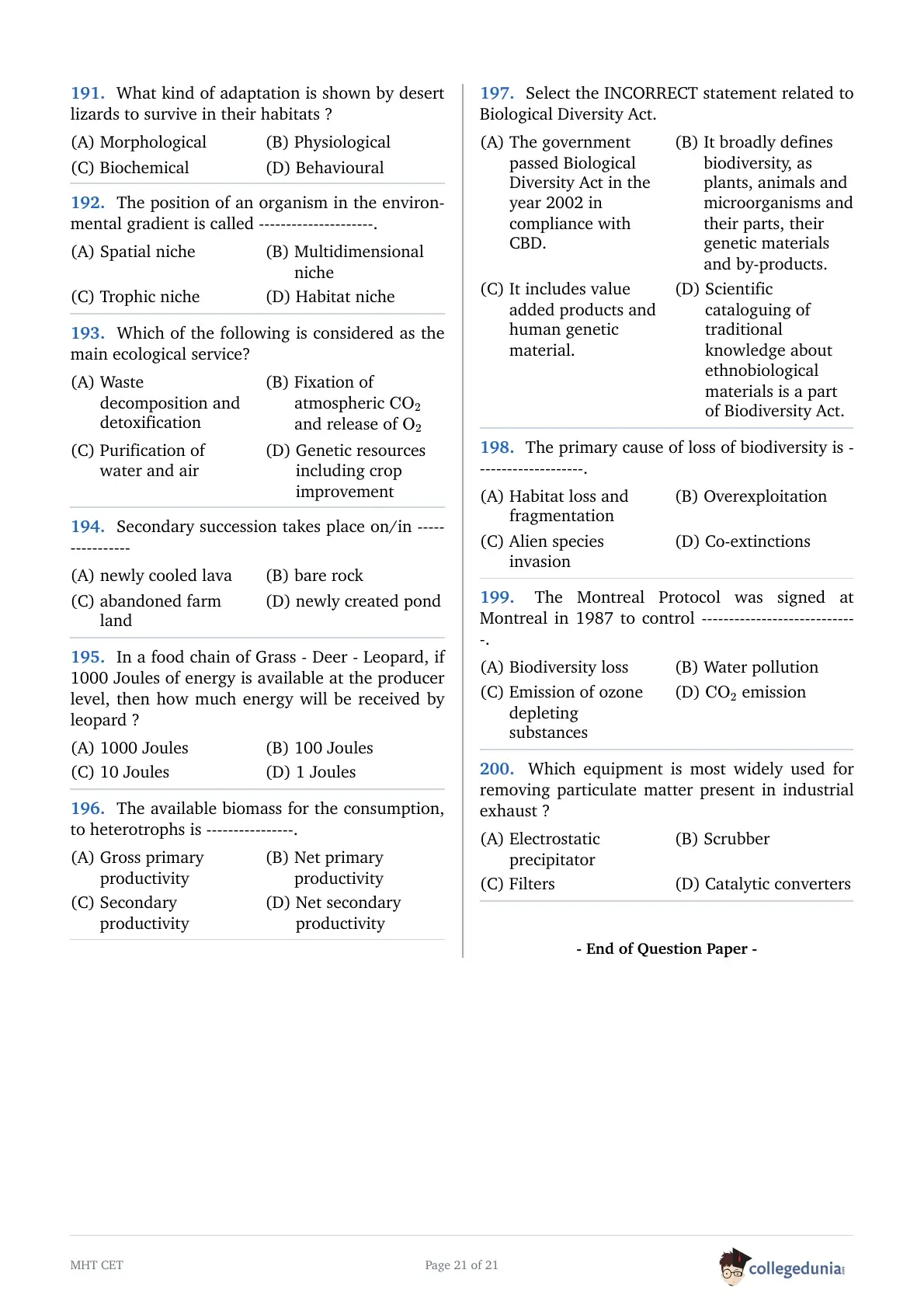
Question 191:

What kind of adaptation is shown by desert lizards to survive in their habitats ?

  • (A) Morphological
  • (B) Physiological
  • (C) Biochemical
  • (D) Behavioural

Question 192:

The position of an organism in the environmental gradient is called ---------------------.

  • (A) Spatial niche
  • (B) Multidimensional niche
  • (C) Trophic niche
  • (D) Habitat niche

Question 193:

Which of the following is considered as the main ecological service?

  • (A) Waste decomposition and detoxification
  • (B) Fixation of atmospheric \(\text{CO}_{2}\) and release of \(\text{O}_{2}\)
  • (C) Purification of water and air
  • (D) Genetic resources including crop improvement

Question 194:

Secondary succession takes place on/in ----------------

  • (A) newly cooled lava
  • (B) bare rock
  • (C) abandoned farm land
  • (D) newly created pond

Question 195:

In a food chain of Grass - Deer - Leopard, if 1000 Joules of energy is available at the producer level, then how much energy will be received by leopard ?

  • (A) 1000 Joules
  • (B) 100 Joules
  • (C) 10 Joules
  • (D) 1 Joules

Question 196:

The available biomass for the consumption, to heterotrophs is ----------------.

  • (A) Gross primary productivity
  • (B) Net primary productivity
  • (C) Secondary productivity
  • (D) Net secondary productivity

Question 197:

Select the INCORRECT statement related to Biological Diversity Act.

  • (A) The government passed Biological Diversity Act in the year 2002 in compliance with CBD.
  • (B) It broadly defines biodiversity, as plants, animals and microorganisms and their parts, their genetic materials and by-products.
  • (C) It includes value added products and human genetic material.
  • (D) Scientific cataloguing of traditional knowledge about ethnobiological materials is a part of Biodiversity Act.

Question 198:

The primary cause of loss of biodiversity is --------------------.

  • (A) Habitat loss and fragmentation
  • (B) Overexploitation
  • (C) Alien species invasion
  • (D) Co-extinctions

Question 199:

The Montreal Protocol was signed at Montreal in 1987 to control -----------------------------.

  • (A) Biodiversity loss
  • (B) Water pollution
  • (C) Emission of ozone depleting substances
  • (D) \(\text{CO}_{2}\) emission

Question 200:

Which equipment is most widely used for removing particulate matter present in industrial exhaust ?

  • (A) Electrostatic precipitator
  • (B) Scrubber
  • (C) Filters
  • (D) Catalytic converters

MHT CET 2026 PCB Exam Pattern and Marking Scheme

Parameter Details
Conducting Body Maharashtra Common Entrance Test Cell (Maharashtra CET Cell)
Exam Mode Online (Computer-Based Test)
Duration 180 minutes (3 hours)
Groups / Subjects PCB (Physics, Chemistry, Biology) for Pharmacy and Agriculture
Total Questions

200

Total Marks 200
Question Type Multiple Choice Questions (MCQs)
Marking Scheme 1 mark for each correct answer
Negative Marking No
Syllabus Weightage
  • Class 12 – 80%
  • Class 11 – 20%

MHT CET 2026 April 21 Shift 1 PCB Paper Analysis