




MHT CET 2026 April 21 Shift 2 PCB Question Paper is available for download here. Maharashtra State CET Cell conducted MHT CET 2026 PCB Exam on April 21 in Shift 2 from 2 PM to 5 PM in CBT mode.
The MHT CET 2026 PCB question paper includes the following:
- The MHT CET 2026 PCB Question Paper consists of 200 multiple-choice questions (MCQs) totalling 200 marks divided into 3 sections: Physics (50 questions), Chemistry (50 questions), and Biology (100 questions).
- All questions carry 1 mark each. There is no negative marking for incorrect answers.
MHT CET 2026 April 21 Shift 2 PCB Question Paper with Solution PDF
| CD PDF | CD PDF with Solutions |
|---|---|
| Download Collegedunia PDF 1.01 MB | - |
Also Check:
MHT CET 2026 April 21 Shift 2 PCB Questions with Solutions
Physics (Q1 - Q50)
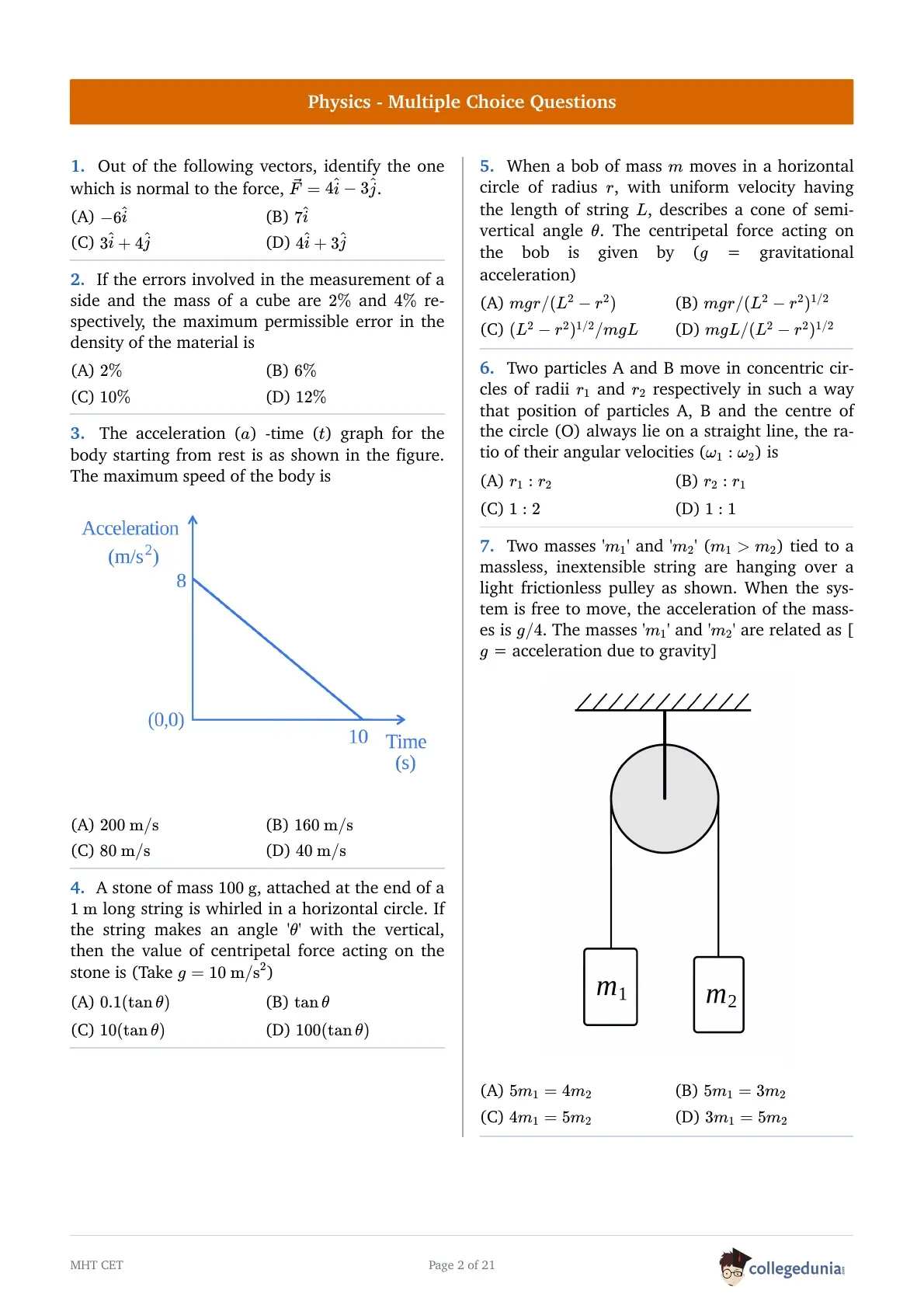
Out of the following vectors, identify the one which is normal to the force, \(\vec{F}=4\hat{i}-3\hat{j}\).
If the errors involved in the measurement of a side and the mass of a cube are \(2\%\) and \(4\%\) respectively, the maximum permissible error in the density of the material is
The acceleration (\(a\)) -time (\(t\)) graph for the body starting from rest is as shown in the figure. The maximum speed of the body is

A stone of mass \(100\ \text{g}\), attached at the end of a \(1\ \text{m}\) long string is whirled in a horizontal circle. If the string makes an angle '\(\theta\)' with the vertical, then the value of centripetal force acting on the stone is (Take \(g=10\ \text{m/s}^{2}\))
When a bob of mass \(m\) moves in a horizontal circle of radius \(r\), with uniform velocity having the length of string \(L\), describes a cone of semivertical angle \(\theta\). The centripetal force acting on the bob is given by (\(g\) = gravitational acceleration)
Two particles A and B move in concentric circles of radii \(r_{1}\) and \(r_{2}\) respectively in such a way that position of particles A, B and the centre of the circle (O) always lie on a straight line, the ratio of their angular velocities (\(\omega _{1}:\omega _{2}\)) is
Two masses '\(m_{1}\)' and '\(m_{2}\)' (\(m_{1}>m_{2}\)) tied to a massless, inextensible string are hanging over a light frictionless pulley as shown. When the system is free to move, the acceleration of the masses is \(g/4\). The masses '\(m_{1}\)' and '\(m_{2}\)' are related as [\(g\) = acceleration due to gravity]

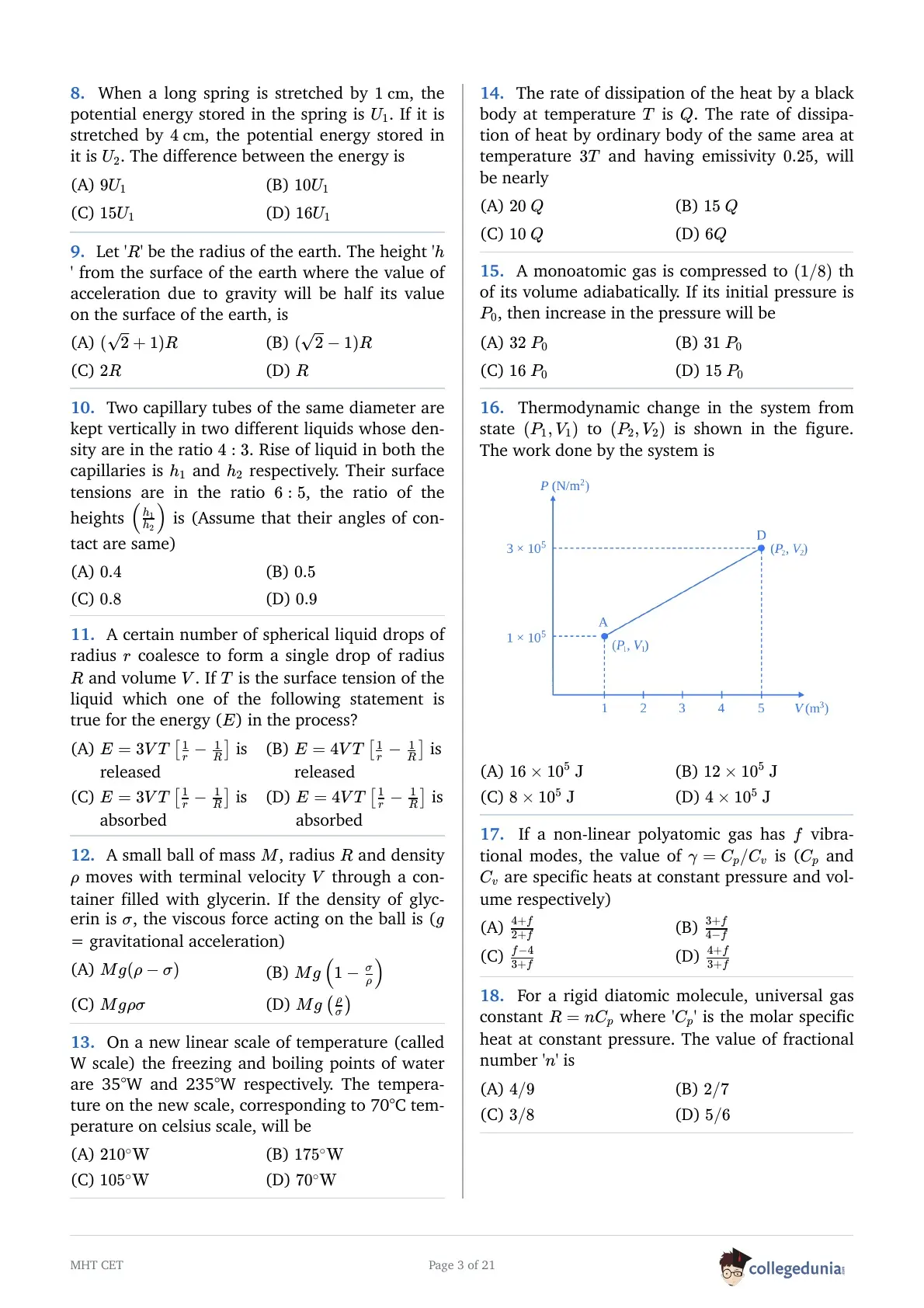
When a long spring is stretched by \(1\ \text{cm}\), the potential energy stored in the spring is \(U_{1}\). If it is stretched by \(4\ \text{cm}\), the potential energy stored in it is \(U_{2}\). The difference between the energy is
Let '\(R\)' be the radius of the earth. The height '\(h\)' from the surface of the earth where the value of acceleration due to gravity will be half its value on the surface of the earth, is
Two capillary tubes of the same diameter are kept vertically in two different liquids whose density are in the ratio \(4:3\). Rise of liquid in both the capillaries is \(h_{1}\) and \(h_{2}\) respectively. Their surface tensions are in the ratio \(6:5\), the ratio of the heights \(\left(\frac{h_{1}}{h_{2}}\right)\) is (Assume that their angles of contact are same)
A certain number of spherical liquid drops of radius \(r\) coalesce to form a single drop of radius \(R\) and volume \(V\). If \(T\) is the surface tension of the liquid which one of the following statement is true for the energy (\(E\)) in the process?
A small ball of mass \(M\), radius \(R\) and density \(\rho\) moves with terminal velocity \(V\) through a container filled with glycerin. If the density of glycerin is \(\sigma\), the viscous force acting on the ball is (\(g\) = gravitational acceleration)
On a new linear scale of temperature (called W scale) the freezing and boiling points of water are 35°W and 235°W respectively. The temperature on the new scale, corresponding to 70°C temperature on celsius scale, will be
The rate of dissipation of the heat by a black body at temperature \(T\) is \(Q\). The rate of dissipation of heat by ordinary body of the same area at temperature \(3T\) and having emissivity \(0.25\), will be nearly
A monoatomic gas is compressed to \((1/8)\) th of its volume adiabatically. If its initial pressure is \(P_{0}\), then increase in the pressure will be
Thermodynamic change in the system from state \((P_{1},V_{1})\) to \((P_{2},V_{2})\) is shown in the figure. The work done by the system is

If a non-linear polyatomic gas has \(f\) vibrational modes, the value of \(\gamma =C_{p}/C_{v}\) is (\(C_{p}\) and \(C_{v}\) are specific heats at constant pressure and volume respectively)
For a rigid diatomic molecule, universal gas constant \(R=nC_{p}\) where '\(C_{p}\)' is the molar specific heat at constant pressure. The value of fractional number '\(n\)' is
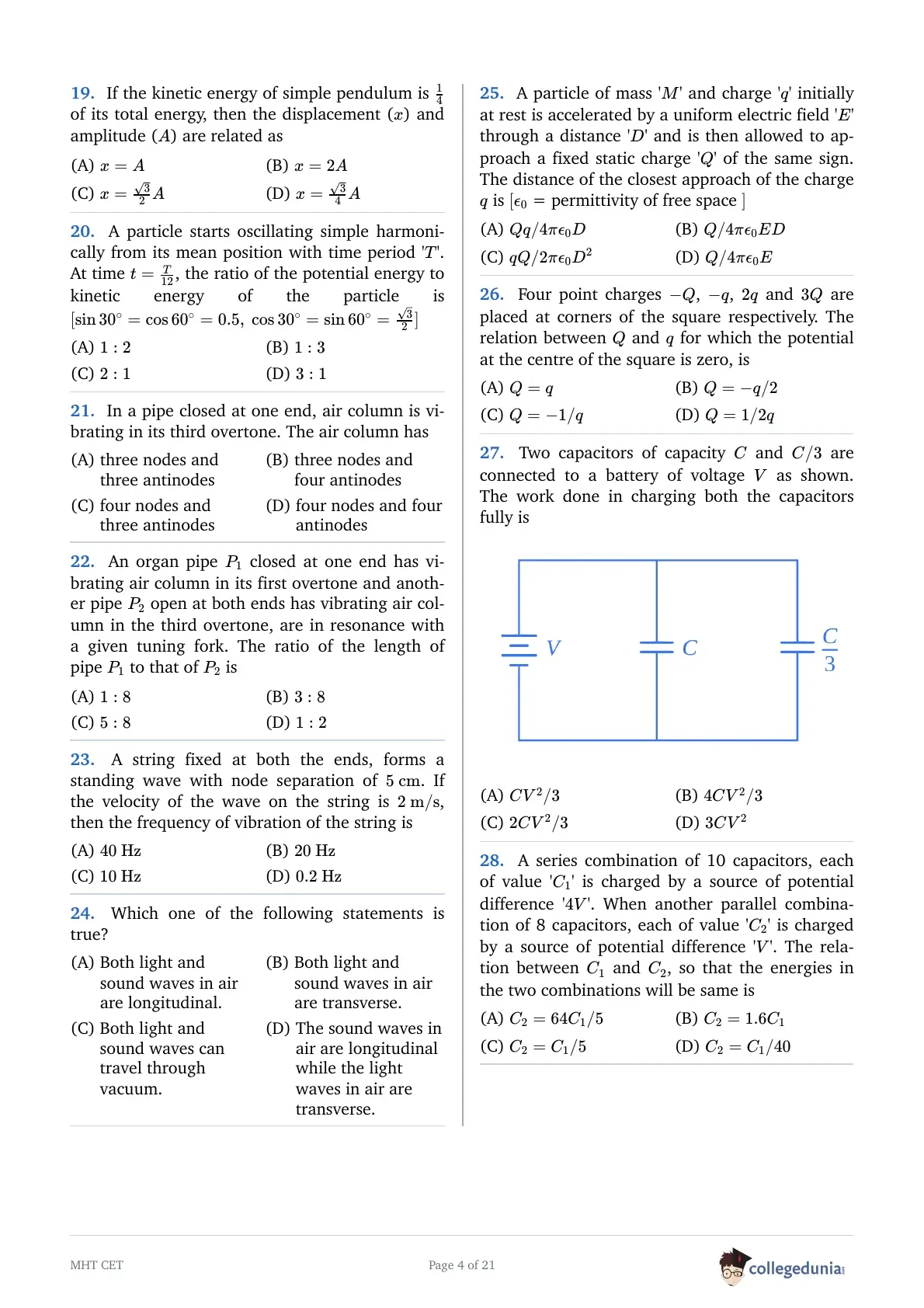
If the kinetic energy of simple pendulum is \(\frac{1}{4}\) of its total energy, then the displacement (\(x\)) and amplitude (\(A\)) are related as
A particle starts oscillating simple harmonically from its mean position with time period '\(T\)'. At time \(t=\frac{T}{12}\), the ratio of the potential energy to kinetic energy of the particle is \([\sin 30^{\circ }=\cos 60^{\circ }=0.5,\ \cos 30^{\circ }=\sin 60^{\circ }=\frac{\sqrt{3}}{2}]\)
In a pipe closed at one end, air column is vibrating in its third overtone. The air column has
An organ pipe \(P_{1}\) closed at one end has vibrating air column in its first overtone and another pipe \(P_{2}\) open at both ends has vibrating air column in the third overtone, are in resonance with a given tuning fork. The ratio of the length of pipe \(P_{1}\) to that of \(P_{2}\) is
A string fixed at both the ends, forms a standing wave with node separation of \(5\ \text{cm}\). If the velocity of the wave on the string is \(2\ \text{m/s}\), then the frequency of vibration of the string is
Which one of the following statements is true?
A particle of mass '\(M\)' and charge '\(q\)' initially at rest is accelerated by a uniform electric field '\(E\)' through a distance '\(D\)' and is then allowed to approach a fixed static charge '\(Q\)' of the same sign. The distance of the closest approach of the charge \(q\) is \([\epsilon _{0}\) = permittivity of free space \(]\)
Four point charges \(-Q\), \(-q\), \(2q\) and \(3Q\) are placed at corners of the square respectively. The relation between \(Q\) and \(q\) for which the potential at the centre of the square is zero, is
Two capacitors of capacity \(C\) and \(C/3\) are connected to a battery of voltage \(V\) as shown. The work done in charging both the capacitors fully is

A series combination of 10 capacitors, each of value '\(C_{1}\)' is charged by a source of potential difference '\(4V\)'. When another parallel combination of 8 capacitors, each of value '\(C_{2}\)' is charged by a source of potential difference '\(V\)'. The relation between \(C_{1}\) and \(C_{2}\), so that the energies in the two combinations will be same is
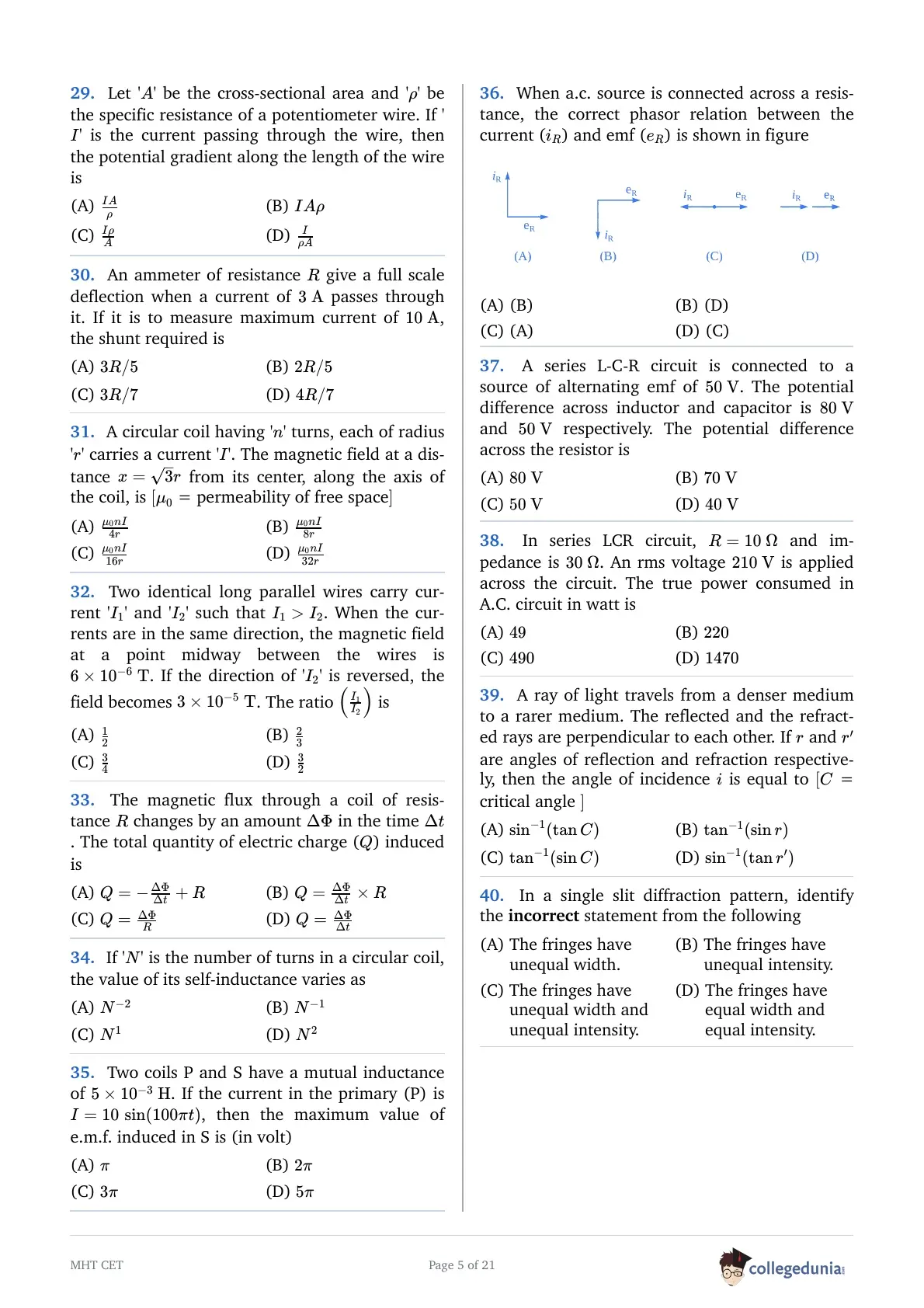
Let '\(A\)' be the cross-sectional area and '\(\rho\)' be the specific resistance of a potentiometer wire. If '\(I\)' is the current passing through the wire, then the potential gradient along the length of the wire is
An ammeter of resistance \(R\) give a full scale deflection when a current of \(3\ \text{A}\) passes through it. If it is to measure maximum current of \(10\ \text{A}\), the shunt required is
A circular coil having '\(n\)' turns, each of radius '\(r\)' carries a current '\(I\)'. The magnetic field at a distance \(x=\sqrt{3}r\) from its center, along the axis of the coil, is \([\mu _{0}\) = permeability of free space\(]\)
Two identical long parallel wires carry current '\(I_{1}\)' and '\(I_{2}\)' such that \(I_{1}>I_{2}\). When the currents are in the same direction, the magnetic field at a point midway between the wires is \(6\times 10^{-6}\ \text{T}\). If the direction of '\(I_{2}\)' is reversed, the field becomes \(3\times 10^{-5}\ \text{T}\). The ratio \(\left(\frac{I_{1}}{I_{2}}\right)\) is
The magnetic flux through a coil of resistance \(R\) changes by an amount \(\Delta \Phi\) in the time \(\Delta t\). The total quantity of electric charge (\(Q\)) induced is
If '\(N\)' is the number of turns in a circular coil, the value of its self-inductance varies as
Two coils P and S have a mutual inductance of \(5\times 10^{-3}\ \text{H}\). If the current in the primary (P) is \(I=10\,\sin (100\pi t)\), then the maximum value of e.m.f. induced in S is (in volt)
When a.c. source is connected across a resistance, the correct phasor relation between the current (\(i_{R}\)) and emf (\(e_{R}\)) is shown in figure

A series L-C-R circuit is connected to a source of alternating emf of \(50\ \text{V}\). The potential difference across inductor and capacitor is \(80\ \text{V}\) and \(50\ \text{V}\) respectively. The potential difference across the resistor is
In series LCR circuit, \(R=10\ \Omega\) and impedance is \(30\ \Omega\). An rms voltage \(210\ \text{V}\) is applied across the circuit. The true power consumed in A.C. circuit in watt is
A ray of light travels from a denser medium to a rarer medium. The reflected and the refracted rays are perpendicular to each other. If \(r\) and \(r'\) are angles of reflection and refraction respectively, then the angle of incidence \(i\) is equal to \([C\) = critical angle \(]\)
In a single slit diffraction pattern, identify the incorrect statement from the following
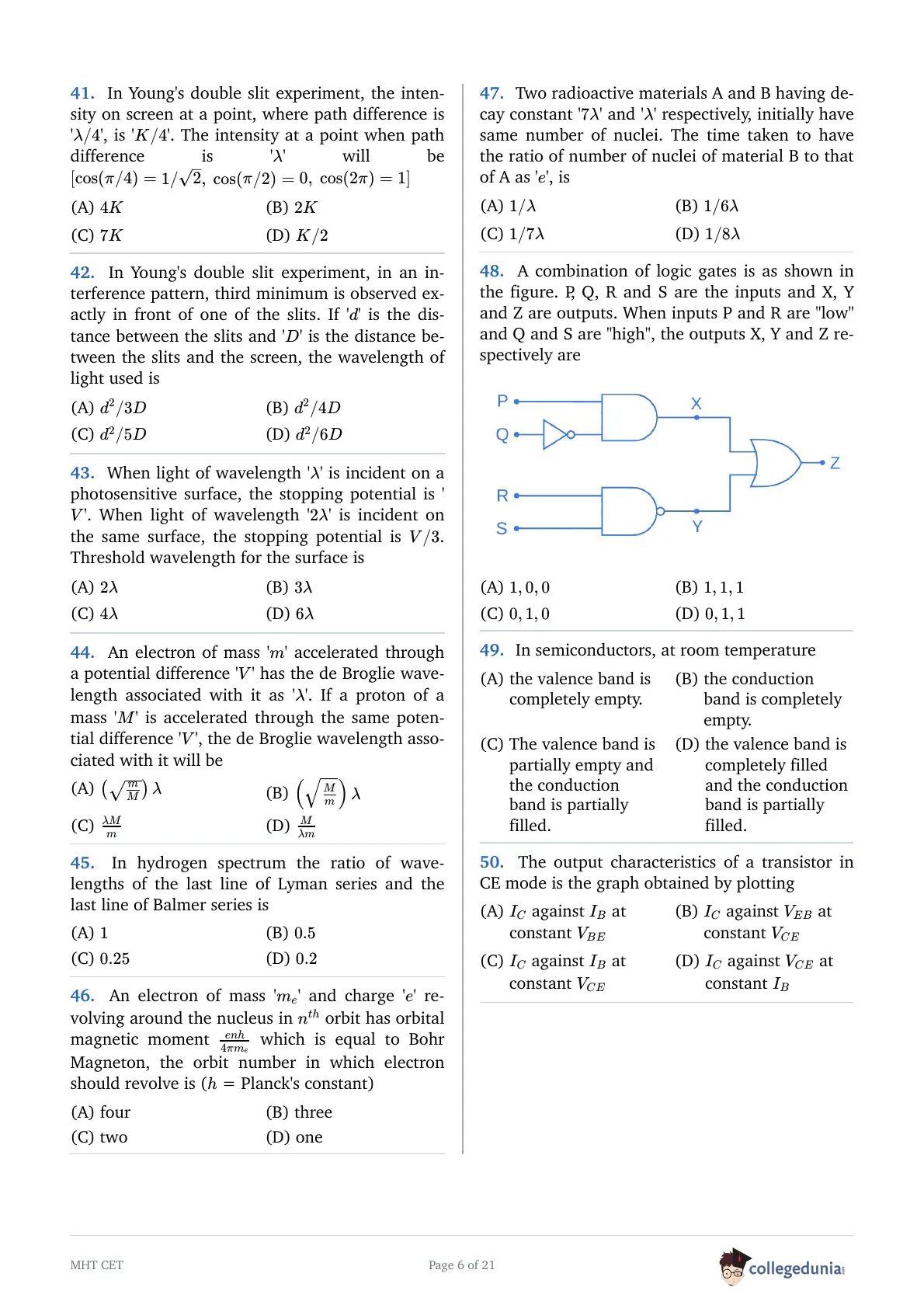
In Young's double slit experiment, the intensity on screen at a point, where path difference is '\(\lambda /4\)', is '\(K/4\)'. The intensity at a point when path difference is '\(\lambda\)' will be \([\cos (\pi /4)=1/\sqrt{2},\ \cos (\pi /2)=0,\ \cos (2\pi )=1]\)
In Young's double slit experiment, in an interference pattern, third minimum is observed exactly in front of one of the slits. If '\(d\)' is the distance between the slits and '\(D\)' is the distance between the slits and the screen, the wavelength of light used is
When light of wavelength '\(\lambda\)' is incident on a photosensitive surface, the stopping potential is '\(V\)'. When light of wavelength '\(2\lambda\)' is incident on the same surface, the stopping potential is \(V/3\). Threshold wavelength for the surface is
An electron of mass '\(m\)' accelerated through a potential difference '\(V\)' has the de Broglie wavelength associated with it as '\(\lambda\)'. If a proton of a mass '\(M\)' is accelerated through the same potential difference '\(V\)', the de Broglie wavelength associated with it will be
In hydrogen spectrum the ratio of wavelengths of the last line of Lyman series and the last line of Balmer series is
An electron of mass '\(m_{e}\)' and charge '\(e\)' revolving around the nucleus in \(n^{th}\) orbit has orbital magnetic moment \(\frac{enh}{4\pi m_{e}}\) which is equal to Bohr Magneton, the orbit number in which electron should revolve is (\(h\) = Planck's constant)
Two radioactive materials A and B having decay constant '\(7\lambda\)' and '\(\lambda\)' respectively, initially have same number of nuclei. The time taken to have the ratio of number of nuclei of material B to that of A as '\(e\)', is
A combination of logic gates is as shown in the figure. P, Q, R and S are the inputs and X, Y and Z are outputs. When inputs P and R are "low" and Q and S are "high", the outputs X, Y and Z respectively are

In semiconductors, at room temperature
The output characteristics of a transistor in CE mode is the graph obtained by plotting
Chemistry (Q51 - Q100)
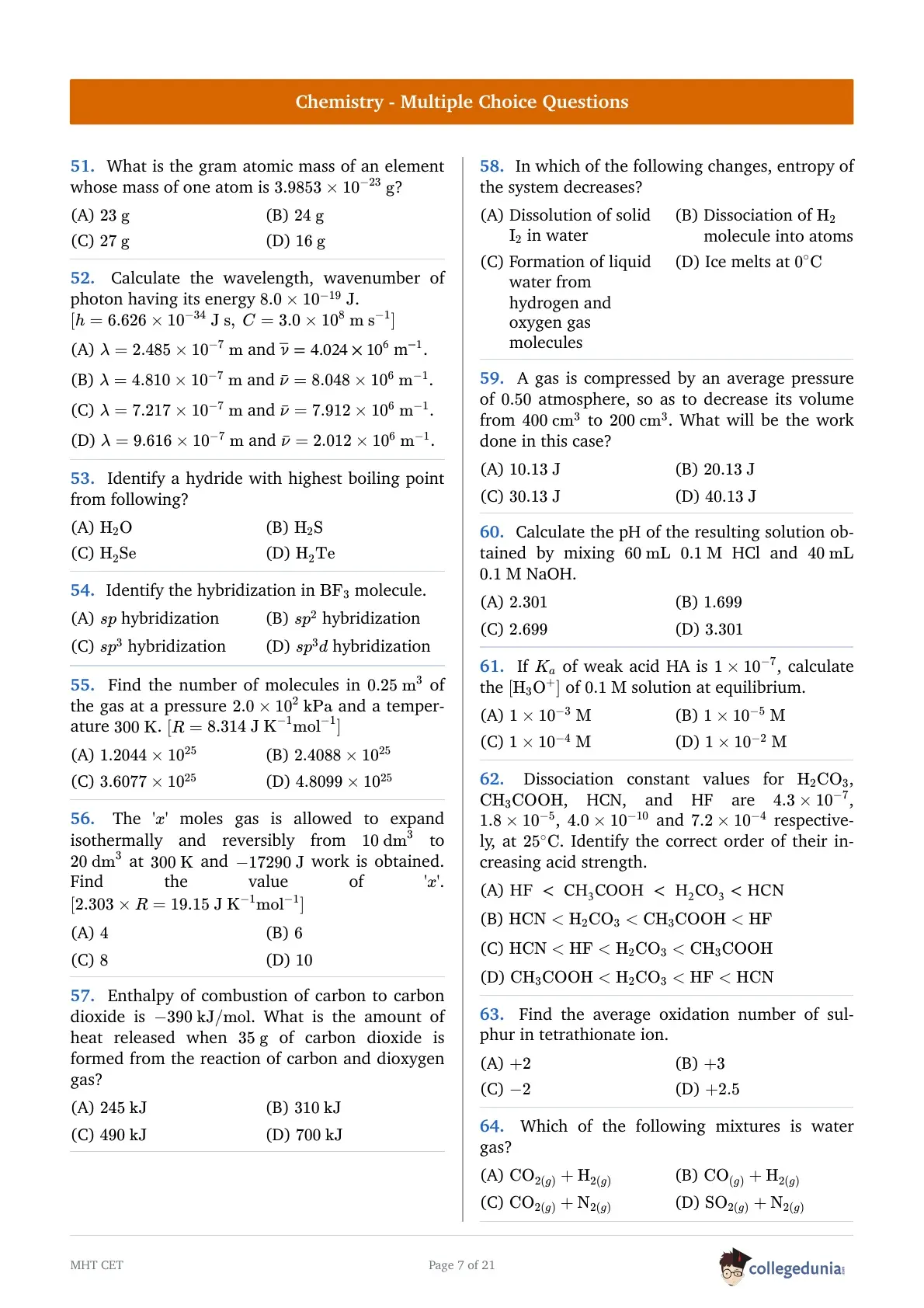
What is the gram atomic mass of an element whose mass of one atom is \(3.9853\times 10^{-23}\ \text{g}\)?
Calculate the wavelength, wavenumber of photon having its energy \(8.0\times 10^{-19}\ \text{J}\).
\([h=6.626\times 10^{-34}\ \text{J s},\ C=3.0\times 10^{8}\ \text{m s}^{-1}]\)
Identify a hydride with highest boiling point from following?
Identify the hybridization in \(\text{BF}_{3}\) molecule.
Find the number of molecules in \(0.25\ \text{m}^{3}\) of the gas at a pressure \(2.0\times 10^{2}\ \text{kPa}\) and a temperature \(300\ \text{K}\). \([R=8.314\ \text{J K}^{-1}\text{mol}^{-1}]\)
The '\(x\)' moles gas is allowed to expand isothermally and reversibly from \(10\ \text{dm}^{3}\) to \(20\ \text{dm}^{3}\) at \(300\ \text{K}\) and \(-17290\ \text{J}\) work is obtained. Find the value of '\(x\)'. \([2.303\times R=19.15\ \text{J K}^{-1}\text{mol}^{-1}]\)
Enthalpy of combustion of carbon to carbon dioxide is \(-390\ \text{kJ/mol}\). What is the amount of heat released when \(35\ \text{g}\) of carbon dioxide is formed from the reaction of carbon and dioxygen gas?
In which of the following changes, entropy of the system decreases?
A gas is compressed by an average pressure of \(0.50\) atmosphere, so as to decrease its volume from \(400\ \text{cm}^{3}\) to \(200\ \text{cm}^{3}\). What will be the work done in this case?
Calculate the pH of the resulting solution obtained by mixing \(60\ \text{mL}\) \(0.1\ \text{M}\) HCl and \(40\ \text{mL}\) \(0.1\ \text{M}\) NaOH.
If \(K_{a}\) of weak acid HA is \(1\times 10^{-7}\), calculate the \([\text{H}_{3}\text{O}^{+}]\) of \(0.1\ \text{M}\) solution at equilibrium.
Dissociation constant values for \(\text{H}_{2}\text{CO}_{3}\), \(\text{CH}_{3}\text{COOH}\), HCN, and HF are \(4.3\times 10^{-7}\), \(1.8\times 10^{-5}\), \(4.0\times 10^{-10}\) and \(7.2\times 10^{-4}\) respectively, at \(25^{\circ }\text{C}\). Identify the correct order of their increasing acid strength.
Find the average oxidation number of sulphur in tetrathionate ion.
Which of the following mixtures is water gas?
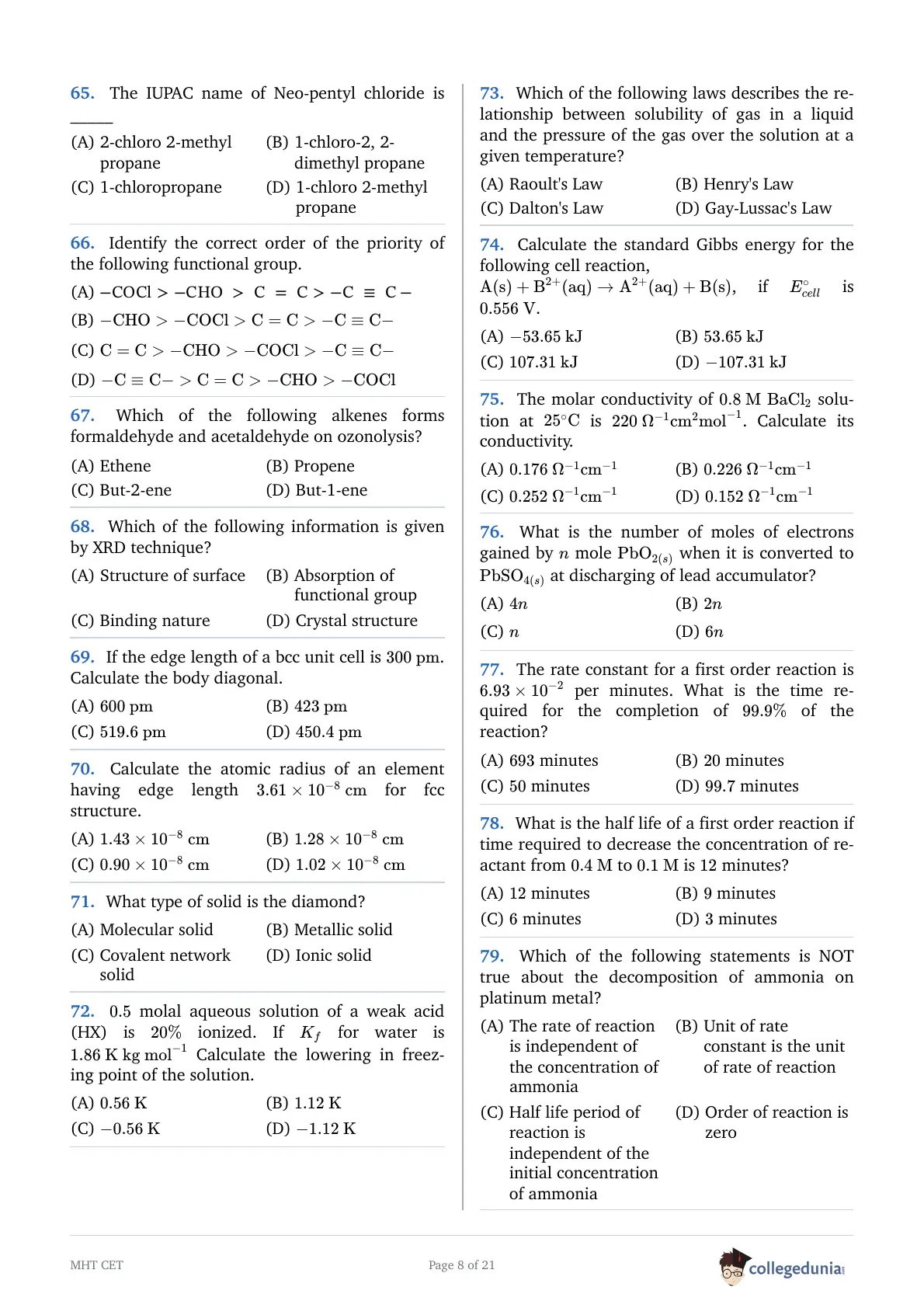
The IUPAC name of Neo-pentyl chloride is _____
Identify the correct order of the priority of the following functional group.
Which of the following alkenes forms formaldehyde and acetaldehyde on ozonolysis?
Which of the following information is given by XRD technique?
If the edge length of a bcc unit cell is \(300\ \text{pm}\). Calculate the body diagonal.
Calculate the atomic radius of an element having edge length \(3.61\times 10^{-8}\ \text{cm}\) for fcc structure.
What type of solid is the diamond?
\(0.5\) molal aqueous solution of a weak acid (HX) is \(20\%\) ionized. If \(K_{f}\) for water is \(1.86\ \text{K kg mol}^{-1}\) Calculate the lowering in freezing point of the solution.
Which of the following laws describes the relationship between solubility of gas in a liquid and the pressure of the gas over the solution at a given temperature?
Calculate the standard Gibbs energy for the following cell reaction,
\(\text{A(s)}+\text{B}^{2+}\text{(aq)}\rightarrow \text{A}^{2+}\text{(aq)}+\text{B(s)}\), if \(E_{cell}^{\circ }\) is \(0.556\ \text{V}\).
The molar conductivity of \(0.8\ \text{M}\) \(\text{BaCl}_{2}\) solution at \(25^{\circ }\text{C}\) is \(220\ \Omega ^{-1}\text{cm}^{2}\text{mol}^{-1}\). Calculate its conductivity.
What is the number of moles of electrons gained by \(n\) mole \(\text{PbO}_{2(s)}\) when it is converted to \(\text{PbSO}_{4(s)}\) at discharging of lead accumulator?
The rate constant for a first order reaction is \(6.93\times 10^{-2}\) per minutes. What is the time required for the completion of \(99.9\%\) of the reaction?
What is the half life of a first order reaction if time required to decrease the concentration of reactant from \(0.4\ \text{M}\) to \(0.1\ \text{M}\) is \(12\) minutes?
Which of the following statements is NOT true about the decomposition of ammonia on platinum metal?
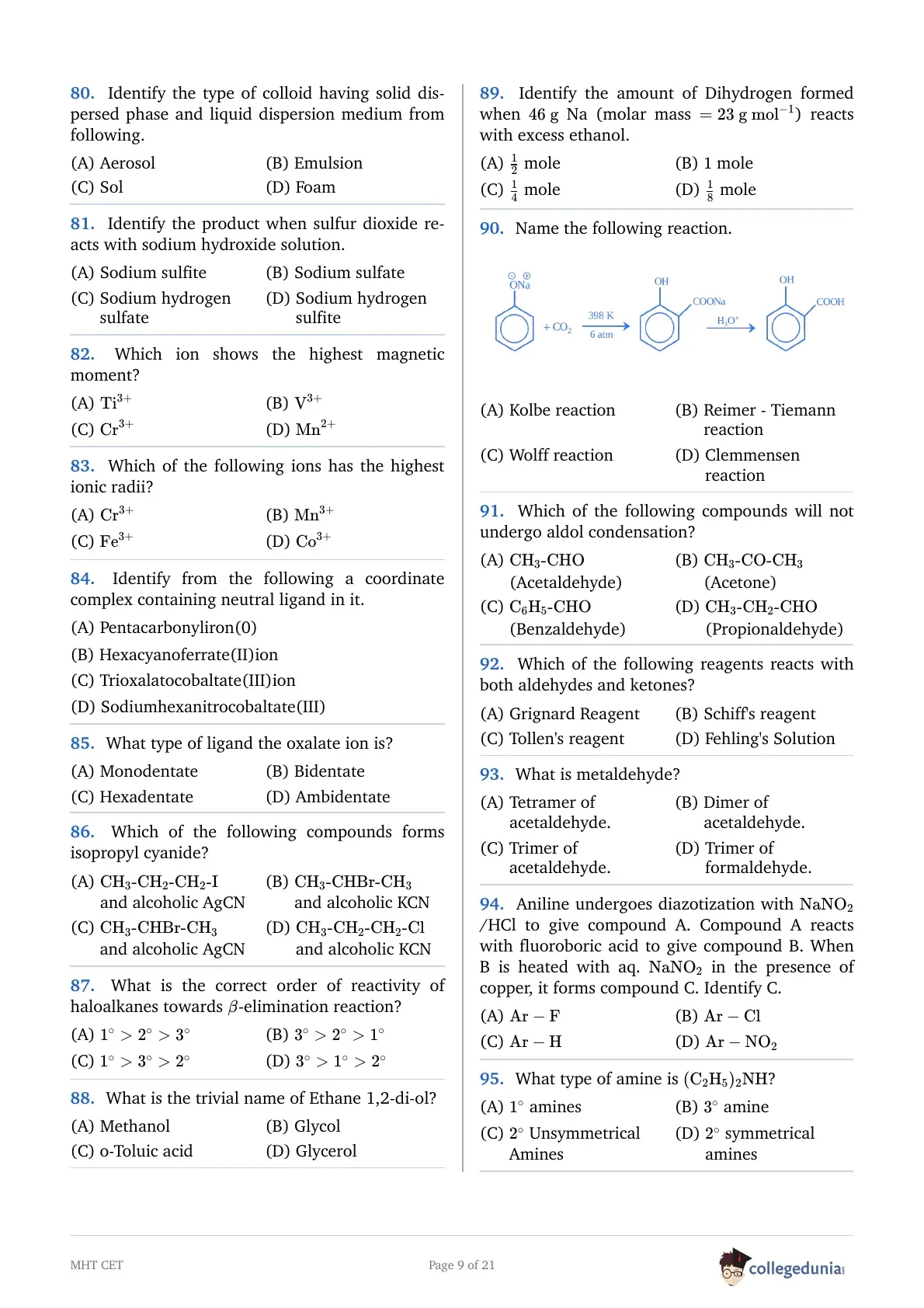
Identify the type of colloid having solid dispersed phase and liquid dispersion medium from following.
Identify the product when sulfur dioxide reacts with sodium hydroxide solution.
Which ion shows the highest magnetic moment?
Which of the following ions has the highest ionic radii?
Identify from the following a coordinate complex containing neutral ligand in it.
What type of ligand the oxalate ion is?
Which of the following compounds forms isopropyl cyanide?
What is the correct order of reactivity of haloalkanes towards \(\beta\)-elimination reaction?
What is the trivial name of Ethane 1,2-di-ol?
Identify the amount of Dihydrogen formed when \(46\ \text{g}\) Na (molar mass \(=23\ \text{g mol}^{-1}\)) reacts with excess ethanol.

Which of the following compounds will not undergo aldol condensation?
Which of the following reagents reacts with both aldehydes and ketones?
What is metaldehyde?
Aniline undergoes diazotization with \(\text{NaNO}_{2}\)/HCl to give compound A. Compound A reacts with fluoroboric acid to give compound B. When B is heated with aq. \(\text{NaNO}_{2}\) in the presence of copper, it forms compound C. Identify C.
What type of amine is \((\text{C}_{2}\text{H}_{5})_{2}\text{NH}\)?
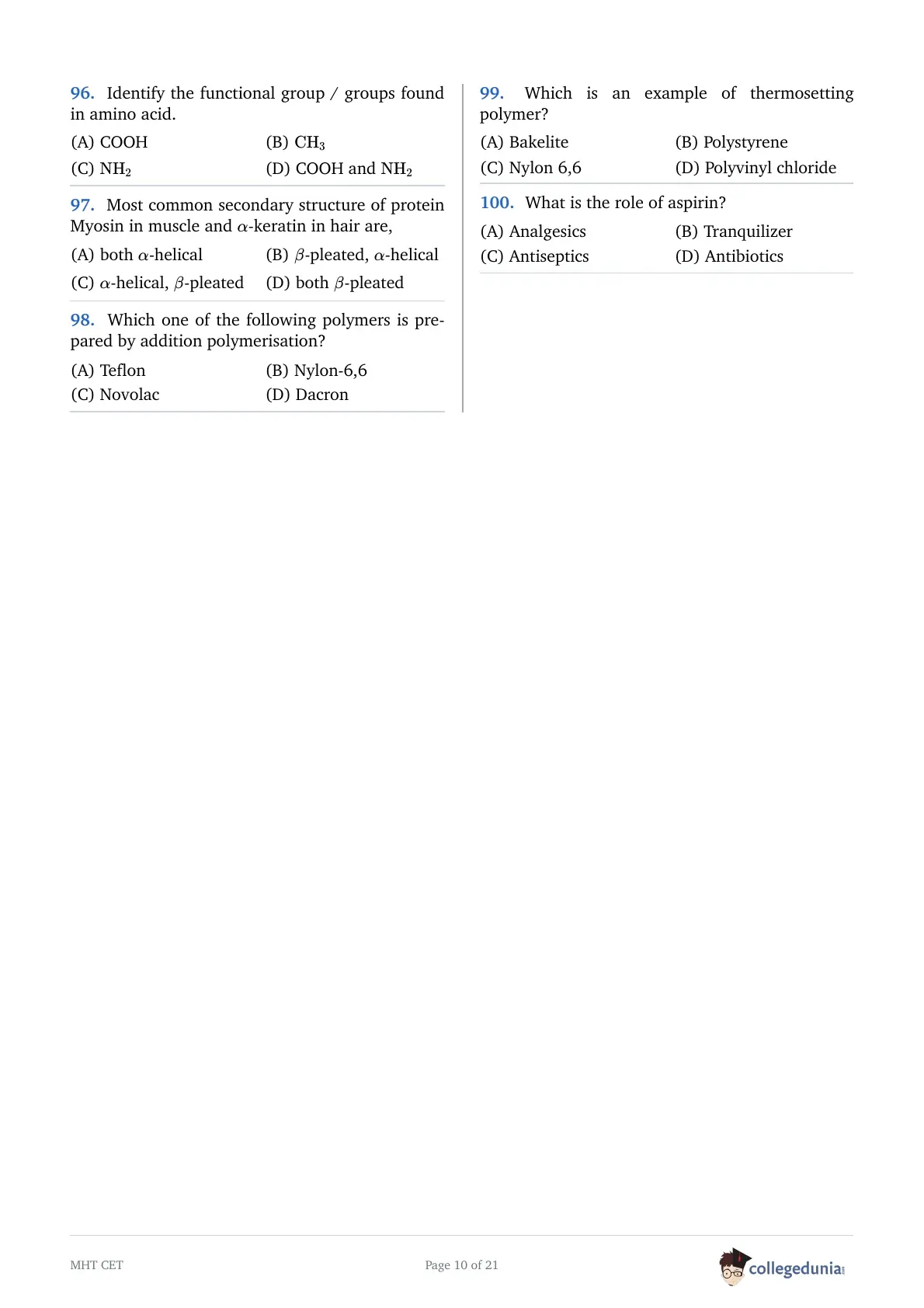
Identify the functional group / groups found in amino acid.
Most common secondary structure of protein Myosin in muscle and \(\alpha\)-keratin in hair are,
Which one of the following polymers is prepared by addition polymerisation?
Which is an example of thermosetting polymer?
What is the role of aspirin?
Biology (Q101 - Q200)
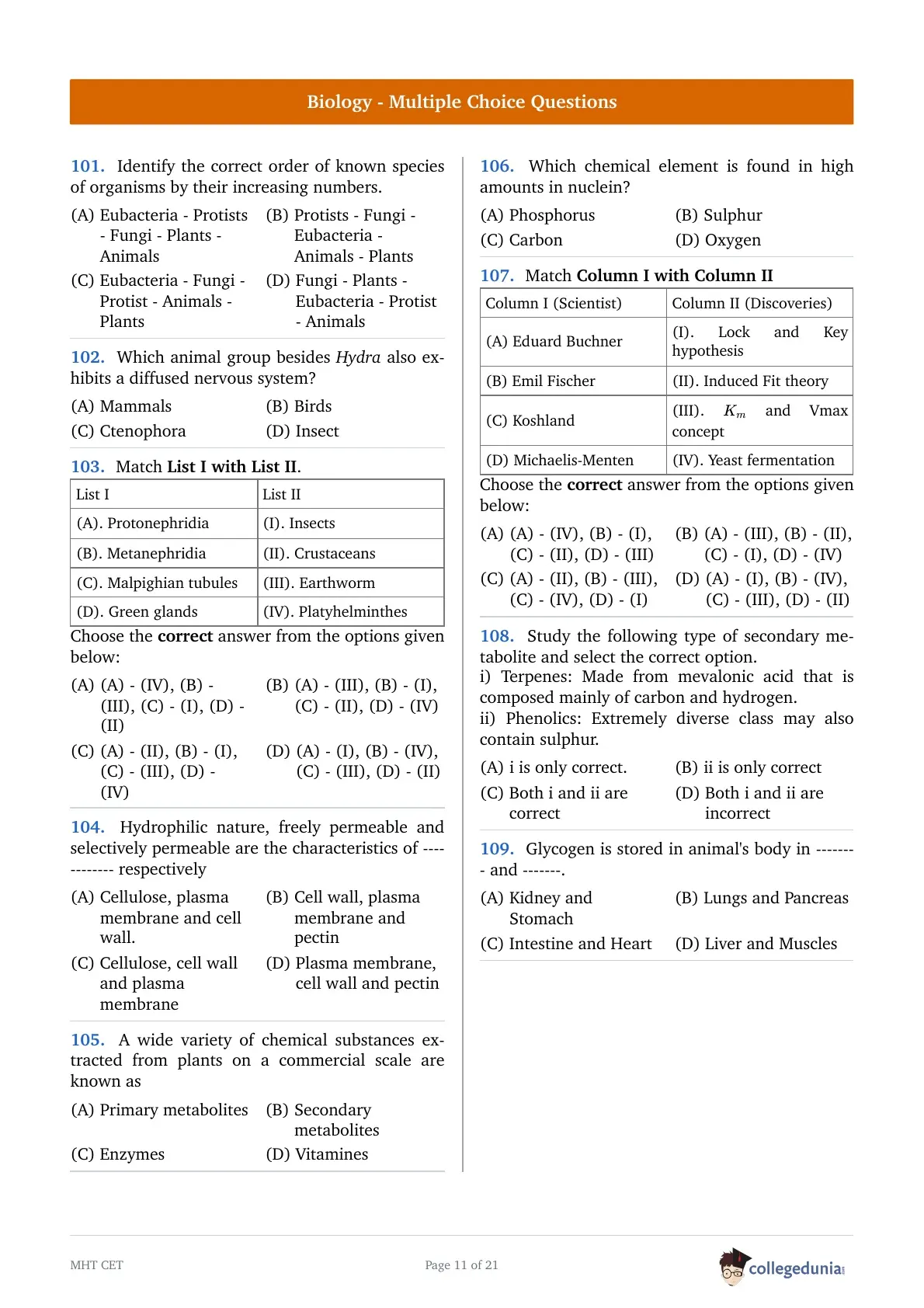
Identify the correct order of known species of organisms by their increasing numbers.
Which animal group besides Hydra also exhibits a diffused nervous system?
Match List I with List II.
| List I | List II |
| (A). Protonephridia | (I). Insects |
| (B). Metanephridia | (II). Crustaceans |
| (C). Malpighian tubules | (III). Earthworm |
| (D). Green glands | (IV). Platyhelminthes |
Hydrophilic nature, freely permeable and selectively permeable are the characteristics of ------------ respectively
A wide variety of chemical substances extracted from plants on a commercial scale are known as
Which chemical element is found in high amounts in nuclein?
Match Column I with Column II
| Column I (Scientist) | Column II (Discoveries) |
| (A) Eduard Buchner | (I). Lock and Key hypothesis |
| (B) Emil Fischer | (II). Induced Fit theory |
| (C) Koshland | (III). \(K_{m}\) and Vmax concept |
| (D) Michaelis-Menten | (IV). Yeast fermentation |
Study the following type of secondary metabolite and select the correct option.
i) Terpenes: Made from mevalonic acid that is composed mainly of carbon and hydrogen.
ii) Phenolics: Extremely diverse class may also contain sulphur.
Glycogen is stored in animal's body in -------- and -------.
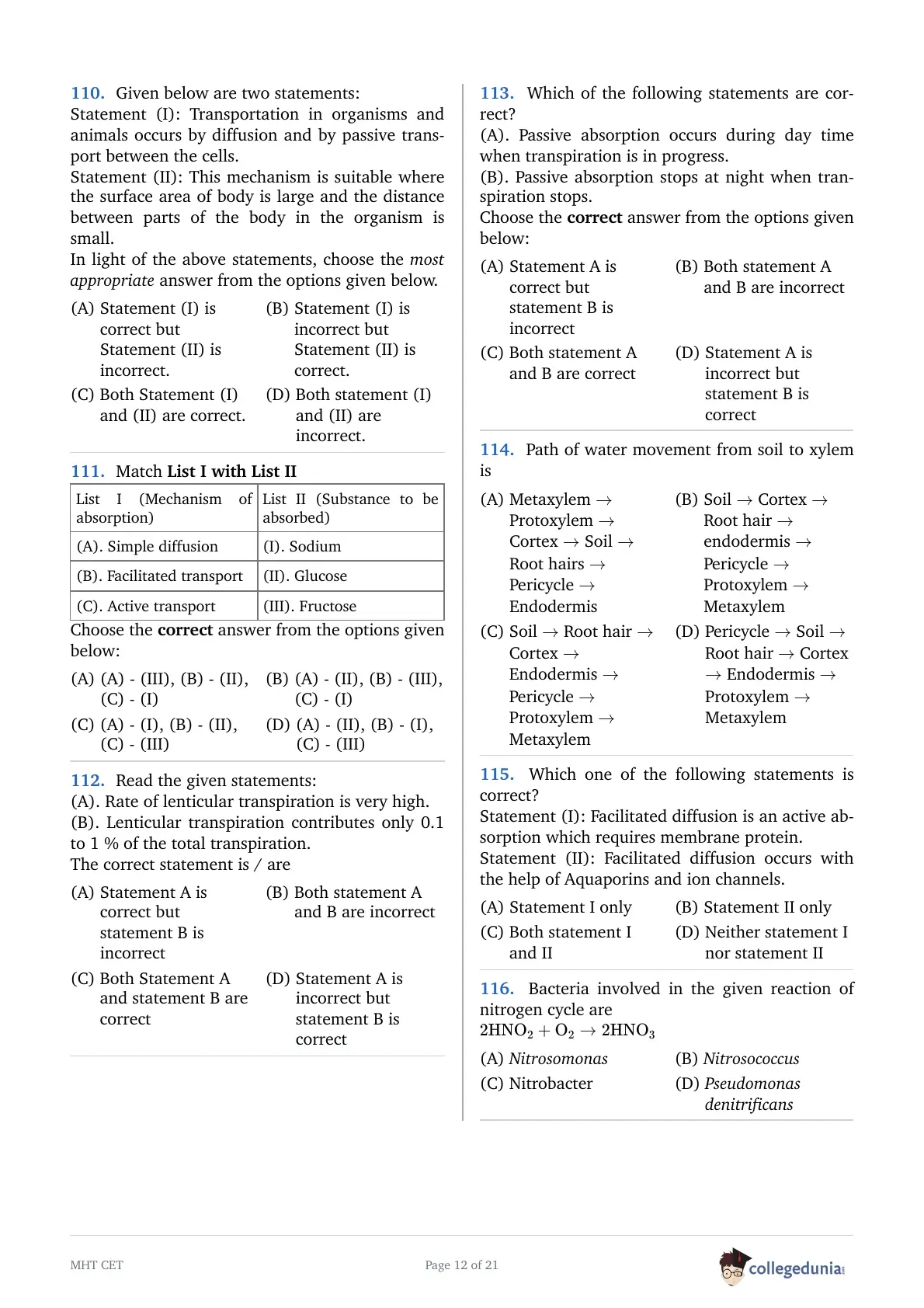
Given below are two statements:
Statement (I): Transportation in organisms and animals occurs by diffusion and by passive transport between the cells.
Statement (II): This mechanism is suitable where the surface area of body is large and the distance between parts of the body in the organism is small.
In light of the above statements, choose the most appropriate answer from the options given below.
Match List I with List II
| List I (Mechanism of absorption) | List II (Substance to be absorbed) |
| (A). Simple diffusion | (I). Sodium |
| (B). Facilitated transport | (II). Glucose |
| (C). Active transport | (III). Fructose |
Read the given statements:
(A). Rate of lenticular transpiration is very high.
(B). Lenticular transpiration contributes only 0.1 to 1 % of the total transpiration.
The correct statement is / are
Which of the following statements are correct?
(A). Passive absorption occurs during day time when transpiration is in progress.
(B). Passive absorption stops at night when transpiration stops.
Choose the correct answer from the options given below:
Path of water movement from soil to xylem is
Which one of the following statements is correct?
Statement (I): Facilitated diffusion is an active absorption which requires membrane protein.
Statement (II): Facilitated diffusion occurs with the help of Aquaporins and ion channels.
Bacteria involved in the given reaction of nitrogen cycle are
\(2\text{HNO}_{2}+\text{O}_{2}\rightarrow 2\text{HNO}_{3}\)
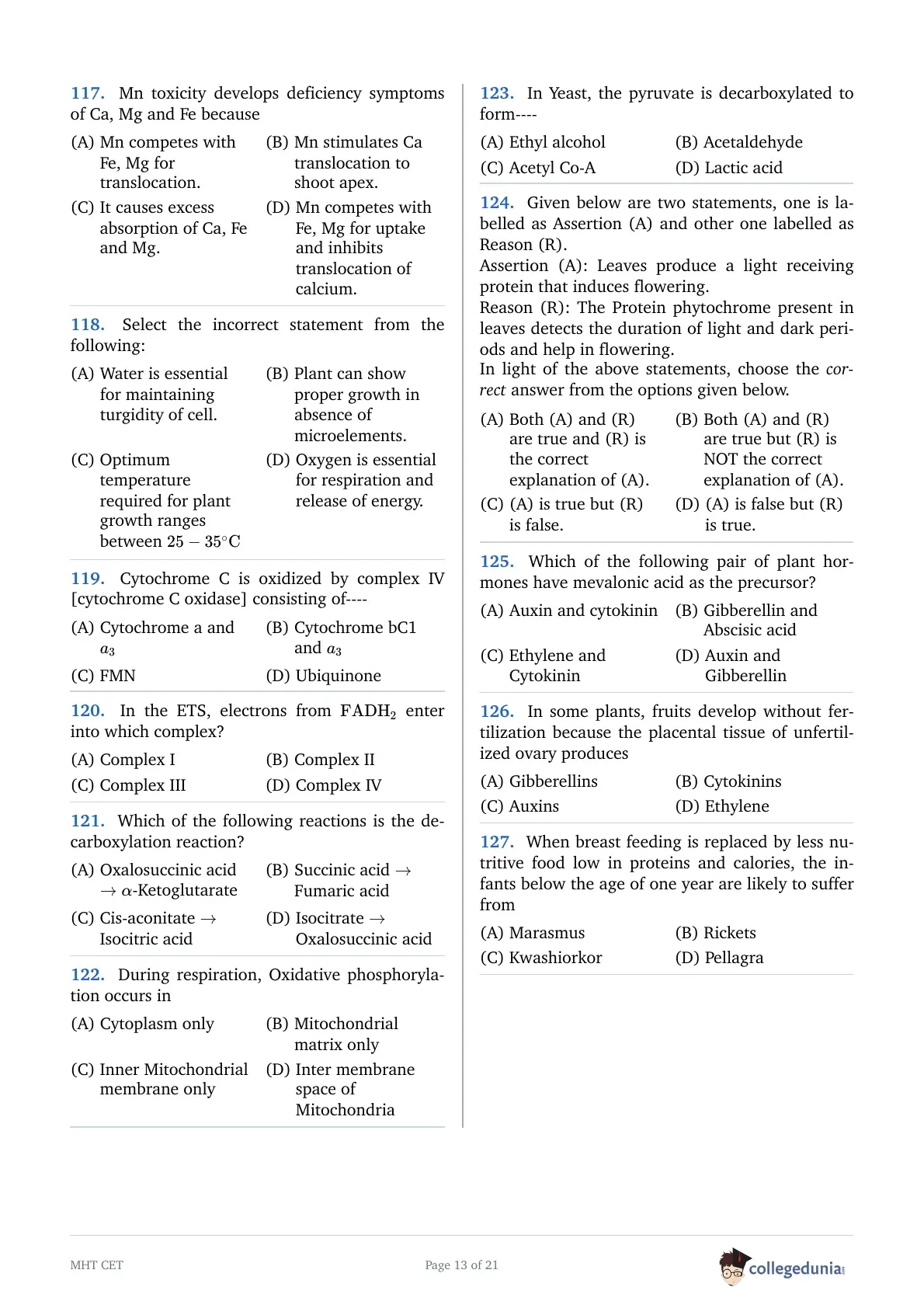
Mn toxicity develops deficiency symptoms of Ca, Mg and Fe because
Select the incorrect statement from the following:
Cytochrome C is oxidized by complex IV [cytochrome C oxidase] consisting of----
In the ETS, electrons from \(\text{FADH}_{2}\) enter into which complex?
Which of the following reactions is the decarboxylation reaction?
During respiration, Oxidative phosphorylation occurs in
In Yeast, the pyruvate is decarboxylated to form----
Given below are two statements, one is labelled as Assertion (A) and other one labelled as Reason (R).
Assertion (A): Leaves produce a light receiving protein that induces flowering.
Reason (R): The Protein phytochrome present in leaves detects the duration of light and dark periods and help in flowering.
In light of the above statements, choose the correct answer from the options given below.
Which of the following pair of plant hormones have mevalonic acid as the precursor?
In some plants, fruits develop without fertilization because the placental tissue of unfertilized ovary produces
When breast feeding is replaced by less nutritive food low in proteins and calories, the infants below the age of one year are likely to suffer from
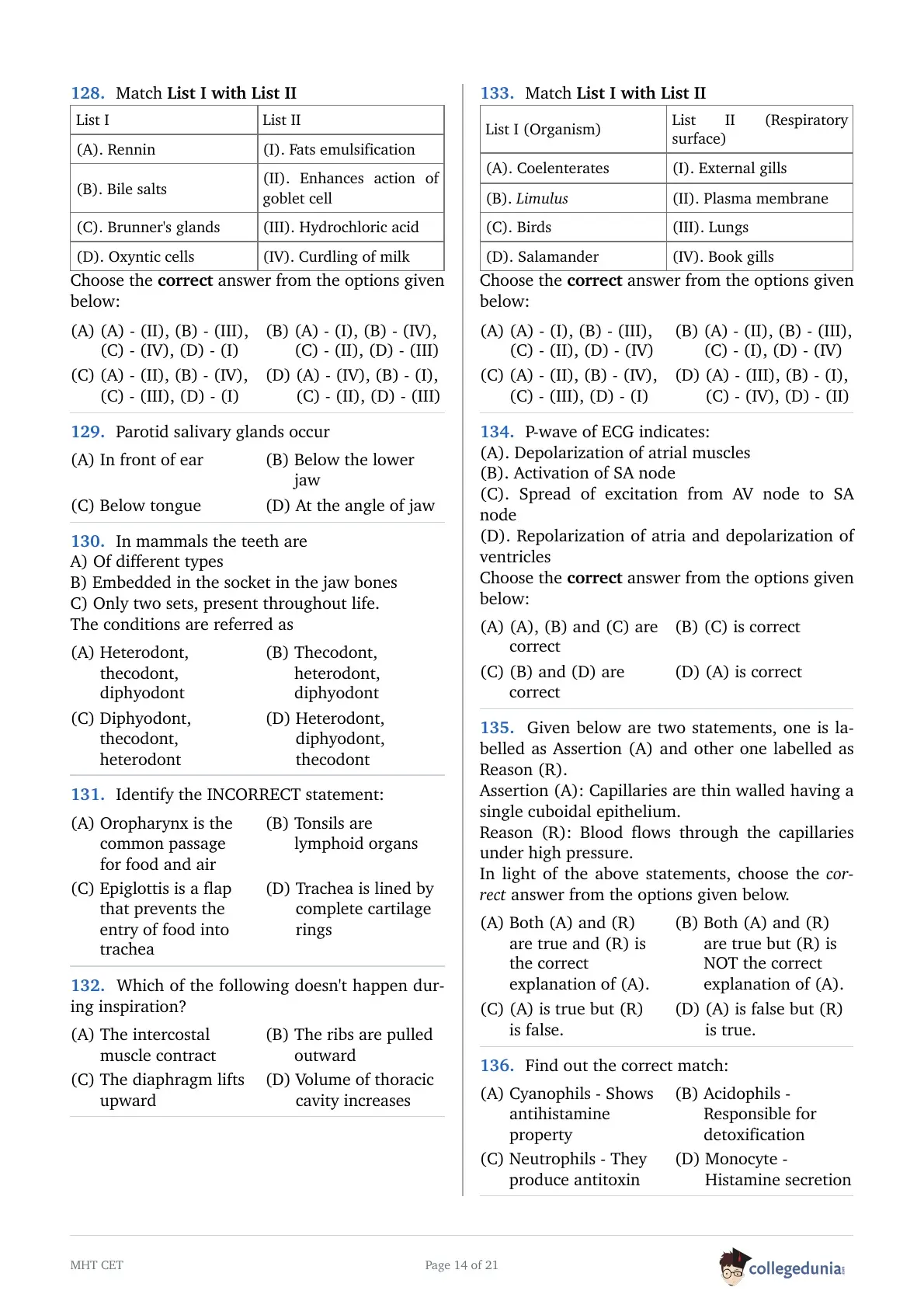
Match List I with List II
| List I | List II |
| (A). Rennin | (I). Fats emulsification |
| (B). Bile salts | (II). Enhances action of goblet cell |
| (C). Brunner's glands | (III). Hydrochloric acid |
| (D). Oxyntic cells | (IV). Curdling of milk |
Parotid salivary glands occur
In mammals the teeth are
A) Of different types
B) Embedded in the socket in the jaw bones
C) Only two sets, present throughout life.
The conditions are referred as
Identify the INCORRECT statement:
Which of the following doesn't happen during inspiration?
Match List I with List II
| List I (Organism) | List II (Respiratory surface) |
| (A). Coelenterates | (I). External gills |
| (B). Limulus | (II). Plasma membrane |
| (C). Birds | (III). Lungs |
| (D). Salamander | (IV). Book gills |
P-wave of ECG indicates:
(A). Depolarization of atrial muscles
(B). Activation of SA node
(C). Spread of excitation from AV node to SA node
(D). Repolarization of atria and depolarization of ventricles
Choose the correct answer from the options given below:
Given below are two statements, one is labelled as Assertion (A) and other one labelled as Reason (R).
Assertion (A): Capillaries are thin walled having a single cuboidal epithelium.
Reason (R): Blood flows through the capillaries under high pressure.
In light of the above statements, choose the correct answer from the options given below.
Find out the correct match:
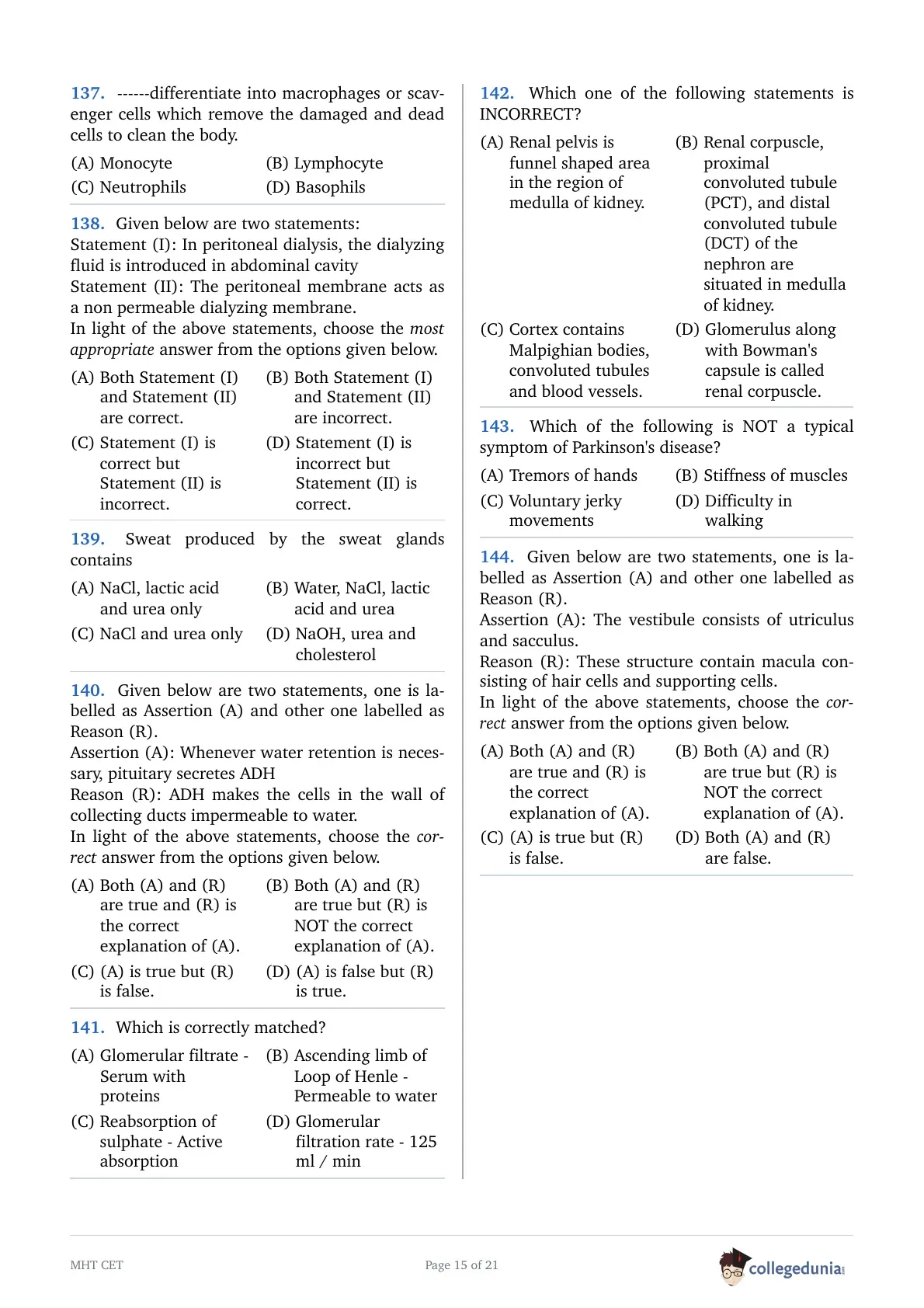
------differentiate into macrophages or scavenger cells which remove the damaged and dead cells to clean the body.
Given below are two statements:
Statement (I): In peritoneal dialysis, the dialyzing fluid is introduced in abdominal cavity
Statement (II): The peritoneal membrane acts as a non permeable dialyzing membrane.
In light of the above statements, choose the most appropriate answer from the options given below.
Sweat produced by the sweat glands contains
Given below are two statements, one is labelled as Assertion (A) and other one labelled as Reason (R).
Assertion (A): Whenever water retention is necessary, pituitary secretes ADH
Reason (R): ADH makes the cells in the wall of collecting ducts impermeable to water.
In light of the above statements, choose the correct answer from the options given below.
Which is correctly matched?
Which one of the following statements is INCORRECT?
Which of the following is NOT a typical symptom of Parkinson's disease?
Given below are two statements, one is labelled as Assertion (A) and other one labelled as Reason (R).
Assertion (A): The vestibule consists of utriculus and sacculus.
Reason (R): These structure contain macula consisting of hair cells and supporting cells.
In light of the above statements, choose the correct answer from the options given below.
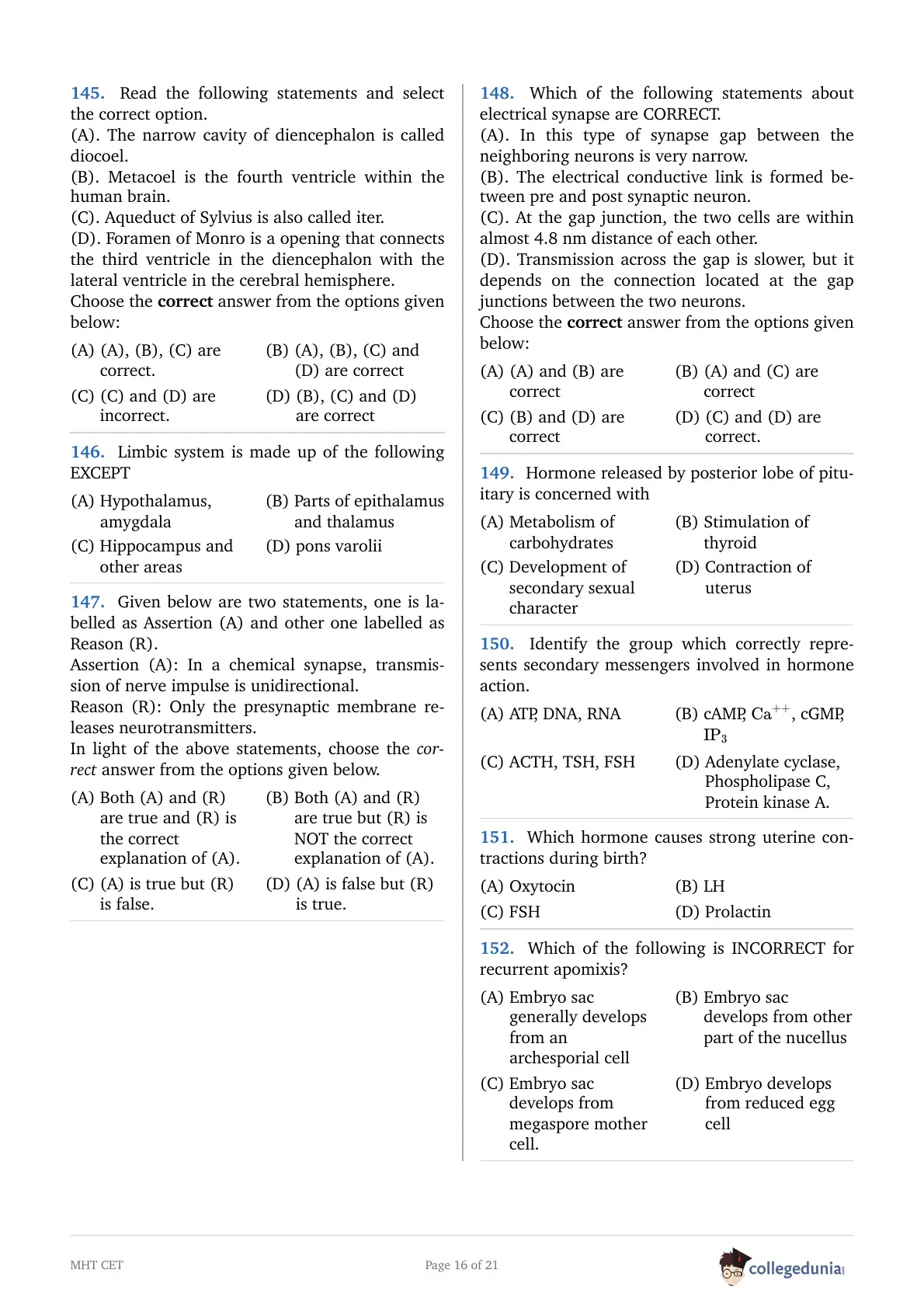
Read the following statements and select the correct option.
(A). The narrow cavity of diencephalon is called diocoel.
(B). Metacoel is the fourth ventricle within the human brain.
(C). Aqueduct of Sylvius is also called iter.
(D). Foramen of Monro is a opening that connects the third ventricle in the diencephalon with the lateral ventricle in the cerebral hemisphere.
Choose the correct answer from the options given below:
Limbic system is made up of the following EXCEPT
Given below are two statements, one is labelled as Assertion (A) and other one labelled as Reason (R).
Assertion (A): In a chemical synapse, transmission of nerve impulse is unidirectional.
Reason (R): Only the presynaptic membrane releases neurotransmitters.
In light of the above statements, choose the correct answer from the options given below.
Which of the following statements about electrical synapse are CORRECT.
(A). In this type of synapse gap between the neighboring neurons is very narrow.
(B). The electrical conductive link is formed between pre and post synaptic neuron.
(C). At the gap junction, the two cells are within almost 4.8 nm distance of each other.
(D). Transmission across the gap is slower, but it depends on the connection located at the gap junctions between the two neurons.
Choose the correct answer from the options given below:
Hormone released by posterior lobe of pituitary is concerned with
Identify the group which correctly represents secondary messengers involved in hormone action.
Which hormone causes strong uterine contractions during birth?
Which of the following is INCORRECT for recurrent apomixis?
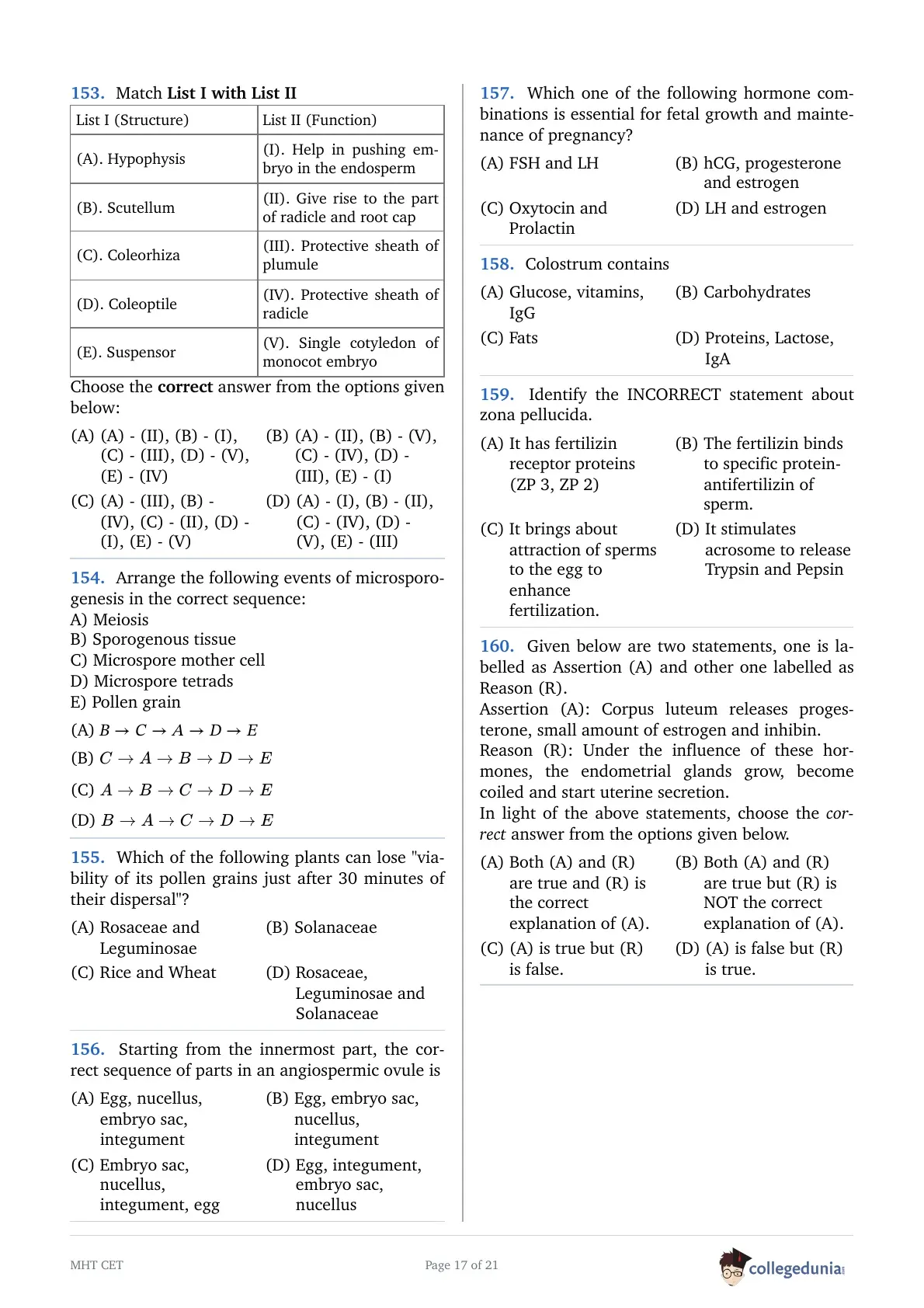
Match List I with List II
| List I (Structure) | List II (Function) |
| (A). Hypophysis | (I). Help in pushing embryo in the endosperm |
| (B). Scutellum | (II). Give rise to the part of radicle and root cap |
| (C). Coleorhiza | (III). Protective sheath of plumule |
| (D). Coleoptile | (IV). Protective sheath of radicle |
| (E). Suspensor | (V). Single cotyledon of monocot embryo |
Arrange the following events of microsporogenesis in the correct sequence:
A) Meiosis
B) Sporogenous tissue
C) Microspore mother cell
D) Microspore tetrads
E) Pollen grain
Which of the following plants can lose "viability of its pollen grains just after 30 minutes of their dispersal"?
Starting from the innermost part, the correct sequence of parts in an angiospermic ovule is
Which one of the following hormone combinations is essential for fetal growth and maintenance of pregnancy?
Colostrum contains
Identify the INCORRECT statement about zona pellucida.
Given below are two statements, one is labelled as Assertion (A) and other one labelled as Reason (R).
Assertion (A): Corpus luteum releases progesterone, small amount of estrogen and inhibin.
Reason (R): Under the influence of these hormones, the endometrial glands grow, become coiled and start uterine secretion.
In light of the above statements, choose the correct answer from the options given below.
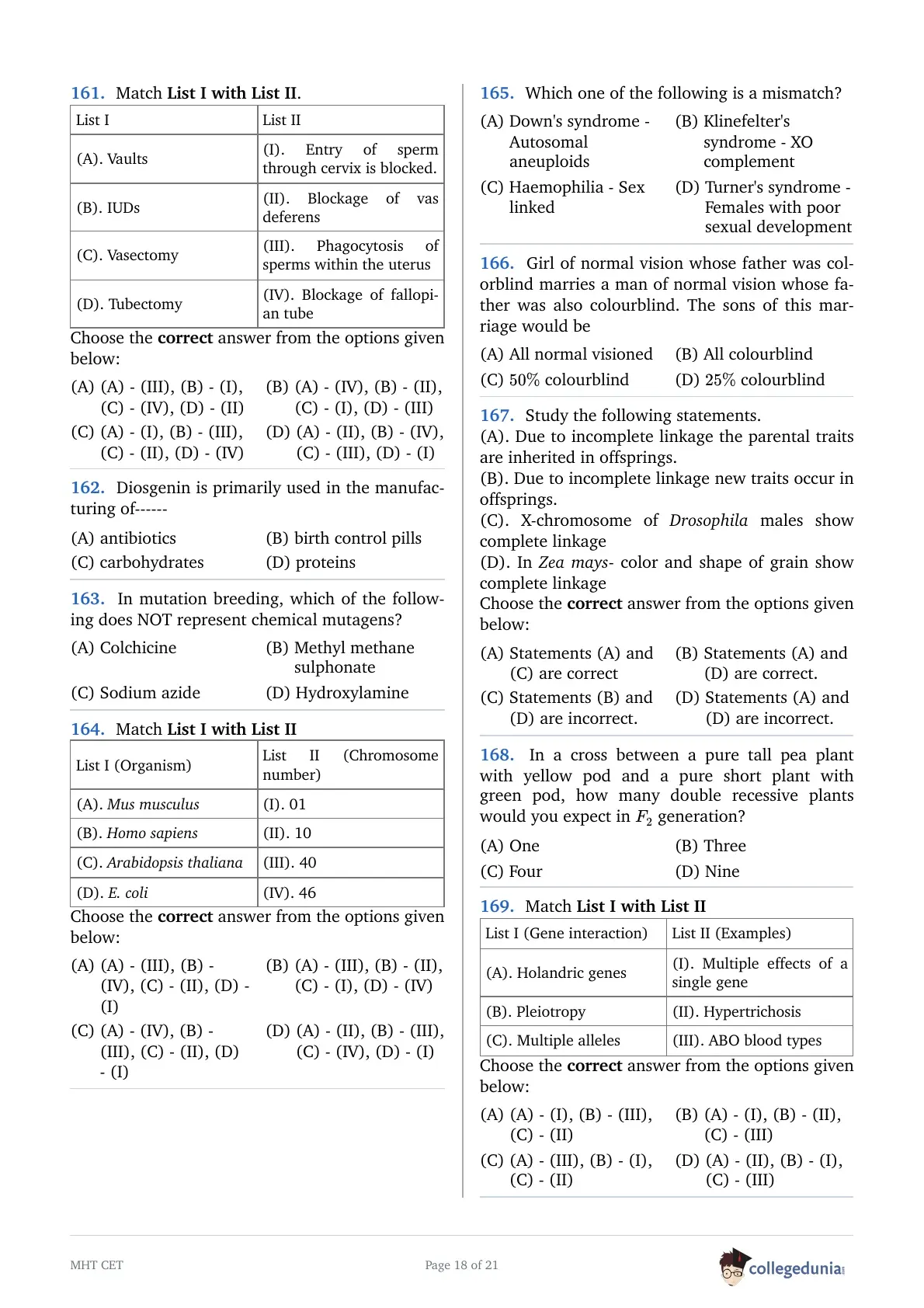
Match List I with List II.
| List I | List II |
| (A). Vaults | (I). Entry of sperm through cervix is blocked. |
| (B). IUDs | (II). Blockage of vas deferens |
| (C). Vasectomy | (III). Phagocytosis of sperms within the uterus |
| (D). Tubectomy | (IV). Blockage of fallopian tube |
Diosgenin is primarily used in the manufacturing of------
In mutation breeding, which of the following does NOT represent chemical mutagens?
Match List I with List II
| List I (Organism) | List II (Chromosome number) |
| (A). Mus musculus | (I). 01 |
| (B). Homo sapiens | (II). 10 |
| (C). Arabidopsis thaliana | (III). 40 |
| (D). E. coli | (IV). 46 |
Which one of the following is a mismatch?
Girl of normal vision whose father was colorblind marries a man of normal vision whose father was also colourblind. The sons of this marriage would be
Study the following statements.
(A). Due to incomplete linkage the parental traits are inherited in offsprings.
(B). Due to incomplete linkage new traits occur in offsprings.
(C). X-chromosome of Drosophila males show complete linkage
(D). In Zea mays- color and shape of grain show complete linkage
Choose the correct answer from the options given below:
In a cross between a pure tall pea plant with yellow pod and a pure short plant with green pod, how many double recessive plants would you expect in \(F_{2}\) generation?
Match List I with List II
| List I (Gene interaction) | List II (Examples) |
| (A). Holandric genes | (I). Multiple effects of a single gene |
| (B). Pleiotropy | (II). Hypertrichosis |
| (C). Multiple alleles | (III). ABO blood types |
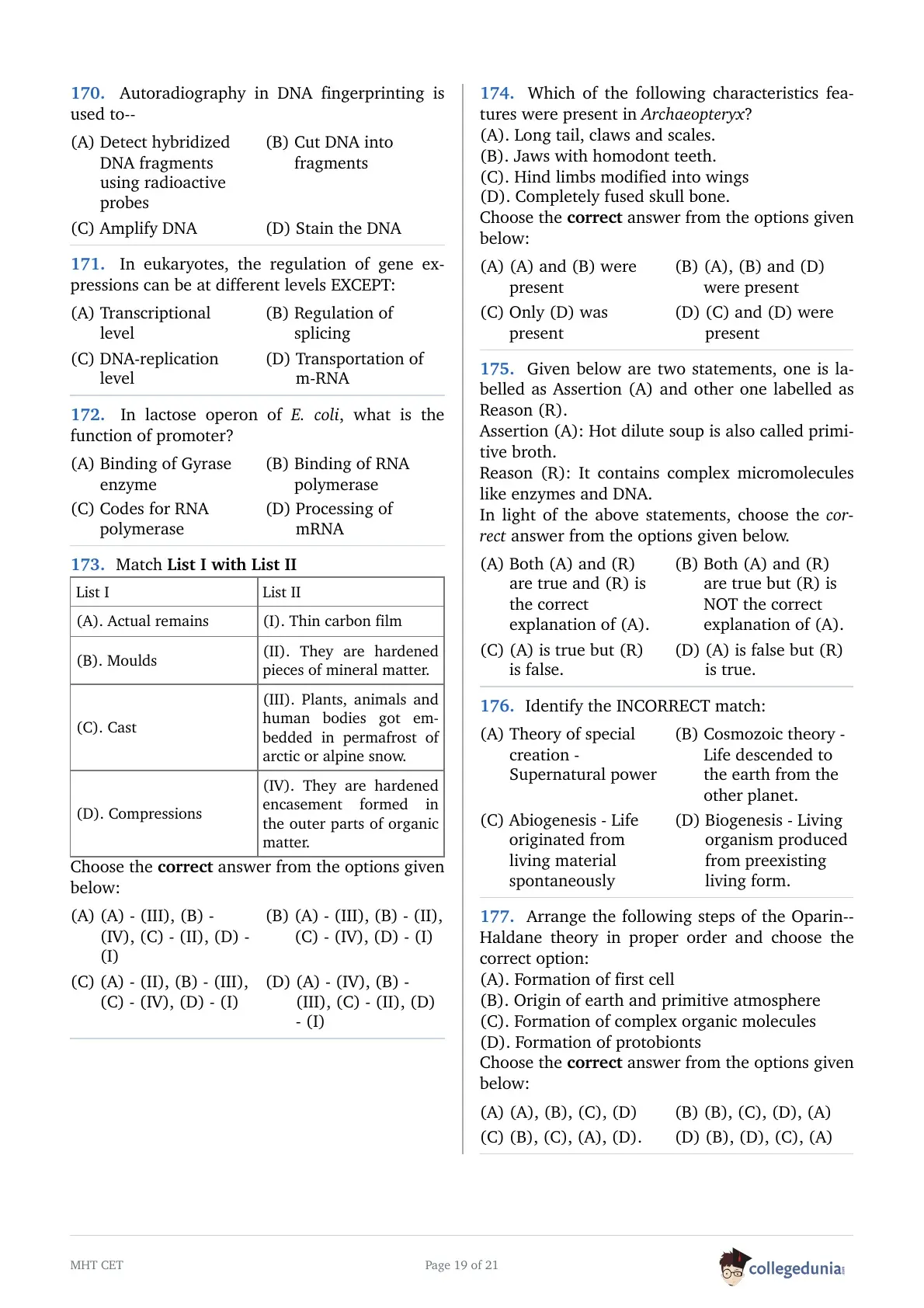
Autoradiography in DNA fingerprinting is used to--
In eukaryotes, the regulation of gene expressions can be at different levels EXCEPT:
In lactose operon of E. coli, what is the function of promoter?
Match List I with List II
| List I | List II |
| (A). Actual remains | (I). Thin carbon film |
| (B). Moulds | (II). They are hardened pieces of mineral matter. |
| (C). Cast | (III). Plants, animals and human bodies got embedded in permafrost of arctic or alpine snow. |
| (D). Compressions | (IV). They are hardened encasement formed in the outer parts of organic matter. |
Which of the following characteristics features were present in Archaeopteryx?
(A). Long tail, claws and scales.
(B). Jaws with homodont teeth.
(C). Hind limbs modified into wings
(D). Completely fused skull bone.
Choose the correct answer from the options given below:
Given below are two statements, one is labelled as Assertion (A) and other one labelled as Reason (R).
Assertion (A): Hot dilute soup is also called primitive broth.
Reason (R): It contains complex micromolecules like enzymes and DNA.
In light of the above statements, choose the correct answer from the options given below.
Identify the INCORRECT match:
Arrange the following steps of the Oparin-- Haldane theory in proper order and choose the correct option:
(A). Formation of first cell
(B). Origin of earth and primitive atmosphere
(C). Formation of complex organic molecules
(D). Formation of protobionts
Choose the correct answer from the options given below:
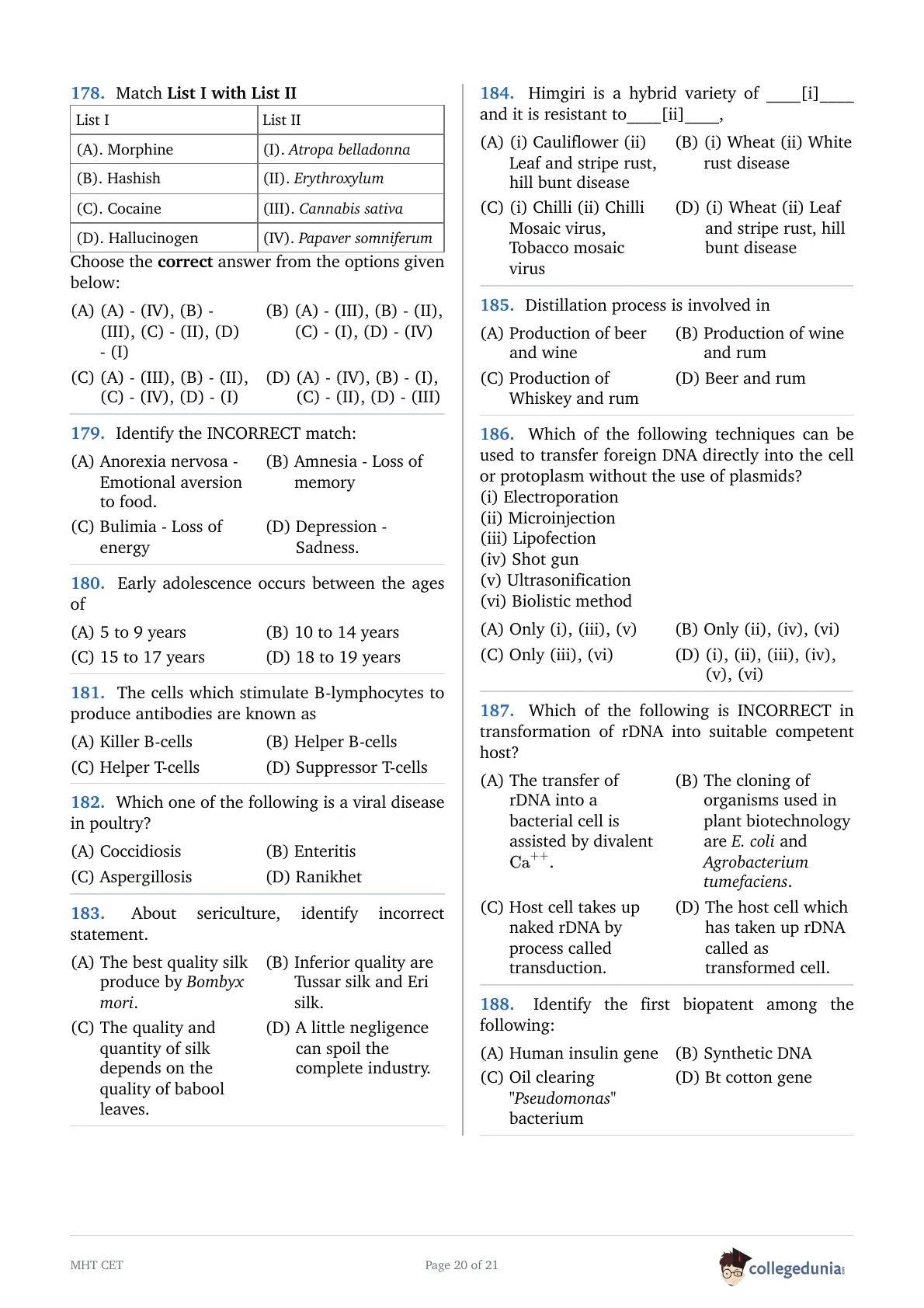
Match List I with List II
| List I | List II |
| (A). Morphine | (I). Atropa belladonna |
| (B). Hashish | (II). Erythroxylum |
| (C). Cocaine | (III). Cannabis sativa |
| (D). Hallucinogen | (IV). Papaver somniferum |
Identify the INCORRECT match:
Early adolescence occurs between the ages of
The cells which stimulate B-lymphocytes to produce antibodies are known as
Which one of the following is a viral disease in poultry?
About sericulture, identify incorrect statement.
Himgiri is a hybrid variety of ____[i]____ and it is resistant to____[ii]____,
Distillation process is involved in
Which of the following techniques can be used to transfer foreign DNA directly into the cell or protoplasm without the use of plasmids?
(i) Electroporation
(ii) Microinjection
(iii) Lipofection
(iv) Shot gun
(v) Ultrasonification
(vi) Biolistic method
Which of the following is INCORRECT in transformation of rDNA into suitable competent host?
Identify the first biopatent among the following:
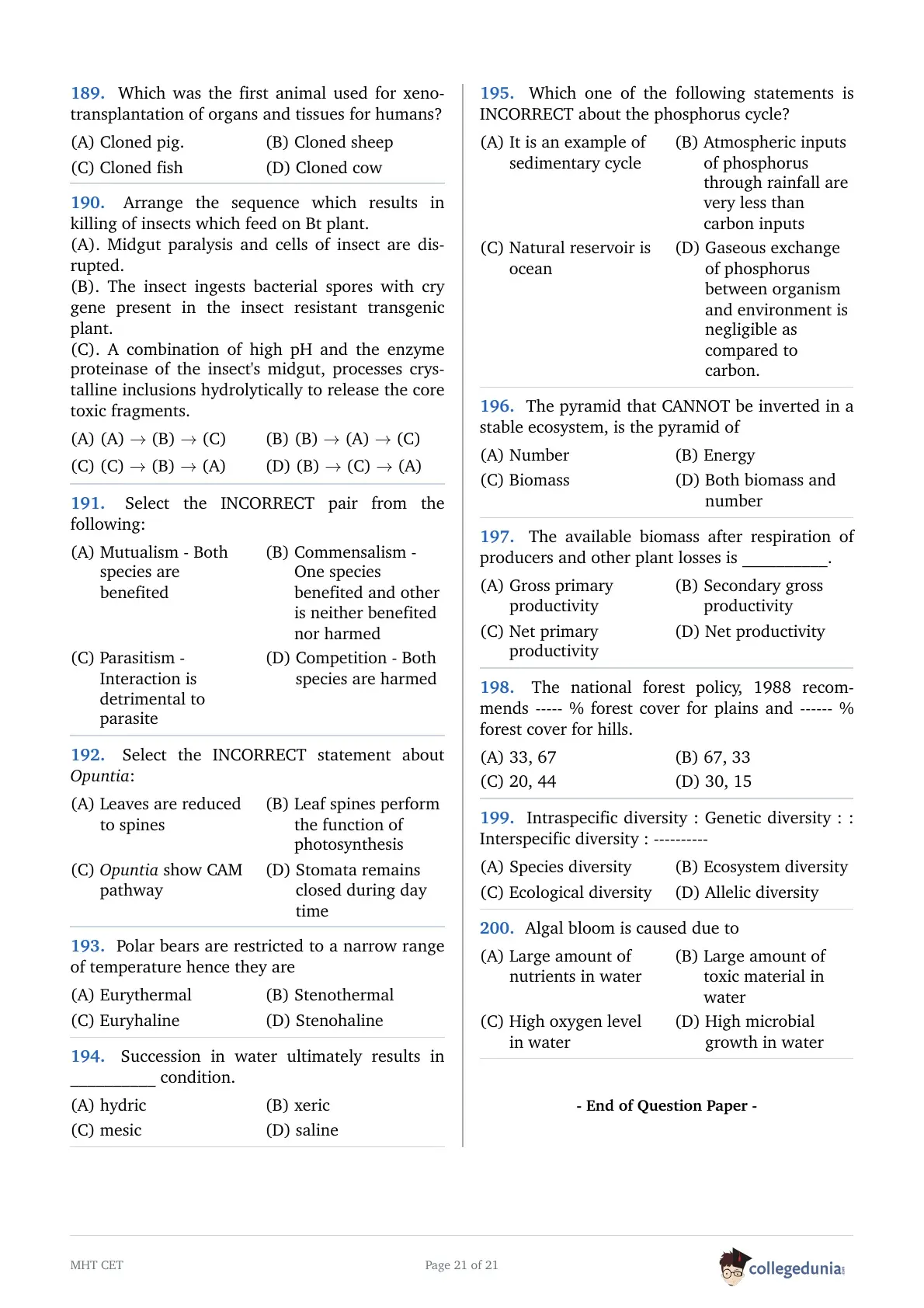
Which was the first animal used for xenotransplantation of organs and tissues for humans?
Arrange the sequence which results in killing of insects which feed on Bt plant.
(A). Midgut paralysis and cells of insect are disrupted.
(B). The insect ingests bacterial spores with cry gene present in the insect resistant transgenic plant.
(C). A combination of high pH and the enzyme proteinase of the insect's midgut, processes crystalline inclusions hydrolytically to release the core toxic fragments.
Select the INCORRECT pair from the following:
Select the INCORRECT statement about Opuntia:
Polar bears are restricted to a narrow range of temperature hence they are
Succession in water ultimately results in __________ condition.
Which one of the following statements is INCORRECT about the phosphorus cycle?
The pyramid that CANNOT be inverted in a stable ecosystem, is the pyramid of
The available biomass after respiration of producers and other plant losses is __________.
The national forest policy, 1988 recommends ----- % forest cover for plains and ------ % forest cover for hills.
Intraspecific diversity : Genetic diversity : : Interspecific diversity : ----------
Algal bloom is caused due to
MHT CET 2026 PCB Exam Pattern and Marking Scheme
| Parameter | Details |
|---|---|
| Conducting Body | Maharashtra Common Entrance Test Cell (Maharashtra CET Cell) |
| Exam Mode | Online (Computer-Based Test) |
| Duration | 180 minutes (3 hours) |
| Groups / Subjects | PCB (Physics, Chemistry, Biology) for Pharmacy and Agriculture |
| Total Questions |
200 |
| Total Marks | 200 |
| Question Type | Multiple Choice Questions (MCQs) |
| Marking Scheme | 1 mark for each correct answer |
| Negative Marking | No |
| Syllabus Weightage |
|



Comments