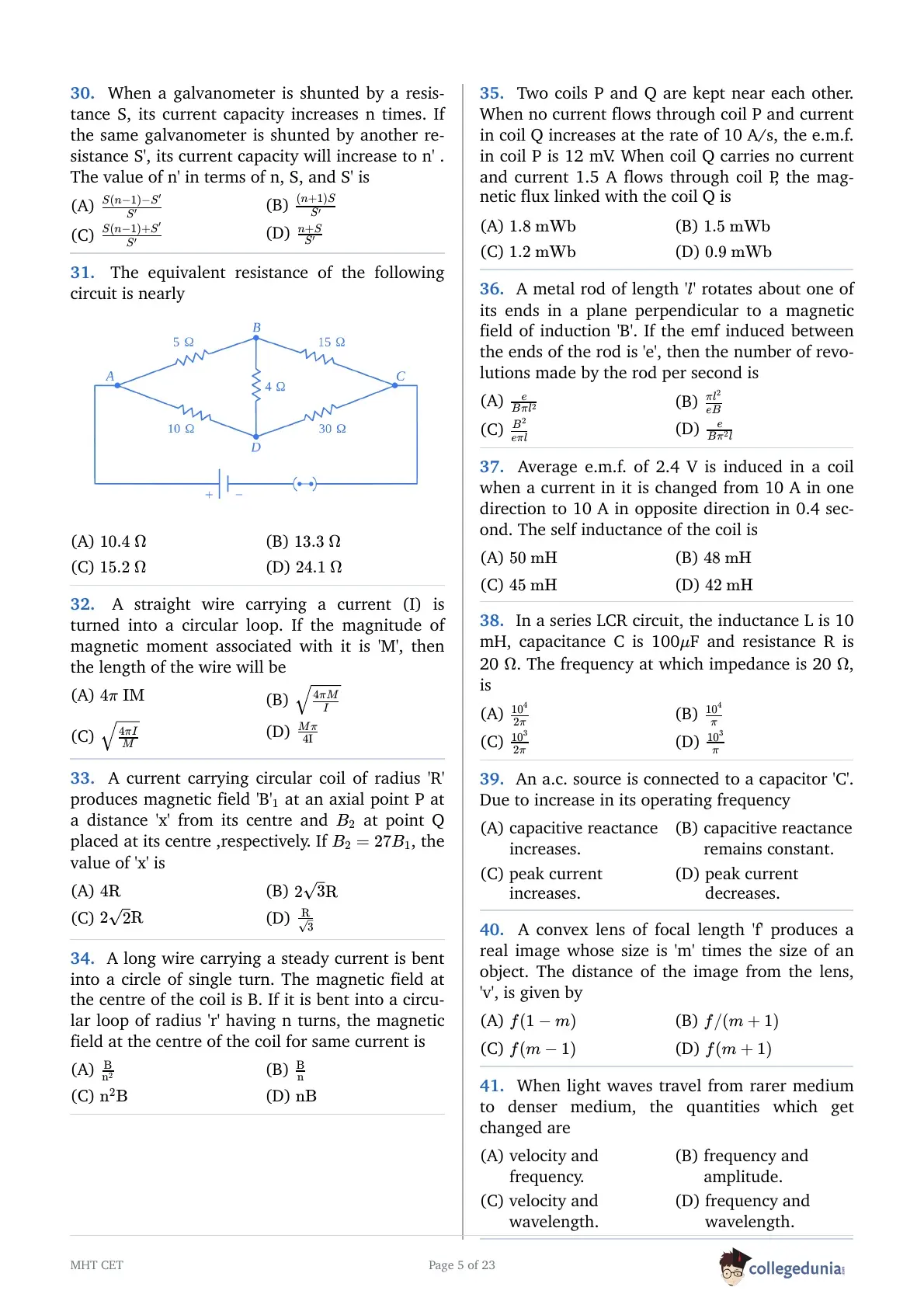
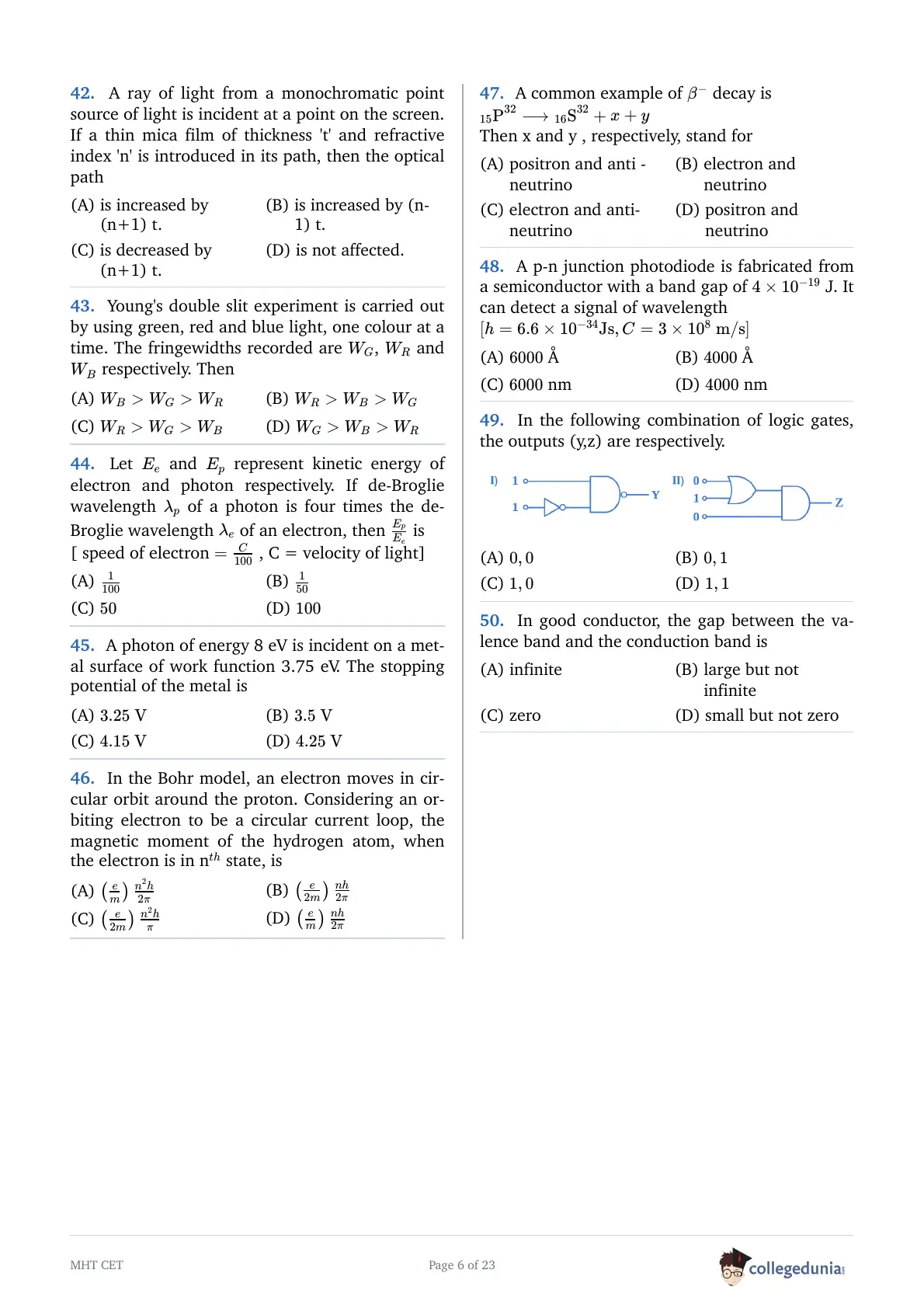
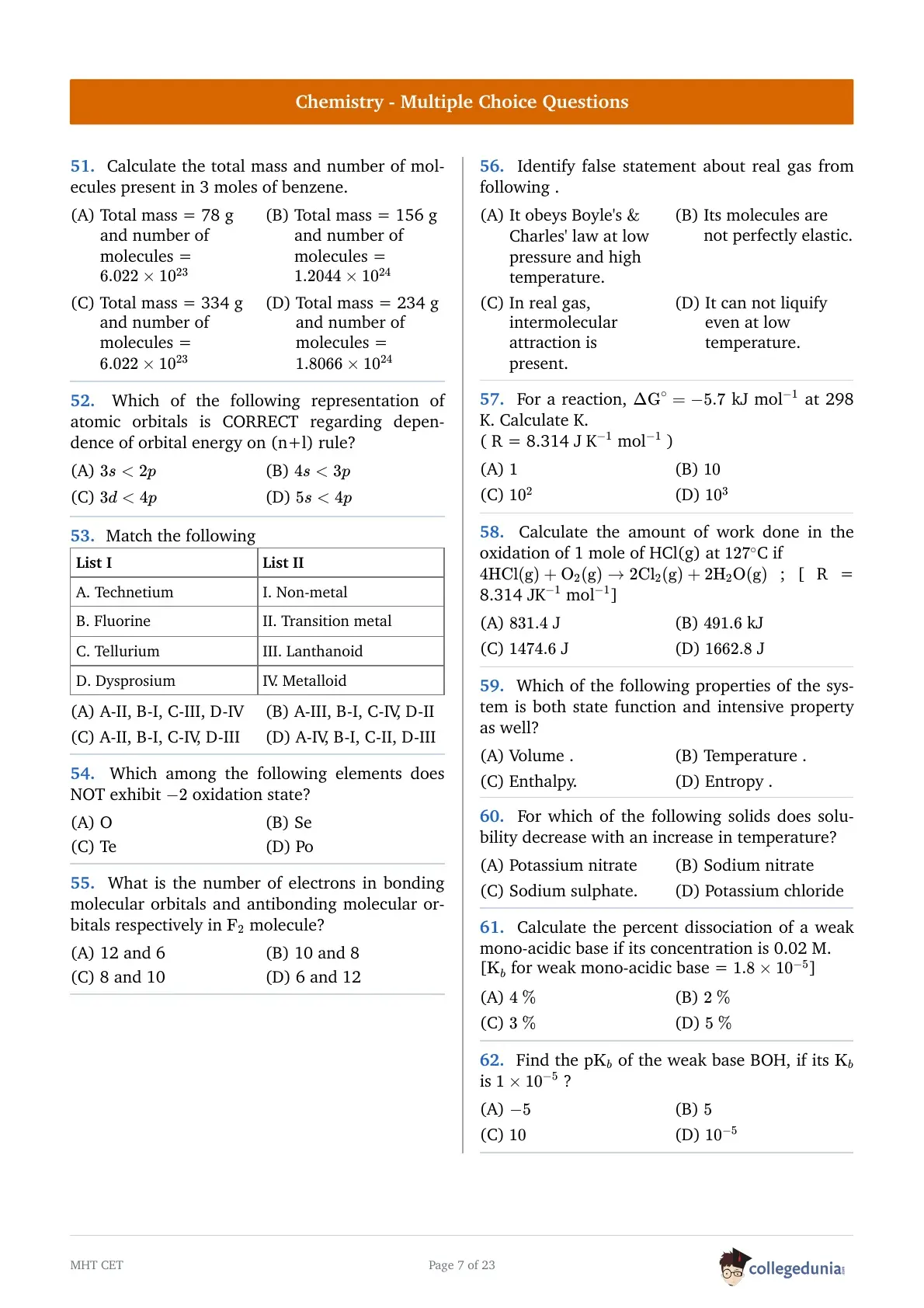
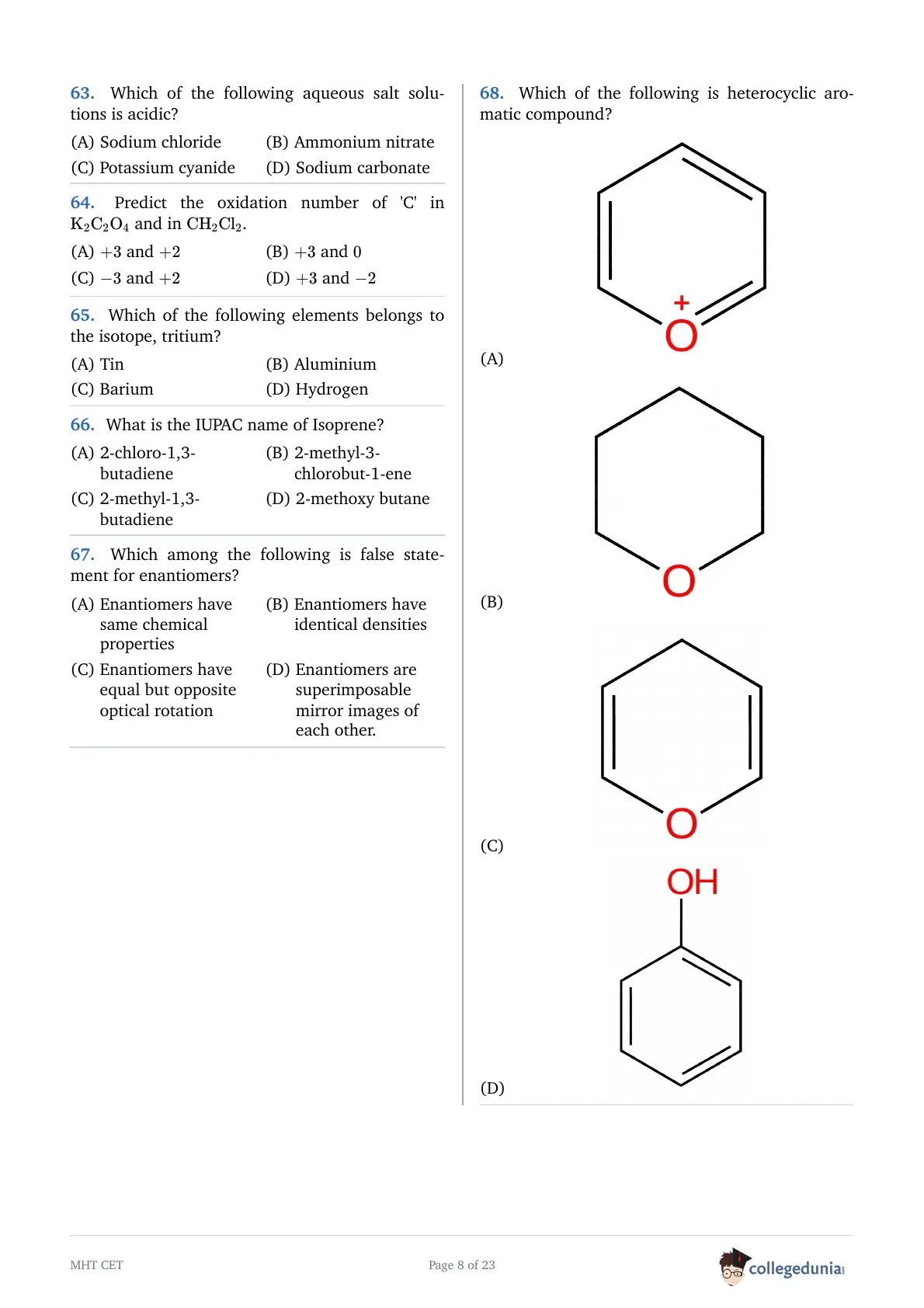
MHT CET 2026 April 22 Shift 1 PCB Question Paper is available for download here. Maharashtra State CET Cell conducted MHT CET 2026 PCB Exam on April 22 in Shift 1 from 9 AM to 12 PM in CBT mode.

The MHT CET 2026 PCB question paper includes the following:

  • The MHT CET 2026 PCB Question Paper consists of 200 multiple-choice questions (MCQs) totalling 200 marks divided into 3 sections: Physics (50 questions), Chemistry (50 questions), and Biology (100 questions).
  • All questions carry 1 mark each. There is no negative marking for incorrect answers.

MHT CET 2026 April 22 Shift 1 PCB Question Paper with Solution PDF

CD PDF CD PDF with Solutions
Download Collegedunia PDF 1.15 MB -

Also Check:

MHT CET 2026 April 22 Shift 1 PCB Questions with Solutions


Physics (Q1 - Q50)

Question 1:

A student measures times for 20 oscillations of a simple pendulum as 30s, 32s, 35s and 31s. If the minimum division in the measuring clock is 1s, then correct mean time in second , within error limits , is

  • (A) \((32\pm 5)\text{s}\)
  • (B) \((32\pm 3)\text{s}\)
  • (C) \((32\pm 2)\text{s}\)
  • (D) \((32\pm 1)\text{s}\)

Question 2:

A vehicle runs on a straight road of length 'L'. It travels half the distance with speed V and the remaining distance with speed \(\frac{3V}{2}\). Its average speed is

  • (A) \(\frac{4V}{3}\)
  • (B) \(\frac{3V}{4}\)
  • (C) \(\frac{5V}{6}\)
  • (D) \(\frac{6V}{5}\)

Question 3:

A particle starting from rest moves along the circumference of a circle of radius \(r=\sqrt{2}\) m with an angular acceleration \(\alpha =\frac{\pi }{9}\) rad/s\({}^{2}\). The magnitude of its average velocity and instantaneous angular velocity in the time , it completes one fourth rotation, is respectively

  • (A) \(\frac{2}{5}\) m/s, \(\frac{\pi }{\sqrt{2}}\) rad/s
  • (B) \(\frac{3}{2}\) m/s, \(\frac{\pi }{2}\) rad/s
  • (C) \(\frac{4}{5}\) m/s, \(\frac{\pi }{3}\) rad/s
  • (D) \(\frac{2}{3}\) m/s, \(\frac{\pi }{3}\) rad/s

Question 4:

A body, performing uniform circular motion of radius 'r', has frequency 'n'. Its centripetal acceleration per unit radius is related as \((\text{n})^{x}\). The value of \(x\) is

  • (A) \(-2\)
  • (B) \(-1\)
  • (C) \(1\)
  • (D) \(2\)

Question 5:

A body performs uniform circular motion with radius \(\vec{r}=4\hat{i}-2\hat{j}+2\hat{k}\) and angular velocity \(\vec{\omega }=2\hat{i}-3\hat{j}+\hat{k}\). The magnitude of linear velocity of the body is

  • (A) \(5\sqrt{2}\)
  • (B) \(4\sqrt{5}\)
  • (C) \(8\sqrt{2}\)
  • (D) \(2\sqrt{5}\)

Question 6:

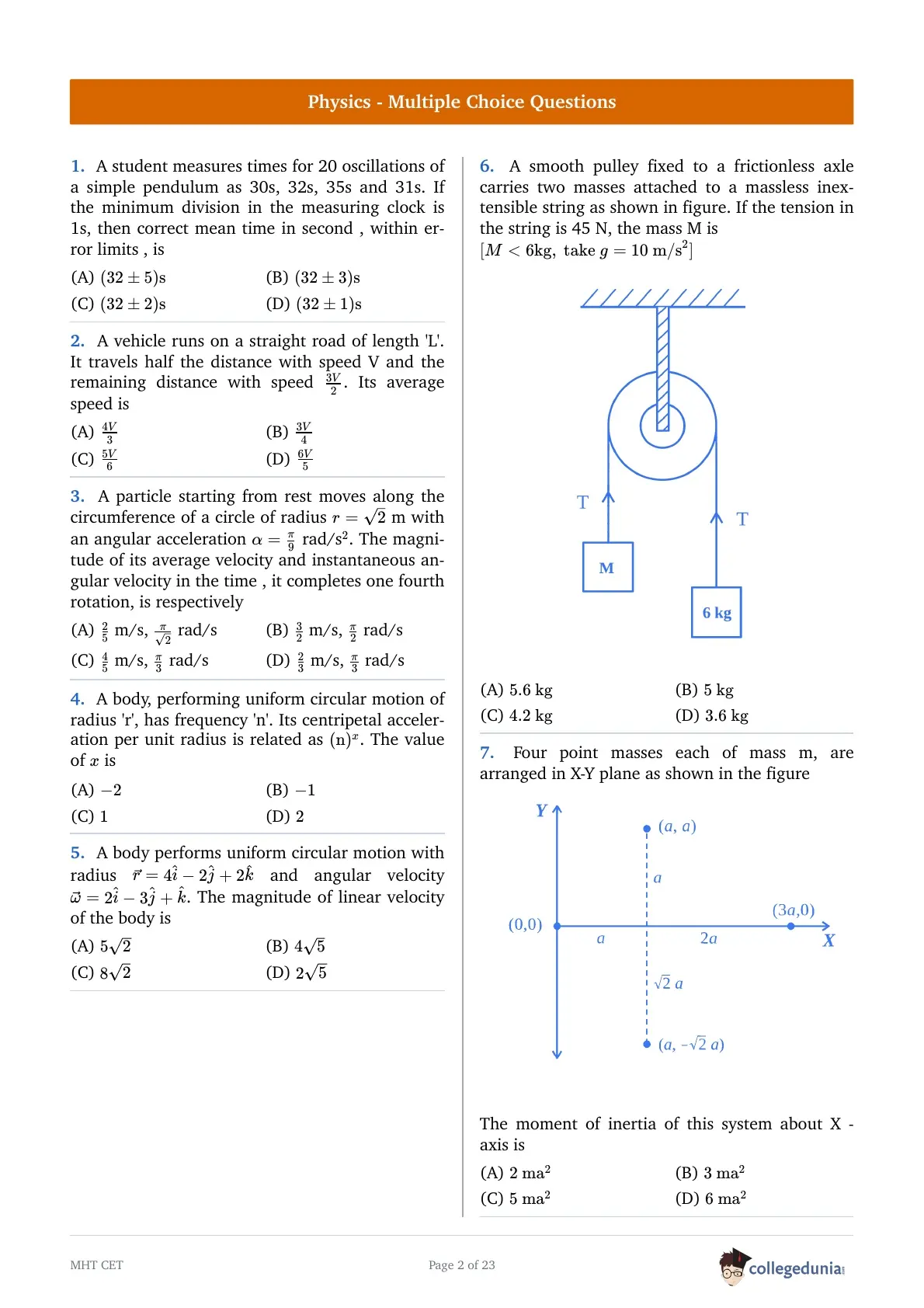
A smooth pulley fixed to a frictionless axle carries two masses attached to a massless inextensible string as shown in figure. If the tension in the string is 45 N, the mass M is
\([M\lt 6\text{kg},\text{ take }g=10\text{ m/s}^{2}]\)

  • (A) \(5.6\text{ kg}\)
  • (B) \(5\text{ kg}\)
  • (C) \(4.2\text{ kg}\)
  • (D) \(3.6\text{ kg}\)

Question 7:

Four point masses each of mass m, are arranged in X-Y plane as shown in the figure

  • (A) \(2\text{ ma}^{2}\)
  • (B) \(3\text{ ma}^{2}\)
  • (C) \(5\text{ ma}^{2}\)
  • (D) \(6\text{ ma}^{2}\)

Question 8:

Two identical copper spheres of radius R and density \(\varrho\) are placed in contact with each other. The gravitational force acting between them is proportional to \(\text{R}^{x}\). The value of \(x\) is

  • (A) \(7\)
  • (B) \(6\)
  • (C) \(4\)
  • (D) \(2\)

Question 9:

A thin metal disc of radius 'r' floats on the water surface and bends the surface downwards along the perimeter, making an angle '\(\theta\)' with the vertical edge of the disc. If the weight of water displaced by the disc is 'W', the weight of the metal disc is
[ T = surface tension of water]

  • (A) \(2\pi r\text{T}+\text{W}\)
  • (B) \(2\pi r\text{T}\cos \theta -\text{W}\)
  • (C) \(2\pi r\text{T}\cos \theta +\text{W}\)
  • (D) \(\text{W}-2\pi r\text{T}\cos \theta\)

Question 10:

When a mercury drop of radius 'R' breaks into n droplets of equal size, the radius (r) of each droplet is 'xR'. The value of x is

  • (A) \((n)^{\frac{-1}{3}}\)
  • (B) \((n)^{\frac{-1}{2}}\)
  • (C) \((n)^{\frac{1}{2}}\)
  • (D) \((n)^{\frac{1}{3}}\)

Question 11:

Identify the nature of flow of water which is flowing in a pipe of radius 1.4 cm with an average velocity of 12 cm/s.
\([\eta _{water}=10^{-3}\text{kg m}^{-1}\text{s}^{-1}\text{ and }\varrho _{water}=10^{3}\text{kg/m}^{3}]\)

  • (A) first streamline then unsteady
  • (B) streamline
  • (C) unsteady
  • (D) turbulent

Question 12:

Two spherical black bodies have radii \(R_{1}\) and \(R_{2}\). Their surface temperatures are \(T_{1}\) K and \(T_{2}\) K respectively. If they radiate the same power, the ratio \(\frac{R_{1}}{R_{2}}\) is

  • (A) \(\left(\frac{T_{1}}{T_{2}}\right)^{4}\)
  • (B) \(\left(\frac{T_{1}}{T_{2}}\right)^{2}\)
  • (C) \(\left(\frac{T_{2}}{T_{1}}\right)^{4}\)
  • (D) \(\left(\frac{T_{2}}{T_{1}}\right)^{2}\)

Question 13:

A clock with an iron pendulum keeps the correct time at \(14^{\circ }\text{C}\). If the room temperature is \(20^{\circ }\text{C}\), the error in seconds per day will be nearly (coefficient of linear expansion of iron is \(1.2\times 10^{-5}/{}^{\circ }\text{C}\) )

  • (A) \(2.62\text{ s}\)
  • (B) \(3.11\text{ s}\)
  • (C) \(4.34\text{ s}\)
  • (D) \(6.25\text{ s}\)

Question 14:

The relation obeyed by a perfect gas during an adiabatic process is \(pV^{3/2}\). The initial temperature of the gas is 'T'. When the gas is compressed to half of its initial volume, the final temperature of the gas is

  • (A) \(4\text{T}\)
  • (B) \(2\sqrt{2}\text{T}\)
  • (C) \(2\text{T}\)
  • (D) \(\sqrt{2}\text{T}\)

Question 15:

If R is the universal gas constant then the amount of heat needed to raise the temperature of 3 moles of an ideal monoatomic gas from 273 K to 393 K when no work is done is

  • (A) \(450\text{ R}\)
  • (B) \(500\text{ R}\)
  • (C) \(540\text{ R}\)
  • (D) \(570\text{ R}\)

Question 16:

Two identical vessels are completely filled with two ideal gases A and B. If the ratio of mass of gas A to that of gas B is 1:2 and the ratio of rms speed of molecules of gas A to that of gas B is 2:1, the ratio of pressure exerted by molecules of gas B, on the walls of vessel to that by molecules of gas A is

  • (A) \(4:1\)
  • (B) \(2:1\)
  • (C) \(1:2\)
  • (D) \(1:4\)

Question 17:

The Translational K.E. of the molecules of a gas at absolute temperature (T) can be doubled by

  • (A) increasing T to \(\sqrt{2}\text{T}\)
  • (B) increasing T to 2 T
  • (C) increasing T to 4 T
  • (D) decreasing T to \(\frac{T}{2}\)

Question 18:

In an oscillating LC circuit, the maximum charge on the capacitor is Q. When the energy is stored equally between the electric and magnetic fields, the charge on the capacitor is q. The relation between Q and q is

  • (A) \(Q=q\)
  • (B) \(Q=\sqrt{2}q\)
  • (C) \(Q=\sqrt{3}q\)
  • (D) \(Q=2q\)

Question 19:

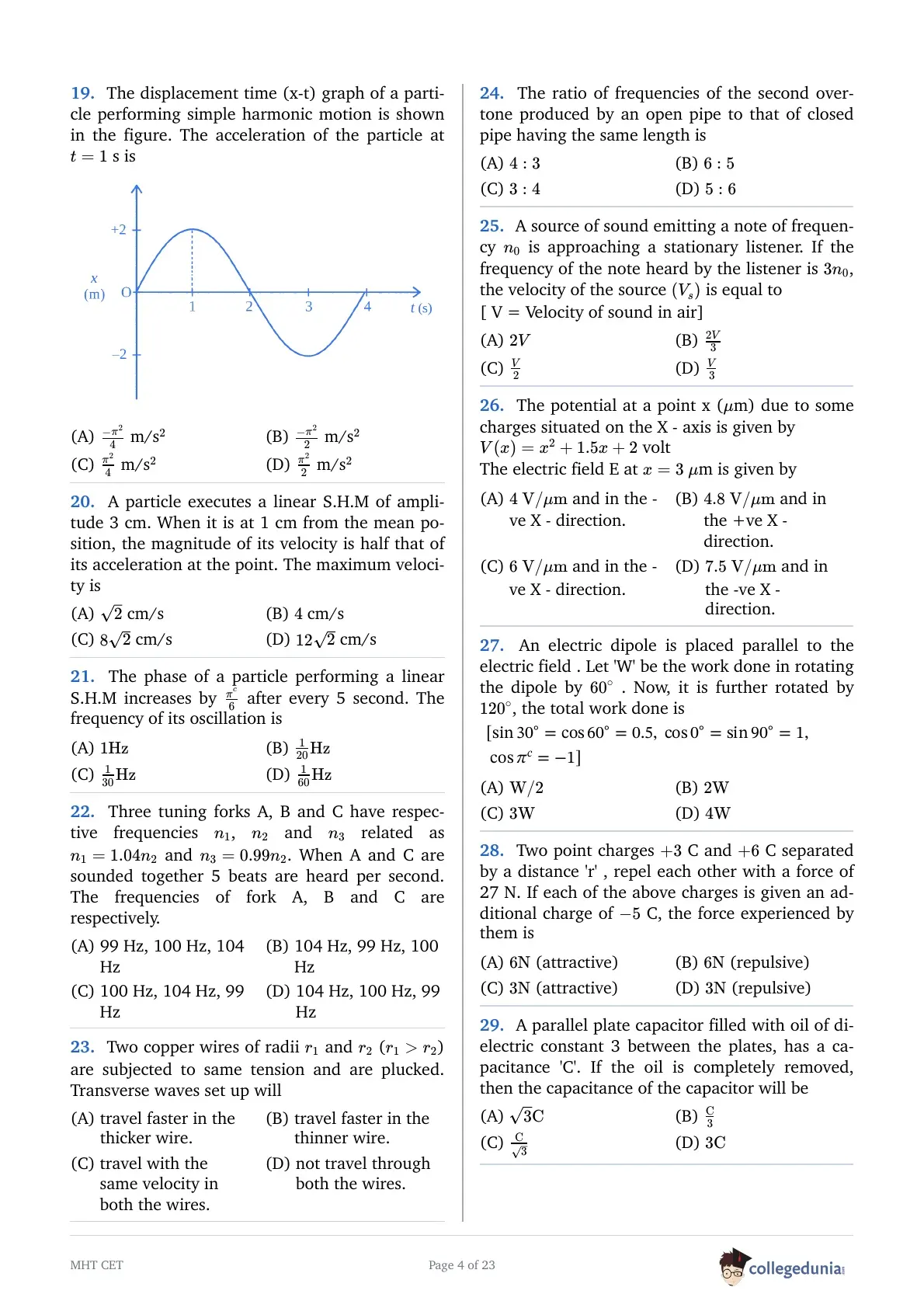
The displacement time (x-t) graph of a particle performing simple harmonic motion is shown in the figure. The acceleration of the particle at \(t=1\) s is

  • (A) \(\frac{-\pi ^{2}}{4}\) m/s\({}^{2}\)
  • (B) \(\frac{-\pi ^{2}}{2}\) m/s\({}^{2}\)
  • (C) \(\frac{\pi ^{2}}{4}\) m/s\({}^{2}\)
  • (D) \(\frac{\pi ^{2}}{2}\) m/s\({}^{2}\)

Question 20:

A particle executes a linear S.H.M of amplitude 3 cm. When it is at 1 cm from the mean position, the magnitude of its velocity is half that of its acceleration at the point. The maximum velocity is

  • (A) \(\sqrt{2}\) cm/s
  • (B) \(4\) cm/s
  • (C) \(8\sqrt{2}\) cm/s
  • (D) \(12\sqrt{2}\) cm/s

Question 21:

The phase of a particle performing a linear S.H.M increases by \(\frac{\pi ^{c}}{6}\) after every 5 second. The frequency of its oscillation is

  • (A) \(1\text{Hz}\)
  • (B) \(\frac{1}{20}\text{Hz}\)
  • (C) \(\frac{1}{30}\text{Hz}\)
  • (D) \(\frac{1}{60}\text{Hz}\)

Question 22:

Three tuning forks A, B and C have respective frequencies \(n_{1}\), \(n_{2}\) and \(n_{3}\) related as \(n_{1}=1.04n_{2}\) and \(n_{3}=0.99n_{2}\). When A and C are sounded together 5 beats are heard per second. The frequencies of fork A, B and C are respectively.

  • (A) 99 Hz, 100 Hz, 104 Hz
  • (B) 104 Hz, 99 Hz, 100 Hz
  • (C) 100 Hz, 104 Hz, 99 Hz
  • (D) 104 Hz, 100 Hz, 99 Hz

Question 23:

Two copper wires of radii \(r_{1}\) and \(r_{2}\) (\(r_{1}>r_{2}\)) are subjected to same tension and are plucked. Transverse waves set up will

  • (A) travel faster in the thicker wire.
  • (B) travel faster in the thinner wire.
  • (C) travel with the same velocity in both the wires.
  • (D) not travel through both the wires.

Question 24:

The ratio of frequencies of the second overtone produced by an open pipe to that of closed pipe having the same length is

  • (A) \(4:3\)
  • (B) \(6:5\)
  • (C) \(3:4\)
  • (D) \(5:6\)

Question 25:

A source of sound emitting a note of frequency \(n_{0}\) is approaching a stationary listener. If the frequency of the note heard by the listener is \(3n_{0}\), the velocity of the source \((V_{s})\) is equal to
[ V = Velocity of sound in air]

  • (A) \(2V\)
  • (B) \(\frac{2V}{3}\)
  • (C) \(\frac{V}{2}\)
  • (D) \(\frac{V}{3}\)

Question 26:

The potential at a point x (\(\mu\)m) due to some charges situated on the X - axis is given by
\(V(x)=x^{2}+1.5x+2\) volt
The electric field E at \(x=3\ \mu\)m is given by

  • (A) \(4\ \text{V}/\mu \text{m}\) and in the -ve X - direction.
  • (B) \(4.8\ \text{V}/\mu \text{m}\) and in the +ve X - direction.
  • (C) \(6\ \text{V}/\mu \text{m}\) and in the -ve X - direction.
  • (D) \(7.5\ \text{V}/\mu \text{m}\) and in the -ve X - direction.

Question 27:

An electric dipole is placed parallel to the electric field . Let 'W' be the work done in rotating the dipole by \(60^{\circ }\) . Now, it is further rotated by \(120^{\circ }\), the total work done is
\([\sin 30^{\circ }=\cos 60^{\circ }=0.5,\ \cos 0^{\circ }=\sin 90^{\circ }=1,\ \cos \pi ^{c}=-1]\)

  • (A) \(\text{W}/2\)
  • (B) \(2\text{W}\)
  • (C) \(3\text{W}\)
  • (D) \(4\text{W}\)

Question 28:

Two point charges \(+3\) C and \(+6\) C separated by a distance 'r' , repel each other with a force of 27 N. If each of the above charges is given an additional charge of \(-5\) C, the force experienced by them is

  • (A) \(6\text{N}\) (attractive)
  • (B) \(6\text{N}\) (repulsive)
  • (C) \(3\text{N}\) (attractive)
  • (D) \(3\text{N}\) (repulsive)

Question 29:

A parallel plate capacitor filled with oil of dielectric constant 3 between the plates, has a capacitance 'C'. If the oil is completely removed, then the capacitance of the capacitor will be

  • (A) \(\sqrt{3}\text{C}\)
  • (B) \(\frac{\text{C}}{3}\)
  • (C) \(\frac{\text{C}}{\sqrt{3}}\)
  • (D) \(3\text{C}\)

Question 30:

When a galvanometer is shunted by a resistance S, its current capacity increases n times. If the same galvanometer is shunted by another resistance S', its current capacity will increase to n' . The value of n' in terms of n, S, and S' is

  • (A) \(\frac{S(n-1)-S'}{S'}\)
  • (B) \(\frac{(n+1)S}{S'}\)
  • (C) \(\frac{S(n-1)+S'}{S'}\)
  • (D) \(\frac{n+S}{S'}\)

Question 31:

The equivalent resistance of the following circuit is nearly

  • (A) \(10.4\ \Omega\)
  • (B) \(13.3\ \Omega\)
  • (C) \(15.2\ \Omega\)
  • (D) \(24.1\ \Omega\)

Question 32:

A straight wire carrying a current (I) is turned into a circular loop. If the magnitude of magnetic moment associated with it is 'M', then the length of the wire will be

  • (A) \(4\pi \text{ IM}\)
  • (B) \(\sqrt{\frac{4\pi M}{I}}\)
  • (C) \(\sqrt{\frac{4\pi I}{M}}\)
  • (D) \(\frac{M\pi }{4\text{I}}\)

Question 33:

A current carrying circular coil of radius 'R' produces magnetic field 'B'\({}_{1}\) at an axial point P at a distance 'x' from its centre and \(B_{2}\) at point Q placed at its centre ,respectively. If \(B_{2}=27B_{1}\), the value of 'x' is

  • (A) \(4\text{R}\)
  • (B) \(2\sqrt{3}\text{R}\)
  • (C) \(2\sqrt{2}\text{R}\)
  • (D) \(\frac{\text{R}}{\sqrt{3}}\)

Question 34:

A long wire carrying a steady current is bent into a circle of single turn. The magnetic field at the centre of the coil is B. If it is bent into a circular loop of radius 'r' having n turns, the magnetic field at the centre of the coil for same current is

  • (A) \(\frac{\text{B}}{\text{n}^{2}}\)
  • (B) \(\frac{\text{B}}{\text{n}}\)
  • (C) \(\text{n}^{2}\text{B}\)
  • (D) \(\text{nB}\)

Question 35:

Two coils P and Q are kept near each other. When no current flows through coil P and current in coil Q increases at the rate of 10 A/s, the e.m.f. in coil P is 12 mV. When coil Q carries no current and current 1.5 A flows through coil P, the magnetic flux linked with the coil Q is

  • (A) \(1.8\text{ mWb}\)
  • (B) \(1.5\text{ mWb}\)
  • (C) \(1.2\text{ mWb}\)
  • (D) \(0.9\text{ mWb}\)

Question 36:

A metal rod of length '\(l\)' rotates about one of its ends in a plane perpendicular to a magnetic field of induction 'B'. If the emf induced between the ends of the rod is 'e', then the number of revolutions made by the rod per second is

  • (A) \(\frac{e}{B\pi l^{2}}\)
  • (B) \(\frac{\pi l^{2}}{eB}\)
  • (C) \(\frac{B^{2}}{e\pi l}\)
  • (D) \(\frac{e}{B\pi ^{2}l}\)

Question 37:

Average e.m.f. of 2.4 V is induced in a coil when a current in it is changed from 10 A in one direction to 10 A in opposite direction in 0.4 second. The self inductance of the coil is

  • (A) \(50\text{ mH}\)
  • (B) \(48\text{ mH}\)
  • (C) \(45\text{ mH}\)
  • (D) \(42\text{ mH}\)

Question 38:

In a series LCR circuit, the inductance L is 10 mH, capacitance C is 100\(\mu\)F and resistance R is 20 \(\Omega\). The frequency at which impedance is 20 \(\Omega\), is

  • (A) \(\frac{10^{4}}{2\pi }\)
  • (B) \(\frac{10^{4}}{\pi }\)
  • (C) \(\frac{10^{3}}{2\pi }\)
  • (D) \(\frac{10^{3}}{\pi }\)

Question 39:

An a.c. source is connected to a capacitor 'C'. Due to increase in its operating frequency

  • (A) capacitive reactance increases.
  • (B) capacitive reactance remains constant.
  • (C) peak current increases.
  • (D) peak current decreases.

Question 40:

A convex lens of focal length 'f' produces a real image whose size is 'm' times the size of an object. The distance of the image from the lens, 'v', is given by

  • (A) \(f(1-m)\)
  • (B) \(f/(m+1)\)
  • (C) \(f(m-1)\)
  • (D) \(f(m+1)\)

Question 41:

When light waves travel from rarer medium to denser medium, the quantities which get changed are

  • (A) velocity and frequency.
  • (B) frequency and amplitude.
  • (C) velocity and wavelength.
  • (D) frequency and wavelength.

Question 42:

A ray of light from a monochromatic point source of light is incident at a point on the screen. If a thin mica film of thickness 't' and refractive index 'n' is introduced in its path, then the optical path

  • (A) is increased by (n+1) t.
  • (B) is increased by (n-1) t.
  • (C) is decreased by (n+1) t.
  • (D) is not affected.

Question 43:

Young's double slit experiment is carried out by using green, red and blue light, one colour at a time. The fringewidths recorded are \(W_{G}\), \(W_{R}\) and \(W_{B}\) respectively. Then

  • (A) \(W_{B}>W_{G}>W_{R}\)
  • (B) \(W_{R}>W_{B}>W_{G}\)
  • (C) \(W_{R}>W_{G}>W_{B}\)
  • (D) \(W_{G}>W_{B}>W_{R}\)

Question 44:

Let \(E_{e}\) and \(E_{p}\) represent kinetic energy of electron and photon respectively. If de-Broglie wavelength \(\lambda _{p}\) of a photon is four times the de-Broglie wavelength \(\lambda _{e}\) of an electron, then \(\frac{E_{p}}{E_{e}}\) is
[ speed of electron \(=\frac{C}{100}\) , C = velocity of light]

  • (A) \(\frac{1}{100}\)
  • (B) \(\frac{1}{50}\)
  • (C) \(50\)
  • (D) \(100\)

Question 45:

A photon of energy 8 eV is incident on a metal surface of work function 3.75 eV. The stopping potential of the metal is

  • (A) \(3.25\text{ V}\)
  • (B) \(3.5\text{ V}\)
  • (C) \(4.15\text{ V}\)
  • (D) \(4.25\text{ V}\)

Question 46:

In the Bohr model, an electron moves in circular orbit around the proton. Considering an orbiting electron to be a circular current loop, the magnetic moment of the hydrogen atom, when the electron is in n\({}^{th}\) state, is

  • (A) \(\left(\frac{e}{m}\right)\frac{n^{2}h}{2\pi }\)
  • (B) \(\left(\frac{e}{2m}\right)\frac{nh}{2\pi }\)
  • (C) \(\left(\frac{e}{2m}\right)\frac{n^{2}h}{\pi }\)
  • (D) \(\left(\frac{e}{m}\right)\frac{nh}{2\pi }\)

Question 47:

A common example of \(\beta ^{-}\) decay is
\({}_{15}\text{P}^{32}\longrightarrow {}_{16}\text{S}^{32}+x+y\)
Then x and y , respectively, stand for

  • (A) positron and anti - neutrino
  • (B) electron and neutrino
  • (C) electron and anti-neutrino
  • (D) positron and neutrino

Question 48:

A p-n junction photodiode is fabricated from a semiconductor with a band gap of \(4\times 10^{-19}\) J. It can detect a signal of wavelength
\([h=6.6\times 10^{-34}\text{Js},C=3\times 10^{8}\text{ m/s}]\)

  • (A) \(6000\) Å
  • (B) \(4000\) Å
  • (C) \(6000\) nm
  • (D) \(4000\) nm

Question 49:

In the following combination of logic gates, the outputs (y,z) are respectively.

  • (A) \(0,0\)
  • (B) \(0,1\)
  • (C) \(1,0\)
  • (D) \(1,1\)

Question 50:

In good conductor, the gap between the valence band and the conduction band is

  • (A) infinite
  • (B) large but not infinite
  • (C) zero
  • (D) small but not zero

Chemistry (Q51 - Q100)

Question 51:

Calculate the total mass and number of molecules present in 3 moles of benzene.

  • (A) Total mass = 78 g and number of molecules = \(6.022\times 10^{23}\)
  • (B) Total mass = 156 g and number of molecules = \(1.2044\times 10^{24}\)
  • (C) Total mass = 334 g and number of molecules = \(6.022\times 10^{23}\)
  • (D) Total mass = 234 g and number of molecules = \(1.8066\times 10^{24}\)

Question 52:

Which of the following representation of atomic orbitals is CORRECT regarding dependence of orbital energy on (n+l) rule?

  • (A) \(3s\lt 2p\)
  • (B) \(4s\lt 3p\)
  • (C) \(3d\lt 4p\)
  • (D) \(5s\lt 4p\)

Question 53:

Match the following

List IList II
A. TechnetiumI. Non-metal
B. FluorineII. Transition metal
C. TelluriumIII. Lanthanoid
D. DysprosiumIV. Metalloid
  • (A) A-II, B-I, C-III, D-IV
  • (B) A-III, B-I, C-IV, D-II
  • (C) A-II, B-I, C-IV, D-III
  • (D) A-IV, B-I, C-II, D-III

Question 54:

Which among the following elements does NOT exhibit \(-2\) oxidation state?

  • (A) O
  • (B) Se
  • (C) Te
  • (D) Po

Question 55:

What is the number of electrons in bonding molecular orbitals and antibonding molecular orbitals respectively in \(\text{F}_{2}\) molecule?

  • (A) 12 and 6
  • (B) 10 and 8
  • (C) 8 and 10
  • (D) 6 and 12

Question 56:

Identify false statement about real gas from following .

  • (A) It obeys Boyle's \(\&\) Charles' law at low pressure and high temperature.
  • (B) Its molecules are not perfectly elastic.
  • (C) In real gas, intermolecular attraction is present.
  • (D) It can not liquify even at low temperature.

Question 57:

For a reaction, \(\Delta \text{G}^{\circ }=-5.7\) kJ mol\({}^{-1}\) at 298 K. Calculate K.
( R = 8.314 J K\({}^{-1}\) mol\({}^{-1}\) )

  • (A) \(1\)
  • (B) \(10\)
  • (C) \(10^{2}\)
  • (D) \(10^{3}\)

Question 58:

Calculate the amount of work done in the oxidation of 1 mole of HCl(g) at \(127^{\circ }\)C if
\(4\text{HCl(g)}+\text{O}_{2}\text{(g)}\rightarrow 2\text{Cl}_{2}\text{(g)}+2\text{H}_{2}\text{O(g)}\) ; [ R = 8.314 JK\({}^{-1}\) mol\({}^{-1}\)]

  • (A) \(831.4\) J
  • (B) \(491.6\) kJ
  • (C) \(1474.6\) J
  • (D) \(1662.8\) J

Question 59:

Which of the following properties of the system is both state function and intensive property as well?

  • (A) Volume .
  • (B) Temperature .
  • (C) Enthalpy.
  • (D) Entropy .

Question 60:

For which of the following solids does solubility decrease with an increase in temperature?

  • (A) Potassium nitrate
  • (B) Sodium nitrate
  • (C) Sodium sulphate.
  • (D) Potassium chloride

Question 61:

Calculate the percent dissociation of a weak mono-acidic base if its concentration is 0.02 M.
[\(\text{K}_{b}\) for weak mono-acidic base = \(1.8\times 10^{-5}\)]

  • (A) \(4\ \%\)
  • (B) \(2\ \%\)
  • (C) \(3\ \%\)
  • (D) \(5\ \%\)

Question 62:

Find the p\(\text{K}_{b}\) of the weak base BOH, if its \(\text{K}_{b}\) is \(1\times 10^{-5}\) ?

  • (A) \(-5\)
  • (B) \(5\)
  • (C) \(10\)
  • (D) \(10^{-5}\)

Question 63:

Which of the following aqueous salt solutions is acidic?

  • (A) Sodium chloride
  • (B) Ammonium nitrate
  • (C) Potassium cyanide
  • (D) Sodium carbonate

Question 64:

Predict the oxidation number of 'C' in \(\text{K}_{2}\text{C}_{2}\text{O}_{4}\) and in \(\text{CH}_{2}\text{Cl}_{2}\).

  • (A) \(+3\) and \(+2\)
  • (B) \(+3\) and \(0\)
  • (C) \(-3\) and \(+2\)
  • (D) \(+3\) and \(-2\)

Question 65:

Which of the following elements belongs to the isotope, tritium?

  • (A) Tin
  • (B) Aluminium
  • (C) Barium
  • (D) Hydrogen

Question 66:

What is the IUPAC name of Isoprene?

  • (A) 2-chloro-1,3-butadiene
  • (B) 2-methyl-3-chlorobut-1-ene
  • (C) 2-methyl-1,3-butadiene
  • (D) 2-methoxy butane

Question 67:

Which among the following is false statement for enantiomers?

  • (A) Enantiomers have same chemical properties
  • (B) Enantiomers have identical densities
  • (C) Enantiomers have equal but opposite optical rotation
  • (D) Enantiomers are superimposable mirror images of each other.

Question 68:

Which of the following is heterocyclic aromatic compound?

  • (A)
  • (B)
  • (C)
  • (D)

Question 69:

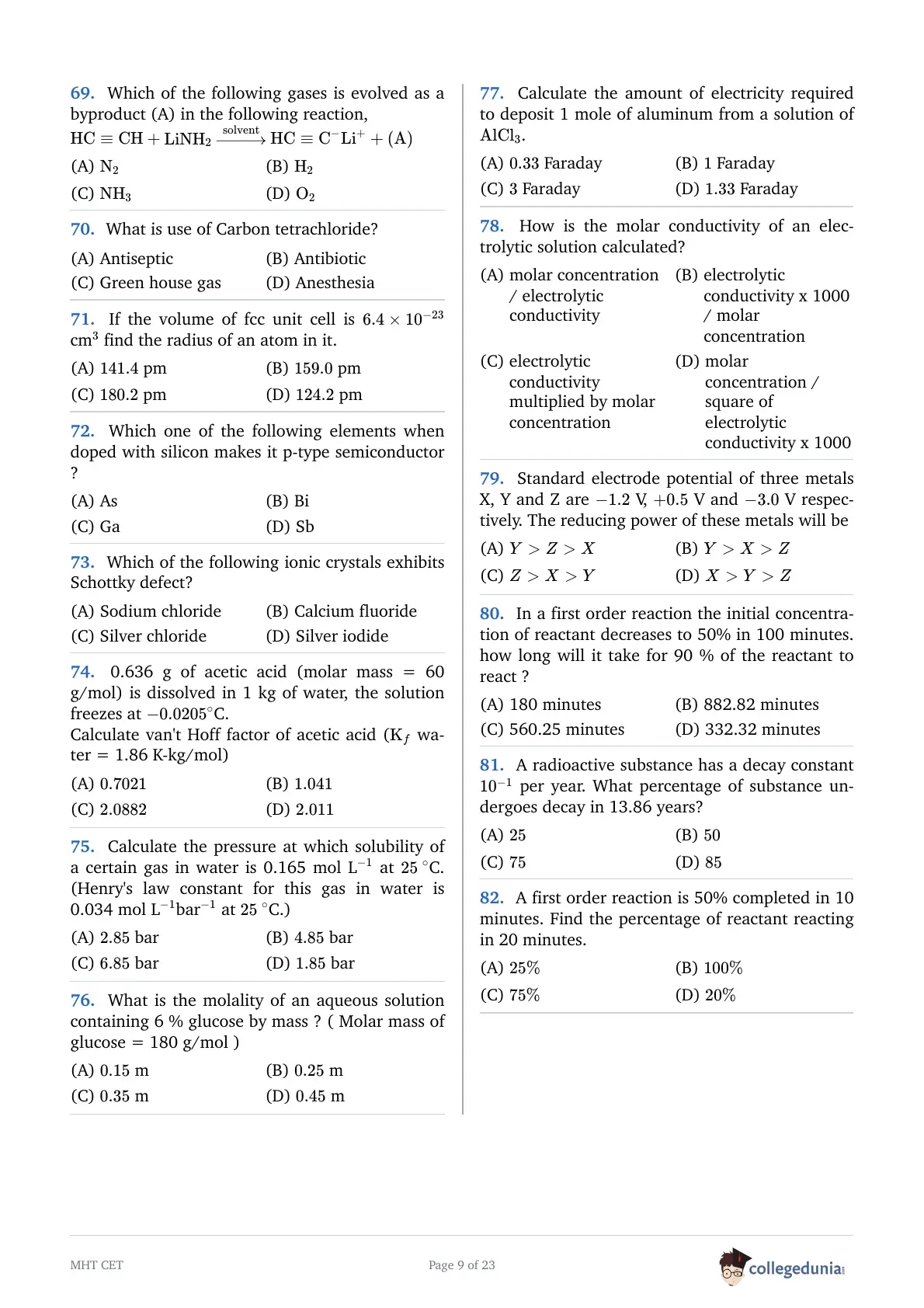
Which of the following gases is evolved as a byproduct (A) in the following reaction,
\(\text{HC}\equiv \text{CH}+\text{LiNH}_{2}\xrightarrow{\text{solvent}}\text{HC}\equiv \text{C}^{-}\text{Li}^{+}+(\text{A})\)

  • (A) \(\text{N}_{2}\)
  • (B) \(\text{H}_{2}\)
  • (C) \(\text{NH}_{3}\)
  • (D) \(\text{O}_{2}\)

Question 70:

What is use of Carbon tetrachloride?

  • (A) Antiseptic
  • (B) Antibiotic
  • (C) Green house gas
  • (D) Anesthesia

Question 71:

If the volume of fcc unit cell is \(6.4\times 10^{-23}\) cm\({}^{3}\) find the radius of an atom in it.

  • (A) \(141.4\) pm
  • (B) \(159.0\) pm
  • (C) \(180.2\) pm
  • (D) \(124.2\) pm

Question 72:

Which one of the following elements when doped with silicon makes it p-type semiconductor ?

  • (A) As
  • (B) Bi
  • (C) Ga
  • (D) Sb

Question 73:

Which of the following ionic crystals exhibits Schottky defect?

  • (A) Sodium chloride
  • (B) Calcium fluoride
  • (C) Silver chloride
  • (D) Silver iodide

Question 74:

0.636 g of acetic acid (molar mass = 60 g/mol) is dissolved in 1 kg of water, the solution freezes at \(-0.0205^{\circ }\)C.
Calculate van't Hoff factor of acetic acid (\(\text{K}_{f}\) water = 1.86 K-kg/mol)

  • (A) \(0.7021\)
  • (B) \(1.041\)
  • (C) \(2.0882\)
  • (D) \(2.011\)

Question 75:

Calculate the pressure at which solubility of a certain gas in water is 0.165 mol L\({}^{-1}\) at \(25\ ^{\circ }\)C. (Henry's law constant for this gas in water is 0.034 mol L\({}^{-1}\)bar\({}^{-1}\) at \(25\ ^{\circ }\)C.)

  • (A) \(2.85\) bar
  • (B) \(4.85\) bar
  • (C) \(6.85\) bar
  • (D) \(1.85\) bar

Question 76:

What is the molality of an aqueous solution containing 6 % glucose by mass ? ( Molar mass of glucose = 180 g/mol )

  • (A) \(0.15\) m
  • (B) \(0.25\) m
  • (C) \(0.35\) m
  • (D) \(0.45\) m

Question 77:

Calculate the amount of electricity required to deposit 1 mole of aluminum from a solution of \(\text{AlCl}_{3}\).

  • (A) \(0.33\) Faraday
  • (B) \(1\) Faraday
  • (C) \(3\) Faraday
  • (D) \(1.33\) Faraday

Question 78:

How is the molar conductivity of an electrolytic solution calculated?

  • (A) molar concentration / electrolytic conductivity
  • (B) electrolytic conductivity x 1000 / molar concentration
  • (C) electrolytic conductivity multiplied by molar concentration
  • (D) molar concentration / square of electrolytic conductivity x 1000

Question 79:

Standard electrode potential of three metals X, Y and Z are \(-1.2\) V, \(+0.5\) V and \(-3.0\) V respectively. The reducing power of these metals will be

  • (A) \(Y>Z>X\)
  • (B) \(Y>X>Z\)
  • (C) \(Z>X>Y\)
  • (D) \(X>Y>Z\)

Question 80:

In a first order reaction the initial concentration of reactant decreases to 50% in 100 minutes. how long will it take for 90 % of the reactant to react ?

  • (A) 180 minutes
  • (B) 882.82 minutes
  • (C) 560.25 minutes
  • (D) 332.32 minutes

Question 81:

A radioactive substance has a decay constant \(10^{-1}\) per year. What percentage of substance undergoes decay in 13.86 years?

  • (A) \(25\)
  • (B) \(50\)
  • (C) \(75\)
  • (D) \(85\)

Question 82:

A first order reaction is 50% completed in 10 minutes. Find the percentage of reactant reacting in 20 minutes.

  • (A) \(25\%\)
  • (B) \(100\%\)
  • (C) \(75\%\)
  • (D) \(20\%\)

Question 83:

Identify the combinations of dispersed phase and dispersion medium for the mist from following.

  • (A) liquid particles dispersed in a gas.
  • (B) liquid particles dispersed in a liquid.
  • (C) liquid particles dispersed in a solid.
  • (D) solid particles dispersed in a liquid.

Question 84:

What is the number of S-OH and S=O bonds present in one molecule of pyrosulfuric acid respectively?

  • (A) 1 and 2
  • (B) 2 and 4
  • (C) 4 and 1
  • (D) 1 and 3

Question 85:

Which of the following are used in sun screen lotion?

  • (A) \(\text{TiO}_{2}\) and SnO
  • (B) \(\text{TiO}_{2}\) and MnO
  • (C) \(\text{TiO}_{2}\) and ZnO
  • (D) \(\text{TiO}_{2}\) and NiO

Question 86:

Choose an incorrect statement about the properties of lanthanides.

  • (A) Except Promethium all are nonradioactive in nature
  • (B) The atomic and ionic radii decrease from lanthanum to lutetium.
  • (C) Binding to water is common
  • (D) Coordination numbers usually less than 6.

Question 87:

What is the IUPAC name of \(\text{K}_{3}[\text{Co}(\text{C}_{2}\text{O}_{4})_{3}]\) ?

  • (A) Potassium tris(oxalato)cobalt(III)
  • (B) Potassium tris(oxalato)cobaltate(III)
  • (C) Potassium trioxalatocobaltate(III)
  • (D) Potassium trioxalatocobalt(III)

Question 88:

Find the hybridization and number of coordinate bonds formed in tetracyanonickelate(II) ion respectively.

  • (A) \(sp^{3}d^{2}\) and 4 coordinate bonds
  • (B) \(dsp^{2}\) and 4 coordinate bonds.
  • (C) \(dsp^{2}\) and 2 coordinate bonds
  • (D) \(sp^{3}\) and 2 coordinate bonds

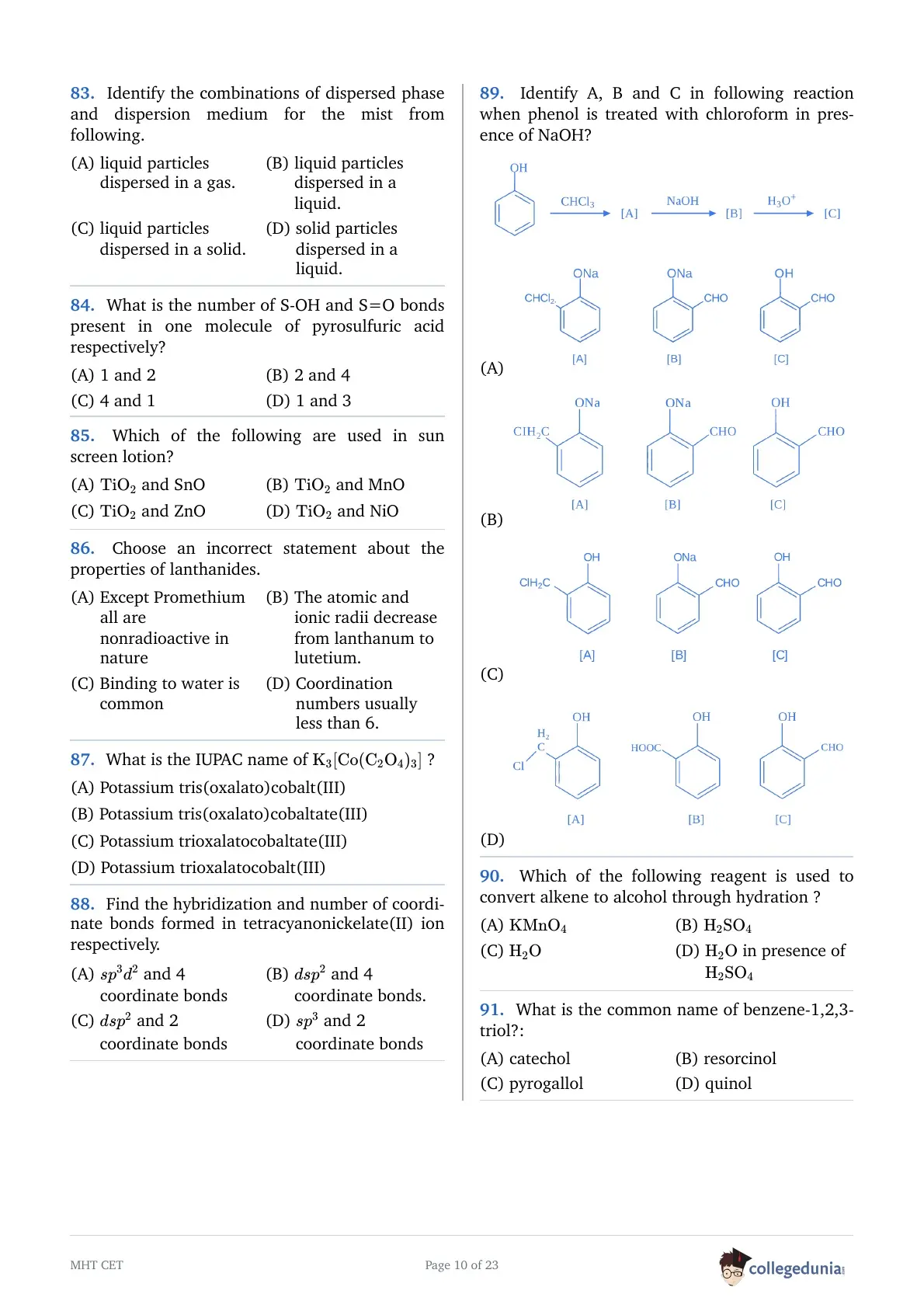
Question 89:

Identify A, B and C in following reaction when phenol is treated with chloroform in presence of NaOH?

  • (A)
  • (B)
  • (C)
  • (D)

Question 90:

Which of the following reagent is used to convert alkene to alcohol through hydration ?

  • (A) \(\text{KMnO}_{4}\)
  • (B) \(\text{H}_{2}\text{SO}_{4}\)
  • (C) \(\text{H}_{2}\text{O}\)
  • (D) \(\text{H}_{2}\text{O}\) in presence of \(\text{H}_{2}\text{SO}_{4}\)

Question 91:

What is the common name of benzene-1,2,3-triol?:

  • (A) catechol
  • (B) resorcinol
  • (C) pyrogallol
  • (D) quinol

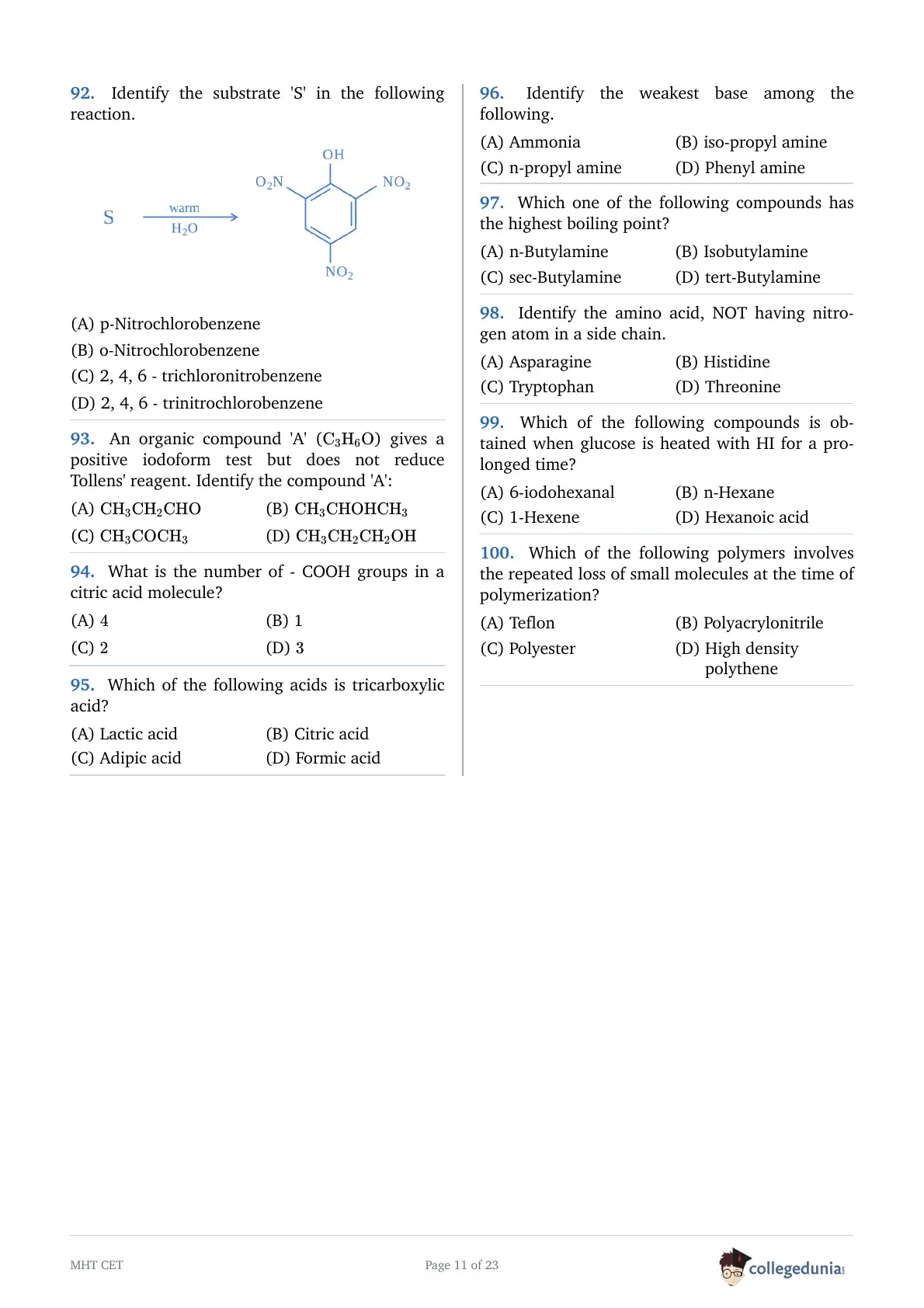
Question 92:

Identify the substrate 'S' in the following reaction.

  • (A) p-Nitrochlorobenzene
  • (B) o-Nitrochlorobenzene
  • (C) 2, 4, 6 - trichloronitrobenzene
  • (D) 2, 4, 6 - trinitrochlorobenzene

Question 93:

An organic compound 'A' (\(\text{C}_{3}\text{H}_{6}\text{O}\)) gives a positive iodoform test but does not reduce Tollens' reagent. Identify the compound 'A':

  • (A) \(\text{CH}_{3}\text{CH}_{2}\text{CHO}\)
  • (B) \(\text{CH}_{3}\text{CHOHCH}_{3}\)
  • (C) \(\text{CH}_{3}\text{COCH}_{3}\)
  • (D) \(\text{CH}_{3}\text{CH}_{2}\text{CH}_{2}\text{OH}\)

Question 94:

What is the number of - COOH groups in a citric acid molecule?

  • (A) \(4\)
  • (B) \(1\)
  • (C) \(2\)
  • (D) \(3\)

Question 95:

Which of the following acids is tricarboxylic acid?

  • (A) Lactic acid
  • (B) Citric acid
  • (C) Adipic acid
  • (D) Formic acid

Question 96:

Identify the weakest base among the following.

  • (A) Ammonia
  • (B) iso-propyl amine
  • (C) n-propyl amine
  • (D) Phenyl amine

Question 97:

Which one of the following compounds has the highest boiling point?

  • (A) n-Butylamine
  • (B) Isobutylamine
  • (C) sec-Butylamine
  • (D) tert-Butylamine

Question 98:

Identify the amino acid, NOT having nitrogen atom in a side chain.

  • (A) Asparagine
  • (B) Histidine
  • (C) Tryptophan
  • (D) Threonine

Question 99:

Which of the following compounds is obtained when glucose is heated with HI for a prolonged time?

  • (A) 6-iodohexanal
  • (B) n-Hexane
  • (C) 1-Hexene
  • (D) Hexanoic acid

Question 100:

Which of the following polymers involves the repeated loss of small molecules at the time of polymerization?

  • (A) Teflon
  • (B) Polyacrylonitrile
  • (C) Polyester
  • (D) High density polythene

Biology (Q101 - Q200)

Question 101:

In Plasmodium, which causes malaria, fertilization of gametocytes takes place in ____.

  • (A) liver cells of man
  • (B) erythrocytes of man
  • (C) gut of a female Anopheles mosquito
  • (D) salivary glands of a female Anopheles mosquito

Question 102:

In Planaria, the nervous system consists of ____.

  • (A) a single ventral nerve cord, an inverted U shaped brain, a pair of eyes located ventrally
  • (B) a pair of ventral nerve cords, a pair of eyes located dorsally, an inverted U-shaped brain with ten branches of nerves arising from each ganglion
  • (C) a mass of cerebral ganglion with nine branches of nerves arising from each ganglion, a pair of ventral nerve cords interconnected by commissures, a pair of dorsally located eyes
  • (D) an inverted U-shaped brain, a pair of ventrally placed eyes, peripheral nerve plexus arising laterally from nerve cords

Question 103:

The cotyledons in some non-endospermic seeds act as a food storage organ and in others they act as ______.

  • (A) perisperm
  • (B) photosynthetic organs
  • (C) pericarp
  • (D) haustorium

Question 104:

An additional apoplastic route that allows direct access to xylem is along the secondary roots because they ______.

  • (A) do not pass through endodermis
  • (B) have plasmodesmata
  • (C) develop from pericycle
  • (D) are made up of non-living cells

Question 105:

The approximate size of a nucleus in a typical mammalian cell is about ______ meter and the length of DNA molecule is about ______ meters respectively.

  • (A) \(10^{-9}\) and 4.8
  • (B) \(10^{-6}\) and 3.8
  • (C) \(10^{-6}\) and 2.2
  • (D) \(10^{-2}\) and 1.2

Question 106:

In organisms living in hot water springs, the ambient temperature ___.

  • (A) protects them from harmful pathogens.
  • (B) affects the enzyme kinetics of their cell metabolism.
  • (C) helps them to obtain nutrition.
  • (D) protects them from predators.

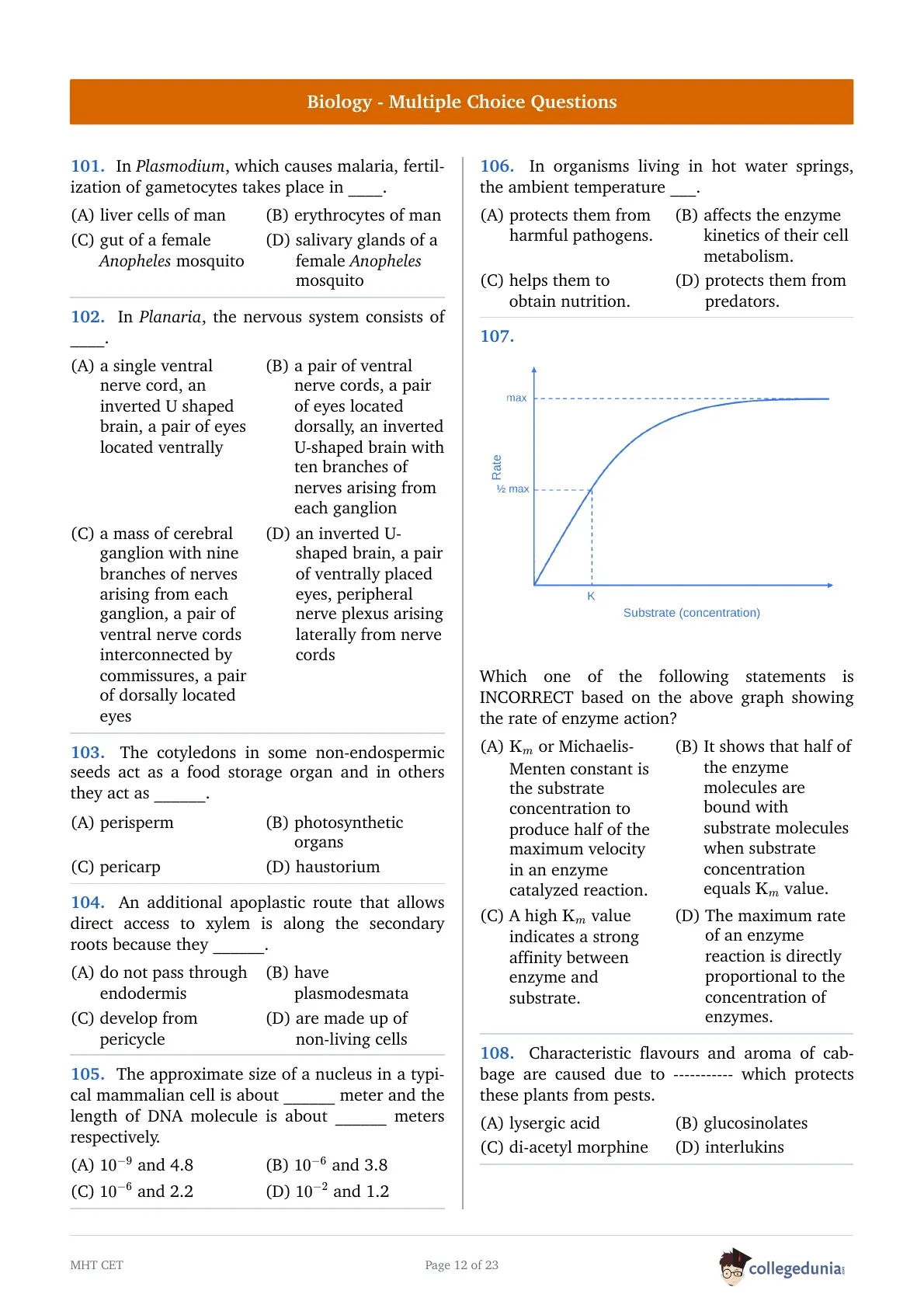
Question 107:

  • (A) \(\text{K}_{m}\) or Michaelis-Menten constant is the substrate concentration to produce half of the maximum velocity in an enzyme catalyzed reaction.
  • (B) It shows that half of the enzyme molecules are bound with substrate molecules when substrate concentration equals \(\text{K}_{m}\) value.
  • (C) A high \(\text{K}_{m}\) value indicates a strong affinity between enzyme and substrate.
  • (D) The maximum rate of an enzyme reaction is directly proportional to the concentration of enzymes.

Question 108:

Characteristic flavours and aroma of cabbage are caused due to ----------- which protects these plants from pests.

  • (A) lysergic acid
  • (B) glucosinolates
  • (C) di-acetyl morphine
  • (D) interlukins

Question 109:

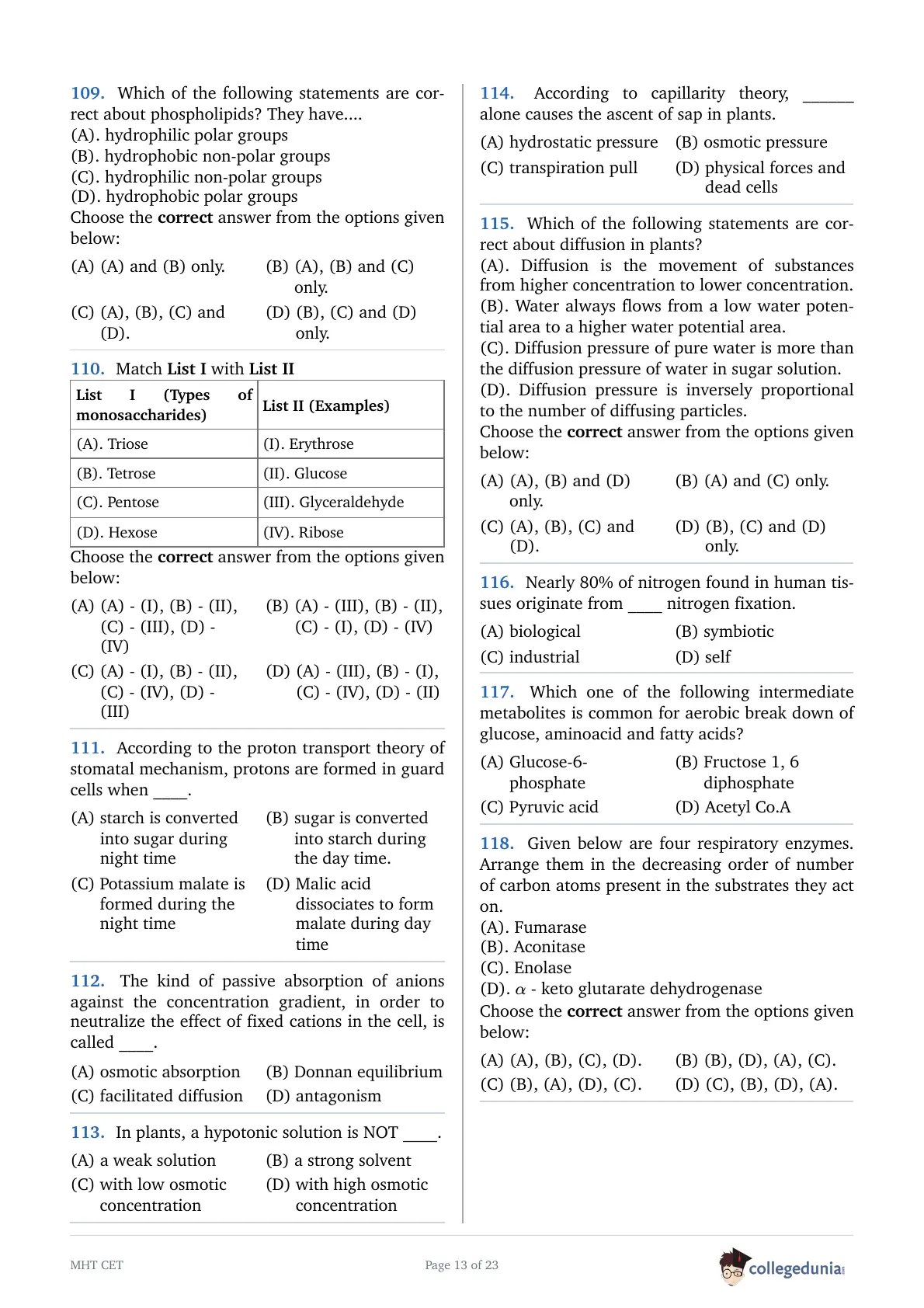
Which of the following statements are correct about phospholipids? They have....
(A). hydrophilic polar groups
(B). hydrophobic non-polar groups
(C). hydrophilic non-polar groups
(D). hydrophobic polar groups
Choose the correct answer from the options given below:

  • (A) (A) and (B) only.
  • (B) (A), (B) and (C) only.
  • (C) (A), (B), (C) and (D).
  • (D) (B), (C) and (D) only.

Question 110:

Match List I with List II

List I (Types of monosaccharides)List II (Examples)
(A). Triose(I). Erythrose
(B). Tetrose(II). Glucose
(C). Pentose(III). Glyceraldehyde
(D). Hexose(IV). Ribose
  • (A) (A) - (I), (B) - (II), (C) - (III), (D) - (IV)
  • (B) (A) - (III), (B) - (II), (C) - (I), (D) - (IV)
  • (C) (A) - (I), (B) - (II), (C) - (IV), (D) - (III)
  • (D) (A) - (III), (B) - (I), (C) - (IV), (D) - (II)

Question 111:

According to the proton transport theory of stomatal mechanism, protons are formed in guard cells when ____.

  • (A) starch is converted into sugar during night time
  • (B) sugar is converted into starch during the day time.
  • (C) Potassium malate is formed during the night time
  • (D) Malic acid dissociates to form malate during day time

Question 112:

The kind of passive absorption of anions against the concentration gradient, in order to neutralize the effect of fixed cations in the cell, is called ____.

  • (A) osmotic absorption
  • (B) Donnan equilibrium
  • (C) facilitated diffusion
  • (D) antagonism

Question 113:

In plants, a hypotonic solution is NOT ____.

  • (A) a weak solution
  • (B) a strong solvent
  • (C) with low osmotic concentration
  • (D) with high osmotic concentration

Question 114:

According to capillarity theory, ______ alone causes the ascent of sap in plants.

  • (A) hydrostatic pressure
  • (B) osmotic pressure
  • (C) transpiration pull
  • (D) physical forces and dead cells

Question 115:

Which of the following statements are correct about diffusion in plants?
(A). Diffusion is the movement of substances from higher concentration to lower concentration.
(B). Water always flows from a low water potential area to a higher water potential area.
(C). Diffusion pressure of pure water is more than the diffusion pressure of water in sugar solution.
(D). Diffusion pressure is inversely proportional to the number of diffusing particles.
Choose the correct answer from the options given below:

  • (A) (A), (B) and (D) only.
  • (B) (A) and (C) only.
  • (C) (A), (B), (C) and (D).
  • (D) (B), (C) and (D) only.

Question 116:

Nearly 80% of nitrogen found in human tissues originate from ____ nitrogen fixation.

  • (A) biological
  • (B) symbiotic
  • (C) industrial
  • (D) self

Question 117:

Which one of the following intermediate metabolites is common for aerobic break down of glucose, aminoacid and fatty acids?

  • (A) Glucose-6-phosphate
  • (B) Fructose 1, 6 diphosphate
  • (C) Pyruvic acid
  • (D) Acetyl Co.A

Question 118:

Given below are four respiratory enzymes. Arrange them in the decreasing order of number of carbon atoms present in the substrates they act on.
(A). Fumarase
(B). Aconitase
(C). Enolase
(D). \(\alpha\) - keto glutarate dehydrogenase
Choose the correct answer from the options given below:

  • (A) (A), (B), (C), (D).
  • (B) (B), (D), (A), (C).
  • (C) (B), (A), (D), (C).
  • (D) (C), (B), (D), (A).

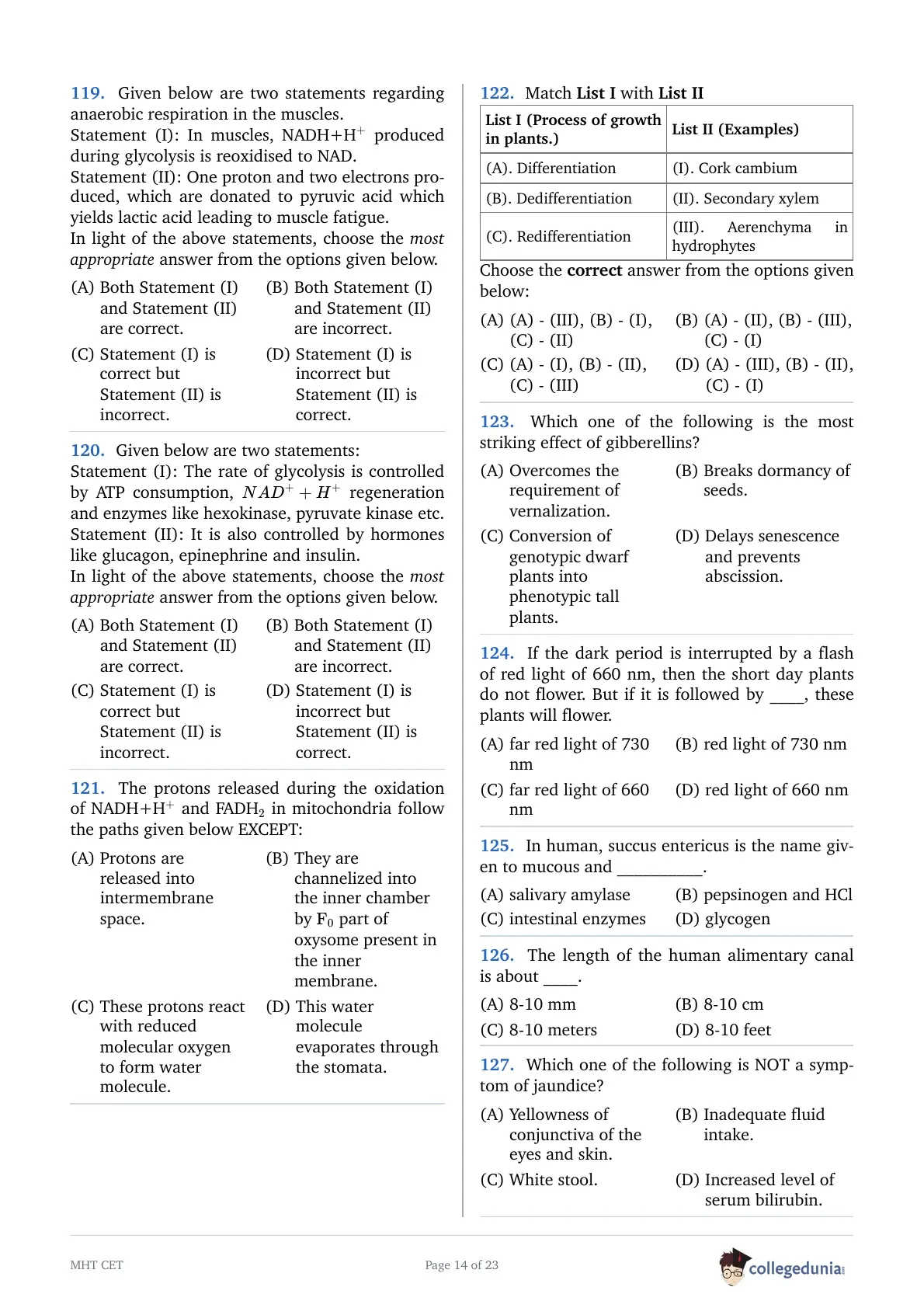
Question 119:

Given below are two statements regarding anaerobic respiration in the muscles.
Statement (I): In muscles, NADH+H\({}^{+}\) produced during glycolysis is reoxidised to NAD.
Statement (II): One proton and two electrons produced, which are donated to pyruvic acid which yields lactic acid leading to muscle fatigue.
In light of the above statements, choose the most appropriate answer from the options given below.

  • (A) Both Statement (I) and Statement (II) are correct.
  • (B) Both Statement (I) and Statement (II) are incorrect.
  • (C) Statement (I) is correct but Statement (II) is incorrect.
  • (D) Statement (I) is incorrect but Statement (II) is correct.

Question 120:

Given below are two statements:
Statement (I): The rate of glycolysis is controlled by ATP consumption, \(NAD^{+}+H^{+}\) regeneration and enzymes like hexokinase, pyruvate kinase etc.
Statement (II): It is also controlled by hormones like glucagon, epinephrine and insulin.
In light of the above statements, choose the most appropriate answer from the options given below.

  • (A) Both Statement (I) and Statement (II) are correct.
  • (B) Both Statement (I) and Statement (II) are incorrect.
  • (C) Statement (I) is correct but Statement (II) is incorrect.
  • (D) Statement (I) is incorrect but Statement (II) is correct.

Question 121:

The protons released during the oxidation of NADH+H\({}^{+}\) and FADH\({}_{2}\) in mitochondria follow the paths given below EXCEPT:

  • (A) Protons are released into intermembrane space.
  • (B) They are channelized into the inner chamber by \(\text{F}_{0}\) part of oxysome present in the inner membrane.
  • (C) These protons react with reduced molecular oxygen to form water molecule.
  • (D) This water molecule evaporates through the stomata.

Question 122:

Match List I with List II

List I (Process of growth in plants.)List II (Examples)
(A). Differentiation(I). Cork cambium
(B). Dedifferentiation(II). Secondary xylem
(C). Redifferentiation(III). Aerenchyma in hydrophytes
  • (A) (A) - (III), (B) - (I), (C) - (II)
  • (B) (A) - (II), (B) - (III), (C) - (I)
  • (C) (A) - (I), (B) - (II), (C) - (III)
  • (D) (A) - (III), (B) - (II), (C) - (I)

Question 123:

Which one of the following is the most striking effect of gibberellins?

  • (A) Overcomes the requirement of vernalization.
  • (B) Breaks dormancy of seeds.
  • (C) Conversion of genotypic dwarf plants into phenotypic tall plants.
  • (D) Delays senescence and prevents abscission.

Question 124:

If the dark period is interrupted by a flash of red light of 660 nm, then the short day plants do not flower. But if it is followed by ____, these plants will flower.

  • (A) far red light of 730 nm
  • (B) red light of 730 nm
  • (C) far red light of 660 nm
  • (D) red light of 660 nm

Question 125:

In human, succus entericus is the name given to mucous and __________.

  • (A) salivary amylase
  • (B) pepsinogen and HCl
  • (C) intestinal enzymes
  • (D) glycogen

Question 126:

The length of the human alimentary canal is about ____.

  • (A) 8-10 mm
  • (B) 8-10 cm
  • (C) 8-10 meters
  • (D) 8-10 feet

Question 127:

Which one of the following is NOT a symptom of jaundice?

  • (A) Yellowness of conjunctiva of the eyes and skin.
  • (B) Inadequate fluid intake.
  • (C) White stool.
  • (D) Increased level of serum bilirubin.

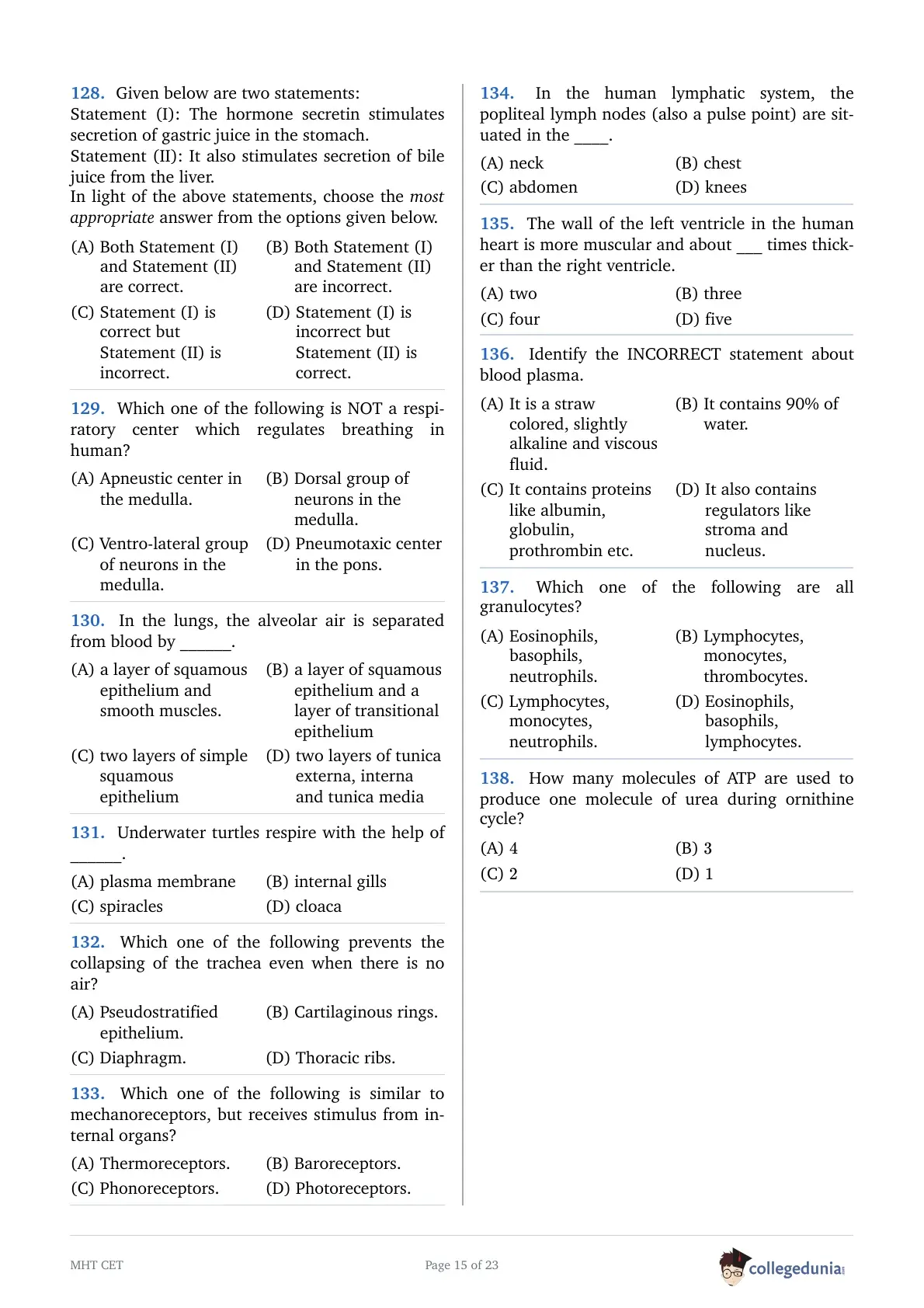
Question 128:

Given below are two statements:
Statement (I): The hormone secretin stimulates secretion of gastric juice in the stomach.
Statement (II): It also stimulates secretion of bile juice from the liver.
In light of the above statements, choose the most appropriate answer from the options given below.

  • (A) Both Statement (I) and Statement (II) are correct.
  • (B) Both Statement (I) and Statement (II) are incorrect.
  • (C) Statement (I) is correct but Statement (II) is incorrect.
  • (D) Statement (I) is incorrect but Statement (II) is correct.

Question 129:

Which one of the following is NOT a respiratory center which regulates breathing in human?

  • (A) Apneustic center in the medulla.
  • (B) Dorsal group of neurons in the medulla.
  • (C) Ventro-lateral group of neurons in the medulla.
  • (D) Pneumotaxic center in the pons.

Question 130:

In the lungs, the alveolar air is separated from blood by ______.

  • (A) a layer of squamous epithelium and smooth muscles.
  • (B) a layer of squamous epithelium and a layer of transitional epithelium
  • (C) two layers of simple squamous epithelium
  • (D) two layers of tunica externa, interna and tunica media

Question 131:

Underwater turtles respire with the help of ______.

  • (A) plasma membrane
  • (B) internal gills
  • (C) spiracles
  • (D) cloaca

Question 132:

Which one of the following prevents the collapsing of the trachea even when there is no air?

  • (A) Pseudostratified epithelium.
  • (B) Cartilaginous rings.
  • (C) Diaphragm.
  • (D) Thoracic ribs.

Question 133:

Which one of the following is similar to mechanoreceptors, but receives stimulus from internal organs?

  • (A) Thermoreceptors.
  • (B) Baroreceptors.
  • (C) Phonoreceptors.
  • (D) Photoreceptors.

Question 134:

In the human lymphatic system, the popliteal lymph nodes (also a pulse point) are situated in the ____.

  • (A) neck
  • (B) chest
  • (C) abdomen
  • (D) knees

Question 135:

The wall of the left ventricle in the human heart is more muscular and about ___ times thicker than the right ventricle.

  • (A) two
  • (B) three
  • (C) four
  • (D) five

Question 136:

Identify the INCORRECT statement about blood plasma.

  • (A) It is a straw colored, slightly alkaline and viscous fluid.
  • (B) It contains 90% of water.
  • (C) It contains proteins like albumin, globulin, prothrombin etc.
  • (D) It also contains regulators like stroma and nucleus.

Question 137:

Which one of the following are all granulocytes?

  • (A) Eosinophils, basophils, neutrophils.
  • (B) Lymphocytes, monocytes, thrombocytes.
  • (C) Lymphocytes, monocytes, neutrophils.
  • (D) Eosinophils, basophils, lymphocytes.

Question 138:

How many molecules of ATP are used to produce one molecule of urea during ornithine cycle?

  • (A) \(4\)
  • (B) \(3\)
  • (C) \(2\)
  • (D) \(1\)

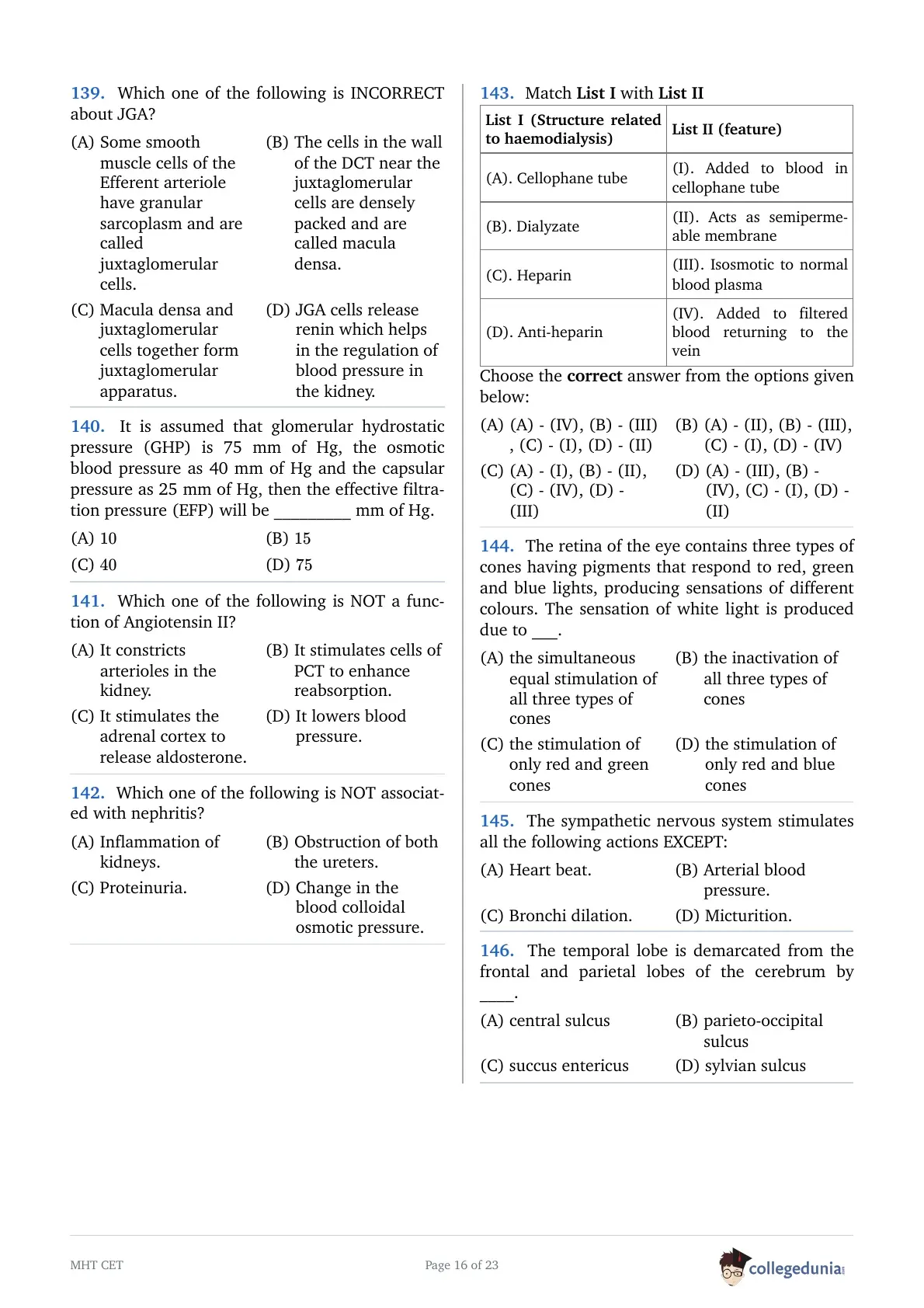
Question 139:

Which one of the following is INCORRECT about JGA?

  • (A) Some smooth muscle cells of the Efferent arteriole have granular sarcoplasm and are called juxtaglomerular cells.
  • (B) The cells in the wall of the DCT near the juxtaglomerular cells are densely packed and are called macula densa.
  • (C) Macula densa and juxtaglomerular cells together form juxtaglomerular apparatus.
  • (D) JGA cells release renin which helps in the regulation of blood pressure in the kidney.

Question 140:

It is assumed that glomerular hydrostatic pressure (GHP) is 75 mm of Hg, the osmotic blood pressure as 40 mm of Hg and the capsular pressure as 25 mm of Hg, then the effective filtration pressure (EFP) will be _________ mm of Hg.

  • (A) \(10\)
  • (B) \(15\)
  • (C) \(40\)
  • (D) \(75\)

Question 141:

Which one of the following is NOT a function of Angiotensin II?

  • (A) It constricts arterioles in the kidney.
  • (B) It stimulates cells of PCT to enhance reabsorption.
  • (C) It stimulates the adrenal cortex to release aldosterone.
  • (D) It lowers blood pressure.

Question 142:

Which one of the following is NOT associated with nephritis?

  • (A) Inflammation of kidneys.
  • (B) Obstruction of both the ureters.
  • (C) Proteinuria.
  • (D) Change in the blood colloidal osmotic pressure.

Question 143:

Match List I with List II

List I (Structure related to haemodialysis)List II (feature)
(A). Cellophane tube(I). Added to blood in cellophane tube
(B). Dialyzate(II). Acts as semipermeable membrane
(C). Heparin(III). Isosmotic to normal blood plasma
(D). Anti-heparin(IV). Added to filtered blood returning to the vein
  • (A) (A) - (IV), (B) - (III) , (C) - (I), (D) - (II)
  • (B) (A) - (II), (B) - (III), (C) - (I), (D) - (IV)
  • (C) (A) - (I), (B) - (II), (C) - (IV), (D) - (III)
  • (D) (A) - (III), (B) - (IV), (C) - (I), (D) - (II)

Question 144:

The retina of the eye contains three types of cones having pigments that respond to red, green and blue lights, producing sensations of different colours. The sensation of white light is produced due to ___.

  • (A) the simultaneous equal stimulation of all three types of cones
  • (B) the inactivation of all three types of cones
  • (C) the stimulation of only red and green cones
  • (D) the stimulation of only red and blue cones

Question 145:

The sympathetic nervous system stimulates all the following actions EXCEPT:

  • (A) Heart beat.
  • (B) Arterial blood pressure.
  • (C) Bronchi dilation.
  • (D) Micturition.

Question 146:

The temporal lobe is demarcated from the frontal and parietal lobes of the cerebrum by ____.

  • (A) central sulcus
  • (B) parieto-occipital sulcus
  • (C) succus entericus
  • (D) sylvian sulcus

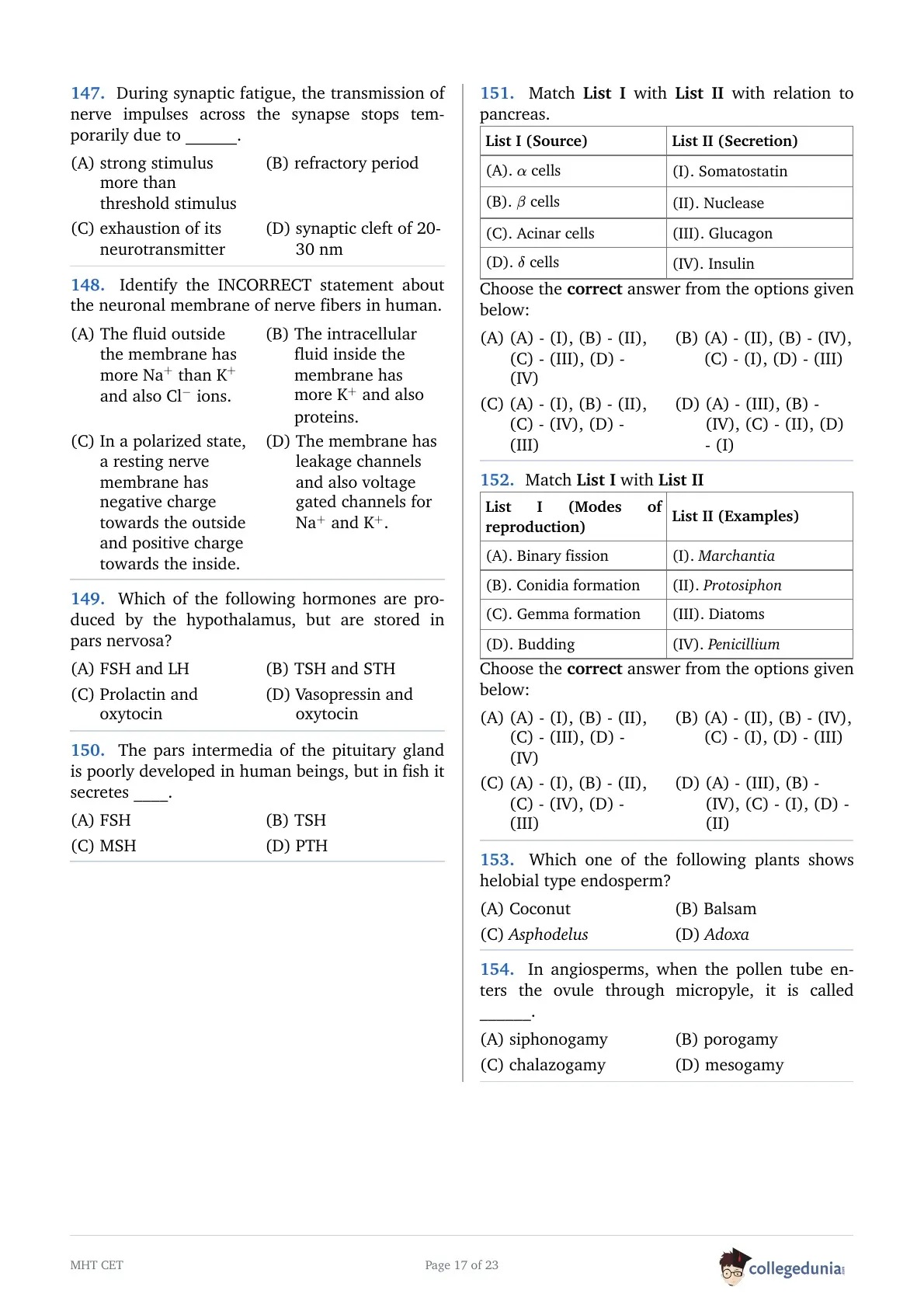
Question 147:

During synaptic fatigue, the transmission of nerve impulses across the synapse stops temporarily due to ______.

  • (A) strong stimulus more than threshold stimulus
  • (B) refractory period
  • (C) exhaustion of its neurotransmitter
  • (D) synaptic cleft of 20-30 nm

Question 148:

Identify the INCORRECT statement about the neuronal membrane of nerve fibers in human.

  • (A) The fluid outside the membrane has more Na\({}^{+}\) than K\({}^{+}\) and also Cl\({}^{-}\) ions.
  • (B) The intracellular fluid inside the membrane has more K\({}^{+}\) and also proteins.
  • (C) In a polarized state, a resting nerve membrane has negative charge towards the outside and positive charge towards the inside.
  • (D) The membrane has leakage channels and also voltage gated channels for Na\({}^{+}\) and K\({}^{+}\).

Question 149:

Which of the following hormones are produced by the hypothalamus, but are stored in pars nervosa?

  • (A) FSH and LH
  • (B) TSH and STH
  • (C) Prolactin and oxytocin
  • (D) Vasopressin and oxytocin

Question 150:

The pars intermedia of the pituitary gland is poorly developed in human beings, but in fish it secretes ____.

  • (A) FSH
  • (B) TSH
  • (C) MSH
  • (D) PTH

Question 151:

Match List I with List II with relation to pancreas.

List I (Source)List II (Secretion)
(A). \(\alpha\) cells(I). Somatostatin
(B). \(\beta\) cells(II). Nuclease
(C). Acinar cells(III). Glucagon
(D). \(\delta\) cells(IV). Insulin
  • (A) (A) - (I), (B) - (II), (C) - (III), (D) - (IV)
  • (B) (A) - (II), (B) - (IV), (C) - (I), (D) - (III)
  • (C) (A) - (I), (B) - (II), (C) - (IV), (D) - (III)
  • (D) (A) - (III), (B) - (IV), (C) - (II), (D) - (I)

Question 152:

Match List I with List II

List I (Modes of reproduction)List II (Examples)
(A). Binary fission(I). Marchantia
(B). Conidia formation(II). Protosiphon
(C). Gemma formation(III). Diatoms
(D). Budding(IV). Penicillium
  • (A) (A) - (I), (B) - (II), (C) - (III), (D) - (IV)
  • (B) (A) - (II), (B) - (IV), (C) - (I), (D) - (III)
  • (C) (A) - (I), (B) - (II), (C) - (IV), (D) - (III)
  • (D) (A) - (III), (B) - (IV), (C) - (I), (D) - (II)

Question 153:

Which one of the following plants shows helobial type endosperm?

  • (A) Coconut
  • (B) Balsam
  • (C) Asphodelus
  • (D) Adoxa

Question 154:

In angiosperms, when the pollen tube enters the ovule through micropyle, it is called ______.

  • (A) siphonogamy
  • (B) porogamy
  • (C) chalazogamy
  • (D) mesogamy

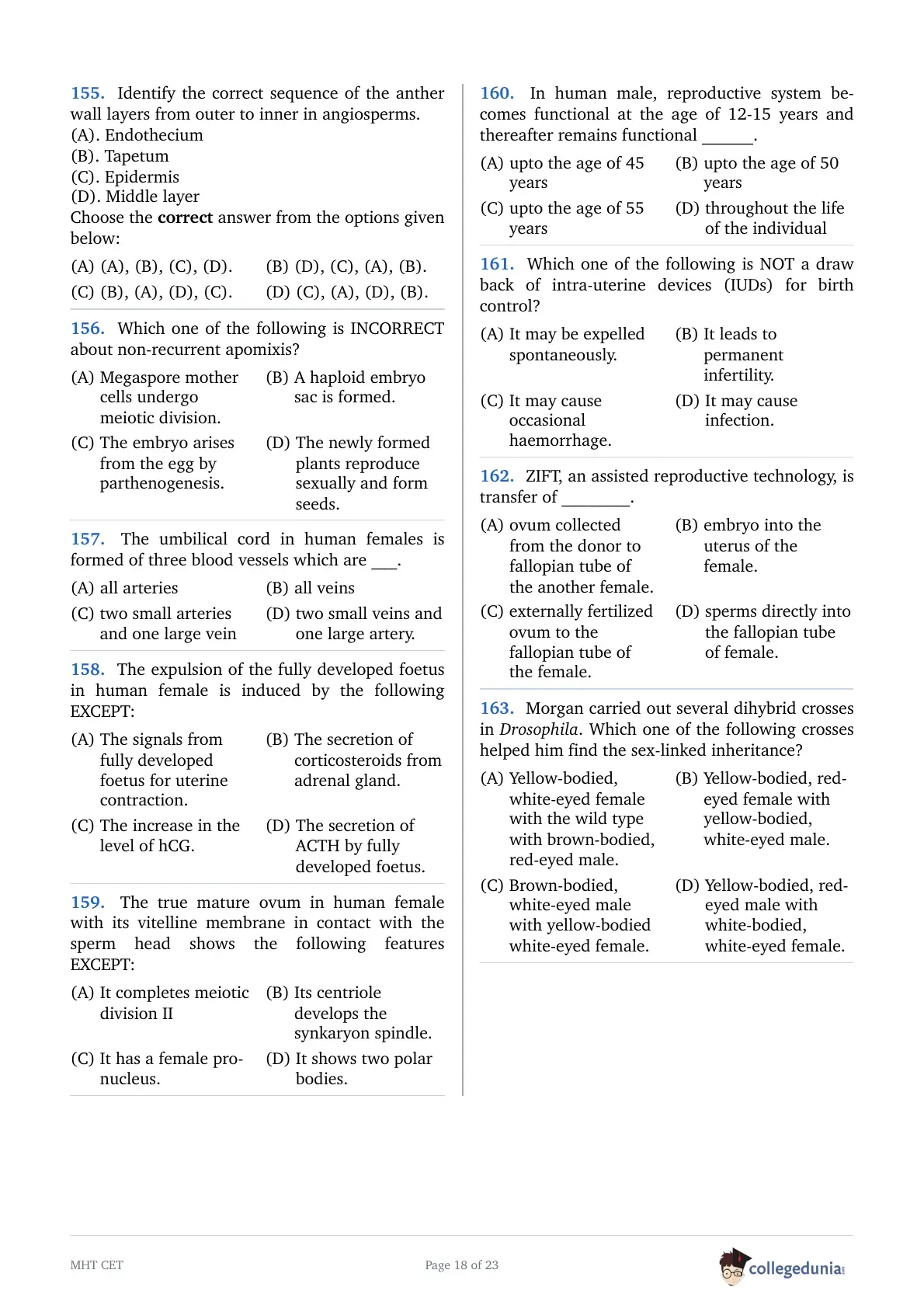
Question 155:

Identify the correct sequence of the anther wall layers from outer to inner in angiosperms.
(A). Endothecium
(B). Tapetum
(C). Epidermis
(D). Middle layer
Choose the correct answer from the options given below:

  • (A) (A), (B), (C), (D).
  • (B) (D), (C), (A), (B).
  • (C) (B), (A), (D), (C).
  • (D) (C), (A), (D), (B).

Question 156:

Which one of the following is INCORRECT about non-recurrent apomixis?

  • (A) Megaspore mother cells undergo meiotic division.
  • (B) A haploid embryo sac is formed.
  • (C) The embryo arises from the egg by parthenogenesis.
  • (D) The newly formed plants reproduce sexually and form seeds.

Question 157:

The umbilical cord in human females is formed of three blood vessels which are ___.

  • (A) all arteries
  • (B) all veins
  • (C) two small arteries and one large vein
  • (D) two small veins and one large artery.

Question 158:

The expulsion of the fully developed foetus in human female is induced by the following EXCEPT:

  • (A) The signals from fully developed foetus for uterine contraction.
  • (B) The secretion of corticosteroids from adrenal gland.
  • (C) The increase in the level of hCG.
  • (D) The secretion of ACTH by fully developed foetus.

Question 159:

The true mature ovum in human female with its vitelline membrane in contact with the sperm head shows the following features EXCEPT:

  • (A) It completes meiotic division II
  • (B) Its centriole develops the synkaryon spindle.
  • (C) It has a female pro-nucleus.
  • (D) It shows two polar bodies.

Question 160:

In human male, reproductive system becomes functional at the age of 12-15 years and thereafter remains functional ______.

  • (A) upto the age of 45 years
  • (B) upto the age of 50 years
  • (C) upto the age of 55 years
  • (D) throughout the life of the individual

Question 161:

Which one of the following is NOT a draw back of intra-uterine devices (IUDs) for birth control?

  • (A) It may be expelled spontaneously.
  • (B) It leads to permanent infertility.
  • (C) It may cause occasional haemorrhage.
  • (D) It may cause infection.

Question 162:

ZIFT, an assisted reproductive technology, is transfer of ________.

  • (A) ovum collected from the donor to fallopian tube of the another female.
  • (B) embryo into the uterus of the female.
  • (C) externally fertilized ovum to the fallopian tube of the female.
  • (D) sperms directly into the fallopian tube of female.

Question 163:

Morgan carried out several dihybrid crosses in Drosophila. Which one of the following crosses helped him find the sex-linked inheritance?

  • (A) Yellow-bodied, white-eyed female with the wild type with brown-bodied, red-eyed male.
  • (B) Yellow-bodied, red-eyed female with yellow-bodied, white-eyed male.
  • (C) Brown-bodied, white-eyed male with yellow-bodied white-eyed female.
  • (D) Yellow-bodied, red-eyed male with white-bodied, white-eyed female.

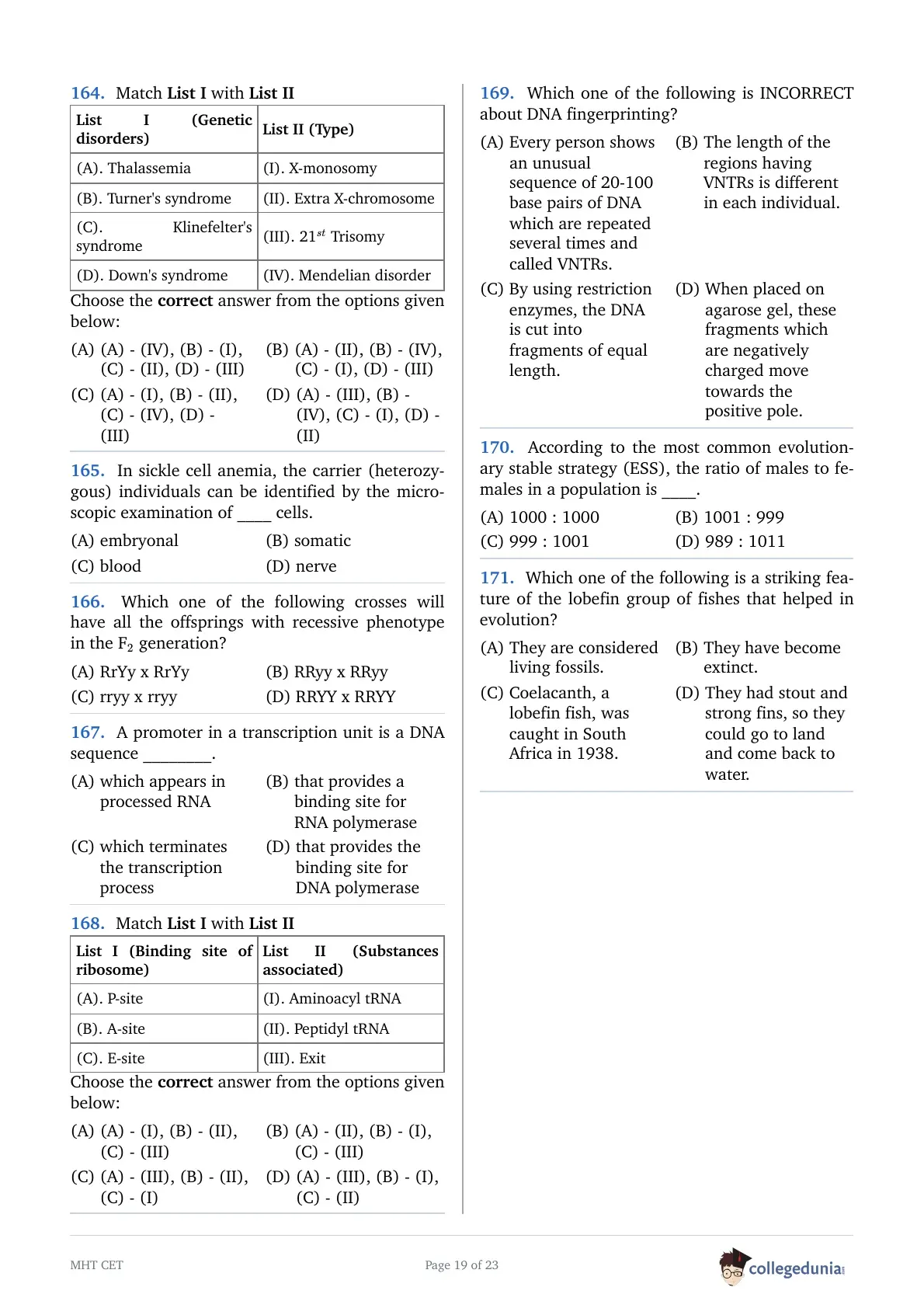
Question 164:

Match List I with List II

List I (Genetic disorders)List II (Type)
(A). Thalassemia(I). X-monosomy
(B). Turner's syndrome(II). Extra X-chromosome
(C). Klinefelter's syndrome(III). 21\({}^{st}\) Trisomy
(D). Down's syndrome(IV). Mendelian disorder
  • (A) (A) - (IV), (B) - (I), (C) - (II), (D) - (III)
  • (B) (A) - (II), (B) - (IV), (C) - (I), (D) - (III)
  • (C) (A) - (I), (B) - (II), (C) - (IV), (D) - (III)
  • (D) (A) - (III), (B) - (IV), (C) - (I), (D) - (II)

Question 165:

In sickle cell anemia, the carrier (heterozygous) individuals can be identified by the microscopic examination of ____ cells.

  • (A) embryonal
  • (B) somatic
  • (C) blood
  • (D) nerve

Question 166:

Which one of the following crosses will have all the offsprings with recessive phenotype in the F\({}_{2}\) generation?

  • (A) RrYy x RrYy
  • (B) RRyy x RRyy
  • (C) rryy x rryy
  • (D) RRYY x RRYY

Question 167:

A promoter in a transcription unit is a DNA sequence ________.

  • (A) which appears in processed RNA
  • (B) that provides a binding site for RNA polymerase
  • (C) which terminates the transcription process
  • (D) that provides the binding site for DNA polymerase

Question 168:

Match List I with List II

List I (Binding site of ribosome)List II (Substances associated)
(A). P-site(I). Aminoacyl tRNA
(B). A-site(II). Peptidyl tRNA
(C). E-site(III). Exit
  • (A) (A) - (I), (B) - (II), (C) - (III)
  • (B) (A) - (II), (B) - (I), (C) - (III)
  • (C) (A) - (III), (B) - (II), (C) - (I)
  • (D) (A) - (III), (B) - (I), (C) - (II)

Question 169:

Which one of the following is INCORRECT about DNA fingerprinting?

  • (A) Every person shows an unusual sequence of 20-100 base pairs of DNA which are repeated several times and called VNTRs.
  • (B) The length of the regions having VNTRs is different in each individual.
  • (C) By using restriction enzymes, the DNA is cut into fragments of equal length.
  • (D) When placed on agarose gel, these fragments which are negatively charged move towards the positive pole.

Question 170:

According to the most common evolutionary stable strategy (ESS), the ratio of males to females in a population is ____.

  • (A) 1000 : 1000
  • (B) 1001 : 999
  • (C) 999 : 1001
  • (D) 989 : 1011

Question 171:

Which one of the following is a striking feature of the lobefin group of fishes that helped in evolution?

  • (A) They are considered living fossils.
  • (B) They have become extinct.
  • (C) Coelacanth, a lobefin fish, was caught in South Africa in 1938.
  • (D) They had stout and strong fins, so they could go to land and come back to water.

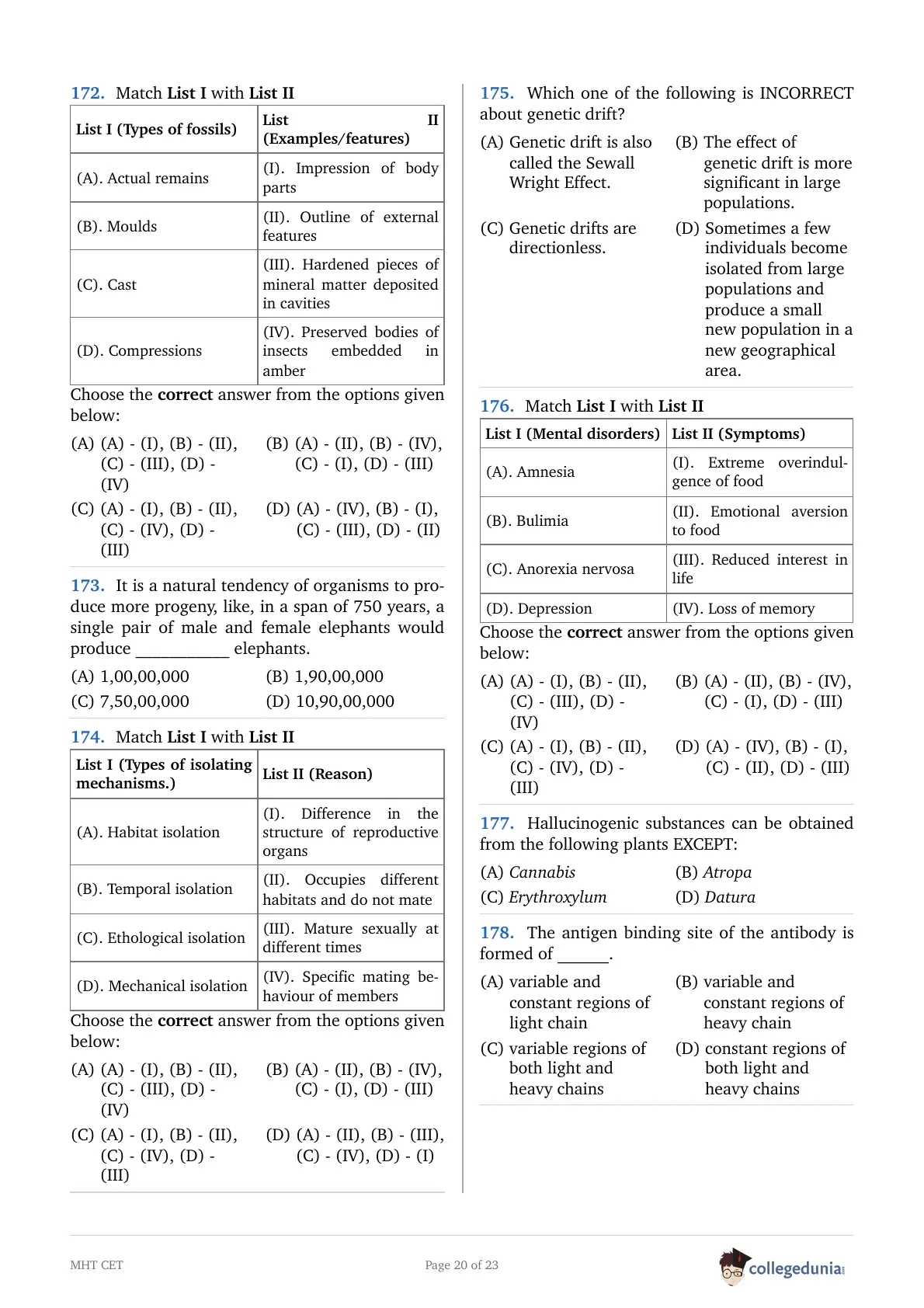
Question 172:

Match List I with List II

List I (Types of fossils)List II (Examples/features)
(A). Actual remains(I). Impression of body parts
(B). Moulds(II). Outline of external features
(C). Cast(III). Hardened pieces of mineral matter deposited in cavities
(D). Compressions(IV). Preserved bodies of insects embedded in amber
  • (A) (A) - (I), (B) - (II), (C) - (III), (D) - (IV)
  • (B) (A) - (II), (B) - (IV), (C) - (I), (D) - (III)
  • (C) (A) - (I), (B) - (II), (C) - (IV), (D) - (III)
  • (D) (A) - (IV), (B) - (I), (C) - (III), (D) - (II)

Question 173:

It is a natural tendency of organisms to produce more progeny, like, in a span of 750 years, a single pair of male and female elephants would produce ___________ elephants.

  • (A) 1,00,00,000
  • (B) 1,90,00,000
  • (C) 7,50,00,000
  • (D) 10,90,00,000

Question 174:

Match List I with List II

List I (Types of isolating mechanisms.)List II (Reason)
(A). Habitat isolation(I). Difference in the structure of reproductive organs
(B). Temporal isolation(II). Occupies different habitats and do not mate
(C). Ethological isolation(III). Mature sexually at different times
(D). Mechanical isolation(IV). Specific mating behaviour of members
  • (A) (A) - (I), (B) - (II), (C) - (III), (D) - (IV)
  • (B) (A) - (II), (B) - (IV), (C) - (I), (D) - (III)
  • (C) (A) - (I), (B) - (II), (C) - (IV), (D) - (III)
  • (D) (A) - (II), (B) - (III), (C) - (IV), (D) - (I)

Question 175:

Which one of the following is INCORRECT about genetic drift?

  • (A) Genetic drift is also called the Sewall Wright Effect.
  • (B) The effect of genetic drift is more significant in large populations.
  • (C) Genetic drifts are directionless.
  • (D) Sometimes a few individuals become isolated from large populations and produce a small new population in a new geographical area.

Question 176:

Match List I with List II

List I (Mental disorders)List II (Symptoms)
(A). Amnesia(I). Extreme overindulgence of food
(B). Bulimia(II). Emotional aversion to food
(C). Anorexia nervosa(III). Reduced interest in life
(D). Depression(IV). Loss of memory
  • (A) (A) - (I), (B) - (II), (C) - (III), (D) - (IV)
  • (B) (A) - (II), (B) - (IV), (C) - (I), (D) - (III)
  • (C) (A) - (I), (B) - (II), (C) - (IV), (D) - (III)
  • (D) (A) - (IV), (B) - (I), (C) - (II), (D) - (III)

Question 177:

Hallucinogenic substances can be obtained from the following plants EXCEPT:

  • (A) Cannabis
  • (B) Atropa
  • (C) Erythroxylum
  • (D) Datura

Question 178:

The antigen binding site of the antibody is formed of ______.

  • (A) variable and constant regions of light chain
  • (B) variable and constant regions of heavy chain
  • (C) variable regions of both light and heavy chains
  • (D) constant regions of both light and heavy chains

Question 179:

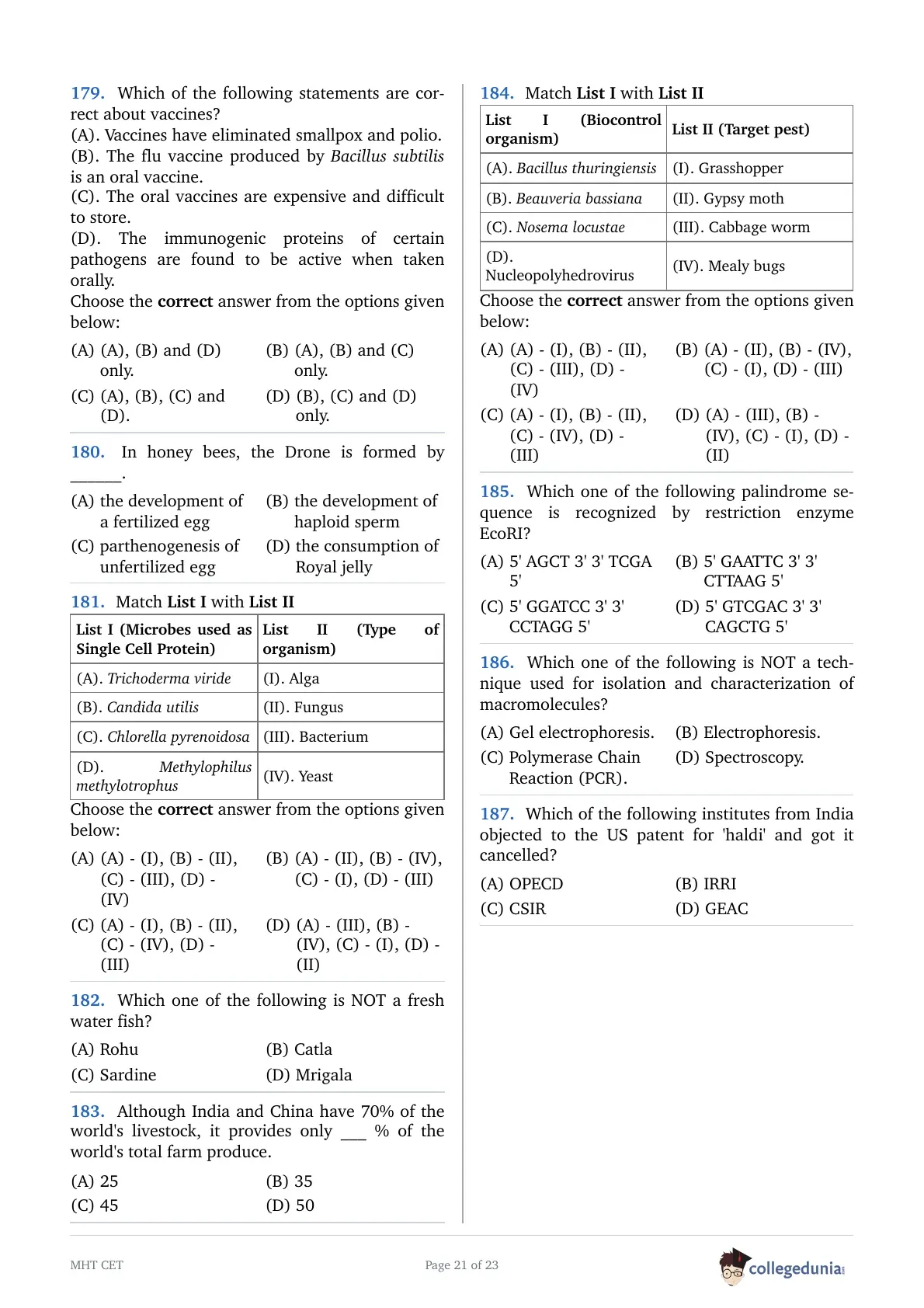
Which of the following statements are correct about vaccines?
(A). Vaccines have eliminated smallpox and polio.
(B). The flu vaccine produced by Bacillus subtilis is an oral vaccine.
(C). The oral vaccines are expensive and difficult to store.
(D). The immunogenic proteins of certain pathogens are found to be active when taken orally.
Choose the correct answer from the options given below:

  • (A) (A), (B) and (D) only.
  • (B) (A), (B) and (C) only.
  • (C) (A), (B), (C) and (D).
  • (D) (B), (C) and (D) only.

Question 180:

In honey bees, the Drone is formed by ______.

  • (A) the development of a fertilized egg
  • (B) the development of haploid sperm
  • (C) parthenogenesis of unfertilized egg
  • (D) the consumption of Royal jelly

Question 181:

Match List I with List II

List I (Microbes used as Single Cell Protein)List II (Type of organism)
(A). Trichoderma viride(I). Alga
(B). Candida utilis(II). Fungus
(C). Chlorella pyrenoidosa(III). Bacterium
(D). Methylophilus methylotrophus(IV). Yeast
  • (A) (A) - (I), (B) - (II), (C) - (III), (D) - (IV)
  • (B) (A) - (II), (B) - (IV), (C) - (I), (D) - (III)
  • (C) (A) - (I), (B) - (II), (C) - (IV), (D) - (III)
  • (D) (A) - (III), (B) - (IV), (C) - (I), (D) - (II)

Question 182:

Which one of the following is NOT a fresh water fish?

  • (A) Rohu
  • (B) Catla
  • (C) Sardine
  • (D) Mrigala

Question 183:

Although India and China have 70% of the world's livestock, it provides only ___ % of the world's total farm produce.

  • (A) 25
  • (B) 35
  • (C) 45
  • (D) 50

Question 184:

Match List I with List II

List I (Biocontrol organism)List II (Target pest)
(A). Bacillus thuringiensis(I). Grasshopper
(B). Beauveria bassiana(II). Gypsy moth
(C). Nosema locustae(III). Cabbage worm
(D). Nucleopolyhedrovirus(IV). Mealy bugs
  • (A) (A) - (I), (B) - (II), (C) - (III), (D) - (IV)
  • (B) (A) - (II), (B) - (IV), (C) - (I), (D) - (III)
  • (C) (A) - (I), (B) - (II), (C) - (IV), (D) - (III)
  • (D) (A) - (III), (B) - (IV), (C) - (I), (D) - (II)

Question 185:

Which one of the following palindrome sequence is recognized by restriction enzyme EcoRI?

  • (A) 5' AGCT 3' 3' TCGA 5'
  • (B) 5' GAATTC 3' 3' CTTAAG 5'
  • (C) 5' GGATCC 3' 3' CCTAGG 5'
  • (D) 5' GTCGAC 3' 3' CAGCTG 5'

Question 186:

Which one of the following is NOT a technique used for isolation and characterization of macromolecules?

  • (A) Gel electrophoresis.
  • (B) Electrophoresis.
  • (C) Polymerase Chain Reaction (PCR).
  • (D) Spectroscopy.

Question 187:

Which of the following institutes from India objected to the US patent for 'haldi' and got it cancelled?

  • (A) OPECD
  • (B) IRRI
  • (C) CSIR
  • (D) GEAC

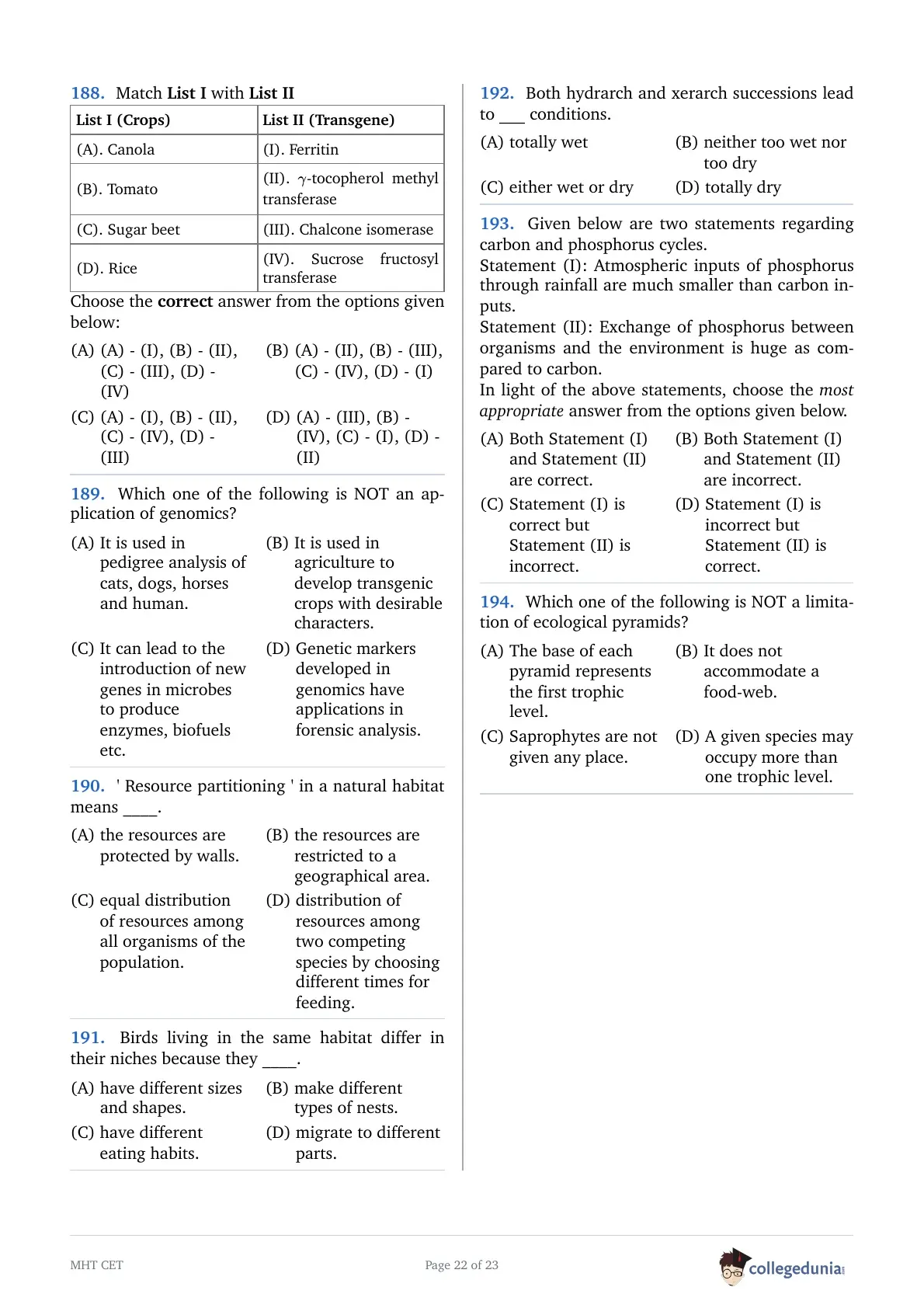
Question 188:

Match List I with List II

List I (Crops)List II (Transgene)
(A). Canola(I). Ferritin
(B). Tomato(II). \(\gamma\)-tocopherol methyl transferase
(C). Sugar beet(III). Chalcone isomerase
(D). Rice(IV). Sucrose fructosyl transferase
  • (A) (A) - (I), (B) - (II), (C) - (III), (D) - (IV)
  • (B) (A) - (II), (B) - (III), (C) - (IV), (D) - (I)
  • (C) (A) - (I), (B) - (II), (C) - (IV), (D) - (III)
  • (D) (A) - (III), (B) - (IV), (C) - (I), (D) - (II)

Question 189:

Which one of the following is NOT an application of genomics?

  • (A) It is used in pedigree analysis of cats, dogs, horses and human.
  • (B) It is used in agriculture to develop transgenic crops with desirable characters.
  • (C) It can lead to the introduction of new genes in microbes to produce enzymes, biofuels etc.
  • (D) Genetic markers developed in genomics have applications in forensic analysis.

Question 190:

' Resource partitioning ' in a natural habitat means ____.

  • (A) the resources are protected by walls.
  • (B) the resources are restricted to a geographical area.
  • (C) equal distribution of resources among all organisms of the population.
  • (D) distribution of resources among two competing species by choosing different times for feeding.

Question 191:

Birds living in the same habitat differ in their niches because they ____.

  • (A) have different sizes and shapes.
  • (B) make different types of nests.
  • (C) have different eating habits.
  • (D) migrate to different parts.

Question 192:

Both hydrarch and xerarch successions lead to ___ conditions.

  • (A) totally wet
  • (B) neither too wet nor too dry
  • (C) either wet or dry
  • (D) totally dry

Question 193:

Given below are two statements regarding carbon and phosphorus cycles.
Statement (I): Atmospheric inputs of phosphorus through rainfall are much smaller than carbon inputs.
Statement (II): Exchange of phosphorus between organisms and the environment is huge as compared to carbon.
In light of the above statements, choose the most appropriate answer from the options given below.

  • (A) Both Statement (I) and Statement (II) are correct.
  • (B) Both Statement (I) and Statement (II) are incorrect.
  • (C) Statement (I) is correct but Statement (II) is incorrect.
  • (D) Statement (I) is incorrect but Statement (II) is correct.

Question 194:

Which one of the following is NOT a limitation of ecological pyramids?

  • (A) The base of each pyramid represents the first trophic level.
  • (B) It does not accommodate a food-web.
  • (C) Saprophytes are not given any place.
  • (D) A given species may occupy more than one trophic level.

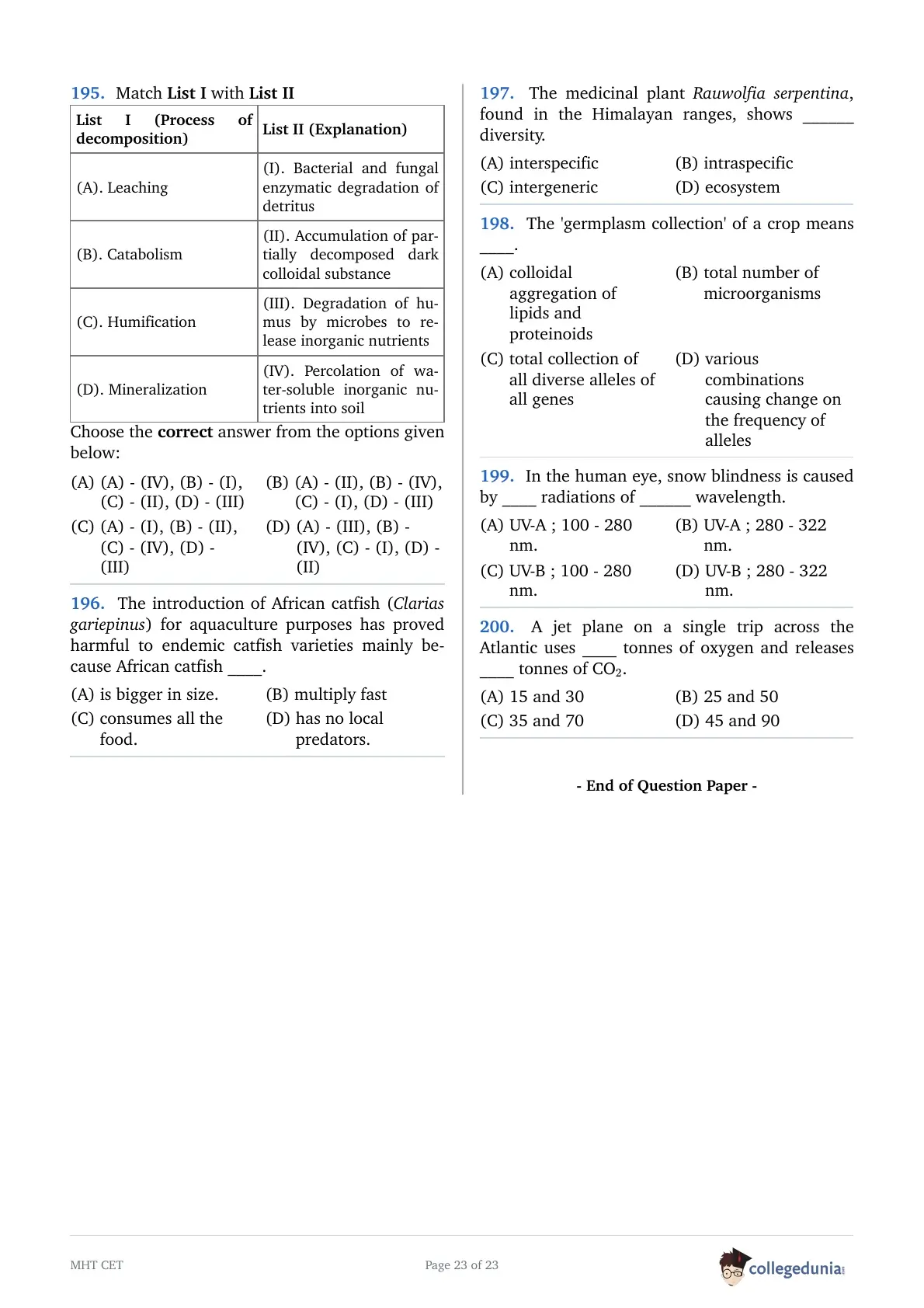
Question 195:

Match List I with List II

List I (Process of decomposition)List II (Explanation)
(A). Leaching(I). Bacterial and fungal enzymatic degradation of detritus
(B). Catabolism(II). Accumulation of partially decomposed dark colloidal substance
(C). Humification(III). Degradation of humus by microbes to release inorganic nutrients
(D). Mineralization(IV). Percolation of water-soluble inorganic nutrients into soil
  • (A) (A) - (IV), (B) - (I), (C) - (II), (D) - (III)
  • (B) (A) - (II), (B) - (IV), (C) - (I), (D) - (III)
  • (C) (A) - (I), (B) - (II), (C) - (IV), (D) - (III)
  • (D) (A) - (III), (B) - (IV), (C) - (I), (D) - (II)

Question 196:

The introduction of African catfish (Clarias gariepinus) for aquaculture purposes has proved harmful to endemic catfish varieties mainly because African catfish ____.

  • (A) is bigger in size.
  • (B) multiply fast
  • (C) consumes all the food.
  • (D) has no local predators.

Question 197:

The medicinal plant Rauwolfia serpentina, found in the Himalayan ranges, shows ______ diversity.

  • (A) interspecific
  • (B) intraspecific
  • (C) intergeneric
  • (D) ecosystem

Question 198:

The 'germplasm collection' of a crop means ____.

  • (A) colloidal aggregation of lipids and proteinoids
  • (B) total number of microorganisms
  • (C) total collection of all diverse alleles of all genes
  • (D) various combinations causing change on the frequency of alleles

Question 199:

In the human eye, snow blindness is caused by ____ radiations of ______ wavelength.

  • (A) UV-A ; 100 - 280 nm.
  • (B) UV-A ; 280 - 322 nm.
  • (C) UV-B ; 100 - 280 nm.
  • (D) UV-B ; 280 - 322 nm.

Question 200:

A jet plane on a single trip across the Atlantic uses ____ tonnes of oxygen and releases ____ tonnes of CO\({}_{2}\).

  • (A) 15 and 30
  • (B) 25 and 50
  • (C) 35 and 70
  • (D) 45 and 90

MHT CET 2026 PCB Exam Pattern and Marking Scheme

Parameter Details
Conducting Body Maharashtra Common Entrance Test Cell (Maharashtra CET Cell)
Exam Mode Online (Computer-Based Test)
Duration 180 minutes (3 hours)
Groups / Subjects PCB (Physics, Chemistry, Biology) for Pharmacy and Agriculture
Total Questions

200

Total Marks 200
Question Type Multiple Choice Questions (MCQs)
Marking Scheme 1 mark for each correct answer
Negative Marking No
Syllabus Weightage
  • Class 12 – 80%
  • Class 11 – 20%

MHT CET 2026 April 22 Shift 1 PCB Paper Analysis