




MHT CET 2026 April 23 Shift 1 PCB Question Paper is available for download here. Maharashtra State CET Cell conducted MHT CET 2026 PCB Exam on April 23 in Shift 1 from 9 AM to 12 PM in CBT mode.
The MHT CET 2026 PCB question paper includes the following:
- The MHT CET 2026 PCB Question Paper consists of 200 multiple-choice questions (MCQs) totalling 200 marks divided into 3 sections: Physics (50 questions), Chemistry (50 questions), and Biology (100 questions).
- All questions carry 1 mark each. There is no negative marking for incorrect answers.
MHT CET 2026 April 23 Shift 1 PCB Question Paper with Solution PDF
| CD PDF | CD PDF with Solutions |
|---|---|
| Download Collegedunia PDF 1.11 MB | - |
Also Check:
MHT CET 2026 April 23 Shift 1 PCB Questions with Solutions
Physics (Q1 - Q50)
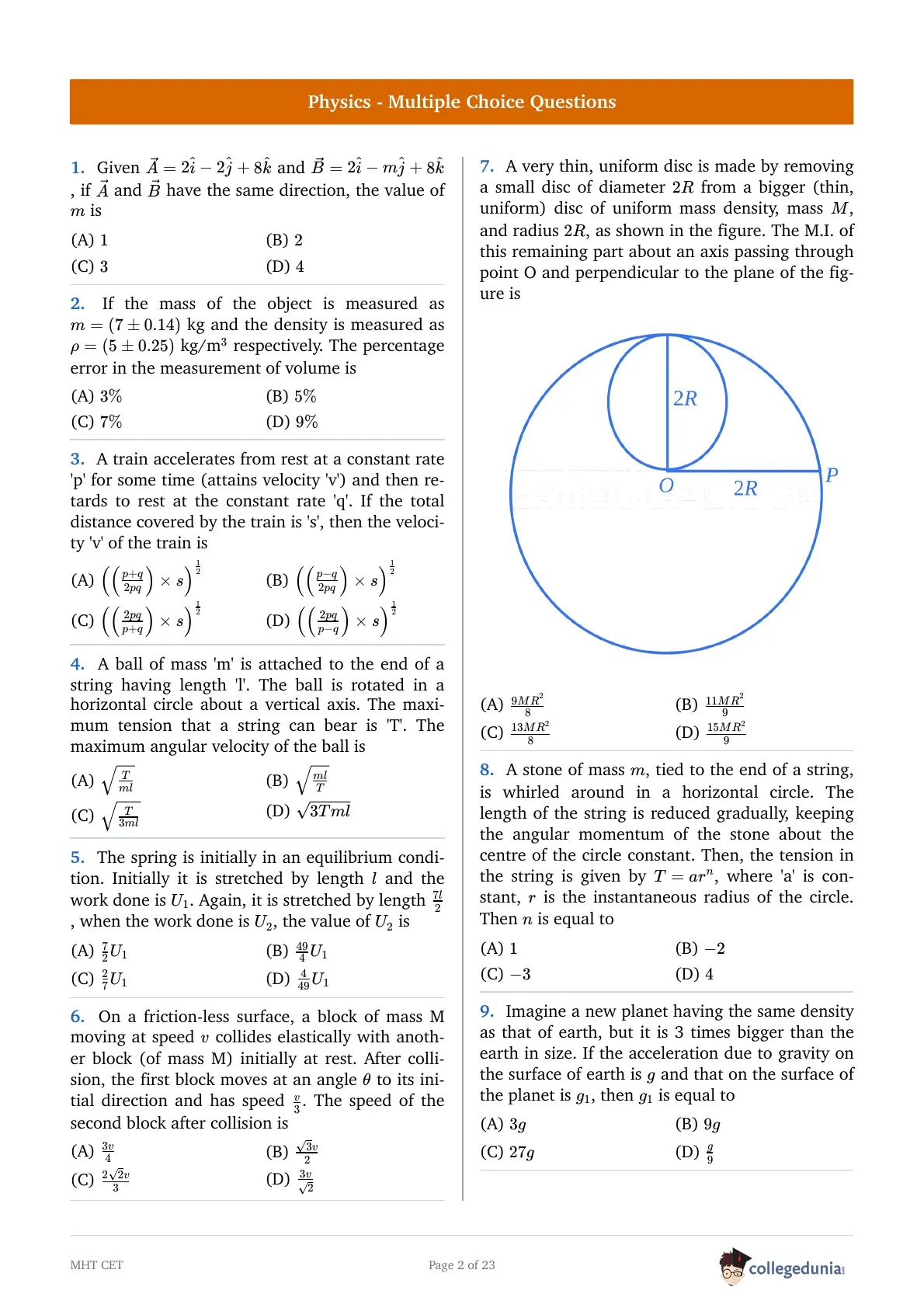
Given \(\vec{A}=2\hat{i}-2\hat{j}+8\hat{k}\) and \(\vec{B}=2\hat{i}-m\hat{j}+8\hat{k}\), if \(\vec{A}\) and \(\vec{B}\) have the same direction, the value of \(m\) is
If the mass of the object is measured as \(m=(7\pm 0.14)\) kg and the density is measured as \(\rho =(5\pm 0.25)\) kg/m\({}^{3}\) respectively. The percentage error in the measurement of volume is
A train accelerates from rest at a constant rate 'p' for some time (attains velocity 'v') and then retards to rest at the constant rate 'q'. If the total distance covered by the train is 's', then the velocity 'v' of the train is
A ball of mass 'm' is attached to the end of a string having length 'l'. The ball is rotated in a horizontal circle about a vertical axis. The maximum tension that a string can bear is 'T'. The maximum angular velocity of the ball is
The spring is initially in an equilibrium condition. Initially it is stretched by length \(l\) and the work done is \(U_{1}\). Again, it is stretched by length \(\frac{7l}{2}\), when the work done is \(U_{2}\), the value of \(U_{2}\) is
On a friction-less surface, a block of mass M moving at speed \(v\) collides elastically with another block (of mass M) initially at rest. After collision, the first block moves at an angle \(\theta\) to its initial direction and has speed \(\frac{v}{3}\). The speed of the second block after collision is
A very thin, uniform disc is made by removing a small disc of diameter \(2R\) from a bigger (thin, uniform) disc of uniform mass density, mass \(M\), and radius \(2R\), as shown in the figure. The M.I. of this remaining part about an axis passing through point O and perpendicular to the plane of the figure is

A stone of mass \(m\), tied to the end of a string, is whirled around in a horizontal circle. The length of the string is reduced gradually, keeping the angular momentum of the stone about the centre of the circle constant. Then, the tension in the string is given by \(T=ar^{n}\), where 'a' is constant, \(r\) is the instantaneous radius of the circle. Then \(n\) is equal to
Imagine a new planet having the same density as that of earth, but it is 3 times bigger than the earth in size. If the acceleration due to gravity on the surface of earth is \(g\) and that on the surface of the planet is \(g_{1}\), then \(g_{1}\) is equal to
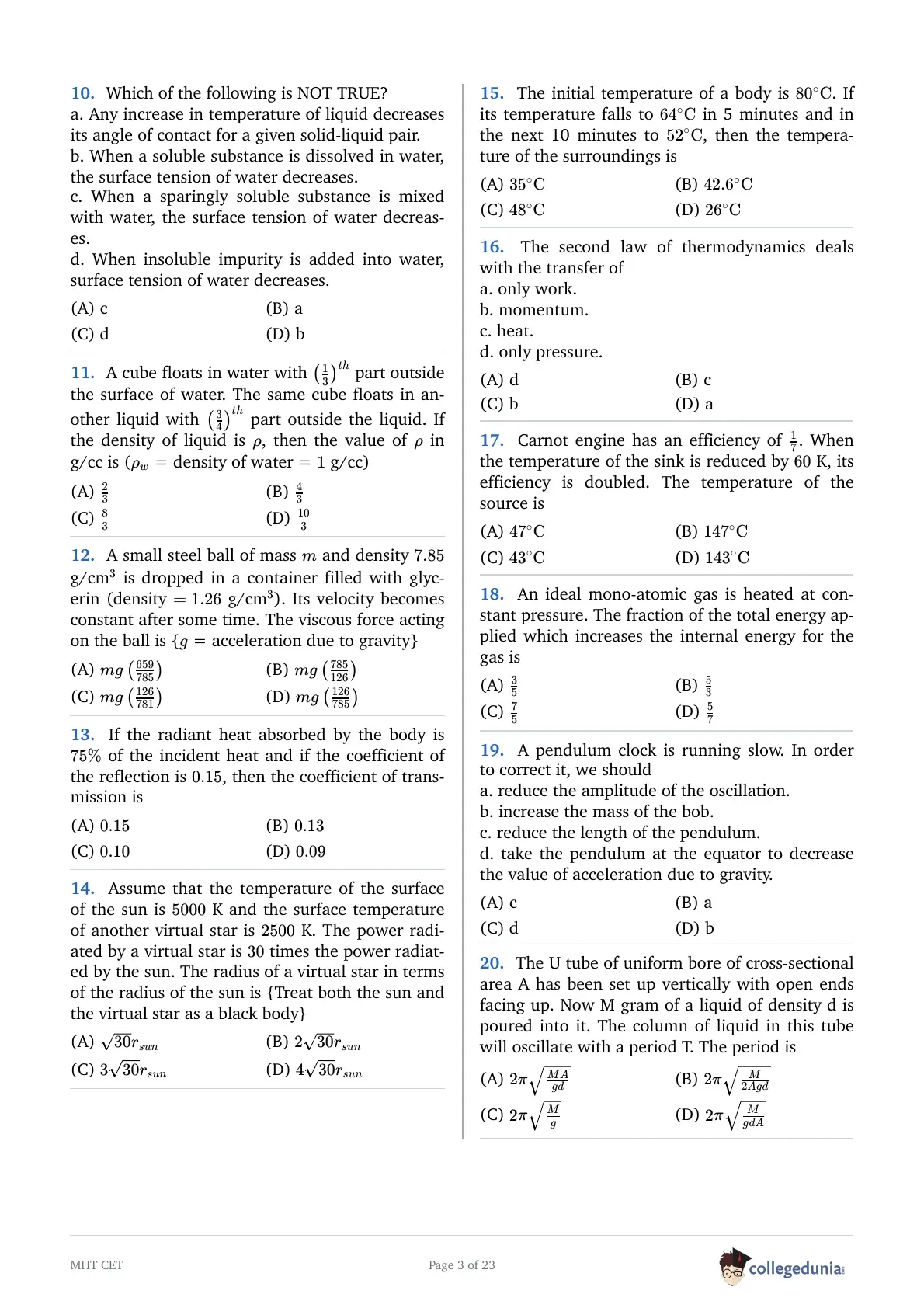
Which of the following is NOT TRUE?
a. Any increase in temperature of liquid decreases its angle of contact for a given solid-liquid pair.
b. When a soluble substance is dissolved in water, the surface tension of water decreases.
c. When a sparingly soluble substance is mixed with water, the surface tension of water decreases.
d. When insoluble impurity is added into water, surface tension of water decreases.
A cube floats in water with \(\left(\frac{1}{3}\right)^{th}\) part outside the surface of water. The same cube floats in another liquid with \(\left(\frac{3}{4}\right)^{th}\) part outside the liquid. If the density of liquid is \(\rho\), then the value of \(\rho\) in g/cc is (\(\rho _{w}\) = density of water = \(1\) g/cc)
A small steel ball of mass \(m\) and density \(7.85\) g/cm\({}^{3}\) is dropped in a container filled with glycerin (density \(=1.26\) g/cm\({}^{3}\)). Its velocity becomes constant after some time. The viscous force acting on the ball is {\(g\) = acceleration due to gravity}
If the radiant heat absorbed by the body is \(75\%\) of the incident heat and if the coefficient of the reflection is \(0.15\), then the coefficient of transmission is
Assume that the temperature of the surface of the sun is \(5000\) K and the surface temperature of another virtual star is \(2500\) K. The power radiated by a virtual star is \(30\) times the power radiated by the sun. The radius of a virtual star in terms of the radius of the sun is {Treat both the sun and the virtual star as a black body}
The initial temperature of a body is \(80^{\circ }\text{C}\). If its temperature falls to \(64^{\circ }\text{C}\) in 5 minutes and in the next 10 minutes to \(52^{\circ }\text{C}\), then the temperature of the surroundings is
The second law of thermodynamics deals with the transfer of
a. only work.
b. momentum.
c. heat.
d. only pressure.
Carnot engine has an efficiency of \(\frac{1}{7}\). When the temperature of the sink is reduced by \(60\) K, its efficiency is doubled. The temperature of the source is
An ideal mono-atomic gas is heated at constant pressure. The fraction of the total energy applied which increases the internal energy for the gas is
A pendulum clock is running slow. In order to correct it, we should
a. reduce the amplitude of the oscillation.
b. increase the mass of the bob.
c. reduce the length of the pendulum.
d. take the pendulum at the equator to decrease the value of acceleration due to gravity.
The U tube of uniform bore of cross-sectional area A has been set up vertically with open ends facing up. Now M gram of a liquid of density d is poured into it. The column of liquid in this tube will oscillate with a period T. The period is
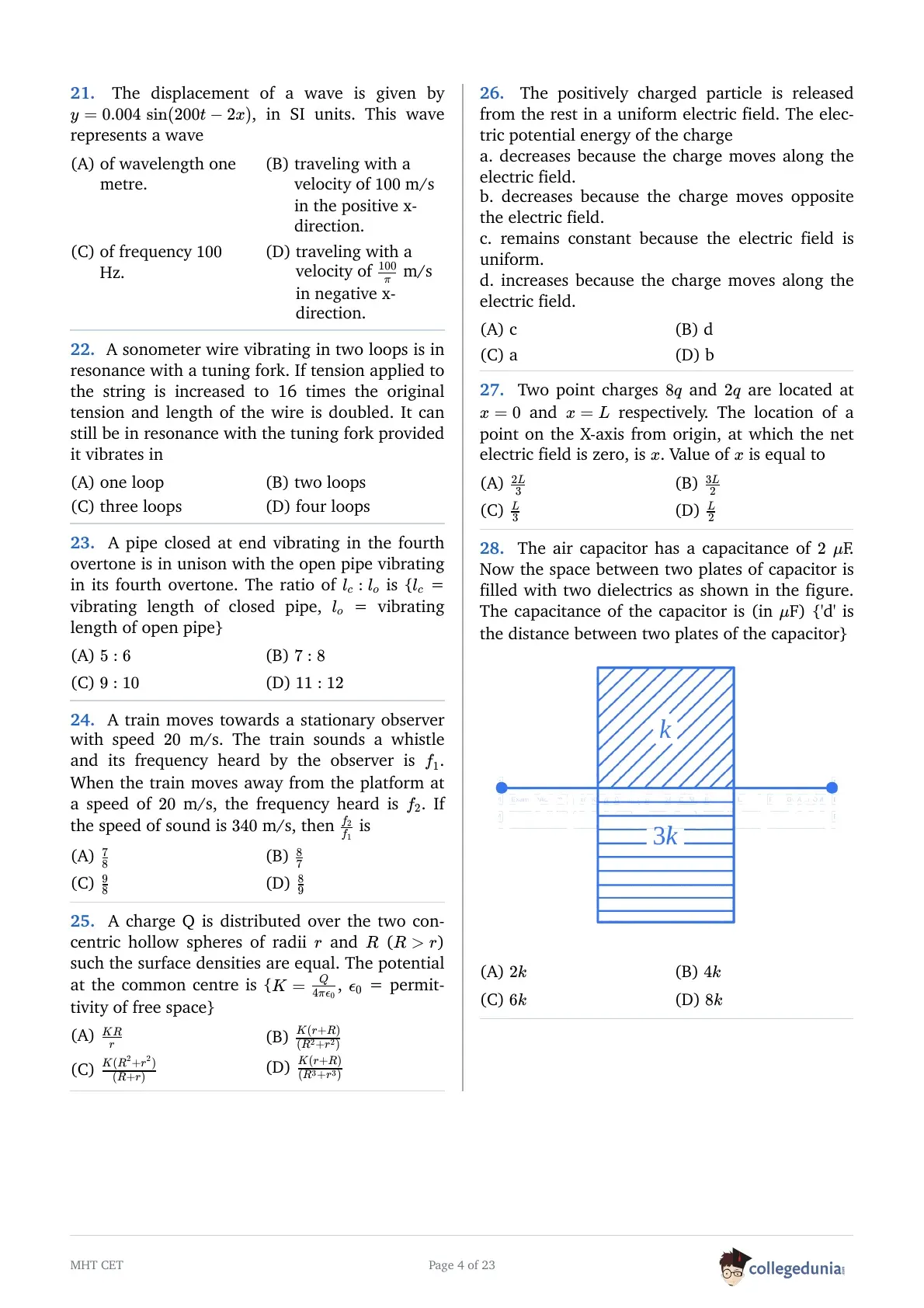
The displacement of a wave is given by \(y=0.004\,\sin (200t-2x)\), in SI units. This wave represents a wave
A sonometer wire vibrating in two loops is in resonance with a tuning fork. If tension applied to the string is increased to 16 times the original tension and length of the wire is doubled. It can still be in resonance with the tuning fork provided it vibrates in
A pipe closed at end vibrating in the fourth overtone is in unison with the open pipe vibrating in its fourth overtone. The ratio of \(l_{c}:l_{o}\) is {\(l_{c}\) = vibrating length of closed pipe, \(l_{o}\) = vibrating length of open pipe}
A train moves towards a stationary observer with speed \(20\) m/s. The train sounds a whistle and its frequency heard by the observer is \(f_{1}\). When the train moves away from the platform at a speed of \(20\) m/s, the frequency heard is \(f_{2}\). If the speed of sound is \(340\) m/s, then \(\frac{f_{2}}{f_{1}}\) is
A charge Q is distributed over the two concentric hollow spheres of radii \(r\) and \(R\) (\(R>r\)) such the surface densities are equal. The potential at the common centre is {\(K=\frac{Q}{4\pi \epsilon _{0}}\), \(\epsilon _{0}\) = permittivity of free space}
The positively charged particle is released from the rest in a uniform electric field. The electric potential energy of the charge
a. decreases because the charge moves along the electric field.
b. decreases because the charge moves opposite the electric field.
c. remains constant because the electric field is uniform.
d. increases because the charge moves along the electric field.
Two point charges \(8q\) and \(2q\) are located at \(x=0\) and \(x=L\) respectively. The location of a point on the X-axis from origin, at which the net electric field is zero, is \(x\). Value of \(x\) is equal to
The air capacitor has a capacitance of \(2\) \(\mu\)F. Now the space between two plates of capacitor is filled with two dielectrics as shown in the figure. The capacitance of the capacitor is (in \(\mu\)F) {'d' is the distance between two plates of the capacitor}

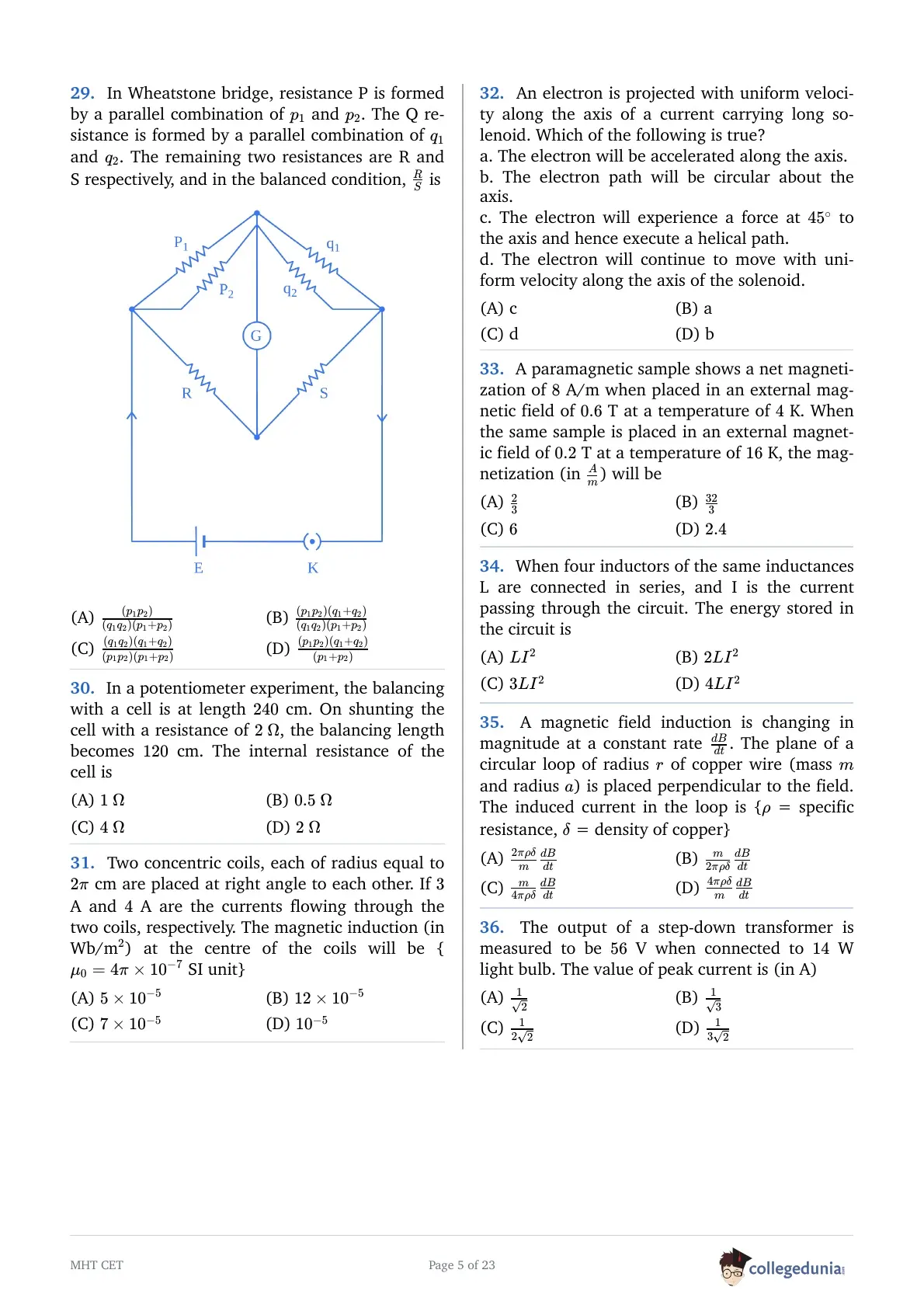
In Wheatstone bridge, resistance P is formed by a parallel combination of \(p_{1}\) and \(p_{2}\). The Q resistance is formed by a parallel combination of \(q_{1}\) and \(q_{2}\). The remaining two resistances are R and S respectively, and in the balanced condition, \(\frac{R}{S}\) is

In a potentiometer experiment, the balancing with a cell is at length \(240\) cm. On shunting the cell with a resistance of \(2\ \Omega\), the balancing length becomes \(120\) cm. The internal resistance of the cell is
Two concentric coils, each of radius equal to \(2\pi\) cm are placed at right angle to each other. If \(3\) A and \(4\) A are the currents flowing through the two coils, respectively. The magnetic induction (in Wb/m\({}^{2}\)) at the centre of the coils will be {\(\mu _{0}=4\pi \times 10^{-7}\) SI unit}
An electron is projected with uniform velocity along the axis of a current carrying long solenoid. Which of the following is true?
a. The electron will be accelerated along the axis.
b. The electron path will be circular about the axis.
c. The electron will experience a force at \(45^{\circ }\) to the axis and hence execute a helical path.
d. The electron will continue to move with uniform velocity along the axis of the solenoid.
A paramagnetic sample shows a net magnetization of \(8\) A/m when placed in an external magnetic field of \(0.6\) T at a temperature of \(4\) K. When the same sample is placed in an external magnetic field of \(0.2\) T at a temperature of \(16\) K, the magnetization (in \(\frac{A}{m}\)) will be
When four inductors of the same inductances L are connected in series, and I is the current passing through the circuit. The energy stored in the circuit is
A magnetic field induction is changing in magnitude at a constant rate \(\frac{dB}{dt}\). The plane of a circular loop of radius \(r\) of copper wire (mass \(m\) and radius \(a\)) is placed perpendicular to the field. The induced current in the loop is {\(\rho\) = specific resistance, \(\delta\) = density of copper}
The output of a step-down transformer is measured to be \(56\) V when connected to \(14\) W light bulb. The value of peak current is (in A)
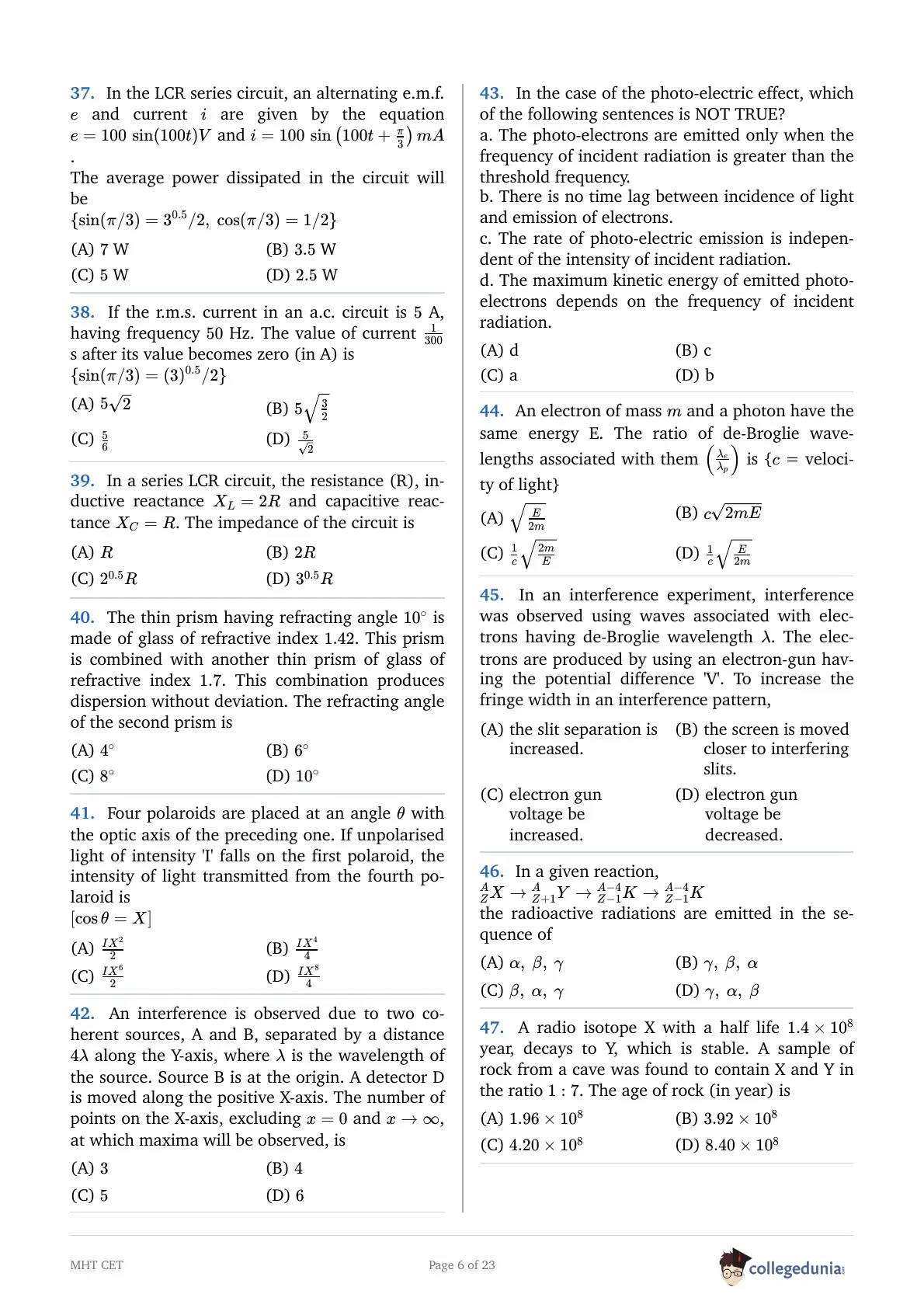
In the LCR series circuit, an alternating e.m.f. \(e\) and current \(i\) are given by the equation \(e=100\,\sin (100t)V\) and \(i=100\,\sin \left(100t+\frac{\pi }{3}\right)mA\).
The average power dissipated in the circuit will be
\(\{\sin (\pi /3)=3^{0.5}/2,\ \cos (\pi /3)=1/2\}\)
If the r.m.s. current in an a.c. circuit is \(5\) A, having frequency \(50\) Hz. The value of current \(\frac{1}{300}\) s after its value becomes zero (in A) is
\(\{\sin (\pi /3)=(3)^{0.5}/2\}\)
In a series LCR circuit, the resistance (R), inductive reactance \(X_{L}=2R\) and capacitive reactance \(X_{C}=R\). The impedance of the circuit is
The thin prism having refracting angle \(10^{\circ }\) is made of glass of refractive index \(1.42\). This prism is combined with another thin prism of glass of refractive index \(1.7\). This combination produces dispersion without deviation. The refracting angle of the second prism is
Four polaroids are placed at an angle \(\theta\) with the optic axis of the preceding one. If unpolarised light of intensity 'I' falls on the first polaroid, the intensity of light transmitted from the fourth polaroid is
\([\cos \theta =X]\)
An interference is observed due to two coherent sources, A and B, separated by a distance \(4\lambda\) along the Y-axis, where \(\lambda\) is the wavelength of the source. Source B is at the origin. A detector D is moved along the positive X-axis. The number of points on the X-axis, excluding \(x=0\) and \(x\rightarrow \infty\), at which maxima will be observed, is
In the case of the photo-electric effect, which of the following sentences is NOT TRUE?
a. The photo-electrons are emitted only when the frequency of incident radiation is greater than the threshold frequency.
b. There is no time lag between incidence of light and emission of electrons.
c. The rate of photo-electric emission is independent of the intensity of incident radiation.
d. The maximum kinetic energy of emitted photo-electrons depends on the frequency of incident radiation.
An electron of mass \(m\) and a photon have the same energy E. The ratio of de-Broglie wavelengths associated with them \(\left(\frac{\lambda _{e}}{\lambda _{p}}\right)\) is {\(c\) = velocity of light}
In an interference experiment, interference was observed using waves associated with electrons having de-Broglie wavelength \(\lambda\). The electrons are produced by using an electron-gun having the potential difference 'V'. To increase the fringe width in an interference pattern,
In a given reaction,
\({}_{Z}^{A}X\rightarrow {}_{Z+1}^{A}Y\rightarrow {}_{Z-1}^{A-4}K\rightarrow {}_{Z-1}^{A-4}K\)
the radioactive radiations are emitted in the sequence of
A radio isotope X with a half life \(1.4\times 10^{8}\) year, decays to Y, which is stable. A sample of rock from a cave was found to contain X and Y in the ratio \(1:7\). The age of rock (in year) is

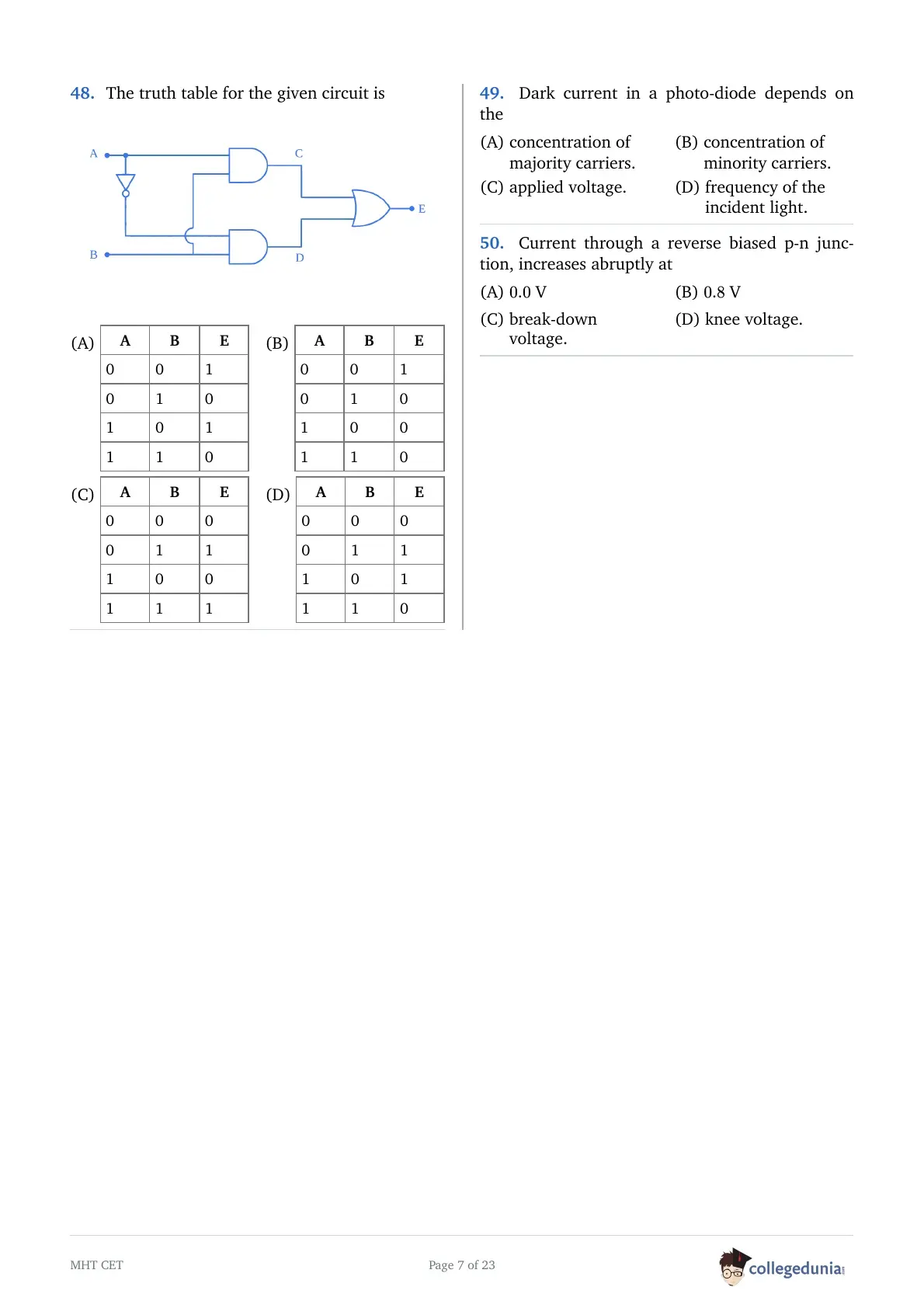
Dark current in a photo-diode depends on the
Current through a reverse biased p-n junction, increases abruptly at
Chemistry (Q51 - Q100)
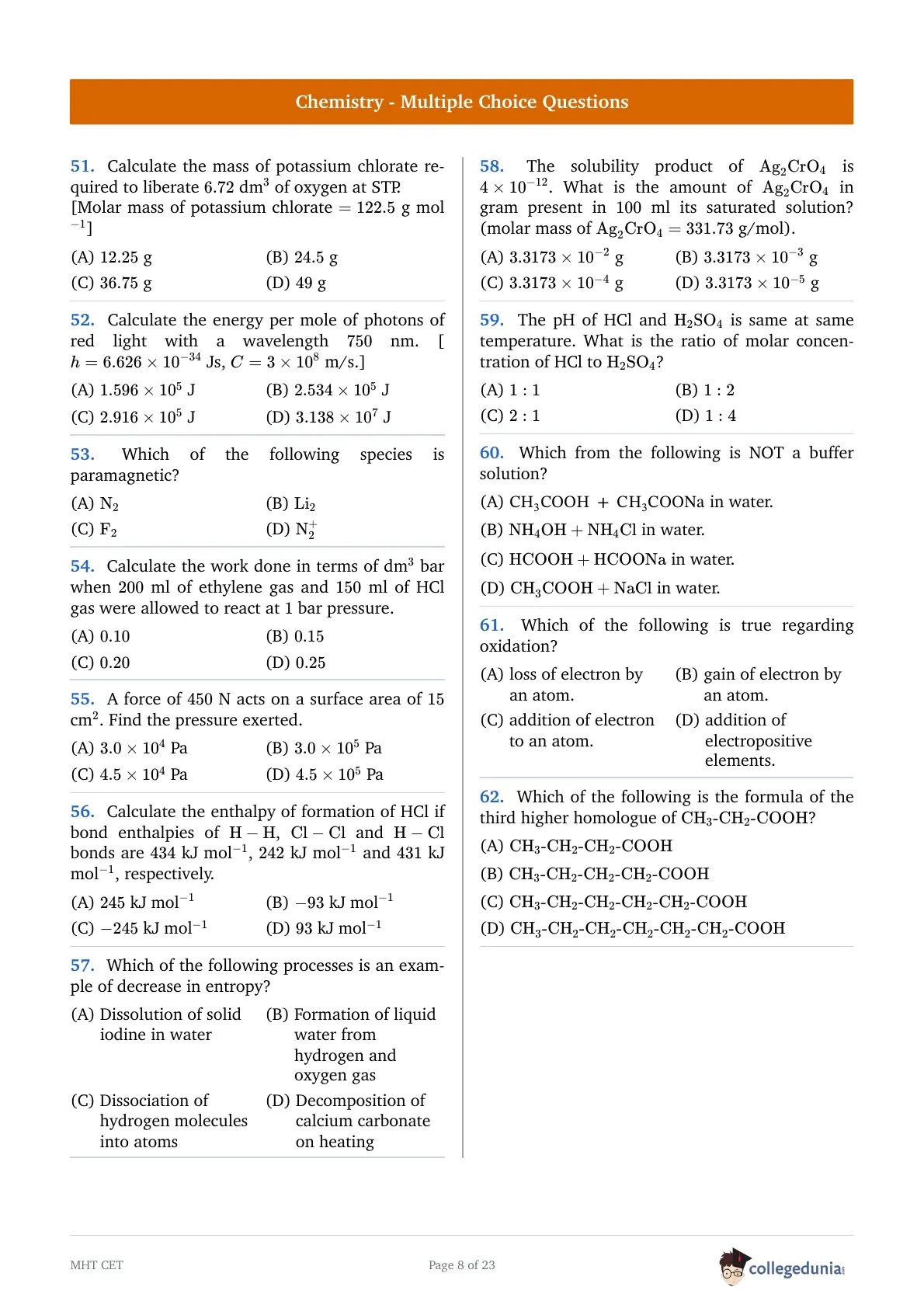
Calculate the mass of potassium chlorate required to liberate \(6.72\) dm\({}^{3}\) of oxygen at STP.
[Molar mass of potassium chlorate \(=122.5\) g mol\({}^{-1}\)]
Calculate the energy per mole of photons of red light with a wavelength \(750\) nm. [\(h=6.626\times 10^{-34}\) Js, \(C=3\times 10^{8}\) m/s.]
Which of the following species is paramagnetic?
Calculate the work done in terms of dm\({}^{3}\) bar when \(200\) ml of ethylene gas and \(150\) ml of HCl gas were allowed to react at \(1\) bar pressure.
A force of \(450\) N acts on a surface area of \(15\) cm\({}^{2}\). Find the pressure exerted.
Calculate the enthalpy of formation of HCl if bond enthalpies of \(\text{H}-\text{H}\), \(\text{Cl}-\text{Cl}\) and \(\text{H}-\text{Cl}\) bonds are \(434\) kJ mol\({}^{-1}\), \(242\) kJ mol\({}^{-1}\) and \(431\) kJ mol\({}^{-1}\), respectively.
Which of the following processes is an example of decrease in entropy?
The solubility product of \(\text{Ag}_{2}\text{CrO}_{4}\) is \(4\times 10^{-12}\). What is the amount of \(\text{Ag}_{2}\text{CrO}_{4}\) in gram present in \(100\) ml its saturated solution? (molar mass of \(\text{Ag}_{2}\text{CrO}_{4}=331.73\) g/mol).
The pH of HCl and \(\text{H}_{2}\text{SO}_{4}\) is same at same temperature. What is the ratio of molar concentration of HCl to \(\text{H}_{2}\text{SO}_{4}\)?
Which from the following is NOT a buffer solution?
Which of the following is true regarding oxidation?
Which of the following is the formula of the third higher homologue of \(\text{CH}_{3}\text{-CH}_{2}\text{-COOH}\)?
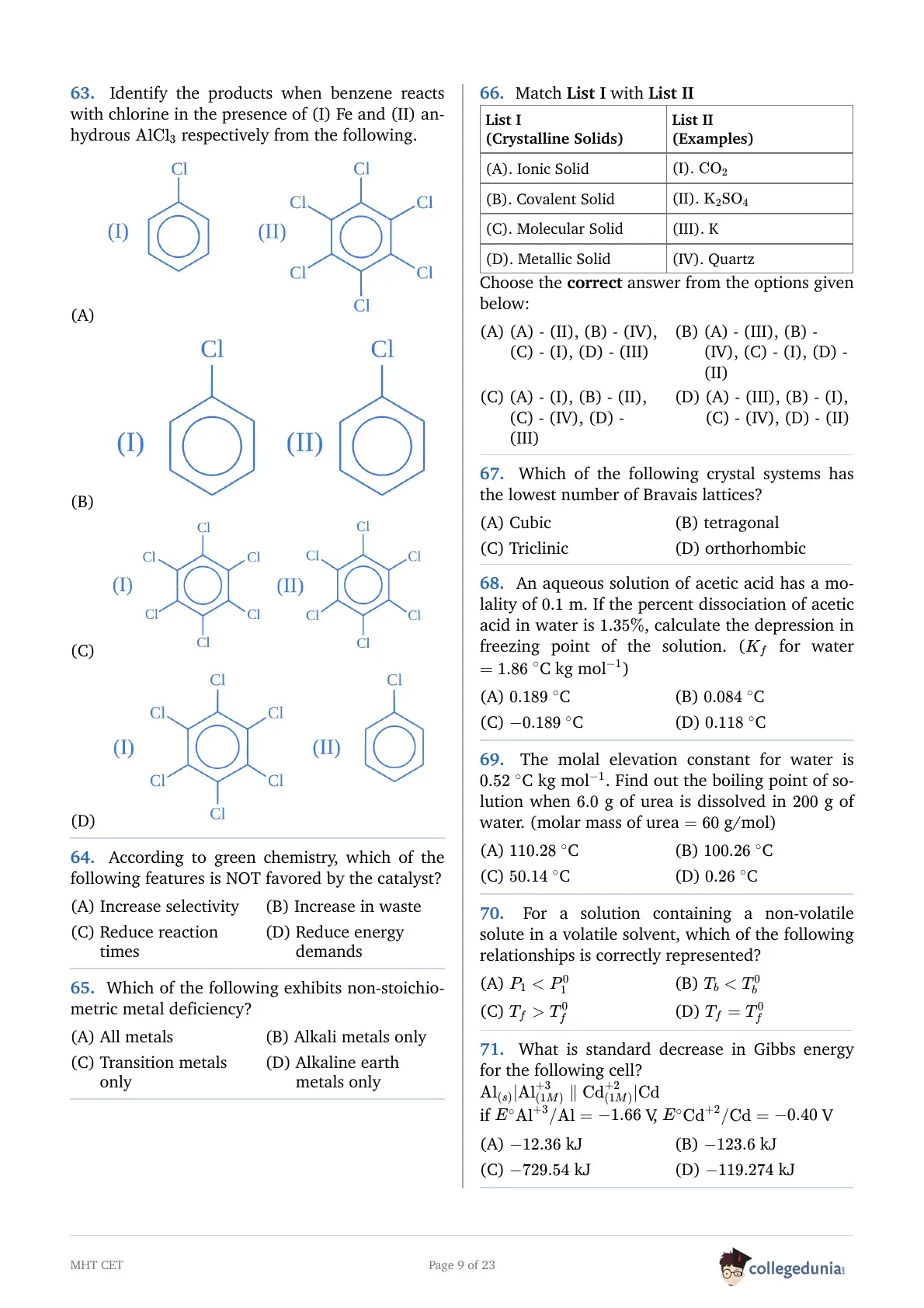
Identify the products when benzene reacts with chlorine in the presence of (I) Fe and (II) anhydrous \(\text{AlCl}_{3}\) respectively from the following.
- (A)
![]()
- (B)
![]()
- (C)
![]()
- (D)
![]()


According to green chemistry, which of the following features is NOT favored by the catalyst?
Which of the following exhibits non-stoichiometric metal deficiency?
Match List I with List II
| List I (Crystalline Solids) | List II (Examples) |
|---|---|
| (A). Ionic Solid | (I). \(\text{CO}_{2}\) |
| (B). Covalent Solid | (II). \(\text{K}_{2}\text{SO}_{4}\) |
| (C). Molecular Solid | (III). K |
| (D). Metallic Solid | (IV). Quartz |
Which of the following crystal systems has the lowest number of Bravais lattices?
An aqueous solution of acetic acid has a molality of \(0.1\) m. If the percent dissociation of acetic acid in water is \(1.35\%\), calculate the depression in freezing point of the solution. (\(K_{f}\) for water \(=1.86\) \({}^{\circ }\)C kg mol\({}^{-1}\))
The molal elevation constant for water is \(0.52\) \({}^{\circ }\)C kg mol\({}^{-1}\). Find out the boiling point of solution when \(6.0\) g of urea is dissolved in \(200\) g of water. (molar mass of urea \(=60\) g/mol)
For a solution containing a non-volatile solute in a volatile solvent, which of the following relationships is correctly represented?
What is standard decrease in Gibbs energy for the following cell?
\(\text{Al}_{(s)}|\text{Al}_{(1M)}^{+3}\parallel \text{Cd}_{(1M)}^{+2}|\text{Cd}\)
if \(E^{\circ }\text{Al}^{+3}/\text{Al}=-1.66\) V, \(E^{\circ }\text{Cd}^{+2}/\text{Cd}=-0.40\) V
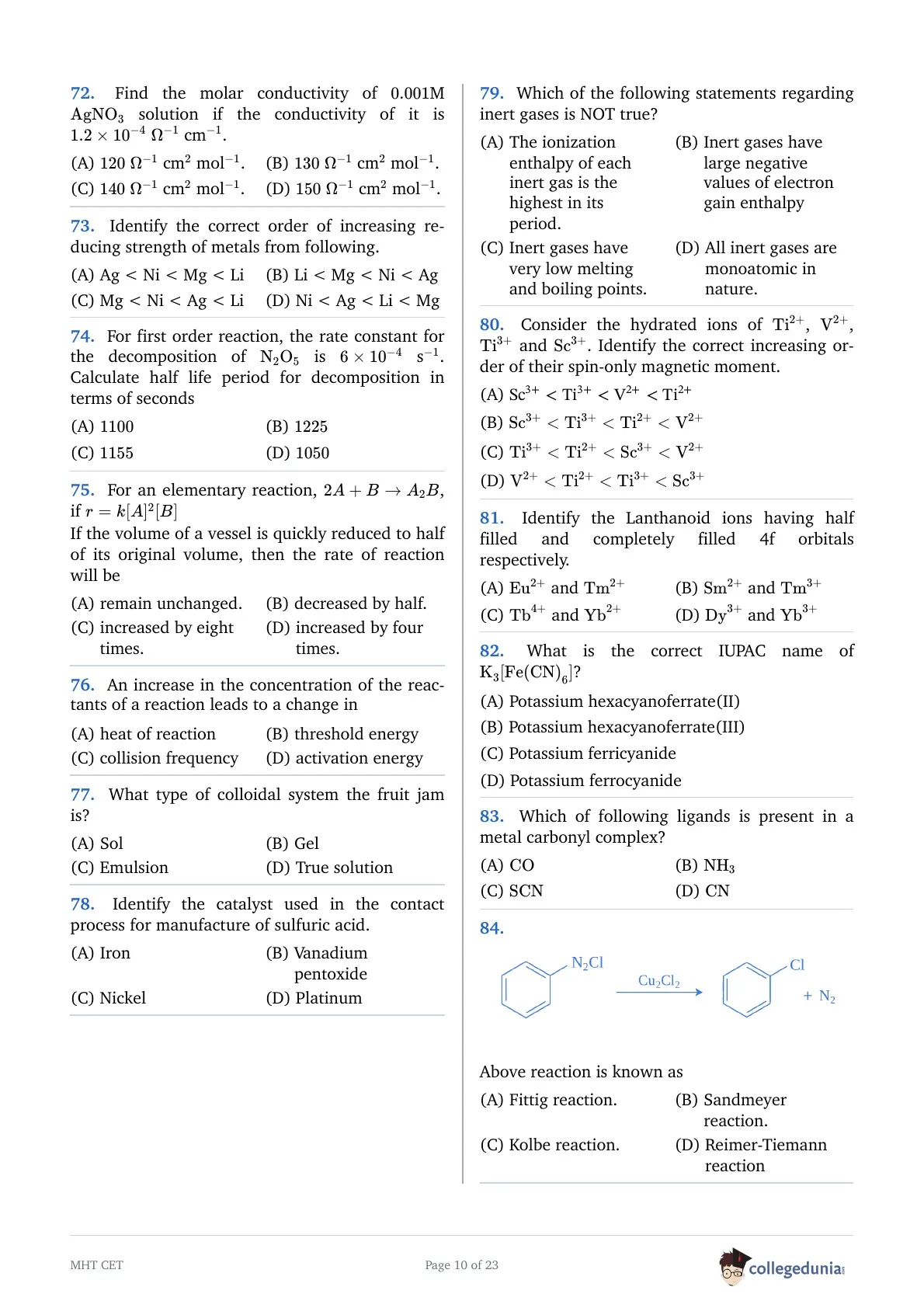
Find the molar conductivity of \(0.001\)M \(\text{AgNO}_{3}\) solution if the conductivity of it is \(1.2\times 10^{-4}\) \(\Omega ^{-1}\) cm\({}^{-1}\).
Identify the correct order of increasing reducing strength of metals from following.
For first order reaction, the rate constant for the decomposition of \(\text{N}_{2}\text{O}_{5}\) is \(6\times 10^{-4}\) s\({}^{-1}\). Calculate half life period for decomposition in terms of seconds
For an elementary reaction, \(2A+B\rightarrow A_{2}B\), if \(r=k[A]^{2}[B]\)
If the volume of a vessel is quickly reduced to half of its original volume, then the rate of reaction will be
An increase in the concentration of the reactants of a reaction leads to a change in
What type of colloidal system the fruit jam is?
Identify the catalyst used in the contact process for manufacture of sulfuric acid.
Which of the following statements regarding inert gases is NOT true?
Consider the hydrated ions of \(\text{Ti}^{2+}\), \(\text{V}^{2+}\), \(\text{Ti}^{3+}\) and \(\text{Sc}^{3+}\). Identify the correct increasing order of their spin-only magnetic moment.
Identify the Lanthanoid ions having half filled and completely filled 4f orbitals respectively.
What is the correct IUPAC name of \(\text{K}_{3}[\text{Fe(CN)}_{6}]\)?
Which of following ligands is present in a metal carbonyl complex?

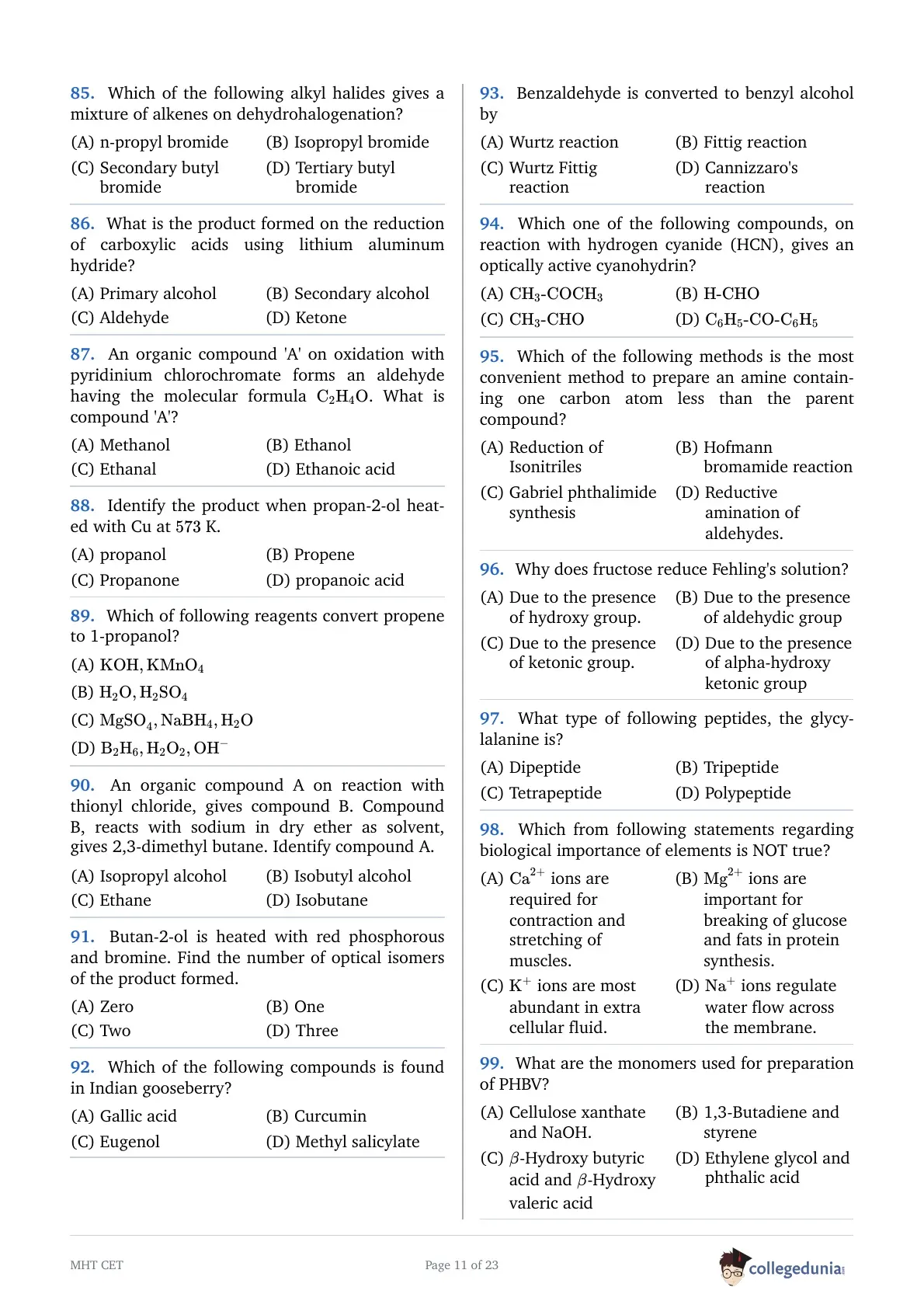
Which of the following alkyl halides gives a mixture of alkenes on dehydrohalogenation?
What is the product formed on the reduction of carboxylic acids using lithium aluminum hydride?
An organic compound 'A' on oxidation with pyridinium chlorochromate forms an aldehyde having the molecular formula \(\text{C}_{2}\text{H}_{4}\text{O}\). What is compound 'A'?
Identify the product when propan-2-ol heated with Cu at \(573\) K.
Which of following reagents convert propene to 1-propanol?
An organic compound A on reaction with thionyl chloride, gives compound B. Compound B, reacts with sodium in dry ether as solvent, gives 2,3-dimethyl butane. Identify compound A.
Butan-2-ol is heated with red phosphorous and bromine. Find the number of optical isomers of the product formed.
Which of the following compounds is found in Indian gooseberry?
Benzaldehyde is converted to benzyl alcohol by
Which one of the following compounds, on reaction with hydrogen cyanide (HCN), gives an optically active cyanohydrin?
Which of the following methods is the most convenient method to prepare an amine containing one carbon atom less than the parent compound?
Why does fructose reduce Fehling's solution?
What type of following peptides, the glycylalanine is?
Which from following statements regarding biological importance of elements is NOT true?
What are the monomers used for preparation of PHBV?
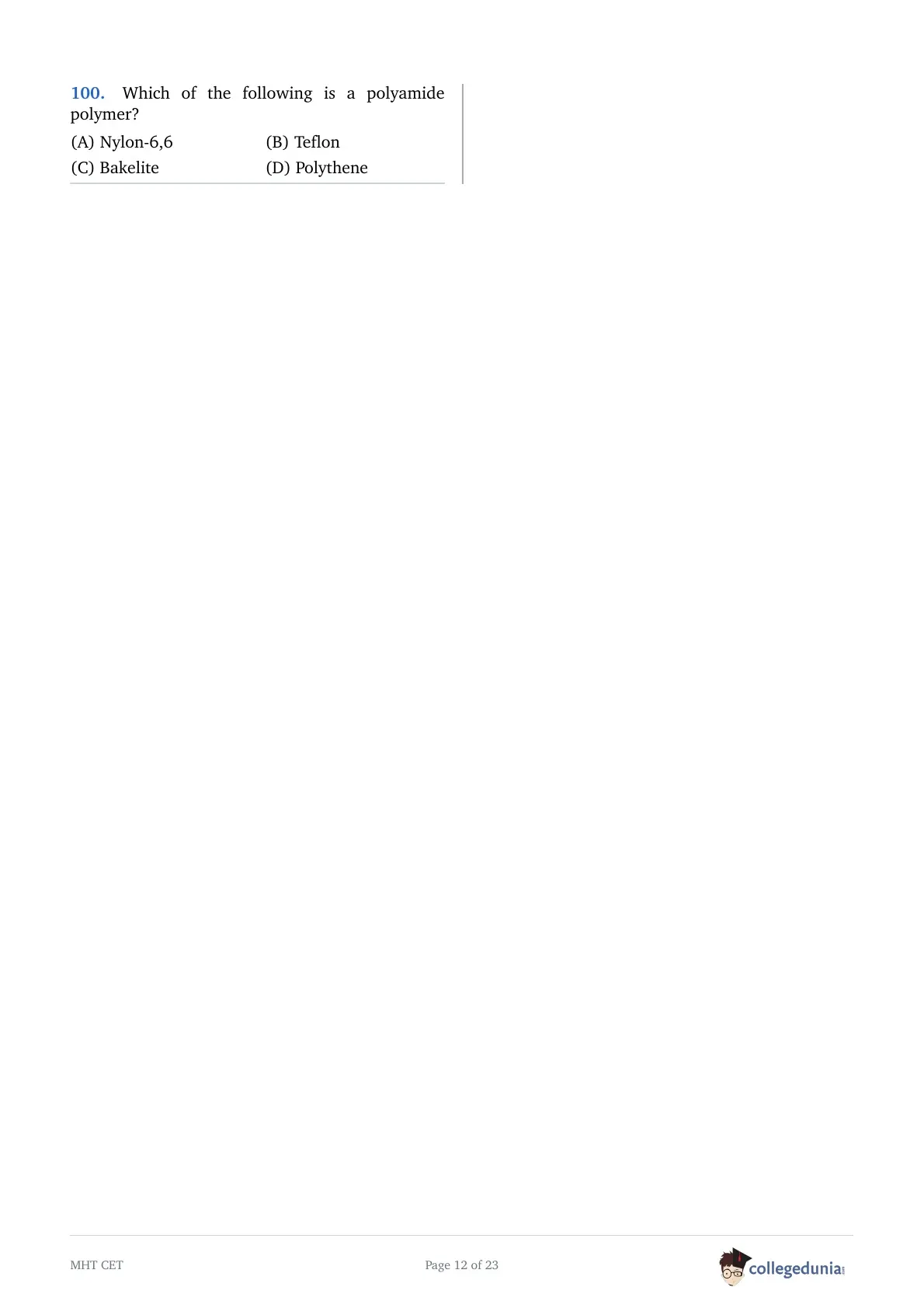
Which of the following is a polyamide polymer?
Biology (Q101 - Q200)
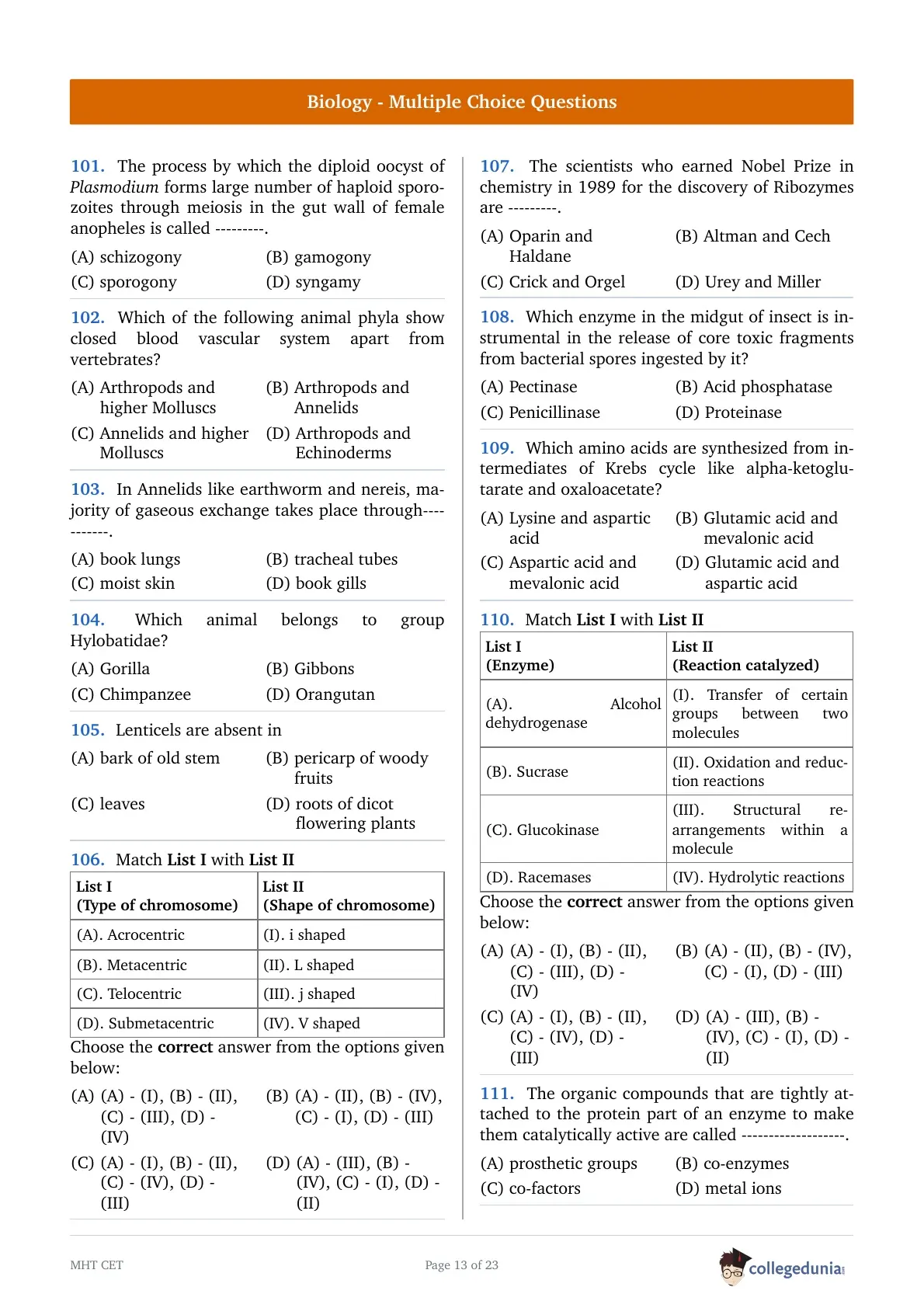
The process by which the diploid oocyst of Plasmodium forms large number of haploid sporozoites through meiosis in the gut wall of female anopheles is called ---------.
Which of the following animal phyla show closed blood vascular system apart from vertebrates?
In Annelids like earthworm and nereis, majority of gaseous exchange takes place through-----------.
Which animal belongs to group Hylobatidae?
Lenticels are absent in
Match List I with List II
| List I (Type of chromosome) | List II (Shape of chromosome) |
|---|---|
| (A). Acrocentric | (I). i shaped |
| (B). Metacentric | (II). L shaped |
| (C). Telocentric | (III). j shaped |
| (D). Submetacentric | (IV). V shaped |
The scientists who earned Nobel Prize in chemistry in 1989 for the discovery of Ribozymes are ---------.
Which enzyme in the midgut of insect is instrumental in the release of core toxic fragments from bacterial spores ingested by it?
Which amino acids are synthesized from intermediates of Krebs cycle like alpha-ketoglutarate and oxaloacetate?
Match List I with List II
| List I (Enzyme) | List II (Reaction catalyzed) |
|---|---|
| (A). Alcohol dehydrogenase | (I). Transfer of certain groups between two molecules |
| (B). Sucrase | (II). Oxidation and reduction reactions |
| (C). Glucokinase | (III). Structural rearrangements within a molecule |
| (D). Racemases | (IV). Hydrolytic reactions |
The organic compounds that are tightly attached to the protein part of an enzyme to make them catalytically active are called -------------------.
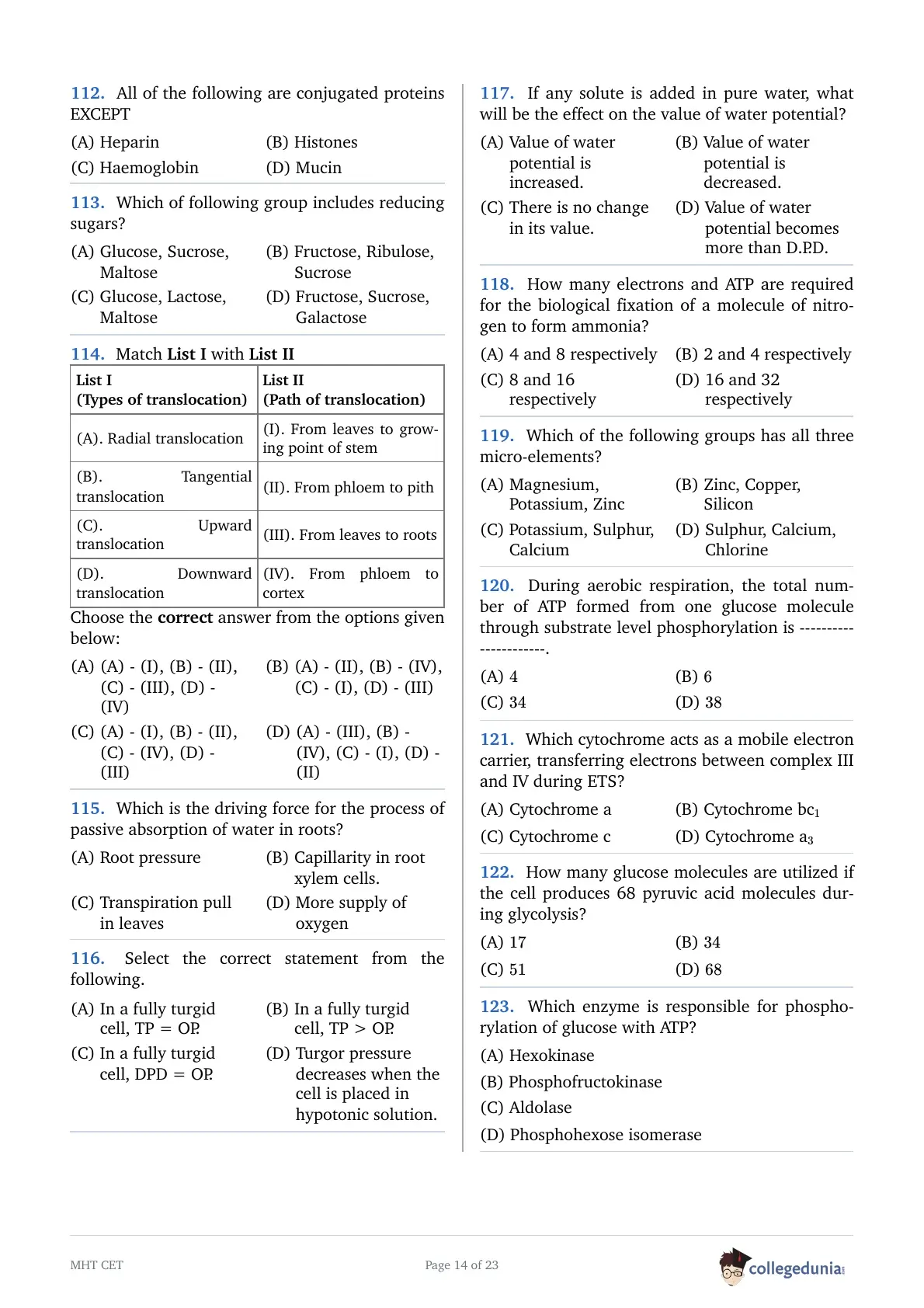
All of the following are conjugated proteins EXCEPT
Which of following group includes reducing sugars?
Match List I with List II
| List I (Types of translocation) | List II (Path of translocation) |
|---|---|
| (A). Radial translocation | (I). From leaves to growing point of stem |
| (B). Tangential translocation | (II). From phloem to pith |
| (C). Upward translocation | (III). From leaves to roots |
| (D). Downward translocation | (IV). From phloem to cortex |
Which is the driving force for the process of passive absorption of water in roots?
Select the correct statement from the following.
If any solute is added in pure water, what will be the effect on the value of water potential?
How many electrons and ATP are required for the biological fixation of a molecule of nitrogen to form ammonia?
Which of the following groups has all three micro-elements?
During aerobic respiration, the total number of ATP formed from one glucose molecule through substrate level phosphorylation is ----------------------.
Which cytochrome acts as a mobile electron carrier, transferring electrons between complex III and IV during ETS?
How many glucose molecules are utilized if the cell produces 68 pyruvic acid molecules during glycolysis?
Which enzyme is responsible for phosphorylation of glucose with ATP?
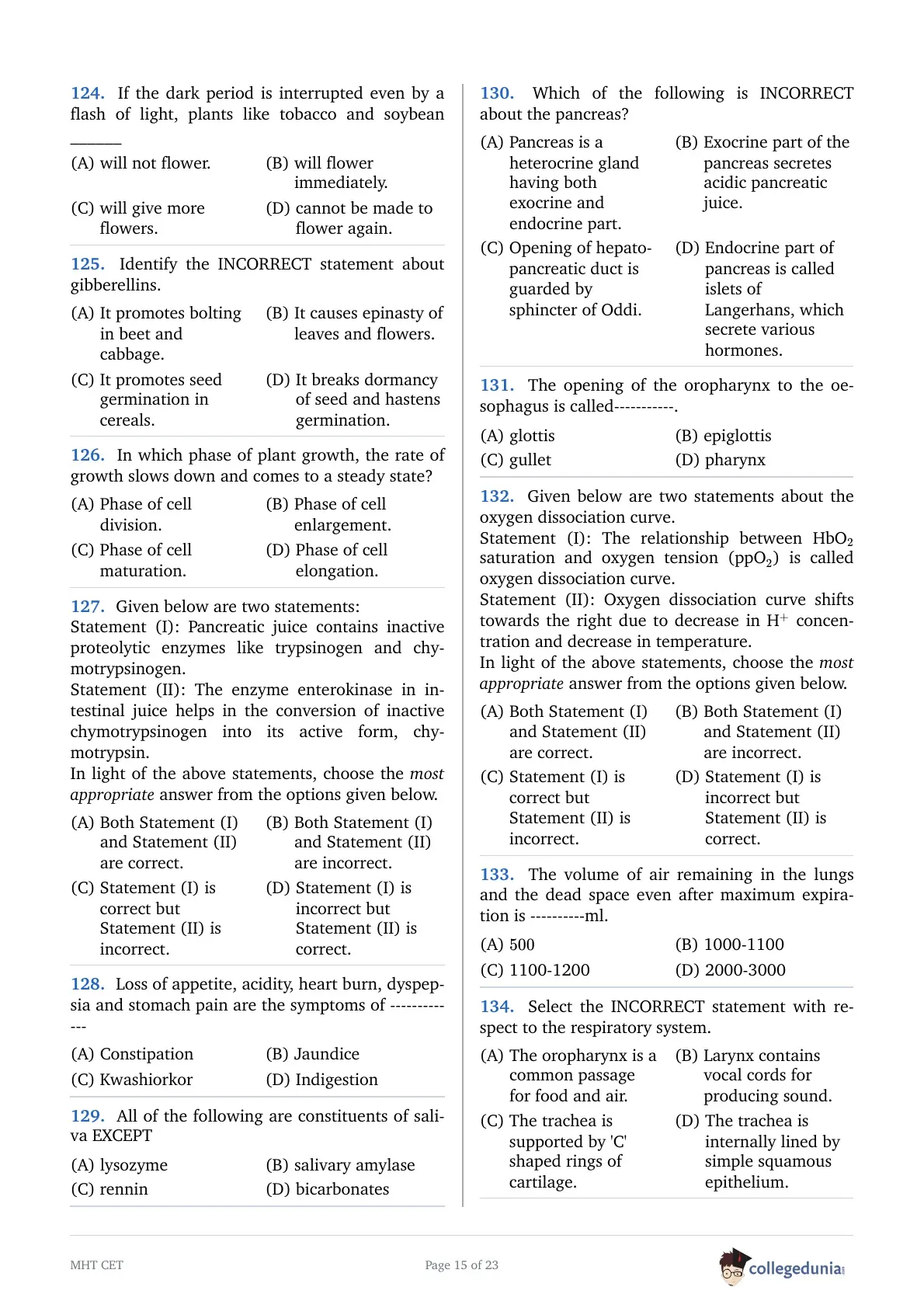
If the dark period is interrupted even by a flash of light, plants like tobacco and soybean ______
Identify the INCORRECT statement about gibberellins.
In which phase of plant growth, the rate of growth slows down and comes to a steady state?
Given below are two statements:
Statement (I): Pancreatic juice contains inactive proteolytic enzymes like trypsinogen and chymotrypsinogen.
Statement (II): The enzyme enterokinase in intestinal juice helps in the conversion of inactive chymotrypsinogen into its active form, chymotrypsin.
In light of the above statements, choose the most appropriate answer from the options given below.
Loss of appetite, acidity, heart burn, dyspepsia and stomach pain are the symptoms of -------------
All of the following are constituents of saliva EXCEPT
Which of the following is INCORRECT about the pancreas?
The opening of the oropharynx to the oesophagus is called-----------.
Given below are two statements about the oxygen dissociation curve.
Statement (I): The relationship between HbO\({}_{2}\) saturation and oxygen tension (ppO\({}_{2}\)) is called oxygen dissociation curve.
Statement (II): Oxygen dissociation curve shifts towards the right due to decrease in H\({}^{+}\) concentration and decrease in temperature.
In light of the above statements, choose the most appropriate answer from the options given below.
The volume of air remaining in the lungs and the dead space even after maximum expiration is ----------ml.
Select the INCORRECT statement with respect to the respiratory system.
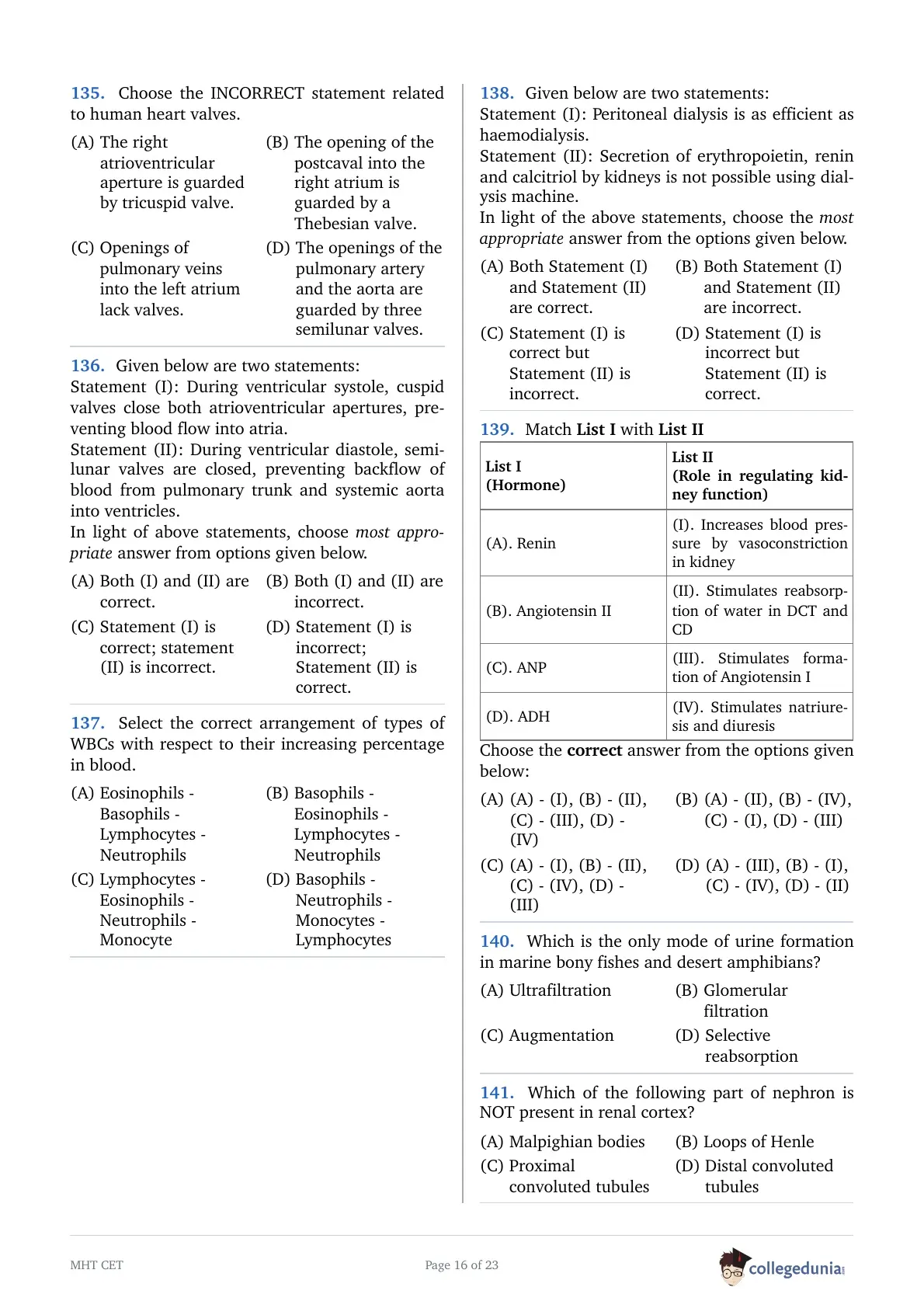
Choose the INCORRECT statement related to human heart valves.
Given below are two statements:
Statement (I): During ventricular systole, cuspid valves close both atrioventricular apertures, preventing blood flow into atria.
Statement (II): During ventricular diastole, semilunar valves are closed, preventing backflow of blood from pulmonary trunk and systemic aorta into ventricles.
In light of above statements, choose most appropriate answer from options given below.
Select the correct arrangement of types of WBCs with respect to their increasing percentage in blood.
Given below are two statements:
Statement (I): Peritoneal dialysis is as efficient as haemodialysis.
Statement (II): Secretion of erythropoietin, renin and calcitriol by kidneys is not possible using dialysis machine.
In light of the above statements, choose the most appropriate answer from the options given below.
Match List I with List II
| List I (Hormone) | List II (Role in regulating kidney function) |
|---|---|
| (A). Renin | (I). Increases blood pressure by vasoconstriction in kidney |
| (B). Angiotensin II | (II). Stimulates reabsorption of water in DCT and CD |
| (C). ANP | (III). Stimulates formation of Angiotensin I |
| (D). ADH | (IV). Stimulates natriuresis and diuresis |
Which is the only mode of urine formation in marine bony fishes and desert amphibians?
Which of the following part of nephron is NOT present in renal cortex?
Given below are two statements:
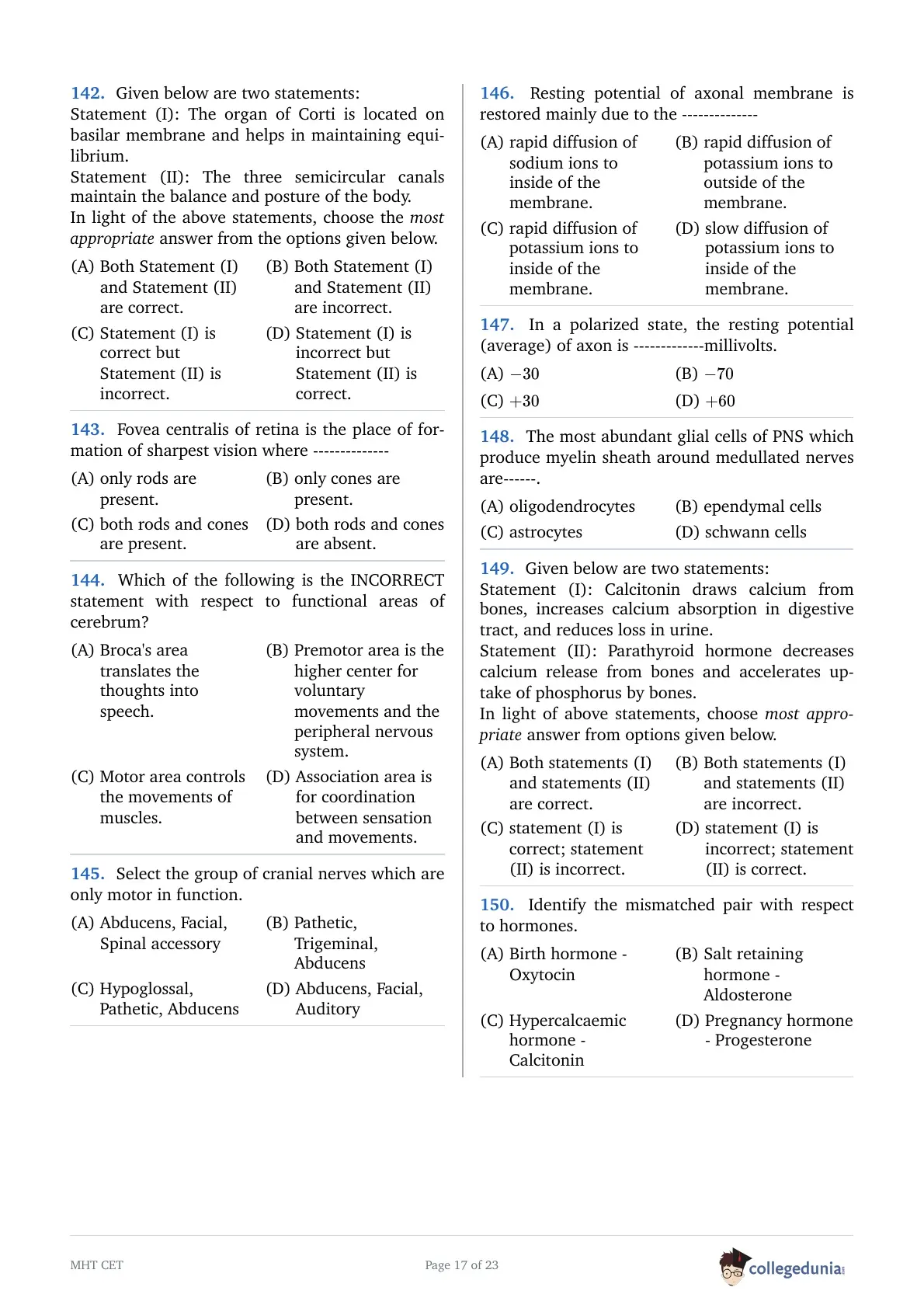
Statement (I): The organ of Corti is located on basilar membrane and helps in maintaining equilibrium.
Statement (II): The three semicircular canals maintain the balance and posture of the body.
In light of the above statements, choose the most appropriate answer from the options given below.
Fovea centralis of retina is the place of formation of sharpest vision where --------------
Which of the following is the INCORRECT statement with respect to functional areas of cerebrum?
Select the group of cranial nerves which are only motor in function.
Resting potential of axonal membrane is restored mainly due to the --------------
In a polarized state, the resting potential (average) of axon is -------------millivolts.
The most abundant glial cells of PNS which produce myelin sheath around medullated nerves are------.
Given below are two statements:
Statement (I): Calcitonin draws calcium from bones, increases calcium absorption in digestive tract, and reduces loss in urine.
Statement (II): Parathyroid hormone decreases calcium release from bones and accelerates uptake of phosphorus by bones.
In light of above statements, choose most appropriate answer from options given below.
Identify the mismatched pair with respect to hormones.
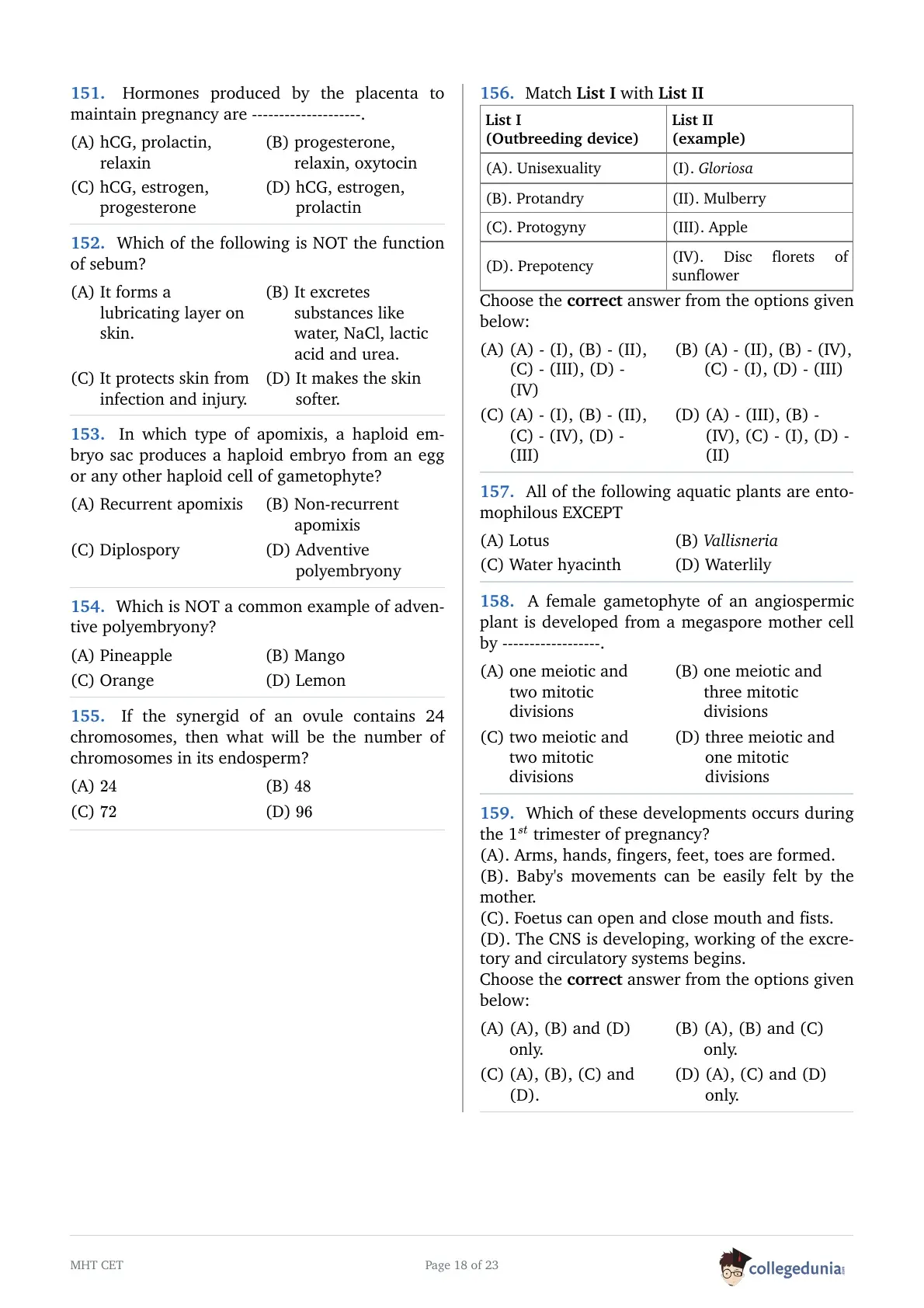
Hormones produced by the placenta to maintain pregnancy are --------------------.
Which of the following is NOT the function of sebum?
In which type of apomixis, a haploid embryo sac produces a haploid embryo from an egg or any other haploid cell of gametophyte?
Which is NOT a common example of adventive polyembryony?
If the synergid of an ovule contains 24 chromosomes, then what will be the number of chromosomes in its endosperm?
Match List I with List II
| List I (Outbreeding device) | List II (example) |
|---|---|
| (A). Unisexuality | (I). Gloriosa |
| (B). Protandry | (II). Mulberry |
| (C). Protogyny | (III). Apple |
| (D). Prepotency | (IV). Disc florets of sunflower |
All of the following aquatic plants are entomophilous EXCEPT
A female gametophyte of an angiospermic plant is developed from a megaspore mother cell by ------------------.
Which of these developments occurs during the 1\({}^{st}\) trimester of pregnancy?
(A). Arms, hands, fingers, feet, toes are formed.
(B). Baby's movements can be easily felt by the mother.
(C). Foetus can open and close mouth and fists.
(D). The CNS is developing, working of the excretory and circulatory systems begins.
Choose the correct answer from the options given below:
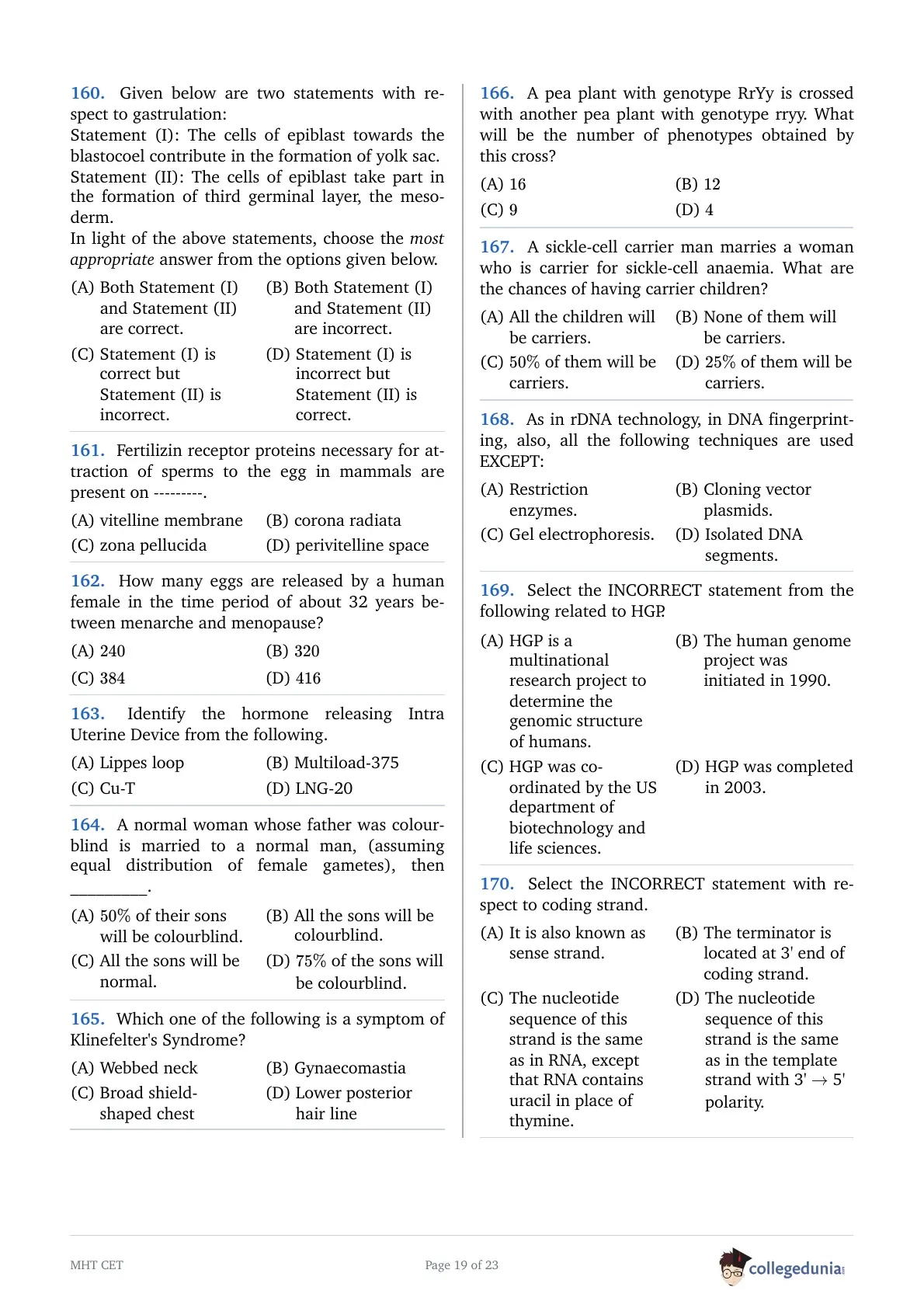
Given below are two statements with respect to gastrulation:
Statement (I): The cells of epiblast towards the blastocoel contribute in the formation of yolk sac.
Statement (II): The cells of epiblast take part in the formation of third germinal layer, the mesoderm.
In light of the above statements, choose the most appropriate answer from the options given below.
Fertilizin receptor proteins necessary for attraction of sperms to the egg in mammals are present on ---------.
How many eggs are released by a human female in the time period of about 32 years between menarche and menopause?
Identify the hormone releasing Intra Uterine Device from the following.
A normal woman whose father was colourblind is married to a normal man, (assuming equal distribution of female gametes), then _________.
Which one of the following is a symptom of Klinefelter's Syndrome?
A pea plant with genotype RrYy is crossed with another pea plant with genotype rryy. What will be the number of phenotypes obtained by this cross?
A sickle-cell carrier man marries a woman who is carrier for sickle-cell anaemia. What are the chances of having carrier children?
As in rDNA technology, in DNA fingerprinting, also, all the following techniques are used EXCEPT:
Select the INCORRECT statement from the following related to HGP.
Select the INCORRECT statement with respect to coding strand.
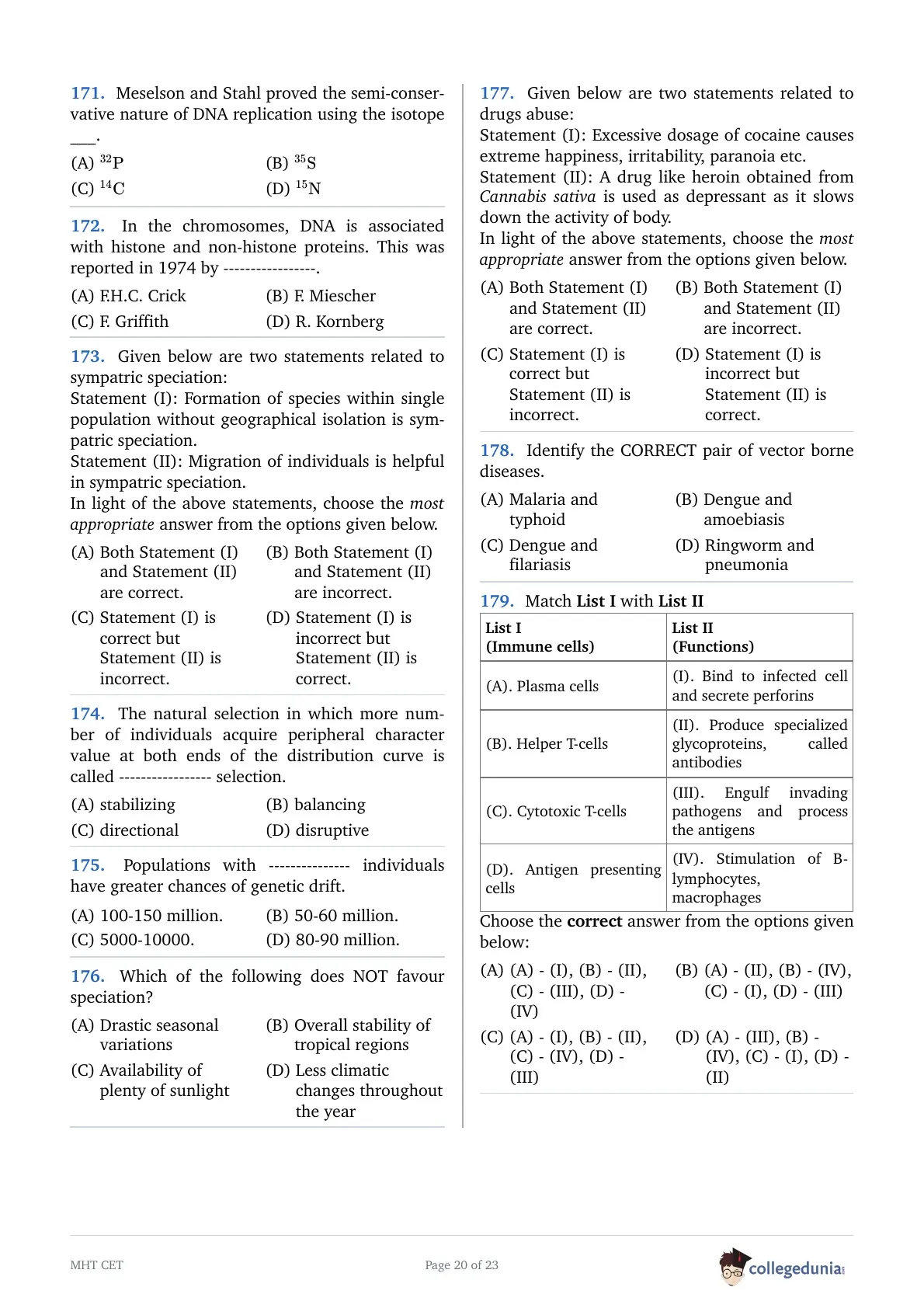
Meselson and Stahl proved the semi-conservative nature of DNA replication using the isotope ___.
In the chromosomes, DNA is associated with histone and non-histone proteins. This was reported in 1974 by -----------------.
Given below are two statements related to sympatric speciation:
Statement (I): Formation of species within single population without geographical isolation is sympatric speciation.
Statement (II): Migration of individuals is helpful in sympatric speciation.
In light of the above statements, choose the most appropriate answer from the options given below.
The natural selection in which more number of individuals acquire peripheral character value at both ends of the distribution curve is called ----------------- selection.
Populations with --------------- individuals have greater chances of genetic drift.
Which of the following does NOT favour speciation?
Given below are two statements related to drugs abuse:
Statement (I): Excessive dosage of cocaine causes extreme happiness, irritability, paranoia etc.
Statement (II): A drug like heroin obtained from Cannabis sativa is used as depressant as it slows down the activity of body.
In light of the above statements, choose the most appropriate answer from the options given below.
Identify the CORRECT pair of vector borne diseases.
Match List I with List II
| List I (Immune cells) | List II (Functions) |
|---|---|
| (A). Plasma cells | (I). Bind to infected cell and secrete perforins |
| (B). Helper T-cells | (II). Produce specialized glycoproteins, called antibodies |
| (C). Cytotoxic T-cells | (III). Engulf invading pathogens and process the antigens |
| (D). Antigen presenting cells | (IV). Stimulation of B-lymphocytes, macrophages |
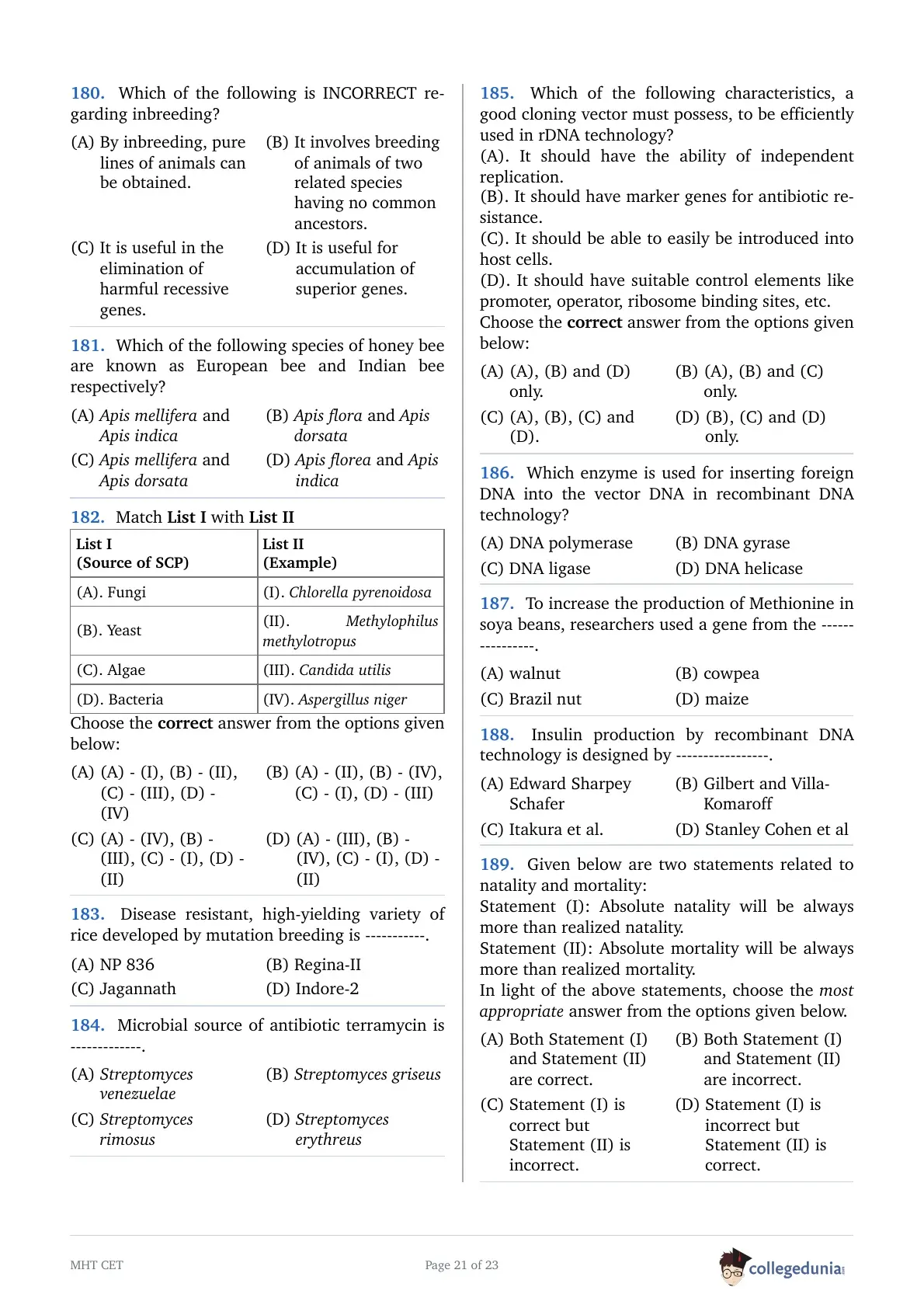
Which of the following is INCORRECT regarding inbreeding?
Which of the following species of honey bee are known as European bee and Indian bee respectively?
Match List I with List II
| List I (Source of SCP) | List II (Example) |
|---|---|
| (A). Fungi | (I). Chlorella pyrenoidosa |
| (B). Yeast | (II). Methylophilus methylotropus |
| (C). Algae | (III). Candida utilis |
| (D). Bacteria | (IV). Aspergillus niger |
Disease resistant, high-yielding variety of rice developed by mutation breeding is -----------.
Microbial source of antibiotic terramycin is -------------.
Which of the following characteristics, a good cloning vector must possess, to be efficiently used in rDNA technology?
(A). It should have the ability of independent replication.
(B). It should have marker genes for antibiotic resistance.
(C). It should be able to easily be introduced into host cells.
(D). It should have suitable control elements like promoter, operator, ribosome binding sites, etc.
Choose the correct answer from the options given below:
Which enzyme is used for inserting foreign DNA into the vector DNA in recombinant DNA technology?
To increase the production of Methionine in soya beans, researchers used a gene from the ----------------.
Insulin production by recombinant DNA technology is designed by -----------------.
Given below are two statements related to natality and mortality:
Statement (I): Absolute natality will be always more than realized natality.
Statement (II): Absolute mortality will be always more than realized mortality.
In light of the above statements, choose the most appropriate answer from the options given below.
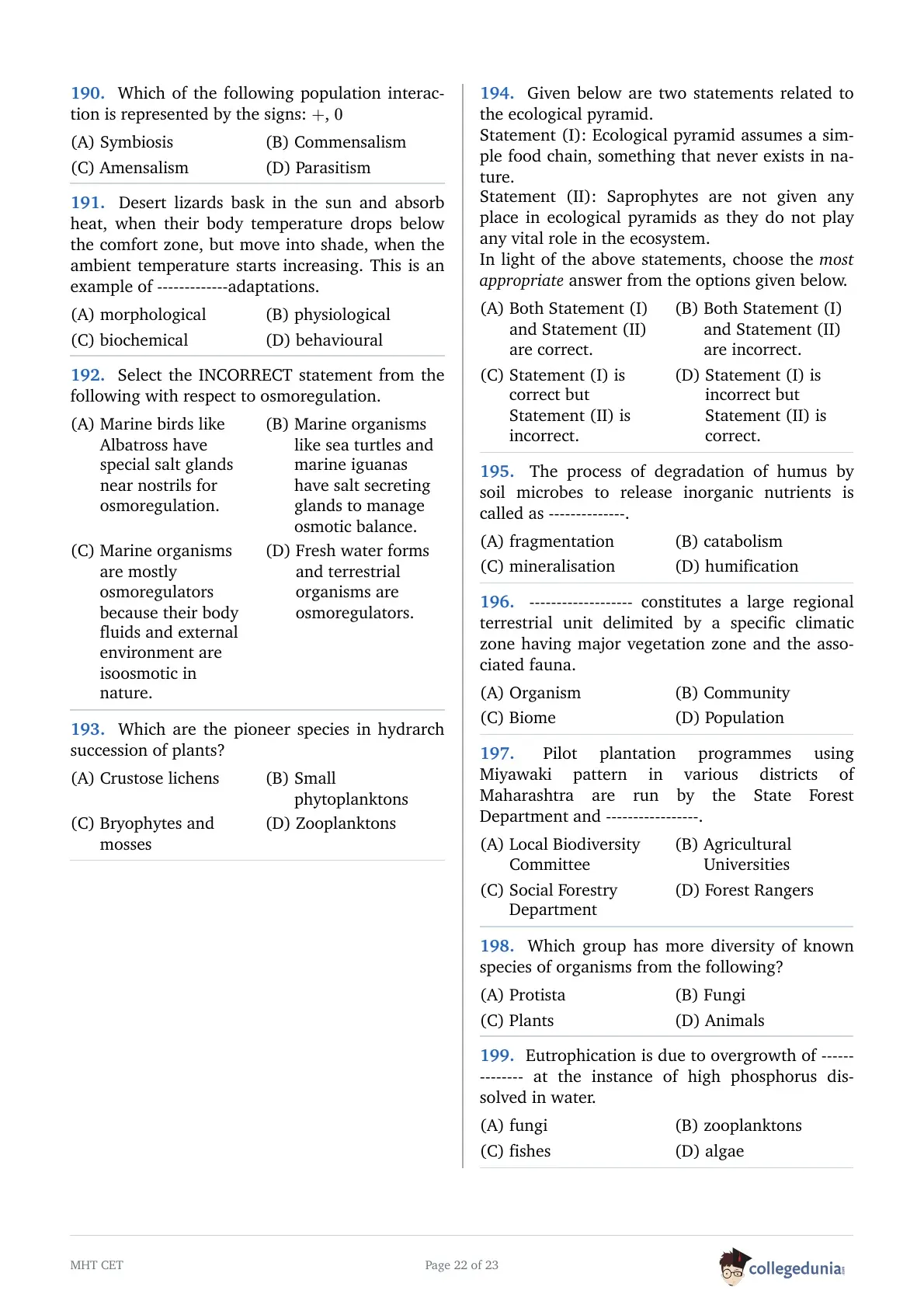
Which of the following population interaction is represented by the signs: \(+\), \(0\)
Desert lizards bask in the sun and absorb heat, when their body temperature drops below the comfort zone, but move into shade, when the ambient temperature starts increasing. This is an example of -------------adaptations.
Select the INCORRECT statement from the following with respect to osmoregulation.
Which are the pioneer species in hydrarch succession of plants?
Given below are two statements related to the ecological pyramid.
Statement (I): Ecological pyramid assumes a simple food chain, something that never exists in nature.
Statement (II): Saprophytes are not given any place in ecological pyramids as they do not play any vital role in the ecosystem.
In light of the above statements, choose the most appropriate answer from the options given below.
The process of degradation of humus by soil microbes to release inorganic nutrients is called as --------------.
------------------- constitutes a large regional terrestrial unit delimited by a specific climatic zone having major vegetation zone and the associated fauna.
Pilot plantation programmes using Miyawaki pattern in various districts of Maharashtra are run by the State Forest Department and -----------------.
Which group has more diversity of known species of organisms from the following?
Eutrophication is due to overgrowth of -------------- at the instance of high phosphorus dissolved in water.
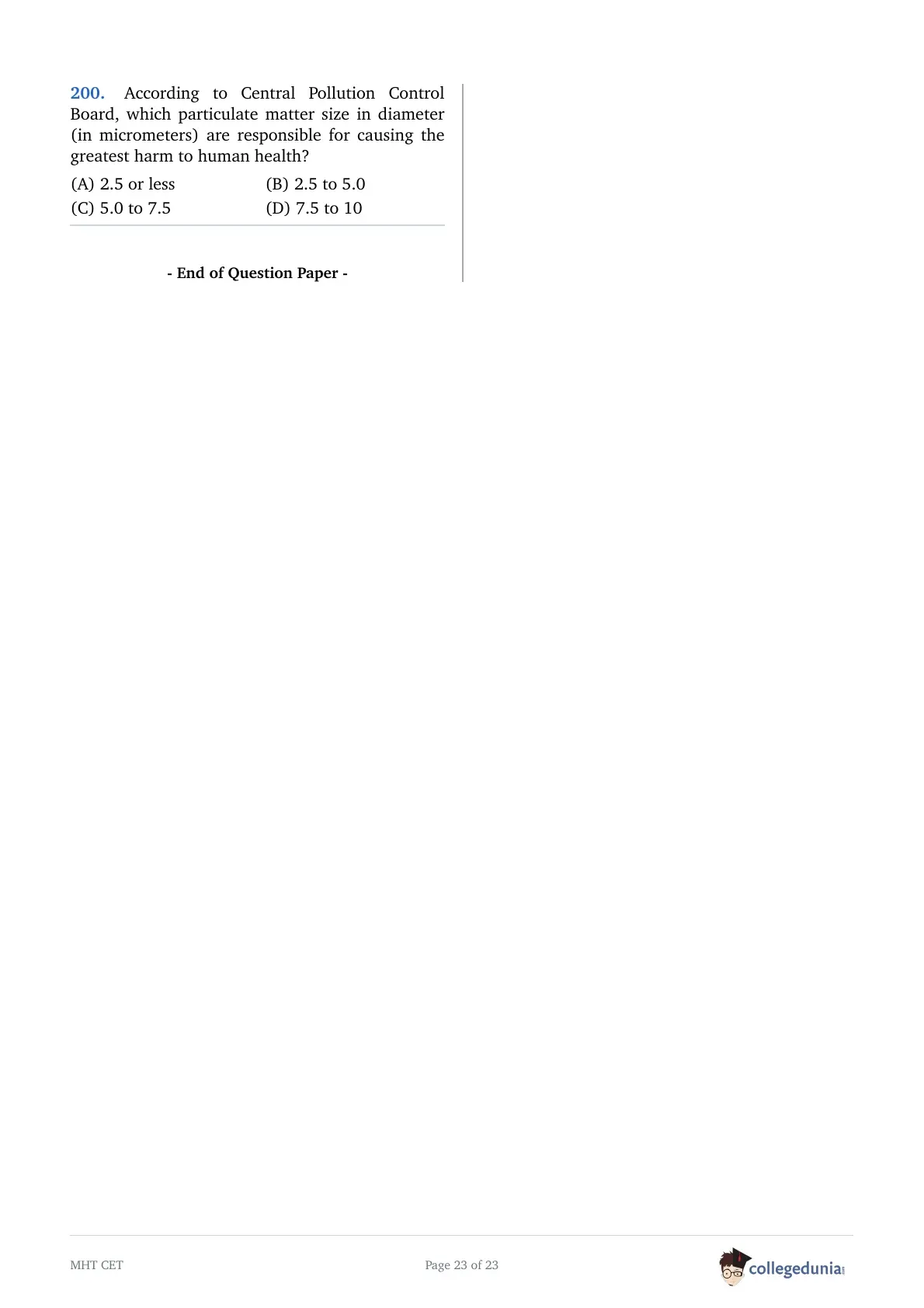
According to Central Pollution Control Board, which particulate matter size in diameter (in micrometers) are responsible for causing the greatest harm to human health?
MHT CET 2026 PCB Exam Pattern and Marking Scheme
| Parameter | Details |
|---|---|
| Conducting Body | Maharashtra Common Entrance Test Cell (Maharashtra CET Cell) |
| Exam Mode | Online (Computer-Based Test) |
| Duration | 180 minutes (3 hours) |
| Groups / Subjects | PCB (Physics, Chemistry, Biology) for Pharmacy and Agriculture |
| Total Questions |
200 |
| Total Marks | 200 |
| Question Type | Multiple Choice Questions (MCQs) |
| Marking Scheme | 1 mark for each correct answer |
| Negative Marking | No |
| Syllabus Weightage |
|



Comments