




MHT CET 2026 April 23 Shift 2 PCB Question Paper is available for download here. Maharashtra State CET Cell conducted MHT CET 2026 PCB Exam on April 23 in Shift 2 from 2 PM to 5 PM in CBT mode.
The MHT CET 2026 PCB question paper includes the following:
- The MHT CET 2026 PCB Question Paper consists of 200 multiple-choice questions (MCQs) totalling 200 marks divided into 3 sections: Physics (50 questions), Chemistry (50 questions), and Biology (100 questions).
- All questions carry 1 mark each. There is no negative marking for incorrect answers.
MHT CET 2026 April 23 Shift 2 PCB Question Paper with Solution PDF
| CD PDF | CD PDF with Solutions |
|---|---|
| Download Collegedunia PDF 1.34 MB | - |
Also Check:
MHT CET 2026 April 23 Shift 2 PCB Questions with Solutions
Physics (Q1 - Q50)
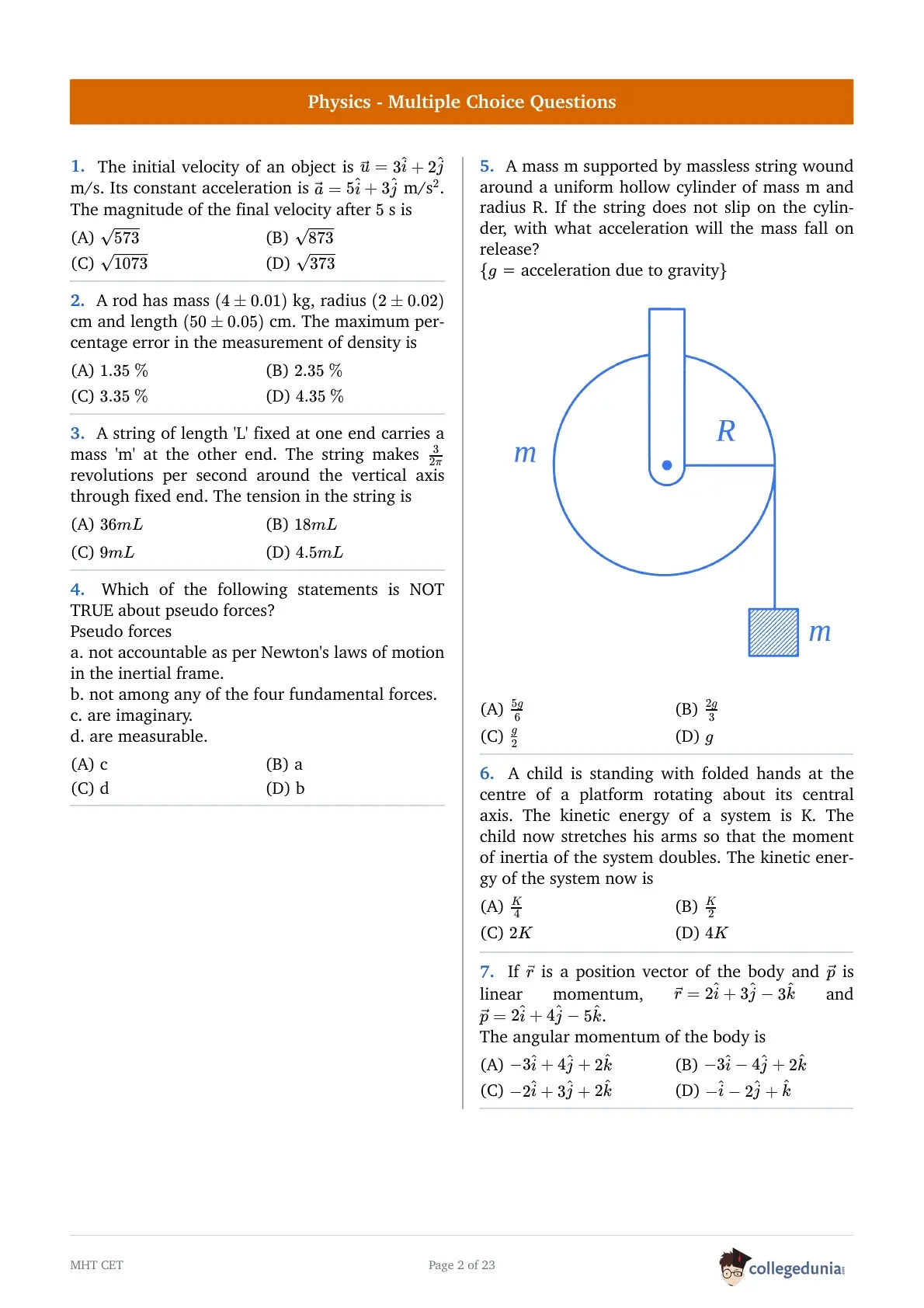
The initial velocity of an object is \(\vec{u}=3\hat{i}+2\hat{j}\) m/s. Its constant acceleration is \(\vec{a}=5\hat{i}+3\hat{j}\) m/s\({}^{2}\). The magnitude of the final velocity after \(5\) s is
A rod has mass \((4\pm 0.01)\) kg, radius \((2\pm 0.02)\) cm and length \((50\pm 0.05)\) cm. The maximum percentage error in the measurement of density is
A string of length 'L' fixed at one end carries a mass 'm' at the other end. The string makes \(\frac{3}{2\pi }\) revolutions per second around the vertical axis through fixed end. The tension in the string is
Which of the following statements is NOT TRUE about pseudo forces?
Pseudo forces
a. not accountable as per Newton's laws of motion in the inertial frame.
b. not among any of the four fundamental forces.
c. are imaginary.
d. are measurable.
A mass m supported by massless string wound around a uniform hollow cylinder of mass m and radius R. If the string does not slip on the cylinder, with what acceleration will the mass fall on release?
\(\{g\) = acceleration due to gravity\(\}\)

A child is standing with folded hands at the centre of a platform rotating about its central axis. The kinetic energy of a system is K. The child now stretches his arms so that the moment of inertia of the system doubles. The kinetic energy of the system now is
If \(\vec{r}\) is a position vector of the body and \(\vec{p}\) is linear momentum, \(\vec{r}=2\hat{i}+3\hat{j}-3\hat{k}\) and \(\vec{p}=2\hat{i}+4\hat{j}-5\hat{k}\).
The angular momentum of the body is
The escape velocity of a body on the earth's surface is \(v_{e}\). A body is thrown with a speed of \(\sqrt{6}v_{e}\). Assume that the sun and the planets do not influence the motion of the body, the velocity of a body at infinite distance is \(v_{\infty }\). The value of \(\frac{v_{\infty }}{v_{e}}\) is
Two capillary tubes of radii \(r_{1}=0.3\) cm and \(r_{2}=0.6\) cm are dipped in the same liquid. The ratio of heights through which the liquid will rise in the tubes \(\left(\frac{h_{1}}{h_{2}}\right)\) is
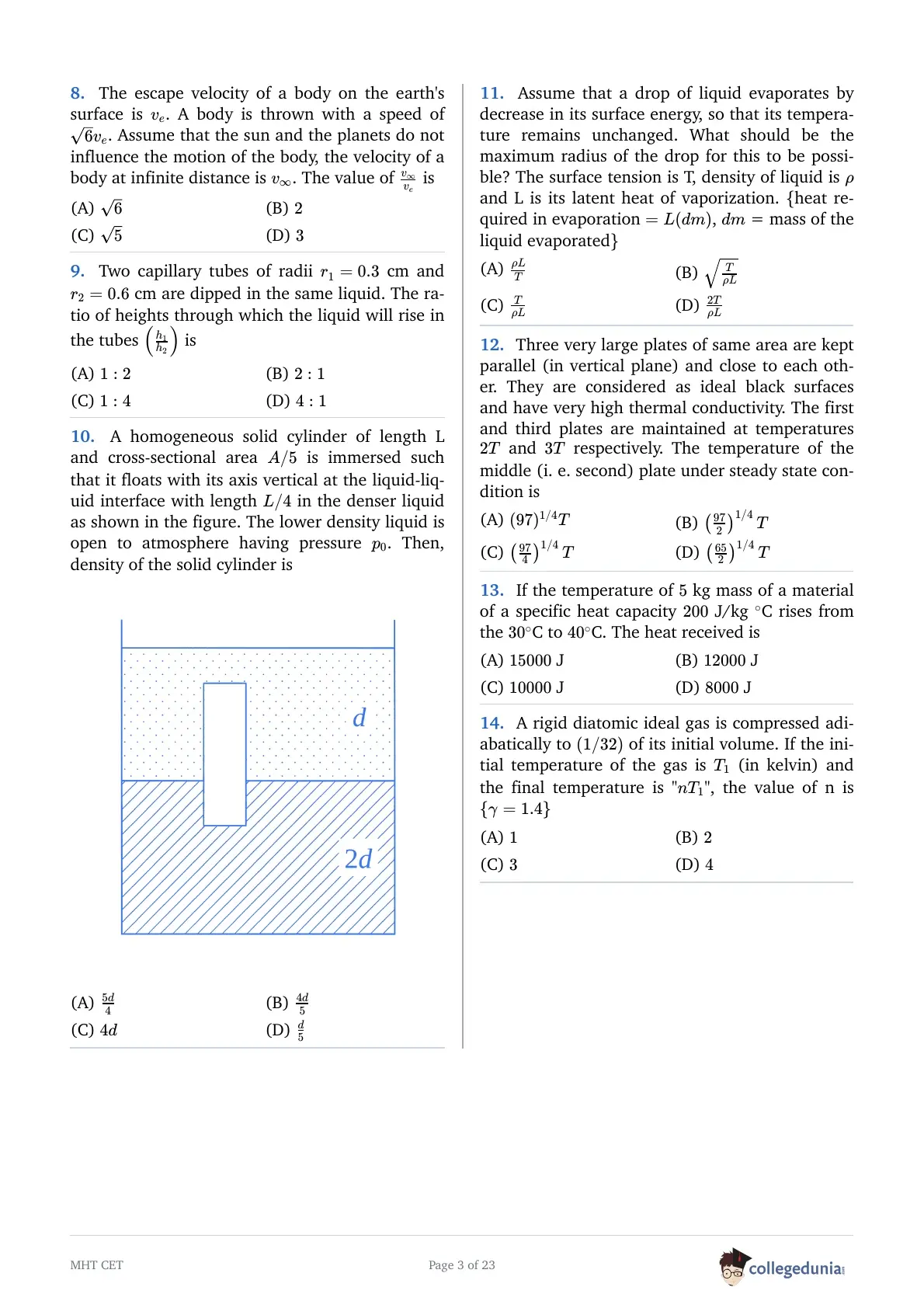
A homogeneous solid cylinder of length L and cross-sectional area \(A/5\) is immersed such that it floats with its axis vertical at the liquid-liquid interface with length \(L/4\) in the denser liquid as shown in the figure. The lower density liquid is open to atmosphere having pressure \(p_{0}\). Then, density of the solid cylinder is

Assume that a drop of liquid evaporates by decrease in its surface energy, so that its temperature remains unchanged. What should be the maximum radius of the drop for this to be possible? The surface tension is T, density of liquid is \(\rho\) and L is its latent heat of vaporization. \(\{\)heat required in evaporation \(=L(dm)\), \(dm\) = mass of the liquid evaporated\(\}\)
Three very large plates of same area are kept parallel (in vertical plane) and close to each other. They are considered as ideal black surfaces and have very high thermal conductivity. The first and third plates are maintained at temperatures \(2T\) and \(3T\) respectively. The temperature of the middle (i. e. second) plate under steady state condition is
If the temperature of \(5\) kg mass of a material of a specific heat capacity \(200\) J/kg \({}^{\circ }\)C rises from the \(30^{\circ }\)C to \(40^{\circ }\)C. The heat received is
A rigid diatomic ideal gas is compressed adiabatically to \((1/32)\) of its initial volume. If the initial temperature of the gas is \(T_{1}\) (in kelvin) and the final temperature is "\(nT_{1}\)", the value of n is \(\{\gamma =1.4\}\)
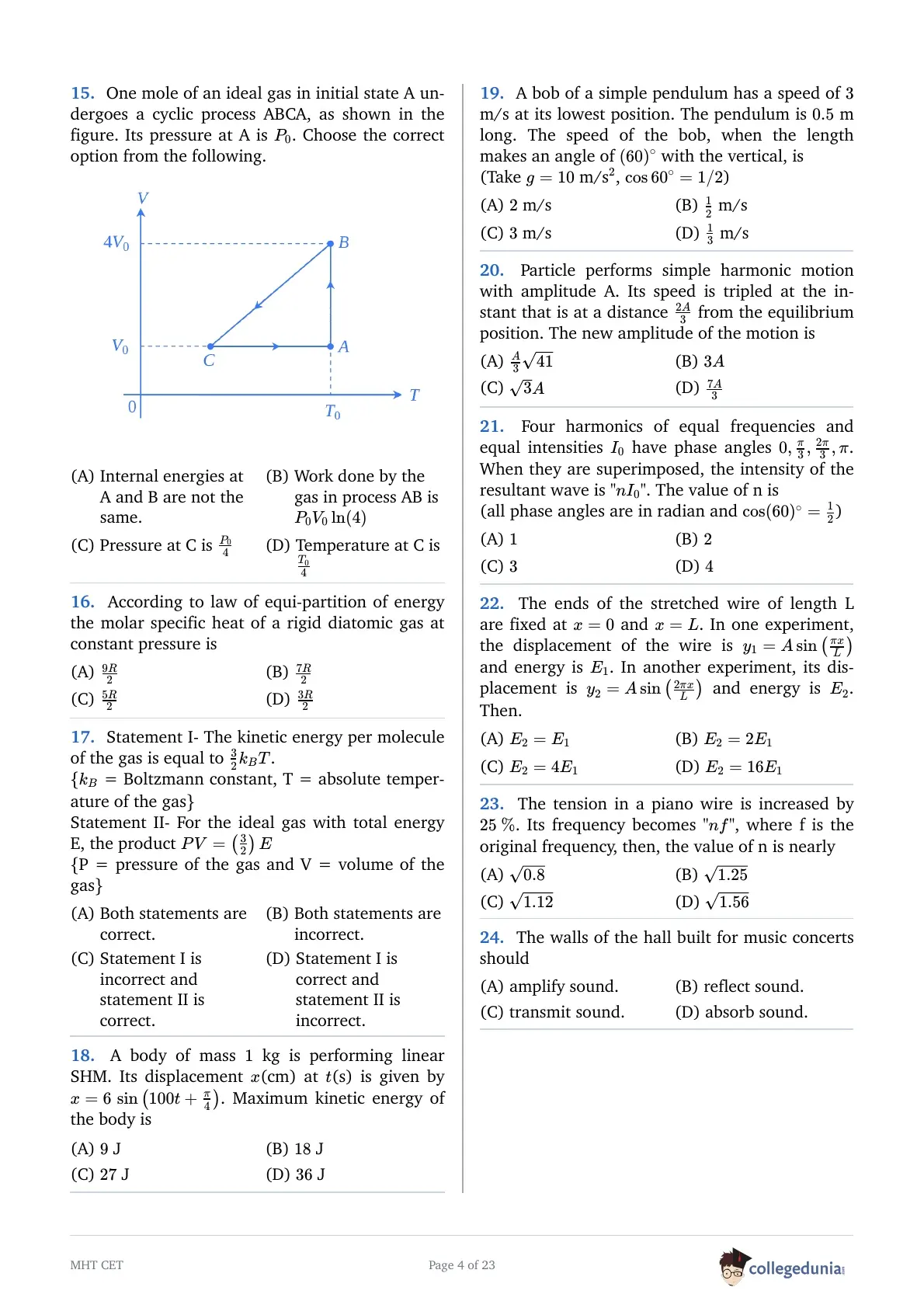
One mole of an ideal gas in initial state A undergoes a cyclic process ABCA, as shown in the figure. Its pressure at A is \(P_{0}\). Choose the correct option from the following.

According to law of equi-partition of energy the molar specific heat of a rigid diatomic gas at constant pressure is
Statement I- The kinetic energy per molecule of the gas is equal to \(\frac{3}{2}k_{B}T\).
\(\{k_{B}\) = Boltzmann constant, T = absolute temperature of the gas\(\}\)
Statement II- For the ideal gas with total energy E, the product \(PV=\left(\frac{3}{2}\right)E\)
\(\{\)P = pressure of the gas and V = volume of the gas\(\}\)
A body of mass \(1\) kg is performing linear SHM. Its displacement \(x\)(cm) at \(t\)(s) is given by \(x=6\,\sin \left(100t+\frac{\pi }{4}\right)\). Maximum kinetic energy of the body is
A bob of a simple pendulum has a speed of \(3\) m/s at its lowest position. The pendulum is \(0.5\) m long. The speed of the bob, when the length makes an angle of \((60)^{\circ }\) with the vertical, is
(Take \(g=10\) m/s\({}^{2}\), \(\cos 60^{\circ }=1/2\))
Particle performs simple harmonic motion with amplitude A. Its speed is tripled at the instant that is at a distance \(\frac{2A}{3}\) from the equilibrium position. The new amplitude of the motion is
Four harmonics of equal frequencies and equal intensities \(I_{0}\) have phase angles \(0,\frac{\pi }{3},\frac{2\pi }{3},\pi\). When they are superimposed, the intensity of the resultant wave is "\(nI_{0}\)". The value of n is
(all phase angles are in radian and \(\cos (60)^{\circ }=\frac{1}{2}\))
The ends of the stretched wire of length L are fixed at \(x=0\) and \(x=L\). In one experiment, the displacement of the wire is \(y_{1}=A\sin \left(\frac{\pi x}{L}\right)\) and energy is \(E_{1}\). In another experiment, its displacement is \(y_{2}=A\sin \left(\frac{2\pi x}{L}\right)\) and energy is \(E_{2}\). Then.
The tension in a piano wire is increased by \(25\ \%\). Its frequency becomes "\(nf\)", where f is the original frequency, then, the value of n is nearly
The walls of the hall built for music concerts should
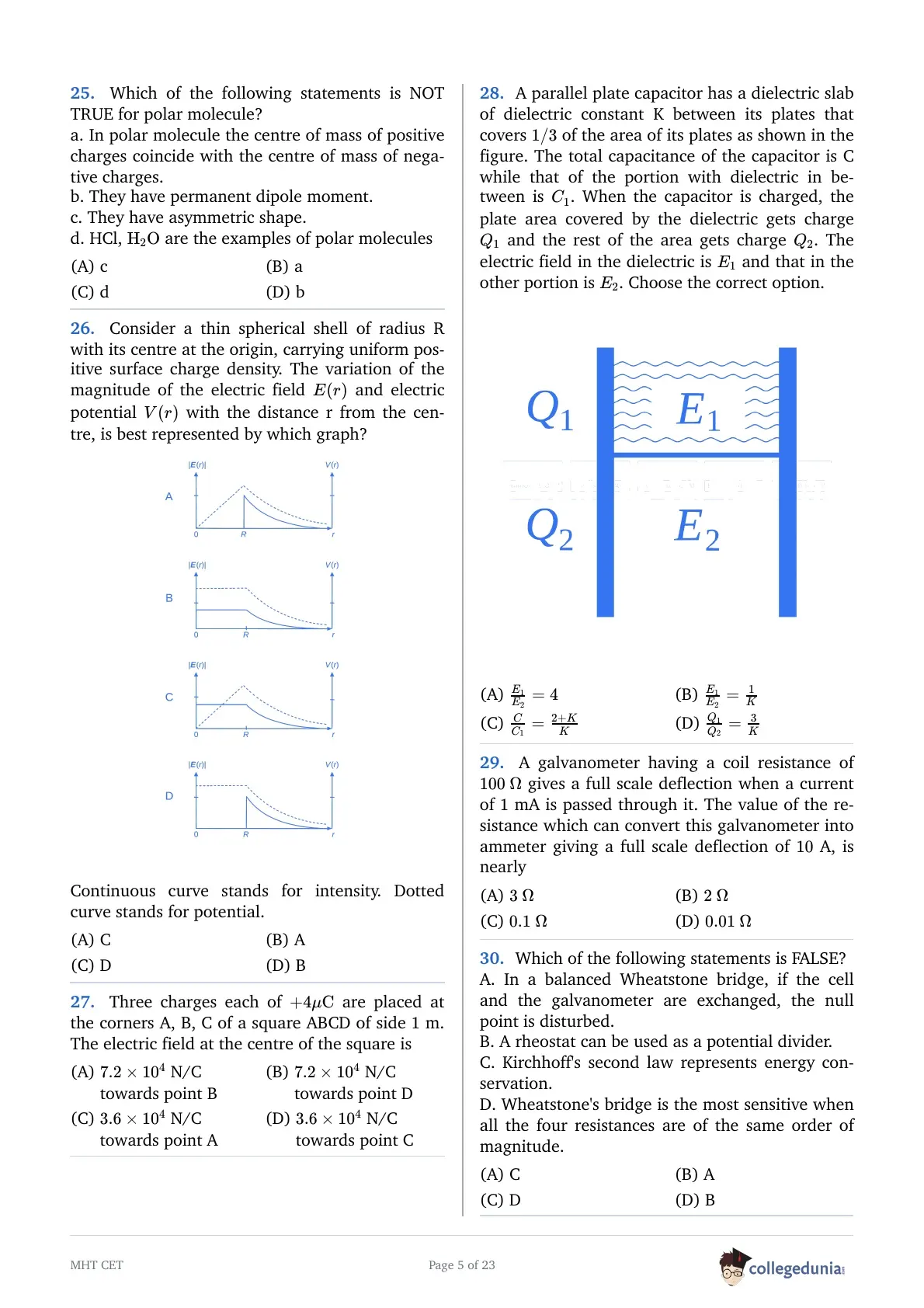
Which of the following statements is NOT TRUE for polar molecule?
a. In polar molecule the centre of mass of positive charges coincide with the centre of mass of negative charges.
b. They have permanent dipole moment.
c. They have asymmetric shape.
d. HCl, \(\text{H}_{2}\text{O}\) are the examples of polar molecules
Consider a thin spherical shell of radius R with its centre at the origin, carrying uniform positive surface charge density. The variation of the magnitude of the electric field \(E(r)\) and electric potential \(V(r)\) with the distance r from the centre, is best represented by which graph?

Three charges each of \(+4\mu \text{C}\) are placed at the corners A, B, C of a square ABCD of side \(1\) m. The electric field at the centre of the square is
A parallel plate capacitor has a dielectric slab of dielectric constant K between its plates that covers \(1/3\) of the area of its plates as shown in the figure. The total capacitance of the capacitor is C while that of the portion with dielectric in between is \(C_{1}\). When the capacitor is charged, the plate area covered by the dielectric gets charge \(Q_{1}\) and the rest of the area gets charge \(Q_{2}\). The electric field in the dielectric is \(E_{1}\) and that in the other portion is \(E_{2}\). Choose the correct option.

A galvanometer having a coil resistance of \(100\ \Omega\) gives a full scale deflection when a current of \(1\) mA is passed through it. The value of the resistance which can convert this galvanometer into ammeter giving a full scale deflection of \(10\) A, is nearly
Which of the following statements is FALSE?
A. In a balanced Wheatstone bridge, if the cell and the galvanometer are exchanged, the null point is disturbed.
B. A rheostat can be used as a potential divider.
C. Kirchhoff's second law represents energy conservation.
D. Wheatstone's bridge is the most sensitive when all the four resistances are of the same order of magnitude.
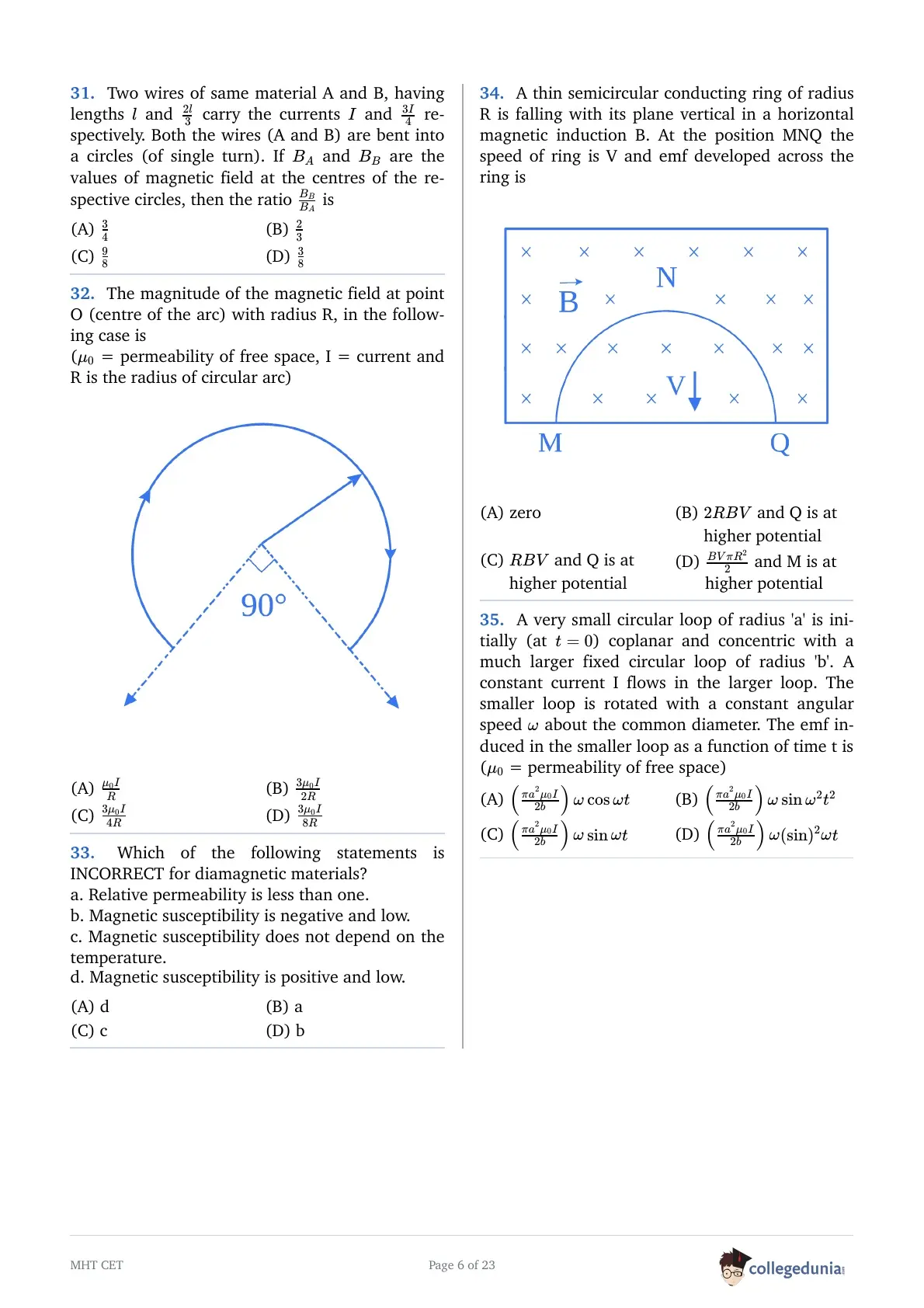
Two wires of same material A and B, having lengths \(l\) and \(\frac{2l}{3}\) carry the currents \(I\) and \(\frac{3I}{4}\) respectively. Both the wires (A and B) are bent into a circles (of single turn). If \(B_{A}\) and \(B_{B}\) are the values of magnetic field at the centres of the respective circles, then the ratio \(\frac{B_{B}}{B_{A}}\) is
The magnitude of the magnetic field at point O (centre of the arc) with radius R, in the following case is
(\(\mu _{0}\) = permeability of free space, I = current and R is the radius of circular arc)

Which of the following statements is INCORRECT for diamagnetic materials?
a. Relative permeability is less than one.
b. Magnetic susceptibility is negative and low.
c. Magnetic susceptibility does not depend on the temperature.
d. Magnetic susceptibility is positive and low.
A thin semicircular conducting ring of radius R is falling with its plane vertical in a horizontal magnetic induction B. At the position MNQ the speed of ring is V and emf developed across the ring is

A very small circular loop of radius 'a' is initially (at \(t=0\)) coplanar and concentric with a much larger fixed circular loop of radius 'b'. A constant current I flows in the larger loop. The smaller loop is rotated with a constant angular speed \(\omega\) about the common diameter. The emf induced in the smaller loop as a function of time t is
(\(\mu _{0}\) = permeability of free space)
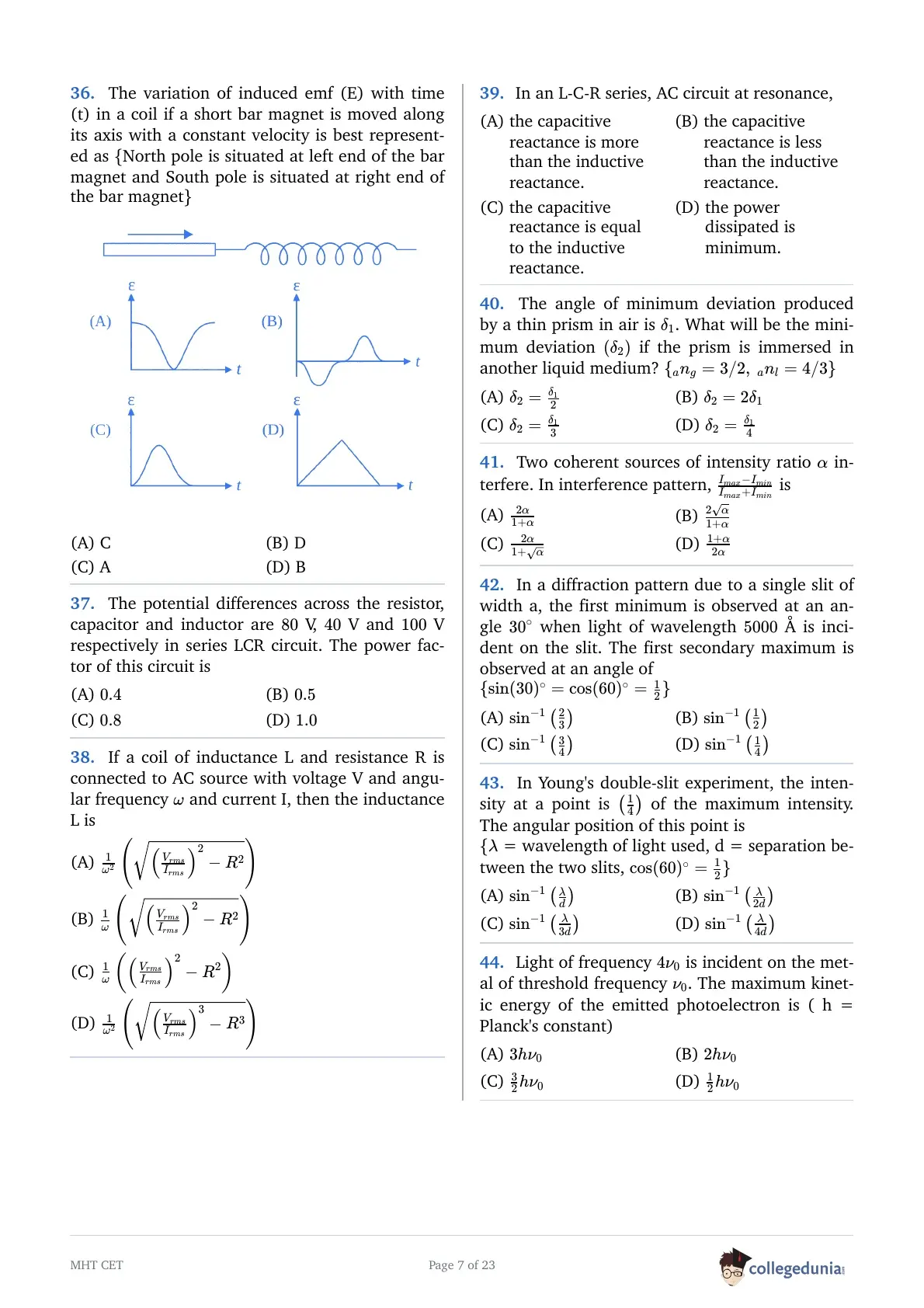
The variation of induced emf (E) with time (t) in a coil if a short bar magnet is moved along its axis with a constant velocity is best represented as \(\{\)North pole is situated at left end of the bar magnet and South pole is situated at right end of the bar magnet\(\}\)

The potential differences across the resistor, capacitor and inductor are \(80\) V, \(40\) V and \(100\) V respectively in series LCR circuit. The power factor of this circuit is
If a coil of inductance L and resistance R is connected to AC source with voltage V and angular frequency \(\omega\) and current I, then the inductance L is
In an L-C-R series, AC circuit at resonance,
The angle of minimum deviation produced by a thin prism in air is \(\delta _{1}\). What will be the minimum deviation \((\delta _{2})\) if the prism is immersed in another liquid medium? \(\{{}_{a}n_{g}=3/2,\ {}_{a}n_{l}=4/3\}\)
Two coherent sources of intensity ratio \(\alpha\) interfere. In interference pattern, \(\frac{I_{max}-I_{min}}{I_{max}+I_{min}}\) is
In a diffraction pattern due to a single slit of width a, the first minimum is observed at an angle \(30^{\circ }\) when light of wavelength \(5000\) Å is incident on the slit. The first secondary maximum is observed at an angle of
\(\{\sin (30)^{\circ }=\cos (60)^{\circ }=\frac{1}{2}\}\)
In Young's double-slit experiment, the intensity at a point is \(\left(\frac{1}{4}\right)\) of the maximum intensity. The angular position of this point is
\(\{\lambda\) = wavelength of light used, d = separation between the two slits, \(\cos (60)^{\circ }=\frac{1}{2}\}\)
Light of frequency \(4\nu _{0}\) is incident on the metal of threshold frequency \(\nu _{0}\). The maximum kinetic energy of the emitted photoelectron is ( h = Planck's constant)
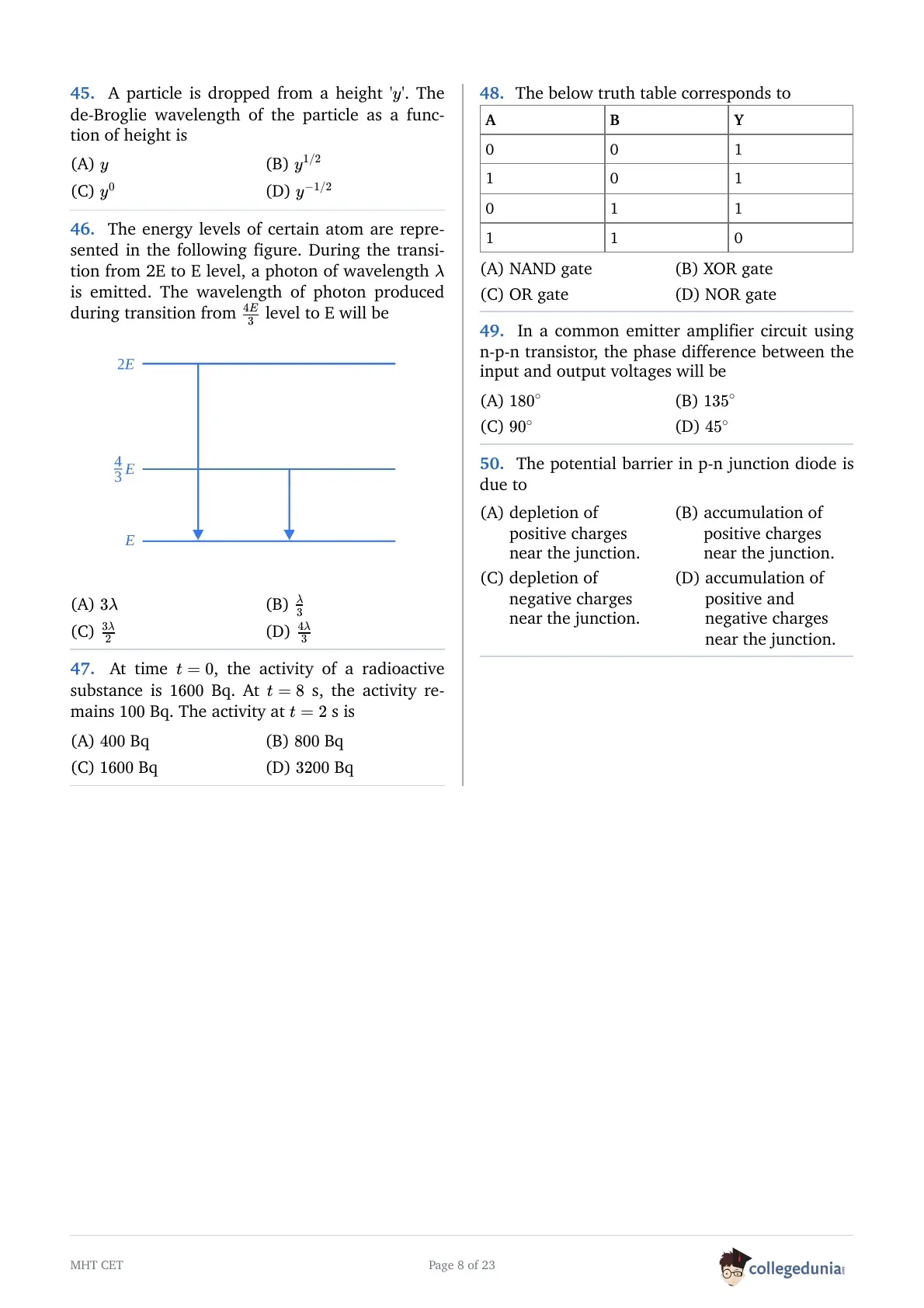
A particle is dropped from a height '\(y\)'. The de-Broglie wavelength of the particle as a function of height is
The energy levels of certain atom are represented in the following figure. During the transition from 2E to E level, a photon of wavelength \(\lambda\) is emitted. The wavelength of photon produced during transition from \(\frac{4E}{3}\) level to E will be

At time \(t=0\), the activity of a radioactive substance is \(1600\) Bq. At \(t=8\) s, the activity remains \(100\) Bq. The activity at \(t=2\) s is
In a common emitter amplifier circuit using n-p-n transistor, the phase difference between the input and output voltages will be
The potential barrier in p-n junction diode is due to
Chemistry (Q51 - Q100)
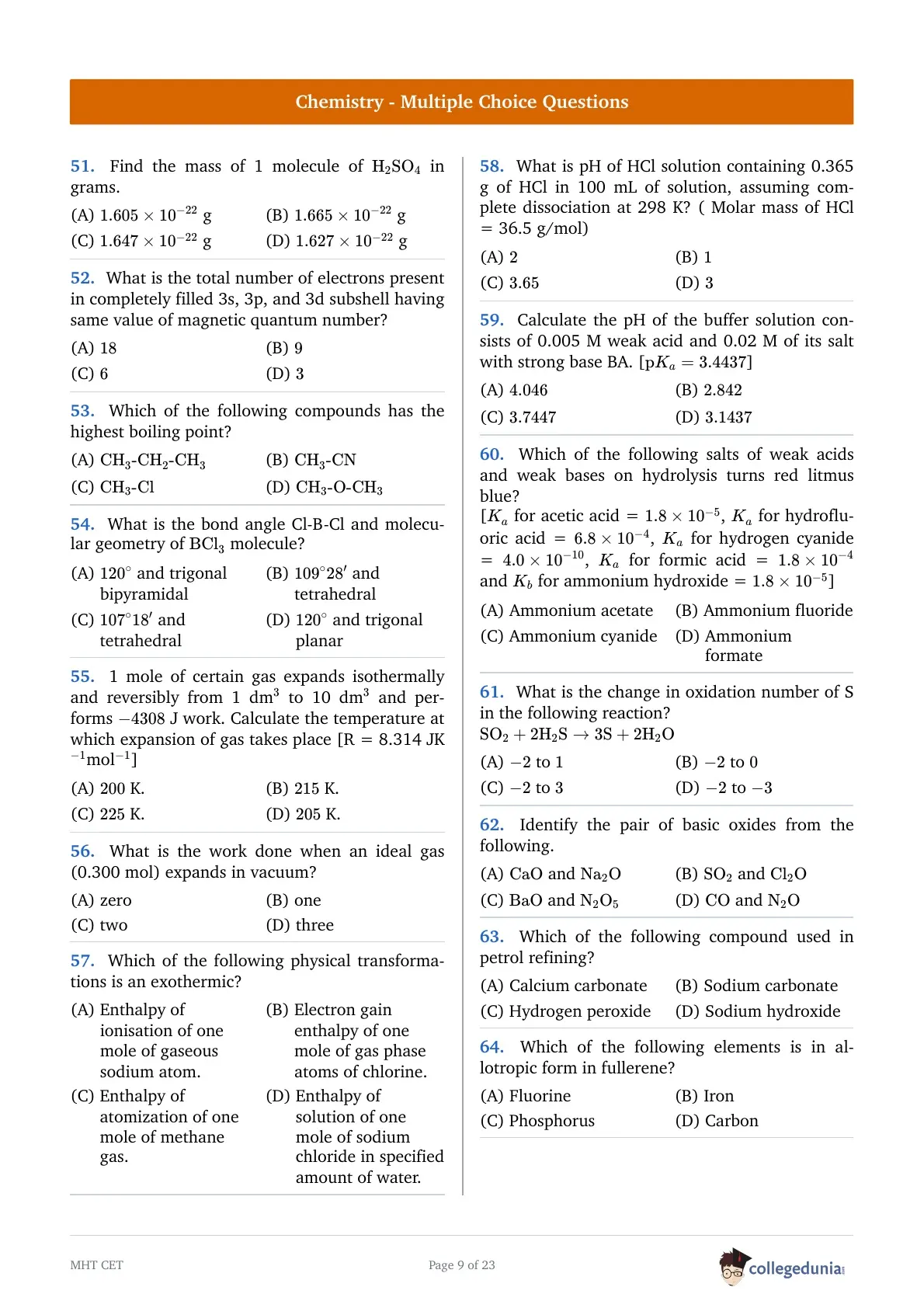
Find the mass of 1 molecule of \(\text{H}_{2}\text{SO}_{4}\) in grams.
What is the total number of electrons present in completely filled 3s, 3p, and 3d subshell having same value of magnetic quantum number?
Which of the following compounds has the highest boiling point?
What is the bond angle Cl-B-Cl and molecular geometry of \(\text{BCl}_{3}\) molecule?
1 mole of certain gas expands isothermally and reversibly from 1 dm\({}^{3}\) to 10 dm\({}^{3}\) and performs \(-4308\) J work. Calculate the temperature at which expansion of gas takes place [R = 8.314 JK\({}^{-1}\)mol\({}^{-1}\)]
What is the work done when an ideal gas (0.300 mol) expands in vacuum?
Which of the following physical transformations is an exothermic?
What is pH of HCl solution containing 0.365 g of HCl in 100 mL of solution, assuming complete dissociation at 298 K? ( Molar mass of HCl = 36.5 g/mol)
Calculate the pH of the buffer solution consists of 0.005 M weak acid and 0.02 M of its salt with strong base BA. [\(\text{p}K_{a}=3.4437\)]
Which of the following salts of weak acids and weak bases on hydrolysis turns red litmus blue?
[\(K_{a}\) for acetic acid = \(1.8\times 10^{-5}\), \(K_{a}\) for hydrofluoric acid = \(6.8\times 10^{-4}\), \(K_{a}\) for hydrogen cyanide = \(4.0\times 10^{-10}\), \(K_{a}\) for formic acid = \(1.8\times 10^{-4}\) and \(K_{b}\) for ammonium hydroxide = \(1.8\times 10^{-5}\)]
What is the change in oxidation number of S in the following reaction?
\(\text{SO}_{2}+2\text{H}_{2}\text{S}\rightarrow 3\text{S}+2\text{H}_{2}\text{O}\)
Identify the pair of basic oxides from the following.
Which of the following compound used in petrol refining?
Which of the following elements is in allotropic form in fullerene?


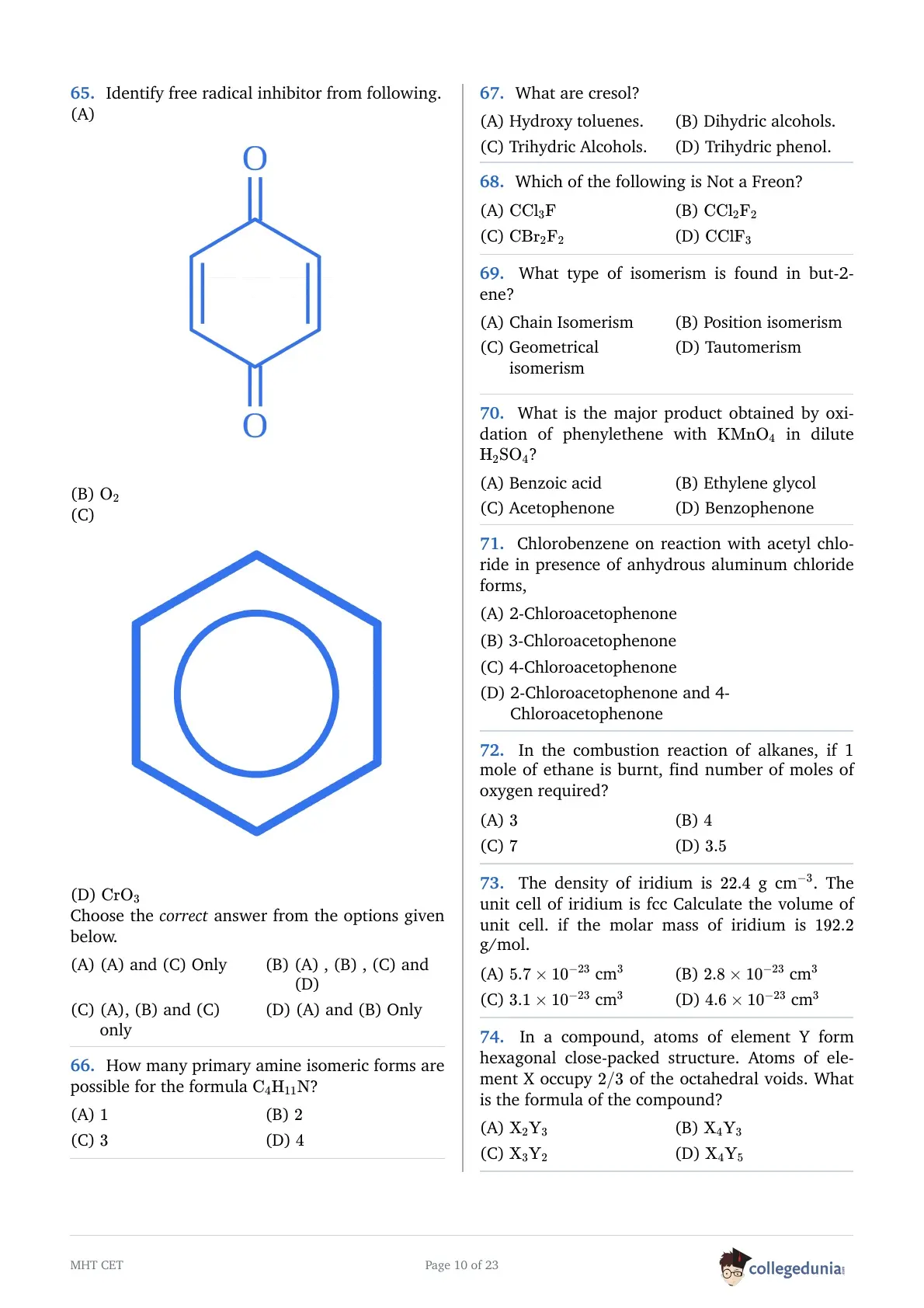
How many primary amine isomeric forms are possible for the formula \(\text{C}_{4}\text{H}_{11}\text{N}\)?
What are cresol?
Which of the following is Not a Freon?
What type of isomerism is found in but-2-ene?
What is the major product obtained by oxidation of phenylethene with \(\text{KMnO}_{4}\) in dilute \(\text{H}_{2}\text{SO}_{4}\)?
Chlorobenzene on reaction with acetyl chloride in presence of anhydrous aluminum chloride forms,
In the combustion reaction of alkanes, if 1 mole of ethane is burnt, find number of moles of oxygen required?
The density of iridium is \(22.4\) g cm\({}^{-3}\). The unit cell of iridium is fcc Calculate the volume of unit cell. if the molar mass of iridium is \(192.2\) g/mol.
In a compound, atoms of element Y form hexagonal close-packed structure. Atoms of element X occupy \(2/3\) of the octahedral voids. What is the formula of the compound?
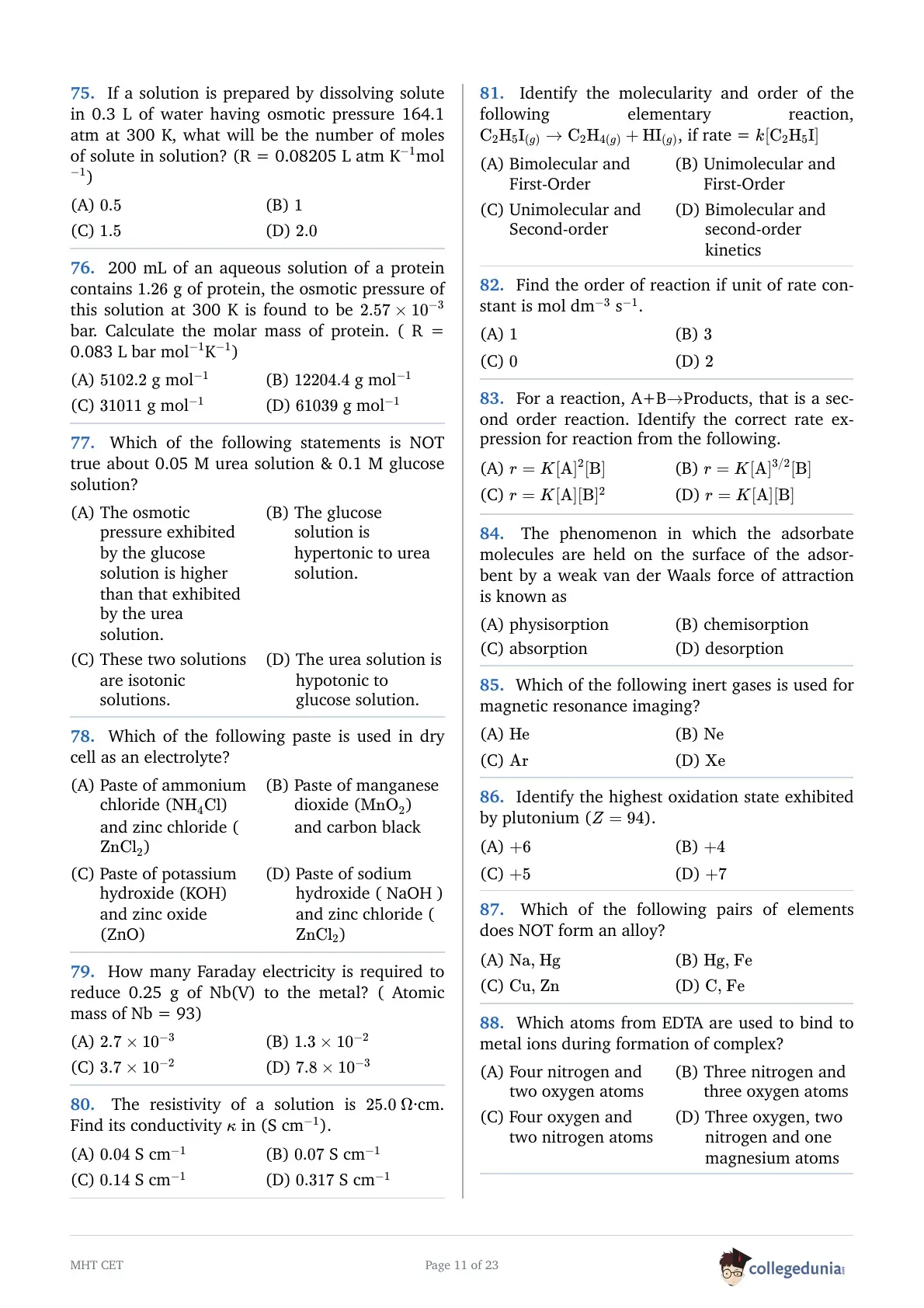
If a solution is prepared by dissolving solute in 0.3 L of water having osmotic pressure 164.1 atm at 300 K, what will be the number of moles of solute in solution? (R = 0.08205 L atm K\({}^{-1}\)mol\({}^{-1}\))
200 mL of an aqueous solution of a protein contains \(1.26\) g of protein, the osmotic pressure of this solution at 300 K is found to be \(2.57\times 10^{-3}\) bar. Calculate the molar mass of protein. ( R = 0.083 L bar mol\({}^{-1}\)K\({}^{-1}\))
Which of the following statements is NOT true about 0.05 M urea solution & 0.1 M glucose solution?
Which of the following paste is used in dry cell as an electrolyte?
How many Faraday electricity is required to reduce 0.25 g of Nb(V) to the metal? ( Atomic mass of Nb = 93)
The resistivity of a solution is \(25.0\ \Omega\)·cm. Find its conductivity \(\kappa\) in (S cm\({}^{-1}\)).
Identify the molecularity and order of the following elementary reaction, \(\text{C}_{2}\text{H}_{5}\text{I}_{(g)}\rightarrow \text{C}_{2}\text{H}_{4(g)}+\text{HI}_{(g)}\), if rate = \(k[\text{C}_{2}\text{H}_{5}\text{I}]\)
Find the order of reaction if unit of rate constant is mol dm\({}^{-3}\) s\({}^{-1}\).
For a reaction, A+B\(\rightarrow\)Products, that is a second order reaction. Identify the correct rate expression for reaction from the following.
The phenomenon in which the adsorbate molecules are held on the surface of the adsorbent by a weak van der Waals force of attraction is known as
Which of the following inert gases is used for magnetic resonance imaging?
Identify the highest oxidation state exhibited by plutonium (\(Z=94\)).
Which of the following pairs of elements does NOT form an alloy?
Which atoms from EDTA are used to bind to metal ions during formation of complex?
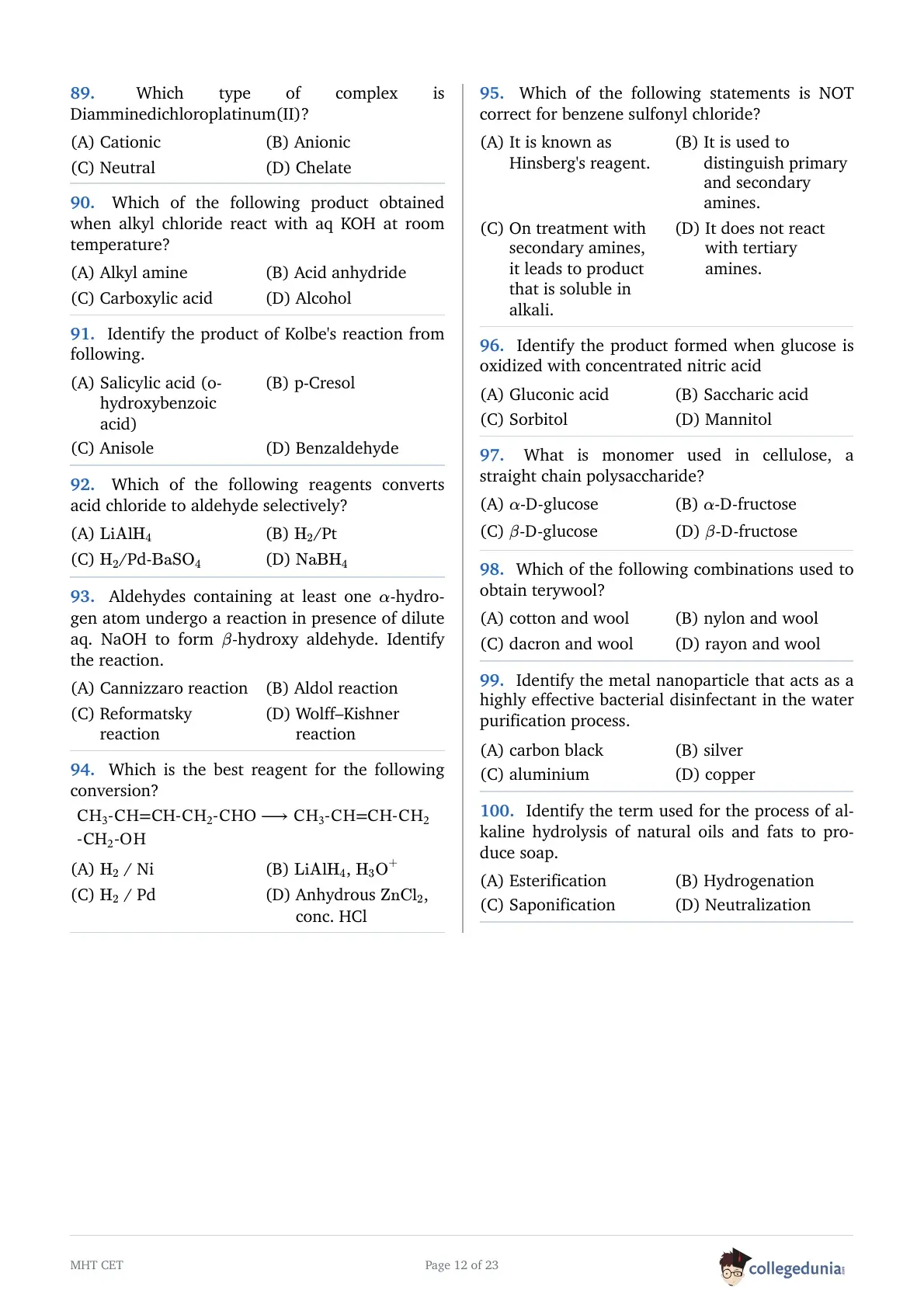
Which type of complex is Diamminedichloroplatinum(II)?
Which of the following product obtained when alkyl chloride react with aq KOH at room temperature?
Identify the product of Kolbe's reaction from following.
Which of the following reagents converts acid chloride to aldehyde selectively?
Aldehydes containing at least one \(\alpha\)-hydrogen atom undergo a reaction in presence of dilute aq. NaOH to form \(\beta\)-hydroxy aldehyde. Identify the reaction.
Which is the best reagent for the following conversion?
\(\text{CH}_{3}\text{-CH=CH-CH}_{2}\text{-CHO}\longrightarrow \text{CH}_{3}\text{-CH=CH-CH}_{2}\text{-CH}_{2}\text{-OH}\)
Which of the following statements is NOT correct for benzene sulfonyl chloride?
Identify the product formed when glucose is oxidized with concentrated nitric acid
What is monomer used in cellulose, a straight chain polysaccharide?
Which of the following combinations used to obtain terywool?
Identify the metal nanoparticle that acts as a highly effective bacterial disinfectant in the water purification process.
Identify the term used for the process of alkaline hydrolysis of natural oils and fats to produce soap.
Biology (Q101 - Q200)
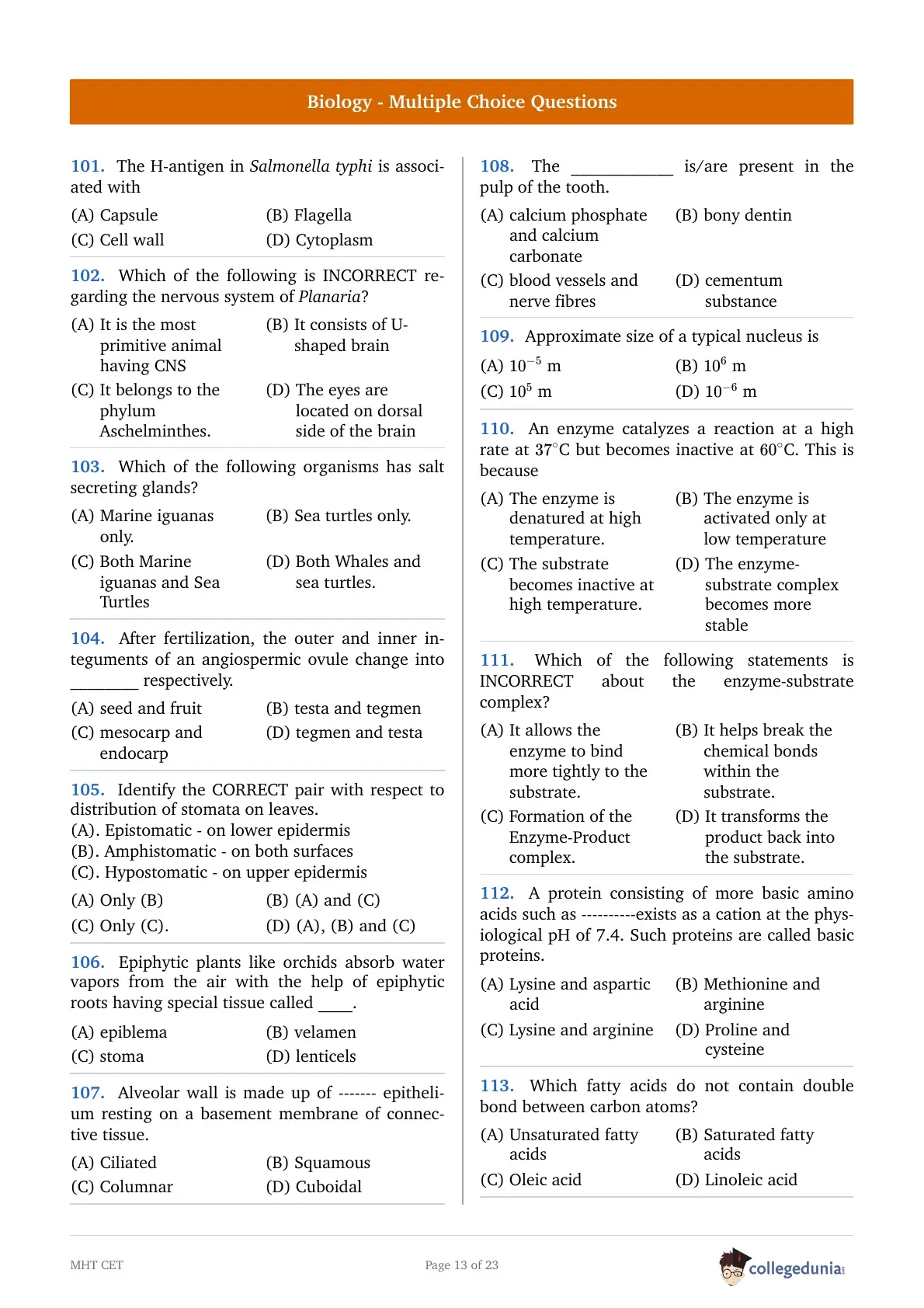
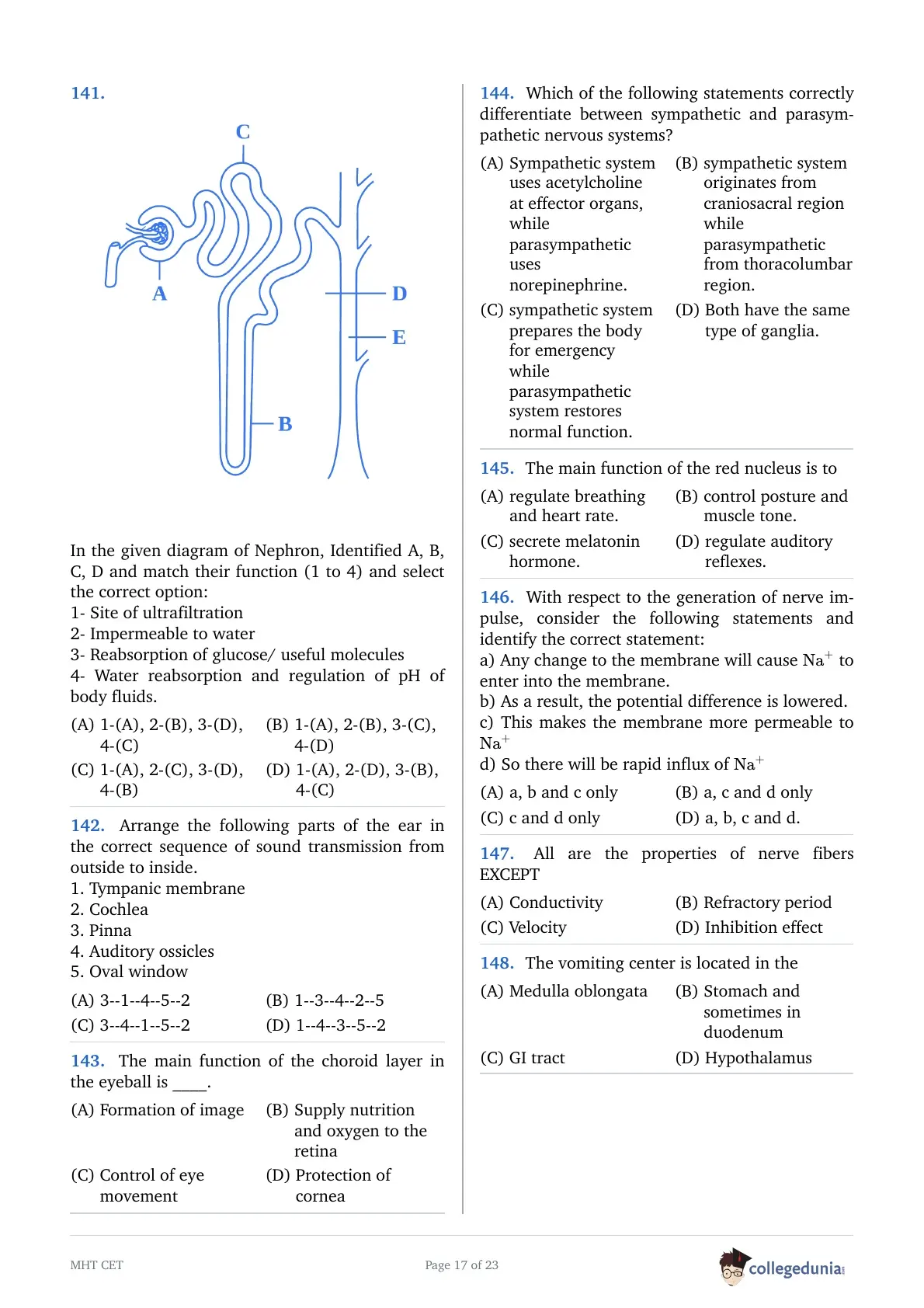
The H-antigen in Salmonella typhi is associated with
Which of the following is INCORRECT regarding the nervous system of Planaria?
Which of the following organisms has salt secreting glands?
After fertilization, the outer and inner integuments of an angiospermic ovule change into ________ respectively.
Identify the CORRECT pair with respect to distribution of stomata on leaves.
(A). Epistomatic - on lower epidermis
(B). Amphistomatic - on both surfaces
(C). Hypostomatic - on upper epidermis
Epiphytic plants like orchids absorb water vapors from the air with the help of epiphytic roots having special tissue called ____.
Alveolar wall is made up of ------- epithelium resting on a basement membrane of connective tissue.
The ____________ is/are present in the pulp of the tooth.
Approximate size of a typical nucleus is
An enzyme catalyzes a reaction at a high rate at \(37^{\circ }\)C but becomes inactive at \(60^{\circ }\)C. This is because
Which of the following statements is INCORRECT about the enzyme-substrate complex?
A protein consisting of more basic amino acids such as ----------exists as a cation at the physiological pH of 7.4. Such proteins are called basic proteins.
Which fatty acids do not contain double bond between carbon atoms?
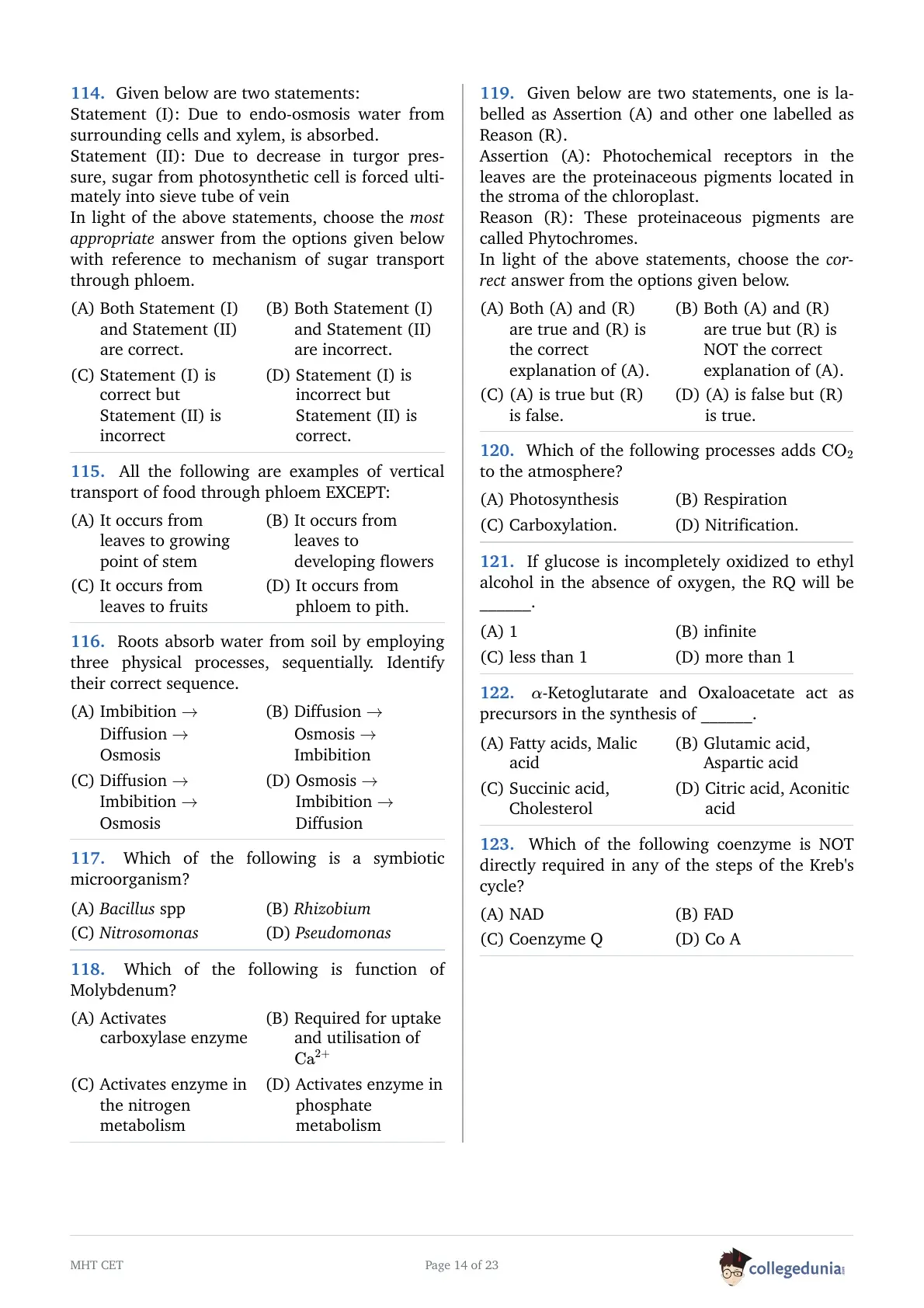
Given below are two statements:
Statement (I): Due to endo-osmosis water from surrounding cells and xylem, is absorbed.
Statement (II): Due to decrease in turgor pressure, sugar from photosynthetic cell is forced ultimately into sieve tube of vein
In light of the above statements, choose the most appropriate answer from the options given below with reference to mechanism of sugar transport through phloem.
All the following are examples of vertical transport of food through phloem EXCEPT:
Roots absorb water from soil by employing three physical processes, sequentially. Identify their correct sequence.
Which of the following is a symbiotic microorganism?
Which of the following is function of Molybdenum?
Given below are two statements, one is labelled as Assertion (A) and other one labelled as Reason (R).
Assertion (A): Photochemical receptors in the leaves are the proteinaceous pigments located in the stroma of the chloroplast.
Reason (R): These proteinaceous pigments are called Phytochromes.
In light of the above statements, choose the correct answer from the options given below.
Which of the following processes adds \(\text{CO}_{2}\) to the atmosphere?
If glucose is incompletely oxidized to ethyl alcohol in the absence of oxygen, the RQ will be ______.
\(\alpha\)-Ketoglutarate and Oxaloacetate act as precursors in the synthesis of ______.
Which of the following coenzyme is NOT directly required in any of the steps of the Kreb's cycle?
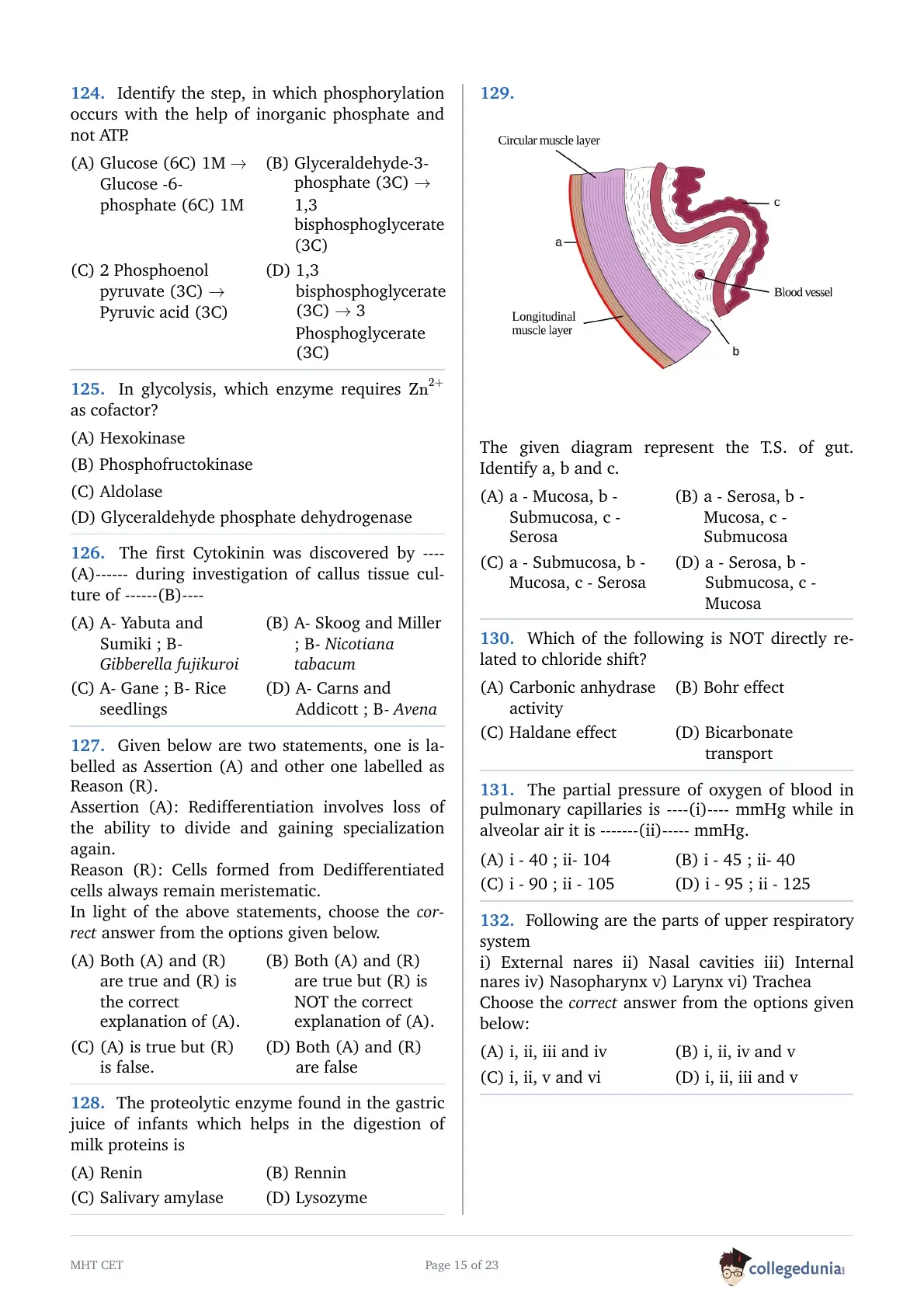
Identify the step, in which phosphorylation occurs with the help of inorganic phosphate and not ATP.
In glycolysis, which enzyme requires \(\text{Zn}^{2+}\) as cofactor?
The first Cytokinin was discovered by ----(A)------ during investigation of callus tissue culture of ------(B)----
Given below are two statements, one is labelled as Assertion (A) and other one labelled as Reason (R).
Assertion (A): Redifferentiation involves loss of the ability to divide and gaining specialization again.
Reason (R): Cells formed from Dedifferentiated cells always remain meristematic.
In light of the above statements, choose the correct answer from the options given below.
The proteolytic enzyme found in the gastric juice of infants which helps in the digestion of milk proteins is

Which of the following is NOT directly related to chloride shift?
The partial pressure of oxygen of blood in pulmonary capillaries is ----(i)---- mmHg while in alveolar air it is -------(ii)----- mmHg.
Following are the parts of upper respiratory system
i) External nares ii) Nasal cavities iii) Internal nares iv) Nasopharynx v) Larynx vi) Trachea
Choose the correct answer from the options given below:
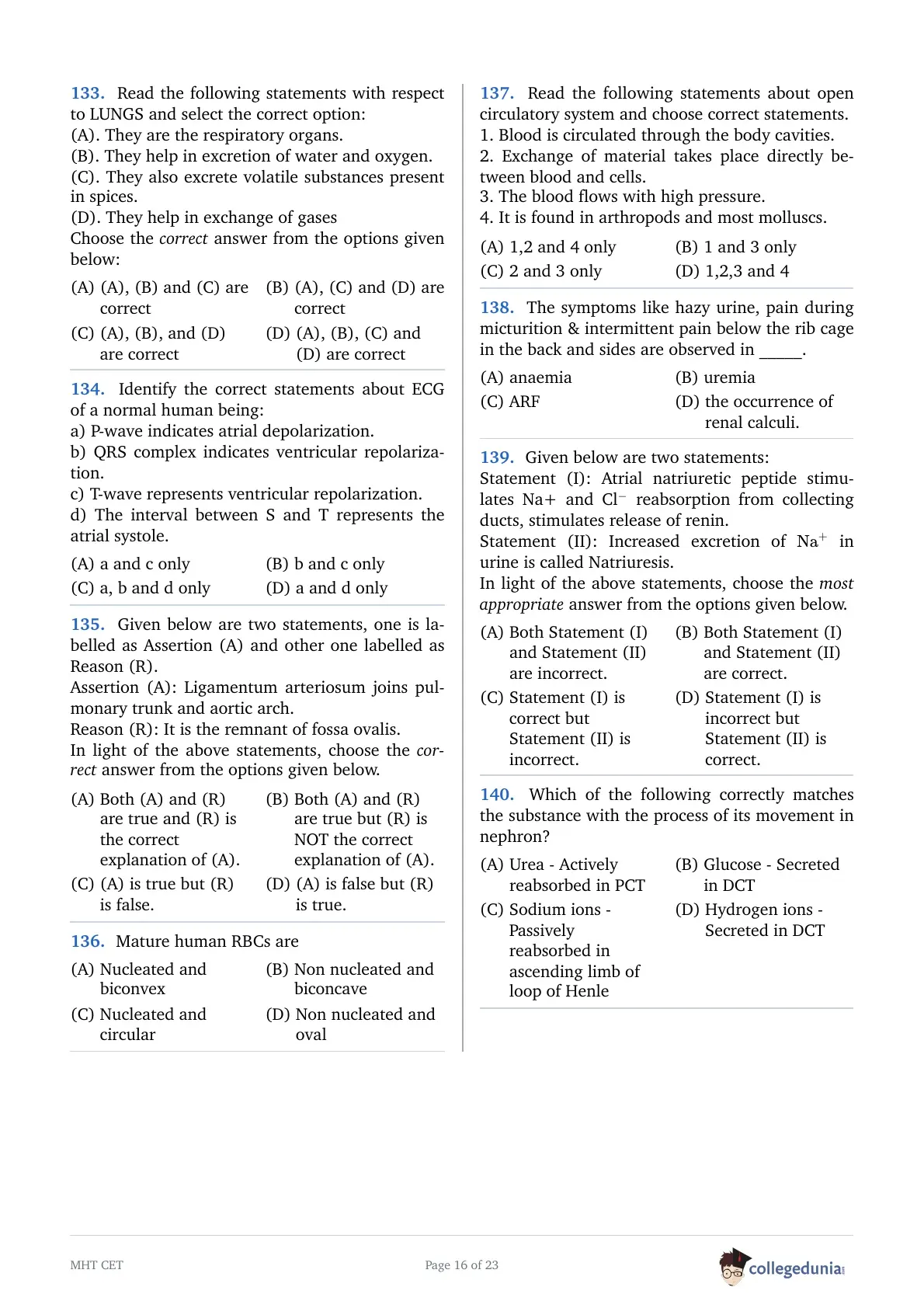
Read the following statements with respect to LUNGS and select the correct option:
(A). They are the respiratory organs.
(B). They help in excretion of water and oxygen.
(C). They also excrete volatile substances present in spices.
(D). They help in exchange of gases
Choose the correct answer from the options given below:
Identify the correct statements about ECG of a normal human being:
a) P-wave indicates atrial depolarization.
b) QRS complex indicates ventricular repolarization.
c) T-wave represents ventricular repolarization.
d) The interval between S and T represents the atrial systole.
Given below are two statements, one is labelled as Assertion (A) and other one labelled as Reason (R).
Assertion (A): Ligamentum arteriosum joins pulmonary trunk and aortic arch.
Reason (R): It is the remnant of fossa ovalis.
In light of the above statements, choose the correct answer from the options given below.
Mature human RBCs are
Read the following statements about open circulatory system and choose correct statements.
1. Blood is circulated through the body cavities.
2. Exchange of material takes place directly between blood and cells.
3. The blood flows with high pressure.
4. It is found in arthropods and most molluscs.
The symptoms like hazy urine, pain during micturition & intermittent pain below the rib cage in the back and sides are observed in _____.
Given below are two statements:
Statement (I): Atrial natriuretic peptide stimulates Na+ and Cl\({}^{-}\) reabsorption from collecting ducts, stimulates release of renin.
Statement (II): Increased excretion of \(\text{Na}^{+}\) in urine is called Natriuresis.
In light of the above statements, choose the most appropriate answer from the options given below.
Which of the following correctly matches the substance with the process of its movement in nephron?

Arrange the following parts of the ear in the correct sequence of sound transmission from outside to inside.
1. Tympanic membrane
2. Cochlea
3. Pinna
4. Auditory ossicles
5. Oval window
The main function of the choroid layer in the eyeball is ____.
Which of the following statements correctly differentiate between sympathetic and parasympathetic nervous systems?
The main function of the red nucleus is to
With respect to the generation of nerve impulse, consider the following statements and identify the correct statement:
a) Any change to the membrane will cause \(\text{Na}^{+}\) to enter into the membrane.
b) As a result, the potential difference is lowered.
c) This makes the membrane more permeable to \(\text{Na}^{+}\)
d) So there will be rapid influx of \(\text{Na}^{+}\)
All are the properties of nerve fibers EXCEPT
The vomiting center is located in the
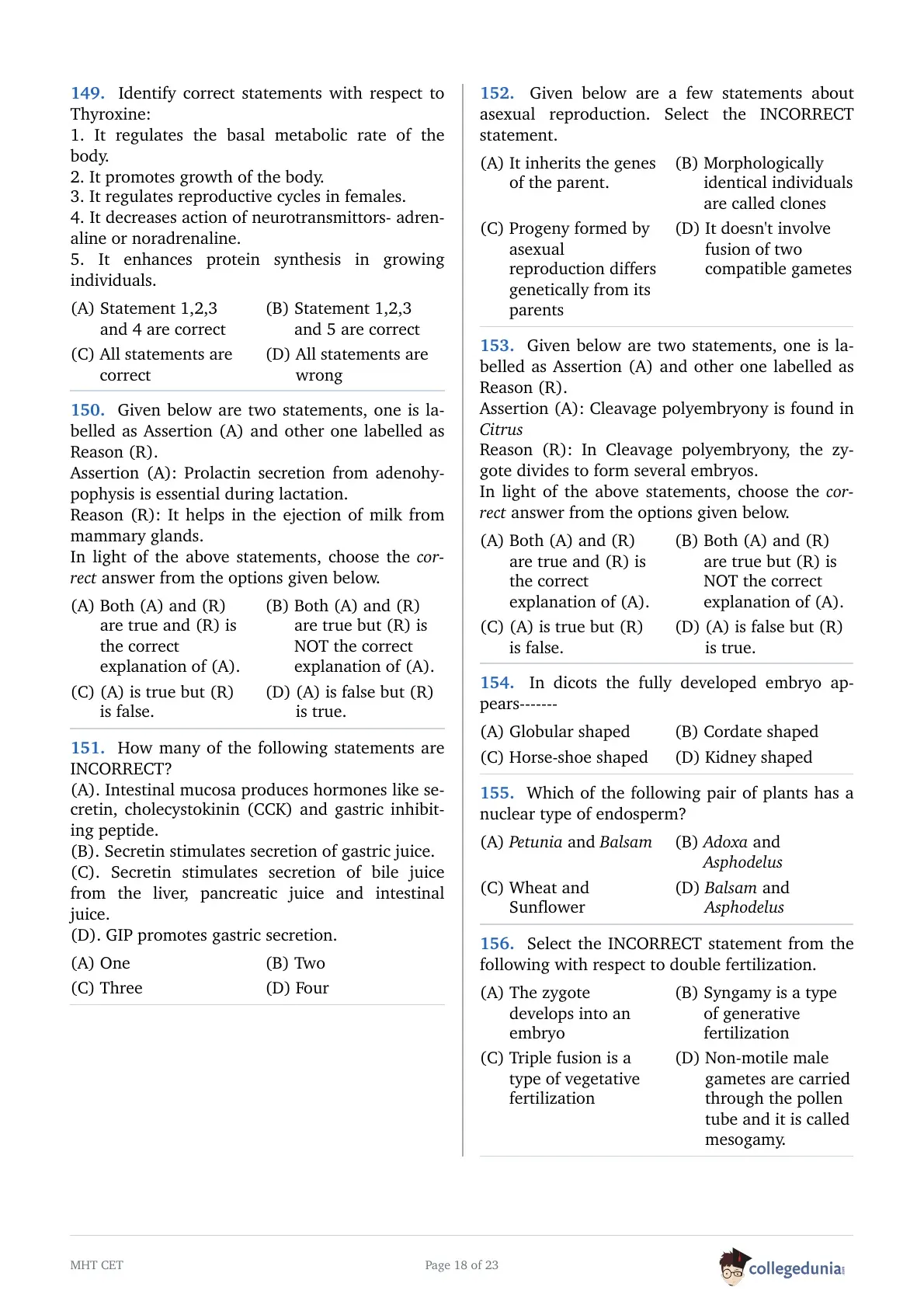
Identify correct statements with respect to Thyroxine:
1. It regulates the basal metabolic rate of the body.
2. It promotes growth of the body.
3. It regulates reproductive cycles in females.
4. It decreases action of neurotransmittors- adrenaline or noradrenaline.
5. It enhances protein synthesis in growing individuals.
Given below are two statements, one is labelled as Assertion (A) and other one labelled as Reason (R).
Assertion (A): Prolactin secretion from adenohypophysis is essential during lactation.
Reason (R): It helps in the ejection of milk from mammary glands.
In light of the above statements, choose the correct answer from the options given below.
How many of the following statements are INCORRECT?
(A). Intestinal mucosa produces hormones like secretin, cholecystokinin (CCK) and gastric inhibiting peptide.
(B). Secretin stimulates secretion of gastric juice.
(C). Secretin stimulates secretion of bile juice from the liver, pancreatic juice and intestinal juice.
(D). GIP promotes gastric secretion.
Given below are a few statements about asexual reproduction. Select the INCORRECT statement.
Given below are two statements, one is labelled as Assertion (A) and other one labelled as Reason (R).
Assertion (A): Cleavage polyembryony is found in Citrus
Reason (R): In Cleavage polyembryony, the zygote divides to form several embryos.
In light of the above statements, choose the correct answer from the options given below.
In dicots the fully developed embryo appears-------
Which of the following pair of plants has a nuclear type of endosperm?
Select the INCORRECT statement from the following with respect to double fertilization.
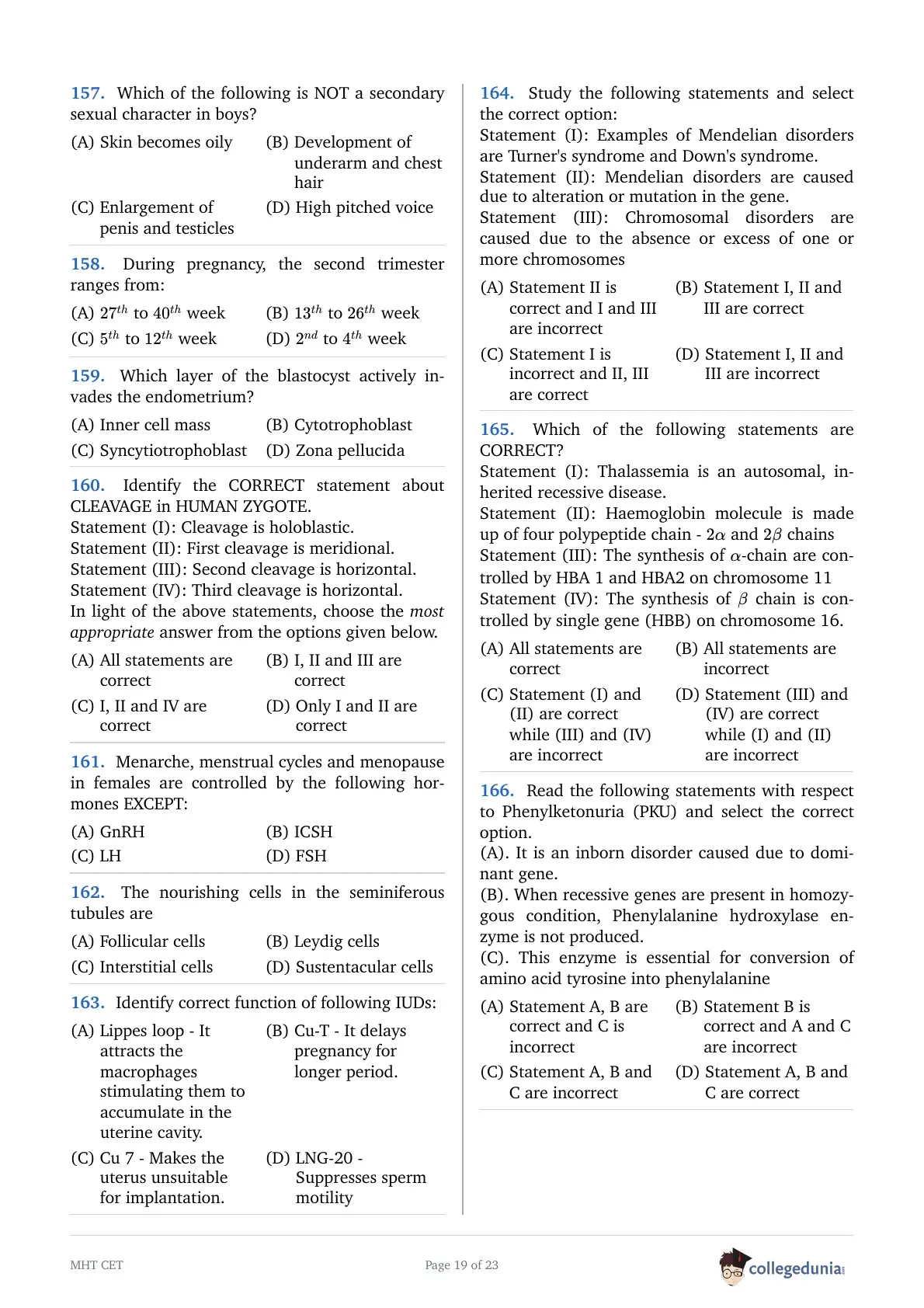
Which of the following is NOT a secondary sexual character in boys?
During pregnancy, the second trimester ranges from:
Which layer of the blastocyst actively invades the endometrium?
Identify the CORRECT statement about CLEAVAGE in HUMAN ZYGOTE.
Statement (I): Cleavage is holoblastic.
Statement (II): First cleavage is meridional.
Statement (III): Second cleavage is horizontal.
Statement (IV): Third cleavage is horizontal.
In light of the above statements, choose the most appropriate answer from the options given below.
Menarche, menstrual cycles and menopause in females are controlled by the following hormones EXCEPT:
The nourishing cells in the seminiferous tubules are
Identify correct function of following IUDs:
Study the following statements and select the correct option:
Statement (I): Examples of Mendelian disorders are Turner's syndrome and Down's syndrome.
Statement (II): Mendelian disorders are caused due to alteration or mutation in the gene.
Statement (III): Chromosomal disorders are caused due to the absence or excess of one or more chromosomes
Which of the following statements are CORRECT?
Statement (I): Thalassemia is an autosomal, inherited recessive disease.
Statement (II): Haemoglobin molecule is made up of four polypeptide chain - \(2\alpha\) and \(2\beta\) chains
Statement (III): The synthesis of \(\alpha\)-chain are controlled by HBA 1 and HBA2 on chromosome 11
Statement (IV): The synthesis of \(\beta\) chain is controlled by single gene (HBB) on chromosome 16.
Read the following statements with respect to Phenylketonuria (PKU) and select the correct option.
(A). It is an inborn disorder caused due to dominant gene.
(B). When recessive genes are present in homozygous condition, Phenylalanine hydroxylase enzyme is not produced.
(C). This enzyme is essential for conversion of amino acid tyrosine into phenylalanine
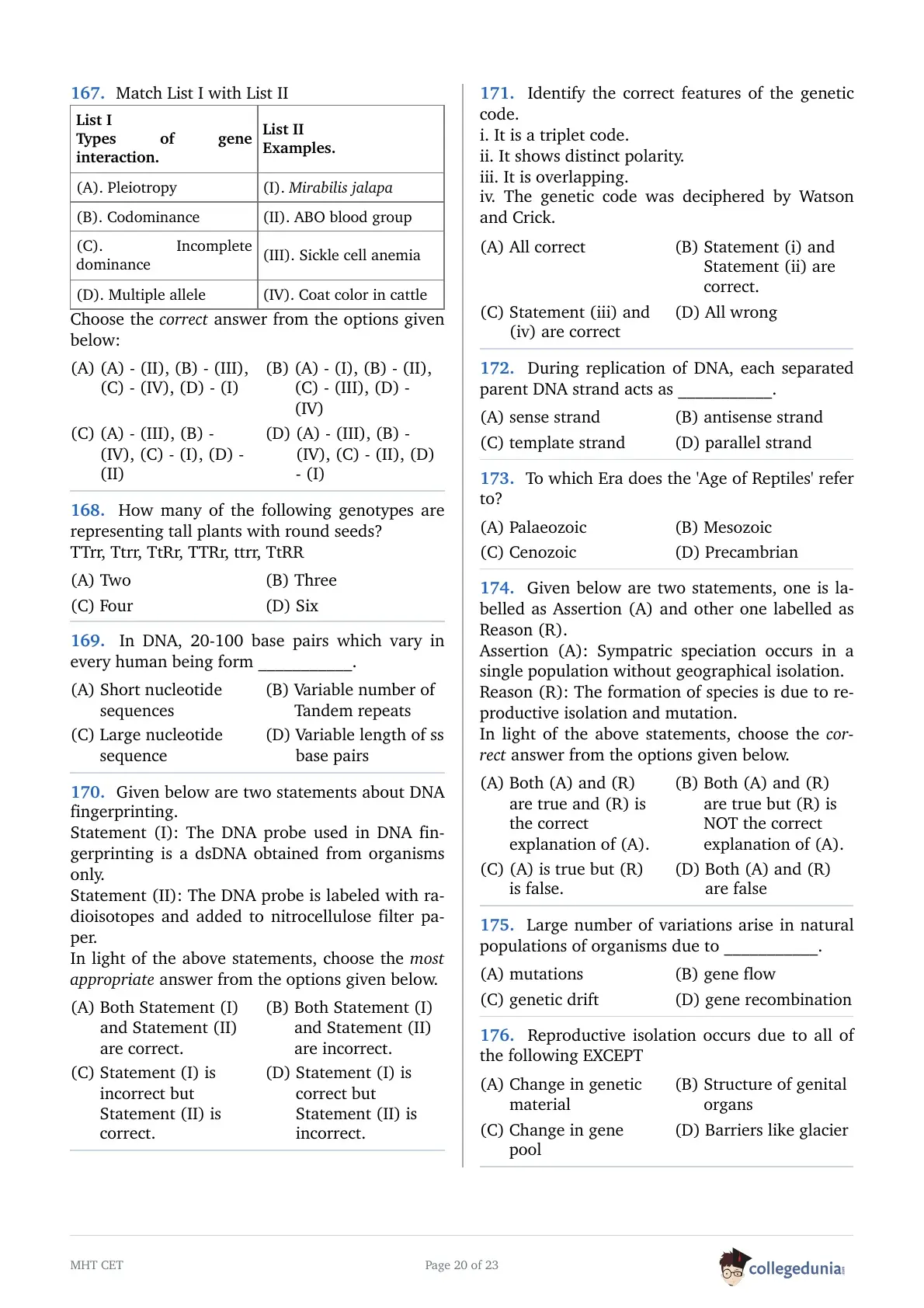
Match List I with List II
| List I Types of gene interaction. | List II Examples. |
|---|---|
| (A). Pleiotropy | (I). Mirabilis jalapa |
| (B). Codominance | (II). ABO blood group |
| (C). Incomplete dominance | (III). Sickle cell anemia |
| (D). Multiple allele | (IV). Coat color in cattle |
How many of the following genotypes are representing tall plants with round seeds?
TTrr, Ttrr, TtRr, TTRr, ttrr, TtRR
In DNA, 20-100 base pairs which vary in every human being form ___________.
Given below are two statements about DNA fingerprinting.
Statement (I): The DNA probe used in DNA fingerprinting is a dsDNA obtained from organisms only.
Statement (II): The DNA probe is labeled with radioisotopes and added to nitrocellulose filter paper.
In light of the above statements, choose the most appropriate answer from the options given below.
Identify the correct features of the genetic code.
i. It is a triplet code.
ii. It shows distinct polarity.
iii. It is overlapping.
iv. The genetic code was deciphered by Watson and Crick.
During replication of DNA, each separated parent DNA strand acts as ___________.
To which Era does the 'Age of Reptiles' refer to?
Given below are two statements, one is labelled as Assertion (A) and other one labelled as Reason (R).
Assertion (A): Sympatric speciation occurs in a single population without geographical isolation.
Reason (R): The formation of species is due to reproductive isolation and mutation.
In light of the above statements, choose the correct answer from the options given below.
Large number of variations arise in natural populations of organisms due to ___________.
Reproductive isolation occurs due to all of the following EXCEPT
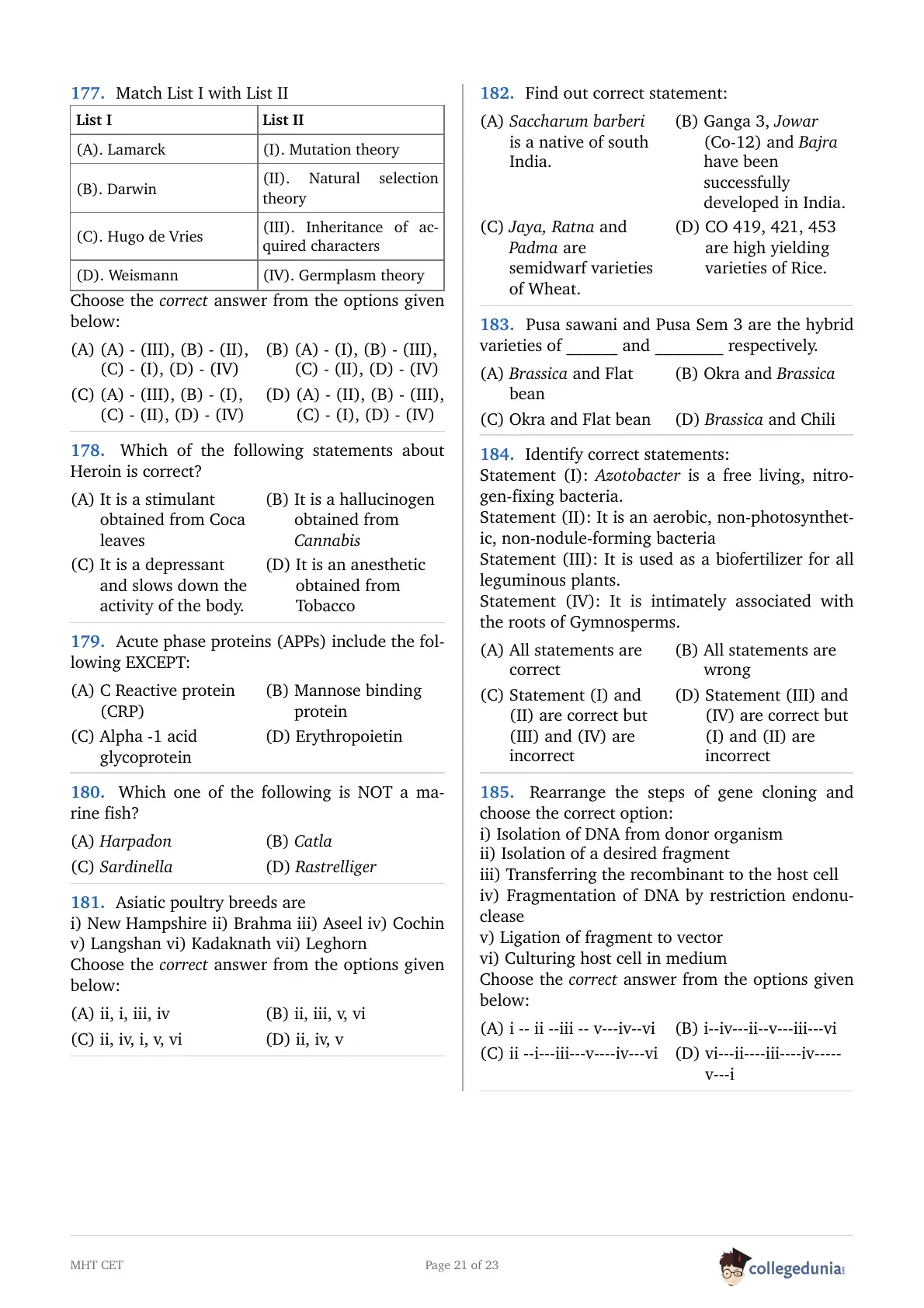
Match List I with List II
| List I | List II |
|---|---|
| (A). Lamarck | (I). Mutation theory |
| (B). Darwin | (II). Natural selection theory |
| (C). Hugo de Vries | (III). Inheritance of acquired characters |
| (D). Weismann | (IV). Germplasm theory |
Which of the following statements about Heroin is correct?
Acute phase proteins (APPs) include the following EXCEPT:
Which one of the following is NOT a marine fish?
Asiatic poultry breeds are
i) New Hampshire ii) Brahma iii) Aseel iv) Cochin v) Langshan vi) Kadaknath vii) Leghorn
Choose the correct answer from the options given below:
Find out correct statement:
Pusa sawani and Pusa Sem 3 are the hybrid varieties of ______ and ________ respectively.
Identify correct statements:
Statement (I): Azotobacter is a free living, nitrogen-fixing bacteria.
Statement (II): It is an aerobic, non-photosynthetic, non-nodule-forming bacteria
Statement (III): It is used as a biofertilizer for all leguminous plants.
Statement (IV): It is intimately associated with the roots of Gymnosperms.
Rearrange the steps of gene cloning and choose the correct option:
i) Isolation of DNA from donor organism
ii) Isolation of a desired fragment
iii) Transferring the recombinant to the host cell
iv) Fragmentation of DNA by restriction endonuclease
v) Ligation of fragment to vector
vi) Culturing host cell in medium
Choose the correct answer from the options given below:
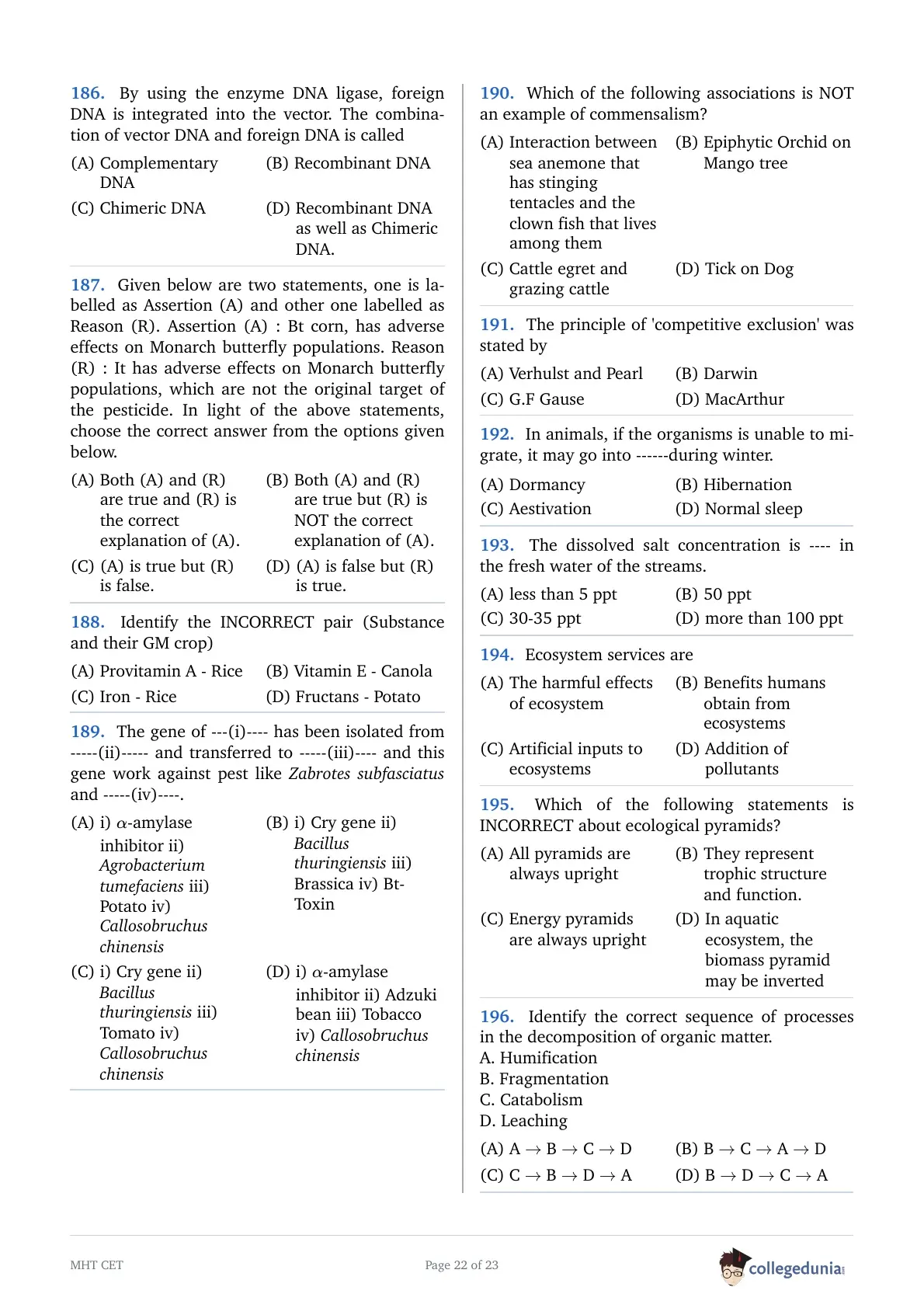
By using the enzyme DNA ligase, foreign DNA is integrated into the vector. The combination of vector DNA and foreign DNA is called
Given below are two statements, one is labelled as Assertion (A) and other one labelled as Reason (R). Assertion (A) : Bt corn, has adverse effects on Monarch butterfly populations. Reason (R) : It has adverse effects on Monarch butterfly populations, which are not the original target of the pesticide. In light of the above statements, choose the correct answer from the options given below.
Identify the INCORRECT pair (Substance and their GM crop)
The gene of ---(i)---- has been isolated from -----(ii)----- and transferred to -----(iii)---- and this gene work against pest like Zabrotes subfasciatus and -----(iv)----.
Which of the following associations is NOT an example of commensalism?
The principle of 'competitive exclusion' was stated by
In animals, if the organisms is unable to migrate, it may go into ------during winter.
The dissolved salt concentration is ---- in the fresh water of the streams.
Ecosystem services are
Which of the following statements is INCORRECT about ecological pyramids?
Identify the correct sequence of processes in the decomposition of organic matter.
A. Humification
B. Fragmentation
C. Catabolism
D. Leaching
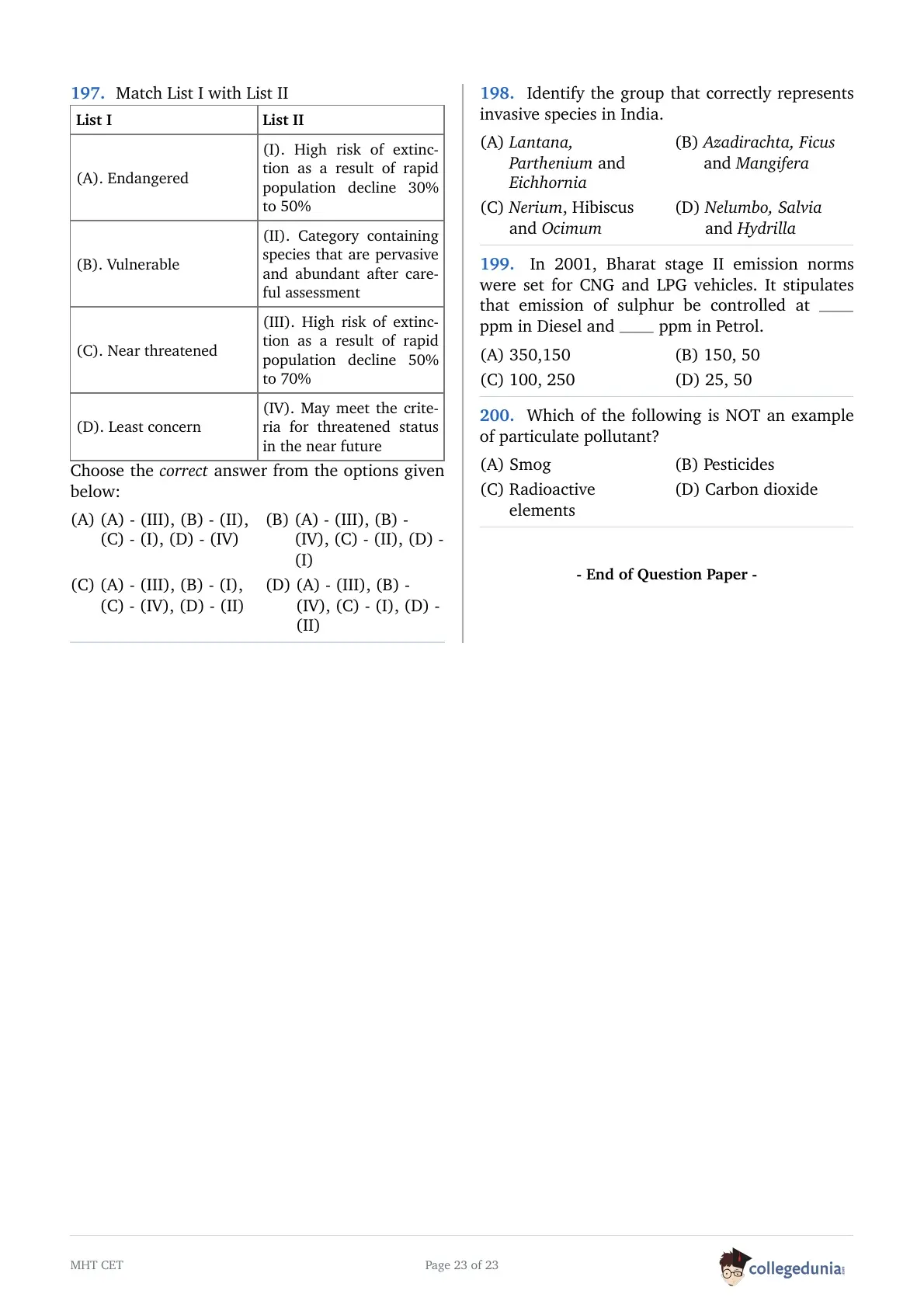
Match List I with List II
| List I | List II |
|---|---|
| (A). Endangered | (I). High risk of extinction as a result of rapid population decline 30% to 50% |
| (B). Vulnerable | (II). Category containing species that are pervasive and abundant after careful assessment |
| (C). Near threatened | (III). High risk of extinction as a result of rapid population decline 50% to 70% |
| (D). Least concern | (IV). May meet the criteria for threatened status in the near future |
Identify the group that correctly represents invasive species in India.
In 2001, Bharat stage II emission norms were set for CNG and LPG vehicles. It stipulates that emission of sulphur be controlled at \(\_\_\_\_\) ppm in Diesel and \(\_\_\_\_\) ppm in Petrol.
Which of the following is NOT an example of particulate pollutant?
MHT CET 2026 PCB Exam Pattern and Marking Scheme
| Parameter | Details |
|---|---|
| Conducting Body | Maharashtra Common Entrance Test Cell (Maharashtra CET Cell) |
| Exam Mode | Online (Computer-Based Test) |
| Duration | 180 minutes (3 hours) |
| Groups / Subjects | PCB (Physics, Chemistry, Biology) for Pharmacy and Agriculture |
| Total Questions |
200 |
| Total Marks | 200 |
| Question Type | Multiple Choice Questions (MCQs) |
| Marking Scheme | 1 mark for each correct answer |
| Negative Marking | No |
| Syllabus Weightage |
|



Comments