




MHT CET 2026 April 24 Shift 1 PCB Question Paper is available for download here. Maharashtra State CET Cell conducted MHT CET 2026 PCB Exam on April 24 in Shift 1 from 9 AM to 12 PM in CBT mode.
The MHT CET 2026 PCB question paper includes the following:
- The MHT CET 2026 PCB Question Paper consists of 200 multiple-choice questions (MCQs) totalling 200 marks divided into 3 sections: Physics (50 questions), Chemistry (50 questions), and Biology (100 questions).
- All questions carry 1 mark each. There is no negative marking for incorrect answers.
MHT CET 2026 April 24 Shift 1 PCB Question Paper with Solution PDF
| CD PDF | CD PDF with Solutions |
|---|---|
| Download Collegedunia PDF 1.12 MB | - |
Also Check:
MHT CET 2026 April 24 Shift 1 PCB Questions with Solutions
Physics (Q1 - Q50)
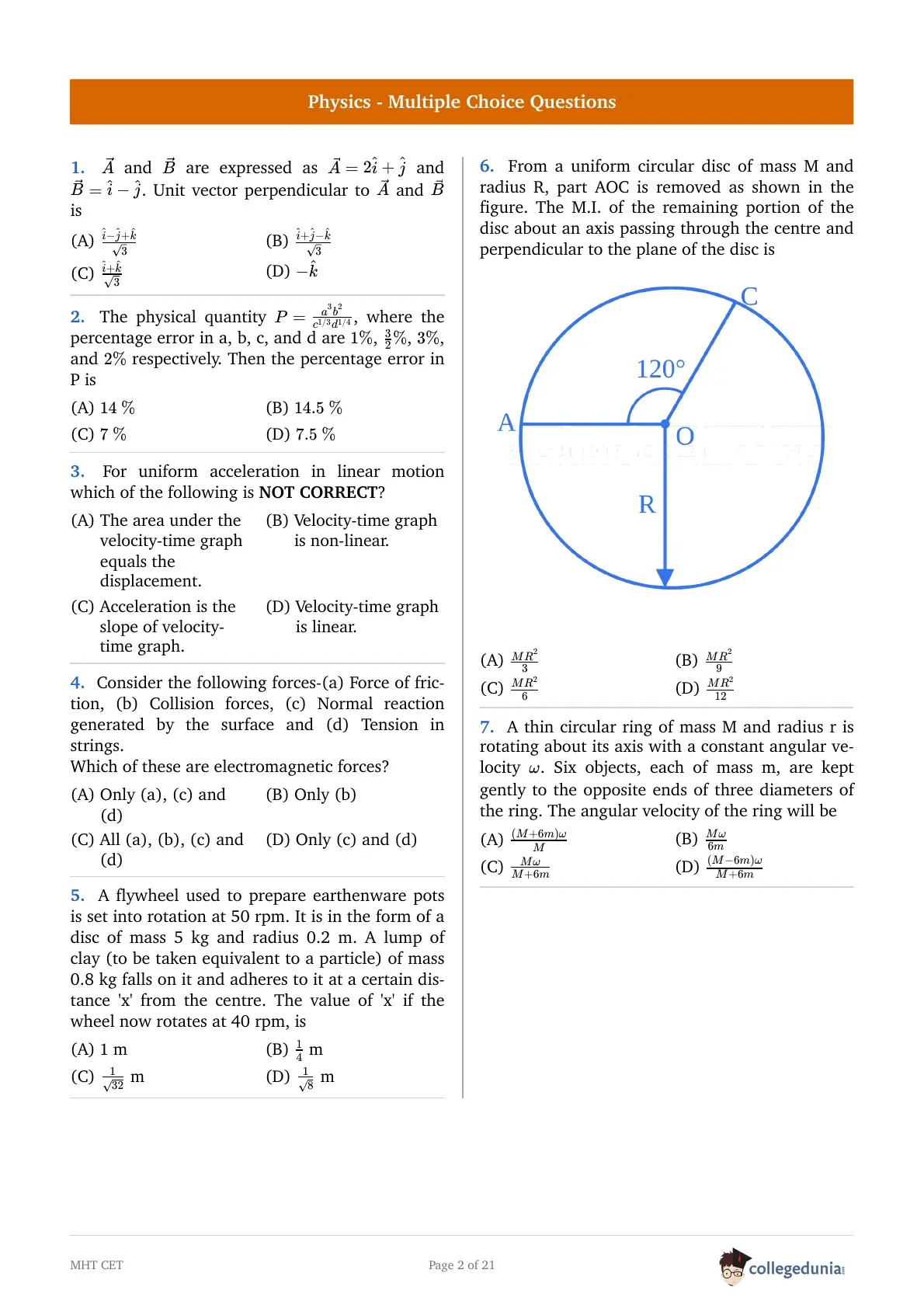
\(\vec{A}\) and \(\vec{B}\) are expressed as \(\vec{A}=2\hat{i}+\hat{j}\) and \(\vec{B}=\hat{i}-\hat{j}\). Unit vector perpendicular to \(\vec{A}\) and \(\vec{B}\) is
The physical quantity \(P=\frac{a^{3}b^{2}}{c^{1/3}d^{1/4}}\), where the percentage error in a, b, c, and d are \(1\%\), \(\frac{3}{2}\%\), \(3\%\), and \(2\%\) respectively. Then the percentage error in P is
For uniform acceleration in linear motion which of the following is NOT CORRECT?
Consider the following forces-(a) Force of friction, (b) Collision forces, (c) Normal reaction generated by the surface and (d) Tension in strings.
Which of these are electromagnetic forces?
A flywheel used to prepare earthenware pots is set into rotation at 50 rpm. It is in the form of a disc of mass 5 kg and radius 0.2 m. A lump of clay (to be taken equivalent to a particle) of mass 0.8 kg falls on it and adheres to it at a certain distance 'x' from the centre. The value of 'x' if the wheel now rotates at 40 rpm, is
From a uniform circular disc of mass M and radius R, part AOC is removed as shown in the figure. The M.I. of the remaining portion of the disc about an axis passing through the centre and perpendicular to the plane of the disc is

A thin circular ring of mass M and radius r is rotating about its axis with a constant angular velocity \(\omega\). Six objects, each of mass m, are kept gently to the opposite ends of three diameters of the ring. The angular velocity of the ring will be
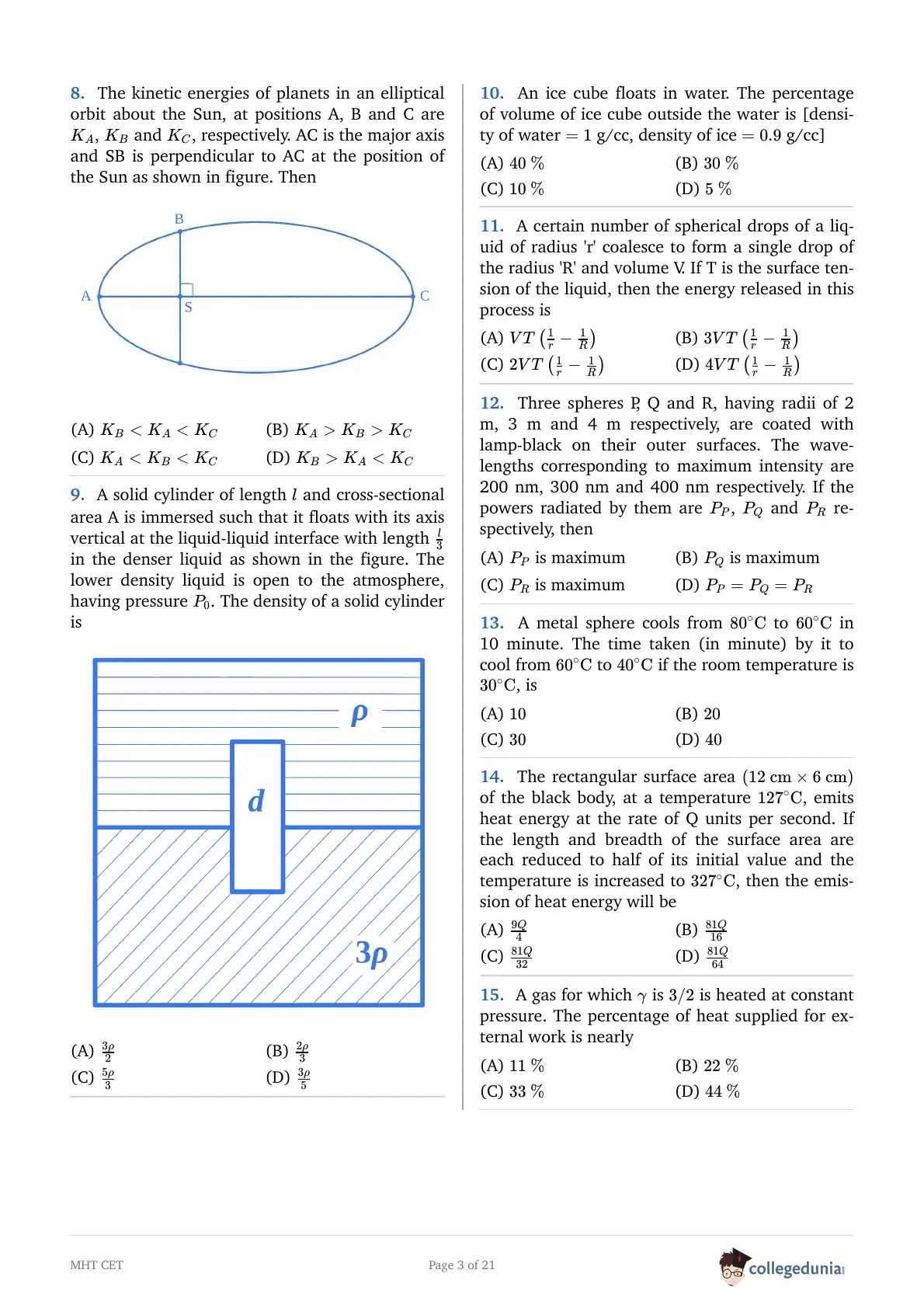
The kinetic energies of planets in an elliptical orbit about the Sun, at positions A, B and C are \(K_{A}\), \(K_{B}\) and \(K_{C}\), respectively. AC is the major axis and SB is perpendicular to AC at the position of the Sun as shown in figure. Then

A solid cylinder of length \(l\) and cross-sectional area A is immersed such that it floats with its axis vertical at the liquid-liquid interface with length \(\frac{l}{3}\) in the denser liquid as shown in the figure. The lower density liquid is open to the atmosphere, having pressure \(P_{0}\). The density of a solid cylinder is

An ice cube floats in water. The percentage of volume of ice cube outside the water is [density of water \(=1\) g/cc, density of ice \(=0.9\) g/cc]
A certain number of spherical drops of a liquid of radius 'r' coalesce to form a single drop of the radius 'R' and volume V. If T is the surface tension of the liquid, then the energy released in this process is
Three spheres P, Q and R, having radii of 2 m, 3 m and 4 m respectively, are coated with lamp-black on their outer surfaces. The wavelengths corresponding to maximum intensity are 200 nm, 300 nm and 400 nm respectively. If the powers radiated by them are \(P_{P}\), \(P_{Q}\) and \(P_{R}\) respectively, then
A metal sphere cools from \(80^{\circ }\text{C}\) to \(60^{\circ }\text{C}\) in 10 minute. The time taken (in minute) by it to cool from \(60^{\circ }\text{C}\) to \(40^{\circ }\text{C}\) if the room temperature is \(30^{\circ }\text{C}\), is
The rectangular surface area \((12\ \text{cm}\times 6\ \text{cm})\) of the black body, at a temperature \(127^{\circ }\text{C}\), emits heat energy at the rate of Q units per second. If the length and breadth of the surface area are each reduced to half of its initial value and the temperature is increased to \(327^{\circ }\text{C}\), then the emission of heat energy will be
A gas for which \(\gamma\) is \(3/2\) is heated at constant pressure. The percentage of heat supplied for external work is nearly
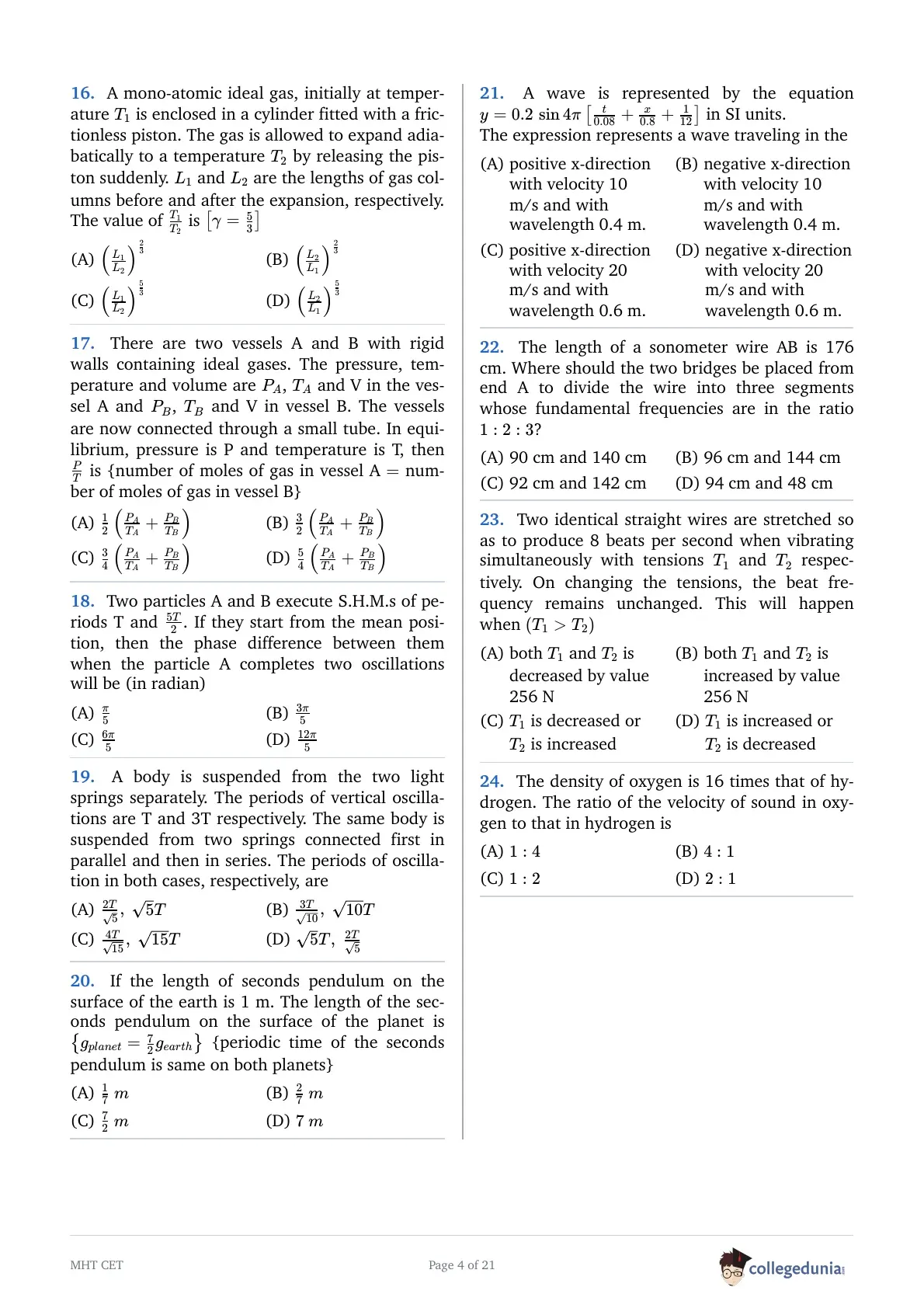
A mono-atomic ideal gas, initially at temperature \(T_{1}\) is enclosed in a cylinder fitted with a frictionless piston. The gas is allowed to expand adiabatically to a temperature \(T_{2}\) by releasing the piston suddenly. \(L_{1}\) and \(L_{2}\) are the lengths of gas columns before and after the expansion, respectively. The value of \(\frac{T_{1}}{T_{2}}\) is \(\left[\gamma =\frac{5}{3}\right]\)
There are two vessels A and B with rigid walls containing ideal gases. The pressure, temperature and volume are \(P_{A}\), \(T_{A}\) and V in the vessel A and \(P_{B}\), \(T_{B}\) and V in vessel B. The vessels are now connected through a small tube. In equilibrium, pressure is P and temperature is T, then \(\frac{P}{T}\) is {number of moles of gas in vessel A \(=\) number of moles of gas in vessel B}
Two particles A and B execute S.H.M.s of periods T and \(\frac{5T}{2}\). If they start from the mean position, then the phase difference between them when the particle A completes two oscillations will be (in radian)
A body is suspended from the two light springs separately. The periods of vertical oscillations are T and 3T respectively. The same body is suspended from two springs connected first in parallel and then in series. The periods of oscillation in both cases, respectively, are
If the length of seconds pendulum on the surface of the earth is 1 m. The length of the seconds pendulum on the surface of the planet is \(\left\{g_{planet}=\frac{7}{2}g_{earth}\right\}\) {periodic time of the seconds pendulum is same on both planets}
A wave is represented by the equation \(y=0.2\,\sin 4\pi \left[\frac{t}{0.08}+\frac{x}{0.8}+\frac{1}{12}\right]\) in SI units.
The expression represents a wave traveling in the
The length of a sonometer wire AB is 176 cm. Where should the two bridges be placed from end A to divide the wire into three segments whose fundamental frequencies are in the ratio \(1:2:3\)?
Two identical straight wires are stretched so as to produce 8 beats per second when vibrating simultaneously with tensions \(T_{1}\) and \(T_{2}\) respectively. On changing the tensions, the beat frequency remains unchanged. This will happen when \((T_{1}>T_{2})\)
The density of oxygen is 16 times that of hydrogen. The ratio of the velocity of sound in oxygen to that in hydrogen is
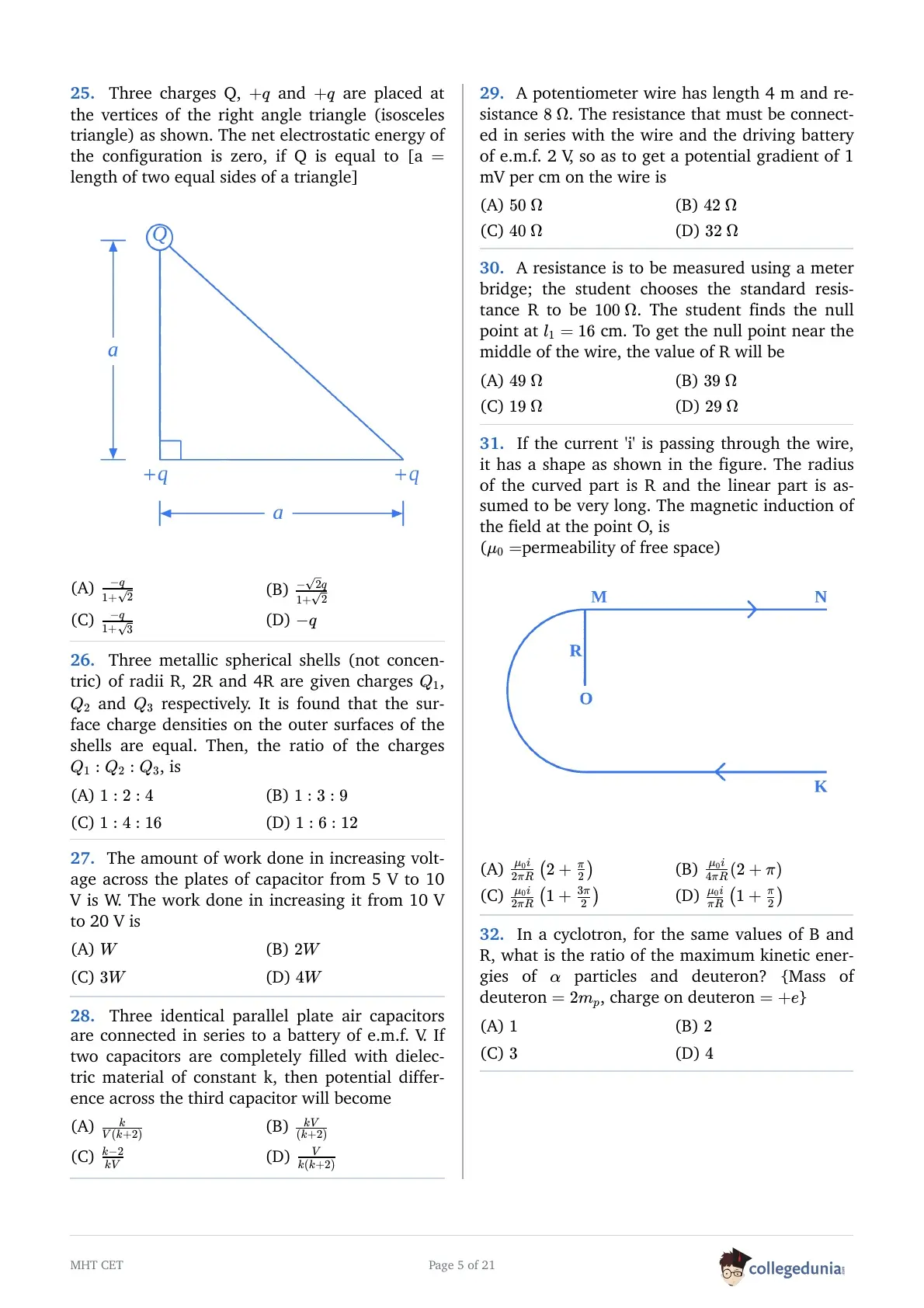
Three charges Q, \(+q\) and \(+q\) are placed at the vertices of the right angle triangle (isosceles triangle) as shown. The net electrostatic energy of the configuration is zero, if Q is equal to [a \(=\) length of two equal sides of a triangle]

Three metallic spherical shells (not concentric) of radii R, 2R and 4R are given charges \(Q_{1}\), \(Q_{2}\) and \(Q_{3}\) respectively. It is found that the surface charge densities on the outer surfaces of the shells are equal. Then, the ratio of the charges \(Q_{1}:Q_{2}:Q_{3}\), is
The amount of work done in increasing voltage across the plates of capacitor from 5 V to 10 V is W. The work done in increasing it from 10 V to 20 V is
Three identical parallel plate air capacitors are connected in series to a battery of e.m.f. V. If two capacitors are completely filled with dielectric material of constant k, then potential difference across the third capacitor will become
A potentiometer wire has length 4 m and resistance \(8\ \Omega\). The resistance that must be connected in series with the wire and the driving battery of e.m.f. 2 V, so as to get a potential gradient of 1 mV per cm on the wire is
A resistance is to be measured using a meter bridge; the student chooses the standard resistance R to be \(100\ \Omega\). The student finds the null point at \(l_{1}=16\) cm. To get the null point near the middle of the wire, the value of R will be
If the current 'i' is passing through the wire, it has a shape as shown in the figure. The radius of the curved part is R and the linear part is assumed to be very long. The magnetic induction of the field at the point O, is
(\(\mu _{0}=\)permeability of free space)

In a cyclotron, for the same values of B and R, what is the ratio of the maximum kinetic energies of \(\alpha\) particles and deuteron? {Mass of deuteron \(=2m_{p}\), charge on deuteron \(=+e\)}
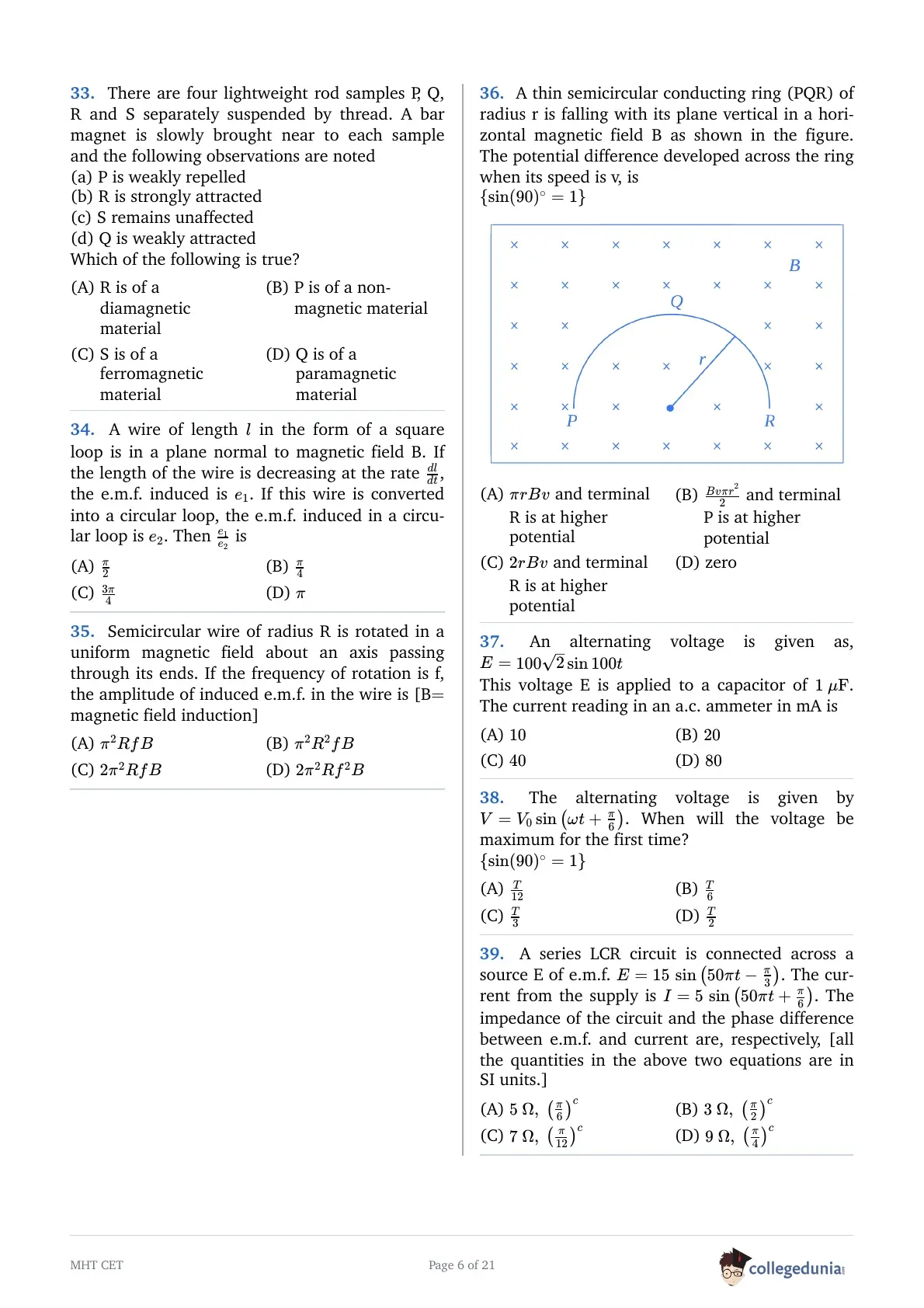
There are four lightweight rod samples P, Q, R and S separately suspended by thread. A bar magnet is slowly brought near to each sample and the following observations are noted
(a) P is weakly repelled
(b) R is strongly attracted
(c) S remains unaffected
(d) Q is weakly attracted
Which of the following is true?
A wire of length \(l\) in the form of a square loop is in a plane normal to magnetic field B. If the length of the wire is decreasing at the rate \(\frac{dl}{dt}\), the e.m.f. induced is \(e_{1}\). If this wire is converted into a circular loop, the e.m.f. induced in a circular loop is \(e_{2}\). Then \(\frac{e_{1}}{e_{2}}\) is
Semicircular wire of radius R is rotated in a uniform magnetic field about an axis passing through its ends. If the frequency of rotation is f, the amplitude of induced e.m.f. in the wire is [B\(=\)magnetic field induction]
A thin semicircular conducting ring (PQR) of radius r is falling with its plane vertical in a horizontal magnetic field B as shown in the figure. The potential difference developed across the ring when its speed is v, is
\(\{\sin (90)^{\circ }=1\}\)

An alternating voltage is given as, \(E=100\sqrt{2}\sin 100t\)
This voltage E is applied to a capacitor of \(1\ \mu \text{F}\). The current reading in an a.c. ammeter in mA is
The alternating voltage is given by \(V=V_{0}\sin \left(\omega t+\frac{\pi }{6}\right)\). When will the voltage be maximum for the first time?
\(\{\sin (90)^{\circ }=1\}\)
A series LCR circuit is connected across a source E of e.m.f. \(E=15\,\sin \left(50\pi t-\frac{\pi }{3}\right)\). The current from the supply is \(I=5\,\sin \left(50\pi t+\frac{\pi }{6}\right)\). The impedance of the circuit and the phase difference between e.m.f. and current are, respectively, [all the quantities in the above two equations are in SI units.]
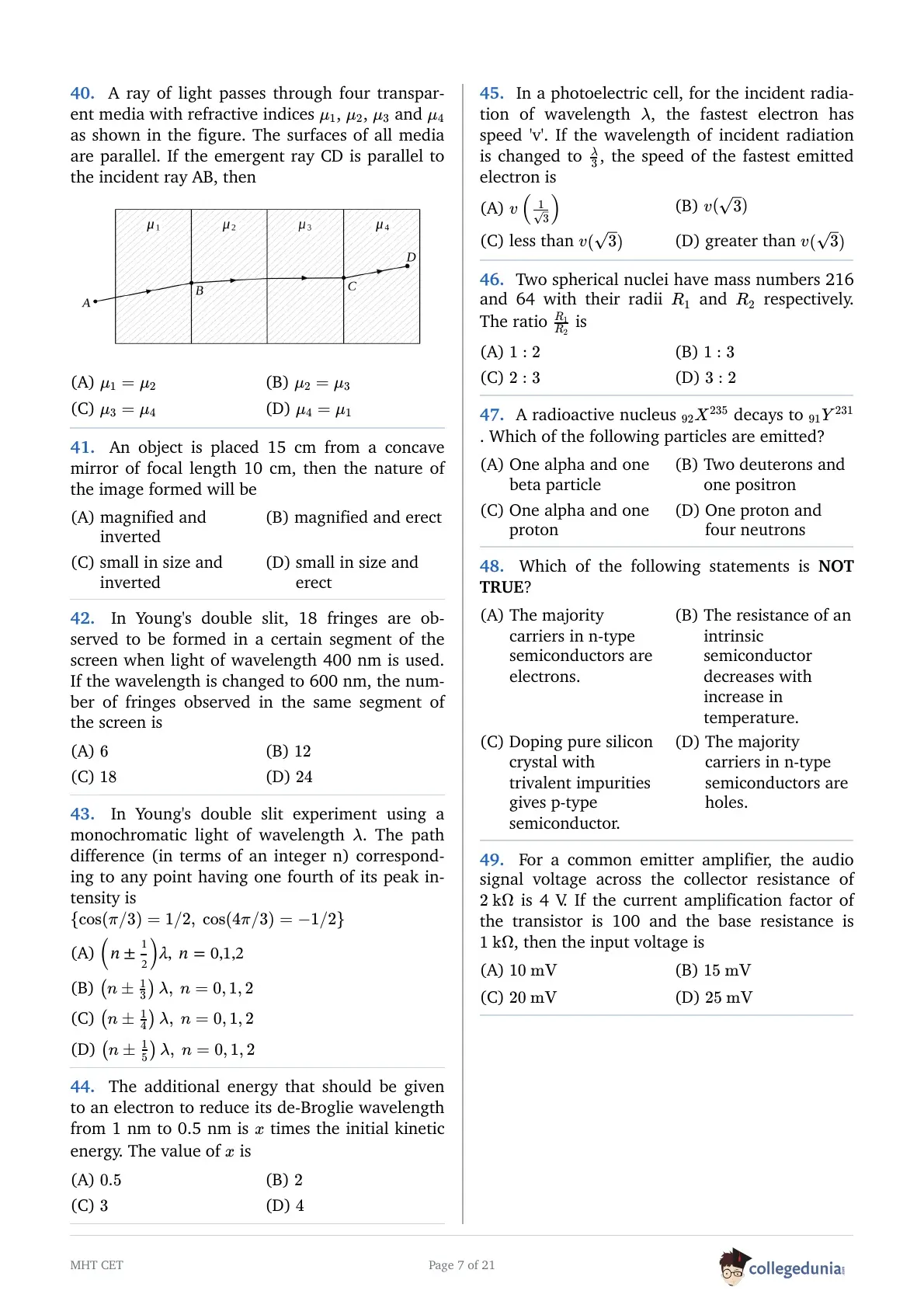
A ray of light passes through four transparent media with refractive indices \(\mu _{1}\), \(\mu _{2}\), \(\mu _{3}\) and \(\mu _{4}\) as shown in the figure. The surfaces of all media are parallel. If the emergent ray CD is parallel to the incident ray AB, then

An object is placed 15 cm from a concave mirror of focal length 10 cm, then the nature of the image formed will be
In Young's double slit, 18 fringes are observed to be formed in a certain segment of the screen when light of wavelength 400 nm is used. If the wavelength is changed to 600 nm, the number of fringes observed in the same segment of the screen is
In Young's double slit experiment using a monochromatic light of wavelength \(\lambda\). The path difference (in terms of an integer n) corresponding to any point having one fourth of its peak intensity is
\(\{\cos (\pi /3)=1/2,\ \cos (4\pi /3)=-1/2\}\)
The additional energy that should be given to an electron to reduce its de-Broglie wavelength from 1 nm to 0.5 nm is \(x\) times the initial kinetic energy. The value of \(x\) is
In a photoelectric cell, for the incident radiation of wavelength \(\lambda\), the fastest electron has speed 'v'. If the wavelength of incident radiation is changed to \(\frac{\lambda }{3}\), the speed of the fastest emitted electron is
Two spherical nuclei have mass numbers 216 and 64 with their radii \(R_{1}\) and \(R_{2}\) respectively. The ratio \(\frac{R_{1}}{R_{2}}\) is
A radioactive nucleus \({}_{92}X^{235}\) decays to \({}_{91}Y^{231}\). Which of the following particles are emitted?
Which of the following statements is NOT TRUE?
For a common emitter amplifier, the audio signal voltage across the collector resistance of \(2\ \text{k}\Omega\) is 4 V. If the current amplification factor of the transistor is 100 and the base resistance is \(1\ \text{k}\Omega\), then the input voltage is
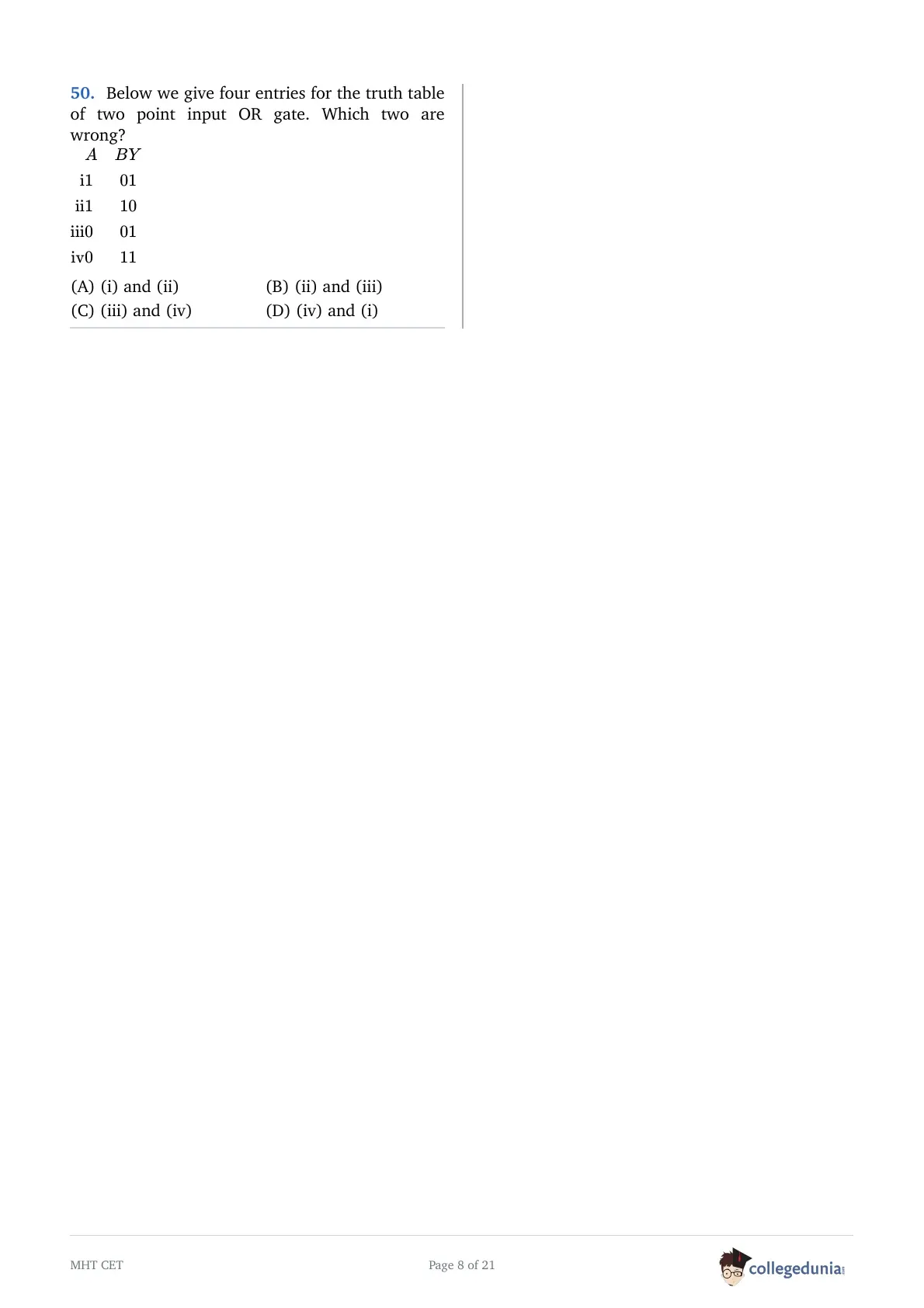
Below we give four entries for the truth table of two point input OR gate. Which two are wrong?
\(\begin{aligned} & A & B & Y \\ \text{i} & 1 & 0 & 1 \\ \text{ii} & 1 & 1 & 0 \\ \text{iii} & 0 & 0 & 1 \\ \text{iv} & 0 & 1 & 1 \end{aligned}\)
Chemistry (Q51 - Q100)
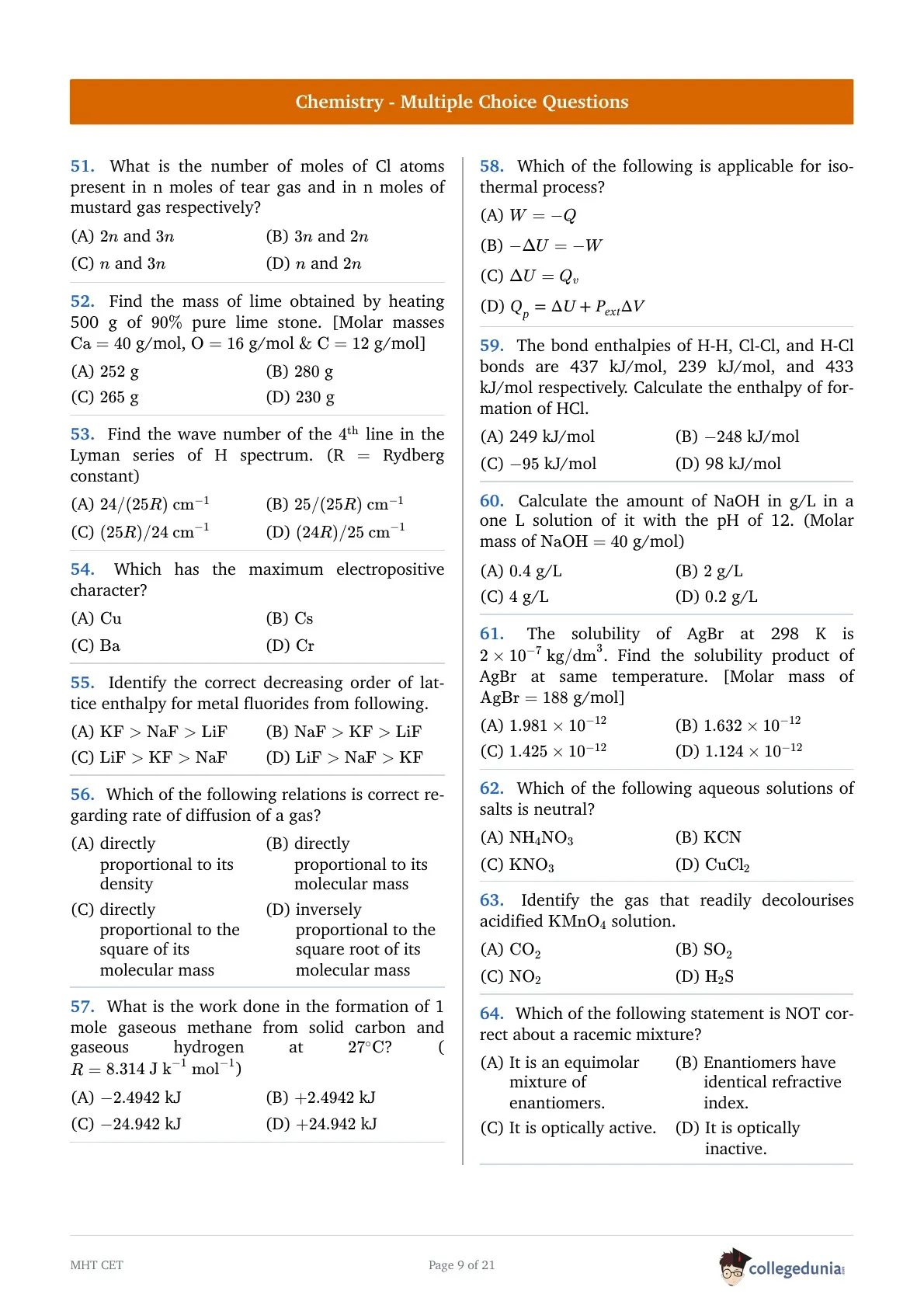
What is the number of moles of Cl atoms present in n moles of tear gas and in n moles of mustard gas respectively?
Find the mass of lime obtained by heating 500 g of \(90\%\) pure lime stone. [Molar masses \(\text{Ca}=40\) g/mol, \(\text{O}=16\) g/mol \(\&\) \(\text{C}=12\) g/mol]
Find the wave number of the \(4^{\text{th}}\) line in the Lyman series of H spectrum. (R \(=\) Rydberg constant)
Which has the maximum electropositive character?
Identify the correct decreasing order of lattice enthalpy for metal fluorides from following.
Which of the following relations is correct regarding rate of diffusion of a gas?
What is the work done in the formation of 1 mole gaseous methane from solid carbon and gaseous hydrogen at \(27^{\circ }\text{C}\)? (\(R=8.314\ \text{J k}^{-1}\text{ mol}^{-1}\))
Which of the following is applicable for isothermal process?
The bond enthalpies of H-H, Cl-Cl, and H-Cl bonds are 437 kJ/mol, 239 kJ/mol, and 433 kJ/mol respectively. Calculate the enthalpy of formation of HCl.
Calculate the amount of NaOH in g/L in a one L solution of it with the pH of 12. (Molar mass of \(\text{NaOH}=40\) g/mol)
The solubility of AgBr at 298 K is \(2\times 10^{-7}\ \text{kg/dm}^{3}\). Find the solubility product of AgBr at same temperature. [Molar mass of \(\text{AgBr}=188\) g/mol]
Which of the following aqueous solutions of salts is neutral?
Identify the gas that readily decolourises acidified \(\text{KMnO}_{4}\) solution.
Which of the following statement is NOT correct about a racemic mixture?
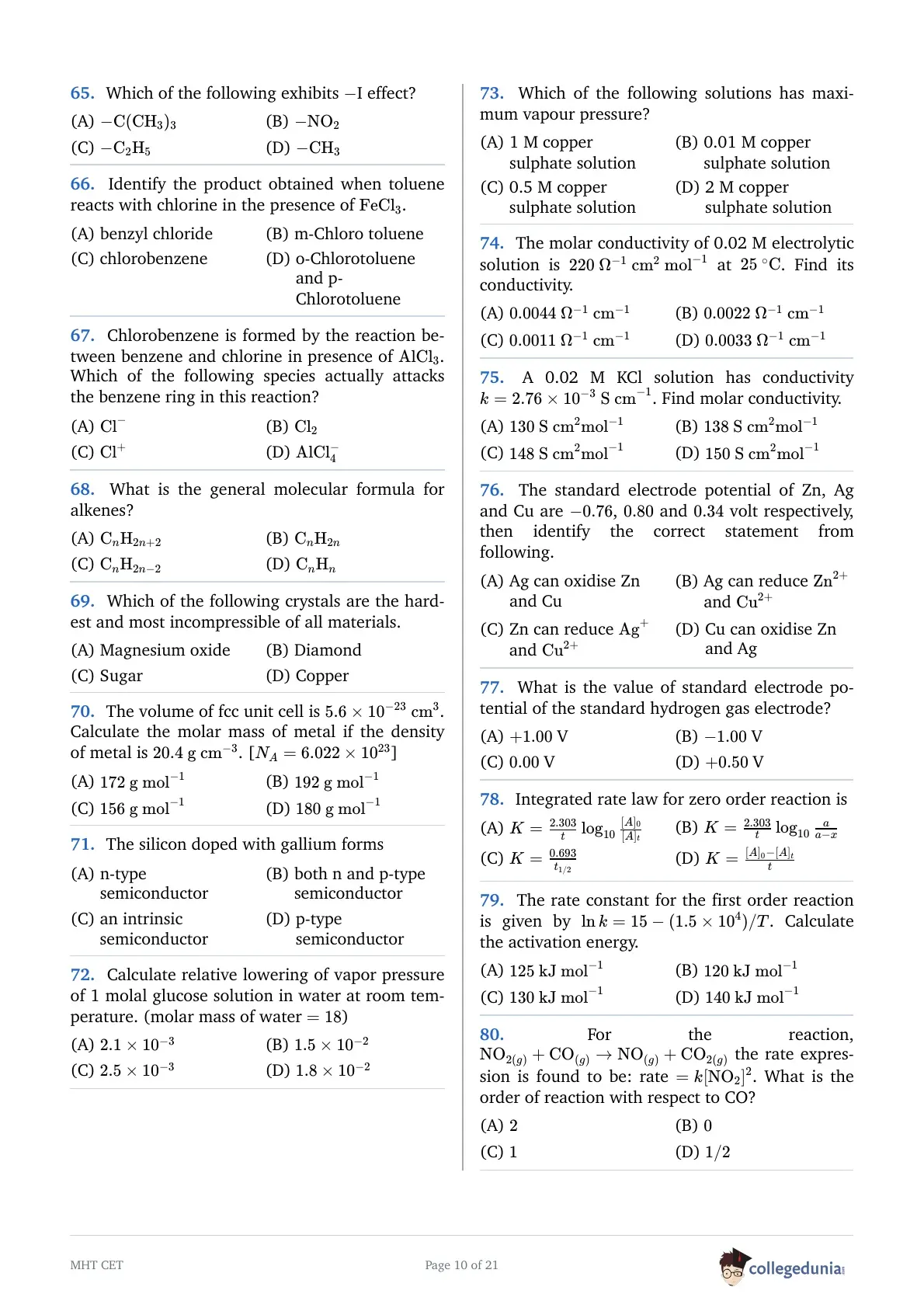
Which of the following exhibits \(-\)I effect?
Identify the product obtained when toluene reacts with chlorine in the presence of \(\text{FeCl}_{3}\).
Chlorobenzene is formed by the reaction between benzene and chlorine in presence of \(\text{AlCl}_{3}\). Which of the following species actually attacks the benzene ring in this reaction?
What is the general molecular formula for alkenes?
Which of the following crystals are the hardest and most incompressible of all materials.
The volume of fcc unit cell is \(5.6\times 10^{-23}\ \text{cm}^{3}\). Calculate the molar mass of metal if the density of metal is \(20.4\ \text{g cm}^{-3}\). [\(N_{A}=6.022\times 10^{23}\)]
The silicon doped with gallium forms
Calculate relative lowering of vapor pressure of 1 molal glucose solution in water at room temperature. (molar mass of water \(=18\))
Which of the following solutions has maximum vapour pressure?
The molar conductivity of 0.02 M electrolytic solution is \(220\ \Omega ^{-1}\text{ cm}^{2}\text{ mol}^{-1}\) at \(25\ ^{\circ }\text{C}\). Find its conductivity.
A 0.02 M KCl solution has conductivity \(k=2.76\times 10^{-3}\ \text{S cm}^{-1}\). Find molar conductivity.
The standard electrode potential of Zn, Ag and Cu are \(-0.76\), \(0.80\) and \(0.34\) volt respectively, then identify the correct statement from following.
What is the value of standard electrode potential of the standard hydrogen gas electrode?
Integrated rate law for zero order reaction is
The rate constant for the first order reaction is given by \(\ln k=15-(1.5\times 10^{4})/T\). Calculate the activation energy.
For the reaction, \(\text{NO}_{2(g)}+\text{CO}_{(g)}\rightarrow \text{NO}_{(g)}+\text{CO}_{2(g)}\) the rate expression is found to be: rate \(=k[\text{NO}_{2}]^{2}\). What is the order of reaction with respect to CO?
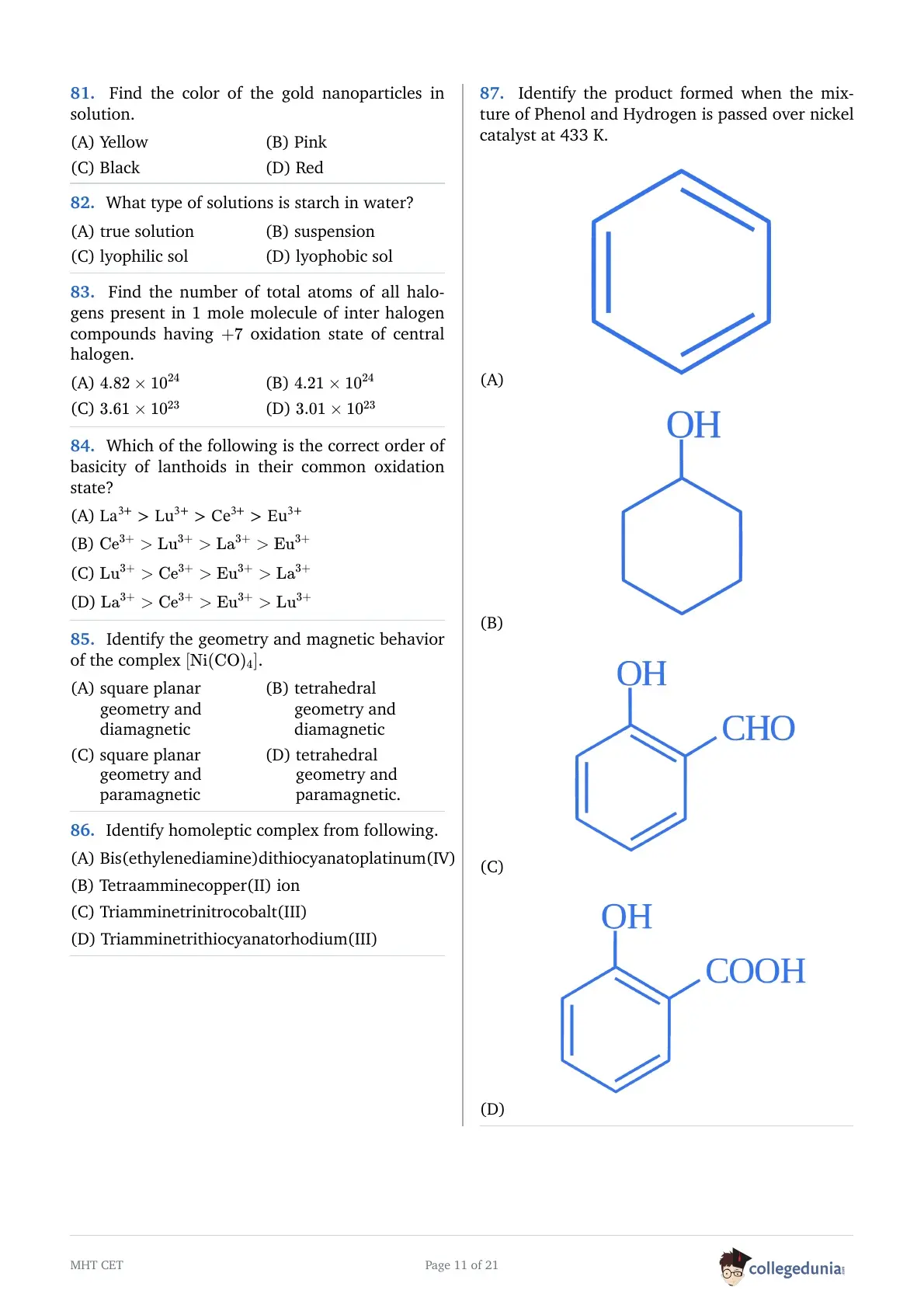
Find the color of the gold nanoparticles in solution.
What type of solutions is starch in water?
Find the number of total atoms of all halogens present in 1 mole molecule of inter halogen compounds having \(+7\) oxidation state of central halogen.
Which of the following is the correct order of basicity of lanthoids in their common oxidation state?
Identify the geometry and magnetic behavior of the complex \([\text{Ni}(\text{CO})_{4}]\).
Identify homoleptic complex from following.
Identify the product formed when the mixture of Phenol and Hydrogen is passed over nickel catalyst at 433 K.
- (A)
![]()
- (B)
![]()
- (C)
![]()
- (D)
![]()


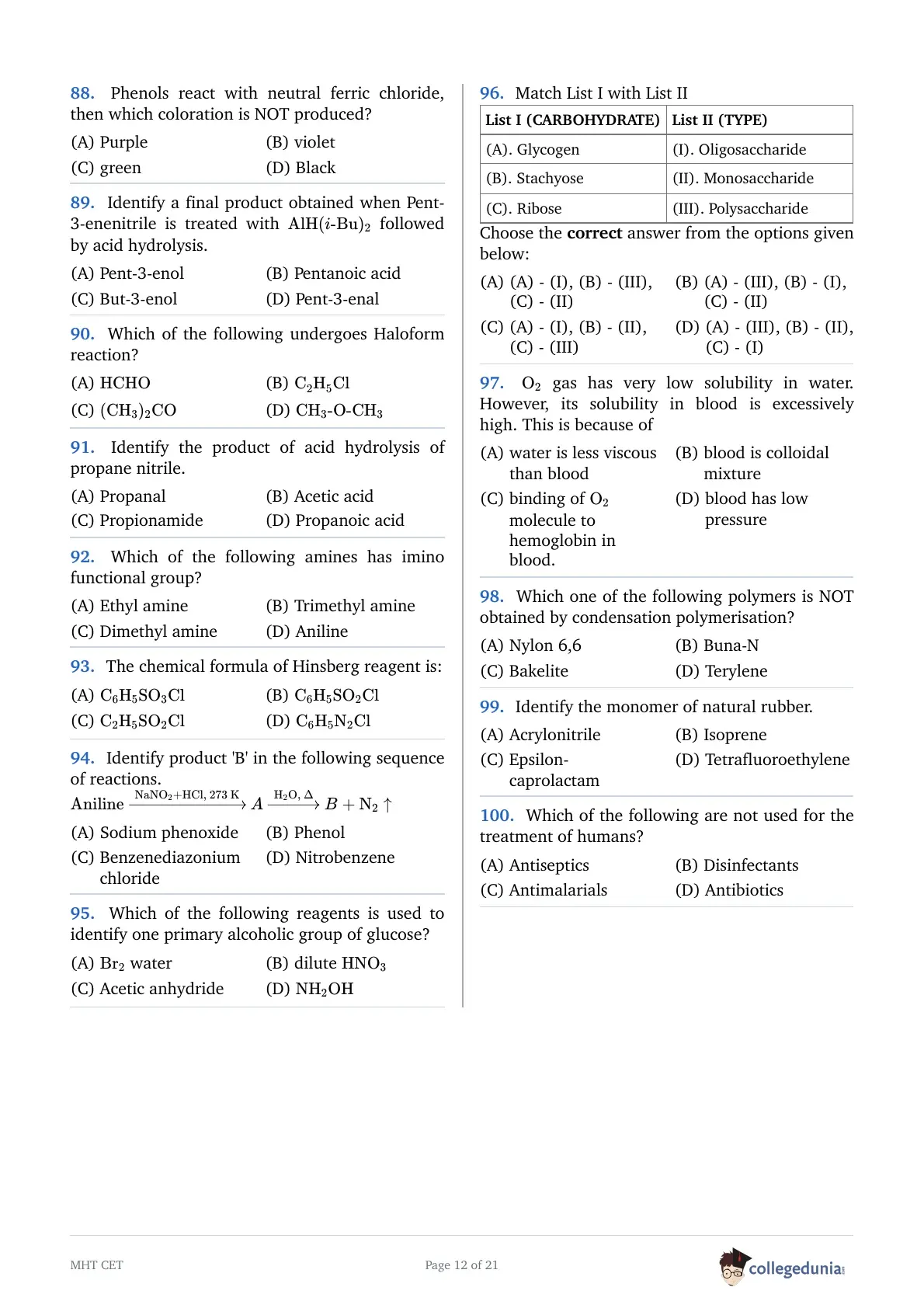
Phenols react with neutral ferric chloride, then which coloration is NOT produced?
Identify a final product obtained when Pent-3-enenitrile is treated with \(\text{AlH}(i\text{-Bu})_{2}\) followed by acid hydrolysis.
Which of the following undergoes Haloform reaction?
Identify the product of acid hydrolysis of propane nitrile.
Which of the following amines has imino functional group?
The chemical formula of Hinsberg reagent is:
Identify product 'B' in the following sequence of reactions.
\(\text{Aniline}\xrightarrow{\text{NaNO}_{2}+\text{HCl},\ 273\ \text{K}}A\xrightarrow{\text{H}_{2}\text{O},\ \Delta }B+\text{N}_{2}\uparrow\)
Which of the following reagents is used to identify one primary alcoholic group of glucose?
Match List I with List II
| List I (CARBOHYDRATE) | List II (TYPE) |
|---|---|
| (A). Glycogen | (I). Oligosaccharide |
| (B). Stachyose | (II). Monosaccharide |
| (C). Ribose | (III). Polysaccharide |
\(\text{O}_{2}\) gas has very low solubility in water. However, its solubility in blood is excessively high. This is because of
Which one of the following polymers is NOT obtained by condensation polymerisation?
Identify the monomer of natural rubber.
Which of the following are not used for the treatment of humans?
Biology (Q101 - Q200)
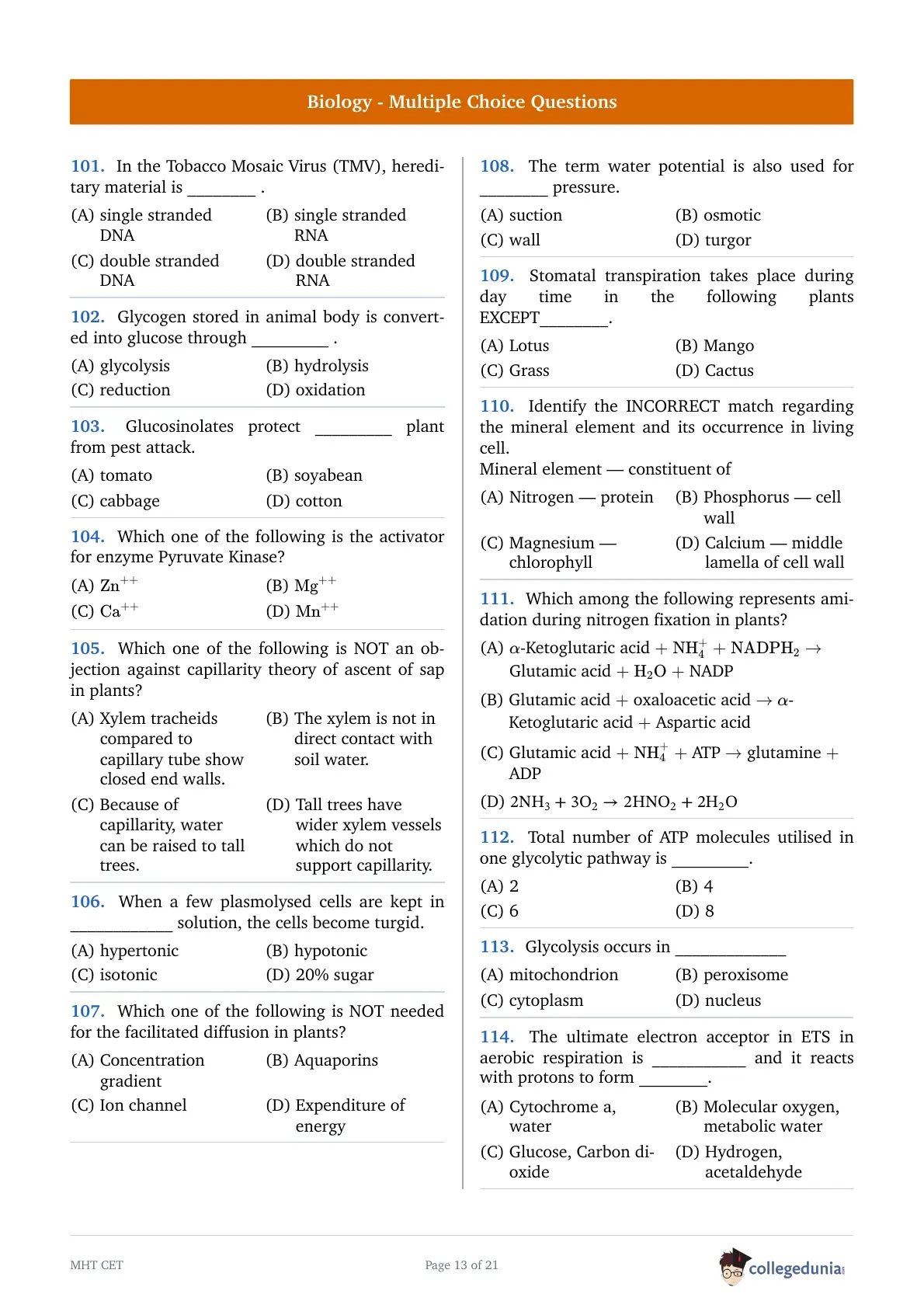
In the Tobacco Mosaic Virus (TMV), hereditary material is ________ .
Glycogen stored in animal body is converted into glucose through _________ .
Glucosinolates protect _________ plant from pest attack.
Which one of the following is the activator for enzyme Pyruvate Kinase?
Which one of the following is NOT an objection against capillarity theory of ascent of sap in plants?
When a few plasmolysed cells are kept in ____________ solution, the cells become turgid.
Which one of the following is NOT needed for the facilitated diffusion in plants?
The term water potential is also used for ________ pressure.
Stomatal transpiration takes place during day time in the following plants EXCEPT________.
Identify the INCORRECT match regarding the mineral element and its occurrence in living cell.
Mineral element — constituent of
Which among the following represents amidation during nitrogen fixation in plants?
Total number of ATP molecules utilised in one glycolytic pathway is _________.
Glycolysis occurs in _____________
The ultimate electron acceptor in ETS in aerobic respiration is ___________ and it reacts with protons to form ________.
Given below are two statements:
Statement (I): There is accumulation of lactic acid in skeletal muscles during vigorous exercise.
Statement (II): Lactic acid is reconverted into pyruvic acid during resting stage of skeletal muscles.
In light of the above statements, choose the most appropriate answer from the options given below.
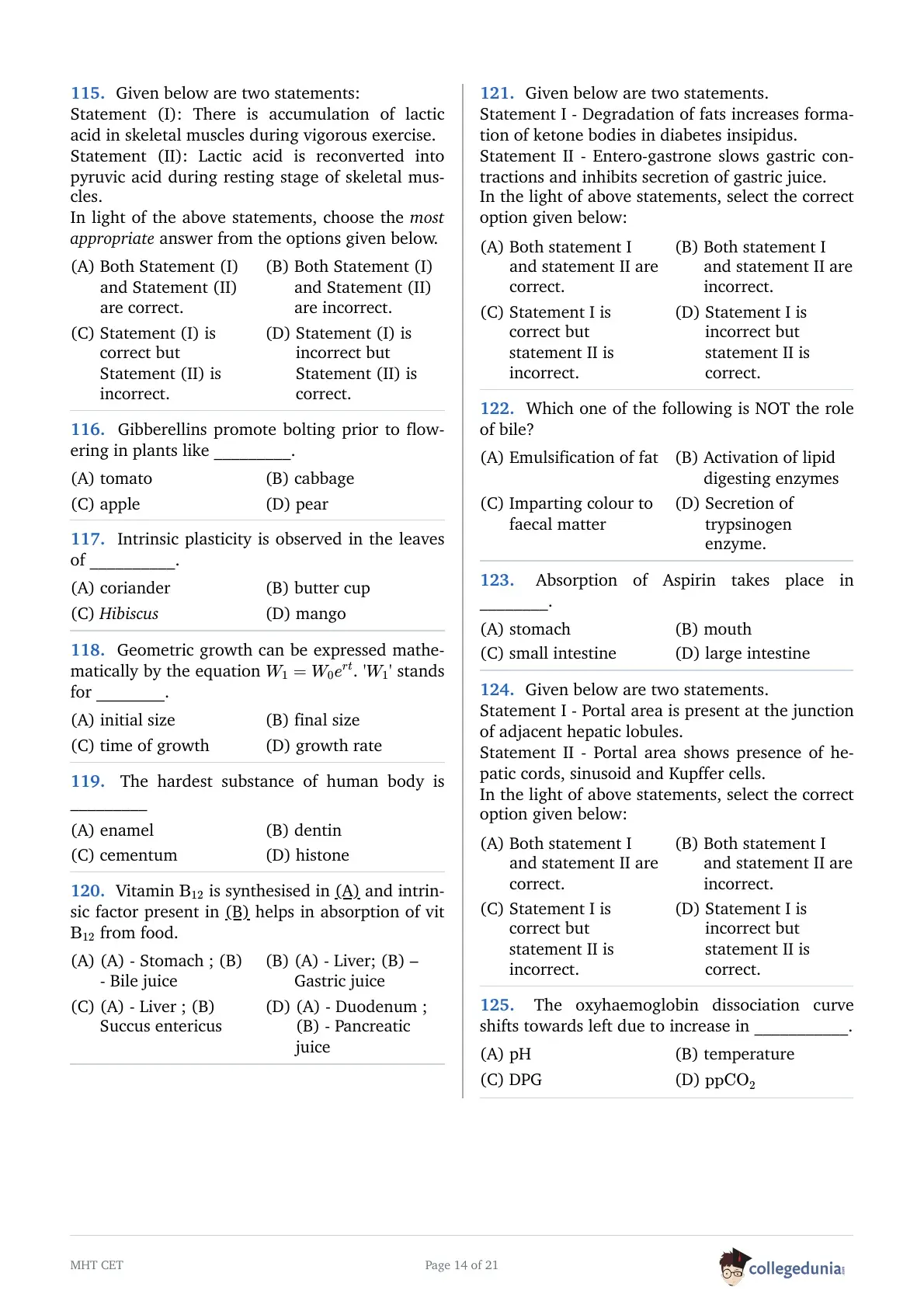
Gibberellins promote bolting prior to flowering in plants like _________.
Intrinsic plasticity is observed in the leaves of __________.
Geometric growth can be expressed mathematically by the equation \(W_{1}=W_{0}e^{rt}\). '\(W_{1}\)' stands for ________.
The hardest substance of human body is _________
Vitamin \(\text{B}_{12}\) is synthesised in (A) and intrinsic factor present in (B) helps in absorption of vit \(\text{B}_{12}\) from food.
Given below are two statements.
Statement I - Degradation of fats increases formation of ketone bodies in diabetes insipidus.
Statement II - Entero-gastrone slows gastric contractions and inhibits secretion of gastric juice.
In the light of above statements, select the correct option given below:
Which one of the following is NOT the role of bile?
Absorption of Aspirin takes place in ________.
Given below are two statements.
Statement I - Portal area is present at the junction of adjacent hepatic lobules.
Statement II - Portal area shows presence of hepatic cords, sinusoid and Kupffer cells.
In the light of above statements, select the correct option given below:
The oxyhaemoglobin dissociation curve shifts towards left due to increase in ___________.
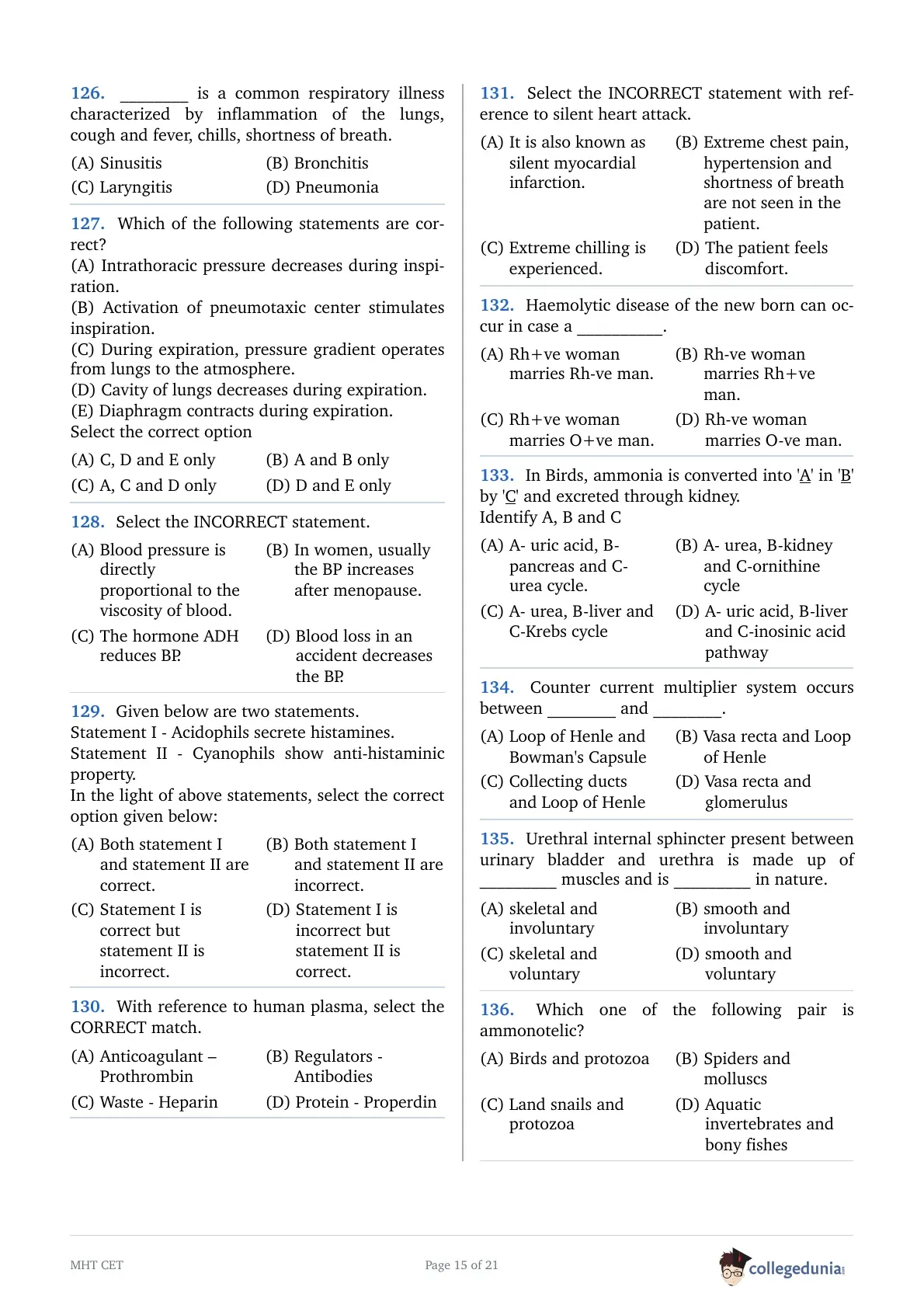
________ is a common respiratory illness characterized by inflammation of the lungs, cough and fever, chills, shortness of breath.
Which of the following statements are correct?
(A) Intrathoracic pressure decreases during inspiration.
(B) Activation of pneumotaxic center stimulates inspiration.
(C) During expiration, pressure gradient operates from lungs to the atmosphere.
(D) Cavity of lungs decreases during expiration.
(E) Diaphragm contracts during expiration.
Select the correct option
Select the INCORRECT statement.
Given below are two statements.
Statement I - Acidophils secrete histamines.
Statement II - Cyanophils show anti-histaminic property.
In the light of above statements, select the correct option given below:
With reference to human plasma, select the CORRECT match.
Select the INCORRECT statement with reference to silent heart attack.
Haemolytic disease of the new born can occur in case a __________.
In Birds, ammonia is converted into 'A' in 'B' by 'C' and excreted through kidney.
Identify A, B and C
Counter current multiplier system occurs between ________ and ________.
Urethral internal sphincter present between urinary bladder and urethra is made up of _________ muscles and is _________ in nature.
Which one of the following pair is ammonotelic?
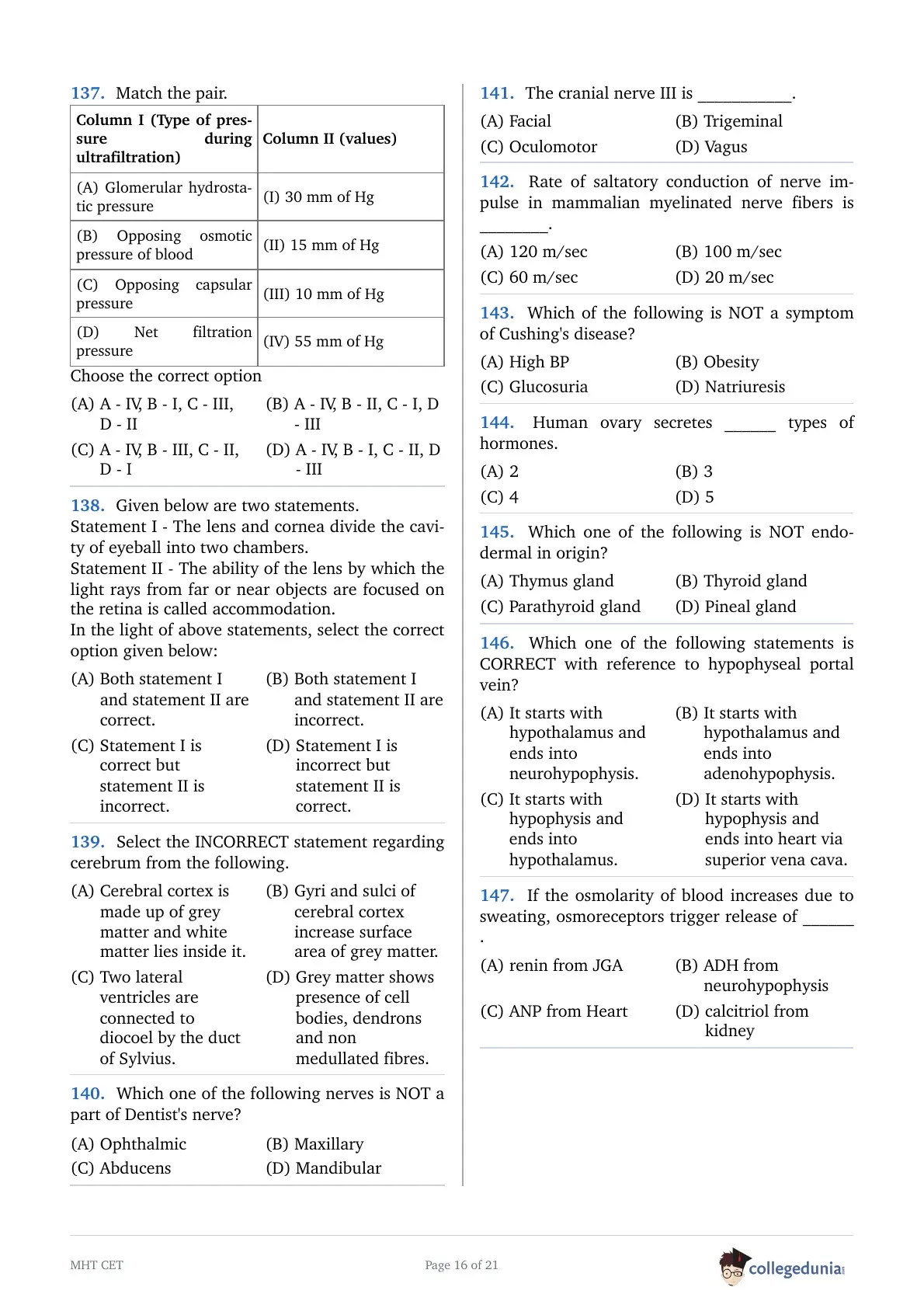
Match the pair.
| Column I (Type of pressure during ultrafiltration) | Column II (values) |
|---|---|
| (A) Glomerular hydrostatic pressure | (I) 30 mm of Hg |
| (B) Opposing osmotic pressure of blood | (II) 15 mm of Hg |
| (C) Opposing capsular pressure | (III) 10 mm of Hg |
| (D) Net filtration pressure | (IV) 55 mm of Hg |
Given below are two statements.
Statement I - The lens and cornea divide the cavity of eyeball into two chambers.
Statement II - The ability of the lens by which the light rays from far or near objects are focused on the retina is called accommodation.
In the light of above statements, select the correct option given below:
Select the INCORRECT statement regarding cerebrum from the following.
Which one of the following nerves is NOT a part of Dentist's nerve?
The cranial nerve III is ___________.
Rate of saltatory conduction of nerve impulse in mammalian myelinated nerve fibers is ________.
Which of the following is NOT a symptom of Cushing's disease?
Human ovary secretes ______ types of hormones.
Which one of the following is NOT endodermal in origin?
Which one of the following statements is CORRECT with reference to hypophyseal portal vein?
If the osmolarity of blood increases due to sweating, osmoreceptors trigger release of ______ .
Select the correct statement.
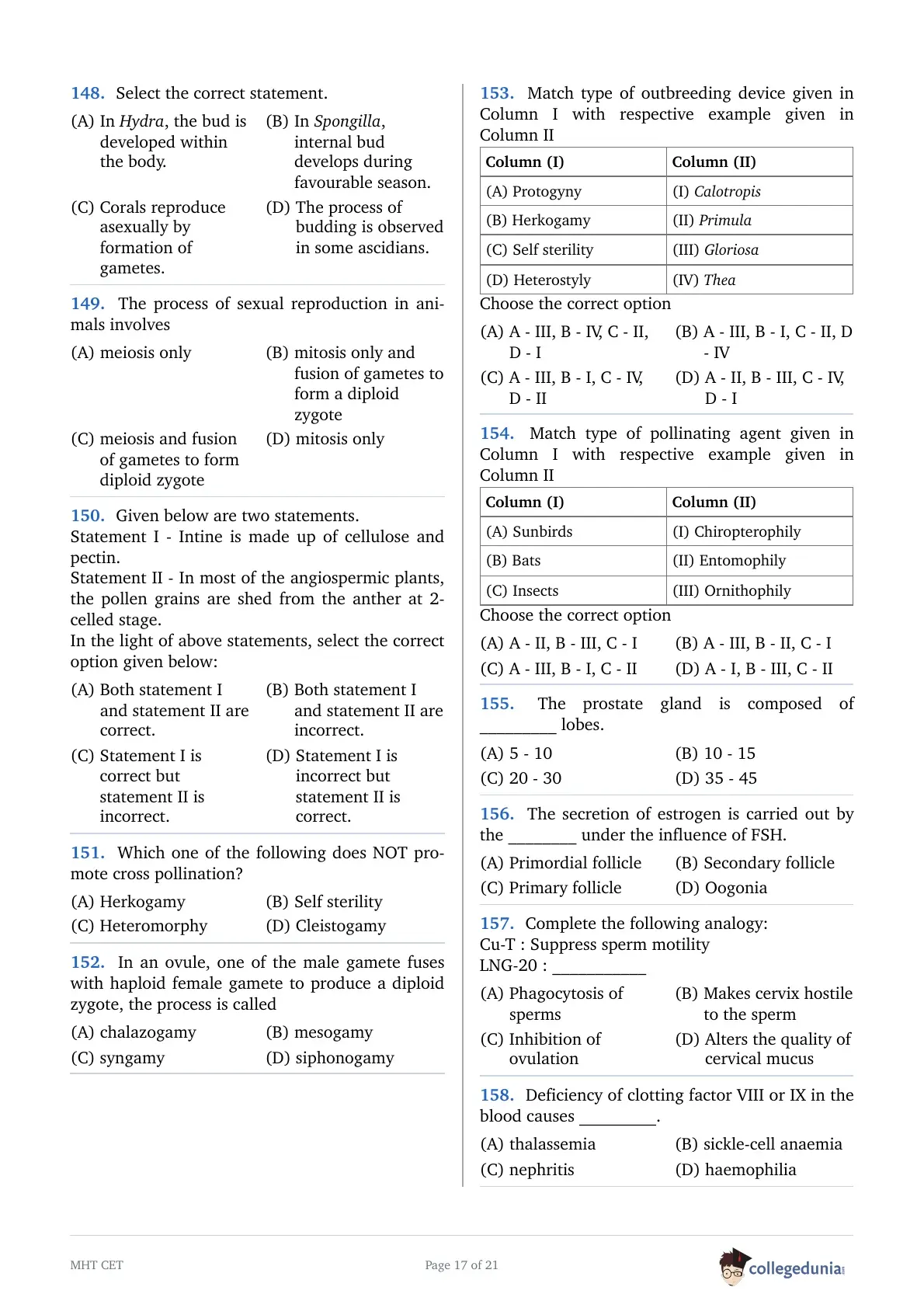
The process of sexual reproduction in animals involves
Given below are two statements.
Statement I - Intine is made up of cellulose and pectin.
Statement II - In most of the angiospermic plants, the pollen grains are shed from the anther at 2-celled stage.
In the light of above statements, select the correct option given below:
Which one of the following does NOT promote cross pollination?
In an ovule, one of the male gamete fuses with haploid female gamete to produce a diploid zygote, the process is called
Match type of outbreeding device given in Column I with respective example given in Column II
| Column (I) | Column (II) |
|---|---|
| (A) Protogyny | (I) Calotropis |
| (B) Herkogamy | (II) Primula |
| (C) Self sterility | (III) Gloriosa |
| (D) Heterostyly | (IV) Thea |
Match type of pollinating agent given in Column I with respective example given in Column II
| Column (I) | Column (II) |
|---|---|
| (A) Sunbirds | (I) Chiropterophily |
| (B) Bats | (II) Entomophily |
| (C) Insects | (III) Ornithophily |
The prostate gland is composed of _________ lobes.
The secretion of estrogen is carried out by the ________ under the influence of FSH.
Complete the following analogy:
Cu-T : Suppress sperm motility
LNG-20 : ___________
Deficiency of clotting factor VIII or IX in the blood causes _________.
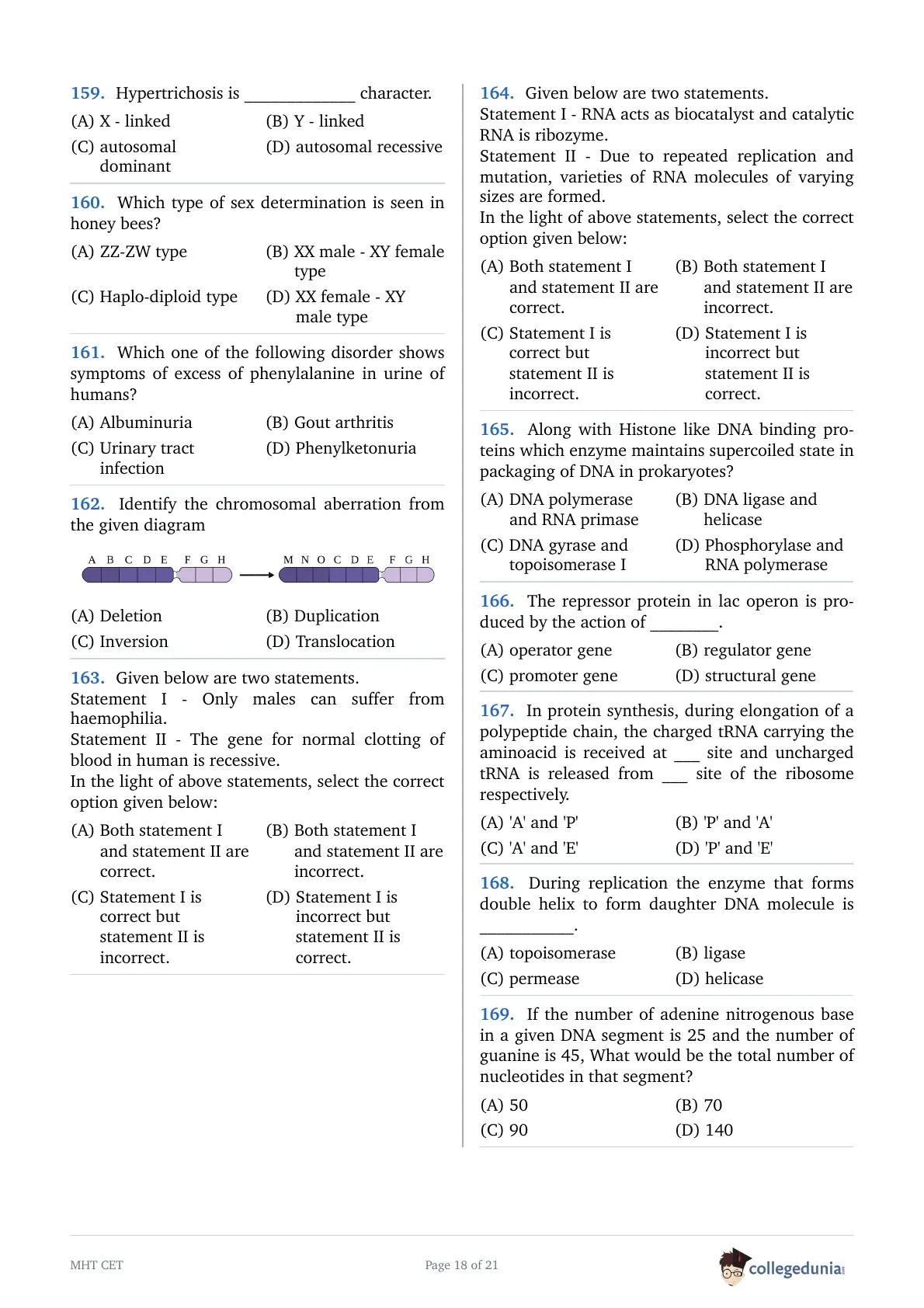
Hypertrichosis is _____________ character.
Which type of sex determination is seen in honey bees?
Which one of the following disorder shows symptoms of excess of phenylalanine in urine of humans?

Given below are two statements.
Statement I - Only males can suffer from haemophilia.
Statement II - The gene for normal clotting of blood in human is recessive.
In the light of above statements, select the correct option given below:
Given below are two statements.
Statement I - RNA acts as biocatalyst and catalytic RNA is ribozyme.
Statement II - Due to repeated replication and mutation, varieties of RNA molecules of varying sizes are formed.
In the light of above statements, select the correct option given below:
Along with Histone like DNA binding proteins which enzyme maintains supercoiled state in packaging of DNA in prokaryotes?
The repressor protein in lac operon is produced by the action of ________.
In protein synthesis, during elongation of a polypeptide chain, the charged tRNA carrying the aminoacid is received at ___ site and uncharged tRNA is released from ___ site of the ribosome respectively.
During replication the enzyme that forms double helix to form daughter DNA molecule is ___________.
If the number of adenine nitrogenous base in a given DNA segment is 25 and the number of guanine is 45, What would be the total number of nucleotides in that segment?
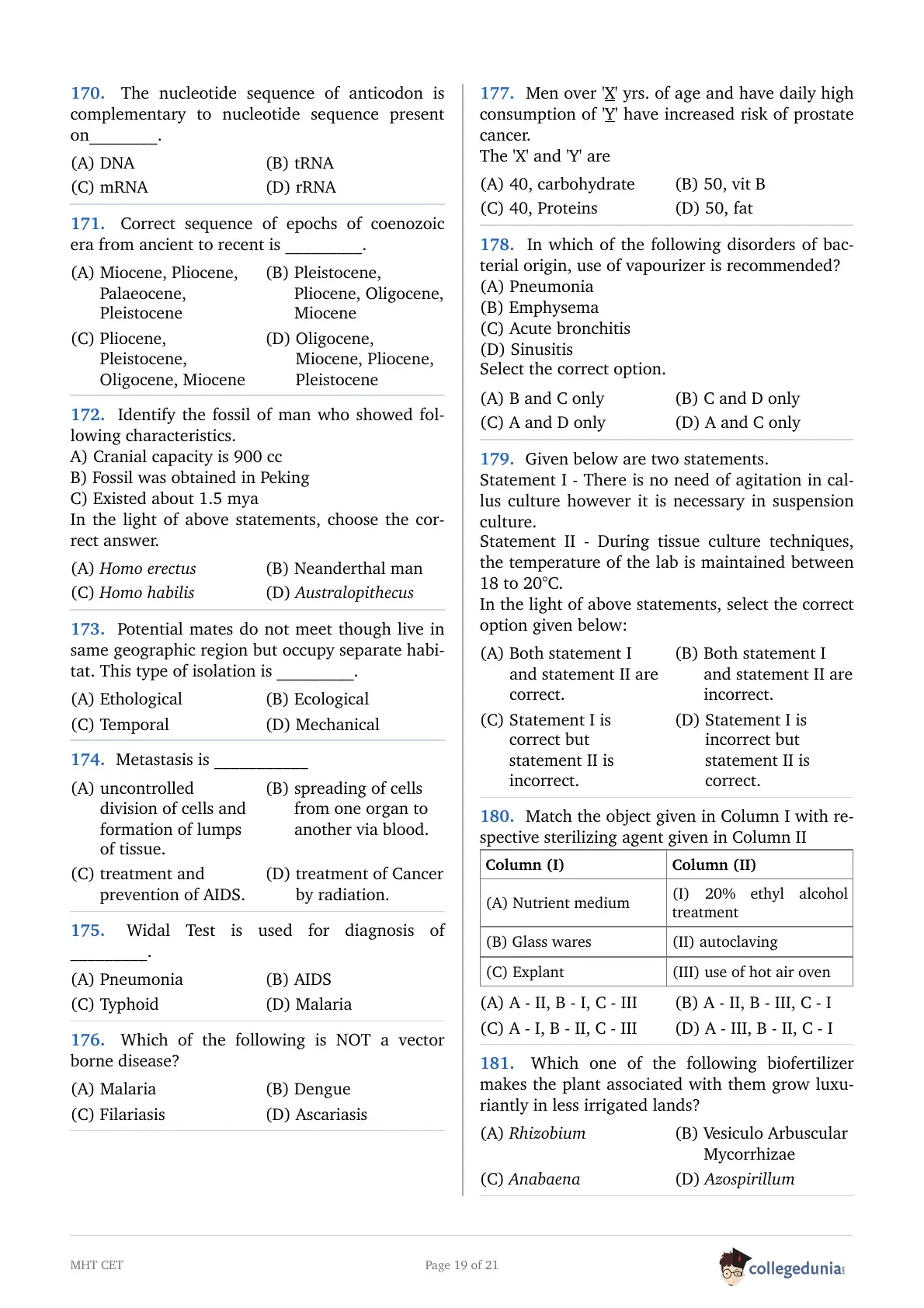
The nucleotide sequence of anticodon is complementary to nucleotide sequence present on________.
Correct sequence of epochs of coenozoic era from ancient to recent is _________.
Identify the fossil of man who showed following characteristics.
A) Cranial capacity is 900 cc
B) Fossil was obtained in Peking
C) Existed about 1.5 mya
In the light of above statements, choose the correct answer.
Potential mates do not meet though live in same geographic region but occupy separate habitat. This type of isolation is _________.
Metastasis is ___________
Widal Test is used for diagnosis of _________.
Which of the following is NOT a vector borne disease?
Men over 'X' yrs. of age and have daily high consumption of 'Y' have increased risk of prostate cancer.
The 'X' and 'Y' are
In which of the following disorders of bacterial origin, use of vapourizer is recommended?
(A) Pneumonia
(B) Emphysema
(C) Acute bronchitis
(D) Sinusitis
Select the correct option.
Given below are two statements.
Statement I - There is no need of agitation in callus culture however it is necessary in suspension culture.
Statement II - During tissue culture techniques, the temperature of the lab is maintained between 18 to 20°C.
In the light of above statements, select the correct option given below:
Match the object given in Column I with respective sterilizing agent given in Column II
| Column (I) | Column (II) |
|---|---|
| (A) Nutrient medium | (I) 20% ethyl alcohol treatment |
| (B) Glass wares | (II) autoclaving |
| (C) Explant | (III) use of hot air oven |
Which one of the following biofertilizer makes the plant associated with them grow luxuriantly in less irrigated lands?
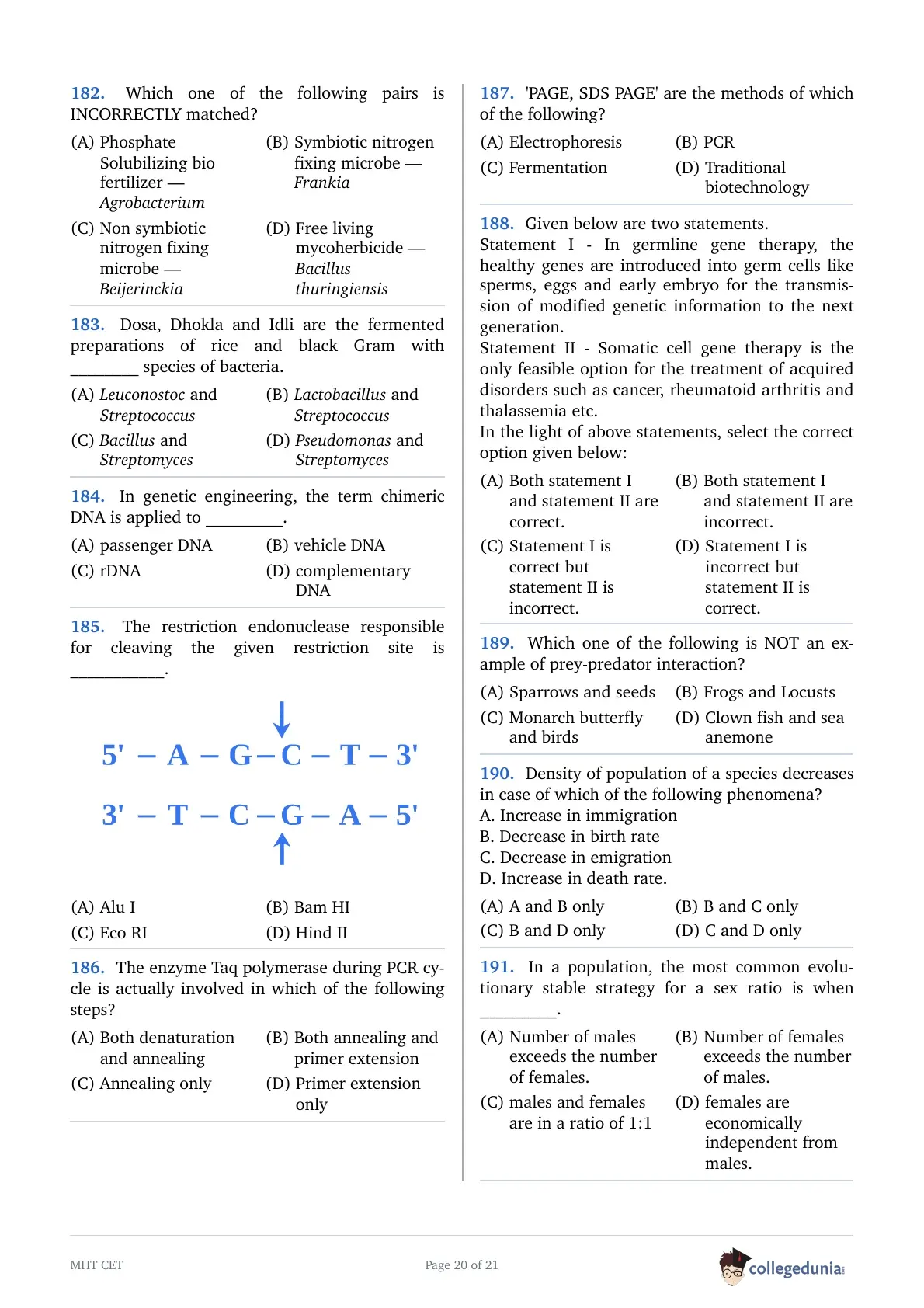
Which one of the following pairs is INCORRECTLY matched?
Dosa, Dhokla and Idli are the fermented preparations of rice and black Gram with ________ species of bacteria.
In genetic engineering, the term chimeric DNA is applied to _________.
The restriction endonuclease responsible for cleaving the given restriction site is ___________.

The enzyme Taq polymerase during PCR cycle is actually involved in which of the following steps?
'PAGE, SDS PAGE' are the methods of which of the following?
Given below are two statements.
Statement I - In germline gene therapy, the healthy genes are introduced into germ cells like sperms, eggs and early embryo for the transmission of modified genetic information to the next generation.
Statement II - Somatic cell gene therapy is the only feasible option for the treatment of acquired disorders such as cancer, rheumatoid arthritis and thalassemia etc.
In the light of above statements, select the correct option given below:
Which one of the following is NOT an example of prey-predator interaction?
Density of population of a species decreases in case of which of the following phenomena?
A. Increase in immigration
B. Decrease in birth rate
C. Decrease in emigration
D. Increase in death rate.
In a population, the most common evolutionary stable strategy for a sex ratio is when _________.
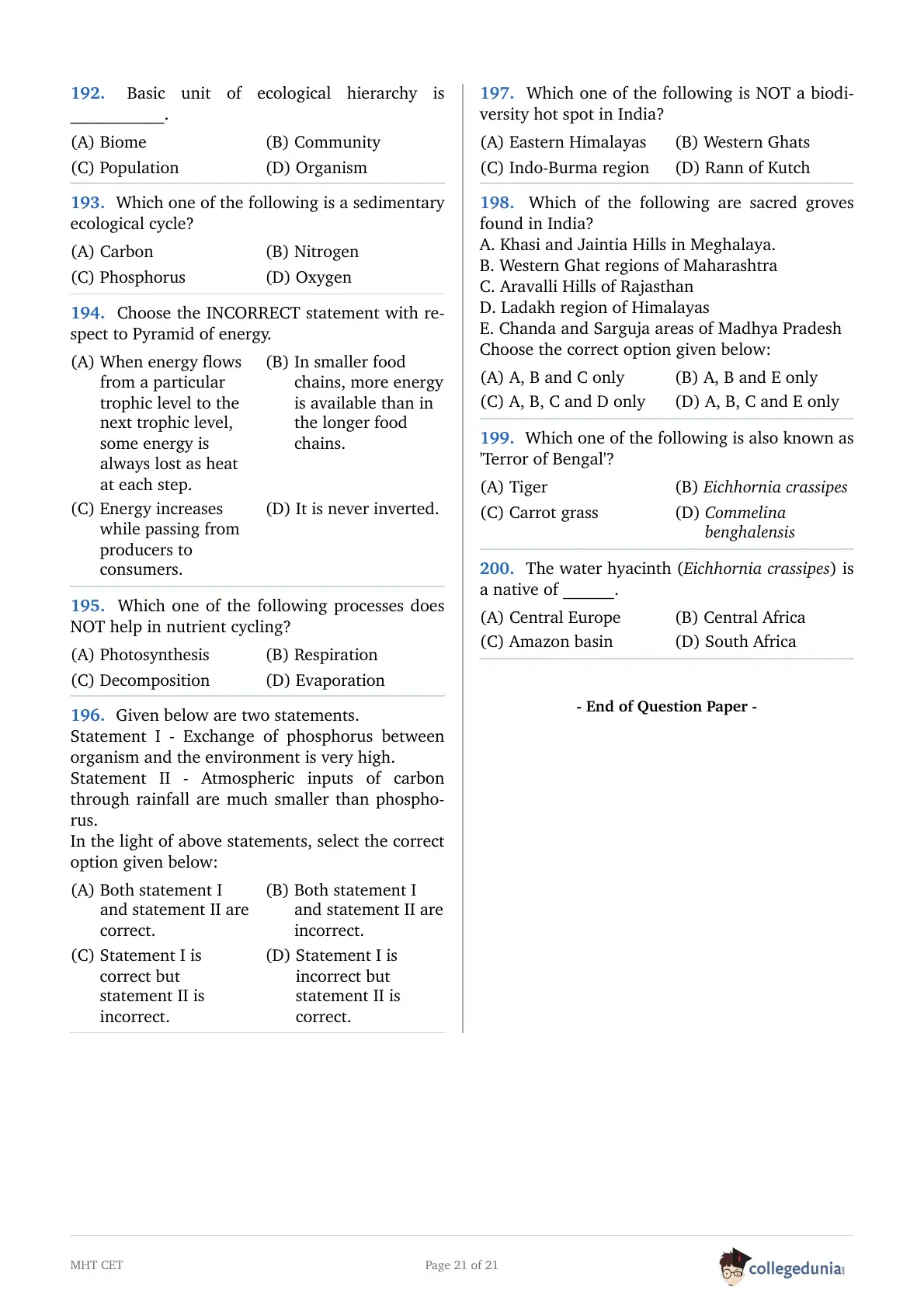
Basic unit of ecological hierarchy is ___________.
Which one of the following is a sedimentary ecological cycle?
Choose the INCORRECT statement with respect to Pyramid of energy.
Which one of the following processes does NOT help in nutrient cycling?
Given below are two statements.
Statement I - Exchange of phosphorus between organism and the environment is very high.
Statement II - Atmospheric inputs of carbon through rainfall are much smaller than phosphorus.
In the light of above statements, select the correct option given below:
Which one of the following is NOT a biodiversity hot spot in India?
Which of the following are sacred groves found in India?
A. Khasi and Jaintia Hills in Meghalaya.
B. Western Ghat regions of Maharashtra
C. Aravalli Hills of Rajasthan
D. Ladakh region of Himalayas
E. Chanda and Sarguja areas of Madhya Pradesh
Choose the correct option given below:
Which one of the following is also known as 'Terror of Bengal'?
The water hyacinth (Eichhornia crassipes) is a native of ______.
MHT CET 2026 PCB Exam Pattern and Marking Scheme
| Parameter | Details |
|---|---|
| Conducting Body | Maharashtra Common Entrance Test Cell (Maharashtra CET Cell) |
| Exam Mode | Online (Computer-Based Test) |
| Duration | 180 minutes (3 hours) |
| Groups / Subjects | PCB (Physics, Chemistry, Biology) for Pharmacy and Agriculture |
| Total Questions |
200 |
| Total Marks | 200 |
| Question Type | Multiple Choice Questions (MCQs) |
| Marking Scheme | 1 mark for each correct answer |
| Negative Marking | No |
| Syllabus Weightage |
|



Comments