




MHT CET 2026 April 24 Shift 2 PCB Question Paper is available for download here. Maharashtra State CET Cell conducted MHT CET 2026 PCB Exam on April 24 in Shift 2 from 2 PM to 5 PM in CBT mode.
The MHT CET 2026 PCB question paper includes the following:
- The MHT CET 2026 PCB Question Paper consists of 200 multiple-choice questions (MCQs) totalling 200 marks divided into 3 sections: Physics (50 questions), Chemistry (50 questions), and Biology (100 questions).
- All questions carry 1 mark each. There is no negative marking for incorrect answers.
MHT CET 2026 April 24 Shift 2 PCB Question Paper with Solution PDF
| CD PDF | CD PDF with Solutions |
|---|---|
| Download Collegedunia PDF 1.35 MB | - |
Also Check:
MHT CET 2026 April 24 Shift 2 PCB Questions with Solutions
Physics (Q1 - Q50)
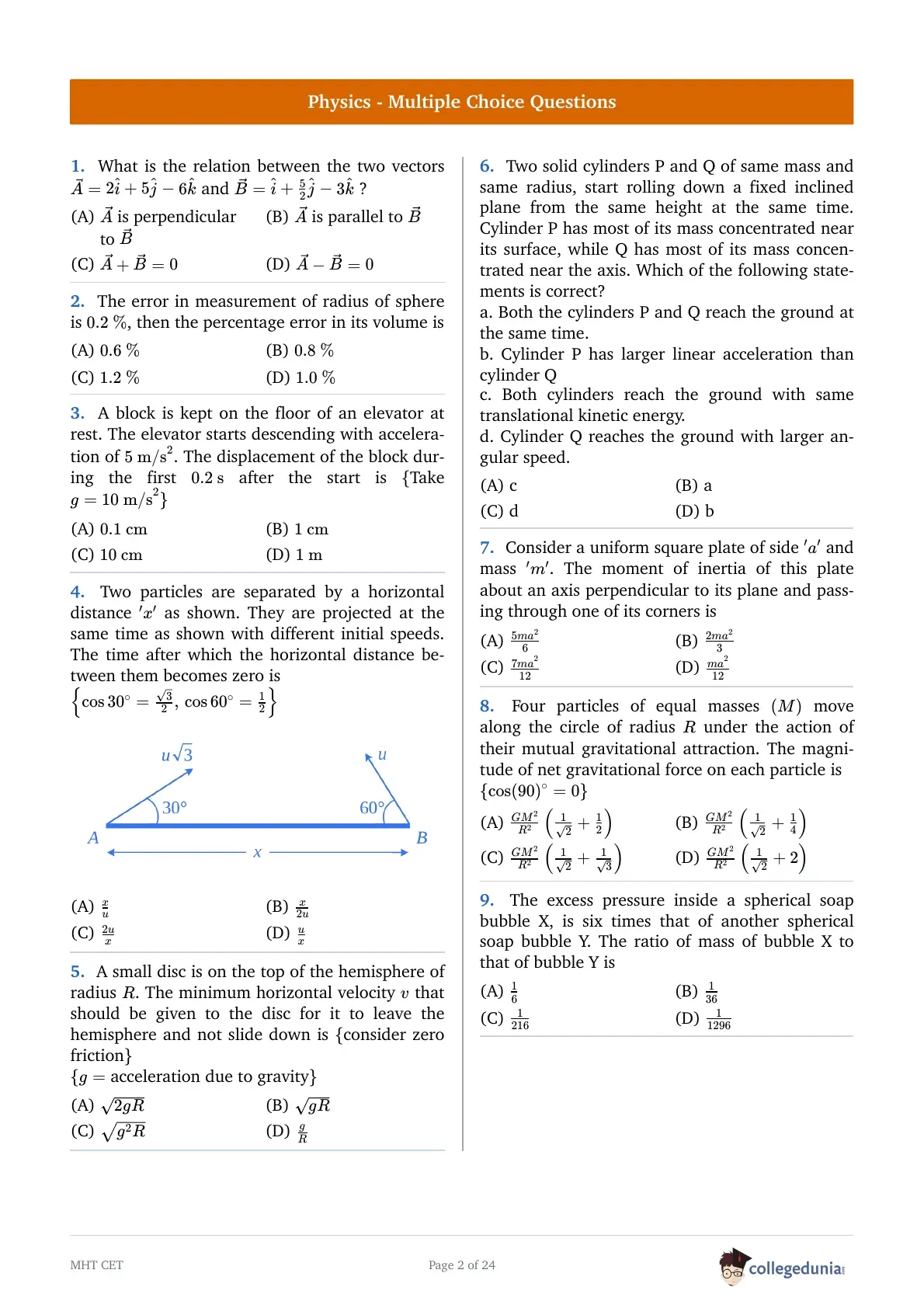
What is the relation between the two vectors \(\vec{A}=2\hat{i}+5\hat{j}-6\hat{k}\) and \(\vec{B}=\hat{i}+\frac{5}{2}\hat{j}-3\hat{k}\) ?
The error in measurement of radius of sphere is \(0.2\ \%\), then the percentage error in its volume is
A block is kept on the floor of an elevator at rest. The elevator starts descending with acceleration of \(5\ \text{m/s}^{2}\). The displacement of the block during the first \(0.2\ \text{s}\) after the start is \(\{\)Take \(g=10\ \text{m/s}^{2}\}\)
Two particles are separated by a horizontal distance \({}'x'\) as shown. They are projected at the same time as shown with different initial speeds. The time after which the horizontal distance between them becomes zero is
\(\left\{\cos 30^{\circ }=\frac{\sqrt{3}}{2},\,\cos 60^{\circ }=\frac{1}{2}\right\}\)

A small disc is on the top of the hemisphere of radius \(R\). The minimum horizontal velocity \(v\) that should be given to the disc for it to leave the hemisphere and not slide down is \(\{\)consider zero friction\(\}\)
\(\{g=\) acceleration due to gravity\(\}\)
Two solid cylinders P and Q of same mass and same radius, start rolling down a fixed inclined plane from the same height at the same time. Cylinder P has most of its mass concentrated near its surface, while Q has most of its mass concentrated near the axis. Which of the following statements is correct?
a. Both the cylinders P and Q reach the ground at the same time.
b. Cylinder P has larger linear acceleration than cylinder Q
c. Both cylinders reach the ground with same translational kinetic energy.
d. Cylinder Q reaches the ground with larger angular speed.
Consider a uniform square plate of side \({}'a'\) and mass \({}'m'\). The moment of inertia of this plate about an axis perpendicular to its plane and passing through one of its corners is
Four particles of equal masses \((M)\) move along the circle of radius \(R\) under the action of their mutual gravitational attraction. The magnitude of net gravitational force on each particle is
\(\{\cos (90)^{\circ }=0\}\)
The excess pressure inside a spherical soap bubble X, is six times that of another spherical soap bubble Y. The ratio of mass of bubble X to that of bubble Y is
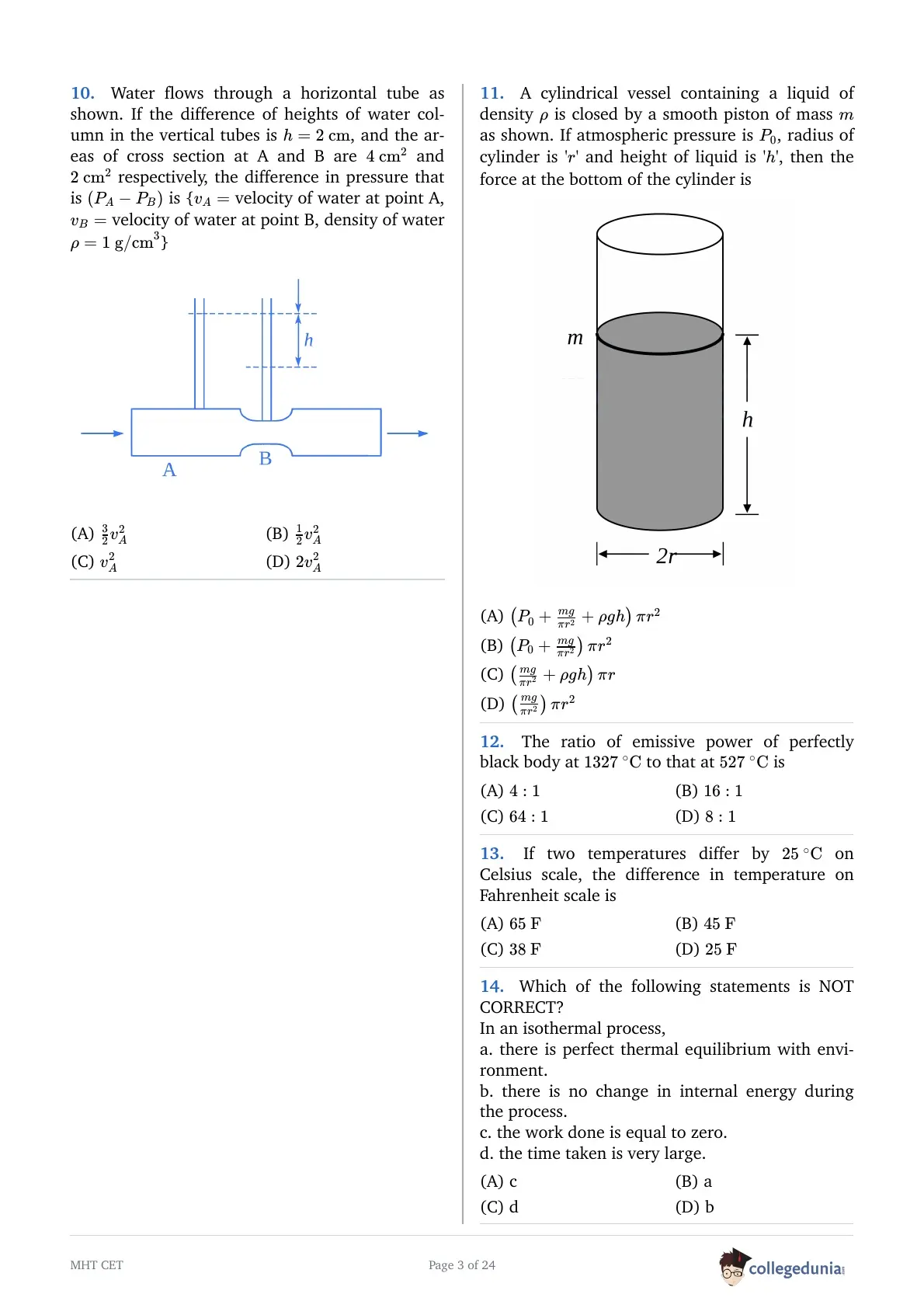
Water flows through a horizontal tube as shown. If the difference of heights of water column in the vertical tubes is \(h=2\ \text{cm}\), and the areas of cross section at A and B are \(4\ \text{cm}^{2}\) and \(2\ \text{cm}^{2}\) respectively, the difference in pressure that is \((P_{A}-P_{B})\) is {\(v_{A}=\) velocity of water at point A, \(v_{B}=\) velocity of water at point B, density of water \(\rho =1\ \text{g/cm}^{3}\)}

A cylindrical vessel containing a liquid of density \(\rho\) is closed by a smooth piston of mass \(m\) as shown. If atmospheric pressure is \(P_{0}\), radius of cylinder is '\(r\)' and height of liquid is '\(h\)', then the force at the bottom of the cylinder is

The ratio of emissive power of perfectly black body at \(1327\ ^{\circ }\text{C}\) to that at \(527\ ^{\circ }\text{C}\) is
If two temperatures differ by \(25\ ^{\circ }\text{C}\) on Celsius scale, the difference in temperature on Fahrenheit scale is
Which of the following statements is NOT CORRECT?
In an isothermal process,
a. there is perfect thermal equilibrium with environment.
b. there is no change in internal energy during the process.
c. the work done is equal to zero.
d. the time taken is very large.
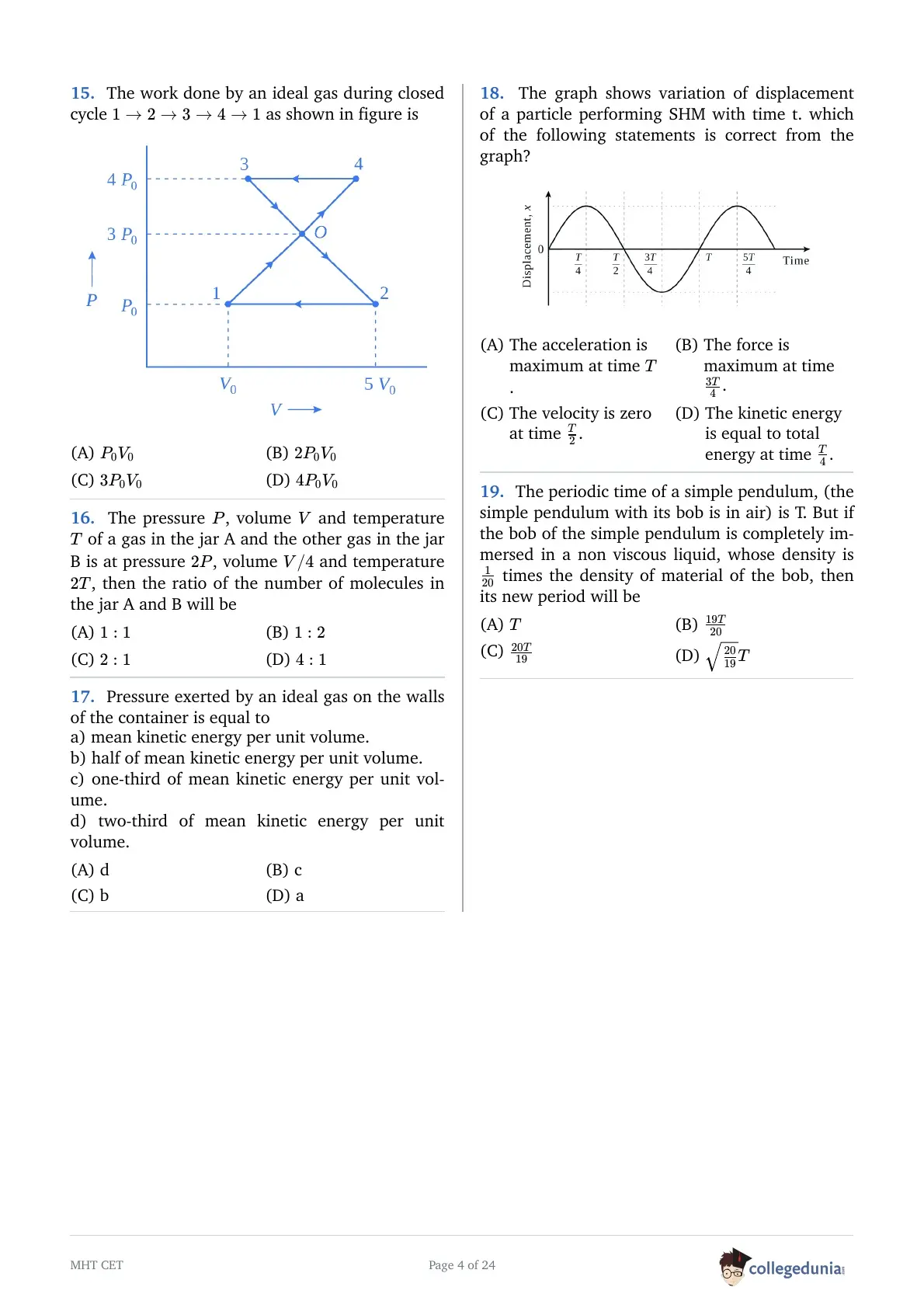
The work done by an ideal gas during closed cycle \(1\rightarrow 2\rightarrow 3\rightarrow 4\rightarrow 1\) as shown in figure is

The pressure \(P\), volume \(V\) and temperature \(T\) of a gas in the jar A and the other gas in the jar B is at pressure \(2P\), volume \(V/4\) and temperature \(2T\), then the ratio of the number of molecules in the jar A and B will be
Pressure exerted by an ideal gas on the walls of the container is equal to
a) mean kinetic energy per unit volume.
b) half of mean kinetic energy per unit volume.
c) one-third of mean kinetic energy per unit volume.
d) two-third of mean kinetic energy per unit volume.
The graph shows variation of displacement of a particle performing SHM with time t. which of the following statements is correct from the graph?

The periodic time of a simple pendulum, (the simple pendulum with its bob is in air) is T. But if the bob of the simple pendulum is completely immersed in a non viscous liquid, whose density is \(\frac{1}{20}\) times the density of material of the bob, then its new period will be
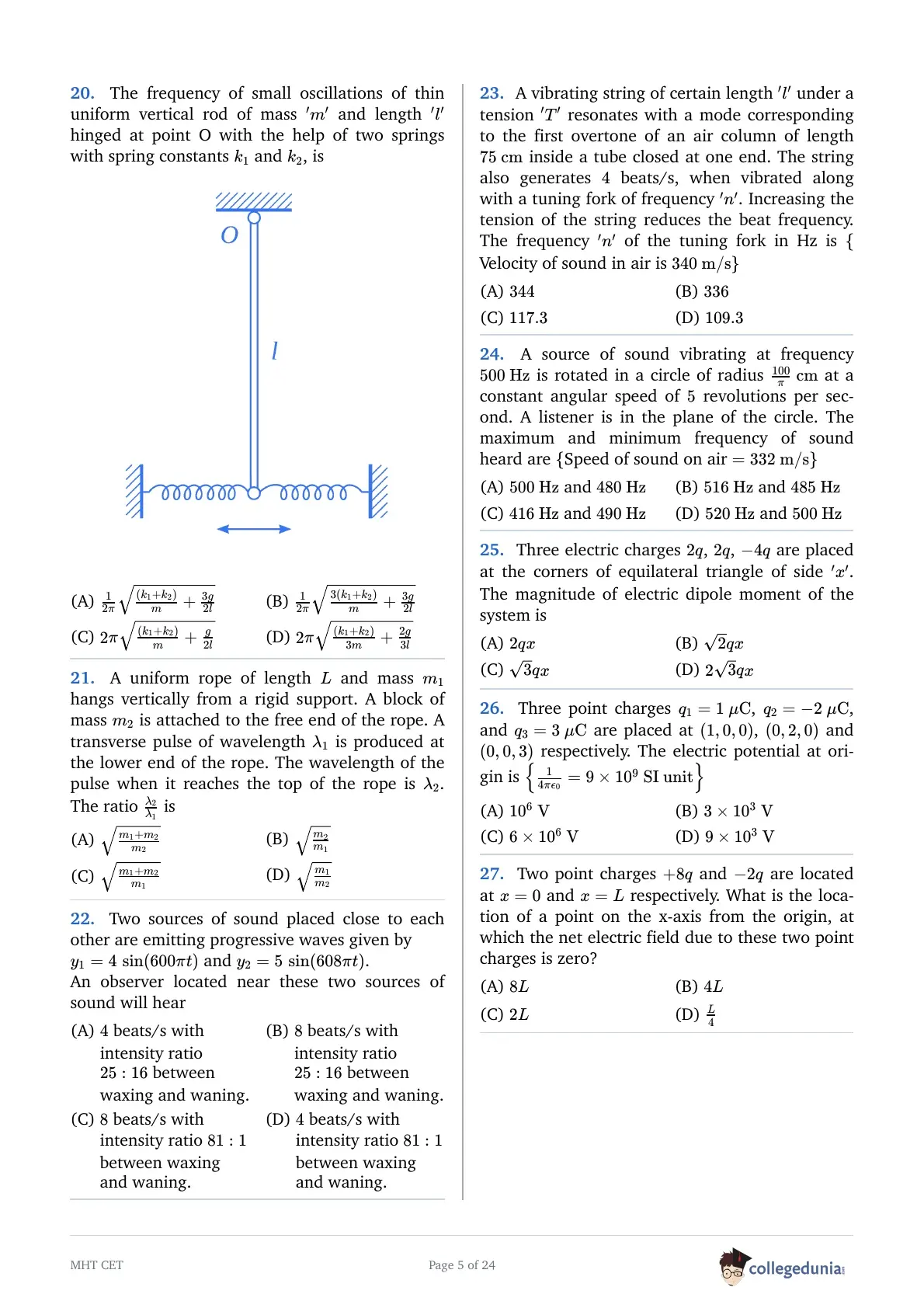
The frequency of small oscillations of thin uniform vertical rod of mass \({}'m'\) and length \({}'l'\) hinged at point O with the help of two springs with spring constants \(k_{1}\) and \(k_{2}\), is

A uniform rope of length \(L\) and mass \(m_{1}\) hangs vertically from a rigid support. A block of mass \(m_{2}\) is attached to the free end of the rope. A transverse pulse of wavelength \(\lambda _{1}\) is produced at the lower end of the rope. The wavelength of the pulse when it reaches the top of the rope is \(\lambda _{2}\). The ratio \(\frac{\lambda _{2}}{\lambda _{1}}\) is
Two sources of sound placed close to each other are emitting progressive waves given by
\(y_{1}=4\,\sin (600\pi t)\) and \(y_{2}=5\,\sin (608\pi t)\).
An observer located near these two sources of sound will hear
A vibrating string of certain length \({}'l'\) under a tension \({}'T'\) resonates with a mode corresponding to the first overtone of an air column of length \(75\ \text{cm}\) inside a tube closed at one end. The string also generates \(4\) beats/s, when vibrated along with a tuning fork of frequency \({}'n'\). Increasing the tension of the string reduces the beat frequency. The frequency \({}'n'\) of the tuning fork in Hz is \(\{\)Velocity of sound in air is \(340\ \text{m/s}\}\)
A source of sound vibrating at frequency \(500\ \text{Hz}\) is rotated in a circle of radius \(\frac{100}{\pi }\ \text{cm}\) at a constant angular speed of \(5\) revolutions per second. A listener is in the plane of the circle. The maximum and minimum frequency of sound heard are \(\{\)Speed of sound on air \(=332\ \text{m/s}\}\)
Three electric charges \(2q\), \(2q\), \(-4q\) are placed at the corners of equilateral triangle of side \({}'x'\). The magnitude of electric dipole moment of the system is
Three point charges \(q_{1}=1\ \mu \text{C}\), \(q_{2}=-2\ \mu \text{C}\), and \(q_{3}=3\ \mu \text{C}\) are placed at \((1,0,0)\), \((0,2,0)\) and \((0,0,3)\) respectively. The electric potential at origin is \(\left\{\frac{1}{4\pi \epsilon _{0}}=9\times 10^{9}\ \text{SI unit}\right\}\)
Two point charges \(+8q\) and \(-2q\) are located at \(x=0\) and \(x=L\) respectively. What is the location of a point on the x-axis from the origin, at which the net electric field due to these two point charges is zero?
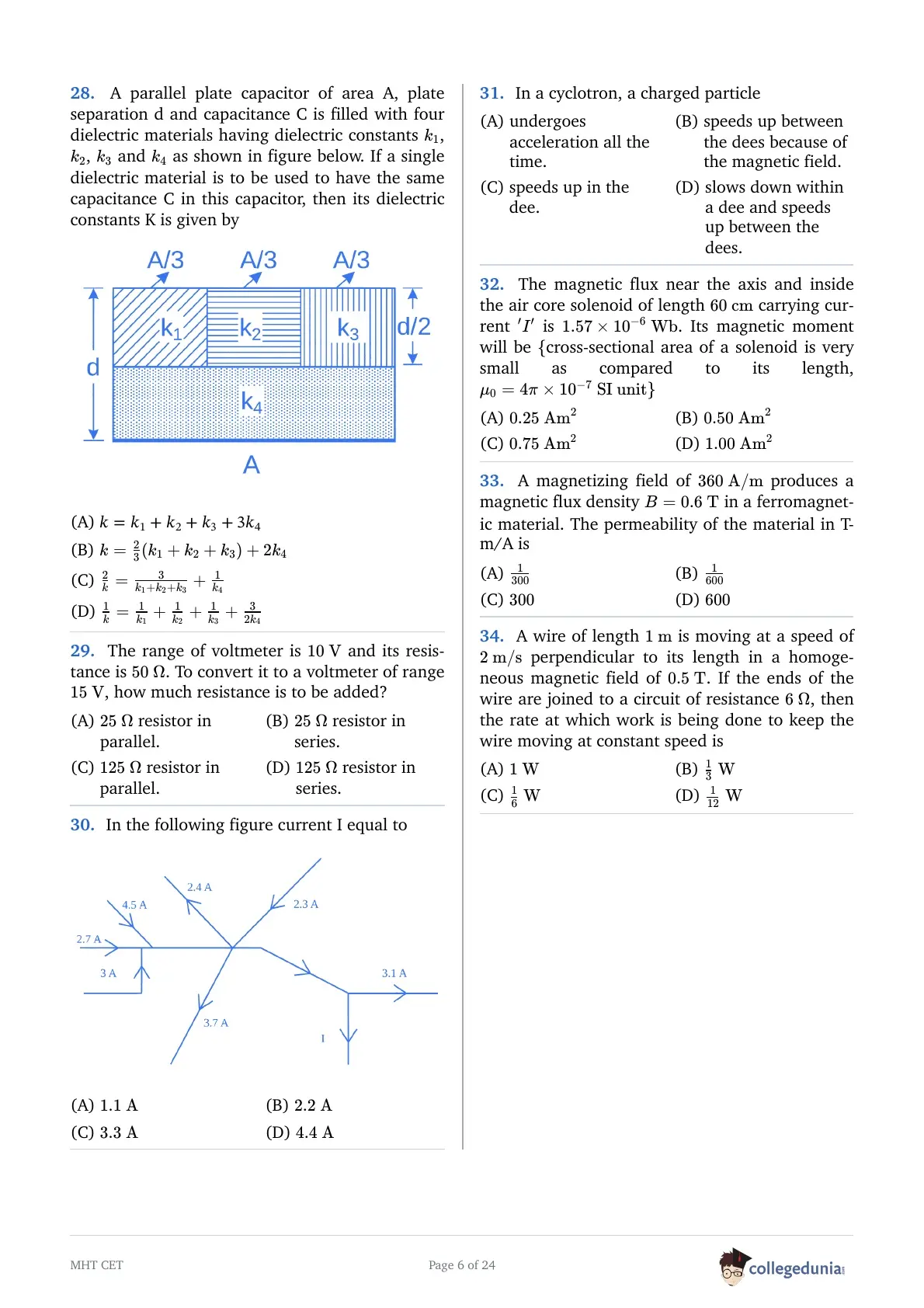
A parallel plate capacitor of area A, plate separation d and capacitance C is filled with four dielectric materials having dielectric constants \(k_{1}\), \(k_{2}\), \(k_{3}\) and \(k_{4}\) as shown in figure below. If a single dielectric material is to be used to have the same capacitance C in this capacitor, then its dielectric constants K is given by

The range of voltmeter is \(10\ \text{V}\) and its resistance is \(50\ \Omega\). To convert it to a voltmeter of range \(15\ \text{V}\), how much resistance is to be added?

In a cyclotron, a charged particle
The magnetic flux near the axis and inside the air core solenoid of length \(60\ \text{cm}\) carrying current \({}'I'\) is \(1.57\times 10^{-6}\ \text{Wb}\). Its magnetic moment will be \(\{\)cross-sectional area of a solenoid is very small as compared to its length, \(\mu _{0}=4\pi \times 10^{-7}\ \text{SI unit}\}\)
A magnetizing field of \(360\ \text{A/m}\) produces a magnetic flux density \(B=0.6\ \text{T}\) in a ferromagnetic material. The permeability of the material in T-m/A is
A wire of length \(1\ \text{m}\) is moving at a speed of \(2\ \text{m/s}\) perpendicular to its length in a homogeneous magnetic field of \(0.5\ \text{T}\). If the ends of the wire are joined to a circuit of resistance \(6\ \Omega\), then the rate at which work is being done to keep the wire moving at constant speed is
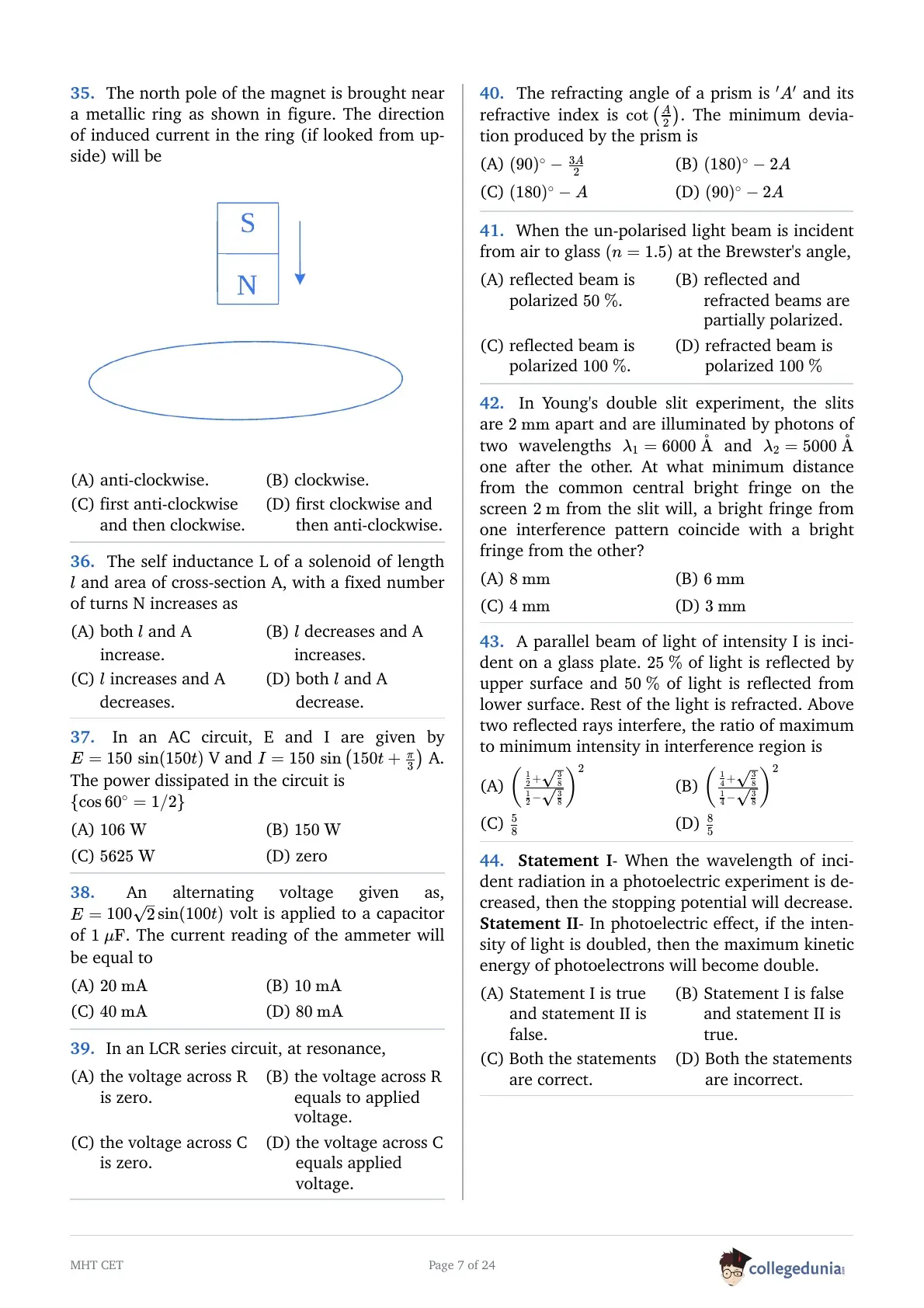
The north pole of the magnet is brought near a metallic ring as shown in figure. The direction of induced current in the ring (if looked from upside) will be

The self inductance L of a solenoid of length \(l\) and area of cross-section A, with a fixed number of turns N increases as
In an AC circuit, E and I are given by \(E=150\,\sin (150t)\) V and \(I=150\,\sin \left(150t+\frac{\pi }{3}\right)\) A. The power dissipated in the circuit is
\(\{\cos 60^{\circ }=1/2\}\)
An alternating voltage given as, \(E=100\sqrt{2}\sin (100t)\) volt is applied to a capacitor of \(1\ \mu \text{F}\). The current reading of the ammeter will be equal to
In an LCR series circuit, at resonance,
The refracting angle of a prism is \({}'A'\) and its refractive index is \(\cot \left(\frac{A}{2}\right)\). The minimum deviation produced by the prism is
When the un-polarised light beam is incident from air to glass \((n=1.5)\) at the Brewster's angle,
In Young's double slit experiment, the slits are \(2\ \text{mm}\) apart and are illuminated by photons of two wavelengths \(\lambda _{1}=6000\ \text{Å}\) and \(\lambda _{2}=5000\ \text{Å}\) one after the other. At what minimum distance from the common central bright fringe on the screen \(2\ \text{m}\) from the slit will, a bright fringe from one interference pattern coincide with a bright fringe from the other?
A parallel beam of light of intensity I is incident on a glass plate. \(25\ \%\) of light is reflected by upper surface and \(50\ \%\) of light is reflected from lower surface. Rest of the light is refracted. Above two reflected rays interfere, the ratio of maximum to minimum intensity in interference region is
Statement I- When the wavelength of incident radiation in a photoelectric experiment is decreased, then the stopping potential will decrease.
Statement II- In photoelectric effect, if the intensity of light is doubled, then the maximum kinetic energy of photoelectrons will become double.
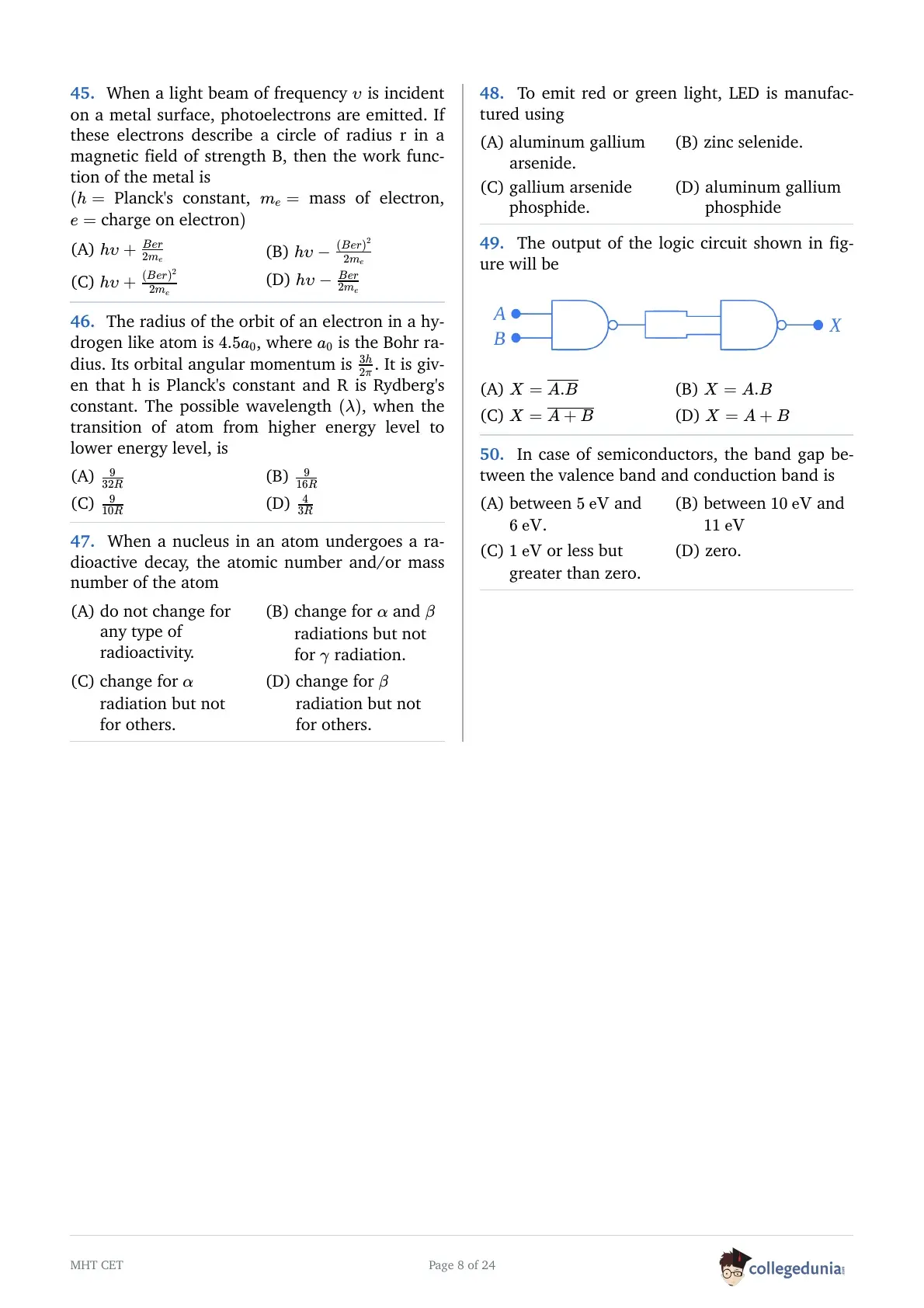
When a light beam of frequency \(\upsilon\) is incident on a metal surface, photoelectrons are emitted. If these electrons describe a circle of radius r in a magnetic field of strength B, then the work function of the metal is
\((h=\) Planck's constant, \(m_{e}=\) mass of electron, \(e=\) charge on electron\()\)
The radius of the orbit of an electron in a hydrogen like atom is \(4.5a_{0}\), where \(a_{0}\) is the Bohr radius. Its orbital angular momentum is \(\frac{3h}{2\pi }\). It is given that h is Planck's constant and R is Rydberg's constant. The possible wavelength \((\lambda )\), when the transition of atom from higher energy level to lower energy level, is
When a nucleus in an atom undergoes a radioactive decay, the atomic number and/or mass number of the atom
To emit red or green light, LED is manufactured using

In case of semiconductors, the band gap between the valence band and conduction band is
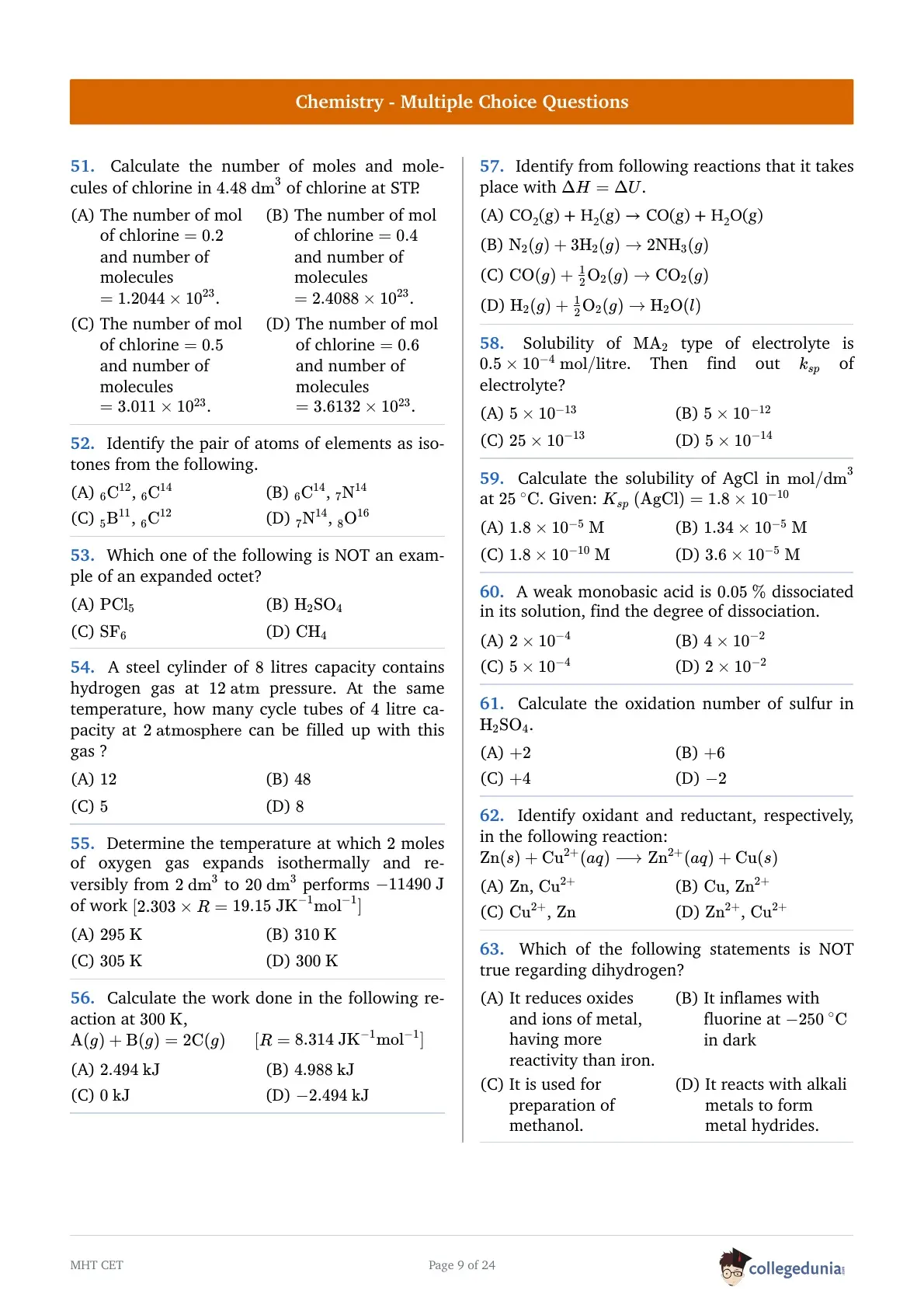
Chemistry (Q51 - Q100)
Calculate the number of moles and molecules of chlorine in \(4.48\ \text{dm}^{3}\) of chlorine at STP.
Identify the pair of atoms of elements as isotones from the following.
Which one of the following is NOT an example of an expanded octet?
A steel cylinder of \(8\) litres capacity contains hydrogen gas at \(12\ \text{atm}\) pressure. At the same temperature, how many cycle tubes of \(4\) litre capacity at \(2\ \text{atmosphere}\) can be filled up with this gas ?
Determine the temperature at which \(2\) moles of oxygen gas expands isothermally and reversibly from \(2\ \text{dm}^{3}\) to \(20\ \text{dm}^{3}\) performs \(-11490\ \text{J}\) of work \([2.303\times R=19.15\ \text{JK}^{-1}\text{mol}^{-1}]\)
Calculate the work done in the following reaction at \(300\ \text{K}\),
\(\text{A}(g)+\text{B}(g)=2\text{C}(g)\) \([R=8.314\ \text{JK}^{-1}\text{mol}^{-1}]\)
Identify from following reactions that it takes place with \(\Delta H=\Delta U\).
Solubility of \(\text{MA}_{2}\) type of electrolyte is \(0.5\times 10^{-4}\ \text{mol/litre}\). Then find out \(k_{sp}\) of electrolyte?
Calculate the solubility of AgCl in \(\text{mol/dm}^{3}\) at \(25\ ^{\circ }\text{C}\). Given: \(K_{sp}\ (\text{AgCl})=1.8\times 10^{-10}\)
A weak monobasic acid is \(0.05\ \%\) dissociated in its solution, find the degree of dissociation.
Calculate the oxidation number of sulfur in \(\text{H}_{2}\text{SO}_{4}\).
Identify oxidant and reductant, respectively, in the following reaction:
\(\text{Zn}(s)+\text{Cu}^{2+}(aq)\longrightarrow \text{Zn}^{2+}(aq)+\text{Cu}(s)\)
Which of the following statements is NOT true regarding dihydrogen?
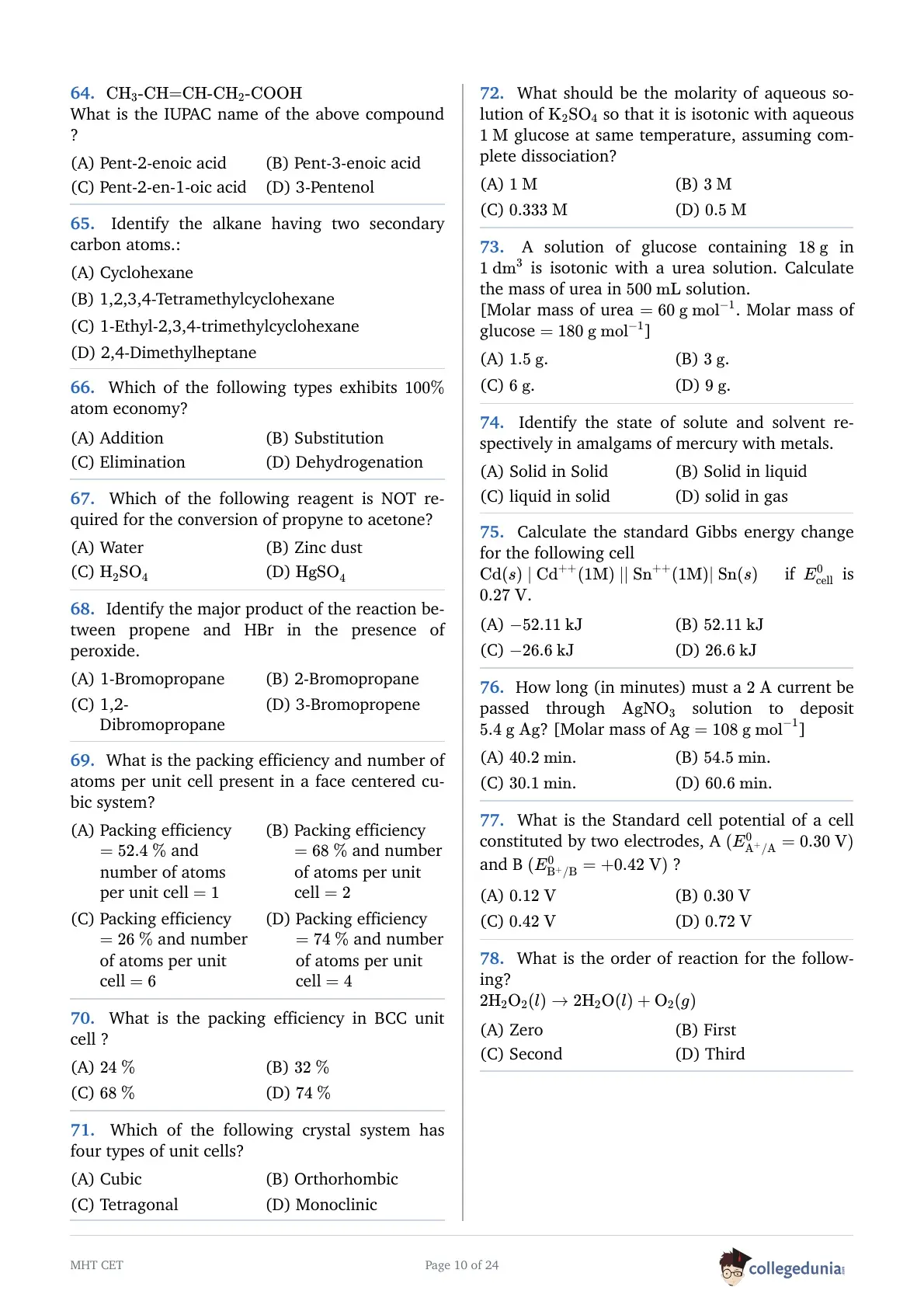
\(\text{CH}_{3}\text{-CH=CH-CH}_{2}\text{-COOH}\)
What is the IUPAC name of the above compound ?
Identify the alkane having two secondary carbon atoms.:
Which of the following types exhibits \(100\%\) atom economy?
Which of the following reagent is NOT required for the conversion of propyne to acetone?
Identify the major product of the reaction between propene and HBr in the presence of peroxide.
What is the packing efficiency and number of atoms per unit cell present in a face centered cubic system?
What is the packing efficiency in BCC unit cell ?
Which of the following crystal system has four types of unit cells?
What should be the molarity of aqueous solution of \(\text{K}_{2}\text{SO}_{4}\) so that it is isotonic with aqueous \(1\ \text{M}\) glucose at same temperature, assuming complete dissociation?
A solution of glucose containing \(18\ \text{g}\) in \(1\ \text{dm}^{3}\) is isotonic with a urea solution. Calculate the mass of urea in \(500\ \text{mL}\) solution.
[Molar mass of urea \(=60\ \text{g mol}^{-1}\). Molar mass of glucose \(=180\ \text{g mol}^{-1}\)]
Identify the state of solute and solvent respectively in amalgams of mercury with metals.
Calculate the standard Gibbs energy change for the following cell
\(\text{Cd}(s)\ |\ \text{Cd}^{++}(1\text{M})\ ||\ \text{Sn}^{++}(1\text{M})|\ \text{Sn}(s)\) if \(E_{\text{cell}}^{0}\) is \(0.27\ \text{V}\).
How long (in minutes) must a \(2\ \text{A}\) current be passed through \(\text{AgNO}_{3}\) solution to deposit \(5.4\ \text{g Ag}\)? [Molar mass of Ag \(=108\ \text{g mol}^{-1}\)]
What is the Standard cell potential of a cell constituted by two electrodes, A \((E_{\text{A}^{+}/\text{A}}^{0}=0.30\ \text{V})\) and B \((E_{\text{B}^{+}/\text{B}}^{0}=+0.42\ \text{V})\) ?
What is the order of reaction for the following?
\(2\text{H}_{2}\text{O}_{2}(l)\rightarrow 2\text{H}_{2}\text{O}(l)+\text{O}_{2}(g)\)
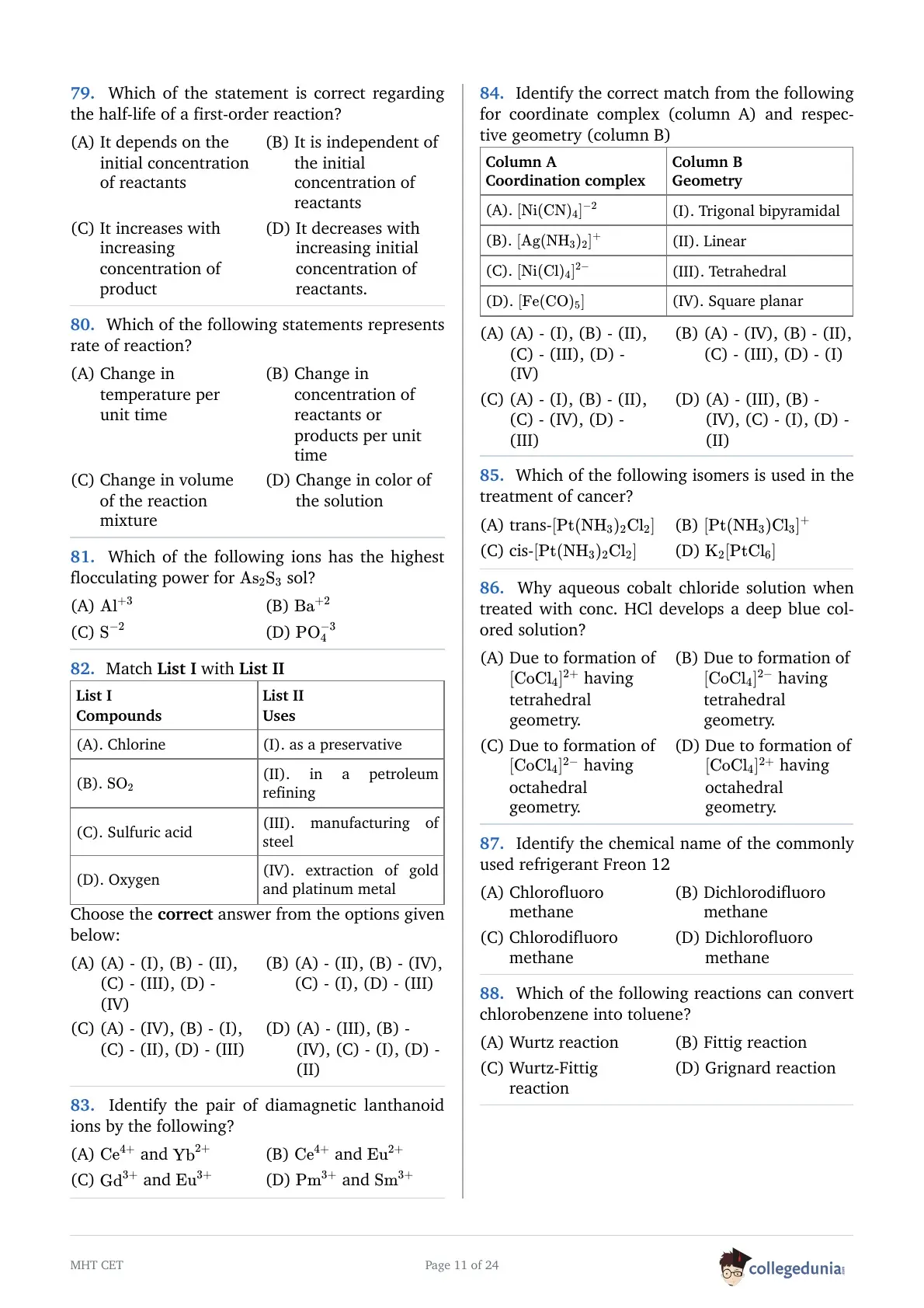
Which of the statement is correct regarding the half-life of a first-order reaction?
Which of the following statements represents rate of reaction?
Which of the following ions has the highest flocculating power for \(\text{As}_{2}\text{S}_{3}\) sol?
Match List I with List II
| List I Compounds | List II Uses |
|---|---|
| (A). Chlorine | (I). as a preservative |
| (B). \(\text{SO}_{2}\) | (II). in a petroleum refining |
| (C). Sulfuric acid | (III). manufacturing of steel |
| (D). Oxygen | (IV). extraction of gold and platinum metal |
Identify the pair of diamagnetic lanthanoid ions by the following?
Identify the correct match from the following for coordinate complex (column A) and respective geometry (column B)
| Column A Coordination complex | Column B Geometry |
|---|---|
| (A). \([\text{Ni}(\text{CN})_{4}]^{-2}\) | (I). Trigonal bipyramidal |
| (B). \([\text{Ag}(\text{NH}_{3})_{2}]^{+}\) | (II). Linear |
| (C). \([\text{Ni}(\text{Cl})_{4}]^{2-}\) | (III). Tetrahedral |
| (D). \([\text{Fe}(\text{CO})_{5}]\) | (IV). Square planar |
Which of the following isomers is used in the treatment of cancer?
Why aqueous cobalt chloride solution when treated with conc. HCl develops a deep blue colored solution?
Identify the chemical name of the commonly used refrigerant Freon 12
Which of the following reactions can convert chlorobenzene into toluene?
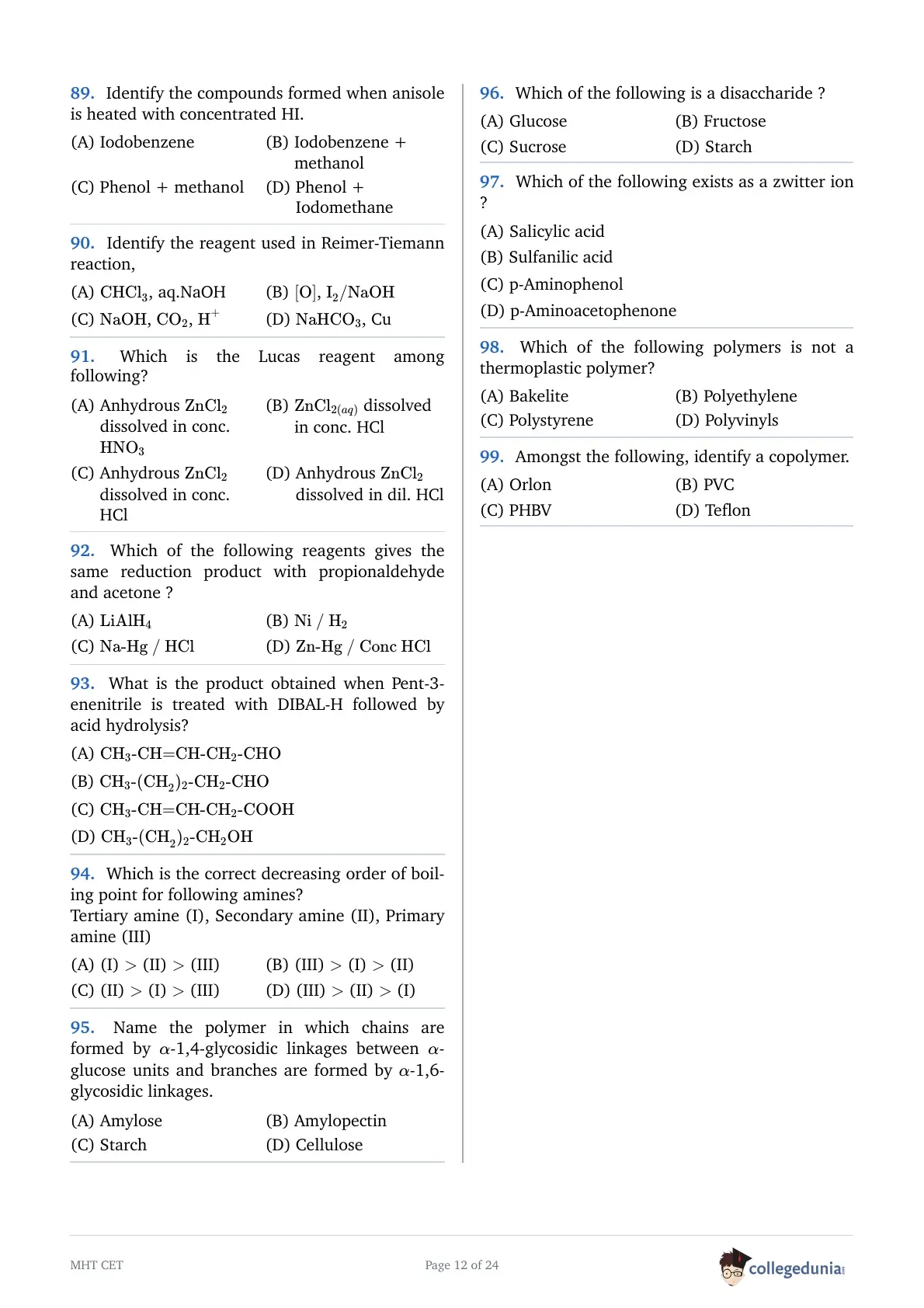
Identify the compounds formed when anisole is heated with concentrated HI.
Identify the reagent used in Reimer-Tiemann reaction,
Which is the Lucas reagent among following?
Which of the following reagents gives the same reduction product with propionaldehyde and acetone ?
What is the product obtained when Pent-3-enenitrile is treated with DIBAL-H followed by acid hydrolysis?
Which is the correct decreasing order of boiling point for following amines?
Tertiary amine (I), Secondary amine (II), Primary amine (III)
Name the polymer in which chains are formed by \(\alpha\)-1,4-glycosidic linkages between \(\alpha\)-glucose units and branches are formed by \(\alpha\)-1,6-glycosidic linkages.
Which of the following is a disaccharide ?
Which of the following exists as a zwitter ion ?
Which of the following polymers is not a thermoplastic polymer?
Amongst the following, identify a copolymer.


Biology (Q101 - Q200)
Find a brachiating ape from the options given below.
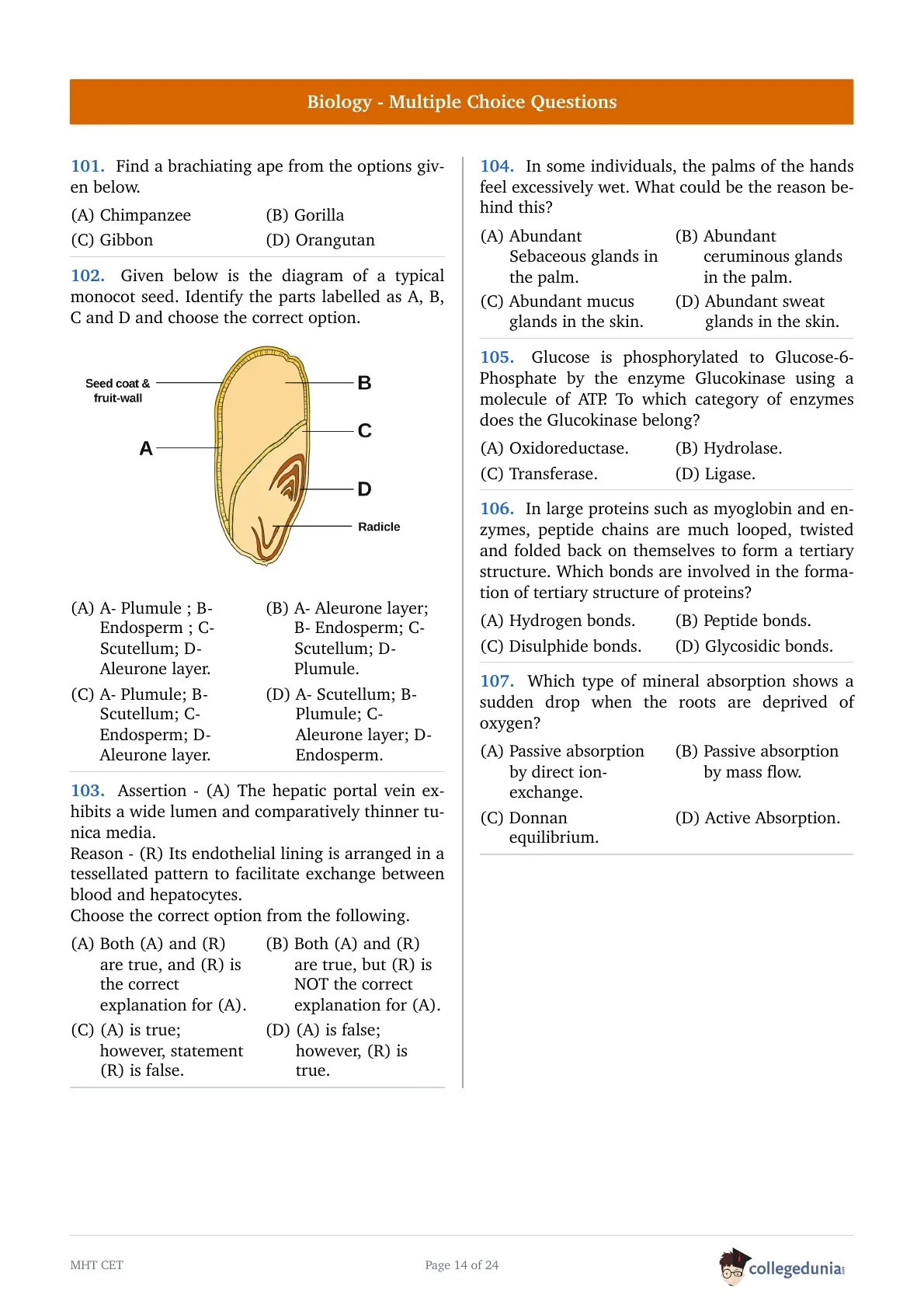
Given below is the diagram of a typical monocot seed. Identify the parts labelled as A, B, C and D and choose the correct option.

Assertion - (A) The hepatic portal vein exhibits a wide lumen and comparatively thinner tunica media.
Reason - (R) Its endothelial lining is arranged in a tessellated pattern to facilitate exchange between blood and hepatocytes.
Choose the correct option from the following.
In some individuals, the palms of the hands feel excessively wet. What could be the reason behind this?
Glucose is phosphorylated to Glucose-6-Phosphate by the enzyme Glucokinase using a molecule of ATP. To which category of enzymes does the Glucokinase belong?
In large proteins such as myoglobin and enzymes, peptide chains are much looped, twisted and folded back on themselves to form a tertiary structure. Which bonds are involved in the formation of tertiary structure of proteins?
Which type of mineral absorption shows a sudden drop when the roots are deprived of oxygen?
Which of the following sets of conditions favour the opening of stomata?
Active absorption of water by roots is _____.
The cortical cell absorbs water from the root hair cell because ___.
Water can easily rise through the conducting elements of xylem due to _____.
Read the following statements and choose the correct answer from the options given below:
(A). Diffusion is the movement of ions/ atoms/ molecules of a substance from the region of their lower concentration to the region of their higher concentration.
(B). Diffusion results in the diffusion pressure (D. P.) which is directly proportional to the number of diffusing particles.
(C). Diffusion pressure of pure solvent (pure water) is always less than the diffusion pressure of solvent in a solution.
(D). The difference in the diffusion pressures of pure solvent and the solvent in a solution is called Diffusion Pressure Deficit.
Which of the following are amides formed from amino acids?
Given below are two statements:
Statement (I): \(\text{NADH}_{2}\) (\(\text{NADH}+\text{H}^{+}\)) and \(\text{FADH}_{2}\) that are produced during glycolysis, connecting link reaction and Krebs cycle, are oxidised with the help of various electron carriers and enzymes.
Statement (II): These carriers and enzymes are arranged in the cytoplasm in the form of various complexes as complex I, II, III, IV and V.
In light of the above statements, choose the most appropriate answer from the options given below.
In Krebs' cycle, GTP is produced during the conversion of ___.
Where does the end product of Glycolysis undergoes aerobic oxidation in eukaryotes?
During lactic acid fermentation, pyruvic acid is reduced to lactic acid using one proton and two electrons from ________________.
Find the CORRECT statements from the following and choose the correct option.
(A). Glycolysis (EMP pathway) is a common path for aerobic and anaerobic respiration.
(B). Glycolysis occurs in mitochondria.
(C). Glycolysis involves the breakdown of glucose molecule into two pyruvic acid molecules.
(D). During Glycolysis, ATP is produced by oxidative phosphorylation.
Which of the following plants require longer duration of light than the critical photoperiod, for flowering?
The process of seed germination is stimulated due to the synthesis of hydrolytic enzymes. Which hormone is responsible for this process?
What is true about Arithmetic and Geometric growth curves?
The process in which digested food components are transported by the blood to each cell and are used for the synthesis of protoplasm is called __________.
Which of the following is NOT bacterial activity in the human alimentary canal?
Some small children aged about 2 to 3 years were showing slender legs and oedema. They also showed symptoms like a protruding belly, bulging eyes, and changes in skin and hair colour. According to you, which of the following could be the possible cause of these symptoms?
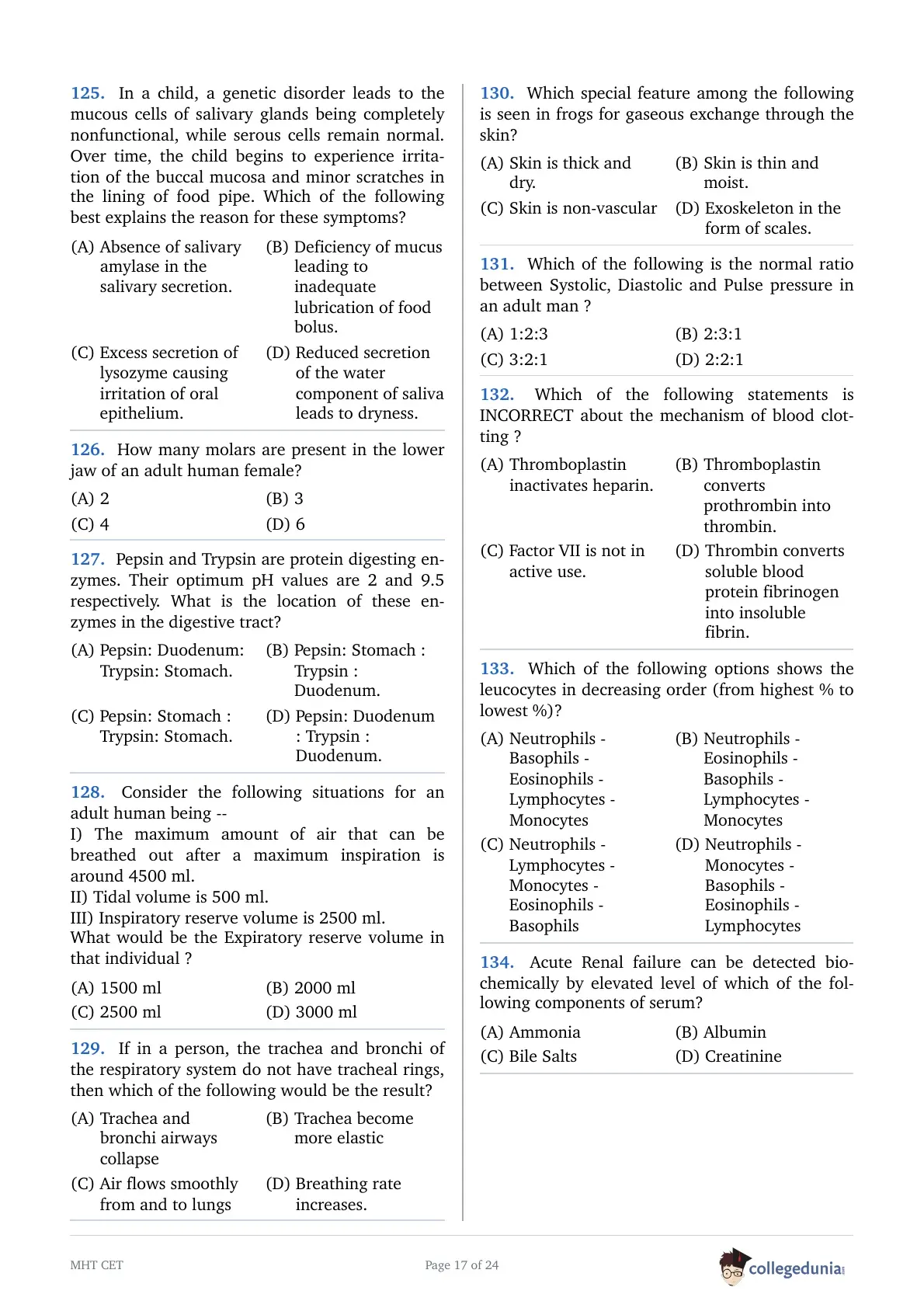
In a child, a genetic disorder leads to the mucous cells of salivary glands being completely nonfunctional, while serous cells remain normal. Over time, the child begins to experience irritation of the buccal mucosa and minor scratches in the lining of food pipe. Which of the following best explains the reason for these symptoms?
How many molars are present in the lower jaw of an adult human female?
Pepsin and Trypsin are protein digesting enzymes. Their optimum pH values are 2 and 9.5 respectively. What is the location of these enzymes in the digestive tract?
Consider the following situations for an adult human being --
I) The maximum amount of air that can be breathed out after a maximum inspiration is around 4500 ml.
II) Tidal volume is 500 ml.
III) Inspiratory reserve volume is 2500 ml.
What would be the Expiratory reserve volume in that individual ?
If in a person, the trachea and bronchi of the respiratory system do not have tracheal rings, then which of the following would be the result?
Which special feature among the following is seen in frogs for gaseous exchange through the skin?
Which of the following is the normal ratio between Systolic, Diastolic and Pulse pressure in an adult man ?
Which of the following statements is INCORRECT about the mechanism of blood clotting ?
Which of the following options shows the leucocytes in decreasing order (from highest % to lowest %)?
Acute Renal failure can be detected biochemically by elevated level of which of the following components of serum?
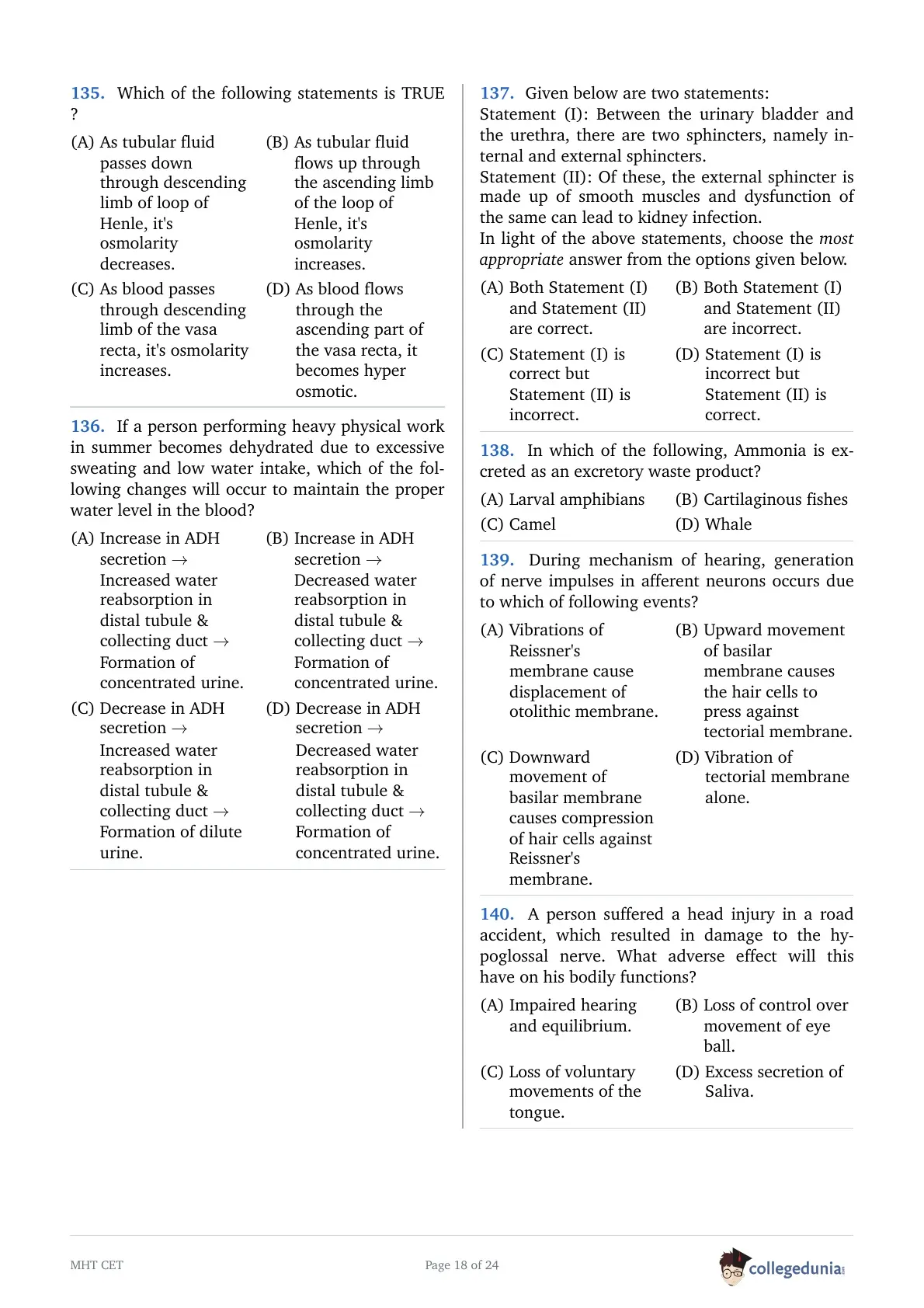
Which of the following statements is TRUE ?
If a person performing heavy physical work in summer becomes dehydrated due to excessive sweating and low water intake, which of the following changes will occur to maintain the proper water level in the blood?
Given below are two statements:
Statement (I): Between the urinary bladder and the urethra, there are two sphincters, namely internal and external sphincters.
Statement (II): Of these, the external sphincter is made up of smooth muscles and dysfunction of the same can lead to kidney infection.
In light of the above statements, choose the most appropriate answer from the options given below.
In which of the following, Ammonia is excreted as an excretory waste product?
During mechanism of hearing, generation of nerve impulses in afferent neurons occurs due to which of following events?
A person suffered a head injury in a road accident, which resulted in damage to the hypoglossal nerve. What adverse effect will this have on his bodily functions?
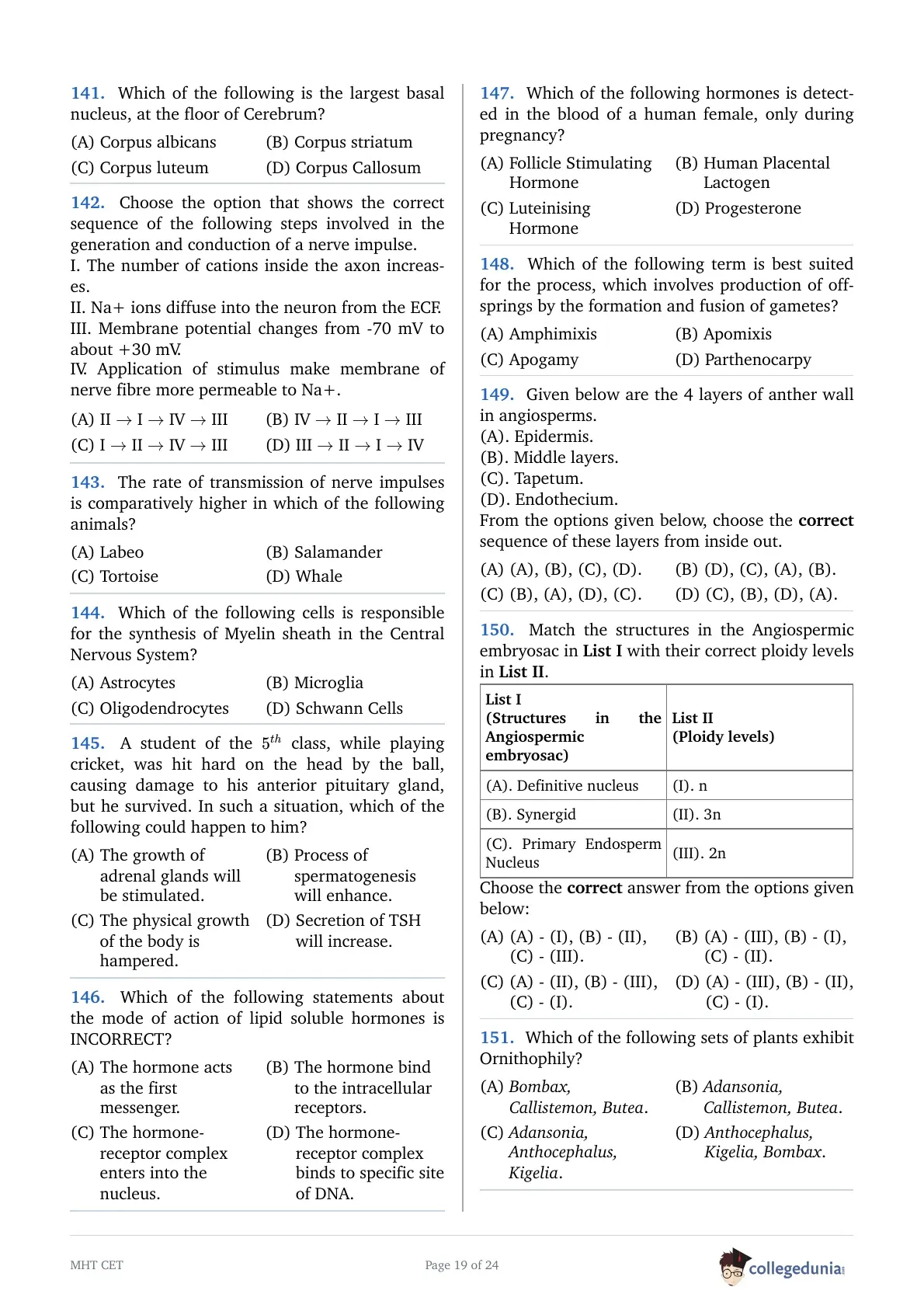
Which of the following is the largest basal nucleus, at the floor of Cerebrum?
Choose the option that shows the correct sequence of the following steps involved in the generation and conduction of a nerve impulse.
I. The number of cations inside the axon increases.
II. Na+ ions diffuse into the neuron from the ECF.
III. Membrane potential changes from -70 mV to about +30 mV.
IV. Application of stimulus make membrane of nerve fibre more permeable to Na+.
The rate of transmission of nerve impulses is comparatively higher in which of the following animals?
Which of the following cells is responsible for the synthesis of Myelin sheath in the Central Nervous System?
A student of the \(5^{th}\) class, while playing cricket, was hit hard on the head by the ball, causing damage to his anterior pituitary gland, but he survived. In such a situation, which of the following could happen to him?
Which of the following statements about the mode of action of lipid soluble hormones is INCORRECT?
Which of the following hormones is detected in the blood of a human female, only during pregnancy?
Which of the following term is best suited for the process, which involves production of offsprings by the formation and fusion of gametes?
Given below are the 4 layers of anther wall in angiosperms.
(A). Epidermis.
(B). Middle layers.
(C). Tapetum.
(D). Endothecium.
From the options given below, choose the correct sequence of these layers from inside out.
Match the structures in the Angiospermic embryosac in List I with their correct ploidy levels in List II.
| List I (Structures in the Angiospermic embryosac) | List II (Ploidy levels) |
|---|---|
| (A). Definitive nucleus | (I). n |
| (B). Synergid | (II). 3n |
| (C). Primary Endosperm Nucleus | (III). 2n |
Which of the following sets of plants exhibit Ornithophily?
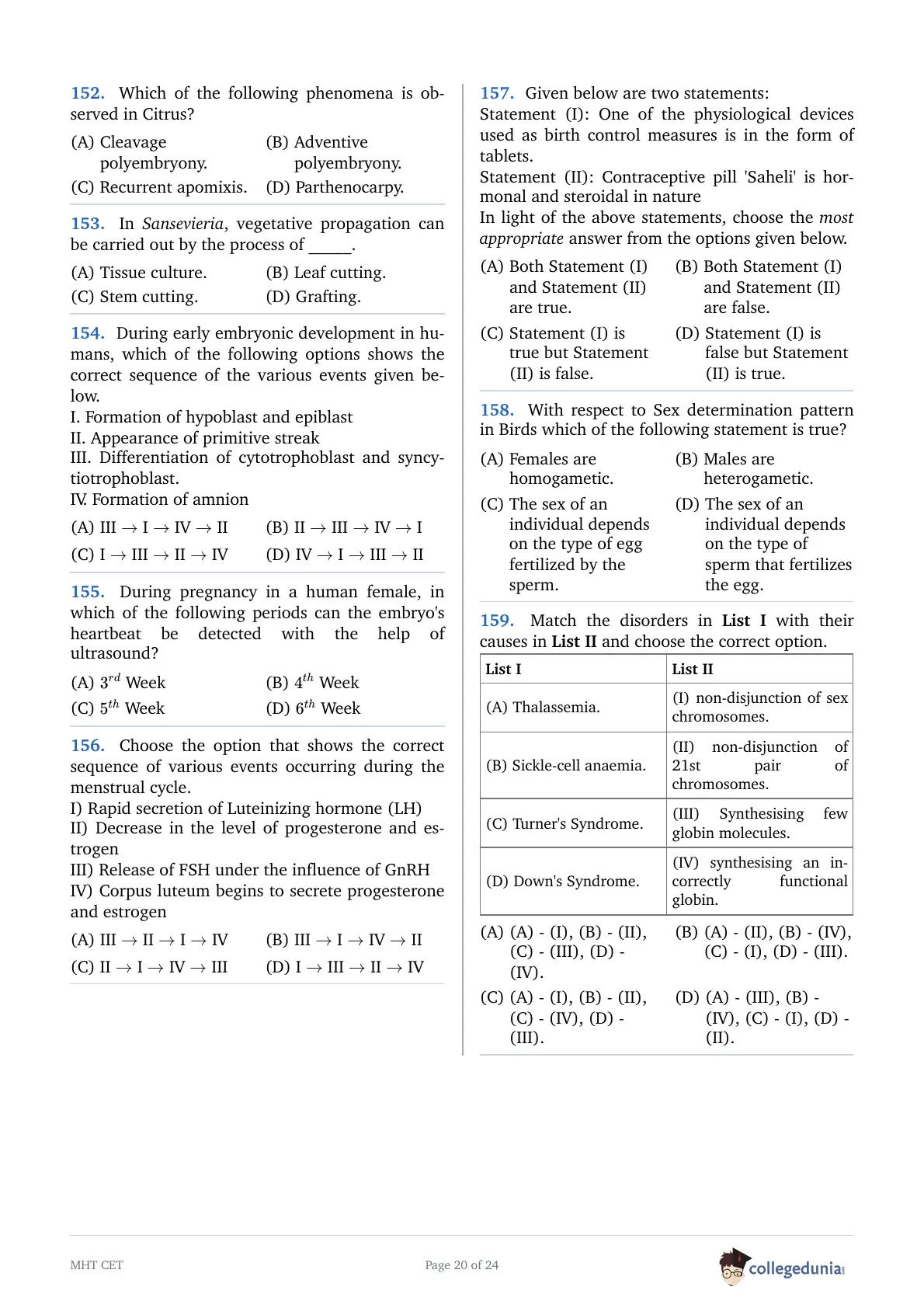
Which of the following phenomena is observed in Citrus?
In Sansevieria, vegetative propagation can be carried out by the process of _____.
During early embryonic development in humans, which of the following options shows the correct sequence of the various events given below.
I. Formation of hypoblast and epiblast
II. Appearance of primitive streak
III. Differentiation of cytotrophoblast and syncytiotrophoblast.
IV. Formation of amnion
During pregnancy in a human female, in which of the following periods can the embryo's heartbeat be detected with the help of ultrasound?
Choose the option that shows the correct sequence of various events occurring during the menstrual cycle.
I) Rapid secretion of Luteinizing hormone (LH)
II) Decrease in the level of progesterone and estrogen
III) Release of FSH under the influence of GnRH
IV) Corpus luteum begins to secrete progesterone and estrogen
Given below are two statements:
Statement (I): One of the physiological devices used as birth control measures is in the form of tablets.
Statement (II): Contraceptive pill 'Saheli' is hormonal and steroidal in nature
In light of the above statements, choose the most appropriate answer from the options given below.
With respect to Sex determination pattern in Birds which of the following statement is true?
Match the disorders in List I with their causes in List II and choose the correct option.
| List I | List II |
|---|---|
| (A) Thalassemia. | (I) non-disjunction of sex chromosomes. |
| (B) Sickle-cell anaemia. | (II) non-disjunction of 21st pair of chromosomes. |
| (C) Turner's Syndrome. | (III) Synthesising few globin molecules. |
| (D) Down's Syndrome. | (IV) synthesising an incorrectly functional globin. |
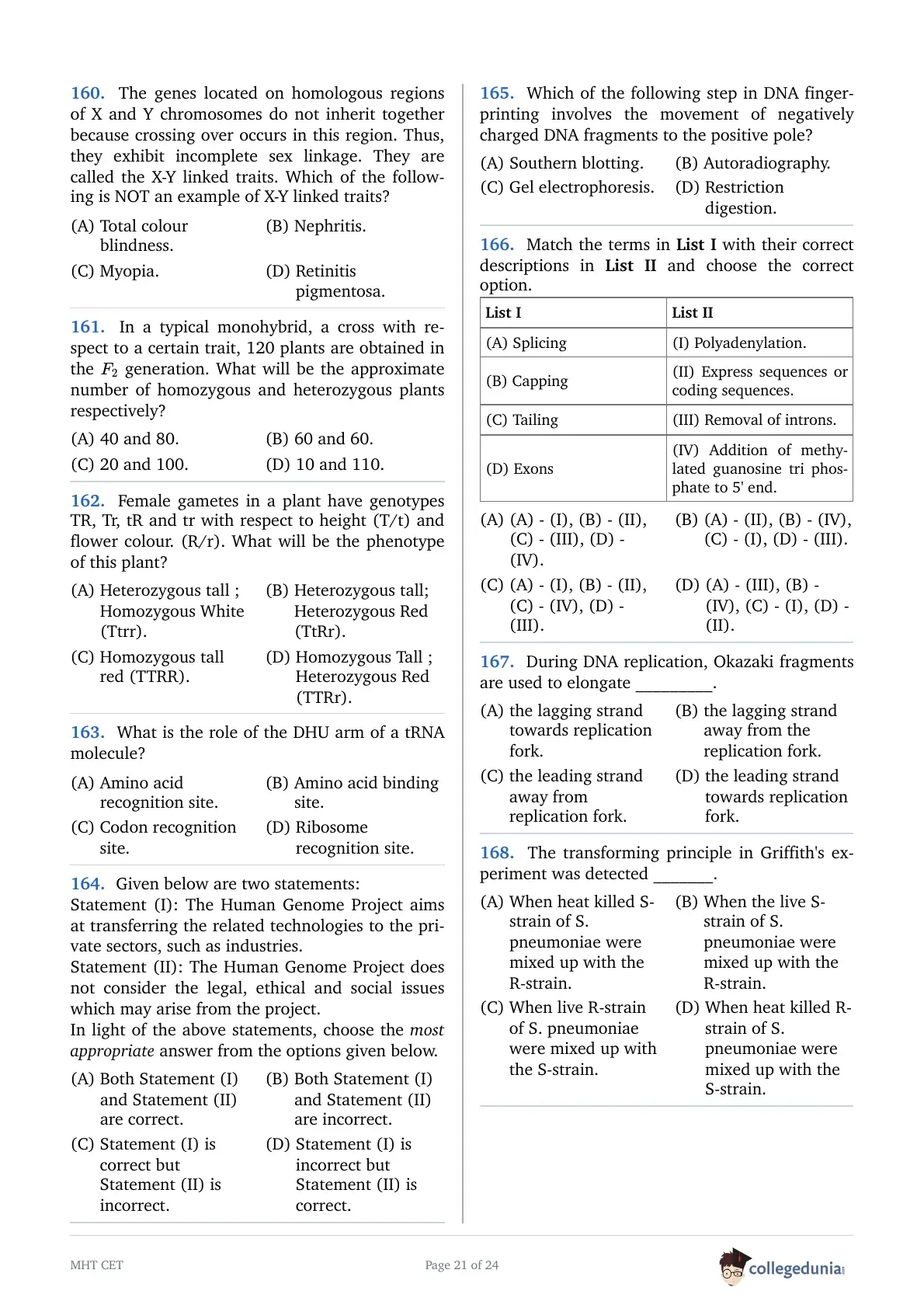
The genes located on homologous regions of X and Y chromosomes do not inherit together because crossing over occurs in this region. Thus, they exhibit incomplete sex linkage. They are called the X-Y linked traits. Which of the following is NOT an example of X-Y linked traits?
In a typical monohybrid, a cross with respect to a certain trait, 120 plants are obtained in the \(F_{2}\) generation. What will be the approximate number of homozygous and heterozygous plants respectively?
Female gametes in a plant have genotypes TR, Tr, tR and tr with respect to height (T/t) and flower colour. (R/r). What will be the phenotype of this plant?
What is the role of the DHU arm of a tRNA molecule?
Given below are two statements:
Statement (I): The Human Genome Project aims at transferring the related technologies to the private sectors, such as industries.
Statement (II): The Human Genome Project does not consider the legal, ethical and social issues which may arise from the project.
In light of the above statements, choose the most appropriate answer from the options given below.
Which of the following step in DNA fingerprinting involves the movement of negatively charged DNA fragments to the positive pole?
Match the terms in List I with their correct descriptions in List II and choose the correct option.
| List I | List II |
|---|---|
| (A) Splicing | (I) Polyadenylation. |
| (B) Capping | (II) Express sequences or coding sequences. |
| (C) Tailing | (III) Removal of introns. |
| (D) Exons | (IV) Addition of methylated guanosine tri phosphate to 5' end. |
During DNA replication, Okazaki fragments are used to elongate _________.
The transforming principle in Griffith's experiment was detected _______.
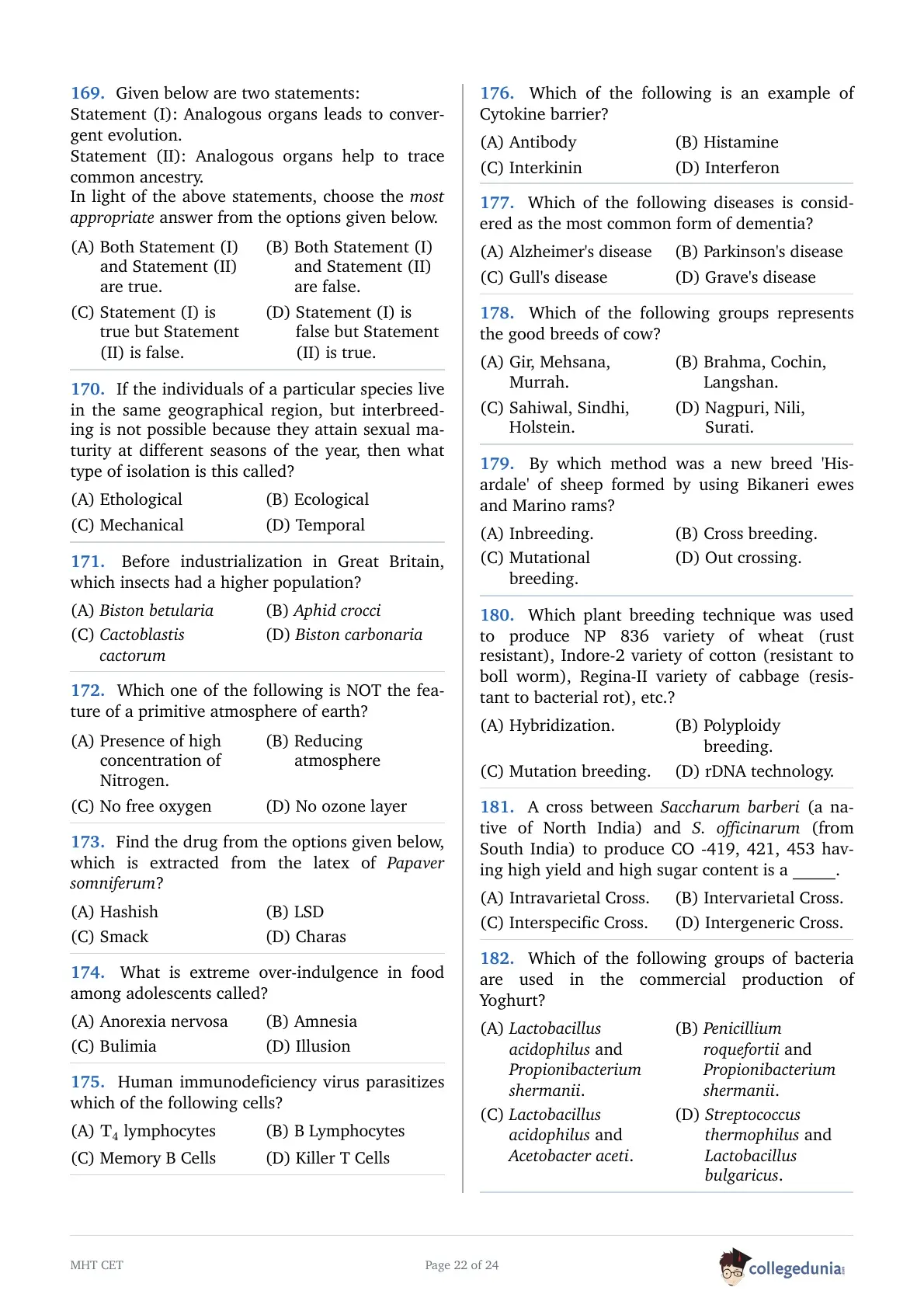
Given below are two statements:
Statement (I): Analogous organs leads to convergent evolution.
Statement (II): Analogous organs help to trace common ancestry.
In light of the above statements, choose the most appropriate answer from the options given below.
If the individuals of a particular species live in the same geographical region, but interbreeding is not possible because they attain sexual maturity at different seasons of the year, then what type of isolation is this called?
Before industrialization in Great Britain, which insects had a higher population?
Which one of the following is NOT the feature of a primitive atmosphere of earth?
Find the drug from the options given below, which is extracted from the latex of Papaver somniferum?
What is extreme over-indulgence in food among adolescents called?
Human immunodeficiency virus parasitizes which of the following cells?
Which of the following is an example of Cytokine barrier?
Which of the following diseases is considered as the most common form of dementia?
Which of the following groups represents the good breeds of cow?
By which method was a new breed 'Hisardale' of sheep formed by using Bikaneri ewes and Marino rams?
Which plant breeding technique was used to produce NP 836 variety of wheat (rust resistant), Indore-2 variety of cotton (resistant to boll worm), Regina-II variety of cabbage (resistant to bacterial rot), etc.?
A cross between Saccharum barberi (a native of North India) and S. officinarum (from South India) to produce CO -419, 421, 453 having high yield and high sugar content is a _____.
Which of the following groups of bacteria are used in the commercial production of Yoghurt?
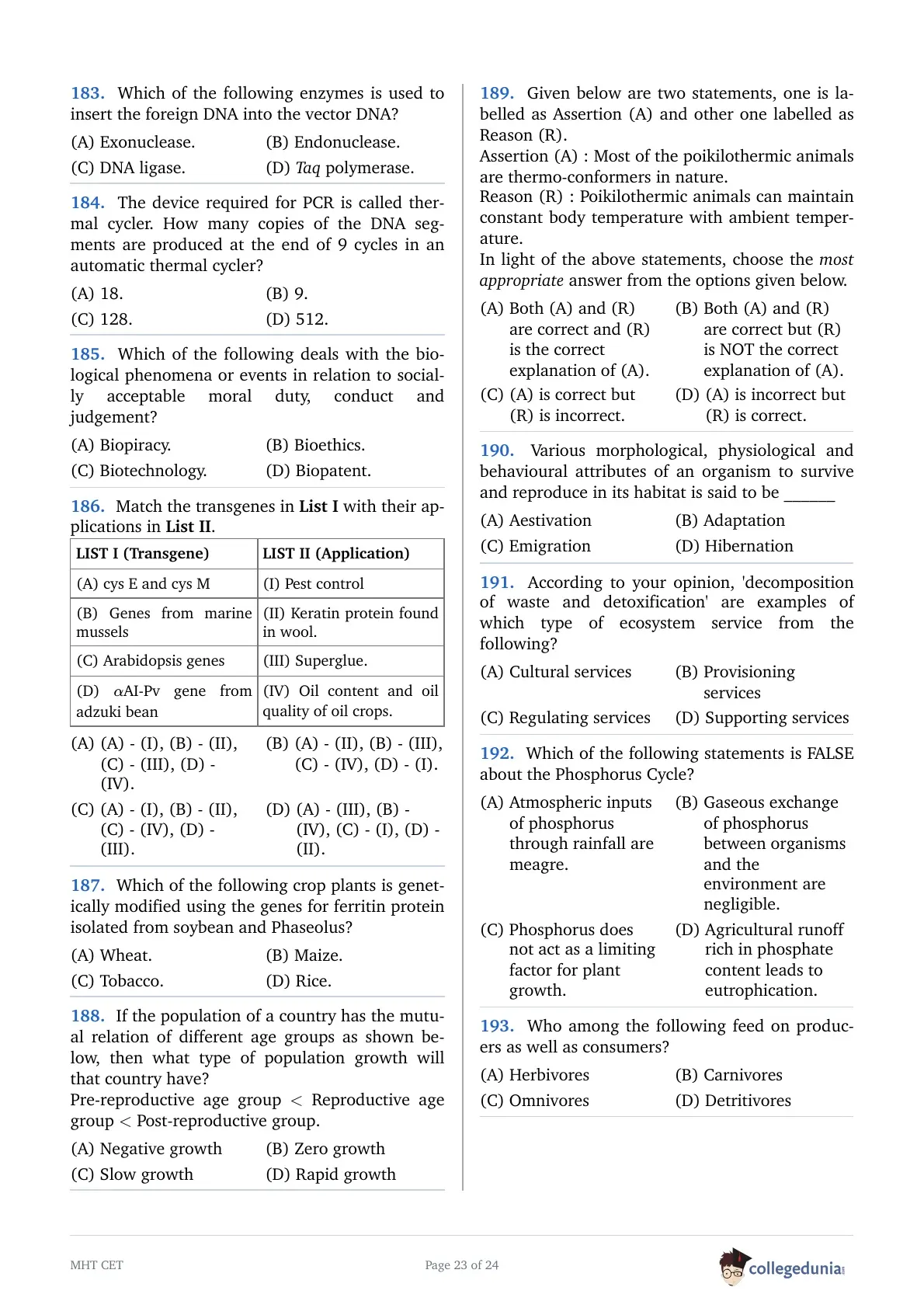
Which of the following enzymes is used to insert the foreign DNA into the vector DNA?
The device required for PCR is called thermal cycler. How many copies of the DNA segments are produced at the end of 9 cycles in an automatic thermal cycler?
Which of the following deals with the biological phenomena or events in relation to socially acceptable moral duty, conduct and judgement?
Match the transgenes in List I with their applications in List II.
| LIST I (Transgene) | LIST II (Application) |
|---|---|
| (A) cys E and cys M | (I) Pest control |
| (B) Genes from marine mussels | (II) Keratin protein found in wool. |
| (C) Arabidopsis genes | (III) Superglue. |
| (D) \(\alpha\)AI-Pv gene from adzuki bean | (IV) Oil content and oil quality of oil crops. |
Which of the following crop plants is genetically modified using the genes for ferritin protein isolated from soybean and Phaseolus?
If the population of a country has the mutual relation of different age groups as shown below, then what type of population growth will that country have?
Pre-reproductive age group \(\lt\) Reproductive age group \(\lt\) Post-reproductive group.
Given below are two statements, one is labelled as Assertion (A) and other one labelled as Reason (R).
Assertion (A) : Most of the poikilothermic animals are thermo-conformers in nature.
Reason (R) : Poikilothermic animals can maintain constant body temperature with ambient temperature.
In light of the above statements, choose the most appropriate answer from the options given below.
Various morphological, physiological and behavioural attributes of an organism to survive and reproduce in its habitat is said to be ______
According to your opinion, 'decomposition of waste and detoxification' are examples of which type of ecosystem service from the following?
Which of the following statements is FALSE about the Phosphorus Cycle?
Who among the following feed on producers as well as consumers?
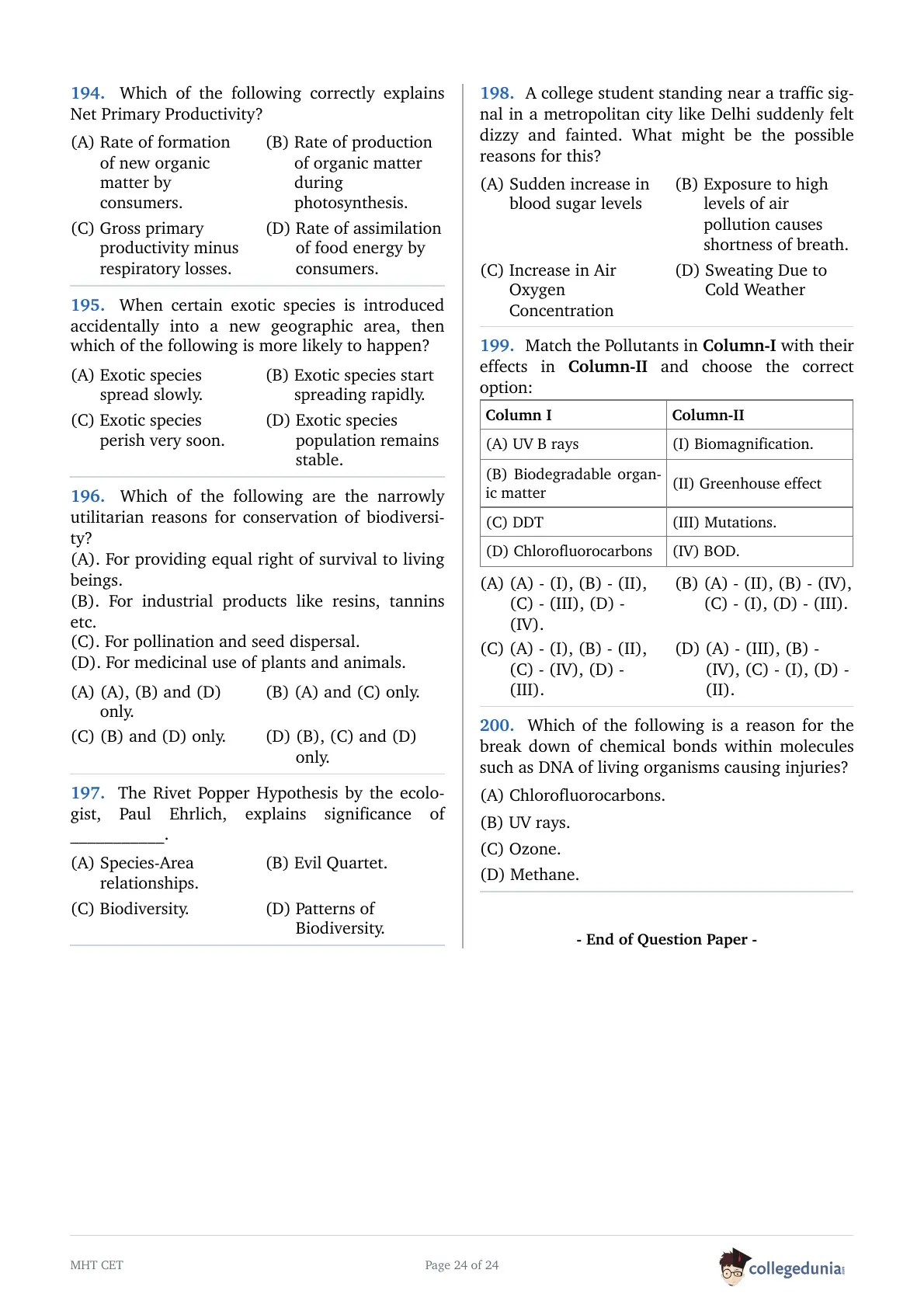
Which of the following correctly explains Net Primary Productivity?
When certain exotic species is introduced accidentally into a new geographic area, then which of the following is more likely to happen?
Which of the following are the narrowly utilitarian reasons for conservation of biodiversity?
(A). For providing equal right of survival to living beings.
(B). For industrial products like resins, tannins etc.
(C). For pollination and seed dispersal.
(D). For medicinal use of plants and animals.
The Rivet Popper Hypothesis by the ecologist, Paul Ehrlich, explains significance of ___________.
A college student standing near a traffic signal in a metropolitan city like Delhi suddenly felt dizzy and fainted. What might be the possible reasons for this?
Match the Pollutants in Column-I with their effects in Column-II and choose the correct option:
| Column I | Column-II |
|---|---|
| (A) UV B rays | (I) Biomagnification. |
| (B) Biodegradable organic matter | (II) Greenhouse effect |
| (C) DDT | (III) Mutations. |
| (D) Chlorofluorocarbons | (IV) BOD. |
Which of the following is a reason for the break down of chemical bonds within molecules such as DNA of living organisms causing injuries?
MHT CET 2026 PCB Exam Pattern and Marking Scheme
| Parameter | Details |
|---|---|
| Conducting Body | Maharashtra Common Entrance Test Cell (Maharashtra CET Cell) |
| Exam Mode | Online (Computer-Based Test) |
| Duration | 180 minutes (3 hours) |
| Groups / Subjects | PCB (Physics, Chemistry, Biology) for Pharmacy and Agriculture |
| Total Questions |
200 |
| Total Marks | 200 |
| Question Type | Multiple Choice Questions (MCQs) |
| Marking Scheme | 1 mark for each correct answer |
| Negative Marking | No |
| Syllabus Weightage |
|



Comments