




MHT CET 2026 April 25 Shift 1 PCB Question Paper is available for download here. Maharashtra State CET Cell is conducting MHT CET 2026 PCB Exam on April 25 in Shift 1 from 9 AM to 12 PM in CBT mode.
The MHT CET 2026 PCB question paper includes the following:
- The MHT CET 2026 PCB Question Paper consists of 200 multiple-choice questions (MCQs) totalling 200 marks divided into 3 sections: Physics (50 questions), Chemistry (50 questions), and Biology (100 questions).
- All questions carry 1 mark each. There is no negative marking for incorrect answers.
MHT CET 2026 April 25 Shift 1 PCB Question Paper with Solution PDF
| CD PDF | CD PDF with Solutions |
|---|---|
| Download Collegedunia PDF 1.22 MB | - |
Also Check:
MHT CET 2026 April 25 Shift 1 PCB Questions with Solutions
Physics (Q1 - Q50)
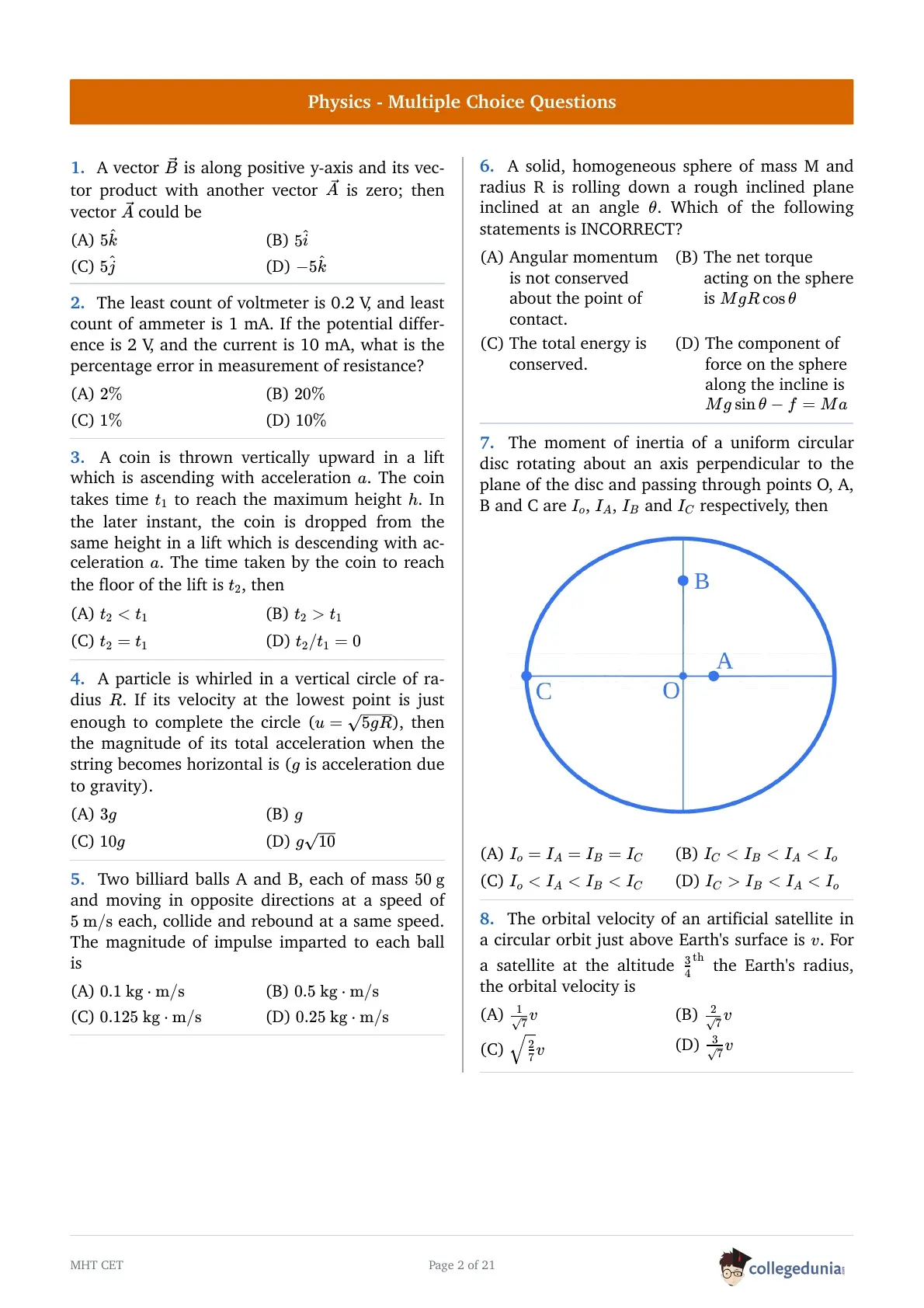
A vector \(\vec{B}\) is along positive y-axis and its vector product with another vector \(\vec{A}\) is zero; then vector \(\vec{A}\) could be
The least count of voltmeter is 0.2 V, and least count of ammeter is 1 mA. If the potential difference is 2 V, and the current is 10 mA, what is the percentage error in measurement of resistance?
A coin is thrown vertically upward in a lift which is ascending with acceleration \(a\). The coin takes time \(t_{1}\) to reach the maximum height \(h\). In the later instant, the coin is dropped from the same height in a lift which is descending with acceleration \(a\). The time taken by the coin to reach the floor of the lift is \(t_{2}\), then
A particle is whirled in a vertical circle of radius \(R\). If its velocity at the lowest point is just enough to complete the circle (\(u=\sqrt{5gR}\)), then the magnitude of its total acceleration when the string becomes horizontal is (\(g\) is acceleration due to gravity).
Two billiard balls A and B, each of mass \(50\ \text{g}\) and moving in opposite directions at a speed of \(5\ \text{m/s}\) each, collide and rebound at a same speed. The magnitude of impulse imparted to each ball is
A solid, homogeneous sphere of mass M and radius R is rolling down a rough inclined plane inclined at an angle \(\theta\). Which of the following statements is INCORRECT?
The moment of inertia of a uniform circular disc rotating about an axis perpendicular to the plane of the disc and passing through points O, A, B and C are \(I_{o}\), \(I_{A}\), \(I_{B}\) and \(I_{C}\) respectively, then

The orbital velocity of an artificial satellite in a circular orbit just above Earth's surface is \(v\). For a satellite at the altitude \(\frac{3}{4}^{\text{th}}\) the Earth's radius, the orbital velocity is
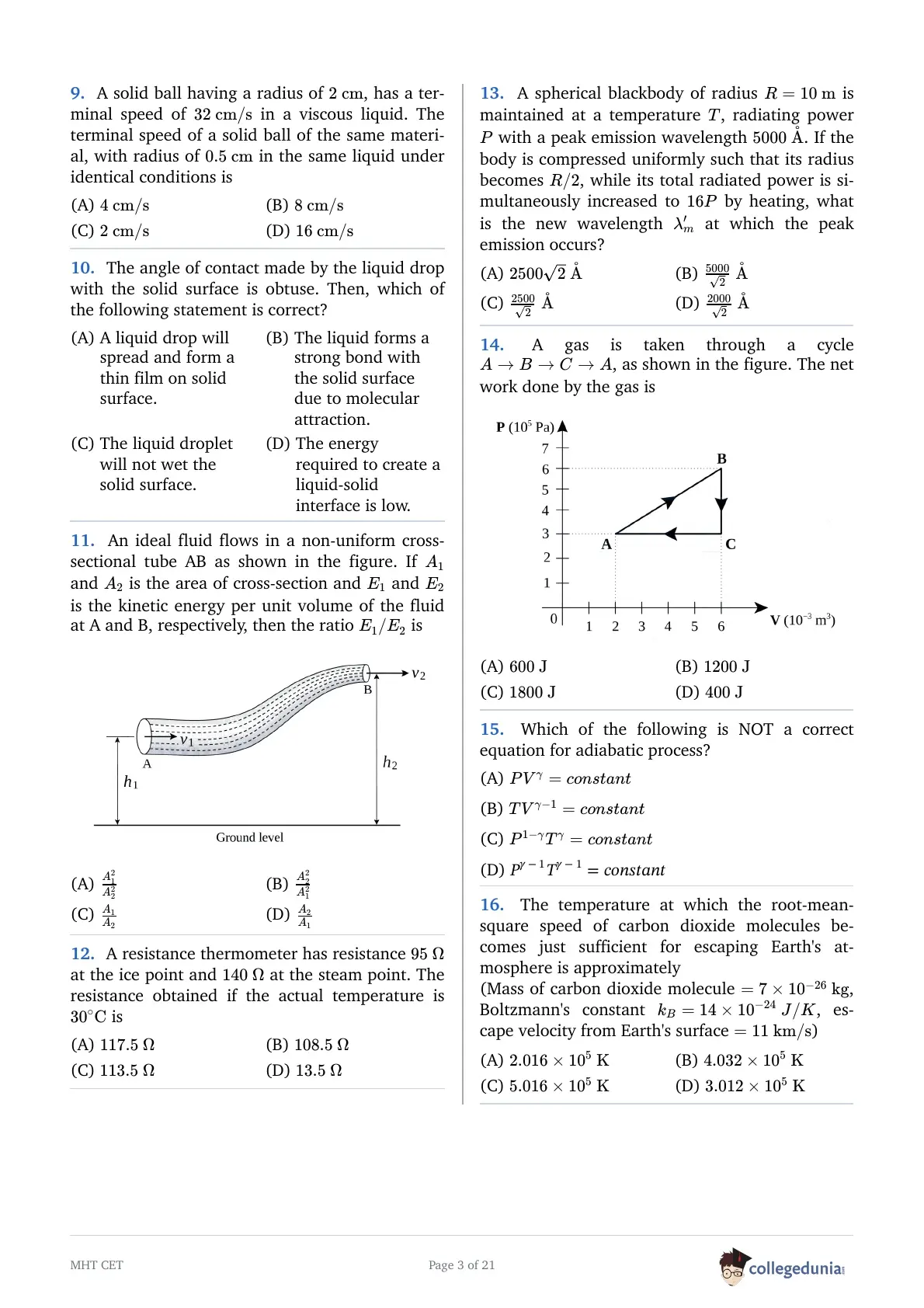
A solid ball having a radius of \(2\ \text{cm}\), has a terminal speed of \(32\ \text{cm/s}\) in a viscous liquid. The terminal speed of a solid ball of the same material, with radius of \(0.5\ \text{cm}\) in the same liquid under identical conditions is
The angle of contact made by the liquid drop with the solid surface is obtuse. Then, which of the following statement is correct?
An ideal fluid flows in a non-uniform cross-sectional tube AB as shown in the figure. If \(A_{1}\) and \(A_{2}\) is the area of cross-section and \(E_{1}\) and \(E_{2}\) is the kinetic energy per unit volume of the fluid at A and B, respectively, then the ratio \(E_{1}/E_{2}\) is

A resistance thermometer has resistance \(95\ \Omega\) at the ice point and \(140\ \Omega\) at the steam point. The resistance obtained if the actual temperature is \(30^{\circ }\text{C}\) is
A spherical blackbody of radius \(R=10\ \text{m}\) is maintained at a temperature \(T\), radiating power \(P\) with a peak emission wavelength \(5000\ \text{Å}\). If the body is compressed uniformly such that its radius becomes \(R/2\), while its total radiated power is simultaneously increased to \(16P\) by heating, what is the new wavelength \(\lambda _{m}'\) at which the peak emission occurs?
A gas is taken through a cycle \(A\rightarrow B\rightarrow C\rightarrow A\), as shown in the figure. The net work done by the gas is

Which of the following is NOT a correct equation for adiabatic process?
The temperature at which the root-mean-square speed of carbon dioxide molecules becomes just sufficient for escaping Earth's atmosphere is approximately
(Mass of carbon dioxide molecule \(=7\times 10^{-26}\ \text{kg}\), Boltzmann's constant \(k_{B}=14\times 10^{-24}\ J/K\), escape velocity from Earth's surface \(=11\ \text{km/s}\))
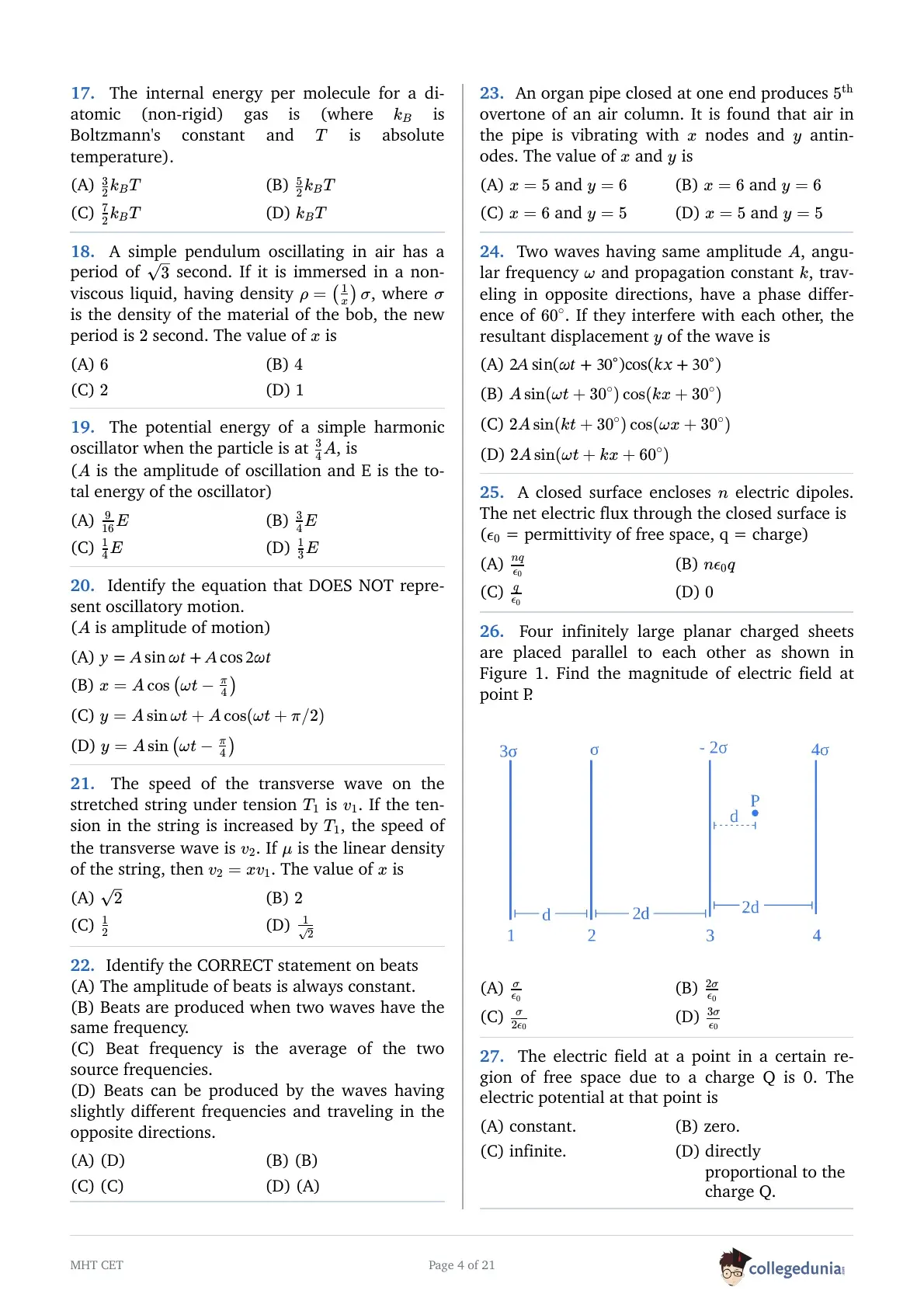
The internal energy per molecule for a diatomic (non-rigid) gas is (where \(k_{B}\) is Boltzmann's constant and \(T\) is absolute temperature).
A simple pendulum oscillating in air has a period of \(\sqrt{3}\) second. If it is immersed in a non-viscous liquid, having density \(\rho =\left(\frac{1}{x}\right)\sigma\), where \(\sigma\) is the density of the material of the bob, the new period is \(2\) second. The value of \(x\) is
The potential energy of a simple harmonic oscillator when the particle is at \(\frac{3}{4}A\), is
(\(A\) is the amplitude of oscillation and E is the total energy of the oscillator)
Identify the equation that DOES NOT represent oscillatory motion.
(\(A\) is amplitude of motion)
The speed of the transverse wave on the stretched string under tension \(T_{1}\) is \(v_{1}\). If the tension in the string is increased by \(T_{1}\), the speed of the transverse wave is \(v_{2}\). If \(\mu\) is the linear density of the string, then \(v_{2}=xv_{1}\). The value of \(x\) is
Identify the CORRECT statement on beats
(A) The amplitude of beats is always constant.
(B) Beats are produced when two waves have the same frequency.
(C) Beat frequency is the average of the two source frequencies.
(D) Beats can be produced by the waves having slightly different frequencies and traveling in the opposite directions.
An organ pipe closed at one end produces \(5^{\text{th}}\) overtone of an air column. It is found that air in the pipe is vibrating with \(x\) nodes and \(y\) antinodes. The value of \(x\) and \(y\) is
Two waves having same amplitude \(A\), angular frequency \(\omega\) and propagation constant \(k\), traveling in opposite directions, have a phase difference of \(60^{\circ }\). If they interfere with each other, the resultant displacement \(y\) of the wave is
A closed surface encloses \(n\) electric dipoles. The net electric flux through the closed surface is
(\(\epsilon _{0}\) = permittivity of free space, q = charge)
Four infinitely large planar charged sheets are placed parallel to each other as shown in Figure 1. Find the magnitude of electric field at point P.

The electric field at a point in a certain region of free space due to a charge Q is 0. The electric potential at that point is
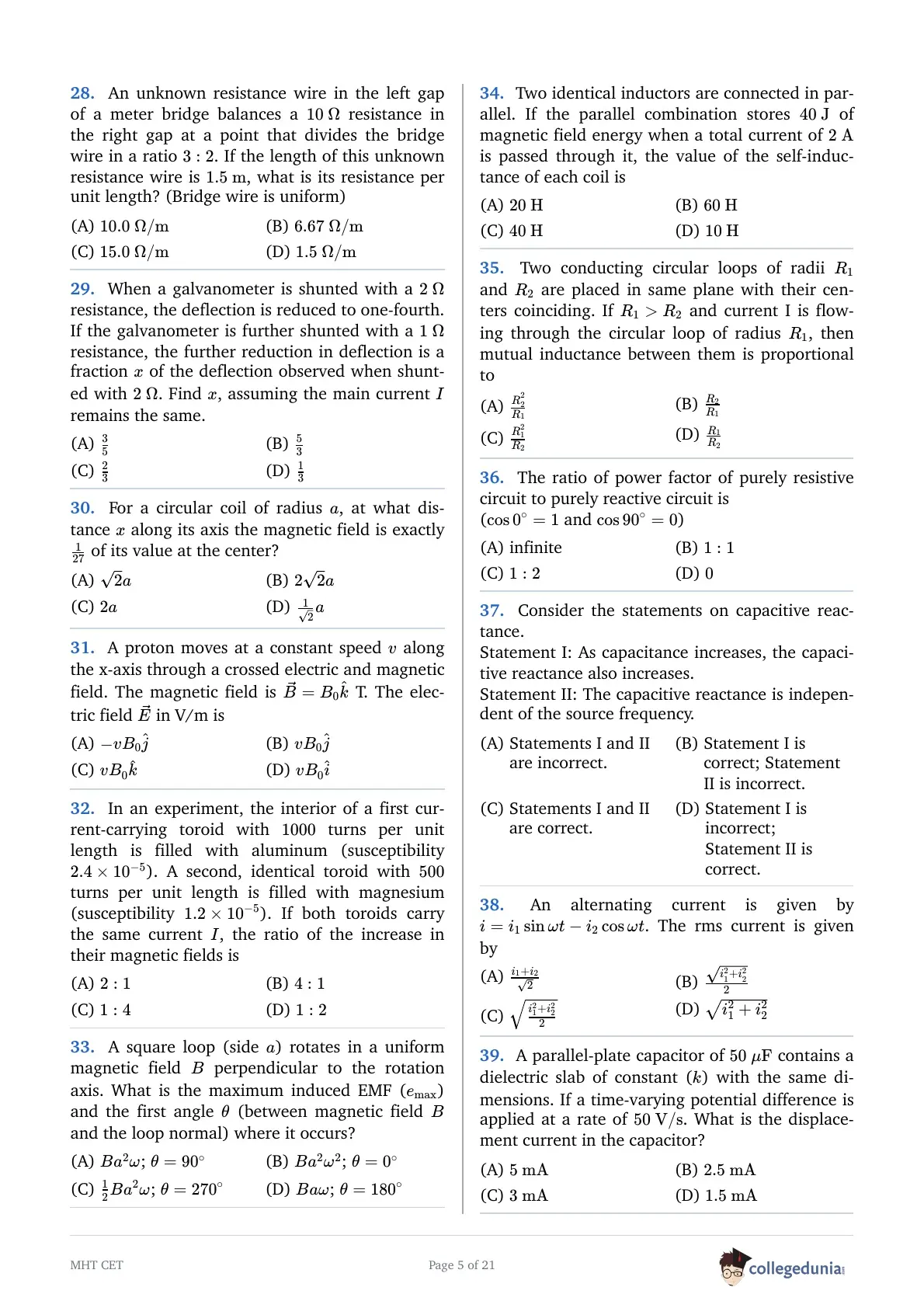
An unknown resistance wire in the left gap of a meter bridge balances a \(10\ \Omega\) resistance in the right gap at a point that divides the bridge wire in a ratio \(3:2\). If the length of this unknown resistance wire is \(1.5\ \text{m}\), what is its resistance per unit length? (Bridge wire is uniform)
When a galvanometer is shunted with a \(2\ \Omega\) resistance, the deflection is reduced to one-fourth. If the galvanometer is further shunted with a \(1\ \Omega\) resistance, the further reduction in deflection is a fraction \(x\) of the deflection observed when shunted with \(2\ \Omega\). Find \(x\), assuming the main current \(I\) remains the same.
For a circular coil of radius \(a\), at what distance \(x\) along its axis the magnetic field is exactly \(\frac{1}{27}\) of its value at the center?
A proton moves at a constant speed \(v\) along the x-axis through a crossed electric and magnetic field. The magnetic field is \(\vec{B}=B_{0}\hat{k}\) T. The electric field \(\vec{E}\) in V/m is
In an experiment, the interior of a first current-carrying toroid with \(1000\) turns per unit length is filled with aluminum (susceptibility \(2.4\times 10^{-5}\)). A second, identical toroid with \(500\) turns per unit length is filled with magnesium (susceptibility \(1.2\times 10^{-5}\)). If both toroids carry the same current \(I\), the ratio of the increase in their magnetic fields is
A square loop (side \(a\)) rotates in a uniform magnetic field \(B\) perpendicular to the rotation axis. What is the maximum induced EMF (\(e_{\text{max}}\)) and the first angle \(\theta\) (between magnetic field \(B\) and the loop normal) where it occurs?
Two identical inductors are connected in parallel. If the parallel combination stores \(40\ \text{J}\) of magnetic field energy when a total current of \(2\ \text{A}\) is passed through it, the value of the self-inductance of each coil is
Two conducting circular loops of radii \(R_{1}\) and \(R_{2}\) are placed in same plane with their centers coinciding. If \(R_{1}>R_{2}\) and current I is flowing through the circular loop of radius \(R_{1}\), then mutual inductance between them is proportional to
The ratio of power factor of purely resistive circuit to purely reactive circuit is
(\(\cos 0^{\circ }=1\) and \(\cos 90^{\circ }=0\))
Consider the statements on capacitive reactance.
Statement I: As capacitance increases, the capacitive reactance also increases.
Statement II: The capacitive reactance is independent of the source frequency.
An alternating current is given by \(i=i_{1}\sin \omega t-i_{2}\cos \omega t\). The rms current is given by
A parallel-plate capacitor of \(50\ \mu \text{F}\) contains a dielectric slab of constant (\(k\)) with the same dimensions. If a time-varying potential difference is applied at a rate of \(50\ \text{V/s}\). What is the displacement current in the capacitor?
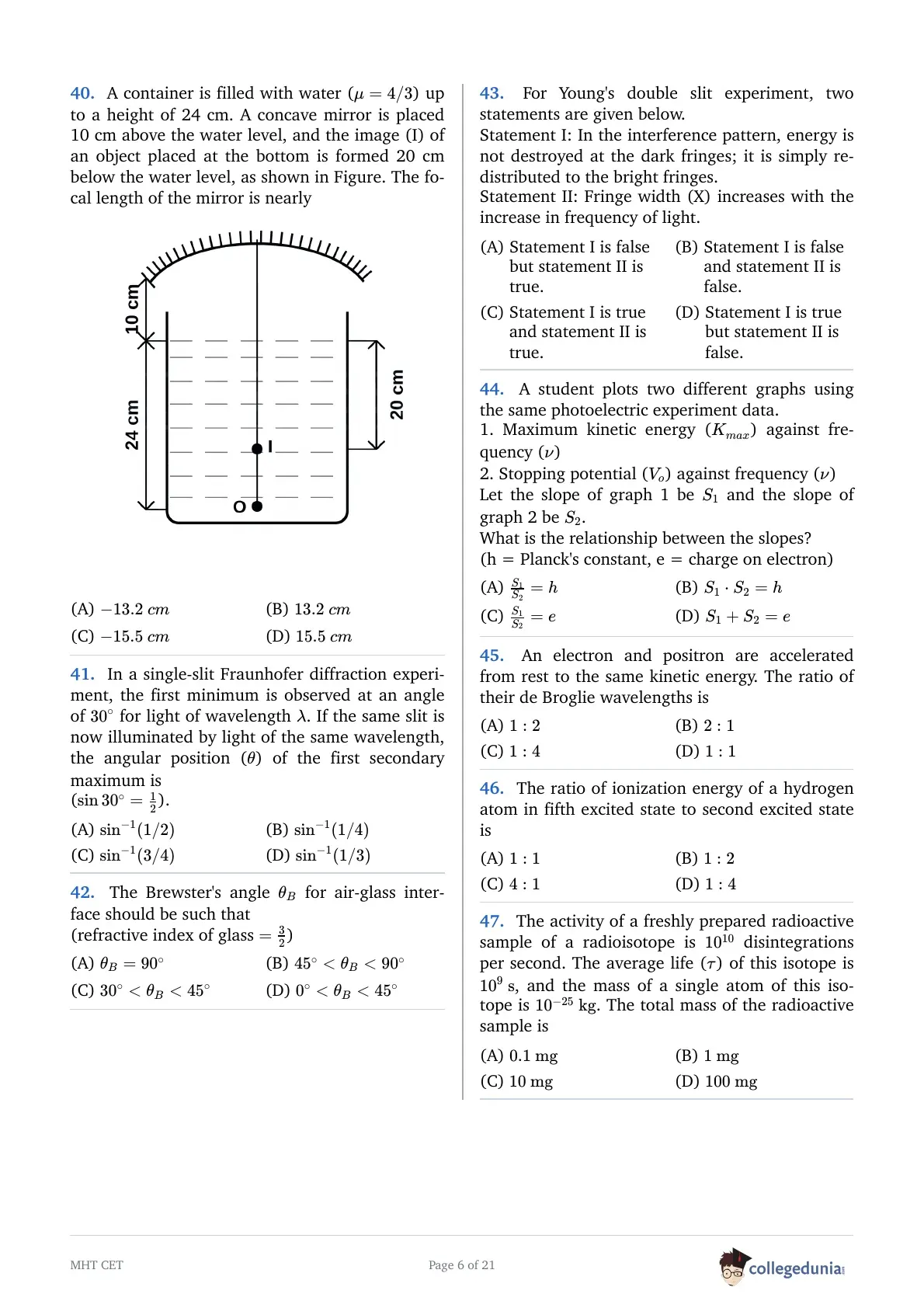
A container is filled with water (\(\mu =4/3\)) up to a height of 24 cm. A concave mirror is placed 10 cm above the water level, and the image (I) of an object placed at the bottom is formed 20 cm below the water level, as shown in Figure. The focal length of the mirror is nearly

In a single-slit Fraunhofer diffraction experiment, the first minimum is observed at an angle of \(30^{\circ }\) for light of wavelength \(\lambda\). If the same slit is now illuminated by light of the same wavelength, the angular position (\(\theta\)) of the first secondary maximum is
(\(\sin 30^{\circ }=\frac{1}{2}\)).
The Brewster's angle \(\theta _{B}\) for air-glass interface should be such that
(refractive index of glass \(=\frac{3}{2}\))
For Young's double slit experiment, two statements are given below.
Statement I: In the interference pattern, energy is not destroyed at the dark fringes; it is simply redistributed to the bright fringes.
Statement II: Fringe width (X) increases with the increase in frequency of light.
A student plots two different graphs using the same photoelectric experiment data.
1. Maximum kinetic energy (\(K_{max}\)) against frequency (\(\nu\))
2. Stopping potential (\(V_{o}\)) against frequency (\(\nu\))
Let the slope of graph 1 be \(S_{1}\) and the slope of graph 2 be \(S_{2}\).
What is the relationship between the slopes?
(h = Planck's constant, e = charge on electron)
An electron and positron are accelerated from rest to the same kinetic energy. The ratio of their de Broglie wavelengths is
The ratio of ionization energy of a hydrogen atom in fifth excited state to second excited state is
The activity of a freshly prepared radioactive sample of a radioisotope is \(10^{10}\) disintegrations per second. The average life (\(\tau\)) of this isotope is \(10^{9}\ \text{s}\), and the mass of a single atom of this isotope is \(10^{-25}\ \text{kg}\). The total mass of the radioactive sample is
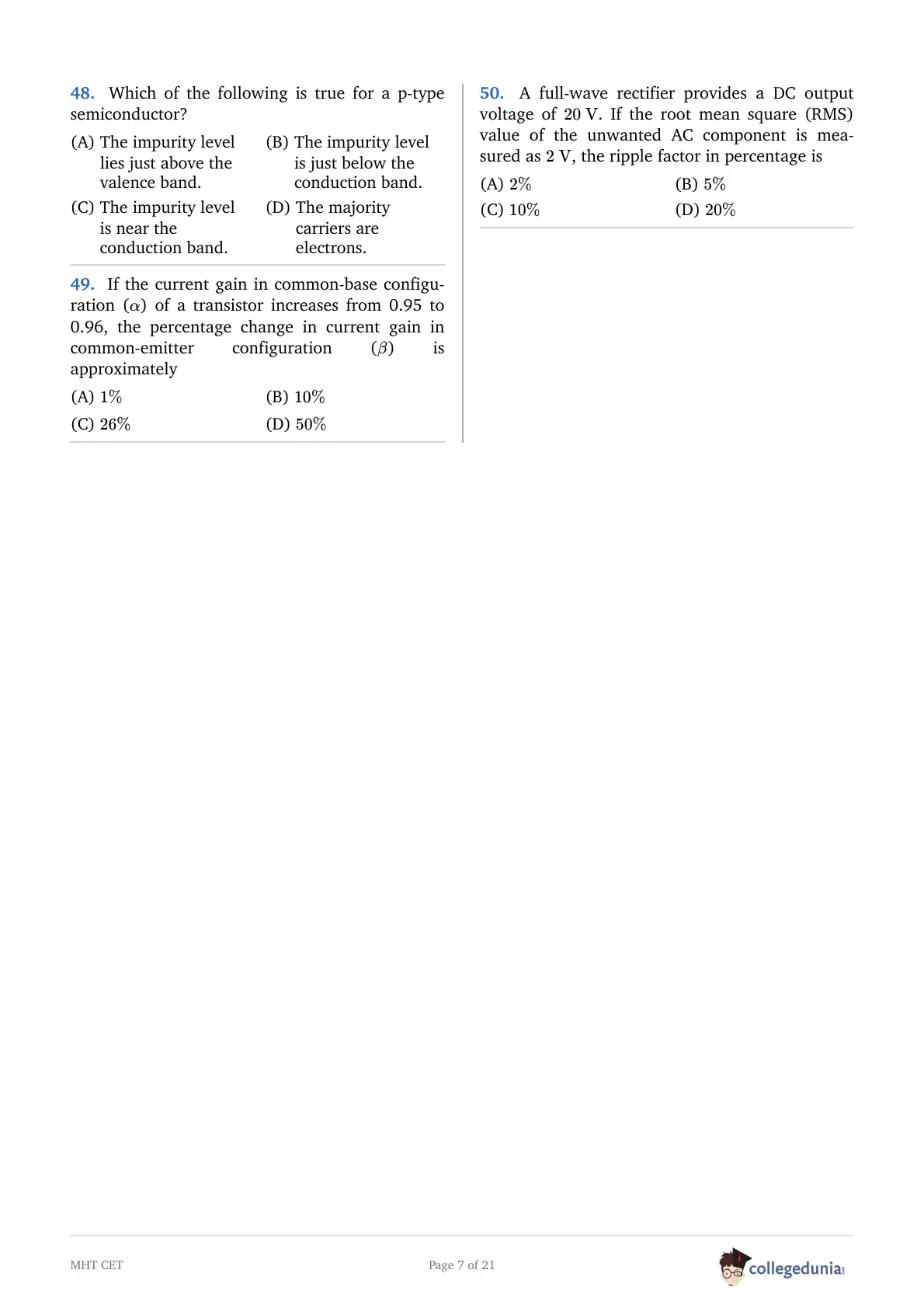
Which of the following is true for a p-type semiconductor?
If the current gain in common-base configuration (\(\alpha\)) of a transistor increases from 0.95 to 0.96, the percentage change in current gain in common-emitter configuration (\(\beta\)) is approximately
A full-wave rectifier provides a DC output voltage of \(20\ \text{V}\). If the root mean square (RMS) value of the unwanted AC component is measured as \(2\ \text{V}\), the ripple factor in percentage is
Chemistry (Q51 - Q100)
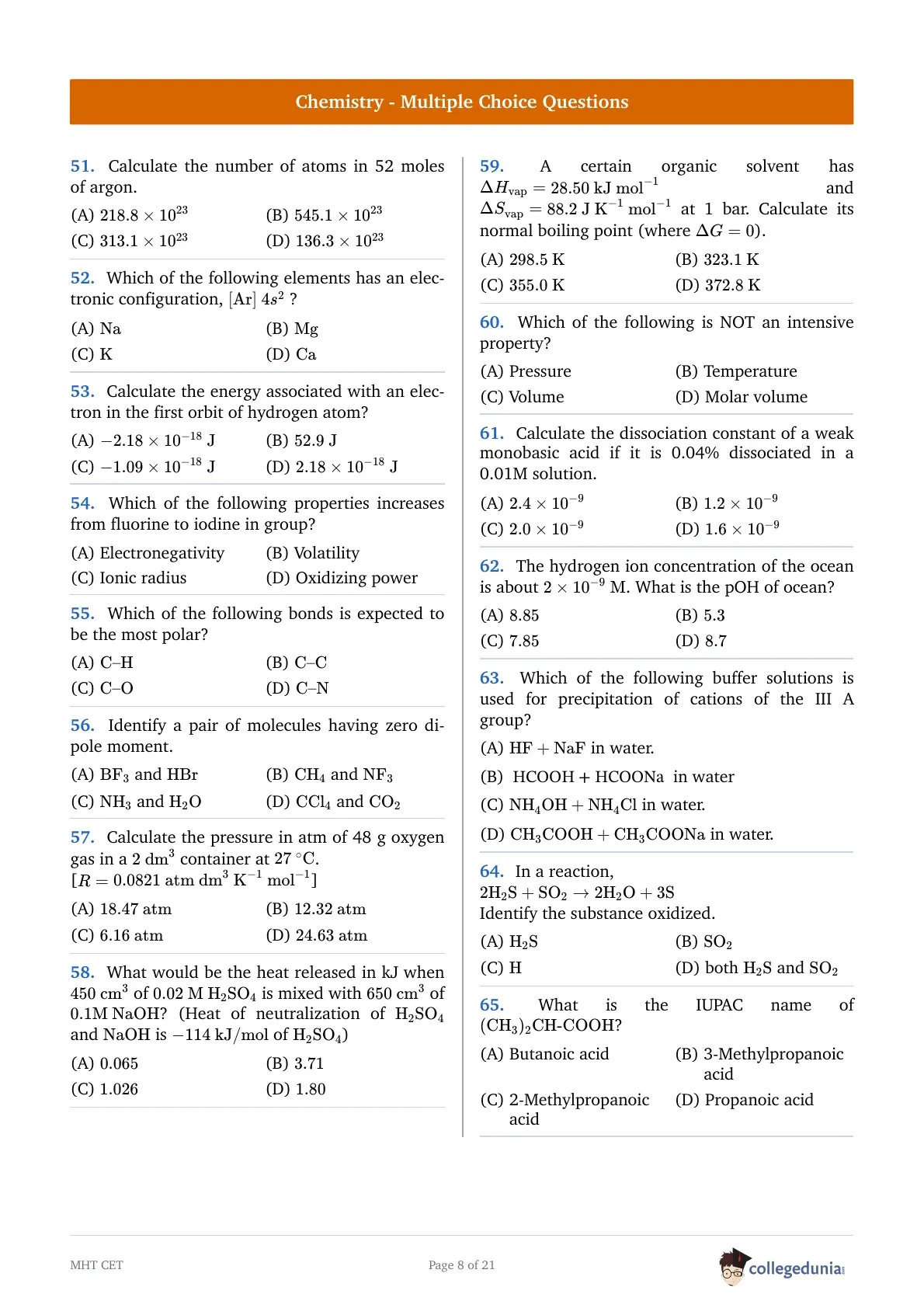
Calculate the number of atoms in 52 moles of argon.
Which of the following elements has an electronic configuration, \([\text{Ar}]\ 4s^{2}\) ?
Calculate the energy associated with an electron in the first orbit of hydrogen atom?
Which of the following properties increases from fluorine to iodine in group?
Which of the following bonds is expected to be the most polar?
Identify a pair of molecules having zero dipole moment.
Calculate the pressure in atm of 48 g oxygen gas in a \(2\ \text{dm}^{3}\) container at \(27\ ^{\circ }\text{C}\).
[\(R=0.0821\ \text{atm dm}^{3}\ \text{K}^{-1}\ \text{mol}^{-1}\)]
What would be the heat released in kJ when \(450\ \text{cm}^{3}\) of \(0.02\ \text{M}\ \text{H}_{2}\text{SO}_{4}\) is mixed with \(650\ \text{cm}^{3}\) of \(0.1\text{M}\ \text{NaOH}\)? (Heat of neutralization of \(\text{H}_{2}\text{SO}_{4}\) and \(\text{NaOH}\) is \(-114\ \text{kJ/mol}\) of \(\text{H}_{2}\text{SO}_{4}\))
A certain organic solvent has \(\Delta H_{\text{vap}}=28.50\ \text{kJ mol}^{-1}\) and \(\Delta S_{\text{vap}}=88.2\ \text{J K}^{-1}\ \text{mol}^{-1}\) at 1 bar. Calculate its normal boiling point (where \(\Delta G=0\)).
Which of the following is NOT an intensive property?
Calculate the dissociation constant of a weak monobasic acid if it is 0.04% dissociated in a 0.01M solution.
The hydrogen ion concentration of the ocean is about \(2\times 10^{-9}\ \text{M}\). What is the pOH of ocean?
Which of the following buffer solutions is used for precipitation of cations of the III A group?
In a reaction,
\(2\text{H}_{2}\text{S}+\text{SO}_{2}\rightarrow 2\text{H}_{2}\text{O}+3\text{S}\)
Identify the substance oxidized.
What is the IUPAC name of \((\text{CH}_{3})_{2}\text{CH-COOH}\)?
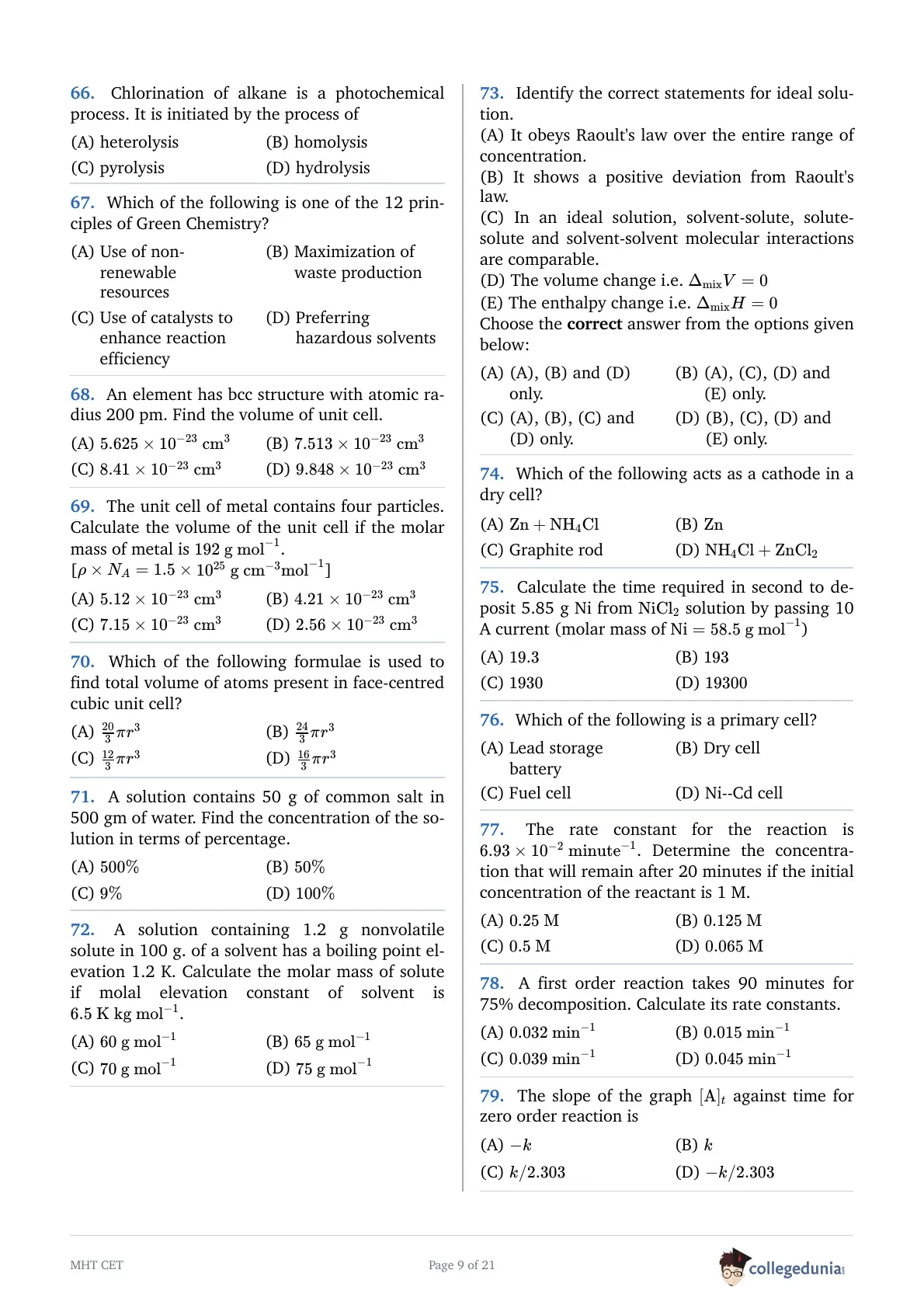
Chlorination of alkane is a photochemical process. It is initiated by the process of
Which of the following is one of the 12 principles of Green Chemistry?
An element has bcc structure with atomic radius 200 pm. Find the volume of unit cell.
The unit cell of metal contains four particles. Calculate the volume of the unit cell if the molar mass of metal is \(192\ \text{g mol}^{-1}\).
[\(\rho \times N_{A}=1.5\times 10^{25}\ \text{g cm}^{-3}\text{mol}^{-1}\)]
Which of the following formulae is used to find total volume of atoms present in face-centred cubic unit cell?
A solution contains 50 g of common salt in 500 gm of water. Find the concentration of the solution in terms of percentage.
A solution containing 1.2 g nonvolatile solute in 100 g. of a solvent has a boiling point elevation 1.2 K. Calculate the molar mass of solute if molal elevation constant of solvent is \(6.5\ \text{K kg mol}^{-1}\).
Identify the correct statements for ideal solution.
(A) It obeys Raoult's law over the entire range of concentration.
(B) It shows a positive deviation from Raoult's law.
(C) In an ideal solution, solvent-solute, solute-solute and solvent-solvent molecular interactions are comparable.
(D) The volume change i.e. \(\Delta _{\text{mix}}V=0\)
(E) The enthalpy change i.e. \(\Delta _{\text{mix}}H=0\)
Choose the correct answer from the options given below:
Which of the following acts as a cathode in a dry cell?
Calculate the time required in second to deposit 5.85 g Ni from \(\text{NiCl}_{2}\) solution by passing 10 A current (molar mass of Ni \(=58.5\ \text{g mol}^{-1}\))
Which of the following is a primary cell?
The rate constant for the reaction is \(6.93\times 10^{-2}\ \text{minute}^{-1}\). Determine the concentration that will remain after 20 minutes if the initial concentration of the reactant is 1 M.
A first order reaction takes 90 minutes for 75% decomposition. Calculate its rate constants.
The slope of the graph \([\text{A}]_{t}\) against time for zero order reaction is
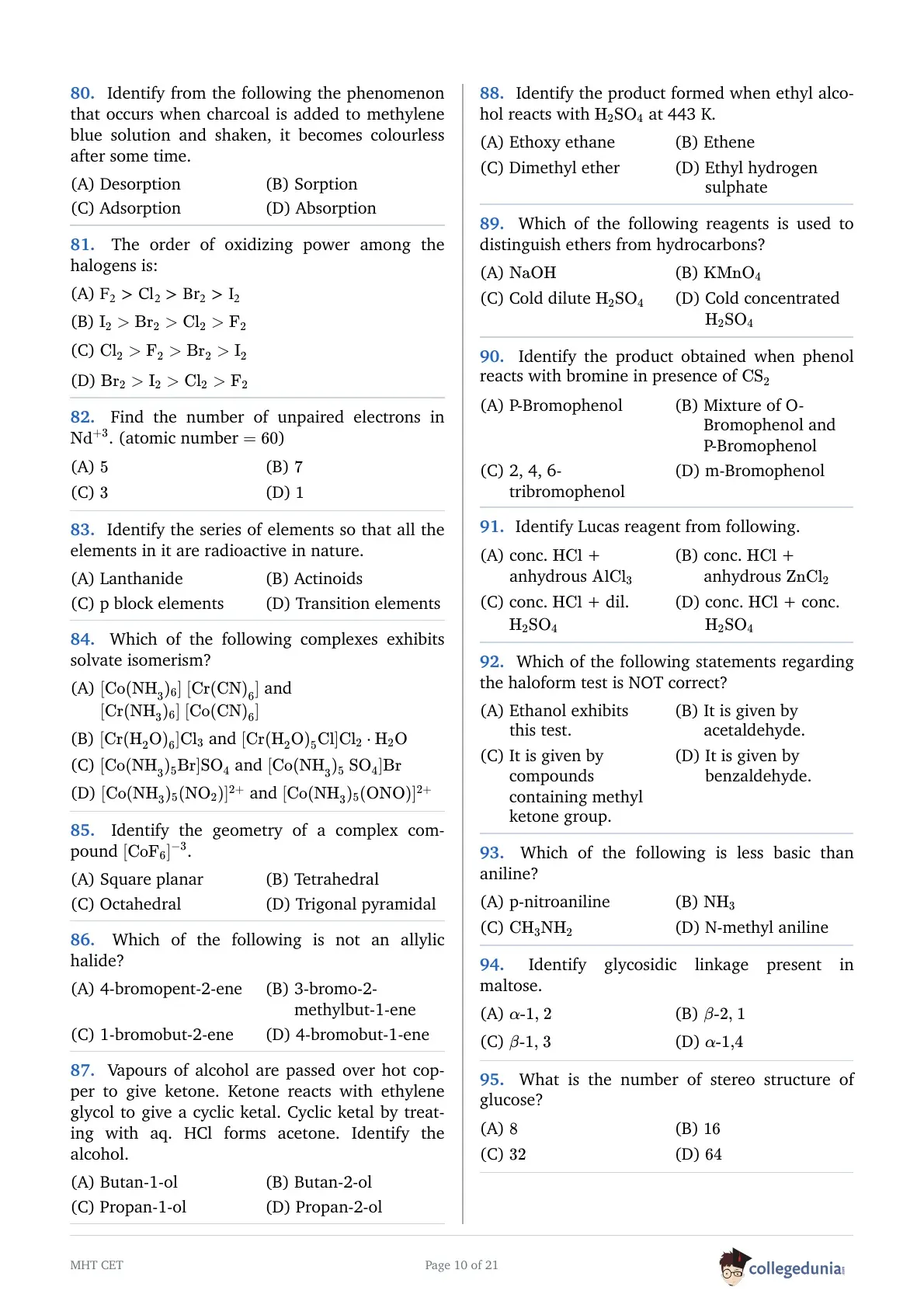
Identify from the following the phenomenon that occurs when charcoal is added to methylene blue solution and shaken, it becomes colourless after some time.
The order of oxidizing power among the halogens is:
Find the number of unpaired electrons in \(\text{Nd}^{+3}\). (atomic number \(=60\))
Identify the series of elements so that all the elements in it are radioactive in nature.
Which of the following complexes exhibits solvate isomerism?
Identify the geometry of a complex compound \([\text{CoF}_{6}]^{-3}\).
Which of the following is not an allylic halide?
Vapours of alcohol are passed over hot copper to give ketone. Ketone reacts with ethylene glycol to give a cyclic ketal. Cyclic ketal by treating with aq. HCl forms acetone. Identify the alcohol.
Identify the product formed when ethyl alcohol reacts with \(\text{H}_{2}\text{SO}_{4}\) at 443 K.
Which of the following reagents is used to distinguish ethers from hydrocarbons?
Identify the product obtained when phenol reacts with bromine in presence of \(\text{CS}_{2}\)
Identify Lucas reagent from following.
Which of the following statements regarding the haloform test is NOT correct?
Which of the following is less basic than aniline?
Identify glycosidic linkage present in maltose.
What is the number of stereo structure of glucose?
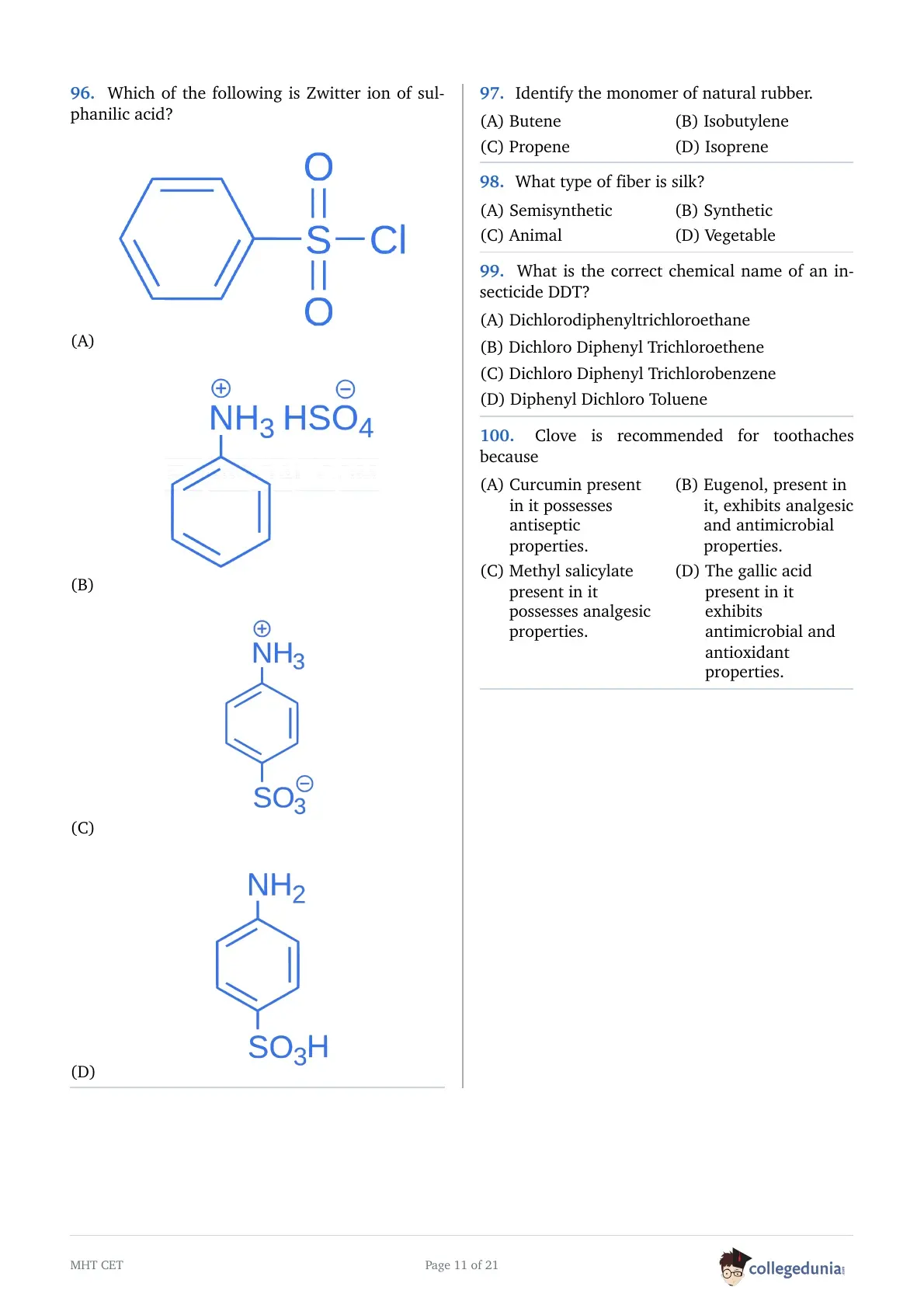
Which of the following is Zwitter ion of sulphanilic acid?
- (A)
![]()
- (B)
![]()
- (C)
![]()
- (D)
![]()


Identify the monomer of natural rubber.
What type of fiber is silk?
What is the correct chemical name of an insecticide DDT?
Clove is recommended for toothaches because
Biology (Q101 - Q200)
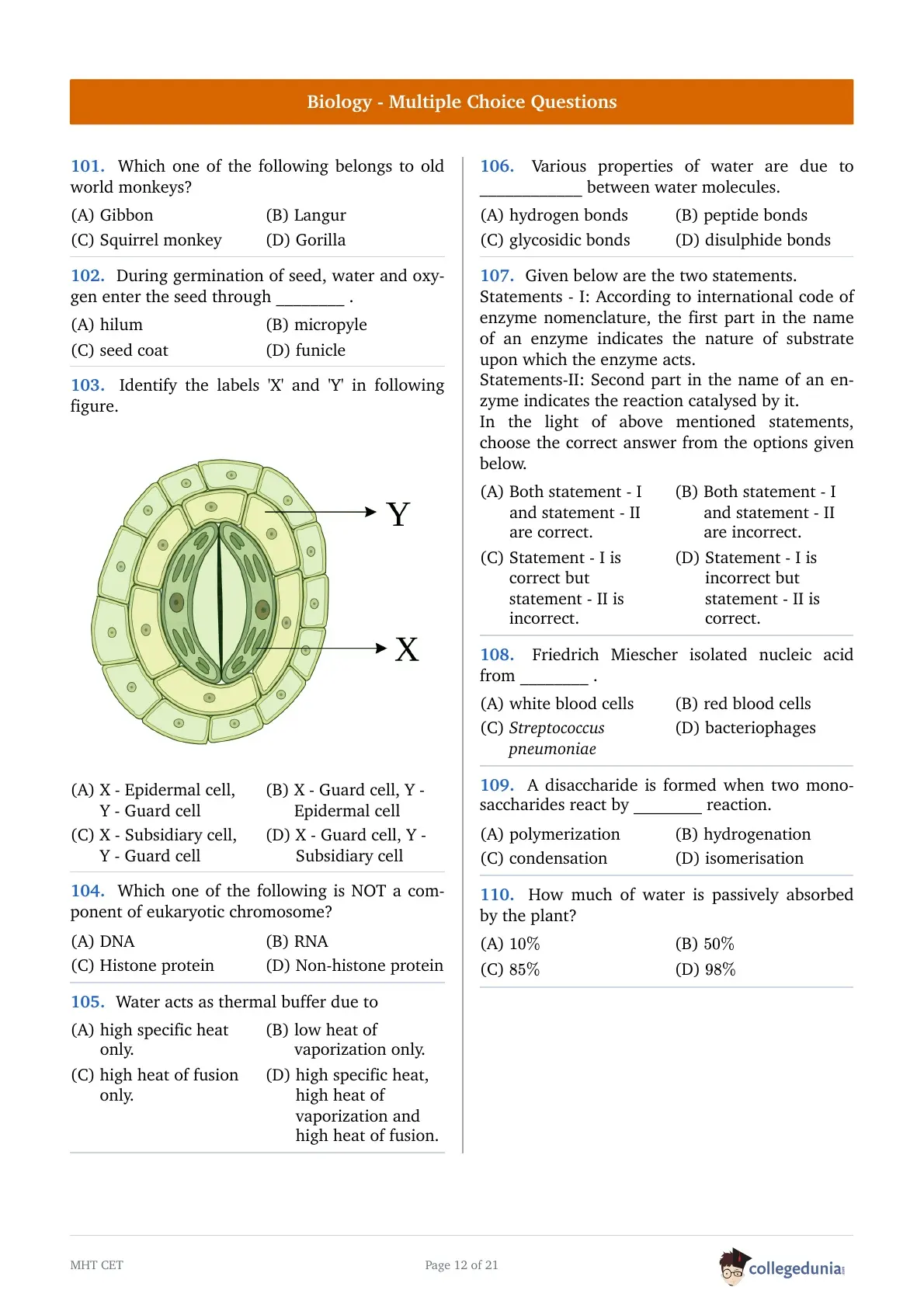
Which one of the following belongs to old world monkeys?
During germination of seed, water and oxygen enter the seed through ________ .

Which one of the following is NOT a component of eukaryotic chromosome?
Water acts as thermal buffer due to
Various properties of water are due to ____________ between water molecules.
Given below are the two statements.
Statements - I: According to international code of enzyme nomenclature, the first part in the name of an enzyme indicates the nature of substrate upon which the enzyme acts.
Statements-II: Second part in the name of an enzyme indicates the reaction catalysed by it.
In the light of above mentioned statements, choose the correct answer from the options given below.
Friedrich Miescher isolated nucleic acid from ________ .
A disaccharide is formed when two monosaccharides react by ________ reaction.
How much of water is passively absorbed by the plant?
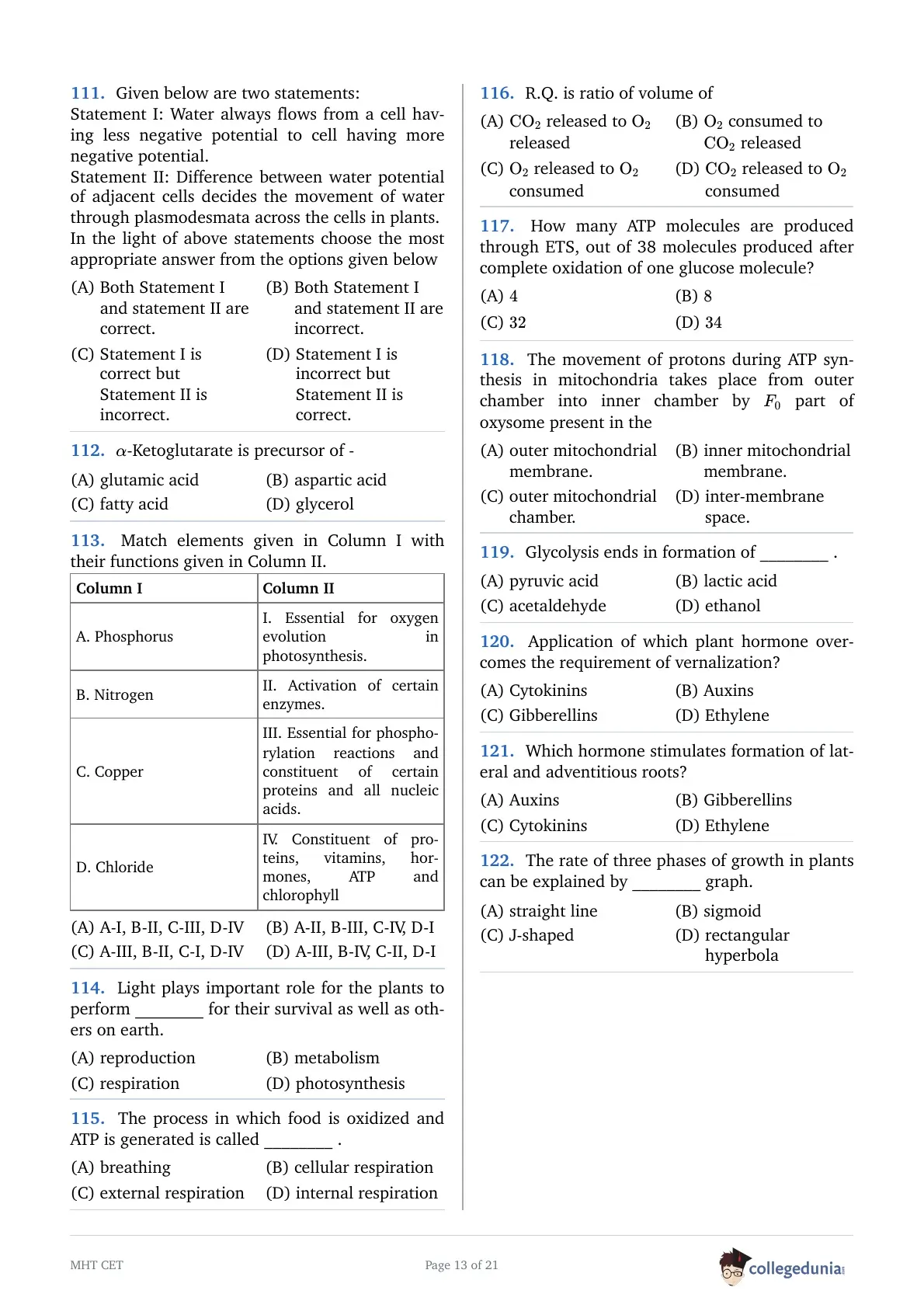
Given below are two statements:
Statement I: Water always flows from a cell having less negative potential to cell having more negative potential.
Statement II: Difference between water potential of adjacent cells decides the movement of water through plasmodesmata across the cells in plants.
In the light of above statements choose the most appropriate answer from the options given below
\(\alpha\)-Ketoglutarate is precursor of -
Match elements given in Column I with their functions given in Column II.
| Column I | Column II |
|---|---|
| A. Phosphorus | I. Essential for oxygen evolution in photosynthesis. |
| B. Nitrogen | II. Activation of certain enzymes. |
| C. Copper | III. Essential for phosphorylation reactions and constituent of certain proteins and all nucleic acids. |
| D. Chloride | IV. Constituent of proteins, vitamins, hormones, ATP and chlorophyll |
Light plays important role for the plants to perform ________ for their survival as well as others on earth.
The process in which food is oxidized and ATP is generated is called ________ .
R.Q. is ratio of volume of
How many ATP molecules are produced through ETS, out of 38 molecules produced after complete oxidation of one glucose molecule?
The movement of protons during ATP synthesis in mitochondria takes place from outer chamber into inner chamber by \(F_{0}\) part of oxysome present in the
Glycolysis ends in formation of ________ .
Application of which plant hormone overcomes the requirement of vernalization?
Which hormone stimulates formation of lateral and adventitious roots?
The rate of three phases of growth in plants can be explained by ________ graph.
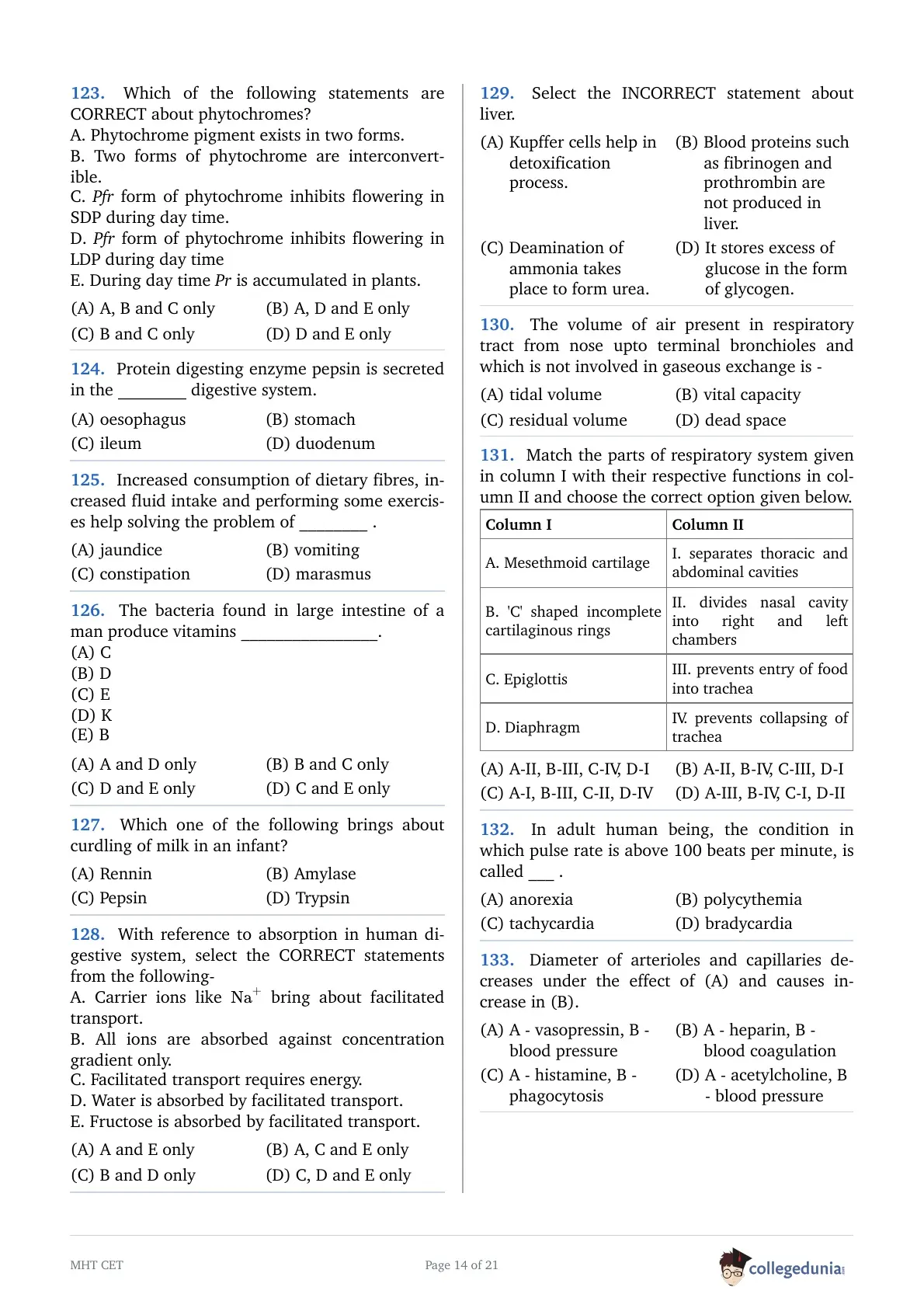
Which of the following statements are CORRECT about phytochromes?
A. Phytochrome pigment exists in two forms.
B. Two forms of phytochrome are interconvertible.
C. Pfr form of phytochrome inhibits flowering in SDP during day time.
D. Pfr form of phytochrome inhibits flowering in LDP during day time
E. During day time Pr is accumulated in plants.
Protein digesting enzyme pepsin is secreted in the ________ digestive system.
Increased consumption of dietary fibres, increased fluid intake and performing some exercises help solving the problem of ________ .
The bacteria found in large intestine of a man produce vitamins ________________.
(A) C
(B) D
(C) E
(D) K
(E) B
Which one of the following brings about curdling of milk in an infant?
With reference to absorption in human digestive system, select the CORRECT statements from the following-
A. Carrier ions like \(\text{Na}^{+}\) bring about facilitated transport.
B. All ions are absorbed against concentration gradient only.
C. Facilitated transport requires energy.
D. Water is absorbed by facilitated transport.
E. Fructose is absorbed by facilitated transport.
Select the INCORRECT statement about liver.
The volume of air present in respiratory tract from nose upto terminal bronchioles and which is not involved in gaseous exchange is -
Match the parts of respiratory system given in column I with their respective functions in column II and choose the correct option given below.
| Column I | Column II |
|---|---|
| A. Mesethmoid cartilage | I. separates thoracic and abdominal cavities |
| B. 'C' shaped incomplete cartilaginous rings | II. divides nasal cavity into right and left chambers |
| C. Epiglottis | III. prevents entry of food into trachea |
| D. Diaphragm | IV. prevents collapsing of trachea |
In adult human being, the condition in which pulse rate is above 100 beats per minute, is called ___ .
Diameter of arterioles and capillaries decreases under the effect of (A) and causes increase in (B).
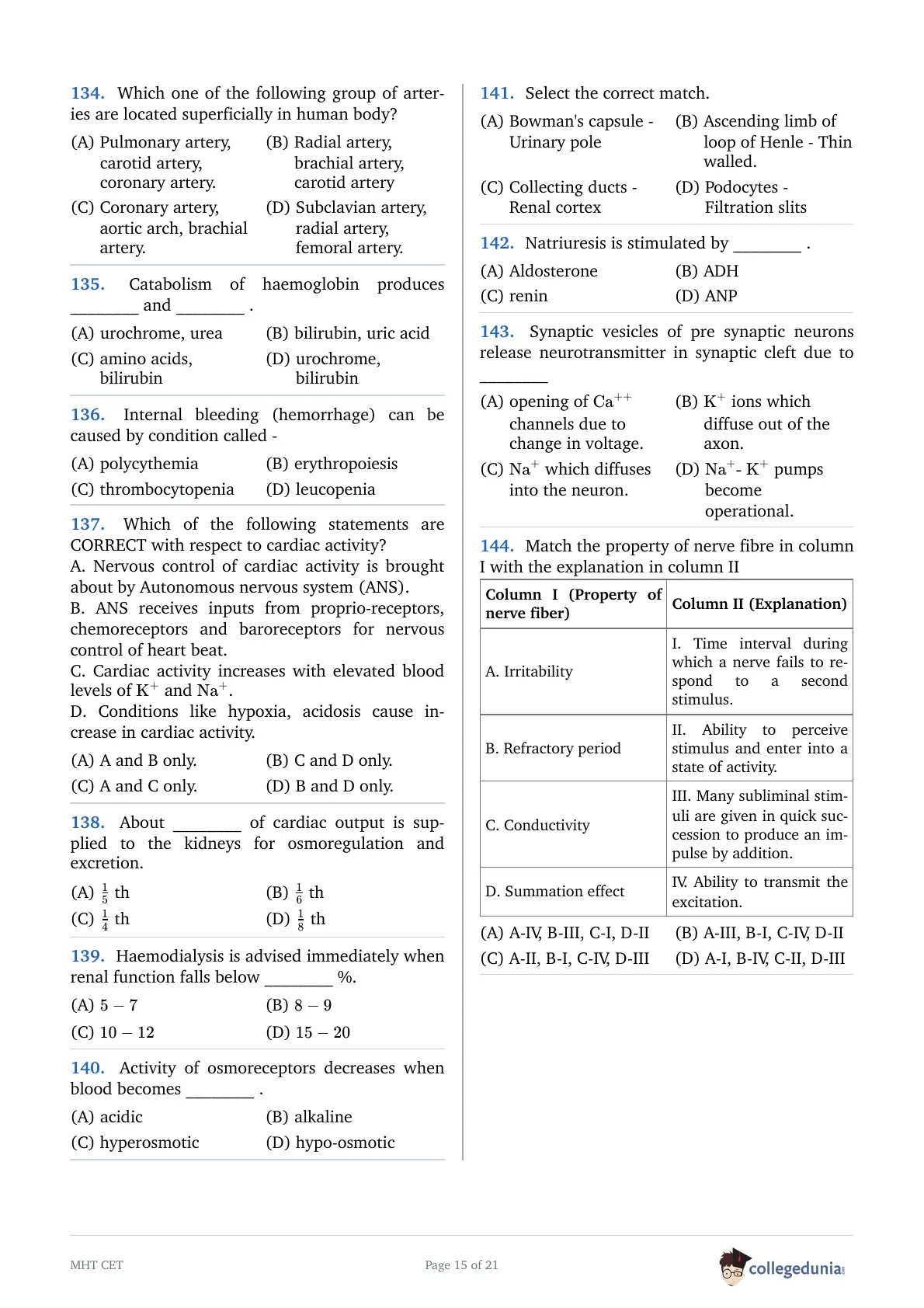
Which one of the following group of arteries are located superficially in human body?
Catabolism of haemoglobin produces ________ and ________ .
Internal bleeding (hemorrhage) can be caused by condition called -
Which of the following statements are CORRECT with respect to cardiac activity?
A. Nervous control of cardiac activity is brought about by Autonomous nervous system (ANS).
B. ANS receives inputs from proprio-receptors, chemoreceptors and baroreceptors for nervous control of heart beat.
C. Cardiac activity increases with elevated blood levels of \(\text{K}^{+}\) and \(\text{Na}^{+}\).
D. Conditions like hypoxia, acidosis cause increase in cardiac activity.
About ________ of cardiac output is supplied to the kidneys for osmoregulation and excretion.
Haemodialysis is advised immediately when renal function falls below ________ %.
Activity of osmoreceptors decreases when blood becomes ________ .
Select the correct match.
Natriuresis is stimulated by ________ .
Synaptic vesicles of pre synaptic neurons release neurotransmitter in synaptic cleft due to ________
Match the property of nerve fibre in column I with the explanation in column II
| Column I (Property of nerve fiber) | Column II (Explanation) |
|---|---|
| A. Irritability | I. Time interval during which a nerve fails to respond to a second stimulus. |
| B. Refractory period | II. Ability to perceive stimulus and enter into a state of activity. |
| C. Conductivity | III. Many subliminal stimuli are given in quick succession to produce an impulse by addition. |
| D. Summation effect | IV. Ability to transmit the excitation. |
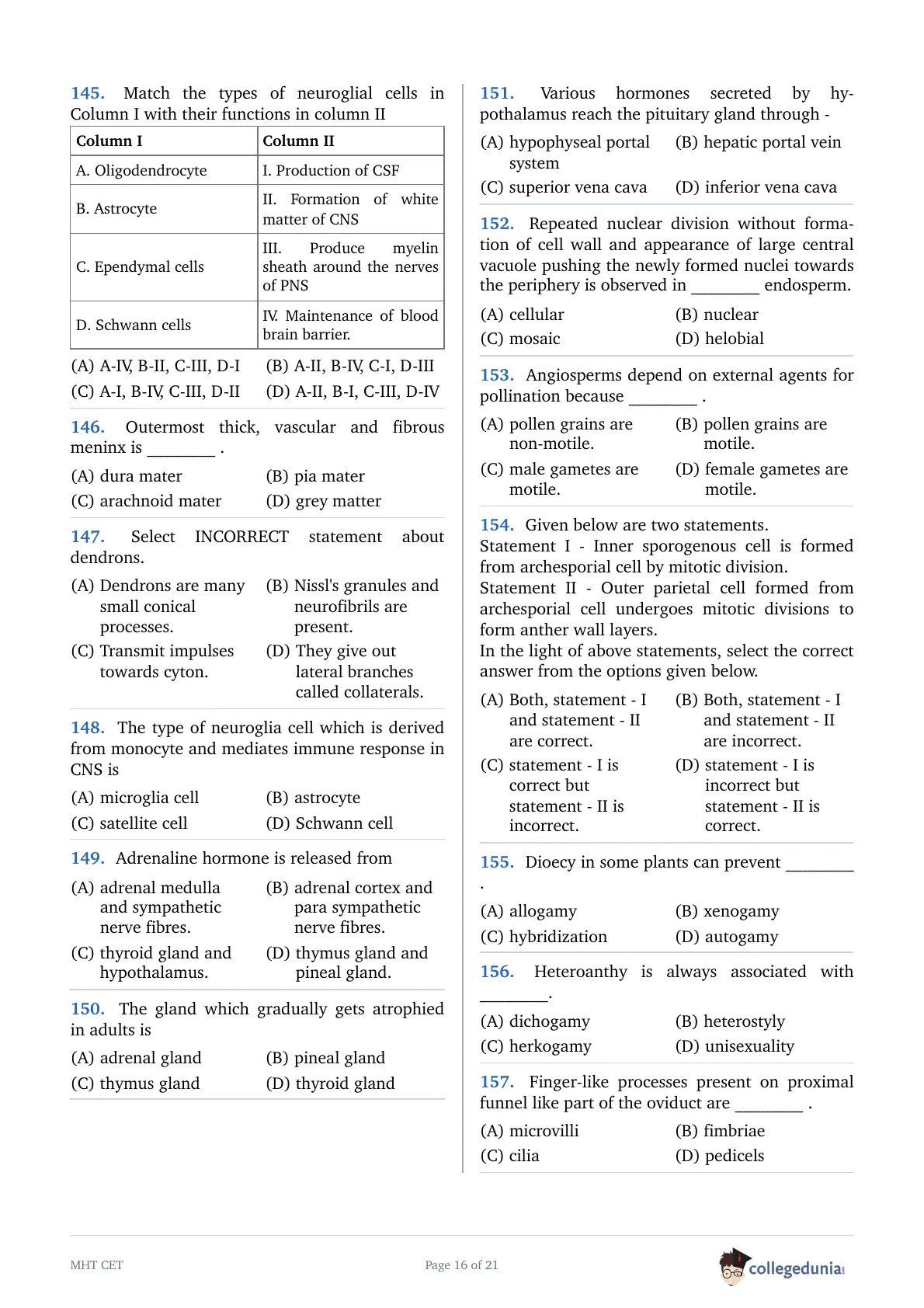
Match the types of neuroglial cells in Column I with their functions in column II
| Column I | Column II |
|---|---|
| A. Oligodendrocyte | I. Production of CSF |
| B. Astrocyte | II. Formation of white matter of CNS |
| C. Ependymal cells | III. Produce myelin sheath around the nerves of PNS |
| D. Schwann cells | IV. Maintenance of blood brain barrier. |
Outermost thick, vascular and fibrous meninx is ________ .
Select INCORRECT statement about dendrons.
The type of neuroglia cell which is derived from monocyte and mediates immune response in CNS is
Adrenaline hormone is released from
The gland which gradually gets atrophied in adults is
Various hormones secreted by hypothalamus reach the pituitary gland through -
Repeated nuclear division without formation of cell wall and appearance of large central vacuole pushing the newly formed nuclei towards the periphery is observed in ________ endosperm.
Angiosperms depend on external agents for pollination because ________ .
Given below are two statements.
Statement I - Inner sporogenous cell is formed from archesporial cell by mitotic division.
Statement II - Outer parietal cell formed from archesporial cell undergoes mitotic divisions to form anther wall layers.
In the light of above statements, select the correct answer from the options given below.
Dioecy in some plants can prevent ________ .
Heteroanthy is always associated with ________.
Finger-like processes present on proximal funnel like part of the oviduct are ________ .
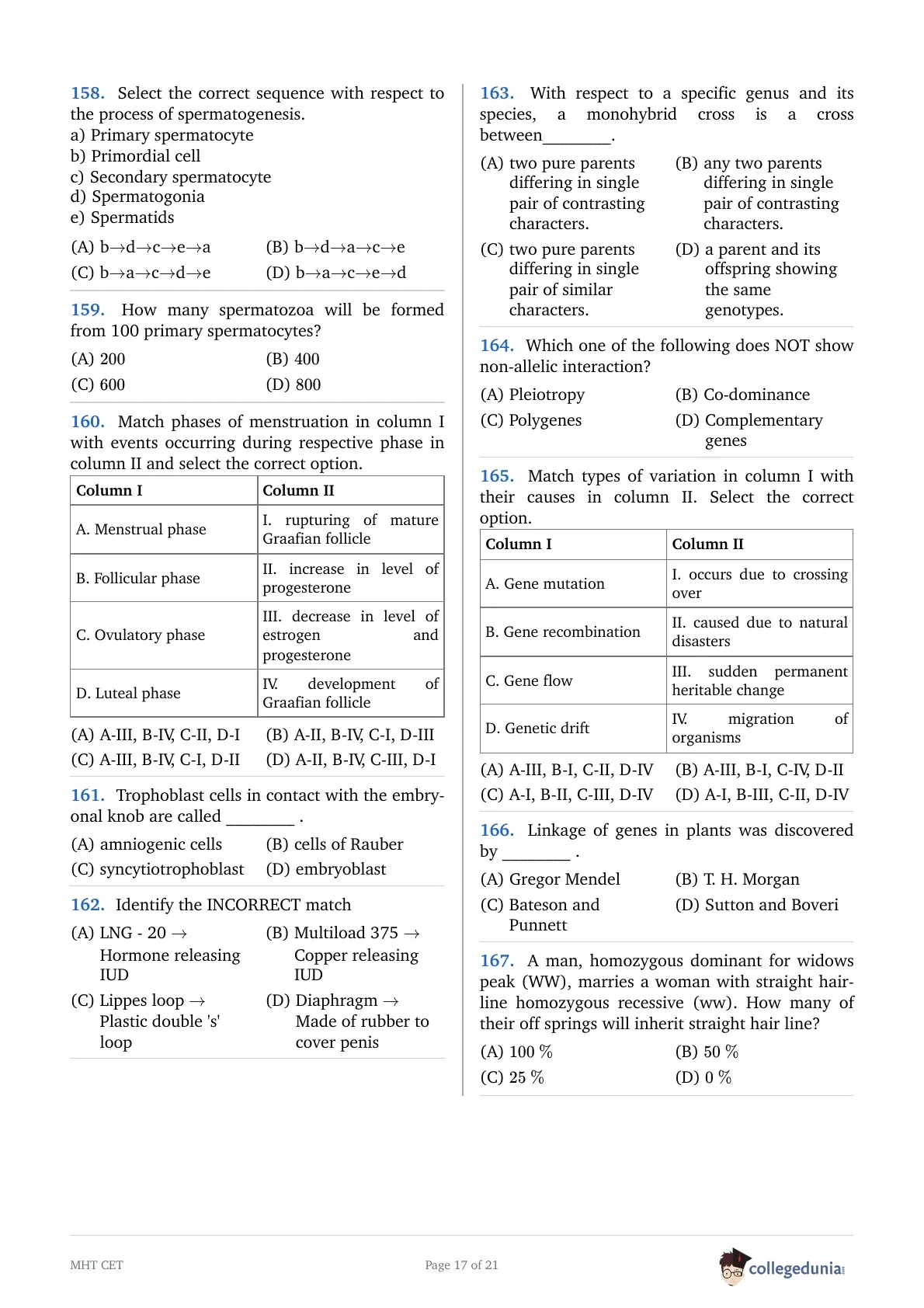
Select the correct sequence with respect to the process of spermatogenesis.
a) Primary spermatocyte
b) Primordial cell
c) Secondary spermatocyte
d) Spermatogonia
e) Spermatids
How many spermatozoa will be formed from 100 primary spermatocytes?
Match phases of menstruation in column I with events occurring during respective phase in column II and select the correct option.
| Column I | Column II |
|---|---|
| A. Menstrual phase | I. rupturing of mature Graafian follicle |
| B. Follicular phase | II. increase in level of progesterone |
| C. Ovulatory phase | III. decrease in level of estrogen and progesterone |
| D. Luteal phase | IV. development of Graafian follicle |
Trophoblast cells in contact with the embryonal knob are called ________ .
Identify the INCORRECT match
With respect to a specific genus and its species, a monohybrid cross is a cross between________.
Which one of the following does NOT show non-allelic interaction?
Match types of variation in column I with their causes in column II. Select the correct option.
| Column I | Column II |
|---|---|
| A. Gene mutation | I. occurs due to crossing over |
| B. Gene recombination | II. caused due to natural disasters |
| C. Gene flow | III. sudden permanent heritable change |
| D. Genetic drift | IV. migration of organisms |
Linkage of genes in plants was discovered by ________ .
A man, homozygous dominant for widows peak (WW), marries a woman with straight hairline homozygous recessive (ww). How many of their off springs will inherit straight hair line?
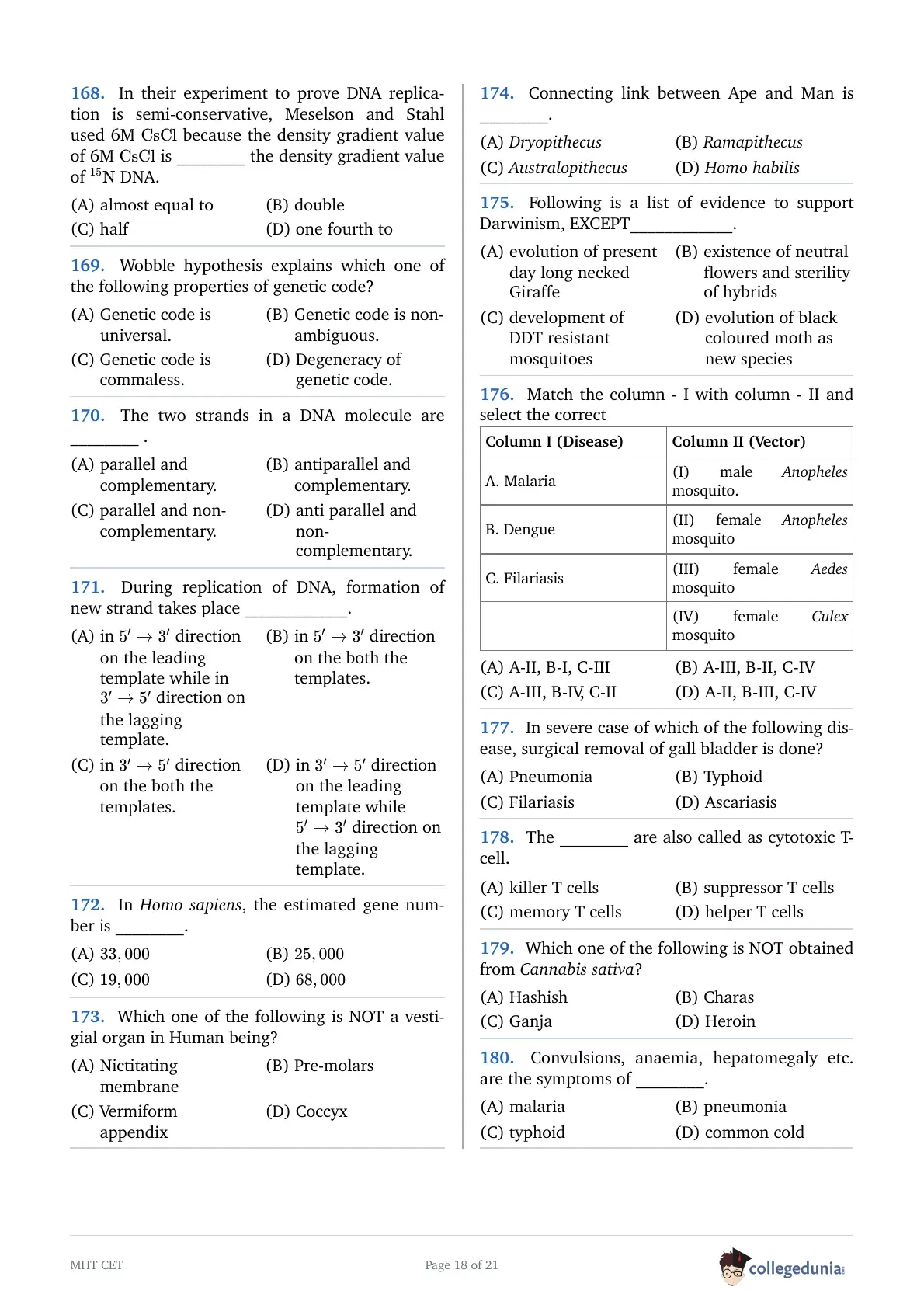
In their experiment to prove DNA replication is semi-conservative, Meselson and Stahl used 6M \(\text{CsCl}\) because the density gradient value of 6M \(\text{CsCl}\) is ________ the density gradient value of \({}^{15}\text{N}\) DNA.
Wobble hypothesis explains which one of the following properties of genetic code?
The two strands in a DNA molecule are ________ .
During replication of DNA, formation of new strand takes place ____________.
In Homo sapiens, the estimated gene number is ________.
Which one of the following is NOT a vestigial organ in Human being?
Connecting link between Ape and Man is ________.
Following is a list of evidence to support Darwinism, EXCEPT____________.
Match the column - I with column - II and select the correct
| Column I (Disease) | Column II (Vector) |
|---|---|
| A. Malaria | (I) male Anopheles mosquito. |
| B. Dengue | (II) female Anopheles mosquito |
| C. Filariasis | (III) female Aedes mosquito |
| (IV) female Culex mosquito |
In severe case of which of the following disease, surgical removal of gall bladder is done?
The ________ are also called as cytotoxic T-cell.
Which one of the following is NOT obtained from Cannabis sativa?
Convulsions, anaemia, hepatomegaly etc. are the symptoms of ________.
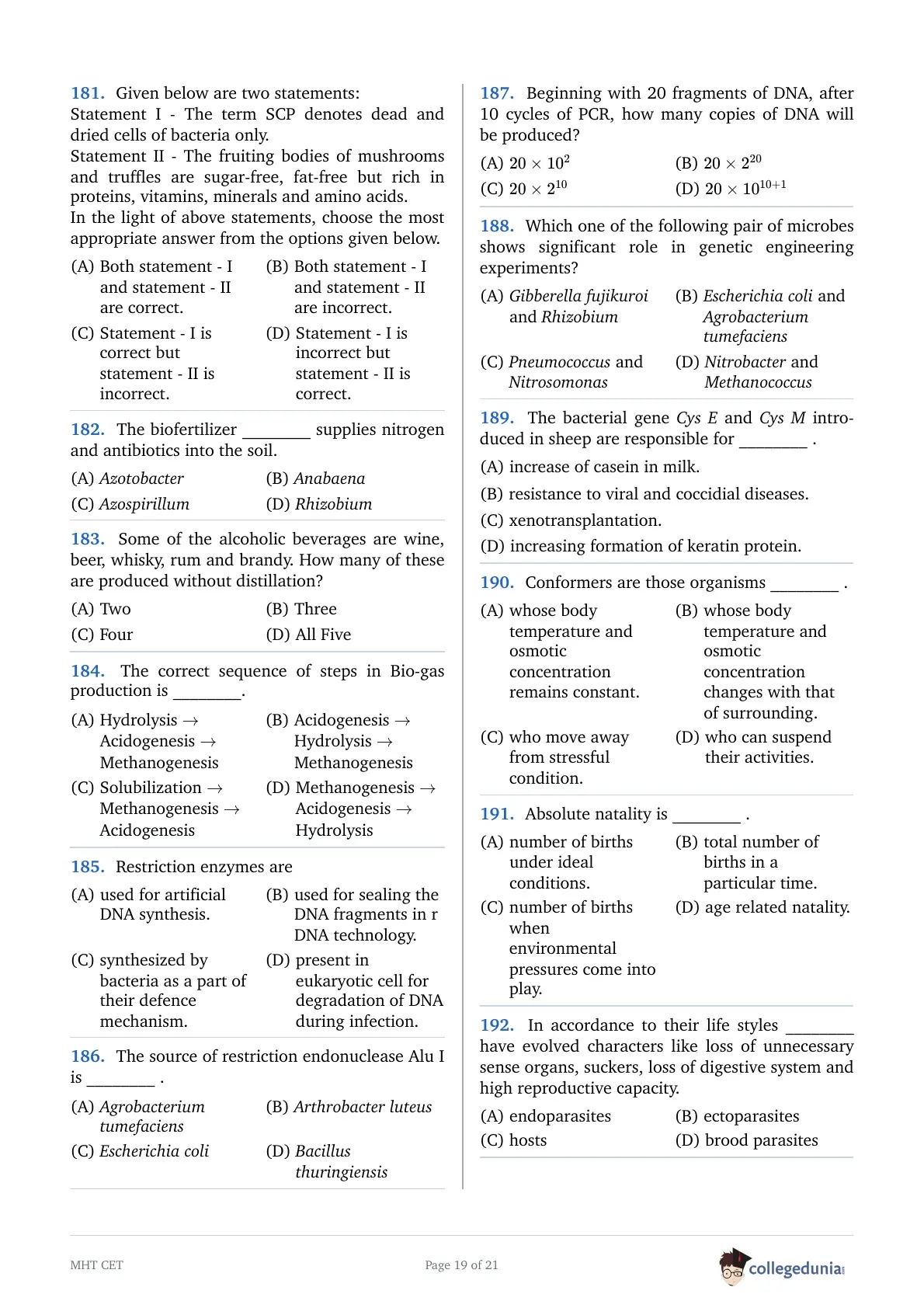
Given below are two statements:
Statement I - The term SCP denotes dead and dried cells of bacteria only.
Statement II - The fruiting bodies of mushrooms and truffles are sugar-free, fat-free but rich in proteins, vitamins, minerals and amino acids.
In the light of above statements, choose the most appropriate answer from the options given below.
The biofertilizer ________ supplies nitrogen and antibiotics into the soil.
Some of the alcoholic beverages are wine, beer, whisky, rum and brandy. How many of these are produced without distillation?
The correct sequence of steps in Bio-gas production is ________.
Restriction enzymes are
The source of restriction endonuclease Alu I is ________ .
Beginning with 20 fragments of DNA, after 10 cycles of PCR, how many copies of DNA will be produced?
Which one of the following pair of microbes shows significant role in genetic engineering experiments?
The bacterial gene Cys E and Cys M introduced in sheep are responsible for ________ .
Conformers are those organisms ________ .
Absolute natality is ________ .
In accordance to their life styles ________ have evolved characters like loss of unnecessary sense organs, suckers, loss of digestive system and high reproductive capacity.
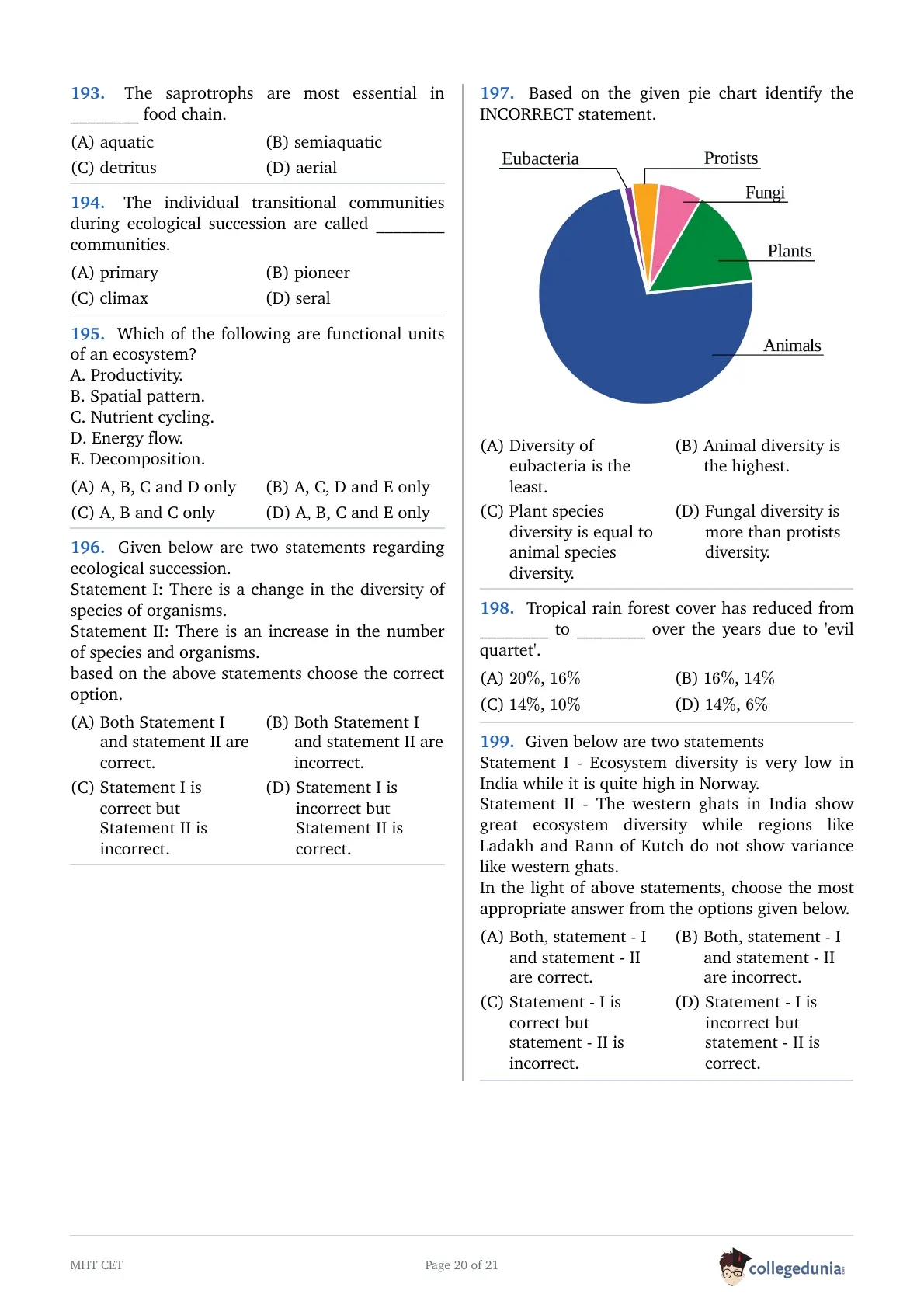
The saprotrophs are most essential in ________ food chain.
The individual transitional communities during ecological succession are called ________ communities.
Which of the following are functional units of an ecosystem?
A. Productivity.
B. Spatial pattern.
C. Nutrient cycling.
D. Energy flow.
E. Decomposition.
Given below are two statements regarding ecological succession.
Statement I: There is a change in the diversity of species of organisms.
Statement II: There is an increase in the number of species and organisms.
based on the above statements choose the correct option.

Tropical rain forest cover has reduced from ________ to ________ over the years due to 'evil quartet'.
Given below are two statements
Statement I - Ecosystem diversity is very low in India while it is quite high in Norway.
Statement II - The western ghats in India show great ecosystem diversity while regions like Ladakh and Rann of Kutch do not show variance like western ghats.
In the light of above statements, choose the most appropriate answer from the options given below.
Which one of the following is NOT an example of invasive species?
MHT CET 2026 PCB Exam Pattern and Marking Scheme
| Parameter | Details |
|---|---|
| Conducting Body | Maharashtra Common Entrance Test Cell (Maharashtra CET Cell) |
| Exam Mode | Online (Computer-Based Test) |
| Duration | 180 minutes (3 hours) |
| Groups / Subjects | PCB (Physics, Chemistry, Biology) for Pharmacy and Agriculture |
| Total Questions |
200 |
| Total Marks | 200 |
| Question Type | Multiple Choice Questions (MCQs) |
| Marking Scheme | 1 mark for each correct answer |
| Negative Marking | No |
| Syllabus Weightage |
|



Comments