




MHT CET 2026 April 25 Shift 2 PCB Question Paper is available for download here. Maharashtra State CET Cell is conducting MHT CET 2026 PCB Exam on April 25 in Shift 2 from 2 PM to 5 PM in CBT mode.
The MHT CET 2026 PCB question paper includes the following:
- The MHT CET 2026 PCB Question Paper consists of 200 multiple-choice questions (MCQs) totalling 200 marks divided into 3 sections: Physics (50 questions), Chemistry (50 questions), and Biology (100 questions).
- All questions carry 1 mark each. There is no negative marking for incorrect answers.
MHT CET 2026 April 25 Shift 2 PCB Question Paper with Solution PDF
| CD PDF | CD PDF with Solutions |
|---|---|
| Download Collegedunia PDF 1.44 MB | - |
Also Check:
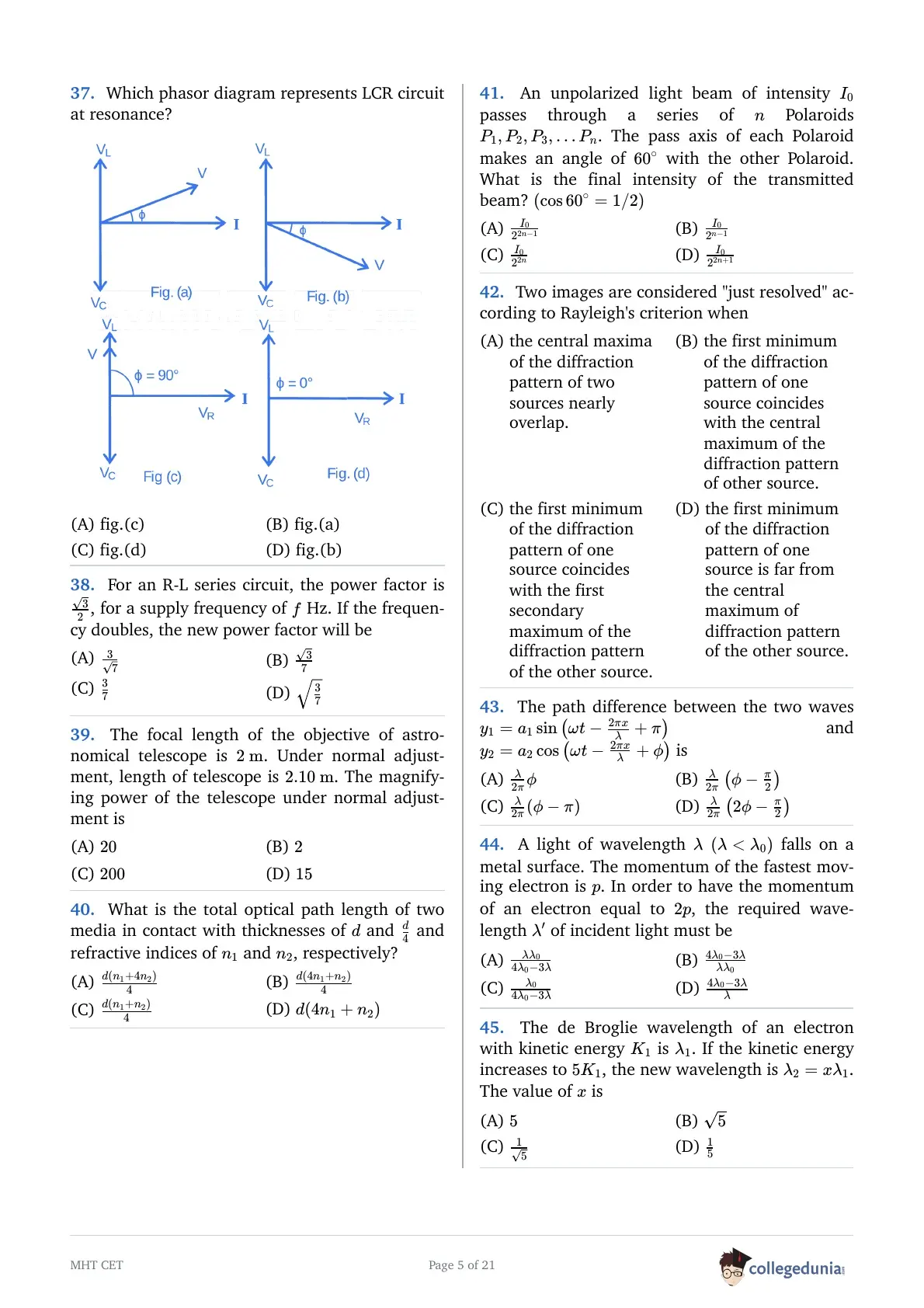
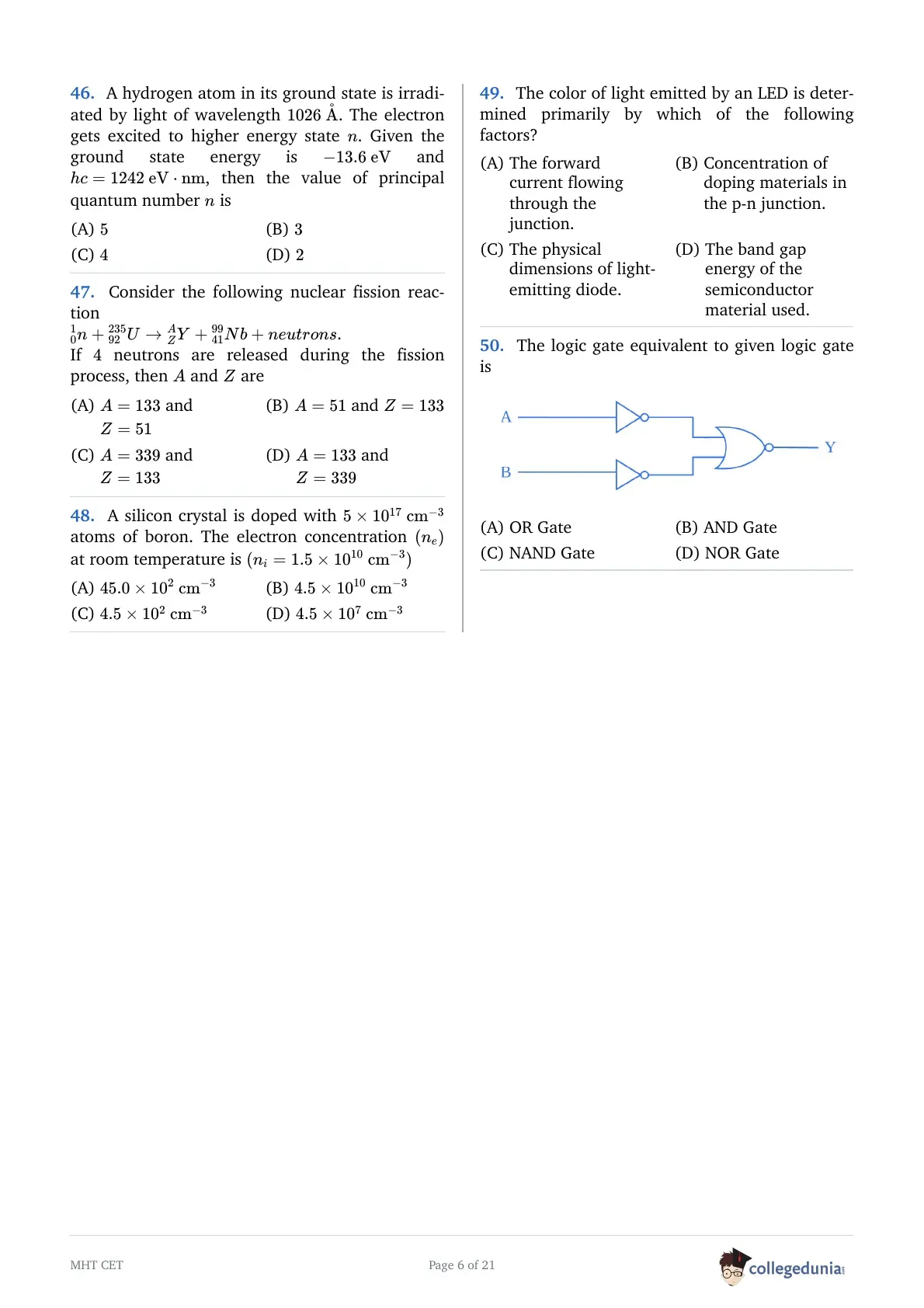
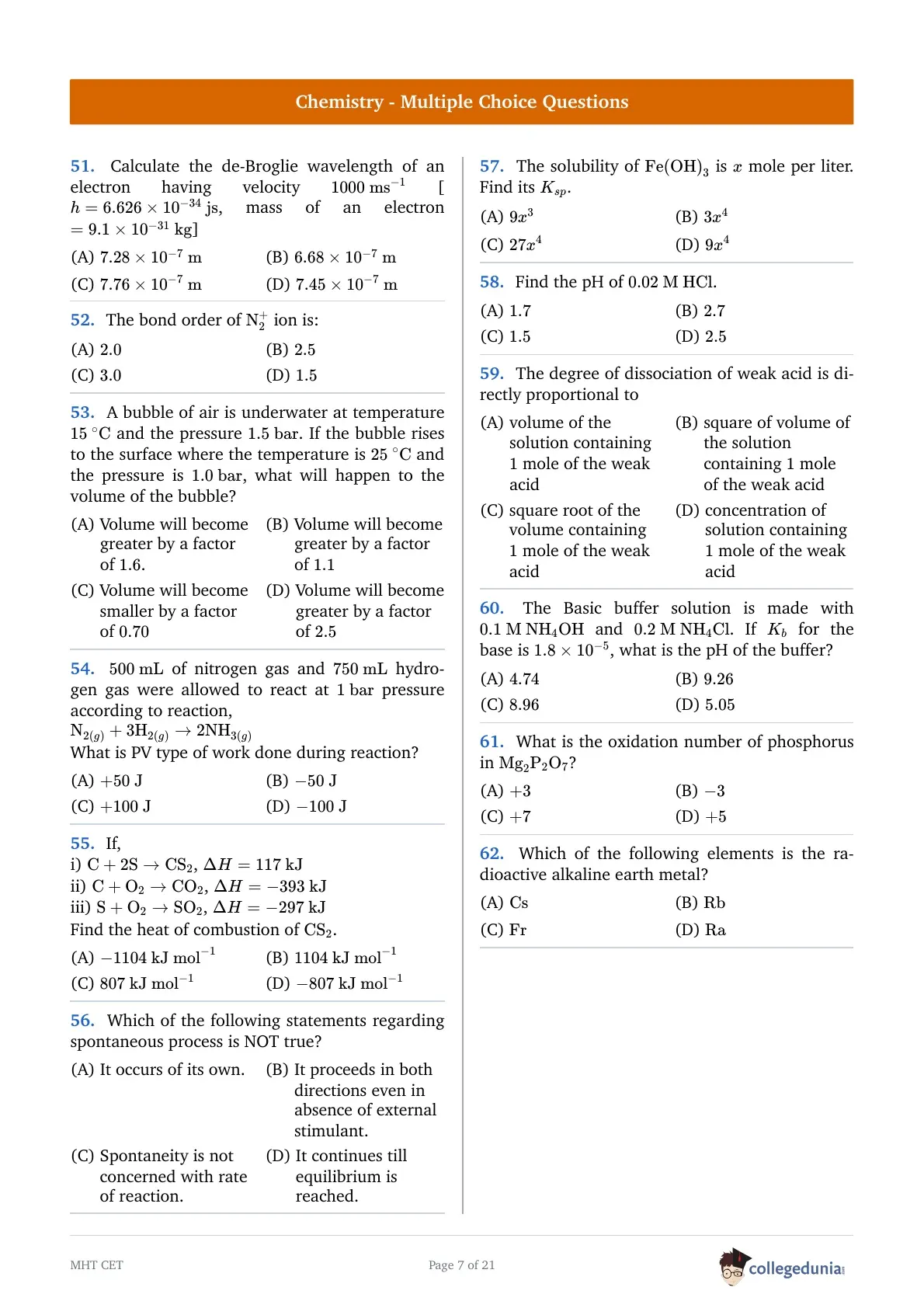
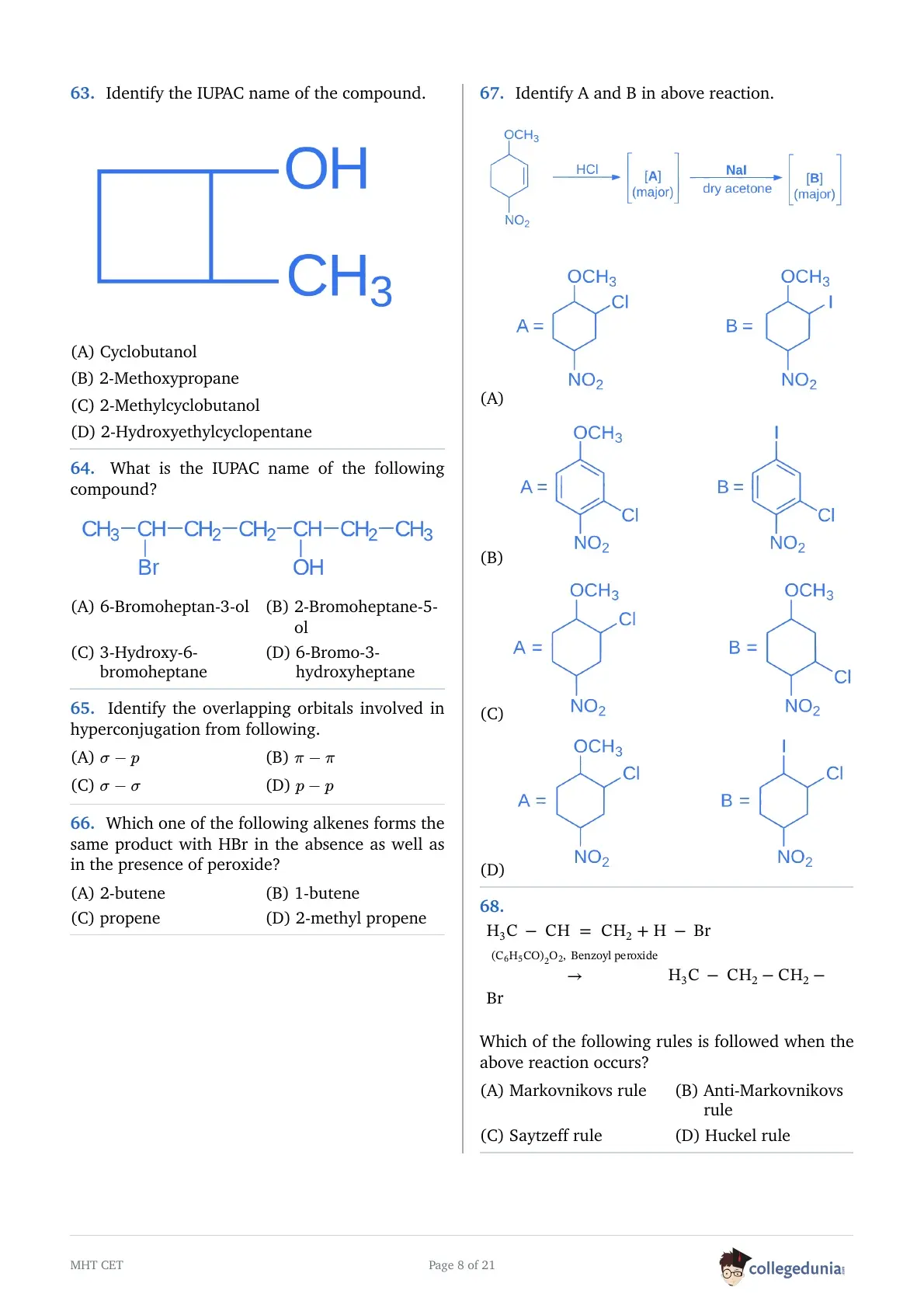
MHT CET 2026 April 25 Shift 2 PCB Questions with Solutions
Physics (Q1 - Q50)
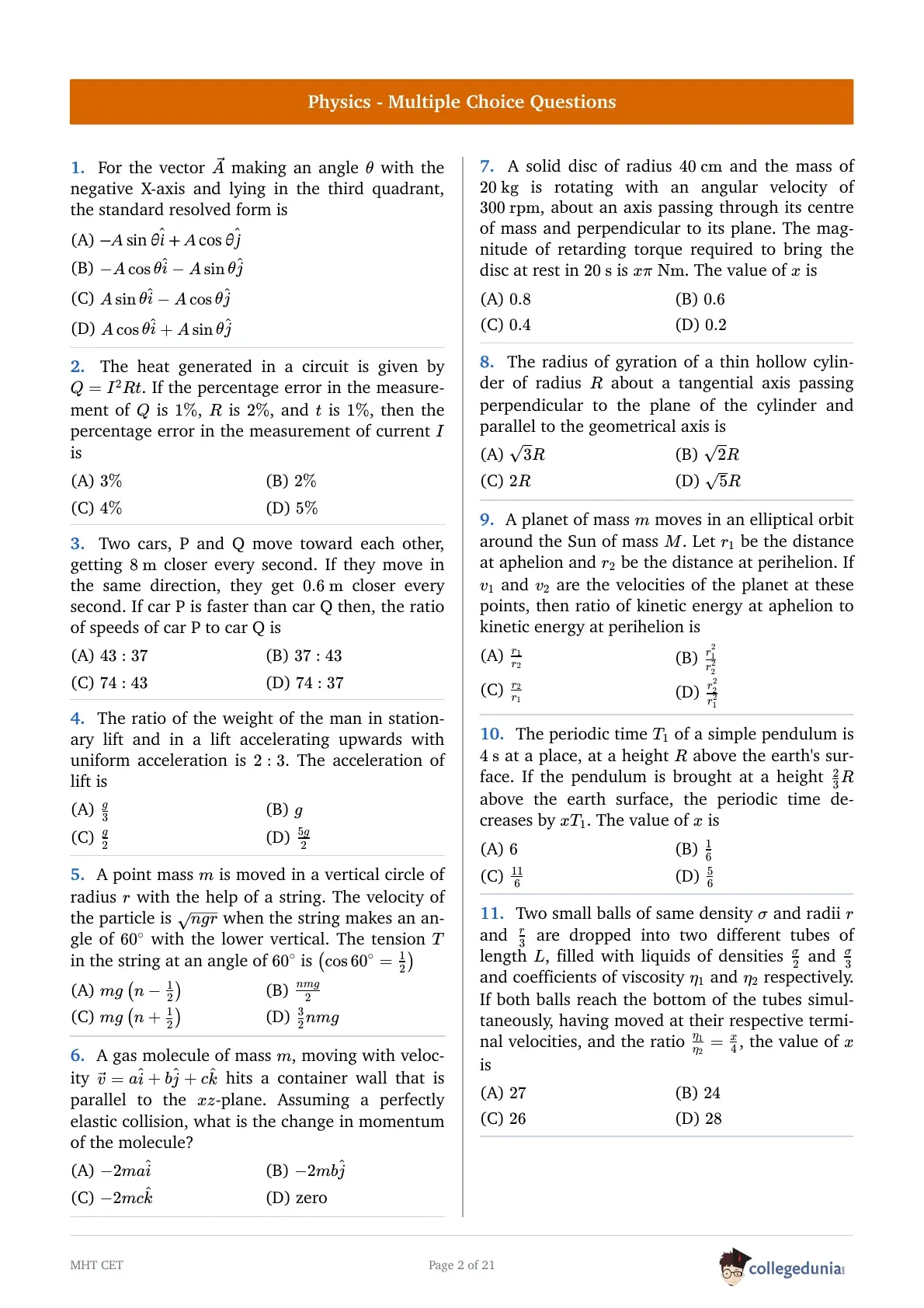
For the vector \(\vec{A}\) making an angle \(\theta\) with the negative X-axis and lying in the third quadrant, the standard resolved form is
The heat generated in a circuit is given by \(Q=I^{2}Rt\). If the percentage error in the measurement of \(Q\) is \(1\%\), \(R\) is \(2\%\), and \(t\) is \(1\%\), then the percentage error in the measurement of current \(I\) is
Two cars, P and Q move toward each other, getting \(8\ \text{m}\) closer every second. If they move in the same direction, they get \(0.6\ \text{m}\) closer every second. If car P is faster than car Q then, the ratio of speeds of car P to car Q is
The ratio of the weight of the man in stationary lift and in a lift accelerating upwards with uniform acceleration is \(2:3\). The acceleration of lift is
A point mass \(m\) is moved in a vertical circle of radius \(r\) with the help of a string. The velocity of the particle is \(\sqrt{ngr}\) when the string makes an angle of \(60^{\circ }\) with the lower vertical. The tension \(T\) in the string at an angle of \(60^{\circ }\) is \(\left(\cos 60^{\circ }=\frac{1}{2}\right)\)
A gas molecule of mass \(m\), moving with velocity \(\vec{v}=a\hat{i}+b\hat{j}+c\hat{k}\) hits a container wall that is parallel to the \(xz\)-plane. Assuming a perfectly elastic collision, what is the change in momentum of the molecule?
A solid disc of radius \(40\ \text{cm}\) and the mass of \(20\ \text{kg}\) is rotating with an angular velocity of \(300\ \text{rpm}\), about an axis passing through its centre of mass and perpendicular to its plane. The magnitude of retarding torque required to bring the disc at rest in \(20\ \text{s}\) is \(x\pi \ \text{Nm}\). The value of \(x\) is
The radius of gyration of a thin hollow cylinder of radius \(R\) about a tangential axis passing perpendicular to the plane of the cylinder and parallel to the geometrical axis is
A planet of mass \(m\) moves in an elliptical orbit around the Sun of mass \(M\). Let \(r_{1}\) be the distance at aphelion and \(r_{2}\) be the distance at perihelion. If \(v_{1}\) and \(v_{2}\) are the velocities of the planet at these points, then ratio of kinetic energy at aphelion to kinetic energy at perihelion is
The periodic time \(T_{1}\) of a simple pendulum is \(4\ \text{s}\) at a place, at a height \(R\) above the earth's surface. If the pendulum is brought at a height \(\frac{2}{3}R\) above the earth surface, the periodic time decreases by \(xT_{1}\). The value of \(x\) is
Two small balls of same density \(\sigma\) and radii \(r\) and \(\frac{r}{3}\) are dropped into two different tubes of length \(L\), filled with liquids of densities \(\frac{\sigma }{2}\) and \(\frac{\sigma }{3}\) and coefficients of viscosity \(\eta _{1}\) and \(\eta _{2}\) respectively. If both balls reach the bottom of the tubes simultaneously, having moved at their respective terminal velocities, and the ratio \(\frac{\eta _{1}}{\eta _{2}}=\frac{x}{4}\), the value of \(x\) is
In a capillary tube of radius \(r\), water rises to a height \(10\ \text{cm}\) on Earth. If the apparatus is taken to the Moon \((g_{moon}=g/6)\) and the tube is replaced with one having double the radius \((2r)\), the water will rise to height
The pressure at the surface of mercury in a barometer tube is \(P_{1}\) and the pressure at the surface of mercury filled in a conical flask is \(P_{2}\). The ratio of \(\frac{P_{1}}{P_{2}}\) is
A metal sphere cools at a rate of \(2^{\circ }\text{C/min}\) when the temperature is \(80^{\circ }\text{C}\). If the temperature of the surroundings is \(30^{\circ }\text{C}\), then the rate of cooling when its temperature is \(50^{\circ }\text{C}\) will be
Assuming the Sun to be a perfectly spherical black body of radius \(R\) and is at a temperature \(T\ \text{K}\), then the total radiant power incident on the Earth at a distance \(r\) from the sun is ( consider \(R_{o}\) is the radius of the Earth and \(\sigma\) is Stefan's constant).
Let \(\eta _{1}\) be the efficiency of a Carnot engine at \(T_{H}=547^{\circ }\text{C}\) and \(T_{C}=247^{\circ }\text{C}\) while \(\eta _{2}\) is the efficiency at \(T_{H}=847^{\circ }\text{C}\) and \(T_{C}=147^{\circ }\text{C}\). If \(\eta _{1}=\frac{x}{41}\eta _{2}\), the value of \(x\) is
Identify the INCORRECT statement for isobaric process.
If the ratio of specific heat of gas \(\gamma =\frac{C_{p}}{C_{v}}\), then the value of \(C_{p}\) in terms of \(\gamma\) and gas constant \(R\) is
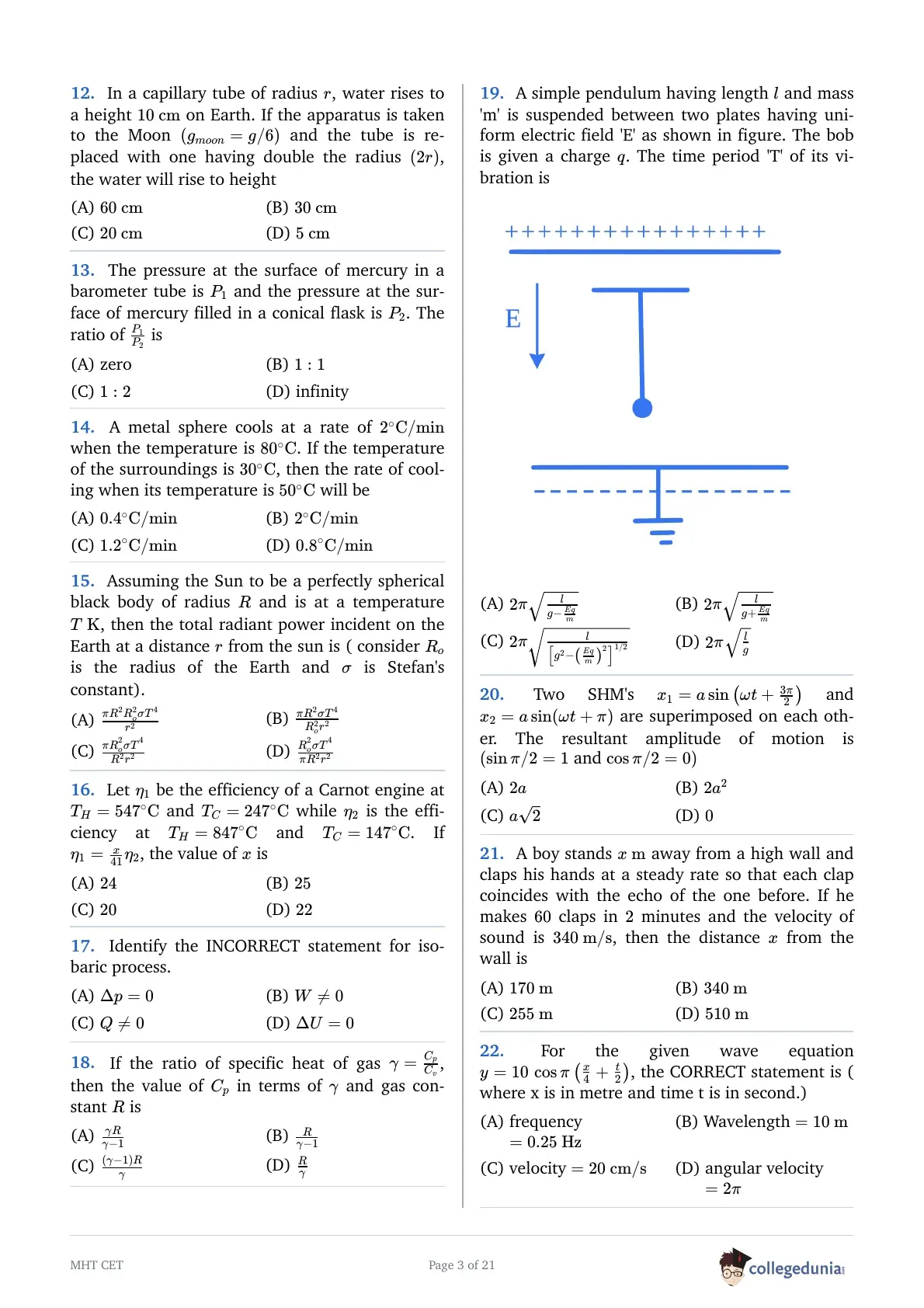
A simple pendulum having length \(l\) and mass 'm' is suspended between two plates having uniform electric field 'E' as shown in figure. The bob is given a charge \(q\). The time period 'T' of its vibration is

Two SHM's \(x_{1}=a\sin \left(\omega t+\frac{3\pi }{2}\right)\) and \(x_{2}=a\sin (\omega t+\pi )\) are superimposed on each other. The resultant amplitude of motion is \((\sin \pi /2=1\) and \(\cos \pi /2=0)\)
A boy stands \(x\ \text{m}\) away from a high wall and claps his hands at a steady rate so that each clap coincides with the echo of the one before. If he makes \(60\) claps in \(2\) minutes and the velocity of sound is \(340\ \text{m/s}\), then the distance \(x\) from the wall is
For the given wave equation \(y=10\,\cos \pi \left(\frac{x}{4}+\frac{t}{2}\right)\), the CORRECT statement is ( where x is in metre and time t is in second.)
A tuning fork produces \(6\) beats per second with both, \(60\ \text{cm}\) and \(40\ \text{cm}\) of the stretched wire of sonometer. The frequency of fork is
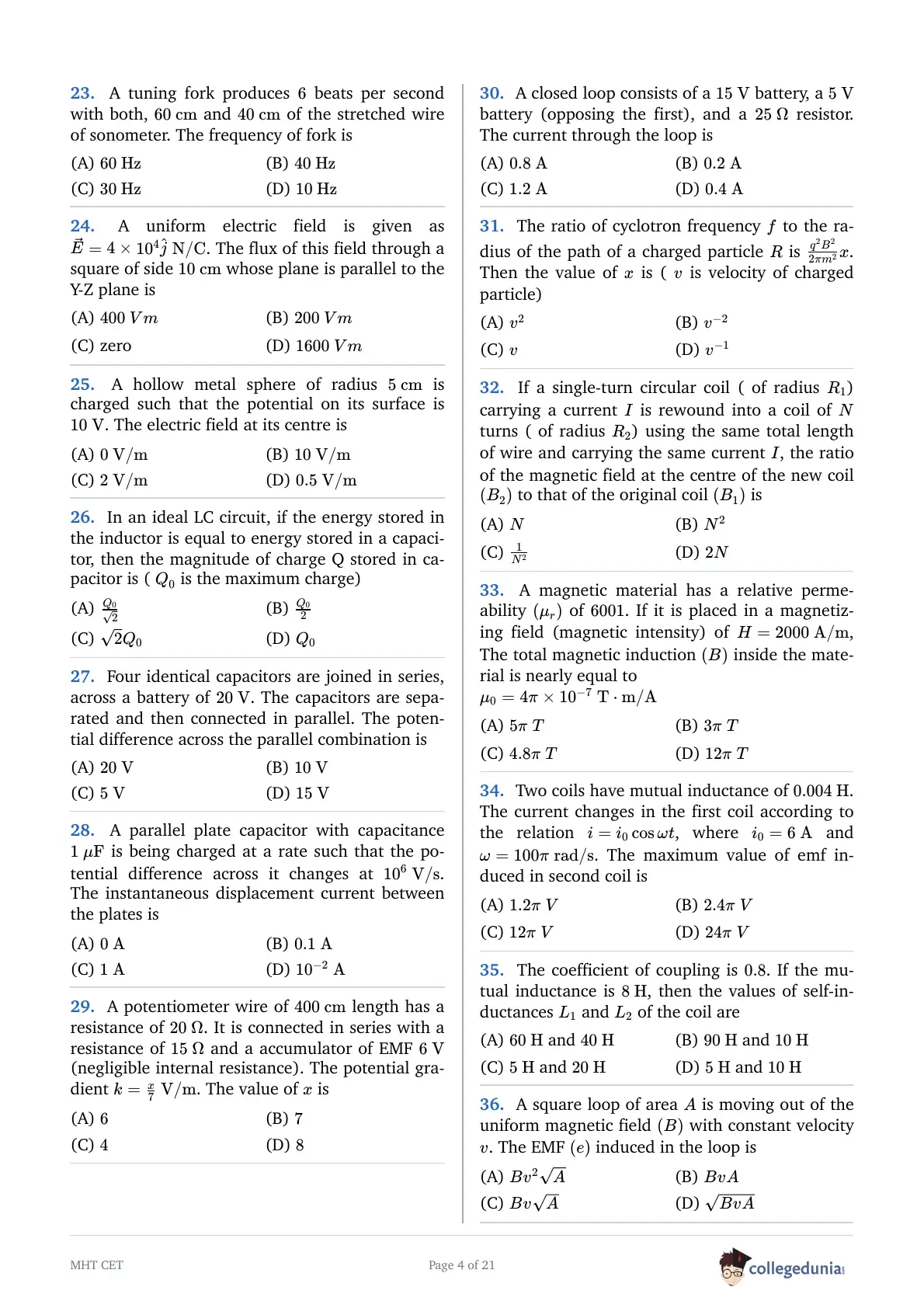
A uniform electric field is given as \(\vec{E}=4\times 10^{4}\hat{j}\ \text{N/C}\). The flux of this field through a square of side \(10\ \text{cm}\) whose plane is parallel to the Y-Z plane is
A hollow metal sphere of radius \(5\ \text{cm}\) is charged such that the potential on its surface is \(10\ \text{V}\). The electric field at its centre is
In an ideal LC circuit, if the energy stored in the inductor is equal to energy stored in a capacitor, then the magnitude of charge Q stored in capacitor is ( \(Q_{0}\) is the maximum charge)
Four identical capacitors are joined in series, across a battery of \(20\ \text{V}\). The capacitors are separated and then connected in parallel. The potential difference across the parallel combination is
A parallel plate capacitor with capacitance \(1\ \mu \text{F}\) is being charged at a rate such that the potential difference across it changes at \(10^{6}\ \text{V/s}\). The instantaneous displacement current between the plates is
A potentiometer wire of \(400\ \text{cm}\) length has a resistance of \(20\ \Omega\). It is connected in series with a resistance of \(15\ \Omega\) and a accumulator of EMF \(6\ \text{V}\) (negligible internal resistance). The potential gradient \(k=\frac{x}{7}\ \text{V/m}\). The value of \(x\) is
A closed loop consists of a \(15\ \text{V}\) battery, a \(5\ \text{V}\) battery (opposing the first), and a \(25\ \Omega\) resistor. The current through the loop is
The ratio of cyclotron frequency \(f\) to the radius of the path of a charged particle \(R\) is \(\frac{q^{2}B^{2}}{2\pi m^{2}}x\). Then the value of \(x\) is ( \(v\) is velocity of charged particle)
If a single-turn circular coil ( of radius \(R_{1}\)) carrying a current \(I\) is rewound into a coil of \(N\) turns ( of radius \(R_{2}\)) using the same total length of wire and carrying the same current \(I\), the ratio of the magnetic field at the centre of the new coil \((B_{2})\) to that of the original coil \((B_{1})\) is
A magnetic material has a relative permeability \((\mu _{r})\) of \(6001\). If it is placed in a magnetizing field (magnetic intensity) of \(H=2000\ \text{A/m}\), The total magnetic induction \((B)\) inside the material is nearly equal to
\(\mu _{0}=4\pi \times 10^{-7}\ \text{T}\cdot \text{m/A}\)
Two coils have mutual inductance of \(0.004\ \text{H}\). The current changes in the first coil according to the relation \(i=i_{0}\cos \omega t\), where \(i_{0}=6\ \text{A}\) and \(\omega =100\pi \ \text{rad/s}\). The maximum value of emf induced in second coil is
The coefficient of coupling is \(0.8\). If the mutual inductance is \(8\ \text{H}\), then the values of self-inductances \(L_{1}\) and \(L_{2}\) of the coil are
A square loop of area \(A\) is moving out of the uniform magnetic field \((B)\) with constant velocity \(v\). The EMF \((e)\) induced in the loop is

For an R-L series circuit, the power factor is \(\frac{\sqrt{3}}{2}\), for a supply frequency of \(f\) Hz. If the frequency doubles, the new power factor will be
The focal length of the objective of astronomical telescope is \(2\ \text{m}\). Under normal adjustment, length of telescope is \(2.10\ \text{m}\). The magnifying power of the telescope under normal adjustment is
What is the total optical path length of two media in contact with thicknesses of \(d\) and \(\frac{d}{4}\) and refractive indices of \(n_{1}\) and \(n_{2}\), respectively?
An unpolarized light beam of intensity \(I_{0}\) passes through a series of \(n\) Polaroids \(P_{1},P_{2},P_{3},\ldots P_{n}\). The pass axis of each Polaroid makes an angle of \(60^{\circ }\) with the other Polaroid. What is the final intensity of the transmitted beam? \((\cos 60^{\circ }=1/2)\)
Two images are considered "just resolved" according to Rayleigh's criterion when
The path difference between the two waves \(y_{1}=a_{1}\sin \left(\omega t-\frac{2\pi x}{\lambda }+\pi \right)\) and \(y_{2}=a_{2}\cos \left(\omega t-\frac{2\pi x}{\lambda }+\phi \right)\) is
A light of wavelength \(\lambda\) \((\lambda \lt \lambda _{0})\) falls on a metal surface. The momentum of the fastest moving electron is \(p\). In order to have the momentum of an electron equal to \(2p\), the required wavelength \(\lambda '\) of incident light must be
The de Broglie wavelength of an electron with kinetic energy \(K_{1}\) is \(\lambda _{1}\). If the kinetic energy increases to \(5K_{1}\), the new wavelength is \(\lambda _{2}=x\lambda _{1}\). The value of \(x\) is
A hydrogen atom in its ground state is irradiated by light of wavelength \(1026\ \text{Å}\). The electron gets excited to higher energy state \(n\). Given the ground state energy is \(-13.6\ \text{eV}\) and \(hc=1242\ \text{eV}\cdot \text{nm}\), then the value of principal quantum number \(n\) is
Consider the following nuclear fission reaction
\({}_{0}^{1}n+{}_{92}^{235}U\rightarrow {}_{Z}^{A}Y+{}_{41}^{99}Nb+neutrons\).
If \(4\) neutrons are released during the fission process, then \(A\) and \(Z\) are
A silicon crystal is doped with \(5\times 10^{17}\ \text{cm}^{-3}\) atoms of boron. The electron concentration \((n_{e})\) at room temperature is \((n_{i}=1.5\times 10^{10}\ \text{cm}^{-3})\)
The color of light emitted by an LED is determined primarily by which of the following factors?

Chemistry (Q51 - Q100)
Calculate the de-Broglie wavelength of an electron having velocity \(1000\ \text{ms}^{-1}\) [\(h=6.626\times 10^{-34}\ \text{js}\), mass of an electron \(=9.1\times 10^{-31}\ \text{kg}\)]
The bond order of \(\text{N}_{2}^{+}\) ion is:
A bubble of air is underwater at temperature \(15\ ^{\circ }\text{C}\) and the pressure \(1.5\ \text{bar}\). If the bubble rises to the surface where the temperature is \(25\ ^{\circ }\text{C}\) and the pressure is \(1.0\ \text{bar}\), what will happen to the volume of the bubble?
\(500\ \text{mL}\) of nitrogen gas and \(750\ \text{mL}\) hydrogen gas were allowed to react at \(1\ \text{bar}\) pressure according to reaction,
\(\text{N}_{2(g)}+3\text{H}_{2(g)}\rightarrow 2\text{NH}_{3(g)}\)
What is PV type of work done during reaction?
If,
i) \(\text{C}+2\text{S}\rightarrow \text{CS}_{2}\), \(\Delta H=117\ \text{kJ}\)
ii) \(\text{C}+\text{O}_{2}\rightarrow \text{CO}_{2}\), \(\Delta H=-393\ \text{kJ}\)
iii) \(\text{S}+\text{O}_{2}\rightarrow \text{SO}_{2}\), \(\Delta H=-297\ \text{kJ}\)
Find the heat of combustion of \(\text{CS}_{2}\).
Which of the following statements regarding spontaneous process is NOT true?
The solubility of \(\text{Fe(OH)}_{3}\) is \(x\) mole per liter. Find its \(K_{sp}\).
Find the pH of \(0.02\ \text{M}\ \text{HCl}\).
The degree of dissociation of weak acid is directly proportional to
The Basic buffer solution is made with \(0.1\ \text{M}\ \text{NH}_{4}\text{OH}\) and \(0.2\ \text{M}\ \text{NH}_{4}\text{Cl}\). If \(K_{b}\) for the base is \(1.8\times 10^{-5}\), what is the pH of the buffer?
What is the oxidation number of phosphorus in \(\text{Mg}_{2}\text{P}_{2}\text{O}_{7}\)?
Which of the following elements is the radioactive alkaline earth metal?


Identify the overlapping orbitals involved in hyperconjugation from following.
Which one of the following alkenes forms the same product with HBr in the absence as well as in the presence of peroxide?


\(\text{H}_{3}\text{C}-\text{CH}=\text{CH}_{2}+\text{H}-\text{Br}\xrightarrow{(\text{C}_{6}\text{H}_{5}\text{CO})_{2}\text{O}_{2},\ \text{Benzoyl peroxide}}\text{H}_{3}\text{C}-\text{CH}_{2}-\text{CH}_{2}-\text{Br}\)
Which of the following rules is followed when the above reaction occurs?
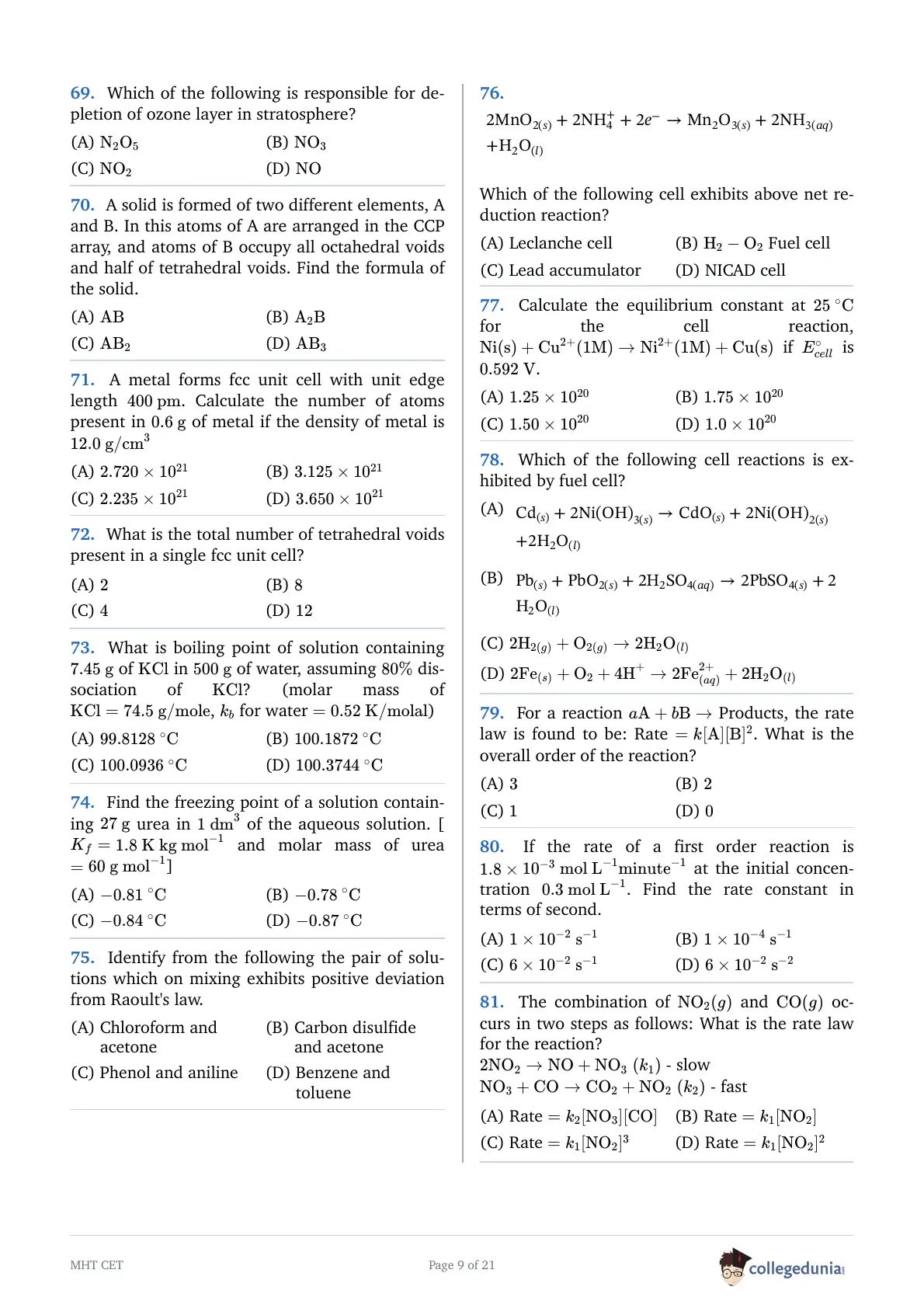
Which of the following is responsible for depletion of ozone layer in stratosphere?
A solid is formed of two different elements, A and B. In this atoms of A are arranged in the CCP array, and atoms of B occupy all octahedral voids and half of tetrahedral voids. Find the formula of the solid.
A metal forms fcc unit cell with unit edge length \(400\ \text{pm}\). Calculate the number of atoms present in \(0.6\ \text{g}\) of metal if the density of metal is \(12.0\ \text{g/cm}^{3}\)
What is the total number of tetrahedral voids present in a single fcc unit cell?
What is boiling point of solution containing \(7.45\ \text{g}\) of \(\text{KCl}\) in \(500\ \text{g}\) of water, assuming \(80\%\) dissociation of \(\text{KCl}\)? (molar mass of \(\text{KCl}=74.5\ \text{g/mole}\), \(k_{b}\) for water \(=0.52\ \text{K/molal}\))
Find the freezing point of a solution containing \(27\ \text{g}\) urea in \(1\ \text{dm}^{3}\) of the aqueous solution. [\(K_{f}=1.8\ \text{K kg mol}^{-1}\) and molar mass of urea \(=60\ \text{g mol}^{-1}\)]
Identify from the following the pair of solutions which on mixing exhibits positive deviation from Raoult's law.
\(2\text{MnO}_{2(s)}+2\text{NH}_{4}^{+}+2e^{-}\rightarrow \text{Mn}_{2}\text{O}_{3(s)}+2\text{NH}_{3(aq)}+\text{H}_{2}\text{O}_{(l)}\)
Which of the following cell exhibits above net reduction reaction?
Calculate the equilibrium constant at \(25\ ^{\circ }\text{C}\) for the cell reaction, \(\text{Ni(s)}+\text{Cu}^{2+}(1\text{M})\rightarrow \text{Ni}^{2+}(1\text{M})+\text{Cu(s)}\) if \(E_{cell}^{\circ }\) is \(0.592\ \text{V}\).
Which of the following cell reactions is exhibited by fuel cell?
For a reaction \(a\text{A}+b\text{B}\rightarrow\) Products, the rate law is found to be: Rate \(=k[\text{A}][\text{B}]^{2}\). What is the overall order of the reaction?
If the rate of a first order reaction is \(1.8\times 10^{-3}\ \text{mol L}^{-1}\text{minute}^{-1}\) at the initial concentration \(0.3\ \text{mol L}^{-1}\). Find the rate constant in terms of second.
The combination of \(\text{NO}_{2}(g)\) and \(\text{CO}(g)\) occurs in two steps as follows: What is the rate law for the reaction?
\(2\text{NO}_{2}\rightarrow \text{NO}+\text{NO}_{3}\) \((k_{1})\) - slow
\(\text{NO}_{3}+\text{CO}\rightarrow \text{CO}_{2}+\text{NO}_{2}\) \((k_{2})\) - fast
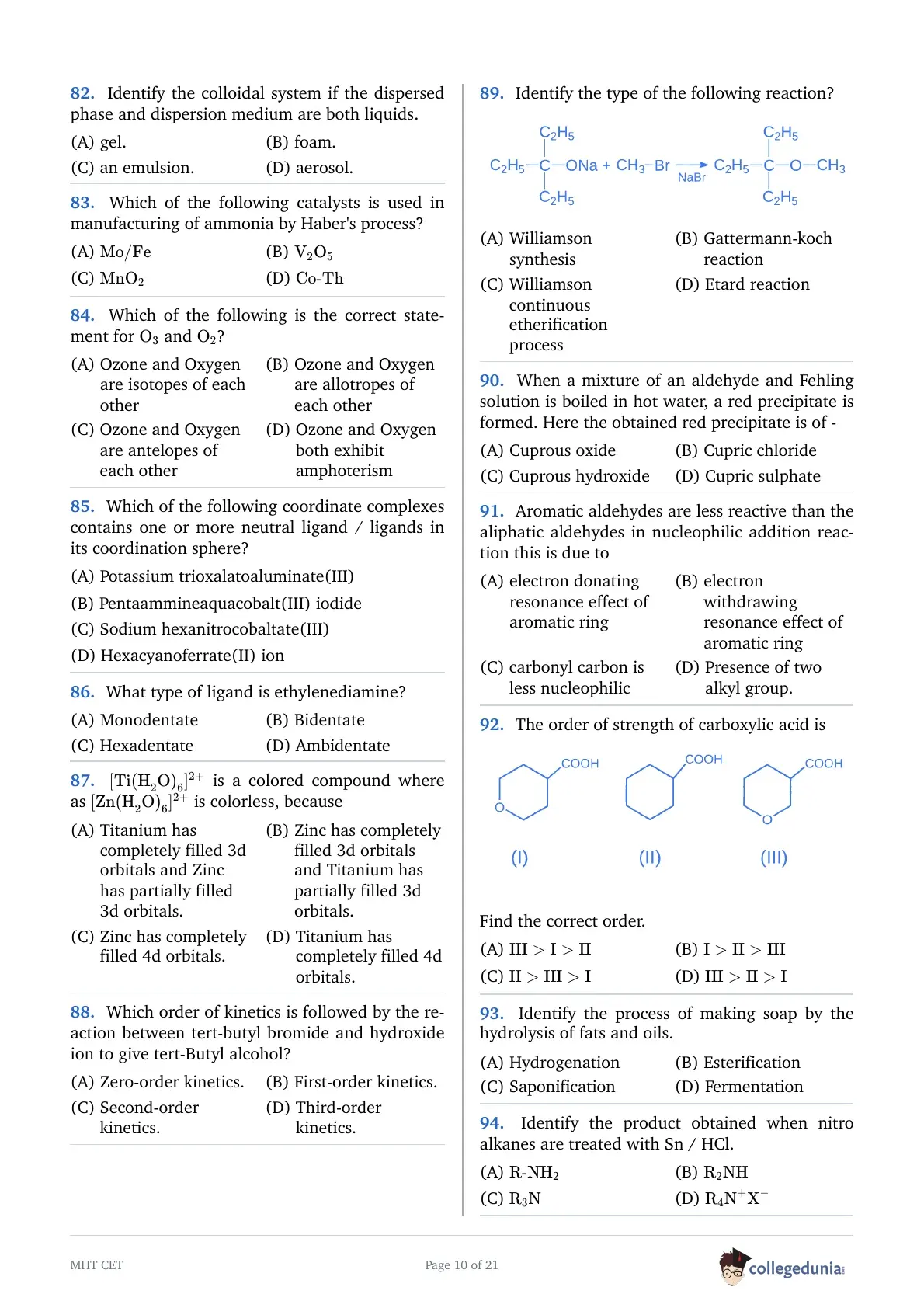
Identify the colloidal system if the dispersed phase and dispersion medium are both liquids.
Which of the following catalysts is used in manufacturing of ammonia by Haber's process?
Which of the following is the correct statement for \(\text{O}_{3}\) and \(\text{O}_{2}\)?
Which of the following coordinate complexes contains one or more neutral ligand / ligands in its coordination sphere?
What type of ligand is ethylenediamine?
\([\text{Ti(H}_{2}\text{O)}_{6}]^{2+}\) is a colored compound where as \([\text{Zn(H}_{2}\text{O)}_{6}]^{2+}\) is colorless, because
Which order of kinetics is followed by the reaction between tert-butyl bromide and hydroxide ion to give tert-Butyl alcohol?

When a mixture of an aldehyde and Fehling solution is boiled in hot water, a red precipitate is formed. Here the obtained red precipitate is of -
Aromatic aldehydes are less reactive than the aliphatic aldehydes in nucleophilic addition reaction this is due to

Identify the process of making soap by the hydrolysis of fats and oils.
Identify the product obtained when nitro alkanes are treated with Sn / HCl.
What type of amine is tert-Butyl amine?
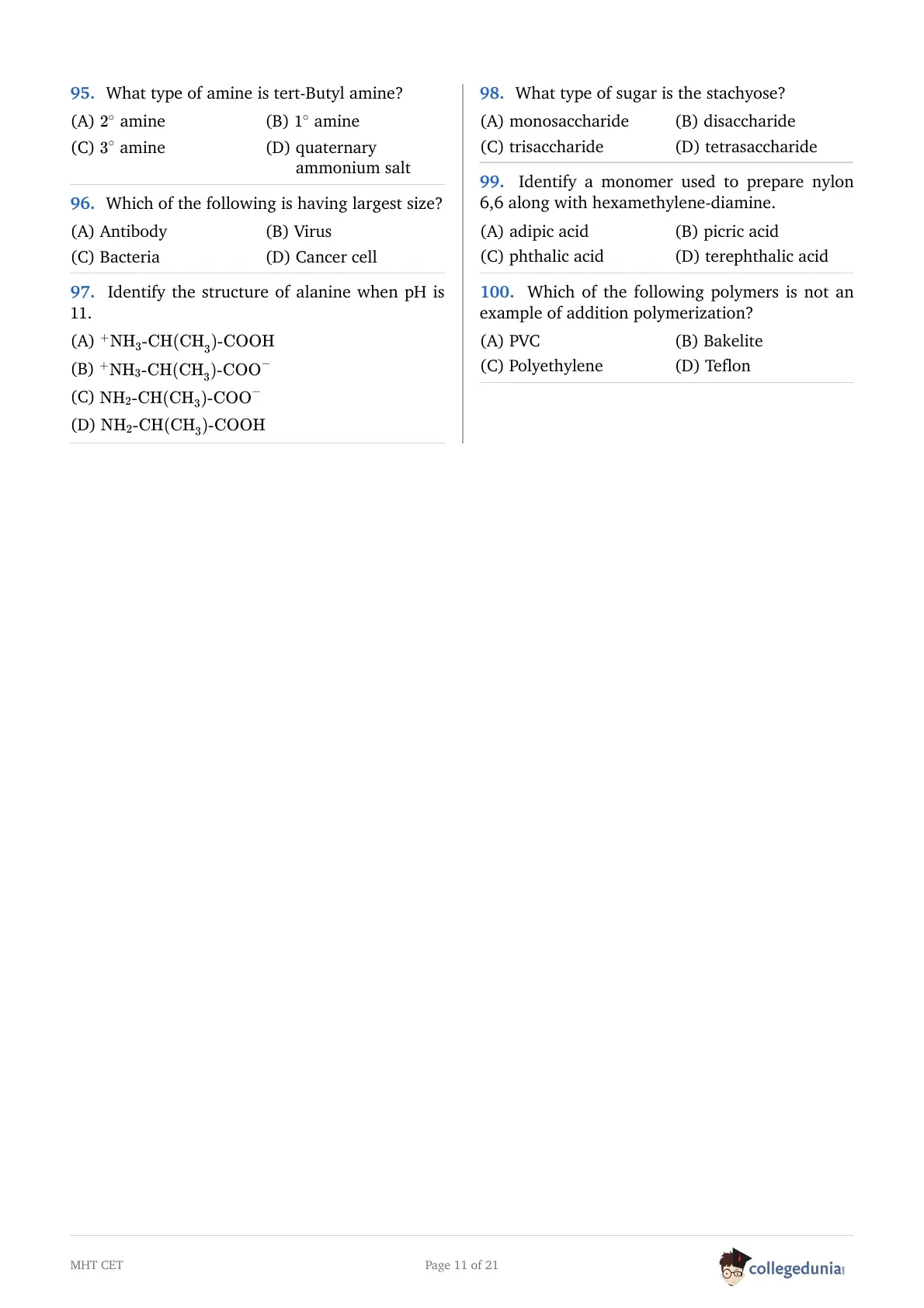
Which of the following is having largest size?
Identify the structure of alanine when pH is \(11\).
What type of sugar is the stachyose?
Identify a monomer used to prepare nylon 6,6 along with hexamethylene-diamine.
Which of the following polymers is not an example of addition polymerization?
Biology (Q101 - Q200)
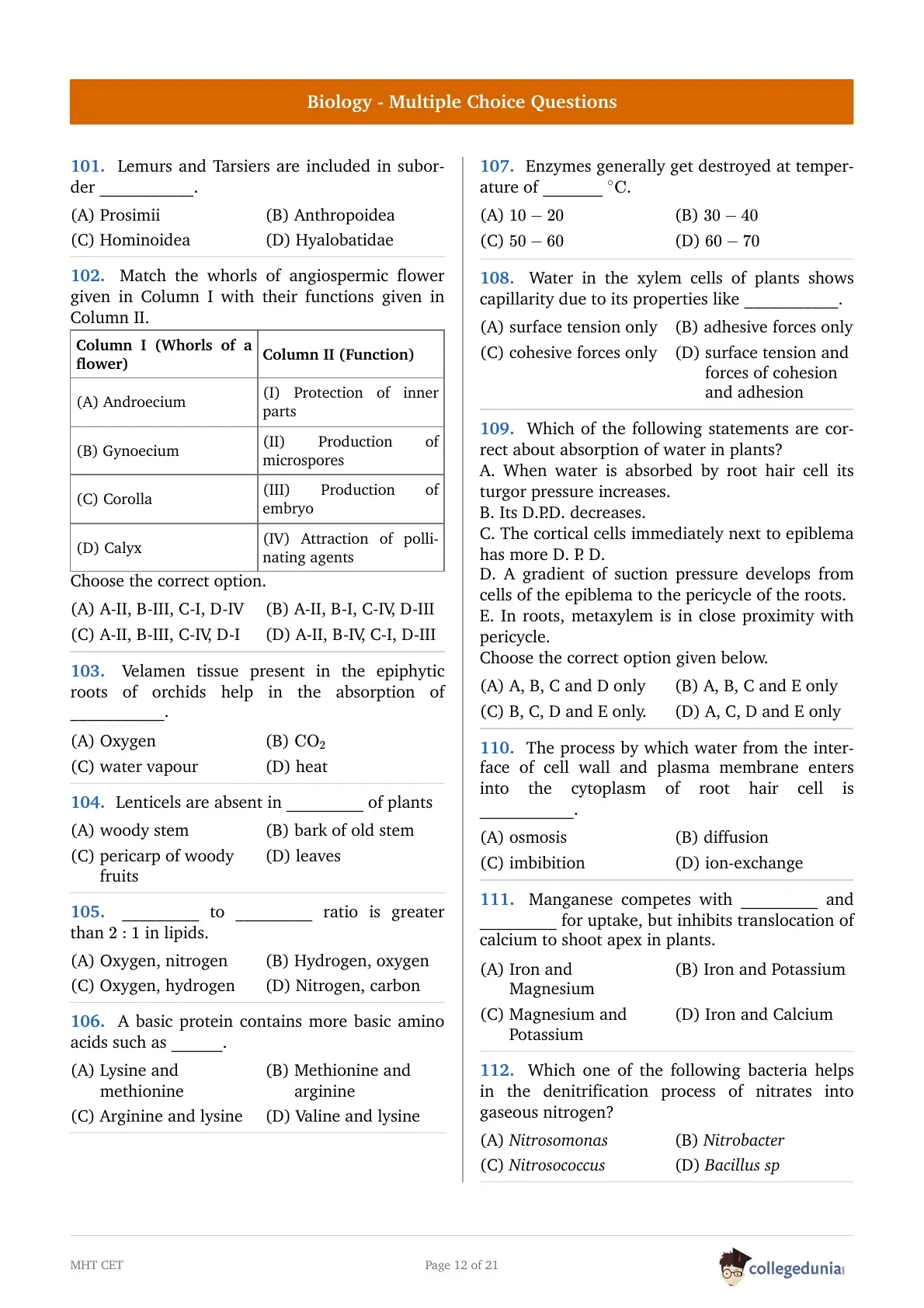
Lemurs and Tarsiers are included in suborder ___________.
Match the whorls of angiospermic flower given in Column I with their functions given in Column II.
| Column I (Whorls of a flower) | Column II (Function) |
|---|---|
| (A) Androecium | (I) Protection of inner parts |
| (B) Gynoecium | (II) Production of microspores |
| (C) Corolla | (III) Production of embryo |
| (D) Calyx | (IV) Attraction of pollinating agents |
Velamen tissue present in the epiphytic roots of orchids help in the absorption of ___________.
Lenticels are absent in _________ of plants
_________ to _________ ratio is greater than \(2:1\) in lipids.
A basic protein contains more basic amino acids such as ______.
Enzymes generally get destroyed at temperature of _______ \({}^{\circ }\text{C}\).
Water in the xylem cells of plants shows capillarity due to its properties like ___________.
Which of the following statements are correct about absorption of water in plants?
A. When water is absorbed by root hair cell its turgor pressure increases.
B. Its D.P.D. decreases.
C. The cortical cells immediately next to epiblema has more D. P. D.
D. A gradient of suction pressure develops from cells of the epiblema to the pericycle of the roots.
E. In roots, metaxylem is in close proximity with pericycle.
Choose the correct option given below.
The process by which water from the interface of cell wall and plasma membrane enters into the cytoplasm of root hair cell is ___________.
Manganese competes with _________ and _________ for uptake, but inhibits translocation of calcium to shoot apex in plants.
Which one of the following bacteria helps in the denitrification process of nitrates into gaseous nitrogen?
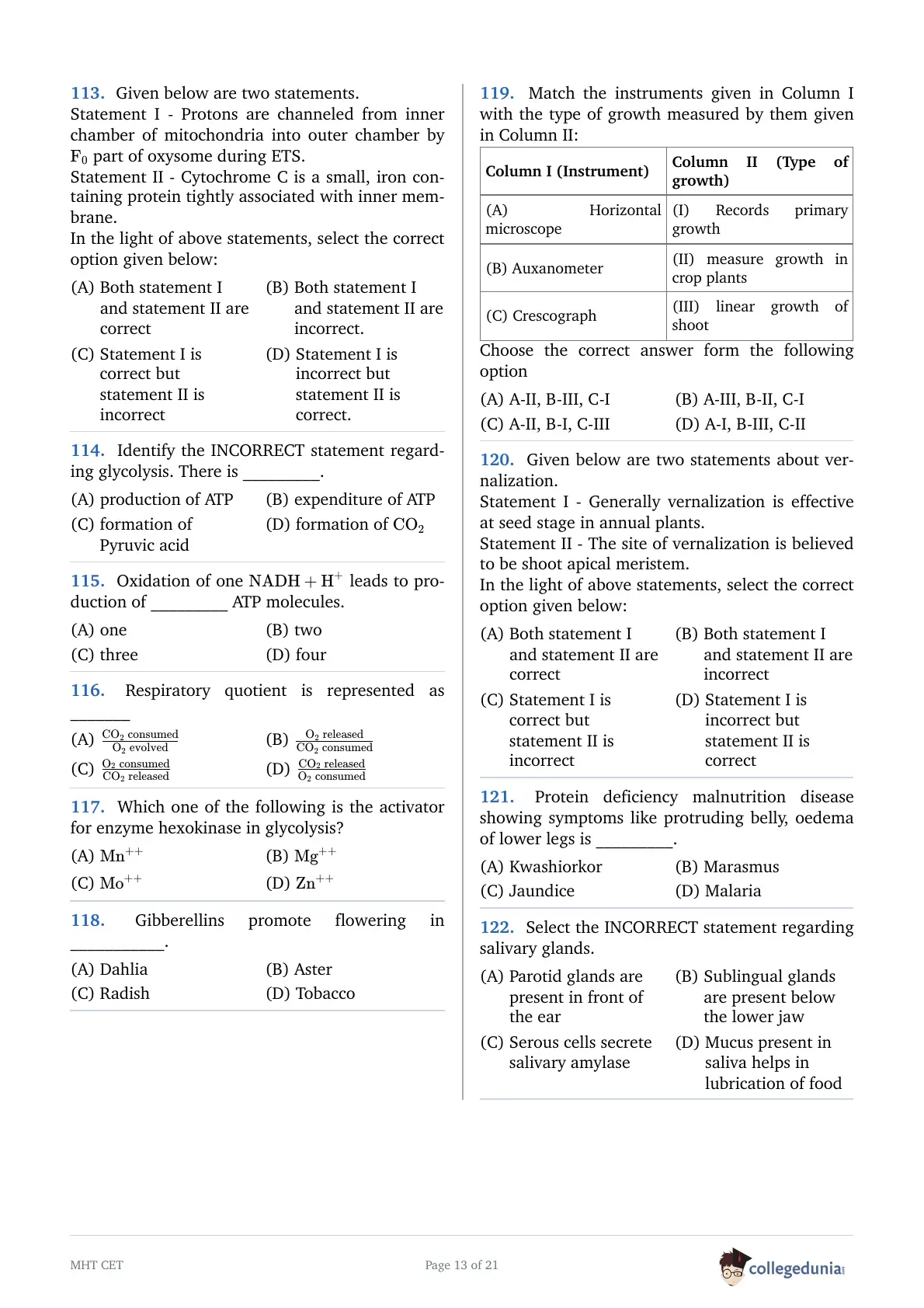
Given below are two statements.
Statement I - Protons are channeled from inner chamber of mitochondria into outer chamber by \(\text{F}_{0}\) part of oxysome during ETS.
Statement II - Cytochrome C is a small, iron containing protein tightly associated with inner membrane.
In the light of above statements, select the correct option given below:
Identify the INCORRECT statement regarding glycolysis. There is _________.
Oxidation of one \(\text{NADH}+\text{H}^{+}\) leads to production of _________ ATP molecules.
Respiratory quotient is represented as _______
Which one of the following is the activator for enzyme hexokinase in glycolysis?
Gibberellins promote flowering in ___________.
Match the instruments given in Column I with the type of growth measured by them given in Column II:
| Column I (Instrument) | Column II (Type of growth) |
|---|---|
| (A) Horizontal microscope | (I) Records primary growth |
| (B) Auxanometer | (II) measure growth in crop plants |
| (C) Crescograph | (III) linear growth of shoot |
Given below are two statements about vernalization.
Statement I - Generally vernalization is effective at seed stage in annual plants.
Statement II - The site of vernalization is believed to be shoot apical meristem.
In the light of above statements, select the correct option given below:
Protein deficiency malnutrition disease showing symptoms like protruding belly, oedema of lower legs is _________.
Select the INCORRECT statement regarding salivary glands.
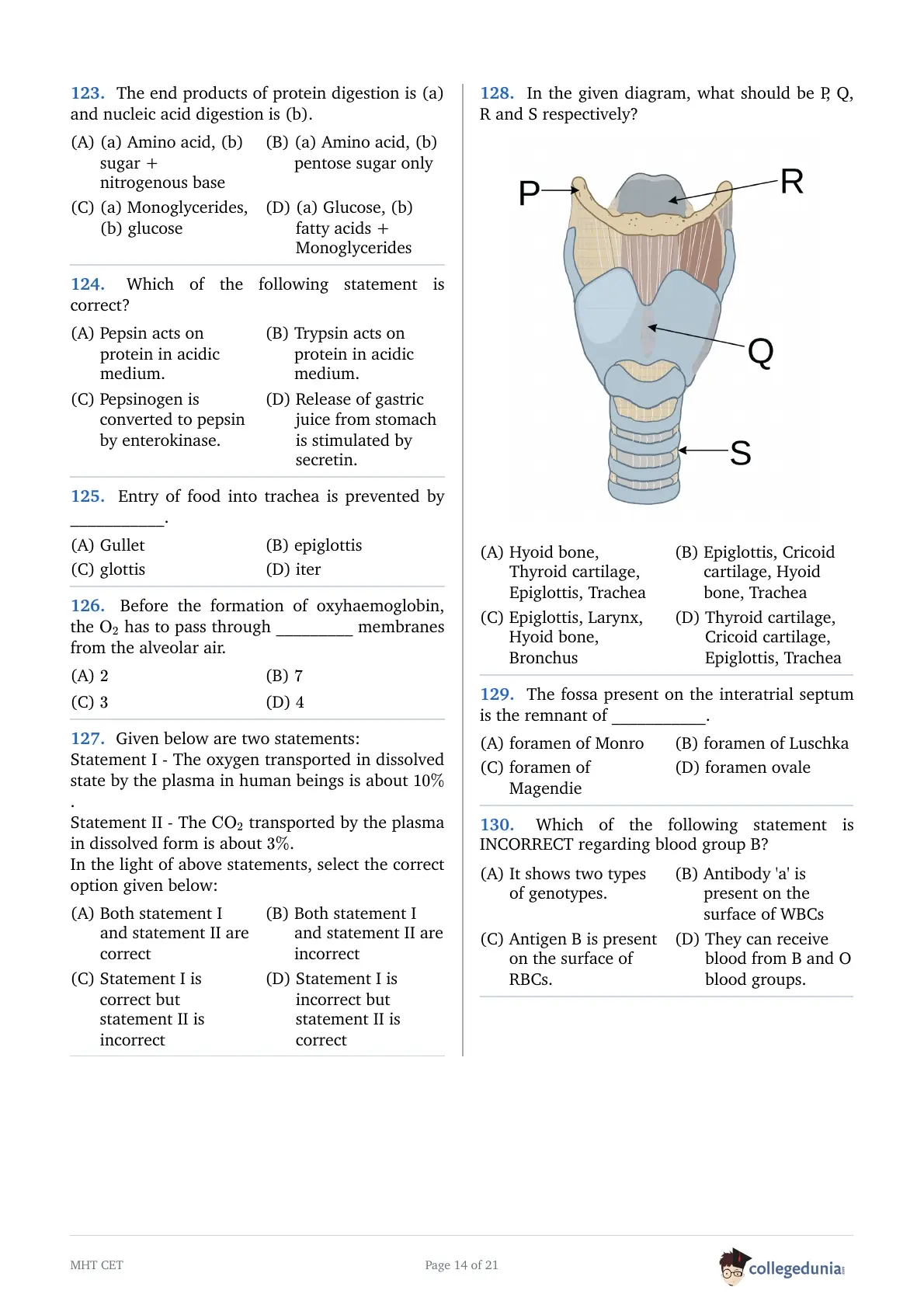
The end products of protein digestion is (a) and nucleic acid digestion is (b).
Which of the following statement is correct?
Entry of food into trachea is prevented by ___________.
Before the formation of oxyhaemoglobin, the \(\text{O}_{2}\) has to pass through _________ membranes from the alveolar air.
Given below are two statements:
Statement I - The oxygen transported in dissolved state by the plasma in human beings is about \(10\%\).
Statement II - The \(\text{CO}_{2}\) transported by the plasma in dissolved form is about \(3\%\).
In the light of above statements, select the correct option given below:

The fossa present on the interatrial septum is the remnant of ___________.
Which of the following statement is INCORRECT regarding blood group B?
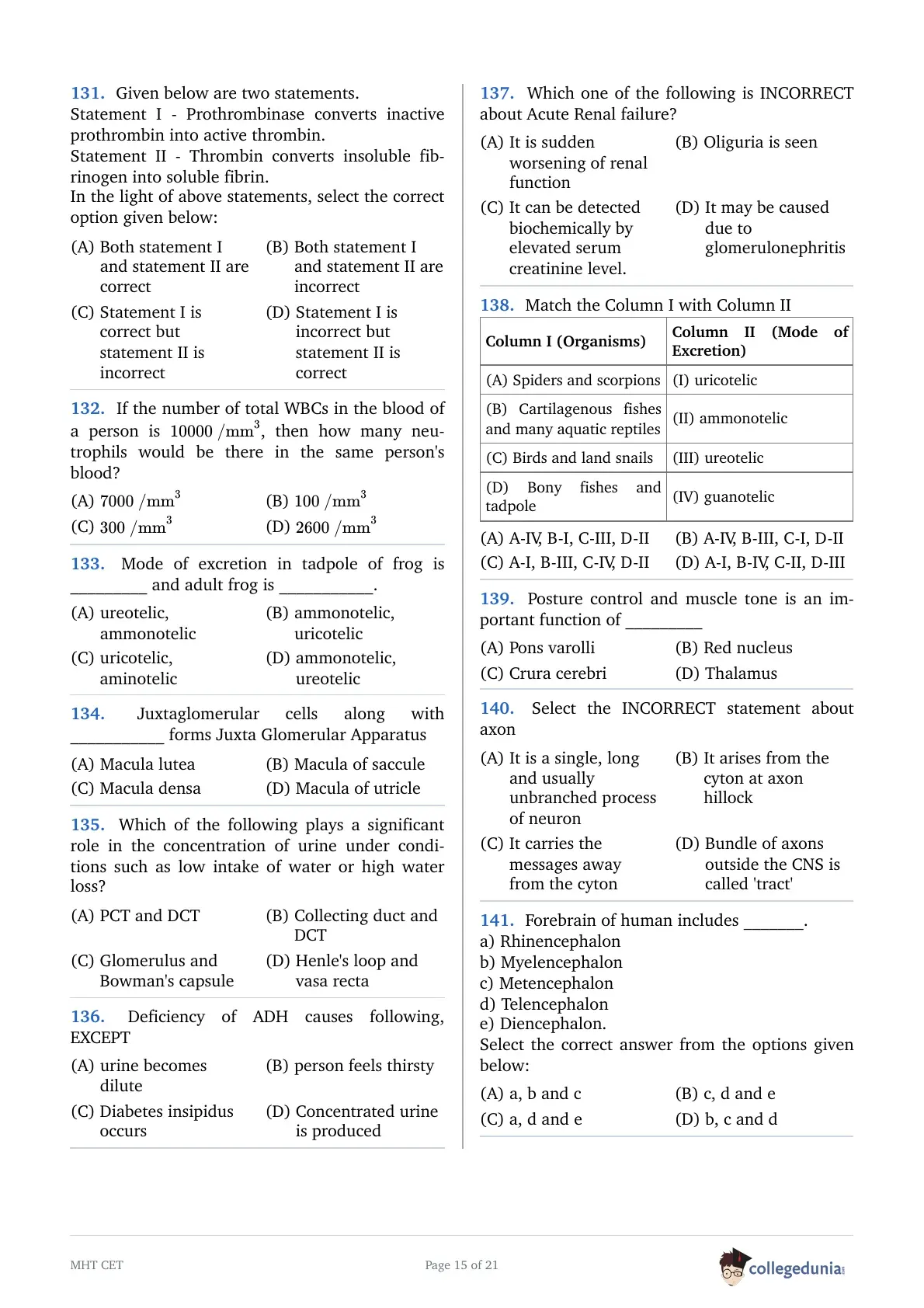
Given below are two statements.
Statement I - Prothrombinase converts inactive prothrombin into active thrombin.
Statement II - Thrombin converts insoluble fibrinogen into soluble fibrin.
In the light of above statements, select the correct option given below:
If the number of total WBCs in the blood of a person is \(10000\ \text{/mm}^{3}\), then how many neutrophils would be there in the same person's blood?
Mode of excretion in tadpole of frog is _________ and adult frog is ___________.
Juxtaglomerular cells along with ___________ forms Juxta Glomerular Apparatus
Which of the following plays a significant role in the concentration of urine under conditions such as low intake of water or high water loss?
Deficiency of ADH causes following, EXCEPT
Which one of the following is INCORRECT about Acute Renal failure?
Match the Column I with Column II
| Column I (Organisms) | Column II (Mode of Excretion) |
|---|---|
| (A) Spiders and scorpions | (I) uricotelic |
| (B) Cartilagenous fishes and many aquatic reptiles | (II) ammonotelic |
| (C) Birds and land snails | (III) ureotelic |
| (D) Bony fishes and tadpole | (IV) guanotelic |
Posture control and muscle tone is an important function of _________
Select the INCORRECT statement about axon
Forebrain of human includes _______.
a) Rhinencephalon
b) Myelencephalon
c) Metencephalon
d) Telencephalon
e) Diencephalon.
Select the correct answer from the options given below:
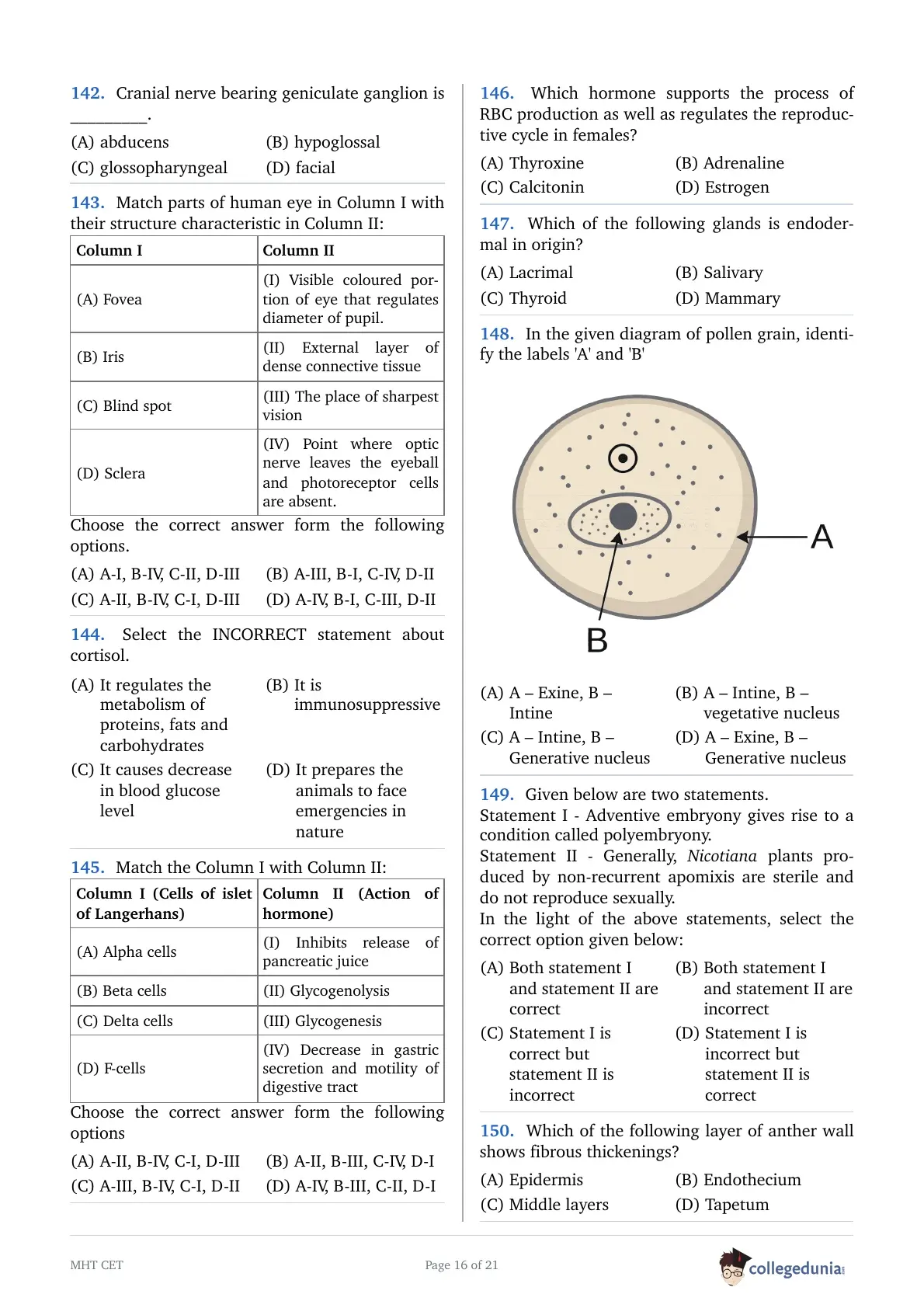
Cranial nerve bearing geniculate ganglion is _________.
Match parts of human eye in Column I with their structure characteristic in Column II:
| Column I | Column II |
|---|---|
| (A) Fovea | (I) Visible coloured portion of eye that regulates diameter of pupil. |
| (B) Iris | (II) External layer of dense connective tissue |
| (C) Blind spot | (III) The place of sharpest vision |
| (D) Sclera | (IV) Point where optic nerve leaves the eyeball and photoreceptor cells are absent. |
Select the INCORRECT statement about cortisol.
Match the Column I with Column II:
| Column I (Cells of islet of Langerhans) | Column II (Action of hormone) |
|---|---|
| (A) Alpha cells | (I) Inhibits release of pancreatic juice |
| (B) Beta cells | (II) Glycogenolysis |
| (C) Delta cells | (III) Glycogenesis |
| (D) F-cells | (IV) Decrease in gastric secretion and motility of digestive tract |
Which hormone supports the process of RBC production as well as regulates the reproductive cycle in females?
Which of the following glands is endodermal in origin?
In the given diagram of pollen grain, identify the labels 'A' and 'B'

Given below are two statements.
Statement I - Adventive embryony gives rise to a condition called polyembryony.
Statement II - Generally, Nicotiana plants produced by non-recurrent apomixis are sterile and do not reproduce sexually.
In the light of the above statements, select the correct option given below:
Which of the following layer of anther wall shows fibrous thickenings?
Self incompatibility is seen in
Which one of the following is NOT an outbreeding device to promote cross pollination?
Which of the following pair of animals indicates continuous breeder?
The pancreas develops from _______ layer of embryo.
Which of the following cells undergoes meiosis II in gametogenesis?
Which of the following does NOT communicate directly with the urethra?
Which of the following layers covering the secondary follicle is fibrous?
Which of the following contraceptive devices is usually used only by males?
In a population with two alleles B and b with frequency \(0.6\) and \(0.4\) in Hardy-Weinberg equilibrium. How many heterozygous individuals in a sample of \(250\) can be expected?
Extra copy of 21st chromosome causes _________ in human.
The number of linkage groups of a particular species corresponds to its _________ number of chromosomes.
Development of feminine characters and no spermatogenesis are characteristic feature of people with __________.
Which one of the following characters does NOT belong to Down's Syndrome?
Choose the group of correct statements regarding sex-linked inheritance.
A) Y-linked genes are inherited only in males.
B) X-linked genes are inherited only in females.
C) Colourblindness shows criss-cross inheritance.
D) Haemophilia is Y-linked recessive disorder.
E) The frequency of colourblind women is much less than colourblind men.
Two different amino acids will never be encoded by the same codon, which property of genetic code does this represent?
Match the gene in Column I with its role in Column II.
| Column I (Gene) | Column II (Role of gene) |
|---|---|
| (A) Structural gene | (I) Binding site for repressor |
| (B) Operator gene | (II) Codes for repressor |
| (C) Promoter gene | (III) Codes for enzyme |
| (D) Regulator gene | (IV) Binding site for RNA polymerase |
Part of gene that is transcribed but NOT translated is __________.
Given below are two statements:
Statement I - The unit of DNA, in which replication occur is called replicon.
Statement II - In eukaryotes, there is only one replicon whereas in prokaryotes there are several replicons.
In the light of above statements, select the correct option given below:
A \(340\ \text{Å}\) long segment of DNA molecule has \(40\) thymine nitrogenous bases, what will be the number of guanine bases in the same segment?
Formation of peptide bond between amino acids during translation is catalyzed by __________.
Triticum aestivum, a hybrid formed by doubling of chromosomes, is an example of ___________.
The industrial melanism phenomenon demonstrates __________
Lob fin fish __________ is considered living fossil.
Pneumonitis and Eosinophilia are symptoms of __________.
Pus is a mixture of ___________.
Smoking causes ___________.
A) Sinusitis
B) Laryngitis
C) Chronic bronchitis
D) Emphysema
E) Pneumonia
Select the correct option:
Paratope of immunoglobulins is __________
Human being obtain antibodies from hyper immunised horses against rabies pathogen. It is _________ type of immunity.
Which one of the following variety of wheat is produced by mutation breeding?
Which of the following forms Hartig net in the intercellular spaces of root cortex?
(Terror of Bengal) 'Water hyacinth' is controlled by using the fungus __________.
Match Column I containing names of antibiotics with Column II containing their microbial sources.
| Column I (Names of antibiotics) | Column II (Microbial source) |
|---|---|
| (A) Chloromycetin | (I) Penicillium griseofulvum |
| (B) Erythromycin | (II) Streptomyces aureofaciens |
| (C) Griseofulvin | (III) Streptomyces venezuelae |
| (D) Terramycin | (IV) Streptomyces erythreus |
In sewage treatment, formation of activated sludge takes place during ___________.
Which one of the following is NOT used as competent host in rDNA technology?
Vehicle DNA is the common name given to which of the following?
The amplified DNA fragments can be separated by ___________.
The technique of PCR was discovered in 1985 by _________.
The gene of \(\alpha\)-amylase inhibitor for the development of pest resistant tobacco plant has been isolated from _________.
Which one of the following is INCORRECT regarding brood parasitism?
As an efficient reproductive strategy under environmental selection pressure, some organisms like _________ and _________ produce a small number of large-sized offspring
Which of the following depicts Exponential growth curve of a population?
- (A)
![]()
- (B)
![]()
- (C)
![]()
- (D)
![]()


Which of the following statements is INCORRECT regarding Niche?
Which one of the following is the most important services provided by an ecosystem?
Long-term storage places of carbon in the form of fossil fuel are known as ___________.
What do you mean by sere?
Which one of the following statements is INCORRECT regarding genetic diversity?
In Satpuda hills of Maharashtra, Pawra tribals by farming, have protected (in situ conservation) __________.
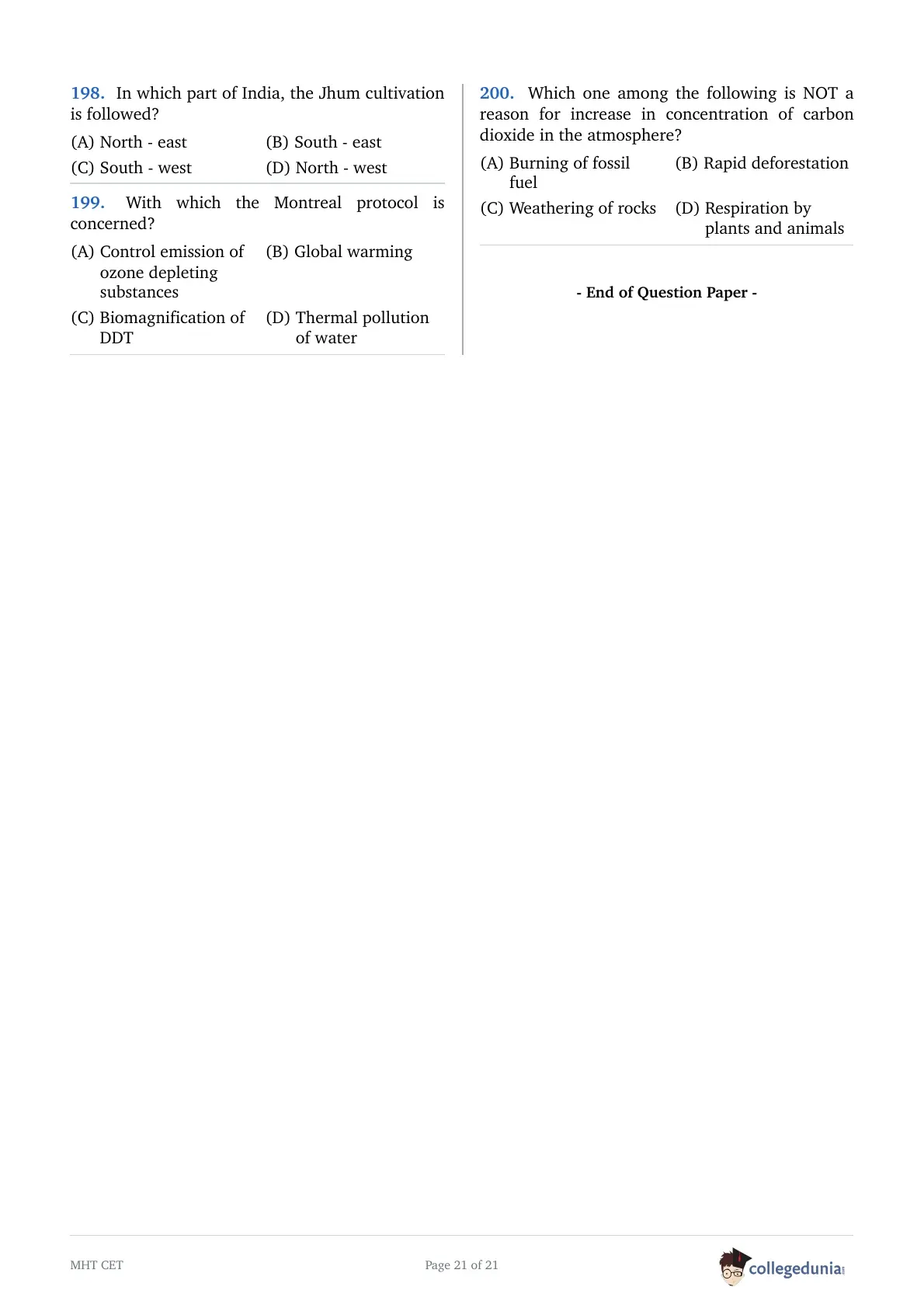
In which part of India, the Jhum cultivation is followed?
With which the Montreal protocol is concerned?
Which one among the following is NOT a reason for increase in concentration of carbon dioxide in the atmosphere?
MHT CET 2026 PCB Exam Pattern and Marking Scheme
| Parameter | Details |
|---|---|
| Conducting Body | Maharashtra Common Entrance Test Cell (Maharashtra CET Cell) |
| Exam Mode | Online (Computer-Based Test) |
| Duration | 180 minutes (3 hours) |
| Groups / Subjects | PCB (Physics, Chemistry, Biology) for Pharmacy and Agriculture |
| Total Questions |
200 |
| Total Marks | 200 |
| Question Type | Multiple Choice Questions (MCQs) |
| Marking Scheme | 1 mark for each correct answer |
| Negative Marking | No |
| Syllabus Weightage |
|



Comments