




MHT CET 2026 April 26 Shift 1 PCB Question Paper is available for download here. Maharashtra State CET Cell conducted MHT CET 2026 PCB Exam on April 26 in Shift 1 from 9 AM to 12 PM in CBT mode.
The MHT CET 2026 PCB question paper includes the following:
- The MHT CET 2026 PCB Question Paper consists of 200 multiple-choice questions (MCQs) totalling 200 marks divided into 3 sections: Physics (50 questions), Chemistry (50 questions), and Biology (100 questions).
- All questions carry 1 mark each. There is no negative marking for incorrect answers.
MHT CET 2026 April 26 Shift 1 PCB Question Paper with Solution PDF
| CD PDF | CD PDF with Solutions |
|---|---|
| Download Collegedunia PDF 1.12 MB | - |
Also Check:
MHT CET 2026 April 26 Shift 1 PCB Questions with Solutions
Physics (Q1 - Q50)
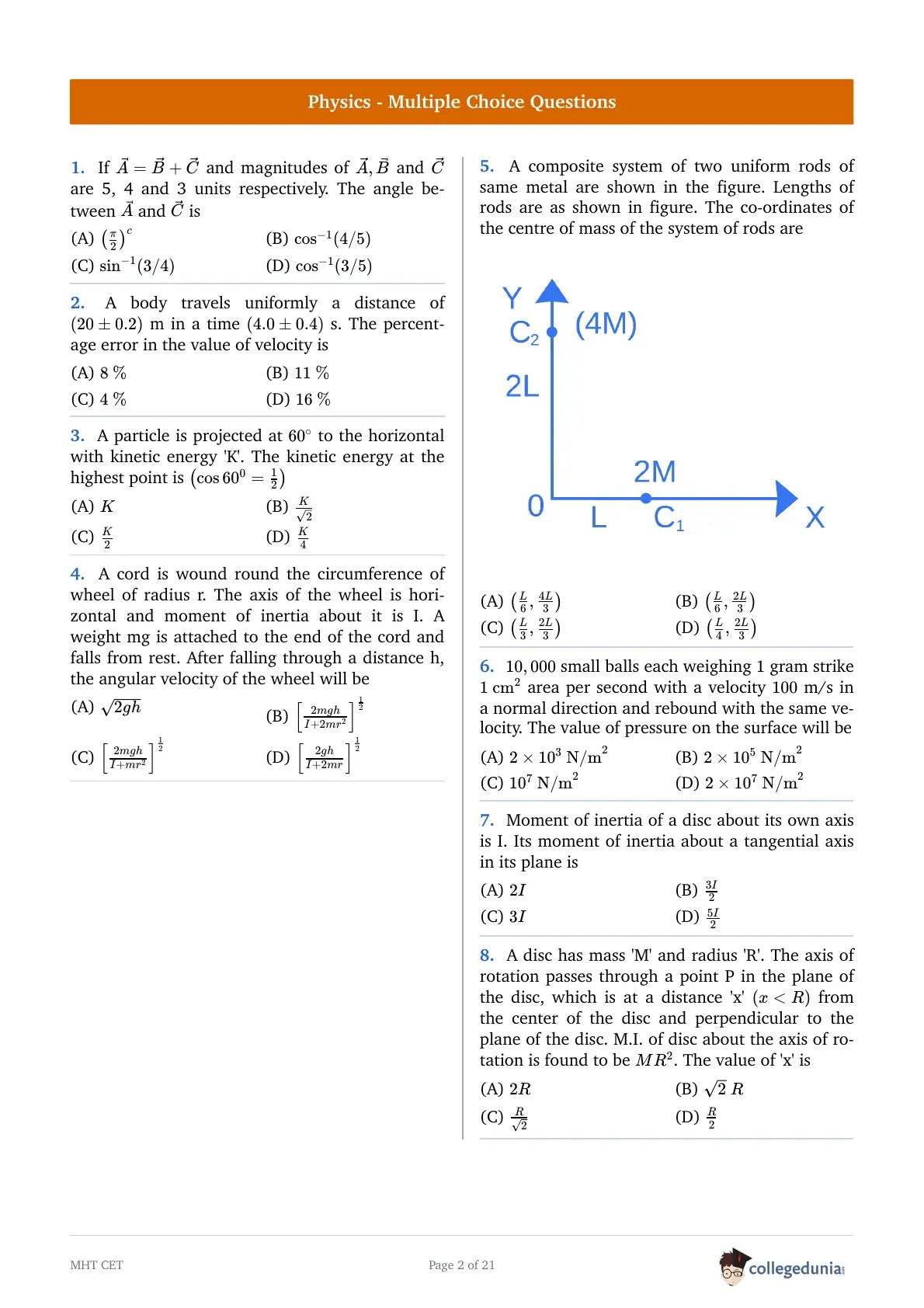
If \(\vec{A}=\vec{B}+\vec{C}\) and magnitudes of \(\vec{A},\vec{B}\) and \(\vec{C}\) are 5, 4 and 3 units respectively. The angle between \(\vec{A}\) and \(\vec{C}\) is
A body travels uniformly a distance of \((20\pm 0.2)\) m in a time \((4.0\pm 0.4)\) s. The percentage error in the value of velocity is
A particle is projected at \(60^{\circ }\) to the horizontal with kinetic energy 'K'. The kinetic energy at the highest point is \(\left(\cos 60^{0}=\frac{1}{2}\right)\)
A cord is wound round the circumference of wheel of radius r. The axis of the wheel is horizontal and moment of inertia about it is I. A weight mg is attached to the end of the cord and falls from rest. After falling through a distance h, the angular velocity of the wheel will be
A composite system of two uniform rods of same metal are shown in the figure. Lengths of rods are as shown in figure. The co-ordinates of the centre of mass of the system of rods are

\(10,000\) small balls each weighing \(1\) gram strike \(1\ \text{cm}^{2}\) area per second with a velocity \(100\) m/s in a normal direction and rebound with the same velocity. The value of pressure on the surface will be
Moment of inertia of a disc about its own axis is I. Its moment of inertia about a tangential axis in its plane is
A disc has mass 'M' and radius 'R'. The axis of rotation passes through a point P in the plane of the disc, which is at a distance 'x' \((x\lt R)\) from the center of the disc and perpendicular to the plane of the disc. M.I. of disc about the axis of rotation is found to be \(MR^{2}\). The value of 'x' is
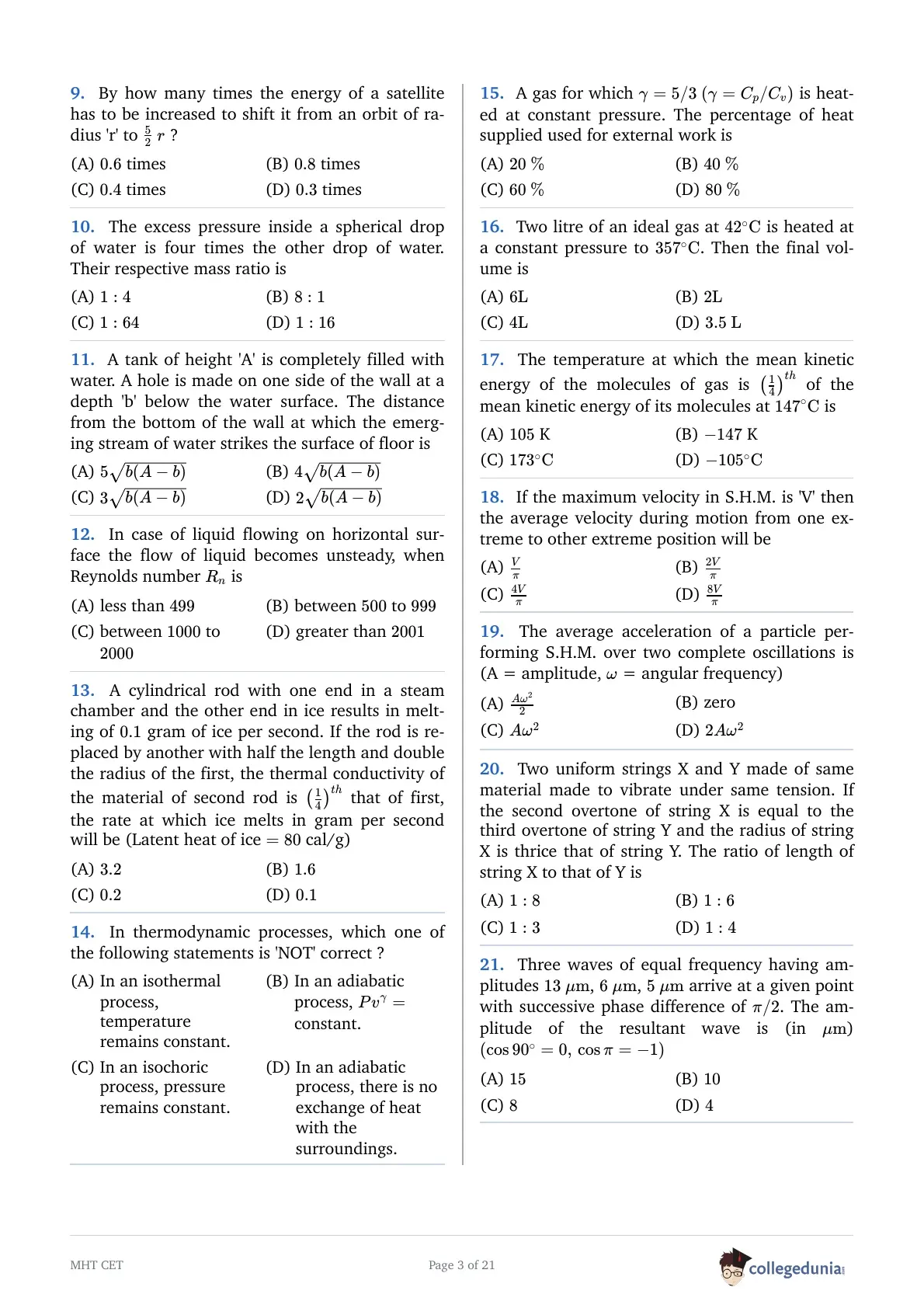
By how many times the energy of a satellite has to be increased to shift it from an orbit of radius 'r' to \(\frac{5}{2}\ r\) ?
The excess pressure inside a spherical drop of water is four times the other drop of water. Their respective mass ratio is
A tank of height 'A' is completely filled with water. A hole is made on one side of the wall at a depth 'b' below the water surface. The distance from the bottom of the wall at which the emerging stream of water strikes the surface of floor is
In case of liquid flowing on horizontal surface the flow of liquid becomes unsteady, when Reynolds number \(R_{n}\) is
A cylindrical rod with one end in a steam chamber and the other end in ice results in melting of \(0.1\) gram of ice per second. If the rod is replaced by another with half the length and double the radius of the first, the thermal conductivity of the material of second rod is \(\left(\frac{1}{4}\right)^{th}\) that of first, the rate at which ice melts in gram per second will be (Latent heat of ice \(=80\) cal/g)
In thermodynamic processes, which one of the following statements is 'NOT' correct ?
A gas for which \(\gamma =5/3\ (\gamma =C_{p}/C_{v})\) is heated at constant pressure. The percentage of heat supplied used for external work is
Two litre of an ideal gas at \(42^{\circ }\text{C}\) is heated at a constant pressure to \(357^{\circ }\text{C}\). Then the final volume is
The temperature at which the mean kinetic energy of the molecules of gas is \(\left(\frac{1}{4}\right)^{th}\) of the mean kinetic energy of its molecules at \(147^{\circ }\text{C}\) is
If the maximum velocity in S.H.M. is 'V' then the average velocity during motion from one extreme to other extreme position will be
The average acceleration of a particle performing S.H.M. over two complete oscillations is (A = amplitude, \(\omega\) = angular frequency)
Two uniform strings X and Y made of same material made to vibrate under same tension. If the second overtone of string X is equal to the third overtone of string Y and the radius of string X is thrice that of string Y. The ratio of length of string X to that of Y is
Three waves of equal frequency having amplitudes \(13\ \mu \text{m}\), \(6\ \mu \text{m}\), \(5\ \mu \text{m}\) arrive at a given point with successive phase difference of \(\pi /2\). The amplitude of the resultant wave is (in \(\mu \text{m}\)) \((\cos 90^{\circ }=0,\,\cos \pi =-1)\)
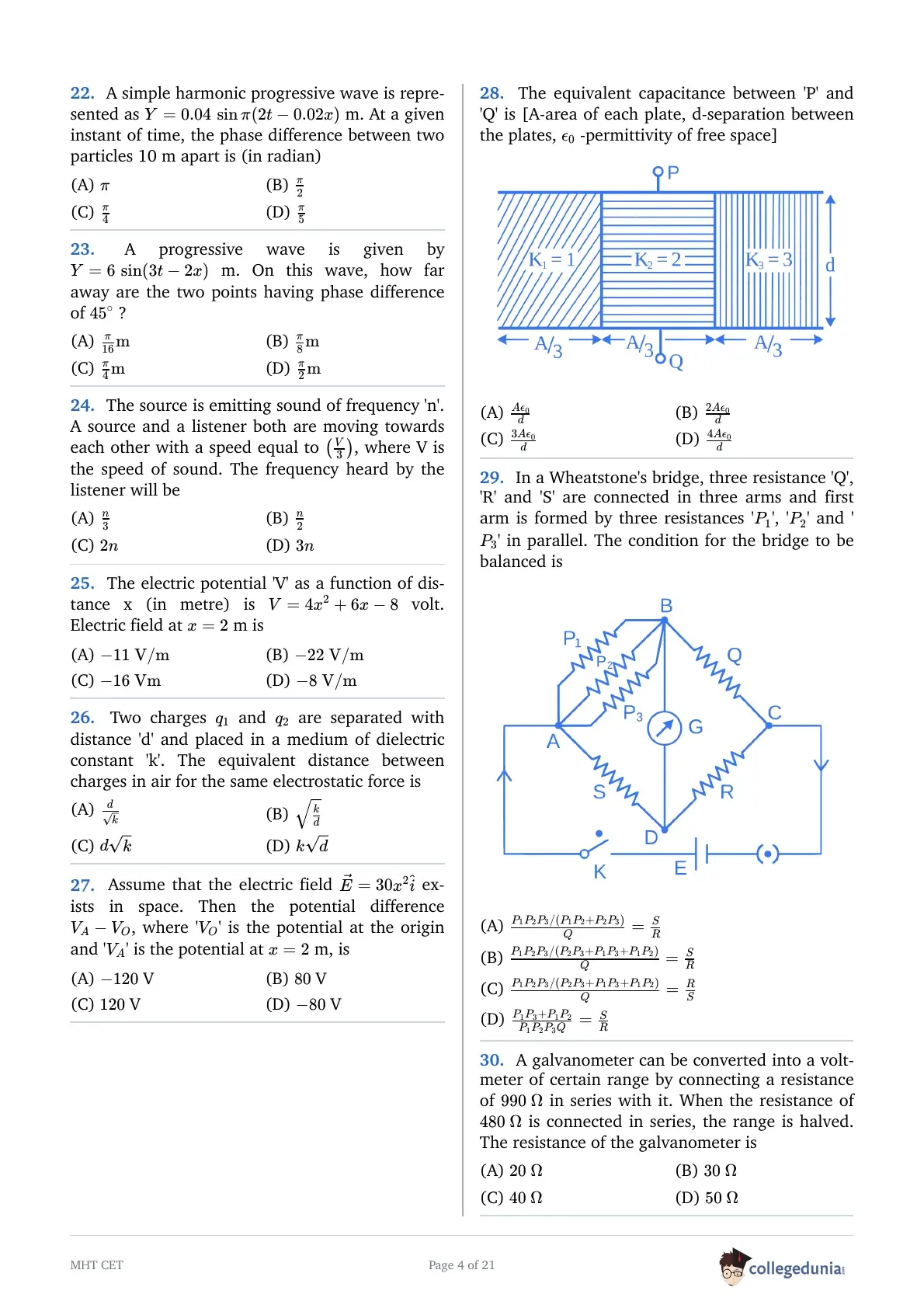
A simple harmonic progressive wave is represented as \(Y=0.04\,\sin \pi (2t-0.02x)\) m. At a given instant of time, the phase difference between two particles 10 m apart is (in radian)
A progressive wave is given by \(Y=6\,\sin (3t-2x)\) m. On this wave, how far away are the two points having phase difference of \(45^{\circ }\) ?
The source is emitting sound of frequency 'n'. A source and a listener both are moving towards each other with a speed equal to \(\left(\frac{V}{3}\right)\), where V is the speed of sound. The frequency heard by the listener will be
The electric potential 'V' as a function of distance x (in metre) is \(V=4x^{2}+6x-8\) volt. Electric field at \(x=2\) m is
Two charges \(q_{1}\) and \(q_{2}\) are separated with distance 'd' and placed in a medium of dielectric constant 'k'. The equivalent distance between charges in air for the same electrostatic force is
Assume that the electric field \(\vec{E}=30x^{2}\hat{i}\) exists in space. Then the potential difference \(V_{A}-V_{O}\), where '\(V_{O}\)' is the potential at the origin and '\(V_{A}\)' is the potential at \(x=2\) m, is
The equivalent capacitance between 'P' and 'Q' is [A-area of each plate, d-separation between the plates, \(\epsilon _{0}\) -permittivity of free space]

In a Wheatstone's bridge, three resistance 'Q', 'R' and 'S' are connected in three arms and first arm is formed by three resistances '\(P_{1}\)', '\(P_{2}\)' and '\(P_{3}\)' in parallel. The condition for the bridge to be balanced is

A galvanometer can be converted into a voltmeter of certain range by connecting a resistance of \(990\ \Omega\) in series with it. When the resistance of \(480\ \Omega\) is connected in series, the range is halved. The resistance of the galvanometer is
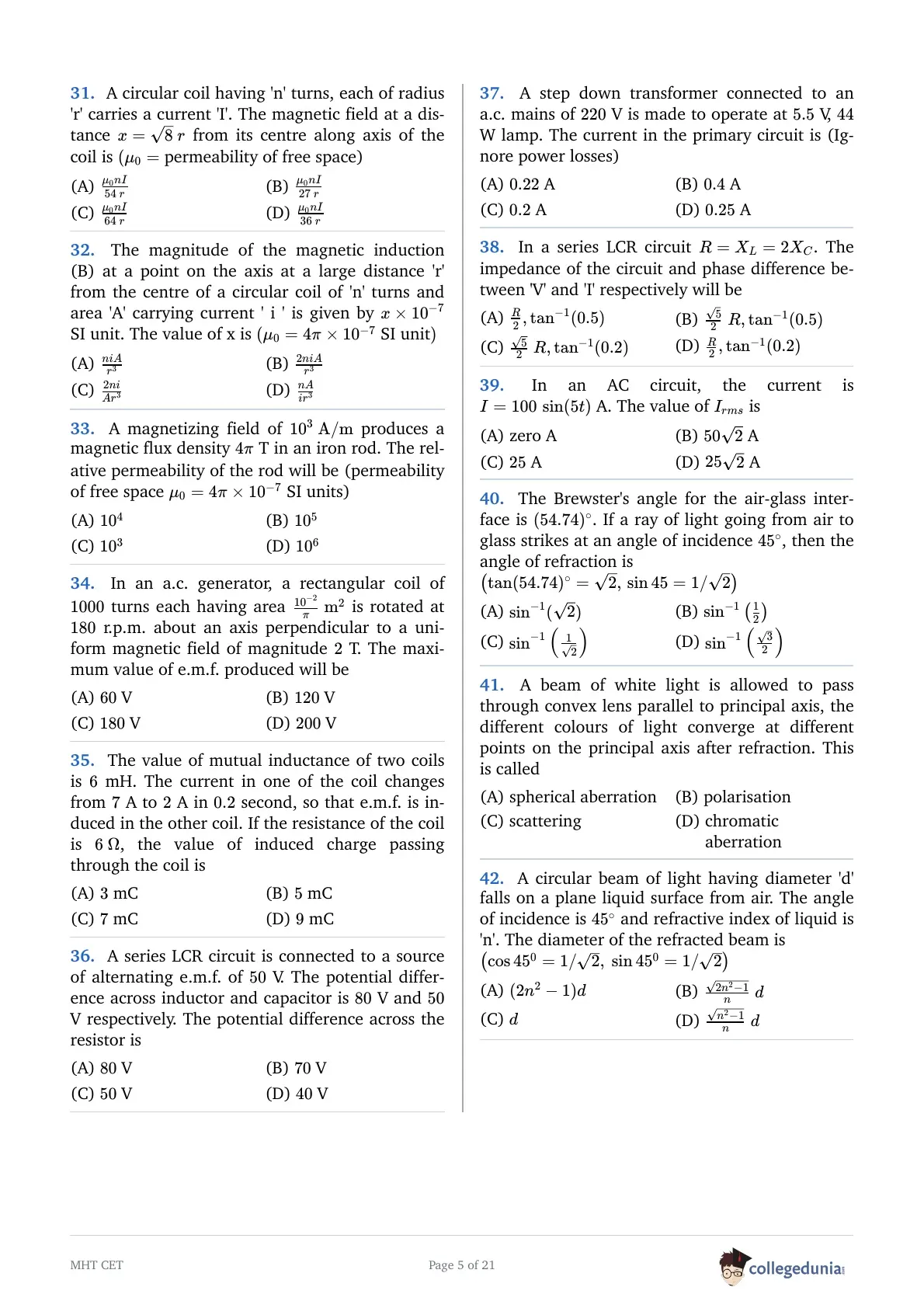
A circular coil having 'n' turns, each of radius 'r' carries a current 'I'. The magnetic field at a distance \(x=\sqrt{8}\ r\) from its centre along axis of the coil is \((\mu _{0}=\) permeability of free space)
The magnitude of the magnetic induction (B) at a point on the axis at a large distance 'r' from the centre of a circular coil of 'n' turns and area 'A' carrying current ' i ' is given by \(x\times 10^{-7}\) SI unit. The value of x is \((\mu _{0}=4\pi \times 10^{-7}\) SI unit\()\)
A magnetizing field of \(10^{3}\ \text{A/m}\) produces a magnetic flux density \(4\pi\) T in an iron rod. The relative permeability of the rod will be (permeability of free space \(\mu _{0}=4\pi \times 10^{-7}\) SI units)
In an a.c. generator, a rectangular coil of \(1000\) turns each having area \(\frac{10^{-2}}{\pi }\ \text{m}^{2}\) is rotated at \(180\) r.p.m. about an axis perpendicular to a uniform magnetic field of magnitude \(2\) T. The maximum value of e.m.f. produced will be
The value of mutual inductance of two coils is \(6\) mH. The current in one of the coil changes from \(7\) A to \(2\) A in \(0.2\) second, so that e.m.f. is induced in the other coil. If the resistance of the coil is \(6\ \Omega\), the value of induced charge passing through the coil is
A series LCR circuit is connected to a source of alternating e.m.f. of \(50\) V. The potential difference across inductor and capacitor is \(80\) V and \(50\) V respectively. The potential difference across the resistor is
A step down transformer connected to an a.c. mains of \(220\) V is made to operate at \(5.5\) V, \(44\) W lamp. The current in the primary circuit is (Ignore power losses)
In a series LCR circuit \(R=X_{L}=2X_{C}\). The impedance of the circuit and phase difference between 'V' and 'I' respectively will be
In an AC circuit, the current is \(I=100\,\sin (5t)\) A. The value of \(I_{rms}\) is
The Brewster's angle for the air-glass interface is \((54.74)^{\circ }\). If a ray of light going from air to glass strikes at an angle of incidence \(45^{\circ }\), then the angle of refraction is
\(\left(\tan (54.74)^{\circ }=\sqrt{2},\,\sin 45=1/\sqrt{2}\right)\)
A beam of white light is allowed to pass through convex lens parallel to principal axis, the different colours of light converge at different points on the principal axis after refraction. This is called
A circular beam of light having diameter 'd' falls on a plane liquid surface from air. The angle of incidence is \(45^{\circ }\) and refractive index of liquid is 'n'. The diameter of the refracted beam is
\(\left(\cos 45^{0}=1/\sqrt{2},\ \sin 45^{0}=1/\sqrt{2}\right)\)
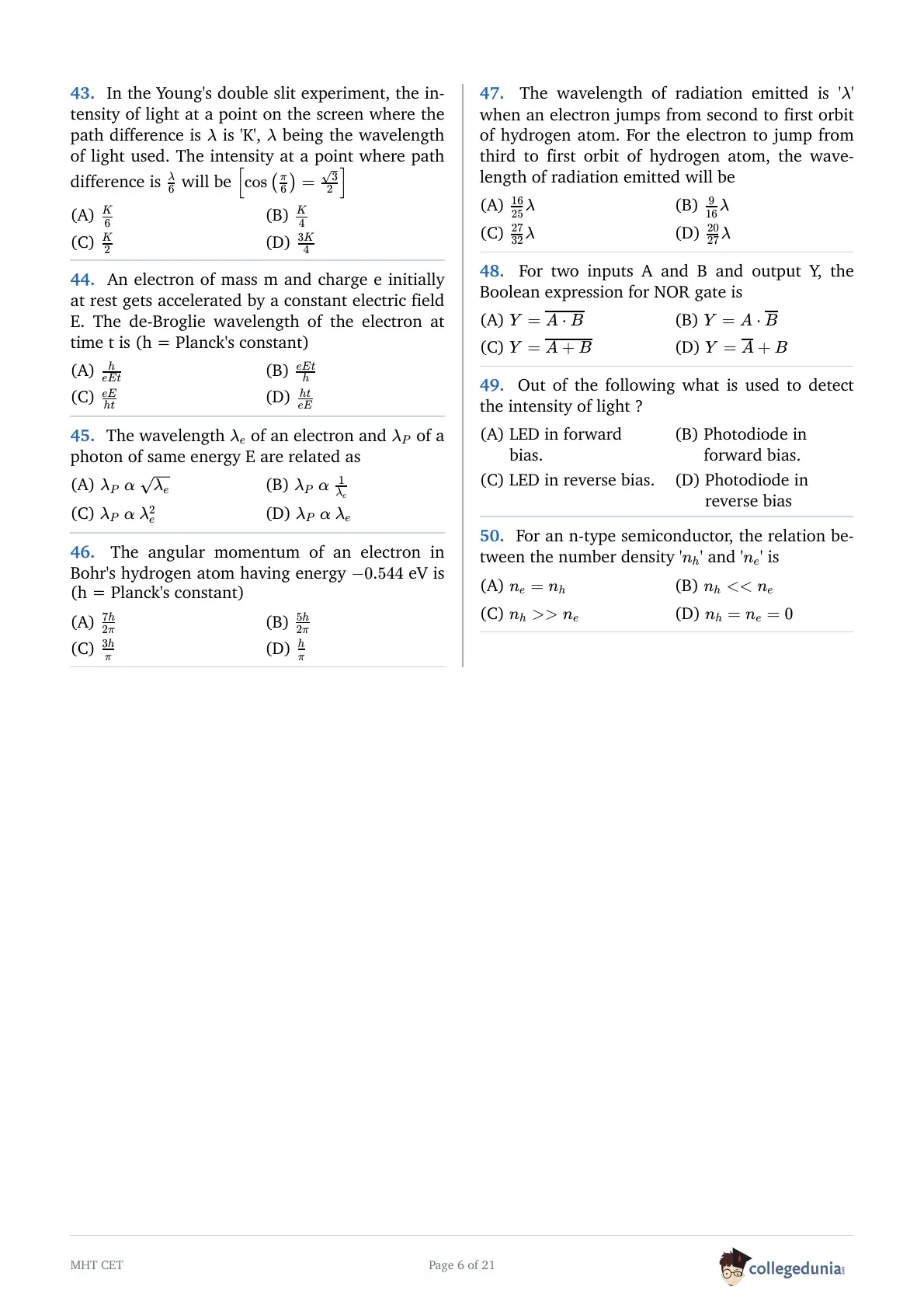
In the Young's double slit experiment, the intensity of light at a point on the screen where the path difference is \(\lambda\) is 'K', \(\lambda\) being the wavelength of light used. The intensity at a point where path difference is \(\frac{\lambda }{6}\) will be \(\left[\cos \left(\frac{\pi }{6}\right)=\frac{\sqrt{3}}{2}\right]\)
An electron of mass m and charge e initially at rest gets accelerated by a constant electric field E. The de-Broglie wavelength of the electron at time t is (h = Planck's constant)
The wavelength \(\lambda _{e}\) of an electron and \(\lambda _{P}\) of a photon of same energy E are related as
The angular momentum of an electron in Bohr's hydrogen atom having energy \(-0.544\) eV is (h = Planck's constant)
The wavelength of radiation emitted is '\(\lambda\)' when an electron jumps from second to first orbit of hydrogen atom. For the electron to jump from third to first orbit of hydrogen atom, the wavelength of radiation emitted will be
For two inputs A and B and output Y, the Boolean expression for NOR gate is
Out of the following what is used to detect the intensity of light ?
For an n-type semiconductor, the relation between the number density '\(n_{h}\)' and '\(n_{e}\)' is
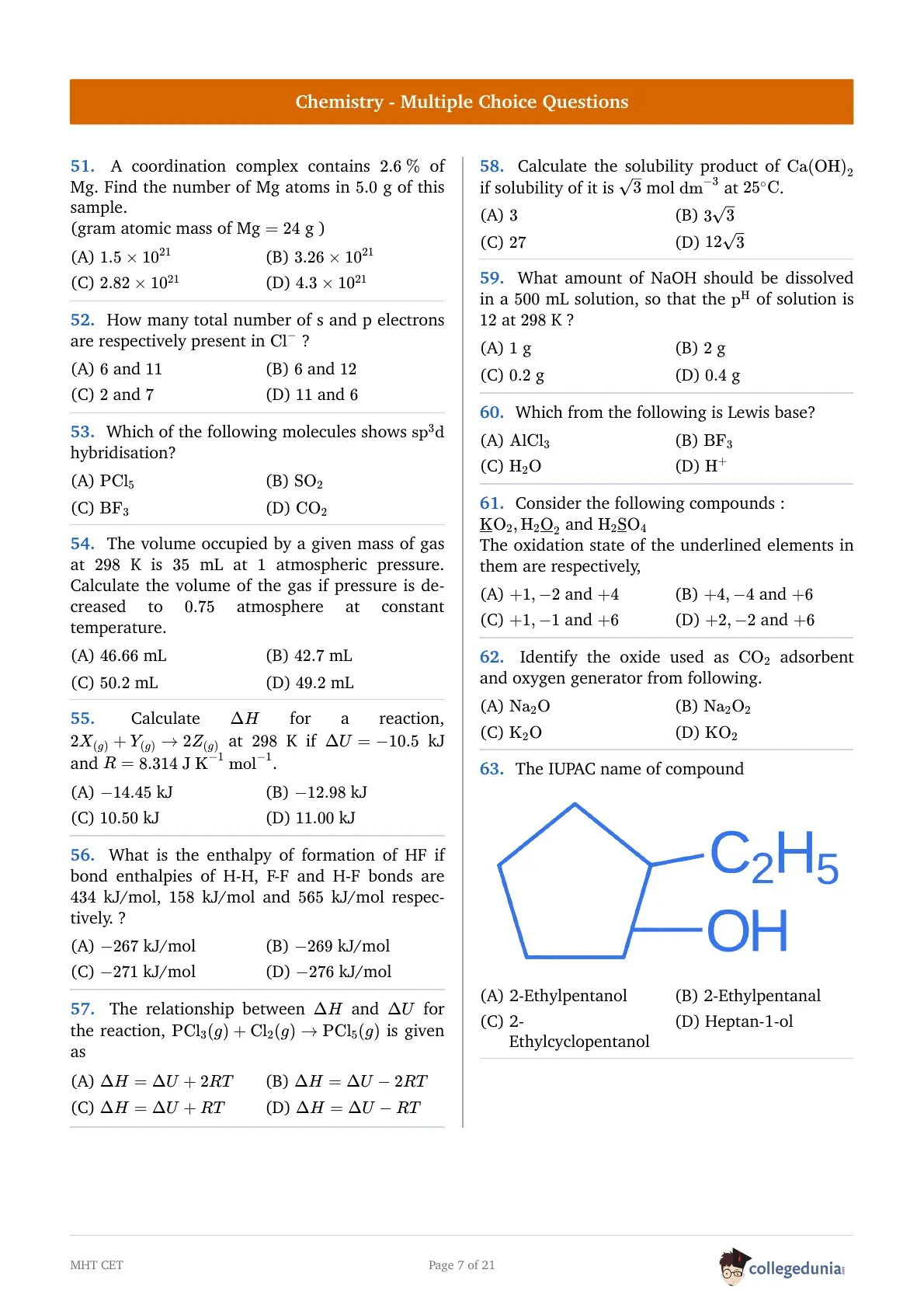
Chemistry (Q51 - Q100)
A coordination complex contains \(2.6\ \%\) of Mg. Find the number of Mg atoms in \(5.0\) g of this sample.
(gram atomic mass of Mg \(=24\) g )
How many total number of s and p electrons are respectively present in \(\text{Cl}^{-}\) ?
Which of the following molecules shows \(\text{sp}^{3}\text{d}\) hybridisation?
The volume occupied by a given mass of gas at \(298\) K is \(35\) mL at \(1\) atmospheric pressure. Calculate the volume of the gas if pressure is decreased to \(0.75\) atmosphere at constant temperature.
Calculate \(\Delta H\) for a reaction, \(2X_{(g)}+Y_{(g)}\rightarrow 2Z_{(g)}\) at \(298\) K if \(\Delta U=-10.5\) kJ and \(R=8.314\ \text{J K}^{-1}\ \text{mol}^{-1}\).
What is the enthalpy of formation of HF if bond enthalpies of H-H, F-F and H-F bonds are \(434\) kJ/mol, \(158\) kJ/mol and \(565\) kJ/mol respectively. ?
The relationship between \(\Delta H\) and \(\Delta U\) for the reaction, \(\text{PCl}_{3}(g)+\text{Cl}_{2}(g)\rightarrow \text{PCl}_{5}(g)\) is given as
Calculate the solubility product of \(\text{Ca(OH)}_{2}\) if solubility of it is \(\sqrt{3}\) mol \(\text{dm}^{-3}\) at \(25^{\circ }\text{C}\).
What amount of NaOH should be dissolved in a \(500\) mL solution, so that the \(\text{p}^{\text{H}}\) of solution is \(12\) at \(298\) K ?
Which from the following is Lewis base?
Consider the following compounds :
\(\underline{\text{K}}\text{O}_{2},\text{H}_{2}\underline{\text{O}}_{2}\) and \(\text{H}_{2}\underline{\text{S}}\text{O}_{4}\)
The oxidation state of the underlined elements in them are respectively,
Identify the oxide used as \(\text{CO}_{2}\) adsorbent and oxygen generator from following.


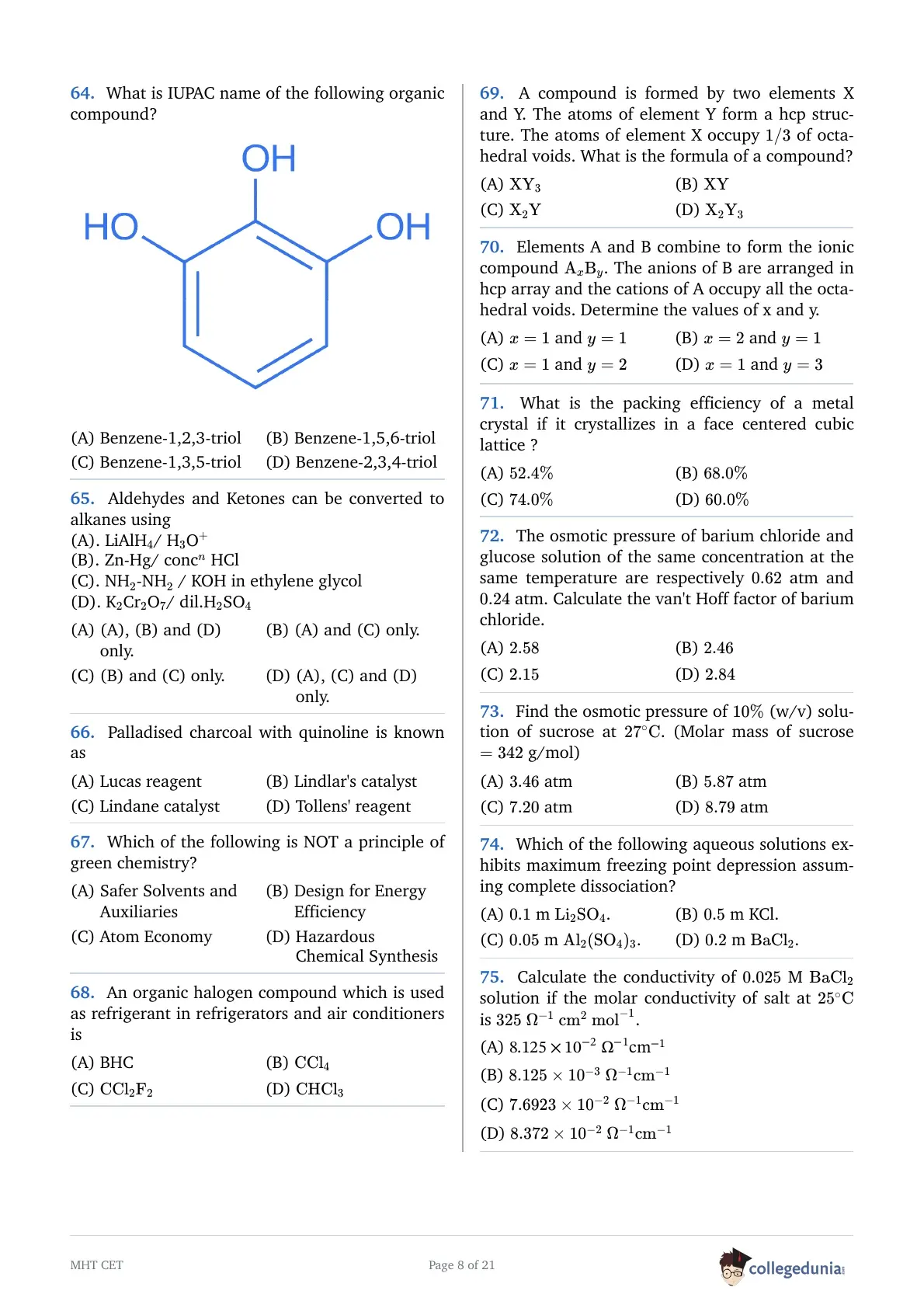
Aldehydes and Ketones can be converted to alkanes using
(A). LiAlH\({}_{4}\)/ H\({}_{3}\)O\({}^{+}\)
(B). Zn-Hg/ conc\({}^{n}\) HCl
(C). NH\({}_{2}\)-NH\({}_{2}\) / KOH in ethylene glycol
(D). K\({}_{2}\)Cr\({}_{2}\)O\({}_{7}\)/ dil.H\({}_{2}\)SO\({}_{4}\)
Palladised charcoal with quinoline is known as
Which of the following is NOT a principle of green chemistry?
An organic halogen compound which is used as refrigerant in refrigerators and air conditioners is
A compound is formed by two elements X and Y. The atoms of element Y form a hcp structure. The atoms of element X occupy \(1/3\) of octahedral voids. What is the formula of a compound?
Elements A and B combine to form the ionic compound \(\text{A}_{x}\text{B}_{y}\). The anions of B are arranged in hcp array and the cations of A occupy all the octahedral voids. Determine the values of x and y.
What is the packing efficiency of a metal crystal if it crystallizes in a face centered cubic lattice ?
The osmotic pressure of barium chloride and glucose solution of the same concentration at the same temperature are respectively \(0.62\) atm and \(0.24\) atm. Calculate the van't Hoff factor of barium chloride.
Find the osmotic pressure of \(10\%\) (w/v) solution of sucrose at \(27^{\circ }\text{C}\). (Molar mass of sucrose \(=342\) g/mol)
Which of the following aqueous solutions exhibits maximum freezing point depression assuming complete dissociation?
Calculate the conductivity of \(0.025\) M \(\text{BaCl}_{2}\) solution if the molar conductivity of salt at \(25^{\circ }\text{C}\) is \(325\ \Omega ^{-1}\ \text{cm}^{2}\ \text{mol}^{-1}\).
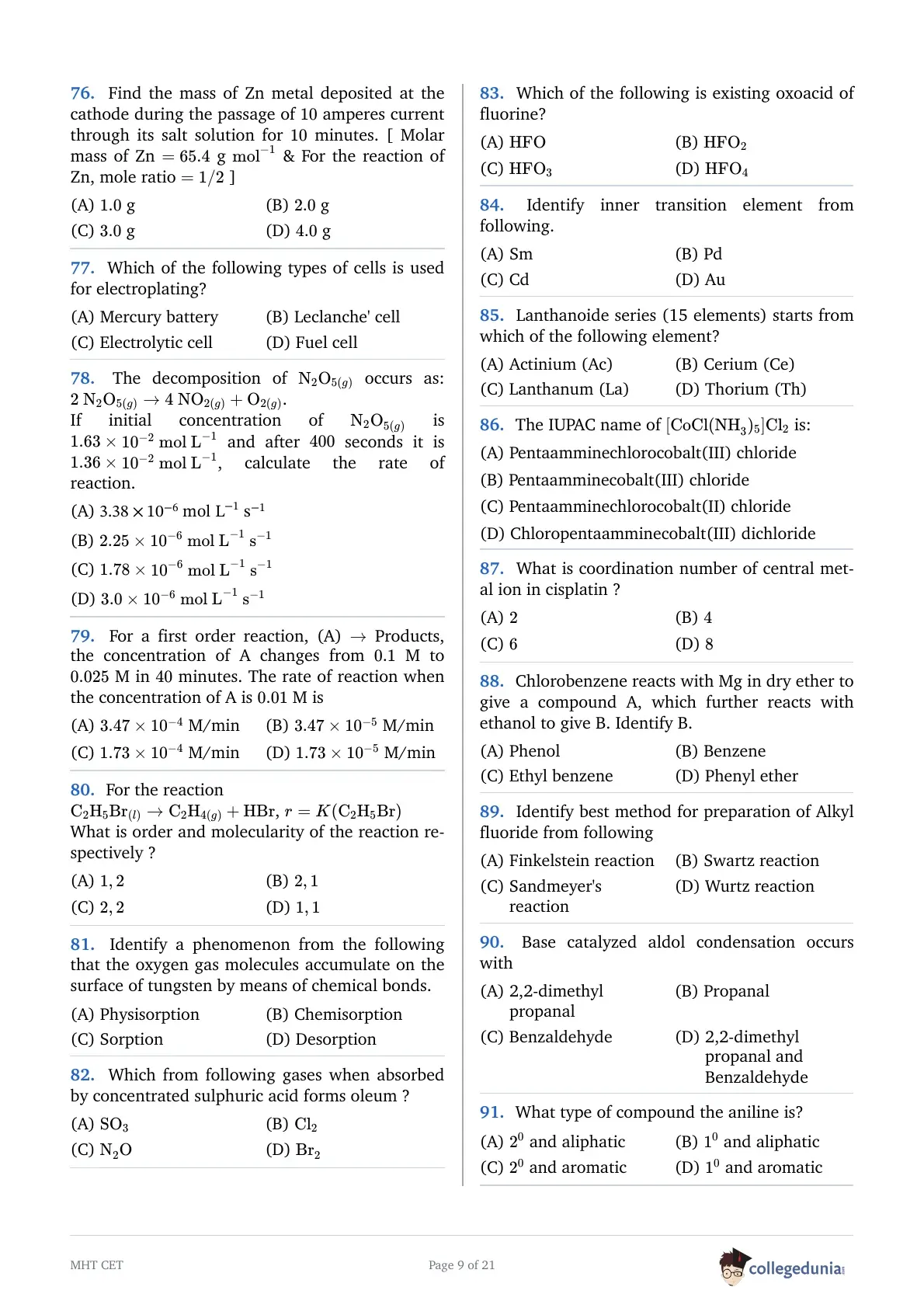
Find the mass of Zn metal deposited at the cathode during the passage of \(10\) amperes current through its salt solution for \(10\) minutes. [ Molar mass of Zn \(=65.4\) g \(\text{mol}^{-1}\) & For the reaction of Zn, mole ratio \(=1/2\) ]
Which of the following types of cells is used for electroplating?
The decomposition of \(\text{N}_{2}\text{O}_{5(g)}\) occurs as: \(2\ \text{N}_{2}\text{O}_{5(g)}\rightarrow 4\ \text{NO}_{2(g)}+\text{O}_{2(g)}\).
If initial concentration of \(\text{N}_{2}\text{O}_{5(g)}\) is \(1.63\times 10^{-2}\ \text{mol L}^{-1}\) and after \(400\) seconds it is \(1.36\times 10^{-2}\ \text{mol L}^{-1}\), calculate the rate of reaction.
For a first order reaction, (A) \(\rightarrow\) Products, the concentration of A changes from \(0.1\) M to \(0.025\) M in \(40\) minutes. The rate of reaction when the concentration of A is \(0.01\) M is
For the reaction
\(\text{C}_{2}\text{H}_{5}\text{Br}_{(l)}\rightarrow \text{C}_{2}\text{H}_{4(g)}+\text{HBr}\), \(r=K(\text{C}_{2}\text{H}_{5}\text{Br})\)
What is order and molecularity of the reaction respectively ?
Identify a phenomenon from the following that the oxygen gas molecules accumulate on the surface of tungsten by means of chemical bonds.
Which from following gases when absorbed by concentrated sulphuric acid forms oleum ?
Which of the following is existing oxoacid of fluorine?
Identify inner transition element from following.
Lanthanoide series (15 elements) starts from which of the following element?
The IUPAC name of \([\text{CoCl(NH}_{3})_{5}]\text{Cl}_{2}\) is:
What is coordination number of central metal ion in cisplatin ?
Chlorobenzene reacts with Mg in dry ether to give a compound A, which further reacts with ethanol to give B. Identify B.
Identify best method for preparation of Alkyl fluoride from following
Base catalyzed aldol condensation occurs with
What type of compound the aniline is?
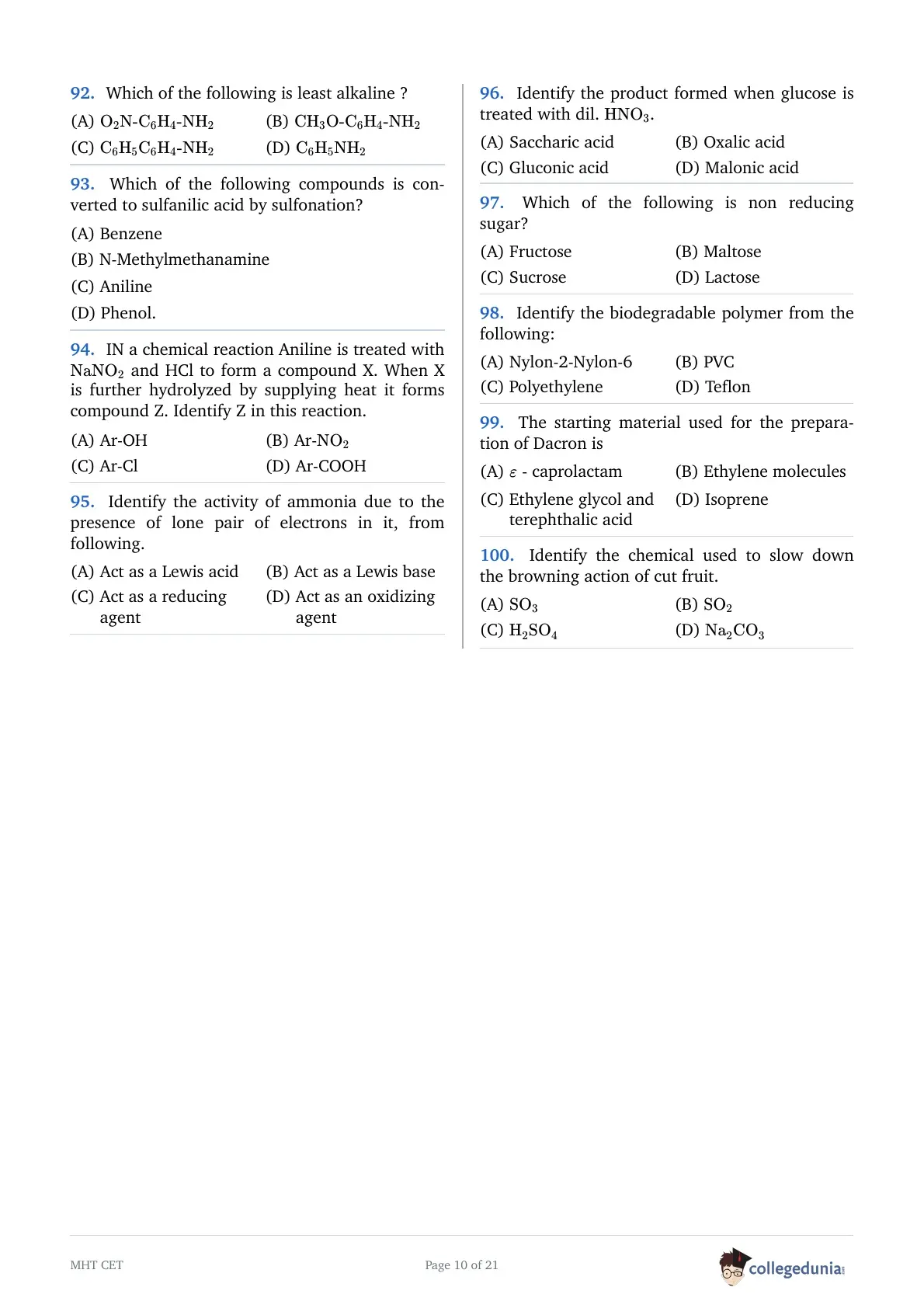
Which of the following is least alkaline ?
Which of the following compounds is converted to sulfanilic acid by sulfonation?
IN a chemical reaction Aniline is treated with \(\text{NaNO}_{2}\) and HCl to form a compound X. When X is further hydrolyzed by supplying heat it forms compound Z. Identify Z in this reaction.
Identify the activity of ammonia due to the presence of lone pair of electrons in it, from following.
Identify the product formed when glucose is treated with dil. \(\text{HNO}_{3}\).
Which of the following is non reducing sugar?
Identify the biodegradable polymer from the following:
The starting material used for the preparation of Dacron is
Identify the chemical used to slow down the browning action of cut fruit.
Biology (Q101 - Q200)
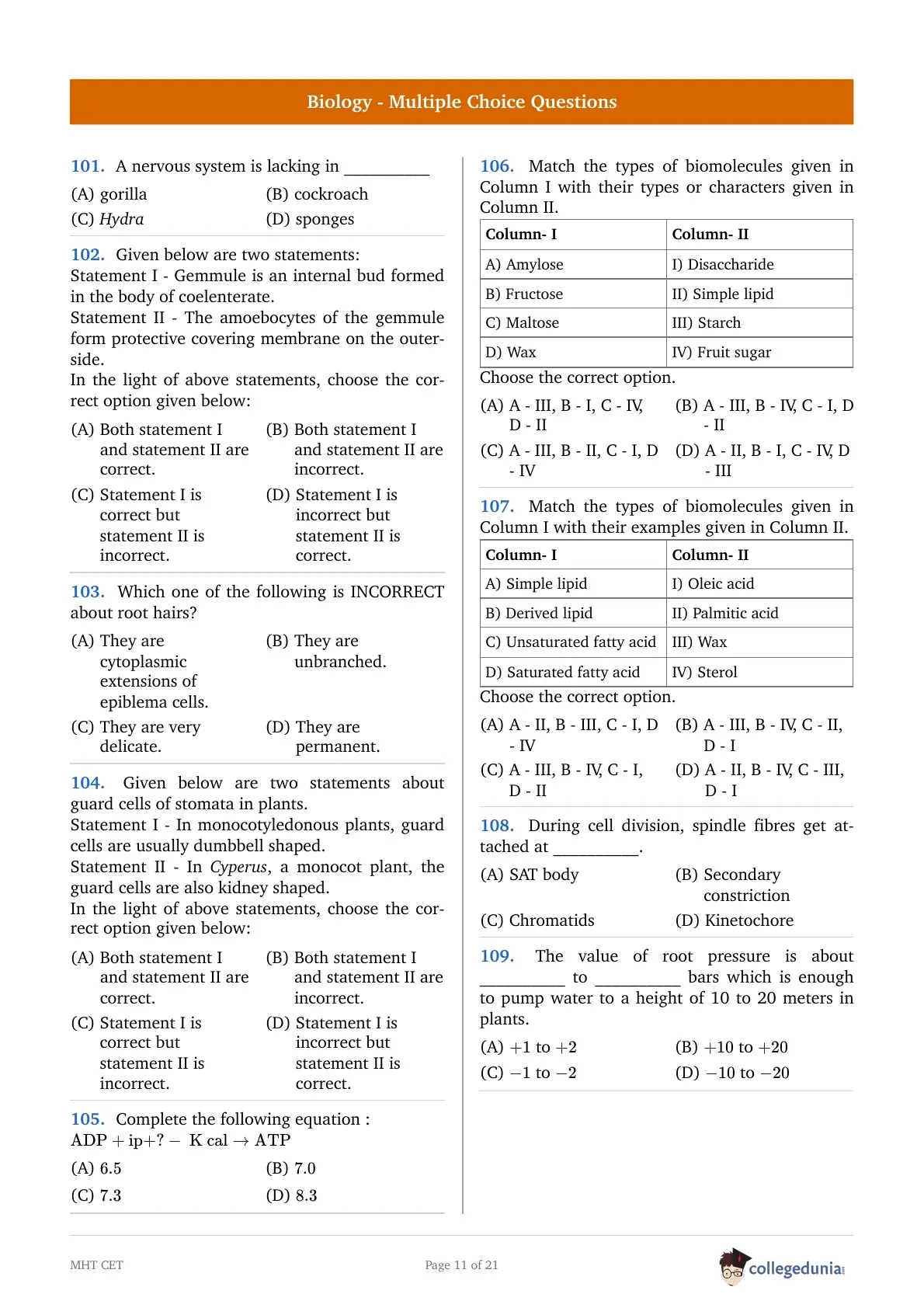
A nervous system is lacking in __________
Given below are two statements:
Statement I - Gemmule is an internal bud formed in the body of coelenterate.
Statement II - The amoebocytes of the gemmule form protective covering membrane on the outerside.
In the light of above statements, choose the correct option given below:
Which one of the following is INCORRECT about root hairs?
Given below are two statements about guard cells of stomata in plants.
Statement I - In monocotyledonous plants, guard cells are usually dumbbell shaped.
Statement II - In Cyperus, a monocot plant, the guard cells are also kidney shaped.
In the light of above statements, choose the correct option given below:
Complete the following equation :
\(\text{ADP}+\text{ip}+?-\ \text{K cal}\rightarrow \text{ATP}\)
Match the types of biomolecules given in Column I with their types or characters given in Column II.
| Column- I | Column- II |
|---|---|
| A) Amylose | I) Disaccharide |
| B) Fructose | II) Simple lipid |
| C) Maltose | III) Starch |
| D) Wax | IV) Fruit sugar |
Match the types of biomolecules given in Column I with their examples given in Column II.
| Column- I | Column- II |
|---|---|
| A) Simple lipid | I) Oleic acid |
| B) Derived lipid | II) Palmitic acid |
| C) Unsaturated fatty acid | III) Wax |
| D) Saturated fatty acid | IV) Sterol |
During cell division, spindle fibres get attached at __________.
The value of root pressure is about __________ to __________ bars which is enough to pump water to a height of 10 to 20 meters in plants.
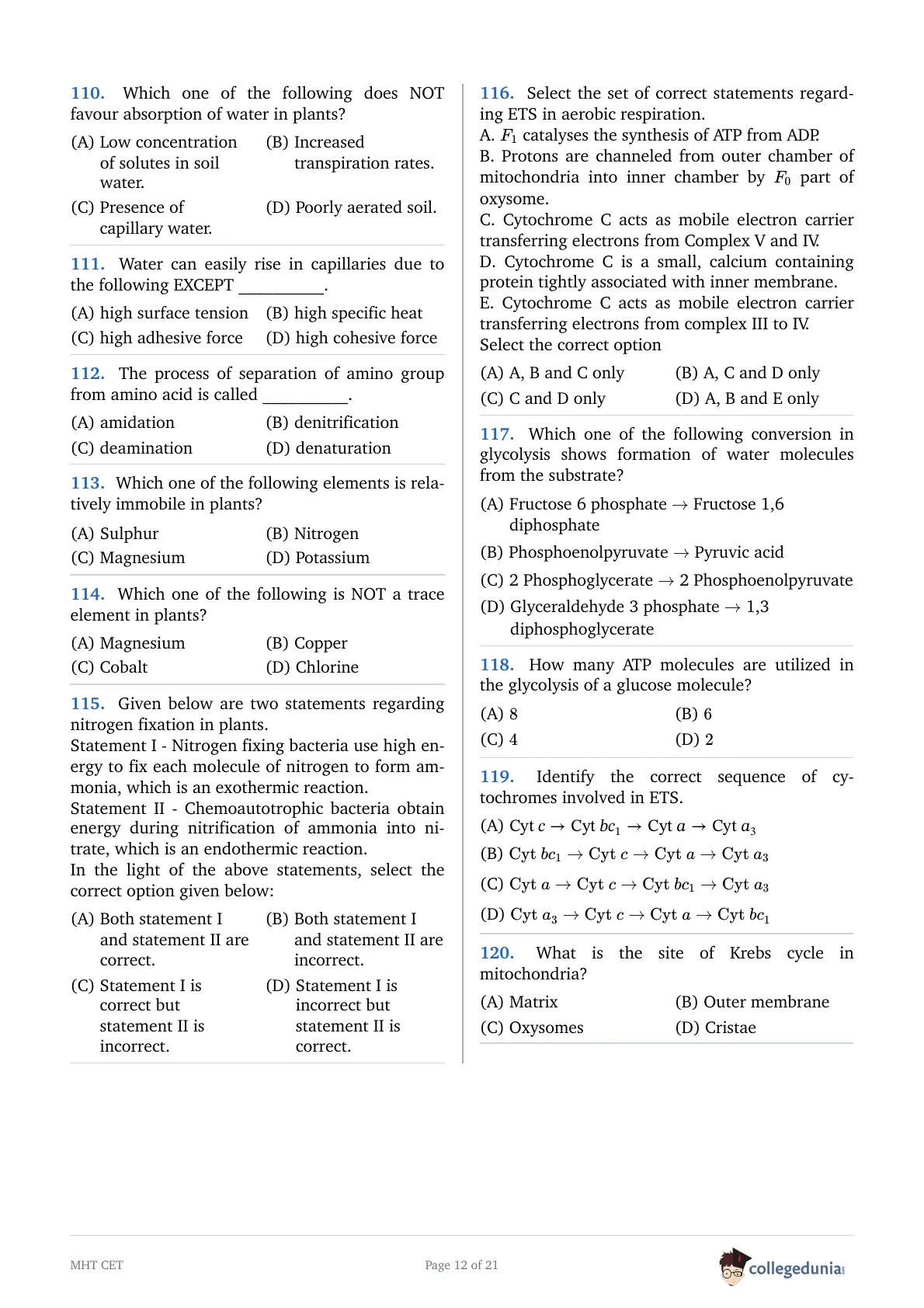
Which one of the following does NOT favour absorption of water in plants?
Water can easily rise in capillaries due to the following EXCEPT __________.
The process of separation of amino group from amino acid is called __________.
Which one of the following elements is relatively immobile in plants?
Which one of the following is NOT a trace element in plants?
Given below are two statements regarding nitrogen fixation in plants.
Statement I - Nitrogen fixing bacteria use high energy to fix each molecule of nitrogen to form ammonia, which is an exothermic reaction.
Statement II - Chemoautotrophic bacteria obtain energy during nitrification of ammonia into nitrate, which is an endothermic reaction.
In the light of the above statements, select the correct option given below:
Select the set of correct statements regarding ETS in aerobic respiration.
A. \(F_{1}\) catalyses the synthesis of ATP from ADP.
B. Protons are channeled from outer chamber of mitochondria into inner chamber by \(F_{0}\) part of oxysome.
C. Cytochrome C acts as mobile electron carrier transferring electrons from Complex V and IV.
D. Cytochrome C is a small, calcium containing protein tightly associated with inner membrane.
E. Cytochrome C acts as mobile electron carrier transferring electrons from complex III to IV.
Select the correct option
Which one of the following conversion in glycolysis shows formation of water molecules from the substrate?
How many ATP molecules are utilized in the glycolysis of a glucose molecule?
Identify the correct sequence of cytochromes involved in ETS.
What is the site of Krebs cycle in mitochondria?
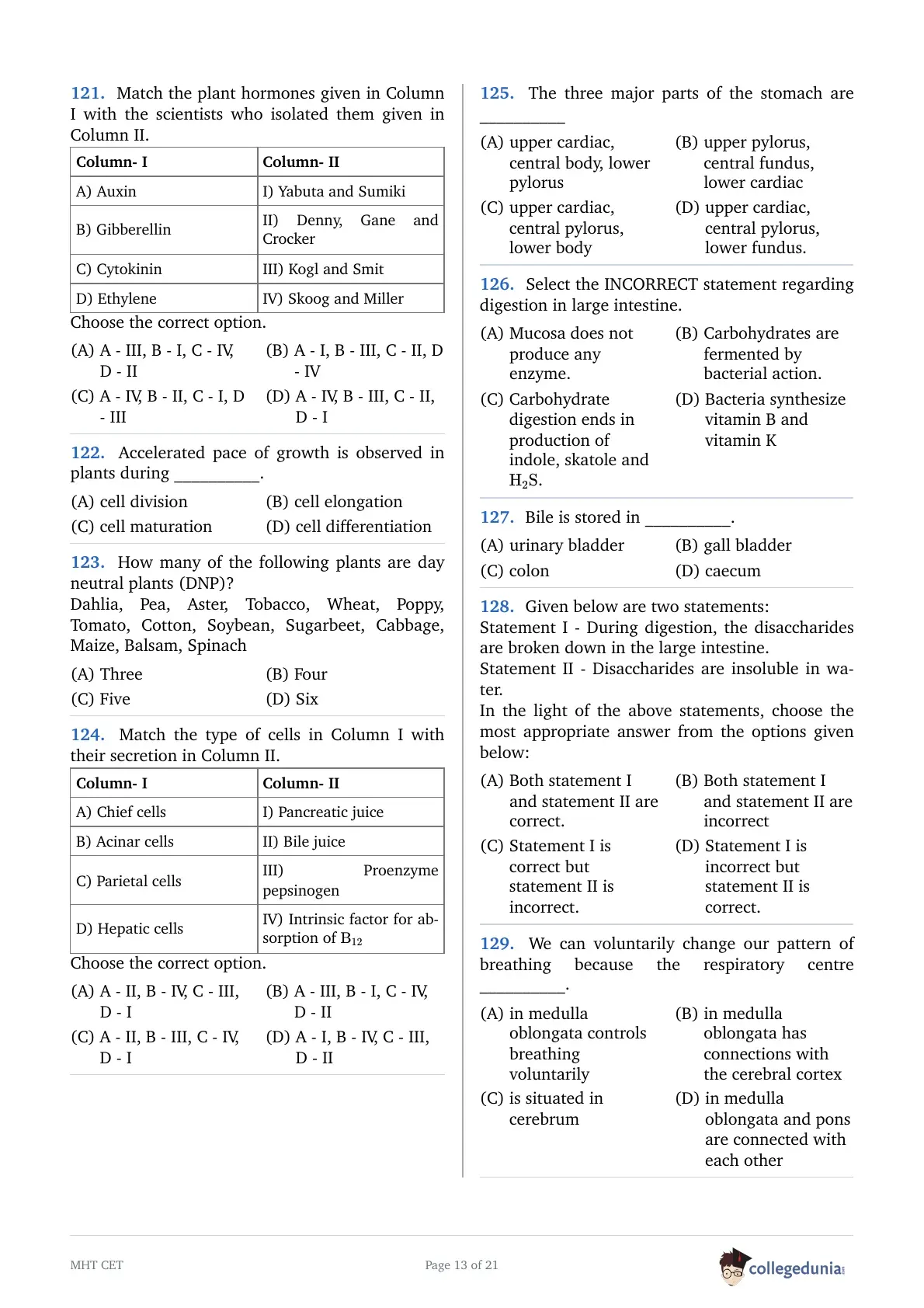
Match the plant hormones given in Column I with the scientists who isolated them given in Column II.
| Column- I | Column- II |
|---|---|
| A) Auxin | I) Yabuta and Sumiki |
| B) Gibberellin | II) Denny, Gane and Crocker |
| C) Cytokinin | III) Kogl and Smit |
| D) Ethylene | IV) Skoog and Miller |
Accelerated pace of growth is observed in plants during __________.
How many of the following plants are day neutral plants (DNP)?
Dahlia, Pea, Aster, Tobacco, Wheat, Poppy, Tomato, Cotton, Soybean, Sugarbeet, Cabbage, Maize, Balsam, Spinach
Match the type of cells in Column I with their secretion in Column II.
| Column- I | Column- II |
|---|---|
| A) Chief cells | I) Pancreatic juice |
| B) Acinar cells | II) Bile juice |
| C) Parietal cells | III) Proenzyme pepsinogen |
| D) Hepatic cells | IV) Intrinsic factor for absorption of \(\text{B}_{12}\) |
The three major parts of the stomach are __________
Select the INCORRECT statement regarding digestion in large intestine.
Bile is stored in __________.
Given below are two statements:
Statement I - During digestion, the disaccharides are broken down in the large intestine.
Statement II - Disaccharides are insoluble in water.
In the light of the above statements, choose the most appropriate answer from the options given below:
We can voluntarily change our pattern of breathing because the respiratory centre __________.
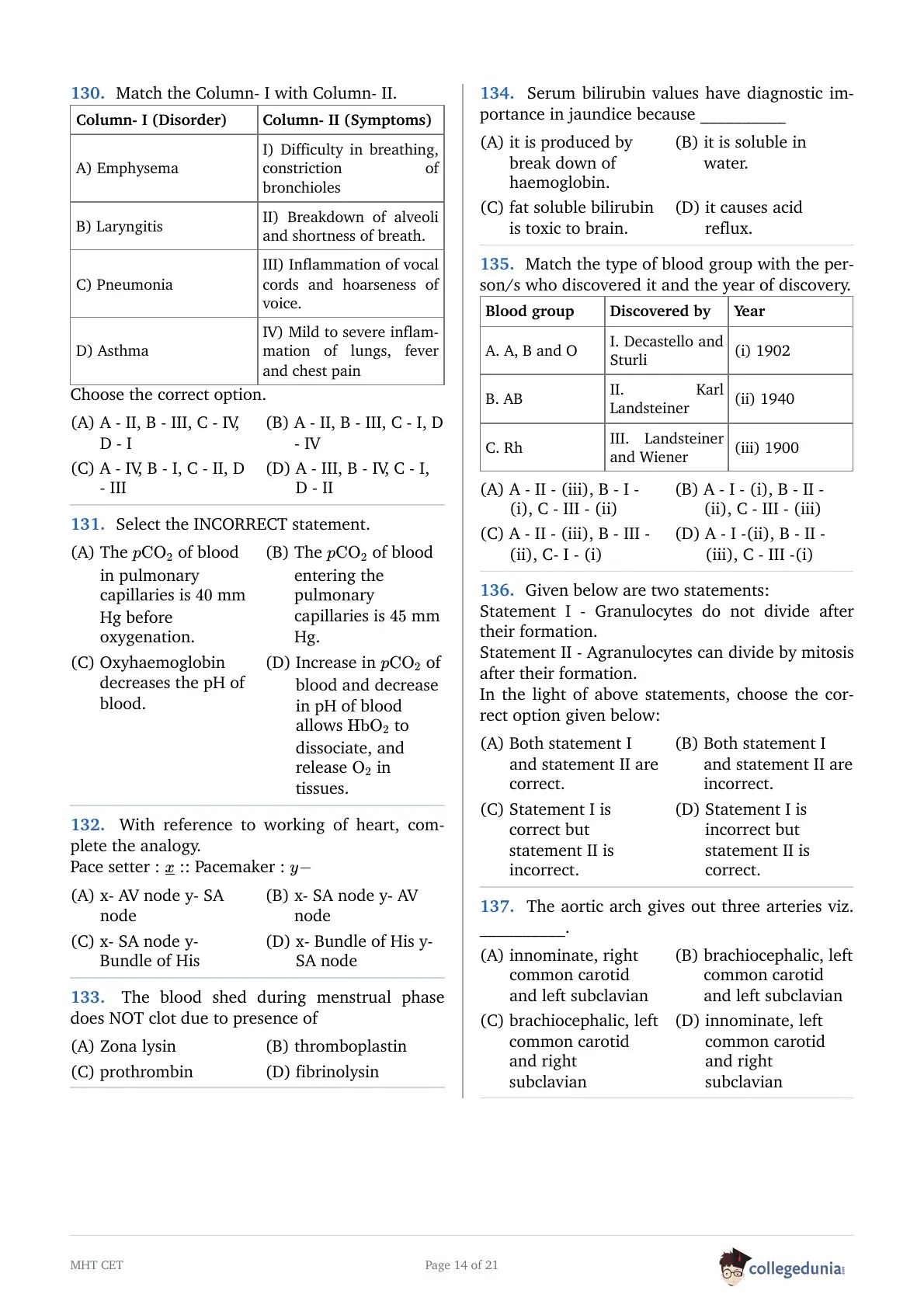
Match the Column- I with Column- II.
| Column- I (Disorder) | Column- II (Symptoms) |
|---|---|
| A) Emphysema | I) Difficulty in breathing, constriction of bronchioles |
| B) Laryngitis | II) Breakdown of alveoli and shortness of breath. |
| C) Pneumonia | III) Inflammation of vocal cords and hoarseness of voice. |
| D) Asthma | IV) Mild to severe inflammation of lungs, fever and chest pain |
Select the INCORRECT statement.
With reference to working of heart, complete the analogy.
Pace setter : \(\underline{x}\) :: Pacemaker : \(y-\)
The blood shed during menstrual phase does NOT clot due to presence of
Serum bilirubin values have diagnostic importance in jaundice because __________
Match the type of blood group with the person/s who discovered it and the year of discovery.
| Blood group | Discovered by | Year |
|---|---|---|
| A. A, B and O | I. Decastello and Sturli | (i) 1902 |
| B. AB | II. Karl Landsteiner | (ii) 1940 |
| C. Rh | III. Landsteiner and Wiener | (iii) 1900 |
Given below are two statements:
Statement I - Granulocytes do not divide after their formation.
Statement II - Agranulocytes can divide by mitosis after their formation.
In the light of above statements, choose the correct option given below:
The aortic arch gives out three arteries viz. __________.
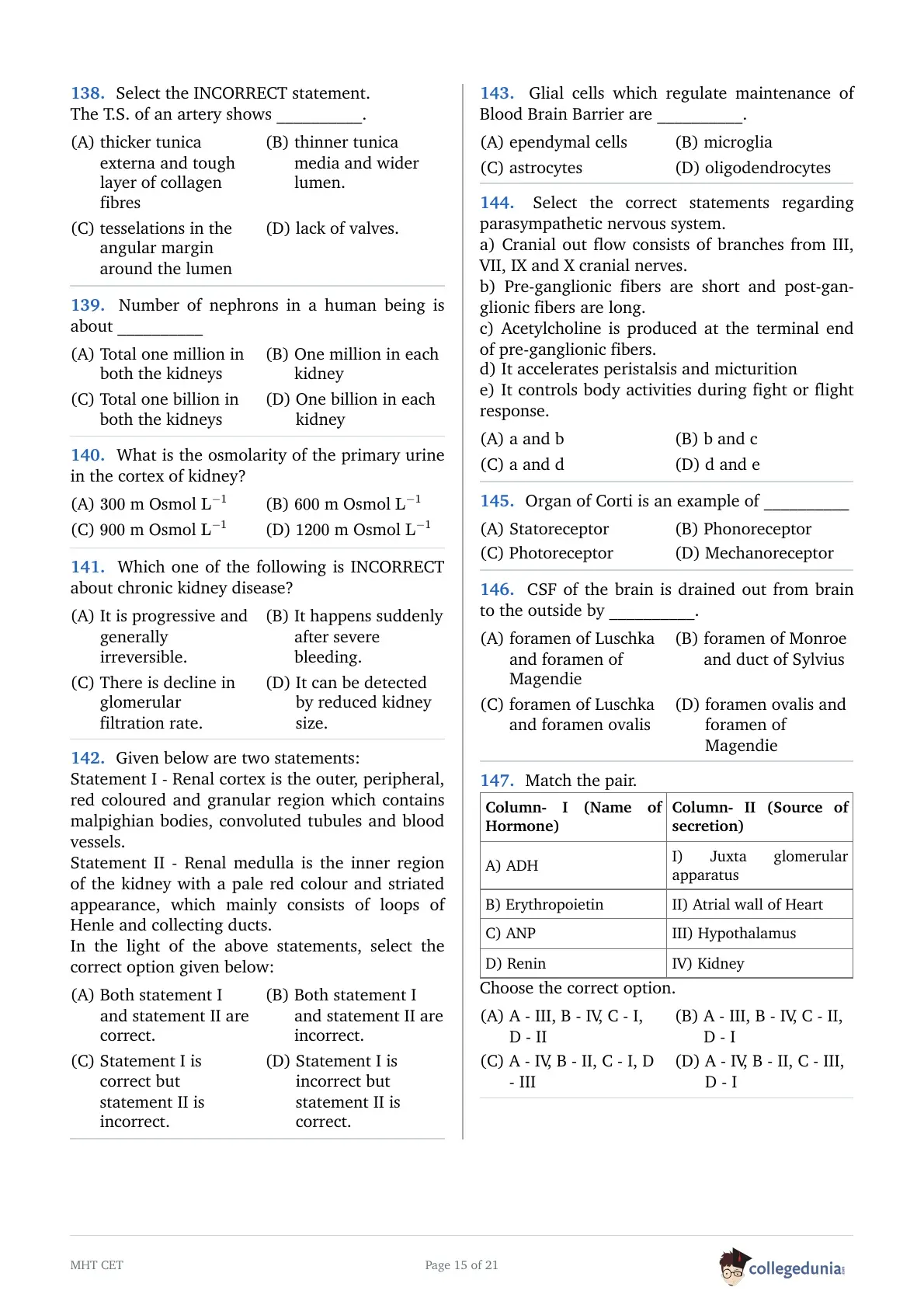
Select the INCORRECT statement.
The T.S. of an artery shows __________.
Number of nephrons in a human being is about __________
What is the osmolarity of the primary urine in the cortex of kidney?
Which one of the following is INCORRECT about chronic kidney disease?
Given below are two statements:
Statement I - Renal cortex is the outer, peripheral, red coloured and granular region which contains malpighian bodies, convoluted tubules and blood vessels.
Statement II - Renal medulla is the inner region of the kidney with a pale red colour and striated appearance, which mainly consists of loops of Henle and collecting ducts.
In the light of the above statements, select the correct option given below:
Glial cells which regulate maintenance of Blood Brain Barrier are __________.
Select the correct statements regarding parasympathetic nervous system.
a) Cranial out flow consists of branches from III, VII, IX and X cranial nerves.
b) Pre-ganglionic fibers are short and post-ganglionic fibers are long.
c) Acetylcholine is produced at the terminal end of pre-ganglionic fibers.
d) It accelerates peristalsis and micturition
e) It controls body activities during fight or flight response.
Organ of Corti is an example of __________
CSF of the brain is drained out from brain to the outside by __________.
Match the pair.
| Column- I (Name of Hormone) | Column- II (Source of secretion) |
|---|---|
| A) ADH | I) Juxta glomerular apparatus |
| B) Erythropoietin | II) Atrial wall of Heart |
| C) ANP | III) Hypothalamus |
| D) Renin | IV) Kidney |

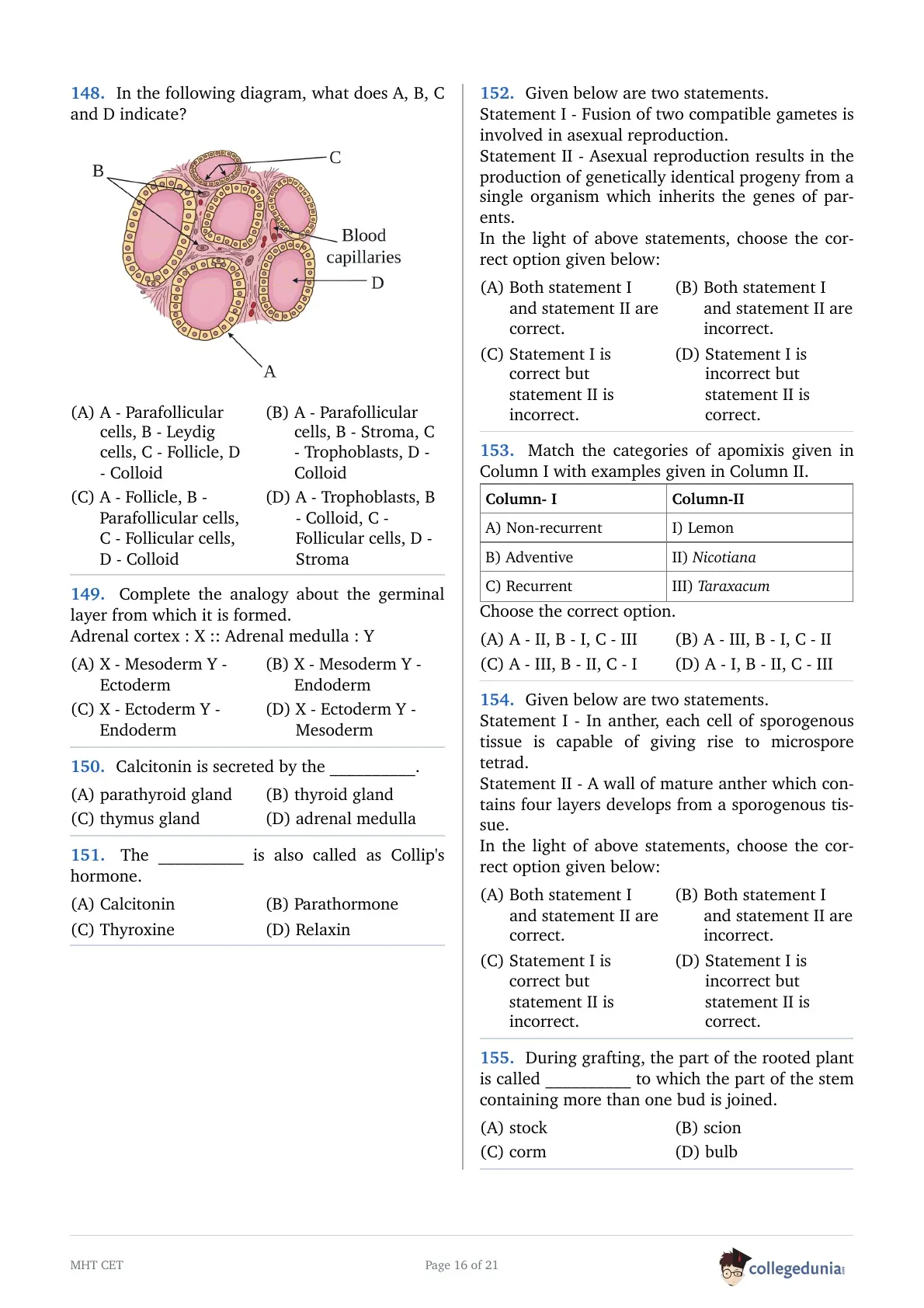
Complete the analogy about the germinal layer from which it is formed.
Adrenal cortex : X :: Adrenal medulla : Y
Calcitonin is secreted by the __________.
The __________ is also called as Collip's hormone.
Given below are two statements.
Statement I - Fusion of two compatible gametes is involved in asexual reproduction.
Statement II - Asexual reproduction results in the production of genetically identical progeny from a single organism which inherits the genes of parents.
In the light of above statements, choose the correct option given below:
Match the categories of apomixis given in Column I with examples given in Column II.
| Column- I | Column-II |
|---|---|
| A) Non-recurrent | I) Lemon |
| B) Adventive | II) Nicotiana |
| C) Recurrent | III) Taraxacum |
Given below are two statements.
Statement I - In anther, each cell of sporogenous tissue is capable of giving rise to microspore tetrad.
Statement II - A wall of mature anther which contains four layers develops from a sporogenous tissue.
In the light of above statements, choose the correct option given below:
During grafting, the part of the rooted plant is called __________ to which the part of the stem containing more than one bud is joined.
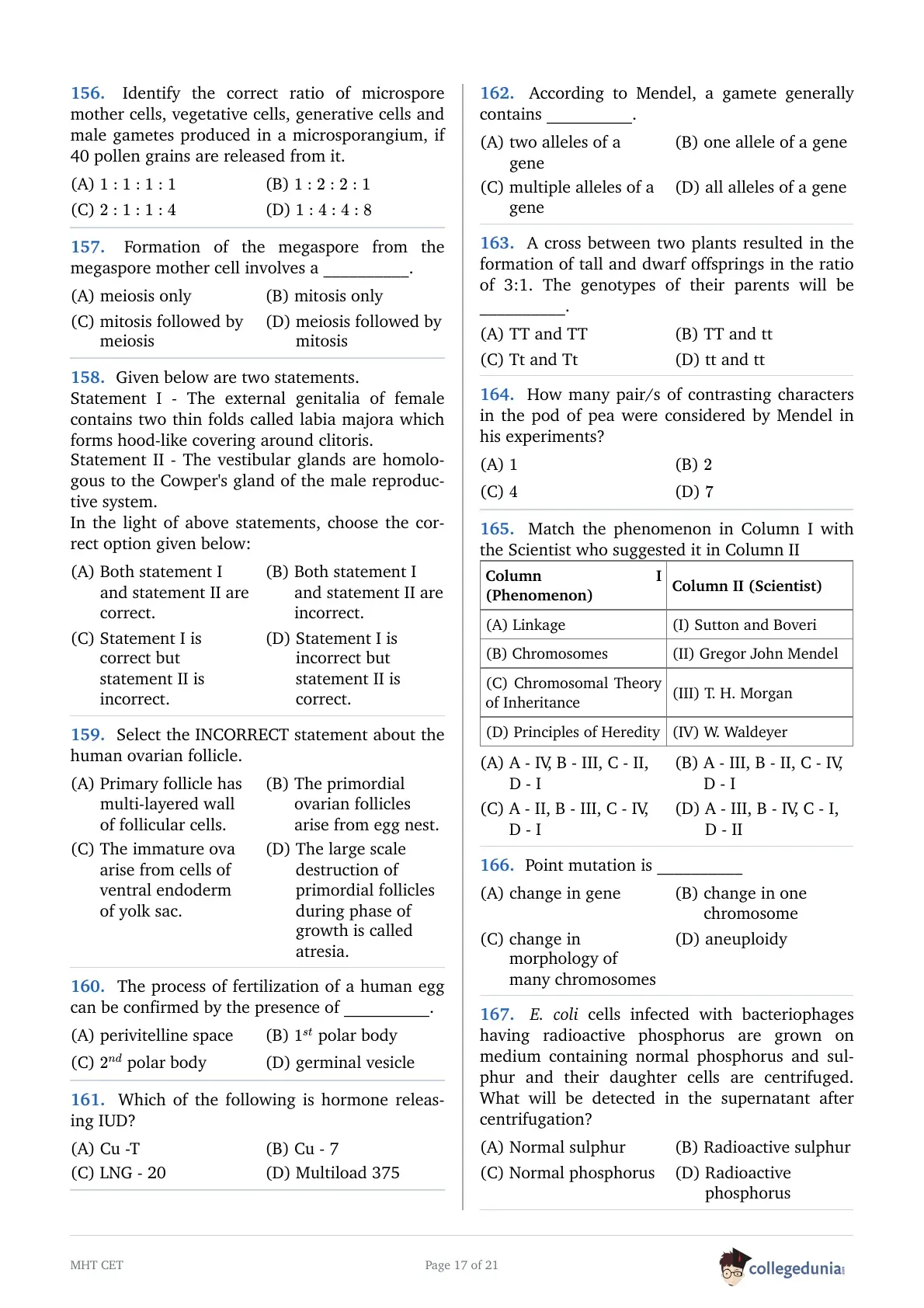
Identify the correct ratio of microspore mother cells, vegetative cells, generative cells and male gametes produced in a microsporangium, if 40 pollen grains are released from it.
Formation of the megaspore from the megaspore mother cell involves a __________.
Given below are two statements.
Statement I - The external genitalia of female contains two thin folds called labia majora which forms hood-like covering around clitoris.
Statement II - The vestibular glands are homologous to the Cowper's gland of the male reproductive system.
In the light of above statements, choose the correct option given below:
Select the INCORRECT statement about the human ovarian follicle.
The process of fertilization of a human egg can be confirmed by the presence of __________.
Which of the following is hormone releasing IUD?
According to Mendel, a gamete generally contains __________.
A cross between two plants resulted in the formation of tall and dwarf offsprings in the ratio of 3:1. The genotypes of their parents will be __________.
How many pair/s of contrasting characters in the pod of pea were considered by Mendel in his experiments?
Match the phenomenon in Column I with the Scientist who suggested it in Column II
| Column I (Phenomenon) | Column II (Scientist) |
|---|---|
| (A) Linkage | (I) Sutton and Boveri |
| (B) Chromosomes | (II) Gregor John Mendel |
| (C) Chromosomal Theory of Inheritance | (III) T. H. Morgan |
| (D) Principles of Heredity | (IV) W. Waldeyer |
Point mutation is __________
E. coli cells infected with bacteriophages having radioactive phosphorus are grown on medium containing normal phosphorus and sulphur and their daughter cells are centrifuged. What will be detected in the supernatant after centrifugation?
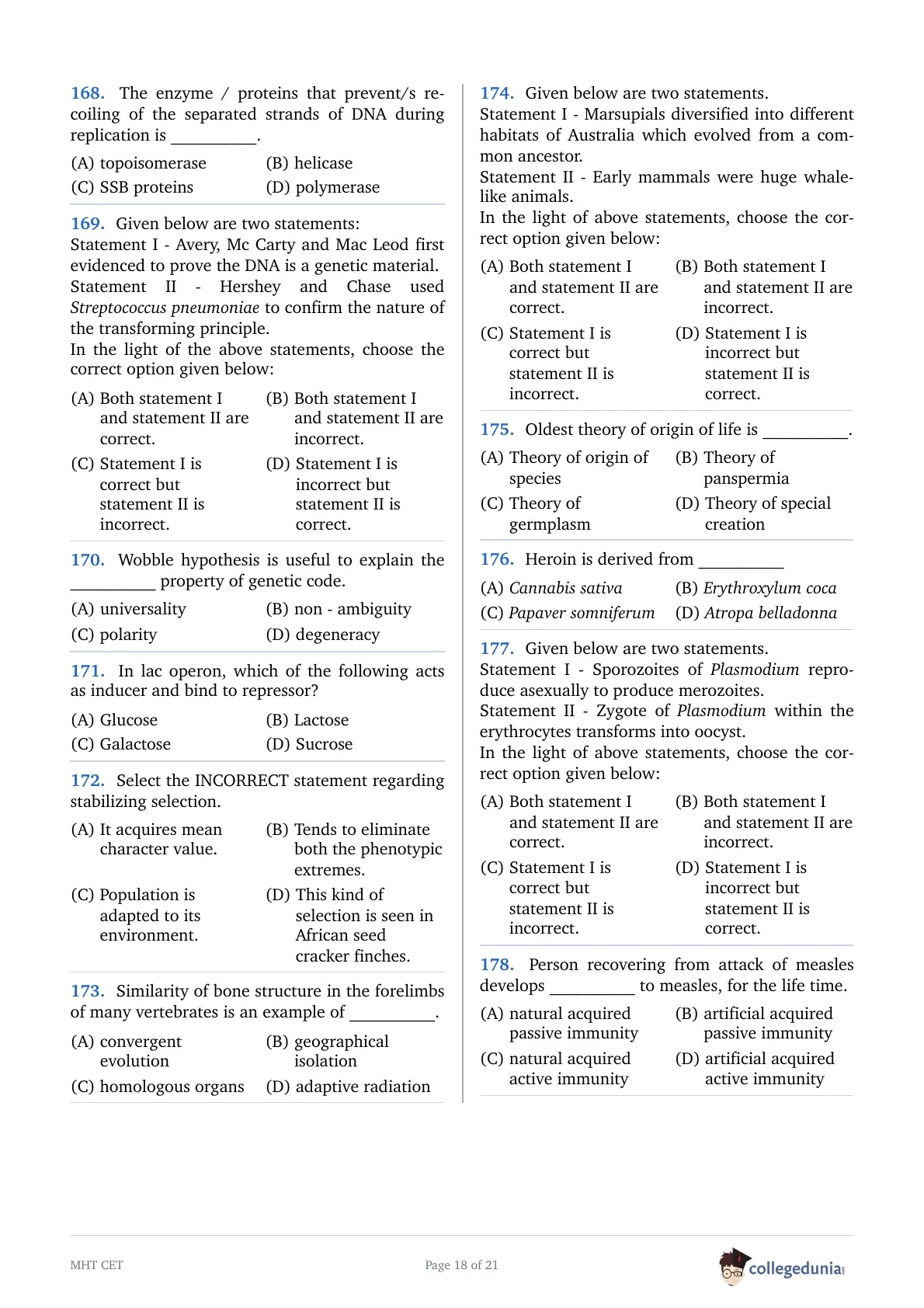
The enzyme / proteins that prevent/s recoiling of the separated strands of DNA during replication is __________.
Given below are two statements:
Statement I - Avery, Mc Carty and Mac Leod first evidenced to prove the DNA is a genetic material.
Statement II - Hershey and Chase used Streptococcus pneumoniae to confirm the nature of the transforming principle.
In the light of the above statements, choose the correct option given below:
Wobble hypothesis is useful to explain the __________ property of genetic code.
In lac operon, which of the following acts as inducer and bind to repressor?
Select the INCORRECT statement regarding stabilizing selection.
Similarity of bone structure in the forelimbs of many vertebrates is an example of __________.
Given below are two statements.
Statement I - Marsupials diversified into different habitats of Australia which evolved from a common ancestor.
Statement II - Early mammals were huge whale-like animals.
In the light of above statements, choose the correct option given below:
Oldest theory of origin of life is __________.
Heroin is derived from __________
Given below are two statements.
Statement I - Sporozoites of Plasmodium reproduce asexually to produce merozoites.
Statement II - Zygote of Plasmodium within the erythrocytes transforms into oocyst.
In the light of above statements, choose the correct option given below:
Person recovering from attack of measles develops __________ to measles, for the life time.
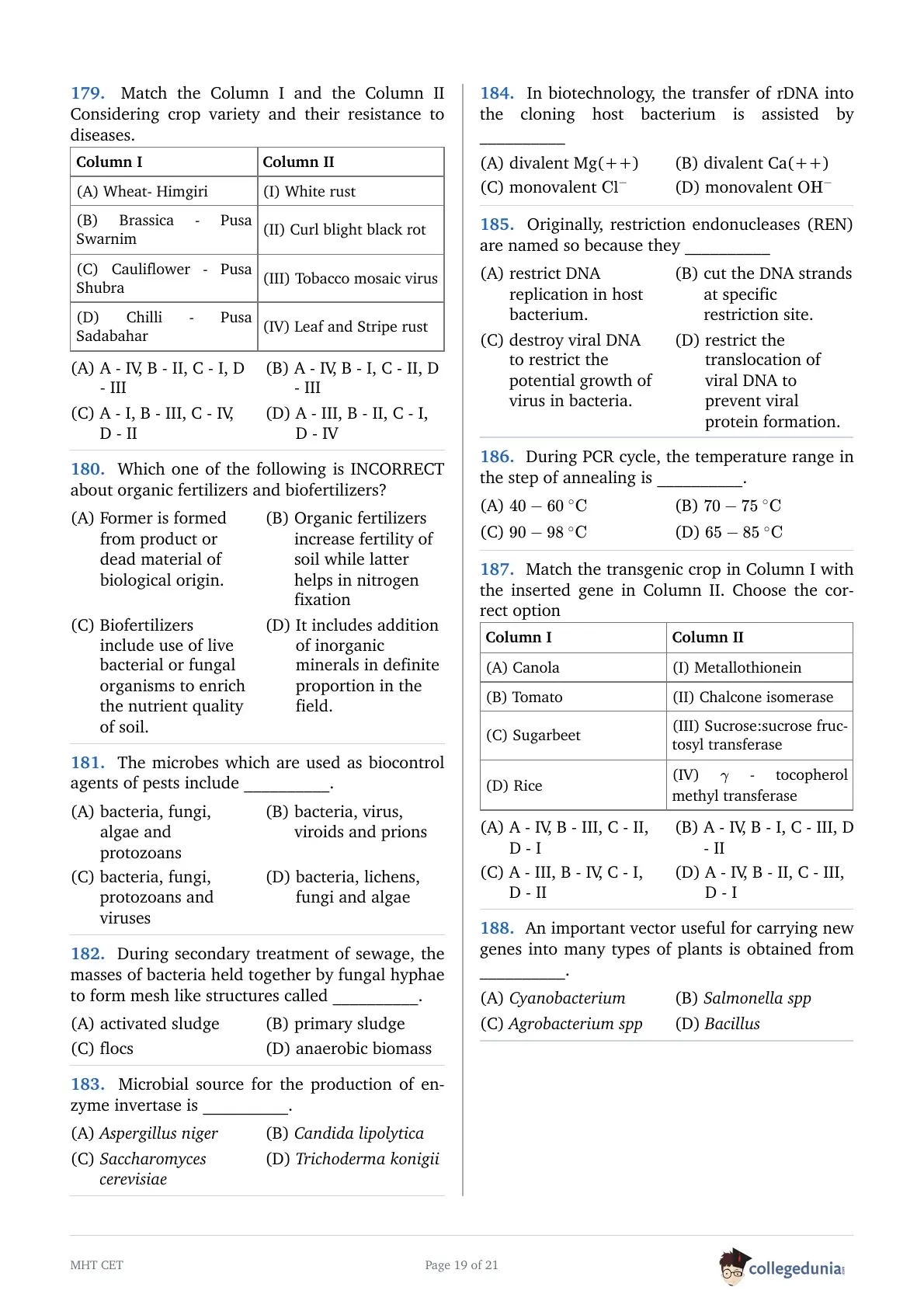
Match the Column I and the Column II Considering crop variety and their resistance to diseases.
| Column I | Column II |
|---|---|
| (A) Wheat- Himgiri | (I) White rust |
| (B) Brassica - Pusa Swarnim | (II) Curl blight black rot |
| (C) Cauliflower - Pusa Shubra | (III) Tobacco mosaic virus |
| (D) Chilli - Pusa Sadabahar | (IV) Leaf and Stripe rust |
Which one of the following is INCORRECT about organic fertilizers and biofertilizers?
The microbes which are used as biocontrol agents of pests include __________.
During secondary treatment of sewage, the masses of bacteria held together by fungal hyphae to form mesh like structures called __________.
Microbial source for the production of enzyme invertase is __________.
In biotechnology, the transfer of rDNA into the cloning host bacterium is assisted by __________
Originally, restriction endonucleases (REN) are named so because they __________
During PCR cycle, the temperature range in the step of annealing is __________.
Match the transgenic crop in Column I with the inserted gene in Column II. Choose the correct option
| Column I | Column II |
|---|---|
| (A) Canola | (I) Metallothionein |
| (B) Tomato | (II) Chalcone isomerase |
| (C) Sugarbeet | (III) Sucrose:sucrose fructosyl transferase |
| (D) Rice | (IV) \(\gamma\) - tocopherol methyl transferase |
An important vector useful for carrying new genes into many types of plants is obtained from __________.
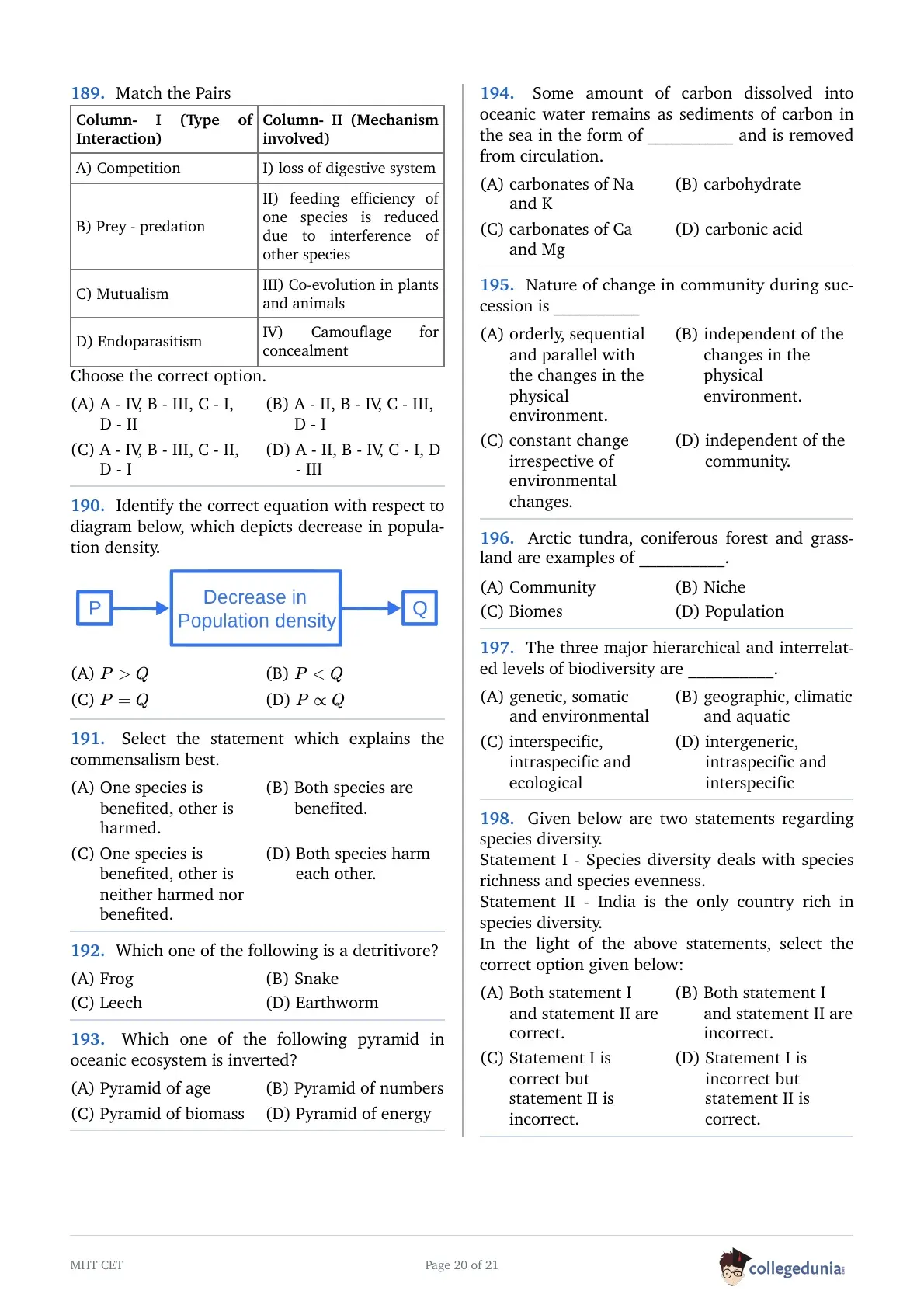
Match the Pairs
| Column- I (Type of Interaction) | Column- II (Mechanism involved) |
|---|---|
| A) Competition | I) loss of digestive system |
| B) Prey - predation | II) feeding efficiency of one species is reduced due to interference of other species |
| C) Mutualism | III) Co-evolution in plants and animals |
| D) Endoparasitism | IV) Camouflage for concealment |
Identify the correct equation with respect to diagram below, which depicts decrease in population density.

Select the statement which explains the commensalism best.
Which one of the following is a detritivore?
Which one of the following pyramid in oceanic ecosystem is inverted?
Some amount of carbon dissolved into oceanic water remains as sediments of carbon in the sea in the form of __________ and is removed from circulation.
Nature of change in community during succession is __________
Arctic tundra, coniferous forest and grassland are examples of __________.
The three major hierarchical and interrelated levels of biodiversity are __________.
Given below are two statements regarding species diversity.
Statement I - Species diversity deals with species richness and species evenness.
Statement II - India is the only country rich in species diversity.
In the light of the above statements, select the correct option given below:
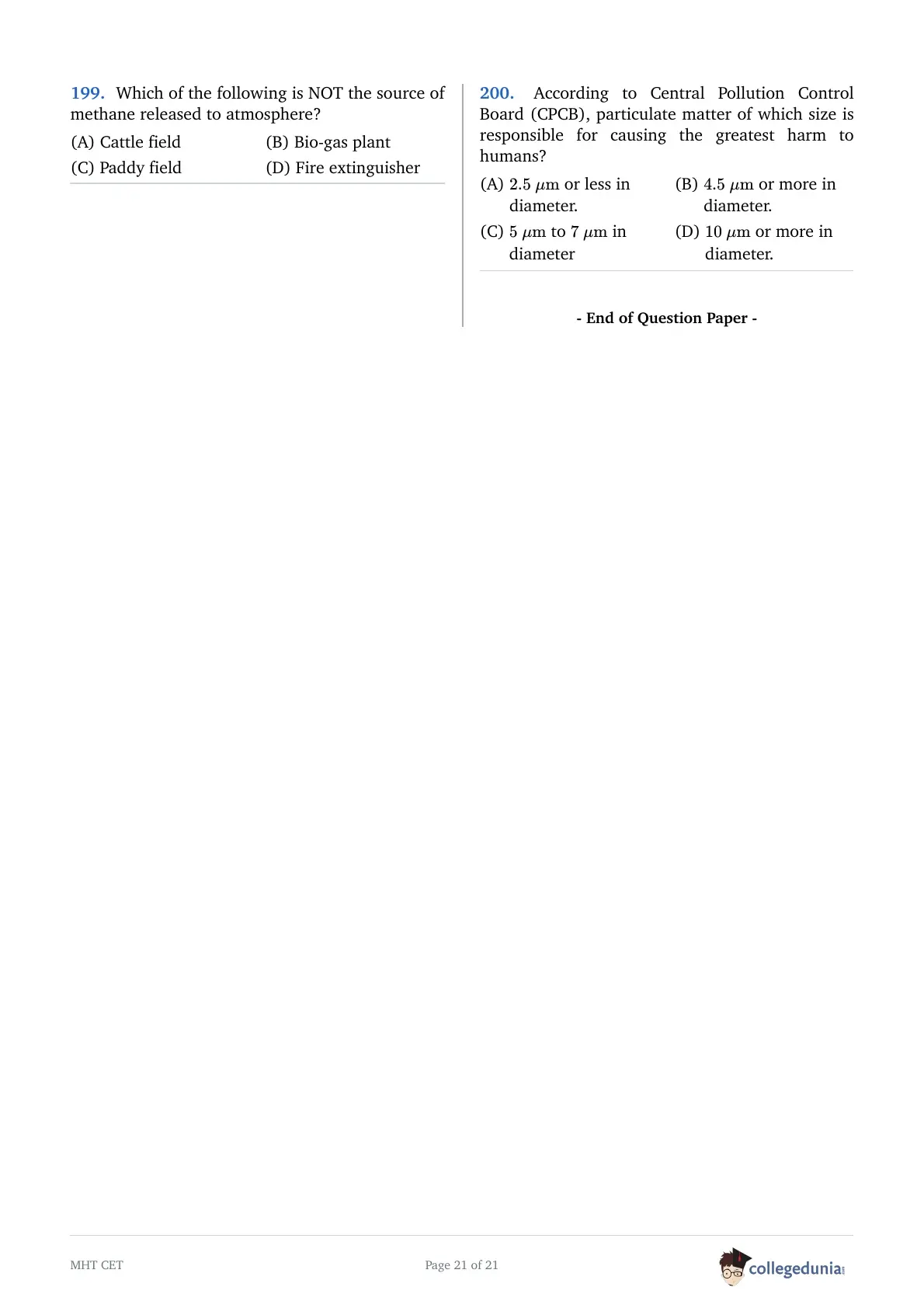
Which of the following is NOT the source of methane released to atmosphere?
According to Central Pollution Control Board (CPCB), particulate matter of which size is responsible for causing the greatest harm to humans?
MHT CET 2026 PCB Exam Pattern and Marking Scheme
| Parameter | Details |
|---|---|
| Conducting Body | Maharashtra Common Entrance Test Cell (Maharashtra CET Cell) |
| Exam Mode | Online (Computer-Based Test) |
| Duration | 180 minutes (3 hours) |
| Groups / Subjects | PCB (Physics, Chemistry, Biology) for Pharmacy and Agriculture |
| Total Questions |
200 |
| Total Marks | 200 |
| Question Type | Multiple Choice Questions (MCQs) |
| Marking Scheme | 1 mark for each correct answer |
| Negative Marking | No |
| Syllabus Weightage |
|



Comments