




MHT CET 2026 May 12 Shift 1 PCM Question Paper is available for download here. Maharashtra State CET Cell conducted MHT CET 2026 PCM Exam on May 12 in Shift 1 from 9 AM to 12 PM in CBT mode.
The MHT CET 2026 PCM question paper includes the following:
- The MHT CET 2026 PCM Question Paper consists of 150 multiple-choice questions (MCQs) totalling 200 marks divided into 3 sections: Physics, Chemistry, and Mathematics, with 50 questions in each subject.
- Physics and Chemistry questions carry 1 mark each while Mathematics questions carry 2 marks each.
- There is no negative marking for incorrect answers.
MHT CET 2026 May 12 Shift 1 PCM Question Paper with Solution PDF
| CD PDF | CD PDF with Solutions |
|---|---|
| Download Collegedunia PDF 1.01 MB | - |
Also Check:
MHT CET 2026 May 12 Shift 1 PCM Questions with Solutions
Physics (Q1 - Q50)
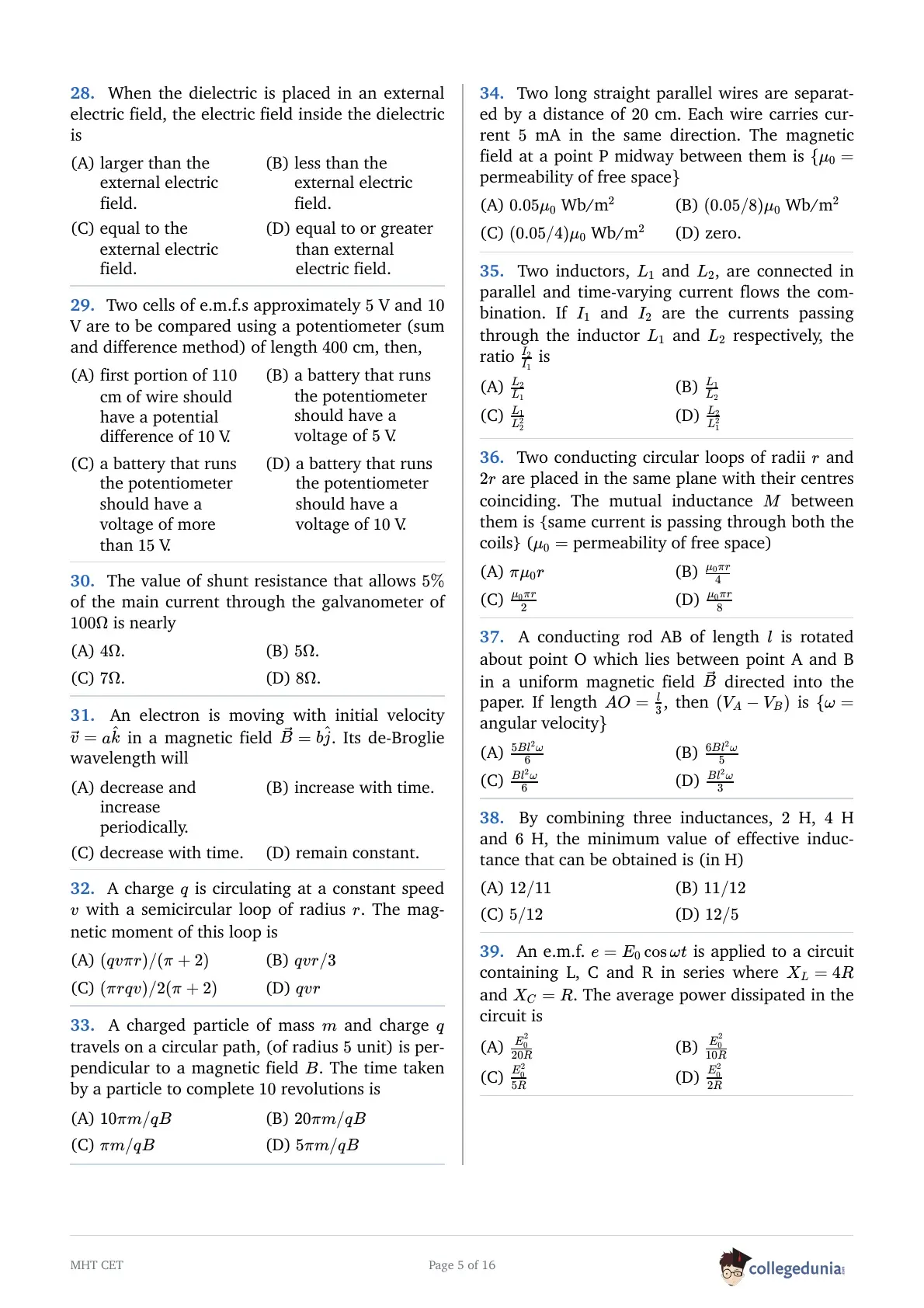
If \(\vec{A}=5\hat{i}+2\hat{j}\) and \(\vec{B}=a\hat{i}+3\hat{j}\) are perpendicular to each other, the value of 'a' is
A particular physical quantity is given by \(X=2\pi \sqrt{\frac{a}{b}}\) and the measured value of 'a' is \(40\) unit with \(0.01\) unit accuracy. The value of 'b' is \(\frac{98}{10}\) unit with \(1\) unit accuracy. The % error in \(X\) is nearly
Two particles A and B are moving in uniform circular motion in concentric circles of radii \(r_{A}\) and \(r_{B}\) with speeds \(v_{A}\) and \(v_{B}\) respectively. \(T_{A}\) and \(T_{B}\) are the time periods of rotation of the particles respectively and their relation is \(T_{A}=3T_{B}\). The ratio of angular speed of B to that of A will be
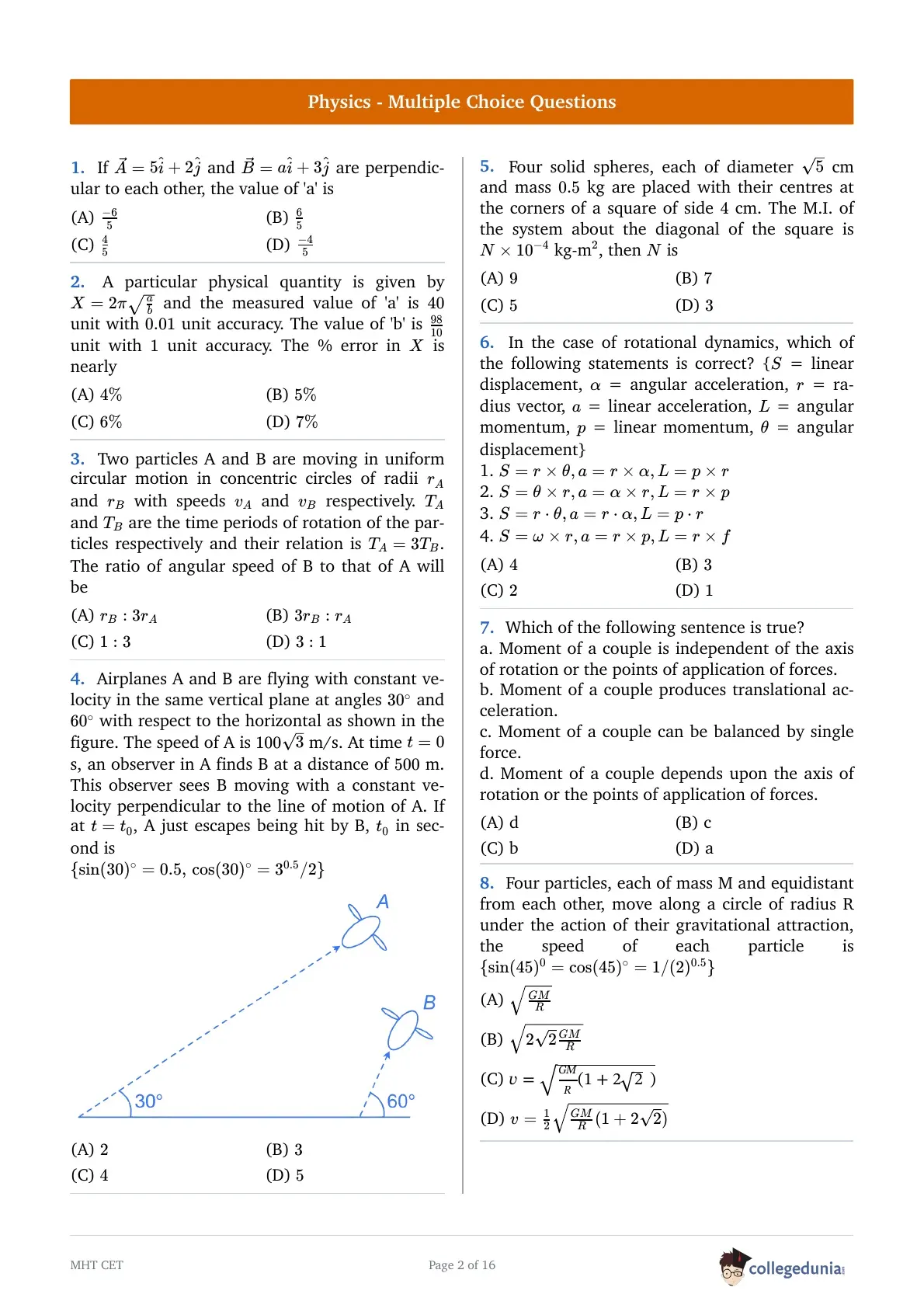
Airplanes A and B are flying with constant velocity in the same vertical plane at angles \(30^{\circ }\) and \(60^{\circ }\) with respect to the horizontal as shown in the figure. The speed of A is \(100\sqrt{3}\) m/s. At time \(t=0\) s, an observer in A finds B at a distance of \(500\) m. This observer sees B moving with a constant velocity perpendicular to the line of motion of A. If at \(t=t_{0}\), A just escapes being hit by B, \(t_{0}\) in second is
\(\{\sin (30)^{\circ }=0.5,\,\cos (30)^{\circ }=3^{0.5}/2\}\)

Four solid spheres, each of diameter \(\sqrt{5}\) cm and mass \(0.5\) kg are placed with their centres at the corners of a square of side \(4\) cm. The M.I. of the system about the diagonal of the square is \(N\times 10^{-4}\) kg-m\({}^{2}\), then \(N\) is
In the case of rotational dynamics, which of the following statements is correct? {\(S\) = linear displacement, \(\alpha\) = angular acceleration, \(r\) = radius vector, \(a\) = linear acceleration, \(L\) = angular momentum, \(p\) = linear momentum, \(\theta\) = angular displacement}
1. \(S=r\times \theta ,a=r\times \alpha ,L=p\times r\)
2. \(S=\theta \times r,a=\alpha \times r,L=r\times p\)
3. \(S=r\cdot \theta ,a=r\cdot \alpha ,L=p\cdot r\)
4. \(S=\omega \times r,a=r\times p,L=r\times f\)
Which of the following sentence is true?
a. Moment of a couple is independent of the axis of rotation or the points of application of forces.
b. Moment of a couple produces translational acceleration.
c. Moment of a couple can be balanced by single force.
d. Moment of a couple depends upon the axis of rotation or the points of application of forces.
Four particles, each of mass M and equidistant from each other, move along a circle of radius R under the action of their gravitational attraction, the speed of each particle is \(\{\sin (45)^{0}=\cos (45)^{\circ }=1/(2)^{0.5}\}\)
A vessel contains oil (density\(=0.6\) g/cm\({}^{3}\)) over mercury (density\(=13.6\) g/cm\({}^{3}\)). A homogeneous sphere floats with half its volume immersed in mercury and the remaining half in oil. The density of the material of the sphere in g/cm\({}^{3}\) is
In a hydraulic press, the small cylinder has a diameter of \(d_{1}\) cm, while the large cylinder has a diameter of \(d_{2}\) cm. If a force \(F_{1}\) is applied to a piston of small cylinder, then the force on the piston of large cylinder \(F_{2}\) is
A rectangular film of liquid is expanded from (\(6\) cm \(\times 5\) cm) to (\(8\) cm \(\times 9\) cm). If the work done is \(4\times 10^{-4}\) J, the surface tension of the liquid is
Three spheres, P, Q and R, having radii \(4\) m, \(5\) m and \(6\) m respectively, are coated with lamp black on their outer surfaces. The wavelengths corresponding to maximum intensity (radiated) are \(400\) nm, \(500\) nm and \(600\) nm respectively. If the powers radiated by them are \(P_{P}\), \(P_{Q}\) and \(P_{R}\) respectively, then \(P_{P}:P_{Q}:P_{R}\) is
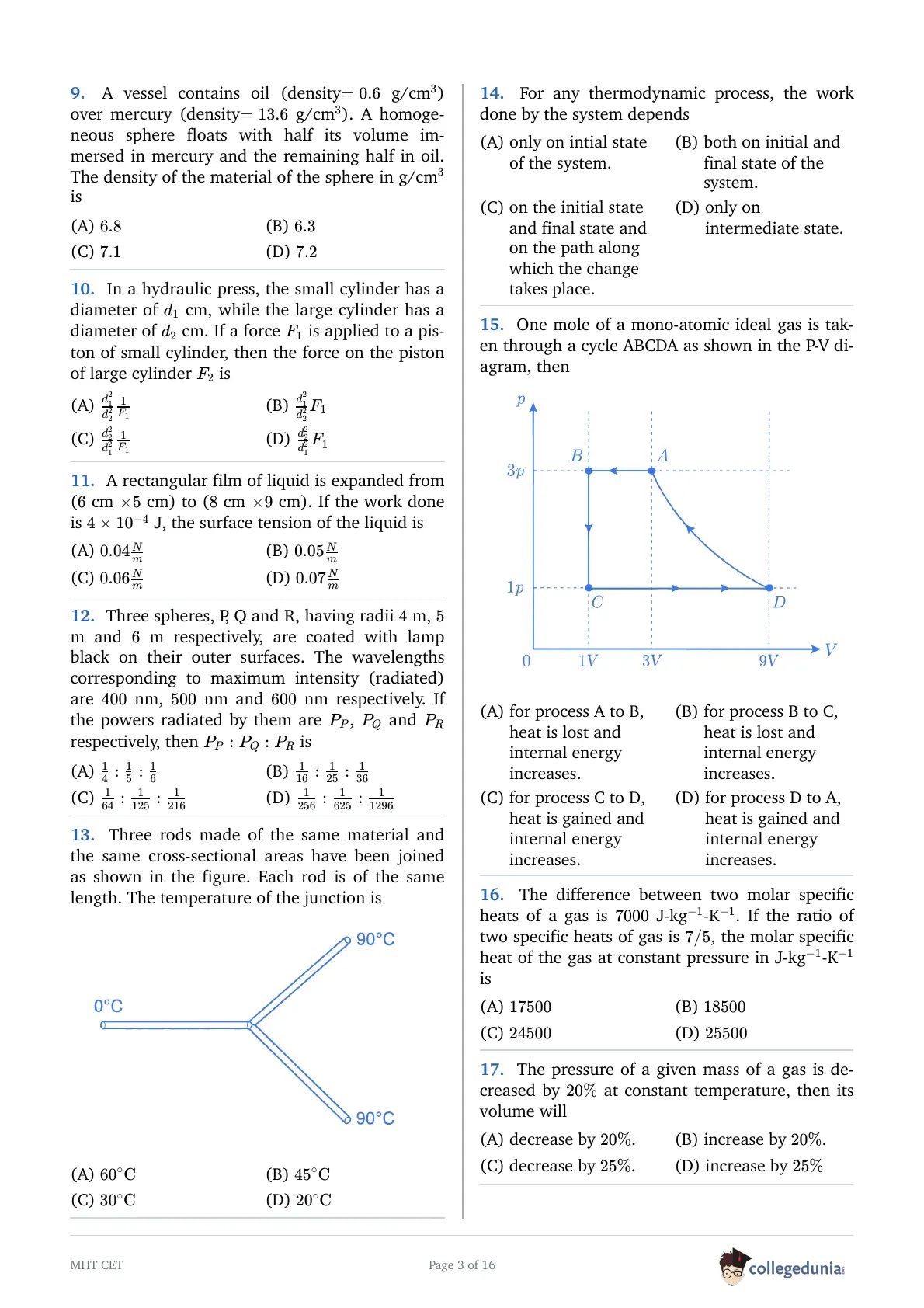
Three rods made of the same material and the same cross-sectional areas have been joined as shown in the figure. Each rod is of the same length. The temperature of the junction is

For any thermodynamic process, the work done by the system depends
One mole of a mono-atomic ideal gas is taken through a cycle ABCDA as shown in the P-V diagram, then

The difference between two molar specific heats of a gas is \(7000\) J-kg\({}^{-1}\)-K\({}^{-1}\). If the ratio of two specific heats of gas is \(7/5\), the molar specific heat of the gas at constant pressure in J-kg\({}^{-1}\)-K\({}^{-1}\) is
The pressure of a given mass of a gas is decreased by \(20\%\) at constant temperature, then its volume will
A particle performing S.H.M., has a period of \(12\) s. The particle starts from a mean position. The ratio of distances travelled by the particle in the first and second second is \(\{\cos (\pi /6)=\frac{\sqrt{3}}{2}\}\)
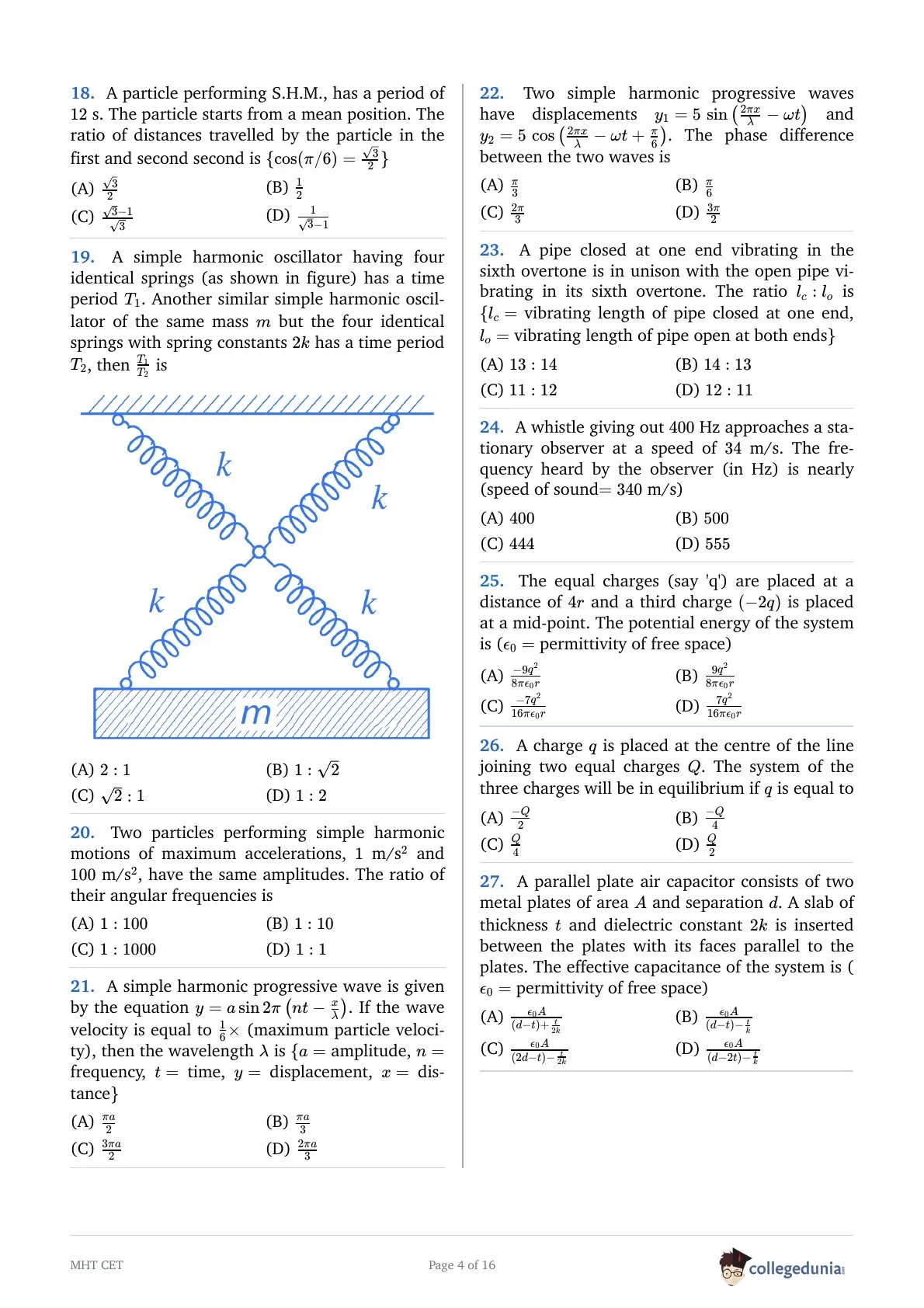
A simple harmonic oscillator having four identical springs (as shown in figure) has a time period \(T_{1}\). Another similar simple harmonic oscillator of the same mass \(m\) but the four identical springs with spring constants \(2k\) has a time period \(T_{2}\), then \(\frac{T_{1}}{T_{2}}\) is

Two particles performing simple harmonic motions of maximum accelerations, \(1\) m/s\({}^{2}\) and \(100\) m/s\({}^{2}\), have the same amplitudes. The ratio of their angular frequencies is
A simple harmonic progressive wave is given by the equation \(y=a\sin 2\pi \left(nt-\frac{x}{\lambda }\right)\). If the wave velocity is equal to \(\frac{1}{6}\times\) (maximum particle velocity), then the wavelength \(\lambda\) is \(\{a=\) amplitude, \(n=\) frequency, \(t=\) time, \(y=\) displacement, \(x=\) distance\(\}\)
Two simple harmonic progressive waves have displacements \(y_{1}=5\,\sin \left(\frac{2\pi x}{\lambda }-\omega t\right)\) and \(y_{2}=5\,\cos \left(\frac{2\pi x}{\lambda }-\omega t+\frac{\pi }{6}\right)\). The phase difference between the two waves is
A pipe closed at one end vibrating in the sixth overtone is in unison with the open pipe vibrating in its sixth overtone. The ratio \(l_{c}:l_{o}\) is \(\{l_{c}=\) vibrating length of pipe closed at one end, \(l_{o}=\) vibrating length of pipe open at both ends\(\}\)
A whistle giving out \(400\) Hz approaches a stationary observer at a speed of \(34\) m/s. The frequency heard by the observer (in Hz) is nearly (speed of sound\(=340\) m/s)
The equal charges (say 'q') are placed at a distance of \(4r\) and a third charge \((-2q)\) is placed at a mid-point. The potential energy of the system is (\(\epsilon _{0}=\) permittivity of free space)
A charge \(q\) is placed at the centre of the line joining two equal charges \(Q\). The system of the three charges will be in equilibrium if \(q\) is equal to
A parallel plate air capacitor consists of two metal plates of area \(A\) and separation \(d\). A slab of thickness \(t\) and dielectric constant \(2k\) is inserted between the plates with its faces parallel to the plates. The effective capacitance of the system is (\(\epsilon _{0}=\) permittivity of free space)
When the dielectric is placed in an external electric field, the electric field inside the dielectric is
Two cells of e.m.f.s approximately \(5\) V and \(10\) V are to be compared using a potentiometer (sum and difference method) of length \(400\) cm, then,
The value of shunt resistance that allows \(5\%\) of the main current through the galvanometer of \(100\Omega\) is nearly
An electron is moving with initial velocity \(\vec{v}=a\hat{k}\) in a magnetic field \(\vec{B}=b\hat{j}\). Its de-Broglie wavelength will
A charge \(q\) is circulating at a constant speed \(v\) with a semicircular loop of radius \(r\). The magnetic moment of this loop is
A charged particle of mass \(m\) and charge \(q\) travels on a circular path, (of radius \(5\) unit) is perpendicular to a magnetic field \(B\). The time taken by a particle to complete \(10\) revolutions is
Two long straight parallel wires are separated by a distance of \(20\) cm. Each wire carries current \(5\) mA in the same direction. The magnetic field at a point P midway between them is \(\{\mu _{0}=\) permeability of free space\(\}\)
Two inductors, \(L_{1}\) and \(L_{2}\), are connected in parallel and time-varying current flows the combination. If \(I_{1}\) and \(I_{2}\) are the currents passing through the inductor \(L_{1}\) and \(L_{2}\) respectively, the ratio \(\frac{I_{2}}{I_{1}}\) is
Two conducting circular loops of radii \(r\) and \(2r\) are placed in the same plane with their centres coinciding. The mutual inductance \(M\) between them is {same current is passing through both the coils} (\(\mu _{0}=\) permeability of free space)
A conducting rod AB of length \(l\) is rotated about point O which lies between point A and B in a uniform magnetic field \(\vec{B}\) directed into the paper. If length \(AO=\frac{l}{3}\), then \((V_{A}-V_{B})\) is \(\{\omega =\) angular velocity\(\}\)
By combining three inductances, \(2\) H, \(4\) H and \(6\) H, the minimum value of effective inductance that can be obtained is (in H)
An e.m.f. \(e=E_{0}\cos \omega t\) is applied to a circuit containing L, C and R in series where \(X_{L}=4R\) and \(X_{C}=R\). The average power dissipated in the circuit is
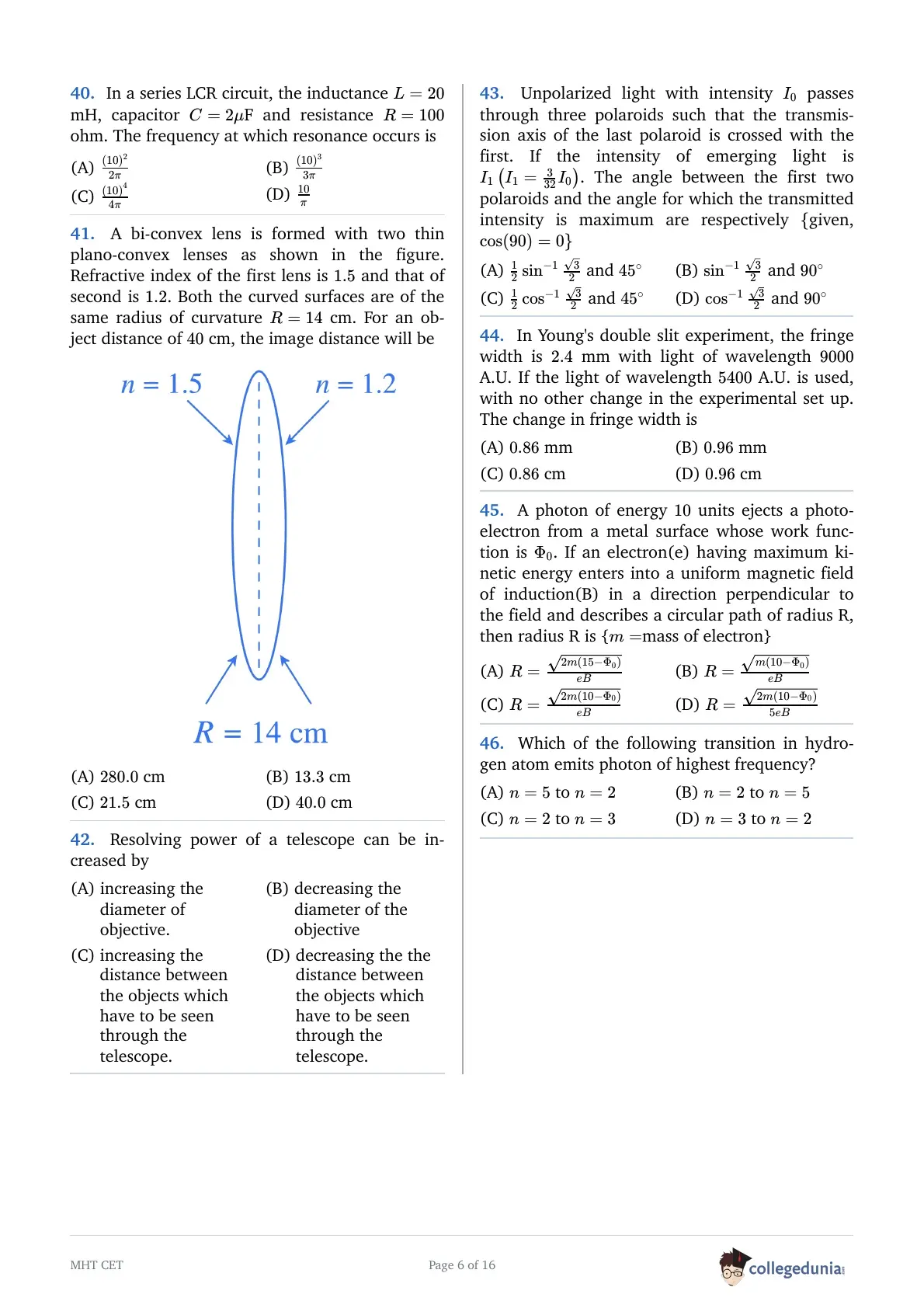
In a series LCR circuit, the inductance \(L=20\) mH, capacitor \(C=2\mu\)F and resistance \(R=100\) ohm. The frequency at which resonance occurs is
A bi-convex lens is formed with two thin plano-convex lenses as shown in the figure. Refractive index of the first lens is \(1.5\) and that of second is \(1.2\). Both the curved surfaces are of the same radius of curvature \(R=14\) cm. For an object distance of \(40\) cm, the image distance will be

Resolving power of a telescope can be increased by
Unpolarized light with intensity \(I_{0}\) passes through three polaroids such that the transmission axis of the last polaroid is crossed with the first. If the intensity of emerging light is \(I_{1}\left(I_{1}=\frac{3}{32}I_{0}\right)\). The angle between the first two polaroids and the angle for which the transmitted intensity is maximum are respectively \(\{\)given, \(\cos (90)=0\}\)
In Young's double slit experiment, the fringe width is \(2.4\) mm with light of wavelength \(9000\) A.U. If the light of wavelength \(5400\) A.U. is used, with no other change in the experimental set up. The change in fringe width is
A photon of energy \(10\) units ejects a photo-electron from a metal surface whose work function is \(\Phi _{0}\). If an electron(e) having maximum kinetic energy enters into a uniform magnetic field of induction(B) in a direction perpendicular to the field and describes a circular path of radius R, then radius R is {\(m=\)mass of electron}
Which of the following transition in hydrogen atom emits photon of highest frequency?
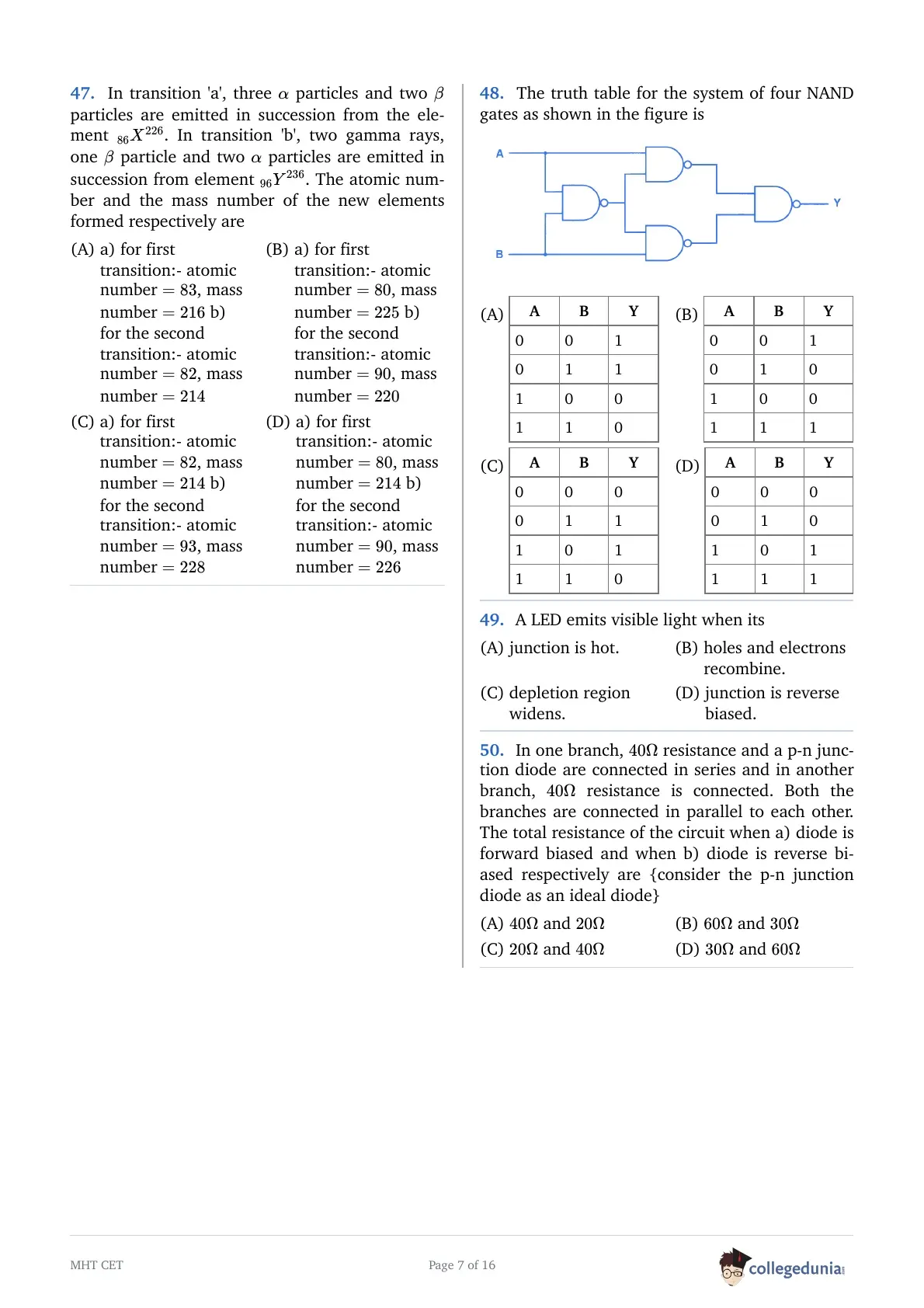
In transition 'a', three \(\alpha\) particles and two \(\beta\) particles are emitted in succession from the element \({}_{86}X^{226}\). In transition 'b', two gamma rays, one \(\beta\) particle and two \(\alpha\) particles are emitted in succession from element \({}_{96}Y^{236}\). The atomic number and the mass number of the new elements formed respectively are
The truth table for the system of four NAND gates as shown in the figure is

A LED emits visible light when its
In one branch, \(40\Omega\) resistance and a p-n junction diode are connected in series and in another branch, \(40\Omega\) resistance is connected. Both the branches are connected in parallel to each other. The total resistance of the circuit when a) diode is forward biased and when b) diode is reverse biased respectively are {consider the p-n junction diode as an ideal diode}
Chemistry (Q51 - Q100)
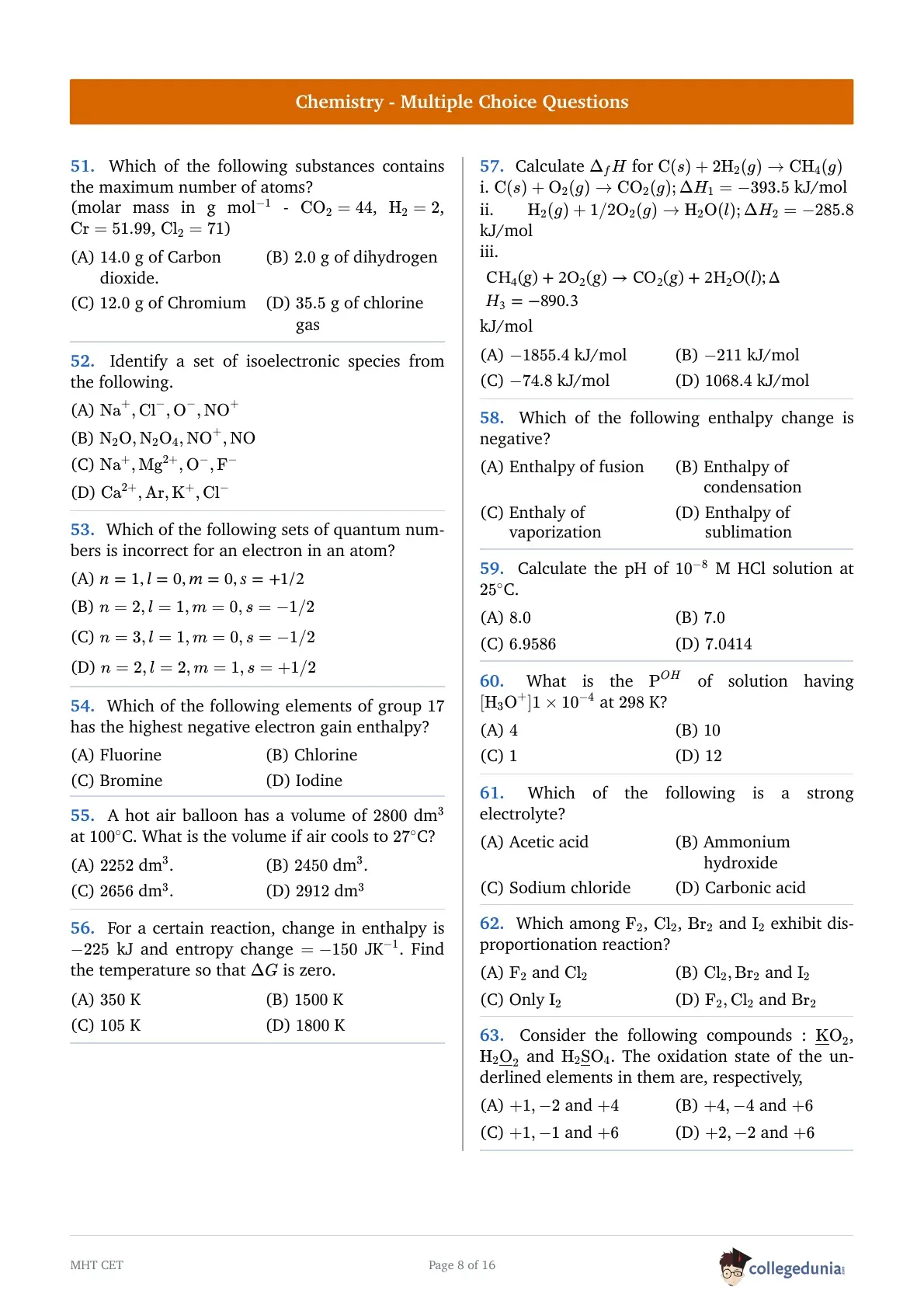
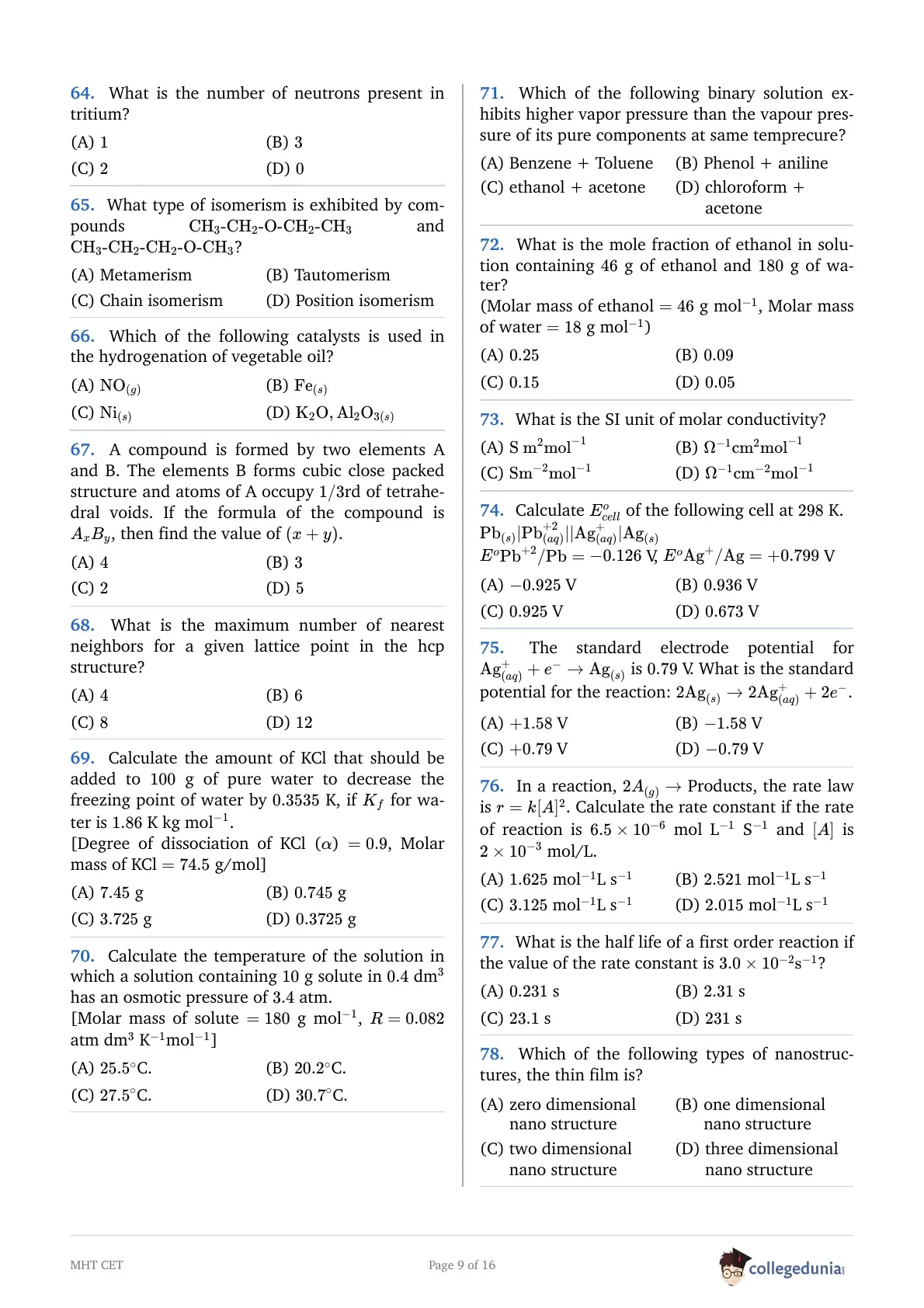
Which of the following substances contains the maximum number of atoms?
(molar mass in g mol\({}^{-1}\) - \(\text{CO}_{2}=44\), \(\text{H}_{2}=2\), \(\text{Cr}=51.99\), \(\text{Cl}_{2}=71\))
Identify a set of isoelectronic species from the following.
Which of the following sets of quantum numbers is incorrect for an electron in an atom?
Which of the following elements of group \(17\) has the highest negative electron gain enthalpy?
A hot air balloon has a volume of \(2800\) dm\({}^{3}\) at \(100{}^{\circ }\)C. What is the volume if air cools to \(27{}^{\circ }\)C?
For a certain reaction, change in enthalpy is \(-225\) kJ and entropy change \(=-150\) JK\({}^{-1}\). Find the temperature so that \(\Delta G\) is zero.
Calculate \(\Delta _{f}H\) for \(\text{C}(s)+2\text{H}_{2}(g)\rightarrow \text{CH}_{4}(g)\)
i. \(\text{C}(s)+\text{O}_{2}(g)\rightarrow \text{CO}_{2}(g);\Delta H_{1}=-393.5\) kJ/mol
ii. \(\text{H}_{2}(g)+1/2\text{O}_{2}(g)\rightarrow \text{H}_{2}\text{O}(l);\Delta H_{2}=-285.8\) kJ/mol
iii. \(\text{CH}_{4}(g)+2\text{O}_{2}(g)\rightarrow \text{CO}_{2}(g)+2\text{H}_{2}\text{O}(l);\Delta H_{3}=-890.3\) kJ/mol
Which of the following enthalpy change is negative?
Calculate the pH of \(10^{-8}\) M HCl solution at \(25{}^{\circ }\)C.
What is the \(\text{P}^{OH}\) of solution having \([\text{H}_{3}\text{O}^{+}]1\times 10^{-4}\) at \(298\) K?
Which of the following is a strong electrolyte?
Which among \(\text{F}_{2}\), \(\text{Cl}_{2}\), \(\text{Br}_{2}\) and \(\text{I}_{2}\) exhibit disproportionation reaction?
Consider the following compounds : \(\underline{\text{K}}\text{O}_{2}\), \(\text{H}_{2}\underline{\text{O}}_{2}\) and \(\text{H}_{2}\underline{\text{S}}\text{O}_{4}\). The oxidation state of the underlined elements in them are, respectively,
What is the number of neutrons present in tritium?
What type of isomerism is exhibited by compounds \(\text{CH}_{3}\text{-CH}_{2}\text{-O-CH}_{2}\text{-CH}_{3}\) and \(\text{CH}_{3}\text{-CH}_{2}\text{-CH}_{2}\text{-O-CH}_{3}\)?
Which of the following catalysts is used in the hydrogenation of vegetable oil?
A compound is formed by two elements A and B. The elements B forms cubic close packed structure and atoms of A occupy \(1/3\)rd of tetrahedral voids. If the formula of the compound is \(A_{x}B_{y}\), then find the value of \((x+y)\).
What is the maximum number of nearest neighbors for a given lattice point in the hcp structure?
Calculate the amount of KCl that should be added to \(100\) g of pure water to decrease the freezing point of water by \(0.3535\) K, if \(K_{f}\) for water is \(1.86\) K kg mol\({}^{-1}\).
[Degree of dissociation of KCl (\(\alpha\)) \(=0.9\), Molar mass of KCl \(=74.5\) g/mol]
Calculate the temperature of the solution in which a solution containing \(10\) g solute in \(0.4\) dm\({}^{3}\) has an osmotic pressure of \(3.4\) atm.
[Molar mass of solute \(=180\) g mol\({}^{-1}\), \(R=0.082\) atm dm\({}^{3}\) K\({}^{-1}\)mol\({}^{-1}\)]
Which of the following binary solution exhibits higher vapor pressure than the vapour pressure of its pure components at same temprecure?
What is the mole fraction of ethanol in solution containing \(46\) g of ethanol and \(180\) g of water?
(Molar mass of ethanol \(=46\) g mol\({}^{-1}\), Molar mass of water \(=18\) g mol\({}^{-1}\))
What is the SI unit of molar conductivity?
Calculate \(E_{cell}^{o}\) of the following cell at \(298\) K.
\(\text{Pb}_{(s)}|\text{Pb}_{(aq)}^{+2}||\text{Ag}_{(aq)}^{+}|\text{Ag}_{(s)}\)
\(E^{o}\text{Pb}^{+2}/\text{Pb}=-0.126\) V, \(E^{o}\text{Ag}^{+}/\text{Ag}=+0.799\) V
The standard electrode potential for \(\text{Ag}_{(aq)}^{+}+e^{-}\rightarrow \text{Ag}_{(s)}\) is \(0.79\) V. What is the standard potential for the reaction: \(2\text{Ag}_{(s)}\rightarrow 2\text{Ag}_{(aq)}^{+}+2e^{-}\).
In a reaction, \(2A_{(g)}\rightarrow\) Products, the rate law is \(r=k[A]^{2}\). Calculate the rate constant if the rate of reaction is \(6.5\times 10^{-6}\) mol L\({}^{-1}\) S\({}^{-1}\) and \([A]\) is \(2\times 10^{-3}\) mol/L.
What is the half life of a first order reaction if the value of the rate constant is \(3.0\times 10^{-2}\text{s}^{-1}\)?
Which of the following types of nanostructures, the thin film is?
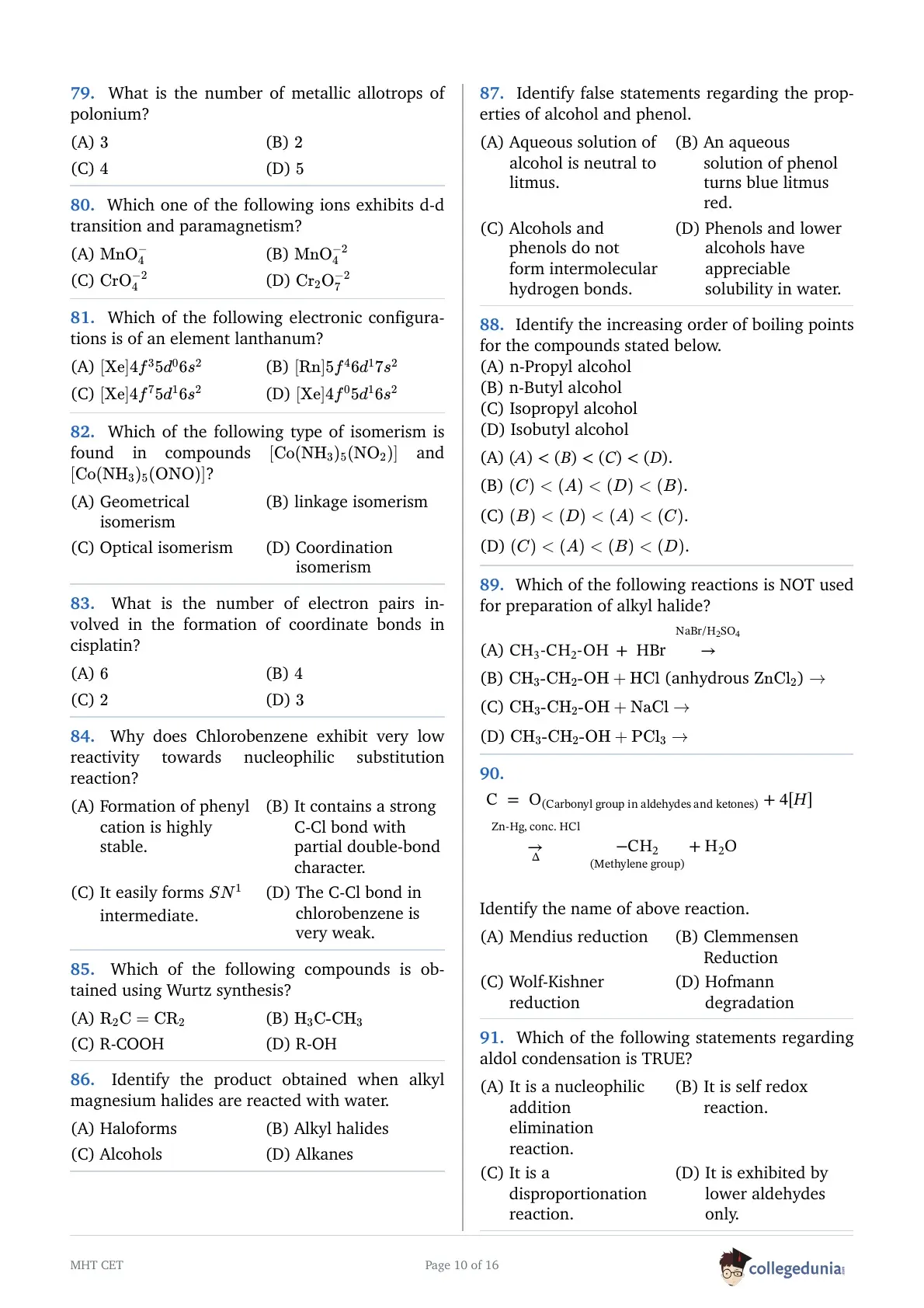
What is the number of metallic allotrops of polonium?
Which one of the following ions exhibits d-d transition and paramagnetism?
Which of the following electronic configurations is of an element lanthanum?
Which of the following type of isomerism is found in compounds \([\text{Co}(\text{NH}_{3})_{5}(\text{NO}_{2})]\) and \([\text{Co}(\text{NH}_{3})_{5}(\text{ONO})]\)?
What is the number of electron pairs involved in the formation of coordinate bonds in cisplatin?
Why does Chlorobenzene exhibit very low reactivity towards nucleophilic substitution reaction?
Which of the following compounds is obtained using Wurtz synthesis?
Identify the product obtained when alkyl magnesium halides are reacted with water.
Identify false statements regarding the properties of alcohol and phenol.
Identify the increasing order of boiling points for the compounds stated below.
(A) n-Propyl alcohol
(B) n-Butyl alcohol
(C) Isopropyl alcohol
(D) Isobutyl alcohol
Which of the following reactions is NOT used for preparation of alkyl halide?
\(\text{C}=\text{O}_{\text{(Carbonyl group in aldehydes and ketones)}}+4[H]\xrightarrow[\Delta ]{\text{Zn-Hg, conc. HCl}}\underset{\text{(Methylene group)}}{-\text{CH}_{2}}+\text{H}_{2}\text{O}\)
Identify the name of above reaction.
Which of the following statements regarding aldol condensation is TRUE?
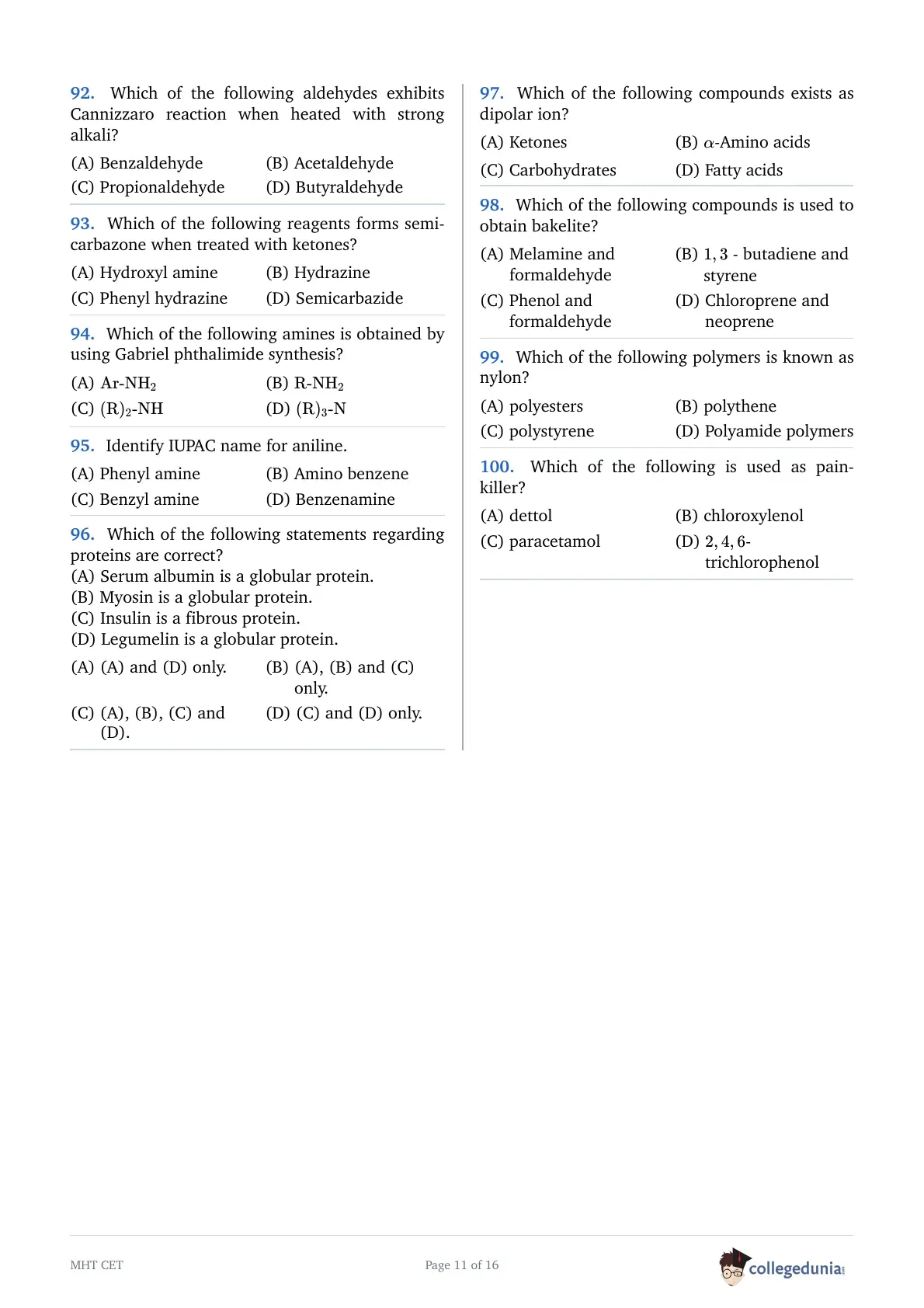
Which of the following aldehydes exhibits Cannizzaro reaction when heated with strong alkali?
Which of the following reagents forms semicarbazone when treated with ketones?
Which of the following amines is obtained by using Gabriel phthalimide synthesis?
Identify IUPAC name for aniline.
Which of the following statements regarding proteins are correct?
(A) Serum albumin is a globular protein.
(B) Myosin is a globular protein.
(C) Insulin is a fibrous protein.
(D) Legumelin is a globular protein.
Which of the following compounds exists as dipolar ion?
Which of the following compounds is used to obtain bakelite?
Which of the following polymers is known as nylon?
Which of the following is used as pain-killer?
Mathematics (Q101 - Q150)
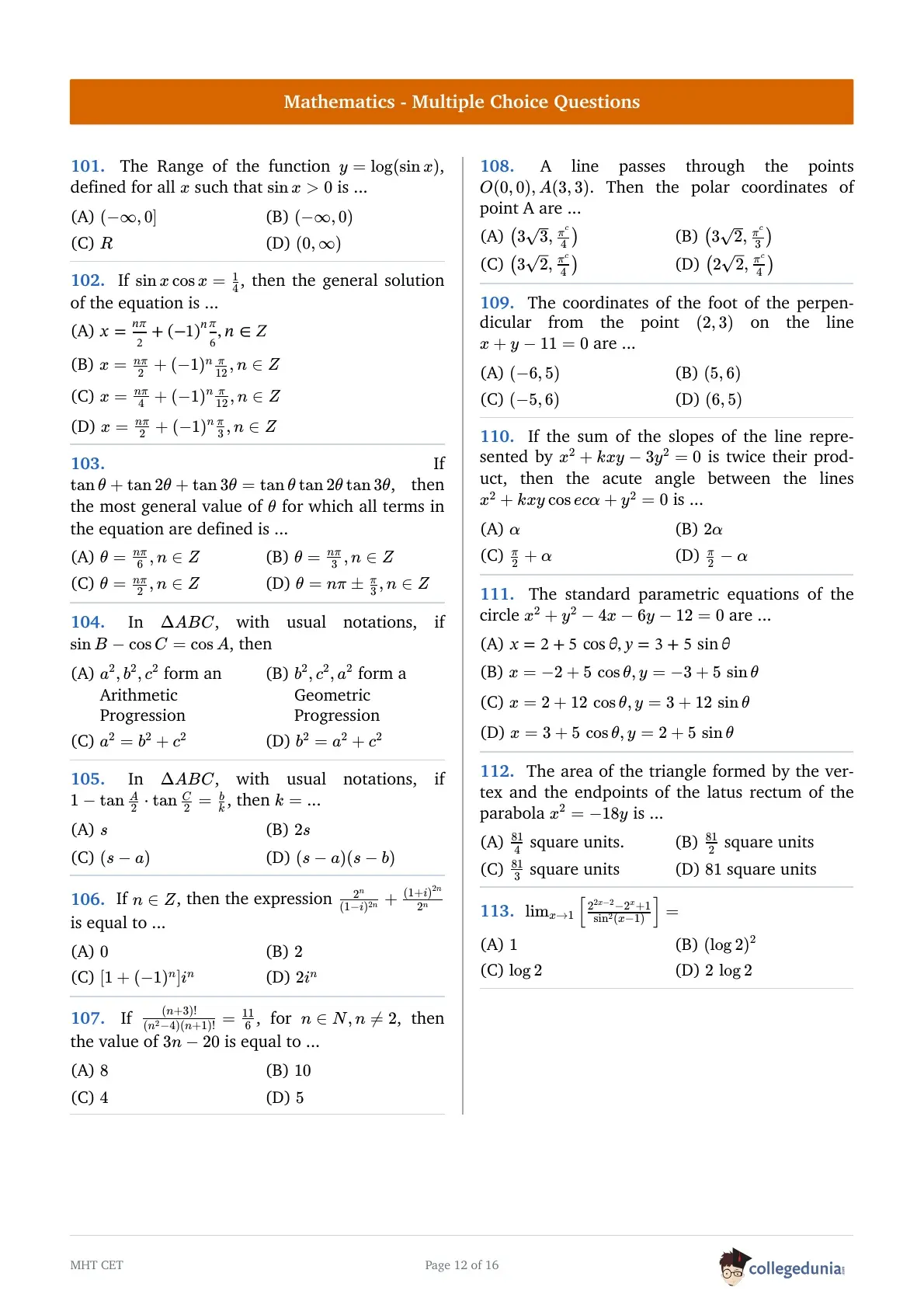
The Range of the function \(y=\log (\sin x)\), defined for all \(x\) such that \(\sin x>0\) is ...
If \(\sin x\cos x=\frac{1}{4}\), then the general solution of the equation is ...
If \(\tan \theta +\tan 2\theta +\tan 3\theta =\tan \theta \tan 2\theta \tan 3\theta\), then the most general value of \(\theta\) for which all terms in the equation are defined is ...
In \(\Delta ABC\), with usual notations, if \(\sin B-\cos C=\cos A\), then
In \(\Delta ABC\), with usual notations, if \(1-\tan \frac{A}{2}\cdot \tan \frac{C}{2}=\frac{b}{k}\), then \(k=\) ...
If \(n\in Z\), then the expression \(\frac{2^{n}}{(1-i)^{2n}}+\frac{(1+i)^{2n}}{2^{n}}\) is equal to ...
If \(\frac{(n+3)!}{(n^{2}-4)(n+1)!}=\frac{11}{6}\), for \(n\in N,n\neq 2\), then the value of \(3n-20\) is equal to ...
A line passes through the points \(O(0,0),A(3,3)\). Then the polar coordinates of point A are ...
The coordinates of the foot of the perpendicular from the point \((2,3)\) on the line \(x+y-11=0\) are ...
If the sum of the slopes of the line represented by \(x^{2}+kxy-3y^{2}=0\) is twice their product, then the acute angle between the lines \(x^{2}+kxy\cos ec\alpha +y^{2}=0\) is ...
The standard parametric equations of the circle \(x^{2}+y^{2}-4x-6y-12=0\) are ...
The area of the triangle formed by the vertex and the endpoints of the latus rectum of the parabola \(x^{2}=-18y\) is ...
\(\lim _{x\rightarrow 1}\left[\frac{2^{2x-2}-2^{x}+1}{\sin ^{2}(x-1)}\right]=\)

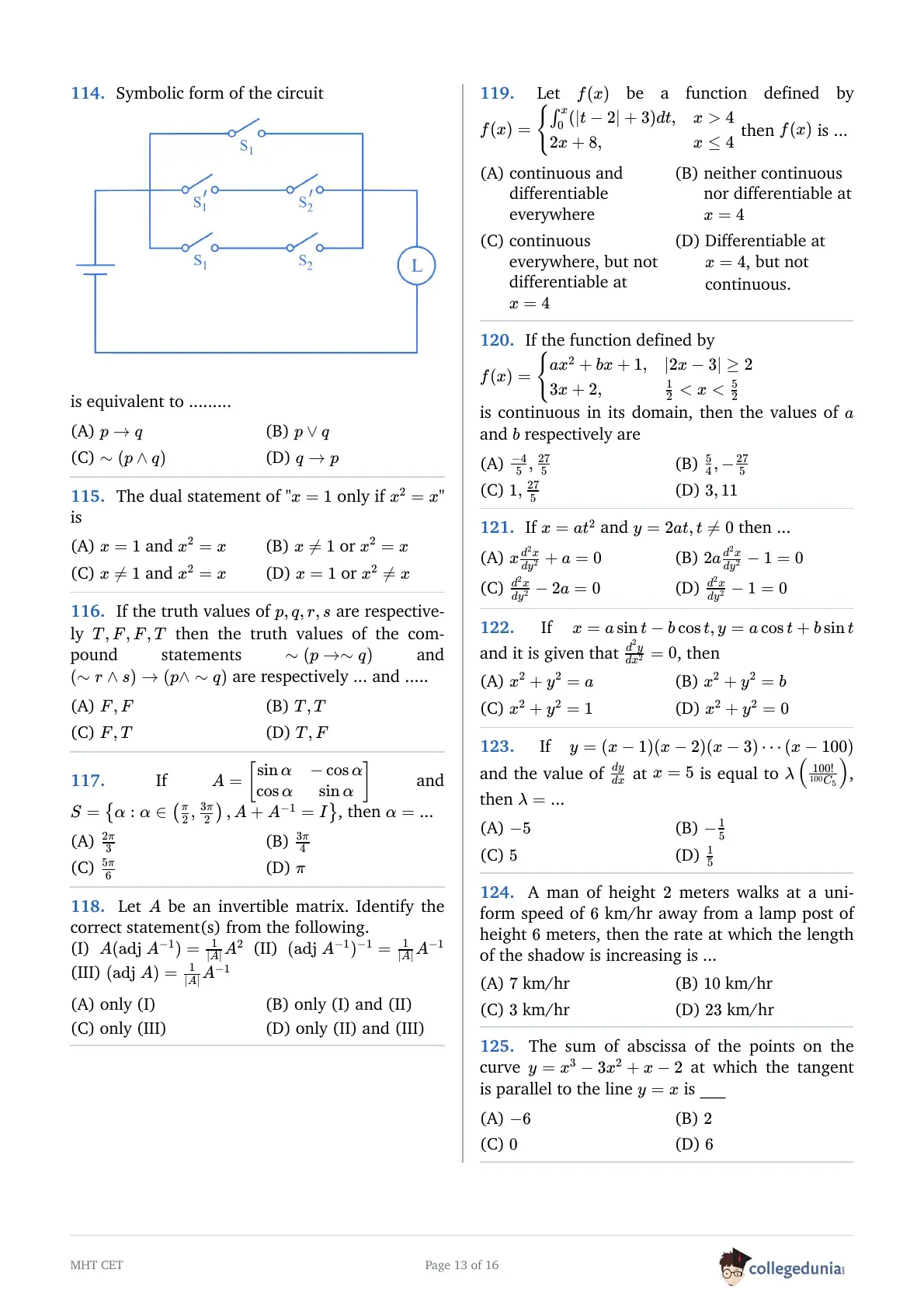
The dual statement of "\(x=1\) only if \(x^{2}=x\)" is
If the truth values of \(p,q,r,s\) are respectively \(T,F,F,T\) then the truth values of the compound statements \(\sim (p\rightarrow \sim q)\) and \((\sim r\wedge s)\rightarrow (p\wedge \sim q)\) are respectively ... and .....
If \(A=\begin{bmatrix} \sin \alpha & -\cos \alpha \\ \cos \alpha & \sin \alpha \end{bmatrix}\) and \(S=\left\{\alpha :\alpha \in \left(\frac{\pi }{2},\frac{3\pi }{2}\right),A+A^{-1}=I\right\}\), then \(\alpha =\) ...
Let \(A\) be an invertible matrix. Identify the correct statement(s) from the following.
(I) \(A(\text{adj }A^{-1})=\frac{1}{|A|}A^{2}\) (II) \((\text{adj }A^{-1})^{-1}=\frac{1}{|A|}A^{-1}\) (III) \((\text{adj }A)=\frac{1}{|A|}A^{-1}\)
Let \(f(x)\) be a function defined by \(f(x)=\begin{cases} \int _{0}^{x}(|t-2|+3)dt, & x>4 \\ 2x+8, & x\leq 4 \end{cases}\) then \(f(x)\) is ...
If the function defined by
\(f(x)=\begin{cases} ax^{2}+bx+1, & |2x-3|\geq 2 \\ 3x+2, & \frac{1}{2}\lt x\lt \frac{5}{2} \end{cases}\)
is continuous in its domain, then the values of \(a\) and \(b\) respectively are
If \(x=at^{2}\) and \(y=2at,t\neq 0\) then ...
If \(x=a\sin t-b\cos t,y=a\cos t+b\sin t\) and it is given that \(\frac{d^{2}y}{dx^{2}}=0\), then
If \(y=(x-1)(x-2)(x-3)\cdots (x-100)\) and the value of \(\frac{dy}{dx}\) at \(x=5\) is equal to \(\lambda \left(\frac{100!}{{}^{100}C_{5}}\right)\), then \(\lambda =\) ...
A man of height \(2\) meters walks at a uniform speed of \(6\) km/hr away from a lamp post of height \(6\) meters, then the rate at which the length of the shadow is increasing is ...
The sum of abscissa of the points on the curve \(y=x^{3}-3x^{2}+x-2\) at which the tangent is parallel to the line \(y=x\) is ___
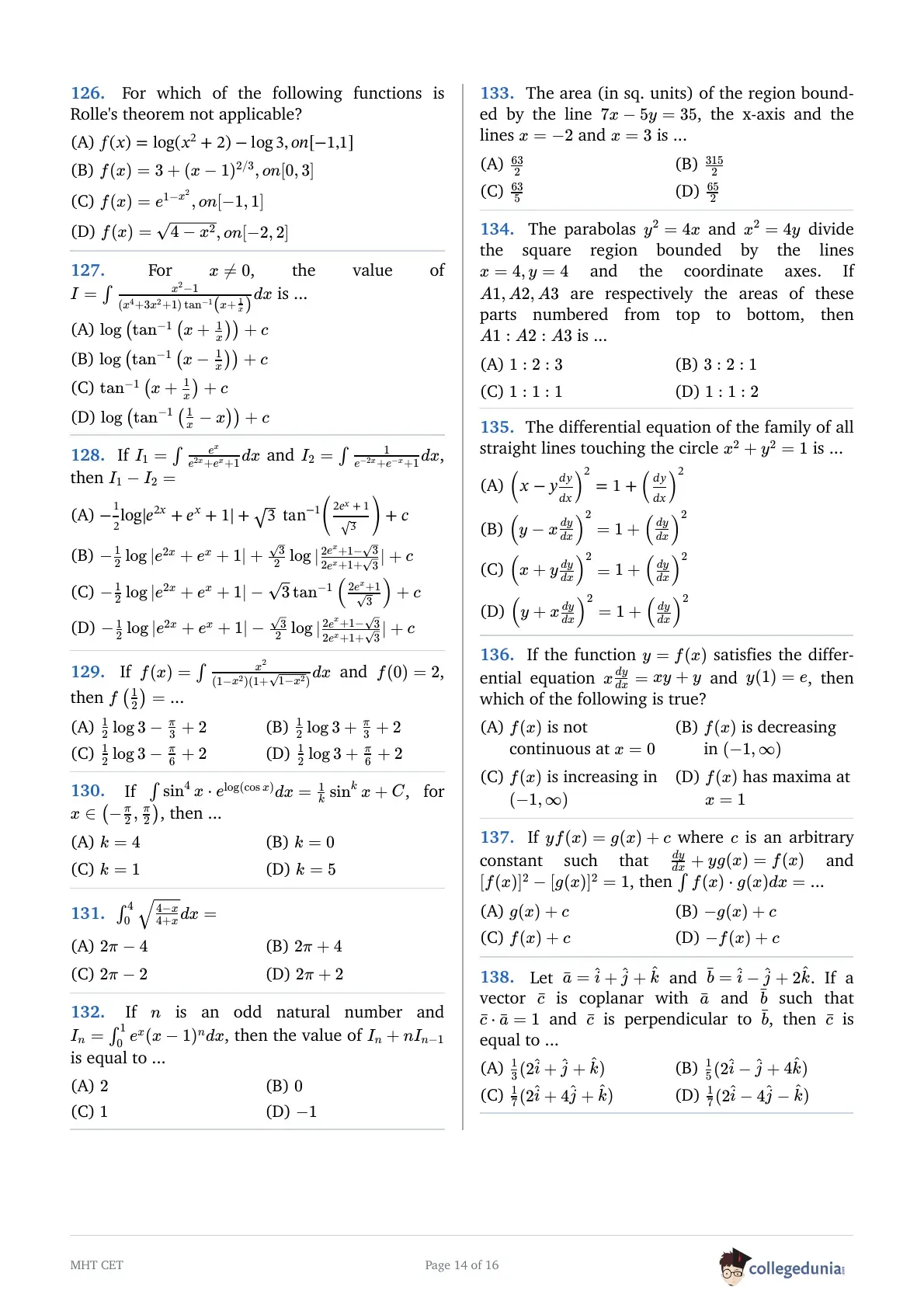
For which of the following functions is Rolle's theorem not applicable?
For \(x\neq 0\), the value of \(I=\int \frac{x^{2}-1}{(x^{4}+3x^{2}+1)\tan ^{-1}\left(x+\frac{1}{x}\right)}dx\) is ...
If \(I_{1}=\int \frac{e^{x}}{e^{2x}+e^{x}+1}dx\) and \(I_{2}=\int \frac{1}{e^{-2x}+e^{-x}+1}dx\), then \(I_{1}-I_{2}=\)
If \(f(x)=\int \frac{x^{2}}{(1-x^{2})(1+\sqrt{1-x^{2}})}dx\) and \(f(0)=2\), then \(f\left(\frac{1}{2}\right)=\) ...
If \(\int \sin ^{4}x\cdot e^{\log (\cos x)}dx=\frac{1}{k}\sin ^{k}x+C\), for \(x\in \left(-\frac{\pi }{2},\frac{\pi }{2}\right)\), then ...
\(\int _{0}^{4}\sqrt{\frac{4-x}{4+x}}dx=\)
If \(n\) is an odd natural number and \(I_{n}=\int _{0}^{1}e^{x}(x-1)^{n}dx\), then the value of \(I_{n}+nI_{n-1}\) is equal to ...
The area (in sq. units) of the region bounded by the line \(7x-5y=35\), the x-axis and the lines \(x=-2\) and \(x=3\) is ...
The parabolas \(y^{2}=4x\) and \(x^{2}=4y\) divide the square region bounded by the lines \(x=4,y=4\) and the coordinate axes. If \(A1,A2,A3\) are respectively the areas of these parts numbered from top to bottom, then \(A1:A2:A3\) is ...
The differential equation of the family of all straight lines touching the circle \(x^{2}+y^{2}=1\) is ...
If the function \(y=f(x)\) satisfies the differential equation \(x\frac{dy}{dx}=xy+y\) and \(y(1)=e\), then which of the following is true?
If \(yf(x)=g(x)+c\) where \(c\) is an arbitrary constant such that \(\frac{dy}{dx}+yg(x)=f(x)\) and \([f(x)]^{2}-[g(x)]^{2}=1\), then \(\int f(x)\cdot g(x)dx=\) ...
Let \(\bar{a}=\hat{i}+\hat{j}+\hat{k}\) and \(\bar{b}=\hat{i}-\hat{j}+2\hat{k}\). If a vector \(\bar{c}\) is coplanar with \(\bar{a}\) and \(\bar{b}\) such that \(\bar{c}\cdot \bar{a}=1\) and \(\bar{c}\) is perpendicular to \(\bar{b}\), then \(\bar{c}\) is equal to ...
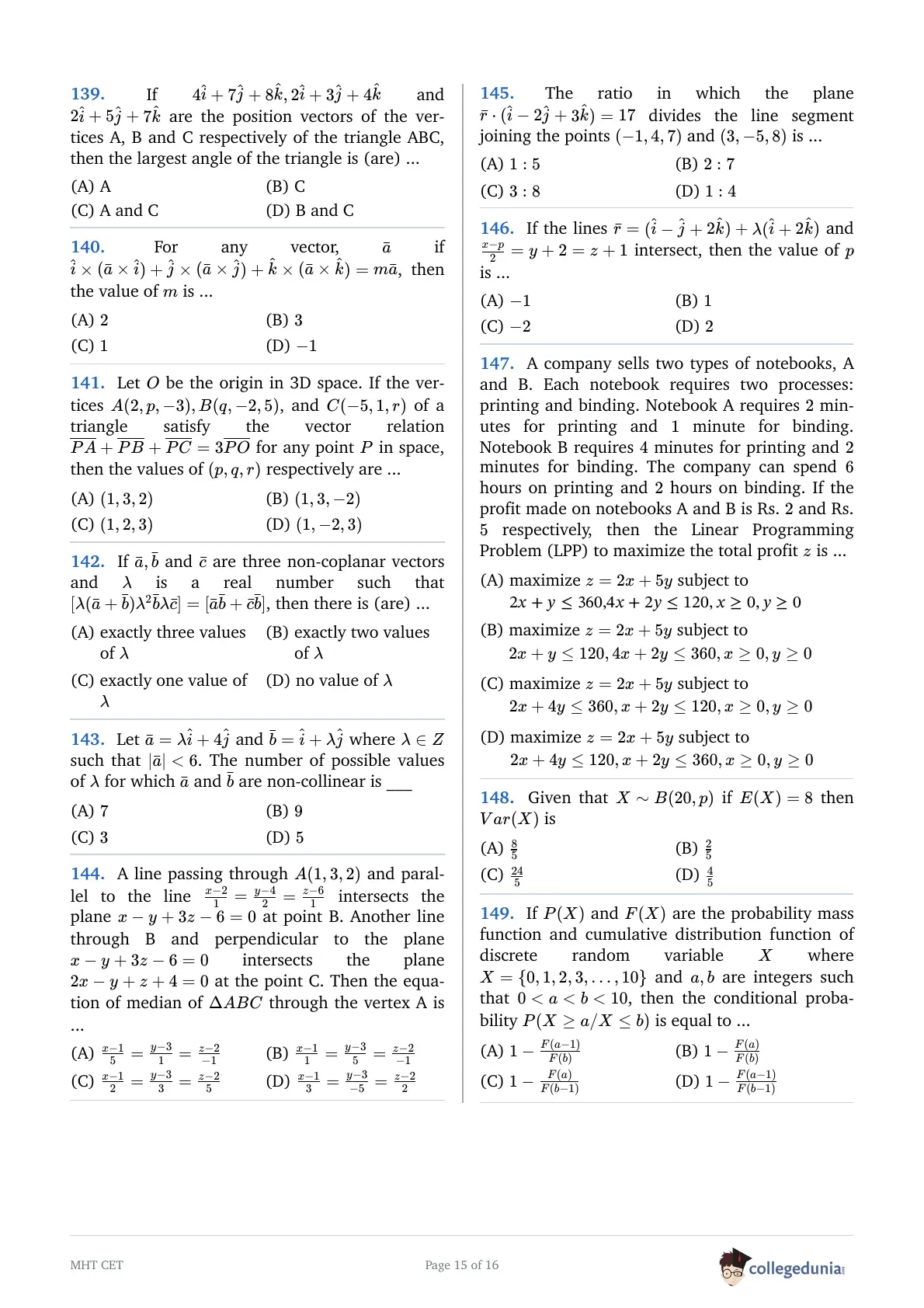
If \(4\hat{i}+7\hat{j}+8\hat{k},2\hat{i}+3\hat{j}+4\hat{k}\) and \(2\hat{i}+5\hat{j}+7\hat{k}\) are the position vectors of the vertices A, B and C respectively of the triangle ABC, then the largest angle of the triangle is (are) ...
For any vector, \(\bar{a}\) if \(\hat{i}\times (\bar{a}\times \hat{i})+\hat{j}\times (\bar{a}\times \hat{j})+\hat{k}\times (\bar{a}\times \hat{k})=m\bar{a}\), then the value of \(m\) is ...
Let \(O\) be the origin in 3D space. If the vertices \(A(2,p,-3),B(q,-2,5)\), and \(C(-5,1,r)\) of a triangle satisfy the vector relation \(\overline{PA}+\overline{PB}+\overline{PC}=3\overline{PO}\) for any point \(P\) in space, then the values of \((p,q,r)\) respectively are ...
If \(\bar{a},\bar{b}\) and \(\bar{c}\) are three non-coplanar vectors and \(\lambda\) is a real number such that \([\lambda (\bar{a}+\bar{b})\lambda ^{2}\bar{b}\lambda \bar{c}]=[\bar{a}\bar{b}+\bar{c}\bar{b}]\), then there is (are) ...
Let \(\bar{a}=\lambda \hat{i}+4\hat{j}\) and \(\bar{b}=\hat{i}+\lambda \hat{j}\) where \(\lambda \in Z\) such that \(|\bar{a}|\lt 6\). The number of possible values of \(\lambda\) for which \(\bar{a}\) and \(\bar{b}\) are non-collinear is ___
A line passing through \(A(1,3,2)\) and parallel to the line \(\frac{x-2}{1}=\frac{y-4}{2}=\frac{z-6}{1}\) intersects the plane \(x-y+3z-6=0\) at point B. Another line through B and perpendicular to the plane \(x-y+3z-6=0\) intersects the plane \(2x-y+z+4=0\) at the point C. Then the equation of median of \(\Delta ABC\) through the vertex A is ...
The ratio in which the plane \(\bar{r}\cdot (\hat{i}-2\hat{j}+3\hat{k})=17\) divides the line segment joining the points \((-1,4,7)\) and \((3,-5,8)\) is ...
If the lines \(\bar{r}=(\hat{i}-\hat{j}+2\hat{k})+\lambda (\hat{i}+2\hat{k})\) and \(\frac{x-p}{2}=y+2=z+1\) intersect, then the value of \(p\) is ...
A company sells two types of notebooks, A and B. Each notebook requires two processes: printing and binding. Notebook A requires \(2\) minutes for printing and \(1\) minute for binding. Notebook B requires \(4\) minutes for printing and \(2\) minutes for binding. The company can spend \(6\) hours on printing and \(2\) hours on binding. If the profit made on notebooks A and B is Rs. \(2\) and Rs. \(5\) respectively, then the Linear Programming Problem (LPP) to maximize the total profit \(z\) is ...
Given that \(X\sim B(20,p)\) if \(E(X)=8\) then \(Var(X)\) is
If \(P(X)\) and \(F(X)\) are the probability mass function and cumulative distribution function of discrete random variable \(X\) where \(X=\{0,1,2,3,\ldots ,10\}\) and \(a,b\) are integers such that \(0\lt a\lt b\lt 10\), then the conditional probability \(P(X\geq a/X\leq b)\) is equal to ...
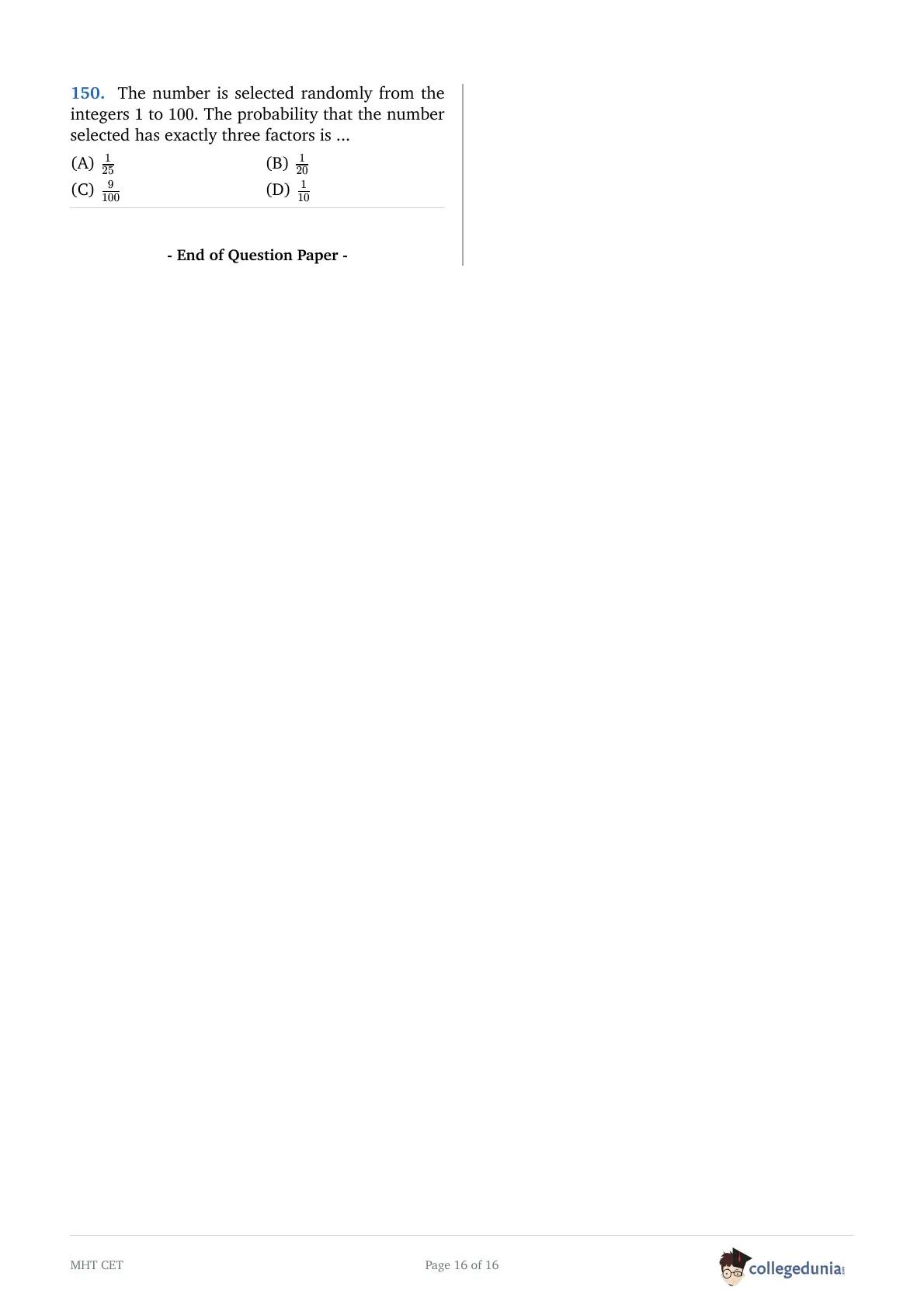
The number is selected randomly from the integers \(1\) to \(100\). The probability that the number selected has exactly three factors is ...
MHT CET 2026 PCM Exam Pattern and Marking Scheme
| Parameter | Details |
|---|---|
| Conducting Body | Maharashtra Common Entrance Test Cell (Maharashtra CET Cell) |
| Exam Mode | Online (Computer-Based Test) |
| Duration | 180 minutes (3 hours) |
| Groups / Subjects | PCM (Physics, Chemistry, Mathematics) for Engineering |
| Total Questions |
150 |
| Total Marks | 200 |
| Question Type | Multiple Choice Questions (MCQs) |
| Marks Distribution |
|
| Negative Marking | No |
| Syllabus Weightage |
|



Comments