




MHT CET 2026 May 12 Shift 2 PCM Question Paper is available for download here. Maharashtra State CET Cell conducted MHT CET 2026 PCM Exam on May 12 in Shift 2 from 2 PM to 5 PM in CBT mode.
The MHT CET 2026 PCM question paper includes the following:
- The MHT CET 2026 PCM Question Paper consists of 150 multiple-choice questions (MCQs) totalling 200 marks divided into 3 sections: Physics, Chemistry, and Mathematics, with 50 questions in each subject.
- Physics and Chemistry questions carry 1 mark each while Mathematics questions carry 2 marks each.
- There is no negative marking for incorrect answers.
MHT CET 2026 May 12 Shift 2 PCM Question Paper with Solution PDF
| CD PDF | CD PDF with Solutions |
|---|---|
| Download Collegedunia PDF 0.79 MB | - |
Also Check:
MHT CET 2026 May 12 Shift 2 PCM Questions with Solutions
Physics (Q1 - Q50)
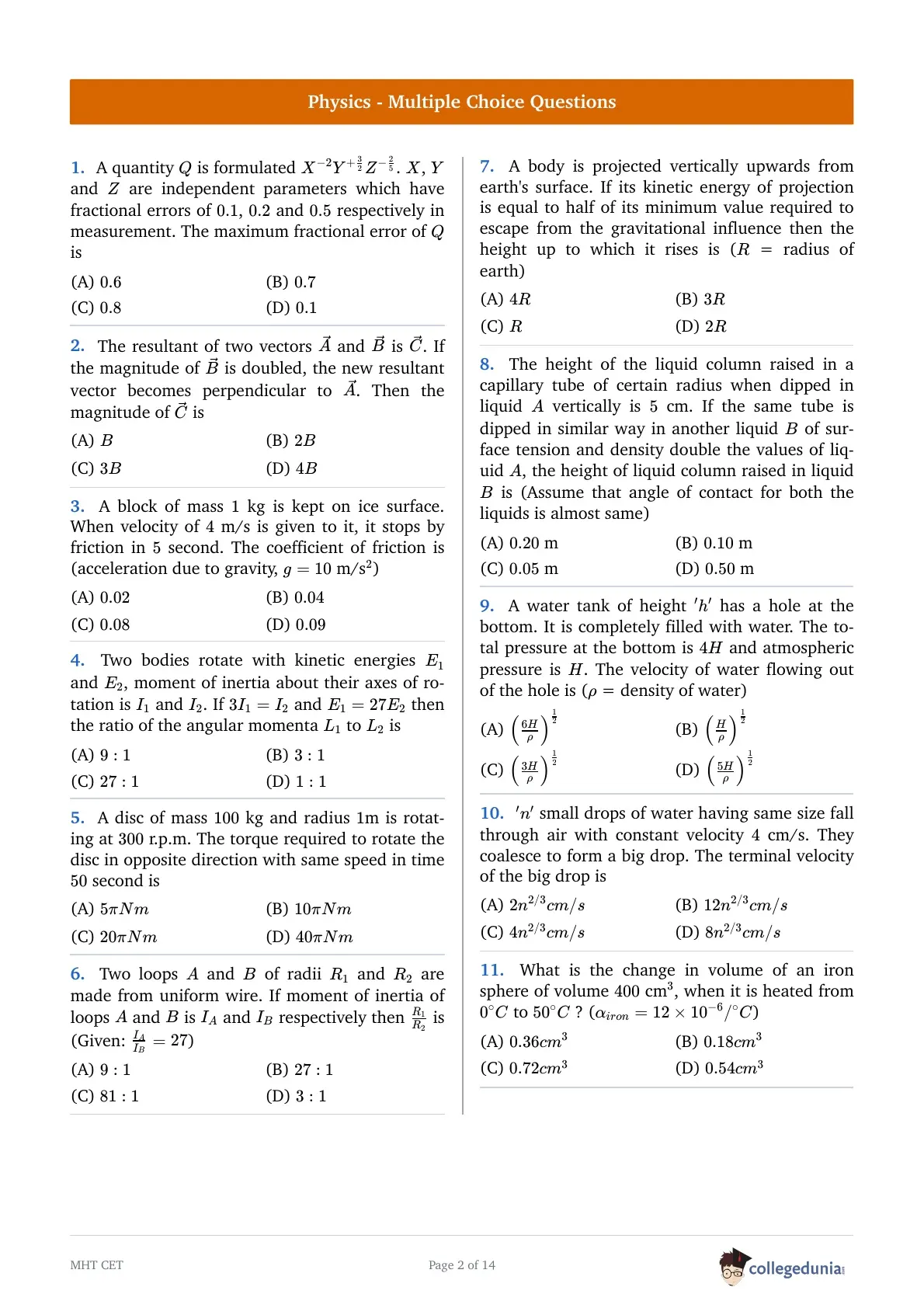
A quantity \(Q\) is formulated \(X^{-2}Y^{+\frac{3}{2}}Z^{-\frac{2}{5}}\). \(X\), \(Y\) and \(Z\) are independent parameters which have fractional errors of \(0.1\), \(0.2\) and \(0.5\) respectively in measurement. The maximum fractional error of \(Q\) is
The resultant of two vectors \(\vec{A}\) and \(\vec{B}\) is \(\vec{C}\). If the magnitude of \(\vec{B}\) is doubled, the new resultant vector becomes perpendicular to \(\vec{A}\). Then the magnitude of \(\vec{C}\) is
A block of mass \(1\) kg is kept on ice surface. When velocity of \(4\) m/s is given to it, it stops by friction in \(5\) second. The coefficient of friction is (acceleration due to gravity, \(g=10\) m/s\({}^{2}\))
Two bodies rotate with kinetic energies \(E_{1}\) and \(E_{2}\), moment of inertia about their axes of rotation is \(I_{1}\) and \(I_{2}\). If \(3I_{1}=I_{2}\) and \(E_{1}=27E_{2}\) then the ratio of the angular momenta \(L_{1}\) to \(L_{2}\) is
A disc of mass \(100\) kg and radius \(1\)m is rotating at \(300\) r.p.m. The torque required to rotate the disc in opposite direction with same speed in time \(50\) second is
Two loops \(A\) and \(B\) of radii \(R_{1}\) and \(R_{2}\) are made from uniform wire. If moment of inertia of loops \(A\) and \(B\) is \(I_{A}\) and \(I_{B}\) respectively then \(\frac{R_{1}}{R_{2}}\) is (Given: \(\frac{I_{A}}{I_{B}}=27\))
A body is projected vertically upwards from earth's surface. If its kinetic energy of projection is equal to half of its minimum value required to escape from the gravitational influence then the height up to which it rises is (\(R\) = radius of earth)
The height of the liquid column raised in a capillary tube of certain radius when dipped in liquid \(A\) vertically is \(5\) cm. If the same tube is dipped in similar way in another liquid \(B\) of surface tension and density double the values of liquid \(A\), the height of liquid column raised in liquid \(B\) is (Assume that angle of contact for both the liquids is almost same)
A water tank of height \({}'h'\) has a hole at the bottom. It is completely filled with water. The total pressure at the bottom is \(4H\) and atmospheric pressure is \(H\). The velocity of water flowing out of the hole is (\(\rho\) = density of water)
\({}'n'\) small drops of water having same size fall through air with constant velocity \(4\) cm/s. They coalesce to form a big drop. The terminal velocity of the big drop is
What is the change in volume of an iron sphere of volume \(400\) cm\({}^{3}\), when it is heated from \(0^{\circ }C\) to \(50^{\circ }C\) ? (\(\alpha _{iron}=12\times 10^{-6}/{}^{\circ }C\))
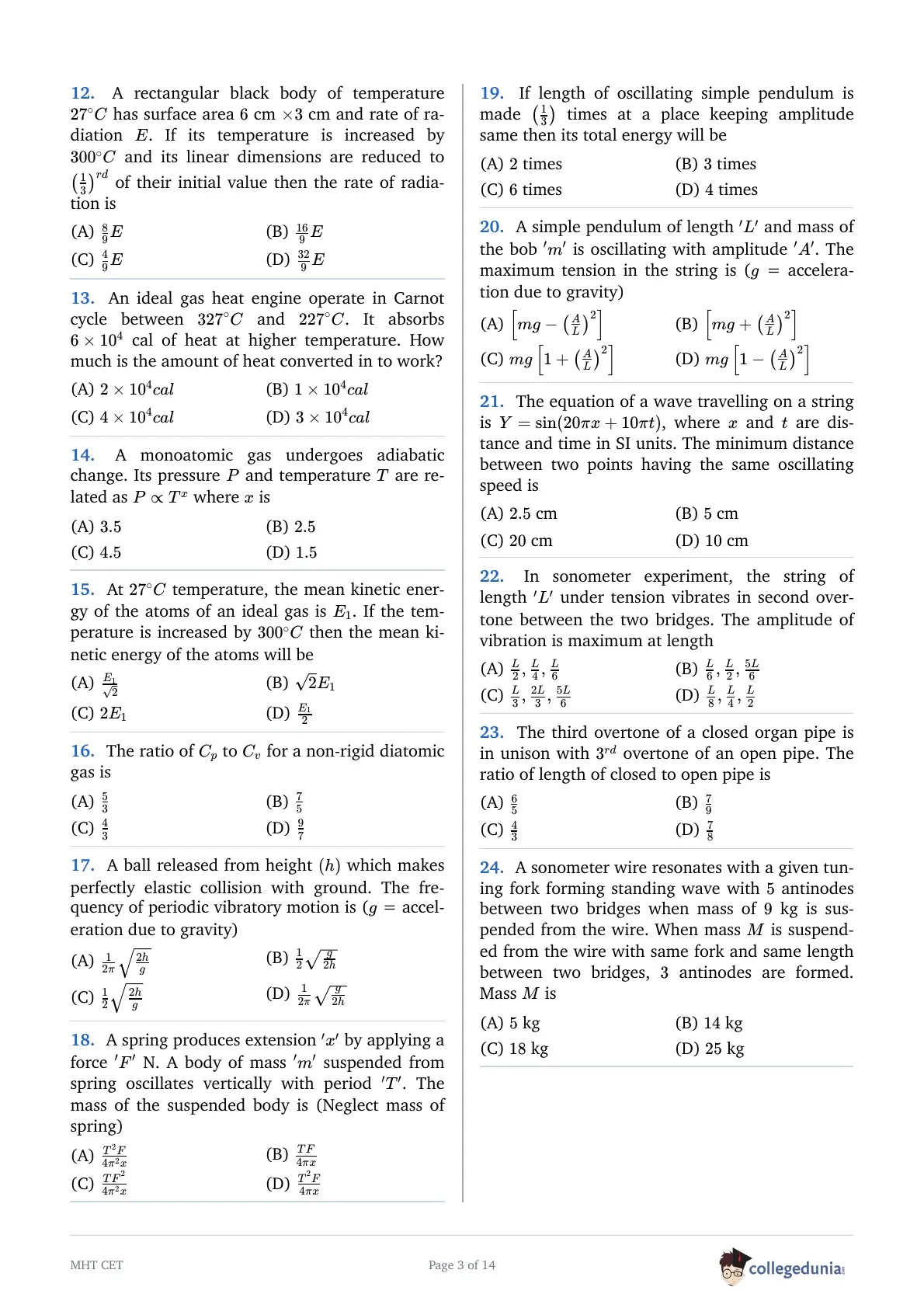
A rectangular black body of temperature \(27^{\circ }C\) has surface area \(6\) cm \(\times 3\) cm and rate of radiation \(E\). If its temperature is increased by \(300^{\circ }C\) and its linear dimensions are reduced to \(\left(\frac{1}{3}\right)^{rd}\) of their initial value then the rate of radiation is
An ideal gas heat engine operate in Carnot cycle between \(327^{\circ }C\) and \(227^{\circ }C\). It absorbs \(6\times 10^{4}\) cal of heat at higher temperature. How much is the amount of heat converted in to work?
A monoatomic gas undergoes adiabatic change. Its pressure \(P\) and temperature \(T\) are related as \(P\propto T^{x}\) where \(x\) is
At \(27^{\circ }C\) temperature, the mean kinetic energy of the atoms of an ideal gas is \(E_{1}\). If the temperature is increased by \(300^{\circ }C\) then the mean kinetic energy of the atoms will be
The ratio of \(C_{p}\) to \(C_{v}\) for a non-rigid diatomic gas is
A ball released from height \((h)\) which makes perfectly elastic collision with ground. The frequency of periodic vibratory motion is (\(g\) = acceleration due to gravity)
A spring produces extension \({}'x'\) by applying a force \({}'F'\) N. A body of mass \({}'m'\) suspended from spring oscillates vertically with period \({}'T'\). The mass of the suspended body is (Neglect mass of spring)
If length of oscillating simple pendulum is made \(\left(\frac{1}{3}\right)\) times at a place keeping amplitude same then its total energy will be
A simple pendulum of length \({}'L'\) and mass of the bob \({}'m'\) is oscillating with amplitude \({}'A'\). The maximum tension in the string is (\(g\) = acceleration due to gravity)
The equation of a wave travelling on a string is \(Y=\sin (20\pi x+10\pi t)\), where \(x\) and \(t\) are distance and time in SI units. The minimum distance between two points having the same oscillating speed is
In sonometer experiment, the string of length \({}'L'\) under tension vibrates in second overtone between the two bridges. The amplitude of vibration is maximum at length
The third overtone of a closed organ pipe is in unison with \(3^{rd}\) overtone of an open pipe. The ratio of length of closed to open pipe is
A sonometer wire resonates with a given tuning fork forming standing wave with \(5\) antinodes between two bridges when mass of \(9\) kg is suspended from the wire. When mass \(M\) is suspended from the wire with same fork and same length between two bridges, \(3\) antinodes are formed. Mass \(M\) is
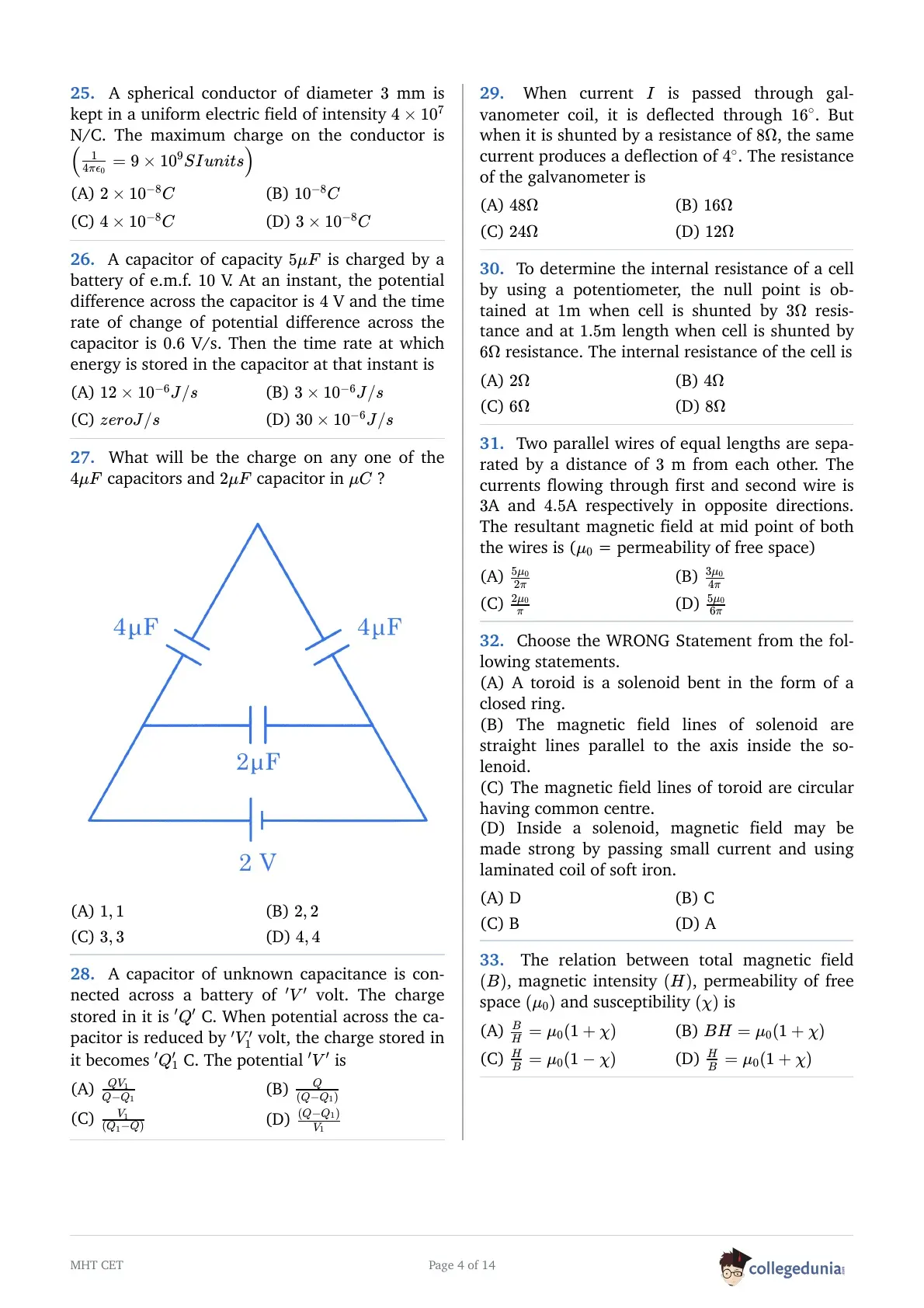
A spherical conductor of diameter \(3\) mm is kept in a uniform electric field of intensity \(4\times 10^{7}\) N/C. The maximum charge on the conductor is \(\left(\frac{1}{4\pi \epsilon _{0}}=9\times 10^{9}SIunits\right)\)
A capacitor of capacity \(5\mu F\) is charged by a battery of e.m.f. \(10\) V. At an instant, the potential difference across the capacitor is \(4\) V and the time rate of change of potential difference across the capacitor is \(0.6\) V/s. Then the time rate at which energy is stored in the capacitor at that instant is
What will be the charge on any one of the \(4\mu F\) capacitors and \(2\mu F\) capacitor in \(\mu C\) ?

A capacitor of unknown capacitance is connected across a battery of \({}'V'\) volt. The charge stored in it is \({}'Q'\) C. When potential across the capacitor is reduced by \({}'V_{1}'\) volt, the charge stored in it becomes \({}'Q_{1}'\) C. The potential \({}'V'\) is
When current \(I\) is passed through galvanometer coil, it is deflected through \(16^{\circ }\). But when it is shunted by a resistance of \(8\Omega\), the same current produces a deflection of \(4^{\circ }\). The resistance of the galvanometer is
To determine the internal resistance of a cell by using a potentiometer, the null point is obtained at \(1\)m when cell is shunted by \(3\Omega\) resistance and at \(1.5\)m length when cell is shunted by \(6\Omega\) resistance. The internal resistance of the cell is
Two parallel wires of equal lengths are separated by a distance of \(3\) m from each other. The currents flowing through first and second wire is \(3\)A and \(4.5\)A respectively in opposite directions. The resultant magnetic field at mid point of both the wires is (\(\mu _{0}\) = permeability of free space)
Choose the WRONG Statement from the following statements.
(A) A toroid is a solenoid bent in the form of a closed ring.
(B) The magnetic field lines of solenoid are straight lines parallel to the axis inside the solenoid.
(C) The magnetic field lines of toroid are circular having common centre.
(D) Inside a solenoid, magnetic field may be made strong by passing small current and using laminated coil of soft iron.
The relation between total magnetic field \((B)\), magnetic intensity \((H)\), permeability of free space \((\mu _{0})\) and susceptibility \((\chi )\) is
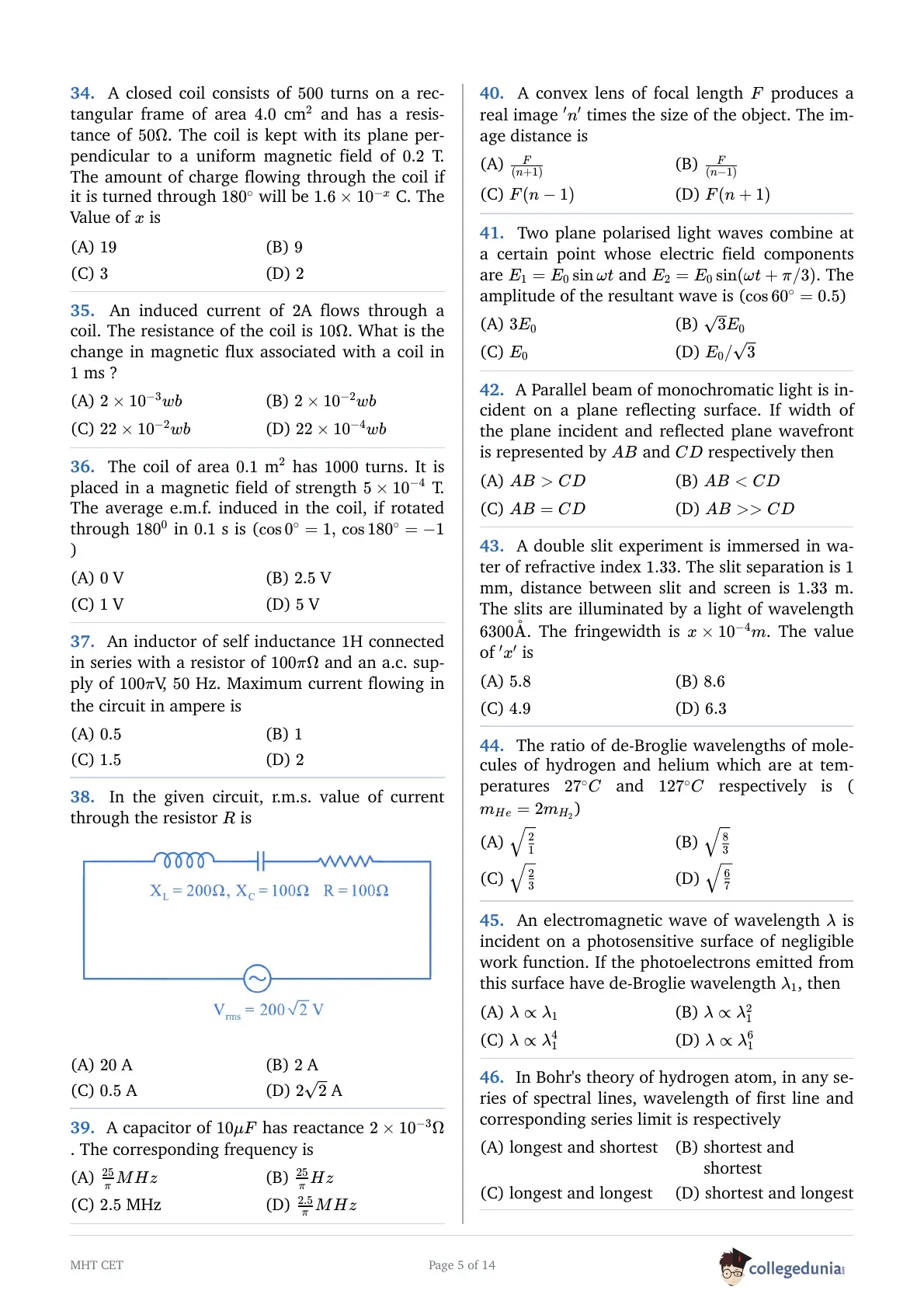
A closed coil consists of \(500\) turns on a rectangular frame of area \(4.0\) cm\({}^{2}\) and has a resistance of \(50\Omega\). The coil is kept with its plane perpendicular to a uniform magnetic field of \(0.2\) T. The amount of charge flowing through the coil if it is turned through \(180^{\circ }\) will be \(1.6\times 10^{-x}\) C. The Value of \(x\) is
An induced current of \(2\)A flows through a coil. The resistance of the coil is \(10\Omega\). What is the change in magnetic flux associated with a coil in \(1\) ms ?
The coil of area \(0.1\) m\({}^{2}\) has \(1000\) turns. It is placed in a magnetic field of strength \(5\times 10^{-4}\) T. The average e.m.f. induced in the coil, if rotated through \(180^{0}\) in \(0.1\) s is (\(\cos 0^{\circ }=1,\,\cos 180^{\circ }=-1\))
An inductor of self inductance \(1\)H connected in series with a resistor of \(100\pi \Omega\) and an a.c. supply of \(100\pi\)V, \(50\) Hz. Maximum current flowing in the circuit in ampere is
In the given circuit, r.m.s. value of current through the resistor \(R\) is

A capacitor of \(10\mu F\) has reactance \(2\times 10^{-3}\Omega\). The corresponding frequency is
A convex lens of focal length \(F\) produces a real image \({}'n'\) times the size of the object. The image distance is
Two plane polarised light waves combine at a certain point whose electric field components are \(E_{1}=E_{0}\sin \omega t\) and \(E_{2}=E_{0}\sin (\omega t+\pi /3)\). The amplitude of the resultant wave is (\(\cos 60^{\circ }=0.5\))
A Parallel beam of monochromatic light is incident on a plane reflecting surface. If width of the plane incident and reflected plane wavefront is represented by \(AB\) and \(CD\) respectively then
A double slit experiment is immersed in water of refractive index \(1.33\). The slit separation is \(1\) mm, distance between slit and screen is \(1.33\) m. The slits are illuminated by a light of wavelength \(6300\text{Å}\). The fringewidth is \(x\times 10^{-4}m\). The value of \({}'x'\) is
The ratio of de-Broglie wavelengths of molecules of hydrogen and helium which are at temperatures \(27^{\circ }C\) and \(127^{\circ }C\) respectively is (\(m_{He}=2m_{H_{2}}\))
An electromagnetic wave of wavelength \(\lambda\) is incident on a photosensitive surface of negligible work function. If the photoelectrons emitted from this surface have de-Broglie wavelength \(\lambda _{1}\), then
In Bohr's theory of hydrogen atom, in any series of spectral lines, wavelength of first line and corresponding series limit is respectively
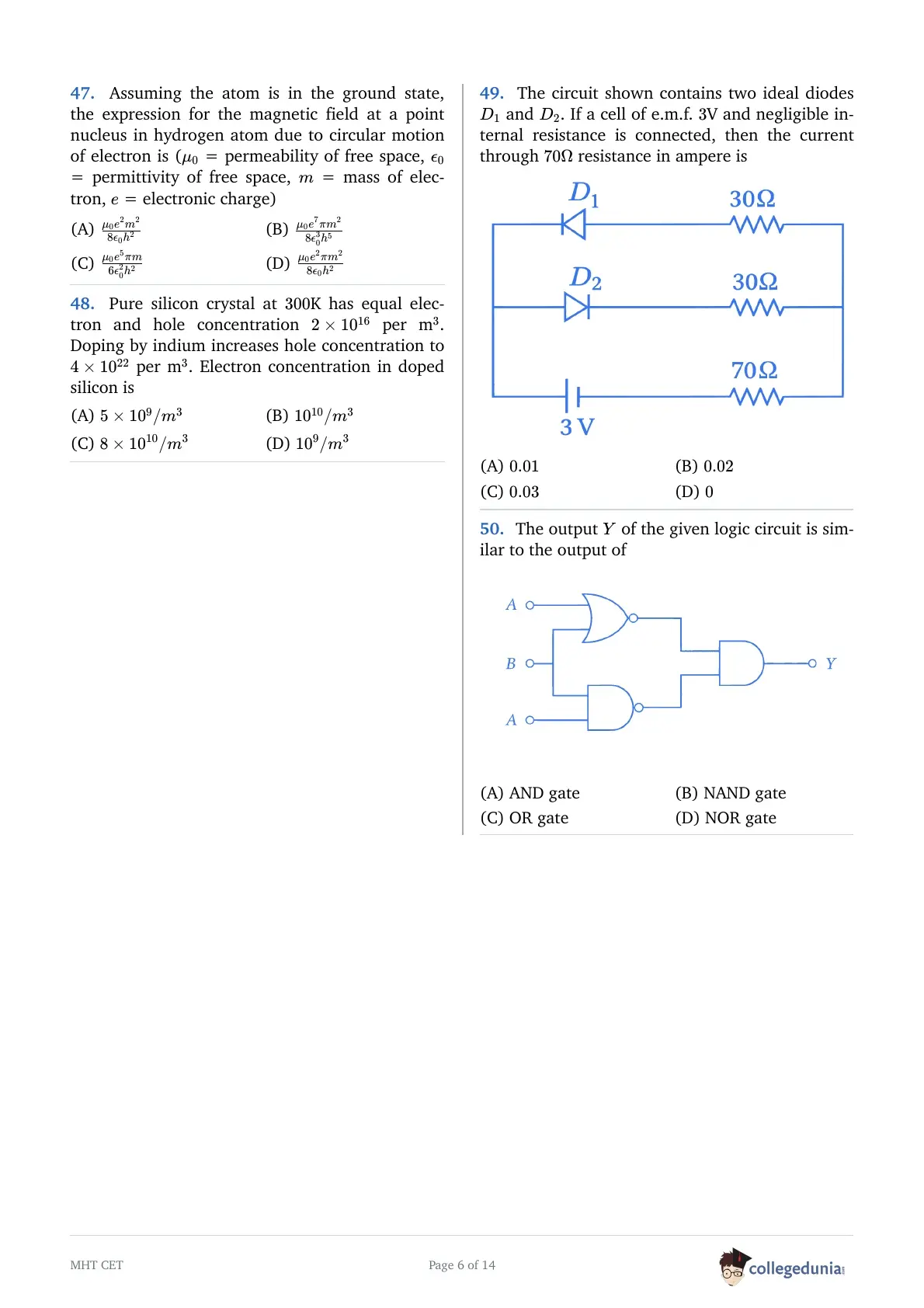
Assuming the atom is in the ground state, the expression for the magnetic field at a point nucleus in hydrogen atom due to circular motion of electron is (\(\mu _{0}\) = permeability of free space, \(\epsilon _{0}\) = permittivity of free space, \(m\) = mass of electron, \(e\) = electronic charge)
Pure silicon crystal at \(300\)K has equal electron and hole concentration \(2\times 10^{16}\) per m\({}^{3}\). Doping by indium increases hole concentration to \(4\times 10^{22}\) per m\({}^{3}\). Electron concentration in doped silicon is
The circuit shown contains two ideal diodes \(D_{1}\) and \(D_{2}\). If a cell of e.m.f. \(3\)V and negligible internal resistance is connected, then the current through \(70\Omega\) resistance in ampere is

The output \(Y\) of the given logic circuit is similar to the output of

Chemistry (Q51 - Q100)
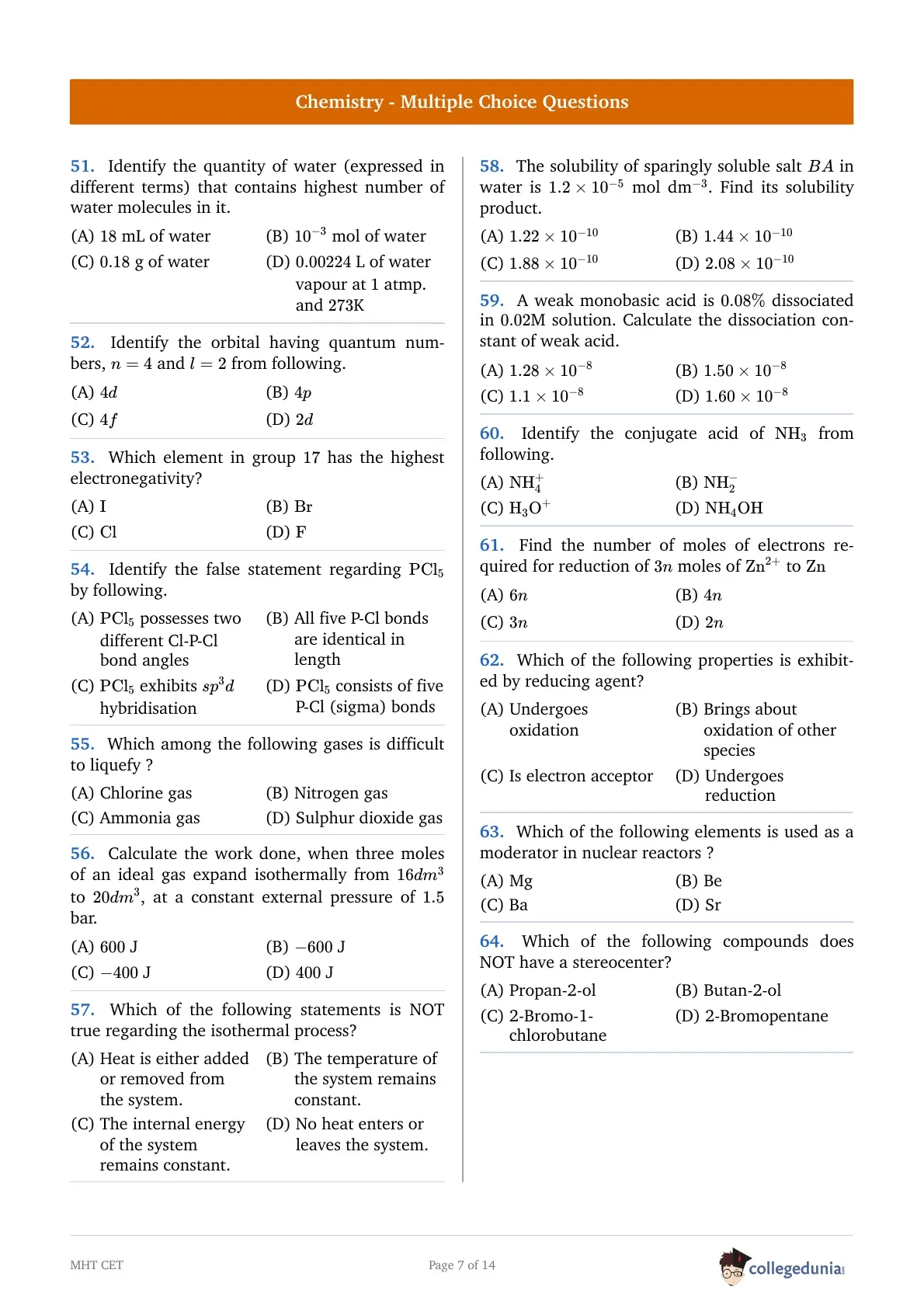
Identify the quantity of water (expressed in different terms) that contains highest number of water molecules in it.
Identify the orbital having quantum numbers, \(n=4\) and \(l=2\) from following.
Which element in group \(17\) has the highest electronegativity?
Identify the false statement regarding \(\text{PCl}_{5}\) by following.
Which among the following gases is difficult to liquefy ?
Calculate the work done, when three moles of an ideal gas expand isothermally from \(16dm^{3}\) to \(20dm^{3}\), at a constant external pressure of \(1.5\) bar.
Which of the following statements is NOT true regarding the isothermal process?
The solubility of sparingly soluble salt \(BA\) in water is \(1.2\times 10^{-5}\) mol dm\({}^{-3}\). Find its solubility product.
A weak monobasic acid is \(0.08\%\) dissociated in \(0.02\)M solution. Calculate the dissociation constant of weak acid.
Identify the conjugate acid of \(\text{NH}_{3}\) from following.
Find the number of moles of electrons required for reduction of \(3n\) moles of \(\text{Zn}^{2+}\) to \(\text{Zn}\)
Which of the following properties is exhibited by reducing agent?
Which of the following elements is used as a moderator in nuclear reactors ?
Which of the following compounds does NOT have a stereocenter?
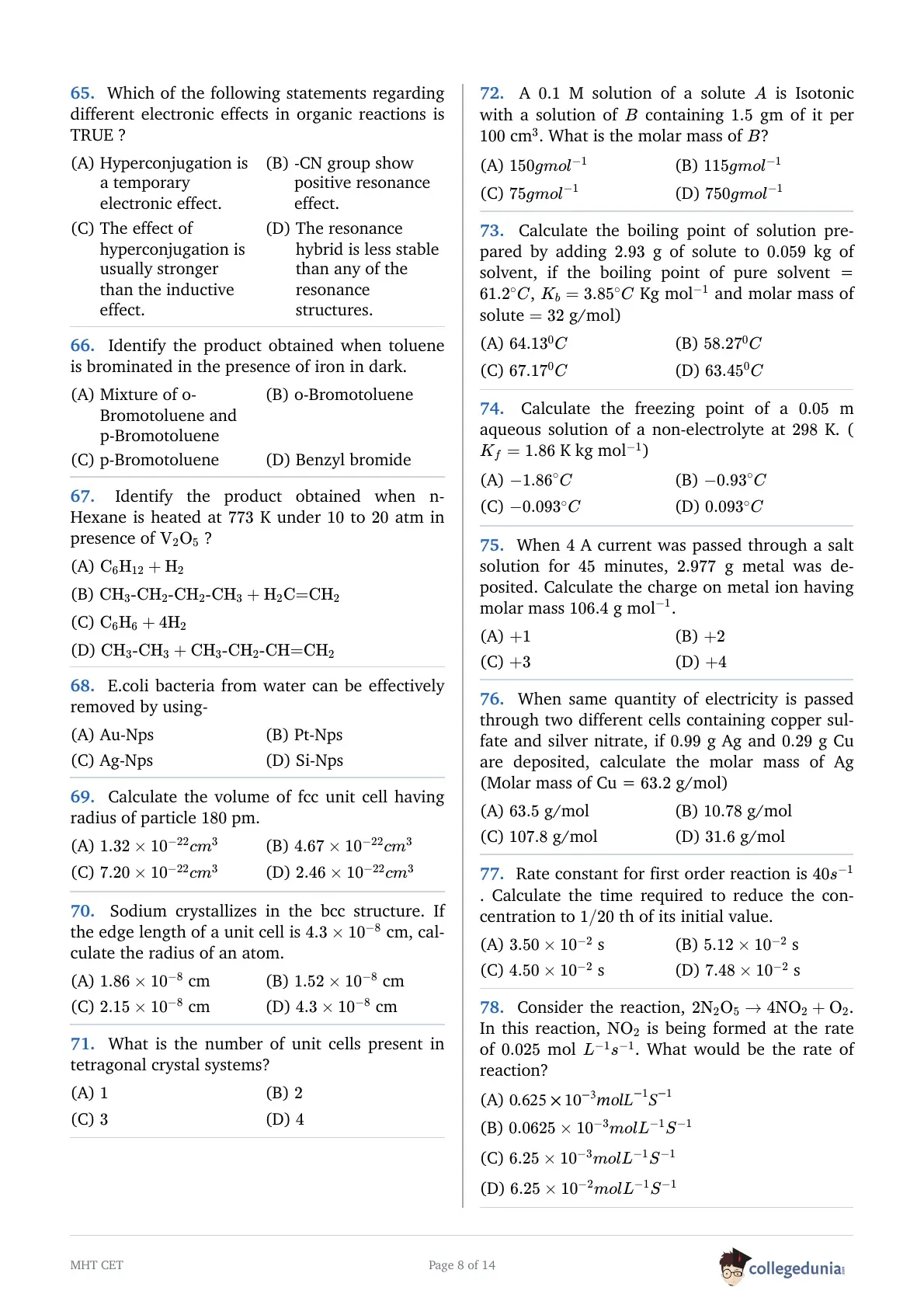
Which of the following statements regarding different electronic effects in organic reactions is TRUE ?
Identify the product obtained when toluene is brominated in the presence of iron in dark.
Identify the product obtained when n-Hexane is heated at \(773\) K under \(10\) to \(20\) atm in presence of \(\text{V}_{2}\text{O}_{5}\) ?
E.coli bacteria from water can be effectively removed by using-
Calculate the volume of fcc unit cell having radius of particle \(180\) pm.
Sodium crystallizes in the bcc structure. If the edge length of a unit cell is \(4.3\times 10^{-8}\) cm, calculate the radius of an atom.
What is the number of unit cells present in tetragonal crystal systems?
A \(0.1\) M solution of a solute \(A\) is Isotonic with a solution of \(B\) containing \(1.5\) gm of it per \(100\) cm\({}^{3}\). What is the molar mass of \(B\)?
Calculate the boiling point of solution prepared by adding \(2.93\) g of solute to \(0.059\) kg of solvent, if the boiling point of pure solvent = \(61.2^{\circ }C\), \(K_{b}=3.85^{\circ }C\) Kg mol\({}^{-1}\) and molar mass of solute \(=32\) g/mol)
Calculate the freezing point of a \(0.05\) m aqueous solution of a non-electrolyte at \(298\) K. (\(K_{f}=1.86\) K kg mol\({}^{-1}\))
When \(4\) A current was passed through a salt solution for \(45\) minutes, \(2.977\) g metal was deposited. Calculate the charge on metal ion having molar mass \(106.4\) g mol\({}^{-1}\).
When same quantity of electricity is passed through two different cells containing copper sulfate and silver nitrate, if \(0.99\) g Ag and \(0.29\) g Cu are deposited, calculate the molar mass of Ag (Molar mass of Cu = \(63.2\) g/mol)
Rate constant for first order reaction is \(40s^{-1}\). Calculate the time required to reduce the concentration to \(1/20\) th of its initial value.
Consider the reaction, \(2\text{N}_{2}\text{O}_{5}\rightarrow 4\text{NO}_{2}+\text{O}_{2}\). In this reaction, \(\text{NO}_{2}\) is being formed at the rate of \(0.025\) mol \(L^{-1}s^{-1}\). What would be the rate of reaction?
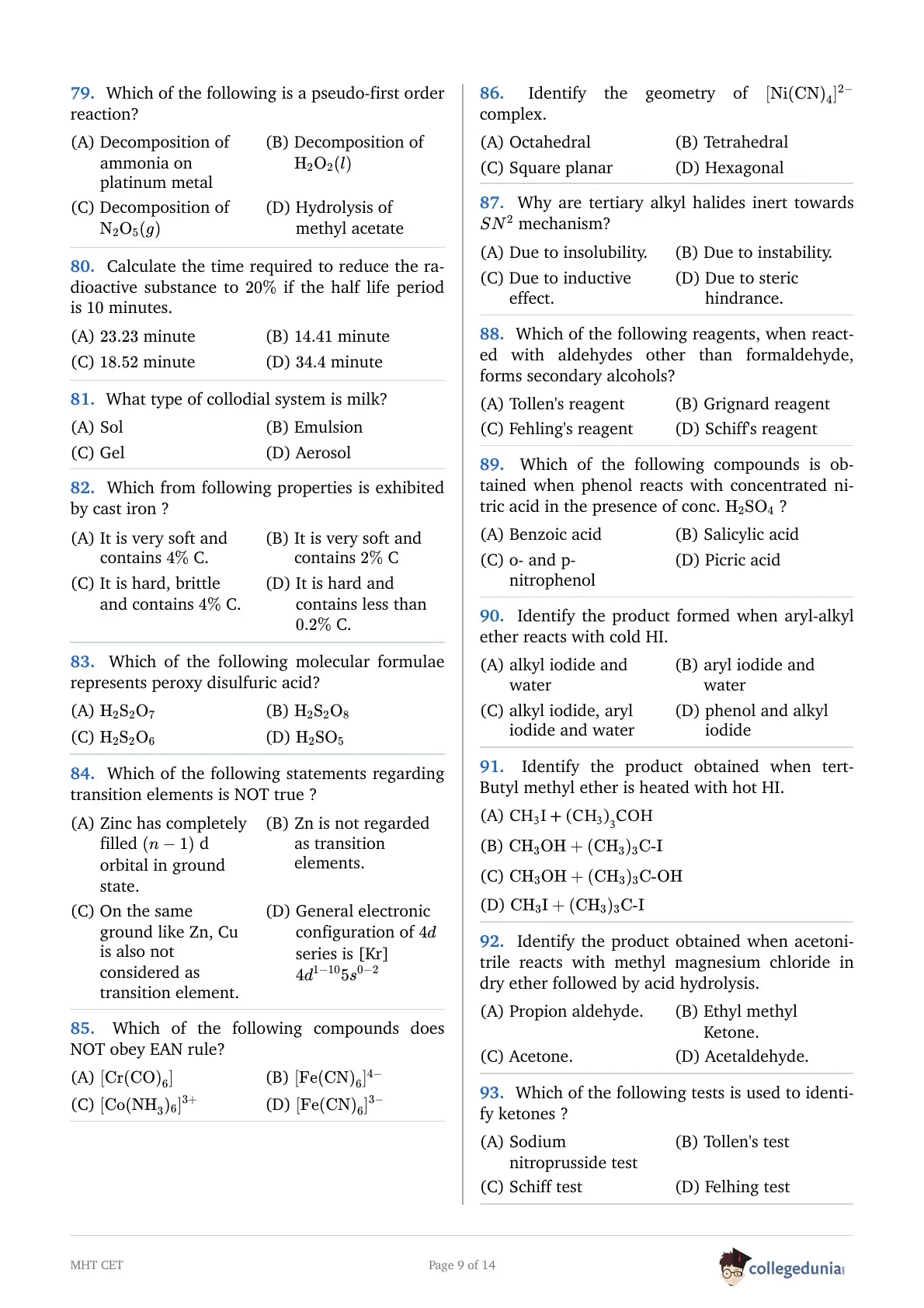
Which of the following is a pseudo-first order reaction?
Calculate the time required to reduce the radioactive substance to \(20\%\) if the half life period is \(10\) minutes.
What type of collodial system is milk?
Which from following properties is exhibited by cast iron ?
Which of the following molecular formulae represents peroxy disulfuric acid?
Which of the following statements regarding transition elements is NOT true ?
Which of the following compounds does NOT obey EAN rule?
Identify the geometry of \([\text{Ni(CN)}_{4}]^{2-}\) complex.
Why are tertiary alkyl halides inert towards \(SN^{2}\) mechanism?
Which of the following reagents, when reacted with aldehydes other than formaldehyde, forms secondary alcohols?
Which of the following compounds is obtained when phenol reacts with concentrated nitric acid in the presence of conc. \(\text{H}_{2}\text{SO}_{4}\) ?
Identify the product formed when aryl-alkyl ether reacts with cold HI.
Identify the product obtained when tert-Butyl methyl ether is heated with hot HI.
Identify the product obtained when acetonitrile reacts with methyl magnesium chloride in dry ether followed by acid hydrolysis.
Which of the following tests is used to identify ketones ?
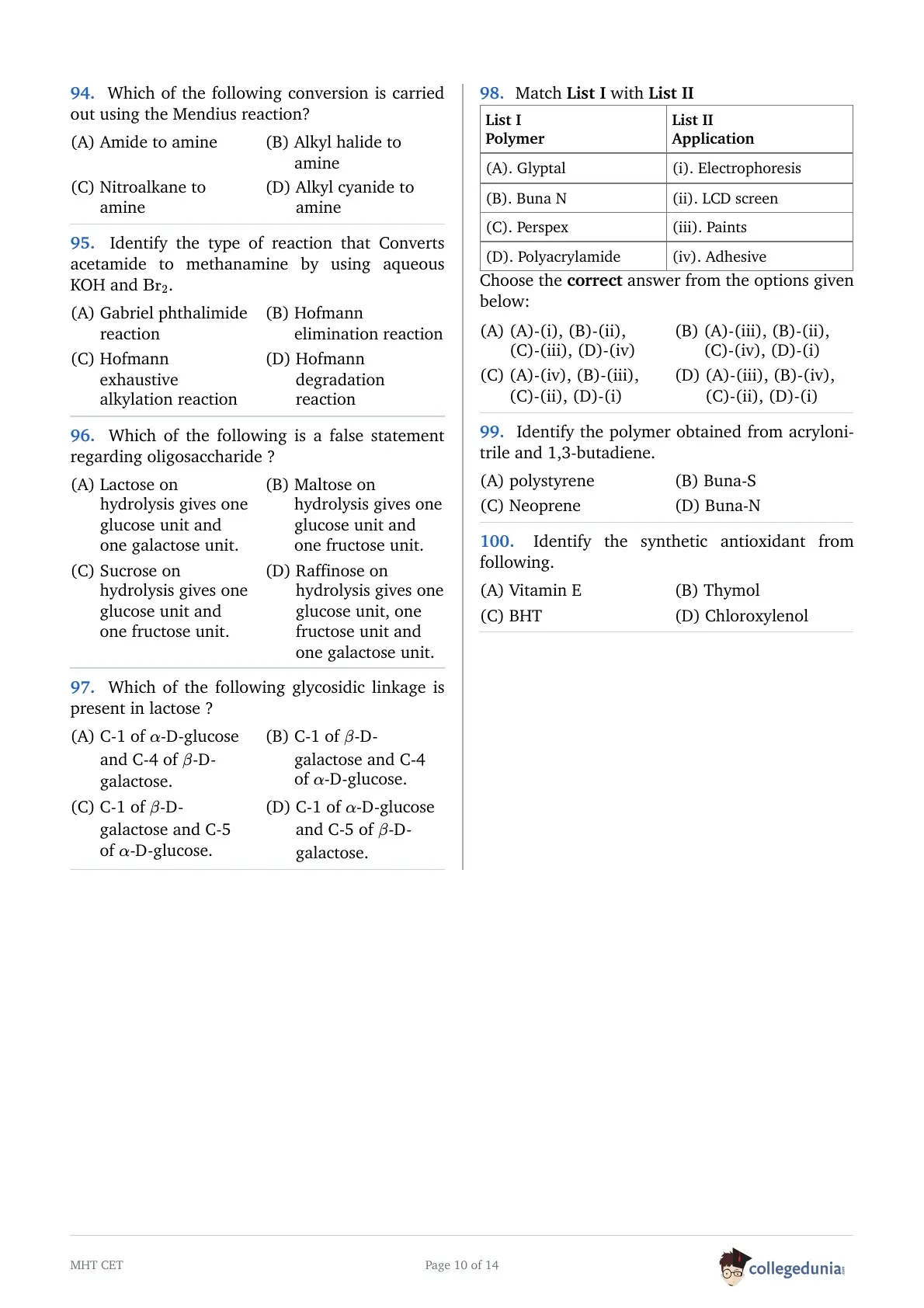
Which of the following conversion is carried out using the Mendius reaction?
Identify the type of reaction that Converts acetamide to methanamine by using aqueous KOH and \(\text{Br}_{2}\).
Which of the following is a false statement regarding oligosaccharide ?
Which of the following glycosidic linkage is present in lactose ?
Match List I with List II
| List I Polymer | List II Application |
|---|---|
| (A). Glyptal | (i). Electrophoresis |
| (B). Buna N | (ii). LCD screen |
| (C). Perspex | (iii). Paints |
| (D). Polyacrylamide | (iv). Adhesive |
Identify the polymer obtained from acrylonitrile and 1,3-butadiene.
Identify the synthetic antioxidant from following.
Mathematics (Q101 - Q150)
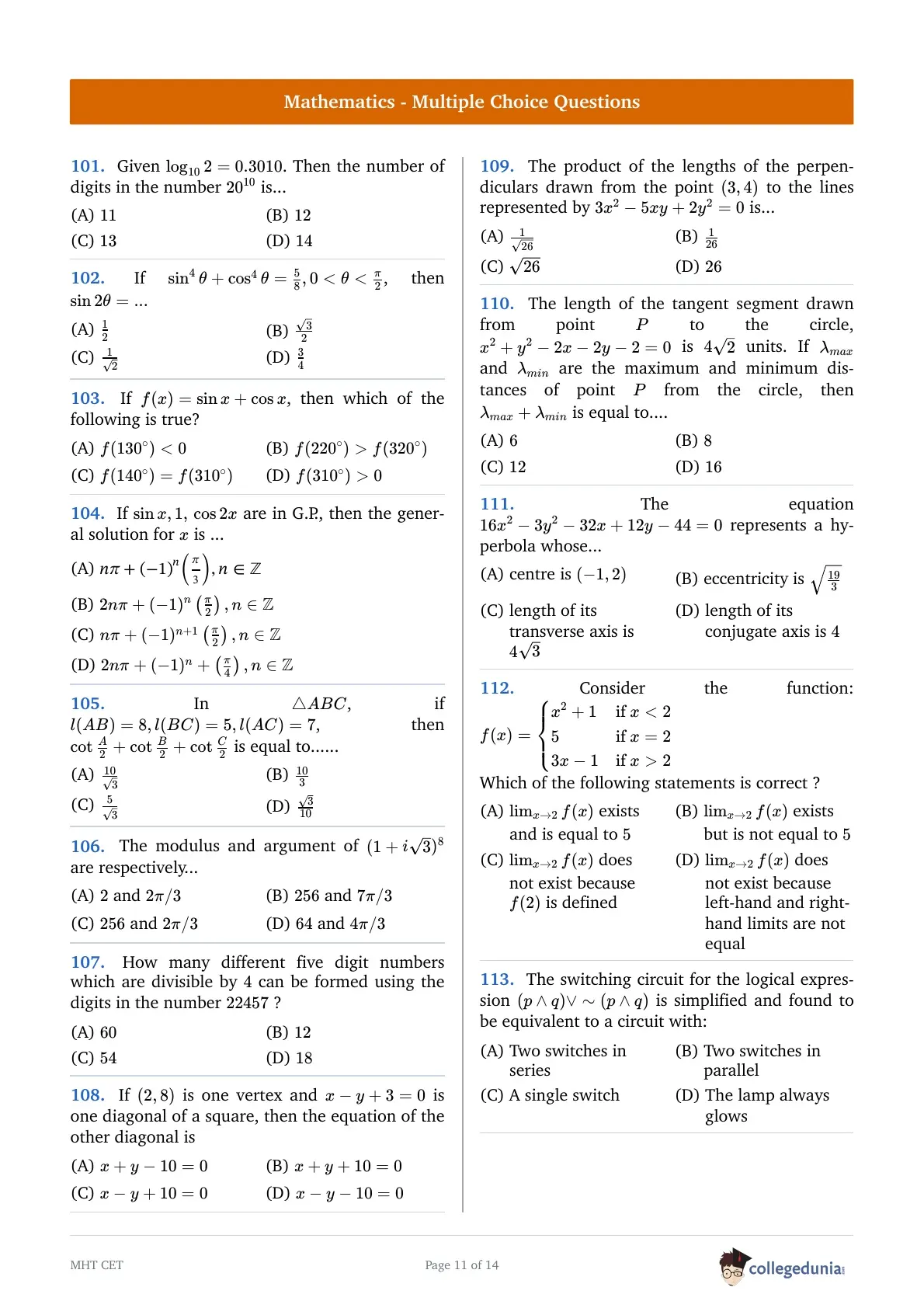
Given \(\log _{10}2=0.3010\). Then the number of digits in the number \(20^{10}\) is...
If \(\sin ^{4}\theta +\cos ^{4}\theta =\frac{5}{8},0\lt \theta \lt \frac{\pi }{2}\), then \(\sin 2\theta =...\)
If \(f(x)=\sin x+\cos x\), then which of the following is true?
If \(\sin x,1,\,\cos 2x\) are in G.P., then the general solution for \(x\) is ...
In \(\triangle ABC\), if \(l(AB)=8,l(BC)=5,l(AC)=7\), then \(\cot \frac{A}{2}+\cot \frac{B}{2}+\cot \frac{C}{2}\) is equal to......
The modulus and argument of \((1+i\sqrt{3})^{8}\) are respectively...
How many different five digit numbers which are divisible by \(4\) can be formed using the digits in the number \(22457\) ?
If \((2,8)\) is one vertex and \(x-y+3=0\) is one diagonal of a square, then the equation of the other diagonal is
The product of the lengths of the perpendiculars drawn from the point \((3,4)\) to the lines represented by \(3x^{2}-5xy+2y^{2}=0\) is...
The length of the tangent segment drawn from point \(P\) to the circle, \(x^{2}+y^{2}-2x-2y-2=0\) is \(4\sqrt{2}\) units. If \(\lambda _{max}\) and \(\lambda _{min}\) are the maximum and minimum distances of point \(P\) from the circle, then \(\lambda _{max}+\lambda _{min}\) is equal to....
The equation \(16x^{2}-3y^{2}-32x+12y-44=0\) represents a hyperbola whose...
Consider the function: \(f(x)=\begin{cases} x^{2}+1 & \text{if }x\lt 2 \\ 5 & \text{if }x=2 \\ 3x-1 & \text{if }x>2 \end{cases}\)
Which of the following statements is correct ?
The switching circuit for the logical expression \((p\wedge q)\vee \sim (p\wedge q)\) is simplified and found to be equivalent to a circuit with:
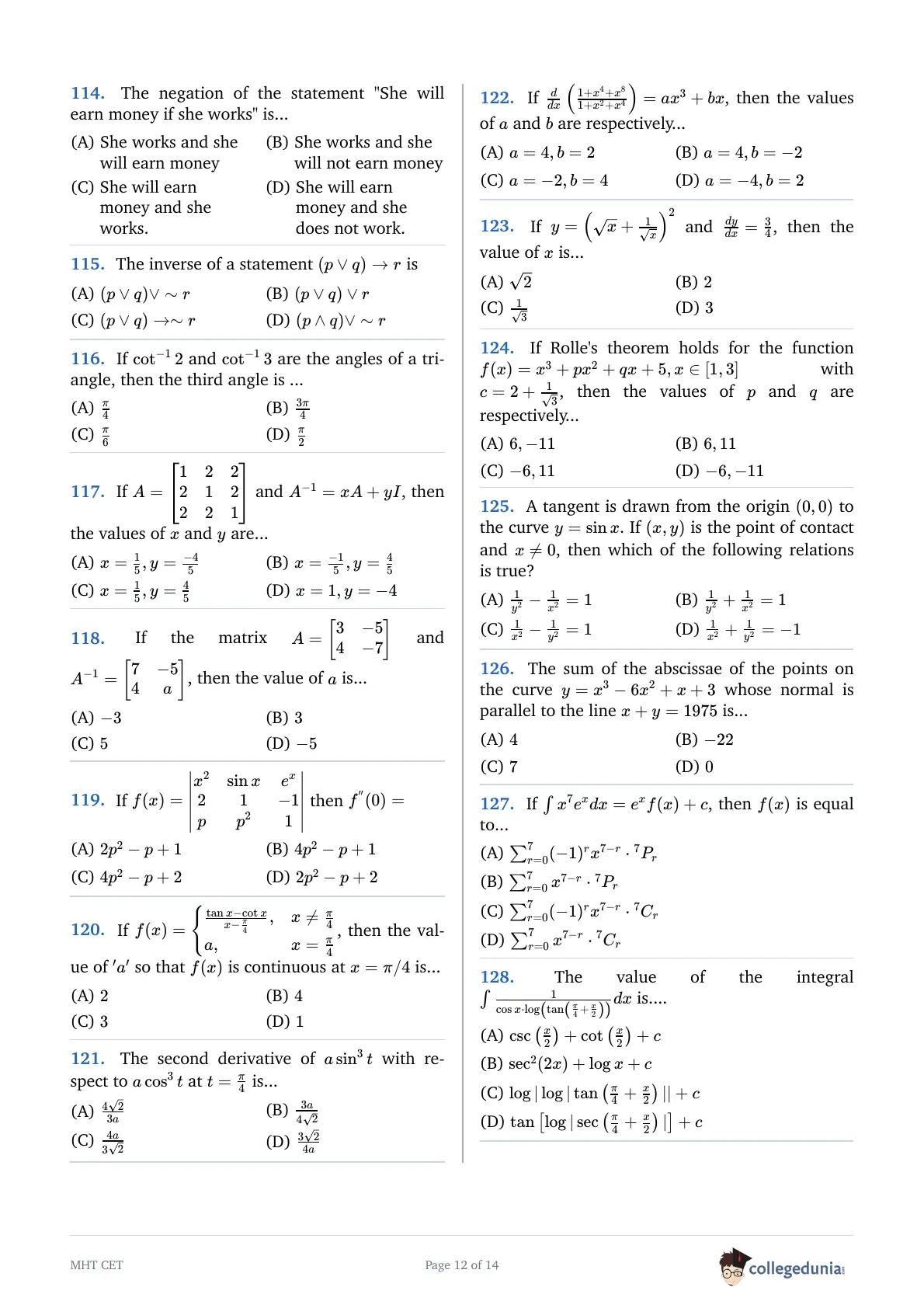
The negation of the statement "She will earn money if she works" is...
The inverse of a statement \((p\vee q)\rightarrow r\) is
If \(\cot ^{-1}2\) and \(\cot ^{-1}3\) are the angles of a triangle, then the third angle is ...
If \(A=\begin{bmatrix} 1 & 2 & 2 \\ 2 & 1 & 2 \\ 2 & 2 & 1 \end{bmatrix}\) and \(A^{-1}=xA+yI\), then the values of \(x\) and \(y\) are...
If the matrix \(A=\begin{bmatrix} 3 & -5 \\ 4 & -7 \end{bmatrix}\) and \(A^{-1}=\begin{bmatrix} 7 & -5 \\ 4 & a \end{bmatrix}\), then the value of \(a\) is...
If \(f(x)=\begin{vmatrix} x^{2} & \sin x & e^{x} \\ 2 & 1 & -1 \\ p & p^{2} & 1 \end{vmatrix}\) then \(f^{''}(0)=\)
If \(f(x)=\begin{cases} \frac{\tan x-\cot x}{x-\frac{\pi }{4}}, & x\neq \frac{\pi }{4} \\ a, & x=\frac{\pi }{4} \end{cases}\), then the value of \({}'a'\) so that \(f(x)\) is continuous at \(x=\pi /4\) is...
The second derivative of \(a\sin ^{3}t\) with respect to \(a\cos ^{3}t\) at \(t=\frac{\pi }{4}\) is...
If \(\frac{d}{dx}\left(\frac{1+x^{4}+x^{8}}{1+x^{2}+x^{4}}\right)=ax^{3}+bx\), then the values of \(a\) and \(b\) are respectively...
If \(y=\left(\sqrt{x}+\frac{1}{\sqrt{x}}\right)^{2}\) and \(\frac{dy}{dx}=\frac{3}{4}\), then the value of \(x\) is...
If Rolle's theorem holds for the function \(f(x)=x^{3}+px^{2}+qx+5,x\in [1,3]\) with \(c=2+\frac{1}{\sqrt{3}}\), then the values of \(p\) and \(q\) are respectively...
A tangent is drawn from the origin \((0,0)\) to the curve \(y=\sin x\). If \((x,y)\) is the point of contact and \(x\neq 0\), then which of the following relations is true?
The sum of the abscissae of the points on the curve \(y=x^{3}-6x^{2}+x+3\) whose normal is parallel to the line \(x+y=1975\) is...
If \(\int x^{7}e^{x}dx=e^{x}f(x)+c\), then \(f(x)\) is equal to...
The value of the integral \(\int \frac{1}{\cos x\cdot \log \left(\tan \left(\frac{\pi }{4}+\frac{x}{2}\right)\right)}dx\) is....
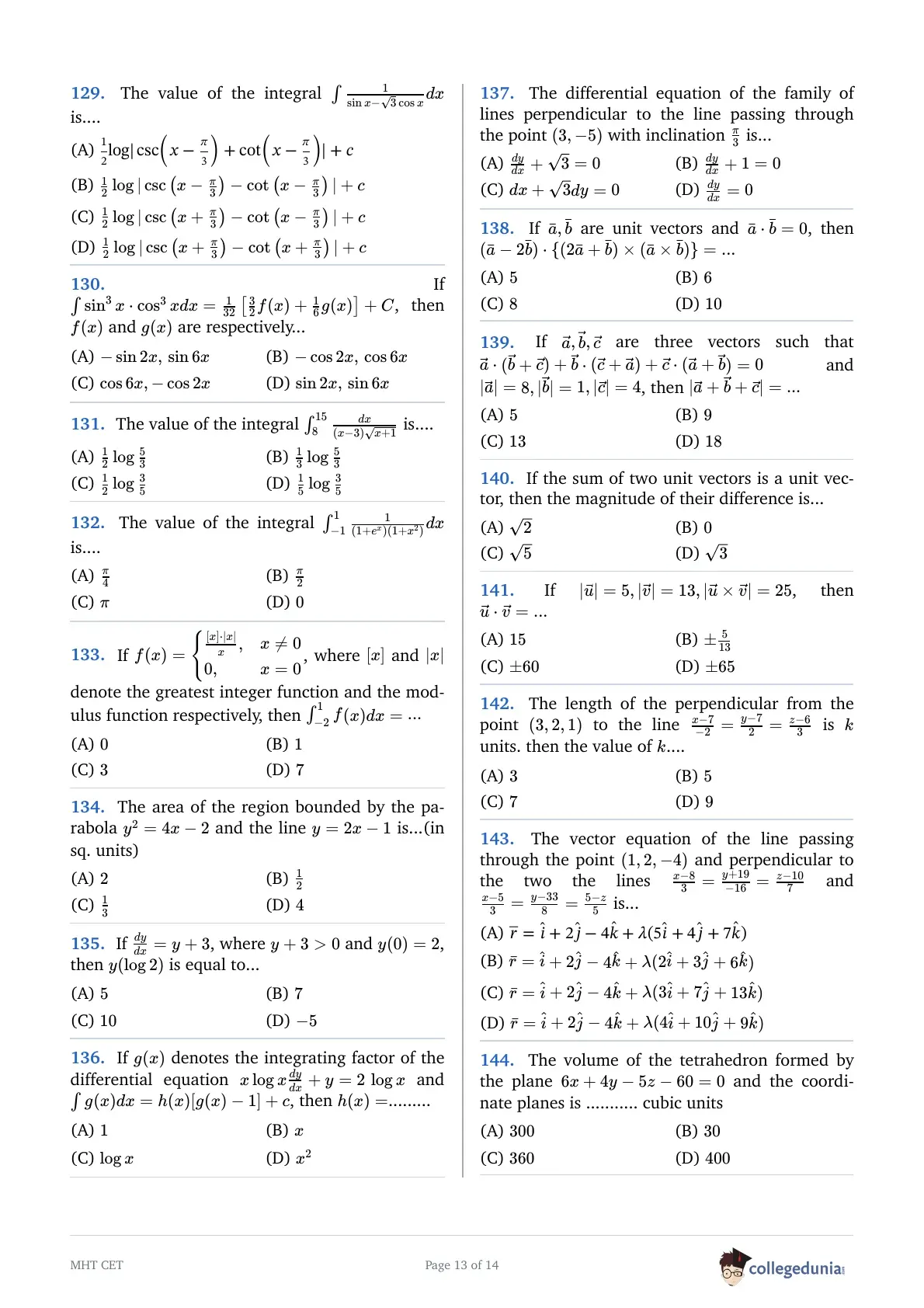
The value of the integral \(\int \frac{1}{\sin x-\sqrt{3}\cos x}dx\) is....
If \(\int \sin ^{3}x\cdot \cos ^{3}xdx=\frac{1}{32}\left[\frac{3}{2}f(x)+\frac{1}{6}g(x)\right]+C\), then \(f(x)\) and \(g(x)\) are respectively...
The value of the integral \(\int _{8}^{15}\frac{dx}{(x-3)\sqrt{x+1}}\) is....
The value of the integral \(\int _{-1}^{1}\frac{1}{(1+e^{x})(1+x^{2})}dx\) is....
If \(f(x)=\begin{cases} \frac{[x]\cdot |x|}{x}, & x\neq 0 \\ 0, & x=0 \end{cases}\), where \([x]\) and \(|x|\) denote the greatest integer function and the modulus function respectively, then \(\int _{-2}^{1}f(x)dx=...\)
The area of the region bounded by the parabola \(y^{2}=4x-2\) and the line \(y=2x-1\) is...(in sq. units)
If \(\frac{dy}{dx}=y+3\), where \(y+3>0\) and \(y(0)=2\), then \(y(\log 2)\) is equal to...
If \(g(x)\) denotes the integrating factor of the differential equation \(x\log x\frac{dy}{dx}+y=2\,\log x\) and \(\int g(x)dx=h(x)[g(x)-1]+c\), then \(h(x)=\).........
The differential equation of the family of lines perpendicular to the line passing through the point \((3,-5)\) with inclination \(\frac{\pi }{3}\) is...
If \(\bar{a},\bar{b}\) are unit vectors and \(\bar{a}\cdot \bar{b}=0\), then \((\bar{a}-2\bar{b})\cdot \{(2\bar{a}+\bar{b})\times (\bar{a}\times \bar{b})\}=...\)
If \(\vec{a},\vec{b},\vec{c}\) are three vectors such that \(\vec{a}\cdot (\vec{b}+\vec{c})+\vec{b}\cdot (\vec{c}+\vec{a})+\vec{c}\cdot (\vec{a}+\vec{b})=0\) and \(|\vec{a}|=8,|\vec{b}|=1,|\vec{c}|=4\), then \(|\vec{a}+\vec{b}+\vec{c}|=...\)
If the sum of two unit vectors is a unit vector, then the magnitude of their difference is...
If \(|\vec{u}|=5,|\vec{v}|=13,|\vec{u}\times \vec{v}|=25\), then \(\vec{u}\cdot \vec{v}=...\)
The length of the perpendicular from the point \((3,2,1)\) to the line \(\frac{x-7}{-2}=\frac{y-7}{2}=\frac{z-6}{3}\) is \(k\) units. then the value of \(k\)....
The vector equation of the line passing through the point \((1,2,-4)\) and perpendicular to the two the lines \(\frac{x-8}{3}=\frac{y+19}{-16}=\frac{z-10}{7}\) and \(\frac{x-5}{3}=\frac{y-33}{8}=\frac{5-z}{5}\) is...
The volume of the tetrahedron formed by the plane \(6x+4y-5z-60=0\) and the coordinate planes is ........... cubic units
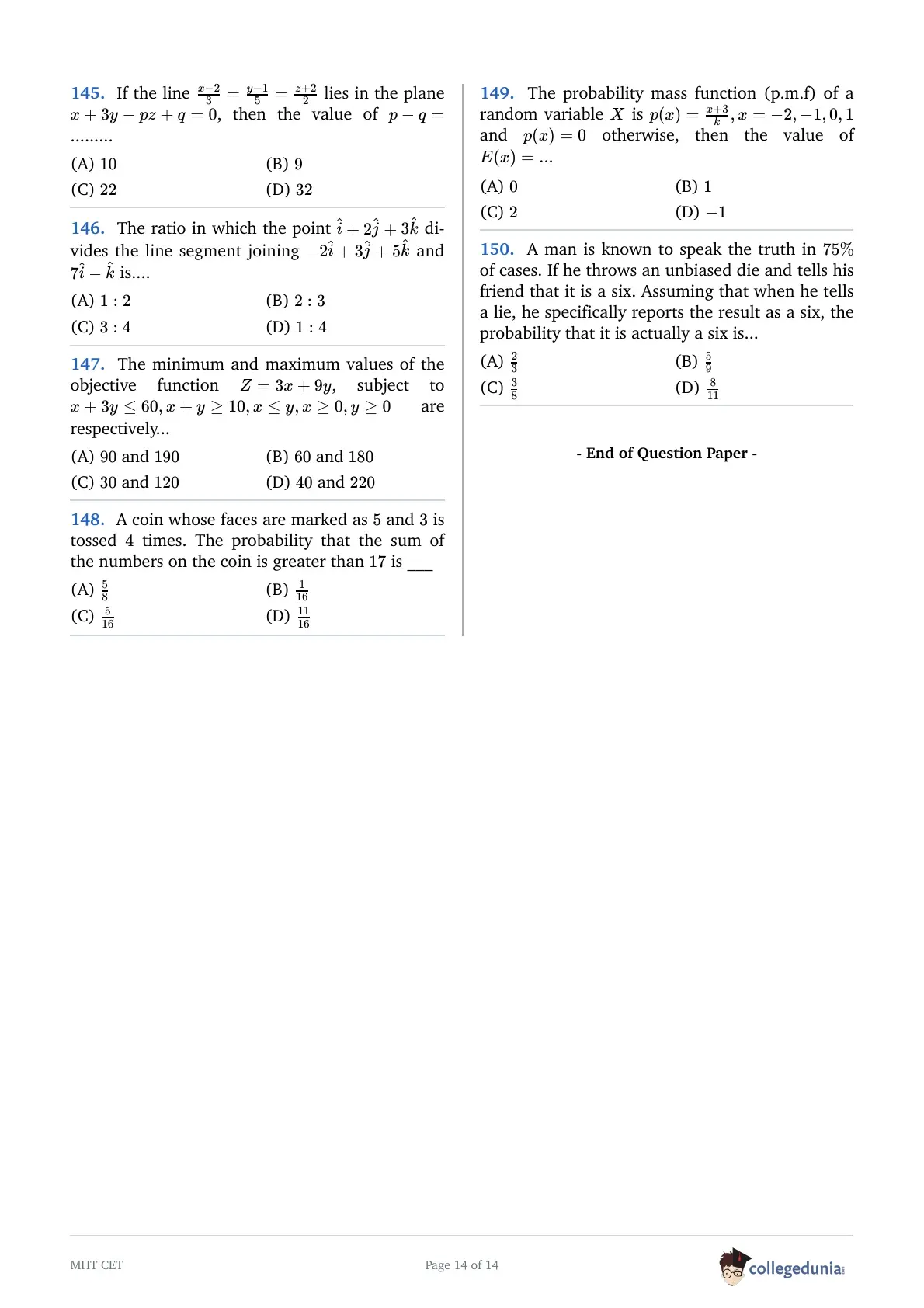
If the line \(\frac{x-2}{3}=\frac{y-1}{5}=\frac{z+2}{2}\) lies in the plane \(x+3y-pz+q=0\), then the value of \(p-q=\).........
The ratio in which the point \(\hat{i}+2\hat{j}+3\hat{k}\) divides the line segment joining \(-2\hat{i}+3\hat{j}+5\hat{k}\) and \(7\hat{i}-\hat{k}\) is....
The minimum and maximum values of the objective function \(Z=3x+9y\), subject to \(x+3y\leq 60,x+y\geq 10,x\leq y,x\geq 0,y\geq 0\) are respectively...
A coin whose faces are marked as \(5\) and \(3\) is tossed \(4\) times. The probability that the sum of the numbers on the coin is greater than \(17\) is ___
The probability mass function (p.m.f) of a random variable \(X\) is \(p(x)=\frac{x+3}{k},x=-2,-1,0,1\) and \(p(x)=0\) otherwise, then the value of \(E(x)=...\)
A man is known to speak the truth in \(75\%\) of cases. If he throws an unbiased die and tells his friend that it is a six. Assuming that when he tells a lie, he specifically reports the result as a six, the probability that it is actually a six is...
MHT CET 2026 PCM Exam Pattern and Marking Scheme
| Parameter | Details |
|---|---|
| Conducting Body | Maharashtra Common Entrance Test Cell (Maharashtra CET Cell) |
| Exam Mode | Online (Computer-Based Test) |
| Duration | 180 minutes (3 hours) |
| Groups / Subjects | PCM (Physics, Chemistry, Mathematics) for Engineering |
| Total Questions |
150 |
| Total Marks | 200 |
| Question Type | Multiple Choice Questions (MCQs) |
| Marks Distribution |
|
| Negative Marking | No |
| Syllabus Weightage |
|



Comments