




MHT CET 2026 May 13 Shift 1 PCM Question Paper is available for download here. Maharashtra State CET Cell conducted MHT CET 2026 PCM Exam on May 13 in Shift 1 from 9 AM to 12 PM in CBT mode.
The MHT CET 2026 PCM question paper includes the following:
- The MHT CET 2026 PCM Question Paper consists of 150 multiple-choice questions (MCQs) totalling 200 marks divided into 3 sections: Physics, Chemistry, and Mathematics, with 50 questions in each subject.
- Physics and Chemistry questions carry 1 mark each while Mathematics questions carry 2 marks each.
- There is no negative marking for incorrect answers.
MHT CET 2026 May 13 Shift 1 PCM Question Paper with Solution PDF
| CD PDF | CD PDF with Solutions |
|---|---|
| Download Collegedunia PDF 0.84 MB | - |
Also Check:
MHT CET 2026 May 13 Shift 1 PCM Questions with Solutions
Physics (Q1 - Q50)
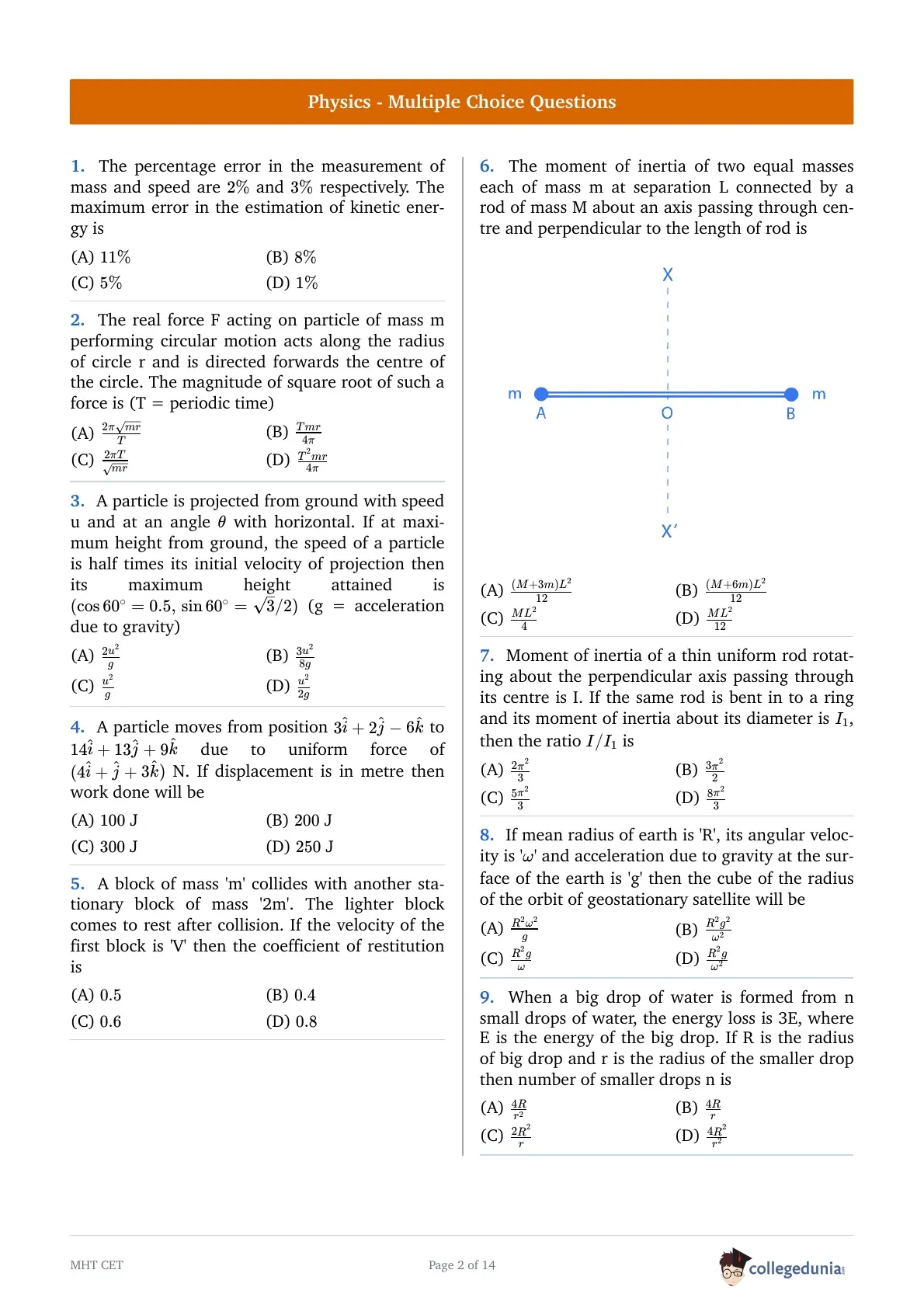
The percentage error in the measurement of mass and speed are \(2\%\) and \(3\%\) respectively. The maximum error in the estimation of kinetic energy is
The real force F acting on particle of mass m performing circular motion acts along the radius of circle r and is directed forwards the centre of the circle. The magnitude of square root of such a force is (T = periodic time)
A particle is projected from ground with speed u and at an angle \(\theta\) with horizontal. If at maximum height from ground, the speed of a particle is half times its initial velocity of projection then its maximum height attained is \((\cos 60^{\circ }=0.5,\,\sin 60^{\circ }=\sqrt{3}/2)\) (g = acceleration due to gravity)
A particle moves from position \(3\hat{i}+2\hat{j}-6\hat{k}\) to \(14\hat{i}+13\hat{j}+9\hat{k}\) due to uniform force of \((4\hat{i}+\hat{j}+3\hat{k})\) N. If displacement is in metre then work done will be
A block of mass 'm' collides with another stationary block of mass '2m'. The lighter block comes to rest after collision. If the velocity of the first block is 'V' then the coefficient of restitution is
The moment of inertia of two equal masses each of mass m at separation L connected by a rod of mass M about an axis passing through centre and perpendicular to the length of rod is

Moment of inertia of a thin uniform rod rotating about the perpendicular axis passing through its centre is I. If the same rod is bent in to a ring and its moment of inertia about its diameter is \(I_{1}\), then the ratio \(I/I_{1}\) is
If mean radius of earth is 'R', its angular velocity is '\(\omega\)' and acceleration due to gravity at the surface of the earth is 'g' then the cube of the radius of the orbit of geostationary satellite will be
When a big drop of water is formed from n small drops of water, the energy loss is 3E, where E is the energy of the big drop. If R is the radius of big drop and r is the radius of the smaller drop then number of smaller drops n is
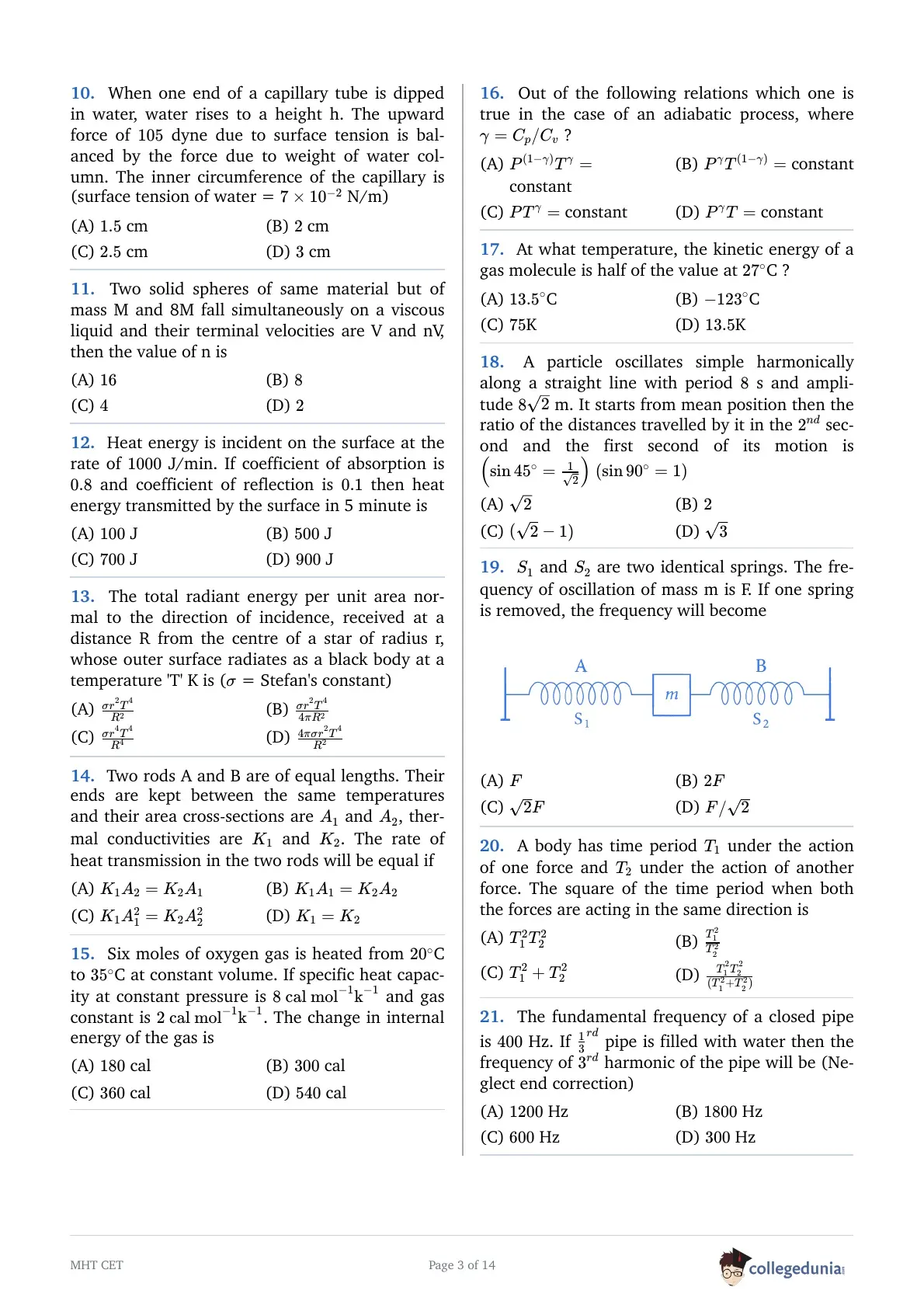
When one end of a capillary tube is dipped in water, water rises to a height h. The upward force of \(105\) dyne due to surface tension is balanced by the force due to weight of water column. The inner circumference of the capillary is (surface tension of water = \(7\times 10^{-2}\) N/m)
Two solid spheres of same material but of mass M and 8M fall simultaneously on a viscous liquid and their terminal velocities are V and nV, then the value of n is
Heat energy is incident on the surface at the rate of \(1000\) J/min. If coefficient of absorption is \(0.8\) and coefficient of reflection is \(0.1\) then heat energy transmitted by the surface in 5 minute is
The total radiant energy per unit area normal to the direction of incidence, received at a distance R from the centre of a star of radius r, whose outer surface radiates as a black body at a temperature 'T' K is (\(\sigma\) = Stefan's constant)
Two rods A and B are of equal lengths. Their ends are kept between the same temperatures and their area cross-sections are \(A_{1}\) and \(A_{2}\), thermal conductivities are \(K_{1}\) and \(K_{2}\). The rate of heat transmission in the two rods will be equal if
Six moles of oxygen gas is heated from \(20^{\circ }\)C to \(35^{\circ }\)C at constant volume. If specific heat capacity at constant pressure is \(8\text{ cal mol}^{-1}\text{k}^{-1}\) and gas constant is \(2\text{ cal mol}^{-1}\text{k}^{-1}\). The change in internal energy of the gas is
Out of the following relations which one is true in the case of an adiabatic process, where \(\gamma =C_{p}/C_{v}\) ?
At what temperature, the kinetic energy of a gas molecule is half of the value at \(27^{\circ }\)C ?
A particle oscillates simple harmonically along a straight line with period \(8\) s and amplitude \(8\sqrt{2}\) m. It starts from mean position then the ratio of the distances travelled by it in the \(2^{nd}\) second and the first second of its motion is \(\left(\sin 45^{\circ }=\frac{1}{\sqrt{2}}\right)\) \((\sin 90^{\circ }=1)\)
\(S_{1}\) and \(S_{2}\) are two identical springs. The frequency of oscillation of mass m is F. If one spring is removed, the frequency will become

A body has time period \(T_{1}\) under the action of one force and \(T_{2}\) under the action of another force. The square of the time period when both the forces are acting in the same direction is
The fundamental frequency of a closed pipe is \(400\) Hz. If \(\frac{1}{3}^{rd}\) pipe is filled with water then the frequency of \(3^{rd}\) harmonic of the pipe will be (Neglect end correction)
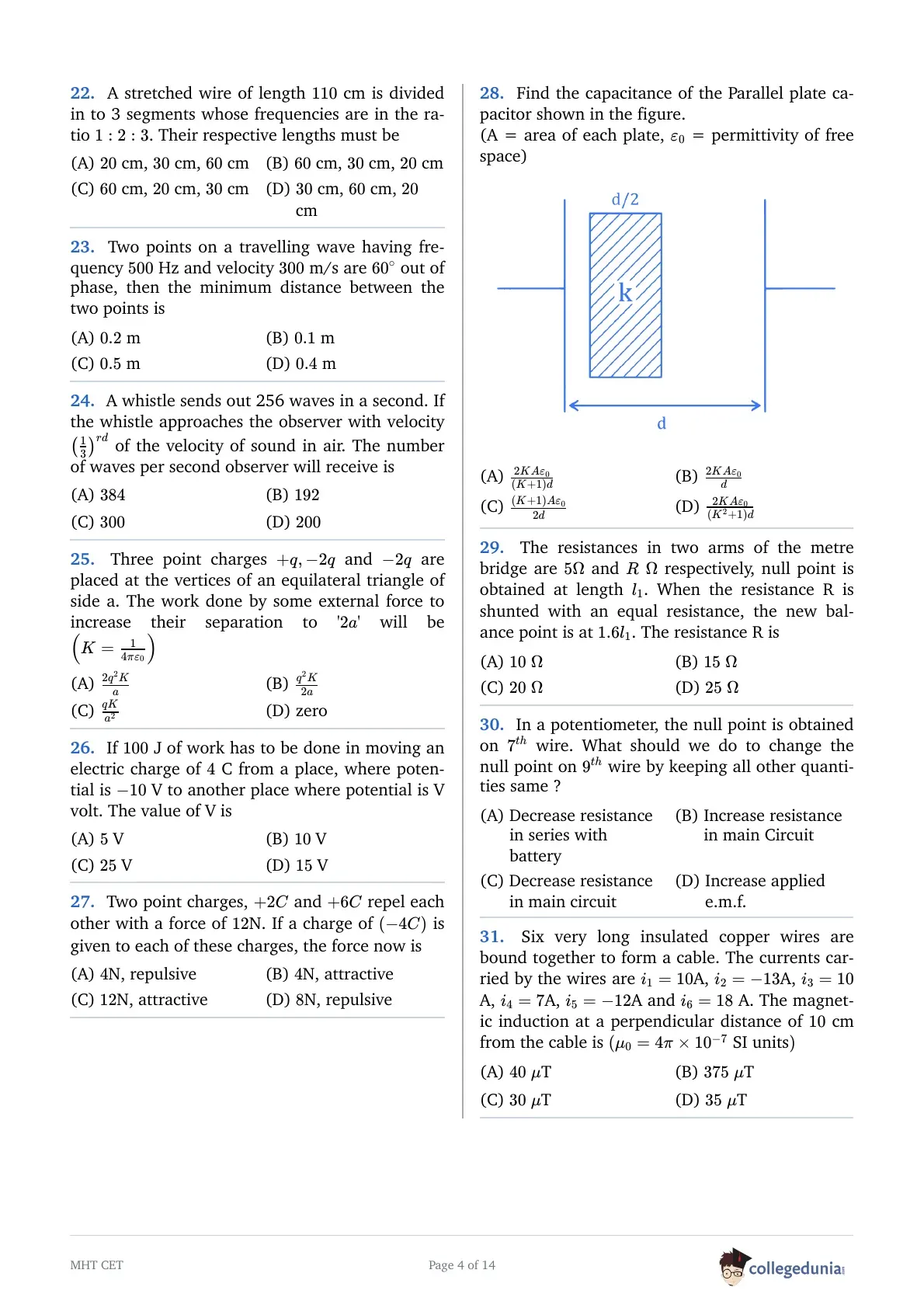
A stretched wire of length \(110\) cm is divided in to 3 segments whose frequencies are in the ratio \(1:2:3\). Their respective lengths must be
Two points on a travelling wave having frequency \(500\) Hz and velocity \(300\) m/s are \(60^{\circ }\) out of phase, then the minimum distance between the two points is
A whistle sends out 256 waves in a second. If the whistle approaches the observer with velocity \(\left(\frac{1}{3}\right)^{rd}\) of the velocity of sound in air. The number of waves per second observer will receive is
Three point charges \(+q,-2q\) and \(-2q\) are placed at the vertices of an equilateral triangle of side a. The work done by some external force to increase their separation to '\(2a\)' will be \(\left(K=\frac{1}{4\pi \varepsilon _{0}}\right)\)
If \(100\) J of work has to be done in moving an electric charge of \(4\) C from a place, where potential is \(-10\) V to another place where potential is V volt. The value of V is
Two point charges, \(+2C\) and \(+6C\) repel each other with a force of \(12\)N. If a charge of \((-4C)\) is given to each of these charges, the force now is
Find the capacitance of the Parallel plate capacitor shown in the figure.
(A = area of each plate, \(\varepsilon _{0}\) = permittivity of free space)

The resistances in two arms of the metre bridge are \(5\Omega\) and \(R\) \(\Omega\) respectively, null point is obtained at length \(l_{1}\). When the resistance R is shunted with an equal resistance, the new balance point is at \(1.6l_{1}\). The resistance R is
In a potentiometer, the null point is obtained on \(7^{th}\) wire. What should we do to change the null point on \(9^{th}\) wire by keeping all other quantities same ?
Six very long insulated copper wires are bound together to form a cable. The currents carried by the wires are \(i_{1}=10\)A, \(i_{2}=-13\)A, \(i_{3}=10\)A, \(i_{4}=7\)A, \(i_{5}=-12\)A and \(i_{6}=18\) A. The magnetic induction at a perpendicular distance of \(10\) cm from the cable is \((\mu _{0}=4\pi \times 10^{-7}\) SI units\()\)
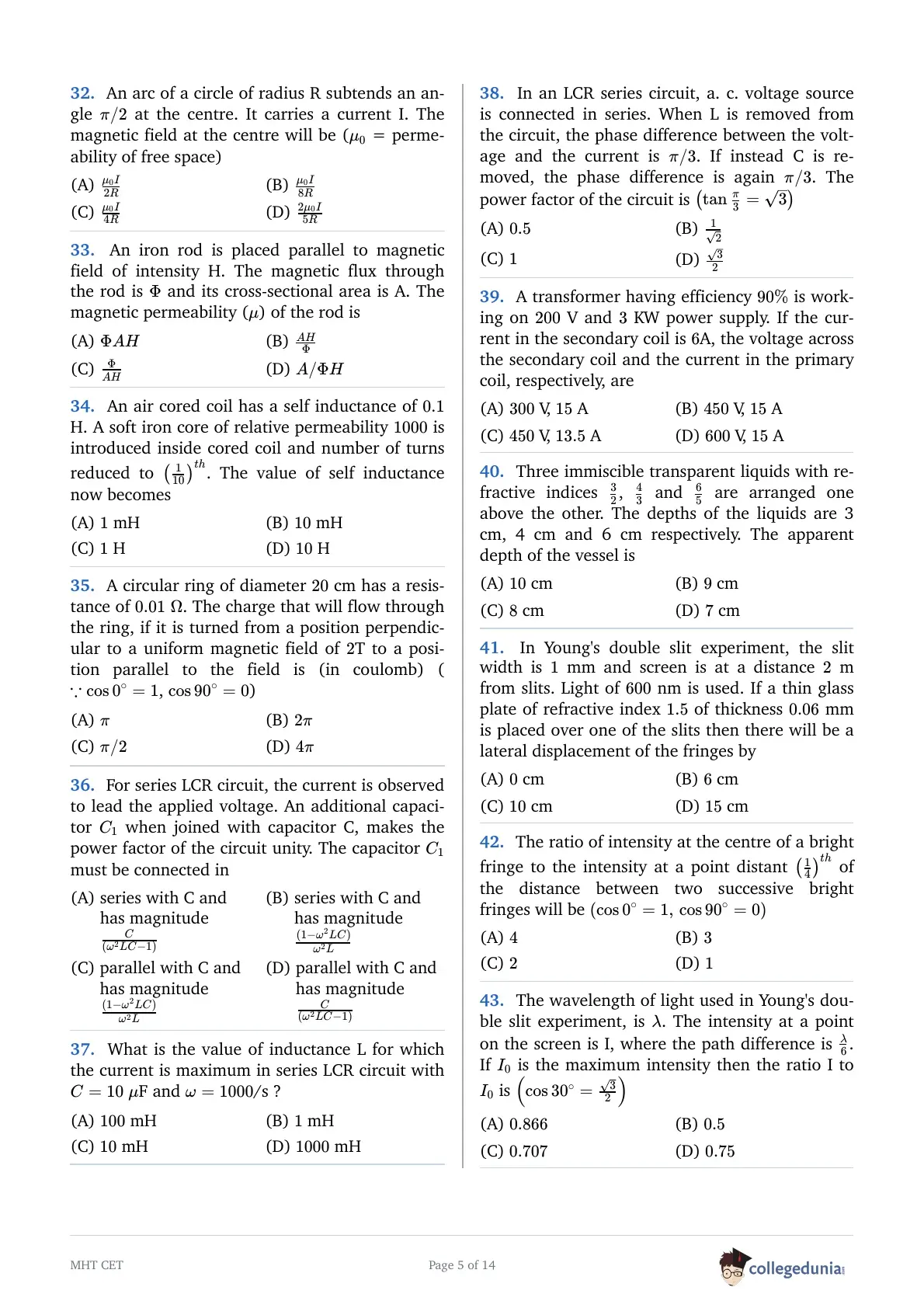
An arc of a circle of radius R subtends an angle \(\pi /2\) at the centre. It carries a current I. The magnetic field at the centre will be (\(\mu _{0}\) = permeability of free space)
An iron rod is placed parallel to magnetic field of intensity H. The magnetic flux through the rod is \(\Phi\) and its cross-sectional area is A. The magnetic permeability (\(\mu\)) of the rod is
An air cored coil has a self inductance of \(0.1\) H. A soft iron core of relative permeability \(1000\) is introduced inside cored coil and number of turns reduced to \(\left(\frac{1}{10}\right)^{th}\). The value of self inductance now becomes
A circular ring of diameter \(20\) cm has a resistance of \(0.01\) \(\Omega\). The charge that will flow through the ring, if it is turned from a position perpendicular to a uniform magnetic field of \(2\)T to a position parallel to the field is (in coulomb) (\(\because \cos 0^{\circ }=1\), \(\cos 90^{\circ }=0\))
For series LCR circuit, the current is observed to lead the applied voltage. An additional capacitor \(C_{1}\) when joined with capacitor C, makes the power factor of the circuit unity. The capacitor \(C_{1}\) must be connected in
What is the value of inductance L for which the current is maximum in series LCR circuit with \(C=10\) \(\mu\)F and \(\omega =1000\)/s ?
In an LCR series circuit, a. c. voltage source is connected in series. When L is removed from the circuit, the phase difference between the voltage and the current is \(\pi /3\). If instead C is removed, the phase difference is again \(\pi /3\). The power factor of the circuit is \(\left(\tan \frac{\pi }{3}=\sqrt{3}\right)\)
A transformer having efficiency \(90\%\) is working on \(200\) V and \(3\) KW power supply. If the current in the secondary coil is \(6\)A, the voltage across the secondary coil and the current in the primary coil, respectively, are
Three immiscible transparent liquids with refractive indices \(\frac{3}{2}\), \(\frac{4}{3}\) and \(\frac{6}{5}\) are arranged one above the other. The depths of the liquids are 3 cm, 4 cm and 6 cm respectively. The apparent depth of the vessel is
In Young's double slit experiment, the slit width is \(1\) mm and screen is at a distance \(2\) m from slits. Light of \(600\) nm is used. If a thin glass plate of refractive index \(1.5\) of thickness \(0.06\) mm is placed over one of the slits then there will be a lateral displacement of the fringes by
The ratio of intensity at the centre of a bright fringe to the intensity at a point distant \(\left(\frac{1}{4}\right)^{th}\) of the distance between two successive bright fringes will be \((\cos 0^{\circ }=1,\,\cos 90^{\circ }=0)\)
The wavelength of light used in Young's double slit experiment, is \(\lambda\). The intensity at a point on the screen is I, where the path difference is \(\frac{\lambda }{6}\). If \(I_{0}\) is the maximum intensity then the ratio I to \(I_{0}\) is \(\left(\cos 30^{\circ }=\frac{\sqrt{3}}{2}\right)\)
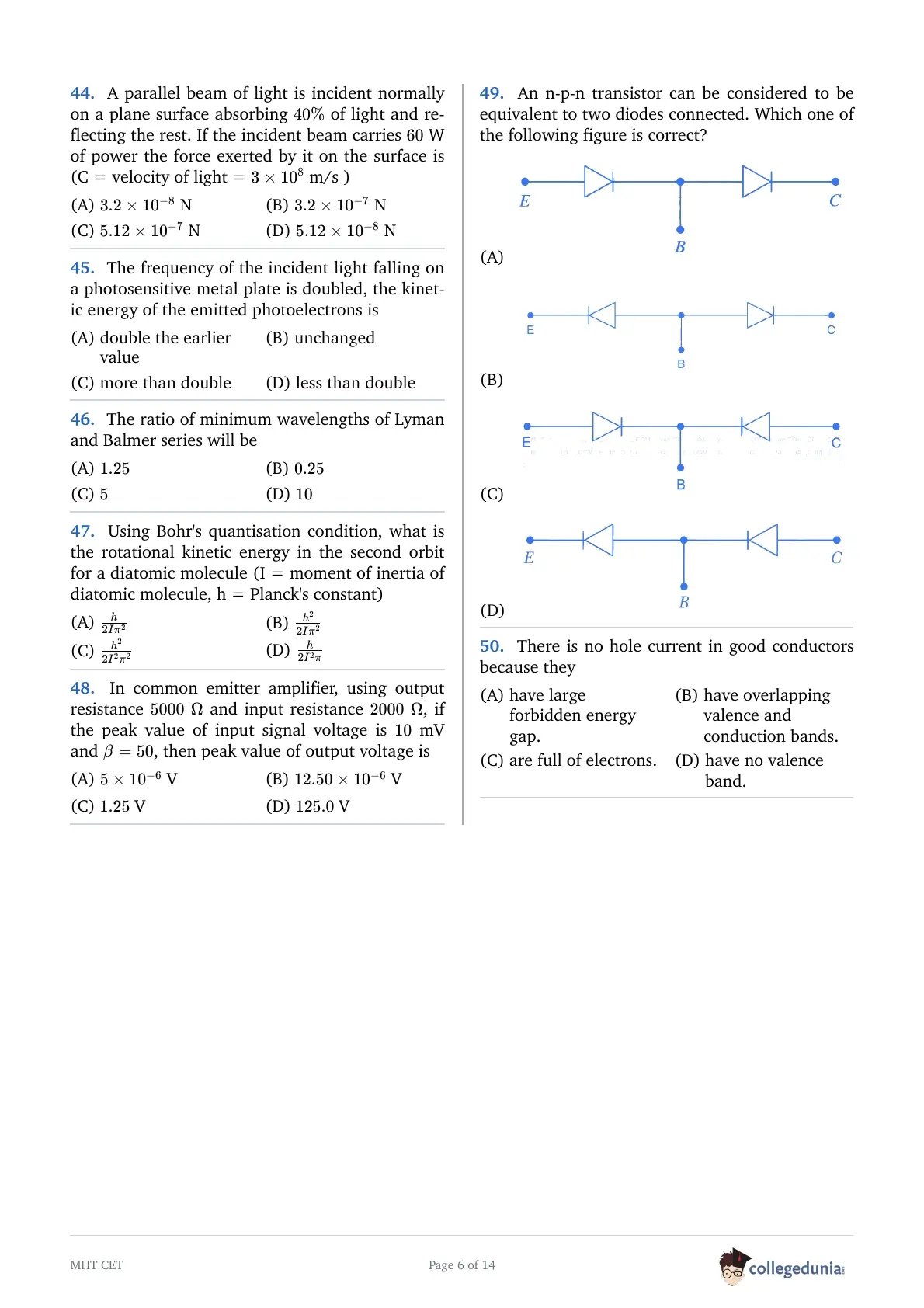
A parallel beam of light is incident normally on a plane surface absorbing \(40\%\) of light and reflecting the rest. If the incident beam carries \(60\) W of power the force exerted by it on the surface is (C = velocity of light = \(3\times 10^{8}\) m/s )
The frequency of the incident light falling on a photosensitive metal plate is doubled, the kinetic energy of the emitted photoelectrons is
The ratio of minimum wavelengths of Lyman and Balmer series will be
Using Bohr's quantisation condition, what is the rotational kinetic energy in the second orbit for a diatomic molecule (I = moment of inertia of diatomic molecule, h = Planck's constant)
In common emitter amplifier, using output resistance \(5000\) \(\Omega\) and input resistance \(2000\) \(\Omega\), if the peak value of input signal voltage is \(10\) mV and \(\beta =50\), then peak value of output voltage is
An n-p-n transistor can be considered to be equivalent to two diodes connected. Which one of the following figure is correct?
- (A)
![]()
- (B)
![]()
- (C)
![]()
- (D)
![]()


There is no hole current in good conductors because they
Chemistry (Q51 - Q100)
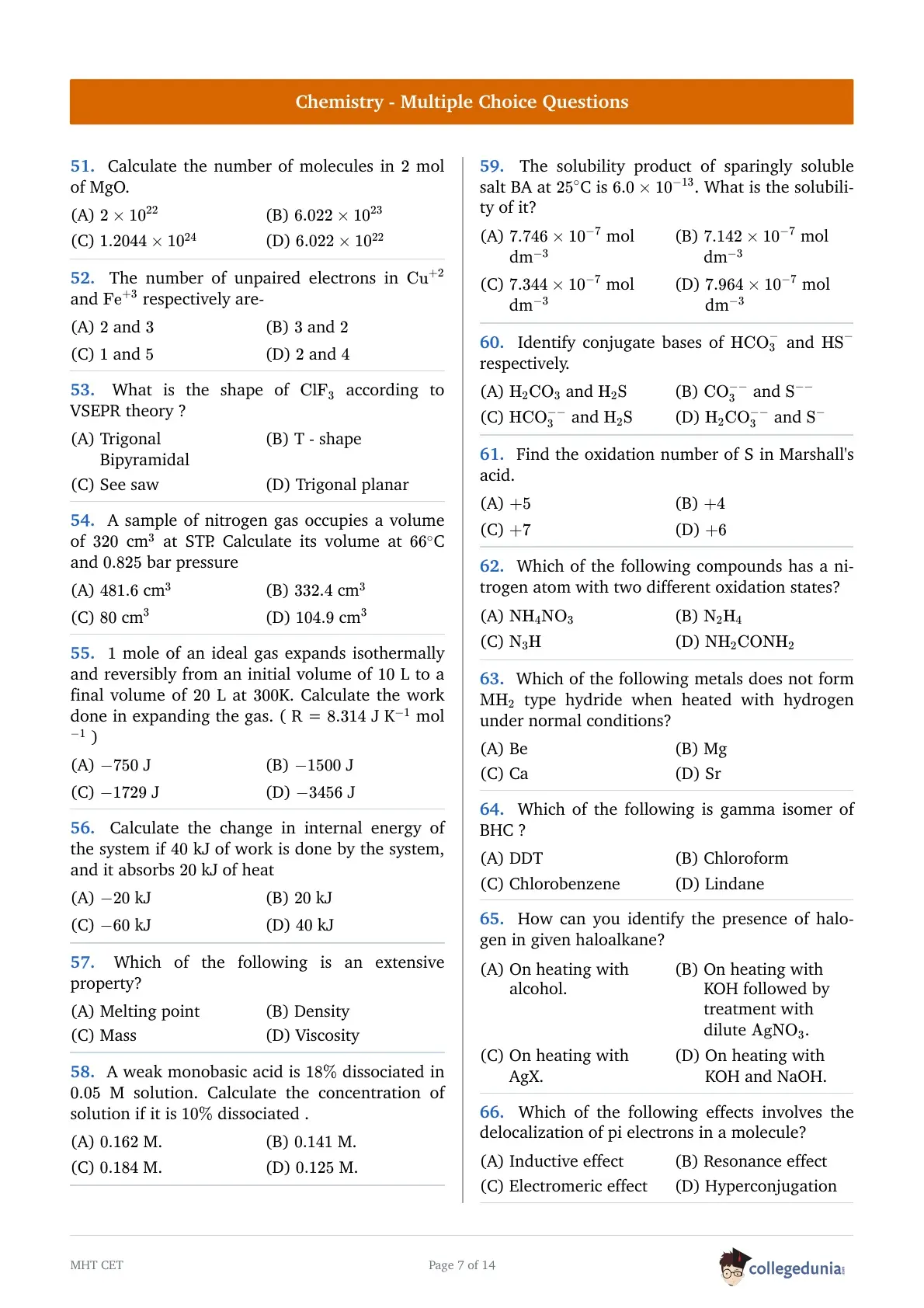
Calculate the number of molecules in \(2\) mol of MgO.
The number of unpaired electrons in \(\text{Cu}^{+2}\) and \(\text{Fe}^{+3}\) respectively are-
What is the shape of \(\text{ClF}_{3}\) according to VSEPR theory ?
A sample of nitrogen gas occupies a volume of \(320\) cm\({}^{3}\) at STP. Calculate its volume at \(66{}^{\circ }\)C and \(0.825\) bar pressure
\(1\) mole of an ideal gas expands isothermally and reversibly from an initial volume of \(10\) L to a final volume of \(20\) L at \(300\)K. Calculate the work done in expanding the gas. ( R = \(8.314\) J K\({}^{-1}\) mol\({}^{-1}\) )
Calculate the change in internal energy of the system if \(40\) kJ of work is done by the system, and it absorbs \(20\) kJ of heat
Which of the following is an extensive property?
A weak monobasic acid is \(18\) % dissociated in \(0.05\) M solution. Calculate the concentration of solution if it is \(10\) % dissociated .
The solubility product of sparingly soluble salt BA at \(25{}^{\circ }\)C is \(6.0\times 10^{-13}\). What is the solubility of it?
Identify conjugate bases of \(\text{HCO}_{3}^{-}\) and \(\text{HS}^{-}\) respectively.
Find the oxidation number of S in Marshall's acid.
Which of the following compounds has a nitrogen atom with two different oxidation states?
Which of the following metals does not form \(\text{MH}_{2}\) type hydride when heated with hydrogen under normal conditions?
Which of the following is gamma isomer of BHC ?
How can you identify the presence of halogen in given haloalkane?
Which of the following effects involves the delocalization of pi electrons in a molecule?
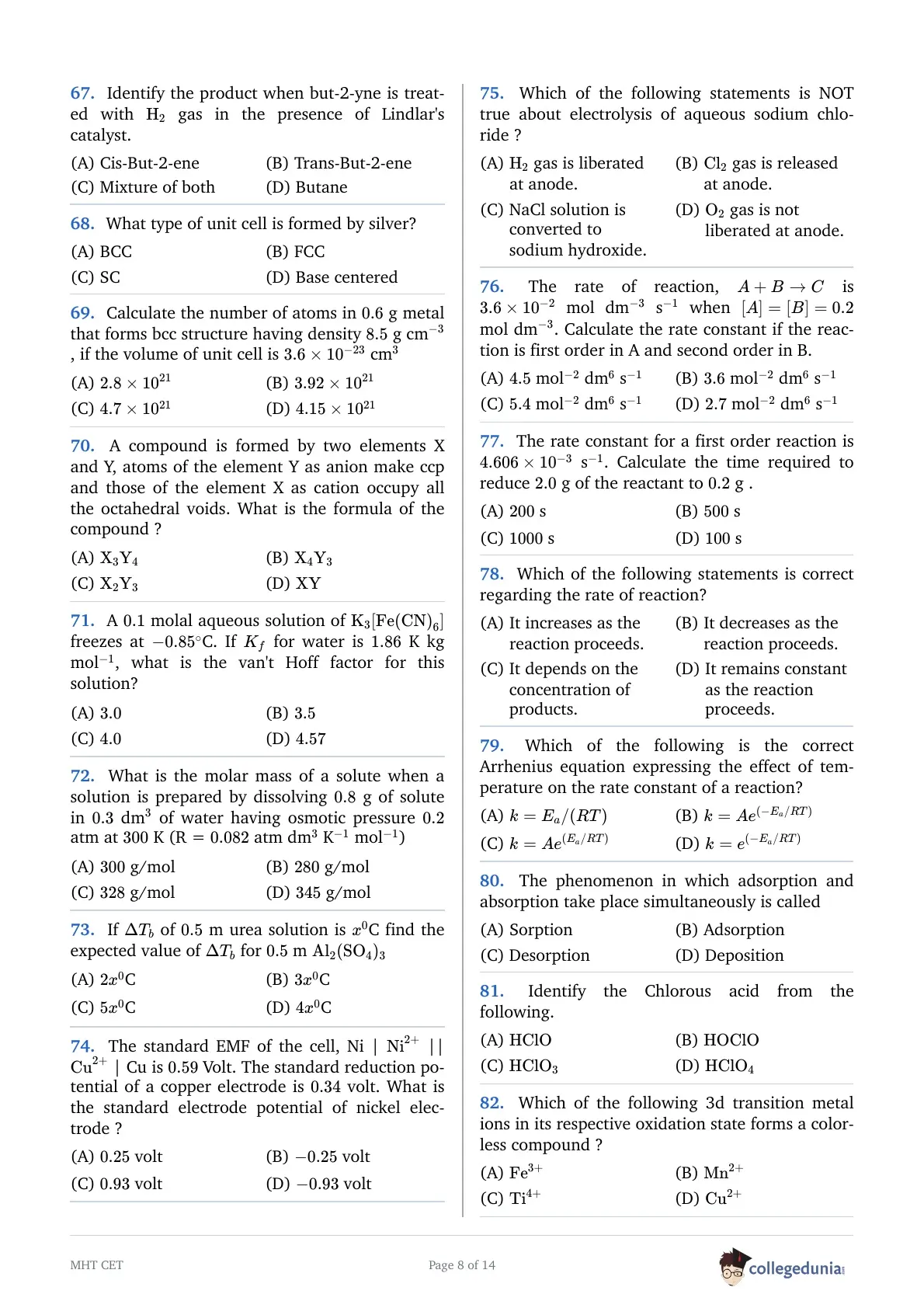
Identify the product when but-2-yne is treated with \(\text{H}_{2}\) gas in the presence of Lindlar's catalyst.
What type of unit cell is formed by silver?
Calculate the number of atoms in \(0.6\) g metal that forms bcc structure having density \(8.5\) g cm\({}^{-3}\), if the volume of unit cell is \(3.6\times 10^{-23}\) cm\({}^{3}\)
A compound is formed by two elements X and Y, atoms of the element Y as anion make ccp and those of the element X as cation occupy all the octahedral voids. What is the formula of the compound ?
A \(0.1\) molal aqueous solution of \(\text{K}_{3}[\text{Fe(CN)}_{6}]\) freezes at \(-0.85{}^{\circ }\)C. If \(K_{f}\) for water is \(1.86\) K kg mol\({}^{-1}\), what is the van't Hoff factor for this solution?
What is the molar mass of a solute when a solution is prepared by dissolving \(0.8\) g of solute in \(0.3\) dm\({}^{3}\) of water having osmotic pressure \(0.2\) atm at \(300\) K (R = \(0.082\) atm dm\({}^{3}\) K\({}^{-1}\) mol\({}^{-1}\))
If \(\Delta T_{b}\) of \(0.5\) m urea solution is \(x{}^{0}\)C find the expected value of \(\Delta T_{b}\) for \(0.5\) m \(\text{Al}_{2}(\text{SO}_{4})_{3}\)
The standard EMF of the cell, Ni | \(\text{Ni}^{2+}\) || \(\text{Cu}^{2+}\) | Cu is \(0.59\) Volt. The standard reduction potential of a copper electrode is \(0.34\) volt. What is the standard electrode potential of nickel electrode ?
Which of the following statements is NOT true about electrolysis of aqueous sodium chloride ?
The rate of reaction, \(A+B\rightarrow C\) is \(3.6\times 10^{-2}\) mol dm\({}^{-3}\) s\({}^{-1}\) when \([A]=[B]=0.2\) mol dm\({}^{-3}\). Calculate the rate constant if the reaction is first order in A and second order in B.
The rate constant for a first order reaction is \(4.606\times 10^{-3}\) s\({}^{-1}\). Calculate the time required to reduce \(2.0\) g of the reactant to \(0.2\) g .
Which of the following statements is correct regarding the rate of reaction?
Which of the following is the correct Arrhenius equation expressing the effect of temperature on the rate constant of a reaction?
The phenomenon in which adsorption and absorption take place simultaneously is called
Identify the Chlorous acid from the following.
Which of the following 3d transition metal ions in its respective oxidation state forms a colorless compound ?
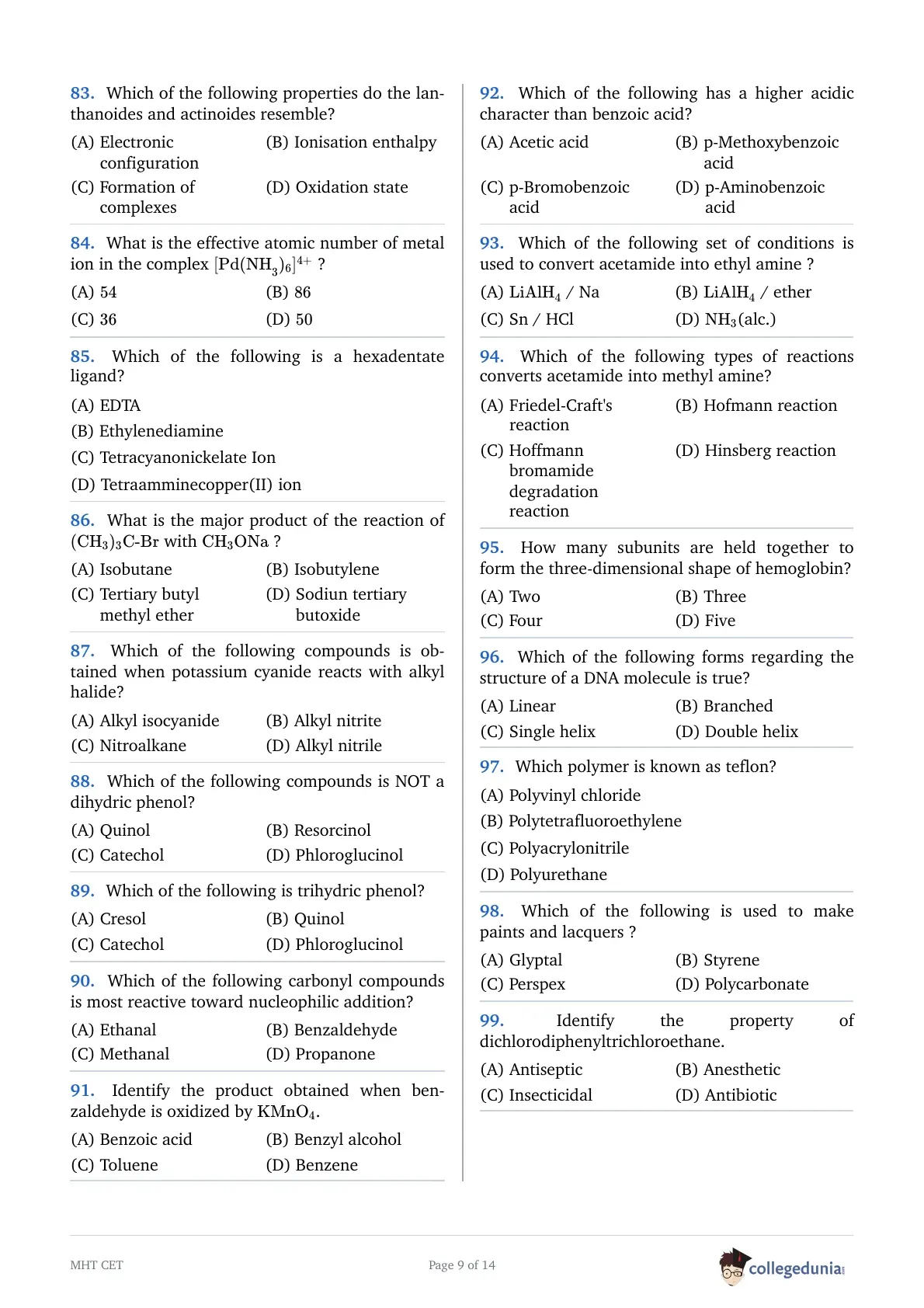
Which of the following properties do the lanthanoides and actinoides resemble?
What is the effective atomic number of metal ion in the complex \([\text{Pd(NH}_{3})_{6}]^{4+}\) ?
Which of the following is a hexadentate ligand?
What is the major product of the reaction of \((\text{CH}_{3})_{3}\text{C-Br}\) with \(\text{CH}_{3}\text{ONa}\) ?
Which of the following compounds is obtained when potassium cyanide reacts with alkyl halide?
Which of the following compounds is NOT a dihydric phenol?
Which of the following is trihydric phenol?
Which of the following carbonyl compounds is most reactive toward nucleophilic addition?
Identify the product obtained when benzaldehyde is oxidized by \(\text{KMnO}_{4}\).
Which of the following has a higher acidic character than benzoic acid?
Which of the following set of conditions is used to convert acetamide into ethyl amine ?
Which of the following types of reactions converts acetamide into methyl amine?
How many subunits are held together to form the three-dimensional shape of hemoglobin?
Which of the following forms regarding the structure of a DNA molecule is true?
Which polymer is known as teflon?
Which of the following is used to make paints and lacquers ?
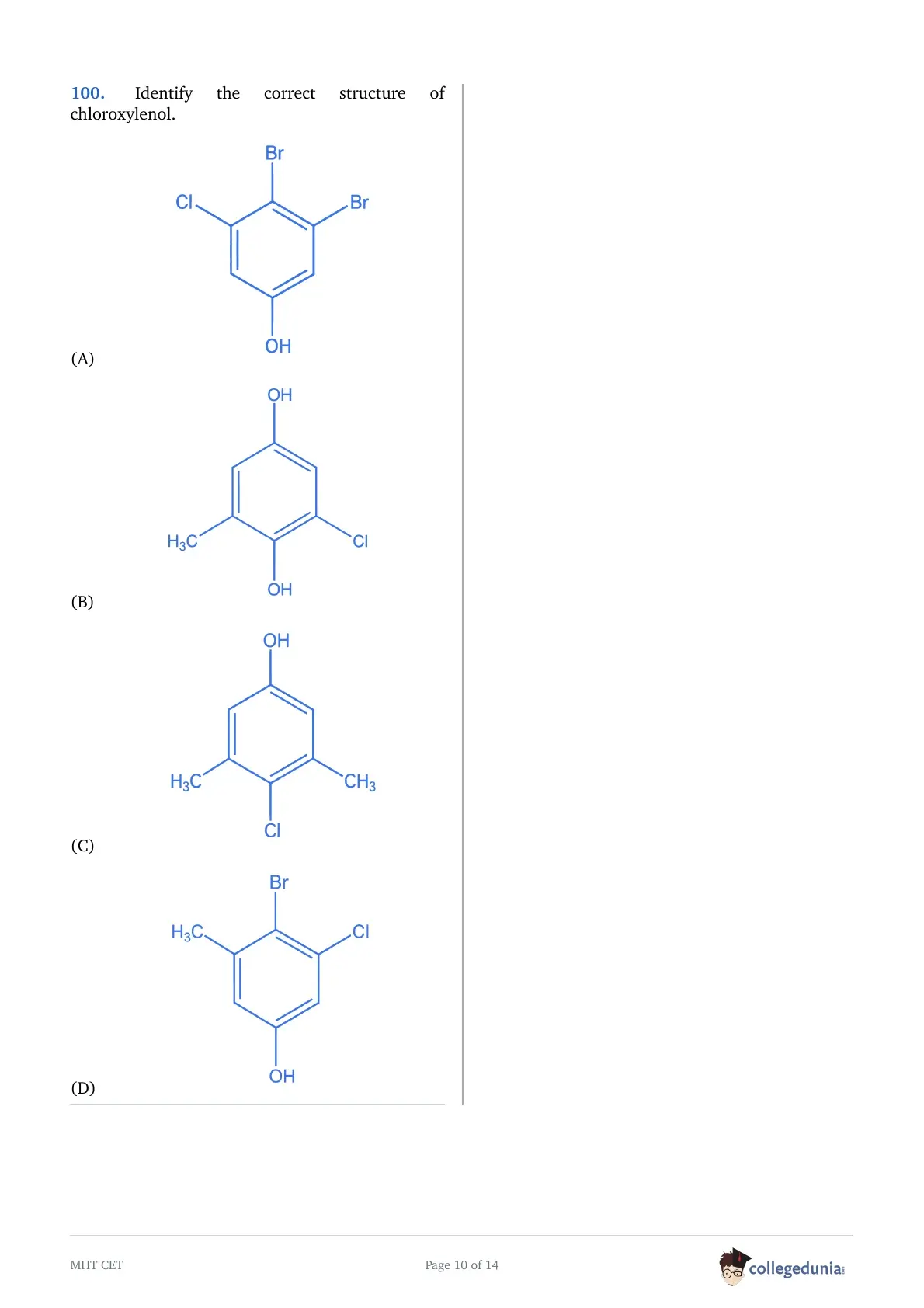
Identify the property of dichlorodiphenyltrichloroethane.


Mathematics (Q101 - Q150)
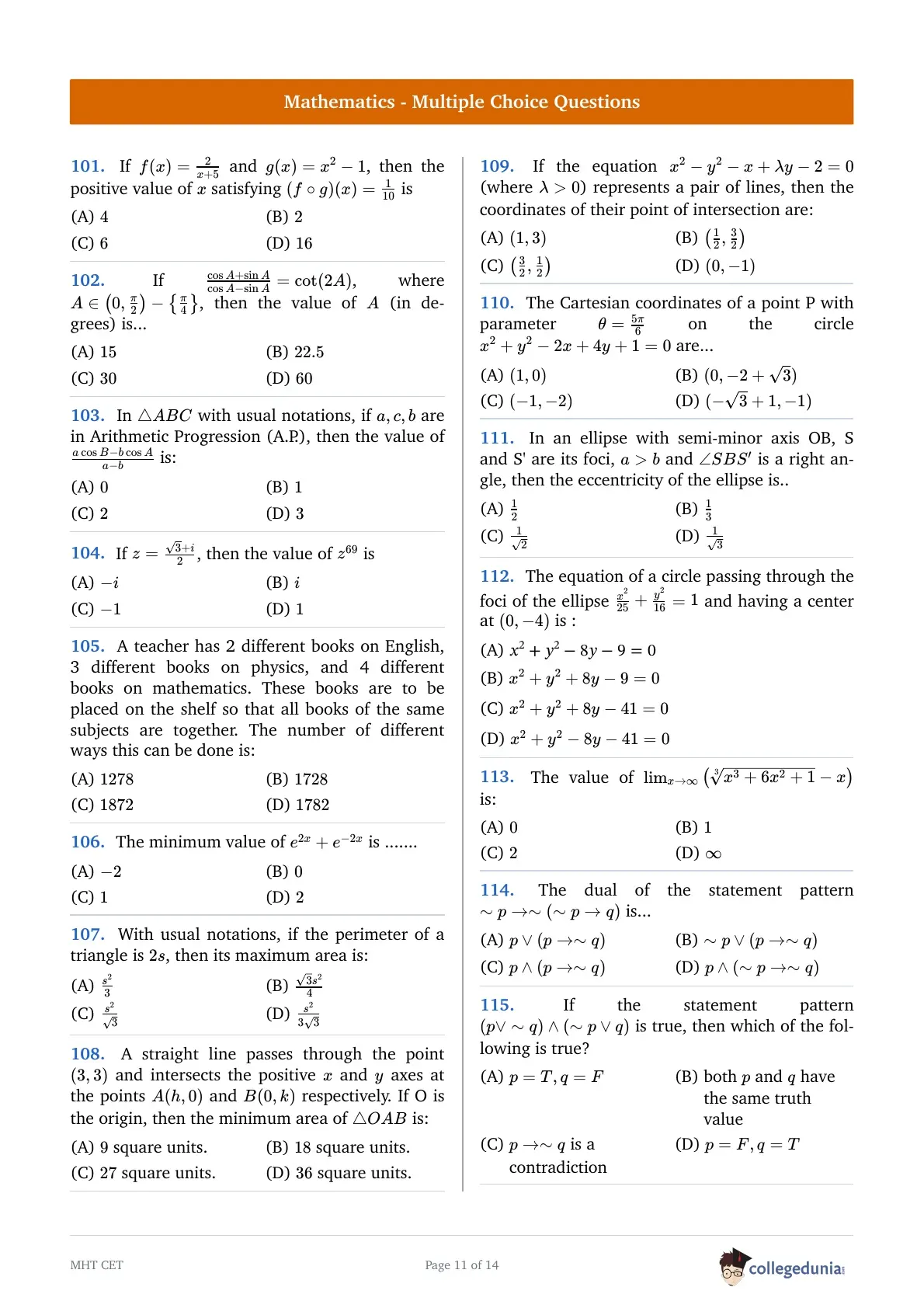
If \(f(x)=\frac{2}{x+5}\) and \(g(x)=x^{2}-1\), then the positive value of \(x\) satisfying \((f\circ g)(x)=\frac{1}{10}\) is
If \(\frac{\cos A+\sin A}{\cos A-\sin A}=\cot (2A)\), where \(A\in \left(0,\frac{\pi }{2}\right)-\left\{\frac{\pi }{4}\right\}\), then the value of \(A\) (in degrees) is...
In \(\triangle ABC\) with usual notations, if \(a,c,b\) are in Arithmetic Progression (A.P.), then the value of \(\frac{a\cos B-b\cos A}{a-b}\) is:
If \(z=\frac{\sqrt{3}+i}{2}\), then the value of \(z^{69}\) is
A teacher has 2 different books on English, 3 different books on physics, and 4 different books on mathematics. These books are to be placed on the shelf so that all books of the same subjects are together. The number of different ways this can be done is:
The minimum value of \(e^{2x}+e^{-2x}\) is .......
With usual notations, if the perimeter of a triangle is \(2s\), then its maximum area is:
A straight line passes through the point \((3,3)\) and intersects the positive \(x\) and \(y\) axes at the points \(A(h,0)\) and \(B(0,k)\) respectively. If O is the origin, then the minimum area of \(\triangle OAB\) is:
If the equation \(x^{2}-y^{2}-x+\lambda y-2=0\) (where \(\lambda >0\)) represents a pair of lines, then the coordinates of their point of intersection are:
The Cartesian coordinates of a point P with parameter \(\theta =\frac{5\pi }{6}\) on the circle \(x^{2}+y^{2}-2x+4y+1=0\) are...
In an ellipse with semi-minor axis OB, S and S' are its foci, \(a>b\) and \(\angle SBS'\) is a right angle, then the eccentricity of the ellipse is..
The equation of a circle passing through the foci of the ellipse \(\frac{x^{2}}{25}+\frac{y^{2}}{16}=1\) and having a center at \((0,-4)\) is :
The value of \(\lim _{x\rightarrow \infty }\left(\sqrt[3]{x^{3}+6x^{2}+1}-x\right)\) is:
The dual of the statement pattern \(\sim p\rightarrow \sim (\sim p\rightarrow q)\) is...
If the statement pattern \((p\vee \sim q)\wedge (\sim p\vee q)\) is true, then which of the following is true?
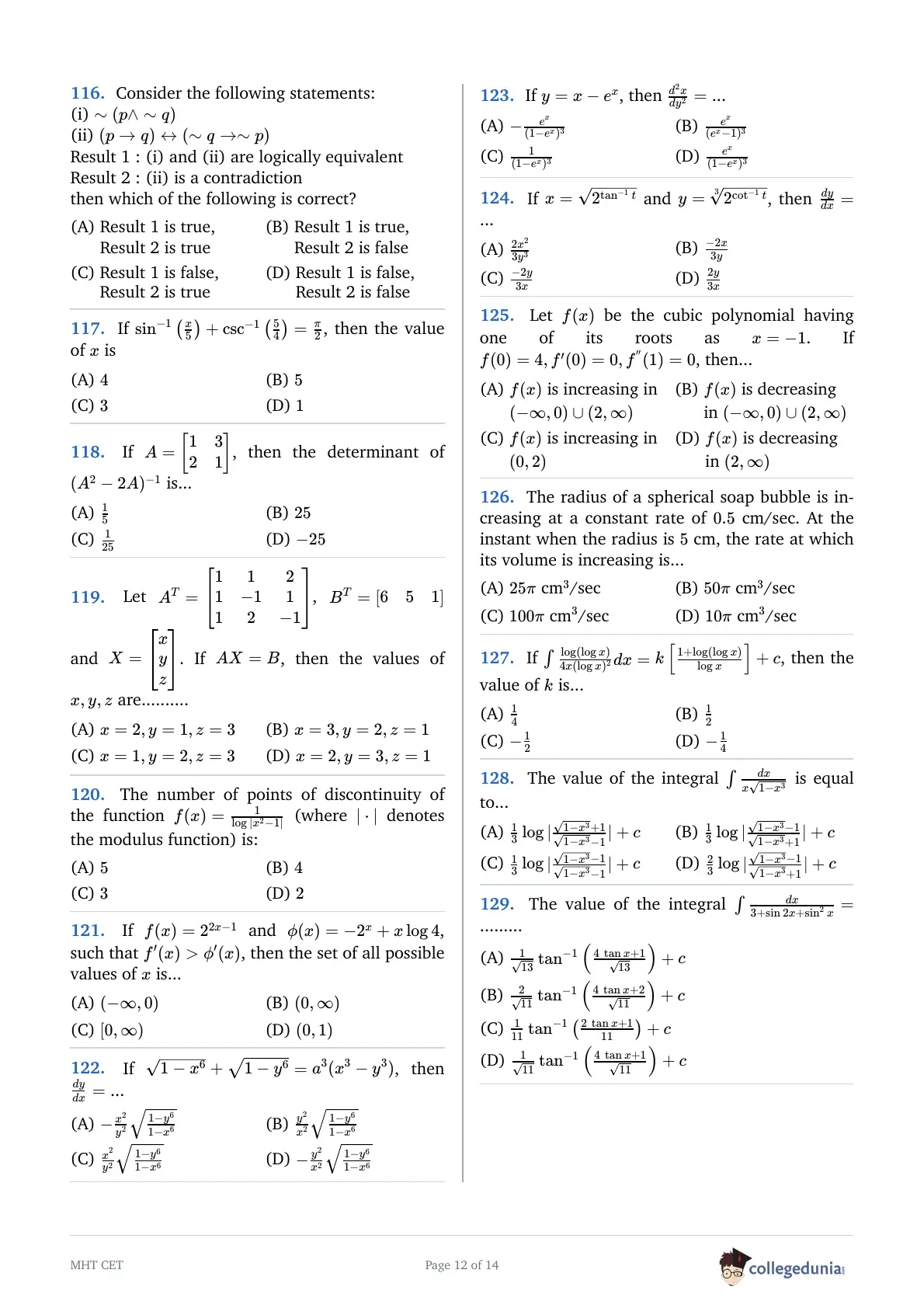
Consider the following statements:
(i) \(\sim (p\wedge \sim q)\)
(ii) \((p\rightarrow q)\leftrightarrow (\sim q\rightarrow \sim p)\)
Result 1 : (i) and (ii) are logically equivalent
Result 2 : (ii) is a contradiction
then which of the following is correct?
If \(\sin ^{-1}\left(\frac{x}{5}\right)+\csc ^{-1}\left(\frac{5}{4}\right)=\frac{\pi }{2}\), then the value of \(x\) is
If \(A=\begin{bmatrix} 1 & 3 \\ 2 & 1 \end{bmatrix}\), then the determinant of \((A^{2}-2A)^{-1}\) is...
Let \(A^{T}=\begin{bmatrix} 1 & 1 & 2 \\ 1 & -1 & 1 \\ 1 & 2 & -1 \end{bmatrix}\), \(B^{T}=[\begin{matrix} 6 & 5 & 1 \end{matrix}]\) and \(X=\begin{bmatrix} x \\ y \\ z \end{bmatrix}\). If \(AX=B\), then the values of \(x,y,z\) are..........
The number of points of discontinuity of the function \(f(x)=\frac{1}{\log |x^{2}-1|}\) (where \(|\cdot |\) denotes the modulus function) is:
If \(f(x)=2^{2x-1}\) and \(\phi (x)=-2^{x}+x\log 4\), such that \(f'(x)>\phi '(x)\), then the set of all possible values of \(x\) is...
If \(\sqrt{1-x^{6}}+\sqrt{1-y^{6}}=a^{3}(x^{3}-y^{3})\), then \(\frac{dy}{dx}=\) ...
If \(y=x-e^{x}\), then \(\frac{d^{2}x}{dy^{2}}=\) ...
If \(x=\sqrt{2^{\tan ^{-1}t}}\) and \(y=\sqrt[3]{2^{\cot ^{-1}t}}\), then \(\frac{dy}{dx}=\) ...
Let \(f(x)\) be the cubic polynomial having one of its roots as \(x=-1\). If \(f(0)=4,f'(0)=0,f^{''}(1)=0\), then...
The radius of a spherical soap bubble is increasing at a constant rate of \(0.5\) cm/sec. At the instant when the radius is \(5\) cm, the rate at which its volume is increasing is...
If \(\int \frac{\log (\log x)}{4x(\log x)^{2}}dx=k\left[\frac{1+\log (\log x)}{\log x}\right]+c\), then the value of \(k\) is...
The value of the integral \(\int \frac{dx}{x\sqrt{1-x^{3}}}\) is equal to...
The value of the integral \(\int \frac{dx}{3+\sin 2x+\sin ^{2}x}=\) .........
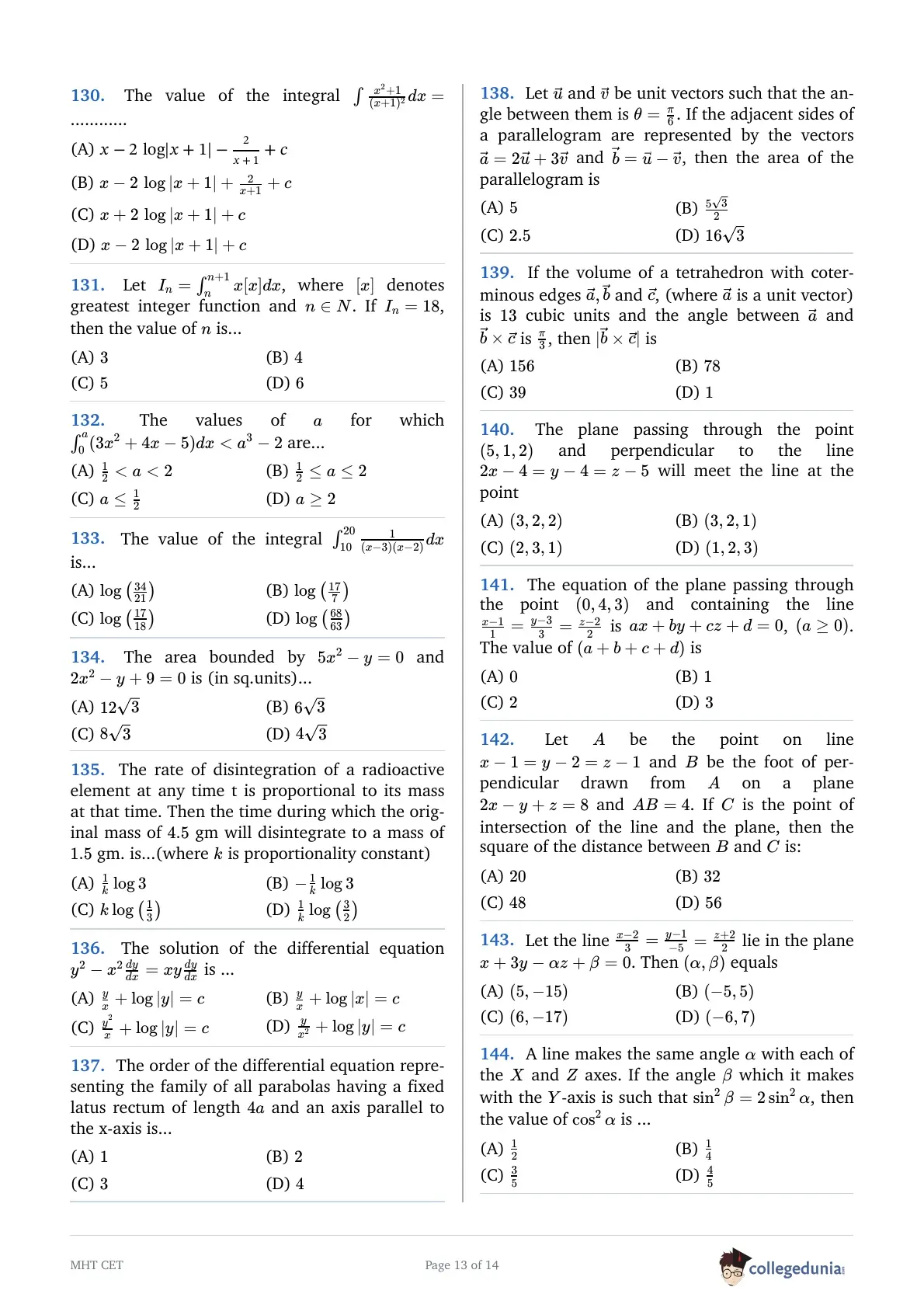
The value of the integral \(\int \frac{x^{2}+1}{(x+1)^{2}}dx=\) ............
Let \(I_{n}=\int _{n}^{n+1}x[x]dx\), where \([x]\) denotes greatest integer function and \(n\in N\). If \(I_{n}=18\), then the value of \(n\) is...
The values of \(a\) for which \(\int _{0}^{a}(3x^{2}+4x-5)dx\lt a^{3}-2\) are...
The value of the integral \(\int _{10}^{20}\frac{1}{(x-3)(x-2)}dx\) is...
The area bounded by \(5x^{2}-y=0\) and \(2x^{2}-y+9=0\) is (in sq.units)...
The rate of disintegration of a radioactive element at any time t is proportional to its mass at that time. Then the time during which the original mass of \(4.5\) gm will disintegrate to a mass of \(1.5\) gm. is...(where \(k\) is proportionality constant)
The solution of the differential equation \(y^{2}-x^{2}\frac{dy}{dx}=xy\frac{dy}{dx}\) is ...
The order of the differential equation representing the family of all parabolas having a fixed latus rectum of length \(4a\) and an axis parallel to the x-axis is...
Let \(\vec{u}\) and \(\vec{v}\) be unit vectors such that the angle between them is \(\theta =\frac{\pi }{6}\). If the adjacent sides of a parallelogram are represented by the vectors \(\vec{a}=2\vec{u}+3\vec{v}\) and \(\vec{b}=\vec{u}-\vec{v}\), then the area of the parallelogram is
If the volume of a tetrahedron with coterminous edges \(\vec{a},\vec{b}\) and \(\vec{c}\), (where \(\vec{a}\) is a unit vector) is \(13\) cubic units and the angle between \(\vec{a}\) and \(\vec{b}\times \vec{c}\) is \(\frac{\pi }{3}\), then \(|\vec{b}\times \vec{c}|\) is
The plane passing through the point \((5,1,2)\) and perpendicular to the line \(2x-4=y-4=z-5\) will meet the line at the point
The equation of the plane passing through the point \((0,4,3)\) and containing the line \(\frac{x-1}{1}=\frac{y-3}{3}=\frac{z-2}{2}\) is \(ax+by+cz+d=0\), \((a\geq 0)\). The value of \((a+b+c+d)\) is
Let \(A\) be the point on line \(x-1=y-2=z-1\) and \(B\) be the foot of perpendicular drawn from \(A\) on a plane \(2x-y+z=8\) and \(AB=4\). If \(C\) is the point of intersection of the line and the plane, then the square of the distance between \(B\) and \(C\) is:
Let the line \(\frac{x-2}{3}=\frac{y-1}{-5}=\frac{z+2}{2}\) lie in the plane \(x+3y-\alpha z+\beta =0\). Then \((\alpha ,\beta )\) equals
A line makes the same angle \(\alpha\) with each of the \(X\) and \(Z\) axes. If the angle \(\beta\) which it makes with the \(Y\)-axis is such that \(\sin ^{2}\beta =2\sin ^{2}\alpha\), then the value of \(\cos ^{2}\alpha\) is ...
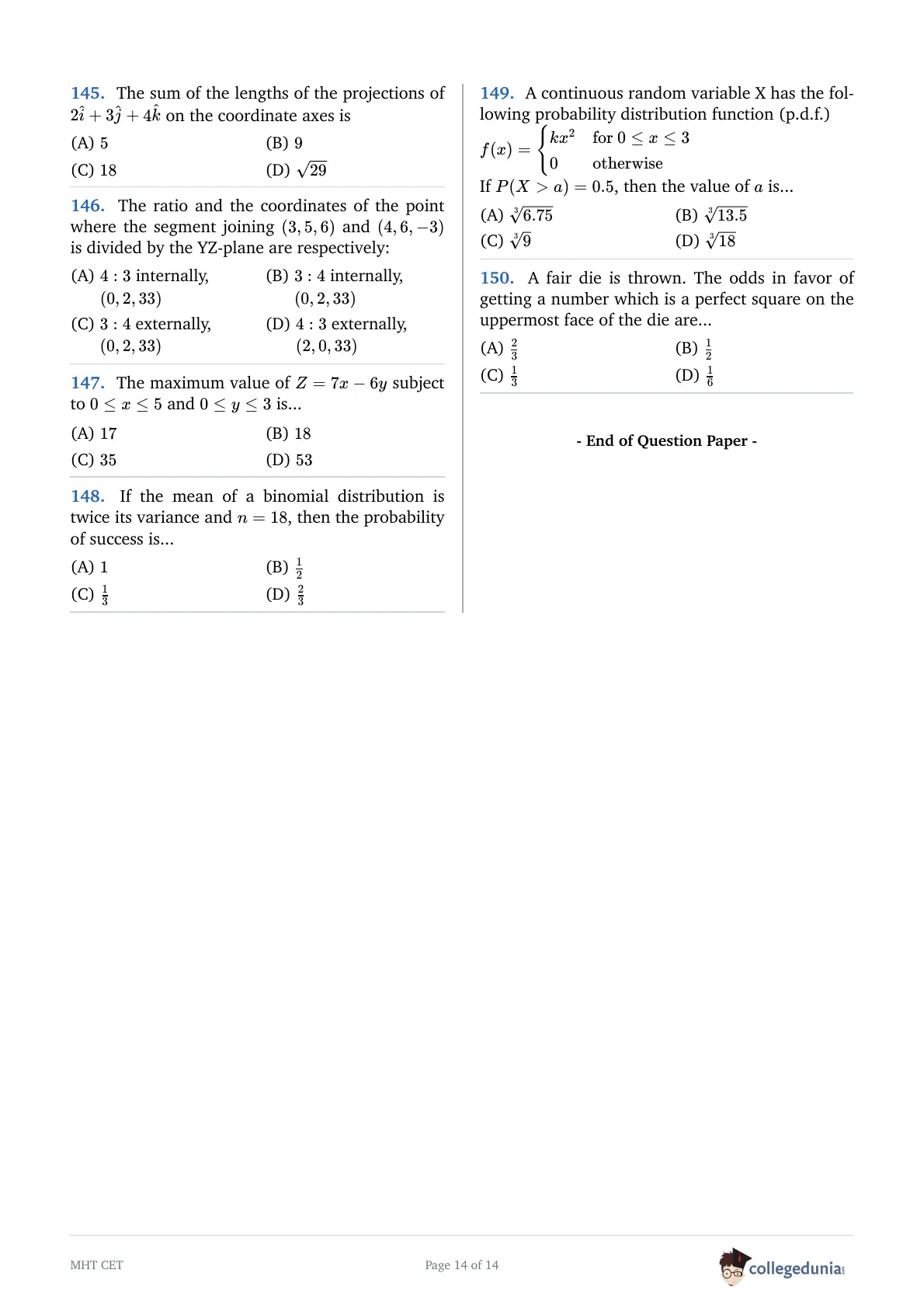
The sum of the lengths of the projections of \(2\hat{i}+3\hat{j}+4\hat{k}\) on the coordinate axes is
The ratio and the coordinates of the point where the segment joining \((3,5,6)\) and \((4,6,-3)\) is divided by the YZ-plane are respectively:
The maximum value of \(Z=7x-6y\) subject to \(0\leq x\leq 5\) and \(0\leq y\leq 3\) is...
If the mean of a binomial distribution is twice its variance and \(n=18\), then the probability of success is...
A continuous random variable X has the following probability distribution function (p.d.f.)
\(f(x)=\begin{cases} kx^{2} & \text{for }0\leq x\leq 3 \\ 0 & \text{otherwise} \end{cases}\)
If \(P(X>a)=0.5\), then the value of \(a\) is...
A fair die is thrown. The odds in favor of getting a number which is a perfect square on the uppermost face of the die are...
MHT CET 2026 PCM Exam Pattern and Marking Scheme
| Parameter | Details |
|---|---|
| Conducting Body | Maharashtra Common Entrance Test Cell (Maharashtra CET Cell) |
| Exam Mode | Online (Computer-Based Test) |
| Duration | 180 minutes (3 hours) |
| Groups / Subjects | PCM (Physics, Chemistry, Mathematics) for Engineering |
| Total Questions |
150 |
| Total Marks | 200 |
| Question Type | Multiple Choice Questions (MCQs) |
| Marks Distribution |
|
| Negative Marking | No |
| Syllabus Weightage |
|



Comments