




MHT CET 2026 May 14 Shift 1 PCM Question Paper is available for download here. Maharashtra State CET Cell conducted MHT CET 2026 PCM Exam on May 14 in Shift 1 from 9 AM to 12 PM in CBT mode.
The MHT CET 2026 PCM question paper includes the following:
- The MHT CET 2026 PCM Question Paper consists of 150 multiple-choice questions (MCQs) totalling 200 marks divided into 3 sections: Physics, Chemistry, and Mathematics, with 50 questions in each subject.
- Physics and Chemistry questions carry 1 mark each while Mathematics questions carry 2 marks each.
- There is no negative marking for incorrect answers.
MHT CET 2026 May 14 Shift 1 PCM Question Paper with Solution PDF
| CD PDF | CD PDF with Solutions |
|---|---|
| Download Collegedunia PDF 0.92 MB | - |
Also Check:
MHT CET 2026 May 14 Shift 1 PCM Questions with Solutions
Physics (Q1 - Q50)
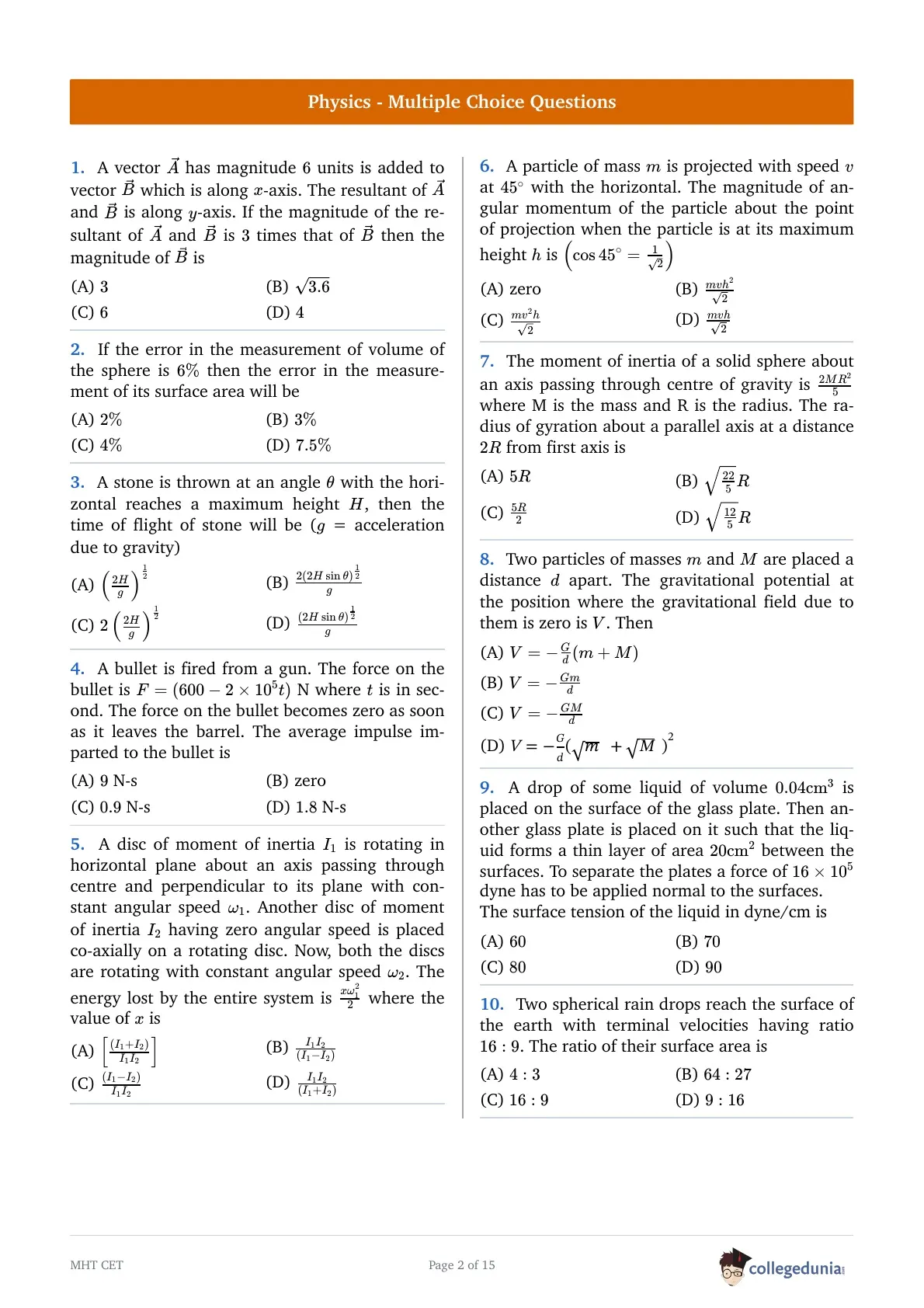
A vector \(\vec{A}\) has magnitude \(6\) units is added to vector \(\vec{B}\) which is along \(x\)-axis. The resultant of \(\vec{A}\) and \(\vec{B}\) is along \(y\)-axis. If the magnitude of the resultant of \(\vec{A}\) and \(\vec{B}\) is \(3\) times that of \(\vec{B}\) then the magnitude of \(\vec{B}\) is
If the error in the measurement of volume of the sphere is \(6\%\) then the error in the measurement of its surface area will be
A stone is thrown at an angle \(\theta\) with the horizontal reaches a maximum height \(H\), then the time of flight of stone will be (\(g\) = acceleration due to gravity)
A bullet is fired from a gun. The force on the bullet is \(F=(600-2\times 10^{5}t)\) N where \(t\) is in second. The force on the bullet becomes zero as soon as it leaves the barrel. The average impulse imparted to the bullet is
A disc of moment of inertia \(I_{1}\) is rotating in horizontal plane about an axis passing through centre and perpendicular to its plane with constant angular speed \(\omega _{1}\). Another disc of moment of inertia \(I_{2}\) having zero angular speed is placed co-axially on a rotating disc. Now, both the discs are rotating with constant angular speed \(\omega _{2}\). The energy lost by the entire system is \(\frac{x\omega _{1}^{2}}{2}\) where the value of \(x\) is
A particle of mass \(m\) is projected with speed \(v\) at \(45^{\circ }\) with the horizontal. The magnitude of angular momentum of the particle about the point of projection when the particle is at its maximum height \(h\) is \(\left(\cos 45^{\circ }=\frac{1}{\sqrt{2}}\right)\)
The moment of inertia of a solid sphere about an axis passing through centre of gravity is \(\frac{2MR^{2}}{5}\) where M is the mass and R is the radius. The radius of gyration about a parallel axis at a distance \(2R\) from first axis is
Two particles of masses \(m\) and \(M\) are placed a distance \(d\) apart. The gravitational potential at the position where the gravitational field due to them is zero is \(V\). Then
A drop of some liquid of volume \(0.04\text{cm}^{3}\) is placed on the surface of the glass plate. Then another glass plate is placed on it such that the liquid forms a thin layer of area \(20\text{cm}^{2}\) between the surfaces. To separate the plates a force of \(16\times 10^{5}\) dyne has to be applied normal to the surfaces.
The surface tension of the liquid in dyne/cm is
Two spherical rain drops reach the surface of the earth with terminal velocities having ratio \(16:9\). The ratio of their surface area is
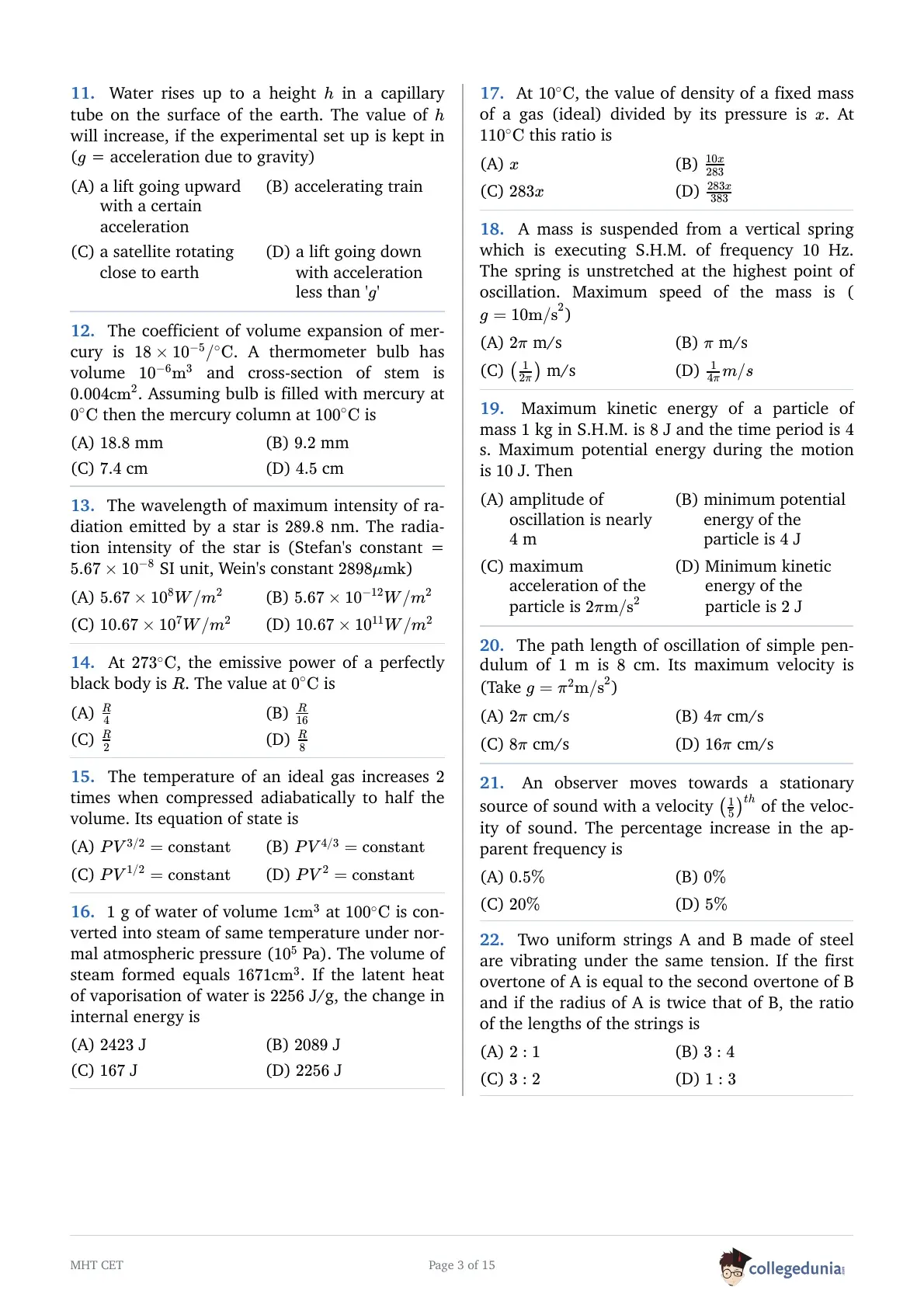
Water rises up to a height \(h\) in a capillary tube on the surface of the earth. The value of \(h\) will increase, if the experimental set up is kept in (\(g\) = acceleration due to gravity)
The coefficient of volume expansion of mercury is \(18\times 10^{-5}/^{\circ }\text{C}\). A thermometer bulb has volume \(10^{-6}\text{m}^{3}\) and cross-section of stem is \(0.004\text{cm}^{2}\). Assuming bulb is filled with mercury at \(0^{\circ }\text{C}\) then the mercury column at \(100^{\circ }\text{C}\) is
The wavelength of maximum intensity of radiation emitted by a star is \(289.8\) nm. The radiation intensity of the star is (Stefan's constant = \(5.67\times 10^{-8}\) SI unit, Wein's constant \(2898\mu \text{mk}\))
At \(273^{\circ }\text{C}\), the emissive power of a perfectly black body is \(R\). The value at \(0^{\circ }\text{C}\) is
The temperature of an ideal gas increases \(2\) times when compressed adiabatically to half the volume. Its equation of state is
\(1\) g of water of volume \(1\text{cm}^{3}\) at \(100^{\circ }\text{C}\) is converted into steam of same temperature under normal atmospheric pressure (\(10^{5}\) Pa). The volume of steam formed equals \(1671\text{cm}^{3}\). If the latent heat of vaporisation of water is \(2256\) J/g, the change in internal energy is
At \(10^{\circ }\text{C}\), the value of density of a fixed mass of a gas (ideal) divided by its pressure is \(x\). At \(110^{\circ }\text{C}\) this ratio is
A mass is suspended from a vertical spring which is executing S.H.M. of frequency \(10\) Hz. The spring is unstretched at the highest point of oscillation. Maximum speed of the mass is (\(g=10\text{m/s}^{2}\))
Maximum kinetic energy of a particle of mass \(1\) kg in S.H.M. is \(8\) J and the time period is \(4\) s. Maximum potential energy during the motion is \(10\) J. Then
The path length of oscillation of simple pendulum of \(1\) m is \(8\) cm. Its maximum velocity is (Take \(g=\pi ^{2}\text{m/s}^{2}\))
An observer moves towards a stationary source of sound with a velocity \(\left(\frac{1}{5}\right)^{th}\) of the velocity of sound. The percentage increase in the apparent frequency is
Two uniform strings A and B made of steel are vibrating under the same tension. If the first overtone of A is equal to the second overtone of B and if the radius of A is twice that of B, the ratio of the lengths of the strings is
\(n_{1}\) is the fundamental frequency of the pipe closed at one end and \(n_{2}\) is the fundamental frequency of the pipe open at both ends. If both are joined end to end, the fundamental frequency of closed pipe so formed is
A wave travelling in the positive \(x\)-direction having displacement along \(y\)-direction as \(1\) m, wavelength \(2\pi\) m and frequency \(\frac{1}{\pi }\) Hz is represented by
The electric flux entering and leaving an enclosed surface are \(\Phi _{1}\) and \(\Phi _{2}\) respectively. The electric charge inside the surface will be (\(\varepsilon _{0}\) = permittivity of vacuum)
A parallel plate capacitor having capacity \(12\) pF is charged by a battery of \(10\) V between its plates. The battery is now disconnected and a slab of dielectric constant \(6\) is kept between the plates. The work done by the capacitor on the slab is
A parallel plate air capacitor has capacity \(C\) and plate area \(A\). Now the space between its plates is filled by two slabs of thickness \(\frac{d}{2}\) each, having dielectric constants \(K_{1}\) and \(K_{2}\). Distance of separation between plates is \(d\). The capacity of the capacitor is (\(\varepsilon _{0}\) = permittivity of free space)
When a dielectric is placed in an electric field, the electric field inside the dielectric
When a resistance of \(100\Omega\) is connected in series with galvanometer of resistance \(R\), its range is \(V\). To double its range, another additional resistance of \(1000\Omega\) is connected in series. Find the value of \(R\).
A potentiometer wire has length \(L\). For a given cell of e.m.f. \(E\), the balancing length is \(\frac{L}{3}\) from the positive end of the wire. If the length of potentiometer wire is increased by \(50\%\) then for the same cell the balance point is obtained at length (from positive end)
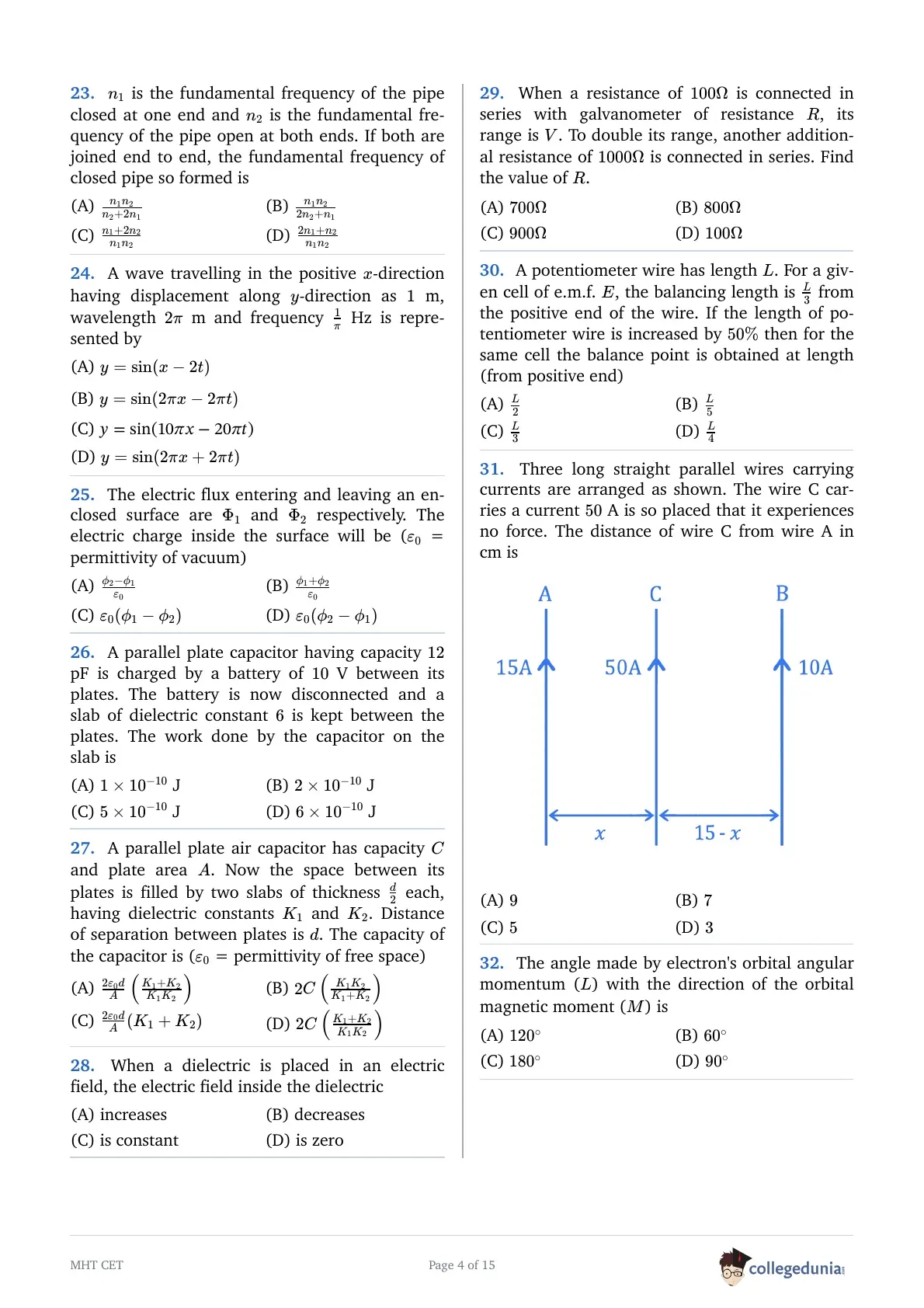
Three long straight parallel wires carrying currents are arranged as shown. The wire C carries a current \(50\) A is so placed that it experiences no force. The distance of wire C from wire A in cm is

The angle made by electron's orbital angular momentum (\(L\)) with the direction of the orbital magnetic moment (\(M\)) is
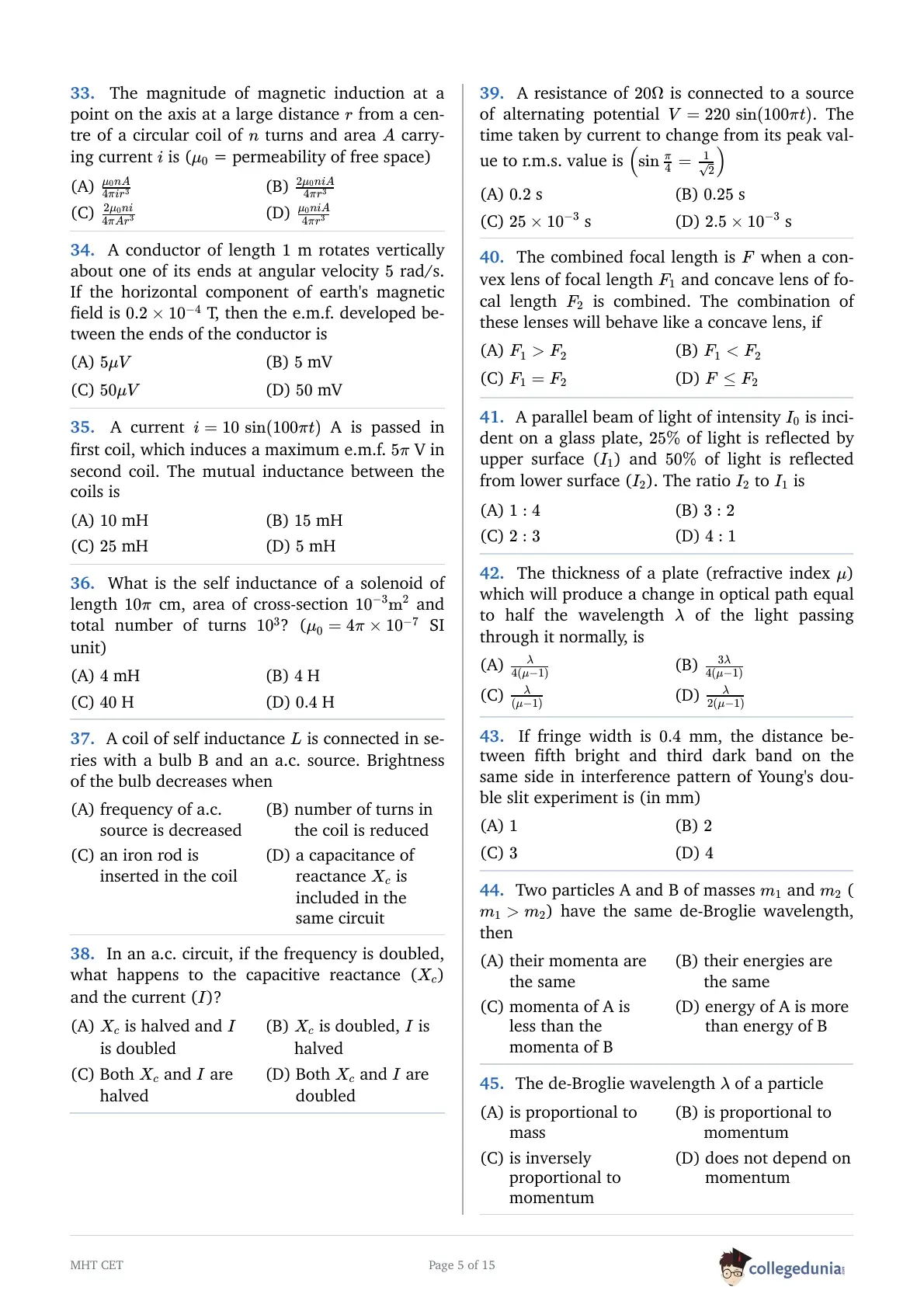
The magnitude of magnetic induction at a point on the axis at a large distance \(r\) from a centre of a circular coil of \(n\) turns and area \(A\) carrying current \(i\) is (\(\mu _{0}\) = permeability of free space)
A conductor of length \(1\) m rotates vertically about one of its ends at angular velocity \(5\) rad/s. If the horizontal component of earth's magnetic field is \(0.2\times 10^{-4}\) T, then the e.m.f. developed between the ends of the conductor is
A current \(i=10\,\sin (100\pi t)\) A is passed in first coil, which induces a maximum e.m.f. \(5\pi\) V in second coil. The mutual inductance between the coils is
What is the self inductance of a solenoid of length \(10\pi\) cm, area of cross-section \(10^{-3}\text{m}^{2}\) and total number of turns \(10^{3}\)? (\(\mu _{0}=4\pi \times 10^{-7}\) SI unit)
A coil of self inductance \(L\) is connected in series with a bulb B and an a.c. source. Brightness of the bulb decreases when
In an a.c. circuit, if the frequency is doubled, what happens to the capacitive reactance (\(X_{c}\)) and the current (\(I\))?
A resistance of \(20\Omega\) is connected to a source of alternating potential \(V=220\,\sin (100\pi t)\). The time taken by current to change from its peak value to r.m.s. value is \(\left(\sin \frac{\pi }{4}=\frac{1}{\sqrt{2}}\right)\)
The combined focal length is \(F\) when a convex lens of focal length \(F_{1}\) and concave lens of focal length \(F_{2}\) is combined. The combination of these lenses will behave like a concave lens, if
A parallel beam of light of intensity \(I_{0}\) is incident on a glass plate, \(25\%\) of light is reflected by upper surface (\(I_{1}\)) and \(50\%\) of light is reflected from lower surface (\(I_{2}\)). The ratio \(I_{2}\) to \(I_{1}\) is
The thickness of a plate (refractive index \(\mu\)) which will produce a change in optical path equal to half the wavelength \(\lambda\) of the light passing through it normally, is
If fringe width is \(0.4\) mm, the distance between fifth bright and third dark band on the same side in interference pattern of Young's double slit experiment is (in mm)
Two particles A and B of masses \(m_{1}\) and \(m_{2}\) (\(m_{1}>m_{2}\)) have the same de-Broglie wavelength, then
The de-Broglie wavelength \(\lambda\) of a particle
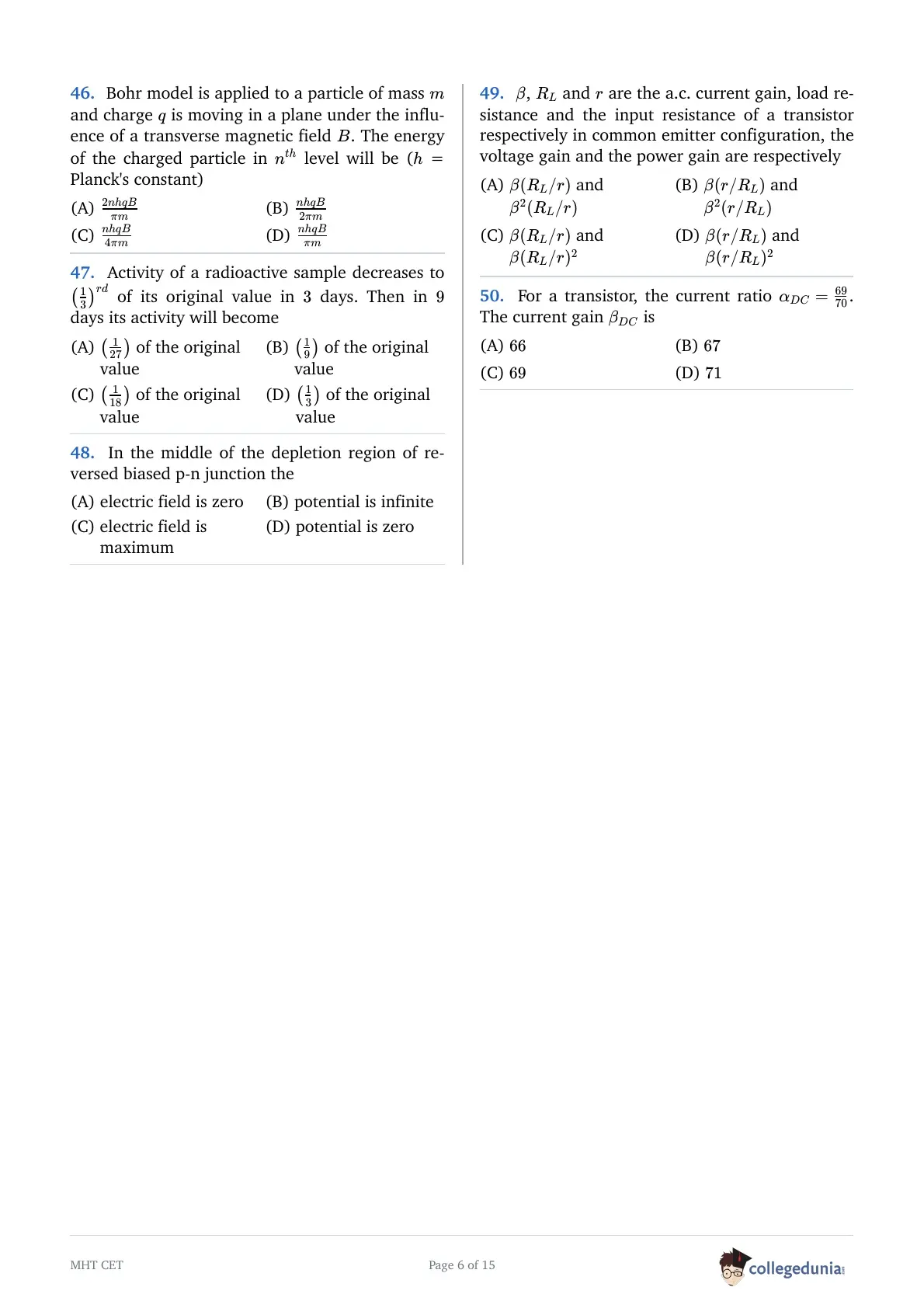
Bohr model is applied to a particle of mass \(m\) and charge \(q\) is moving in a plane under the influence of a transverse magnetic field \(B\). The energy of the charged particle in \(n^{th}\) level will be (\(h\) = Planck's constant)
Activity of a radioactive sample decreases to \(\left(\frac{1}{3}\right)^{rd}\) of its original value in \(3\) days. Then in \(9\) days its activity will become
In the middle of the depletion region of reversed biased p-n junction the
\(\beta\), \(R_{L}\) and \(r\) are the a.c. current gain, load resistance and the input resistance of a transistor respectively in common emitter configuration, the voltage gain and the power gain are respectively
For a transistor, the current ratio \(\alpha _{DC}=\frac{69}{70}\). The current gain \(\beta _{DC}\) is
Chemistry (Q51 - Q100)
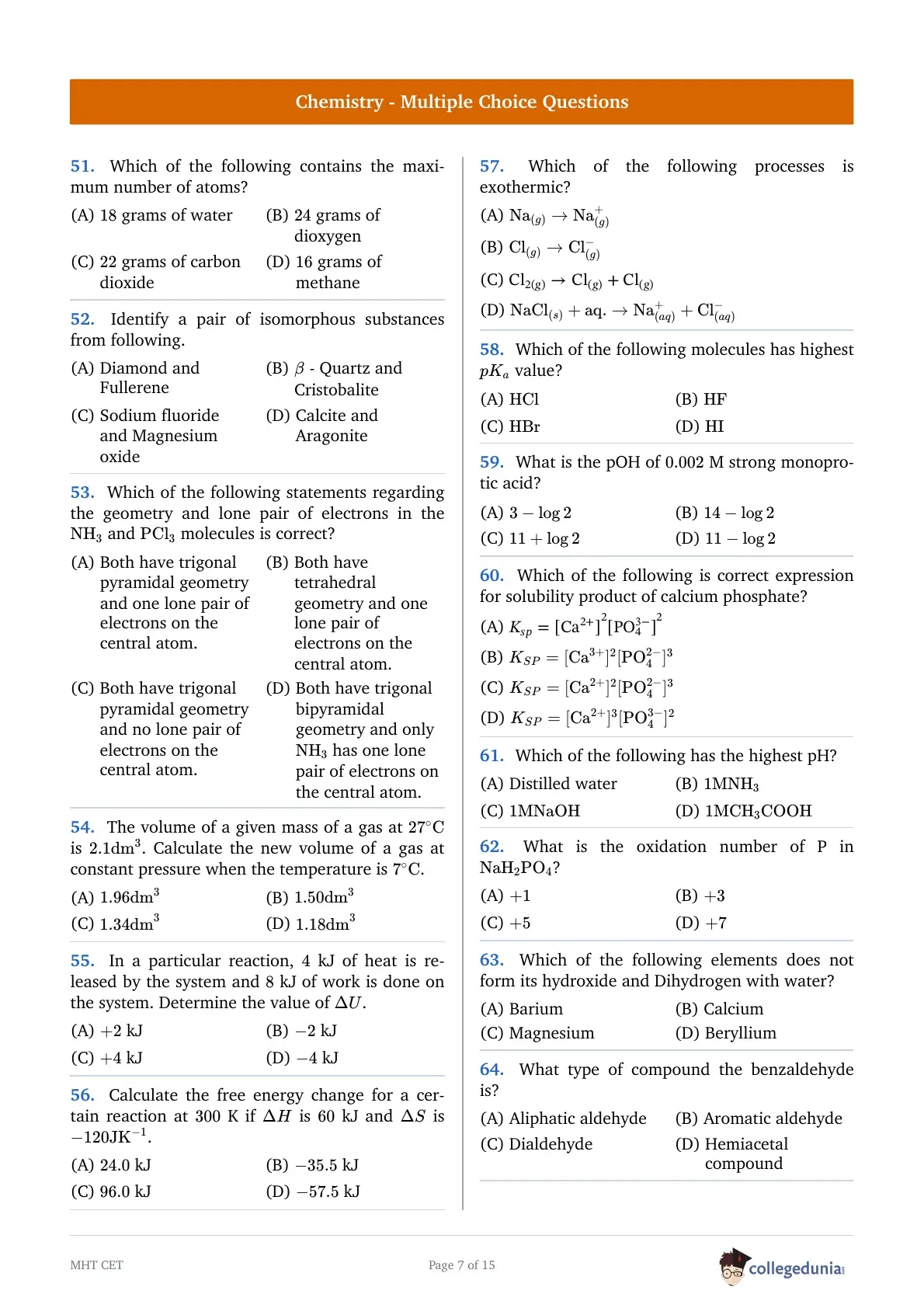
Which of the following contains the maximum number of atoms?
Identify a pair of isomorphous substances from following.
Which of the following statements regarding the geometry and lone pair of electrons in the \(\text{NH}_{3}\) and \(\text{PCl}_{3}\) molecules is correct?
The volume of a given mass of a gas at \(27^{\circ }\text{C}\) is \(2.1\text{dm}^{3}\). Calculate the new volume of a gas at constant pressure when the temperature is \(7^{\circ }\text{C}\).
In a particular reaction, \(4\) kJ of heat is released by the system and \(8\) kJ of work is done on the system. Determine the value of \(\Delta U\).
Calculate the free energy change for a certain reaction at \(300\) K if \(\Delta H\) is \(60\) kJ and \(\Delta S\) is \(-120\text{JK}^{-1}\).
Which of the following processes is exothermic?
Which of the following molecules has highest \(pK_{a}\) value?
What is the pOH of \(0.002\) M strong monoprotic acid?
Which of the following is correct expression for solubility product of calcium phosphate?
Which of the following has the highest pH?
What is the oxidation number of P in \(\text{NaH}_{2}\text{PO}_{4}\)?
Which of the following elements does not form its hydroxide and Dihydrogen with water?
What type of compound the benzaldehyde is?
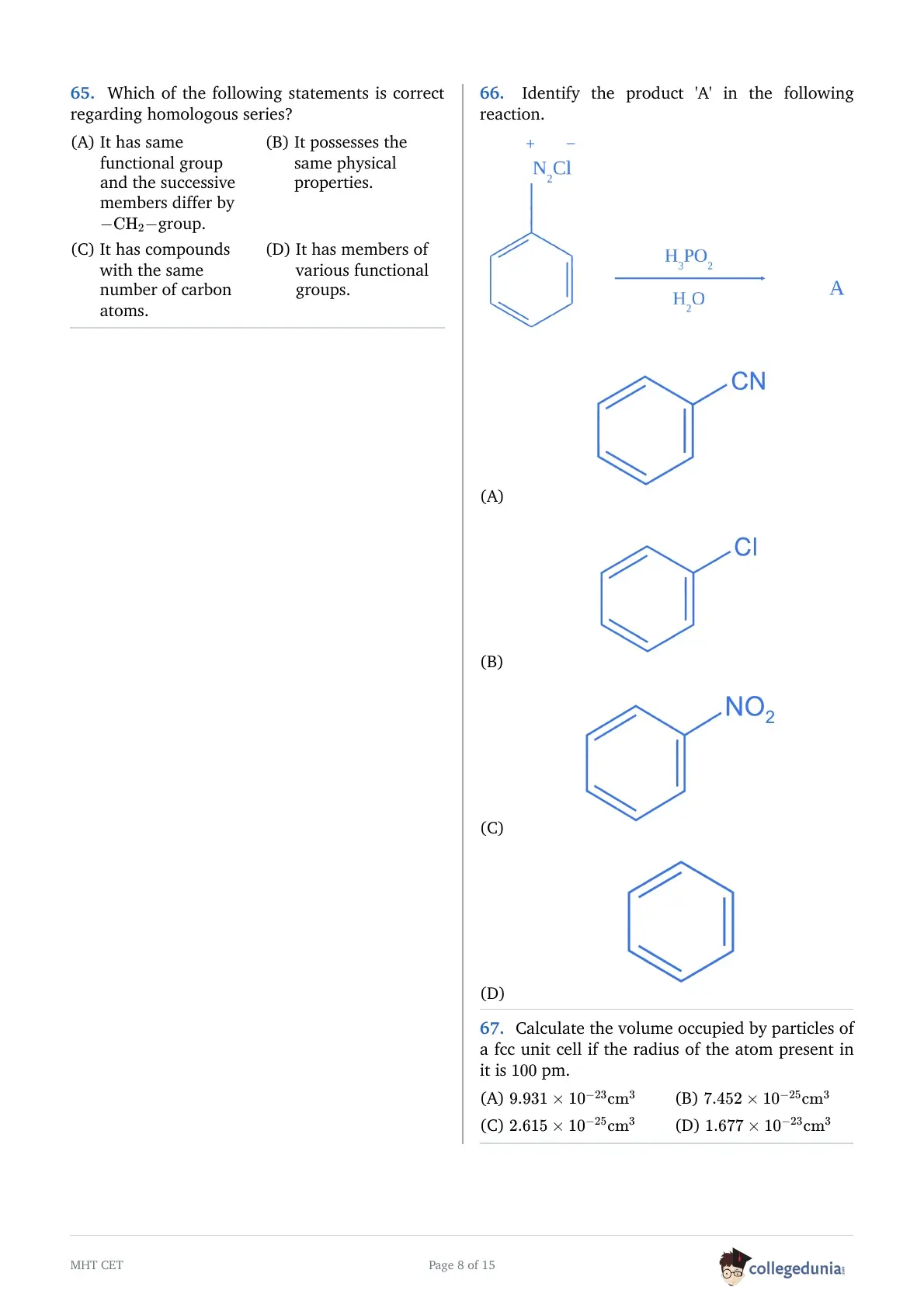
Which of the following statements is correct regarding homologous series?


Calculate the volume occupied by particles of a fcc unit cell if the radius of the atom present in it is \(100\) pm.
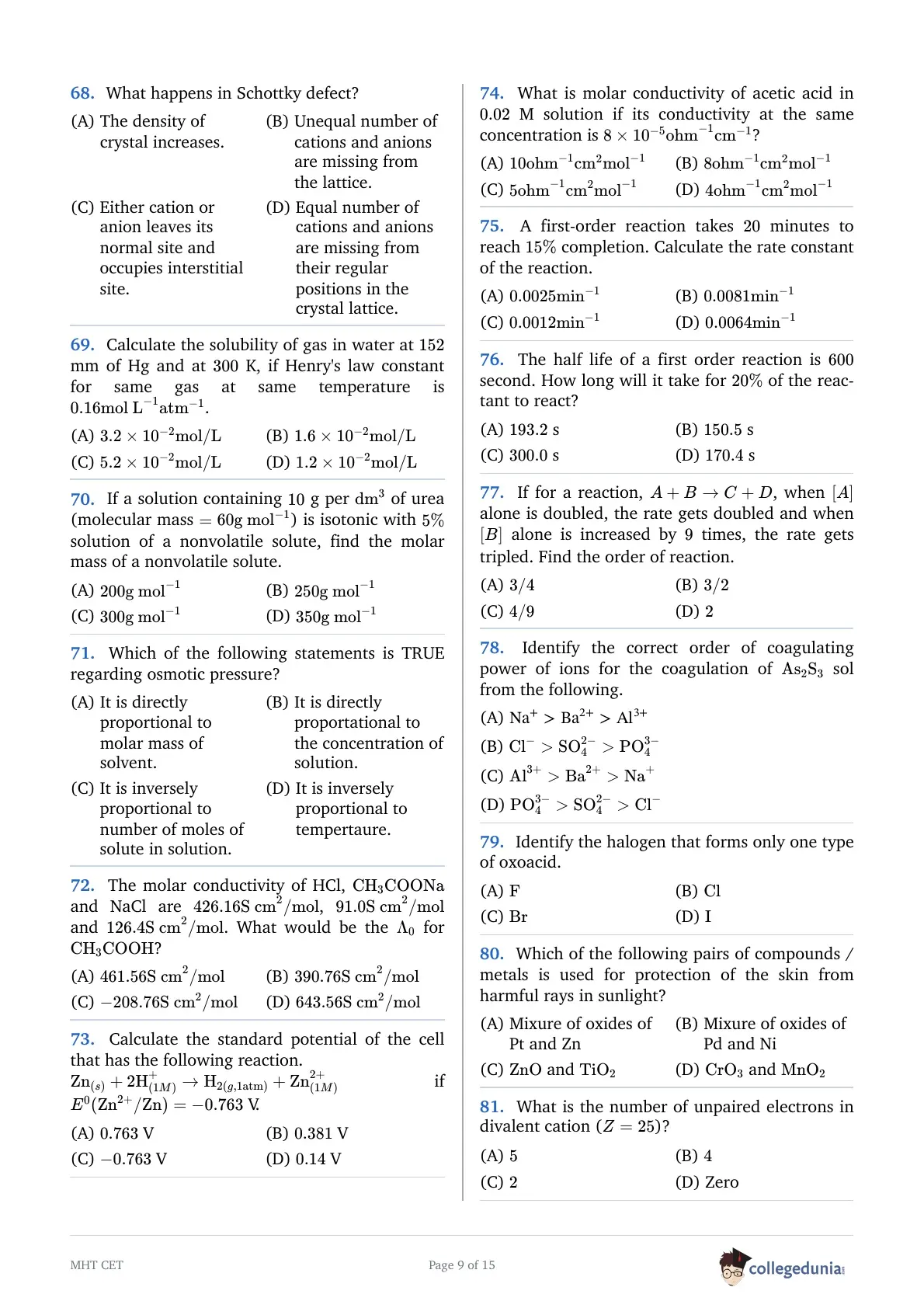
What happens in Schottky defect?
Calculate the solubility of gas in water at \(152\) mm of Hg and at \(300\) K, if Henry's law constant for same gas at same temperature is \(0.16\text{mol L}^{-1}\text{atm}^{-1}\).
If a solution containing \(10\) g per \(\text{dm}^{3}\) of urea (molecular mass \(=60\text{g mol}^{-1}\)) is isotonic with \(5\%\) solution of a nonvolatile solute, find the molar mass of a nonvolatile solute.
Which of the following statements is TRUE regarding osmotic pressure?
The molar conductivity of HCl, \(\text{CH}_{3}\text{COONa}\) and NaCl are \(426.16\text{S cm}^{2}/\text{mol}\), \(91.0\text{S cm}^{2}/\text{mol}\) and \(126.4\text{S cm}^{2}/\text{mol}\). What would be the \(\Lambda _{0}\) for \(\text{CH}_{3}\text{COOH}\)?
Calculate the standard potential of the cell that has the following reaction.
\(\text{Zn}_{(s)}+2\text{H}_{(1M)}^{+}\rightarrow \text{H}_{2(g,1\text{atm})}+\text{Zn}_{(1M)}^{2+}\) if \(E^{0}(\text{Zn}^{2+}/\text{Zn})=-0.763\) V.
What is molar conductivity of acetic acid in \(0.02\) M solution if its conductivity at the same concentration is \(8\times 10^{-5}\text{ohm}^{-1}\text{cm}^{-1}\)?
A first-order reaction takes \(20\) minutes to reach \(15\%\) completion. Calculate the rate constant of the reaction.
The half life of a first order reaction is \(600\) second. How long will it take for \(20\%\) of the reactant to react?
If for a reaction, \(A+B\rightarrow C+D\), when \([A]\) alone is doubled, the rate gets doubled and when \([B]\) alone is increased by \(9\) times, the rate gets tripled. Find the order of reaction.
Identify the correct order of coagulating power of ions for the coagulation of \(\text{As}_{2}\text{S}_{3}\) sol from the following.
Identify the halogen that forms only one type of oxoacid.
Which of the following pairs of compounds / metals is used for protection of the skin from harmful rays in sunlight?
What is the number of unpaired electrons in divalent cation (\(Z=25\))?
Which of the following cations has the maximum number of unpaired electrons?
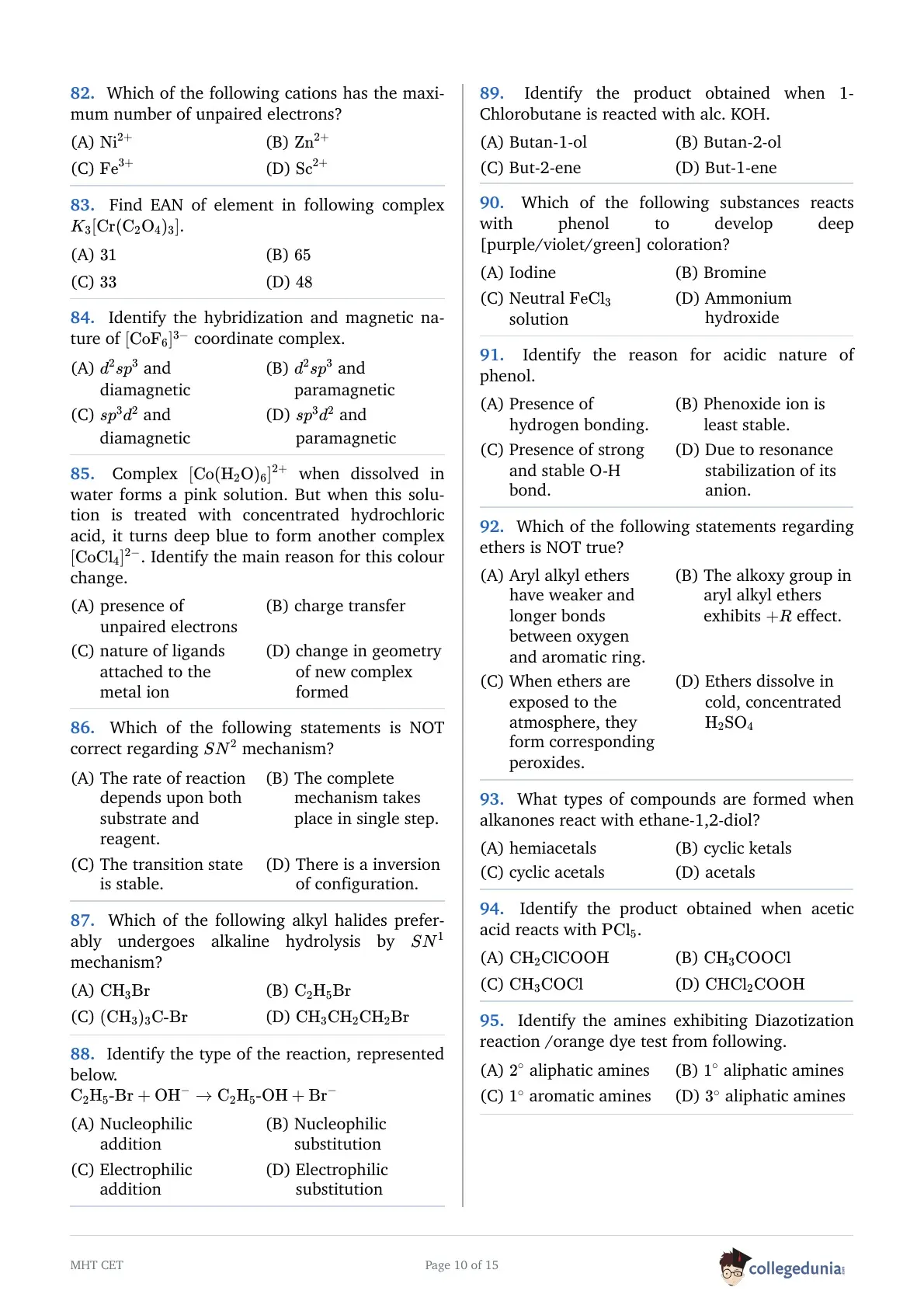
Find EAN of element in following complex \(K_{3}[\text{Cr}(\text{C}_{2}\text{O}_{4})_{3}]\).
Identify the hybridization and magnetic nature of \([\text{CoF}_{6}]^{3-}\) coordinate complex.
Complex \([\text{Co}(\text{H}_{2}\text{O})_{6}]^{2+}\) when dissolved in water forms a pink solution. But when this solution is treated with concentrated hydrochloric acid, it turns deep blue to form another complex \([\text{CoCl}_{4}]^{2-}\). Identify the main reason for this colour change.
Which of the following statements is NOT correct regarding \(SN^{2}\) mechanism?
Which of the following alkyl halides preferably undergoes alkaline hydrolysis by \(SN^{1}\) mechanism?
Identify the type of the reaction, represented below.
\(\text{C}_{2}\text{H}_{5}\text{-Br}+\text{OH}^{-}\rightarrow \text{C}_{2}\text{H}_{5}\text{-OH}+\text{Br}^{-}\)
Identify the product obtained when 1-Chlorobutane is reacted with alc. KOH.
Which of the following substances reacts with phenol to develop deep [purple/violet/green] coloration?
Identify the reason for acidic nature of phenol.
Which of the following statements regarding ethers is NOT true?
What types of compounds are formed when alkanones react with ethane-1,2-diol?
Identify the product obtained when acetic acid reacts with \(\text{PCl}_{5}\).
Identify the amines exhibiting Diazotization reaction /orange dye test from following.
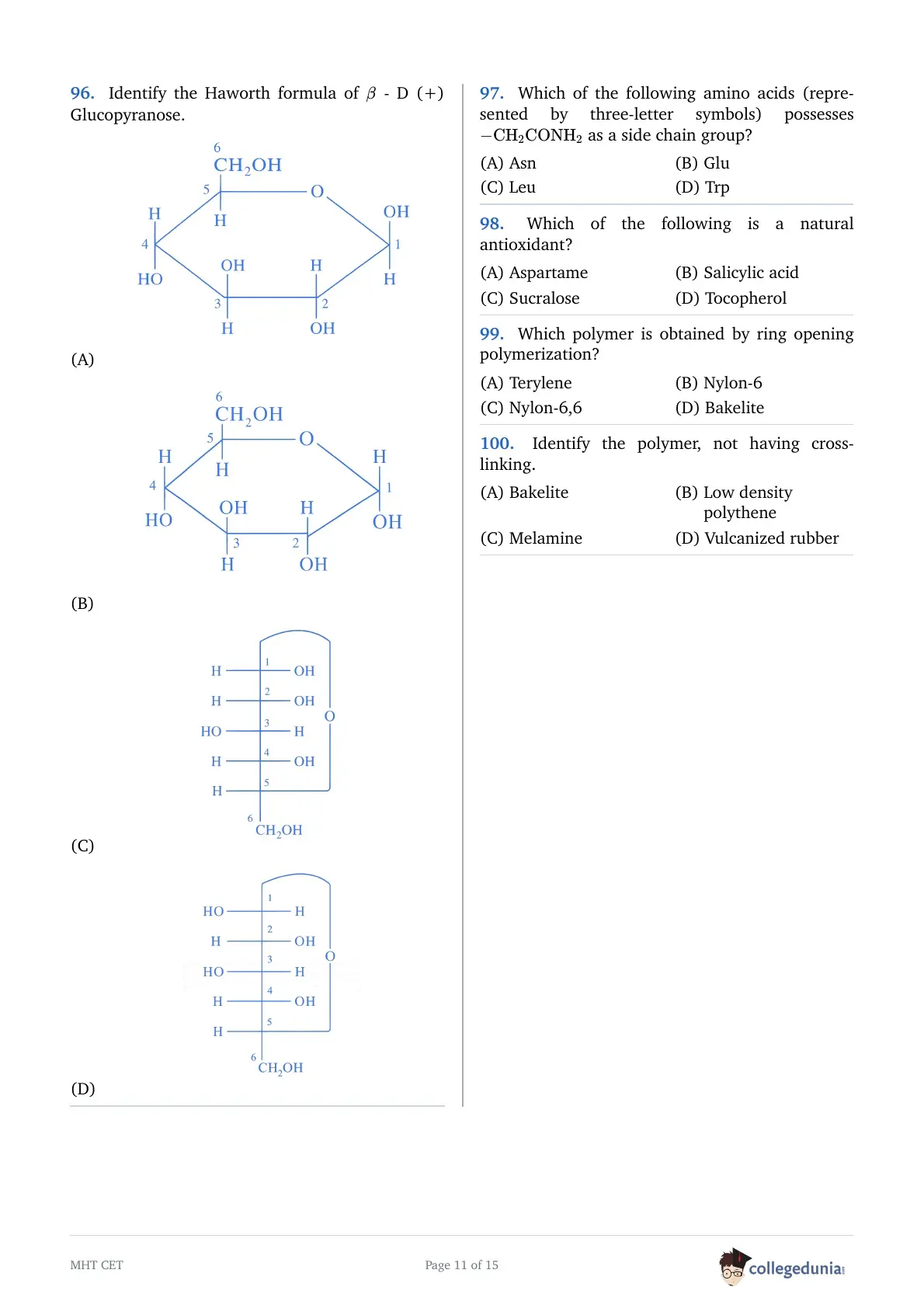
Identify the Haworth formula of \(\beta\) - D (+) Glucopyranose.
- (A)
![]()
- (B)
![]()
- (C)
![]()
- (D)
![]()


Which of the following amino acids (represented by three-letter symbols) possesses \(-\text{CH}_{2}\text{CONH}_{2}\) as a side chain group?
Which of the following is a natural antioxidant?
Which polymer is obtained by ring opening polymerization?
Identify the polymer, not having cross-linking.
Mathematics (Q101 - Q150)
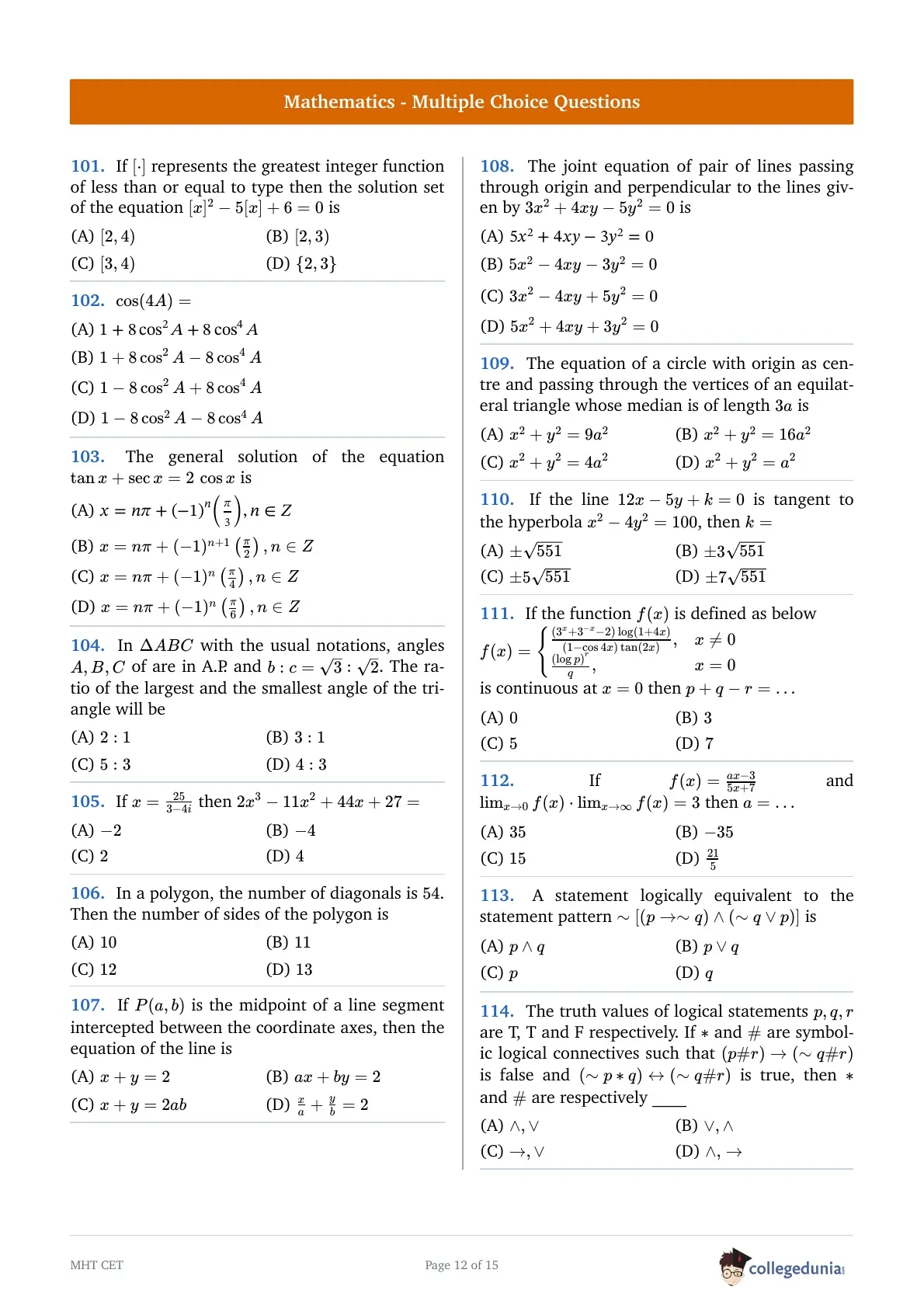
If \([\cdot ]\) represents the greatest integer function of less than or equal to type then the solution set of the equation \([x]^{2}-5[x]+6=0\) is
\(\cos (4A)=\)
The general solution of the equation \(\tan x+\sec x=2\,\cos x\) is
In \(\Delta ABC\) with the usual notations, angles \(A,B,C\) of are in A.P. and \(b:c=\sqrt{3}:\sqrt{2}\). The ratio of the largest and the smallest angle of the triangle will be
If \(x=\frac{25}{3-4i}\) then \(2x^{3}-11x^{2}+44x+27=\)
In a polygon, the number of diagonals is \(54\). Then the number of sides of the polygon is
If \(P(a,b)\) is the midpoint of a line segment intercepted between the coordinate axes, then the equation of the line is
The joint equation of pair of lines passing through origin and perpendicular to the lines given by \(3x^{2}+4xy-5y^{2}=0\) is
The equation of a circle with origin as centre and passing through the vertices of an equilateral triangle whose median is of length \(3a\) is
If the line \(12x-5y+k=0\) is tangent to the hyperbola \(x^{2}-4y^{2}=100\), then \(k=\)
If the function \(f(x)\) is defined as below
\(f(x)=\begin{cases} \frac{(3^{x}+3^{-x}-2)\log (1+4x)}{(1-\cos 4x)\tan (2x)}, & x\neq 0 \\ \frac{(\log p)^{r}}{q}, & x=0 \end{cases}\)
is continuous at \(x=0\) then \(p+q-r=\ldots\)
If \(f(x)=\frac{ax-3}{5x+7}\) and \(\lim _{x\rightarrow 0}f(x)\cdot \lim _{x\rightarrow \infty }f(x)=3\) then \(a=\ldots\)
A statement logically equivalent to the statement pattern \(\sim [(p\rightarrow \sim q)\wedge (\sim q\vee p)]\) is
The truth values of logical statements \(p,q,r\) are T, T and F respectively. If \(\*\) and \(\#\) are symbolic logical connectives such that \((p\#r)\rightarrow (\sim q\#r)\) is false and \((\sim p\* q)\leftrightarrow (\sim q\#r)\) is true, then \(\*\) and \(\#\) are respectively ____
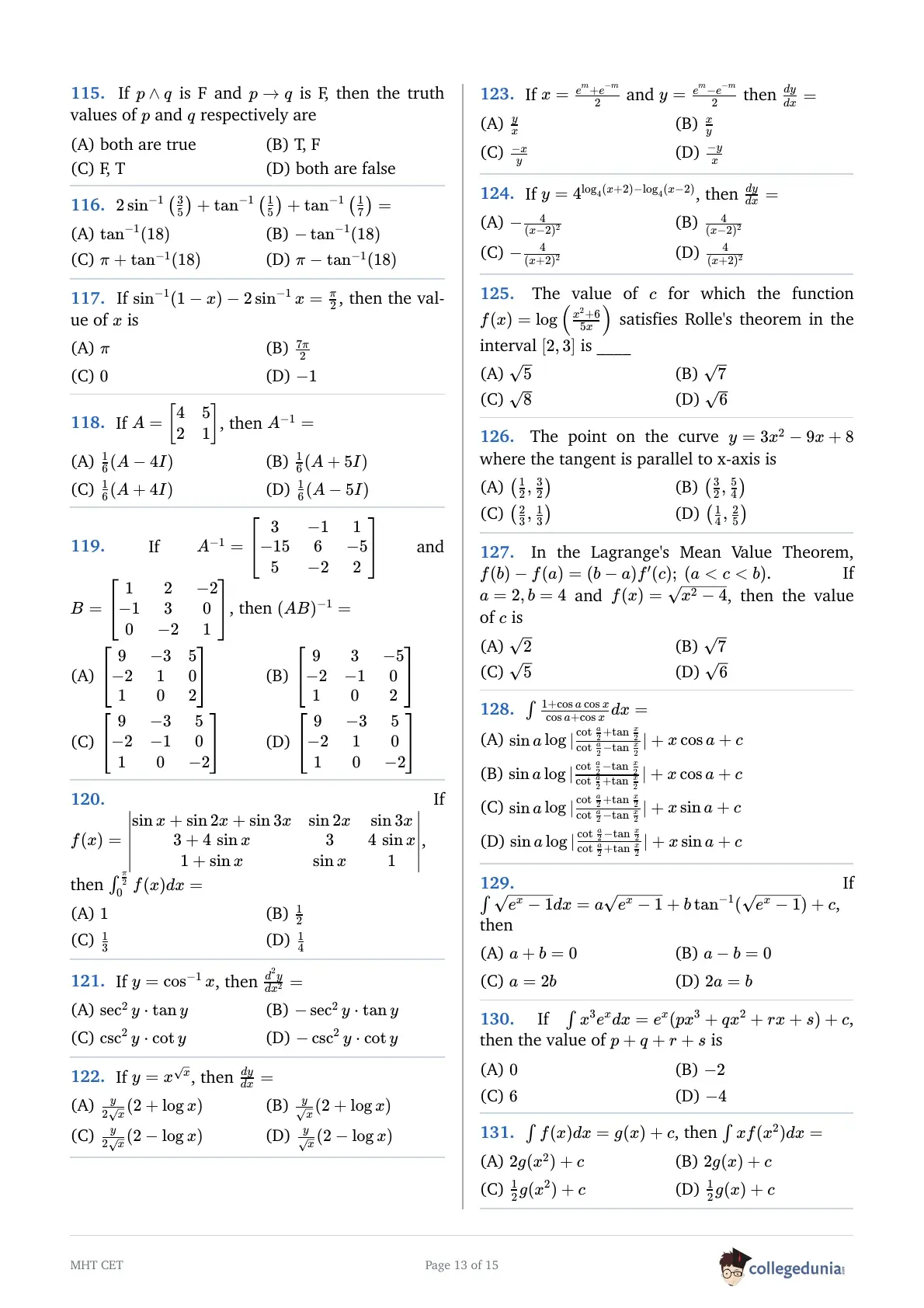
If \(p\wedge q\) is F and \(p\rightarrow q\) is F, then the truth values of \(p\) and \(q\) respectively are
\(2\sin ^{-1}\left(\frac{3}{5}\right)+\tan ^{-1}\left(\frac{1}{5}\right)+\tan ^{-1}\left(\frac{1}{7}\right)=\)
If \(\sin ^{-1}(1-x)-2\sin ^{-1}x=\frac{\pi }{2}\), then the value of \(x\) is
If \(A=\begin{bmatrix} 4 & 5 \\ 2 & 1 \end{bmatrix}\), then \(A^{-1}=\)
If \(A^{-1}=\begin{bmatrix} 3 & -1 & 1 \\ -15 & 6 & -5 \\ 5 & -2 & 2 \end{bmatrix}\) and \(B=\begin{bmatrix} 1 & 2 & -2 \\ -1 & 3 & 0 \\ 0 & -2 & 1 \end{bmatrix}\), then \((AB)^{-1}=\)
If \(f(x)=\begin{vmatrix} \sin x+\sin 2x+\sin 3x & \sin 2x & \sin 3x \\ 3+4\,\sin x & 3 & 4\,\sin x \\ 1+\sin x & \sin x & 1 \end{vmatrix}\), then \(\int _{0}^{\frac{\pi }{2}}f(x)dx=\)
If \(y=\cos ^{-1}x\), then \(\frac{d^{2}y}{dx^{2}}=\)
If \(y=x^{\sqrt{x}}\), then \(\frac{dy}{dx}=\)
If \(x=\frac{e^{m}+e^{-m}}{2}\) and \(y=\frac{e^{m}-e^{-m}}{2}\) then \(\frac{dy}{dx}=\)
If \(y=4^{\log _{4}(x+2)-\log _{4}(x-2)}\), then \(\frac{dy}{dx}=\)
The value of \(c\) for which the function \(f(x)=\log \left(\frac{x^{2}+6}{5x}\right)\) satisfies Rolle's theorem in the interval \([2,3]\) is ____
The point on the curve \(y=3x^{2}-9x+8\) where the tangent is parallel to x-axis is
In the Lagrange's Mean Value Theorem, \(f(b)-f(a)=(b-a)f'(c);\ (a\lt c\lt b)\). If \(a=2,b=4\) and \(f(x)=\sqrt{x^{2}-4}\), then the value of \(c\) is
\(\int \frac{1+\cos a\cos x}{\cos a+\cos x}dx=\)
If \(\int \sqrt{e^{x}-1}dx=a\sqrt{e^{x}-1}+b\tan ^{-1}(\sqrt{e^{x}-1})+c\), then
If \(\int x^{3}e^{x}dx=e^{x}(px^{3}+qx^{2}+rx+s)+c\), then the value of \(p+q+r+s\) is
\(\int f(x)dx=g(x)+c\), then \(\int xf(x^{2})dx=\)
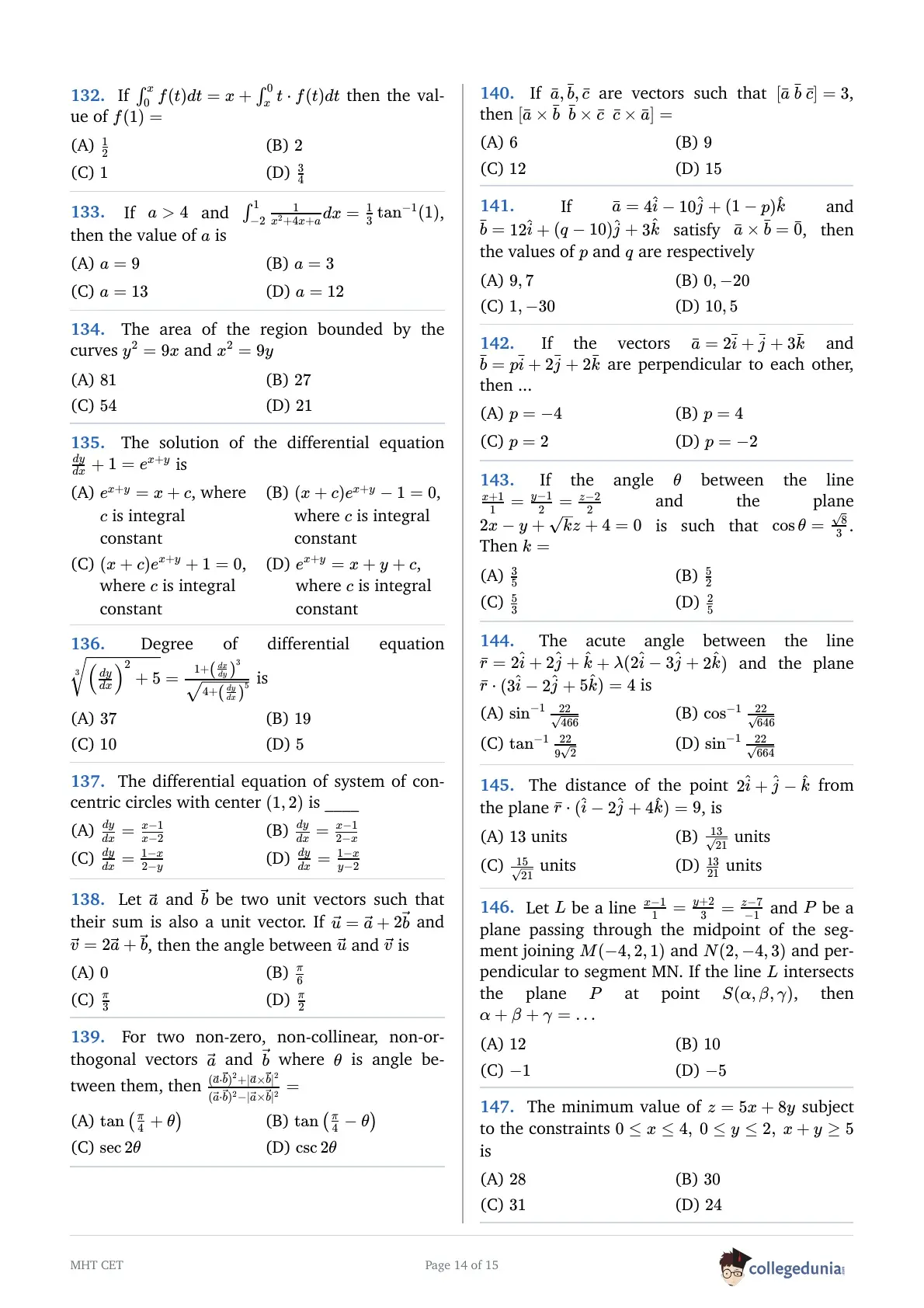
If \(\int _{0}^{x}f(t)dt=x+\int _{x}^{0}t\cdot f(t)dt\) then the value of \(f(1)=\)
If \(a>4\) and \(\int _{-2}^{1}\frac{1}{x^{2}+4x+a}dx=\frac{1}{3}\tan ^{-1}(1)\), then the value of \(a\) is
The area of the region bounded by the curves \(y^{2}=9x\) and \(x^{2}=9y\)
The solution of the differential equation \(\frac{dy}{dx}+1=e^{x+y}\) is
Degree of differential equation \(\sqrt[3]{\left(\frac{dy}{dx}\right)^{2}+5}=\frac{1+\left(\frac{dx}{dy}\right)^{3}}{\sqrt{4+\left(\frac{dy}{dx}\right)^{5}}}\) is
The differential equation of system of concentric circles with center \((1,2)\) is ____
Let \(\vec{a}\) and \(\vec{b}\) be two unit vectors such that their sum is also a unit vector. If \(\vec{u}=\vec{a}+2\vec{b}\) and \(\vec{v}=2\vec{a}+\vec{b}\), then the angle between \(\vec{u}\) and \(\vec{v}\) is
For two non-zero, non-collinear, non-orthogonal vectors \(\vec{a}\) and \(\vec{b}\) where \(\theta\) is angle between them, then \(\frac{(\vec{a}\cdot \vec{b})^{2}+|\vec{a}\times \vec{b}|^{2}}{(\vec{a}\cdot \vec{b})^{2}-|\vec{a}\times \vec{b}|^{2}}=\)
If \(\bar{a},\bar{b},\bar{c}\) are vectors such that \([\bar{a}\ \bar{b}\ \bar{c}]=3\), then \([\bar{a}\times \bar{b}\ \ \bar{b}\times \bar{c}\ \ \bar{c}\times \bar{a}]=\)
If \(\bar{a}=4\hat{i}-10\hat{j}+(1-p)\hat{k}\) and \(\bar{b}=12\hat{i}+(q-10)\hat{j}+3\hat{k}\) satisfy \(\bar{a}\times \bar{b}=\bar{0}\), then the values of \(p\) and \(q\) are respectively
If the vectors \(\bar{a}=2\bar{i}+\bar{j}+3\bar{k}\) and \(\bar{b}=p\bar{i}+2\bar{j}+2\bar{k}\) are perpendicular to each other, then ...
If the angle \(\theta\) between the line \(\frac{x+1}{1}=\frac{y-1}{2}=\frac{z-2}{2}\) and the plane \(2x-y+\sqrt{k}z+4=0\) is such that \(\cos \theta =\frac{\sqrt{8}}{3}\). Then \(k=\)
The acute angle between the line \(\bar{r}=2\hat{i}+2\hat{j}+\hat{k}+\lambda (2\hat{i}-3\hat{j}+2\hat{k})\) and the plane \(\bar{r}\cdot (3\hat{i}-2\hat{j}+5\hat{k})=4\) is
The distance of the point \(2\hat{i}+\hat{j}-\hat{k}\) from the plane \(\bar{r}\cdot (\hat{i}-2\hat{j}+4\hat{k})=9\), is
Let \(L\) be a line \(\frac{x-1}{1}=\frac{y+2}{3}=\frac{z-7}{-1}\) and \(P\) be a plane passing through the midpoint of the segment joining \(M(-4,2,1)\) and \(N(2,-4,3)\) and perpendicular to segment MN. If the line \(L\) intersects the plane \(P\) at point \(S(\alpha ,\beta ,\gamma )\), then \(\alpha +\beta +\gamma =\ldots\)
The minimum value of \(z=5x+8y\) subject to the constraints \(0\leq x\leq 4,\ 0\leq y\leq 2,\ x+y\geq 5\) is
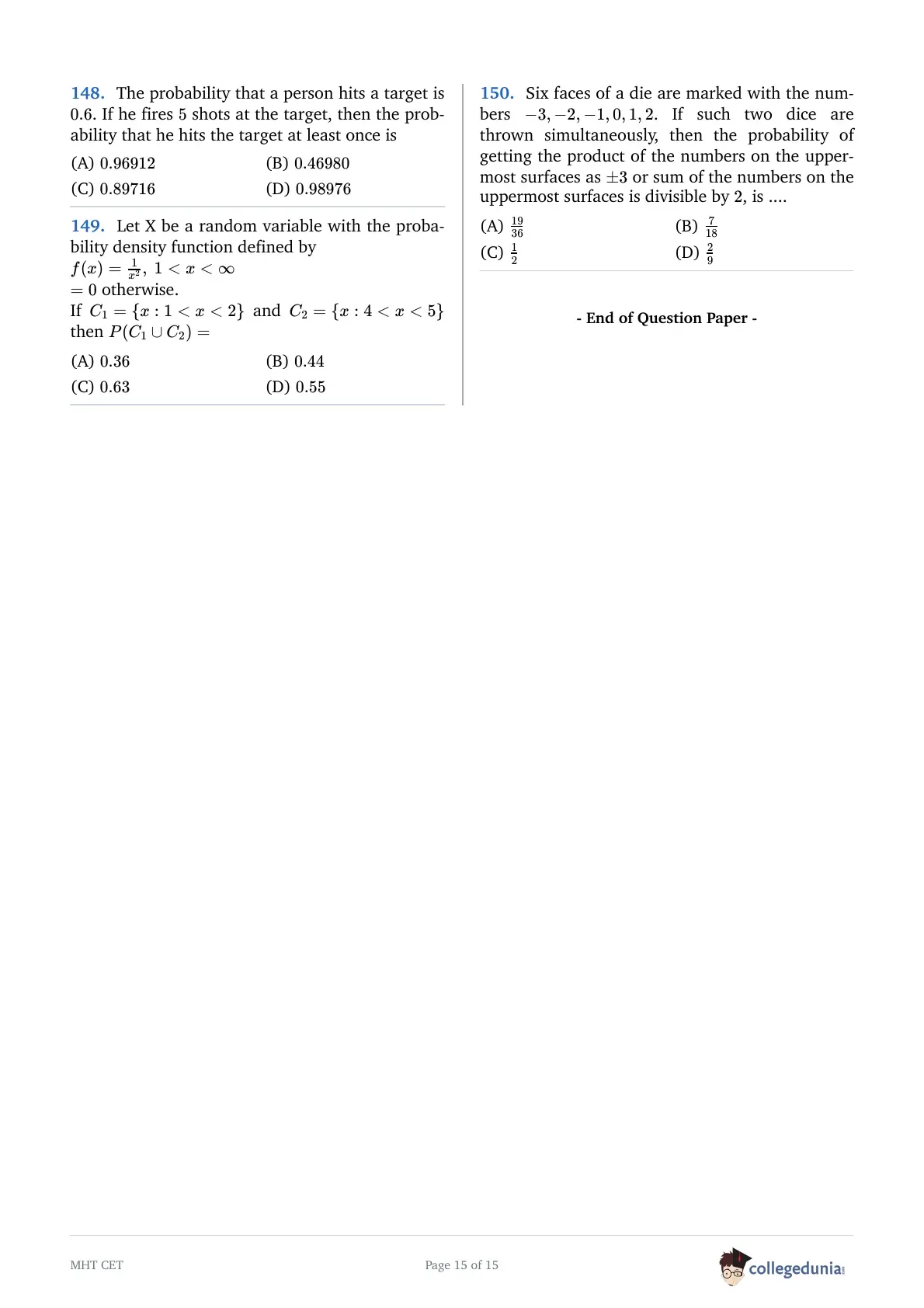
The probability that a person hits a target is \(0.6\). If he fires \(5\) shots at the target, then the probability that he hits the target at least once is
Let X be a random variable with the probability density function defined by
\(f(x)=\frac{1}{x^{2}},\ 1\lt x\lt \infty\)
\(=0\) otherwise.
If \(C_{1}=\{x:1\lt x\lt 2\}\) and \(C_{2}=\{x:4\lt x\lt 5\}\) then \(P(C_{1}\cup C_{2})=\)
Six faces of a die are marked with the numbers \(-3,-2,-1,0,1,2\). If such two dice are thrown simultaneously, then the probability of getting the product of the numbers on the uppermost surfaces as \(\pm 3\) or sum of the numbers on the uppermost surfaces is divisible by \(2\), is ....
MHT CET 2026 PCM Exam Pattern and Marking Scheme
| Parameter | Details |
|---|---|
| Conducting Body | Maharashtra Common Entrance Test Cell (Maharashtra CET Cell) |
| Exam Mode | Online (Computer-Based Test) |
| Duration | 180 minutes (3 hours) |
| Groups / Subjects | PCM (Physics, Chemistry, Mathematics) for Engineering |
| Total Questions |
150 |
| Total Marks | 200 |
| Question Type | Multiple Choice Questions (MCQs) |
| Marks Distribution |
|
| Negative Marking | No |
| Syllabus Weightage |
|



Comments