




MHT CET 2026 May 14 Shift 2 PCM Question Paper is available for download here. Maharashtra State CET Cell conducted MHT CET 2026 PCM Exam on May 14 in Shift 2 from 2 PM to 5 PM in CBT mode.
The MHT CET 2026 PCM question paper includes the following:
- The MHT CET 2026 PCM Question Paper consists of 150 multiple-choice questions (MCQs) totalling 200 marks divided into 3 sections: Physics, Chemistry, and Mathematics, with 50 questions in each subject.
- Physics and Chemistry questions carry 1 mark each while Mathematics questions carry 2 marks each.
- There is no negative marking for incorrect answers.
MHT CET 2026 May 14 Shift 2 PCM Question Paper with Solution PDF
| CD PDF | CD PDF with Solutions |
|---|---|
| Download Collegedunia PDF 0.74 MB | - |
Also Check:
MHT CET 2026 May 14 Shift 2 PCM Questions with Solutions
Physics (Q1 - Q50)
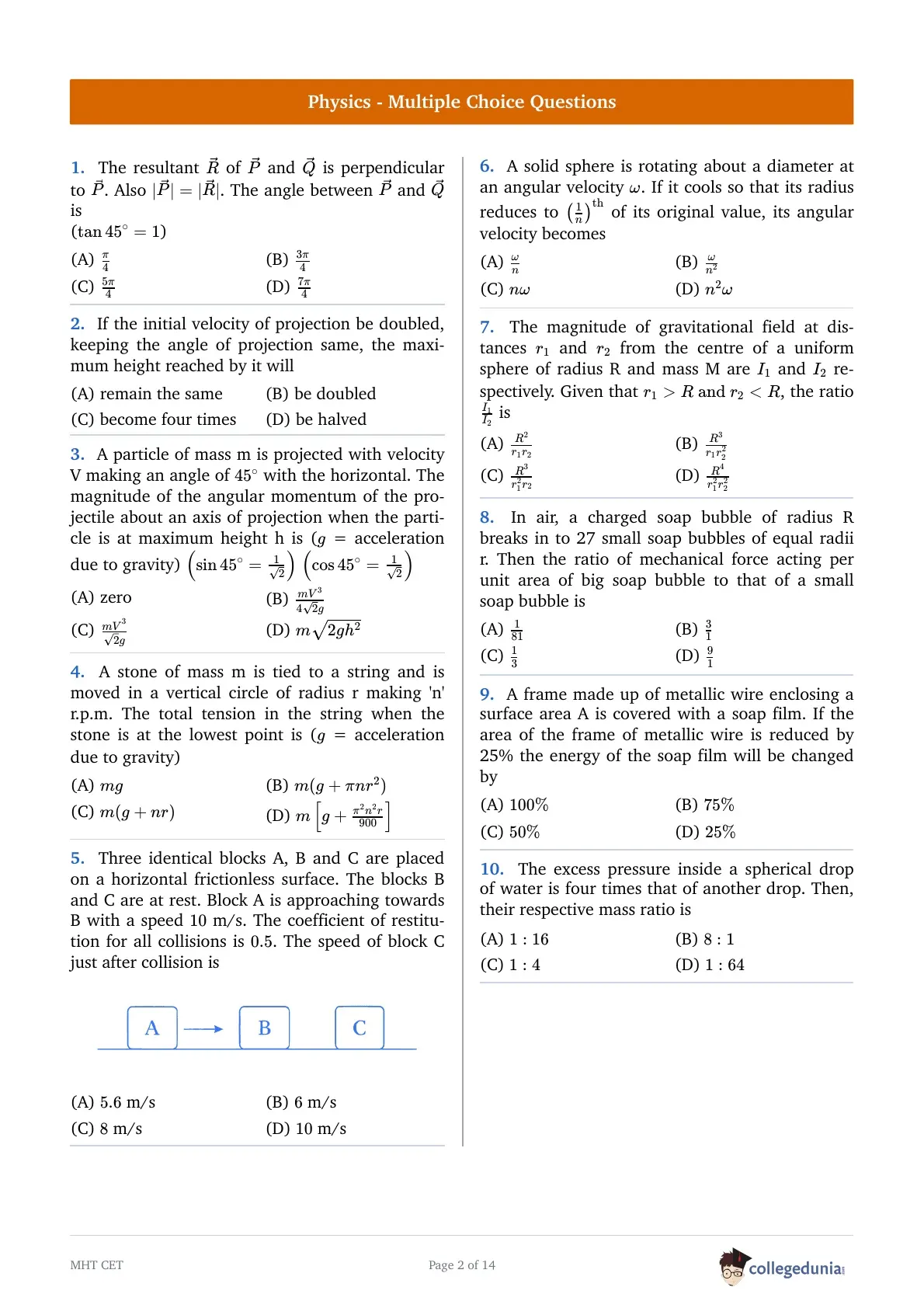
The resultant \(\vec{R}\) of \(\vec{P}\) and \(\vec{Q}\) is perpendicular to \(\vec{P}\). Also \(|\vec{P}|=|\vec{R}|\). The angle between \(\vec{P}\) and \(\vec{Q}\) is
(\(\tan 45^{\circ }=1\))
If the initial velocity of projection be doubled, keeping the angle of projection same, the maximum height reached by it will
A particle of mass m is projected with velocity V making an angle of \(45^{\circ }\) with the horizontal. The magnitude of the angular momentum of the projectile about an axis of projection when the particle is at maximum height h is (\(g\) = acceleration due to gravity) \(\left(\sin 45^{\circ }=\frac{1}{\sqrt{2}}\right)\) \(\left(\cos 45^{\circ }=\frac{1}{\sqrt{2}}\right)\)
A stone of mass m is tied to a string and is moved in a vertical circle of radius r making 'n' r.p.m. The total tension in the string when the stone is at the lowest point is (\(g\) = acceleration due to gravity)
Three identical blocks A, B and C are placed on a horizontal frictionless surface. The blocks B and C are at rest. Block A is approaching towards B with a speed \(10\) m/s. The coefficient of restitution for all collisions is \(0.5\). The speed of block C just after collision is

A solid sphere is rotating about a diameter at an angular velocity \(\omega\). If it cools so that its radius reduces to \(\left(\frac{1}{n}\right)^{\text{th}}\) of its original value, its angular velocity becomes
The magnitude of gravitational field at distances \(r_{1}\) and \(r_{2}\) from the centre of a uniform sphere of radius R and mass M are \(I_{1}\) and \(I_{2}\) respectively. Given that \(r_{1}>R\text{ and }r_{2}\lt R\), the ratio \(\frac{I_{1}}{I_{2}}\) is
In air, a charged soap bubble of radius R breaks in to 27 small soap bubbles of equal radii r. Then the ratio of mechanical force acting per unit area of big soap bubble to that of a small soap bubble is
A frame made up of metallic wire enclosing a surface area A is covered with a soap film. If the area of the frame of metallic wire is reduced by 25% the energy of the soap film will be changed by
The excess pressure inside a spherical drop of water is four times that of another drop. Then, their respective mass ratio is
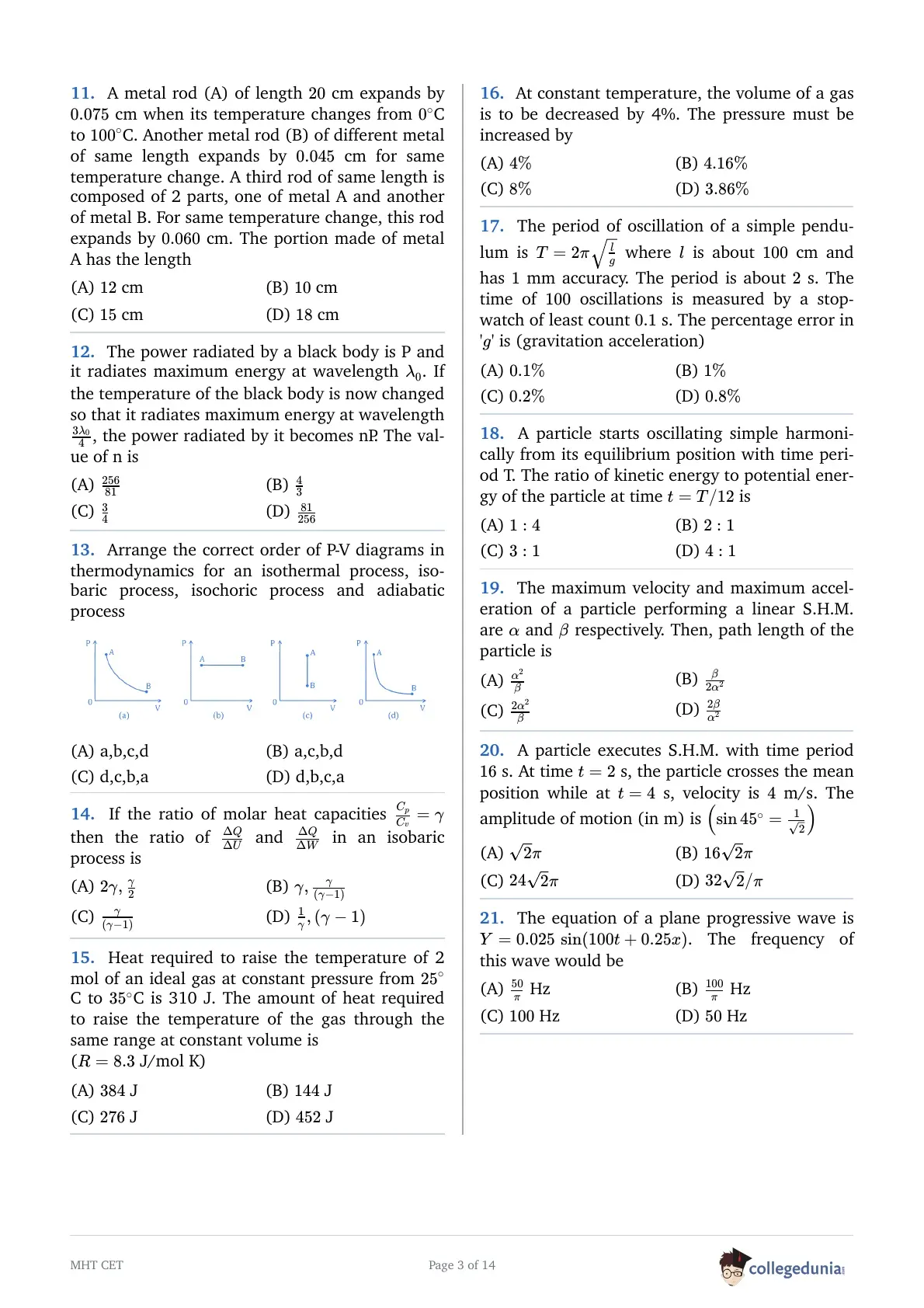
A metal rod (A) of length \(20\) cm expands by \(0.075\) cm when its temperature changes from \(0^{\circ }\)C to \(100^{\circ }\)C. Another metal rod (B) of different metal of same length expands by \(0.045\) cm for same temperature change. A third rod of same length is composed of 2 parts, one of metal A and another of metal B. For same temperature change, this rod expands by \(0.060\) cm. The portion made of metal A has the length
The power radiated by a black body is P and it radiates maximum energy at wavelength \(\lambda _{0}\). If the temperature of the black body is now changed so that it radiates maximum energy at wavelength \(\frac{3\lambda _{0}}{4}\), the power radiated by it becomes nP. The value of n is
Arrange the correct order of P-V diagrams in thermodynamics for an isothermal process, isobaric process, isochoric process and adiabatic process

If the ratio of molar heat capacities \(\frac{C_{p}}{C_{v}}=\gamma\) then the ratio of \(\frac{\Delta Q}{\Delta U}\) and \(\frac{\Delta Q}{\Delta W}\) in an isobaric process is
Heat required to raise the temperature of 2 mol of an ideal gas at constant pressure from \(25^{\circ }\)C to \(35^{\circ }\)C is 310 J. The amount of heat required to raise the temperature of the gas through the same range at constant volume is
(\(R=8.3\) J/mol K)
At constant temperature, the volume of a gas is to be decreased by 4%. The pressure must be increased by
The period of oscillation of a simple pendulum is \(T=2\pi \sqrt{\frac{l}{g}}\) where \(l\) is about \(100\) cm and has \(1\) mm accuracy. The period is about \(2\) s. The time of \(100\) oscillations is measured by a stopwatch of least count \(0.1\) s. The percentage error in '\(g\)' is (gravitation acceleration)
A particle starts oscillating simple harmonically from its equilibrium position with time period T. The ratio of kinetic energy to potential energy of the particle at time \(t=T/12\) is
The maximum velocity and maximum acceleration of a particle performing a linear S.H.M. are \(\alpha\) and \(\beta\) respectively. Then, path length of the particle is
A particle executes S.H.M. with time period \(16\) s. At time \(t=2\) s, the particle crosses the mean position while at \(t=4\) s, velocity is \(4\) m/s. The amplitude of motion (in m) is \(\left(\sin 45^{\circ }=\frac{1}{\sqrt{2}}\right)\)
The equation of a plane progressive wave is \(Y=0.025\,\sin (100t+0.25x)\). The frequency of this wave would be
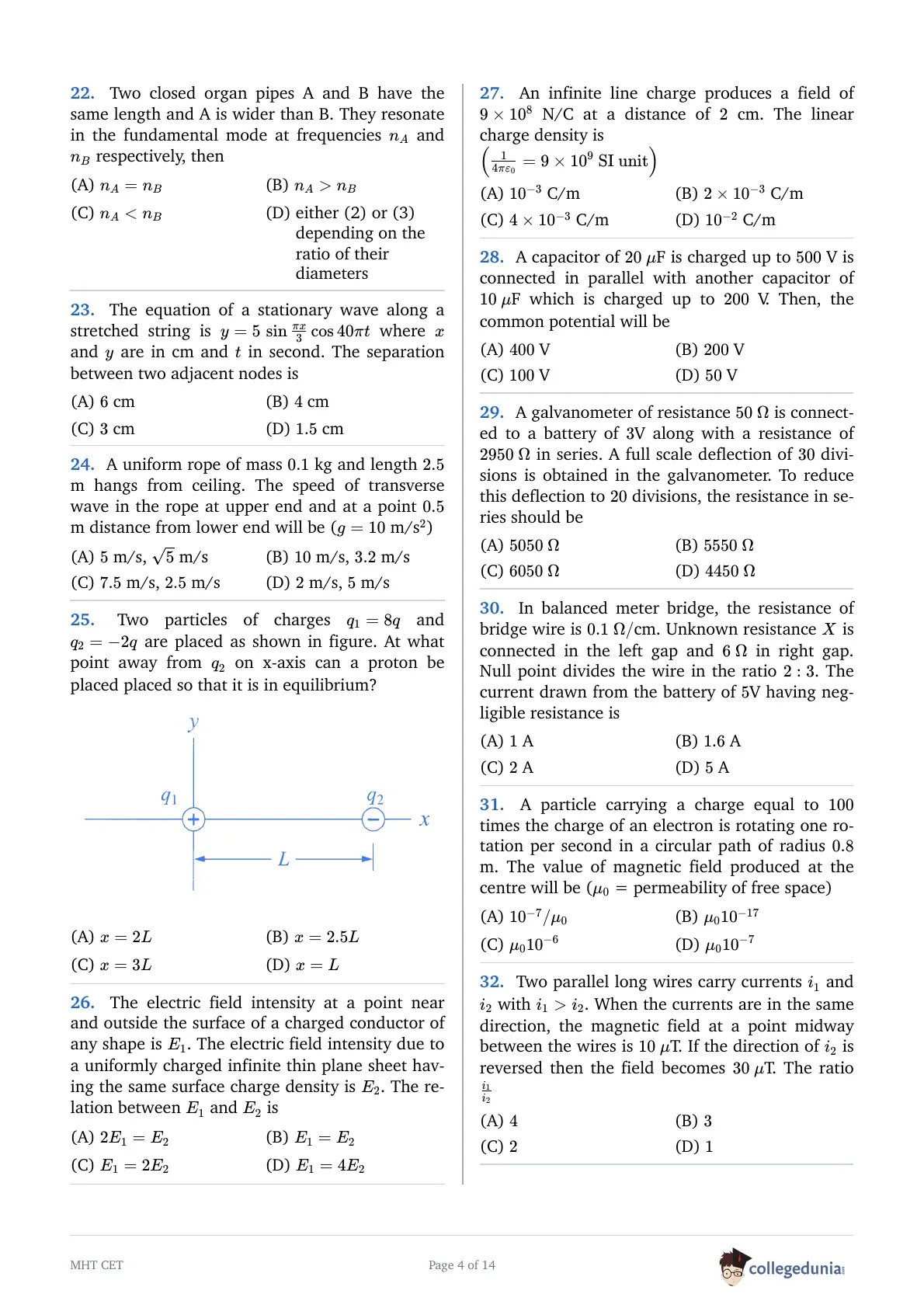
Two closed organ pipes A and B have the same length and A is wider than B. They resonate in the fundamental mode at frequencies \(n_{A}\) and \(n_{B}\) respectively, then
The equation of a stationary wave along a stretched string is \(y=5\,\sin \frac{\pi x}{3}\cos 40\pi t\) where \(x\) and \(y\) are in cm and \(t\) in second. The separation between two adjacent nodes is
A uniform rope of mass \(0.1\) kg and length \(2.5\) m hangs from ceiling. The speed of transverse wave in the rope at upper end and at a point \(0.5\) m distance from lower end will be (\(g=10\) m/s\({}^{2}\))
Two particles of charges \(q_{1}=8q\) and \(q_{2}=-2q\) are placed as shown in figure. At what point away from \(q_{2}\) on x-axis can a proton be placed placed so that it is in equilibrium?

The electric field intensity at a point near and outside the surface of a charged conductor of any shape is \(E_{1}\). The electric field intensity due to a uniformly charged infinite thin plane sheet having the same surface charge density is \(E_{2}\). The relation between \(E_{1}\) and \(E_{2}\) is
An infinite line charge produces a field of \(9\times 10^{8}\) N/C at a distance of \(2\) cm. The linear charge density is
\(\left(\frac{1}{4\pi \varepsilon _{0}}=9\times 10^{9}\text{ SI unit}\right)\)
A capacitor of \(20\ \mu\)F is charged up to \(500\) V is connected in parallel with another capacitor of \(10\ \mu\)F which is charged up to \(200\) V. Then, the common potential will be
A galvanometer of resistance \(50\ \Omega\) is connected to a battery of \(3\)V along with a resistance of \(2950\ \Omega\) in series. A full scale deflection of \(30\) divisions is obtained in the galvanometer. To reduce this deflection to \(20\) divisions, the resistance in series should be
In balanced meter bridge, the resistance of bridge wire is \(0.1\ \Omega /\)cm. Unknown resistance \(X\) is connected in the left gap and \(6\ \Omega\) in right gap. Null point divides the wire in the ratio \(2:3\). The current drawn from the battery of \(5\)V having negligible resistance is
A particle carrying a charge equal to \(100\) times the charge of an electron is rotating one rotation per second in a circular path of radius \(0.8\) m. The value of magnetic field produced at the centre will be (\(\mu _{0}\) = permeability of free space)
Two parallel long wires carry currents \(i_{1}\) and \(i_{2}\) with \(i_{1}>i_{2}\). When the currents are in the same direction, the magnetic field at a point midway between the wires is \(10\ \mu\)T. If the direction of \(i_{2}\) is reversed then the field becomes \(30\ \mu\)T. The ratio \(\frac{i_{1}}{i_{2}}\)
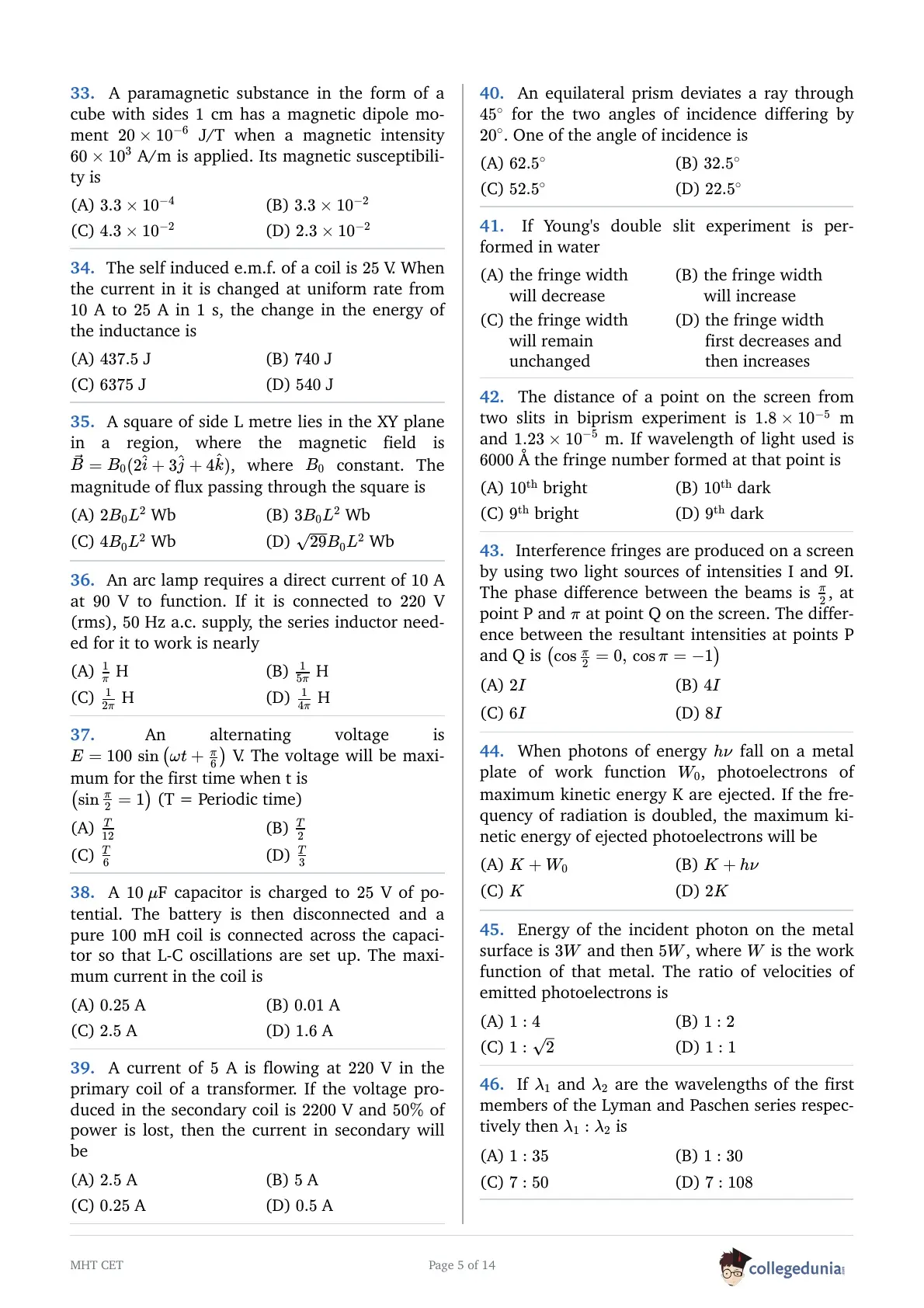
A paramagnetic substance in the form of a cube with sides \(1\) cm has a magnetic dipole moment \(20\times 10^{-6}\) J/T when a magnetic intensity \(60\times 10^{3}\) A/m is applied. Its magnetic susceptibility is
The self induced e.m.f. of a coil is \(25\) V. When the current in it is changed at uniform rate from \(10\) A to \(25\) A in \(1\) s, the change in the energy of the inductance is
A square of side L metre lies in the XY plane in a region, where the magnetic field is \(\vec{B}=B_{0}(2\hat{i}+3\hat{j}+4\hat{k})\), where \(B_{0}\) constant. The magnitude of flux passing through the square is
An arc lamp requires a direct current of \(10\) A at \(90\) V to function. If it is connected to \(220\) V (rms), \(50\) Hz a.c. supply, the series inductor needed for it to work is nearly
An alternating voltage is \(E=100\,\sin \left(\omega t+\frac{\pi }{6}\right)\) V. The voltage will be maximum for the first time when t is
\(\left(\sin \frac{\pi }{2}=1\right)\) (T = Periodic time)
A \(10\ \mu\)F capacitor is charged to \(25\) V of potential. The battery is then disconnected and a pure \(100\) mH coil is connected across the capacitor so that L-C oscillations are set up. The maximum current in the coil is
A current of \(5\) A is flowing at \(220\) V in the primary coil of a transformer. If the voltage produced in the secondary coil is \(2200\) V and \(50\%\) of power is lost, then the current in secondary will be
An equilateral prism deviates a ray through \(45^{\circ }\) for the two angles of incidence differing by \(20^{\circ }\). One of the angle of incidence is
If Young's double slit experiment is performed in water
The distance of a point on the screen from two slits in biprism experiment is \(1.8\times 10^{-5}\) m and \(1.23\times 10^{-5}\) m. If wavelength of light used is \(6000\) Å the fringe number formed at that point is
Interference fringes are produced on a screen by using two light sources of intensities I and 9I. The phase difference between the beams is \(\frac{\pi }{2}\), at point P and \(\pi\) at point Q on the screen. The difference between the resultant intensities at points P and Q is \(\left(\cos \frac{\pi }{2}=0,\,\cos \pi =-1\right)\)
When photons of energy \(h\nu\) fall on a metal plate of work function \(W_{0}\), photoelectrons of maximum kinetic energy K are ejected. If the frequency of radiation is doubled, the maximum kinetic energy of ejected photoelectrons will be
Energy of the incident photon on the metal surface is \(3W\) and then \(5W\), where \(W\) is the work function of that metal. The ratio of velocities of emitted photoelectrons is
If \(\lambda _{1}\) and \(\lambda _{2}\) are the wavelengths of the first members of the Lyman and Paschen series respectively then \(\lambda _{1}:\lambda _{2}\) is
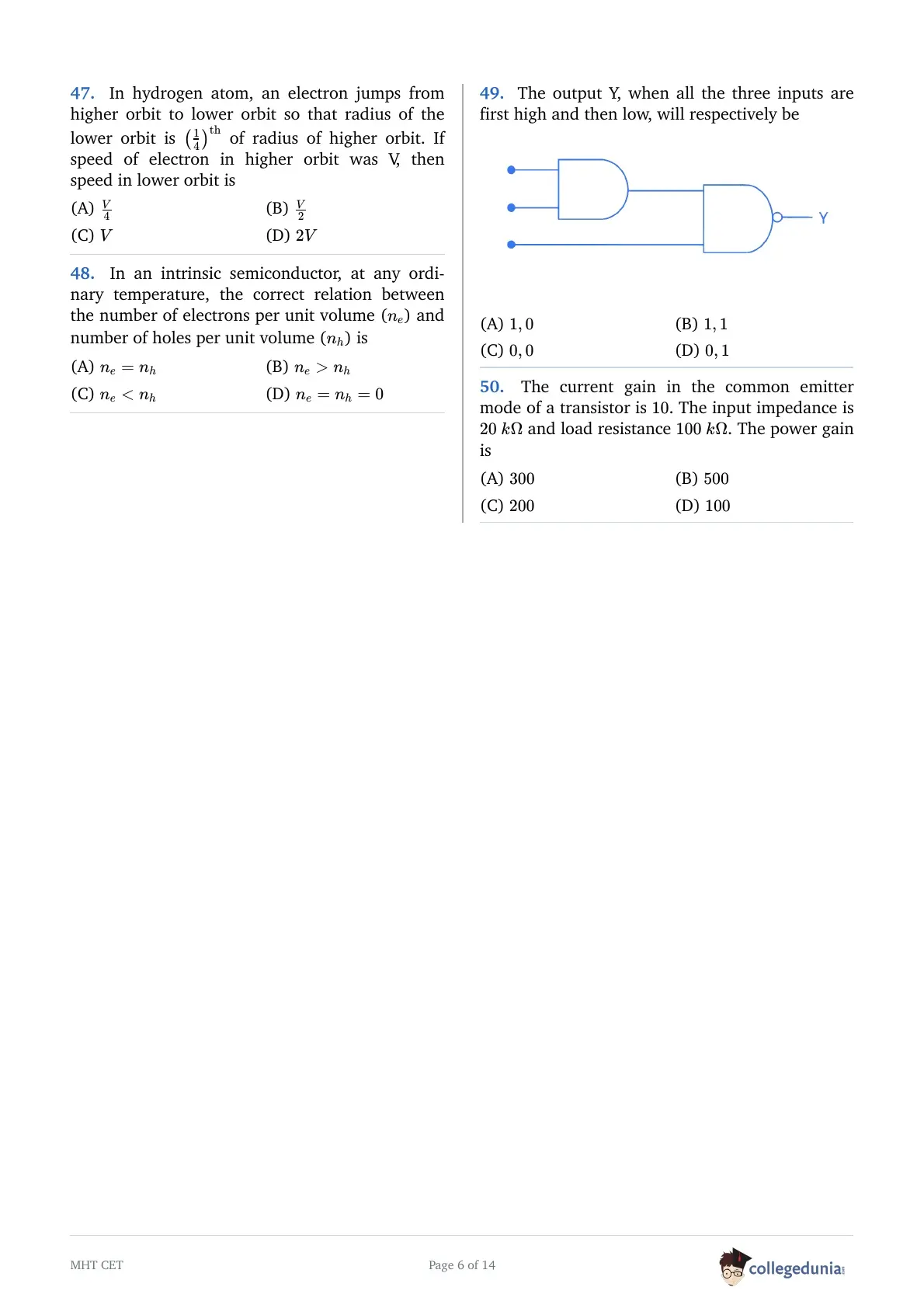
In hydrogen atom, an electron jumps from higher orbit to lower orbit so that radius of the lower orbit is \(\left(\frac{1}{4}\right)^{\text{th}}\) of radius of higher orbit. If speed of electron in higher orbit was V, then speed in lower orbit is
In an intrinsic semiconductor, at any ordinary temperature, the correct relation between the number of electrons per unit volume (\(n_{e}\)) and number of holes per unit volume (\(n_{h}\)) is
The output Y, when all the three inputs are first high and then low, will respectively be

The current gain in the common emitter mode of a transistor is \(10\). The input impedance is \(20\ k\Omega\) and load resistance \(100\ k\Omega\). The power gain is
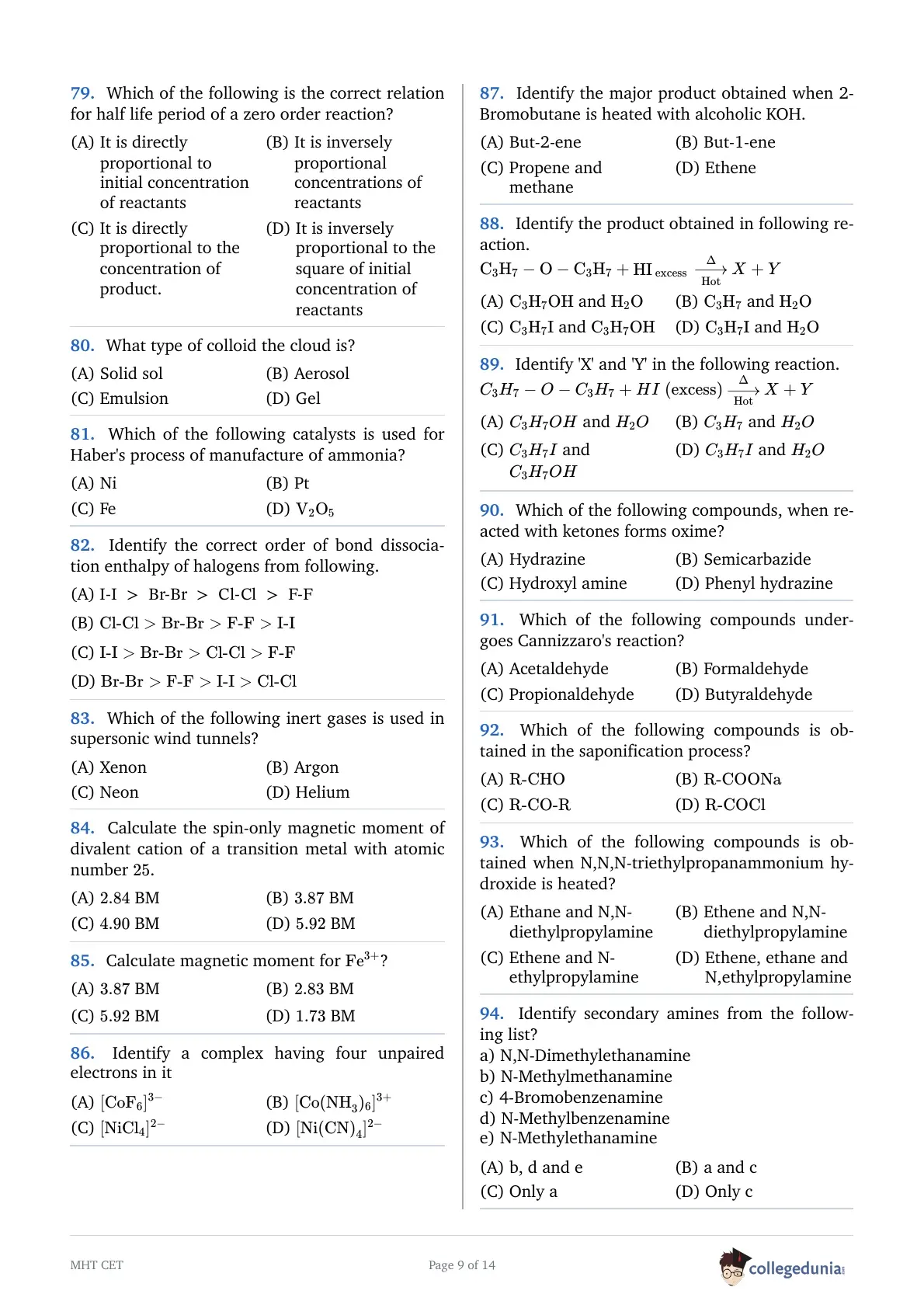
Chemistry (Q51 - Q100)
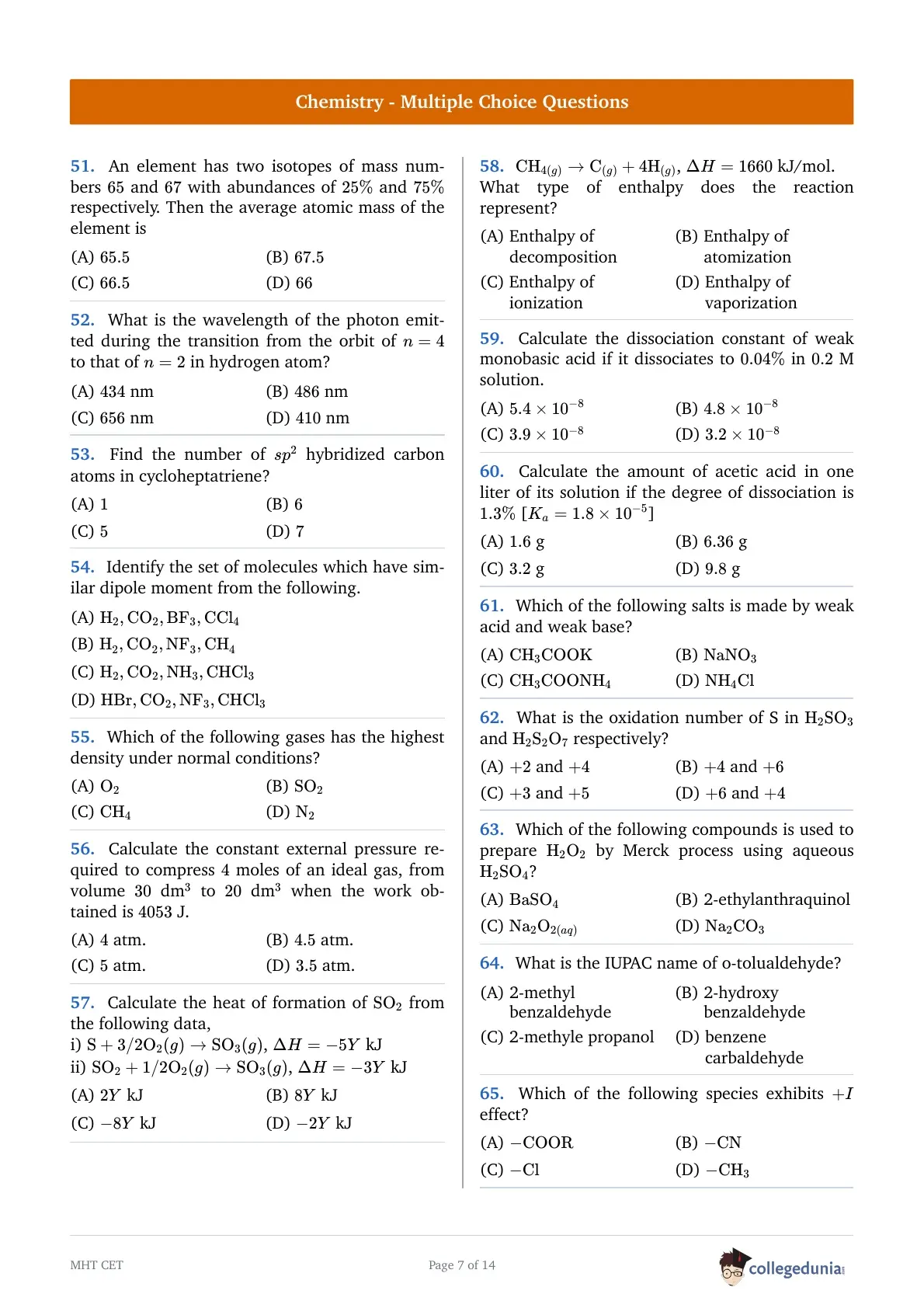
An element has two isotopes of mass numbers \(65\) and \(67\) with abundances of \(25\%\) and \(75\%\) respectively. Then the average atomic mass of the element is
What is the wavelength of the photon emitted during the transition from the orbit of \(n=4\) to that of \(n=2\) in hydrogen atom?
Find the number of \(sp^{2}\) hybridized carbon atoms in cycloheptatriene?
Identify the set of molecules which have similar dipole moment from the following.
Which of the following gases has the highest density under normal conditions?
Calculate the constant external pressure required to compress \(4\) moles of an ideal gas, from volume \(30\) dm\({}^{3}\) to \(20\) dm\({}^{3}\) when the work obtained is \(4053\) J.
Calculate the heat of formation of \(\text{SO}_{2}\) from the following data,
i) \(\text{S}+3/2\text{O}_{2}(g)\rightarrow \text{SO}_{3}(g)\), \(\Delta H=-5Y\) kJ
ii) \(\text{SO}_{2}+1/2\text{O}_{2}(g)\rightarrow \text{SO}_{3}(g)\), \(\Delta H=-3Y\) kJ
\(\text{CH}_{4(g)}\rightarrow \text{C}_{(g)}+4\text{H}_{(g)}\), \(\Delta H=1660\) kJ/mol.
What type of enthalpy does the reaction represent?
Calculate the dissociation constant of weak monobasic acid if it dissociates to \(0.04\%\) in \(0.2\) M solution.
Calculate the amount of acetic acid in one liter of its solution if the degree of dissociation is \(1.3\%\) [\(K_{a}=1.8\times 10^{-5}\)]
Which of the following salts is made by weak acid and weak base?
What is the oxidation number of S in \(\text{H}_{2}\text{SO}_{3}\) and \(\text{H}_{2}\text{S}_{2}\text{O}_{7}\) respectively?
Which of the following compounds is used to prepare \(\text{H}_{2}\text{O}_{2}\) by Merck process using aqueous \(\text{H}_{2}\text{SO}_{4}\)?
What is the IUPAC name of o-tolualdehyde?
Which of the following species exhibits \(+I\) effect?
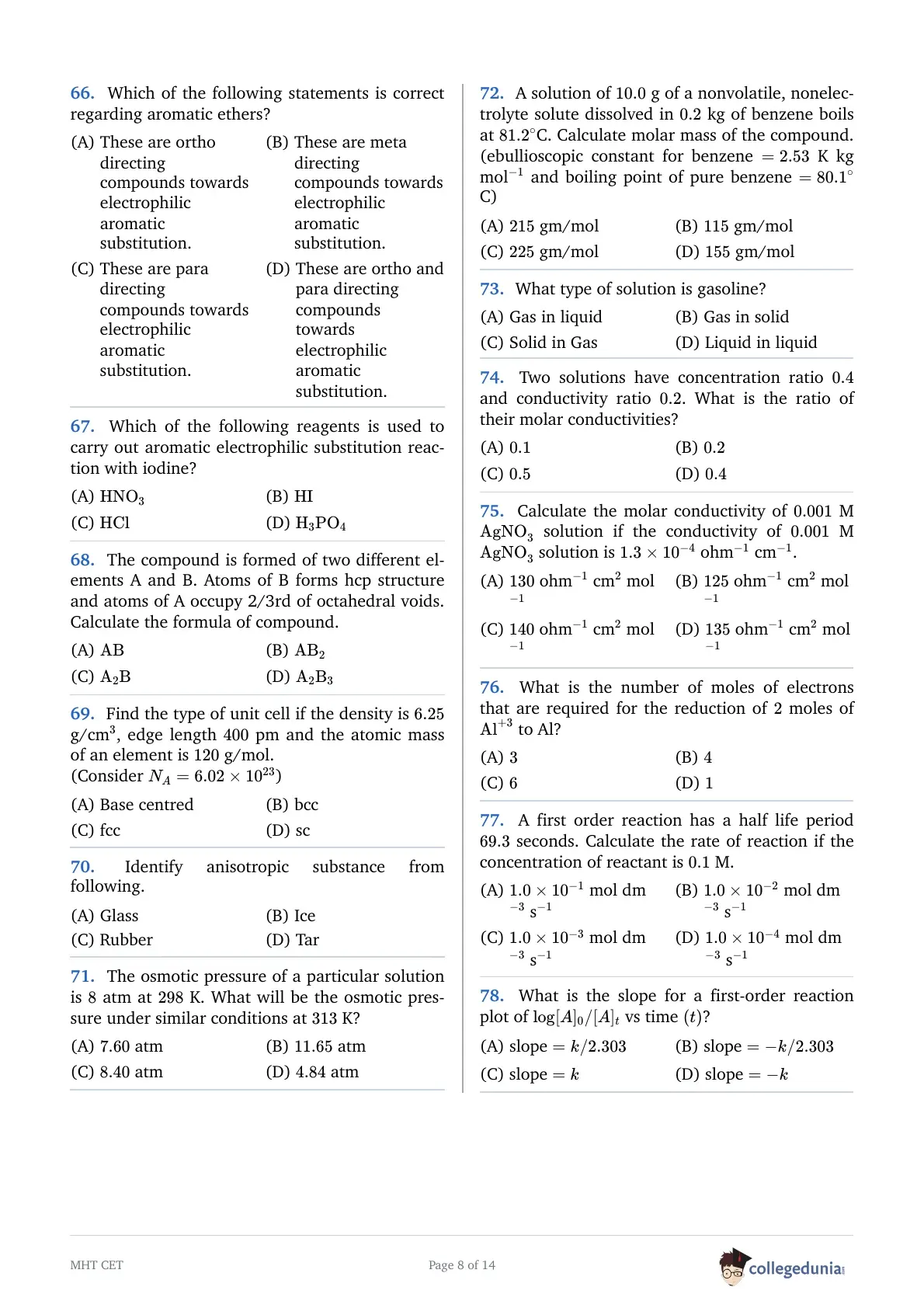
Which of the following statements is correct regarding aromatic ethers?
Which of the following reagents is used to carry out aromatic electrophilic substitution reaction with iodine?
The compound is formed of two different elements A and B. Atoms of B forms hcp structure and atoms of A occupy 2/3rd of octahedral voids. Calculate the formula of compound.
Find the type of unit cell if the density is \(6.25\) g/cm\({}^{3}\), edge length \(400\) pm and the atomic mass of an element is \(120\) g/mol.
(Consider \(N_{A}=6.02\times 10^{23}\))
Identify anisotropic substance from following.
The osmotic pressure of a particular solution is \(8\) atm at \(298\) K. What will be the osmotic pressure under similar conditions at \(313\) K?
A solution of \(10.0\) g of a nonvolatile, nonelectrolyte solute dissolved in \(0.2\) kg of benzene boils at \(81.2^{\circ }\)C. Calculate molar mass of the compound. (ebullioscopic constant for benzene \(=2.53\) K kg mol\({}^{-1}\) and boiling point of pure benzene \(=80.1^{\circ }\)C)
What type of solution is gasoline?
Two solutions have concentration ratio \(0.4\) and conductivity ratio \(0.2\). What is the ratio of their molar conductivities?
Calculate the molar conductivity of \(0.001\) M \(\text{AgNO}_{3}\) solution if the conductivity of \(0.001\) M \(\text{AgNO}_{3}\) solution is \(1.3\times 10^{-4}\) ohm\({}^{-1}\) cm\({}^{-1}\).
What is the number of moles of electrons that are required for the reduction of \(2\) moles of \(\text{Al}^{+3}\) to Al?
A first order reaction has a half life period \(69.3\) seconds. Calculate the rate of reaction if the concentration of reactant is \(0.1\) M.
What is the slope for a first-order reaction plot of \(\log [A]_{0}/[A]_{t}\) vs time \((t)\)?
Which of the following is the correct relation for half life period of a zero order reaction?
What type of colloid the cloud is?
Which of the following catalysts is used for Haber's process of manufacture of ammonia?
Identify the correct order of bond dissociation enthalpy of halogens from following.
Which of the following inert gases is used in supersonic wind tunnels?
Calculate the spin-only magnetic moment of divalent cation of a transition metal with atomic number \(25\).
Calculate magnetic moment for \(\text{Fe}^{3+}\)?
Identify a complex having four unpaired electrons in it
Identify the major product obtained when 2-Bromobutane is heated with alcoholic KOH.
Identify the product obtained in following reaction.
\(\mathrm{C}_{3}\mathrm{H}_{7}-\mathrm{O}-\mathrm{C}_{3}\mathrm{H}_{7}+\mathrm{HI}_{\text{ excess }}\xrightarrow[\mathrm{Hot}]{\Delta }X+Y\)
Identify 'X' and 'Y' in the following reaction.
\(C_{3}H_{7}-O-C_{3}H_{7}+HI\ (\text{excess})\xrightarrow[\text{Hot}]{\Delta }X+Y\)
Which of the following compounds, when reacted with ketones forms oxime?
Which of the following compounds undergoes Cannizzaro's reaction?
Which of the following compounds is obtained in the saponification process?
Which of the following compounds is obtained when N,N,N-triethylpropanammonium hydroxide is heated?
Identify secondary amines from the following list?
a) N,N-Dimethylethanamine
b) N-Methylmethanamine
c) 4-Bromobenzenamine
d) N-Methylbenzenamine
e) N-Methylethanamine
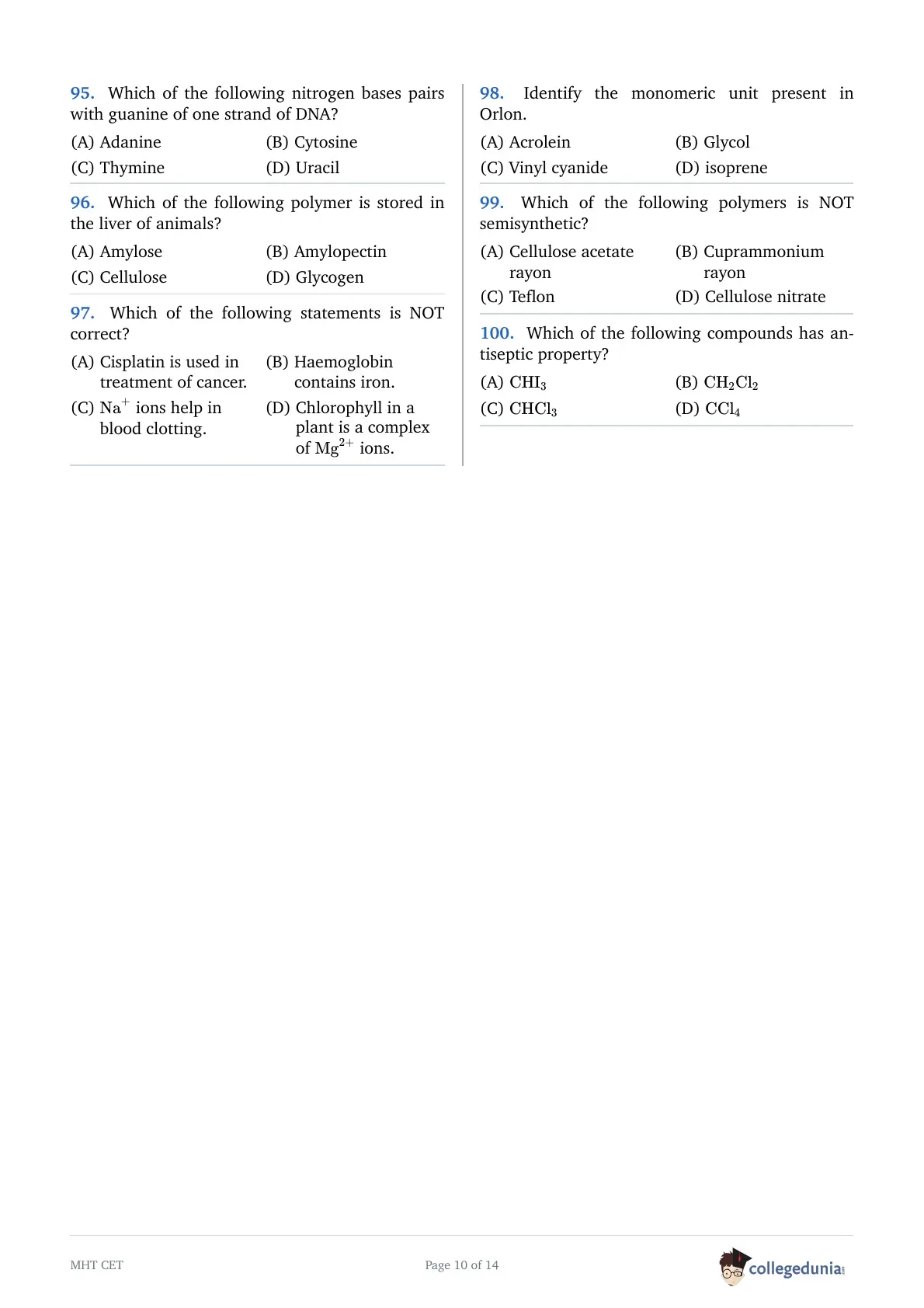
Which of the following nitrogen bases pairs with guanine of one strand of DNA?
Which of the following polymer is stored in the liver of animals?
Which of the following statements is NOT correct?
Identify the monomeric unit present in Orlon.
Which of the following polymers is NOT semisynthetic?
Which of the following compounds has antiseptic property?
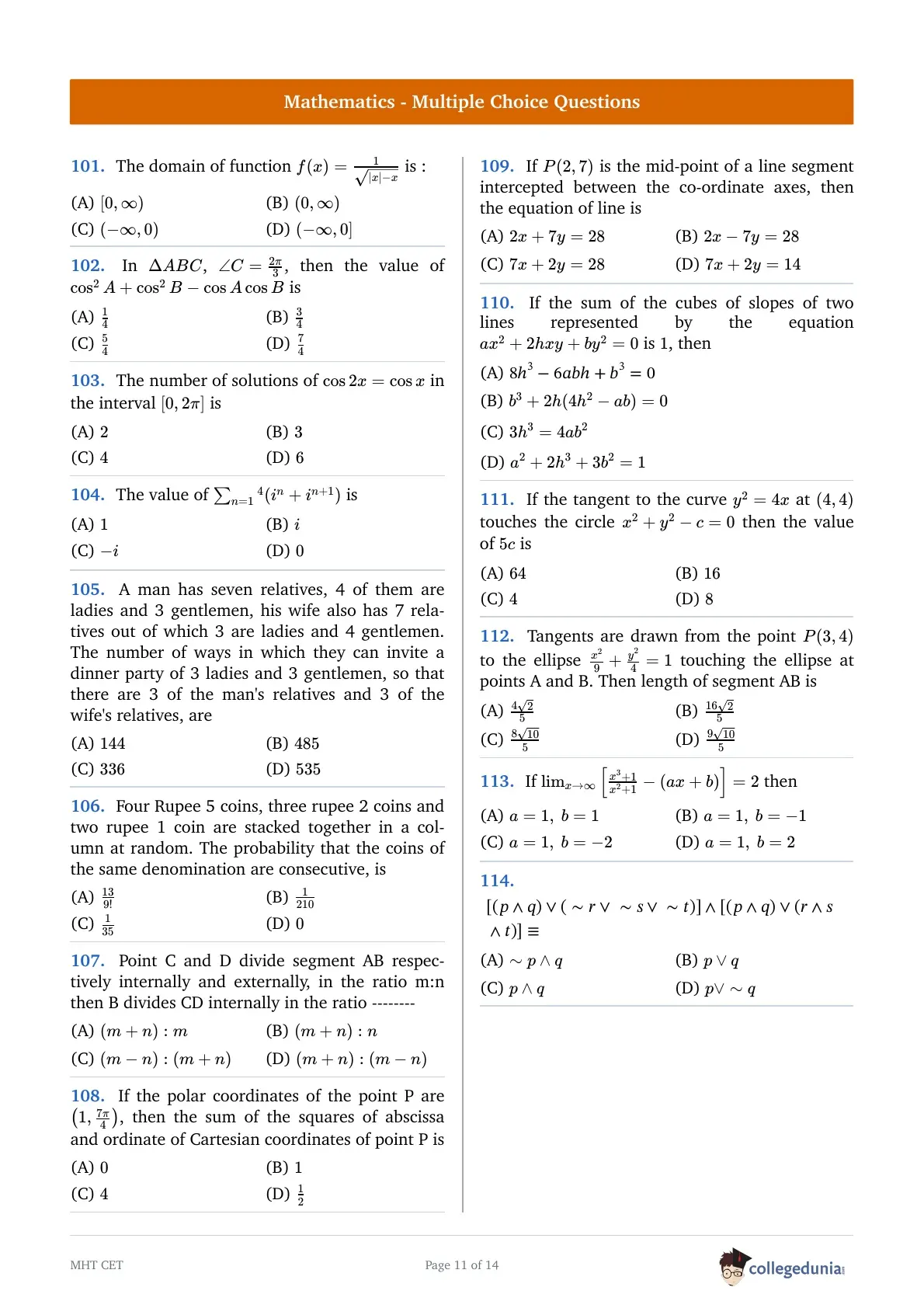
Mathematics (Q101 - Q150)
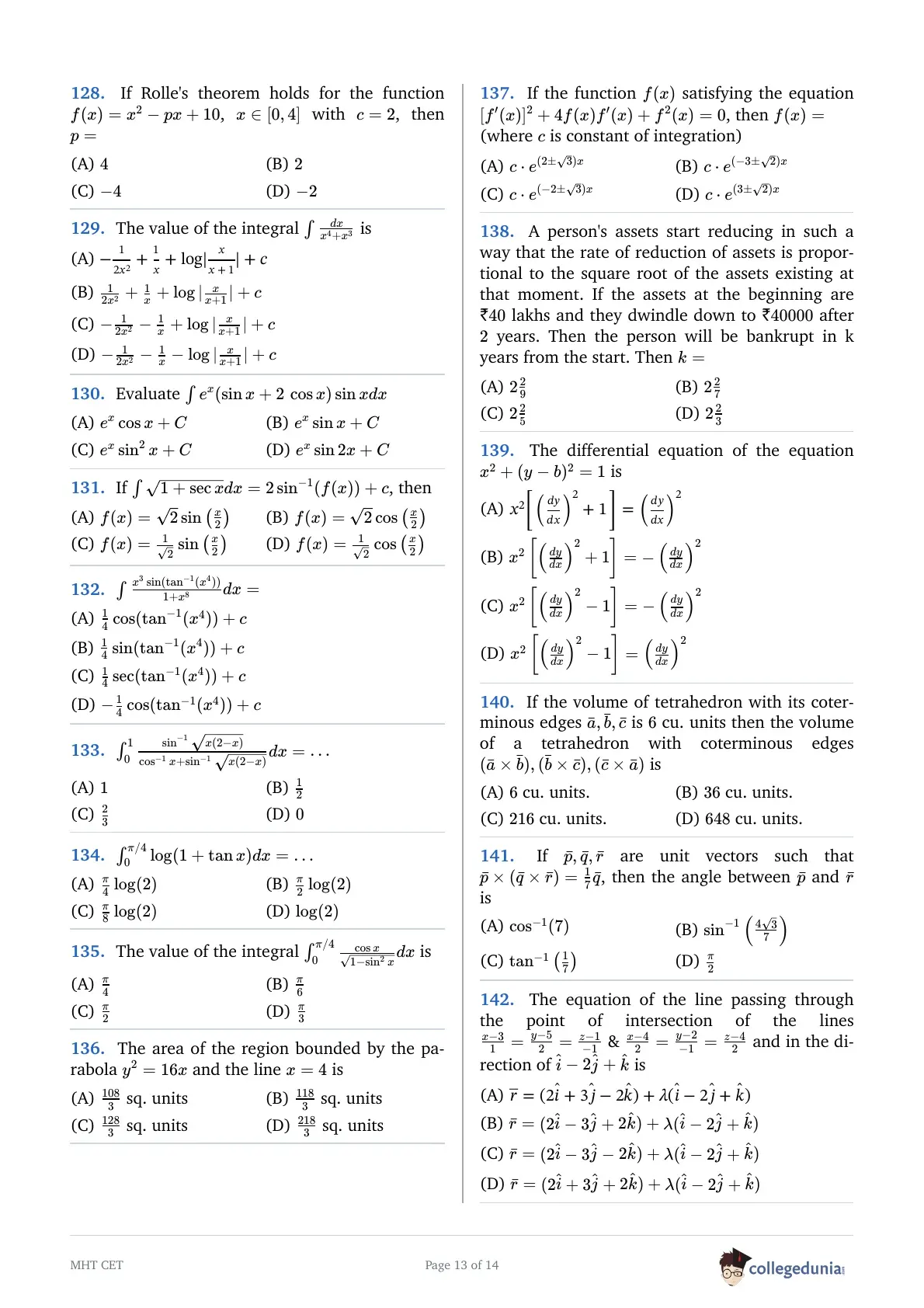
The domain of function \(f(x)=\frac{1}{\sqrt{|x|-x}}\) is :
In \(\Delta ABC\), \(\angle C=\frac{2\pi }{3}\), then the value of \(\cos ^{2}A+\cos ^{2}B-\cos A\cos B\) is
The number of solutions of \(\cos 2x=\cos x\) in the interval \([0,2\pi ]\) is
The value of \(\sum _{n=1}{}^{4}(i^{n}+i^{n+1})\) is
A man has seven relatives, 4 of them are ladies and 3 gentlemen, his wife also has 7 relatives out of which 3 are ladies and 4 gentlemen. The number of ways in which they can invite a dinner party of 3 ladies and 3 gentlemen, so that there are 3 of the man's relatives and 3 of the wife's relatives, are
Four Rupee 5 coins, three rupee 2 coins and two rupee 1 coin are stacked together in a column at random. The probability that the coins of the same denomination are consecutive, is
Point C and D divide segment AB respectively internally and externally, in the ratio m:n then B divides CD internally in the ratio --------
If the polar coordinates of the point P are \(\left(1,\frac{7\pi }{4}\right)\), then the sum of the squares of abscissa and ordinate of Cartesian coordinates of point P is
If \(P(2,7)\) is the mid-point of a line segment intercepted between the co-ordinate axes, then the equation of line is
If the sum of the cubes of slopes of two lines represented by the equation \(ax^{2}+2hxy+by^{2}=0\) is \(1\), then
If the tangent to the curve \(y^{2}=4x\) at \((4,4)\) touches the circle \(x^{2}+y^{2}-c=0\) then the value of \(5c\) is
Tangents are drawn from the point \(P(3,4)\) to the ellipse \(\frac{x^{2}}{9}+\frac{y^{2}}{4}=1\) touching the ellipse at points A and B. Then length of segment AB is
If \(\lim _{x\rightarrow \infty }\left[\frac{x^{3}+1}{x^{2}+1}-(ax+b)\right]=2\) then
\([(p\wedge q)\vee (\sim r\vee \sim s\vee \sim t)]\wedge [(p\wedge q)\vee (r\wedge s\wedge t)]\equiv\)
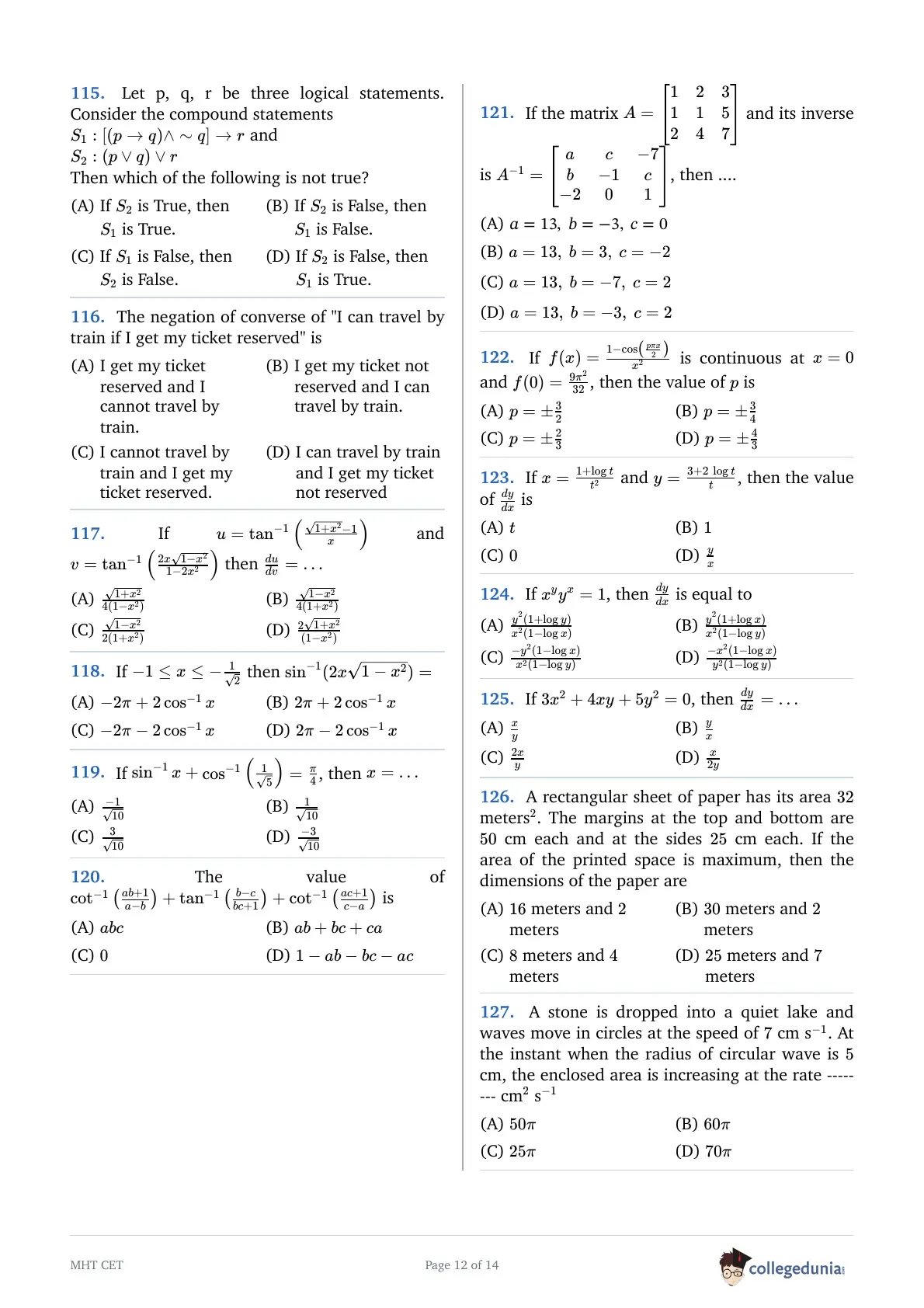
Let p, q, r be three logical statements. Consider the compound statements
\(S_{1}:[(p\rightarrow q)\wedge \sim q]\rightarrow r\) and
\(S_{2}:(p\vee q)\vee r\)
Then which of the following is not true?
The negation of converse of "I can travel by train if I get my ticket reserved" is
If \(u=\tan ^{-1}\left(\frac{\sqrt{1+x^{2}}-1}{x}\right)\) and \(v=\tan ^{-1}\left(\frac{2x\sqrt{1-x^{2}}}{1-2x^{2}}\right)\) then \(\frac{du}{dv}=\ldots\)
If \(-1\leq x\leq -\frac{1}{\sqrt{2}}\) then \(\sin ^{-1}(2x\sqrt{1-x^{2}})=\)
If \(\sin ^{-1}x+\cos ^{-1}\left(\frac{1}{\sqrt{5}}\right)=\frac{\pi }{4}\), then \(x=\ldots\)
The value of \(\cot ^{-1}\left(\frac{ab+1}{a-b}\right)+\tan ^{-1}\left(\frac{b-c}{bc+1}\right)+\cot ^{-1}\left(\frac{ac+1}{c-a}\right)\) is
If the matrix \(A=\begin{bmatrix} 1 & 2 & 3 \\ 1 & 1 & 5 \\ 2 & 4 & 7 \end{bmatrix}\) and its inverse is \(A^{-1}=\begin{bmatrix} a & c & -7 \\ b & -1 & c \\ -2 & 0 & 1 \end{bmatrix}\), then ....
If \(f(x)=\frac{1-\cos \left(\frac{p\pi x}{2}\right)}{x^{2}}\) is continuous at \(x=0\) and \(f(0)=\frac{9\pi ^{2}}{32}\), then the value of \(p\) is
If \(x=\frac{1+\log t}{t^{2}}\) and \(y=\frac{3+2\,\log t}{t}\), then the value of \(\frac{dy}{dx}\) is
If \(x^{y}y^{x}=1\), then \(\frac{dy}{dx}\) is equal to
If \(3x^{2}+4xy+5y^{2}=0\), then \(\frac{dy}{dx}=\ldots\)
A rectangular sheet of paper has its area \(32\) meters\({}^{2}\). The margins at the top and bottom are \(50\) cm each and at the sides \(25\) cm each. If the area of the printed space is maximum, then the dimensions of the paper are
A stone is dropped into a quiet lake and waves move in circles at the speed of \(7\) cm s\({}^{-1}\). At the instant when the radius of circular wave is \(5\) cm, the enclosed area is increasing at the rate -------- cm\({}^{2}\) s\({}^{-1}\)
If Rolle's theorem holds for the function \(f(x)=x^{2}-px+10\), \(x\in [0,4]\) with \(c=2\), then \(p=\)
The value of the integral \(\int \frac{dx}{x^{4}+x^{3}}\) is
Evaluate \(\int e^{x}(\sin x+2\,\cos x)\sin xdx\)
If \(\int \sqrt{1+\sec x}dx=2\sin ^{-1}(f(x))+c\), then
\(\int \frac{x^{3}\sin (\tan ^{-1}(x^{4}))}{1+x^{8}}dx=\)
\(\int _{0}^{1}\frac{\sin ^{-1}\sqrt{x(2-x)}}{\cos ^{-1}x+\sin ^{-1}\sqrt{x(2-x)}}dx=\ldots\)
\(\int _{0}^{\pi /4}\log (1+\tan x)dx=\ldots\)
The value of the integral \(\int _{0}^{\pi /4}\frac{\cos x}{\sqrt{1-\sin ^{2}x}}dx\) is
The area of the region bounded by the parabola \(y^{2}=16x\) and the line \(x=4\) is
If the function \(f(x)\) satisfying the equation \([f'(x)]^{2}+4f(x)f'(x)+f^{2}(x)=0\), then \(f(x)=\)
(where \(c\) is constant of integration)
A person's assets start reducing in such a way that the rate of reduction of assets is proportional to the square root of the assets existing at that moment. If the assets at the beginning are \(\text{₹}40\) lakhs and they dwindle down to \(\text{₹}40000\) after \(2\) years. Then the person will be bankrupt in k years from the start. Then \(k=\)
The differential equation of the equation \(x^{2}+(y-b)^{2}=1\) is
If the volume of tetrahedron with its coterminous edges \(\bar{a},\bar{b},\bar{c}\) is \(6\) cu. units then the volume of a tetrahedron with coterminous edges \((\bar{a}\times \bar{b}),(\bar{b}\times \bar{c}),(\bar{c}\times \bar{a})\) is
If \(\bar{p},\bar{q},\bar{r}\) are unit vectors such that \(\bar{p}\times (\bar{q}\times \bar{r})=\frac{1}{7}\bar{q}\), then the angle between \(\bar{p}\) and \(\bar{r}\) is
The equation of the line passing through the point of intersection of the lines \(\frac{x-3}{1}=\frac{y-5}{2}=\frac{z-1}{-1}\) & \(\frac{x-4}{2}=\frac{y-2}{-1}=\frac{z-4}{2}\) and in the direction of \(\hat{i}-2\hat{j}+\hat{k}\) is
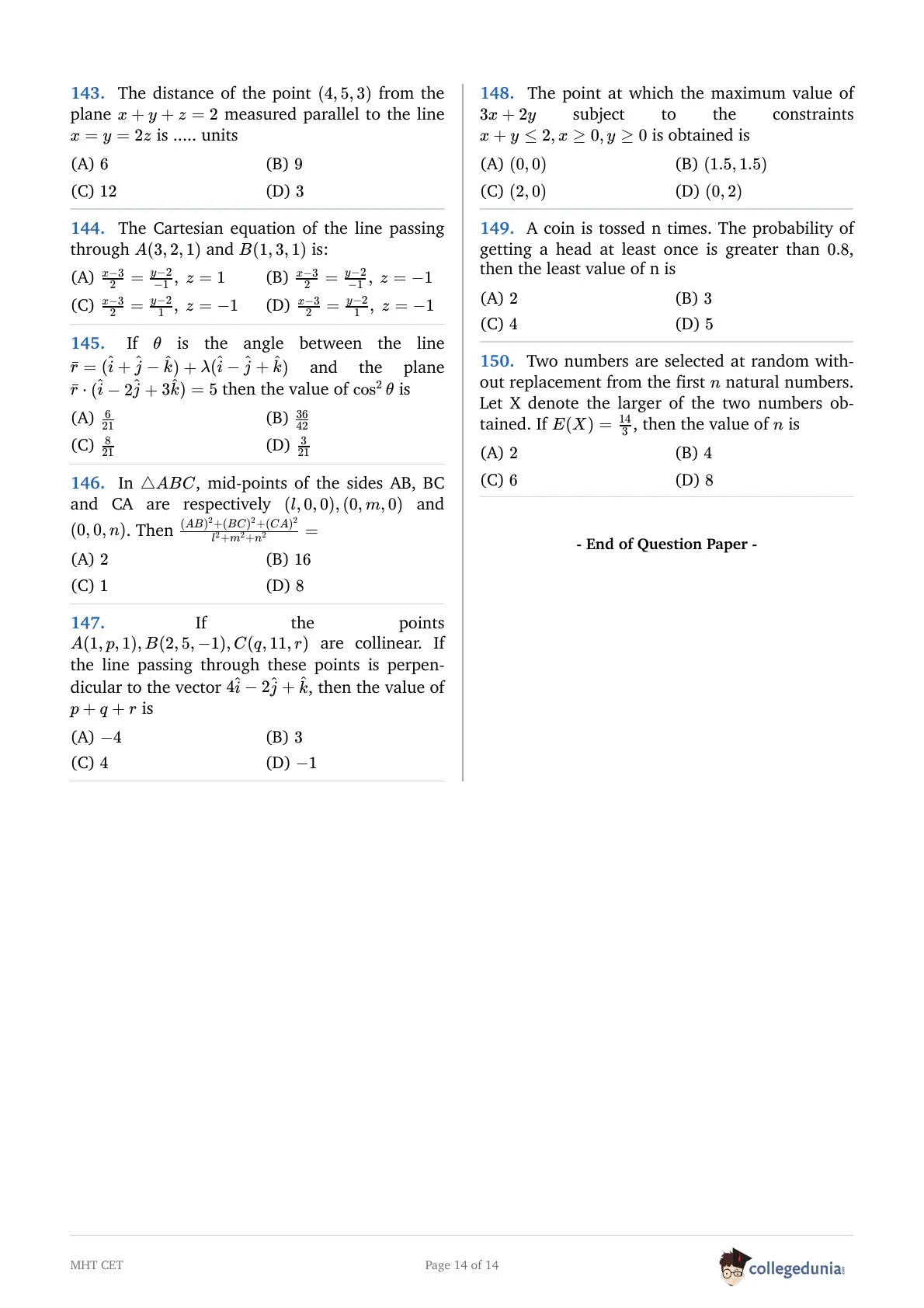
The distance of the point \((4,5,3)\) from the plane \(x+y+z=2\) measured parallel to the line \(x=y=2z\) is ..... units
The Cartesian equation of the line passing through \(A(3,2,1)\) and \(B(1,3,1)\) is:
If \(\theta\) is the angle between the line \(\bar{r}=(\hat{i}+\hat{j}-\hat{k})+\lambda (\hat{i}-\hat{j}+\hat{k})\) and the plane \(\bar{r}\cdot (\hat{i}-2\hat{j}+3\hat{k})=5\) then the value of \(\cos ^{2}\theta\) is
In \(\triangle ABC\), mid-points of the sides AB, BC and CA are respectively \((l,0,0),(0,m,0)\) and \((0,0,n)\). Then \(\frac{(AB)^{2}+(BC)^{2}+(CA)^{2}}{l^{2}+m^{2}+n^{2}}=\)
If the points \(A(1,p,1),B(2,5,-1),C(q,11,r)\) are collinear. If the line passing through these points is perpendicular to the vector \(4\hat{i}-2\hat{j}+\hat{k}\), then the value of \(p+q+r\) is
The point at which the maximum value of \(3x+2y\) subject to the constraints \(x+y\leq 2,x\geq 0,y\geq 0\) is obtained is
A coin is tossed n times. The probability of getting a head at least once is greater than \(0.8\), then the least value of n is
Two numbers are selected at random without replacement from the first \(n\) natural numbers. Let X denote the larger of the two numbers obtained. If \(E(X)=\frac{14}{3}\), then the value of \(n\) is
MHT CET 2026 PCM Exam Pattern and Marking Scheme
| Parameter | Details |
|---|---|
| Conducting Body | Maharashtra Common Entrance Test Cell (Maharashtra CET Cell) |
| Exam Mode | Online (Computer-Based Test) |
| Duration | 180 minutes (3 hours) |
| Groups / Subjects | PCM (Physics, Chemistry, Mathematics) for Engineering |
| Total Questions |
150 |
| Total Marks | 200 |
| Question Type | Multiple Choice Questions (MCQs) |
| Marks Distribution |
|
| Negative Marking | No |
| Syllabus Weightage |
|



Comments