




MHT CET 2026 May 19 Shift 1 PCM Question Paper is available for download here. Maharashtra State CET Cell conducted MHT CET 2026 PCM Exam on May 19 in Shift 1 from 9 AM to 12 PM in CBT mode.
The MHT CET 2026 PCM question paper includes the following:
- The MHT CET 2026 PCM Question Paper consists of 150 multiple-choice questions (MCQs) totalling 200 marks divided into 3 sections: Physics, Chemistry, and Mathematics, with 50 questions in each subject.
- Physics and Chemistry questions carry 1 mark each while Mathematics questions carry 2 marks each.
- There is no negative marking for incorrect answers.
MHT CET 2026 May 19 Shift 1 PCM Question Paper with Solution PDF
| CD PDF | CD PDF with Solutions |
|---|---|
| Download Collegedunia PDF 0.85 MB | - |
Also Check:
MHT CET 2026 May 19 Shift 1 PCM Questions with Solutions
Physics (Q1 - Q50)
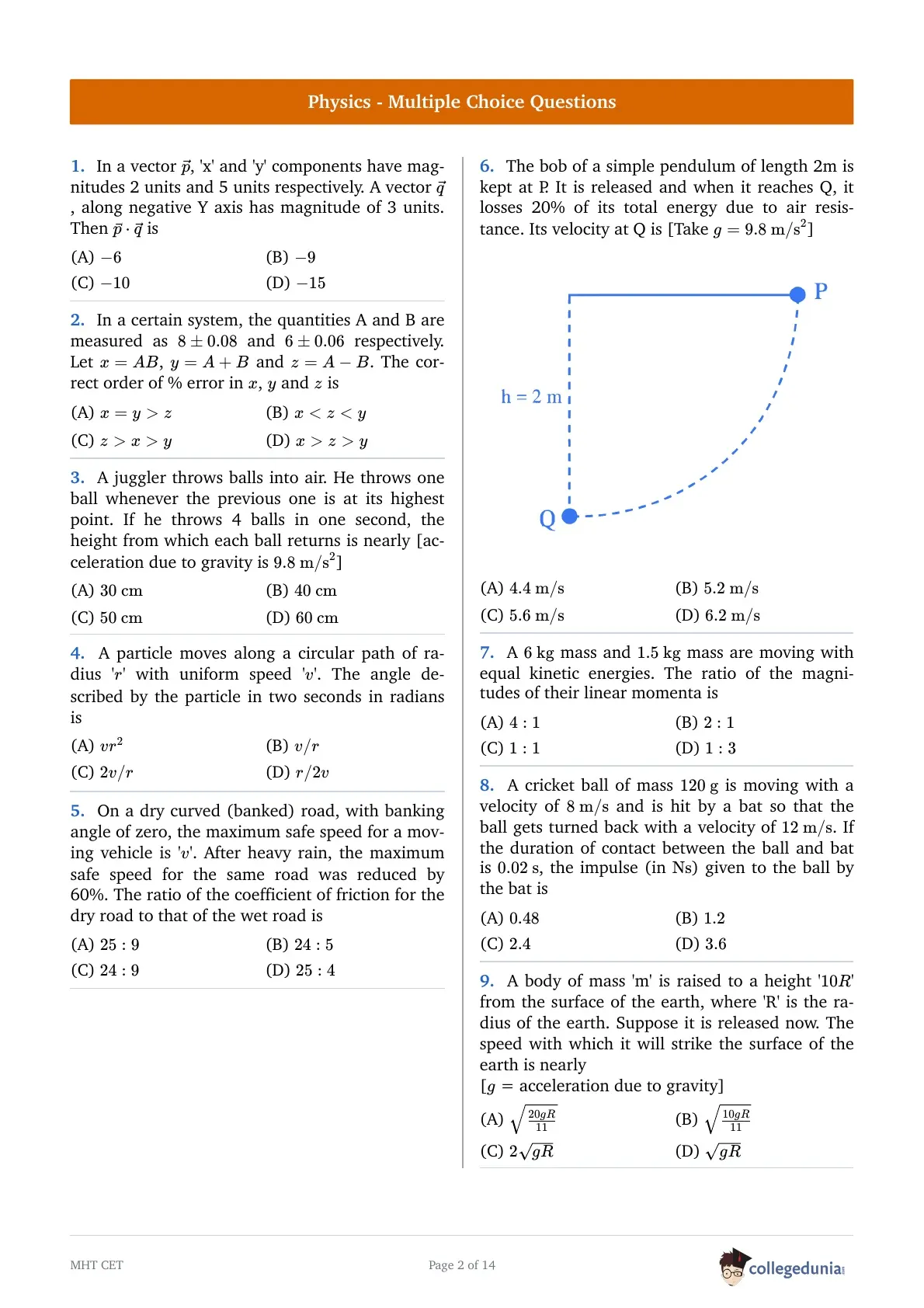
In a vector \(\vec{p}\), 'x' and 'y' components have magnitudes 2 units and 5 units respectively. A vector \(\vec{q}\), along negative Y axis has magnitude of 3 units. Then \(\vec{p}\cdot \vec{q}\) is
In a certain system, the quantities A and B are measured as \(8\pm 0.08\) and \(6\pm 0.06\) respectively. Let \(x=AB\), \(y=A+B\) and \(z=A-B\). The correct order of % error in \(x\), \(y\) and \(z\) is
A juggler throws balls into air. He throws one ball whenever the previous one is at its highest point. If he throws 4 balls in one second, the height from which each ball returns is nearly [acceleration due to gravity is \(9.8\text{ m/s}^{2}\)]
A particle moves along a circular path of radius '\(r\)' with uniform speed '\(v\)'. The angle described by the particle in two seconds in radians is
On a dry curved (banked) road, with banking angle of zero, the maximum safe speed for a moving vehicle is '\(v\)'. After heavy rain, the maximum safe speed for the same road was reduced by 60%. The ratio of the coefficient of friction for the dry road to that of the wet road is
The bob of a simple pendulum of length 2m is kept at P. It is released and when it reaches Q, it losses 20% of its total energy due to air resistance. Its velocity at Q is [Take \(g=9.8\text{ m/s}^{2}\)]

A \(6\text{ kg}\) mass and \(1.5\text{ kg}\) mass are moving with equal kinetic energies. The ratio of the magnitudes of their linear momenta is
A cricket ball of mass \(120\text{ g}\) is moving with a velocity of \(8\text{ m/s}\) and is hit by a bat so that the ball gets turned back with a velocity of \(12\text{ m/s}\). If the duration of contact between the ball and bat is \(0.02\text{ s}\), the impulse (in \(\text{Ns}\)) given to the ball by the bat is
A body of mass 'm' is raised to a height '\(10R\)' from the surface of the earth, where 'R' is the radius of the earth. Suppose it is released now. The speed with which it will strike the surface of the earth is nearly
[\(g\) = acceleration due to gravity]
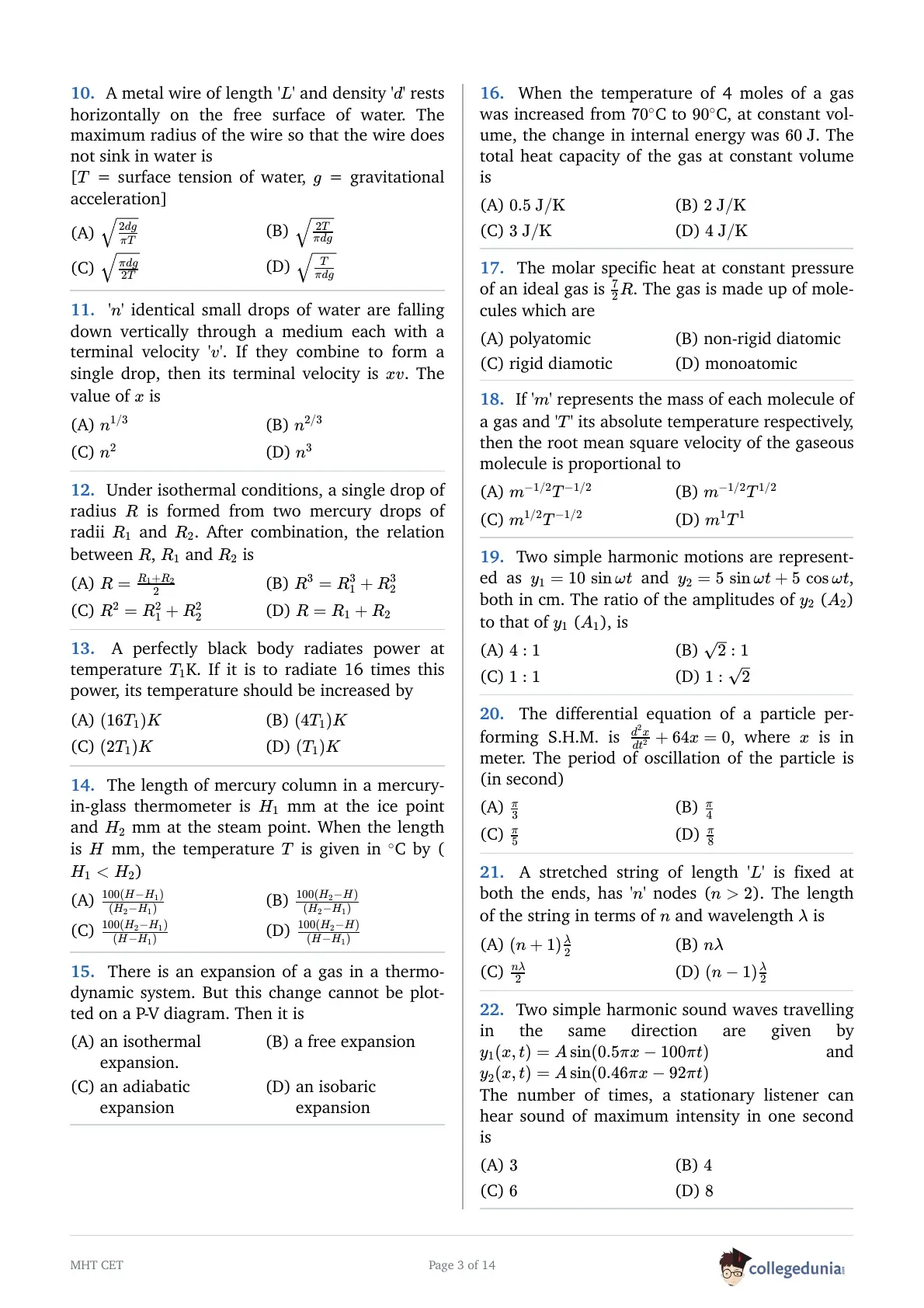
A metal wire of length '\(L\)' and density '\(d\)' rests horizontally on the free surface of water. The maximum radius of the wire so that the wire does not sink in water is
[\(T\) = surface tension of water, \(g\) = gravitational acceleration]
'\(n\)' identical small drops of water are falling down vertically through a medium each with a terminal velocity '\(v\)'. If they combine to form a single drop, then its terminal velocity is \(xv\). The value of \(x\) is
Under isothermal conditions, a single drop of radius \(R\) is formed from two mercury drops of radii \(R_{1}\) and \(R_{2}\). After combination, the relation between \(R\), \(R_{1}\) and \(R_{2}\) is
A perfectly black body radiates power at temperature \(T_{1}\)K. If it is to radiate 16 times this power, its temperature should be increased by
The length of mercury column in a mercury-in-glass thermometer is \(H_{1}\) mm at the ice point and \(H_{2}\) mm at the steam point. When the length is \(H\) mm, the temperature \(T\) is given in \({}^{\circ }\)C by (\(H_{1}\lt H_{2}\))
There is an expansion of a gas in a thermodynamic system. But this change cannot be plotted on a P-V diagram. Then it is
When the temperature of 4 moles of a gas was increased from \(70^{\circ }\)C to \(90^{\circ }\)C, at constant volume, the change in internal energy was \(60\text{ J}\). The total heat capacity of the gas at constant volume is
The molar specific heat at constant pressure of an ideal gas is \(\frac{7}{2}R\). The gas is made up of molecules which are
If '\(m\)' represents the mass of each molecule of a gas and '\(T\)' its absolute temperature respectively, then the root mean square velocity of the gaseous molecule is proportional to
Two simple harmonic motions are represented as \(y_{1}=10\,\sin \omega t\) and \(y_{2}=5\,\sin \omega t+5\,\cos \omega t\), both in cm. The ratio of the amplitudes of \(y_{2}\) (\(A_{2}\)) to that of \(y_{1}\) (\(A_{1}\)), is
The differential equation of a particle performing S.H.M. is \(\frac{d^{2}x}{dt^{2}}+64x=0\), where \(x\) is in meter. The period of oscillation of the particle is (in second)
A stretched string of length '\(L\)' is fixed at both the ends, has '\(n\)' nodes (\(n>2\)). The length of the string in terms of \(n\) and wavelength \(\lambda\) is
Two simple harmonic sound waves travelling in the same direction are given by \(y_{1}(x,t)=A\sin (0.5\pi x-100\pi t)\) and \(y_{2}(x,t)=A\sin (0.46\pi x-92\pi t)\)
The number of times, a stationary listener can hear sound of maximum intensity in one second is
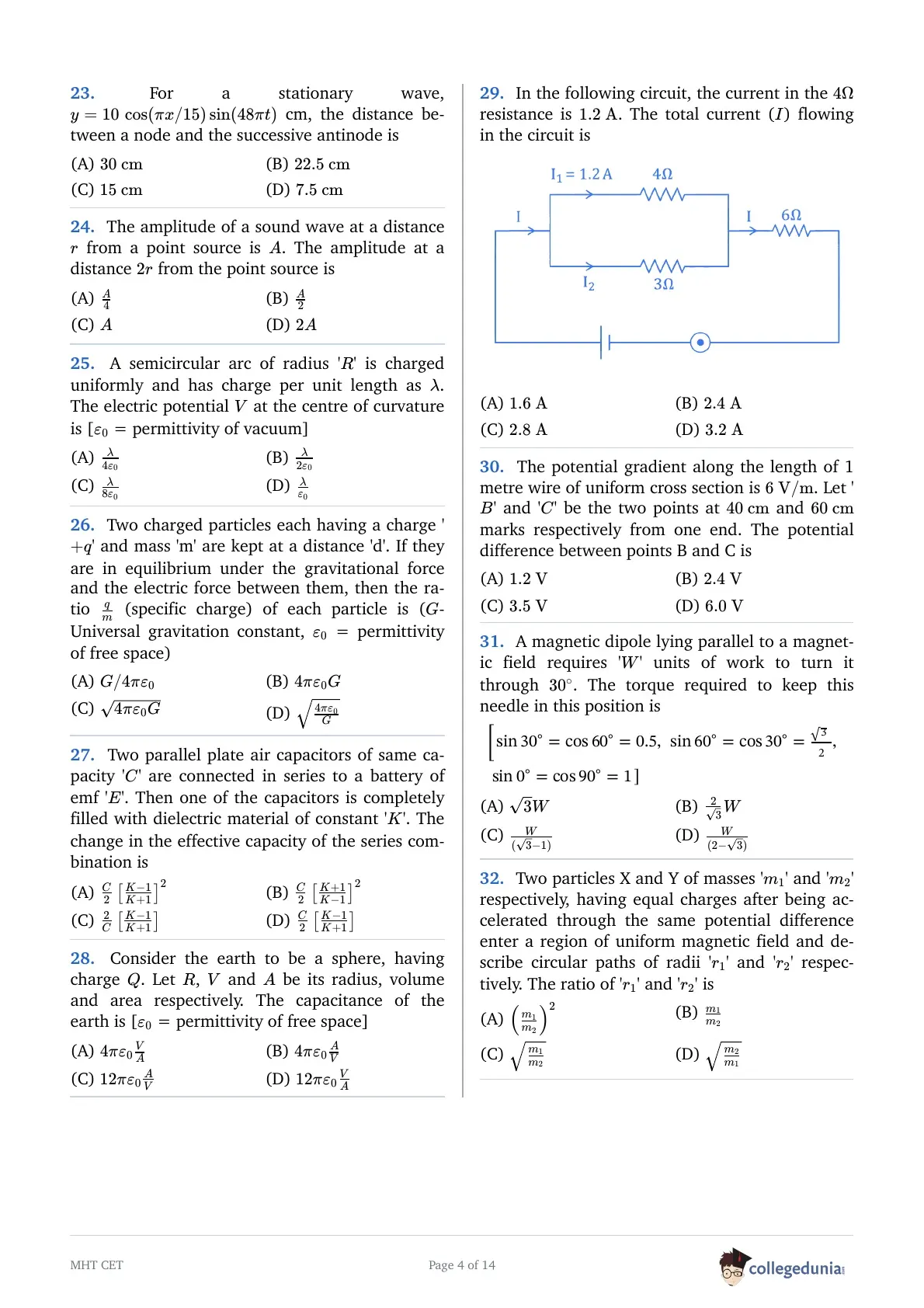
For a stationary wave, \(y=10\,\cos (\pi x/15)\sin (48\pi t)\) cm, the distance between a node and the successive antinode is
The amplitude of a sound wave at a distance \(r\) from a point source is \(A\). The amplitude at a distance \(2r\) from the point source is
A semicircular arc of radius '\(R\)' is charged uniformly and has charge per unit length as \(\lambda\). The electric potential \(V\) at the centre of curvature is [\(\varepsilon _{0}\) = permittivity of vacuum]
Two charged particles each having a charge '\(+q\)' and mass 'm' are kept at a distance 'd'. If they are in equilibrium under the gravitational force and the electric force between them, then the ratio \(\frac{q}{m}\) (specific charge) of each particle is (\(G\)- Universal gravitation constant, \(\varepsilon _{0}\) = permittivity of free space)
Two parallel plate air capacitors of same capacity '\(C\)' are connected in series to a battery of emf '\(E\)'. Then one of the capacitors is completely filled with dielectric material of constant '\(K\)'. The change in the effective capacity of the series combination is
Consider the earth to be a sphere, having charge \(Q\). Let \(R\), \(V\) and \(A\) be its radius, volume and area respectively. The capacitance of the earth is [\(\varepsilon _{0}\) = permittivity of free space]
In the following circuit, the current in the \(4\Omega\) resistance is \(1.2\text{ A}\). The total current (\(I\)) flowing in the circuit is

The potential gradient along the length of 1 metre wire of uniform cross section is \(6\text{ V/m}\). Let '\(B\)' and '\(C\)' be the two points at \(40\text{ cm}\) and \(60\text{ cm}\) marks respectively from one end. The potential difference between points B and C is
A magnetic dipole lying parallel to a magnetic field requires '\(W\)' units of work to turn it through \(30^{\circ }\). The torque required to keep this needle in this position is
\(\left[\sin 30^{\circ }=\cos 60^{\circ }=0.5,\,\sin 60^{\circ }=\cos 30^{\circ }=\frac{\sqrt{3}}{2},\,\sin 0^{\circ }=\cos 90^{\circ }=1\right]\)
Two particles X and Y of masses '\(m_{1}\)' and '\(m_{2}\)' respectively, having equal charges after being accelerated through the same potential difference enter a region of uniform magnetic field and describe circular paths of radii '\(r_{1}\)' and '\(r_{2}\)' respectively. The ratio of '\(r_{1}\)' and '\(r_{2}\)' is
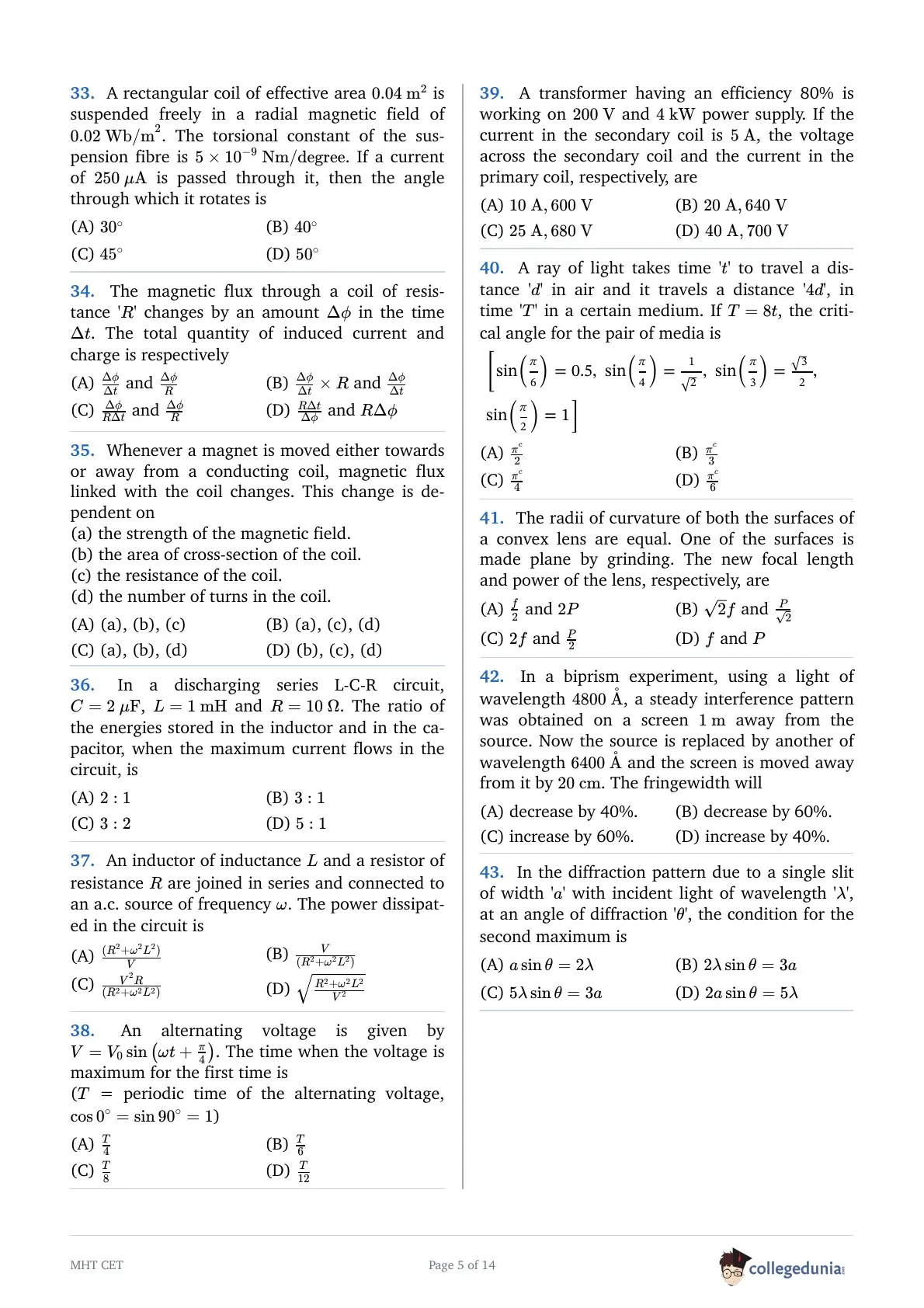
A rectangular coil of effective area \(0.04\text{ m}^{2}\) is suspended freely in a radial magnetic field of \(0.02\text{ Wb/m}^{2}\). The torsional constant of the suspension fibre is \(5\times 10^{-9}\text{ Nm/degree}\). If a current of \(250\ \mu \text{A}\) is passed through it, then the angle through which it rotates is
The magnetic flux through a coil of resistance '\(R\)' changes by an amount \(\Delta \phi\) in the time \(\Delta t\). The total quantity of induced current and charge is respectively
Whenever a magnet is moved either towards or away from a conducting coil, magnetic flux linked with the coil changes. This change is dependent on
(a) the strength of the magnetic field.
(b) the area of cross-section of the coil.
(c) the resistance of the coil.
(d) the number of turns in the coil.
In a discharging series L-C-R circuit, \(C=2\ \mu \text{F}\), \(L=1\text{ mH}\) and \(R=10\ \Omega\). The ratio of the energies stored in the inductor and in the capacitor, when the maximum current flows in the circuit, is
An inductor of inductance \(L\) and a resistor of resistance \(R\) are joined in series and connected to an a.c. source of frequency \(\omega\). The power dissipated in the circuit is
An alternating voltage is given by \(V=V_{0}\sin \left(\omega t+\frac{\pi }{4}\right)\). The time when the voltage is maximum for the first time is
(\(T\) = periodic time of the alternating voltage, \(\cos 0^{\circ }=\sin 90^{\circ }=1\))
A transformer having an efficiency 80% is working on \(200\text{ V}\) and \(4\text{ kW}\) power supply. If the current in the secondary coil is \(5\text{ A}\), the voltage across the secondary coil and the current in the primary coil, respectively, are
A ray of light takes time '\(t\)' to travel a distance '\(d\)' in air and it travels a distance '\(4d\)', in time '\(T\)' in a certain medium. If \(T=8t\), the critical angle for the pair of media is
\(\left[\sin \left(\frac{\pi }{6}\right)=0.5,\,\sin \left(\frac{\pi }{4}\right)=\frac{1}{\sqrt{2}},\,\sin \left(\frac{\pi }{3}\right)=\frac{\sqrt{3}}{2},\,\sin \left(\frac{\pi }{2}\right)=1\right]\)
The radii of curvature of both the surfaces of a convex lens are equal. One of the surfaces is made plane by grinding. The new focal length and power of the lens, respectively, are
In a biprism experiment, using a light of wavelength \(4800\text{ Å}\), a steady interference pattern was obtained on a screen \(1\text{ m}\) away from the source. Now the source is replaced by another of wavelength \(6400\text{ Å}\) and the screen is moved away from it by \(20\text{ cm}\). The fringewidth will
In the diffraction pattern due to a single slit of width '\(a\)' with incident light of wavelength '\(\lambda\)', at an angle of diffraction '\(\theta\)', the condition for the second maximum is
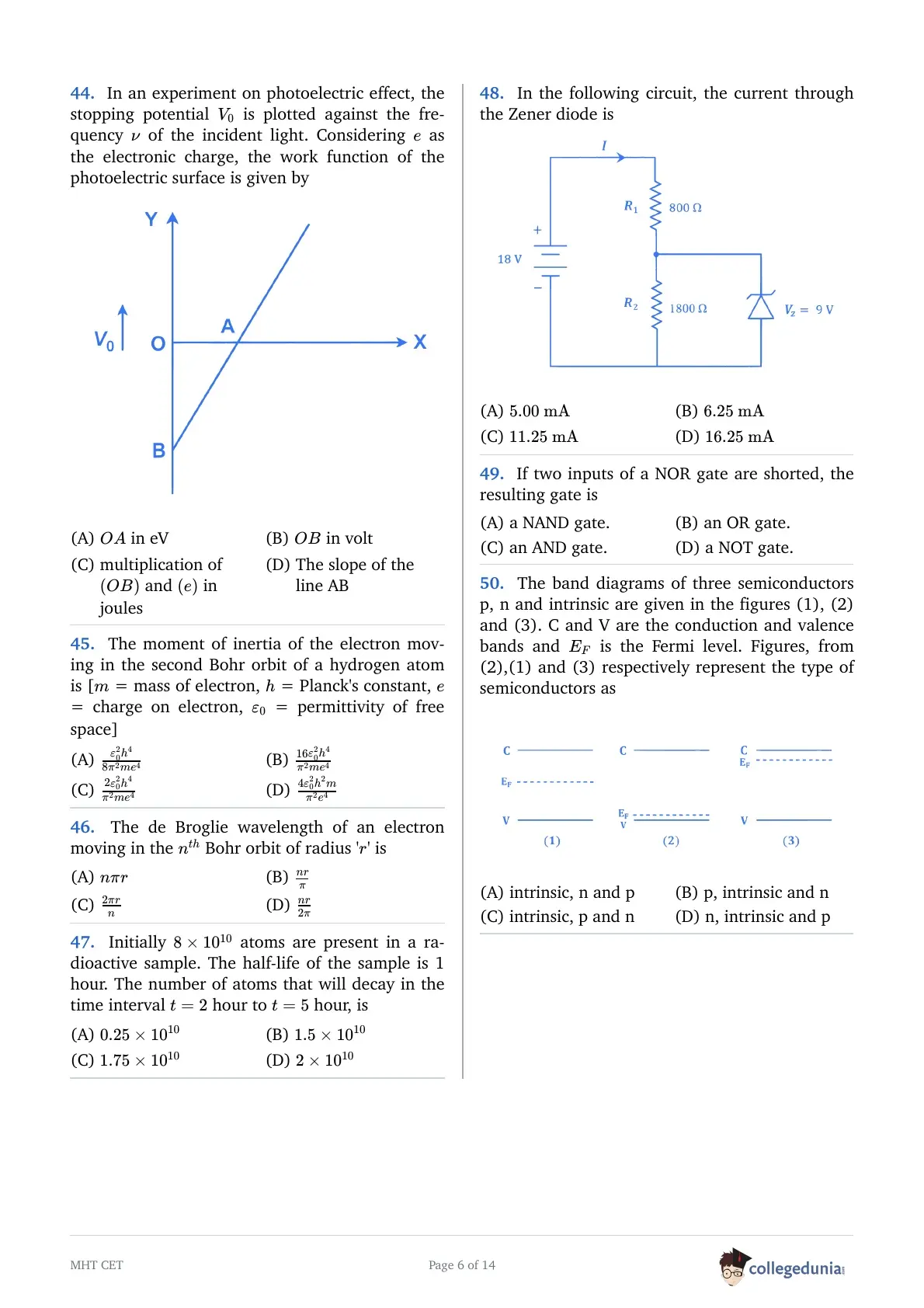
In an experiment on photoelectric effect, the stopping potential \(V_{0}\) is plotted against the frequency \(\nu\) of the incident light. Considering \(e\) as the electronic charge, the work function of the photoelectric surface is given by

The moment of inertia of the electron moving in the second Bohr orbit of a hydrogen atom is [\(m\) = mass of electron, \(h\) = Planck's constant, \(e\) = charge on electron, \(\varepsilon _{0}\) = permittivity of free space]
The de Broglie wavelength of an electron moving in the \(n^{th}\) Bohr orbit of radius '\(r\)' is
Initially \(8\times 10^{10}\) atoms are present in a radioactive sample. The half-life of the sample is 1 hour. The number of atoms that will decay in the time interval \(t=2\) hour to \(t=5\) hour, is

If two inputs of a NOR gate are shorted, the resulting gate is
The band diagrams of three semiconductors p, n and intrinsic are given in the figures (1), (2) and (3). C and V are the conduction and valence bands and \(E_{F}\) is the Fermi level. Figures, from (2),(1) and (3) respectively represent the type of semiconductors as

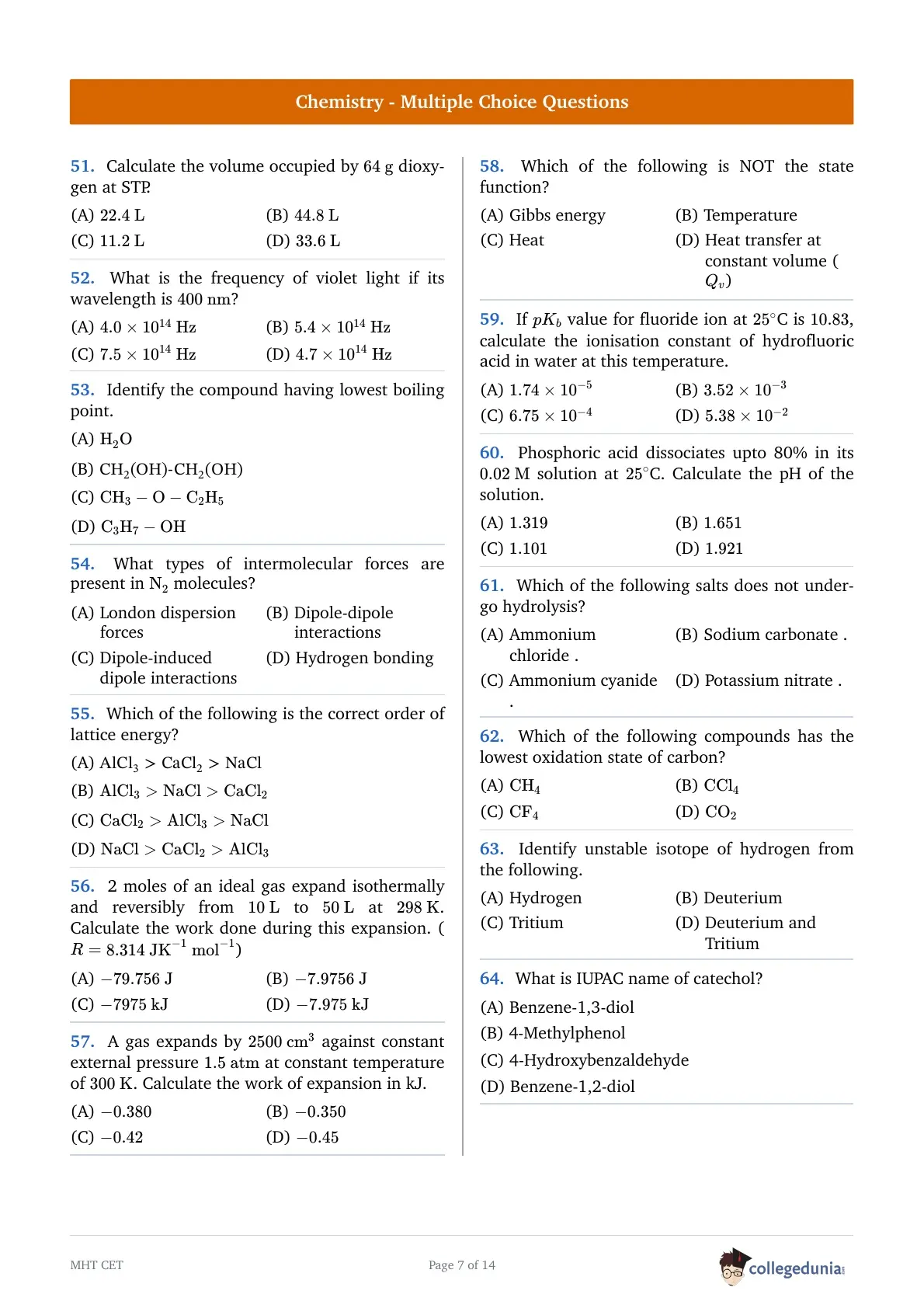
Chemistry (Q51 - Q100)
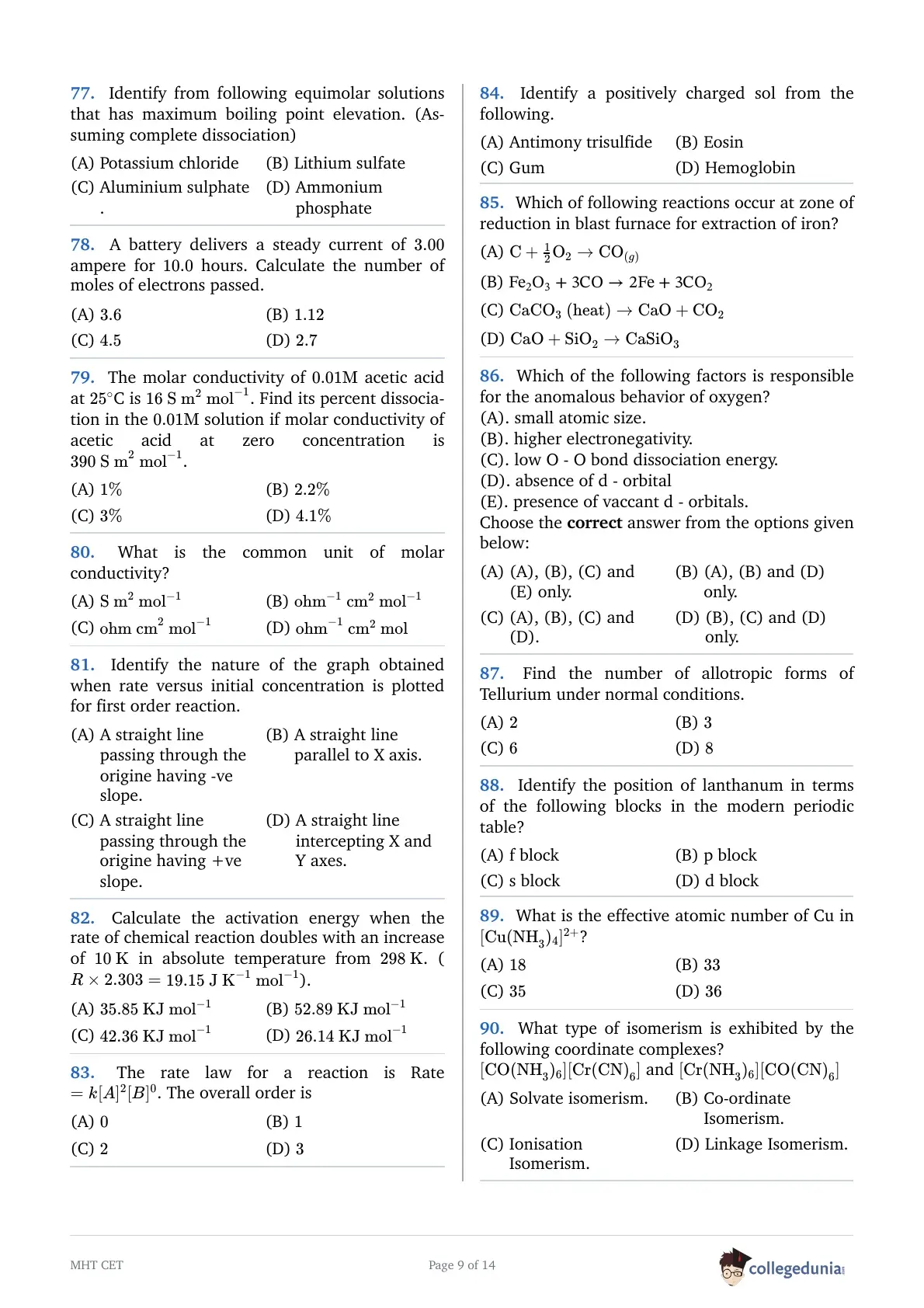
Calculate the volume occupied by \(64\text{ g}\) dioxygen at STP.
What is the frequency of violet light if its wavelength is \(400\text{ nm}\)?
Identify the compound having lowest boiling point.
What types of intermolecular forces are present in \(\text{N}_{2}\) molecules?
Which of the following is the correct order of lattice energy?
2 moles of an ideal gas expand isothermally and reversibly from \(10\text{ L}\) to \(50\text{ L}\) at \(298\text{ K}\). Calculate the work done during this expansion. (\(R=8.314\text{ JK}^{-1}\text{ mol}^{-1}\))
A gas expands by \(2500\text{ cm}^{3}\) against constant external pressure \(1.5\text{ atm}\) at constant temperature of \(300\text{ K}\). Calculate the work of expansion in kJ.
Which of the following is NOT the state function?
If \(pK_{b}\) value for fluoride ion at \(25^{\circ }\)C is \(10.83\), calculate the ionisation constant of hydrofluoric acid in water at this temperature.
Phosphoric acid dissociates upto 80% in its \(0.02\text{ M}\) solution at \(25^{\circ }\)C. Calculate the pH of the solution.
Which of the following salts does not undergo hydrolysis?
Which of the following compounds has the lowest oxidation state of carbon?
Identify unstable isotope of hydrogen from the following.
What is IUPAC name of catechol?
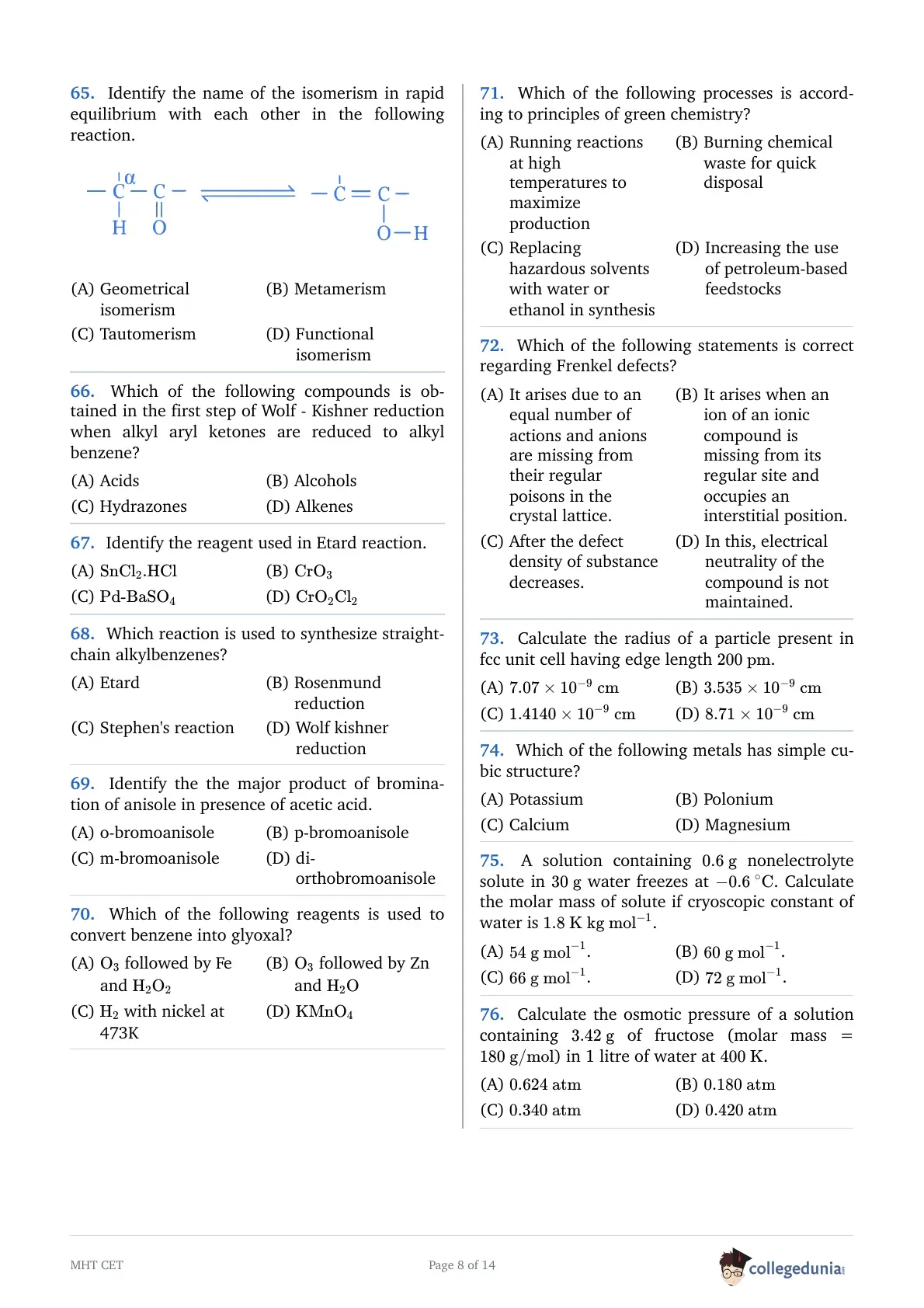
Identify the name of the isomerism in rapid equilibrium with each other in the following reaction.

Which of the following compounds is obtained in the first step of Wolf - Kishner reduction when alkyl aryl ketones are reduced to alkyl benzene?
Identify the reagent used in Etard reaction.
Which reaction is used to synthesize straight-chain alkylbenzenes?
Identify the the major product of bromination of anisole in presence of acetic acid.
Which of the following reagents is used to convert benzene into glyoxal?
Which of the following processes is according to principles of green chemistry?
Which of the following statements is correct regarding Frenkel defects?
Calculate the radius of a particle present in fcc unit cell having edge length \(200\text{ pm}\).
Which of the following metals has simple cubic structure?
A solution containing \(0.6\text{ g}\) nonelectrolyte solute in \(30\text{ g}\) water freezes at \(-0.6\ ^{\circ }\text{C}\). Calculate the molar mass of solute if cryoscopic constant of water is \(1.8\text{ K kg mol}^{-1}\).
Calculate the osmotic pressure of a solution containing \(3.42\text{ g}\) of fructose (molar mass = \(180\text{ g/mol}\)) in 1 litre of water at \(400\text{ K}\).
Identify from following equimolar solutions that has maximum boiling point elevation. (Assuming complete dissociation)
A battery delivers a steady current of \(3.00\) ampere for \(10.0\) hours. Calculate the number of moles of electrons passed.
The molar conductivity of \(0.01\text{M}\) acetic acid at \(25^{\circ }\)C is \(16\text{ S m}^{2}\text{ mol}^{-1}\). Find its percent dissociation in the \(0.01\text{M}\) solution if molar conductivity of acetic acid at zero concentration is \(390\text{ S m}^{2}\text{ mol}^{-1}\).
What is the common unit of molar conductivity?
Identify the nature of the graph obtained when rate versus initial concentration is plotted for first order reaction.
Calculate the activation energy when the rate of chemical reaction doubles with an increase of \(10\text{ K}\) in absolute temperature from \(298\text{ K}\). (\(R\times 2.303=19.15\text{ J K}^{-1}\text{ mol}^{-1}\)).
The rate law for a reaction is Rate \(=k[A]^{2}[B]^{0}\). The overall order is
Identify a positively charged sol from the following.
Which of following reactions occur at zone of reduction in blast furnace for extraction of iron?
Which of the following factors is responsible for the anomalous behavior of oxygen?
(A). small atomic size.
(B). higher electronegativity.
(C). low O - O bond dissociation energy.
(D). absence of d - orbital
(E). presence of vaccant d - orbitals.
Choose the correct answer from the options given below:
Find the number of allotropic forms of Tellurium under normal conditions.
Identify the position of lanthanum in terms of the following blocks in the modern periodic table?
What is the effective atomic number of Cu in \([\text{Cu(NH}_{3})_{4}]^{2+}\)?
What type of isomerism is exhibited by the following coordinate complexes?
\([\text{CO(NH}_{3})_{6}][\text{Cr(CN)}_{6}]\) and \([\text{Cr(NH}_{3})_{6}][\text{CO(CN)}_{6}]\)
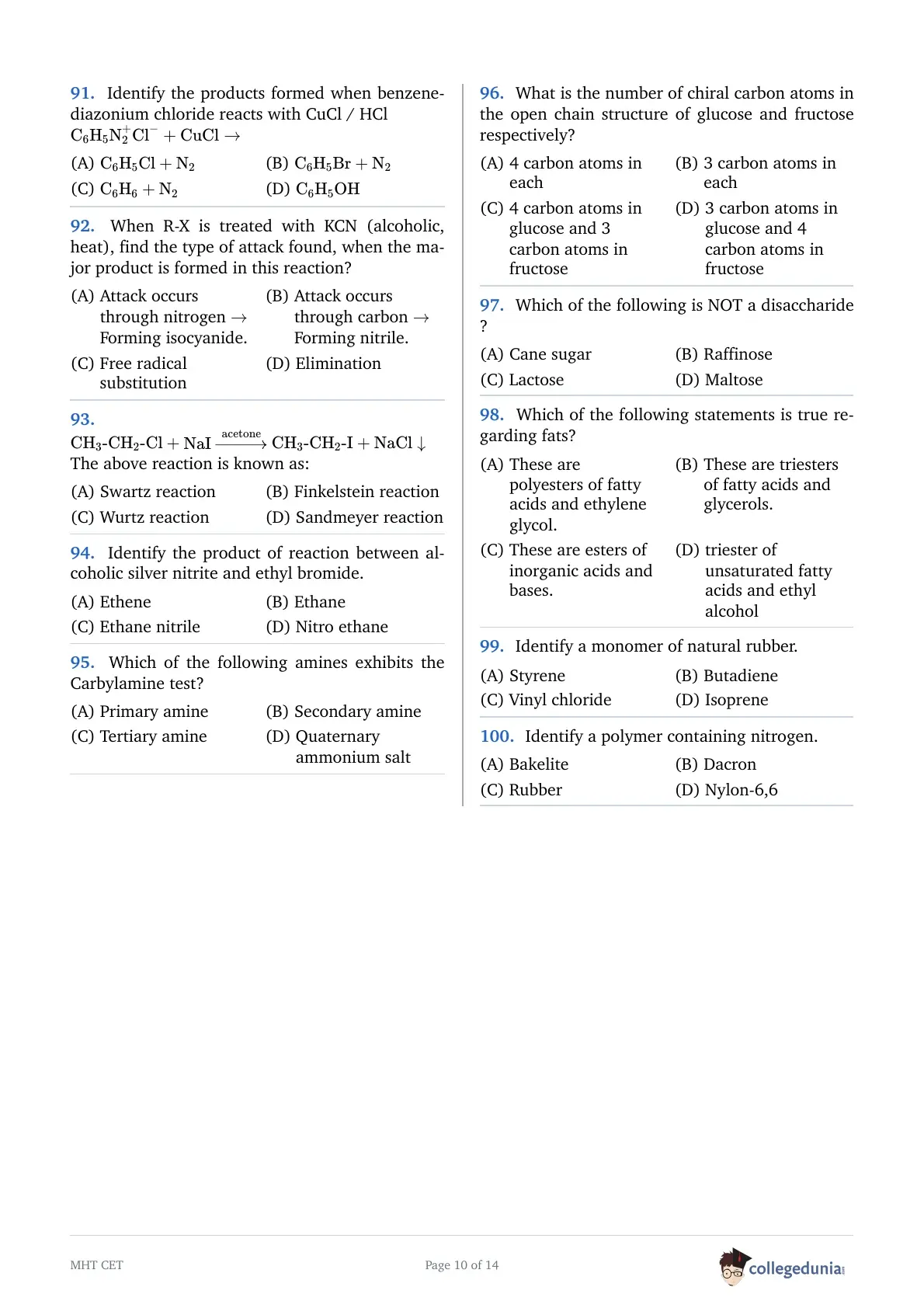
Identify the products formed when benzenediazonium chloride reacts with CuCl / HCl
\(\text{C}_{6}\text{H}_{5}\text{N}_{2}^{+}\text{Cl}^{-}+\text{CuCl}\rightarrow\)
When R-X is treated with KCN (alcoholic, heat), find the type of attack found, when the major product is formed in this reaction?
\(\text{CH}_{3}\text{-CH}_{2}\text{-Cl}+\text{NaI}\xrightarrow{\text{acetone}}\text{CH}_{3}\text{-CH}_{2}\text{-I}+\text{NaCl}\downarrow\)
The above reaction is known as:
Identify the product of reaction between alcoholic silver nitrite and ethyl bromide.
Which of the following amines exhibits the Carbylamine test?
What is the number of chiral carbon atoms in the open chain structure of glucose and fructose respectively?
Which of the following is NOT a disaccharide ?
Which of the following statements is true regarding fats?
Identify a monomer of natural rubber.
Identify a polymer containing nitrogen.
Mathematics (Q101 - Q150)
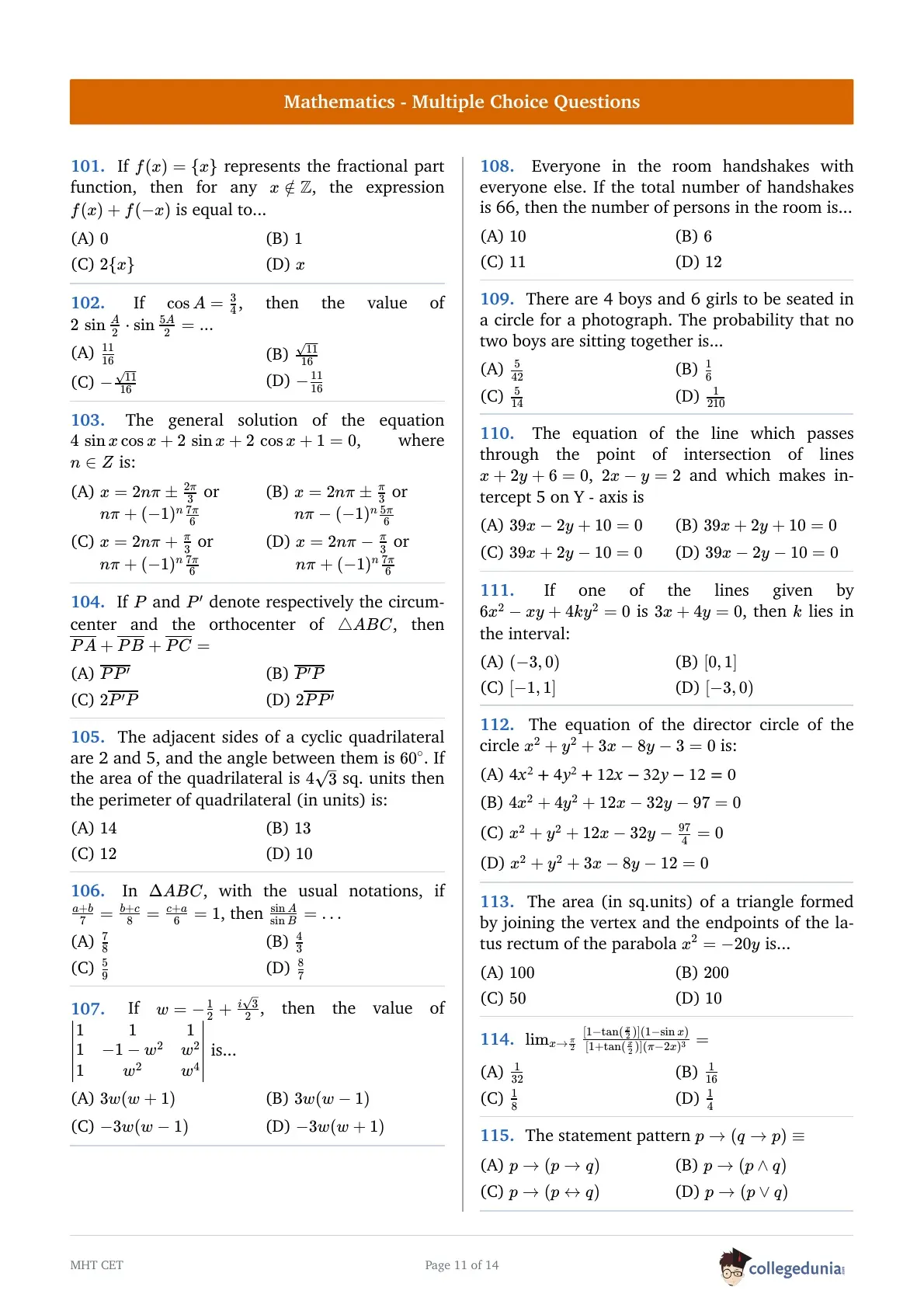
If \(f(x)=\{x\}\) represents the fractional part function, then for any \(x\notin \mathbb{Z}\), the expression \(f(x)+f(-x)\) is equal to...
If \(\cos A=\frac{3}{4}\), then the value of \(2\,\sin \frac{A}{2}\cdot \sin \frac{5A}{2}=...\)
The general solution of the equation \(4\,\sin x\cos x+2\,\sin x+2\,\cos x+1=0\), where \(n\in Z\) is:
If \(P\) and \(P'\) denote respectively the circumcenter and the orthocenter of \(\triangle ABC\), then \(\overline{PA}+\overline{PB}+\overline{PC}=\)
The adjacent sides of a cyclic quadrilateral are 2 and 5, and the angle between them is \(60^{\circ }\). If the area of the quadrilateral is \(4\sqrt{3}\) sq. units then the perimeter of quadrilateral (in units) is:
In \(\Delta ABC\), with the usual notations, if \(\frac{a+b}{7}=\frac{b+c}{8}=\frac{c+a}{6}=1\), then \(\frac{\sin A}{\sin B}=\ldots\)
If \(w=-\frac{1}{2}+\frac{i\sqrt{3}}{2}\), then the value of \(\begin{vmatrix} 1 & 1 & 1 \\ 1 & -1-w^{2} & w^{2} \\ 1 & w^{2} & w^{4} \end{vmatrix}\) is...
Everyone in the room handshakes with everyone else. If the total number of handshakes is 66, then the number of persons in the room is...
There are 4 boys and 6 girls to be seated in a circle for a photograph. The probability that no two boys are sitting together is...
The equation of the line which passes through the point of intersection of lines \(x+2y+6=0\), \(2x-y=2\) and which makes intercept 5 on Y - axis is
If one of the lines given by \(6x^{2}-xy+4ky^{2}=0\) is \(3x+4y=0\), then \(k\) lies in the interval:
The equation of the director circle of the circle \(x^{2}+y^{2}+3x-8y-3=0\) is:
The area (in sq.units) of a triangle formed by joining the vertex and the endpoints of the latus rectum of the parabola \(x^{2}=-20y\) is...
\(\lim _{x\rightarrow \frac{\pi }{2}}\frac{[1-\tan (\frac{x}{2})](1-\sin x)}{[1+\tan (\frac{x}{2})](\pi -2x)^{3}}=\)
The statement pattern \(p\rightarrow (q\rightarrow p)\equiv\)
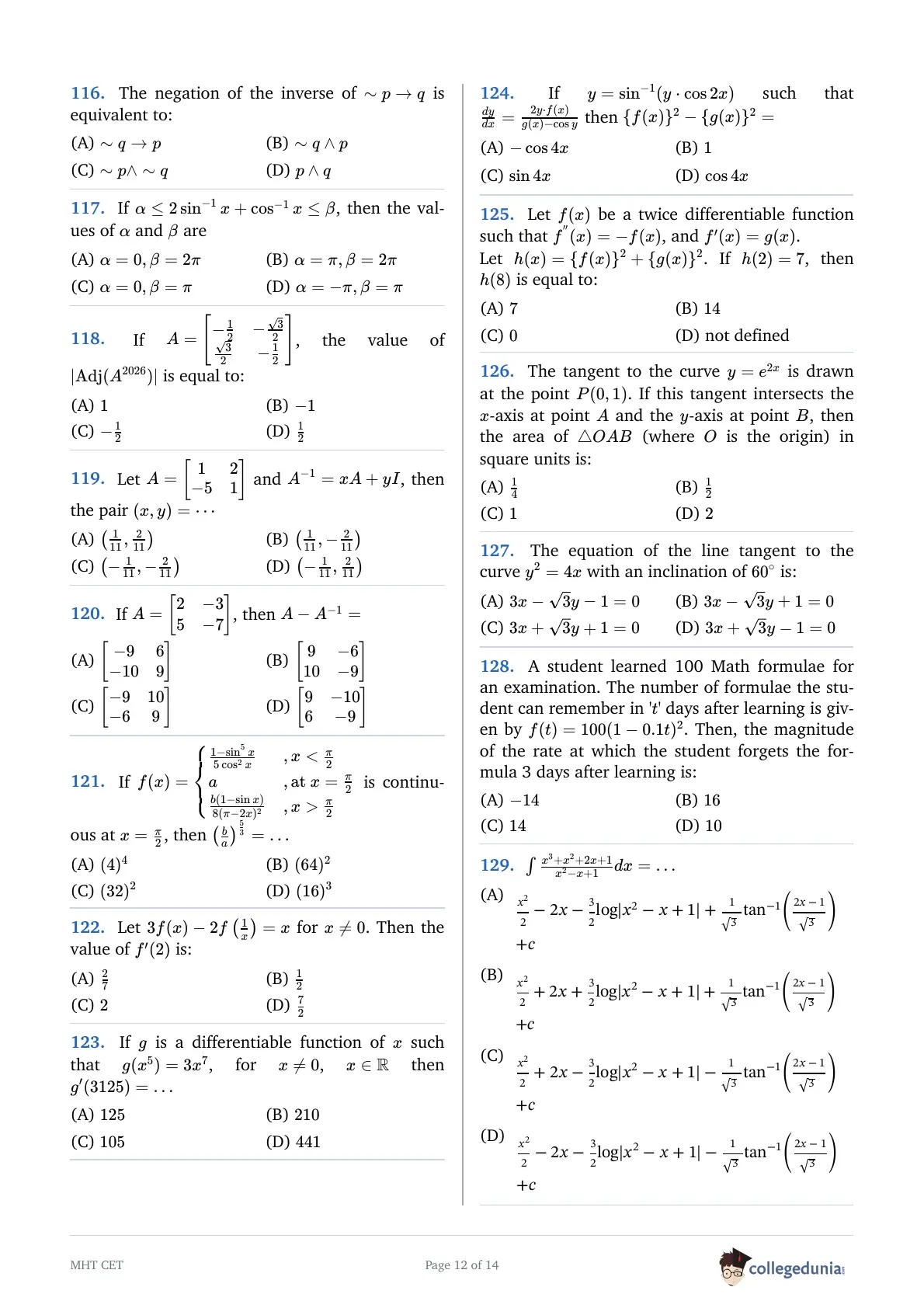
The negation of the inverse of \(\sim p\rightarrow q\) is equivalent to:
If \(\alpha \leq 2\sin ^{-1}x+\cos ^{-1}x\leq \beta\), then the values of \(\alpha\) and \(\beta\) are
If \(A=\begin{bmatrix} -\frac{1}{2} & -\frac{\sqrt{3}}{2} \\ \frac{\sqrt{3}}{2} & -\frac{1}{2} \end{bmatrix}\), the value of \(|\text{Adj}(A^{2026})|\) is equal to:
Let \(A=\begin{bmatrix} 1 & 2 \\ -5 & 1 \end{bmatrix}\) and \(A^{-1}=xA+yI\), then the pair \((x,y)=\cdots\)
If \(A=\begin{bmatrix} 2 & -3 \\ 5 & -7 \end{bmatrix}\), then \(A-A^{-1}=\)
If \(f(x)=\begin{cases} \frac{1-\sin ^{5}x}{5\cos ^{2}x} & ,x\lt \frac{\pi }{2} \\ a & ,\text{at }x=\frac{\pi }{2} \\ \frac{b(1-\sin x)}{8(\pi -2x)^{2}} & ,x>\frac{\pi }{2} \end{cases}\) is continuous at \(x=\frac{\pi }{2}\), then \(\left(\frac{b}{a}\right)^{\frac{5}{3}}=\ldots\)
Let \(3f(x)-2f\left(\frac{1}{x}\right)=x\) for \(x\neq 0\). Then the value of \(f'(2)\) is:
If \(g\) is a differentiable function of \(x\) such that \(g(x^{5})=3x^{7}\), for \(x\neq 0\), \(x\in \mathbb{R}\) then \(g'(3125)=\ldots\)
If \(y=\sin ^{-1}(y\cdot \cos 2x)\) such that \(\frac{dy}{dx}=\frac{2y\cdot f(x)}{g(x)-\cos y}\) then \(\{f(x)\}^{2}-\{g(x)\}^{2}=\)
Let \(f(x)\) be a twice differentiable function such that \(f^{''}(x)=-f(x)\), and \(f'(x)=g(x)\).
Let \(h(x)=\{f(x)\}^{2}+\{g(x)\}^{2}\). If \(h(2)=7\), then \(h(8)\) is equal to:
The tangent to the curve \(y=e^{2x}\) is drawn at the point \(P(0,1)\). If this tangent intersects the \(x\)-axis at point \(A\) and the \(y\)-axis at point \(B\), then the area of \(\triangle OAB\) (where \(O\) is the origin) in square units is:
The equation of the line tangent to the curve \(y^{2}=4x\) with an inclination of \(60^{\circ }\) is:
A student learned 100 Math formulae for an examination. The number of formulae the student can remember in '\(t\)' days after learning is given by \(f(t)=100(1-0.1t)^{2}\). Then, the magnitude of the rate at which the student forgets the formula 3 days after learning is:
\(\int \frac{x^{3}+x^{2}+2x+1}{x^{2}-x+1}dx=\ldots\)
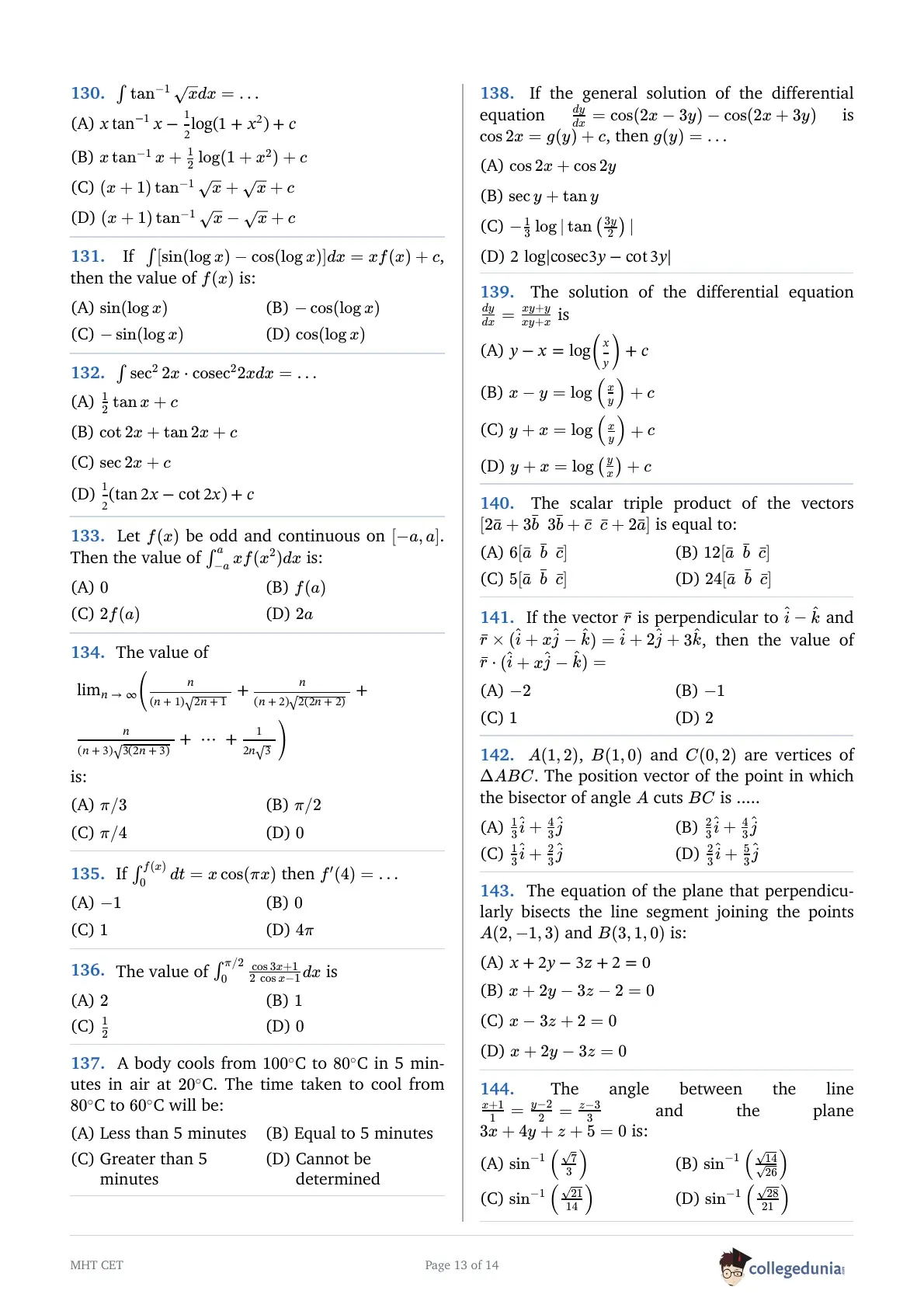
\(\int \tan ^{-1}\sqrt{x}dx=\ldots\)
If \(\int [\sin (\log x)-\cos (\log x)]dx=xf(x)+c\), then the value of \(f(x)\) is:
\(\int \sec ^{2}2x\cdot \text{cosec}^{2}2xdx=\ldots\)
Let \(f(x)\) be odd and continuous on \([-a,a]\). Then the value of \(\int _{-a}^{a}xf(x^{2})dx\) is:
The value of \(\lim _{n\rightarrow \infty }\left(\frac{n}{(n+1)\sqrt{2n+1}}+\frac{n}{(n+2)\sqrt{2(2n+2)}}+\frac{n}{(n+3)\sqrt{3(2n+3)}}+\cdots +\frac{1}{2n\sqrt{3}}\right)\) is:
If \(\int _{0}^{f(x)}dt=x\cos (\pi x)\) then \(f'(4)=\ldots\)
The value of \(\int _{0}^{\pi /2}\frac{\cos 3x+1}{2\,\cos x-1}dx\) is
A body cools from \(100^{\circ }\)C to \(80^{\circ }\)C in 5 minutes in air at \(20^{\circ }\)C. The time taken to cool from \(80^{\circ }\)C to \(60^{\circ }\)C will be:
If the general solution of the differential equation \(\frac{dy}{dx}=\cos (2x-3y)-\cos (2x+3y)\) is \(\cos 2x=g(y)+c\), then \(g(y)=\ldots\)
The solution of the differential equation \(\frac{dy}{dx}=\frac{xy+y}{xy+x}\) is
The scalar triple product of the vectors \([2\bar{a}+3\bar{b}\ \ 3\bar{b}+\bar{c}\ \ \bar{c}+2\bar{a}]\) is equal to:
If the vector \(\bar{r}\) is perpendicular to \(\hat{i}-\hat{k}\) and \(\bar{r}\times (\hat{i}+x\hat{j}-\hat{k})=\hat{i}+2\hat{j}+3\hat{k}\), then the value of \(\bar{r}\cdot (\hat{i}+x\hat{j}-\hat{k})=\)
\(A(1,2)\), \(B(1,0)\) and \(C(0,2)\) are vertices of \(\Delta ABC\). The position vector of the point in which the bisector of angle \(A\) cuts \(BC\) is .....
The equation of the plane that perpendicularly bisects the line segment joining the points \(A(2,-1,3)\) and \(B(3,1,0)\) is:
The angle between the line \(\frac{x+1}{1}=\frac{y-2}{2}=\frac{z-3}{3}\) and the plane \(3x+4y+z+5=0\) is:
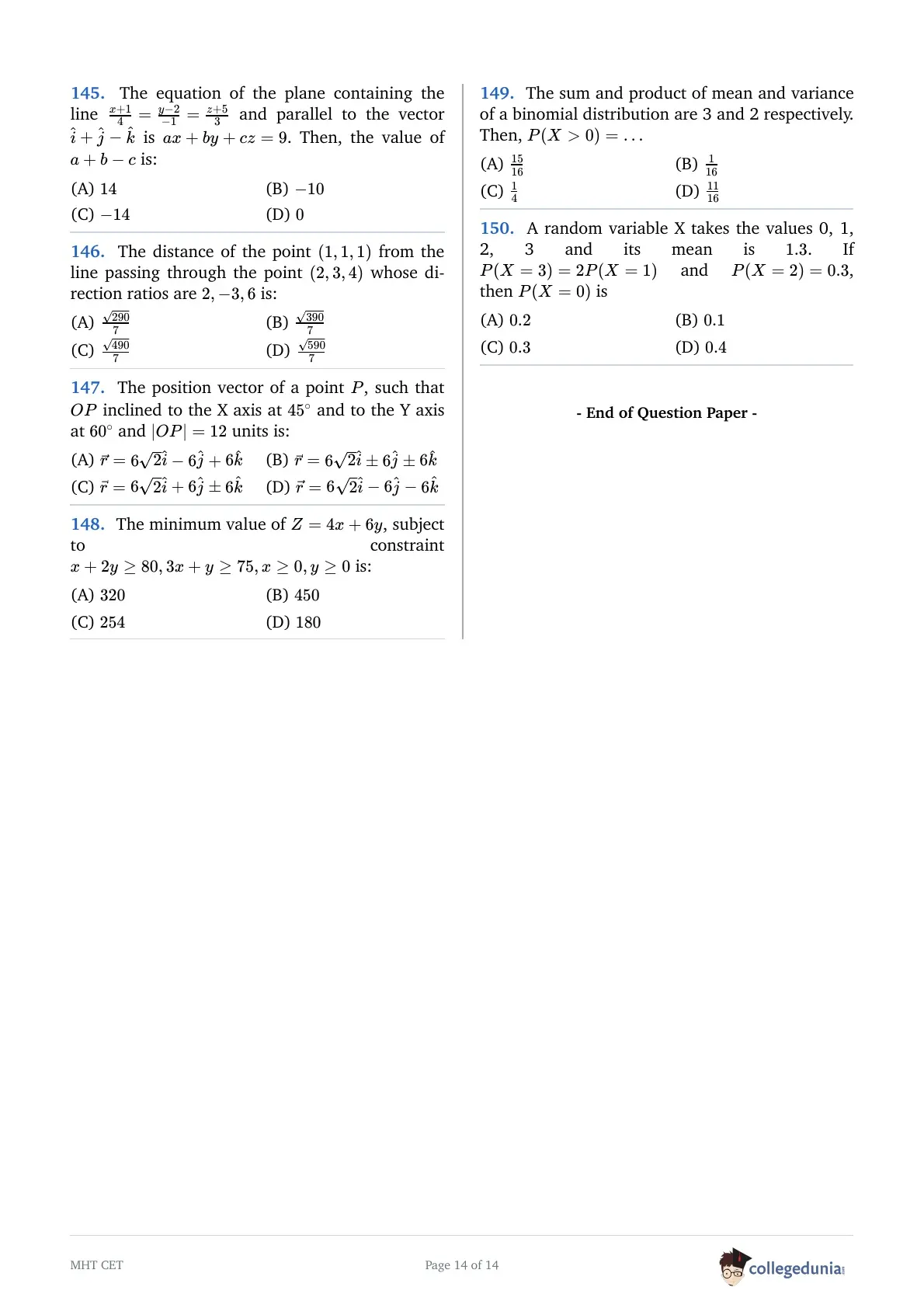
The equation of the plane containing the line \(\frac{x+1}{4}=\frac{y-2}{-1}=\frac{z+5}{3}\) and parallel to the vector \(\hat{i}+\hat{j}-\hat{k}\) is \(ax+by+cz=9\). Then, the value of \(a+b-c\) is:
The distance of the point \((1,1,1)\) from the line passing through the point \((2,3,4)\) whose direction ratios are \(2,-3,6\) is:
The position vector of a point \(P\), such that \(OP\) inclined to the X axis at \(45^{\circ }\) and to the Y axis at \(60^{\circ }\) and \(|OP|=12\) units is:
The minimum value of \(Z=4x+6y\), subject to constraint \(x+2y\geq 80,3x+y\geq 75,x\geq 0,y\geq 0\) is:
The sum and product of mean and variance of a binomial distribution are 3 and 2 respectively. Then, \(P(X>0)=\ldots\)
A random variable X takes the values 0, 1, 2, 3 and its mean is \(1.3\). If \(P(X=3)=2P(X=1)\) and \(P(X=2)=0.3\), then \(P(X=0)\) is
MHT CET 2026 PCM Exam Pattern and Marking Scheme
| Parameter | Details |
|---|---|
| Conducting Body | Maharashtra Common Entrance Test Cell (Maharashtra CET Cell) |
| Exam Mode | Online (Computer-Based Test) |
| Duration | 180 minutes (3 hours) |
| Groups / Subjects | PCM (Physics, Chemistry, Mathematics) for Engineering |
| Total Questions |
150 |
| Total Marks | 200 |
| Question Type | Multiple Choice Questions (MCQs) |
| Marks Distribution |
|
| Negative Marking | No |
| Syllabus Weightage |
|



Comments