




MHT CET 2026 May 19 Shift 2 PCM Question Paper is available for download here. Maharashtra State CET Cell conducted MHT CET 2026 PCM Exam on May 19 in Shift 2 from 2 PM to 5 PM in CBT mode.
The MHT CET 2026 PCM question paper includes the following:
- The MHT CET 2026 PCM Question Paper consists of 150 multiple-choice questions (MCQs) totalling 200 marks divided into 3 sections: Physics, Chemistry, and Mathematics, with 50 questions in each subject.
- Physics and Chemistry questions carry 1 mark each while Mathematics questions carry 2 marks each.
- There is no negative marking for incorrect answers.
MHT CET 2026 May 19 Shift 2 PCM Question Paper with Solution PDF
| CD PDF | CD PDF with Solutions |
|---|---|
| Download Collegedunia PDF 1.05 MB | - |
Also Check:
MHT CET 2026 May 19 Shift 2 PCM Questions with Solutions
Physics (Q1 - Q50)
A vector \(\vec{A}\) of magnitude \(7\sqrt{2}\) unit, another vector \(\vec{B}\) of magnitude \(14\) unit are inclined at an angle of \(60^{\circ }\). The magnitude of the scalar product \((\vec{A}\cdot \vec{B})\) is \(\left[\cos (60)^{\circ }=\frac{1}{2}\right]\)
A wire has mass \((0.4\pm 0.002)\) g, radius \((0.6\pm 0.006)\) mm and length \((8\pm 0.04)\) cm. The percentage error in the measurement of its density is
The minute hand of a wall-clock is \(10\) cm long. The average velocity of the tip of the minute hand between \(6.00\) am to \(7.30\) am is
A lead bullet moving with velocity '\(v\)' strikes a wall and stops. \(75\%\) of its energy is converted into heat. If the increase in the temperature is \(\frac{v^{2}}{nJs}\), then the value of \(n\) is \(\{s=\text{specific heat of lead},J=\text{mechanical equivalent of heat}\}\)
A body is moved along a straight line by a machine delivering constant power. The distance moved by the body in time \(t\) is proportional to
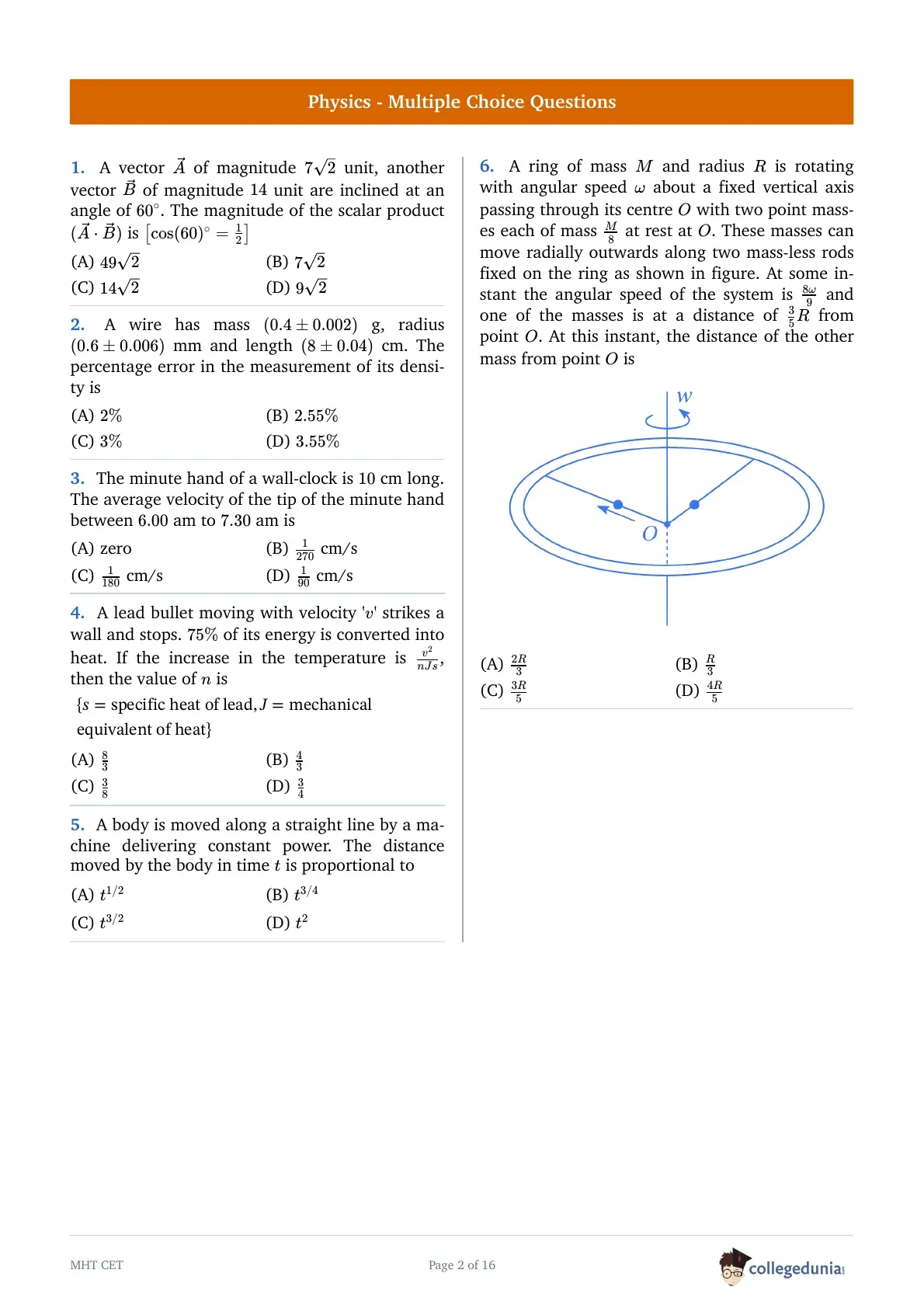
A ring of mass \(M\) and radius \(R\) is rotating with angular speed \(\omega\) about a fixed vertical axis passing through its centre \(O\) with two point masses each of mass \(\frac{M}{8}\) at rest at \(O\). These masses can move radially outwards along two mass-less rods fixed on the ring as shown in figure. At some instant the angular speed of the system is \(\frac{8\omega }{9}\) and one of the masses is at a distance of \(\frac{3}{5}R\) from point \(O\). At this instant, the distance of the other mass from point \(O\) is

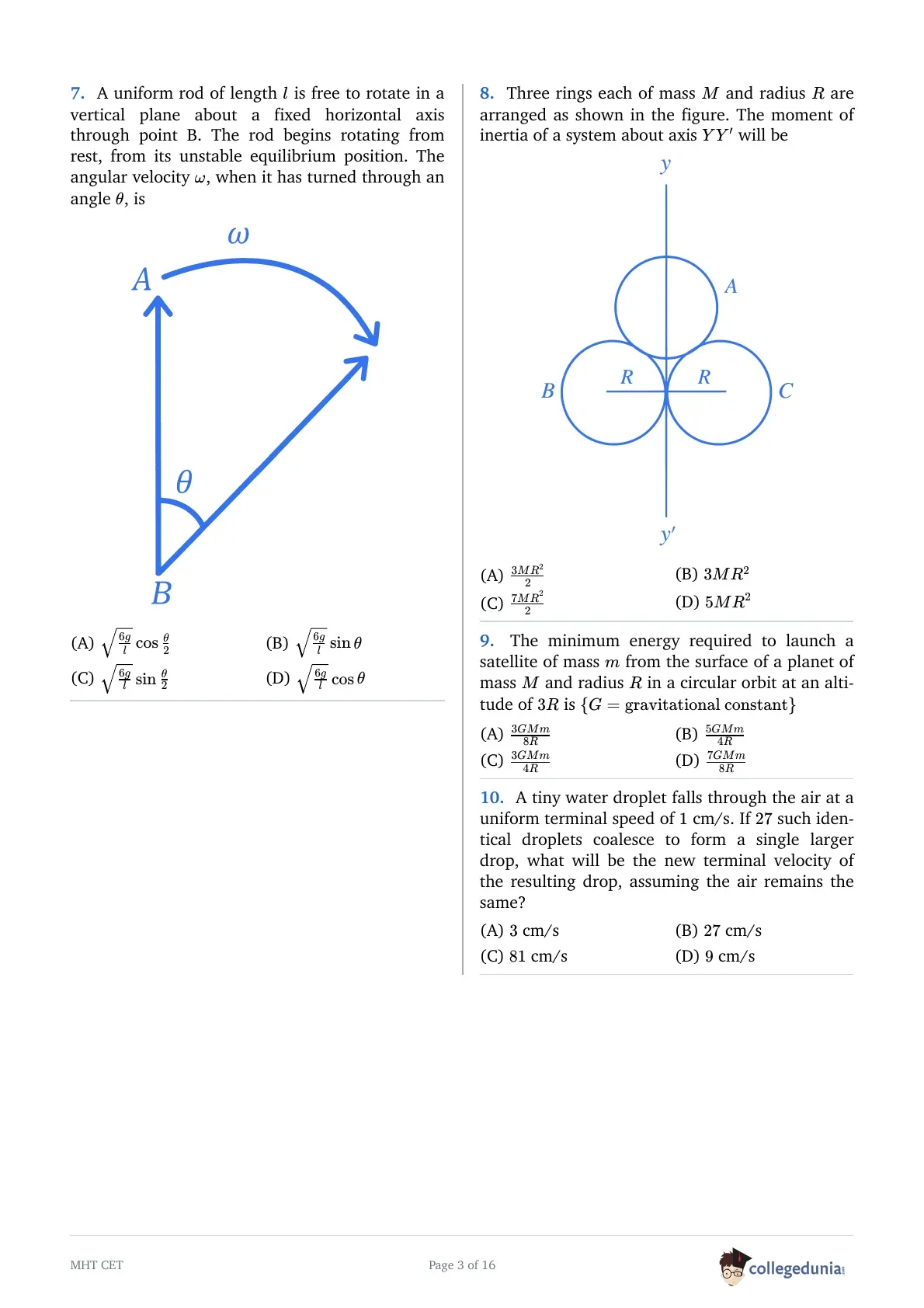
A uniform rod of length \(l\) is free to rotate in a vertical plane about a fixed horizontal axis through point B. The rod begins rotating from rest, from its unstable equilibrium position. The angular velocity \(\omega\), when it has turned through an angle \(\theta\), is

Three rings each of mass \(M\) and radius \(R\) are arranged as shown in the figure. The moment of inertia of a system about axis \(YY'\) will be

The minimum energy required to launch a satellite of mass \(m\) from the surface of a planet of mass \(M\) and radius \(R\) in a circular orbit at an altitude of \(3R\) is \(\{G=\text{gravitational constant}\}\)
A tiny water droplet falls through the air at a uniform terminal speed of \(1\) cm/s. If \(27\) such identical droplets coalesce to form a single larger drop, what will be the new terminal velocity of the resulting drop, assuming the air remains the same?
Which of the following is NOT TRUE?
a. When soluble substance is dissolved in water, the surface tension of water increases.
b. When sparingly soluble substance is mixed with water, surface tension of water increases.
c. When insoluble impurity is added into the water, surface tension of water decreases.
d. In case of molten copper or molten cadmium, the surface tension increases with increase in its temperature.
In a hydraulic press, the piston in the small cylinder has a diameter of \(d_{1}\) cm, while the larger piston has a diameter of \(d_{2}\) cm. If a force \(F_{1}\) is applied to the small piston, then the force \(F_{2}\) on the large piston is given by
The power radiated by a black body is \(P\) and it radiates maximum energy at wavelength \(\lambda _{o}\). If the temperature of the black body is now changed so that it radiates maximum energy at wavelength \(0.75\lambda _{o}\), the power radiated by it becomes \(nP\). The value \(n\) is
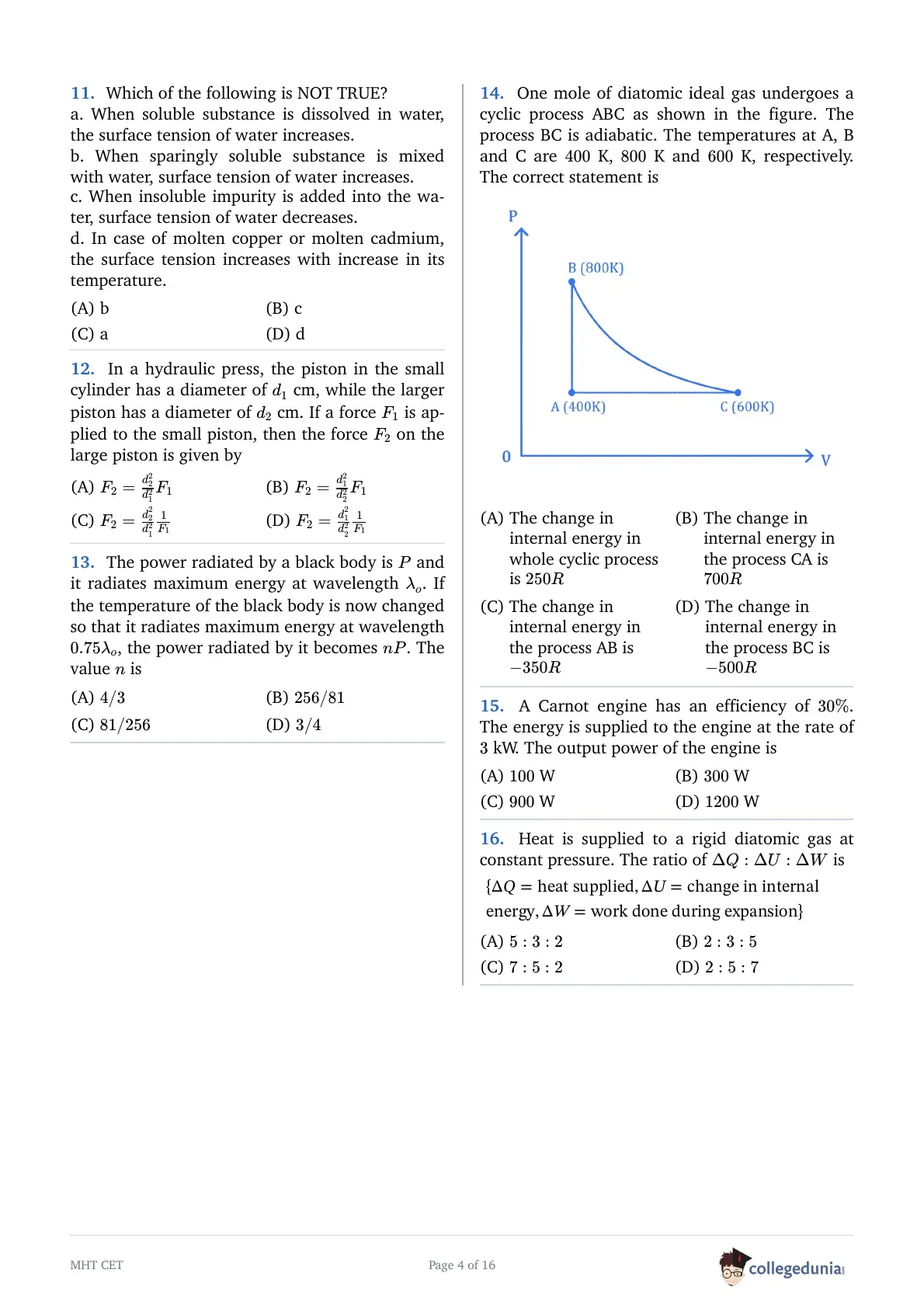
One mole of diatomic ideal gas undergoes a cyclic process ABC as shown in the figure. The process BC is adiabatic. The temperatures at A, B and C are \(400\) K, \(800\) K and \(600\) K, respectively. The correct statement is

A Carnot engine has an efficiency of \(30\%\). The energy is supplied to the engine at the rate of \(3\) kW. The output power of the engine is
Heat is supplied to a rigid diatomic gas at constant pressure. The ratio of \(\Delta Q:\Delta U:\Delta W\) is \(\{\Delta Q=\text{heat supplied},\Delta U=\text{change in internal energy},\Delta W=\text{work done during expansion}\}\)
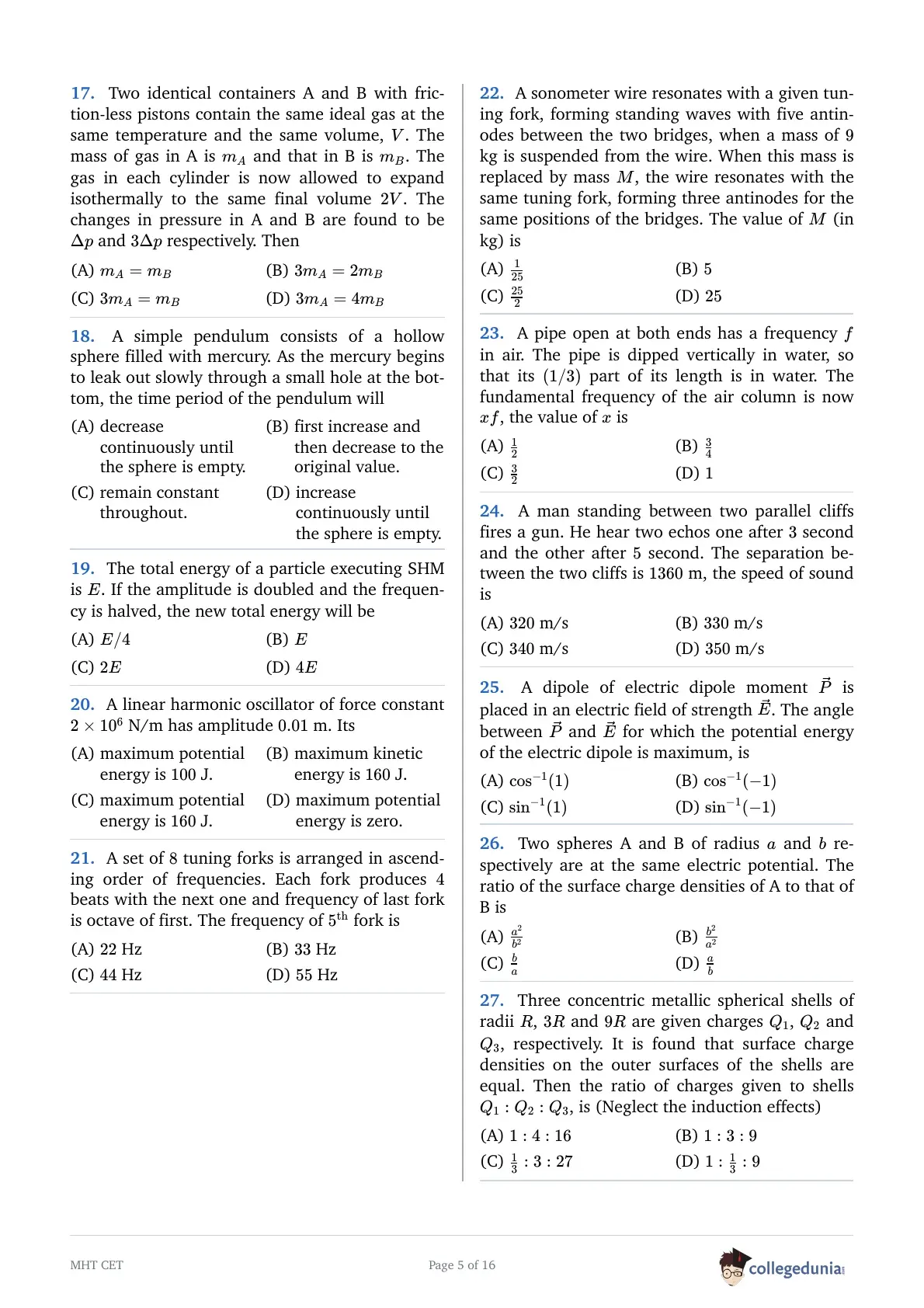
Two identical containers A and B with friction-less pistons contain the same ideal gas at the same temperature and the same volume, \(V\). The mass of gas in A is \(m_{A}\) and that in B is \(m_{B}\). The gas in each cylinder is now allowed to expand isothermally to the same final volume \(2V\). The changes in pressure in A and B are found to be \(\Delta p\) and \(3\Delta p\) respectively. Then
A simple pendulum consists of a hollow sphere filled with mercury. As the mercury begins to leak out slowly through a small hole at the bottom, the time period of the pendulum will
The total energy of a particle executing SHM is \(E\). If the amplitude is doubled and the frequency is halved, the new total energy will be
A linear harmonic oscillator of force constant \(2\times 10^{6}\) N/m has amplitude \(0.01\) m. Its
A set of \(8\) tuning forks is arranged in ascending order of frequencies. Each fork produces \(4\) beats with the next one and frequency of last fork is octave of first. The frequency of \(5^{\text{th}}\) fork is
A sonometer wire resonates with a given tuning fork, forming standing waves with five antinodes between the two bridges, when a mass of \(9\) kg is suspended from the wire. When this mass is replaced by mass \(M\), the wire resonates with the same tuning fork, forming three antinodes for the same positions of the bridges. The value of \(M\) (in kg) is
A pipe open at both ends has a frequency \(f\) in air. The pipe is dipped vertically in water, so that its \((1/3)\) part of its length is in water. The fundamental frequency of the air column is now \(xf\), the value of \(x\) is
A man standing between two parallel cliffs fires a gun. He hear two echos one after \(3\) second and the other after \(5\) second. The separation between the two cliffs is \(1360\) m, the speed of sound is
A dipole of electric dipole moment \(\vec{P}\) is placed in an electric field of strength \(\vec{E}\). The angle between \(\vec{P}\) and \(\vec{E}\) for which the potential energy of the electric dipole is maximum, is
Two spheres A and B of radius \(a\) and \(b\) respectively are at the same electric potential. The ratio of the surface charge densities of A to that of B is
Three concentric metallic spherical shells of radii \(R\), \(3R\) and \(9R\) are given charges \(Q_{1}\), \(Q_{2}\) and \(Q_{3}\), respectively. It is found that surface charge densities on the outer surfaces of the shells are equal. Then the ratio of charges given to shells \(Q_{1}:Q_{2}:Q_{3}\), is (Neglect the induction effects)
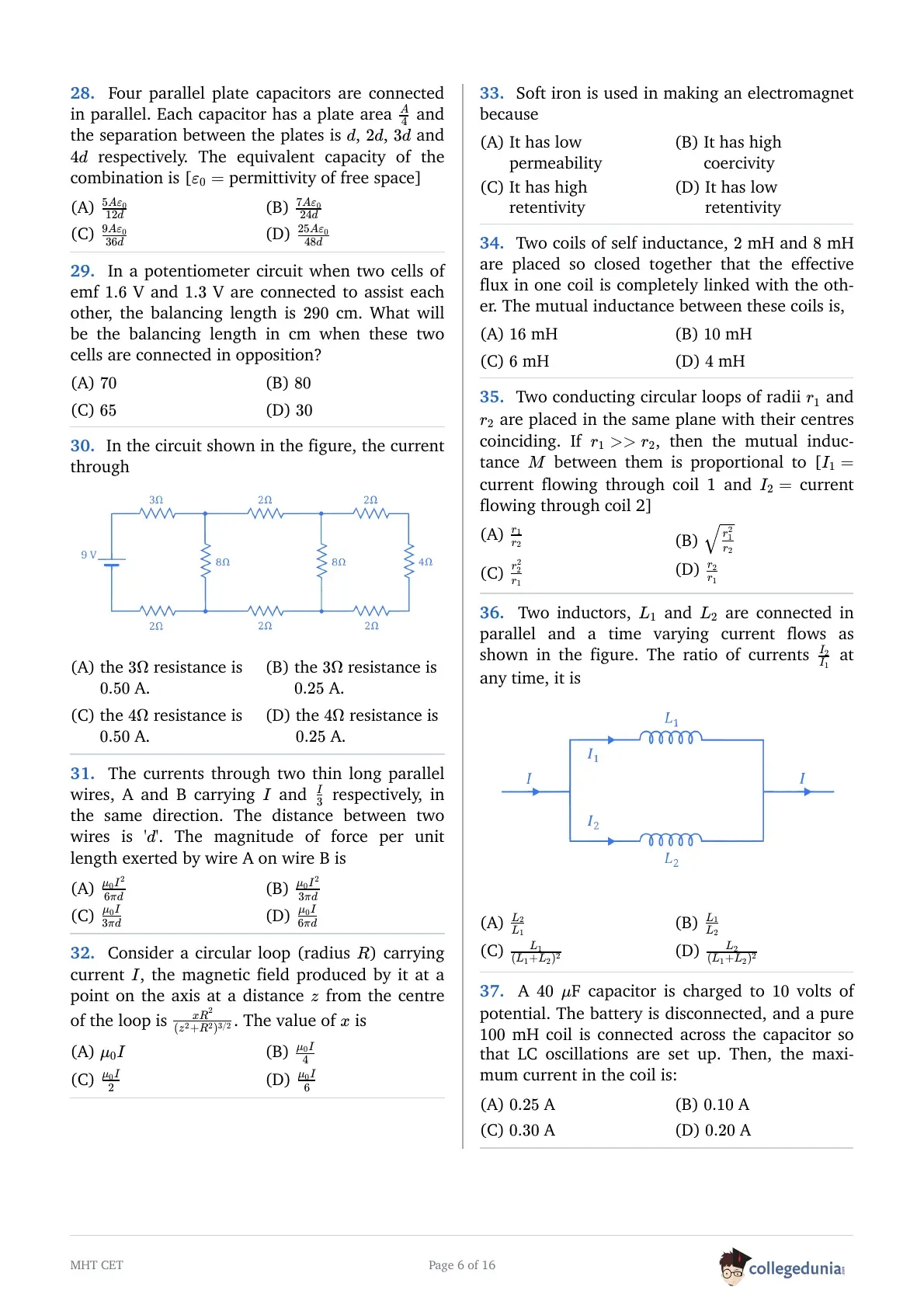
Four parallel plate capacitors are connected in parallel. Each capacitor has a plate area \(\frac{A}{4}\) and the separation between the plates is \(d\), \(2d\), \(3d\) and \(4d\) respectively. The equivalent capacity of the combination is [\(\varepsilon _{0}=\) permittivity of free space]
In a potentiometer circuit when two cells of emf \(1.6\) V and \(1.3\) V are connected to assist each other, the balancing length is \(290\) cm. What will be the balancing length in cm when these two cells are connected in opposition?

The currents through two thin long parallel wires, A and B carrying \(I\) and \(\frac{I}{3}\) respectively, in the same direction. The distance between two wires is '\(d\)'. The magnitude of force per unit length exerted by wire A on wire B is
Consider a circular loop (radius \(R\)) carrying current \(I\), the magnetic field produced by it at a point on the axis at a distance \(z\) from the centre of the loop is \(\frac{xR^{2}}{(z^{2}+R^{2})^{3/2}}\). The value of \(x\) is
Soft iron is used in making an electromagnet because
Two coils of self inductance, \(2\) mH and \(8\) mH are placed so closed together that the effective flux in one coil is completely linked with the other. The mutual inductance between these coils is,
Two conducting circular loops of radii \(r_{1}\) and \(r_{2}\) are placed in the same plane with their centres coinciding. If \(r_{1}>>r_{2}\), then the mutual inductance \(M\) between them is proportional to [\(I_{1}=\) current flowing through coil 1 and \(I_{2}=\) current flowing through coil 2]
Two inductors, \(L_{1}\) and \(L_{2}\) are connected in parallel and a time varying current flows as shown in the figure. The ratio of currents \(\frac{I_{2}}{I_{1}}\) at any time, it is

A \(40\) \(\mu\)F capacitor is charged to \(10\) volts of potential. The battery is disconnected, and a pure \(100\) mH coil is connected across the capacitor so that LC oscillations are set up. Then, the maximum current in the coil is:
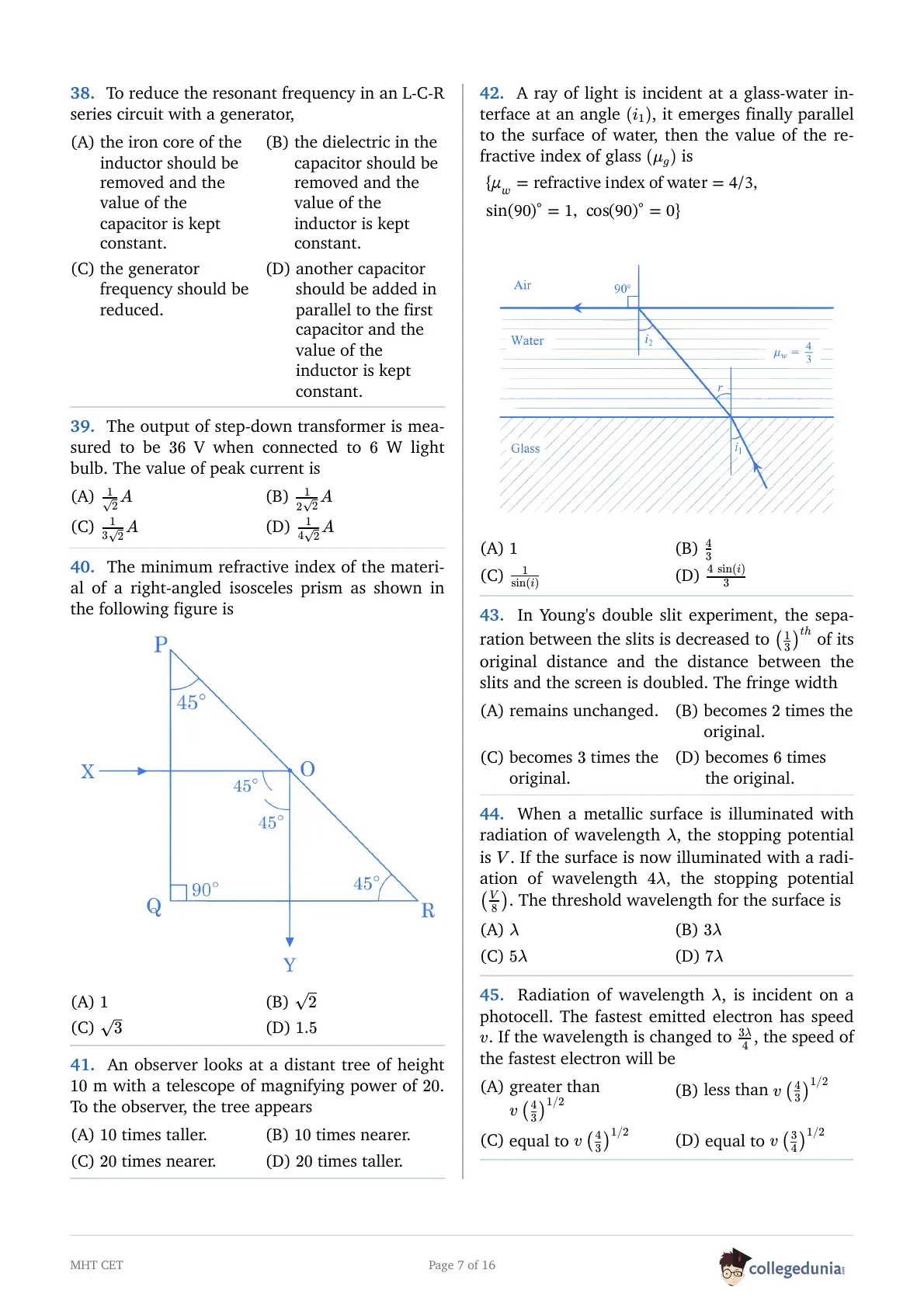
To reduce the resonant frequency in an L-C-R series circuit with a generator,
The output of step-down transformer is measured to be \(36\) V when connected to \(6\) W light bulb. The value of peak current is
The minimum refractive index of the material of a right-angled isosceles prism as shown in the following figure is

An observer looks at a distant tree of height \(10\) m with a telescope of magnifying power of \(20\). To the observer, the tree appears
A ray of light is incident at a glass-water interface at an angle \((i_{1})\), it emerges finally parallel to the surface of water, then the value of the refractive index of glass \((\mu _{g})\) is \(\{\mu _{w}=\text{refractive index of water}=4/3,\,\sin (90)^{\circ }=1,\,\cos (90)^{\circ }=0\}\)

In Young's double slit experiment, the separation between the slits is decreased to \(\left(\frac{1}{3}\right)^{th}\) of its original distance and the distance between the slits and the screen is doubled. The fringe width
When a metallic surface is illuminated with radiation of wavelength \(\lambda\), the stopping potential is \(V\). If the surface is now illuminated with a radiation of wavelength \(4\lambda\), the stopping potential \(\left(\frac{V}{8}\right)\). The threshold wavelength for the surface is
Radiation of wavelength \(\lambda\), is incident on a photocell. The fastest emitted electron has speed \(v\). If the wavelength is changed to \(\frac{3\lambda }{4}\), the speed of the fastest electron will be
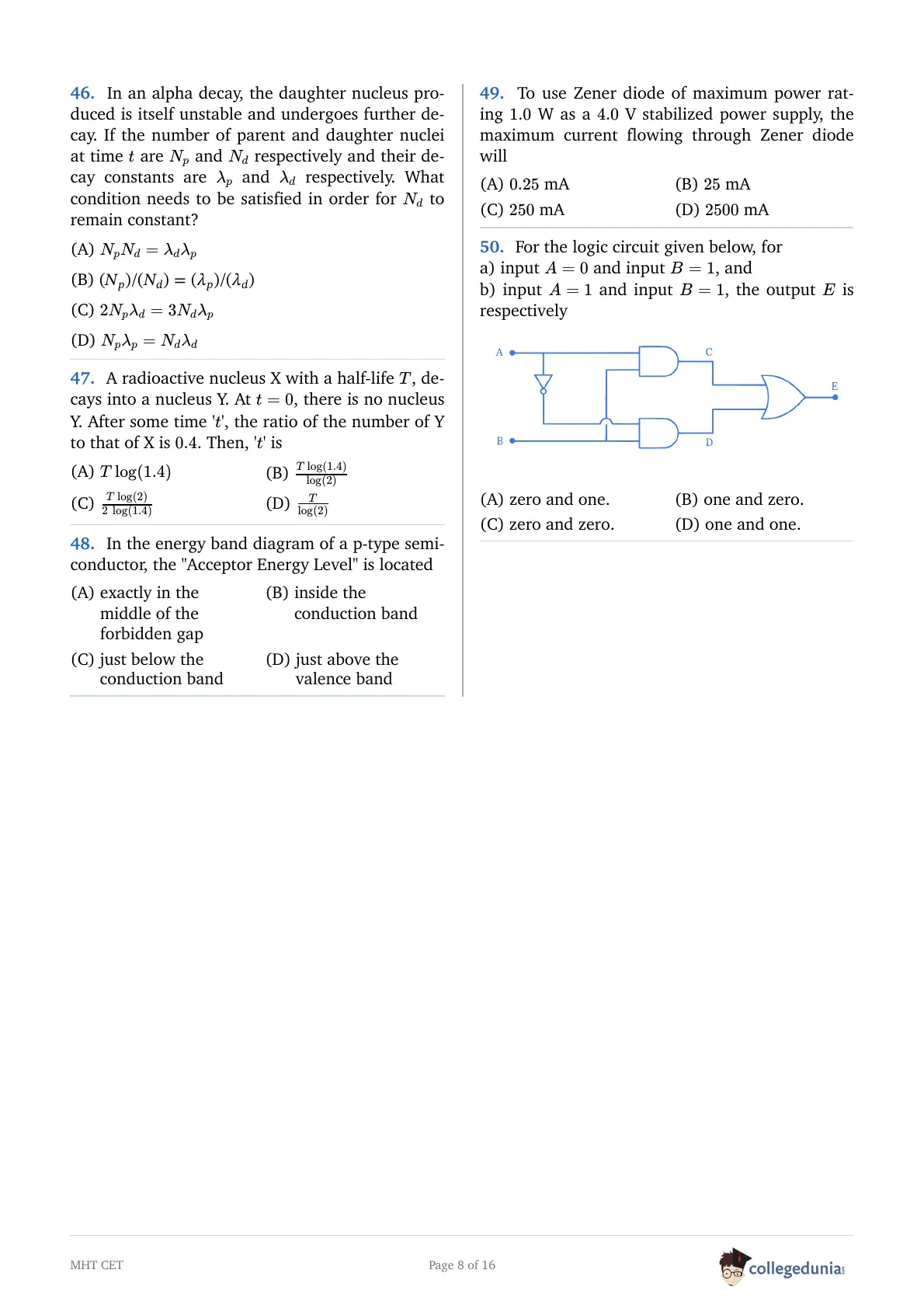
In an alpha decay, the daughter nucleus produced is itself unstable and undergoes further decay. If the number of parent and daughter nuclei at time \(t\) are \(N_{p}\) and \(N_{d}\) respectively and their decay constants are \(\lambda _{p}\) and \(\lambda _{d}\) respectively. What condition needs to be satisfied in order for \(N_{d}\) to remain constant?
A radioactive nucleus X with a half-life \(T\), decays into a nucleus Y. At \(t=0\), there is no nucleus Y. After some time '\(t\)', the ratio of the number of Y to that of X is \(0.4\). Then, '\(t\)' is
In the energy band diagram of a p-type semiconductor, the "Acceptor Energy Level" is located
To use Zener diode of maximum power rating \(1.0\) W as a \(4.0\) V stabilized power supply, the maximum current flowing through Zener diode will
For the logic circuit given below, for
a) input \(A=0\) and input \(B=1\), and
b) input \(A=1\) and input \(B=1\), the output \(E\) is respectively

Chemistry (Q51 - Q100)
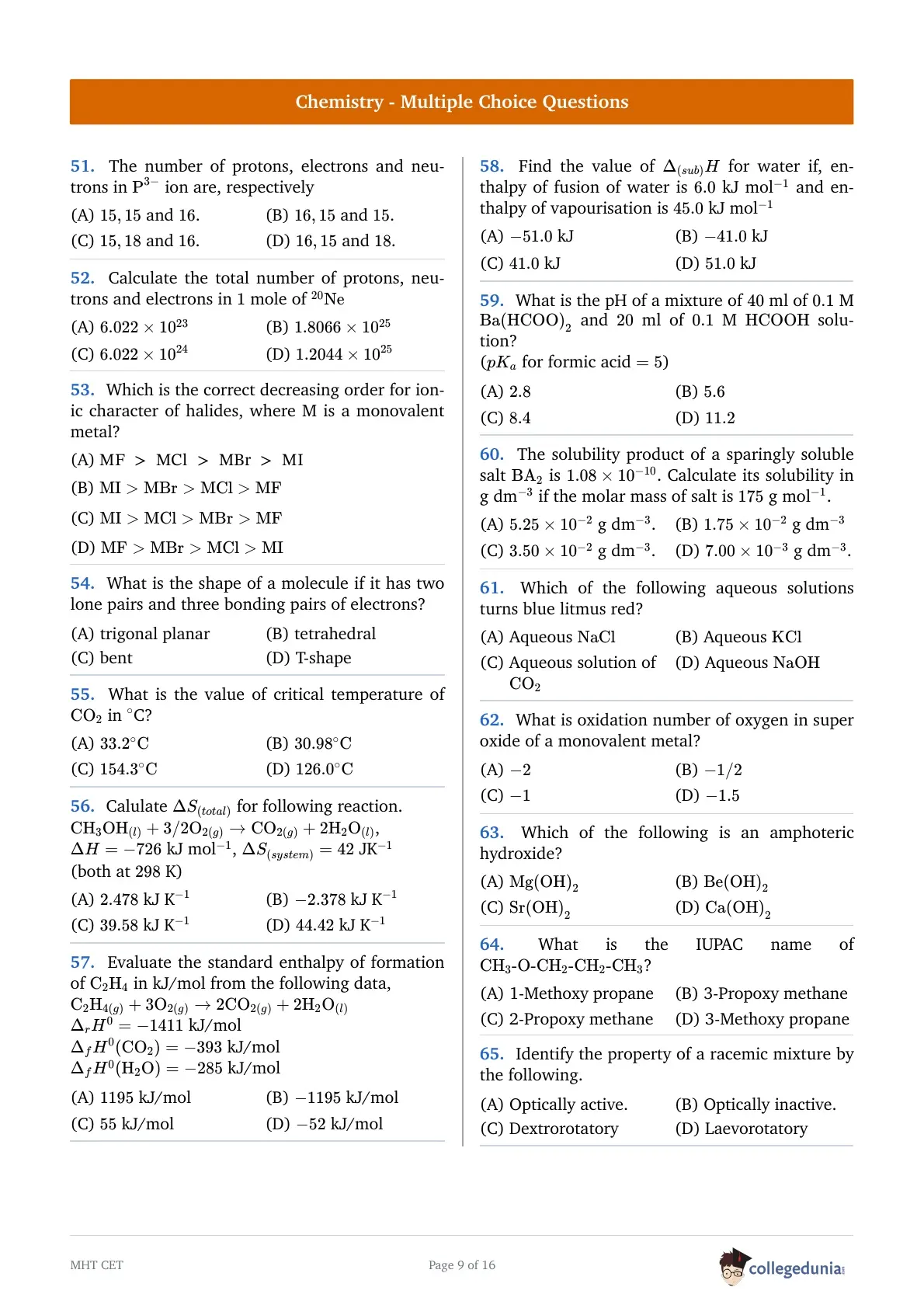
The number of protons, electrons and neutrons in \(\text{P}^{3-}\) ion are, respectively
Calculate the total number of protons, neutrons and electrons in \(1\) mole of \({}^{20}\text{Ne}\)
Which is the correct decreasing order for ionic character of halides, where M is a monovalent metal?
What is the shape of a molecule if it has two lone pairs and three bonding pairs of electrons?
What is the value of critical temperature of \(\text{CO}_{2}\) in \({}^{\circ }\)C?
Calulate \(\Delta S_{(total)}\) for following reaction.
\(\text{CH}_{3}\text{OH}_{(l)}+3/2\text{O}_{2(g)}\rightarrow \text{CO}_{2(g)}+2\text{H}_{2}\text{O}_{(l)}\), \(\Delta H=-726\) kJ mol\({}^{-1}\), \(\Delta S_{(system)}=42\) JK\({}^{-1}\)
(both at \(298\) K)
Evaluate the standard enthalpy of formation of \(\text{C}_{2}\text{H}_{4}\) in kJ/mol from the following data,
\(\text{C}_{2}\text{H}_{4(g)}+3\text{O}_{2(g)}\rightarrow 2\text{CO}_{2(g)}+2\text{H}_{2}\text{O}_{(l)}\) \(\Delta _{r}H^{0}=-1411\) kJ/mol
\(\Delta _{f}H^{0}(\text{CO}_{2})=-393\) kJ/mol
\(\Delta _{f}H^{0}(\text{H}_{2}\text{O})=-285\) kJ/mol
Find the value of \(\Delta _{(sub)}H\) for water if, enthalpy of fusion of water is \(6.0\) kJ mol\({}^{-1}\) and enthalpy of vapourisation is \(45.0\) kJ mol\({}^{-1}\)
What is the pH of a mixture of \(40\) ml of \(0.1\) M \(\text{Ba(HCOO)}_{2}\) and \(20\) ml of \(0.1\) M \(\text{HCOOH}\) solution?
(\(pK_{a}\) for formic acid \(=5\))
The solubility product of a sparingly soluble salt \(\text{BA}_{2}\) is \(1.08\times 10^{-10}\). Calculate its solubility in g dm\({}^{-3}\) if the molar mass of salt is \(175\) g mol\({}^{-1}\).
Which of the following aqueous solutions turns blue litmus red?
What is oxidation number of oxygen in super oxide of a monovalent metal?
Which of the following is an amphoteric hydroxide?
What is the IUPAC name of \(\text{CH}_{3}\text{-O-CH}_{2}\text{-CH}_{2}\text{-CH}_{3}\)?
Identify the property of a racemic mixture by the following.
Which of the following is the most stable cation?
Which of the following reagents is used for acetylation of benzene?
(A) \((\text{CH}_{3}\text{CO})_{2}\text{O}\)
(B) \(\text{H}_{2}/\text{Pt}\)
(C) \(\text{CO}/\text{Ni}\)
(D) \(\text{CH}_{3}\text{COCl}\)
Choose the CORRECT option from the following.
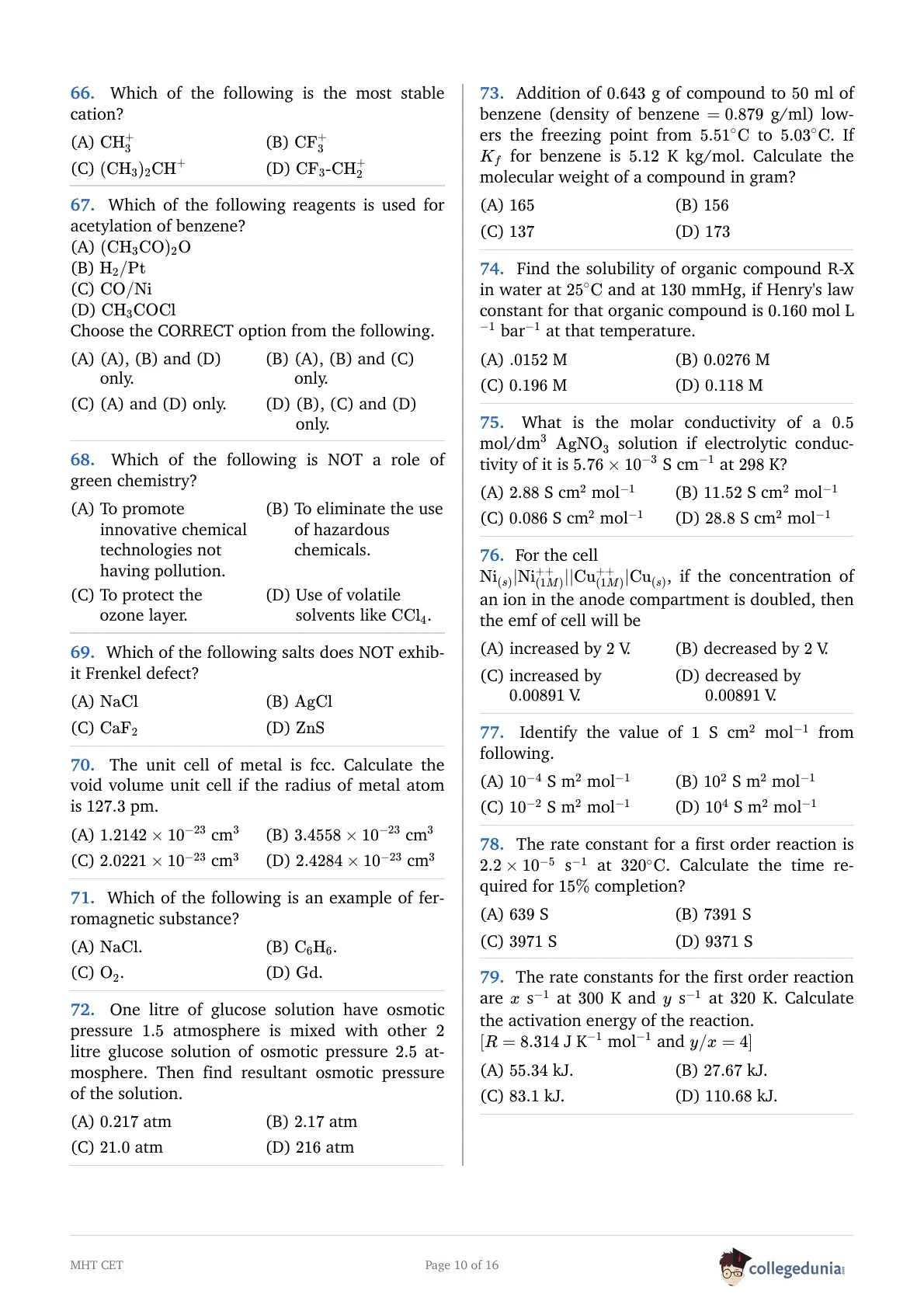
Which of the following is NOT a role of green chemistry?
Which of the following salts does NOT exhibit Frenkel defect?
The unit cell of metal is fcc. Calculate the void volume unit cell if the radius of metal atom is \(127.3\) pm.
Which of the following is an example of ferromagnetic substance?
One litre of glucose solution have osmotic pressure \(1.5\) atmosphere is mixed with other \(2\) litre glucose solution of osmotic pressure \(2.5\) atmosphere. Then find resultant osmotic pressure of the solution.
Addition of \(0.643\) g of compound to \(50\) ml of benzene (density of benzene \(=0.879\) g/ml) lowers the freezing point from \(5.51^{\circ }\text{C}\) to \(5.03^{\circ }\text{C}\). If \(K_{f}\) for benzene is \(5.12\) K kg/mol. Calculate the molecular weight of a compound in gram?
Find the solubility of organic compound R-X in water at \(25^{\circ }\text{C}\) and at \(130\) mmHg, if Henry's law constant for that organic compound is \(0.160\) mol L\({}^{-1}\) bar\({}^{-1}\) at that temperature.
What is the molar conductivity of a \(0.5\) mol/dm\({}^{3}\) \(\text{AgNO}_{3}\) solution if electrolytic conductivity of it is \(5.76\times 10^{-3}\) S cm\({}^{-1}\) at \(298\) K?
For the cell
\(\text{Ni}_{(s)}|\text{Ni}_{(1M)}^{++}||\text{Cu}_{(1M)}^{++}|\text{Cu}_{(s)}\), if the concentration of an ion in the anode compartment is doubled, then the emf of cell will be
Identify the value of \(1\) S cm\({}^{2}\) mol\({}^{-1}\) from following.
The rate constant for a first order reaction is \(2.2\times 10^{-5}\) s\({}^{-1}\) at \(320^{\circ }\text{C}\). Calculate the time required for \(15\%\) completion?
The rate constants for the first order reaction are \(x\) s\({}^{-1}\) at \(300\) K and \(y\) s\({}^{-1}\) at \(320\) K. Calculate the activation energy of the reaction.
\([R=8.314\) J K\({}^{-1}\) mol\({}^{-1}\) and \(y/x=4]\)
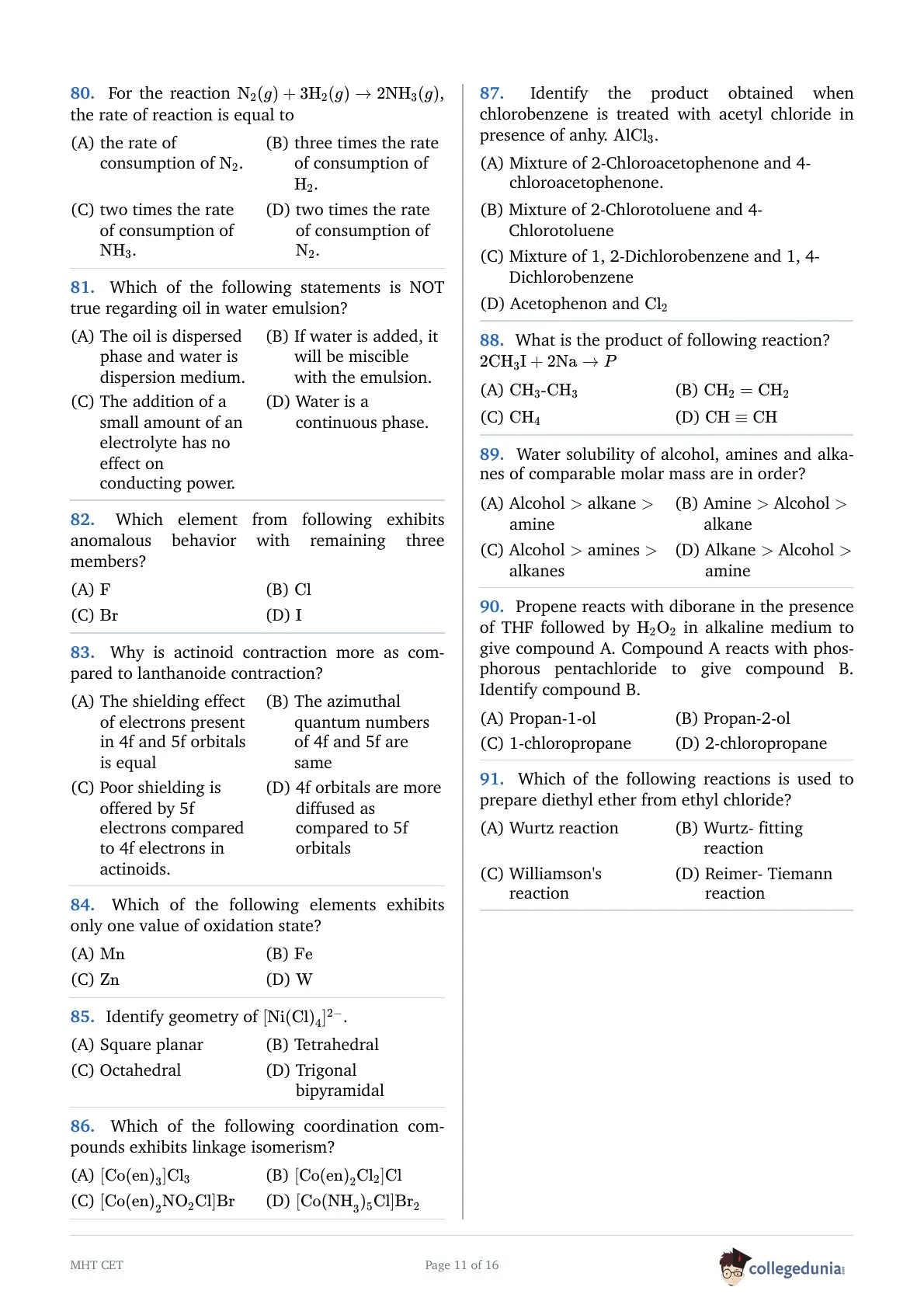
For the reaction \(\text{N}_{2}(g)+3\text{H}_{2}(g)\rightarrow 2\text{NH}_{3}(g)\), the rate of reaction is equal to
Which of the following statements is NOT true regarding oil in water emulsion?
Which element from following exhibits anomalous behavior with remaining three members?
Why is actinoid contraction more as compared to lanthanoide contraction?
Which of the following elements exhibits only one value of oxidation state?
Identify geometry of \([\text{Ni(Cl)}_{4}]^{2-}\).
Which of the following coordination compounds exhibits linkage isomerism?
Identify the product obtained when chlorobenzene is treated with acetyl chloride in presence of anhy. \(\text{AlCl}_{3}\).
What is the product of following reaction?
\(2\text{CH}_{3}\text{I}+2\text{Na}\rightarrow P\)
Water solubility of alcohol, amines and alkanes of comparable molar mass are in order?
Propene reacts with diborane in the presence of THF followed by \(\text{H}_{2}\text{O}_{2}\) in alkaline medium to give compound A. Compound A reacts with phosphorous pentachloride to give compound B. Identify compound B.
Which of the following reactions is used to prepare diethyl ether from ethyl chloride?
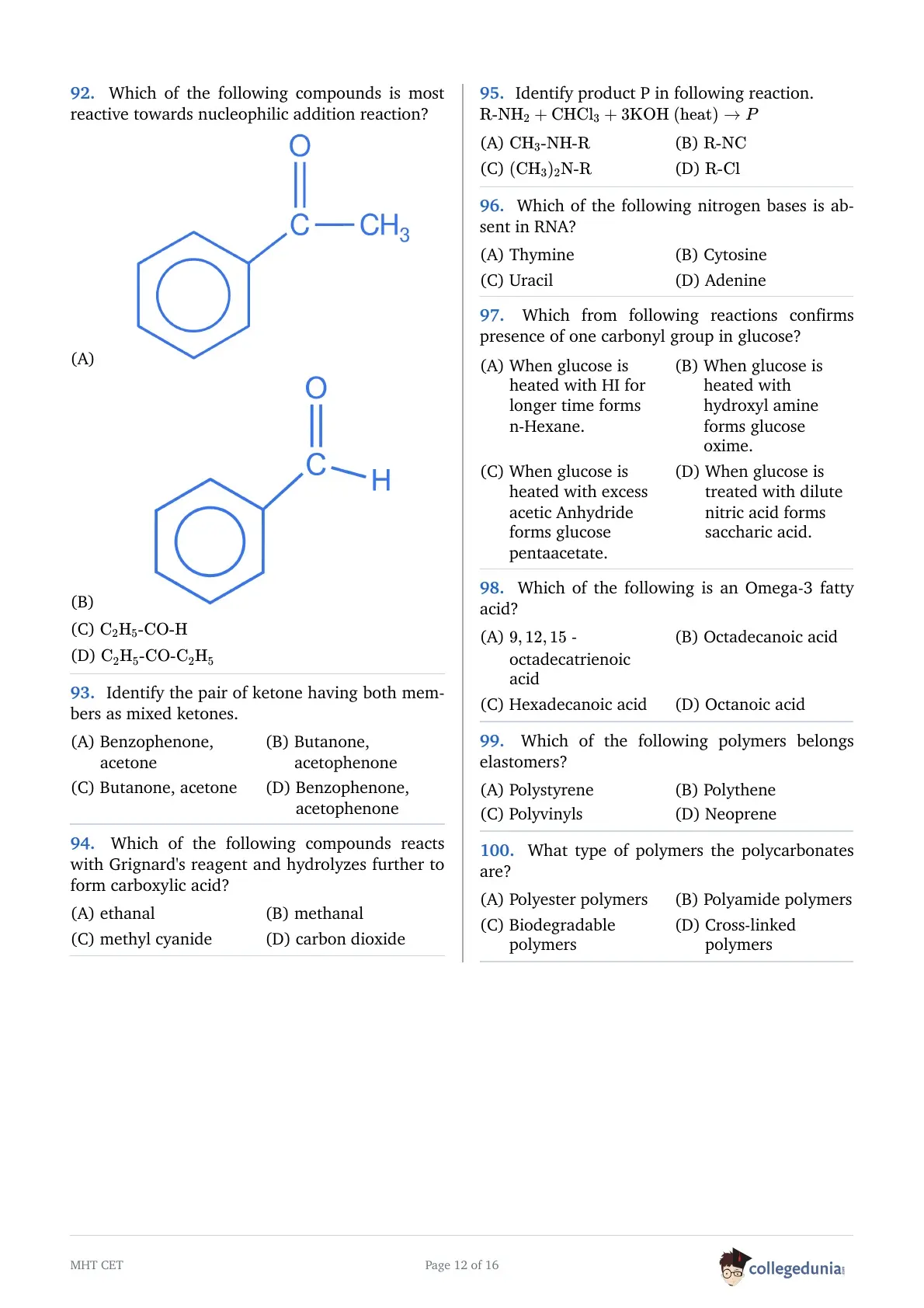
Which of the following compounds is most reactive towards nucleophilic addition reaction?
- (A)
![]()
- (B)
![]()
- (C) \(\text{C}_{2}\text{H}_{5}\text{-CO-H}\)
- (D) \(\text{C}_{2}\text{H}_{5}\text{-CO-C}_{2}\text{H}_{5}\)


Identify the pair of ketone having both members as mixed ketones.
Which of the following compounds reacts with Grignard's reagent and hydrolyzes further to form carboxylic acid?
Identify product P in following reaction.
\(\text{R-NH}_{2}+\text{CHCl}_{3}+3\text{KOH (heat)}\rightarrow P\)
Which of the following nitrogen bases is absent in RNA?
Which from following reactions confirms presence of one carbonyl group in glucose?
Which of the following is an Omega-3 fatty acid?
Which of the following polymers belongs elastomers?
What type of polymers the polycarbonates are?
Mathematics (Q101 - Q150)
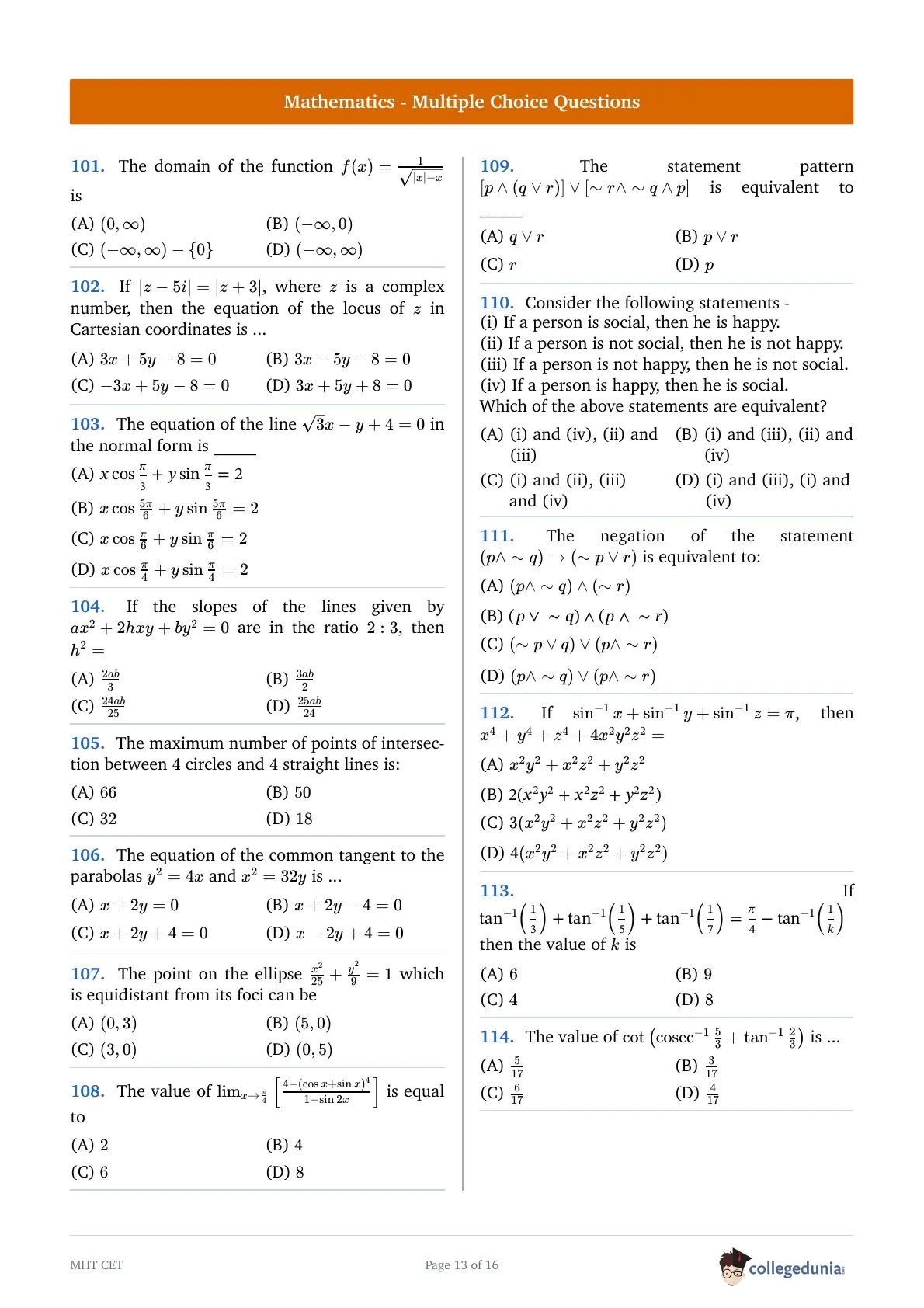
The domain of the function \(f(x)=\frac{1}{\sqrt{|x|-x}}\) is
If \(|z-5i|=|z+3|\), where \(z\) is a complex number, then the equation of the locus of \(z\) in Cartesian coordinates is ...
The equation of the line \(\sqrt{3}x-y+4=0\) in the normal form is _____
If the slopes of the lines given by \(ax^{2}+2hxy+by^{2}=0\) are in the ratio \(2:3\), then \(h^{2}=\)
The maximum number of points of intersection between \(4\) circles and \(4\) straight lines is:
The equation of the common tangent to the parabolas \(y^{2}=4x\) and \(x^{2}=32y\) is ...
The point on the ellipse \(\frac{x^{2}}{25}+\frac{y^{2}}{9}=1\) which is equidistant from its foci can be
The value of \(\lim _{x\rightarrow \frac{\pi }{4}}\left[\frac{4-(\cos x+\sin x)^{4}}{1-\sin 2x}\right]\) is equal to
The statement pattern \([p\wedge (q\vee r)]\vee [\sim r\wedge \sim q\wedge p]\) is equivalent to _____
Consider the following statements -
(i) If a person is social, then he is happy.
(ii) If a person is not social, then he is not happy.
(iii) If a person is not happy, then he is not social.
(iv) If a person is happy, then he is social.
Which of the above statements are equivalent?
The negation of the statement \((p\wedge \sim q)\rightarrow (\sim p\vee r)\) is equivalent to:
If \(\sin ^{-1}x+\sin ^{-1}y+\sin ^{-1}z=\pi\), then \(x^{4}+y^{4}+z^{4}+4x^{2}y^{2}z^{2}=\)
If \(\tan ^{-1}\left(\frac{1}{3}\right)+\tan ^{-1}\left(\frac{1}{5}\right)+\tan ^{-1}\left(\frac{1}{7}\right)=\frac{\pi }{4}-\tan ^{-1}\left(\frac{1}{k}\right)\) then the value of \(k\) is
The value of \(\cot \left(\operatorname{cosec}^{-1}\frac{5}{3}+\tan ^{-1}\frac{2}{3}\right)\) is ...
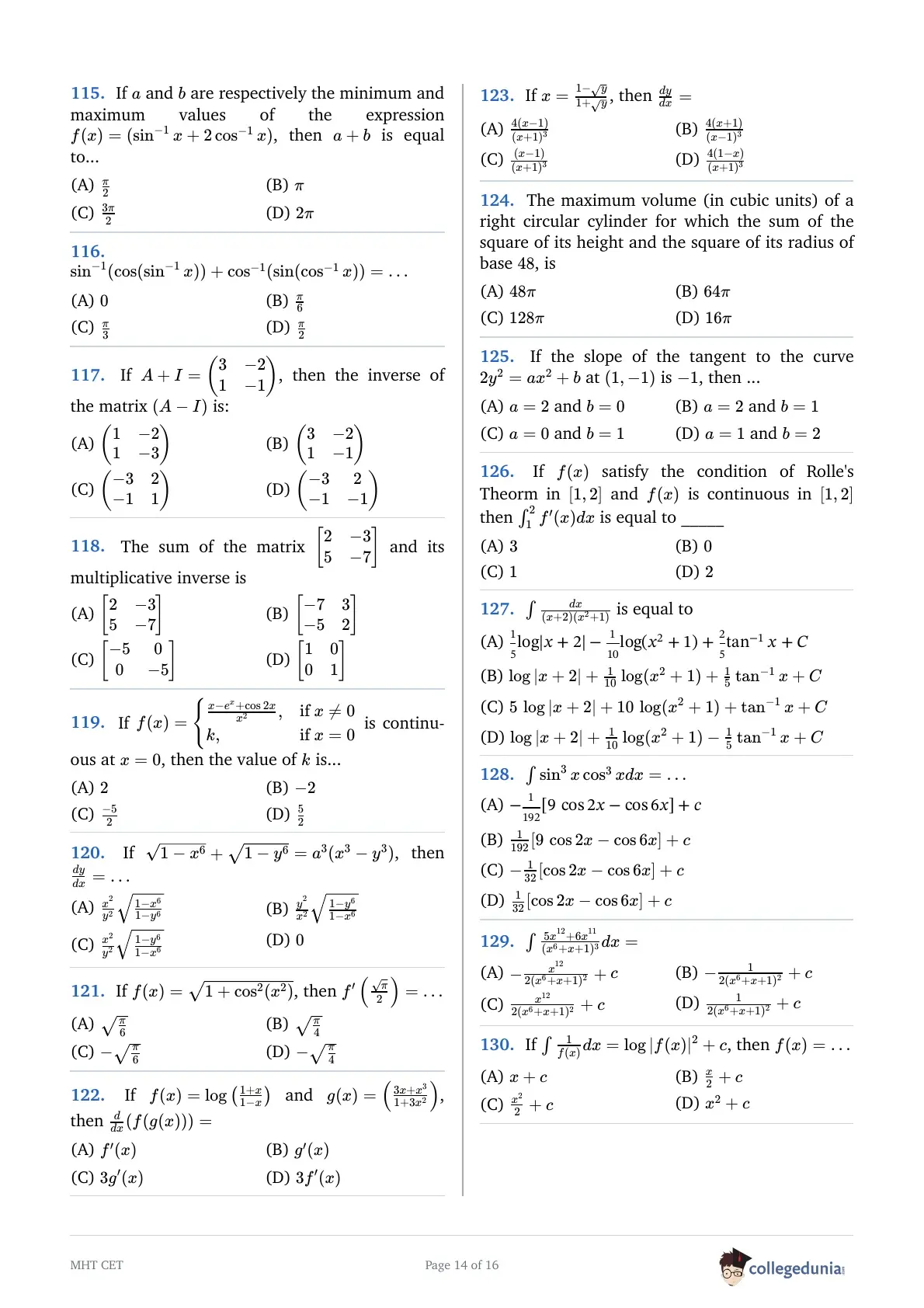
If \(a\) and \(b\) are respectively the minimum and maximum values of the expression \(f(x)=(\sin ^{-1}x+2\cos ^{-1}x)\), then \(a+b\) is equal to...
\(\sin ^{-1}(\cos (\sin ^{-1}x))+\cos ^{-1}(\sin (\cos ^{-1}x))=\ldots\)
If \(A+I=\begin{pmatrix} 3 & -2 \\ 1 & -1 \end{pmatrix}\), then the inverse of the matrix \((A-I)\) is:
The sum of the matrix \(\begin{bmatrix} 2 & -3 \\ 5 & -7 \end{bmatrix}\) and its multiplicative inverse is
If \(f(x)=\begin{cases} \frac{x-e^{x}+\cos 2x}{x^{2}}, & \text{if }x\neq 0 \\ k, & \text{if }x=0 \end{cases}\) is continuous at \(x=0\), then the value of \(k\) is...
If \(\sqrt{1-x^{6}}+\sqrt{1-y^{6}}=a^{3}(x^{3}-y^{3})\), then \(\frac{dy}{dx}=\ldots\)
If \(f(x)=\sqrt{1+\cos ^{2}(x^{2})}\), then \(f'\left(\frac{\sqrt{\pi }}{2}\right)=\ldots\)
If \(f(x)=\log \left(\frac{1+x}{1-x}\right)\) and \(g(x)=\left(\frac{3x+x^{3}}{1+3x^{2}}\right)\), then \(\frac{d}{dx}(f(g(x)))=\)
If \(x=\frac{1-\sqrt{y}}{1+\sqrt{y}}\), then \(\frac{dy}{dx}=\)
The maximum volume (in cubic units) of a right circular cylinder for which the sum of the square of its height and the square of its radius of base \(48\), is
If the slope of the tangent to the curve \(2y^{2}=ax^{2}+b\) at \((1,-1)\) is \(-1\), then ...
If \(f(x)\) satisfy the condition of Rolle's Theorm in \([1,2]\) and \(f(x)\) is continuous in \([1,2]\) then \(\int _{1}^{2}f'(x)dx\) is equal to _____
\(\int \frac{dx}{(x+2)(x^{2}+1)}\) is equal to
\(\int \sin ^{3}x\cos ^{3}xdx=\ldots\)
\(\int \frac{5x^{12}+6x^{11}}{(x^{6}+x+1)^{3}}dx=\)
If \(\int \frac{1}{f(x)}dx=\log |f(x)|^{2}+c\), then \(f(x)=\ldots\)
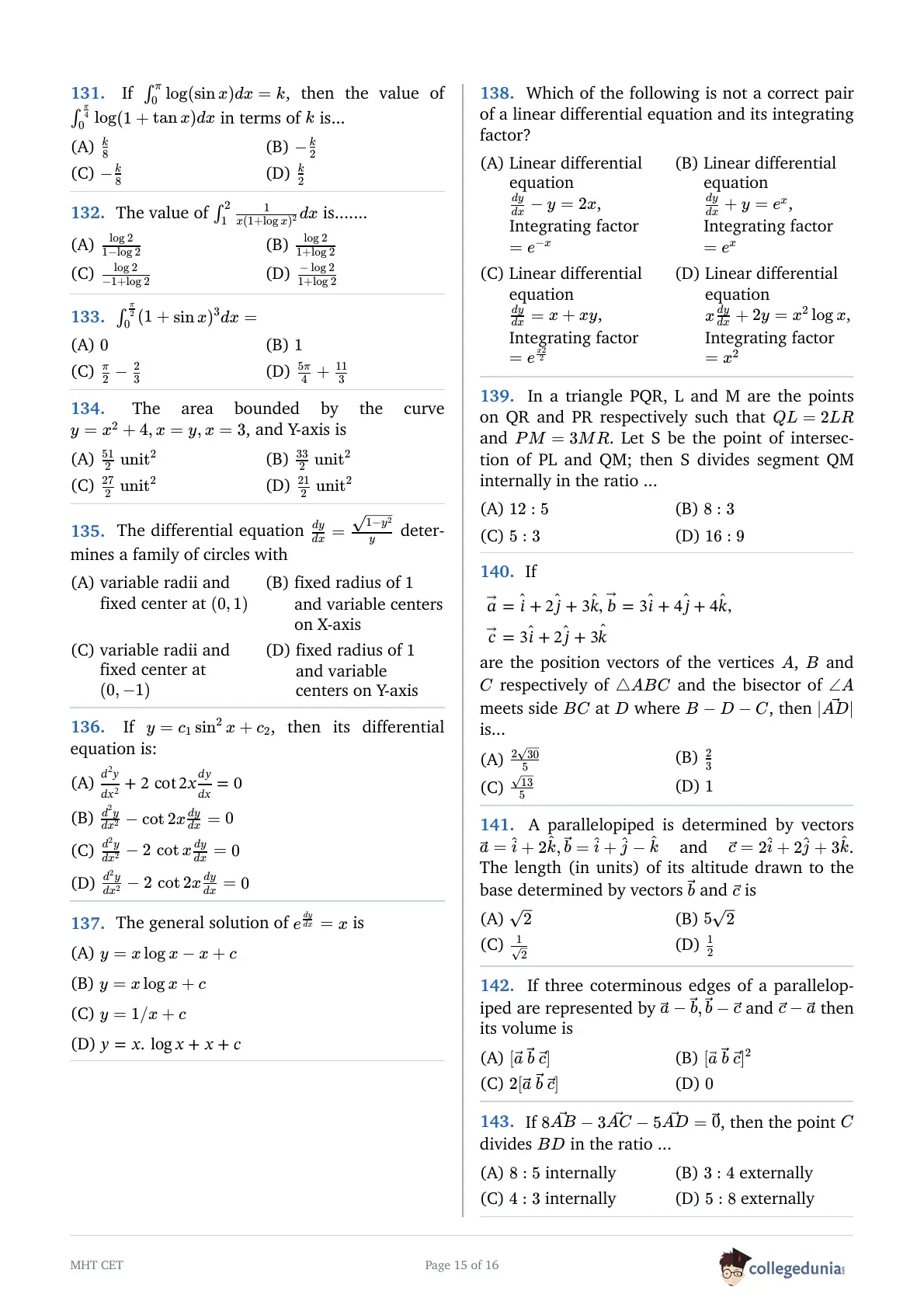
If \(\int _{0}^{\pi }\log (\sin x)dx=k\), then the value of \(\int _{0}^{\frac{\pi }{4}}\log (1+\tan x)dx\) in terms of \(k\) is...
The value of \(\int _{1}^{2}\frac{1}{x(1+\log x)^{2}}dx\) is.......
\(\int _{0}^{\frac{\pi }{2}}(1+\sin x)^{3}dx=\)
The area bounded by the curve \(y=x^{2}+4,x=y,x=3\), and Y-axis is
The differential equation \(\frac{dy}{dx}=\frac{\sqrt{1-y^{2}}}{y}\) determines a family of circles with
If \(y=c_{1}\sin ^{2}x+c_{2}\), then its differential equation is:
The general solution of \(e^{\frac{dy}{dx}}=x\) is
Which of the following is not a correct pair of a linear differential equation and its integrating factor?
In a triangle PQR, L and M are the points on QR and PR respectively such that \(QL=2LR\) and \(PM=3MR\). Let S be the point of intersection of PL and QM; then S divides segment QM internally in the ratio ...
If \(\vec{a}=\hat{i}+2\hat{j}+3\hat{k},\vec{b}=3\hat{i}+4\hat{j}+4\hat{k},\vec{c}=3\hat{i}+2\hat{j}+3\hat{k}\) are the position vectors of the vertices \(A\), \(B\) and \(C\) respectively of \(\triangle ABC\) and the bisector of \(\angle A\) meets side \(BC\) at \(D\) where \(B-D-C\), then \(|\vec{AD}|\) is...
A parallelopiped is determined by vectors \(\vec{a}=\hat{i}+2\hat{k},\vec{b}=\hat{i}+\hat{j}-\hat{k}\) and \(\vec{c}=2\hat{i}+2\hat{j}+3\hat{k}\). The length (in units) of its altitude drawn to the base determined by vectors \(\vec{b}\) and \(\vec{c}\) is
If three coterminous edges of a parallelopiped are represented by \(\vec{a}-\vec{b},\vec{b}-\vec{c}\) and \(\vec{c}-\vec{a}\) then its volume is
If \(8\vec{AB}-3\vec{AC}-5\vec{AD}=\vec{0}\), then the point \(C\) divides \(BD\) in the ratio ...
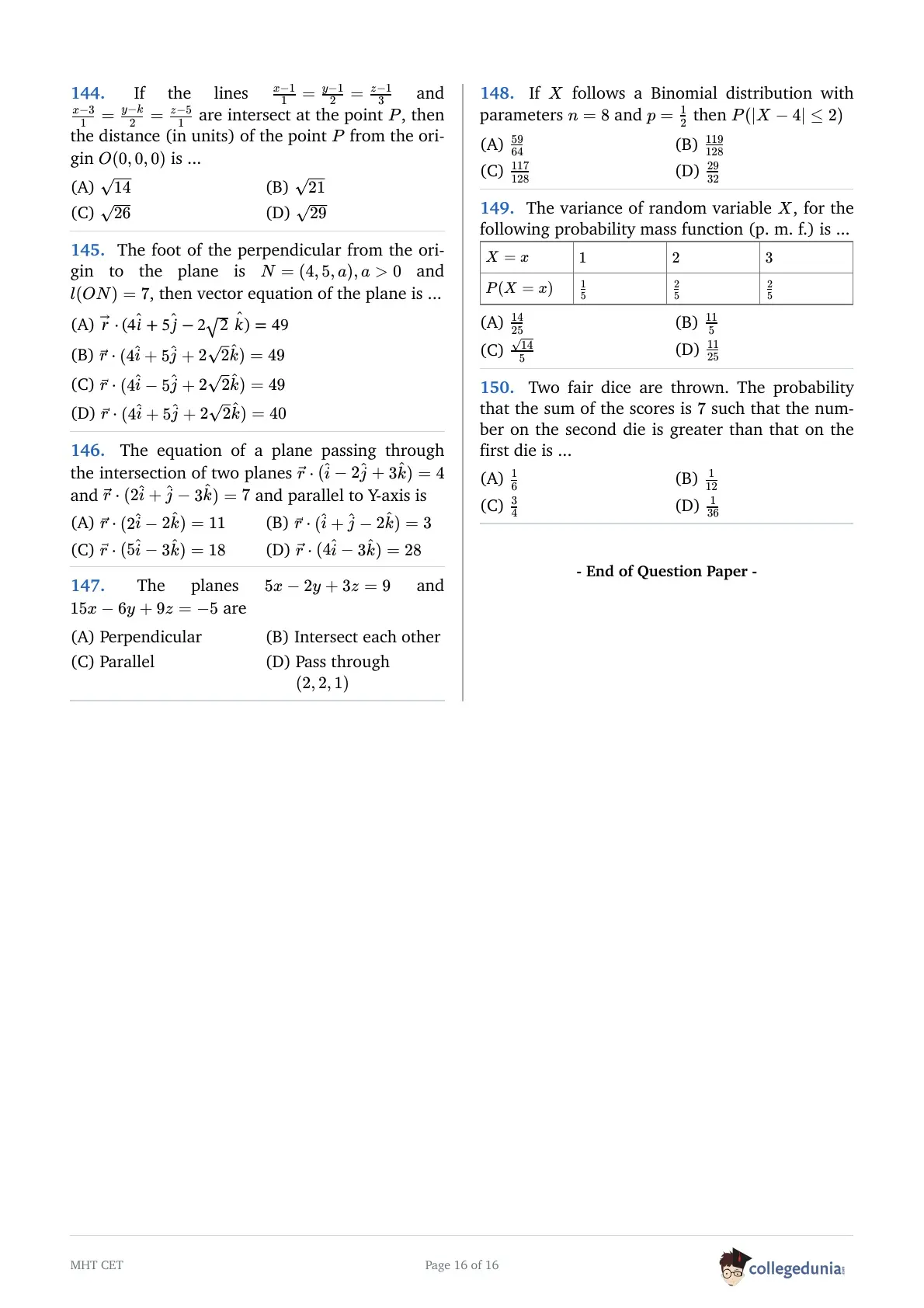
If the lines \(\frac{x-1}{1}=\frac{y-1}{2}=\frac{z-1}{3}\) and \(\frac{x-3}{1}=\frac{y-k}{2}=\frac{z-5}{1}\) are intersect at the point \(P\), then the distance (in units) of the point \(P\) from the origin \(O(0,0,0)\) is ...
The foot of the perpendicular from the origin to the plane is \(N=(4,5,a),a>0\) and \(l(ON)=7\), then vector equation of the plane is ...
The equation of a plane passing through the intersection of two planes \(\vec{r}\cdot (\hat{i}-2\hat{j}+3\hat{k})=4\) and \(\vec{r}\cdot (2\hat{i}+\hat{j}-3\hat{k})=7\) and parallel to Y-axis is
The planes \(5x-2y+3z=9\) and \(15x-6y+9z=-5\) are
If \(X\) follows a Binomial distribution with parameters \(n=8\) and \(p=\frac{1}{2}\) then \(P(|X-4|\leq 2)\)
The variance of random variable \(X\), for the following probability mass function (p. m. f.) is ...
| \(X=x\) | \(1\) | \(2\) | \(3\) |
| \(P(X=x)\) | \(\frac{1}{5}\) | \(\frac{2}{5}\) | \(\frac{2}{5}\) |
Two fair dice are thrown. The probability that the sum of the scores is \(7\) such that the number on the second die is greater than that on the first die is ...
MHT CET 2026 PCM Exam Pattern and Marking Scheme
| Parameter | Details |
|---|---|
| Conducting Body | Maharashtra Common Entrance Test Cell (Maharashtra CET Cell) |
| Exam Mode | Online (Computer-Based Test) |
| Duration | 180 minutes (3 hours) |
| Groups / Subjects | PCM (Physics, Chemistry, Mathematics) for Engineering |
| Total Questions |
150 |
| Total Marks | 200 |
| Question Type | Multiple Choice Questions (MCQs) |
| Marks Distribution |
|
| Negative Marking | No |
| Syllabus Weightage |
|



Comments