




MHT CET 2026 May 20 Shift 1 PCM Question Paper is available for download here. Maharashtra State CET Cell conducted MHT CET 2026 PCM Exam on May 20 in Shift 1 from 9 AM to 12 PM in CBT mode.
The MHT CET 2026 PCM question paper includes the following:
- The MHT CET 2026 PCM Question Paper consists of 150 multiple-choice questions (MCQs) totalling 200 marks divided into 3 sections: Physics, Chemistry, and Mathematics, with 50 questions in each subject.
- Physics and Chemistry questions carry 1 mark each while Mathematics questions carry 2 marks each.
- There is no negative marking for incorrect answers.
MHT CET 2026 May 20 Shift 1 PCM Question Paper with Solution PDF
| CD PDF | CD PDF with Solutions |
|---|---|
| Download Collegedunia PDF 0.93 MB | - |
Also Check:
MHT CET 2026 May 20 Shift 1 PCM Questions with Solutions
Physics (Q1 - Q50)
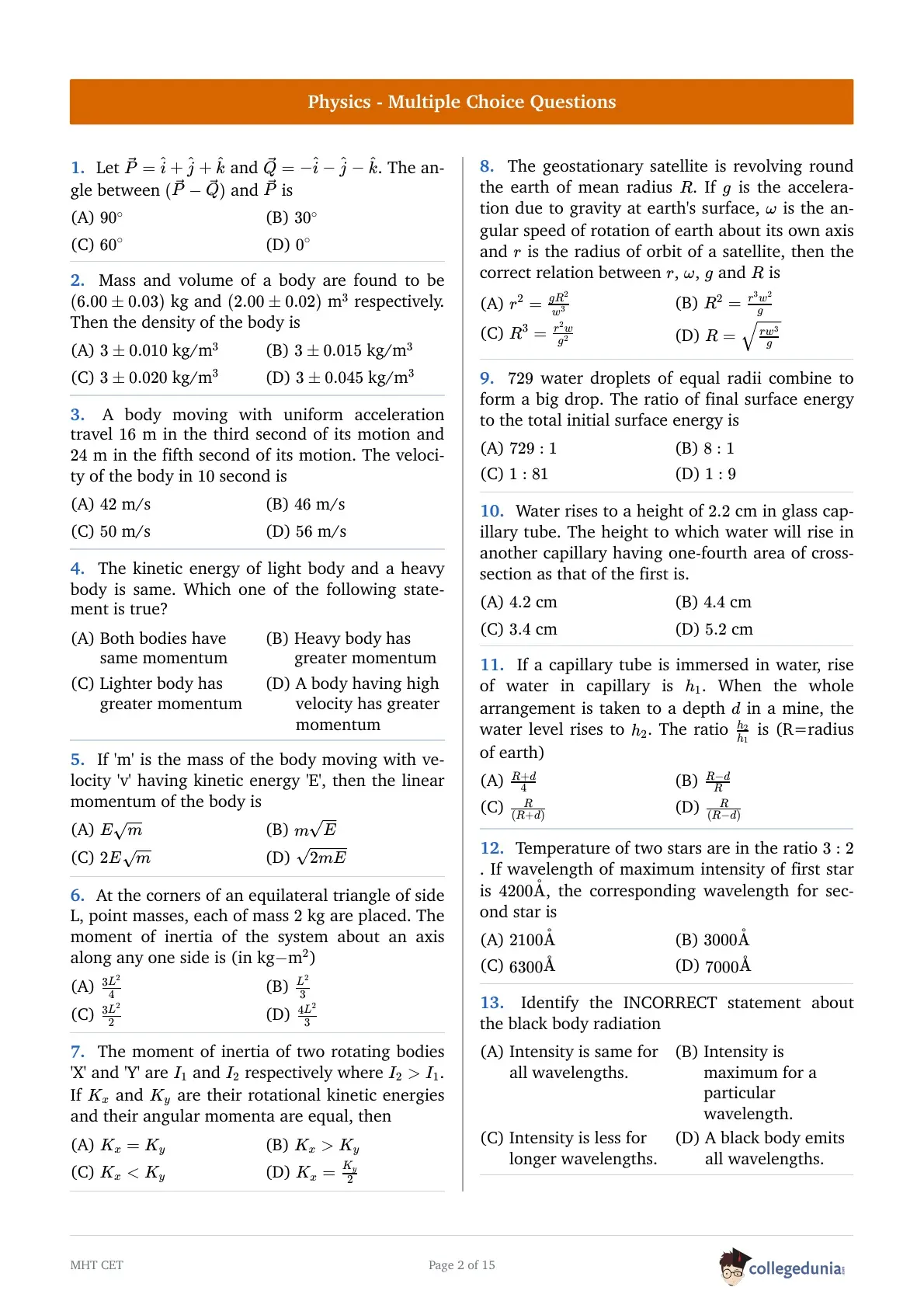
Let \(\vec{P}=\hat{i}+\hat{j}+\hat{k}\) and \(\vec{Q}=-\hat{i}-\hat{j}-\hat{k}\). The angle between \((\vec{P}-\vec{Q})\) and \(\vec{P}\) is
Mass and volume of a body are found to be \((6.00\pm 0.03)\) kg and \((2.00\pm 0.02)\) m\({}^{3}\) respectively. Then the density of the body is
A body moving with uniform acceleration travel \(16\) m in the third second of its motion and \(24\) m in the fifth second of its motion. The velocity of the body in \(10\) second is
The kinetic energy of light body and a heavy body is same. Which one of the following statement is true?
If 'm' is the mass of the body moving with velocity 'v' having kinetic energy 'E', then the linear momentum of the body is
At the corners of an equilateral triangle of side L, point masses, each of mass \(2\) kg are placed. The moment of inertia of the system about an axis along any one side is (in kg\(-\)m\({}^{2}\))
The moment of inertia of two rotating bodies 'X' and 'Y' are \(I_{1}\) and \(I_{2}\) respectively where \(I_{2}>I_{1}\). If \(K_{x}\) and \(K_{y}\) are their rotational kinetic energies and their angular momenta are equal, then
The geostationary satellite is revolving round the earth of mean radius \(R\). If \(g\) is the acceleration due to gravity at earth's surface, \(\omega\) is the angular speed of rotation of earth about its own axis and \(r\) is the radius of orbit of a satellite, then the correct relation between \(r\), \(\omega\), \(g\) and \(R\) is
\(729\) water droplets of equal radii combine to form a big drop. The ratio of final surface energy to the total initial surface energy is
Water rises to a height of \(2.2\) cm in glass capillary tube. The height to which water will rise in another capillary having one-fourth area of cross-section as that of the first is.
If a capillary tube is immersed in water, rise of water in capillary is \(h_{1}\). When the whole arrangement is taken to a depth \(d\) in a mine, the water level rises to \(h_{2}\). The ratio \(\frac{h_{2}}{h_{1}}\) is (R=radius of earth)
Temperature of two stars are in the ratio \(3:2\). If wavelength of maximum intensity of first star is \(4200\text{Å}\), the corresponding wavelength for second star is
Identify the INCORRECT statement about the black body radiation
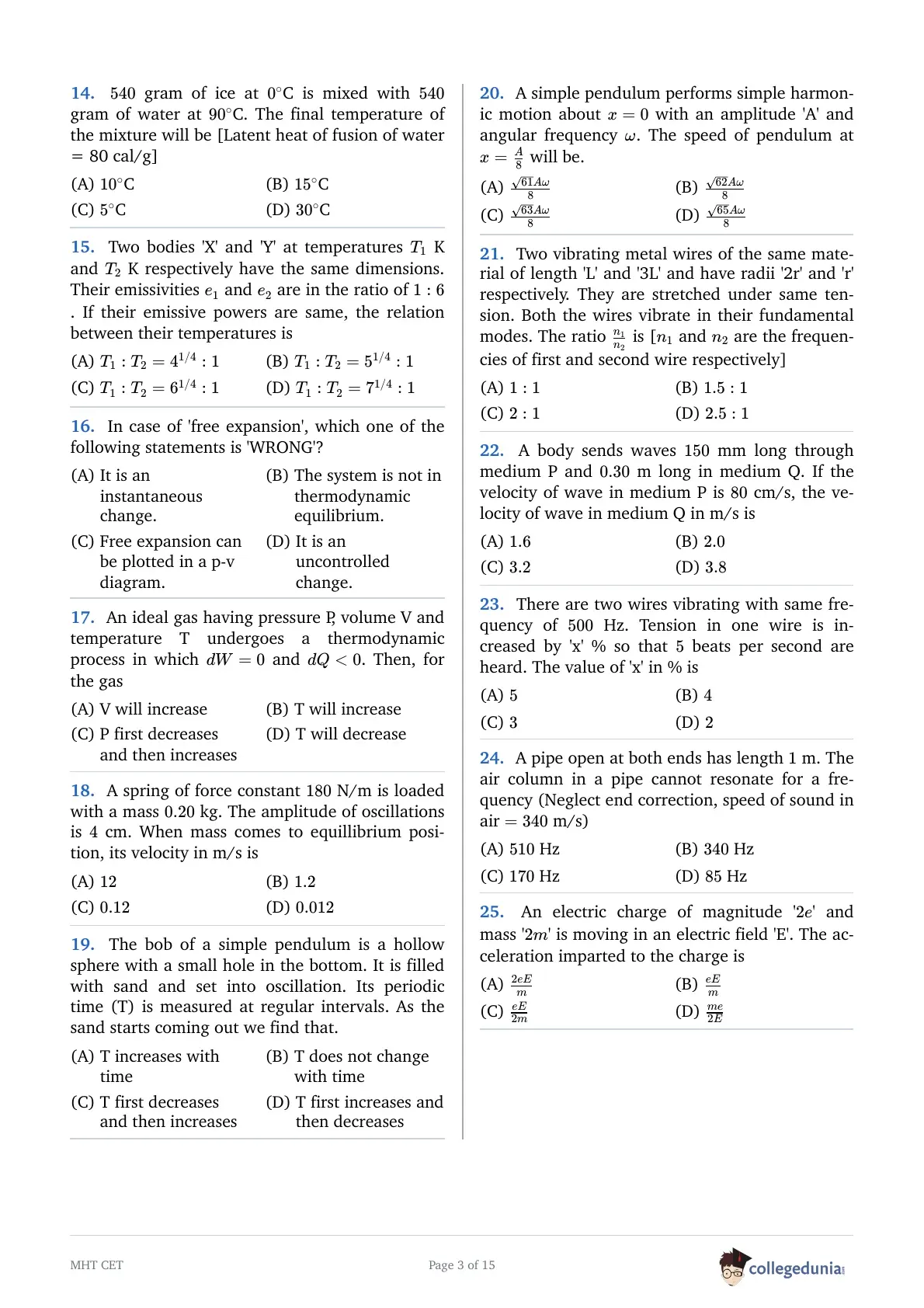
\(540\) gram of ice at \(0^{\circ }\)C is mixed with \(540\) gram of water at \(90^{\circ }\)C. The final temperature of the mixture will be [Latent heat of fusion of water = 80 cal/g]
Two bodies 'X' and 'Y' at temperatures \(T_{1}\) K and \(T_{2}\) K respectively have the same dimensions. Their emissivities \(e_{1}\) and \(e_{2}\) are in the ratio of \(1:6\). If their emissive powers are same, the relation between their temperatures is
In case of 'free expansion', which one of the following statements is 'WRONG'?
An ideal gas having pressure P, volume V and temperature T undergoes a thermodynamic process in which \(dW=0\) and \(dQ\lt 0\). Then, for the gas
A spring of force constant \(180\) N/m is loaded with a mass \(0.20\) kg. The amplitude of oscillations is \(4\) cm. When mass comes to equillibrium position, its velocity in m/s is
The bob of a simple pendulum is a hollow sphere with a small hole in the bottom. It is filled with sand and set into oscillation. Its periodic time (T) is measured at regular intervals. As the sand starts coming out we find that.
A simple pendulum performs simple harmonic motion about \(x=0\) with an amplitude 'A' and angular frequency \(\omega\). The speed of pendulum at \(x=\frac{A}{8}\) will be.
Two vibrating metal wires of the same material of length 'L' and '3L' and have radii '2r' and 'r' respectively. They are stretched under same tension. Both the wires vibrate in their fundamental modes. The ratio \(\frac{n_{1}}{n_{2}}\) is [\(n_{1}\) and \(n_{2}\) are the frequencies of first and second wire respectively]
A body sends waves \(150\) mm long through medium P and \(0.30\) m long in medium Q. If the velocity of wave in medium P is \(80\) cm/s, the velocity of wave in medium Q in m/s is
There are two wires vibrating with same frequency of \(500\) Hz. Tension in one wire is increased by 'x' % so that \(5\) beats per second are heard. The value of 'x' in % is
A pipe open at both ends has length \(1\) m. The air column in a pipe cannot resonate for a frequency (Neglect end correction, speed of sound in air \(=340\) m/s)
An electric charge of magnitude '\(2e\)' and mass '\(2m\)' is moving in an electric field 'E'. The acceleration imparted to the charge is
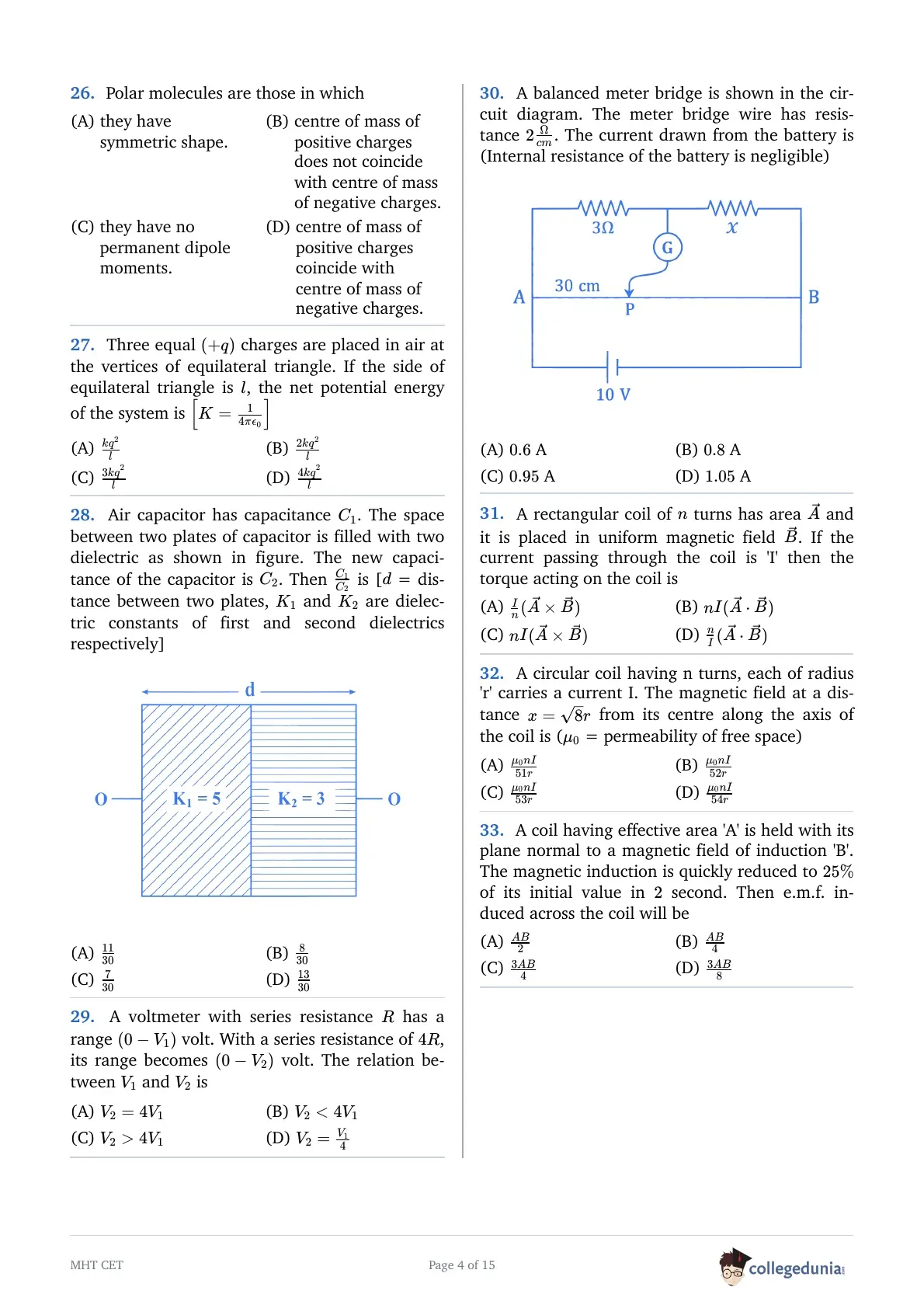
Polar molecules are those in which
Three equal \((+q)\) charges are placed in air at the vertices of equilateral triangle. If the side of equilateral triangle is \(l\), the net potential energy of the system is \(\left[K=\frac{1}{4\pi \epsilon _{0}}\right]\)
Air capacitor has capacitance \(C_{1}\). The space between two plates of capacitor is filled with two dielectric as shown in figure. The new capacitance of the capacitor is \(C_{2}\). Then \(\frac{C_{1}}{C_{2}}\) is [\(d\) = distance between two plates, \(K_{1}\) and \(K_{2}\) are dielectric constants of first and second dielectrics respectively]

A voltmeter with series resistance \(R\) has a range \((0-V_{1})\) volt. With a series resistance of \(4R\), its range becomes \((0-V_{2})\) volt. The relation between \(V_{1}\) and \(V_{2}\) is
A balanced meter bridge is shown in the circuit diagram. The meter bridge wire has resistance \(2\frac{\Omega }{cm}\). The current drawn from the battery is (Internal resistance of the battery is negligible)

A rectangular coil of \(n\) turns has area \(\vec{A}\) and it is placed in uniform magnetic field \(\vec{B}\). If the current passing through the coil is 'I' then the torque acting on the coil is
A circular coil having n turns, each of radius 'r' carries a current I. The magnetic field at a distance \(x=\sqrt{8}r\) from its centre along the axis of the coil is (\(\mu _{0}\) = permeability of free space)
A coil having effective area 'A' is held with its plane normal to a magnetic field of induction 'B'. The magnetic induction is quickly reduced to \(25\%\) of its initial value in \(2\) second. Then e.m.f. induced across the coil will be
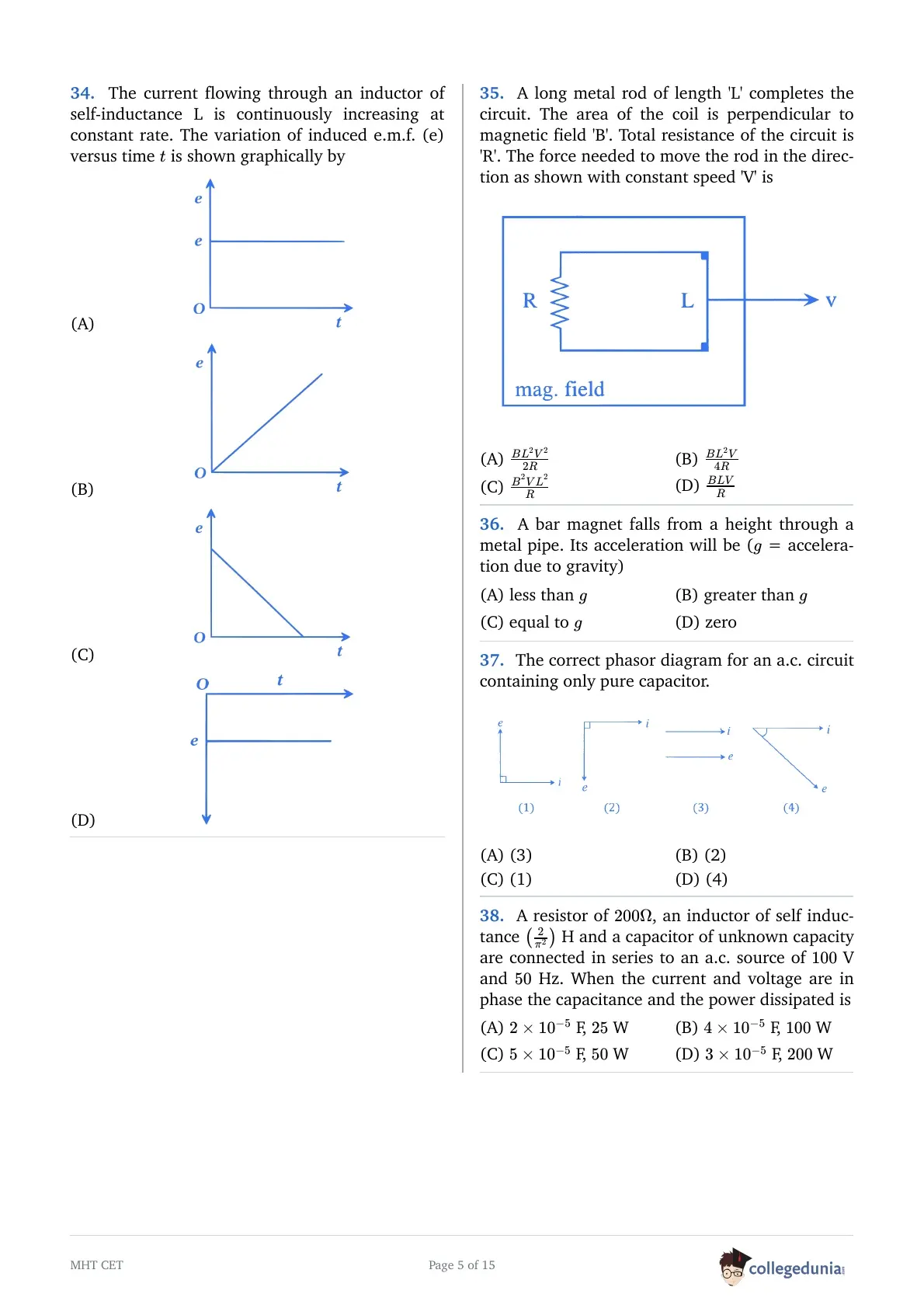
The current flowing through an inductor of self-inductance L is continuously increasing at constant rate. The variation of induced e.m.f. (e) versus time \(t\) is shown graphically by
- (A)
![]()
- (B)
![]()
- (C)
![]()
- (D)
![]()


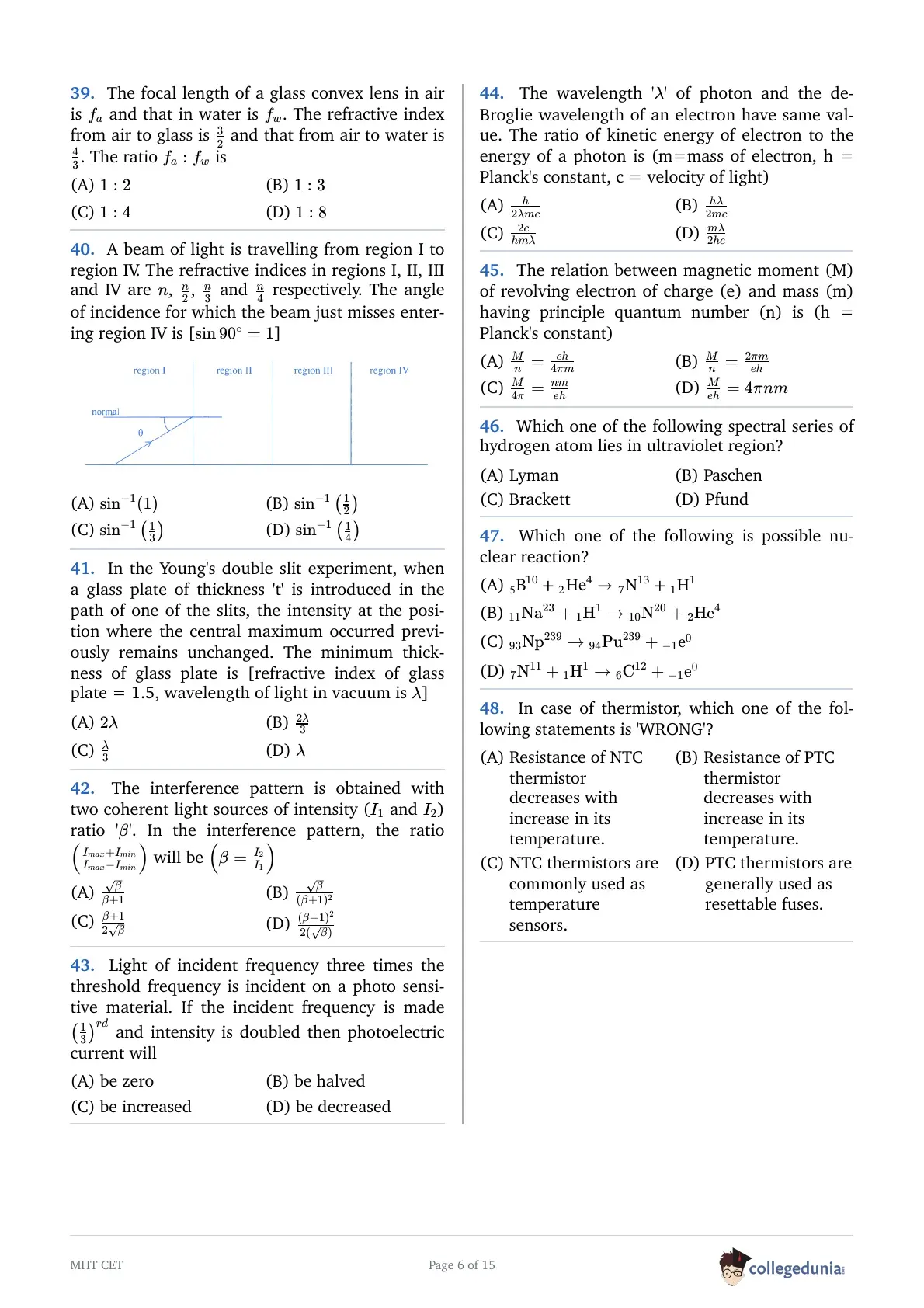
A long metal rod of length 'L' completes the circuit. The area of the coil is perpendicular to magnetic field 'B'. Total resistance of the circuit is 'R'. The force needed to move the rod in the direction as shown with constant speed 'V' is

A bar magnet falls from a height through a metal pipe. Its acceleration will be (\(g\) = acceleration due to gravity)
The correct phasor diagram for an a.c. circuit containing only pure capacitor.

A resistor of \(200\Omega\), an inductor of self inductance \(\left(\frac{2}{\pi ^{2}}\right)\) H and a capacitor of unknown capacity are connected in series to an a.c. source of \(100\) V and \(50\) Hz. When the current and voltage are in phase the capacitance and the power dissipated is
The focal length of a glass convex lens in air is \(f_{a}\) and that in water is \(f_{w}\). The refractive index from air to glass is \(\frac{3}{2}\) and that from air to water is \(\frac{4}{3}\). The ratio \(f_{a}:f_{w}\) is
A beam of light is travelling from region I to region IV. The refractive indices in regions I, II, III and IV are \(n\), \(\frac{n}{2}\), \(\frac{n}{3}\) and \(\frac{n}{4}\) respectively. The angle of incidence for which the beam just misses entering region IV is [\(\sin 90^{\circ }=1\)]

In the Young's double slit experiment, when a glass plate of thickness 't' is introduced in the path of one of the slits, the intensity at the position where the central maximum occurred previously remains unchanged. The minimum thickness of glass plate is [refractive index of glass plate = 1.5, wavelength of light in vacuum is \(\lambda\)]
The interference pattern is obtained with two coherent light sources of intensity (\(I_{1}\) and \(I_{2}\)) ratio '\(\beta\)'. In the interference pattern, the ratio \(\left(\frac{I_{max}+I_{min}}{I_{max}-I_{min}}\right)\) will be \(\left(\beta =\frac{I_{2}}{I_{1}}\right)\)
Light of incident frequency three times the threshold frequency is incident on a photo sensitive material. If the incident frequency is made \(\left(\frac{1}{3}\right)^{rd}\) and intensity is doubled then photoelectric current will
The wavelength '\(\lambda\)' of photon and the de-Broglie wavelength of an electron have same value. The ratio of kinetic energy of electron to the energy of a photon is (m=mass of electron, h = Planck's constant, c = velocity of light)
The relation between magnetic moment (M) of revolving electron of charge (e) and mass (m) having principle quantum number (n) is (h = Planck's constant)
Which one of the following spectral series of hydrogen atom lies in ultraviolet region?
Which one of the following is possible nuclear reaction?
In case of thermistor, which one of the following statements is 'WRONG'?
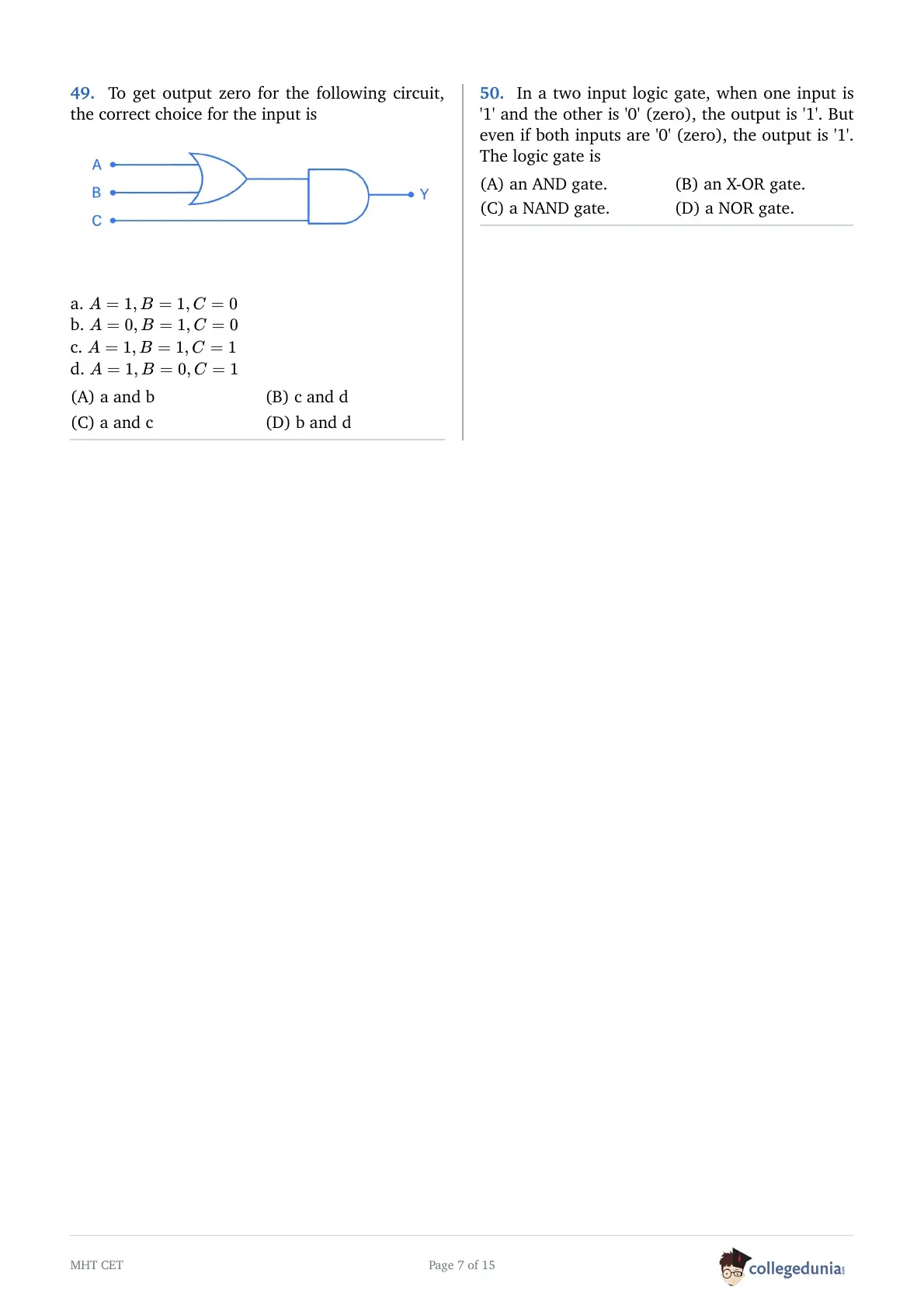
To get output zero for the following circuit, the correct choice for the input is

In a two input logic gate, when one input is '1' and the other is '0' (zero), the output is '1'. But even if both inputs are '0' (zero), the output is '1'. The logic gate is
Chemistry (Q51 - Q100)
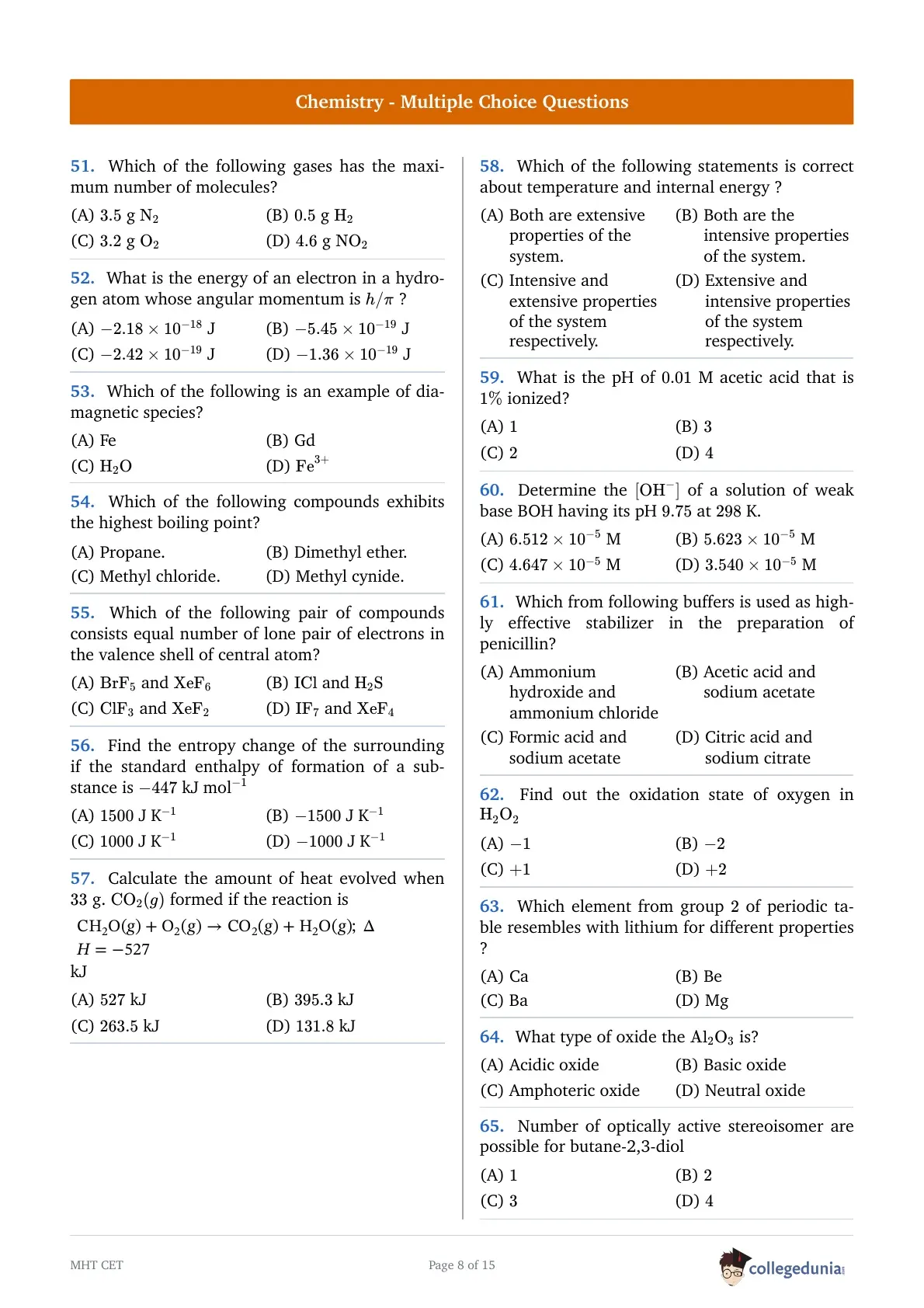
Which of the following gases has the maximum number of molecules?
What is the energy of an electron in a hydrogen atom whose angular momentum is \(h/\pi\) ?
Which of the following is an example of diamagnetic species?
Which of the following compounds exhibits the highest boiling point?
Which of the following pair of compounds consists equal number of lone pair of electrons in the valence shell of central atom?
Find the entropy change of the surrounding if the standard enthalpy of formation of a substance is \(-447\) kJ mol\({}^{-1}\)
Calculate the amount of heat evolved when \(33\) g. \(\text{CO}_{2}(g)\) formed if the reaction is
\(\text{CH}_{2}\text{O}(g)+\text{O}_{2}(g)\rightarrow \text{CO}_{2}(g)+\text{H}_{2}\text{O}(g);\ \Delta H=-527\) kJ
Which of the following statements is correct about temperature and internal energy ?
What is the pH of \(0.01\) M acetic acid that is \(1\%\) ionized?
Determine the \([\text{OH}^{-}]\) of a solution of weak base BOH having its pH \(9.75\) at \(298\) K.
Which from following buffers is used as highly effective stabilizer in the preparation of penicillin?
Find out the oxidation state of oxygen in \(\text{H}_{2}\text{O}_{2}\)
Which element from group \(2\) of periodic table resembles with lithium for different properties ?
What type of oxide the \(\text{Al}_{2}\text{O}_{3}\) is?
Number of optically active stereoisomer are possible for butane-2,3-diol
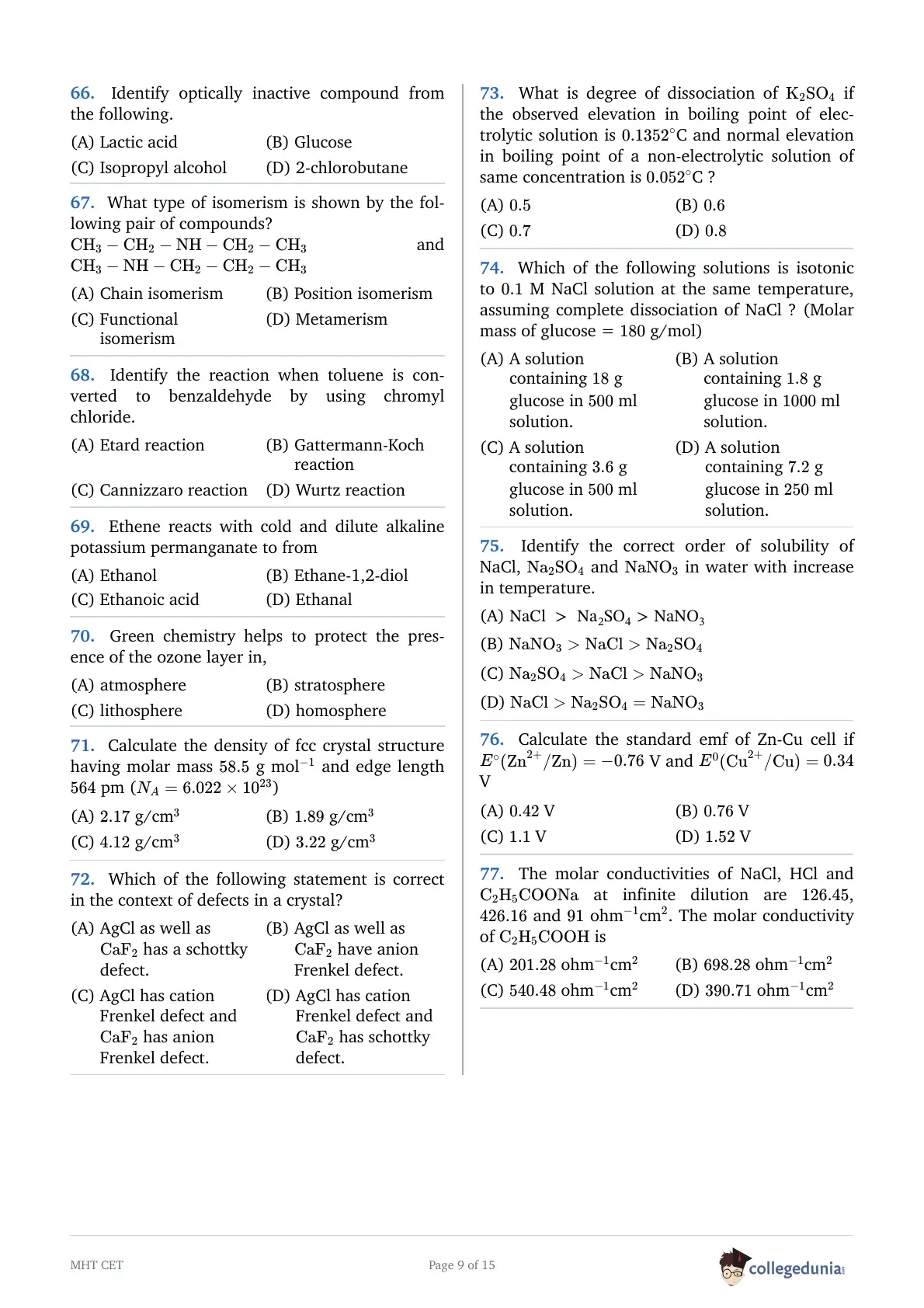
Identify optically inactive compound from the following.
What type of isomerism is shown by the following pair of compounds?
\(\text{CH}_{3}-\text{CH}_{2}-\text{NH}-\text{CH}_{2}-\text{CH}_{3}\) and \(\text{CH}_{3}-\text{NH}-\text{CH}_{2}-\text{CH}_{2}-\text{CH}_{3}\)
Identify the reaction when toluene is converted to benzaldehyde by using chromyl chloride.
Ethene reacts with cold and dilute alkaline potassium permanganate to from
Green chemistry helps to protect the presence of the ozone layer in,
Calculate the density of fcc crystal structure having molar mass \(58.5\) g mol\({}^{-1}\) and edge length \(564\) pm (\(N_{A}=6.022\times 10^{23}\))
Which of the following statement is correct in the context of defects in a crystal?
What is degree of dissociation of \(\text{K}_{2}\text{SO}_{4}\) if the observed elevation in boiling point of electrolytic solution is \(0.1352^{\circ }\)C and normal elevation in boiling point of a non-electrolytic solution of same concentration is \(0.052^{\circ }\)C ?
Which of the following solutions is isotonic to \(0.1\) M NaCl solution at the same temperature, assuming complete dissociation of NaCl ? (Molar mass of glucose = \(180\) g/mol)
Identify the correct order of solubility of NaCl, \(\text{Na}_{2}\text{SO}_{4}\) and \(\text{NaNO}_{3}\) in water with increase in temperature.
Calculate the standard emf of Zn-Cu cell if \(E^{\circ }(\text{Zn}^{2+}/\text{Zn})=-0.76\) V and \(E^{0}(\text{Cu}^{2+}/\text{Cu})=0.34\) V
The molar conductivities of NaCl, HCl and \(\text{C}_{2}\text{H}_{5}\text{COONa}\) at infinite dilution are \(126.45\), \(426.16\) and \(91\) ohm\({}^{-1}\)cm\({}^{2}\). The molar conductivity of \(\text{C}_{2}\text{H}_{5}\text{COOH}\) is
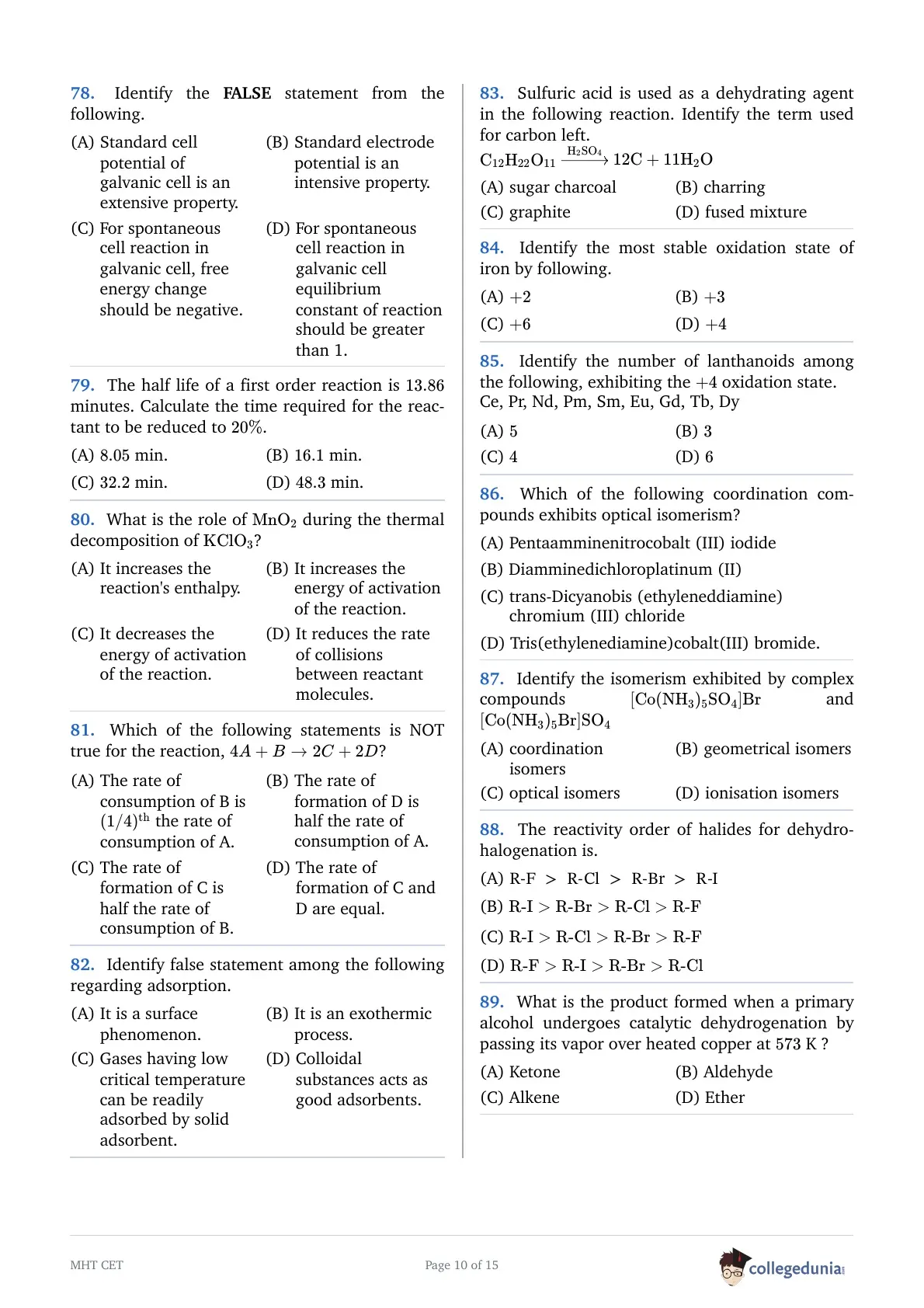
Identify the FALSE statement from the following.
The half life of a first order reaction is \(13.86\) minutes. Calculate the time required for the reactant to be reduced to \(20\%\).
What is the role of \(\text{MnO}_{2}\) during the thermal decomposition of \(\text{KClO}_{3}\)?
Which of the following statements is NOT true for the reaction, \(4A+B\rightarrow 2C+2D\)?
Identify false statement among the following regarding adsorption.
Sulfuric acid is used as a dehydrating agent in the following reaction. Identify the term used for carbon left.
\(\text{C}_{12}\text{H}_{22}\text{O}_{11}\xrightarrow{\text{H}_{2}\text{SO}_{4}}12\text{C}+11\text{H}_{2}\text{O}\)
Identify the most stable oxidation state of iron by following.
Identify the number of lanthanoids among the following, exhibiting the \(+4\) oxidation state.
Ce, Pr, Nd, Pm, Sm, Eu, Gd, Tb, Dy
Which of the following coordination compounds exhibits optical isomerism?
Identify the isomerism exhibited by complex compounds \([\text{Co}(\text{NH}_{3})_{5}\text{SO}_{4}]\text{Br}\) and \([\text{Co}(\text{NH}_{3})_{5}\text{Br}]\text{SO}_{4}\)
The reactivity order of halides for dehydrohalogenation is.
What is the product formed when a primary alcohol undergoes catalytic dehydrogenation by passing its vapor over heated copper at \(573\) K ?
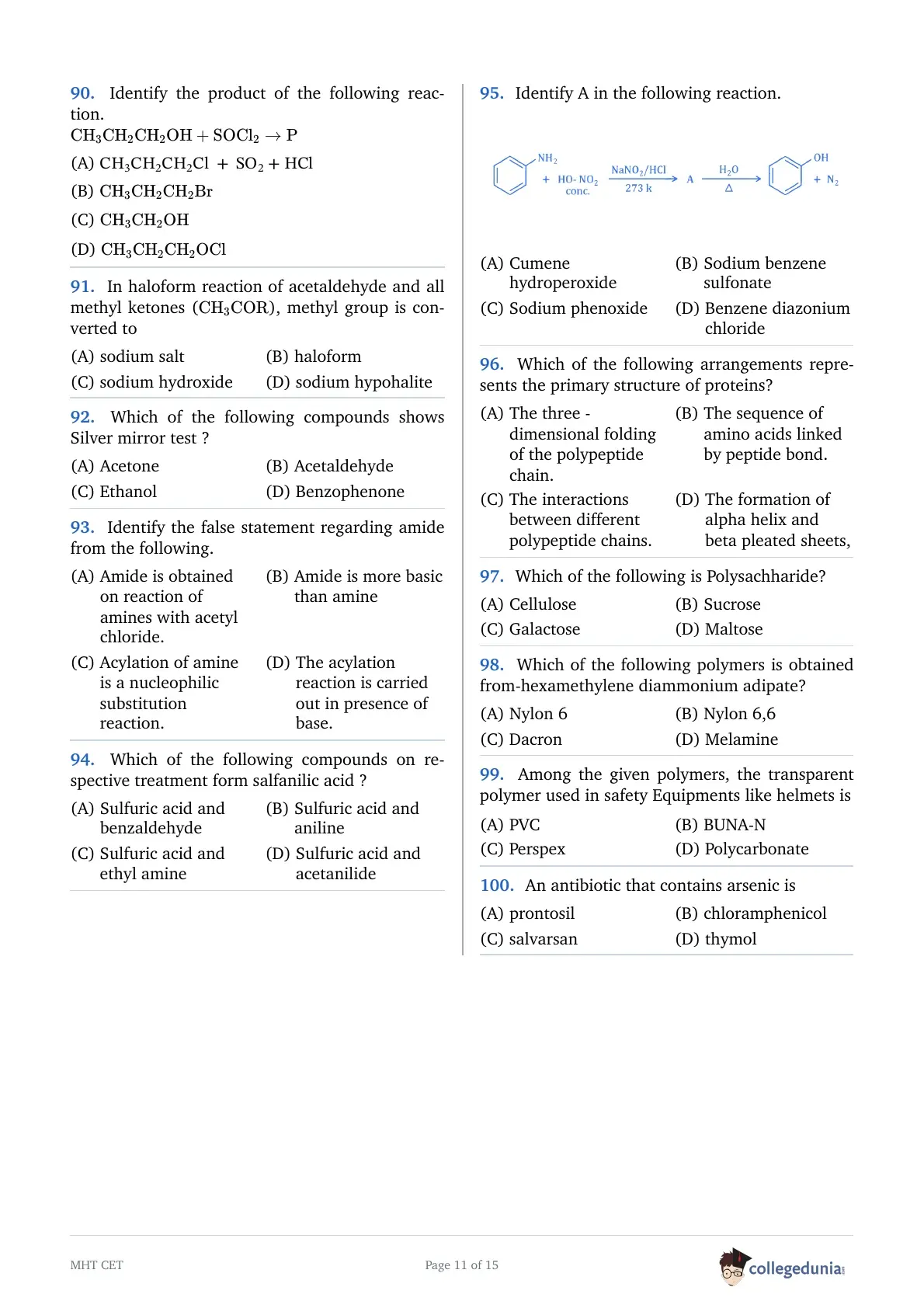
Identify the product of the following reaction.
\(\text{CH}_{3}\text{CH}_{2}\text{CH}_{2}\text{OH}+\text{SOCl}_{2}\rightarrow \text{P}\)
In haloform reaction of acetaldehyde and all methyl ketones (\(\text{CH}_{3}\text{COR}\)), methyl group is converted to
Which of the following compounds shows Silver mirror test ?
Identify the false statement regarding amide from the following.
Which of the following compounds on respective treatment form salfanilic acid ?

Which of the following arrangements represents the primary structure of proteins?
Which of the following is Polysachharide?
Which of the following polymers is obtained from-hexamethylene diammonium adipate?
Among the given polymers, the transparent polymer used in safety Equipments like helmets is
An antibiotic that contains arsenic is
Mathematics (Q101 - Q150)
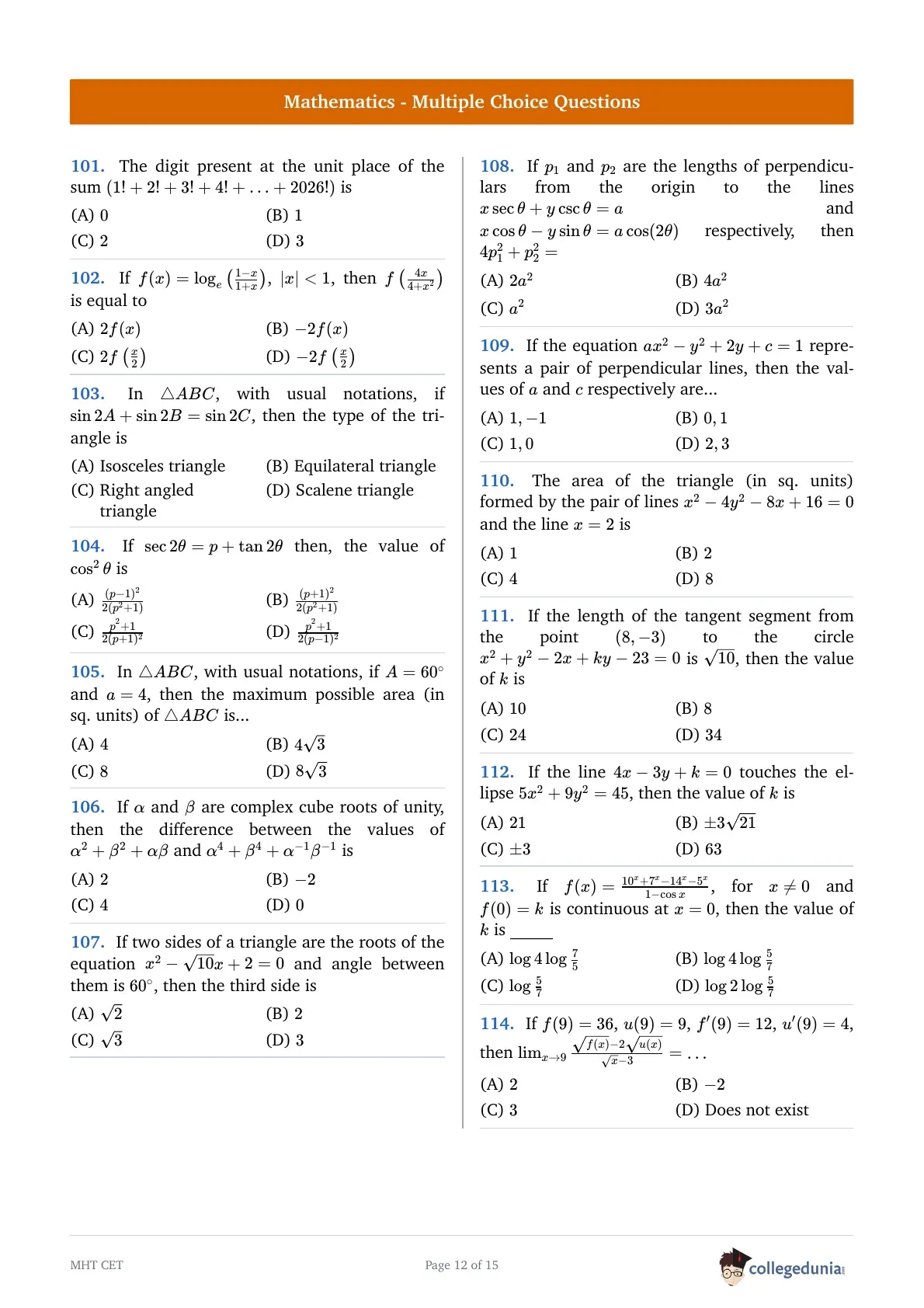
The digit present at the unit place of the sum \((1!+2!+3!+4!+\ldots +2026!)\) is
If \(f(x)=\log _{e}\left(\frac{1-x}{1+x}\right)\), \(|x|\lt 1\), then \(f\left(\frac{4x}{4+x^{2}}\right)\) is equal to
In \(\triangle ABC\), with usual notations, if \(\sin 2A+\sin 2B=\sin 2C\), then the type of the triangle is
If \(\sec 2\theta =p+\tan 2\theta\) then, the value of \(\cos ^{2}\theta\) is
In \(\triangle ABC\), with usual notations, if \(A=60^{\circ }\) and \(a=4\), then the maximum possible area (in sq. units) of \(\triangle ABC\) is...
If \(\alpha\) and \(\beta\) are complex cube roots of unity, then the difference between the values of \(\alpha ^{2}+\beta ^{2}+\alpha \beta\) and \(\alpha ^{4}+\beta ^{4}+\alpha ^{-1}\beta ^{-1}\) is
If two sides of a triangle are the roots of the equation \(x^{2}-\sqrt{10}x+2=0\) and angle between them is \(60^{\circ }\), then the third side is
If \(p_{1}\) and \(p_{2}\) are the lengths of perpendiculars from the origin to the lines \(x\sec \theta +y\csc \theta =a\) and \(x\cos \theta -y\sin \theta =a\cos (2\theta )\) respectively, then \(4p_{1}^{2}+p_{2}^{2}=\)
If the equation \(ax^{2}-y^{2}+2y+c=1\) represents a pair of perpendicular lines, then the values of \(a\) and \(c\) respectively are...
The area of the triangle (in sq. units) formed by the pair of lines \(x^{2}-4y^{2}-8x+16=0\) and the line \(x=2\) is
If the length of the tangent segment from the point \((8,-3)\) to the circle \(x^{2}+y^{2}-2x+ky-23=0\) is \(\sqrt{10}\), then the value of \(k\) is
If the line \(4x-3y+k=0\) touches the ellipse \(5x^{2}+9y^{2}=45\), then the value of \(k\) is
If \(f(x)=\frac{10^{x}+7^{x}-14^{x}-5^{x}}{1-\cos x}\), for \(x\neq 0\) and \(f(0)=k\) is continuous at \(x=0\), then the value of \(k\) is _____
If \(f(9)=36\), \(u(9)=9\), \(f'(9)=12\), \(u'(9)=4\), then \(\lim _{x\rightarrow 9}\frac{\sqrt{f(x)}-2\sqrt{u(x)}}{\sqrt{x}-3}=\ldots\)
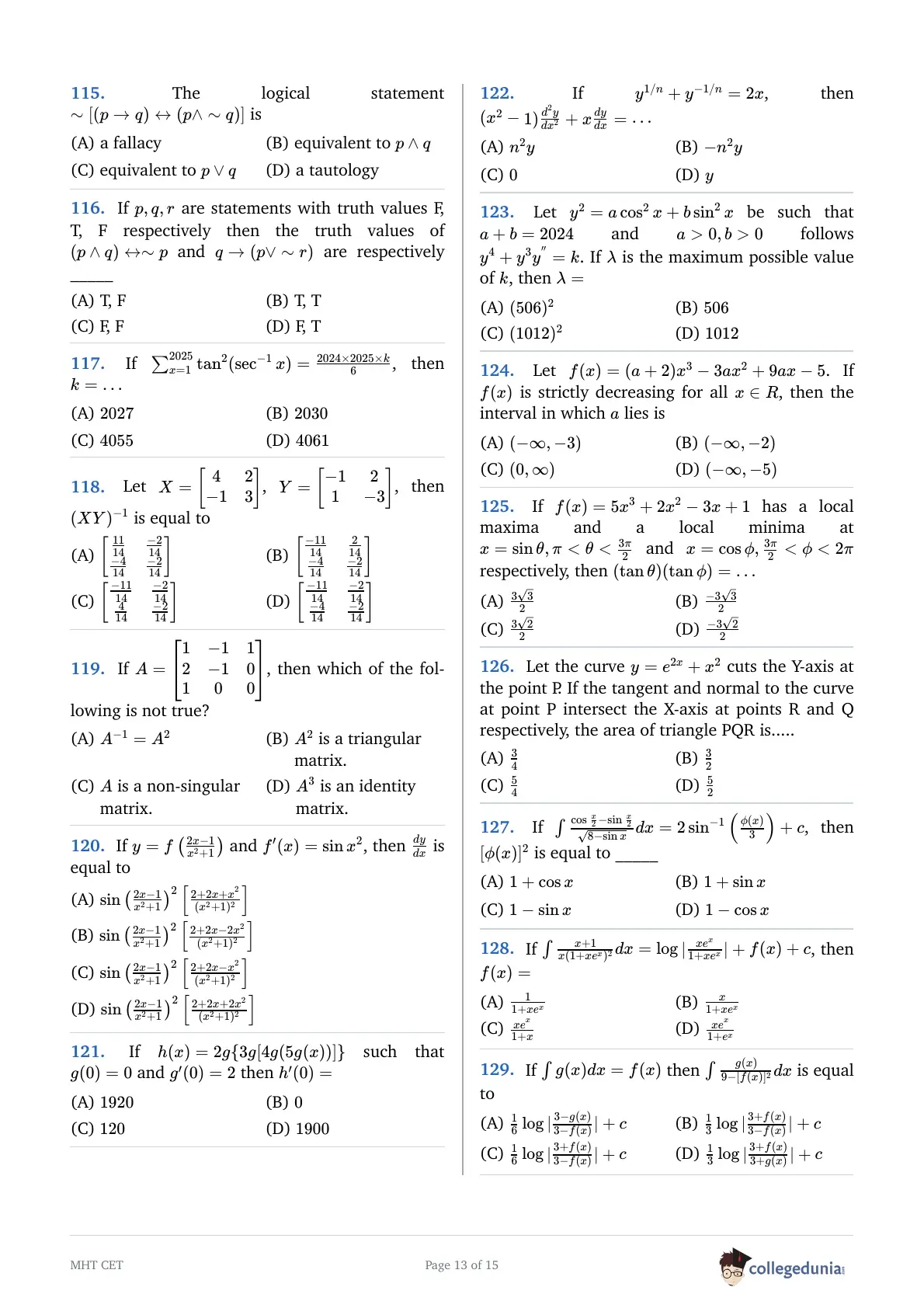
The logical statement \(\sim [(p\rightarrow q)\leftrightarrow (p\wedge \sim q)]\) is
If \(p,q,r\) are statements with truth values F, T, F respectively then the truth values of \((p\wedge q)\leftrightarrow \sim p\) and \(q\rightarrow (p\vee \sim r)\) are respectively _____
If \(\sum _{x=1}^{2025}\tan ^{2}(\sec ^{-1}x)=\frac{2024\times 2025\times k}{6}\), then \(k=\ldots\)
Let \(X=\begin{bmatrix} 4 & 2 \\ -1 & 3 \end{bmatrix}\), \(Y=\begin{bmatrix} -1 & 2 \\ 1 & -3 \end{bmatrix}\), then \((XY)^{-1}\) is equal to
If \(A=\begin{bmatrix} 1 & -1 & 1 \\ 2 & -1 & 0 \\ 1 & 0 & 0 \end{bmatrix}\), then which of the following is not true?
If \(y=f\left(\frac{2x-1}{x^{2}+1}\right)\) and \(f'(x)=\sin x^{2}\), then \(\frac{dy}{dx}\) is equal to
If \(h(x)=2g\{3g[4g(5g(x))]\}\) such that \(g(0)=0\) and \(g'(0)=2\) then \(h'(0)=\)
If \(y^{1/n}+y^{-1/n}=2x\), then \((x^{2}-1)\frac{d^{2}y}{dx^{2}}+x\frac{dy}{dx}=\ldots\)
Let \(y^{2}=a\cos ^{2}x+b\sin ^{2}x\) be such that \(a+b=2024\) and \(a>0,b>0\) follows \(y^{4}+y^{3}y^{''}=k\). If \(\lambda\) is the maximum possible value of \(k\), then \(\lambda =\)
Let \(f(x)=(a+2)x^{3}-3ax^{2}+9ax-5\). If \(f(x)\) is strictly decreasing for all \(x\in R\), then the interval in which \(a\) lies is
If \(f(x)=5x^{3}+2x^{2}-3x+1\) has a local maxima and a local minima at \(x=\sin \theta ,\pi \lt \theta \lt \frac{3\pi }{2}\) and \(x=\cos \phi ,\frac{3\pi }{2}\lt \phi \lt 2\pi\) respectively, then \((\tan \theta )(\tan \phi )=\ldots\)
Let the curve \(y=e^{2x}+x^{2}\) cuts the Y-axis at the point P. If the tangent and normal to the curve at point P intersect the X-axis at points R and Q respectively, the area of triangle PQR is.....
If \(\int \frac{\cos \frac{x}{2}-\sin \frac{x}{2}}{\sqrt{8-\sin x}}dx=2\sin ^{-1}\left(\frac{\phi (x)}{3}\right)+c\), then \([\phi (x)]^{2}\) is equal to _____
If \(\int \frac{x+1}{x(1+xe^{x})^{2}}dx=\log |\frac{xe^{x}}{1+xe^{x}}|+f(x)+c\), then \(f(x)=\)
If \(\int g(x)dx=f(x)\) then \(\int \frac{g(x)}{9-[f(x)]^{2}}dx\) is equal to
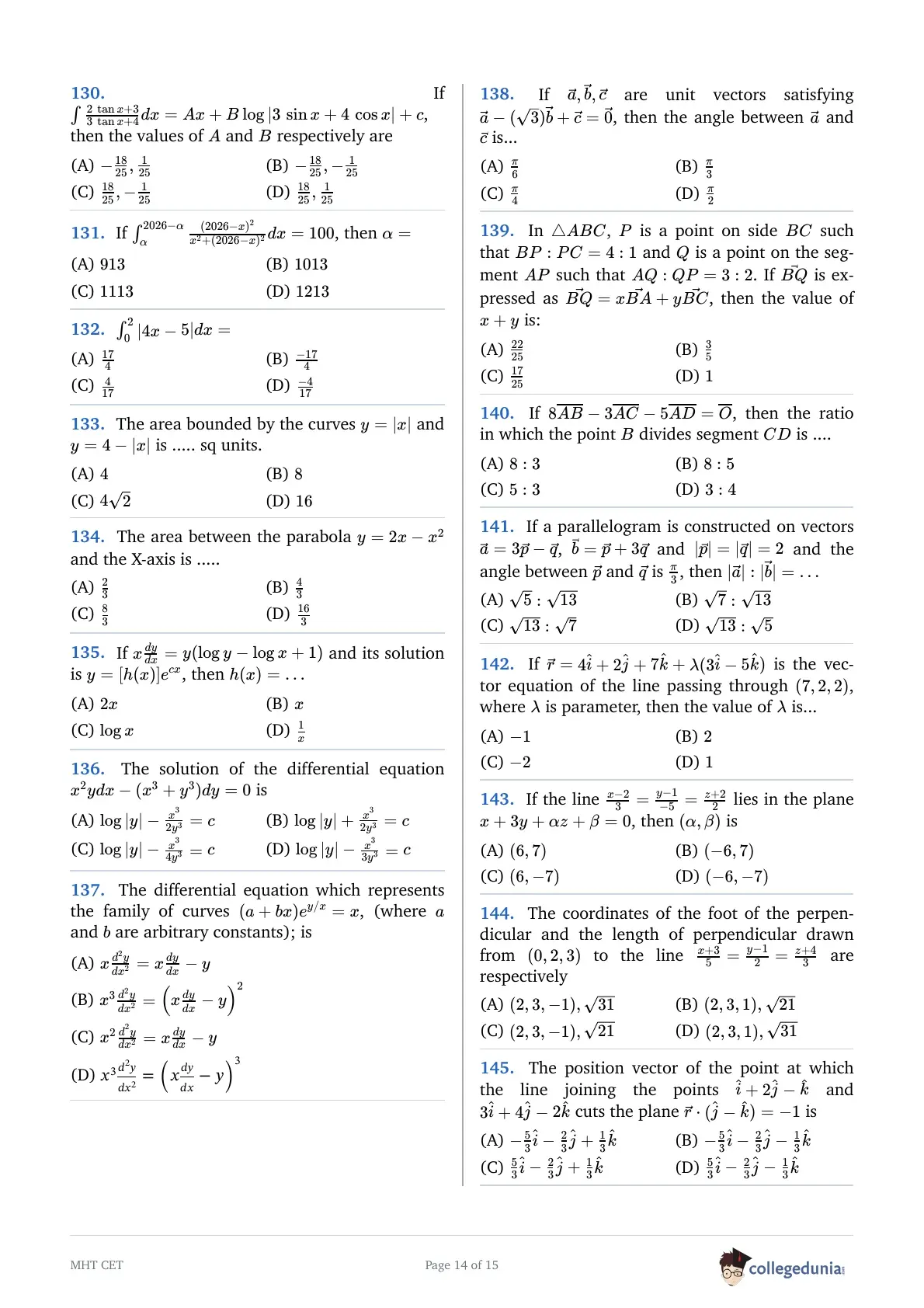
If \(\int \frac{2\,\tan x+3}{3\,\tan x+4}dx=Ax+B\log |3\,\sin x+4\,\cos x|+c\), then the values of \(A\) and \(B\) respectively are
If \(\int _{\alpha }^{2026-\alpha }\frac{(2026-x)^{2}}{x^{2}+(2026-x)^{2}}dx=100\), then \(\alpha =\)
\(\int _{0}^{2}|4x-5|dx=\)
The area bounded by the curves \(y=|x|\) and \(y=4-|x|\) is ..... sq units.
The area between the parabola \(y=2x-x^{2}\) and the X-axis is .....
If \(x\frac{dy}{dx}=y(\log y-\log x+1)\) and its solution is \(y=[h(x)]e^{cx}\), then \(h(x)=\ldots\)
The solution of the differential equation \(x^{2}ydx-(x^{3}+y^{3})dy=0\) is
The differential equation which represents the family of curves \((a+bx)e^{y/x}=x\), (where \(a\) and \(b\) are arbitrary constants); is
If \(\vec{a},\vec{b},\vec{c}\) are unit vectors satisfying \(\vec{a}-(\sqrt{3})\vec{b}+\vec{c}=\vec{0}\), then the angle between \(\vec{a}\) and \(\vec{c}\) is...
In \(\triangle ABC\), \(P\) is a point on side \(BC\) such that \(BP:PC=4:1\) and \(Q\) is a point on the segment \(AP\) such that \(AQ:QP=3:2\). If \(\vec{BQ}\) is expressed as \(\vec{BQ}=x\vec{BA}+y\vec{BC}\), then the value of \(x+y\) is:
If \(8\overline{AB}-3\overline{AC}-5\overline{AD}=\overline{O}\), then the ratio in which the point \(B\) divides segment \(CD\) is ....
If a parallelogram is constructed on vectors \(\vec{a}=3\vec{p}-\vec{q}\), \(\vec{b}=\vec{p}+3\vec{q}\) and \(|\vec{p}|=|\vec{q}|=2\) and the angle between \(\vec{p}\) and \(\vec{q}\) is \(\frac{\pi }{3}\), then \(|\vec{a}|:|\vec{b}|=\ldots\)
If \(\vec{r}=4\hat{i}+2\hat{j}+7\hat{k}+\lambda (3\hat{i}-5\hat{k})\) is the vector equation of the line passing through \((7,2,2)\), where \(\lambda\) is parameter, then the value of \(\lambda\) is...
If the line \(\frac{x-2}{3}=\frac{y-1}{-5}=\frac{z+2}{2}\) lies in the plane \(x+3y+\alpha z+\beta =0\), then \((\alpha ,\beta )\) is
The coordinates of the foot of the perpendicular and the length of perpendicular drawn from \((0,2,3)\) to the line \(\frac{x+3}{5}=\frac{y-1}{2}=\frac{z+4}{3}\) are respectively
The position vector of the point at which the line joining the points \(\hat{i}+2\hat{j}-\hat{k}\) and \(3\hat{i}+4\hat{j}-2\hat{k}\) cuts the plane \(\vec{r}\cdot (\hat{j}-\hat{k})=-1\) is
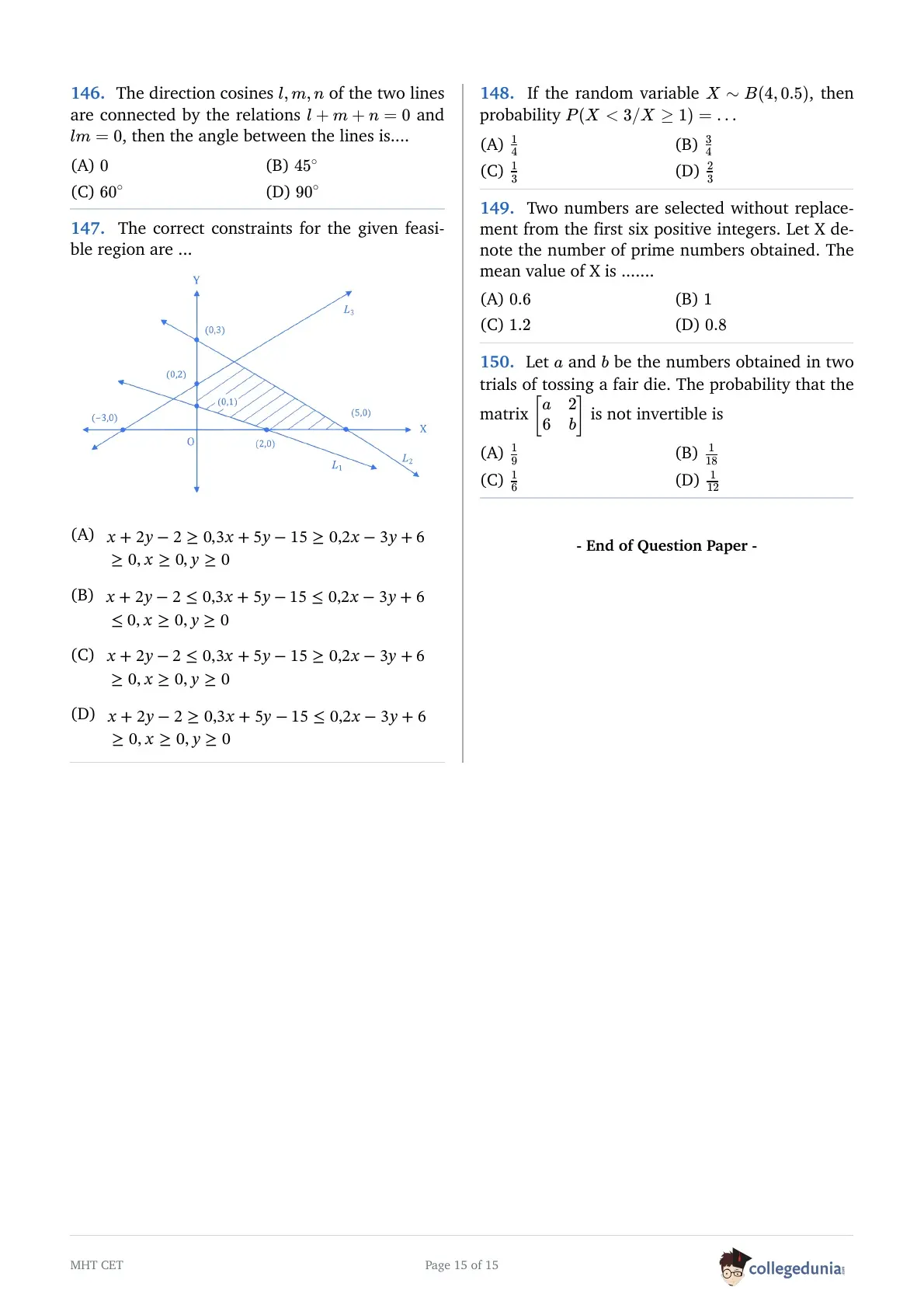
The direction cosines \(l,m,n\) of the two lines are connected by the relations \(l+m+n=0\) and \(lm=0\), then the angle between the lines is....

If the random variable \(X\sim B(4,0.5)\), then probability \(P(X\lt 3/X\geq 1)=\ldots\)
Two numbers are selected without replacement from the first six positive integers. Let X denote the number of prime numbers obtained. The mean value of X is .......
Let \(a\) and \(b\) be the numbers obtained in two trials of tossing a fair die. The probability that the matrix \(\begin{bmatrix} a & 2 \\ 6 & b \end{bmatrix}\) is not invertible is
MHT CET 2026 PCM Exam Pattern and Marking Scheme
| Parameter | Details |
|---|---|
| Conducting Body | Maharashtra Common Entrance Test Cell (Maharashtra CET Cell) |
| Exam Mode | Online (Computer-Based Test) |
| Duration | 180 minutes (3 hours) |
| Groups / Subjects | PCM (Physics, Chemistry, Mathematics) for Engineering |
| Total Questions |
150 |
| Total Marks | 200 |
| Question Type | Multiple Choice Questions (MCQs) |
| Marks Distribution |
|
| Negative Marking | No |
| Syllabus Weightage |
|



Comments