



Education Content Expert
Amorphous Solid is a type of solid in which the particles do not possess a regular three-dimensional arrangement.
- They have a more random arrangement of molecules.
- Amorphous solids exhibit short-range order over a few molecular dimensions.
- Amorphous solids do not have a distinct melting point, and they can become liquids at various temperatures.
- They typically display isotropic physical properties, which do not change depending on the direction of measurement and have the same magnitude in all directions.
- Because of their rather random arrangement of molecules, amorphous solids are sometimes referred to as supercooled liquids.
| Table of Content |
Key Terms: Amorphous Solid, Molecules, Crystalline Solids, Temperature, Solids, Polymers, Isotropic Amorphous Solids, Melting point, Boiling point, Plastics, Liquid, Crystals
What is Amorphous Solid?
[Click Here for Sample Questions]
Amorphous Solids, also known as non-crystalline solids, are solids that lack the long-range order that characterises crystals.
- Amorphous solids particles are arranged in short-range order and follow a regular pattern across short distances.
- They have different melting points, and they are not consistently structured.
- They turn into crystalline solids at a given temperature.
- The terms "glass" and "glassy solid" are occasionally used interchangeably with amorphous solid.
- Glasses, metallic glasses, and some types of plastics and polymers are examples of amorphous solids.
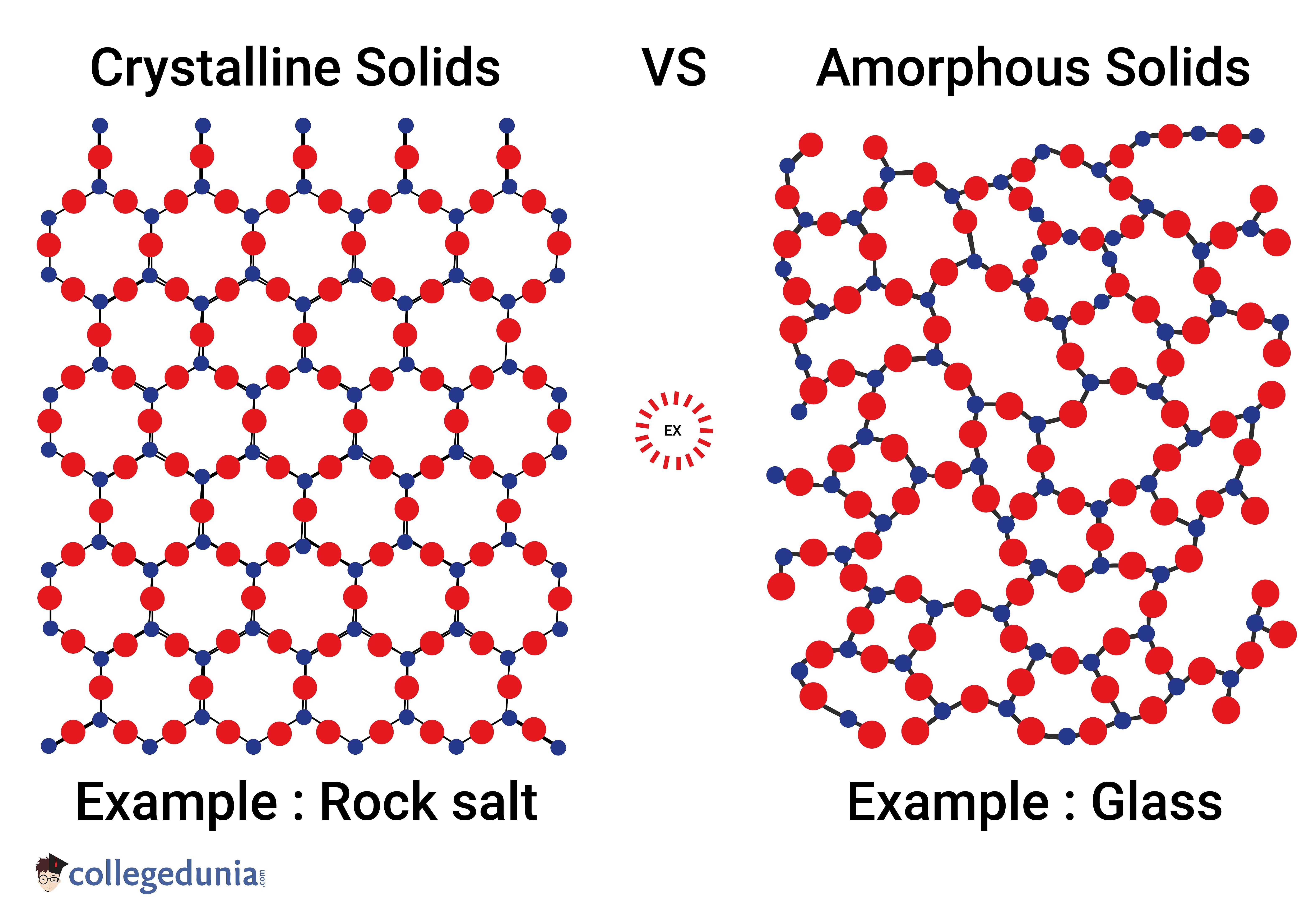
Amorphous and Crystalline Solids
The video below explains this:
Amorphous and Crystalline Solids Detailed Video Explanation:
Read More:
| Relevant Concepts | ||
|---|---|---|
| Solid State | States of Matter | Electrical Properties of Solids |
| Classification Of Crystalline Solids | Imperfections in Solids | Packing Efficiency |
Examples of Amorphous Solids
[Click Here for Previous Year Questions]
Amorphous Solids exhibit a regular pattern at short distances due to the arrangement of particles in short-range order.
- Amorphous solids include things like glass, rubber, pitch, several types of plastic, fibreglass, polyurethane, teflon, cellophane, thin film lubricants and chalk.
- One crystalline material that has SiO4 Tetrahedra arranged in a regular order is known as Quartz.
- When quartz is melted and the molten material is quickly cooled to prevent crystallisation, glass, an amorphous solid, is formed.
Properties of Amorphous Solids
[Click Here for Sample Questions]
The characteristics of Amorphous Solids include that they are not arranged in long-term order, they have varying melting points and they transform themselves into crystalline solids at a certain temperature.
Absence of Long-Term Order
The constituent particles of an amorphous solid are not arranged in a long-range order. They might have a few discrete areas of organised layout, though. Crystallites are the crystalline components of an amorphous material.
Varying Melting Point
Amorphous solids have a variety of melting points rather than a distinct melting point. For instance, glass heated to a certain temperature softens and ultimately melts. As a result, glass can be blown or moulded into a variety of shapes. Amorphous solids lack the fusion heat that is typical of them.
Transformation Into Crystal Form
When heated and then gently cooled by annealing, an amorphous material becomes crystalline at a certain temperature. That is why glass artefacts from past seem milky due to crystallisation.
Isotropic Amorphous Solids
[Click Here for Previous Year Questions]
Isotropic solids are considered to be amorphous solids. In other words, they display consistent characteristics from all angles. An amorphous solid has the same value for its thermal and electrical conductivities, coefficient of thermal expansion, and refractive index regardless of the direction in which the parameters are tested.
- Any given crystalline solid can become amorphous by either freezing its vapour or very quickly cooling down its melt. As a result, the particles are unable to organise themselves into a crystalline structure.
- Quartz glass or silica glass is created when quartz, the crystalline form of SiO2, is melted and then quickly cooled.
- Despite having the same SiO2 composition as quartz, this substance is not as ordered at the molecular level.
- When thin layers of melted metal are quickly cooled, metal alloys take on an amorphous shape.
- The resulting metallic glasses are far more corrosion-resistant than the crystalline alloys of the same composition, and they are also robust and flexible.
Difference Between Crystalline and Amorphous Solid
[Click Here for Sample Questions]
There are various differences between Amorphous and Crystalline solids and some of them are the isotropic and anisotropic properties of crystalline and amorphous substances respectively.
Amorphous solids have irregular surfaces when split into two parts, whereas crystalline solids have uniform surfaces. Amorphous solids may occasionally become crystalline by the process of crystallisation. For instance, certain antique glass artefacts may turn milky as a result of this transformation.
Here is the difference Crystalline and Amorphous Solid:
| Properties | Crystalline Solid | Amorphous Solid |
|---|---|---|
| Structure | The atoms, ions, and molecules that make up the substance are grouped in regular and distinct three-dimensional patterns. For instance, sugar, diamonds, and sodium chloride. | Three-dimensional patterns made up of constituent particles are asymmetrical. |
| Cutting With a Knife | Crystalline solids divide into two pieces when cut with the edge of a sharp instrument, and the newly created surfaces are smooth and plain. | Amorphous solids form uneven surfaces when cut with a sharp edge tool. |
| Solid Type | Crystalline solids are true solids. | Amorphous solids are pseudo-solids. |
| Compressibility | Inflexible and Rigid. | Usually stiff and incapable of being squeezed significantly. |
| Melting Point | Crystalline solids have a high melting point and start melting at a certain temperature. | .Amorphous solids can be heated to various forms and progressively soften over a wide range of temperatures. |
| Heat of Fusion | Definite. | Not Certain. |
| Physical Properties | These are anisotropic because their physical characteristics don't match up in every direction. | These are isotropic, meaning that all directions of their physical characteristics are the same. |
Things to Remember
- Amorphous solids are defined as matter that lacks typical long-range organisation in their atomic structure.
- Physically combining two materials results in the formation of a distinct type of amorphous solid.
- Amorphous solids are frequently referred to as supercooled liquids due to the relatively haphazard way in which their molecules are arranged.
- They lack a long-range order, sharp melting point, and convert into crystalline form at some temperature.
- Examples of amorphous solids are glasses, ceramics, gels, polymers, etc.
- Amorphous solids are isotropic in nature, i.e. they exhibit uniform properties in all directions.
Check More:
Previous Year Questions
- Amorphous solids are characterised by property as… (AMUEEE - 2015)
- Amorphous solids exhibit the property of…
- Which of the following is an amorphous solid… (AIIMS - 2015)
- Which of the following statements is not true about amorphous solids…
- Crystalline solids have… (AIIMS - 2001)
- BeCl in vapour state and solid state…
- Which of the following is true about the value of refractive…
- The major binding force of diamond, silicon and quartz is…
- An element has a body centered cubic (bcc) structure with a… (NEET - 2020)
- A metal crystallizes with a face-centered cubic lattice. The… (NEET - 2012)
Sample Questions
Ques. What is an Amorphous Solid? (5 Marks)
Ans. Amorphous solids lack regular and periodically recurring patterns. Amorphous solids have a structure that resembles that of liquids.
- Amorphous solids float under gravity very slowly and behave like fluids. They are not true solids.
- They are actually supercooled liquids. In an amorphous solid, the regular arrangement of component particles only extends a short distance.
- Any non-glassy material whose atoms and constituent particles are not arranged in a positive cross-section pattern is said to be amorphous.
- There are two characteristics of amorphous solids. When split or shattered, they produce particles with strange, regularly wrapped surfaces, and when exposed to x-beams, they fail to adequately depict patterns because their segments are not put together in a typical grouping.
- There is no translational periodicity in an amorphous solid.
Ques. What are the properties of amorphous solids? (5 marks)
Ans. The properties of amorphous solids are as follows:
- Although they don't have perfect solid properties, amorphous substances resemble solids.
- The component particles of amorphous material are not arranged in a predictable manner.
- Only short-range order exists in the organisation of the constituent particles, such as atoms or molecules, therefore periodic repetition of regular patterns only extends over a small distance.
- Pseudosolids or supercooled liquids of extremely high viscosity are other names for amorphous solids.
- Amorphous solids are isotropic by nature because their physical characteristics do not change as the direction of a force changes.
- Sharp melting points are absent from amorphous materials. Solids that are amorphous lack a distinct phase.
- Instead of melting at a certain temperature, materials soften over time when heated.
Ques. What is an example of an Amorphous solid? (2 Marks)
Ans. Amorphous Solids can be natural as well as artificial materials. The most frequently used type of amorphous solid is Glass. Plastic, Quartz Glass (Silica), Cellophane, Teflon, Fibreglass, and Polyurethane are some other examples of Amorphous solids.
Ques. How can an Amorphous solid be made? (3 Marks)
Ans. Amorphous solids can be made by the following methods.
- A crystalline solid can be converted into an amorphous solid by blasting it with high-kinetic-energy ions. Interdiffusion (atomic-scale mixing) between crystalline layers can form an amorphous phase under particular composition and temperature circumstances.
- Melt spinning involves propelling a jet of molten metal against the moving surface of a cool, revolving copper cylinder. A continuous ribbon of solid metallic glass is spun off at speeds exceeding one kilometre per minute.
- A short powerful laser pulse melts a small area, which is quickly quenched by the surrounding material and transformed into glass in laser glazing.
Ques. Is Sugar an Amorphous Solid? (2 Marks)
Ans. Pure sugar is a relatively sweet substance. Similar to many other solids that precipitate from solutions, it develops typical, crystalline structures. Of course, sugar has the potential to be amorphous as well. By melting sugar and quickly cooling it, you will also be left with a transparent amorphous "glass."
Ques. Glass is an Amorphous Solid. Why? (2 Marks)
Ans. When glass is created, the substance, which frequently contains silica, is easily cooled from its liquid condition but does not solidify if the temperature falls below its melting point.
- To transform the substance into an amorphous solid, it is further cooled to below the glass-transition temperature.
- It's a solid, but unusual one. It is considered an amorphous solid because it lacks the organized molecular structure of true solids yet is too hard to be classified as a liquid.
Ques. What causes anisotropy in Crystalline Solids? (3 Marks)
Ans. Anisotropy is the property of showing qualities with varying values when measured along axes in various directions in physics.
- crystalline solids are anisotropic, meaning that various measurements of some of their physical characteristics, such as electrical resistance or refractive index, in the same crystals provide different results.
- It is a result of various particle arrangements facing various orientations.
- Amorphous solids, in contrast, are isotropic by nature. This is due to their lack of long-term organisation and intermittent organisation in all directions.
Ques. What traits distinguish an Amorphous Solid? (3 Marks)
Ans. Amorphous solids lack an ordered atomic structure, which prevents them from having well-defined melting points or producing regular geometric structures. The unique characteristics of amorphous solids have aided both medicine development and materials research (using them to create resistant coatings, for example) (e.g., using amorphous materials to enhance the bioavailability of pharmaceuticals).
Ques What distinguishes Crystalline Solids from Amorphous Solids? (5 Marks)
Ans. The distinctions between crystalline and amorphous solids are as follows:
- Crystals have an organised arrangement of their component parts. On the other side, amorphous solids lack this organisation.
- Their particle placement is arbitrary. Crystals are distinguished by their sharp edges and geometric shape. Amorphous solids have no geometry in their shapes.
- There is a specific melting point below which crystalline substances will melt. Although it won't melt at a particular temperature, an amorphous solid will melt across a wide temperature range.
- The crystal's constituent particles are organised in a protracted chain. This suggests that the particle arrangement will remain constant over time. In a short time, amorphous solids will organise. They have a wide variety of particle arrangements.
- Amorphous Solids are sometimes referred to as Supercooled Liquids, while True Solids are also known as Crystals.
Ques. How can amorphous solids be recognised? (3 Marks)
Ans. Amorphous solids are distinguished by two features.
- They form particles with odd, frequently twisted surfaces when they are cleaved or fractured.
- When they are subjected to x-rays, they produce patterns that are challenging to describe because their constituent parts are not arranged in a logical order.
For Latest Updates on Upcoming Board Exams, Click Here: https://t.me/class_10_12_board_updates
Check-Out:



Comments