



Education Content Expert
Barium Nitrate is an inorganic compound with the chemical formula Ba(NO3)2. Barium dinitrate, nitrobarite, and barium salt are other names for Barium Nitrate. In 1808, English Chemist Sir Humphry Davy isolated barium for the first time via electrolysis of molten baryta (BaO).
- Barium Nitrate is a good oxidizing agent and burns with a green-colored flame.
- It is non-combustible under normal settings, at exceptionally high temperatures it can cause explosions.
- It enhances the combustibility of other compounds, even though it is not itself combustible.
- It is used to create explosives like Baratol, Thermate, and more.
- It is also used in other things like green signal lights, detonators, propellants, paints, rodenticides, etc.
- The melting point of Barium Nitrate is around 592 °C.
- Barium Nitrate is exceedingly harmful to humans in large quantities.
- Upper lung inflammation, skin discomfort, and eye irritation are some of the signs of barium nitrate overdose.
Key Terms: Barium Nitrate, Inflammation, Combustion, Barium Sulfide, Inorganic Compound, Oxidizing Agent, Pyrotechnics
What is Barium Nitrate?
[Click Here for Sample Questions]
Barium Nitrate is an inorganic substance with the formula Ba(NO3)2. It is also known as barium dinitrate, nitrobarite, and barium salt. It has a green flame and is an excellent Oxidizing Agent. It's commonly used in pyrotechnics.
- It is a white crystalline substance.
- It is a non-combustible chemical that improves the combustion of combustible components.
- The chemical formula for barium nitrate is Ba (NO3)2.
- Its Molar Mass is 261.34 g mol-1.
- It requires one barium cation Ba2+ and two nitrate anions NO3- to produce.
- The crystal structure is also cubic, with one barium cation surrounded by four nitrate anions.

Barium Nitrate
Structure of Barium Nitrate
[Click Here for Sample Questions]
Barium Nitrate has the chemical formula Ba (NO3)2. The structure of barium nitrate is as follows:
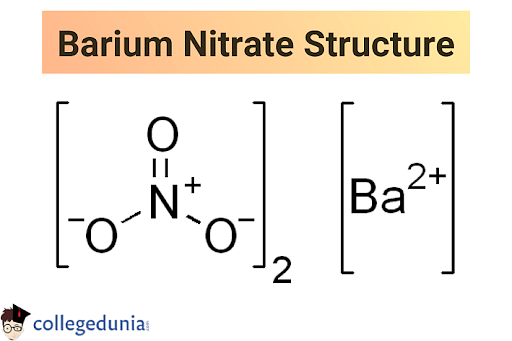
Barium Nitrate Structure
Properties of Barium Nitrate
[Click Here for Sample Questions]
The properties of Barium Nitrate are as follows:
| Properties of Barium Nitrate | |
|---|---|
| Chemical Name | Barium Nitrate |
| Molecular Weight | 261.34 g/mol |
| Appearance | Crystalline Solid |
| Colour | White |
| Refractive Index | 1.5659 |
| Odour | Odourless |
| Boiling Point | The compound decomposes under intense heat |
| Combustibility | Non-Combustible |
| Vapour Pressure | Low |
| Density | 3.24 g/cubic cm |
| Decomposition | Decomposes upon heating, producing nitrogen oxides |
| Solubility | High in Solubility, 10.3g/100g of water |
| Melting Point | 592 °C |
Read More:
Preparation of Barium Nitrate
[Click Here for Sample Questions]
Barium Nitrate is prepared using two standard processes typically when manufacturing in large quantities.
Method 1
The first step is to dissolve barium carbonate (BaCO3) in nitric acid (HNO3). As the two chemicals react, iron impurities precipitate on the surface. These contaminants must be removed using the filtration procedure. The leftover mixture must then be evaporated. After Crystallization pure barium nitrate is obtained, which is commonly used in industry.
| 2HNO3 + Ba \(\to\) Ba(NO3)2 + H2 |
Method 2
The second step is to additionally employ a separate process for producing barium nitrate. A chemical interaction between barium sulfide and nitric acid is used in this alternative method. However, extreme temperatures can cause the Decomposition of Ba(NO3)2 into barium oxide, nitrogen dioxide, and oxygen, hence extreme temperatures must be avoided during this process.
| 2Ba(NO3)2 \(\to\) 2BaO + 4NO2 + O2 |
Uses of Barium Nitrate
[Click Here for Sample Questions]
The uses of Barium Nitrate are given below:
In the Fireworks Business
- When it comes to the fireworks industry, barium nitrate is a valuable component since it can aid in the manufacturing of green flames.
- Aside from fireworks, this compound can also be seen in a variety of pyrotechnic displays.
- Sodium chloride produces yellow flames, but copper chloride turns blue after combustion, just as barium nitrate does.
- As a result, all of these are frequently employed in fireworks.
In Glasswork Manufacturing Plants
- Barium nitrate is an important ingredient in the production of high-quality glass.
- The oxygen molecule connected to this chemical can help prevent the discoloration of glass goods.
- Furthermore, such glassware is extraordinarily clear.
- This chemical is also used by experts in the production of optical glasses.
- In camera lenses, barium nitrate can improve the Refractive Index, resulting in better images.
Military Application
- Barium nitrate aids in the manufacture of tracer bullets.
- Ba(NO3)2 charge put directly at the end of such ammunition allows one to follow the exact path that the bullet follows when shot.
- When such bullets are shot from a gun, this charge illuminates. The smoke from this section is evident, marking the bullet's route perfectly.
- Furthermore, barium nitrate is one of the principal compounds used in the manufacture of flares, which are used to direct troops to a specific spot.
- Finally, explosive detonators contain this chemical.
- Barium nitrate is an essential component of explosives due to its oxidizing tendency.
Rodenticide
Barium nitrate is also a reliable rodenticide. Leaving it out in the open in houses will keep rodents like mice and rats from entering or staying inside.
Paints
Home wall paints are just a combination of numerous chemical ingredients. One of these chemicals is barium nitrate. Notably, most paints would not exist without this specific barium nitrate because it is frequently used as a major ingredient.
Barium Nitrate Health Hazards
[Click Here for Sample Questions]
The health hazards associated with Barium Nitrate are:
- High amounts of this chemical are extremely toxic to humans.
- It is important not to inhale too many of its fumes.
- Similarly, direct contact with the eyes and skin can cause a variety of unpleasant symptoms.
- Some of the symptoms of barium nitrate poisoning include upper lung inflammation, skin irritation, and eye irritation.
- Notably, these can be readily prevented by adopting simple precautions when dealing with them.
Check More:
Things to Remember
- Barium nitrate is a white, crystalline material with the chemical formula Ba(NO3)2.
- It's a salt that has a slightly acidic flavor.
- It is non-combustible under normal conditions, however, it can create explosions at extremely high temperatures.
- Barium nitrate is an oxidizing agent that aids in the combustion of other chemicals.
- It has a melting point of roughly 592° C.
- It is not possible to boil barium nitrate. It simply decomposes at high temperatures.
- Individuals who are exposed to this material may develop symptoms of barium nitrate poisoning, which include skin, eye, and lung irritation.
Sample Questions
Ques. Who was the first to discover Barium Nitrate? (1 Mark)
Ans. Sir Humphry Davy, an English chemist, isolated barium for the first time in 1808 by electrolysis of molten baryta (BaO)
Ques. What are the applications of Barium Nitrate? (1 Mark)
Ans. Barium Nitrate is a crystalline (sand-like) powder that is colorless to white and odorless. It is used in the production of fireworks, green and neon lights, and ceramic glazes.
Ques. What is the temperature at which Barium Nitrate decomposes? (2 Marks)
Ans. Anhydrous bulk barium nitrate decomposes at temperatures ranging from 500 to 700 °C, with the primary decomposition occurring at 630 °C. The gaseous products were oxygen and nitric oxide, which evolved concurrently.
Ques. What are some unusual and lesser-known applications of Barium Nitrate? (2 Marks)
Ans. Some lesser-known applications of Barium Nitrate are as follows:
- It is an important component in the chemical photoflash method.
- It is utilized as a raw material to create neon sign lightings, which is a common marketing help.
- In the creation of enamels, a little amount of Barium Nitrate acts as a source of barium oxide.
Ques. What happens on burning Barium Nitrate? (1 Mark)
Ans. When barium nitrate is burned, it produces a green flame. It decomposes into barium oxide, oxygen, and nitrogen dioxide when heated.
Ques. How should Barium Nitrate be stored? (2 Marks)
Ans. Barium Nitrate should be kept away from incompatible materials in a cold, dry, well-ventilated, lockable storage space. Keep airborne concentrations below exposure limits by using ventilation.
Ques. Is Barium in drinking water harmful? (3 Marks)
Ans. Vomiting, abdominal cramps, diarrhea, difficulty breathing, increased or lowered blood pressure, numbness around the face, and muscle weakness is among the side effects of Barium. Ingestion of significant amounts of easily dissolved barium compounds can result in abnormalities in heart rhythm, paralysis, and possibly death.
Ques. How acidic is Barium Nitrate? (2 Marks)
Ans. Barium is a group 2 metal whose cation in solution has no acidic or basic characteristics. Because the nitrate anion is the extremely weak conjugate base of a strong acid (nitric acid), it does not influence the pH of the solution. As a result, the pH of Barium Nitrate will be 7.
Ques. Which of the following things does require Barium Nitrate for its production?
(A) Explosives
(B) Rodenticides
(c) Green Signal Lights
(D) All of the above (1 Mark)
Ans. (D) All of the above
Explanation: Barium Nitrate is present in all explosives, rodenticides, and green signal lights.
Ques. What are the two industrial-scale methods of producing Barium Nitrate? (3 Marks)
Ans. Manufacturing units generally follow one of two primary modes for large-scale production of Barium Nitrate:
- The first step involves reacting suspended barium carbonate with nitric acid. Following the completion of this operation, the nitrate is crystallized using the vacuum evaporation method.
- The second method involves combining nitric acid and barium sulfide. First, any sulfur and heavy metals in the ensuing reaction must be carefully removed. The barium nitrate is then crystallized at extremely low temperatures.
Ques. What happens when Barium Nitrate is heated? (2 Marks)
Ans. When burned, barium nitrate emits a green flame. It decomposes to barium oxide, oxygen, and nitrogen dioxide when heated. This converts barium nitrite into nitric oxide. To produce barium sulfate it combines with either sulfate or sulfuric acid.
For Latest Updates on Upcoming Board Exams, Click Here: https://t.me/class_10_12_board_updates
Check-Out:



Comments