



Education Journalist | Study Abroad Lead
Aluminium is a non-corrosive light-weight silvery-white metal. It is included in the Boron group (group 13) in the periodic table. Aluminium is the most abundant metallic element on the earth taking up approximately 8% of the earth’s crust.
Due to its chemical reactivity, aluminium does not occur as a free element on the surface of Earth. It is seen as different ores. Bauxite ore, Al2O3.xH2O, is the most commonly found form of aluminium. Cryolite, alunite, and some other gemstones are also different forms of aluminium. The chemical symbol is Al.
This article discusses the ores and the process of extraction of aluminium.
| Table of Content |
Key Terms: Aluminium, Ore, Metallurgy, Hall Heroult, Bauxite, Electrolysis, Bayer’s Method, Alumina, Corundum, Cryolite
Aluminium Ore
[Click Here for Sample Questions]
A mineral from which metal can be extracted easily and in an economic manner is its ore. Aluminium has varied properties and the ore extraction of aluminum is a comparatively cost-effective process. Following are the different ores of aluminium:
- Bauxite (Al2O3.2H2O) is the chief ore from which Aluminium is extracted. Almost 98 per cent of Aluminium produced for commercial purposes is extracted from bauxite. It is mainly acquired through mining and is seen in the topsoil in tropical and subtropical regions.
- Corundum (Al2O3) is an oxide of aluminium that is known to form hexagonal barrel-shaped prisms at both ends. It is one of the most durable gemstones known to mankind and has a hardness of 9 on the Mohs scale.
- Cryolite (Na3AlF6) is a white halide mineral that is used as a solvent in the electrolytic production of bauxite and other metallurgical uses. Large amounts of synthetic cryolite are produced from fluorite. Cryolite is predominantly found in Ivigtut, Greenland, Spain, Colorado, etc.
Also Read:
| Related Articles | ||
|---|---|---|
| Metallurgy | Metals & Non-Metals Important Questions | Metal & Non-Metals Revision Notes |
| Concentration of Ore | Mineral & Energy Resources | Boron & Aluminium Uses |
Metallurgy of Aluminium
[Click Here for Previous Year Questions]
Metallurgy is the study of the chemical and physical nature of metallic elements, intermetallic compounds, and their alloys. The purification of metals into their pure form by the process of extraction is metallurgy. This method involves all the stages in which a metal gets separated as a pure metal from its ore. Bayer’s process and the Hall-Heroult are the common processes that are used to extract aluminium industrially.
Concentration of Bauxite (Ore of Aluminium)
[Click Here for Sample Questions]
Bauxite is the ore of aluminium. The concentration stage includes the removal of gangue impurities obtained from the earth's crust. Bauxite is concentrated in a process known as leaching. This process is commonly known as Bayer’s Process of aluminium extraction. The steps are listed below:
- The impure aluminium is added to sodium hydroxide (NaOH) solution which is extremely hot and concentrated.
- The pure aluminium gets dissolved in the solution and the impurities are then filtered off.
- After this process, in order to obtain the dissolved alumina, a small quantity of freshly prepared Aluminium Hydroxide [Al(OH)3] precipitate is added after diluting it with water.
- This is done to obtain more amounts of Al(OH)3 precipitate. Then this precipitate is separated by washing and heating it strongly.

Concentration of Aluminum Ore (Bauxite)
Electrolysis of Alumina (Al2O3)
[Click Here for Previous Year Questions]
- The Alumina(Al2O3) which is obtained by the concentration of bauxite is now reduced using electricity as the reducing agent.
- Aluminium is a highly reactive metal and hence electricity is used as the reducing agent.
- At first, the Alumina is mixed with molten cryolite (NaAIF6).
- The melting point of Alumina is very high. When cryolite is added to it, the melting point can be reduced. This increases the electrical conductivity of Alumina.
- The mix is then subjected to electrolysis.
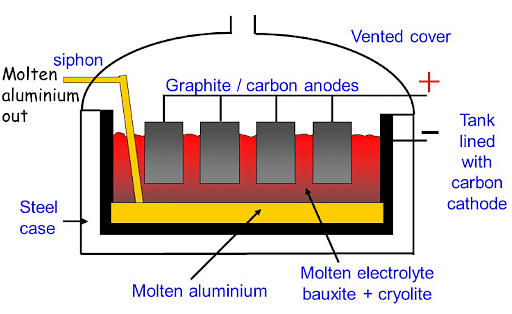
Electrolysis for Aluminum Extraction
The reactions involved can be summarised as follows:
STEP 1:
Al2O3.2H2O + Na2CO3 + heat \(\Box\) 2NaAlO2 +2H2O +CO2
Impure bauxite is converted into sodium aluminate by fusing the impure metal with sodium carbonate or sodium hydroxide in the presence of heat.
STEP 2:
2NaAlO2 +3H2O +CO2 \(\Box\) Na2CO3 + 2Al(OH)3
Sodium aluminate is converted into aluminum hydroxide.
STEP 3:
2Al(OH)3 1100℃ → Al2O3 + 3H2O
Aluminum hydroxide precipitate is converted into pure alumina.
Hall Heroult Process
[Click Here for Sample Questions]
Hall-Heroult process was put forward by two scientists namely, Charles Martin Hall and Paul Heroult. Even though they were unknown to each other, both of them experimented with the extraction and the refining of aluminium and applied for patents at the same time. So this process is known in both of their names. There are three stages in this process of aluminum extraction:
- Concentration of Bauxite
- Extraction of metals from concentrated ore
- Refining of metals
The steps given below summarize the process of aluminum extraction:
- Alumina is known to melt at 2050oC. Hence alumina cannot be directly electrolyzed. As a result, electrolysis is carried out with cryolite and fluorspar (3:1 ratio).
- In an iron tank lined with a heat insulator and a sloping floor, electrolysis is carried out,.
- An outlet is provided in the tank to tap the molten aluminium.
- Graphite or gas carbon are used as the cathode and thick carbon rods act as the anode.
- To prevent burning of the anodic rods, coke powder covering is employed. This prevents heat loss from the molten electrolyte.
- 100 A current is passed through the electrolyte at a temperature of 950oC.
- Al, Ca, and Na ions are formed that eventually migrate to the cathodic end.
- Owing to the lower position of the Al ions in the electrochemical series, these reach the cathode quickly.
- Aluminium hence gets deposited at the cathode and starts melting at 950oC electrolyte temperature in the tank.
- Nascent oxygen forms at the anode that reacts with the coke carbon forming carbon monoxide.
- This carbon monoxide further reacts with atmospheric oxygen to produce carbon dioxide.
Note: The carbon anodes need replacement frequently due to the nascent oxygen reaction with the carbon anode.

Aluminium Extraction by Hall-Heroult Process
The following are the reaction involved in the extraction process:
Overall Reaction: 2Al2O3 + 3C → 4Al + 3CO2
At Cathode :
Al 3+ + 3e– → Al (l)
At Anode :
C (s) + O2– → CO (g) + 2e–
C (s) + 2O2– → CO2 (g) + 4e–
Refining of Aluminium
[Click Here for Previous Year Questions]
The aluminium which is obtained after electrolysis is 99 percent pure. The remaining impurity gets purified by Hoop's electrolytic method. This process is done inside an iron tank which has a lining of carbon inside it. Also, it contains three different layers of molten liquid with entirely different densities.
- The first and foremost layer from the top is aluminium in which carbon electrodes are dipped. This carbon electrode acts as the cathode.
- The second layer contains the mixture of sodium, barium, and ammonium fluorides which acts as the electrolyte.
- The final and bottom layer has pure aluminium with carbon lining. It serves the purpose of the anode. Electricity is then passed through this.
In this process, the aluminium ions from the middle layers reach the cathode as pure. Similarly, aluminium ions from the bottom layer also reach the middle layer leaving behind all the impurities. That is this method gives out pure aluminium just serving as the last stage of this process.
Uses of Aluminum
[Click Here for Sample Questions]
After inventing the Hall-Heroult process, Aluminum became more like the common man's metal. It became available at cheap rates as the cost of extraction is very low. Following re the applications of aluminium:
- Manufacture of storage cans
- Used in paints
- Foils made of aluminum is used for wrapping food materials
- For extraction of manganese and chromium from their respective oxides aluminium is used
- Mostly used in alloys like stainless Alnico
- Used to make cooking utensils as it is of higher thermal conductivity.
- It is very much used as a household appliance due to its ability to become corrosion-free.
- It is used in the field of construction
- Used for making the spare parts of automobiles
Things to Remember
- Aluminium is the most abundant metal on earth's crust.
- Ore of Aluminium is Bauxite(Al2O3.2H2O).
- Aluminium is a very light metal that is non-toxic, non-magnetic, and does not spark.
- The extraction of Aluminium is mostly done in industries by The Hall-Heroult Process.
- The process includes- Concentration of Bauxite, Electrolysis of Alumina, and Refining of Aluminium.
- Hoop’s electrolytic method is predominantly used for refining of aluminium.
- Aluminum is widely used in different household items and also in making various alloys.
Also Read:
Previous Year Questions
Sample Questions
Ques. Which is the first step of the extraction of Aluminum? (2 marks)
Ans. The concentration of Bauxite is the first stage in the extraction of Aluminium. Bauxite is concentrated through a process named as leaching. In this process, hot and concentrated NaOH is added to the impure bauxite.
Ques. What are the three steps involved in the extraction of Aluminum? (2 marks)
Ans. The three steps involved in the extraction of aluminum are:
- Concentration of Bauxite
- Electrolysis of Alumina
- Refining of Aluminium.
Ques. What is the most crucial stage in the extraction of Aluminium? (2 marks)
Ans. The most significant step in the extraction of aluminum is the reduction of alumina. Alumina is not a material that can be easily reduced. It is by using electricity that the reduction of Alumina is done.
Ques. Why is electricity used as the reducing agent in the Hall-Heroult process? (2 marks)
Ans. Aluminium is a highly reactive metal. So reducing it by making use of a simple reducing agent is not practical here. That is why electricity, the most powerful reducing agent, is used.
Ques. Who were the scientists who invented the Hall-Heroult Process? (1 mark)
Ans. The Hall-Heroult process was invented by two famous scientists, Charles Martin Hall and Paul Heroult.
Ques. Briefly explain the electrolysis of Alumina? (3 marks)
Ans. The electrolysis of Alumina is done by making use of electricity. Firstly, molten cryolite is added to it, in order to increase its electrical conductivity. Electricity is then passed into it. The following reactions occur:
Al2O3 ————> 2Al3+ + 3O2-
Al3+ + 3e- ————> Al
Cathode:-
Al3+(melt) + 3e- —-------> Al
Anode:-
C(s) + O2-( melt) —--------> CO(g) + 2e-
During this process, the aluminum metals that get liberated in the cathode gets sedimented at the bottom which is removed periodically.
Ques. Why is refining done in aluminum? (1 mark)
Ans. The process of refining is done in the aluminium collected after the electrolysis because the aluminum which is obtained after the second stage is 99 percent pure only.
Ques. What are the alloys that are produced by making use of aluminum? (2 marks)
Ans. AA-8000, Alclad, Al-Li, Alnico, Birmabright, and Duralumin are the common alloys of aluminium.
Ques. Give the reaction when aluminum reacts with caustic soda. (2 marks)
Ans. Aluminium reacts with caustic soda to produce sodium meta-aluminate. The reaction is given by:
For Latest Updates on Upcoming Board Exams, Click Here: https://t.me/class_10_12_board_updates
Check-Out:



Comments