



Education Journalist | Study Abroad Lead
Biconvex Lens is a lens that consists of two convex lens surfaces placed at the back of each other in a spherical form that has the same radius of curvature. It is also called a convex-convex lens or a plano-convex lens. Biconvex lenses have many uses in real life like magnifying or condensing lenses and magnifiers. In this lens, a parallel beam of light passes through the lens and then converges on the focus or a spot behind the lens. Therefore, the biconvex lens is a positive or converging lens. The biconvex lens formula is given by,
\({1 \over f}= ({\mu_2 \over \mu_1} - 1)({1 \over R_1} - {1 \over R_2} )\)
| Table of Content |
Key Terms: Biconvex Lens, Plano-convex lens, Optical Instruments, Focal Length, Refraction of Light, Real Image, Convex Lens
What is Biconvex Lens?
[Click Here for Previous Year Questions]
Biconvex lens consists of two convex surfaces in spherical form. They are used in optical instruments for focusing or controlling laser beams, quality of the image, etc. A parallel beam of light goes through the lens and converges into a focus in biconvex lenses.
- The distance from the lens to the focus behind the lens is known as the focal length of the lens.
- Images are formed by Biconvex Lens due to the refraction of light.
- Refraction of light refers to the change in the direction of light when the light passes from one medium to another.
- A Rainbow is an example of the Refraction of Light.
- Therefore, the image formed by biconvex lenses is a real image.
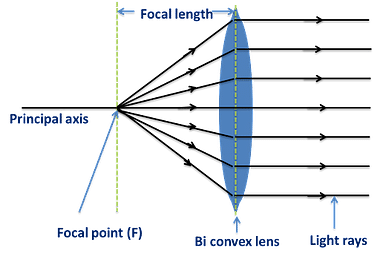
- There is a curvature on both sides of the lens and because of this, there are two focuses and two centers on both sides.
- There is a line known as the principal axis that is drawn in the middle of the lens.
- They are symmetrical lenses. Both the convex lenses in biconvex lenses or plano-convex lenses have the same radius of curvature.
- The center of the spherical convex lens is known as the optical center. When the two spheres intersect in a way that their optical centers coincide, a biconvex lens is formed.
| Example of Biconvex Lens
|
Also Read:
Biconvex Lens Formula
[Click Here for Sample Questions]
The derivation of the Biconvex Lens formula is given below:
We know that,
\({1 \over f} = {1 \over u} - {1 \over v} \)
The general equation for the refraction on the spherical surface is as given below:
\({\mu_2 \over v} - {\mu_2 \over u}= {\mu_2 - \mu_1 \over R} \)
The equation for the light ray coming from the medium μ2 to the medium μ1 becomes:
\({\mu_2 \over v} - {\mu_1 \over v_2}= {\mu_2 - \mu_1 \over R_2}{\mu_2 - \mu_1 \over R_1} \)
From the above equations, we get
\({1 \over v} - {1 \over u}= ({\mu_2 \over \mu_1} - 1)({1 \over R_1} - {1 \over R_2} )\)
As the light rays emerge from the object that is placed at infinity, so u = ∞ and v = f
So, we get the biconvex lens formula as:
| \({1 \over f}= ({\mu_2 \over \mu_1} - 1)({1 \over R_1} - {1 \over R_2} )\) |
- R1 = radius of curvature of lens 1
- R2 = radius of curvature of lens 2
Properties of Biconvex Lens
[Click Here for Previous Year Questions]
The properties of the biconvex lens are as follows:
- The focal length of a biconvex lens is always positive.
- The focal length of the biconvex lens is short in length.
- Biconvex Lens can easily converge the incident light.
- Real and Virtual images can be formed on a biconvex lens.
- It reduces the spherical aberration and can cancel the distortion and the coma with a conjugate ratio corresponding to unity.
- The biconvex lens is symmetrical in form as they have equal radii on both sides of the lens.
- They are usually recommended for virtual imaging in the case of real objects, and for a positive conjugate ratio between 0.2 to 5.
Uses and Applications of Biconvex Lenses
[Click Here for Sample Questions]
The uses of the biconvex lens are as follows:
- Biconvex Lens is used as a burning glass.
- A Human has a biconvex lens in their eye which is used to produce virtual images.
- It is a positive lens and is used for converging beams.
- Biconvex lens has many uses in real life like magnifying or condensing lenses and magnifiers.
- It is used in popular imaging instruments like microscopes, telescopes, projectors, and binoculars.
Previous Year Questions
- Two thin biconvex lenses have focal lengths … [KCET 2021]
- A slit of width 'a' is illuminated by the red light of wavelength … [KCET 2021]
- Which of the statements are correct with reference to single slit diffraction … [KCET 2021]
- In Young's double-slit experiment a monochromatic source … [KCET 2021]
- A double convex lens has focal length 25 cm … [NEET 2019]
- A point object is placed at a distance of 20 cm from a thin planoconvex … [JEE Advanced 2006]
- The graph between object distance u and image distance … [JEE Advanced 2006]
- A biconvex lens of focal length f forms a circular image of radius r … [JEE Advanced]
- A biconvex lens has a radius of curvature of magnitude … [NEET 2011]
- Assume that light of wavelength 600nm is coming from a star … [NEET 2020]
- An object is placed at a distance of 40 cm … [NEET 2018]
- An equiconvex lens has power P … [NEET 2019]
- You are asked to design a shaving mirror assuming … [JEE Mains 2015]
- What is the position and nature of image formed by lens combination … [JEE Mains 2019]
- Light is incident from a medium into air at two possible angles … [JEE Mains 2013]
- Diameter of a plano-convex lens is … [JEE Mains 2013]
- A convergent doublet of separated lenses … [JEE Mains 2018]
- A convex lens is put 10cm from a light source … [JEE Mains 2019]
Things to Remember
- Biconvex lens consists of two convex surfaces in spherical form.
- It has a positive focal length.
- The focal length of biconvex lens is short.
- Biconvex lens have a high ability to converge the incident light.
- Biconvex lens can form real as well as virtual images.
- They can minimize spherical aberration. The lenses have a distortion value whose conjugate ratio corresponds to unity.
Also Read:
Sample Questions
Ques. Under what condition does a biconvex lens of glass having a certain refractive index act as a plane glass sheet when immersed in a liquid? (1 Mark) [Delhi 2012]
Ans. When the refractive index of a glass of a biconvex lens is equal to the refractive index of the liquid in which the lens is immersed
or µ1 = µg
Ques. How would a biconvex lens appear when placed in a trough of liquid having the same refractive index as that of the lens? (1 Mark) [Comptt. Delhi 2011]
Ans. A biconvex lens appears as plane glass when placed in a trough of liquid having the same refractive index as that of the lens.
Ques. A biconvex lens made of a transparent material of refractive index 1.25 is immersed in water of refractive index 1.33. Will the lens behave as a converging or a diverging lens? Give a reason. (1 Mark) [All India 2014]
Ans. The lens will behave as a diverging lens, because
\(\frac{1}{f} = (\mu - 1)(\frac{1}{R_1} - \frac{1}{R_2})\)
\(\frac{1}{f} = (\frac{\mu_1}{\mu_2} -1)(\frac{1}{R_1} - \frac{1}{R_2})\)
\(\frac{\mu_1}{\mu_2} = \frac{1.25}{1.33} = 0.98\)
Ques. A biconvex lens made of a transparent material of refractive index 1.5 is immersed in water of refractive index 1.33. Will the lens behave as a converging or a diverging lens? Give a reason. (1 Mark) [All India 2014]
Ans. The lens will behave as a converging lens because
\(\frac{\mu_1}{\mu_2} = \frac{1.5}{1.33} = 1.12 > 1\)
Hence the value of ‘f’ will be positive.
Ques. Why is a biconvex lens called a positive lens? (2 Marks)
Ans. Biconvex Lens is a simple lens that consists of two convex surfaces in spherical form. The biconvex Lens has the same kind of radius of curvature and converges the diverging rays to a focus behind the lens thus biconvex lens is called a positive lens.
Ques. What is the difference between a convex lens and a biconvex lens? (2 Marks)
Ans. A convex lens has one convex surface and the other as a plane surface whereas, in a biconvex lens, both the surfaces are convex and form a spherical shape. Some examples of biconvex lens include the human eye and magnifying glass.
Ques. What is the difference between a biconvex lens and a biconcave lens? (2 Marks)
Ans. In a biconvex lens, both surfaces are convex and curve outwards whereas, in a biconcave lens, both surfaces are concave and curve inwards.
Ques. State three properties of Biconvex Lens? (2 Marks)
Ans. The three properties of Biconvex Lens are:
- The focal length of biconvex lens is short.
- Biconvex Lens can easily converge the incident light.
- Real and Virtual images can be formed on a biconvex lens.
Ques. How can you make Biconvex Lens yourself? (3 Marks)
Ans. These are the steps that can be followed to make a biconvex lens:
- Use cardboard and cut out a circle from the cardboard of a radius of 3 cm.
- Use a plastic water bottle and cut out a circle from the plastic bottle of the same measurement.
- Join both circles using glue or fevicol. Make sure to leave some space between them in the centre.
- Dip the circle in a bowl of water. After letting some water in the gap left. After the water is filled, stick the leftover space too.
- Take a newspaper and read the lines using the glass circle, the lines will appear magnified as it has become a biconvex lane.
For Latest Updates on Upcoming Board Exams, Click Here: https://t.me/class_10_12_board_updates
Read Also:



Comments