



Education Content Expert
Biodegradable and Non-Biodegradable Polymers are the two types of polymers based on decomposition. A polymer is defined as a macromolecule consisting of repeated subunits called monomers. Biodegradable polymers are those polymers that can be decomposed by the action of microorganisms in a few days. Polylactic acid (PLA) and Polyhydroxyalkanoates (PHA) are a few examples of biodegradable polymers. Non-biodegradable polymers are those polymers that can not be decomposed by the action of microorganisms such as polyethylene terephthalate (PET).
Read More: Addition & Condensation Polymerisation
| Table of Content |
Key Terms: Polymers, Biodegradable Polymers, Non-Biodegradable Polymers, Macromolecules, Decomposition, Microorganisms, Polyesters
Biodegradable and Non-Biodegradable Polymers
[Click Here for Sample Questions]
Polymers are macromolecules that are composed of repeating structural units called monomers. Polymers can be classified into two broad categories depending on the process of decomposition:
- Biodegradable Polymers: Polymers that can be broken down into smaller molecules by microorganisms such as bacteria, and fungi. Examples are Polylactic acid (PLA) and Polyhydroxyalkanoates (PHA).
- Non-biodegradable Polymers: Polymers that cannot be broken down into smaller pieces and remain in the environment for long periods of time. Polyethylene terephthalate (PET) is a non-biodegradable polymer.
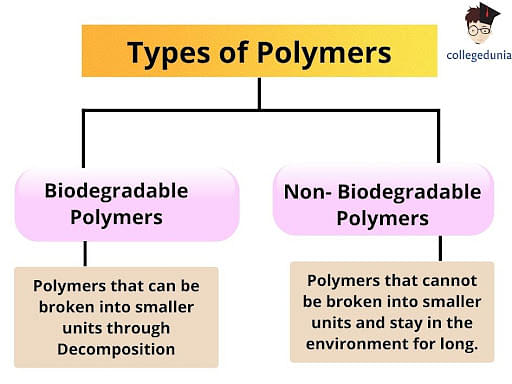
Types of Polymers
Read More:
| Important Concepts Related to Polymers | ||
|---|---|---|
| Nylon | Natural & Synthetic Polymers | Types and Process of Decomposition |
| Thermosetting Polymer | Plastics | Neoprene |
Biodegradable Polymers
[Click Here for Previous Year Questions]
Biodegradable polymers are those polymers that can be degraded or decomposed under aerobic or anaerobic conditions, as a result of the action of microorganisms or enzymes such as bacteria and fungi. Some common examples of biodegradable polymers include Polyesters, polyamides, and polyurethanes. These polymers are used in packaging, medical implants, and other applications requiring minimal environmental impact.
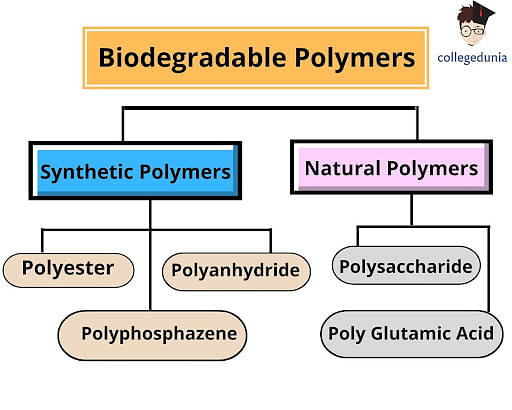
Biodegradable Polymers
Examples of Biodegradable Polymers
There are numerous biodegradable polymers. Given below are a few most common biodegradable polymers:
PHBV
- Poly β-hydroxybutyrate – co-β-hydroxy valerate (PHBV) is produced by the combination of 3-hydroxybutanoic acid and 3-hydroxypentanoic acid, and the monomer units are connected by ester bonds.
- It decomposes into carbon dioxide and water.
- It is brittle and is used to make medicines and bottles, orthopedic devices, packing material, etc.
Polyglycolic Acid (PGA)
- It is produced by the chain polymerization of cyclic dimers of glycolic acid.
- It is the simplest linear aliphatic polymer and is used in drug delivery, orthopedic operations like screws and nails, etc.
Nylon-2-Nylon-6
- Made from glycine and aminocaproic acid.
- It is used in making bristles of toothbrushes and strings of musical instruments.
Read More: Polymers MCQs
Non-Biodegradable Polymers
[Click Here for Sample Questions]
Non-biodegradable polymers are those polymers that are made up of synthetic materials and can not be broken down by decomposition. These polymers remain in the environment for long periods of time. Such polymers cause negative impacts on the environment and human health. They are a major cause of pollution and cause damage to the ecosystem.
Examples of non-biodegradable polymers include Polyethylene terephthalate (PET), Polystyrene, Polyvinyl chloride (PVC), Polypropylene, etc.
Examples of Non-Biodegradable Polymers
Some examples of non-biodegradable polymers include:
Polyethene
It has very high strength and lubricity. It is used in orthopedic implants and catheters. It can be classified further into three types:
- Linear high-density polyethylene (HDPE)
- Branched low-density polyethylene (LDPE)
- Ultra-high molecular weight polyethylene (UHMWPE)
Teflon
Teflon or tetrafluoroethylene is chemically and biologically inert and has high lubricity. It is used in cooking wares or wiring in aerospace etc.
Read More: High-Density Polyethylene
Handwritten Notes on Polymers
[Click Here for Previous Year Questions]
Provided below are some important concepts from polymers, their types and uses.


Things to Remember
- Polymers are macromolecules that are made up of repeated subunits called monomers.
- There are two types of polymers namely Biodegradable and Non-Biodegradable Polymers.
- Biodegradable Polymers are polymers that can be decomposed into smaller units through microorganisms.
- Non-biodegradable Polymers are synthetic polymers that can not be broken down into smaller units by the action of microorganisms.
- Polyesters, polyamides, and polyurethanes are a few biodegradable polymers.
- Polyethylene terephthalate (PET), Polystyrene, Polyvinyl chloride (PVC), and Polypropylene are non-biodegradable polymers.
Read More:
| Important Concepts on Types of Polymers | ||
|---|---|---|
| Condensation Polymerization | Biopolymers | Polyurethane Foam |
| Synthetic Polymers | Copolymers | Polytetrafluoroethylene |
| Synthetic Rubber | Bakelite | Polythene |
Previous Year Questions
- Which of the following is a biodegradable polymer…
- The biodegradable polymer is… (NEET 2019)
- Which of the following is not a biodegradable polymer… (KCET 2017)
- Which of the following is a biodegradable polymer of the polyamide class… (GUJCET 2006)
- Which of the following is a biodegradable polymer?
- PHBV is a biodegradable polymer. PHBV is an aliphatic polyester…
- Which among the following polymers is non - biodegradable… (JKCET 2016)
- Which one is a synthetic polymer…
- Polyethylene is a resin obtained by polymerization of…
- Which of the following are thermoplastic polymers…
- Polymer formation from monomers starts by…
- Few polymers are matched with their uses. Point out the…
- Which one of the following monomers forms a biodegradable polymer…
- Which of the following is not polyamide…
- The straight chain polymer is formed by…
Sample Questions
Ques. What is the difference between Biodegradable and Non-Biodegradable polymers? (3 Marks)
Ans. Decomposition is the only major difference between biodegradable and non-biodegradable polymers. The main difference between both types of polymers is that biodegradable polymers can be broken down into smaller units by living organisms, while non-biodegradable polymers cannot be broken down and stay in the environment for a long time.
Ques. What are the types of biodegradable polymers? (5 Marks)
Ans. Though there are many types of biodegradable polymers, however, the most common biodegradable polymers are polylactic acid (PLA), polyhydroxyalkanoate (PHA), and polycaprolactone (PCL).
- Polylactic Acid (PLA): It is a biodegradable polymer made from corn starch. It is used to manufacture biodegradable plastics and compostable packaging.
- Polyhydroxyalkanoate (PHA): It is a biodegradable polymer made from bacteria. It is used in the making of biodegradable plastics and bioplastics.
- Polycaprolactone (PCL): It is a biodegradable polymer made from vegetable oils. It is also used to make biodegradable plastics and compostable packaging.
Ques. How are biodegradable polymers made up? (2 Marks)
Ans. Biodegradable polymers are natural polymers and are made up of natural items only. Many biodegradable polymers are made up of renewable resources such as corn, sugarcane, and tapioca.
Ques. How can we reduce the use of non-biodegradable polymers? (3 Marks)
Ans. In order to reduce the use of non-biodegradable polymers, follow the given steps:
- Start using reusable cups, plates, and cutlery.
- One must bring their own shopping bag to the store.
- Purchase material or items made up of sustainable materials.
Ques. Give a few examples of non-biodegradable polymers. (3 Marks)
Ans. There are a lot of non-biodegradable polymers. Some of them are:
- Polyethylene terephthalate (PET)
- Polystyrene
- Polyvinyl chloride (PVC)
- Polyurethane
- Polypropylene
Ques. What are synthetic biodegradable polymers? (3 Marks)
Ans. Synthetic Biodegradable polymers are the products of the chemical polymerization that occurs for the bio monomers like PLA, polycaprolactone, polybutylene succinate, and polybutylene succinate adipate. These polymers are not present in nature. However, they can be easily dumped in nature, and eventually, they will break down and decompose.
Ques. What are non-biodegradable polymers made from? (3 Marks)
Ans. Non-biodegradable polymers are usually made from synthetic items or chemicals such as polyethylene, polypropylene, etc. These polymers react with other chemicals to create stronger bonds in order to give plastics different properties such as clarity, strength, stiffness, etc.
Ques. How are non-biodegradable polymers a major source of pollution? (3 Marks)
Ans. Non-biodegradable polymers can not be decomposed by microorganisms or any other natural process. These polymers are a major source of pollution. They are often found in products such as food packaging, disposable cups and cutlery, and plastic bags. They stay in the environment for a very long time and if disposed of improperly, they can leach into the environment and cause damage to ecosystems and human and public health.
Do Check Out:



Comments