




The CLAT 2027 Quantitative Techniques section is considered one of the easiest sections to score well with the right preparation. CLAT Quantitative Techniques tests basic Class 10 maths through data sets, not advanced formulas.
- Percentage and ratio topics dominate this section every year.
- You can score high here with focused data interpretation practice.
- Quantitative Techniques carries around 10% weightage in the CLAT UG paper.
- The section has 10 to 14 questions based on 3 to 4 data passages. So prepare accordingly
If you are doing CLAT preparation and want to understand what types of questions are asked in quantitative techniques, then this guide is for you.
Check:
- How to Prepare for СLАT: Section-Wise CLAT Preparation Strategy, Last Minute Tips, CLAT Prep Bооks
- CLAT Mock Test 2027: Attempt Free Online Mock Test, Sectional and Topic-wise Tests
- CLAT 2027 Score 100+: Section-Wise Strategy and Time Management
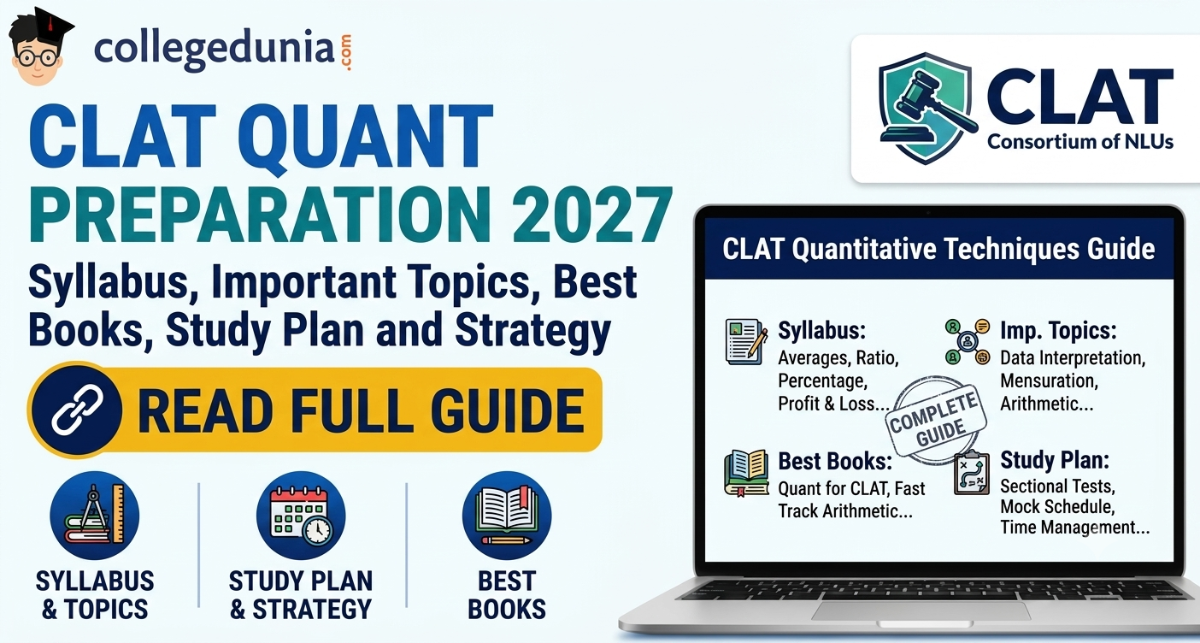
Key Summary
- Quant is around 10% of the CLAT 2027 UG paper, with 10 to 14 questions.
- The section is passage-based data interpretation, not direct maths.
- All questions are at Class 10 level, with no trigonometry or calculus.
- Percentage and ratio are the most repeated topics every year.
- Daily data interpretation practice builds both speed and accuracy.
- Even small gains in Quant can lift your overall CLAT rank.
CLAT 2027 Quantitative Techniques Section Guide (New Section)
Among all sections, the CLAT Quantitative Techniques section is the most misunderstood.
- The CLAT quantitative techniques section is not about complex formulas or higher-level maths.
- It is about interpretation, logical calculation, and working with data under time pressure.
- The CLAT maths syllabus 2027 is designed around real-life numerical situations.
- Instead of direct questions, the CLAT Quantitative Techniques paper presents passages with data in the form of tables, graphs, or caselets.
- Students are required to extract relevant information and apply basic arithmetic concepts to answer questions.
Most students struggle because they are not trained in CLAT data interpretation questions.
Check:
CLAT 2027 Quant Syllabus and Important Topics
The syllabus is based on Class 10 arithmetic. The table below lists the topics that appear most often.
| Topic | Importance |
|---|---|
| Percentages | Very high, asked every year |
| Ratio and Proportion | Very high, asked every year |
| Averages | High |
| Profit and Loss | High |
| Simple and Compound Interest | Moderate |
| Time, Speed and Distance | Moderate |
| Time and Work | Moderate |
| Mixtures and Alligations | Moderate |
| Data Interpretation (tables, graphs, caselets) | Central to the whole section |
| Basic Algebra, Mensuration, Statistics | Low, but do not ignore |
Percentage and ratio form the base of most CLAT Quant questions, so master these two first. There is no trigonometry, calculus, or coordinate geometry in the section.
Check:
- CLAT Exam Pattern: Check CLAT syllabus, Marking Scheme, Exam Mode, Question Paper
- CLAT Syllabus 2026: Download Free PDF, Check Syllabus, Weightage, Books and Preparation
Most Important Quant Topics for CLAT 2027
- Percentages
- Averages
- Ratio & Proportion
- Profit & Loss
- Simple & Compound Interest
- Time, Speed & Distance
- Basic Number Problems
- Data Interpretation (tables, graphs, charts)
DI contributes 60-70 percent of the Quant section.
Check: CLAT Exam Analysis: Check Difficulty Level, Section-Wise Analysis & Expected Cutoff
How to Prepare for Quantitative Techniques for CLAT 2027?
As you all know, the basic step is to prepare well with full focus, dedication, and determination. The first and main step to start the CLAT Quant Preparation is that the candidate must collect all the best study material possible, i.e., best books, notes, question banks, etc., from which you have to study for the CLAT 2027 entrance examination.
- Revise Class 10 arithmetic basics from your NCERT book first.
- Start with percentage and ratio, then link other topics to them.
- Learn key formulas and keep a one-page formula sheet.
- Practise only passage-based questions, not standalone sums.
- Read the data passage fully before you attempt any question.
- Solve daily data sets under a timer to build speed.
- Review each set to fix reading errors and weak topics.
Practise passage-based data sets, not standalone maths problems, since CLAT tests data interpretation.
Tips and Tricks to Attempt CLAT Quantitative Techniques
Below are a few tips to consider while attempting questions from the CLAT quantitative techniques syllabus section:
- Read the passage carefully before attempting the subsequent questions.
- While reading the passage, mark or underline the facts. For instance, information on various speeds of trains in a passage.
- Always keep your rough notes and calculations neat and handy so you can refer to them for later questions.
CLAT Quant Preparation 2027: Data Interpretation Strategy
Almost every CLAT Quant question is data interpretation. Use these focused tips.
- Check the units first, since crore, lakh, and thousand often get mixed up.
- Use the correct base value when you calculate any percentage change.
- Read the question fully, as percentage and percentage points differ.
- Tell cumulative data apart from individual data in tables.
- Underline the exact year or entity the question asks about.
- Solve one full data set daily within a strict time limit.
Most Quant errors come from misreading data, not from weak maths, so slow down while reading the set.
Check:
Why CLAT Quantitative Techniques is Difficult?
- Misconception: Most students believe the CLAT Quant preparation 2027 requires advanced maths. In reality, it requires interpretation.
- Passage-Based Format: Unlike traditional maths, problems are embedded in passages. So, reading and understanding passages are important.
- Time Pressure: Each set requires multiple calculations within a limited time. Hence, practicing more will help you.
- Weak Basics: Students often lack strong arithmetic fundamentals. Strengthen your fundamentals.
- Avoidance: Many students skip this section during preparation, leading to poor performance.
Check: CLAT 2027: How to Score 100+ with a 6-Month Study Plan
CLAT Quant Preparation 2027: Best Books for CLAT 2027 Quant
Use a mix of concept books, official papers, and daily data sets. The table below lists reliable options.
| Book | Use |
|---|---|
| Class 10 NCERT Mathematics | Build strong arithmetic basics |
| Quantitative Aptitude by R.S. Aggarwal | Concept coverage and practice sets |
| Quantitative Techniques for CLAT (coaching modules) | CLAT-style passage practice |
| Data Interpretation practice books | Focused DI set practice |
| CLAT Previous Year Papers and Sample Papers | Real question style and pattern |
Concept books build your base, but CLAT previous year papers and DI sets matter most for this section. Do not rely on direct-formula books alone, since the exam is passage-based.
Check:
CLAT Quant Preparation 2027: Study Plan for CLAT 2027 Quant
A steady daily plan works better than long, rushed sessions. Use the plan below and adjust it to your level.
- Spend 45 to 60 minutes daily on Quant practice.
- Give 15 minutes to concepts and the rest to solving data sets.
- Cover one topic in depth each week, then mix it with older ones.
- Solve two data sets daily under a timer.
- Take one sectional Quant test each week to track accuracy.
- Take one full CLAT mock every week and review it fully.
- Keep an error log and revise it before each mock.
Focus on accuracy first for two months, then build speed in the final months before the exam.
Check:
CLAT Quant Preparation 2027: Common Mistakes to Avoid
Small habits often cost the most marks. Avoid these common errors while preparing for CLAT Quantitative Techniques.
- Do not skip Quant in mock tests just because it has fewer questions.
- Do not practise standalone sums instead of passage-based data sets.
- Do not rush the data passage and misread the numbers.
- Do not confuse percentage with percentage points.
- Do not guess blindly, since negative marking cuts your score.
- Do not ignore percentage and ratio, the top-weightage topics.
Treat Quant as your rank booster, not an optional section, since every mark counts in a close race.
Check:
CLAT Quantitative Techniques Practice Question
Sang-Saath Bank’s employees’ picnic on a river island turned into a disaster as the newly constructed road bridge connecting the island to the riverbank collapsed. Evacuation operations had to be carried out by ferrying the employees from the island across the river and onto the riverbank. One-sixth of the employees were evacuated by villagers in a country boat. Of the remaining, one-fifth were evacuated by fishermen in a trawler. The remaining evacuees were joined by villagers who were helping with the evacuation. Finally, 8 motorboats with 8 people each left the island.
- If half of the motorboats had one villager each and the other half had 2 each, what was the ratio of villagers to employees in the motorboats?
- 1:8
- 3:13
- 3:16
- 2:13
Answer: 2
Rationale: The correct answer is (2). Number of people that left on the 8 motor boats = 8 * 8 = 64 (i) Half of 8 boats had 1 villager each = ½ * 8 * 1 = 4 … (ii) Half of 8 boats had 2 villagers each = ½ * 8 * 2 = 8 … (iii) Therefore, total number of villagers = y = (ii) + (iii) = 4 + 8 = 12 (iv) Therefore, total number of employees in the 8 motor boats = (i) + (iv) = 64 – 12 = 52 (v) Therefore, ratio of villagers to employees in the 8 motor boats = (iv) : (v) = 12:52 = 3:13
- How many employees were evacuated in the trawler?
- 13
- 15
- 12
- 10
Answer: 1
Rationale: Number of employees evacuated by the country boat = x/6 (vi) Remaining employees after country boat evacuation = x – x/6 = 5x/6 (vii) Number of employees evacuated by the trawler = 1/5 * 5x/6 = x/6 (viii) [Note: See Rationale for 1.1 for calculated data] From (v) in
Rationale for 1.1, we know that the number of employees evacuated by the 8 motor boats = 52.
Therefore, 52 = Remaining employees after country boat evacuation - Number of employees evacuated by the trawler, i.e. (vii) – (viii) = 5x/6 – x/6 = 4x/6 = 2x/3 Therefore, x = 52 * 3/2 = 78 = Total number of employees Therefore, the number of employees evacuated by the trawler = 78/6 = 13
- If there were 4 villagers in the country boat, and 6 fishermen in the trawler, and if an equal number of people travelled in each trip; i.e. country boat, trawler, and motorboats, how many people travelled on each trip?
- 10
- 6
- 9
- 8
Answer: 1
Rationale: Total number of employees = 78 [Note: See Rationale for 1.2] Villagers and fishermen in the country boat and trawler = 4 + 6 = 10 Number of villagers in the 8 motor boats = 12 [Note: See (iv) of Rationale for 1.1] Total number of people that travelled = 78 + 12 + 10 = 100 Number of trips = 1 (country boat) + 1 (trawler) + 8 boats = 10 Average number of people travelled by the country boat, trawler and the last 8 boats = 100/10 = 10
- After they reached the shore, 1/3 of the employees took a taxi, half of them took a bus and the remainder took the train. The cost of hiring a 4-seater taxi was Rs.500, the cost of hiring a bus was Rs.5000 and each train ticket was priced at Rs.75. The taxis took a maximum of four passengers each. If the total expenditure on the different modes of transport was Rs.9,475, how many taxis were hired?
- 5
- 6
- 7
- 8
Answer: 3
Rationale: Total number of employees = 78 [Note: See Rationale for 1.2] Number of employees that took a taxi = 1/3 * 78 = 26 Since each taxi is only a 4-seater, the number of taxis needed = 26/4 = 6 1/2 Therefore, number of taxis hired = 7
- The total number of employees in Sang-Saath Bank is 4.5 times the number that went on the picnic. The Securities department of the bank consists of 4/9 of the total number of employees. The percentage of Sang-Saath Bank’s employees in the Securities department is:
- Between 45% - 50% of the total number of employees in the bank
- Between 40% - 45% of the total number of employees in the bank
- More than 50% of the total number of employees in the bank
- Less than 40% of the total number of employees in the bank
Answer: 2
Rationale: Total number of employees evacuated = 78 [Note: See Rationale for 1.2] Total number of employees in the bank = 4.5 * 78 = 351 Number of employees in securities = 4/9 * 351 = 156 Percentage of people in Securities = 156/351 * 100 = 44.44%.
CLAT Question Paper with Answer Key and Solution PDF
| CLAT Paper | Download PDF | Detailed Solution |
|---|---|---|
| CLAT 2026 Question Paper with Answer Key Set A | Download | Check Solution |
| CLAT 2026 Question Paper with Answer Key Set B | Download | Check Solution |
| CLAT 2026 Question Paper with Answer Key Set C | Download | Check Solution |
| CLAT 2026 Question Paper with Answer Key Set D | Download | Check Solution |
CLAT 2027 Quant FAQs
Ques. What is the weightage of Quant in CLAT 2027?
Ans. Quantitative Techniques carries around 10% weightage in the CLAT 2027 UG paper. It has about 10 to 14 questions.
Ques. Is CLAT Quant based on advanced maths?
Ans. No. The section is based on Class 10 maths. It has no trigonometry, calculus, or coordinate geometry.
Ques. How many passages are there in CLAT Quant?
Ans. The section has 3 to 4 data passages. Each passage is followed by a set of questions based on the data.
Ques. Which are the most important topics in CLAT Quant?
Ans. Percentage and ratio are the top topics, asked every year. Averages, profit and loss, and interest also appear often.
Ques. Is CLAT Quant a scoring section?
Ans. Yes. It is one of the most scoring sections with focused practice. Many students move from 7 to 12 marks with two months of DI practice.
Ques. Which are the best books for CLAT 2027 Quant?
Ans. Use Class 10 NCERT maths, R.S. Aggarwal, and CLAT coaching modules. Pair them with previous year papers and DI sets.
Ques. Can I use a calculator in CLAT?
Ans. No. CLAT is an offline exam and does not allow calculators. Practise quick mental calculation for speed.
Ques. Is there negative marking in CLAT Quant?
Ans. Yes. You get 1 mark for a correct answer and lose 0.25 mark for a wrong one. Avoid blind guessing.
Ques. Should I skip Quant if I am weak in maths?
Ans. No. Skipping Quant can lower your rank. The section is Class 10 level and improves fast with daily practice.
Ques. Can I prepare CLAT Quant in two months?
Ans. Yes. Two months of daily data set practice is enough to improve. Focus on accuracy first, then build speed.



Comments