




Consortium of National Law Universities (NLUs) conducts CLAT counselling for admissions to 5-year integrated LLB and LLM programmes across 27 NLUs. CLAT 2027 Counselling registration is expected in mid-December 2026. Last year, the CLAT Counselling registration was held from December 17 to December 27, 2026.
- CLAT Counselling is an online registration process with 5 counselling rounds based on the previous year's admission schedule.
- CLAT counselling process includes registration, NLU preference, seat allotment, seat acceptance, document verification and fee payment.
- Candidates who have received an invitation for the counselling process via email/SMS after result will only be able to take part in CLAT Counselling.
- For UG admission, candidates must fill out a minimum of 15 NLU preferences. You can provide more preferences also.
- Candidates can update the preferences until the CLAT counselling registration deadline.
- Documents required during CLAT 2027 Counselling include CLAT admit card, scorecard, Class 10 and 12 marksheets, valid photo ID and TC certificate. You need to upload scanned copies of the documents.
- The CLAT Counselling fee is INR 30000 for General and INR 20000 for ST/SC/OBC/BC/EWS/PWD candidates.
- The CLAT Seat allotment list is prepared based on candidates' rank, preference and seat availability.
- During the CLAT Seat Allotment round, each allotted student can Freeze (accept and exit), Float (accept and upgrade), or Exit (withdraw).
In the previous year, the Last Round (5) of CLAT Counselling process took place on May 15, 2026.
Related Links:
- CLAT Cutoff: Check Category-Wise Cutoff for top NLUs, Percentile & Previous Year Cutoff
- CLAT College Predictor: Predict your NLU Opening and Closing Ranks, Marks vs Ranks, Course and Seats

Key Summary
- The detailed CLAT Counselling 2027 dates and fee structure will be announced by the Consortium of NLUs in December 2026.
- Consortium of NLUs releases CLAT Seat Allotment based on rank, NLU preferences, seat matrix and applicable reservation/category rules.
- If a candidate has chosen only fifteen preferences, then he/she will be considered only for allotment in those fifteen preferences and not to any other NLUs.
- Candidates should note that they can only move up to higher preferences and can not go down in the preferences given during editing.
- Requests for change of preferences after the last date of registration are not accepted.
CLAT Counselling 2027 Dates
The official CLAT Counselling 2027 schedule is yet to be released. Candidates should regularly check the Consortium's official website after the result is published. The expected dates for CLAT Counselling 2027 are tabulated below:
| Particular | CLAT 2027 Counselling Dates | CLAT 2026 Schedule |
|---|---|---|
| CLAT Counselling Registration | December 2027 | December 17- 27, 2026 |
| CLAT Publication of First Allotment List | January 2027 | January 7, 2026 |
| Payment of Confirmation Fee to Consortium for Freeze and Float options and Admission by NLUs for the First Allotment List | January 2027 | January 7- 15, 2026 |
| CLAT Publication of Second Allotment List | January 2027 | January 22, 2026 |
| Payment of Confirmation Fee to Consortium for Freeze and Float options and Admission by NLUs for the Second Allotment List | January 2027 | January 22- 29, 2026 |
| CLAT Publication of Third Allotment List | February 2027 | February 5, 2026 |
| Payment of Confirmation Fee to Consortium for Freeze and Float options and Admission by NLUs for the Third Allotment List | February 2027 | February 5- 12, 2026 |
| CLAT Publication of Fourth Allotment List | May 2027 | May 2, 2026 |
| Payment of Confirmation Fee to Consortium for Freeze and Float options and Admission by NLUs for the Fourth Allotment List | May 2027 | May 2- 8, 2026 |
| Publication of Fifth and Final Allotment List | May 2027 | May 15, 2026 |
| Payment of Confirmation Fee to Consortium for Freeze option and Admission by NLUs for the Fifth and Final Allotment List | May 2027 | May 15- 20, 2026 |
Also Check: CLAT Merit List: Merit List Out, Download PDF, Category Wise List and Tie Breaking Rules
Ques. Can I change my NLU preference after submitting counselling registration?
Ans. Changes are allowed only until the counselling registration/preference-editing deadline specified by the Consortium. Requests after the deadline are generally not accepted under the published instructions.
CLAT Counselling Registration 2027
Candidates invited for counselling will be able to register through their CLAT candidate account.
The Consortium sent counselling invitations through:
- Registered email ID
- Registered mobile number
- CLAT candidate portal
How to Register for CLAT Counselling 2027?
Candidates can follow these steps once the CLAT 2027 counselling portal opens:
- Step 1: Visit the official CLAT website.
- Step 2: Open the CLAT 2027 candidate login.
- Step 3: Enter the required login credentials.
- Step 4: Check whether the counselling invitation is available.
- Step 5: Click on the counselling registration option.
- Step 6: Review the participating NLU programmes and seat matrix.
- Step 7: Fill upto 15 NLU preferences.
- Step 8: Pay the applicable counselling registration fee online.
- Step 9: Wait for the payment confirmation.
- Step 10: Submit the counselling registration before the deadline.
- Step 11: Keep the payment receipt and registration details for future reference.
Also Check: CLAT PSU Recruitment 2026: 15+ PSUs via CLAT, List of PSUs, Rank Cutoff and How to Apply
Ques. What happens if I do not select Freeze, Float or Exit?
Ans. If a candidate fails to exercise the applicable option within the deadline, the candidature can be treated as not interested, resulting in loss of the allotted seat and removal from subsequent counselling rounds under the latest rules.
Who Can Register for CLAT 2027 Counselling?
To participate in CLAT counselling and secure admission at an NLU, students had to meet two separate eligibility requirements:
- Appear in the CLAT 2027 exam and have a valid rank
- Second, an academic-marks threshold verified during document checking at the NLU
| Parameters | Details |
|---|---|
| Educational Qualification | Must have passed 10+2 or an equivalent examination from a recognised national or state board. |
| Minimum Marks (General/OBC/NRI/PIO/OCI) | 45% marks in 10+ 2 |
| Minimum Marks (SC/ST/PwD) | 40% marks in 10+ 2 |
| Appearing Candidates | Students appearing for their Class 12 board exams in March/April 2027 are eligible to apply (must submit proof of passing at the time of admission) |
| Academic Stream | Open to students from all academic backgrounds |
| Age Limit | No upper age limit for appearing in CLAT UG |
| CLAT 2027 Exam | Students who appeared in and received a rank in CLAT 2027 were eligible to register for counselling |
Also Check: CLAT Seat Allotment: How to Check, Freeze Float Exit and Reporting Documents
Ques. Can I choose Float in the fifth round of CLAT counselling?
Ans. Under the CLAT instructions, Float was available only up to the fourth round. The fifth round was the final round, so candidates had to choose Freeze or Exit. The CLAT 2027 rules should be checked when published.
CLAT Counselling Fee 2027
Consortium will confirm the CLAT Counselling fee 2027 on the portal. The category-wise CLAT Counselling fee 2027 is tabulated below based on previous years' data:
| Category | Fee |
|---|---|
| General | INR 30000 |
| SC/ST/OBC/BC/EWS/PwD | INR 20000 |
CLAT Counselling 2027 Refund Rules
The CLAT Counselling refund policy varies depending on the conditions. Check out the details below:
| Situation | Refund |
|---|---|
| No seat allotted even after the 5th round OR Exit without choosing Freeze/Float | Full refund |
| Seat allotted (Freeze/Float till 4th round) Exit before May 2027 | Full refund |
| Seat allotted (Freeze/Float till 4th round) | INR 5000 deducted |
| Found ineligible by NLU (document verification) | INR 5000 deducted |
| Allotted seat for the first time in 5th round but does not join | Full refund |
| Took admission (Freeze) but withdrew after May 2027 | INR 5000 deducted + Confirmation Fee forfeited |
| Confirmation Fee (in all cases of Exit / non-payment / ineligibility) | Not refunded |
Also Check: CLAT 2027: Is 90 Marks a Safe Score for General Category?
Ques. What documents are required for CLAT UG counselling?
Ans. Candidates should keep their Class 10 and Class 12 marks statements, CLAT admit card, character/conduct certificate, transfer/migration certificate and applicable category, domicile, PwD or other supporting certificates ready.
CLAT Counselling 2027 Seat Allotment Process
CLAT Seat allotment is based on the following factors:
- The candidate’s CLAT rank
- Reservation for different categories
- Preferences chosen during choice locking
- Availability of seats in the desired law colleges
How to Check CLAT 2026 Counselling and Seat Allotment Results
Steps to check the CLAT Counselling and seat allotment results are discussed below:
- Step 1: Visit the official NLU counselling portal, consortiumofnlus.ac.in
- Step 2: Log in using your credentials.
- Step 3: Click on the “Seat Allotment Result” tab.
- Step 4: Download and print the allotment letter for future reference.
Related Links:
- CLAT 2027 Seat Matrix: NLU-Wise Total Seats and Category-Wise Reservation
- CLAT 2027 NLSIU Bangalore Expected Cutoff: Category-Wise Closing Rank
Ques. What happens if I fail to pay the NLU fee after Freeze?
Ans. Under the CLAT 2026 instructions, failure to pay the balance university fee resulted in loss of the seat and forfeiture of the confirmation fee, with the counselling registration fee refunded after the specified deduction.
CLAT Counselling 2027 NLU Preference List
The NLU preference list is an important part of CLAT counselling because the provisional list is prepared based on the preferences.
CLAT Counselling NLU Preference List: Key Takeaways
The following points should be considered while filling out your CLAT NLU preference list:
- UG candidates had to provide a minimum of 15 NLU preferences.
- Candidates could provide additional preferences.
- The allotment list is prepared based on candidates' chosen NLUs in their preference list.
- Preferences could be updated multiple times before counselling registration closed.
- Requests for changing preferences after the deadline were not accepted.
- Candidates could move to a higher preference but could not be moved to a lower preference in their submitted order.
Strategy to Use While Filling CLAT NLU Preferences
- Check the courses offered by each NLU.
- Review the NLU seat matrix.
- Check category-wise eligibility and reservation rules.
- Compare the available programmes.
- Arrange preferred NLUs in the desired order because you cannot move to lower preference
- Recheck the preference order before the registration deadline.
- Include enough preferences to keep more allotment possibilities open.
- Save the final preference list.
Related Links:
- CLAT 2027 Colleges Under Rank 500: NLUs You Can Target
- CLAT 2027 Cutoff for NLSIU Bangalore: Category-Wise Closing Rank
Ques. Is CLAT seat allotment final?
Ans. Seat allotment by the Consortium is provisional and subject to final verification and validation by the concerned NLU.
CLAT Counselling Rounds 2027
CLAT Counselling is an online registration process with 5 counselling rounds based on the previous year's admission schedule. The CLAT Round One seat allotment will be published in January 2027.
Last year, the CLAT counselling Round One seat allotment list was published on January 7, 2026.
| CLAT Counselling Round | What Happens |
|---|---|
| Round 1 | First provisional allotment; highest-ranked students received their top-preference NLUs. |
| Round 2 | Float students from Round 1 were automatically upgraded if a higher-preference NLU became available. Seats vacated by Round 1. |
| Round 3 | Final primary round. Students who froze after this round had to pay the NLU fee to complete admission |
| Round 4 | Vacancy-filling round; seats freed after non-payment in Rounds 1- 3. |
| Round 5 | Final allotment of CLAT 2027. The central admission process conducted by the Consortium will be closed. Member NLUs, however, may thereafter admit candidates to fill remaining vacant seats, if any, by following their prescribed norms |
Also Check: CLAT 2027 NALSAR Hyderabad Expected Cutoff: Category-wise Rank and Score
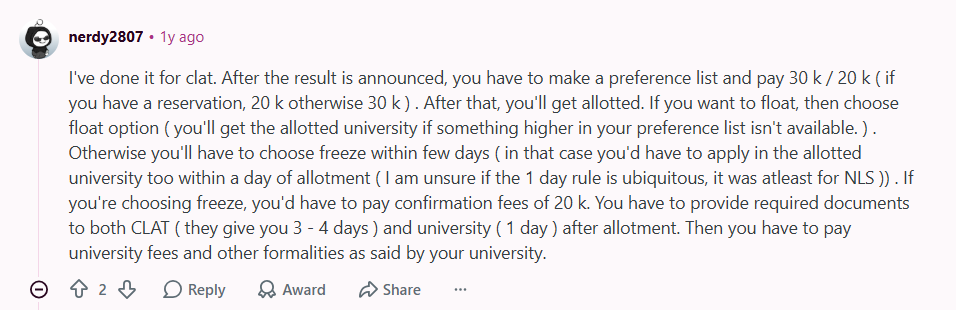
In a Reddit discussion, a user asked how the CLAT Counselling process works.
Based on that, a user replied that after the result is announced, you have to make a preference list and pay INR 30000 or INR 20000 based on your category. After that, you will be allotted. If you want to float, then choose the float option, and you'll get the allotted university if something higher on your preference list is not available. Otherwise, you'll have to choose to freeze within a few days. In that case, you have to apply to the allotted university too, within a day of allotment. If you're choosing to freeze, you would have to pay confirmation fees. You have to provide the required documents and have to pay the university fees, and complete other formalities as said by your university.
Source: Reddit
Ques. Is the CLAT counselling registration fee refundable?
Ans. The refund depends on the candidate's counselling status and the applicable refund conditions. Candidates should read the CLAT 2027 counselling notification before assuming that the entire fee will be refunded.
CLAT Counselling 2027: Freeze, Float and Exit Options
CLAT Counselling, every student who received a seat had to choose one of three options within the confirmation window.
| Option | Meaning | Further Counselling |
|---|---|---|
| Freeze | If the candidate is satisfied with the allotted seat, accepts it, and is not interested in participating in further rounds of seat allocation/ counselling, they may ‘Freeze’ the seat allocation | No |
| Float | Accept the current seat while remaining eligible for a higher-preference NLU in subsequent rounds | Yes, where permitted |
| Exit | Left the counselling process | No |
What is Freeze in CLAT Counselling 2027?
- Freeze means that the candidate accepts the allotted NLU.
- The candidate does not wish to participate in further seat allotment rounds.
- The applicable confirmation fee must be paid within the prescribed deadline.
- The candidate must subsequently pay the remaining university fee to the allotted NLU.
What is Float in CLAT Counselling?
- Float allows a candidate to keep the currently allotted seat while having chances for a better seat through upgradation.
- The candidate must pay the applicable confirmation fee within the specified deadline.
- If a higher-preference NLU is allotted later, the candidate moves to that NLU.
- Once moved to a higher preference, the candidate cannot return to the previously allotted NLU.
What is Exit in CLAT Counselling?
- Exit means leaving the counselling process.
- No further seat is allotted after choosing Exit.
- The candidate will be out of the CLAT counselling process
What Happens If a Candidate Does Not Select Freeze, Float or Exit?
If a candidate who participated in the CLAT Counselling and fails to choose between Freeze, Float or Exit, then
- The candidate loses the currently allotted seat.
- The candidature is removed from the counselling process.
- The candidate is not considered in subsequent allotment lists as per the latest notification
Also Check:
Documents Required for CLAT Counselling 2027
You should keep scanned copies of the required documents ready before CLAT 2027 counselling.
- CLAT 2027 Admit Card
- CLAT 2027 Scorecard
- Class 10 marks statement
- Class 12 marks statement
- Character/Conduct certificate
- Transfer/Migration certificate
- Caste certificate, if applicable
- PwD/SAP certificate, if applicable
- Domicile/Residence certificate, if applicable
- EWS certificate, if applicable
Also Check: CLAT 2027 Expected Cutoff for NLU Jodhpur and NLIU Bhopal
Ques. What happens if I am not allotted a seat in the first CLAT counselling round?
Ans. Candidates who are not allotted a seat in a particular round can wait for the next round, provided they remain eligible and have completed the required counselling process.
CLAT Counselling 2027 Fee Payment at Allotted NLU
After choosing the Freeze option, candidates must complete the remaining fee payment to the allotted NLU within the specified date. The process includes:
Step 1: Pay the University Fee to Your Allotted NLU
- Students who froze their seat in Rounds 1, 2, or 3 must pay the annual tuition and hostel fee directly to the NLU by April 2027, based on the trend.
- Students who froze in Rounds 4 or 5 had to pay the NLU fee by May, 2027. The exact date will be notified later.
- The seat confirmation fee already paid to the Consortium will be adjusted against the NLU fee.
- Non-payment of the NLU fee by a candidate within the deadline will cancel the admission, and the seat will become vacant for the next round.
Step 2: Report to the NLU Campus
- Each NLU sets its own campus reporting date and schedule. Visit your respective NLU’s official website for its reporting date and instructions.
- Bring original copies of all required documents (the same list as the online upload) along with self-attested photocopies and any additional documents specified by the NLU for in-person document verification.
- Class 12 students who received a provisional allotment and were awaiting board results need to show their final mark sheets now. Failure to show the board result will cancel the admission process.
Step 3: Document Verification and Complete Enrolment
- NLU officials verify all original documents against the scanned copies uploaded during online counselling.
- Any discrepancy, such as a name mismatch, an invalid category certificate, or marks below the minimum eligibility criteria will cancel your candidature.
- Students whose documents were found complete and correct were cleared to proceed to enrolment.
Related Link: CLAT 2027 NLSIU Bangalore Expected Cutoff: Category-Wise Closing Rank
Ques. Can I get an NLU that is not in my preference list?
CLAT Counselling 2027: Keynotes
Candidates should follow these points throughout CLAT counselling:
- Check the registered email ID and mobile number regularly.
- Log in to the CLAT portal frequently.
- Verify every counselling invitation.
- Complete registration before the deadline.
- Review the NLU preference list carefully.
- Do not select an NLU casually because preference order affects allotment.
- Keep all original documents ready for admission.
- Upload clear and valid documents wherever required.
- Pay the confirmation fee within the specified deadline.
- Do not miss the deadline for selecting Freeze, Float or Exit.
- Complete the remaining university fee payment after Freeze.
- Check the admission instructions issued by the allotted NLU.
- Keep payment receipts and allotment letters safely.
- Do not assume that allotment automatically confirms final admission. The final admission is completed after physically reporting to the allotted NLU, verification of documents and paying the admission fee.
CLAT 2027 Seat Matrix of Participating NLUs
The seat matrix for 27 participating NLUs has been tabulated below for the CLAT UG programme.
| NLUs | Seat Intake Capacity |
|---|---|
| NLSIU Bangalore | 310 |
| NALSAR Hyderabad | 132 |
| NLIU Bhopal | 202 (BA + B.Sc LLB) |
| WBNUJS Kolkata | 182 (BA + B.Sc LLB) |
| NLU Jodhpur | 196 (BA + BBA LLB) |
| MNLU Nagpur | 240 |
| NUSRL Ranchi | 201 (BA + BBA LLB) |
| RMLNLU Lucknow | 191 |
| RGNUL Punjab | 180 |
| HNLU Raipur | 180 |
| NLUO Odisha | 180 (BA + BBA LLB) |
| HPNLU Shimla | 180 (BA + BBA LLB) |
| IIULER Goa | 180 (BA + BBA LLB) |
| GNLU Gandhinagar | 172 |
| CNLU Patna | 138 (BA + BBA LLB) |
| DSNLU Visakhapatnam | 132 |
| NLUJA Assam | 120 |
| TNNLU Tiruchirappalli | 120 (BA + B.Com LLB) |
| MNLU Aurangabad | 120 |
| DNLU Jabalpur | 120 |
| DBRANLU Haryana | 120 |
| MNLU Mumbai | 100 |
| GNLU Silvassa | 66 |
| NUALS Kochi | 60 |
| NLUT Agartala | 60 |
| RPNLUP Prayagraj | 60 |
| NLU Meghalaya | 60 |
Related Link: List of Top Colleges in India Accepting CLAT
Ques. Can an NLU reject my admission after seat allotment?
Ans. Yes. The concerned NLU can reject admission if discrepancies are found during verification or if the candidate does not satisfy the applicable admission requirements.
CLAT 2027 Expected Cutoff
The table below shows the expected CLAT 2027 Cutoff marks vs. the rank required to get into NLUs for the integrated law course.
For the top 10 NLUs, a safe score range is usually 80- 100 marks out of 120 for the General category.
| Marks | Expected Rank | NLU Tier | Chances |
|---|---|---|---|
| 95+ | 1- 300 | Tier 1(NLSU Bangalore, NALSAR Hyderabad) | Very High |
| 90- 95 | 301- 600 | Top 5 NLUs | High |
| 85- 90 | 601- 1700 | Top 10 NLUs | Good |
| 80- 85 | 1701- 3000 | Mid-tier NLUs | Moderate |
| 75- 80 | 3501- 6300 | Newer NLUs | Fair |
| Below 75 | 6301+ | Lower NLUs | Limited |

Category-wise Minimum CLAT 2027 Cutoff Marks (Expected)
The expected category-wise minimum CLAT 2027 cutoff marks are tabulated below based on past years' trends:
| Category | Qualifying Marks |
|---|---|
| General | 95- 100 |
| EWS | 90- 95 |
| OBC | 88- 94 |
| SC | 75- 85 |
| ST | 65- 75 |
Watch the YouTube video by “Adda247 CLAT Preparation” to learn about the expected marks vs. rank for CLAT 2027.
Also Check:
CLAT Counselling 2027 FAQs
Ques. When will CLAT Counselling 2027 start?
Ans. The exact CLAT Counselling 2027 dates will be announced by the. Candidates should check the official CLAT website and candidate portal for the counselling notification.
Ques. Who conducts CLAT Counselling 2027?
Ans. The Consortium of National Law Universities conducts the centralised CLAT counselling process for participating NLUs.
Ques. Who can participate in CLAT Counselling 2027?
Ans. Candidates who are invited by the Consortium based on the applicable CLAT rank list and NLU admission matrix can participate in counselling.
Ques. Is CLAT counselling registration compulsory for seat allotment?
Ans. Yes. Candidates who are invited for counselling must complete the prescribed registration process to be considered for seat allotment.
Ques. How do I register for CLAT Counselling 2027?
Ans. Log in to the CLAT candidate portal, check the counselling invitation, update NLU preferences and pay the applicable counselling registration fee before the deadline.
Ques. What is the CLAT Counselling 2027 registration fee?
Ans. The CLAT 2027 counselling fee will be announced officially. For reference, the CLAT 2026 fee was INR 30000 for General candidates and INR 20000 for SC/ST/OBC/BC/EWS/PwD categories.
Ques. How many NLU preferences should I fill in CLAT counselling?
Ans. The applicable minimum may be specified in the CLAT 2027 counselling notification. Candidates have to provide at least 15 preferences for UG and 5 for PG.
Ques. Does CLAT counselling guarantee admission?
Ans. No. Completing counselling registration does not guarantee admission. Seat allotment depends on the applicable merit, preferences, seat availability and admission rules, and final admission is subject to verification by the concerned NLU.
Ques. Where can I check the CLAT Counselling 2027 allotment list?
Ans. Candidates should check the official CLAT candidate portal and website for the CLAT 2027 allotment lists and counselling notifications.
Ques. How many CLAT counselling rounds will be conducted in 2027?
Ans. The exact number of CLAT 2027 counselling rounds will be confirmed by the Consortium. CLAT usually has five centralised counselling rounds, including a fifth and final allotment round.



Comments
Found 2 Comments
CLAT cut-off is released seprately for the participating institutes. You must check the opening and closing ranks of the institute you are interested in. If you have met the cut-off, you can register and participate in the counseling.