




COMEDK Chemistry Syllabus 2027 covers Class 11 and 12 Chemistry topics based on the CBSE curriculum. The official COMEDK Chemistry 2027 syllabus is expected to be released along with the notification in January 2027.
| COMEDK Chemistry Syllabus 2027 PDF (To be Updated) |
COMEDK UGET Chemistry section carries 60 multiple-choice questions (MCQs) for 60 marks.
- COMEDK Chemistry syllabus covers 33% from Class 11 and 67% from Class 12 CBSE curriculum.
- Important Class 11 topics for COMEDK 2027 Chemistry are Chemical Bonding and Molecular Structure, Thermodynamics, and Organic Chemistry fundamentals.
- COMEDK Chemistry Class 12 topics are Coordination Compounds, Haloalkanes and Haloarenes, Alcohols, Phenols, and Ethers and Block Elements.
- High-priority COMEDK Chemistry topics include Organic Chemistry, Coordination Compounds, and d- and f-block elements. These topics cover approx. 23 to 30 questions.
- There is no negative marking as per the COMEDK UGET marking scheme. Each correct answer carries one mark, so candidates should aim to attempt all questions within the available time.
Related Links:
- COMEDK UGET Exam Pattern 2027: Total Questions, Total Marks, Weightage, Marking Scheme and Preparation Tips
- COMEDK UGET Syllabus 2027: PDF Download, Subject-Wise Topics, Weightage, and Best Books
Key Summary
- COMEDK Chemistry syllabus 2027 includes theoretical concepts, numerical problems, chemical reactions, and application-based MCQs from Classes 11 and 12.
- Candidates should prioritise conceptual clarity, reaction mechanisms, formula application, and regular numerical practice.
- NCERT Chemistry textbooks for Classes 11 and 12 are useful for building fundamentals and revising core concepts.
- Revise important chemical reactions, named reactions, formulas, periodic trends, chemical bonding concepts, and inorganic chemistry facts regularly.
- Candidates should check the official COMEDK website for the final 2027 syllabus and any changes to the examination pattern.
COMEDK Chemistry Syllabus 2027: Highlights
COMEDK Chemistry syllabus 2027 is based on the latest CBSE curriculum of classes 11 and 12.
| Classes | Key Topics | Weightage (approx.) |
|---|---|---|
| Class 11 | Some Basic Concepts of Chemistry, Atomic Structure, Periodicity, Chemical Bonding, Thermodynamics, Equilibrium, Redox Reactions, Organic Chemistry, Hydrocarbons | 33% |
| Class 12 | Solutions, Electrochemistry, Chemical Kinetics, Coordination Compounds, d- and f-Block Elements, Organic Compounds, Biomolecules | 67% |
Related Link: COMEDK UGET Previous Year Question Papers 2027: Check Year Wise and Subject Wise Papers
Ques. Is the COMEDK Chemistry syllabus 2027 released?
Ans. The official COMEDK Chemistry syllabus 2027 has not yet been released. Candidates can refer to the latest available syllabus (aligned with recent years) and check the official COMEDK website for updates.
COMEDK Chemistry Syllabus 2027: Class 11 Topics
The following table lists the COMEDK Chemistry syllabus 2027 with key topics from Class 11 that you should cover for each unit.
| Unit | Key Topics |
|---|---|
| Some Basic Concepts of Chemistry | Nature of matter, laws of chemical combination, Dalton’s atomic theory, atomic and molecular masses, mole concept, molar mass, empirical and molecular formulae, percentage composition, chemical reactions and stoichiometry |
| Structure of Atom | Discovery of subatomic particles, atomic number, isotopes and isobars, Thomson’s and Rutherford’s models, Bohr’s model, shells and subshells, dual nature of matter, de Broglie relationship, Heisenberg uncertainty principle, orbitals, quantum numbers, electronic configuration, Aufbau principle, Pauli’s exclusion principle and Hund’s rule |
| Classification of Elements and Periodicity in Properties | Modern periodic law, periodic table, atomic and ionic radii, ionisation enthalpy, electron gain enthalpy, electronegativity, valency and nomenclature of elements with atomic numbers greater than 100 |
| Chemical Bonding and Molecular Structure | Ionic and covalent bonds, Lewis structures, bond parameters, polarity, valence bond theory, resonance, VSEPR theory, molecular geometry, hybridisation, molecular orbital theory and hydrogen bonding |
| Chemical Thermodynamics | Systems and surroundings, heat, work, energy, state functions, internal energy, enthalpy, first law of thermodynamics, heat capacity, Hess’s law, enthalpy changes, entropy, Gibbs energy, spontaneity and equilibrium |
| Equilibrium | Physical and chemical equilibrium, law of mass action, equilibrium constants, Le Chatelier’s principle, ionic equilibrium, acids and bases, pH, degree of ionisation, salt hydrolysis, buffer solutions, Henderson equation, solubility product and common-ion effect |
| Redox Reactions | Oxidation and reduction, redox reactions, oxidation numbers, balancing redox equations using electron transfer and oxidation-number changes, and applications of redox reactions |
| Organic Chemistry- Some Basic Principles and Techniques | Purification methods, qualitative and quantitative analysis, classification and IUPAC nomenclature, inductive and electromeric effects, resonance, hyperconjugation, homolytic and heterolytic bond fission, free radicals, carbocations, carbanions, electrophiles, nucleophiles and types of organic reactions |
| Hydrocarbons | Classification of hydrocarbons; alkanes, alkenes and alkynes; nomenclature, isomerism, physical properties, preparation and chemical reactions; Markovnikov’s rule, peroxide effect, ozonolysis, aromaticity, benzene reactions, electrophilic substitution, Friedel- Crafts reactions and directing effects of functional groups |
Related Link: COMEDK Chapter Wise Weightage: Check Subject-Wise Weightage, Paper Analysis
Ques. Is the COMEDK Chemistry syllabus based on NCERT?
Ans. Yes, the COMEDK Chemistry syllabus is broadly aligned with the Class 11 and Class 12 Chemistry curriculum. NCERT textbooks are highly useful for understanding concepts, reactions, and revising important topics.
COMEDK Chemistry Syllabus 2027: Class 12 Topics
The following table lists the COMEDK Chemistry syllabus 2027 with key topics from Class 12 that you should cover for each unit.
| Unit | Key Topics |
|---|---|
| Solutions | Types of solutions, concentration terms, solubility of gases in liquids, solid solutions, Raoult’s law, colligative properties, relative lowering of vapour pressure, elevation of boiling point, depression of freezing point, osmotic pressure, molecular mass determination and van’t Hoff factor |
| Electrochemistry | Redox reactions, EMF of a cell, standard electrode potential, Nernst equation, Gibbs energy and cell EMF, electrolytic conductance, specific and molar conductivity, Kohlrausch’s law, electrolysis, galvanic cells, dry cells, lead accumulators, fuel cells and corrosion |
| Chemical Kinetics | Average and instantaneous reaction rates, factors affecting reaction rates, order and molecularity, rate law, rate constant, integrated rate equations, half-life of zero- and first-order reactions, collision theory, activation energy and Arrhenius equation |
| d- and f-Block Elements | Electronic configurations, occurrence and properties of transition metals, oxidation states, ionic radii, colour, catalytic and magnetic properties, interstitial compounds, alloys, preparation and properties of potassium dichromate and potassium permanganate, lanthanoids, actinoids and lanthanoid contraction |
| Coordination Compounds | Ligands, coordination number, nomenclature, shapes, colour, magnetic properties, Werner’s theory, valence bond theory, crystal field theory, bonding, structural and stereoisomerism, and applications in qualitative analysis, metal extraction and biological systems |
| Haloalkanes and Haloarenes | Nomenclature, carbon- halogen bond, physical and chemical properties, optical rotation, substitution reactions, directing influence of halogens in monosubstituted compounds, and uses and environmental effects of selected halogen-containing compounds |
| Alcohols, Phenols and Ethers | Nomenclature, preparation, physical and chemical properties, identification of primary, secondary and tertiary alcohols, dehydration, acidic nature of phenols, electrophilic substitution reactions and properties and uses of ethers |
| Aldehydes, Ketones and Carboxylic Acids | Nomenclature, carbonyl group, preparation methods, physical and chemical properties, nucleophilic addition, alpha-hydrogen reactivity in aldehydes, acidity, and preparation and uses of carboxylic acids |
| Amines | Classification, nomenclature, structure, preparation, physical and chemical properties, identification of primary, secondary and tertiary amines, diazonium salt preparation and reactions |
| Biomolecules | Carbohydrates, glucose, fructose, sucrose, lactose, maltose, starch, cellulose, glycogen, amino acids, peptide bonds, protein structures, denaturation, enzymes, hormones, vitamins, DNA and RNA |
Related Link: COMEDK UGET Paper Analysis: Check Question Paper PDF, Expected Analysis & Subject-Wise Difficulty
On a discussion forum on Reddit, a user asked whether NCERT is enough for COMEDK Chemistry. As per the response, NCERT is enough to prepare for COMEDK Chemistry. But you are also advised to practice questions as per JEE Main PYQs for better understanding and to solve tricky questions.
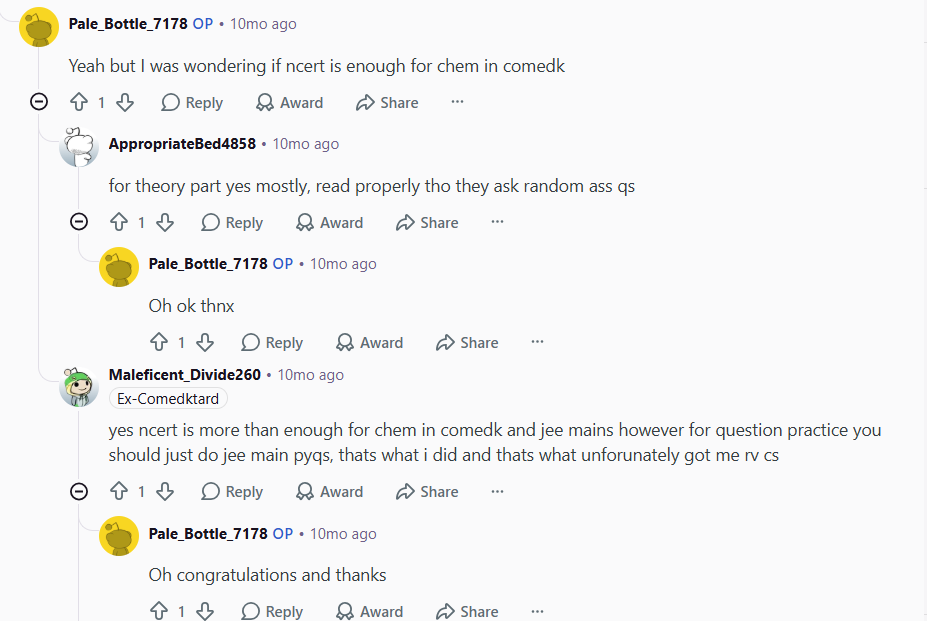
Source: Reddit
Ques. Which chapters are most important for COMEDK Chemistry 2027?
Ans. Organic Chemistry (GOC, Hydrocarbons, Carbonyl compounds, Alcohols, Amines), Chemical Bonding, Coordination Compounds, Thermodynamics, Equilibrium, Chemical Kinetics, d- and f-Block Elements, and Electrochemistry are important areas. The actual number of questions from each chapter may vary.
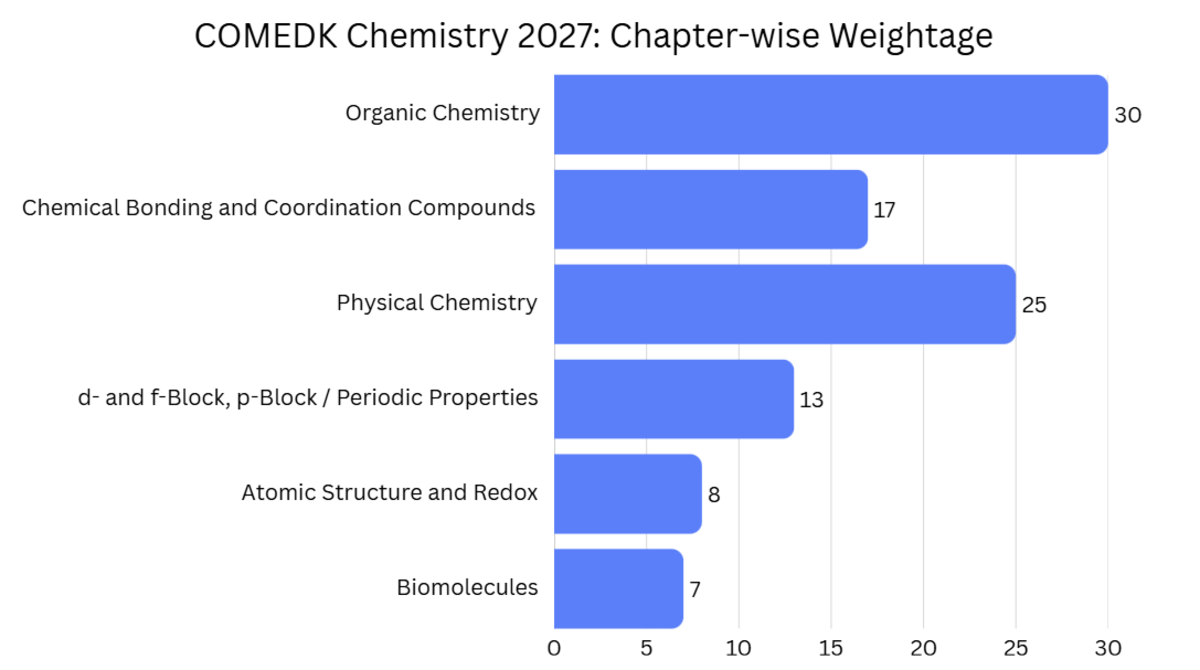
COMEDK Chemistry 2027: Chapter-wise Weightage Based on Trends
The chapter-wise weightage for COMEDK Chemistry topics has been tabulated below based on past years' trend analysis:
| Topics | Expected Number of Questions | Weightage (%) | Priority |
|---|---|---|---|
| Organic Chemistry (GOC, Hydrocarbons, Haloalkanes, Alcohols/Phenols/Ethers, Carbonyls, Amines, Biomolecules) | 12- 18 | 20- 30 | High |
| Chemical Bonding and Coordination Compounds | 6- 10 | 10- 17 | High |
| Physical Chemistry (Thermodynamics, Equilibrium, Kinetics, Electrochemistry, Solutions, Mole Concept) | 10- 15 | 20- 25 | High |
| d- and f-Block, p-Block / Periodic Properties | 5- 8 | 8- 13 | High |
| Atomic Structure and Redox | 3- 5 | 5- 8 | Moderate |
| Biomolecules | 2- 4 | 3- 7 | Low to Moderate |
Related Link: COMEDK Application Process 2027: Registration Date, Direct Link, Application Fee, How to Register
Ques. Which Class 11 Chemistry chapters are important for COMEDK UGET?
Ans. Important Class 11 Chemistry topics include Chemical Bonding, Thermodynamics, Equilibrium, Some Basic Concepts (Mole Concept), Structure of Atom, and Organic Chemistry basics (including Hydrocarbons). Candidates should also cover the remaining prescribed syllabus.
COMEDK Chemistry Syllabus 2027: Priority-Wise Topics
COMEDK Chemistry priority-wise topics are arranged below based on high-priority and moderate-priority topics. The high-priority topics should be your main focus for COMEDK Chemistry 2027.
COMEDK Chemistry 2027: High-Priority Topics
The most important topics for COMEDK Chemistry 2027 that should be the basis of your preparation are tabulated below.
| COMEDK Chemistry High Priority Topics 2027 | ||
|---|---|---|
| General Organic Chemistry (GOC) and reaction mechanisms | Chemical Bonding and Molecular Structure | Coordination Compounds |
| Alcohols, Phenols and Ethers / Haloalkanes | Chemical Kinetics | Thermodynamics and Equilibrium |
| d- and f-Block Elements | Electrochemistry / Solutions | - |
COMEDK Chemistry 2027: Moderate Priority Topics
The moderate topics for COMEDK Chemistry 2027 that you should not skip to score well in the exam are tabulated below:
| COMEDK Chemistry Moderate Priority Topics 2027 | ||
|---|---|---|
| Structure of Atom | Classification of Elements and Periodicity | Redox Reactions |
| Hydrocarbons | Amines | Biomolecules |
| Mole Concept and Stoichiometry | - | - |
Related Link: COMEDK UGET 2027 Dates: Registration, Admit Card, Exam, Answer Key, and Result Dates
Ques. Which Class 12 Chemistry chapters should I prepare first for COMEDK?
Ans. Coordination Compounds, Chemical Kinetics, Electrochemistry, Solutions, d- and f-Block Elements, Haloalkanes and Haloarenes, Alcohols/Phenols/Ethers, Aldehydes/Ketones/Carboxylic Acids, and Amines are priority Class 12 COMEDK Chemistry chapters.
COMEDK Chemistry 2027: Top 5 High-Scoring Chapters
The table below lists the top 5 high-scoring Chemistry chapters that are highly weighted topics as well, based on past years' trends:
| Topics | Remarks |
|---|---|
| Organic Chemistry (GOC + Functional Groups) | High volume of direct theory, mechanisms, and named reactions; very scoring with NCERT-level preparation |
| Chemical Bonding | Conceptual and frequently tested; VSEPR, hybridisation, MOT questions are common |
| Coordination Compounds | Predictable pattern – nomenclature, isomerism, CFT, magnetic properties |
| Chemical Kinetics + Equilibrium / Thermodynamics | Formula-based numericals and conceptual questions; good accuracy possible with practice |
| d- and f-Block Elements | Theory-heavy with periodic trends, colour, oxidation states; memory + understanding based |
Also Check:
Ques. Is COMEDK Chemistry difficult compared with JEE Main Chemistry?
Ans. COMEDK Chemistry is generally considered more manageable than JEE Main Chemistry in terms of depth and complexity, although difficulty varies by year. Focus on NCERT + timed MCQ practice.
Best Books to Prepare for COMEDK Chemistry 2027
The books that you should follow to complete your COMEDK Chemistry syllabus 2027 are tabulated below:
| Book Name | Author / Publisher | Why This Book |
|---|---|---|
| NCERT Chemistry Class 11 and 12 | NCERT | Matches the official syllabus unit by unit; essential for theory and reactions |
| OP Tandon (Physical, Organic, Inorganic) | - | Strong conceptual coverage and practice |
| Objective Chemistry / Chapter-wise MCQ books | Arihant | Entrance-level objective practice |
Ques. How many questions are asked in the COMEDK Chemistry section?
Ans. The COMEDK UGET Chemistry section has 60 multiple-choice questions, carrying 60 marks, based on the established exam pattern. As per the marking scheme, there is no negative marking. Candidates should still manage their time carefully and avoid spending too long on one question.
COMEDK Chemistry Preparation 2027: Month-Wise Plan
The six-month (Nov 2026 to April 2027) COMEDK Chemistry Preparation plan is discussed below.
- Master NCERT thoroughly (theory + examples + exercises + reactions).
- Focus on high-weightage Class 12 topics, and Organic first.
- Daily practice of reactions, mechanisms, and PYQs with complete analysis.
- No negative marking, so attempt all questions after eliminating options.
- Target 45- 55+ in Chemistry for a strong overall rank.
- Use timed mocks (full 180-min papers) from Month 4 onwards.
| Month | Focus Area | Chapters / Topics to Cover | Revision & Practice |
|---|---|---|---|
| November 2026 | Foundation + High-Weightage Class 12 | Chemical Bonding, Coordination Compounds, Solutions, Electrochemistry | Daily NCERT examples; Weekly 30- 40 PYQs from these chapters |
| December 2026 | Continue Class 12 Core | Chemical Kinetics, d- and f-Block Elements, Thermodynamics (if needed), Equilibrium | Chapter-wise tests; Revise Nov chapters once |
| January 2027 | Organic Chemistry Core | GOC, Hydrocarbons, Haloalkanes & Haloarenes, Alcohols/Phenols/Ethers | Full revision of Bonding + Coordination; Start mixed PYQs |
| February 2027 | Organic+ Physical | Aldehydes/Ketones/Carboxylic Acids, Amines, Biomolecules; Mole Concept revision | Weekly full Chemistry sectional (50- 60 Qs in 60 min); Formula & reaction revision |
| March 2027 | Remaining Class 11 | Structure of Atom, Periodicity, Redox, remaining Physical topics | 2 full Chemistry mocks (60 Qs); Error notebook review; Revise high-weightage chapters |
| April 2027 (until exam) | Intensive Revision + Mocks | Full syllabus revision (priority order): Organic, Coordination, Physical, followed by Inorganic | Daily 1 hr reaction/formula + short notes revision; Analyse every mock (accuracy + time) |
COMEDK Chemistry Syllabus 2027: FAQs
Ques. Can I prepare for COMEDK Chemistry using only NCERT textbooks?
Ans. NCERT textbooks provide a strong foundation for concepts, reactions, and formulas. However, candidates should supplement them with MCQ practice, previous-year questions, and mock tests to improve speed and accuracy.
Ques. Which Chemistry chapters can I skip for COMEDK UGET 2027?
Ans. It is not advisable to skip chapters solely because their expected weightage is low. Prioritise high-yield topics first, then cover the remaining syllabus to avoid missing straightforward questions. Confirm the final official list once released.
Ques. How should I prepare a chapter-wise revision timetable for COMEDK Chemistry?
Ans. Divide the syllabus into high-, moderate-, and low-priority topics using previous-year papers. Allocate time for concept/reaction revision, mechanism practice, MCQs, and weekly mock tests, while revisiting weak areas regularly.
Ques. How can I score 50+ marks in COMEDK Chemistry?
Ans. To target 50+ marks, build strong conceptual understanding (especially Organic mechanisms and Bonding), revise reactions and exceptions regularly, practise chapter-wise MCQs, and take full-length mock tests. Aim for high accuracy across both Class 11 and Class 12 topics.
Ques. What are the best books for COMEDK Chemistry 2027 preparation?
Ans. NCERT Chemistry for Classes 11 and 12 is the starting point. Add a reliable MCQ practice book, COMEDK previous-year papers, and mock tests to strengthen numerical-solving skills and exam readiness.
Ques. What is the best order to complete COMEDK Chemistry chapters?
Ans. Start with foundational topics (Mole Concept, Atomic Structure, Bonding), then move to Physical Chemistry numericals, Inorganic (Coordination + d/f-block), and finally Organic. Adjust based on your strengths and mock-test performance.
Ques. What are the common mistakes to avoid while preparing for COMEDK Chemistry?
Ans. Common mistakes include memorising reactions without understanding mechanisms, ignoring Class 11 basics, skipping MCQ practice, neglecting exceptions and named reactions, relying entirely on predicted weightage, and failing to analyse mock-test errors.
Ques. How should I use COMEDK Chemistry mock tests to improve my score?
Ans. Take each mock under timed conditions, identify chapters with low accuracy, classify mistakes as conceptual, reaction-related, or calculation-related, and revise those areas before the next test. Track both accuracy and time spent per question.



Comments