



Content Writer-SME
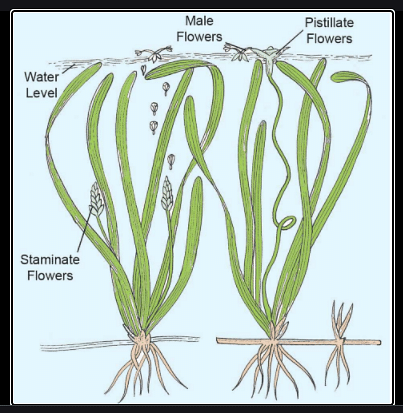
Pollination by Water is called hydrophily. It is quite rare in flowering plants. (E.g. freshwater plants like Vallisneria, and Hydrilla; marine water plants like Zostera). Pollination is the process in which the pollen grains are shed from the anther of the male flower to reach the stigma of the female flower. Pollination takes place within the same flower, same plant, and different plants with the help of abiotic and biotic agents.
Read More: Epimorphosis
Related Links
Pollination by Water
[Click Here for Sample Questions]
In water pollination, the pollen grains are released either on the surface of the water or underwater and get drifted by the water current, until and unless they come in contact with the stigma. The aquatic plants only undergo water pollination and they are called hydrophily. There are very few chances of pollen grains traveling underwater. Pollination by water is very rare in flowering plants and is limited to 30 genres, mainly monocotyledons. Water is a regular mode of transport among the lower plants like algae, bryophytes, and pteridophytes.
Wind and water are abiotic agents and animals are the biotic agents. The majority of plants pollinate with the help of biotic agents, and a very small portion of plants use abiotic agents for pollination. Pollen grains coming in contact with the stigma with the help of air and water is mostly by chance and the chances are quite low.
Pollination by Water
Types of Pollination by Water
[Click Here for Previous Years Questions]
Water pollination is also known as hydrophily. It can happen in two ways, i.e, on the surface of water and underwater. Both of these two types of water pollination has been explained below:
- Hypohydrophily - In this type of pollination, the pollen grains are released below the surface of the water and travel underwater only. An example of hypohydrophily is seagrass. The plant has pollen grains heavier than water, so they sink down and get caught by the stigma of the female flower.
Types of Pollination by Water
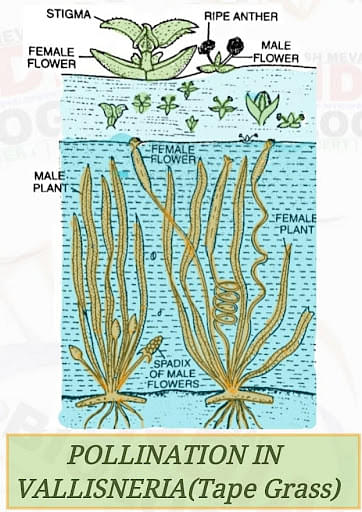
- Epihydrophily - In this type of pollination, the pollen grains float on the surface of the water and reach the stigma of the female flower. The specific gravity of these pollen grains is similar to water thus they don’t submerge. An example of this pollination is Vallisneria.
Characteristics of Plants Pollinated by Water
[Click Here for Sample Questions]
Some of the features that the water pollinated plants possess are:
- Plants that undergoes pollination by water are usually aquatic.
- They produce a large number of pollen grains as most of them get lost in the water flow and very few are able to reach the stigma.
- The stigmas of the female flower are usually above the water and are large and feathery to catch the pollen grains.
- The male flowers release the pollen grains that differ for both underwater and surface water pollen grains.
- The surface pollens are lighter and the underwater pollens are heavier than water.
- The male flower after maturation detaches itself from the plant and floats above the water surface.
Characteristics of Plants Pollinated by Water
Examples of Plants Pollinated by Water
[Click Here for Previous Years Questions]
The water-pollinated plants are mostly aquatic, but not all aquatic plants are pollinated by water, like water hyacinth and water lily. These plants bear flowers on the surface of the water and thus the pollination of pollen grains takes place either by insects or by the wind. Some of the aquatic plants that are water pollinated are:
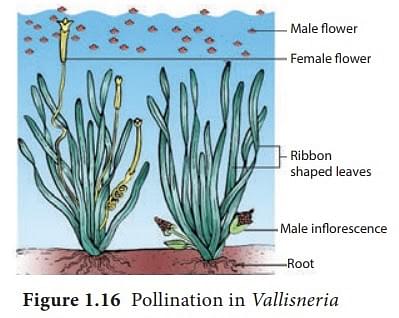
- Hydrilla and Vallisneria - These are the plants that grow in freshwater. The male flower or pollen grains are released on the surface of the water. These pollen grains are carried slowly by water currents and reach the stigma of the female flower. The female flower of the plant reaches its long stalk to the surface of the water, waiting to catch hold of the pollen grains.
- Zostera (Seagrass) - The female flowers remain submerged in the water and release the pollen grains underwater. They are then carried slowly by the water current and the stigma of the flower. The pollen grains of such plants are long like noodles and protected by a mucilaginous covering.
Things to Remember
- Pollen transport by water currents is a typical and almost exclusive adaptation of marine plants.
- Pollination by water is considered by very few plants. Even the aquatic plants don’t use water as a common agent.
- Some of the plants that totally depend on water to transport the pollen grains to the stigma are Hydrilla, Vallisneria, and Seagrass.
- Water pollinated plants have different characteristics than surface plants.
- They don’t bear big and colorful flowers and their pollen grains are like noodles that also sometimes slow down the water current.
- The water pollinated plants are mostly aquatic, but not all aquatic plants are pollinated by water, like water hyacinth and water lily.
Also Read:
| Chapter Related Topics | ||
|---|---|---|
| Pistil | monocot dicot plants anatomy | Controlled Pollination |
| Sporulation | Pollen Grains | Oestrus Cycle |
| Budding | Fragmentation | Vegetative propagation in plants |
Previous Year Questions
- Meiosis takes place in...[NEET 2013]
- The sexual reproduction is absent in….[NEET 1995]
- For union between stock and scion in grafting which one is the first to occur….[NEET 1990]
- Which one of the following plants reproduces vegetatively by epiphyllous buds?
- Vegetative propagation in mint occurs by…
- Hydra reproduces by budding. This is an example of...
- A clone is ......… [KCET 2011]
- Animals which possess cleidoic eggs exhibit….[KCET 2011]
- Which among these is not a post fertilization event ?...[KCET 2016]
- Type of asexual reproduction found in Hydra is..[KEAM]
- Which of the following is having longitudinal binary fission ?….[KEAM]
- In grafting, the stock and scion should be joined….
- Banana is vegetatively propagated by… [AMUEEE 2012]
- Vegetative propagation by leaves is seen in… [JKCET 2010]
- Vegetative propagation in water hyacinth takes place by...[AMUEEE 2013]
- A slender, prostrate subaerial branch of the stem which creeps along….
Sample Questions
Ques. What is pollination and explains the agents of pollination? (3 Marks)
Ans. Pollination is a process in which the pollen grain is shed from the anther and reaches the stigma of a pistil. This process takes place within the same flower, same plant, and different plants with the help of abiotic and biotic agents.
There are three agents that facilitate pollination in plants:
- Wind Pollination - It is an abiotic agent in which the pollen grains travel from the anther to the stigma through the flowing wind.
- Water Pollination - It is an abiotic agent in which the pollen grains travel from another to the stigma with the help of a water current.
- Pollination through animals - Animals and insects are the biotic agents. The anther sticks to the body of the animals and insects and reaches the stigma of the pistil.
Ques. What is pollination by water and what are its types? (3 Marks)
Ans. When the pollen grains are released either on the surface of the water or underwater and get drifted by the water current and come in contact with the stigma, then it is called pollination by water. Water Pollination is of two types:
- Hypohydrophily - When the pollen grains are released below the surface of the water then they sink down and get caught by the stigma of the female flower. then they are called hypohydrophily. An example of hypohydrophily is seagrass.
- Epihydrophily - When the pollen grains float on the surface of the water and reach the stigma of the female flower, then it is called Epihydrophily. An example of this pollination is Vallisneria.
Ques. Name the plants that use water for pollination. (2 Marks)
Ans. There are many aquatic plants that prefer air and animals for pollination. Water pollination is a rare method and there are very few plants that pollinate through the water. Some of the aquatic plants that use water for pollination include Hydrilla, Vallisneria, and Zostera (Seagrass).
Ques. Explain the process of pollination in Vallisneria and how is pollination different from other aquatic plants like water lily? (3 Marks)
Ans. Vallisneria is an aquatic plant that uses water for cross-pollination. The stalk of the female flower reaches the surface of the water and the male flower or the pollen grains are released on the surface. These pollen grains are then carried away by the water current and reach the stigma of the flower.
Water lilies are also aquatic plants but they pollinate with the help of wind or insects. Water lilies have large flowers on the surface of the water. It attracts insects by offering nectar. The insects sit on the flowers and the pollen grains stick to the insect's body. When the insects sit on the female flower then pollination occurs.
Ques. What are the features of water-pollinated plants? (3 Marks)
Ans. Some of the features that the water pollinated plants possess are:
- Water pollinated plants are usually aquatic.
- They produce a large number of pollen grains as most of them get lost in the water flow and very few are able to reach the stigma.
- The stigmas of the female flower are usually above the water and are large and feathery to catch the pollen grains.
- The male flowers release the pollen grains that differ for both underwater and surface water pollen grains. The surface pollens are lighter and the underwater pollens are heavier than water.
- The male flower after maturation detaches itself from the plant and floats above the water surface.
Ques. Pollination in Vallisneria is by? (2 Marks)
Ans. Vallisneria is a genus of aquatic plants. In this plant, pollination is done by pollinating agents i.e., water. Female flowers have long stalked and appear on the surface of the water. When the male flower releases pollen grain it reaches the stigma of the female flower through a water current.
Ques. How is pollination carried out in water plants? (2 Marks)
Ans. Water-mediated pollination takes place in selected plants like Vallisneria. In this plant, the female flower reaches the surface of the water. Pollen grains get sprinkled on the water surface and are passively transported to the female flower for pollination. In seagrasses, the female flower stays submerged in water and pollen grains are released below the water surface. In pollination by water, pollen grains have a mucilaginous covering that protects the pollens from getting wet.
Ques. Mention the pollinating agent of an inflorescence of small dull-colored flowers with well-exposed stamens and large feathery stigma. Give any one characteristic of pollen grains produced by such flowers. (3 Marks) [Delhi 2009]
Ans. The pollinating agent in the described inflorescence with small dull-colored flowers having well-exposed stamens and large stigma is wind. The pollens are non-sticky and can be easily dispersed by wind currents and so a large, feathery stigma easily traps air-borne pollen grain.
Example: Corn cob, its ears, or silk (stigma and style) wave in the wind to trap pollen grains.
Ques. Why should a bisexual flower be emasculated and bagged prior to artificial pollination? (2 Marks) [Foreign 2010]
Ans. Emasculation is a bisexual flower helps to prevent contamination of stigma with self-pollen grains. Bagging prevents contamination of the stigma of the emasculated flower with any other unwanted pollen grains. Thus, a bisexual flower should be emasculated and bagged prior to artificial pollination.
Ques. Make a list of any three outbreeding devices that flowering plants have developed and explain how they help to encourage cross-pollination. (3 Marks) [All India 2014]
Ans. The three outbreeding devices that flowering plants have developed, so as to encourage cross-pollination are:
(i)Receptivity of stigma and release of the pollen grain is not synchronized, i.e. stigma becomes receptive much before pollens are released or after they are released to avoid self-pollination.
(ii) Self-incompatibility, a genetic mechanism to prevent pollens from fertilizing ovules of the same flower by inhibiting their germination on stigma or pistil.
(iii) Production of unisexual flowers so that male and female parts will be present on different plants (dioecious) or on different flowers in the same plant (monoecious). It prevents both autogamy and geitonogamy.
Ques. Answer the following:
(i) Write the characteristic features of the anther, pollen and stigma of wind-pollinated flowers.
(ii) How do flowers reward their insect pollinator? Explain. (2 Marks) [All India 2010]
Ans. In wind-pollinated flowers:
(i) (a) Anthers are well exposed for easy dispersal of pollen grains.
(b) Pollen grains are light and non-sticky so that they can be transported by wind currents.
(c) Stigma is large and feathery to trap pollens.
(iii) Flower rewards their insect pollinators easily by offering: –
(a) Nectar and edible pollen grains.
(b) Safe place for insects to lay eggs by some flowers, e.g. Amorphophallus and Yucca.
Ques. Answer the following:
(i) Mention any four strategies adopted by flowering plants to prevent self-pollination.
(ii) Why is geitonogamy also referred to as genetically autogamy? (2 Marks) [All India 2009]
Ans. (i) Strategies to prevent self-pollination are:
(a) Pollen grain release and stigma receptivity are not synchronized, either the anther matures first or the stigma.
(b) Anther and stigma are placed at different positions so that the pollens cannot come in contact with the stigma of the same flower.
(c) A genetic mechanism called self-incompatibility, which prevents self-pollen from fertilizing the ovules either by inhibiting pollen germination or by retarding the growth of pollen tube in the pistil.
(d) By producing unisexual flowers. Plants are dioecious and continued self-pollination may cause inbreeding depression.
(ii) Geitonogamy is referred to as genetically autogamy because the pollen grains come from the same plant, though from a different flower.
Ques. Explain the following:
(i) Geitonogamy is functionally a cross-pollination but genetically similar to autogamy.
(ii) Why do flowering plants need to develop outbreeding devices? Explain any three such devices developed by flowering plants. (4 Marks) [All India 2010 C]
Ans. (i) Transfer of pollen grains from the anther to the stigma of another flower of the same plant is called geitonogamy. It is functionally cross-pollination as it involves a pollinating agent but is genetically similar to autogamy since the pollen grains come from the same plant (genetically same parent).
(ii) Continued self-pollination results in inbreeding depression because the majority of flowering plants produce hermaphrodite flowers and pollen grains generally come in contact with the stigma of same flower
To discourage this, flowering plants developed many devices. Some of the Strategies to prevent self-pollination are:
(a) Pollen grain release and stigma receptivity are not synchronized, either the anther matures first or the stigma.
(b) Anther and stigma are placed at different positions so that the pollens cannot come in contact with the stigma of the same flower.
(c) A genetic mechanism called self-incompatibility, which prevents self-pollen from fertilizing the ovules either by inhibiting pollen germination or by retarding the growth of the pollen tube in the pistil.
(d) By producing unisexual flowers. Plants are dioecious and continued self-pollination may cause inbreeding depression.
Ques. Enlist the advantages offered by seeds to angiosperms. (2 Marks)
Ans. Significance of seed formation:
- Seed formation is linked with pollination and fertilization that are independent of water and therefore is a more dependable process.
- Seed formation provides protection and nutrition to the developing embryo.
- Seeds are means of multiplication of higher plants. Being capable of perennation, it can withstand variable climate.
Ques. Ria, a science student observed the structure of mature embryosac comprising antipodals, central cells, and egg apparatus. Explain each one of them. (3 Marks) [March 2015]
Ans. The typical female gametophyte or embryo sac is 8-nucleate and 7-celled. 2 polar nuclei are situated below the egg apparatus in the large centraftfell. Three cells are grouped together at the micropylar end and constitute the egg apparatus. The egg apparatus consists of two synergids and one egg cell.
The synergids have special cellular thickenings at the micropylar tip called filiform apparatus, which play an important role in guiding the pollen tubes into the synergid. Three cells are at the chalazal end and are called the antipodals.
Ques. When the pollen is transferred from another to the stigma of the same flower, the pollination is called autogamy. Explain why Cleistogamous flowers are invariably autogamous. Also, justify why Geitonogamy is functionally cross-pollination, but genetically similar to autogamy. (3 Marks) [March 2017]
Ans. In this, flowers are not open pollen falls to the stigma of the same flower, and seed setting takes place without the influence of external agency. In geitonogamy transfer of pollen grains from the anther to the stigma of another flower of the same plant. Functionally geitonogamy is a type of cross-pollination but it is genetically similar to autogamy since the pollen grains come from the same plant.
Ques. Give two examples each of wind, water, and insect-pollinated flowers. (2 Marks)
Ans. Examples are as follows:
- Wind-pollinated flowers - Maize, pine
- Water-pollinated flowers - Hydrilla, Vallisneria
- Insect-pollinated flowers - Sweet pea, Salvia
Ques. Distinguish between Self-pollination and Cross-pollination. (4 Marks)
Ans. Difference between Self-pollination and Cross-pollination is as follows:
| Self-pollination | Cross-pollination |
|---|---|
| Self-pollination occurs within a flower or between two flowers of the same plant. | Cross-pollination occurs between two flowers borne on different plants of the same species. |
| Flowers do not depend on other agencies for pollination. | Agents such as insects, water, and wind are required for pollination. |
| Pollen grains are produced in small numbers. | Produced in large numbers. |
| No wastage of pollen grains occurs and is thus economical. | Wastage of pollen grains occurs, hence, uneconomical. |
| Flowers are not attractive, nor do they produce nectar. | Flowers attract insects by various means like colored petals, scent, and nectar. |
| The offsprings produced are of the same genetic makeup, so purity of the race is maintained. | The offsprings produced may show variations and differ in genetic makeup. |
For Latest Updates on Upcoming Board Exams, Click Here: https://t.me/class_10_12_board_updates
Do Check Out:



Comments