



Content Curator
Dipotassium Phosphate is an inorganic compound that is extremely water-soluble.
- The chemical formula for dipotassium phosphate is K2HPO4.
- It is also known as known as dipotassium hydrogen orthophosphate, potassium phosphate dibasic.
- It is commonly used as a fertilizer due to its high potassium and phosphorus content.
- It is a white or colourless substance.
- It can also be used as a buffering agent.
- The IUPAC name of dipotassium phosphate is dipotassium hydrogen phosphate.
| Table of Content |
Key Terms: Dipotassium Phosphate, IUPAC nomenclature, Chemical formula, Dipotassium hydrogen phosphate, Phosphoric acid, Molar mass, Density, Acidic Reaction, Basic Reaction
What is Dipotassium Phosphate?
[Click Here for Sample Questions]
Dipotassium Phosphate, having the chemical formula K2HPO4, is the dipotassium salt of phosphoric acid.
- It is water soluble but insoluble in ethanol.
- The chemistry of the reaction for producing dipotassium phosphate appears as a condensation of phosphoric acid with potassium hydroxide.
- Phosphoric acid, in turn, is made from phosphate rock, which can be found all over the world.
- It is also known as Dipotassium hydrogen phosphate and Potassium phosphate dibasic.
| Dipotassium Phosphate (K2HPO4) | ||
|---|---|---|
| Chemical Formula | K2HPO4 | |
| Molecular Weight/ Molar Mass | 174.2 g/mol | |
| Density | 2.44 g/cm3 | |
| Melting Point | > 465 °C | |
| Hydrogen Bond Acceptor | 4 | |
Also check:
| Related Concepts | ||
|---|---|---|
| Barium Carbonate | Californium | Hard Water and Soft Water |
| Calcium Sulphate | PbO2 | Classification of Colloids |
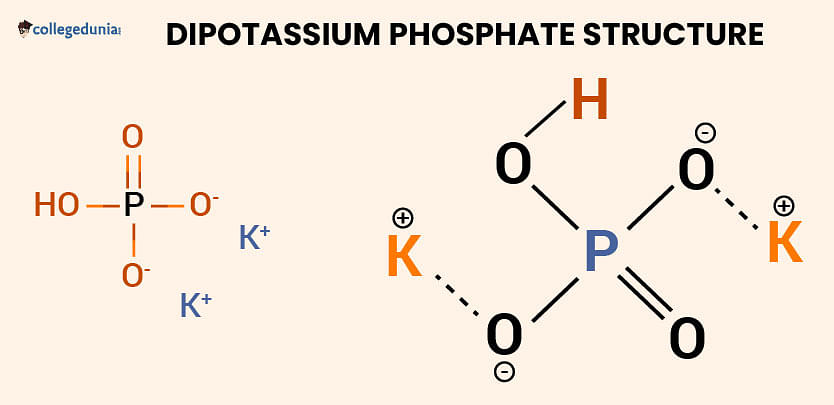
Dipotassium Phosphate Structure (K2HPO4)
[Click Here for Sample Questions]
The structure of dipotassium phosphate is shown below
Physical Properties of Dipotassium Phosphate
[Click Here for Sample Questions]
The following are the physical properties of Dipotassium Phosphate
| Parameters | Values |
|---|---|
| Appearance | White powder; deliquescent |
| Solubility | Soluble in water |
| Odour | Odourless |
| Covalently-Bonded Unit | 3 |
| Heavy Atom Count | 7 |
| Complexity | 4605 |
| Molar mass | 174.2 g/mol |
Chemical Properties of Dipotassium Phosphate
[Click Here for Sample Questions]
The following are the chemical properties of Dipotassium Phosphate
Preparation of Dipotassium Phosphate
Dipotassium Phosphate is produced commercially by partial neutralization of phosphoric acid with two equivalents of potassium chloride.
H3PO4 + 2 KCl → K2HPO4 + 2 HCl
(Phosphoric Acid) (Potassium chloride)
Reaction with hydrochloric acid (HCL) - Acidic Reaction
Dipotassium Phosphate reacts with hydrogen chloride forms phosphoric acid and potassium chloride, and forms phosphoric acid and two molecules of potassium chloride.
K2HPO4 + 2HCl → 2KCl + H3PO4
Reaction with Sodium hydroxide (NaOH) - Basic Reaction
Dipotassium Phosphate reacts with a base like sodium hydroxide to form disodium phosphate and water.
3K2HPO4 + 2NaOH → Na2HPO4 + 2K3PO4 + 2H2O
Uses of Dipotassium Phosphate
[Click Here for Sample Questions]
The following are the uses of Dipotassium Phosphate
- It is used as a food additive
- It is added to milk to increase the pH value.
- It is used as a Fertilizer, (NPK).
- Used in Micelles as a competitive displacement of calcium by sodium.
- It is used as a buffering agent in antifreeze solution.
- It is a source of nutrition in the culturing of antibiotics.
- Used in the preparation of non-dairy powdered coffee creams.
Hazards of Dipotassium Phosphate
[Click Here for Sample Questions]
The following are the hazards of Dipotassium Phosphate
- Ocular Inflammation and Irritation
- Dermatitis on contact with skin.
- It causes irritation of the digestive tract upon ingestion.
- It causes respiratory tract irritation on inhalation.
Also check:
| Other Concepts | ||
|---|---|---|
| Catalysis | Surface Chemistry | Micelle |
| Colloids | Emulsions | Adsorption |
Things to Remember
- Dipotassium Phosphate is the dipotassium salt of phosphoric acid with the chemical formula K2HPO4.
- Dipotassium phosphate is produced by the condensation of phosphoric acid using potassium hydroxide
- Dipotassium Phosphate is odourless, white-coloured, deliquescent solid
- Highly soluble in water with a density of 2.44 g/cm3
- Dipotassium Phosphate is produced commercially by partial neutralization of phosphoric acid with two equivalents of potassium chloride.
- Dipotassium Phosphate reacts with a base like sodium hydroxide to form disodium phosphate and water.
- DPP is used as a food additive, added in milk to increase the pH value, as a fertilizer (NPK) and as a buffering agent in antifreeze solution.
- Dermatitis and Ocular Inflammation are common hazards caused by DPP exposure.
Sample Questions
Ques. What is the molecular formula of Dipotassium Phosphate? (1 Mark)
Ans. The molecular formula of dipotassium phosphate is K2HPO4.
Ques. A mixture of potassium dihydrogen phosphate and dipotassium hydrogen phosphate is an example of – (2 Marks)
Ans. The mixture of Potassium dihydrogen phosphate (K2HPO4) and dipotassium hydrogen phosphate (K2HPO4) are phosphate salts that are used for the preparation of buffer solutions. So, they are an example of Buffer.
Ques. Which Foods Contain Disodium Phosphate? (2 Marks)
Ans. Disodium phosphate is commonly found in food items such as macaroni and pasta. Some cheeses also utilize it as an emulsifier. It can also be found in animal goods such as meat, canned sauces, Jell-O, evaporated milk, and certain chocolate.
Ques. Write the preparation of Dipotassium Phosphate (K2HPO4). (2 Marks)
Ans. Dipotassium Phosphate is produced by the partial neutralization of phosphoric acid with two equivalents of potassium chloride-
H3PO4 + 2 KCl → K2HPO4 + 2 HCl
Ques. Write the physical properties of Dipotassium Phosphate. (5 Marks)
Ans. The physical properties of dipotassium phosphate are as follows –
- Dipotassium Phosphate is odourless
- K2HPO4 is White in colour
- The molar Mass of K2HPO4 is 174.2 g/mol
- Melting Point is > 465 °C
- Deliquescent solid
- Three covalent bond unit
- Compounds have a heavy atom count of 7
- The complexity of the compound is 4605
- Highly soluble in water
- The density is 2.44 g/cm³
- The Hydrogen Bond Acceptor is 4
Ques. What products will be formed when potassium phosphate dibasic reacts with sodium hydroxide? (2 Marks)
Ans. When potassium phosphate dibasic reacts with sodium hydroxide it forms disodium phosphate and water as products.
3K2HPO4 + 2NaOH → Na2HPO4 + 2K3PO4 + 2H2O
Ques. By what other names Dipotassium phosphate is known as? (2 Marks)
Ans. Dipotassium Phosphate is also known by other names which are dipotassium hydrogen, potassium phosphate dibasic, and orthophosphate.
Ques. What is the difference between monopotassium phosphate and dipotassium phosphate? (2 Marks)
Ans. Difference 1 - The difference between monopotassium phosphate (KH2PO4) and dipotassium phosphate (K2HPO4) is that KH2PO4 is monobasic and can release a low amount of potassium whereas K2HPO4 is dibasic and can release a high amount of potassium when used in fertilizer.
Difference 2 - Monobasic salt refers to a salt, which has only one atom of a univalent metal while dibasic salt means having two univalent metal ions
Ques. Write the chemical reaction of dipotassium phosphate and hydrochloric acid. (2 Marks)
Ans. Reaction with hydrochloric acid (HCL) ~ Acidic Reaction
Dipotassium Phosphate reacts with hydrogen chloride forms phosphoric acid and potassium chloride, and forms phosphoric acid and two molecules of potassium chloride.
K2HPO4 + 2HCl → 2KCl + H3PO4
Ques. What are the uses of Potassium phosphate dibasic? (3 Marks)
Ans. • It is used as a food additive
- It is added to milk to increase the pH value.
- It is used as a Fertilizer, (NPK)
- Used in Micelles as a competitive displacement of calcium by sodium.
- It is used as a buffering agent in antifreeze solution
- It is a source of nutrition in the culturing of antibiotics
- Used in the preparation of non-dairy powdered coffee creams
Ques. Write the IUPAC name of DPP and its covalent bond unit. (1 Mark)
Ans. IUPAC's name of Dipotassium phosphate is Dipotassium hydrogen phosphate and its covalent unit is 3.
For Latest Updates on Upcoming Board Exams, Click Here: https://t.me/class_10_12_board_updates
Also Read:



Comments