



Content Curator
Electric field intensity due to a uniformly charged infinite plane sheet can be calculated using Gauss law. In a uniformly charged plane sheet, electric charges are uniformly distributed over the entire surface of the sheet. The electric field produced due to charges at rest is perpendicular to the surface of the sheet.
- Gauss' law is equivalent to Coulomb's law in that it represents the link between the electric field and the electric charge.
- Gauss' law provides a comparable method for calculating electric intensity expressions.
The expression for the electric field intensity (E) due to a uniformly charged infinite plane sheet having surface charge density σ, is given as
\(E = \frac{\sigma}{2 \epsilon _0}\)
Where ϵo pronounced as epsilon naught is the absolute permittivity of free space and its value is 8.854 x 10⁻¹² C2 N-1 m-2
| Table of Content |
Key Terms: Gauss Law, Electric Field, Electric charges, Electric flux, Charge density, Permittivity, Gaussian surface, Electric field lines.
Electric Field
[Click Here for Sample Questions]
The region or space around a charged body within which its influence can be felt by other small charges is known as an Electric field.
- The electric field in a region is represented by imaginary lines, known as lines of force or electric field lines.
- Electric field lines are the straight or curved imaginary lines in a region such that the tangent at any point on the field line gives the direction of the electric field at that point in the region.
Properties of Electric Field Lines
Some properties of electric field lines are:
- Electric field lines begin from a positive charge and end on a negative charge.
- These are the imaginary lines and a tangent at a point on these lines gives the direction of the electric field at that point.
- Electric field lines do not form a closed loop.
- In a charge-free region, electric field lines can be taken to be continuous curves without any break.
Read Also:
| Concepts Related to Electric Field | ||
|---|---|---|
| Electric Flux | Unit of Electric Field | Relation between Electric Field and Electric Potential |
| Electric Field Formula | Unit of Electric Flux | Electric Charge |
What is Gauss Law?
[Click Here for Sample Questions]
Gauss Law, often known as Gauss' flux theorem Gauss' theorem, is the law that specifies the link between the distribution of electric charges and the resulting electric field.
- Gauss' law states that the total amount of electric flux passing through any closed surface is proportionate to the enclosed electric charge.
- It describes the electrical charge contained within or present within the enclosed closed surface.
According to Gauss Law, the total electric flux contained within a closed surface equals 1/ε0 times the total electric charge enclosed by the closed surface. It is represented by
Φ = \(\oint_S \vec{E} . \vec{dS} = \frac{Q}{\epsilon_o}\)
Where
- Φ is the total flux
- ε0 is an electric constant, known as the absolute permittivity of free space
- Q is the total electric charge enclosed by the surface
Electric Field Due To Uniformly Charged Infinite Plane Sheet
[Click Here for Sample Questions]
Consider a thin infinite plane sheet of surface area A, on which charge Q is uniformly distributed over the surface of the sheet. Let σ be the surface charge density of the plane sheet.

Gaussian Surface for Uniformly Charged Infinite Plane Sheet
According to Gauss’s law
\(\phi = \oint_S \vec{E} . \vec{dA} = \frac{Q}{\epsilon_o}= \frac{\sigma A}{\epsilon_o}\)…………….(1)
Where
- E is the electric field intensity at equidistant from the plane sheet
- ε0 is the absolute permittivity of free space
Imagine a cylindrical Gaussian surface with an axis perpendicular to the plane of the sheet. This Gaussian surface is divided into three parts I, II, and III i.e. two end caps and the curved surface of the cylindrical Gaussian surface.
The net electric flux through the surface will be determined by integrating the product of electric field E and the area element dA, i.e.
\(\oint_S \vec{E} . \vec{dA} = \int_I \vec{E} . \vec{dA} + \int_{II} \vec{E} . \vec{dA} + \int_{III} \vec{E} . \vec{dA}\)
⇒ \(\oint_S \vec{E} . \vec{dA} = \int_I EdA cos \theta + \int_{II} EdA cos \theta + \int_{III} EdA cos \theta\)
For surface I and II, the angle between E and dA is 0o and for curved surface III, the angle between E and dA is 90. Therefore
\(\oint_S \vec{E} . \vec{dA} = \int_I EdA cos0 + \int_{II} EdA cos0 + \int_{III} EdA cos90\)
⇒ \(\oint_S \vec{E} . \vec{dA} = \int_I EdA + \int_{II} EdA+0\)
⇒ \(\oint_S \vec{E} . \vec{dA} = \int_I EdA + \int_{II} EdA\)
Using equation (1), we get
\(\phi = \int_I EdA + \int_{II} EdA\)
The electric field is uniform through the surface, therefore, we take E out of integration.
⇒ \(\phi = E \int_I dA + E \int_{II} dA\)
Also, ∫I dA = ∫II dA = A, surface area of the plane sheet
⇒ Φ = EA + EA = 2EA
From equation (1),
2EA = \( \frac{\sigma A}{\epsilon_o}\)
∴ \(E = \frac{\sigma}{2 \epsilon _0}\)
Above equation represents the expression for electric field intensity due to a uniformly charged infinite plane sheet.
The observation from the expression is:
- The electric field intensity is directly proportional to the surface charge density of the plane sheet.
- It is independent of the surface area of the sheet.
- Electric field intensity at a point is independent of the distance from the sheet.
- If surface charge density (σ) is positive then the direction of the electric field is outward and perpendicular to the plane of the sheet.
- If surface charge density (σ) is negative then the direction of the electric field is inward and perpendicular to the plane of the sheet.
Electric field intensity due to a uniformly charged infinite plane sheet, in vector form can be written as
\(E = \frac{\sigma}{2 \epsilon _0} \hat{n}\)
Where, n is a unit vector in a direction perpendicular to the plane of the sheet.
Electric Field Due To Two Parallel Uniformly Charged Infinite Plane Sheets
[Click Here for Sample Questions]
Consider two parallel infinite plane sheets A and B of uniform surface charge densities σ1 and σ2. The electric field intensity due to uniformly charged plane sheets can be calculated in three regions.
- Region I: Outer region of plate A towards the -x axis.
- Region II: Region between plate A and plate B
- Region III: Outer region of plate B towards +x axis
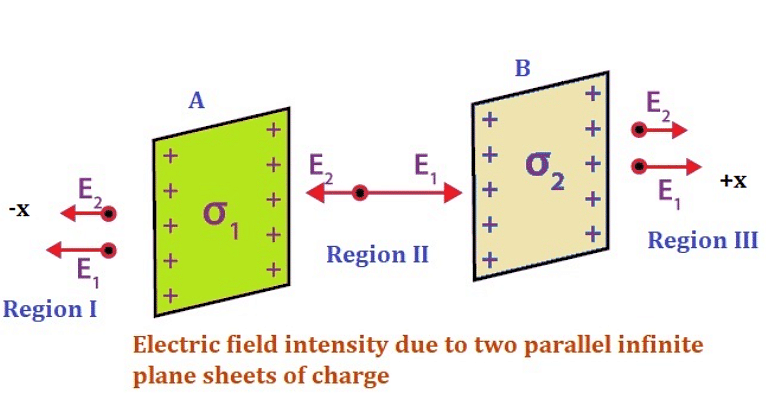
Electric field intensity due to two plane sheets
We will take the following assumptions:
- Electric field pointing towards the positive x-axis will be taken as positive.
- Electric field pointing towards the negative x-axis will be taken as negative.
Electric field intensity due to a uniformly charged infinite plane sheet, in vector form is given by
\(E = \frac{\sigma}{2 \epsilon _0} \hat{n}\)
Therefore, Electric field intensity due to sheets A is given by
\(E_1 = \frac{\sigma_1}{2 \epsilon _0} \hat{i}\)
And, Electric field intensity due to sheets B is given by
\(E_2 = \frac{\sigma_2}{2 \epsilon _0} \hat{i}\)
Now, we will calculate the net electric in different regions.
In Region I:
The net electric field is given by
EI = – E1 – E2
⇒ EI = – \(\frac{\sigma_1}{2 \epsilon _0} \hat{i} - \frac{\sigma_2}{2 \epsilon _0} \hat{i}\)
⇒ EI = – \(( \frac{1}{2 \epsilon _o})\) (σ1 + σ2)\(\hat{i}\)
In Region II:
The net electric field is given by
EII = – E1 – E2
⇒ EII = \(\frac{\sigma_1}{2 \epsilon _0} \hat{i} - \frac{\sigma_2}{2 \epsilon _0} \hat{i}\)
⇒ EII = \(( \frac{1}{2 \epsilon _o})\)(σ1 – σ2)\(\hat{i}\)
In Region III:
The net electric field is given by
EIII = – E1 – E2
⇒ EIII = – \(\frac{\sigma_1}{2 \epsilon _0} \hat{i} - \frac{\sigma_2}{2 \epsilon _0} \hat{i}\)
⇒ EIII = – \(( \frac{1}{2 \epsilon _o})\) (σ1 + σ2)\(\hat{i}\)
Read Also:
Things to Remember
- Electric field is the 3D space around a charged body where a small charge experienced a force.
- Gauss Law states that the electric flux across any closed surface is proportional to the net electric charge enclosed by the surface.
- Electric Field due to uniformly Charged Infinite Plane Sheet is given by E = σ/2εo
- The symbol ϵo is the absolute permittivity of free space and its value is 8.854 x 10⁻¹² C2 N-1 m-2
- Gaussian surface is an imaginary surface around a charged body such that electric field intensity is constant at every of it.
Sample Questions
Ques. What is the direction of electric field intensity at a point due to a negative charge? (1 Mark)
Ans. The electric field intensity at a place caused by a negative charge will be radial and directed toward the charge.
Ques. What is the size of the test charge that should be used to measure the electric field at a point? (1 Mark)
Ans. The test charge used to measure the electric field at a location should be infinitely small in size so that it does not disturb the distribution of the charges whose electric field we wish to measure otherwise the measured field will be different from the actual field.
Ques. Where will the electric field intensity be zero for a uniformly charged sphere? (1 Mark)
Ans: The electric field intensity at the center of a uniformly charged sphere will be zero. It will be maximum on the surface of the sphere and decreases, as we move away from the sphere.
Ques. State and explain Gauss Law with a formula. (3 Marks)
Ans. Gauss law states that the electric flux Φ across any closed surface is equal to 1/ε0 times the net electric charge q enclosed by the surface.
Gauss law can be mathematically expressed as
Φ = q/ε0
Where ε0 is the absolute permittivity of free space and has a value of 8.854 x 10⁻¹² C2 N-1 m-2
Ques. What is the nature of the Gaussian surface involved in the Gauss law of electrostatic? (2 Marks)
(A) Scalar
(B) Electrical
(C) Magnetic
(D) Vector
Ans. The Gaussian surface is an imaginary closed surface and never be electrical and magnetic in nature. It has the direction outwards the enclosed path. It adheres to vector algebra rules. It is in 3D space. So clearly it is a vector in nature.
Ques. How strong is an electric field within a conductor? (3 Marks)
Ans: An electric field's intensity inside a conductor is always zero. The reason for this is that the charges that conduct electricity are only present on the surface outside the conductor, hence the electric field is only present on the conductor's exterior surface.
Alternatively, Gauss' Law can be used to explain it. The charge density inside the conductor would be 0 since the charges are only on the surface and not inside the conductor. As a result, the electric field within the conductor is zero.
Ques. How strong would the electric field be inside a spherical shell? (3 Marks)
Ans. The answer is zero. Because there are no charges inside a conductor, the charges are only present on the conductor's exterior surface. As a result, if we draw a Gaussian Surface inside the spherical shell, it will not include any charge. As a result, the surface charge density will be zero. As a result, the electric field inside a spherical shell will also become zero.
Ques. What characteristics do electric fields have? (3 Marks)
Ans. An electric field has the following properties:
- The electric field lines are perpendicular to the charge's surface.
- The electric field lines never cross one another.
- The amount of the charge and the number of electric field lines are directly related.
Ques. State the applications of Gauss Law. (3 Marks)
Ans. The applications of Gauss's Law are
- To find out the field due to a uniformly charged Straight wire,
- To find out the field due to a uniformly charged Infinite plate sheet,
- To find out the field due to a uniformly charged thin spherical shell, and
- To find out the field due to a low uniformly charged sphere.
Ques. Why do we study Gauss law? (3 Marks)
Ans. Gauss' law in its integral version is most beneficial when a closed surface (GS) with a uniform electric field can be obtained due to symmetry. The electric flux is then a simple product of surface area and electric field intensity, and it is proportional to the total charge encompassed by the surface.
For Latest Updates on Upcoming Board Exams, Click Here: https://t.me/class_10_12_board_updates
Do Check Out:



Comments