



Content Curator
Epsilon Naught is the symbol used to represent the vacuum permittivity, which is the value of the absolute dielectric permittivity of a medium. It is also known as epsilon zero and denoted by ε0. Epsilon Naught is a physical constant that represents the absolute dielectric permittivity of a vacuum.
- Epsilon Naught value is constant in any part of the universe.
- It is synonymous with absolute permittivity and is represented by the Greek alphabet ε0.
- Epsilon Naught is described as a vacuum’s ability to ease the flow of electric field lines.
- The dielectric constant of a material is calculated using Epsilon Naught.
- It can also be pronounced as Epsilon Zero.
| Table of Content |
Key Terms: Epsilon Naught, Dielectric Constant, Permittivity, Coulomb's Law, Relative Permittivity, Dielectric Permittivity, Electric Constant, Electric Field, Epsilon
What is Epsilon Naught?
[Click Here for Sample Questions]
Epsilon Naught is defined as the permittivity of free space that is commonly known as Vacuum Permittivity or Electric Constant.
- It may be also referred to as the distributed capacitance of the medium.
- It is the measure of how dense an electric field is permitted in a medium.
- The dielectric or insulating material has a unit of permittivity, and it is known as the Epsilon.
- A vacuum’s ability to ease the flow of electric field lines can be quantified with Epsilon naught.
- During the formation of an electric field, we receive a measure of the opposition, known as permittivity.
- Free space has dielectric permittivity and is represented by the epsilon naught value.
- The dielectric constant of a material is also calculated using the value of epsilon naught.

Epilson Naught
Epsilon Naught Value
[Click Here for Previous Year Questions]
The CODATA Value of Epsilon Naught is
| ε0 = 8.8541878128(13) x 10-12 F. m-1 |
It has relative uncertainty with a value of 1.5 x 10⁻¹⁰.
The classical vacuum allows the electric field when it receives a capability of permittivity of free space also noted as ε0.
The defined values of Epsilon Naught are as follows:
- ε0 = 8.854187817 x 10⁻¹² F. m-1 (SI Unit)
- ε0 = 8.854187817 x 10⁻¹² C2/N.m2 (CGS Unit)
Read More:
| Relevant Concepts | ||
|---|---|---|
| Mu Naught Value | Types of Capacitors | Unit of Electric Charge |
| Electric Charges and Fields | Electrostatics | Electric Field Formula |
Epsilon Naught Units
[Click Here for Sample Questions]
The permittivity of free space (ε0 ) is expressed using both the SI unit and CGS unit. The Epsilon Naught units are as follows:
- SI Unit: F.m-1 or Farad per meter.
- CGS Unit: C2/Nm2 or Columb square per Newton meter squared.
Epsilon Naught Value Formula
[Click Here for Previous Year Questions]
The dimensional formula of Epsilon Naught is M-1L-3T4A2.
Derivation of the Formula of Epsilon Naught
As derived by Coulomb’s law,
F = (1/4π ε0) q1q2/r2
ε0= (1/4πF) q1q2/r2
So, F = M1L1T-2
q = IXT = AxT1
Then, ε0 = (1/M1L1T-2)(AT1 X AT1)/L2
ε0 = M-1L-3T4A2
Permittivity
[Click Here for Sample Questions]
Permittivity of Free Space defines the capability of a vacuum to allow electric fields. It is denoted by ε0 or epsilon-naught which is also connected to the energy stored within an electric field and capacitance.
The SI unit of the permittivity is F/M (Farad per meter).
F/m = C/V.m = C2/N.m2 = A2.s4/kg.m3 = N/V2
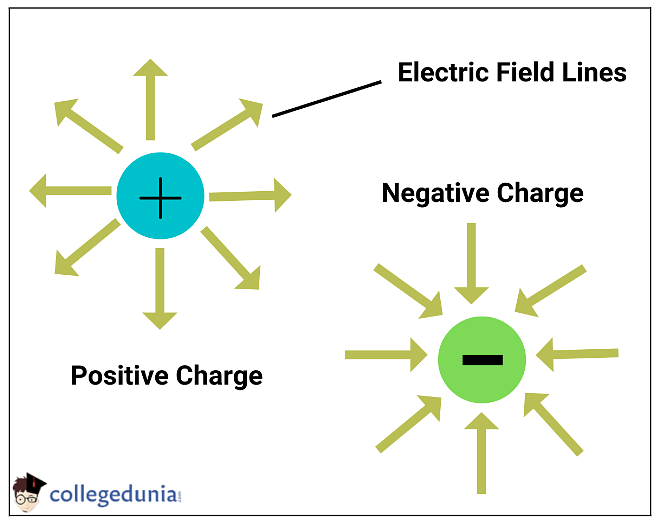
Electric Field Lines
Permittivity is categorized into three different types:
- Permittivity of Substance (ε)
- Permittivity of Free Space (ε0)
- Relative Permittivity (ϵr)
Permittivity of free space is referred to as Epsilon Naught. The free space is a space in which matters do not occupy. The permittivity of free space is used to identify the force using Coulomb's law between the two charged particles. Insulator’s capacitance is also found using the permittivity of free space.
Read More:
| Related Topics | ||
|---|---|---|
| Unit of Electric Field | Difference Between Electric Field and Magnetic Field | Electric Flux |
| Force Between Multiple Charges | Unit of Capacitance | Electrostatic Potential and Capacitance |
Things to Remember
- Epsilon Naught helps to quantify the ability of a vacuum to ease the flow of electric field lines.
- Permittivity is the measure of the opposition during the formation of an electric field.
- The CODATA value of epsilon naught is ε0 = 8.8541878128(13) x 10-12 F. m-1.
- The relative uncertainty of Epsilon Naught is 1.5 x 10⁻¹⁰.
- Epsilon Naught dimensional formula is given as M-1L-3T4A2.
- The SI unit and CGS unit express the permittivity of free space.
- The SI Unit is F. m-1 or Farad per meter and CGS Unit is C2/Nm2 or Columb square per Newton meter squared.
Previous Year Questions
- The dimensional formula for permittivity of free space… (NTA Abhyas - 2020)
- Electric field lines provide information about…
- Consider a sphere of radius R which carries a uniform charge… (JEE Main - 2020)
- When air is replaced by a dielectric medium of constant K, the… (NEET - 1999)
- Let a total charge 2Q be distributed in a sphere of radius… (JEE Main - 2019)
- What is the area of the plates of a 3F parallel plate capacitor…
- Electric field produced by an electron at a point is… (UP CPMT - 2010)
- In a uniform electric field a charge of 3C experiences a force… (AIIMS - 2014)
- The work done by electric field during the displacement… (JIPMER - 2015)
- Coulomb’s law is true for…
Sample Questions
Ques. What is the value of Epsilon Naught? (1 Mark)
Ans. The defined values of Epsilon Naught are as follows:
- ε0 = 8.854187817 x 10⁻¹² F.m-1 (SI unit)
- ε0 = 8.854187817 x 10⁻¹² C2/N. m2 (CGS unit)
Ques. What is Epsilon Naught? (2 Marks)
Ans. A dielectric or insulating material has a unit of permittivity which is known as the Epsilon. Epsilon Naught is a particle that ensures its constant presence in any part of the universe. It is synonymous with absolute permittivity and is represented by the Greek alphabet ε0. It is used to quantify a vacuum’s ability to ease the flow of electric field lines.
Ques. What is Epsilon Naught dimensional formula? (3 Marks)
Ans. Epsilon Naught’ dimensional formula is M-1L-3T4A2.
It is derived using Columb’s Laws as follows:
F = (1/4π ε0) q1q2/r2
ε0= (1/4πF) q1q2/r2
Now, F= M1L1T-2
q = IXT = AxT¹
Then, ε0= (1/M1L1T-2)(AT1 X AT1)/L2
ε0= M-1L-3T4A2
Ques. What are the units of Epsilon Naught? (2 Marks)
Ans. The SI unit and CGS unit both can be used to express the permittivity of free space.
- The CODATA Value of Epsilon Naught is ε0 = 8.8541878128(13) x 10-12 F.m-1.
- The SI unit is F.m-1, or Farad per meter and CGS unit is C2/Nm2 or Columb square per Newton meter squared.
Ques. What is the SI unit of the permittivity, and in which direction the electric line force is? (2 Marks)
Ans. Electric line forces will have direction outwards when the charges are positive, but the direction will be inward if the charges are negative. So, in this case, the direction of the lines will be outwards. The SI unit of the permittivity is F/M (Farad per meter).
F/m = C/V.m = C2/N.m2 = A2.s4/kg.m3= N/V2
Ques. What is the significance of Epsilon Naught in Physics? (1 Mark)
Ans. The significance of Epsilon Naught is that it represents the dielectric permittivity of free space. The value of Epsilon Naught is used in calculating the dielectric constant of a material. The CODATA Value of Epsilon Naught is ε0 = 8.8541878128(13) x 10-12 F. m-1.
Ques. What is the permittivity of free space? (1 Mark)
Ans. The permittivity of free space ε0 is the capability of the classical vacuum to permit the electric field. It is defined as the value which can be approximated to
ε0 = 8.854187817 x 10⁻¹² F. m-1
Ques. What are the three characteristics of permittivity? (1 Mark)
Ans. Permittivity is categorized into 3 different types:
- The permittivity of Substance (ε)
- The permittivity of free space ( ε0)
- Relative Permittivity (ϵr)
Ques. What is ε0 in physics? (1 Mark)
Ans. The symbol ε0 is universally recognized as referring to the electric constant. It is pronounced epsilon-zero or epsilon naught. The dielectric constant of a material is also calculated using the values of Epsilon Naught. The value of Epsilon Naught in SI Unit is ε0= 8.854187817 x 10⁻¹² F.m-1.
Ques. What is the permittivity of air? (1 Mark)
Ans. During the formation of an electric field, we receive a measure of the opposition, known as permittivity. Free space has dielectric permittivity, and the epsilon naught value represents it. A perfect vacuum has a relative permittivity of exactly 1, whereas, at standard temperature and pressure, the air has a relative permittivity of 1.0006.
For Latest Updates on Upcoming Board Exams, Click Here: https://t.me/class_10_12_board_updates
Check-Out:



Comments