



Education Journalist | Study Abroad Lead
Electric Field Lines were first introduced by Michael Faraday and are considered to be a fantastic way of visualizing electric fields. Electric Fields possess electric field lines which are created by electric charges in the space around them. Field lines begin with a positive charge and terminate on a negative charge. Electric field lines cannot move through a conductor due to which the electric field inside a conductor tends to always be zero. While field lines are just mathematical construction, in some cases, they can possess physical importance.
Key Terms: Electric Field Lines, Intensity, Electric Charge, Conductor, Electric Field, Attraction, Positive Charge, Negative Charge
What is Electric Field Lines?
[Click Here for Sample Questions]
Electric field lines were first introduced by Micheal Faraday in the 19th Century. He always believed that the lines are one which can be used to state and interpret the invisible electric field. An electric field can be used in a visual form to explain the overall intensity of the field surrounding it. Electric field lines are imaginary lines or even a curve represented through an empty region such that it is tangent at any point in the area of the electric field vector at that point. The relative closeness of the lines at a given place gives an idea regarding the intensity of the electric field at that particular point.

Electric Field Lines
Properties of Electric Field Lines
[Click Here for Previous Year Questions]
The properties of electric field lines are listed below:
- In a given region of space, if the electric field is zero, electric field lines cease to exist.
- The field lines mostly flow from a higher potential to a lower potential.
- Field lines originate with a positive charge and end on a negative charge.
- Electric field lines go into or exit a charged surface normally.
- In a uniform electric field, the lines are linear, parallel, and uniformly placed.
- Electric field lines never intersect with one another.
- The field lines are 90 degrees to the area of the charge.
- For the field lines to either begin or end at infinity, a single charge needs to be utilized.
- Electric field lines tend to reduce in length due to the force of attraction between 2 positively charged objects.
- Electric field lines mostly point towards a negative charge and away from a positive charge.
Also Read:
| Related Articles | ||
|---|---|---|
| Unit of Electric Field | Difference Between Voltage and Current | Charge Transfer |
Examples of Electric Field
[Click Here for Sample Questions]
Here are a few examples of an electric field:
- An electric lamp can generate electric fields around it when it is connected to a power source. The intensity of the electric field will see an increase as the voltage increases.
- Radio stations operate at a specific frequency that generates various different electric fields.
- A message is transmitted from a transmitting device of a radio station to a common radio or television through an electric field that captures and transmits the data.
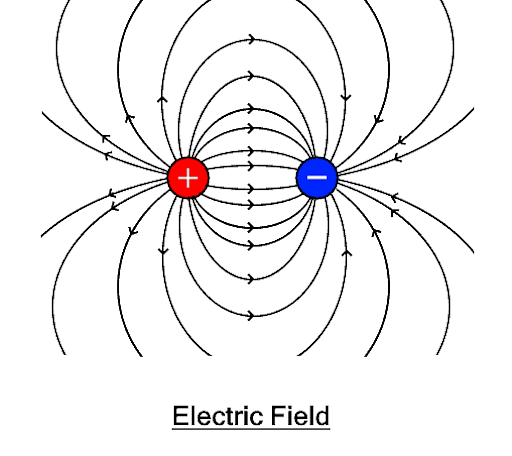
Electric Field
Things to Remember
- Electric field lines are a way of picturing electric fields. Electric fields contain field lines that are created by electric charges in the region surrounding them.
- Electric field lines never intersect one another.
- Field lines never intersect each other if they do intersect, then at the point of cross-over, there shall be two directions of the electric field.
- In regions that do not contain any charges, electric field lines are continuous curves.
- An uncountable number of lines may be drawn to illustrate the electric field in any region.
Also Read:
Previous Year Questions
- Which One Of The Following Graphs Represents The V
- Two Point Charges Q And 3q Are Placed Certain Dist
- Two Point Charges Of 1 C And 1 C Are Separated By
- Two Charges Q And 3q Are Fixed On X Axis Separated
- Three Charge Q Q And 4q Are Placed In A Straight L
- The Unit Of Permittivity Is Same As That Of
- The Force Per Unit Charge Is Known As
- The Electric Field Strength At A Distance R From A
- The Electric Field Components In The Given Figure
- The Electric Field Components In The Given Figure
- The Electric Field At A Point Is
- Two Parallel Large Thin Metal Sheets Have Equal Su
- Two Point Charges Q 1 2 C And Q 2 1 C Are Placed A
- The Positive Charged Ball Is Suspended By Thread O… [RPET 2002]
- The Magnitude Of Electric Field Intensity E Such T
- The Displacement Of A Charge Q In The Electric Fie
- An Electric Line Of Force In The Xy Plane Is Given
- Two Point Charges 10 7 C And 10 7 C Are Placed At
- Two Non-Conducting Solid Spheres Of Radii R And 2r.. [JEE Advanced 2013]
Sample Questions
Ques. What are electric field and electric field lines? (3 Marks)
Ans. An electric field is a space surrounding the charge where similar charges can feel its effect. Electric field lines can be explained as the curve constituting the direction of the electric field when a tangent is drawn on it at any particular point.
Ques. Why are there no electric field lines inside a conductor? (2 Marks)
Ans. There are no electric field lines within a conductor as the electric field inside a conductor is zero since electric charges as well are not present in the field.
Ques. What are the rules for drawing electric field lines? (3 Marks)
Ans. Below are the rules for drawing electric field lines:
- The field line starts at the charge and could end either at the charge or at infinity.
- The electric field lines are closer together when the field is stronger.
- The number of field lines relies on the charge
- The electric field and its lines are tangent at the point that they pass.
- Field lines should never intersect.
Ques. What are the properties of electric field lines? (3 Marks)
Ans. The properties of electric field lines are:
- The number of field lines that start and end at a charge is proportional to the magnitude of the charge.
- Electric field lines never form a closed loop as the field is conservative in nature and thus the lines do not form a closed loop.
- Electric field lines are both smooth and continuous in a region free of charge.
- The electric field lines are perpendicular to the charged surface.
- The beginning of the field line is always a positive charge and terminates with a negative charge.
Ques. When is an electric field uniform? (3 Marks)
Ans. An electric field is uniform when the field in which the value of the field strength remains the same at all points. It has the same magnitude as well as the same direction everywhere in a given space. No matter where the charge is located in the electric field, the force deployed on the charge remains the same.
Ques. What are electric field lines' attraction and repulsion? (3 Marks)
Ans. Field lines in electric fields mostly tend to point away from a positive charge and in the direction of a negative point. In reality, electric fields start with a positive charge and finish with a negative charge. When it comes to picturing electric fields, the field lines are significant. They appear to be pushing each other away, the attraction between unlike charges and the repulsion between similar charges can be felt.
Ques. State a few examples of electric fields. (3 Marks)
Ans. Electric lamps can generate electric fields around them when connected to an electricity source. Antennas possess electric fields to transmit and receive radio and television signals. A radio station operates at a specific frequency that generates different electric fields.
Ques. Why do the electric field lines never intersect one another? What is energy in an electric field? (3 Marks)
Ans. Electric field lines never intersect, if they do this would suggest that we can draw two tangents at the point that they have intersected. If they should intersect, they should be two distinct electric fields in different directions. The energy of an electric field is a result of the excitation of the space permeated by the electric field. It can be assumed as the potential energy that would be imparted on a point charge situated in the field.
For Latest Updates on Upcoming Board Exams, Click Here: https://t.me/class_10_12_board_updates
Do Check Out:



Comments