



Education Journalist | Study Abroad Lead
Faraday’s Law of Electromagnetic Induction is the law of electromagnetism that helps us predict how a magnetic field interacts with an electrical circuit to produce an electromotive force or EMF. This process is called Electromagnetic Induction. Faraday’s Law of Electromagnetic Induction is a set of two laws that determine magnetic field is produced by an electric current and conversely how a change in the magnetic field produces a current through the conductor. The laws are derived from Maxwell’s equations. Faraday’s law of electromagnetic induction is the basic law of electromagnetism.
| Table of Contents |
Key Terms: Faraday’s Law, Electromagnetic Induction, Magnetic Field, Electrical Circuit, Current, Conductor, EMF, Electromagnetism, Electric current
Faraday’s Law of Electromagnetic Induction
[Click Here for Sample Questions]
Faraday’s Laws of Electromagnetic Induction consists of two laws. The first law deals with the induction of emf in a conductor whereas the second law quantifies the emf that is produced in the conductor.
Faraday’s Laws of Electromagnetic Induction Video Explanation
Faraday’s First Law
Faraday’s First Law is derived from a long series of experiments conducted by Faraday & Henry. From the results of the experiment, Faraday reached a conclusion that the magnitude of an induced emf in a circuit is equivalent to the time rate of change of the magnetic flux through any given circuit.
Faraday’s First Law of Electromagnetic Induction states that-
Whenever a conductor is placed in a varying magnetic field, an emf is induced. If the conductor circuit is closed, a current is induced, known as the induced current.
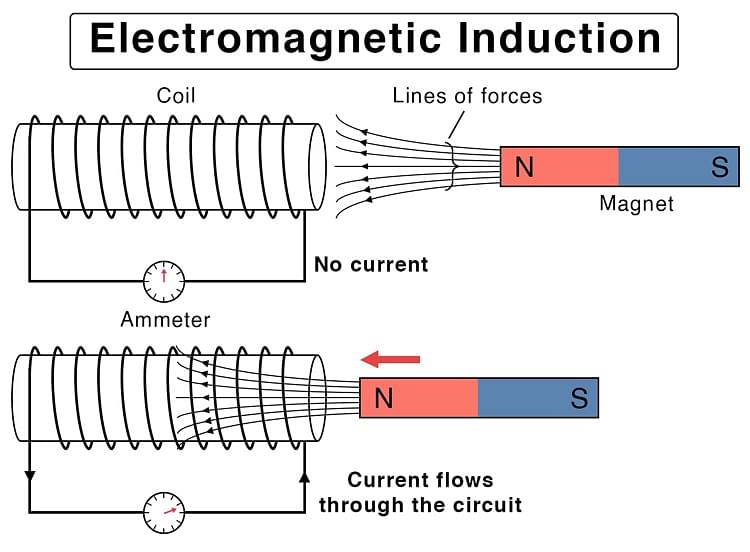
Electromagnetic Induction
Read More: Difference between EMF and Voltage
Change of Magnetic Field Intensity inside a Closed Loop
In a closed loop, no magnetic field will be induced unless there is a power supply available. If a power supply is provided, the magnetic field will expand along with the current and will continue till the magnetic field collapses. Hence, magnetic field lines induced inside a closed loop are continuous.
Ways of Changing the Magnetic Field
There are specifically four ways to change the magnetic field inside a circuit:
- By modifying a region of a coil that is generally placed in the magnetic field.
- By moving the coil inside the magnetic field coil or outside the magnetic field.
- By moving the magnet in the same direction of a coil or against the coil’s direction.
- By rotating the coil in relation to the magnet.
Also Read:
Faraday’s Second Law
Faraday’s Second Law of Electromagnetic Induction states that
The Emf induced inside a coil is equal to the rate of change of associated magnetic flux.
The formula can be written as
ε = \(-N {\triangle \phi \over \triangle t}\)
Here, ε is considered as the electromotive force,
\(\phi\) denotes magnetic flux;
N denotes the number of turns
The electromotive force, or EMF, is, therefore, the change of rate of flux in a circuit.
ε = \({ dt \over d\phi}\)
The EMF or electromotive force is the difference within the potential that is developed across an “unloaded loop”.
Read More: Electromagnetic Induction MCQ
Lenz’s Law
The current is induced inside a loop of wire that is in a direction that opposes the change in flux through that loop. So, we can say, if the magnetic flux increases, then the current induced will tend to create its own flux and will try to cancel out the increase in the flux. If the flux in the loop gets decreased, the current induced will be in the direction which will try to increase the flux through the loop.
The induced voltage in and around the loops will cause the current to flow throughout the wire which is obtained as the output current of a generator. This relationship between induced voltage and current which opposes the change in the loop is defined as Lenz’s Law (denoted by a negative sign).
According to Lenz’s law,
The Polarity of induced emf is such that it tends to produce a current which opposes the change in magnetic flux that produced it
Lenz reached the same conclusion as Faraday. The only difference between the two laws is a minus (-) sign, which shows that the direction of the magnetic field & the direction of emf are having opposite signs.

Lenz’s Law
Check out: Electromagnetic Induction and Alternating Currents Important Questions
Faraday’s Law Derivation
[Click Here for Previous Year Questions]
If we consider a magnet approaching a coil, we can note two-time instances as T1 & T2 where:
Flux linked with coil during T1 is T1= NΦ1
Flux linked with coil during T2 is T2 = NΦ2
So, the change in flux is given, Φ = Φ2 - Φ1
The change in flux is therefore N.Φ
So, the rate of change of flux linkage can be written as N.Φ/t
If we take the derivative of the above equation, we will get,
N.dΦ/dt
Hence, in faraday’s second law of magnetic induction, we got to know that the induced emf of the coil is equal to the rate of change of the linkage of flux. So,
E = N dΦ/dt
If we consider Lenz’s Law,
E = -N dΦ/dt
Considering the equation above, we can come to a conclusion:
- The increase in the no. of turns inside the will also increase the emf induced.
- The increase in the strength in magnetic fields will increase the emf induced.
- The increase in the speed of relative motion in the coil & magnet will result in the increase of emf.
Faraday’s Law Applications
[Click Here for Sample Questions]
Faraday’s Law applications are as given below –
- In an electromagnetic flowmeter, in which inducing an emf helps in the recording of the speed of flow of the liquids.
- The induction cookers used in various households work on the same principle of mutual induction which is based on Faraday’s Law.
- Maxwell’s equations are referred to as the converse of Faraday’s laws which states that any change in the magnetic field also induces a change in the electric field.
- The velocity of fluids can be recorded by inducing EMF in an electromagnetic flowmeter.
- Various electrical devices including the transformers work based on Faraday’s Law.
- Faraday’s laws facilitate the working of various musical instruments also such as electric violin and electric guitar.
Read More: Electromagnetic Induction Important Questions
Faraday’s Law – Relationship Between Induced EMF and Flux
[Click Here for Previous Year Questions]
The relation between induced EMF and flux is as given below –
- Faraday’s first experiment showed that a current is induced only when the strength of the magnetic field varies. For example- an ammeter that is connected to a wire in a loop gets deflected when the magnet is moved towards the wire.
- His second experiment proved that an iron rod becomes electromagnetic when current is passed through it. The relative motion existing between the coil and the magnet induces electromotive force. It was observed that there was no electromotive force when the magnet was first rotated in its axis. But, when the magnet was again rotated in its own axis, there was an electromotive force present. Hence, we can conclude that no deflection in the ammeter took place when the magnet was in a stationary state.
- During the third experiment, no deflection was shown by the Galvanometer. Also, no induced current was produced in the coil (when moved in a stationary magnetic field).In the case of the ammeter, when the magnet was moved away from the loop, the ammeter deflected in an opposite direction.
Read More: ELECTROMAGNETIC DAMPING
Relation between Position of Magnet and Deflection in Galvanometer
[Click Here for Sample Questions]
The summarised version of the relationship between the Position of the Magnet and the Deflection in the Galvanometer is given in the following table:
| Position of Magnet | Deflection in Galvanometer |
|---|---|
| Magnet at rest | No deflection |
| The magnet moves towards the coil | Deflection observed in one direction |
| Magnet is held stationary near the coil | No deflection seen |
| Magnet moved away from the coil | Deflection observed in the opposite direction |
| Magnet, when held stationary away from the coil | No deflection seen |
Conclusion
Faraday finally concluded after all his experiments that if there is the existence of relative motion in between a magnetic field and a conductor, the flux linkage in a coil will change & this will produce a voltage across the coil.
Also Read:
| Related Articles | ||
|---|---|---|
| Electromagnetic Induction | Inductance | Lenz’s Law and Conservation of Energy |
| AC Generator | Electromagnetism | Uses of Inductor |
| Faraday Constant | Solenoid Engine | Magnetic Induction Formula |
Previous Year Questions
- Two identical circular coils A and B are kept on a horizontal tube side by side… [KCET 2013]
- Faraday's laws are consequence of conservation of… [NEET 1991]
- The number of Faradays(F) required to produce 20g of… [NEET 2020]
- If a transformer of an audio amplifier has output impedance 8000 0 and the speaker has input impedance…...[JCECE 2005]
- A conducting loop in the shape of a right angled isosceles triangle of height 10cm10cm is kept such that the 90∘ vertex is…..[JEE Advance 2016]
- A 10m long horizontal wire extends from North East to South West. It is falling with a speed of 5.0ms−1……. [ JEE Main 2019]
- If a current of 2.0A2.0A flows through the smaller loop, then the flux linked with bigger loop is…… [JEE Main 2013]
- A coil of cross-sectional area A having n turns is placed in a uniform magnetic field B….. [JEE Main 21018]
- A copper rod of mass m slides under gravity on two smooth parallel rails, with separation ll and set at an angle of θ with the horizontal….. [JEE Main 2018]
- A copper wire is wound on a wooden frame, whose shape is that of an equilateral…. [JEE Main 2019]
- A metallic rod of length ll is tied to a string of length 2l and made to rotate with angular speed…. [JEE Main 2013]
- A square frame of side 10 cm and a long straight wire carrying current 1 A are in the plane of the paper…. [JEE Main 2014]
- If the rod makes n rotations per second, then the time averaged magnetic moment of the rod is… [JEE Main 2019]
- Figure shows a circular area of radius R where a uniform magnetic field….
- In a coil of resistance 100Ω , a current is induced by changing the magnetic flux through it….. [JEE Main 2017]
- When current in a coil changes from 5A to 2A…. [JEE Main 2015]
- Which radiation in sunlight, causes heating effect?
- X -rays are….
- Arrange the following in decreasing order of wavelength
- Which is having minimum wavelength...[NEET 2002]
- The speed of radio-waves is equal to….. [JIPMER 1998]
- Gamma rays and visible light waves rays are a,ba,b and cc respectively, then….[UPSEE 2016]
- the circular loop of wire is moved with velocity towards the infinite current carrying wire…… [VITEEE 2016]
- A conducting wire frame is placed in a magnetic field which is directed into the paper…...[VITEEE 2019]
Things to Remember
[Click Here for Sample Questions]
- Faraday’s First Law of Electromagnetic Induction states that when a conductor is placed in a varying magnetic field, an emf is induced.
- If the circuit of the conductor is closed, a current is induced, known as the induced current.
- Faraday’s Second Law of Electromagnetic Induction states that the Emf induced inside a coil is equivalent to the rate of change of the magnetic flux that is associated with it.
- Maxwell’s equations are the converse of Faraday’s laws.
- Faraday’s laws help in the working of various musical instruments also such as electric guitar and violin.
Check out: Inductance
Sample Questions
Ques. What do you mean by EMI? (3 marks)
Ans. EMI or Electromagnetic Induction is the process of the current generation by a change in magnetic flux. It is associated with the Laws derived by Faraday and Lenz. This electromagnetic induction is very useful for understanding the processes that are associated with the change of magnetic fields in a loop and also its underlying principles.
Ques. If electric current is flowing from direction B to A in a wire. What will be the direction of the current induced inside the metallic loop that keeps the wire? [All India 2014] (3 marks)
Ans. If we consider Lenz’s Law, we can see that the direction of the current induced will be opposite. It is due to the production of the current. Hence, the current inside the loop will support the current which is flowing in the wire, i.e., in the same direction. Therefore, we come to the conclusion that the current’s direction will be in a clockwise direction in the loop.
Ques. State Lenz's Law. Explain if emf will be induced at the ends of a metallic rod that is held horizontally in the east-west direction, and is allowed to fall under gravity. [Delhi 2013] (3 marks)
Ans. The induced emf of the current in a circuit always opposes the causes which produce it. This is known as Lenz’s Law.
If a metallic rod is held horizontally in an east-west direction and is allowed to fall freely under gravity in the north to south direction, the intensity of the produced magnetic lines of the magnetic fields of the earth will change through it, hence, magnetic flux changes and changes the induced emf in it. So yes, the emf is induced in the metallic rod.
Ques. State Faraday’s Law. [2009, 2012] (3 marks)
Ans. Faraday’s First law states that whenever magnetic flux linkage with a circuit changes, it induces an emf that lasts, as long as the change in the flux continues.
Faraday’s Second law states that the induced emf inside the loop or in a closed circuit is directly proportional to the rate of change in the magnetic flux linkage with the loop, i.e.,
E = -N dΦ/dt
Ques. An 1800 RPM, 3-phase motor (30 HP), is powered by a 60 Hz, 460-volt bus. When the motor starts up it requires 185 amps to start and then to come up to the operating speed.
(A) What will be the coil resistance for the motor?
(B) At normal operating speed, the current drawn is 37 amps. Which of the following given below will explain the phenomenon?
1) When the motor warms up, the bearing friction is reduced.
2) There is a back emf generated when the motor runs at normal speed which reduces the drawn current. (5 marks)
Ans. A)Here, Voltage, V= 460V; Current, I = 185 A; Operating current, I’ = 35A
As the starting of the coil is based on ohmic resistance, we can use Ohm’s law
R = V/I
Substituting the above values in the formula,
R = 460V/185 A
= 2.486 Ω or approx. 2.5 Ω
So, the resistance of the coil is 2.5 Ω
B) Now, the operating current is I’ = 35 A
If we consider phenomenon (1),
The explanation is incorrect as if the motor warms up, it will lead to an increase in bearing friction and the energy will be wasted as heat.
If we consider phenomenon (2),
As there is back emf the current in the coil will be,
I = (V-Vind)/R
Now, V here is applied voltage and Vind is the voltage induced at the ends of the coil which is also called back emf. It will result in a decrease in effective voltage across the coil and the current passing through it will also decrease simultaneously.
Hence, this explanation is correct.
Ques. A closed coil is having 40 turns and an area of 200 cm2, which has been rotated in a magnetic field of flux density 2 Wb m-2. Its plane makes an angle of 30º from a position, where it is rotated. The position of the closed coil is perpendicular to the field at a time of 0.2 sec. What will be the magnitude of the emf induced in the coil due to its rotation? (5 marks)
Ans. Given:
No. of Turns, N = 40 Area, A =200cm
Magnetic field, B = 2 Wb m-2 =200 ‘10-4 m2
So, the initial Flux, \(\phi\)i = BA cos\(\theta\)
= 2 x 200 x 10-4 x cos 60° [since \(\theta\) = 90° - 30° = 60°]
\(\phi\)i = 2 x 10⁻² Wb
If magnitude of induced emf is E = N dΦB/dt
Then, E = 40 x (4 x 10-2 - 2x10⁻²)/0.2
= 4V
So, the magnitude of the induced emf, E is 4V.
Ques. A rod (conducting) having a length of 0.5 m falls freely from the top of a building with a height of 7.2 m at a place. The horizontal component of Earth’s magnetic field is 40378.7 nT. If the Earth’s horizontal magnetic field is perpendicular to the length of the rod, what is the emf induced across the conductor, when the rod is about to touch the ground? [Take g = 10 m s-2] (5 marks)
Ans. Given:
l = 0.5m
h = 7.2m
u= 0 ms/s
g = 10 m/s2
BH = 40378.7 nT
So, the final velocity is,
v2 = u2 + 2gh
= 0 + (2 x 10 x 7.2) = 144
So v = 12 m/s
Now the induced emf, when the rod is just about to touch the ground is
ε = BH/v
= 40378.7 x 10-9 x 0.5 x 12
= 242.7x 10⁻⁶ V
= 242.27 μV
For Latest Updates on Upcoming Board Exams, Click Here: https://t.me/class_10_12_board_updates
Also read:



Comments