



Content Writer
Grignard reaction mechanism is a type of nucleophilic addition reaction that involves the addition of alkyl/vinyl/aryl magnesium halides to any carbonyl group in an aldehyde/ketone.
- They are prepared strictly under anhydrous conditions because they decompose even in the presence of traces of moisture.
- Grignard's reagents are organometallic compounds that have great synthetic importance.
- They are regarded as versatile tools in the synthesis of a large variety of organic compounds.
These compounds are named after Nobel Laureate and French scientist Francois Auguste Victor, who was awarded the Nobel Prize in 1912 for his discovery of Grignard's Reagent.
- The reaction of alkyl or aryl halides with magnesium is largely used for the preparation of Grignard's reagents.
- The chemical formula of Grignard's reagent mechanism is R- Mg- X.
- It is a strong nucleophile with a strong affinity for electron-deficient species (electrophiles) and is highly reactive.
Key Terms: Grignard reaction mechanism, Grignard reagent, Carbonyl Compound, Ketone, Aldehyde, Magnesium, Nucleophilic Addition Reaction, Alkyl Magnesium Halides, Aryl Halides, Hydrolysis, Alcohol
Grignard Reaction Mechanism
[Click Here for Sample Questions]
Grignard reaction mechanism refers to those reactions in which a Grignard’s reagent (alkyl or aryl magnesium halides) is added to an organic compound (aldehydes, ketones, carboxylic acids, alcohol, or amines) for the formation of a variety of industrially important products.
- The mechanism is initiated through a six-membered ring transition state.
- Since they are strong nucleophiles, these compounds can easily form carbon-carbon bonds in 1°, 2°, and 3° alkyl halides.
- Since carbon is more electronegative than magnesium, it will act as a nucleophile.
- It will attack the electrophilic carbon atom present in the polar bond of a carbonyl group.
A Grignard Reaction Mechanism will proceed through these two steps, which are as follows:
Addition of Grignard Reagent
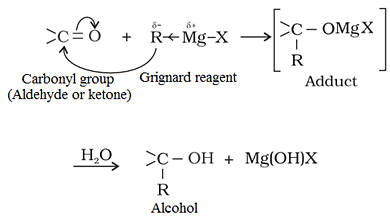
This is the first step involved in a Grignard reaction, where Grignard’s reagent is added to the corresponding reactant to form a temporary and unstable intermediate addition complex.
- This step is responsible for the formation of intermediate complexes.
Hydrolysis of the Intermediate Complexes
The intermediate complex is then hydrolyzed in the presence of dilute acid to form the products. This step will form and release products.

Grignard reaction mechanism
Also Read:
What is Grignard Reagent?
[Click Here for Sample Questions]
Grignard Reagent is a type of strong nucleophile that acts like a carbonyl compound in the presence of electrophiles. The reagent is capable of forming strong carbon-carbon bonds.
- They are similar in nature to organolithium reagents.
- The nucleophilicity of the reagent increases when an amido group is used as a substitute.
- It will replace alkyl substituent.
- Grignard reagent is used in the preparation of amino compounds, amides, acetals, organosulphur compounds and ethers.
Preparation of Grignard Reagent
[Click Here for Sample Questions]
Grignard reagents can be prepared from alkyl or aryl halogen hydrocarbons ( haloalkanes and haloarenes). The reaction of magnesium with haloalkanes or haloarenes gives the corresponding alkyl or aryl magnesium halides.
Formation of Alkyl Magnesium Halides
When haloalkanes are treated with magnesium in dry ether, alkyl magnesium halides are obtained.
R-X + Mg (Dry ether) → R-Mg-X (Alkyl magnesium halide)
Formation of Aryl Magnesium Halides:
Bromoarenes and Iodoarenes react with magnesium in the presence of dry ether to form aryl magnesium halides, popularly known as Grignard reagents.
C6H5Br + Mg → C6H5-Mg-Br
C6H5I + Mg → C6H5-Mg-I
- Chloroarenes also react with magnesium to give phenyl magnesium chloride.
- However, they do so in the presence of tetrahydrofuran (THF), which acts as a solvent.
C6H5Cl + Mg (THF) → C6H5-Mg-Cl

Reaction Contributors
[Click Here for Sample Questions]
The factors affecting reaction contributors are as follows:
- The synthesis of the reagent will be carried out on the magnesium metal surface.
- When magnesium metal is broken down into finer substances, the rate of reaction increases.
- Magnesium oxide will hinder the Grignard reaction mechanism as it is quite unreactive with alkyl halides.
- Things that are harmful to Grignard reagents include complete dryness of the solvent and apparatus.
Important Reactions of Grignard Reagents
[Click Here for Sample Questions]
Grignard reagents find a wide variety of applications in the field of organic chemistry to yield many important organic compounds. Hence, it is regarded as one of the most prominent and versatile compounds.
Grignard Reaction with Alcohols
When alcohol is treated with a Grignard reagent, the H-atom of the -OH group of the alcohol combines with the alkyl part of the reagent to give an alkane.
R-OH (Alcohol) + R’-Mg-X (Grignard reagent) → R’ H (Alkane) + OR- X- Mg (Alkoxy magnesium halide)
C2H5OH + CH3-Mg- Cl → CH4 + C2H5O- Mg- Cl
Grignard Reaction with Aldehydes and Ketone
Almost all aldehydes and ketones react with Grignard reagents to form additional products. The reaction proceeds through the nucleophilic attack of the alkyl group of reagent on the carbonyl carbon.
- The addition of products on hydrolysis yields alcohols.
- The reaction is very useful for the synthesis of different types of alcohols.
Preparation of 1° Alcohols
Primary (1°) alcohols can be obtained by treating Grignard reagents with formaldehyde followed by hydrolysis by dilute acid.

Preparation of 2° Alcohols
Secondary (2o) alcohols can be prepared by treating Grignard reagents with any aldehyde except formaldehyde and hydrolyzing the additional product with dilute acid.
Preparation of 3° Alcohols
Tertiary (3°) primary alcohols are obtained by the action of Grignard reagents on a ketone followed by hydrolysis with dilute acid.

Grignard Reaction with HCN and other Alkyl Cyanides
Aldehydes and ketones can conveniently be prepared by treating reagents with hydrogen cyanide or alkane nitriles followed by hydrolysis.
Reaction with HCN
Aldehydes can be obtained by treating suitable Grignard’s reagents with hydrogen cyanide and hydrolyzing the product thus formed.
R-Mg-X + HCN → RH-C=N.MgX (H2O/H + ) → RCHO (aldehyde) + NH3 + X-Mg-OH
Reaction with Alkyl Cyanides
Ketones are obtained when Grignard reagents are treated with alkyl cyanides and products formed are subjected to acid hydrolysis.
R’-Mg-X + RCN → RR’-C=N.MgX (H2O/H + ) → RCOR’ (ketone) + NH3 + X-Mg-OH
Grignard Reaction with Carbon Dioxide
Grignard reagent can used for the preparation of carboxylic acids by reaction with carbon dioxide. A reagent on treatment with carbon dioxide in an ethereal solution followed by hydrolysis of the addition product by a dilute mineral acid yields a carboxylic acid.
R-Mg-X + O=C=O → RCOOMgX (H2O/H + ) → RCOOH + X-Mg-OH
Grignard Reaction with Primary and Secondary Amines
Primary and secondary amines (both aliphatic and aromatic) react with Grignard reagents to yield an alkane corresponding to the alkyl group present in the reagent.
1° Amine
1° Amine or primary amine, which is an aliphatic and aromatic compound, on reaction with reagent, will produce the required alkane.
R- NH2 + R'- Mg-X → R’H (alkane) + X-Mg-NHR
2° Amine
2° Amine or secondary amine, which is an aliphatic and aromatic compound, on reaction with reagent, will produce the required alkane.
R2-NH + R’- Mg-X → R’-H (alkane) + X-Mg-NR2
Grignard Reaction with Aniline and with Phenol
The reaction is as follows:
Reaction with Aniline
Aniline reacts with Grignard’s reagent to give the corresponding hydrocarbons.
C6H5NH2 + CH3MgBr → CH4 (alkane) + C2H5NH- Mg –Br
Reaction with Phenol
Phenols react with Grignard’s reagent to form the corresponding hydrocarbons.
C6H5OH + CH3MgBr → CH4 (alkane) + C2H5O- Mg – Br
Formation of Etherates
Grignard reagents are highly unstable compounds and explode in the solid-state. However, due to the formation of etherates, they dissolve in ether and get stabilized.
- This is why Grignard reagents are always prepared in ethers and used as ethereal solutions.
Things to Remember
- Grignard reaction mechanism is a strong nucleophile reaction that reacts to form alkyl or aryl magnesium halides.
- The reagents are always prepared and stored in ethers.
- Most of its chemical reactions are carried out in ethereal solutions.
- A Grignard reaction mechanism is carried out in two steps.
- First is the formation of an intermediate complex.
- Second is the formation and release of products after hydrolysis with dilute acid.
- The reagent reacts with alkyl cyanides and carbon dioxide to give the corresponding ketones and carboxylic acid, respectively.
Also Read:
Sample Questions
Ques. What are Grignard’s reagents? (2 marks)
Ans. The alkyl or aryl magnesium halides are commonly known as Grignard’s reagents. They are named after its discoverer Francois Auguste Victor, the French scientist who was awarded the Nobel Prize in 1912 for this discovery.
Ques. Explain how does Grignard’s reaction takes place? (3 marks)
Ans. A Grignard’s reaction usually takes place in two steps but some reactions only involve one, that is the formation of products.
These are the following steps involved in a Grignard’s reaction:
- Addition of Grignard’s reagent (Formation of intermediate complexes): This is the first step involved in a Grignard’s reaction where the Grignard’s reagent is added to the corresponding reactant to form a temporary and unstable intermediate addition complex.
- Hydrolysis of the intermediate complexes (Formation and release of the products): The intermediate complex is then hydrolyzed in the presence of dilute acid to form the products.
Ques. How can one prepare Tertiary alcohol and primary alcohol from Grignard’s reagent? (2 marks)
Ans. Tertiary alcohol can be prepared by treating Grignard’s reagent with ketone followed by hydrolysis with dilute acid. Primary alcohol can be prepared by reacting Grignard’s reagent with formaldehyde and then hydrolyzing with dilute acid.
Ques. Explain why are Grignard’s so reactive in nature? (2 marks)
Ans. Grignard’s reagents are strong nucleophilic species. Due to the abundance of electrons, these have a strong affinity for electron-deficient compounds. Hence they are highly reactive in nature.
Ques. List the importance of Grignard’s reagent? (2 marks)
Ans. Grignard’s reagents can be used to prepare a variety of organic compounds such as alcohols, phenols, aldehydes, ketones, carboxylic acids, alkanes, etc. Thus Grignard’s reagents are the precursors of many organic reactions.
Ques. What is the general formula of Grignard’s reagent? (2 marks)
Ans. The general formula of Grignard’s reagent is R-Mg-X. Here, the R represents the alkyl or the aryl group, Mg stands for magnesium and X denotes the halogen atom. It can also be concluded from the chemical formula that the alkyl group and the halogen atom both are bonded to the central magnesium atom by single bonds.
Ques. Why are Grignard’s prepared as etherates? (2 marks)
Ans. Grignard reagents are highly unstable compounds and explode in the solid-state. However, due to the formation of etherates, they dissolve in ether and get stabilized. This is why Grignard reagents are always prepared in ethers and used as ethereal solutions.
Ques. How are Grignard’s reagents prepared? (2 marks)
Ans. In the laboratory, Grignard’s reagents are prepared by reacting a haloalkane and a haloarene with a magnesium ribbon in an atmosphere of nitrogen, because the reagent is highly reactive in the presence of oxygen or moisture.
Ques. Why Grignard reagents are used? (2 marks)
Ans. Grignard reagents are used to determine the number of halogen atoms present in a halogen compound. The degradation process is used to analyse certain triacylglycerols. It is also used for processing of cross-coupling reactions that are responsible for the formation of several carbon-carbon and carbon-heteroatom bonds.
Ques. What will happen when Grignard reagent react with water and ester? (3 marks)
Ans. The process is as followed:
Reaction with Water
Grignard reagents react with water in dry conditions to form alkane. The decomposition of water is prevented by Diethyl ether.
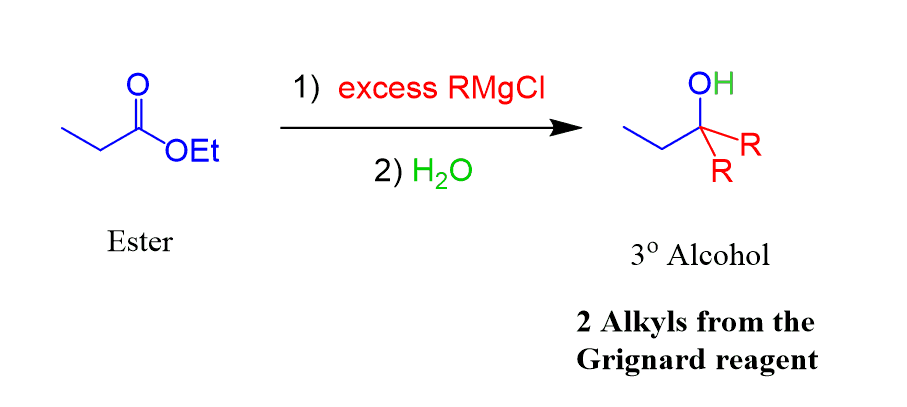
Reaction with Ester
Grignard reagent react with ester to form the compound tertiary alcohol.
Ques. What are the limitations of Grignard reaction mechanism? (3 marks)
Ans. The limitations of Grignard reaction mechanism are as follows:
- Grignard reagents cannot be prepared when acidic functional groups are used in halogen compound.
- The reagents are destroyed on reaction with acidic hydrogen atoms of alcohols, water, phenols groups.
- It cannot take place in acidic proton.
For Latest Updates on Upcoming Board Exams, Click Here: https://t.me/class_10_12_board_updates
Check-Out:



Comments