



Education Journalist | Study Abroad Lead
Phenol Preparation method involves reaction of benzene sulfonic acid with aqueous sodium hydroxide. The resultant salt is mixed with solid sodium hydroxide and reacts at a high temperature. Sodium phenoxide is the product of this reaction. It is acidified with aqueous acid to produce phenol.
| Table of Content |
Keyterms: Benzene, Sulfonic acid, Sodium Hydroxide, Nucleic Acid, Hydroxyl Group, Phenol, Aspirin, Carbolic Acid, Sodium phenoxide, Aqueous acid, Organic componds, Benzene ring, Weak Acid
What is Phenol?
[Click Here for Sample Questions]
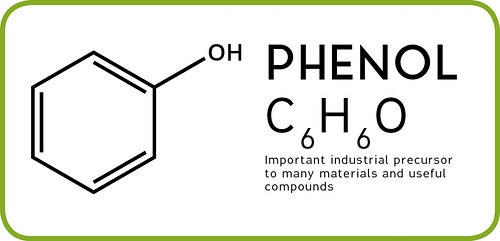
Phenols are organic compounds with a benzene ring and a hydroxyl group attached. Carbolic acids are another name for them. They are weak acids that form phenoxide ions when the hydroxyl group loses one positive hydrogen ion (H+).
People used to be able to make phenol from coal tar back in the day. It was a long and complicated process. It also had a lot of dangers attached to it. However, with technological advancements, new methods for the preparation of phenols in laboratories have emerged. Chemists primarily synthesise and derive phenol from benzene derivatives in laboratories.
Also Read:
Properties of Phenol
[Click Here for Sample Questions]
| Parameters | Description |
|---|---|
| Chemical formula | C6H6O |
| Molar Mass | 94.113 g·mol−1 |
| Appearance | Transparent crystalline solid |
| Odor | Sweet and tarry |
| Density | 1.07 g/cm3 |
| Melting Point | 40.5°C (104.9°F; 313.6 K) |
| Boiling Point | 181.7°C (359.1°F; 454.8 K) |
| Solubility in water | 8.3 g/100 mL (20°C) |
| log P | 1.48 |
| Vapour Pressure | 0.4 mmHg (20°C) |
| Acidity (pKa) | 9.95 (in water), 29.1 (in acetonitrile) |
| Conjugate base | Phenoxide |
| UV-vis (λmax) | 270.75 nm |
| Dipole moment | 1.224 D |
What is Phenol Preparation?
[Click Here for Sample Questions]
Phenol Preparation from Haloarenes
Chlorobenzene is an example of a haloarene that is formed when the benzene ring is monosubstituted. Sodium phenoxide is produced when chlorobenzene is fused with sodium hydroxide at 623K and 320 atm. Finally, when sodium phenoxide (C6H5NaO) is acidified, phenol is yielded.

Conversion of Haloarenes to Phenol
Phenol Preparation from Benzene Sulphonic Acid
By reacting benzene with oleum, benzenesulfonic acid is produced. To encourage the formation of sodium phenoxide, this benzene sulphonic acid can be treated with molten sodium hydroxide at high temperatures. Finally, when sodium phenoxide (C6H5NaO) is acidified, phenol is yielded.

Phenol Preparation from Benzene Sulphonic Acid
Phenol Preparation from Diazonium Salts
Diazonium salts are formed when an (NaNO2 + HCl) aromatic primary amine is treated with nitrous acid at 273–278 K. In nature, these diazonium salts are extremely reactive. These diazonium salts finally hydrolyze to phenols when heated with water. By treating diazonium salts with dilute acids, phenols can be obtained.

Phenol Preparation from Diazonium Salts
Phenol Preparation from Cumene
Cumene is an organic compound made by alkylating benzene with propylene using the Friedel-Crafts reaction. Cumene hydroperoxide is formed when cumene (isopropylbenzene) is oxidised in the presence of air. Cumene hydroperoxide is further treated with dilute acid to produce phenols. Acetone is also produced in large quantities as a by-product of this reaction. As a result, purifications are required for phenols produced using these methods.

Phenol Preparation from Cumene
Phenol Preparation from Dow Process
Chlorobenzene is reacted with dilute sodium hydroxide (NaOH) at about 3000 psi pressure and 300°C in this process.
General Uses of Phenol
[Click Here for Sample Questions]
- The transformation of phenol into plastic precursors is one of its most important uses, accounting for two-thirds of its production.
- Bisphenol- A, a key precursor to epoxide resins and polycarbonates, is produced by condensation with acetone.
- Bakelite is a well-known criterion of phenolic resins made by condensation of diphenols, phenol, or alkyl phenol with formaldehyde.
- When you partially hydrogenate phenol, you get cyclohexanone, which is a precursor to nylon. Alkylation of phenol produces alkylphenols, such as nonylphenol, which are then exposed to ethoxylation to produce nonionic detergents.
Medical Uses of Phenol
[Click Here for Sample Questions]
Phenol is also a beneficial antecedent to a wide range of medications, including aspirin, as well as a number of pharmaceuticals and herbicides.
Phenol is a component of the liquid/liquid phenol–chloroform abstraction technique for obtaining nucleic acids from tissues or cell culture samples in molecular biology. DNA or RNA can be mined depending on the pH of the solution.
Specific Uses of Phenol
[Click Here for Sample Questions]
Because phenol is so inexpensive, it attracts a lot of small-scale use. It's a component of industrial paint strippers for removing epoxy, polyurethane, and other chemically resistant coatings in the aviation industry.
Phenol byproducts have been used in the manufacture of cosmetics such as hair skin lightening preparations, sunscreens, dyes, and skin toners and exfoliators. Nonetheless, phenol is prohibited in cosmetics in the European Union and Canada due to safety concerns.
Things to Remember
- The -OH (hydroxyl) group replaces the hydrogen in an aromatic hydrocarbon.
- Monohydric, dihydric, and polyhydric, depending on the number of -OH groups present.
- Phenol (C6H5OH) is the most basic. It is the common name, and it is also recognised by the International Union of Scientific Organizations (IUPAC).
- The OH group's position is indicated by the letters o (ortho), m (meta), p (para), or by counting the cyclic carbons.
- The sp2 hybridised orbitals of C in the aromatic ring and O form a bond.
Also Read:
Sample Questions
Ques. Why is p-nitrophenol more acidic than p-methylphenol? (1 Mark)
Ans. The p-nitrophenoxide ion is more stable than the p-methyl phenoxide ions (+ 1 and +R effect of—CH3 group) due to the -I and -R effect of N03.
Ques. Give reason why, Bond length of the C—O bond in phenol is shorter than that in methanol. (1 Mark)
Ans. In phenol, it is due to sp2 hybridization (double bond due to resonance), whereas in methanol, it is due to single bond (sp3 hybridization).
Ques. Give reason why, (CH3)3C—Br on reaction with sodium methoxide (Na+ _OCH3) gives alkene as the main product and not an ether. (1 Mark)
Ans. When tertiary halide reacts with a strong nucleophile, it forms an alkene rather than an ether.
Ques. Anisole on reaction with HI gives phenol and CH3I as main products and not iodobenzene and CH3OH. Why? (1 Mark)
Ans. The protonated anisole, methyl phenyl oxonium ion, is formed first in this reaction, and then the halide ion attacks it. Due to the bulky phenyl group's steric hindrance, the attack preferentially occurs on the alkyl group, forming methyl iodide and phenol.
Ques. The boiling points of ethers are lower than their corresponding isomeric alcohols. Explain. (1 Mark)
Ans. Because ethers have a low polarity, they do not show any intermolecular hydrogen bonding. Their isomeric alcohols, on the other hand, have strong intermolecular hydrogen bonding and thus high boiling points.
Ques. Butan-1-ol has a higher boiling point than diethyl ether. Give a reason. (1 Mark)
Ans. Intermolecular hydrogen bonds exist between the molecules of butan-1-ol. As a result, it exists as a group of molecules, and breaking these bonds requires a lot of energy, so its boiling point is high. Diethyl ether, on the other hand, does not show any intermolecular hydrogen bonding. As an outcome, it has a low boiling point.
Ques. Give reason why, protonation of phenols Is difficult whereas ethanol easily undergoes protonation. (1 Mark)
Ans. Because the oxygen atom in phenols acquires a partial positive charge due to resonance, it is difficult to protonate. The alkyl group, on the other hand, is an electron-releasing group in ethanol, increasing the electron density on 0 atoms. As a result, protonation of ethanol is simple.
Ques. Make a list of phenols' physical properties. (2 Marks)
Ans. The physical properties of phenol are as follows:
- Phenols are needle-shaped solids that are usually colourless, toxic, and corrosive.
- Because of their high hygroscopicity, they can quickly liquefy.
- Phenol has a low water solubility but is very soluble in organic solvents.
- Because of hydrogen bonding, the boiling points of the simplest phenols are quite high.
- Because of intramolecular hydrogen bonding, o-nitrophenol is volatile and less soluble in water.
For Latest Updates on Upcoming Board Exams, Click Here: https://t.me/class_10_12_board_updates
Check-Out:



Comments