



Education Journalist | Study Abroad Lead
Helical Motion is the motion generated when one component of the velocity is constant in amplitude and direction which is straight-line motion and the other component is constant in speed but changes in direction evenly (circulation motion). Hence, it is the result of the combination of circular motion and straight-line motion.
| Table of Content |
Key Terms: Motion, Magnetic Fields, Helical motion of charged particles, Helical motion, Velocity, Straight-line motion, Amplitude, Speed, Circulation motion, Lorentz force, Magnetic fields, Centripetal force, Magnetic force
What is Helical Motion?
[Click Here for Sample Questions]
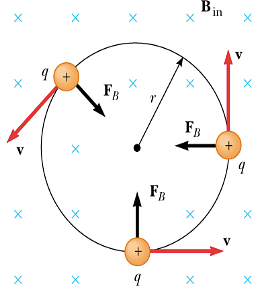
The Helical motion occurs when the velocity vector is not perpendicular to the magnetic field vector. When a charged particle travels perpendicular to a uniform B-field, the simplest situation occurs. In the vacuum, the magnetic fields are the most vital element influencing the motion. The Lorentz force provides the centripetal force in this case, as
Fc = mv2/ r
Since here sin θ = 1
The magnetic force:
F = qvB
Now, if the magnetic force provides the centripetal force, these forces must be equal as:
qvB = mv2 / r
Discover about the Chapter video:
Current Electricity Detailed Video Explanation:
Read More:
Why do charged particles move in a Helical Path?
[Click Here for Previous Year Questions]
As soon as a charged particle enters a magnetic field (B) with some angle (θ), The velocity decomposes into parallel and vertical components B which are
v။ = v cosθ and v⊥ = v sinθ .
- A Uniform magnetic field does not apply any force on the electron in the parallel direction as = 0 so F= ‖ qv‖ B sin 0 = 0.
- Hence, the charged particle continues to move along the field direction with a motion in which speed and velocity are constant (Uniform Motion).
Helical Path
The above two motions are parallel to field B and uniform circular motion creates the actual path of charged particles in a uniform magnetic field B which is called a helical or a Spiral path.

Helical Path of Particles
Read More:
| Related Links | ||
|---|---|---|
| Cyclotron | Magnetic Moment | Magnetic Dipole Moment |
| Derivation of Biot Savart Law | Velocity Selector | Angular Momentum of Electron |
Characteristics of Helical Path
[Click Here for Sample Questions]
The helical path has three different characteristics-
- Radius
- Time period
- Pitch
1. Radius
Force F丄 creates a circular motion that provides a centripetal force on the charged particle with acceleration ar = mv2⊥/R. By applying Newton’s second law of motion and balancing the centripetal force we get a formula for the radius of the helical path. Where m is the charged particle.
F = mar
qv⊥ B = m\(\frac{v^2}{R}\)
R = mv⊥/qB
= \(\frac{mv sin \theta}{qB}\)
2. Time Period
The time needed to complete one revolution is obtained by average velocity as
v = \(\frac{\Delta x}{\Delta t}\)
v 丄 = \(\frac{2 \pi R}{T}\)
T = 2πR / V⊥
=\(\frac{2 \pi R}{qB}m\)
We used the formula for R and v⊥ = v sin. This period is also called the cyclotron period.
3. Pitch of the Helix
Distance Traveled parallel to the Magnetic field in one resolution is called the pitch of the helix and is obtained as
p = v ‖T
= (v cos θ) (\(\frac{2 \pi m}{qB}\)}
Hence, the formula for the pitch of the helix is p = \(\frac{2 \pi mv cos \theta}{qB}\) .
Do Check Out:
Things to Remember
- A helical Path is formed when charged particles enter with an angle of = 90° in a uniform magnetic field. A circular motion is created.
- When the particle's velocity has parallel components to the uniform magnetic field then it moves in a helical path.
- When the particles move parallel, there is no force on the particle but in the perpendicular, there is a centripetal acceleration towards the center.
Sample Questions
Ques. Can a magnetic field accelerate a charged particle? Is it possible to enhance its speed? (3 marks)
Ans. The magnetic field accelerates the charged particle by way of altering its pace direction. The charged particle’s pace is unaffected with the aid of the magnetic discipline. The magnetic area has no impact on pace because it exerts a force perpendicular to the movement. As a result, The pressure can not accomplish paintings on the particle. As a result, the particle’s kinetic electricity cannot be changed. Therefore, it's miles unable to alter the rate.
Ques. An electron with a mass of 9.11 x 10⁻³¹ Kg and a charge of 1.6 x 10⁻¹⁹ C, is projected into a uniform magnetic field of 0.2T at a speed of 1.8 x 10⁶ m/s in such a way that its velocity makes an angle of 37 degrees with the field lines. Find the pitch, period, and radius of the helical path of the electron. (5 marks)
Ans. The time period of Helix is-
T= \(\frac{2 \pi M}{eB}\)
=\(\frac{2(3.14)(9.11 * 10^{-31})}{(1.6 * 10^{-19}( 0.2)}\)
= 1.78 x 10⁻¹⁰ s
= 0.17 ns
The Pitch of the helical path is determined as-
p= \(\frac{2 \pi mv cos \theta}{eB}\)
= \(\frac{2(3.14) (9.11 * 10^{-31}) (1.8 * 10^6)cos 37 }{(1.6 * 10^{-19}) (0.2)}\)
= 0.257 mm
The radius of the helical path is determined as-
R= \(\frac{mv sin \theta}{eB}\)
= \(\frac{(9.11 * 10^{-31})(1.8 * 10^6) sin 37}{(1.6 * 10^{-19}) (0.2)}\)
= 0.193 mm
Ques. When a proton travels in a uniform magnetic field, its velocity changes but its kinetic energy does not. Why? (3 marks)
Ans. The magnetic force will be perpendicular to the direction of the proton’s tour. We know that after the force appearing is perpendicular to the course of the moving fee, the work carried out is zero. It suggests that kinetic strength remains constant. The pressure can alter the direction (velocity) of a proton but no longer its speed (importance). As a result, momentum and pace shift.
Ques. What is Lorentz Force? Explain. (3 marks)
Ans. Lorentz force, the pressure exerted on a charged particle q visiting with velocity v via an electric and magnetic area E and B. The Lorentz pressure named after the Dutch scientist Hendrik A. Lorentz is the total electromagnetic pressure F at the charged particle, and it's miles given via,
F = qE + qv × B
The electric area contributes to the primary time period. The magnetic force, which has a course perpendicular to each the velocity and the magnetic field, is the second time period.
- Magnetic pressure is proportional to q in addition to the size of the vector move product v × B.
- The amount of the pressure equals qvB sin in phrases of the attitude between v and B.
- The pace of a charged particle in a uniform magnetic field is an exciting consequence of the Lorentz force.
- If v is perpendicular to B (i.E., there's a ninety° attitude among v and B), the particle will follow a circular trajectory with radius r = mv/qB.
- The particle orbit might be a helix with an axis parallel to the field strains if the attitude is less than 90°.
- If ϕ is zero, there may be no magnetic pressure appearing at the particle, so that you can continue to tour along the sphere traces undeflected.
- Particle accelerators the use of charged particles, which include cyclotrons, take advantage of the truth that particles circulate in a circular orbit while v and B are at proper angles.
Ques. What is the motion of charged particles? (2 marks)
Ans. The Motion of Charged Particles in a Magnetic and Electric Field. The magnetic force becomes centripetal force because of its direction towards the circular motion of the particle. If the field and velocity are perpendicular to each other, the particle takes a circular path.
Formula - F = q(v x B).
Ques. Why do particles move in a helical path? (2 marks)
Ans. The velocity component is perpendicular to the magnetic field which creates a circular motion, Whereas when the component of the velocity is parallel to the field it moves the particle along a straight line. The pitch is the horizontal distance between the two consecutive circles. Hence, The resulting motion is Helical.
For Latest Updates on Upcoming Board Exams, Click Here: https://t.me/class_10_12_board_updates
Check Out:



Comments