



Education Journalist | Study Abroad Lead
Difference Between Earth and Neutral is that Earth is the surging point of appliances while Neutral is the return path of the electrical current supply. Earth and Neutral play a crucial role in concepts of Electric Current and its connections. Earth and Neutral are both electrical connections in a circuit and they have the same potential, that is the voltage or potential difference of both Earth and Neutral equals zero. Earth is a low resistance path mainly used to provide safety and protect appliances and individuals offering it from residual current leakage. Neutral provides a return path for Alternate Current (AC) carrying circuits and helps in load balancing. Neutral and phase are connected to the main power wiring, however, the ground or the earth is connected to the body of the equipment.
| Table of Content |
Key Terms: Earth, Neutral, Alternate Current, Residual Current, Transformers, Electric Current, Voltage, Circuits, Current flow
What is the Earth?
[Click Here for Sample Questions]
Earth or ground is the surging point of all appliances and provides a low resistance path. It is the safety connection from an electric shock. It has no direct connection to the main power wiring.
- Earth is always connected to machine body parts of appliances in order to provide safe and low resistance paths for it. Hence, the current flow on earth is zero.
- A case of exception for this zero current flow is during the times of disconnections from the main supply or at times of insulation failure when the earth is charged and carries minor current.
- This type of wiring connection helps to protect devices or appliances and the individual operating them from electric shocks or any such damage caused by the residual current leakage.
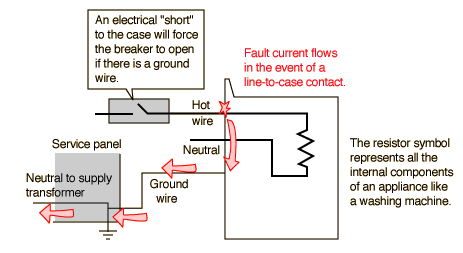
When a bare conductor inside the equipment touches the metal body, there’s a risk of electric shock. The earth conductor provides a low resistance path so that the leakage currents are discharged.
Discover about the Chapter video:
Current Electricity Detailed Video Explanation:
Read More: Difference between Earth and Neutral MCQ
What is Neutral?
[Click Here for Previous Year Questions]
Neutral is a zero-voltage reference point and provides the return path for Alternate Current (AC) carrying circuits and helps in load balancing. Neutral is always connected to main power wiring and is not linked to machine body parts of appliances.
- Neutral completes an AC circuit and provides a return path or conductor back to the electricity source associated (eg: transformers).
- It has a current flow through it and is mainly due to phase current imbalance or at times may be due to third and fifth harmonics.
- The amount of charge or magnitude of current carried by the neutral differs, it may be a fraction of phase current or it can be double of phase current magnitude at times.
- It carries the return current to the source of electricity like a transformer.
- The voltage between the neutral and the earth should be zero.
Difference Between Earth and Neutral
Read More:
Difference Between Earth and Neutral
[Click Here for Sample Questions]
The major difference between earth and neutral are as given below:
| Earth | Neutral |
|---|---|
| Earth is the path with low resistance. It protects and provides safety to the appliances from residual current leakage. | Neutral helps in load balancing in alternate current (AC) carrying circuits since it provides a return path. |
| It usually has no current flow. Exceptions are cases of insulation failure or disconnections when the earth carries minor current. | It is always charged and has current flowing through it in normal conditions. |
| Earth serves as the surging point of electrical appliances. It is always connected directly to the body of the appliance. | Neutral serves as a zero-voltage reference point and provides the return path. It is always connected to the main power wiring. |
| Its supply can be executed separately or connected through a neutral line. | It is connected through a neutral line. |
| Earth cannot be converted into neutral wire. | Neutral can be converted into earth wire. |
Read More:
Things to Remember
- Earth is the surging point of all appliances and provides a low resistance path while the neutral is a zero-voltage reference point and provides the return path.
- Earth helps protect devices or appliances and the individual operating the devices/appliances from electric shocks or any such damage caused by the residual current leakage.
- The neutral completes an AC circuit and provides a return path or conductor back to the electricity source associated (eg: transformers) and helps in load balancing.
- Earth can not be converted to neutral while a neutral can be converted to earth.
- Neutral carries electric current while the earth has zero current flow through it except at disconnections or insulation failures.
- A neutral wire is connected directly to the main power wiring and not to the appliance. It is connected through a neutral line.
Read More: Difference between Earth and Neutral Important Questions
Previous Year Questions
- The electrical permittivity and magnetic permeability of free space are….[DUET 2003]
- Charge passing through a conductor of cross-section area...[VITEEE 2012]
- A square loop, carrying a steady current II, is placed in horizontal plane near a long straight conductor carrying...[VITEEE 2012]
- A potentiometer circuit is set up as shown. The potential gradient, across the potentiometer wire is….[NEET 2010]
- Kirchhoff's junction law or Kirchhoff's first law is based on….[NEET 2010]
Sample Questions
Ques. State the difference between earth and neutral wires in terms of the parameter conversion. (2 marks)
Ans. Earth is non-convertible to neutral, that is earth cannot be converted into neutral wire while in the case of neutral, a neutral is convertible to earth, that is it can be converted to the earth wire. The conversion of earth wire to neutral is impossible since the earth wire has no current flow while the neutral wire has current flow through it. Also, the earth is used for safety purposes and is not suitable to provide a return path for the current supplied.
Ques. How is an earth wire connected? (2 marks)
Ans. An earth wire is connected to the body of the appliance directly. Its supply can be executed separately or connected through a neutral line. The connections of an earth wire are never similar to the neutral wire connections. The earth wire is never directly connected to the main supply wiring system.
Ques. How is a neutral wire connected? (2 marks)
Ans. A neutral wire is connected directly to the main power wiring. It is connected through a neutral line. Also, the neutral wire is never connected to the appliance directly. A neutral wire is never considered as the surging point for appliances. It only provides a return path for the alternating current circuits.
Ques. Mention any two uses of earth. (2 marks)
Ans. 1) Earth is the surging point of all appliances and provides a low resistance path. The resistance inside earth wire is very low or is the least as it is directly connected to the appliances and has a protective property.
2) It helps protect devices or appliances and the individual operating the devices/appliances from electric shocks or any such damage caused by the residual current leakage. When the potential is zero, there are chances of current leakage which may cause substantial damage or danger to the appliance and the individual operating it. The presence of earth wire connected to appliances reduces the risk of such damages.
Ques. What is the use of a neutral? (2 marks)
Ans. Neutral provides the return path for alternate current (AC) carrying circuits and helps in load balancing. The return path provided by the neutral brings back the electric circuits introduced back to the main power supply after the complete utilization of electricity. This beneficial advantage of neutral wire helps in load balancing. The unbalanced load is balanced and then brought back through the return path.
Ques. State two similarities between earth and neutral. (2 marks)
Ans. The earth and neutral are both electrical connections in a circuit. Even though they have major differences in functions and structure, they both have considerable importance in an electric supply system. In the alternating current (AC) circuits, the earth and neutral both have the same potential, that is, the voltage or potential difference of both earth and neutral equals zero.
Ques. Mention any three differences between earth and neutral. (2 marks)
Ans. 1) Earth serves as a surging point of electrical appliances while neutral serves as a zero-voltage reference. A potentiometer circuit is set up as shown. The potential gradient, across the potentiometer wire, hence point and provides the return path.
2) Earth usually has no current flow except during cases of insulation failure or disconnections when the earth carries minor current while a neutral is always charged and has current flowing through it in normal conditions.
3) Earth is the path with low resistance and protects and provides safety to the appliances from residual current leakage while the neutral provides a return path to the alternate current (AC) carrying circuits and helps in load balancing.
Ques. How is the neutral power connected to the earth? (4 Marks)
Ans. Another name for neutral earthing is system earthing. In the neutral earthing system, the neutral of the system is connected to the ground
The advantages of neutral earthing are:
- It can make a closed path
- Elimination of arcing ground
The neutral of the power system may be connected to the earth directly or through a resistor or reactor.
Solid grounding: In this type of neutral grounding, the neutral of the system is directly connected to the ground through a conductor of negligible resistance and reactance.
Resistance grounding: In this type of neutral grounding, the neutral of the system is connected to the ground through one or more resistance. Resistance grounding limits the fault currents. It protects the system from transient overvoltages
Reactance grounding: In this method, a reactance is inserted between the neutral and ground to limit the fault current. This method has high transient voltages appear under fault conditions
Ques. The standard wire gauge used for earthing lead should not be thinner than 8 SWG wire. Explain. (3 Marks)
Ans. Here's the explanation:
- Earthing wire is used in the electric circuit to prevent damage to equipment or personnel handling it. The minimum size of earthing wire is dependent on the current through it.
- The area of cross-section of the earthing lead should not be less than half of the area of cross-section of the thickest wire used in the installation.
- The size of these conductors depends on the size of the cable used for the wiring circuit.
- The cross-sectional area of the earth wire must be less than half of the cross-sectional area of the thickest wire used in the electrical wiring installation.
- Generally, the size of the copper wire used as an earth continuity conductor is 3 SWG. Earth wires smaller than 14 SWG must not be used.
- The minimum size of the earth lead should not be smaller than 8 SWG.
Ques. Explain the advantages of grounding the substation. (5 Marks)
Ans. Grounding of the substation is important because:
The need for earthing:
Power plants and substations are highly vulnerable to hazards of lightning strikes, electrical and mechanical equipment malfunctioning, and human errors in which surge current of the order of kilo amperes is impressed on the plant or are generated from within.
Earthing: It is to provide a sufficiently low impedance path and means to carry and dissipate electric currents into the ground under normal and fault conditions without exceeding any operating and equipment limits or adversely affecting continuity of service. It provides a ground connection for the system neutral.
Advantages of earthing:
Adequate earthing of electrical substations is of significant importance to increase the reliability of the supply service as it helps
- to provide stability of voltage conditions
- preventing excessive voltage peaks during disturbances
- providing protection against lightning
- provides a discharge path for surge arresters
Other than that, an earthed system can assure such a degree of human safety that a person working or walking in the vicinity of grounded facilities is not exposed to the danger of a critical electric shock.
Ques. While measuring the insulation resistance of complete wiring installation to earth using Megger, the resistance measured must not be less than (50 MΩ)/(no. of outlets (Point + switches)). Explain why. (3 Marks)
Ans. As per BIS, the minimum value of insulation resistance (Ri) expressed as-
Insulation resistance \({R_i} = \frac{{50\;M{\rm{\Omega }}}}{{No.of\;points + outlets}}\)
In the counting of points, one switch plus one holder is counted as one point, whereas a socket is counted as half point.
Ques. Why is the main’s neutral wire tied to the earth wire? (3 Marks)
Ans. Reasons for grounding the neutral are as follows:
- Grounding the neutral wire is providing the common reference for all things plugged into the power system.
- Without the ground wire, static electricity will build up to the point and hence may cause significant loss in transmitted power, overheating, fires, etc.
- It gives a return path to neutral, as a short path to the grounded chassis of an appliance will cause a predictable outcome in terms of a fuse.
Ques. In an earthed neutral system, the magnitude of transient voltage is very small. Explain why. (4 Marks)
Ans. In an earthed neutral system, the neutral is earthed either directly or through resistance or reactance depending on the requirement.
The advantages of neutral earthing are:
- The arcing grounds are prevented from occurring by employing suitable switchgear
- As the neutral point is not shifted in this system, thus the voltages of healthy phases remain nearly constant
- The faulty part of the system can be isolated from the remaining system with the help of earth fault relays
- The magnitude of transient voltage is very small
- This system is more reliable, and provides safety to personnel and equipment with reduced operational and maintenance costs than an ungrounded system
For Latest Updates on Upcoming Board Exams, Click Here: https://t.me/class_10_12_board_updates
Check-Out:



Comments